Proceedings of the 2011 Conference on Empirical Methods in Natural Language Processing, pages 1023–1033,
Hierarchical Verb Clustering Using Graph Factorization
Lin Sun and Anna Korhonen
University of Cambridge, Computer Laboratory 15 JJ Thomson Avenue, Cambridge CB3 0GD, UK
ls418,[email protected]
Abstract
Most previous research on verb clustering has focussed on acquiring flat classifications from corpus data, although many manually built classifications are taxonomic in nature. Also Natural Language Processing (NLP) applica-tions benefit from taxonomic classificaapplica-tions because they vary in terms of the granularity they require from a classification. We intro-duce a new clustering method called Hierar-chical Graph Factorization Clustering (HGFC) and extend it so that it is optimal for the task. Our results show that HGFC outperforms the frequently used agglomerative clustering on a hierarchical test set extracted from VerbNet, and that it yields state-of-the-art performance also on a flat test set. We demonstrate how the method can be used to acquire novel classifi-cations as well as to extend existing ones on the basis of some prior knowledge about the classification.
1 Introduction
A variety of verb classifications have been built to support NLP tasks. These include syntactic and se-mantic classifications, as well as ones which in-tegrate aspects of both (Grishman et al., 1994; Miller, 1995; Baker et al., 1998; Palmer et al., 2005; Kipper, 2005; Hovy et al., 2006). Classifications which integrate a wide range of linguistic proper-ties can be particularly useful for tasks suffering from data sparseness. One such classification is the taxonomy of English verbs proposed by Levin (1993) which is based on shared (morpho-)syntactic
and semantic properties of verbs. Levin’s taxon-omy or its extended version in VerbNet (Kipper, 2005) has proved helpful for various NLP applica-tion tasks, including e.g. parsing, word sense disam-biguation, semantic role labeling, information ex-traction, question-answering, and machine transla-tion (Swier and Stevenson, 2004; Dang, 2004; Shi and Mihalcea, 2005; Zapirain et al., 2008).
Because verbs change their meaning and be-haviour across domains, it is important to be able to tune existing classifications as well to build novel ones in a cost-effective manner, when required. In recent years, a variety of approaches have been pro-posed for automatic induction of Levin style classes from corpus data which could be used for this pur-pose (Schulte im Walde, 2006; Joanis et al., 2008; Sun et al., 2008; Li and Brew, 2008; Korhonen et al., 2008; ´O S´eaghdha and Copestake, 2008; Vla-chos et al., 2009). The best of such approaches have yielded promising results. However, they have mostly focussed on acquiring and evaluating flat classifications. Levin’s classification is not flat, but taxonomic in nature, which is practical forNLP pur-poses since applications differ in terms of the gran-ularity they require from a classification.
tering (Ushioda, 1996; Matsuo et al., 2006; Bassiou and Kotropoulos, 2011).
We introduce then a new method called Hierar-chical Graph Factorization Clustering (HGFC) (Yu et al., 2006). This graph-based, probabilistic cluster-ing algorithm has some clear advantages overAGG (e.g. it delays the decision on a verb’s cluster mem-bership at any level until a full graph is available, minimising the problem of error propagation) and it has been shown to perform better than several other hierarchical clustering methods in recent compar-isons (Yu et al., 2006). The method has been applied to the identification of social network communities (Lin et al., 2008), but has not been used (to the best of our knowledge) inNLPbefore.
We modify HGFC with a new tree extraction al-gorithm which ensures a more consistent result, and we propose two novel extensions to it. The first is a method for automatically determining the tree struc-ture (i.e. number of clusters to be produced for each level of the hierarchy). This avoids the need to pre-determine the number of clusters manually. The sec-ond is addition of soft constraints to guide the clus-tering performance (Vlachos et al., 2009). This is useful for situations where a partial (e.g. a flat) verb classification is available and the goal is to extend it. Adopting a set of lexical and syntactic features which have performed well in previous works, we compare the performance of the two methods on test sets extracted from Levin and VerbNet. When eval-uated on a flat clustering task, HGFC outperforms AGG and performs very similarly with the best flat clustering method reported on the same test set (Sun and Korhonen, 2009). When evaluated on a hierar-chical task,HGFCperforms considerably better than AGGat all levels of gold standard classification. The constrained version of HGFC performs the best, as expected, demonstrating the usefulness of soft con-straints for extending partial classifications.
Our qualitative analysis shows that HGFC is ca-pable of detecting novel information not included in our gold standards. The unconstrained version can be used to acquire novel classifications from scratch while the constrained version can be used to extend existing ones with additional class members, classes and levels of hierarchy.
2 Target classification and test sets
The taxonomy of Levin (1993) groups English verbs (e.g. break, fracture, rip) into classes (e.g. 45.1 Break verbs) on the basis of their shared mean-ing components and (morpho-)syntactic behaviour, defined in terms of diathesis alternations (e.g. the causative/inchoative alternation, where anNPframe alternates with an intransitive frame:Tony broke the window ↔ The window broke). It classifies over
3000 verbs in 57 top level classes, some of which divide further into subclasses. The extended version of the taxonomy in VerbNet (Kipper, 2005) classifies 5757 verbs. Its 5 level taxonomy includes 101 top level and 369 subclasses. We used three gold stan-dards (and corresponding test sets) extracted from these resources in our experiments:
T1: The first gold standard is a flat gold standard which includes 13 classes appearing in Levin’s orig-inal taxonomy (Stevenson and Joanis, 2003). We in-cluded this small gold standard in our experiments so that we could compare the flat version of our method against previously published methods. Fol-lowing Stevenson and Joanis (2003), we selected 20 verbs from each class which occur at least 100 times in our corpus. This gave us 260 verbs in total.
T2: The second gold standard is a large, hi-erarchical gold standard which we extracted from VerbNet as follows: 1) We removed all the verbs that have less than 1000 occurrences in our cor-pus. 2) In order to minimise the problem of pol-ysemy, we assigned each verb to the class which, according to VerbNet, corresponds to its predomi-nant sense in WordNet (Miller, 1995). 3) In order to minimise the sparse data problem with very fine-grained classes, we converted the resulting classifi-cation into a 3-level representation so that the classes at the 4th and 5th level were combined. For exam-ple, the sub-classes ofDeclare verbs (numbered as 29.4.1.1.{1,2,3}) were combined into 29.4.1. 4) The classes that have fewer than 5 members were dis-carded. The total number of verb senses in the re-sulting gold standard is 1750, which is 33.2% of the verbs in VerbNet. T2 has 51 top level, 117 second level, and 133 third level classes.
standard was constructed to enable proper evalua-tion of the constrained version ofHGFC(introduced in the following section) where we want to com-pare the impact of constraints across several levels of classification. T3 provides classification of 357 verbs into 11 top level, 14 second level, and 32 third level classes.
For each verb appearing in T1-T3, we extracted all the occurrences (up to 10,000) from the British National Corpus (Leech, 1992) and North American News Text Corpus (Graff, 1995).
3 Method
3.1 Features and feature extraction
Previous works on Levin style verb classification have investigated optimal features for this task (Stevenson and Joanis, 2003; Li and Brew, 2008; Sun and Korhonen, 2009)). We adopt for our exper-iments a set of features which have performed well in recent verb clustering works:
A: Subcategorization frames (SCFs) and their rela-tive frequencies with individual verbs.
B: A withSCFs parameterized for prepositions.
C: B withSCFs parameterized for subjects appear-ing in grammatical relations associated with the verb in parsed data.
D: B with SCFs parameterized for objects appear-ing in grammatical relations associated with the verb in parsed data.
These features are purely syntactic. Although semantic features – verb selectional preferences – proved the best (when used in combination with syn-tactic features) in the recent work of Sun and Ko-rhonen (2009), we left such features for future work because we noticed that different levels of classifi-cation are likely to require semantic features at dif-ferent granularities.
We extracted the syntactic features using the sys-tem of Preiss et al. (2007). The syssys-tem tags, lemma-tizes and parses corpus data using theRASP(Robust Accurate Statistical Parsing toolkit (Briscoe et al., 2006)), and on the basis of the resulting grammat-ical relations, assigns each occurrence of a verb as a member of one of the 168 verbal SCFs. We pa-rameterized the SCFs as described above using the information provided by the system.
3.2 Clustering
We introduce the agglomerative clustering (AGG) and Hierarchical Graph Factorization Clustering (HGFC) methods in the following two subsec-tions, respectively. The subsequent two subsections present our extensions to HGFC: (i) automatically determining the cluster structure and (ii) adding soft constraints to guide clustering performance.
3.2.1 Agglomerative clustering
AGG is a method which treats each verb as a singleton cluster and then successively merges two closest clusters until all the clusters have been merged into one. We used the SciPy’s imple-mentation (Oliphant, 2007) of the algorithm. The cluster distance is measured using linkage criteria. We experimented with four commonly used link-age criteria: Single, Averlink-age, Complete and Ward’s (Ward Jr., 1963). Ward’s criterion performed the best and was used in all the experiments in this pa-per. It measures the increase in variance after two clusters are merged. The output of AGG tends to have excessive number of levels. Cut-based meth-ods (Wu and Leahy, 1993; Shi and Malik, 2000) are frequently applied to extract a simplified view. We followed previous verb clustering works and cut the AGGhierarchy manually.
AGG suffers from two problems. The first is er-ror propagation. When a verb is misclassified at a lower level, the error propagates to all the upper lev-els. The second is local pairwise merging, i.e. the fact that only two clusters can be combined at any level. For example, in order to group clusters rep-resenting Levin classes 9.1, 9.2 and 9.3 into a sin-gle cluster representing class 9, the method has to produce intermediate clusters, e.g. 9.{1,2} and 9.3.
3.2.2 Hierarchical Graph Factorization Clustering
Our new methodHGFCderives a probabilistic bi-partite graph from the similarity matrix (Yu et al., 2006). The local and global clustering structures are learned via the random walk properties of the graph. The method does not suffer from the above prob-lems withAGG. Firstly, there is no error propagation because the decision on a verb’s membership at any level is delayed until the full bipartite graph is avail-able and until a tree structure can be extracted from it by aggregating probabilistic information from all the levels. Secondly, the bipartite graph enables the construction of a hierarchical structure without any intermediate classes. For example, we can group classes 9.{1,2,3}directly into class 9.
We use HGFC with the distributional similarity measure Jensen-Shannon Divergence (djs(v, v0)).
Given a set of verbs, V = {vn}Nn=1, we
compute a similarity matrix W where Wij =
exp(−djs(v1, v2)). W can be encoded by a
undi-rected graph G (Figure 1(a)), where the verbs are
mapped to vertices and the Wij is the edge weight
between verticesiandj.
The graphGand the cluster structure can be
rep-resented by a bipartite graph K(V, U). V are the
vertices onG.U ={up}mp=1represent the hiddenm
clusters. For example, looking at Figure 1(b),V on Gcan be grouped into three clustersu1,u2andu3.
The matrixB denotes then×madjacency matrix,
with bip being the connection weight between the
vertexviand the clusterup. Thus,Brepresents the
connections between clusters at an upper and lower level of clustering. A flat clustering algorithm can be induced by computingB.
The bipartite graph K also induces a similarity
(W0) between vi and vj: w0ij =
Pm
p=1
bipbjp λp = (BΛ−1BT)ij whereΛ = diag(λ1, ..., λm).
There-fore,Bcan be found by approximating the similarity matrixW ofGusingW0 derived fromK. Given a
distance functionζbetween two similarity matrices, BapproximatesW by minimizing the cost function ζ(W, BΛ−1BT). The coupling betweenB andΛis removed by settingH =BΛ−1:
min
H,Λζ(W, HΛH
T), s.t. n
X
i=1
hip= 1 (1)
We use the divergence distance: ζ(X, Y) =
P
ij(xijlog xij
yij−xij+yij). Yu et al. (2006) showed
that this cost function is non-increasing under the update rule:
˜
hip∝hip
X
j
wij
(HΛHT) ij
λphjps.t.
X
i
˜
hip = 1 (2)
˜
λp∝λp
X
j
wij
(HΛHT) ij
hiphjps.t.
X
p
˜
λp=
X
ij
wij (3)
wij can be interpreted as the probability of the
di-rect transition betweenvi andvj: wij = p(vi, vj),
whenPijwij = 1.bipcan be interpreted as:
p(up, uq) = p(up)p(up|uq) = n
X
i=1
bipbiq
di
= (BTD−1B)pq (4)
D = diag(d1, ..., dn)wheredi= m
X
p=0
bip
p(up, uq)is the similarity between the clusters. It
takes into account of a weighted average of contri-butions from all the data. This is different from the linkage method where only the data from two clus-ters are considered.
Given the cluster similarityp(up, uq), we can
con-struct a new graphG1(Figure 1(d)) with the clusters
U as vertices. The cluster algorithm can be applied
again (Figure 1(e)). This process can go on itera-tively, leading to a hierarchical graph.
Algorithm 1HGFC algorithm (Yu et al., 2006)
Require: N verbsV, number of clustersmlforLlevels
Compute the similarity matrixW0fromV
Build the graphG0fromW0, andm0←n forl= 1,2toLdo
FactorizeGl−1to obtain bipartite graphKlwith the
adjacency matrixBl(eq. 1, 2 and 3)
Build a graph Gl with similarity matrix Wl =
BT l D−
1
l Blaccording to equation 4
end for
return BL, BL−1...B1
Additional steps need to be performed in order to extract a tree from the hierarchical graph. Yu et al. (2006) performs the extraction via a propagation of probabilities from the bottom level clusters. For a verbvi, the probability of assigning it to clusterv(pl)
v1
v6 v2
v4 v3
v5 v7
v8 v9
(a)
v1
v7 v6
v9 v8 v2 v3 v4 v5
u1
u2
u3
(b)
u3 u1
u2 v1
v6
v2
v4
v3
v5 v7
v8 v9
(c)
u1 u2
u3
(d)
v1
v7 v6
v9 v8 v2 v3 v4 v5
u1
u2
u3 q1
q2
(e)
Figure 1: (a) An undirected graphGrepresenting the similarity matrix; (b) The bipartite graph showing three clusters onG; (c) The induced clustersU; (d) The new graphG1over clustersU; (e) The new bipartite graph overG1
p(v(l)
p |vi) =
X
Vl−1
...X
V1
p(v(l)
p |v(l−1))...p(v(1)|vi)
= (D(−1)1 B1D2−1B2D3−1B3...Dl−1Bl)ip (5)
This method might not extract a consistent tree structure, because the cluster membership at the lower level does not constrain the upper level mem-bership. This prevented us from extracting a Levin style hierarchical classification in our initial experi-ments. For example, where two verbs were grouped together at a lower level, they could belong to sepa-rate clusters at an upper level. We therefore propose a new tree extraction algorithm (Algorithm 2).
The new algorithm starts from the top level bipar-tite graph, and generates consistent labels for each level by taking into account of the tree constraints set at upper levels.
Algorithm 2Tree extraction algorithm forHGFC
Require: GivenN, (Bl, m
l) on each level forLlevels
On the top levelL, collect the labelsTL(eq. 5)
DefineCto be a(mL−1×mL)zero matrix,Cij ←1,
wherei, j= arg maxi,j{BijL}
forl=L−1to 1 do
fori= 1toN do Computep(vl
p|vi)for each clusterp(eq. 5)
tl
i=argmaxp{p(vpl|vi)|p= 1...ml, Cptl+1
i 6= 0}
end for
RedefineCto be a(ml−1×ml)zero matrix,Cij←
1, wherei, j= arg maxi,j{Bijl }
end for
return Tree consistent labelsTL, TL−1...T1
3.2.3 Automatically determining the number of clusters for HGFC
HGFC needs the number of levels and clusters at each level as input. However, this information is not always available (e.g. when the goal is to actually learn this information automatically). We therefore propose a method for inferring the cluster structure from data. As shown in figure 1, a similarity ma-trix W models one-hop transitions that follow the
links from vertices to neighbors. A walker can also go to other vertices via multi-hop transitions. Ac-cording to the chain rule of the Markov process, the multi-hop transitions indicate a decaying similarity function on the graph (Yu et al., 2006). Aftert
tran-sitions, the similarity matrix (Wt) becomes:
Wt=Wt−1D0−1W0
Yu et al. (2006) proved the correspondence be-tween theHGFClevels (l) and the random walk time: t = 2l−1. So the vertices at levell induce a
sim-ilarity matrix of verbs after t-hop transitions. The
decaying similarity function captures the different scales of clustering structure in the data (Azran and Ghahramani, 2006b). The upper levels would have a smaller number of clusters which represent a more global structure. After several levels, all the verbs are expected to be grouped into one cluster. The number of levels and clusters at each level can thus be learned automatically.
[image:5.612.86.525.72.224.2](ml) to be ml−1 −1. mis denoted as the number
of clusters that have at least one member according to eq. 5. We start by treating each verb as a cluster at the bottom level. The algorithm stops when all the data points are merged into one cluster. The in-creasingly decaying similarity causes many clusters to have 0 members especially at lower levels, which are pruned in the tree extraction.
3.2.4 Adding constraints to HGFC
The basic version of HGFC makes no prior as-sumptions about the classification. It is useful for learning novel verb classifications from scratch. However, when wishing to extend an existing clas-sification (e.g. VerbNet) it may be desirable to guide the clustering performance on the basis of informa-tion that is already known. We propose a constrained version ofHGFC which makes uses of labels at the bottom level to learn upper level classifications. We do this by adding soft constraints to clustering, fol-lowing Vlachos et al. (2009).
We modify the similarity matrixW as follows: If
two verbs have different labels (li 6= lj), the
simi-larity between them is decreased by a factora, and a < 1. We setato 0.5 in the experiments. The
re-sulting tree is generally consistent with the original classification. The influence of the underlying data (domain or features) is reduced according toa.
4 Experimental evaluation
We applied the clustering methods introduced in section 3 to the test sets described in section 2 and evaluated them both quantitatively and qualitatively, as described in the subsequent sections.
4.1 Evaluation methods
We used class based accuracy (ACC) and adjusted rand index (Radj) to evaluate the results on the flat
test set T1 (see section 2 for details of T1-T3). ACC is the proportion of members of dominant clusters DOM-CLUSTiwithin all classesci.
ACC= PC
i=1verbs in DOM-CLUSTi
number of verbs
The formula ofRadjis (Hubert and Arabie, 1985):
Radj =
P
i,j nij
2
−Pi
ni· 2
P
j n·j
2
/ n2
1 2[
P
i ni·
2
+Pj n·j
2
]−Pi ni· 2
P
j n·j
2
/ n2
where nij is the size of the intersection between
classiand clusterj.
We used normalized mutual information (NMI) and F-Score (F) to evaluate hierarchical clustering results on T2 and T3. NMImeasures the amount of statistical information shared by two random vari-ables representing the clustering result and the gold-standard labels. Given random variablesAandB:
NMI(A, B) = I(A;B) [H(A) +H(B)]/2
I(A, B) =X
k
X
j
|(vk∩cj|
N log
N|vk∩cj|
|vk||cj|
where |vk∩cj| is the number of shared
member-ship between clustervkand gold-standard classcj.
The normalized variant of mutual information (MI) enables the comparison of clustering with different cluster numbers (Manning et al., 2008).
F is the harmonic mean of precision (P) and re-call (R). P is calculated using modified purity – a global measure which evaluates the mean precision of clusters. Each cluster is associated with its preva-lent class. The number of verbs in a cluster K that take this class is denoted bynprevalent(K).
mPUR= P
nprevalent(ki)>2nprevalent(ki) number of verbs R is calculated usingACC.
F=2·mPUR·ACC mPUR+ACC
F is not suitable for comparing results with dif-ferent cluster numbers (Rosenberg and Hirschberg, 2007). Therefore, we only report NMI when the number of classes in clustering and gold-standard is substantially different.
Finally, we supplemented quantitative evaluation with qualitative evaluation of clusters produced by different methods.
4.2 Quantitative evaluation
make the results comparable with previously pub-lished ones, we cut the resulting hierarchy at the level of closest match (12 clusters) to theK (13) in
the gold-standard. ForAGG, we cut the hierarchy at 13 clusters.
Method ACC Radj
HGFC 41.2 17.4
AGG (reproduced) 32.7 9.9
AGG (Stevenson and Joanis (2003) 31.0 9.0 Table 1: Comparison against Stevenson and Joanis (2003)’s result on T1 (using similar features).
Table 1 shows our results and the results of Stevenson and Joanis (2003) on T1 when employing AGG using Ward as the linkage criterion. In this ex-periment, we used the same feature set as Stevenson and Joanis (2003) (set B, see section 3.1) and were therefore able to reproduce their AGG result with a difference smaller than 2%. When using this simple feature set, HGFC outperforms the best performing AGGclearly: 8.5% in ACC and 7.3% inRadj.
We also comparedHGFCagainst the best reported clustering method on T1 to date – that of spectral clustering by Sun and Korhonen (2009). We used the feature sets C and D which are similar to the features (SCFparameterized by lexical prefences) in their experiments.HGFCobtains F of 49.93% on T1 which is 5% lower than the result of Sun and Ko-rhonen (2009). The difference comes from the tree consistency requirement. When theHGFC is forced to produce a flat clustering (a one level tree only), it achieves the F of 52.55% which is very close to the performance of spectral clustering.
We then evaluated our methods on the hierarchi-cal test sets T2 and T3. In the first set of experi-ments, we pre-defined the tree structure for HGFC by settingL to 3 andK at each level to be the K
in the hierarchical gold standard. The hierarchy pro-duced byAGGwas cut into 3 levels according toKs in the gold standard. This enabled direct evaluation of the results against the 3 level gold standards using bothNMIand F.
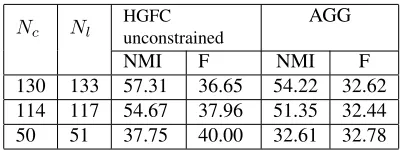
The results are reported in tables 2 and 3. In these tables,Ncis the number of clusters inHGFC
cluster-ing while Nl is the number of classes in the gold
standard (the two do not always correspond per-fectly because a few clusters have zero members).
Nc Nl HGFCunconstrained AGG
NMI F NMI F
[image:7.612.326.527.70.145.2]130 133 57.31 36.65 54.22 32.62 114 117 54.67 37.96 51.35 32.44 50 51 37.75 40.00 32.61 32.78
Table 2: Performance on T2 using a pre-defined tree structure.
Nc Nl HGFCunconstrained HGFCconstrained AGG
NMI F NMI F NMI F
31 32 51.65 42.01 91.47 92.07 49.70 40.30 15 14 42.75 47.70 82.16 82.80 39.19 43.69 11 11 38.91 51.17 71.69 75.00 34.88 44.80
Table 3: Performance on T3 using a pre-defined tree structure.
Table 2 compares the results of the unconstrained version ofHGFCagainst those ofAGGon our largest test set T2. As with T1, HGFC outperforms AGG clearly. The benefit can now be seen at 3 different levels of hierarchy. On average, the HGFC outper-forms AGG 3.5% in NMI and 4.8% in F. The dif-ference between the methods becomes clearer when moving towards the upper levels of the hierarchy.
Table 3 shows the results of both unconstrained and constrained versions of HGFC and those of AGG on the test set T3 (where singular classes are removed to enable proper evaluation of the con-strained method). The results are generally gener-ally better on this test set than on T2 – which is to be expected since T3 is a refined subset of T21.
Recall that the constrained version ofHGFClearns the upper levels of classification on the basis of soft constraints set at the bottom level, as described ear-lier in section 3.2.4. As a consequence, NMIandF are both greater than 90% at the bottom level and the results at the top level are notably lower because the impact of the constraints degrades the further away one moves from the bottom level. Yet, the rela-tively high result across all levels shows that the con-strained version ofHGFC can be employed a useful method to extend the hierarchical structure of known classifications.
1NMIis higher on T2, however, because NMIhas a higher
baseline for larger number of clusters (Vinh et al., 2009). NMI
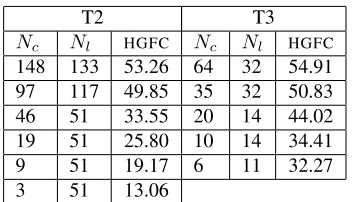
T2 T3 Nc Nl HGFC Nc Nl HGFC
148 133 53.26 64 32 54.91 97 117 49.85 35 32 50.83 46 51 33.55 20 14 44.02 19 51 25.80 10 14 34.41
9 51 19.17 6 11 32.27
[image:8.612.98.275.69.170.2]3 51 13.06
Table 4: NMIof unconstrainedHGFCwhen trees for T2 and T3 are inferred automatically.
Finally, Table 4 shows the results for the uncon-strainedHGFCon T2 and and T3 when the tree struc-ture is not pre-defined but inferred automatically as described in section 3.2.3. 6 levels are learned for T2 and 5 for T3. The number of clusters produced ranges from 3 to 148 for T2 and from 6 to 64 for T3. We can see that the automatically detected clus-ter numbers distribute evenly across different levels. The scale of the clustering structure is more com-plete here than in the gold standards.
In the table, Nc indicates the number of clusters
in the inferred tree, while Nl indicates the closest
match to the number of classes in the gold stan-dard. This evaluation is not fully reliable because the match between the gold standard and the cluster-ing is poor at some levels of hierarchy. However, it is encouraging to see that the results do not drop dra-matically until the match between the two is really poor.
4.3 Qualitative evaluation
To gain a better insight into the performance of HGFC, we conducted further qualitative analysis of the clusters the two versions of this method pro-duced for T3. We focussed on the top level of 11 clusters (in the evaluation against the hierarchical gold standard, see table 3) as the impact of soft con-straints is the weakest for the constrained method at this level.
As expected, the constrainedHGFCkept many in-dividual verbs belonging to same Verbnet subclass together (e.g. verbsenjoy, hate, disdain, regret, love, despise, detest, dislike, fearfor the class 31.2.1) so that most clusters simply group lower level classes and their members together. Three nearly clean clus-ters were produced which only include sub-classes of the same class (e.g. 31.2.0 and 31.2.1 which both
belong to 31.2Admireverbs). However, the remain-ing 8 clusters group together sub-classes (and their members) belonging to unrelated parent classes. In-terestingly, 6 of these make both syntactic and se-mantic sense. For example, several such 37.7Say verbs and 29.5Conjenctureverbs are found together which share the meaning of communication and which take similar sentential complements.
In contrast, none of the clusters produced by the unconstrainedHGFCrepresent a single VerbNet class. The majority represent a high number of classes and fewer members per class. Yet many of the clusters make syntactic and semantic sense. A good example is a cluster which includes member verbs from 9.7Spray/Loadverbs, 21.2Carveverbs, 51.3.1Roll verbs, and 10.4Wipeverbs. The verbs included in this cluster share the meaning of specific type of motion and show similar syntactic behaviour. Thorough Levin style investigation of especially the unconstrained method would require looking at shared diathesis alternations between cluster mem-bers. We left this for future work. However, the analysis we conducted confirmed that the con-strained method could indeed be used for extend-ing known classifications, while the unconstrained method is more suitable for acquiring novel classi-fications from scratch. The errors in clusters pro-duced by both methods were mostly due to syntactic idiosyncracy and the lack of semantic information in clustering. We plan to address the latter problem in our future work.
5 Discussion and conclusion
The results reported in the previous section are promising. On a flat test set (T1), the unconstrained version of HGFC outperforms AGG and performs very similarly with the best current flat clustering method (spectral clustering) evaluated on the same dataset. On the hierarchical test sets (T2 and T3), the unconstrained and constrained versions ofHGFC outperformAGGclearly at all levels of classification. The constrained version ofHGFCdetects the missing hierarchy from the existing gold standards with high accuracy. When the number of clusters and levels is learned automatically, the unconstrained method produces a multi-level hierarchy. Our evaluation against a 3-level gold standard shows that such a hi-erarchy is fairly accurate. Finally, the results from our qualitative evaluation show that both constrained and unconstrained versions of HGFC are capable of learning valuable novel information not included in the gold standards.
The previous work on Levin style verb classifica-tion has mostly focussed on flat classificaclassifica-tions us-ing methods suitable for flat clusterus-ing (Schulte im Walde, 2006; Joanis et al., 2008; Sun et al., 2008; Li and Brew, 2008; Korhonen et al., 2008; ´O S´eaghdha and Copestake, 2008; Vlachos et al., 2009). How-ever, some works have employed hierarchical clus-tering as a method to infer flat clusclus-tering.
For example, Schulte im Walde and Brew (2002) employed AGG to initialize the KMeans clustering for German verbs. This gave better results than random initialization. Stevenson and Joanis (2003) usedAGGfor flat clustering on T1. They cut the hi-erarchy at the number of classes in the gold standard and found that it is difficult to automatically deter-mine a good cut-off. Our evaluation in the previous section shows that HGFC outperforms their imple-mentation ofAGG.
AGG was also used by Ferrer (2004) who per-formed hierarchical clustering of 514 Spanish verbs. The results were evaluated against a hierarchical gold standard resembling that of Levin’s classifi-cation in English (V´azquez et al., 2000). Radj of
0.07 was reported for a 15-way classification which is comparable to the result of Stevenson and Joanis (2003).
Hierarchical clustering has also been performed for the related task of semantic verb classification. For example, Basili et al. (1993) identified the
prob-lems ofAGG, and applied a conceptual clustering al-gorithm (Fisher, 1987) to Italian verbs. They used semi-automatically acquired semantic roles and the concept types as features. No quantitative results were reported. The qualitative evaluation shows that the resulting clusters are very fine-grained.
Schulte im Walde (2008) performed hierarchical clustering of German verbs using human verb asso-ciation as features and AGG as a method. They fo-cussed on two small collections of 56 and 104 verbs and evaluated the result against flat gold standard extracted from GermaNet (Kunze and Lemnitzer, 2002) and German FrameNet (Erk et al., 2003), re-spectively. They reported F of 62.69% for the 56 verbs, and F of 34.68% for the 104 verbs.
In the future, we plan to extend this research line in several directions. First, we will try to deter-mine optimal features for different levels of clus-tering. For example, the general syntactic features (e.g.SCF) may perform the best at top levels of a hi-erarchy while more specific or refined features (e.g. SCF+pp) may be optimal at lower levels. We also plan to investigate incorporating semantic features, like verb selectional preferences, in our feature set. It is likely that different levels of clustering require more or less specific selectional preferences. One way to obtain the latter is hierarchical clustering of relevant noun data.
In addition, we plan to apply the unconstrained HGFC to specific domains to investigate its capabil-ity to learn novel, previously unknown classifica-tions. As for the constrained version of HGFC, we will conduct a larger scale experiment on the Verb-Net data to investigate what kind of upper level hi-erarchy it can propose for this resource (which cur-rently has over 100 top level classes).
Finally, we plan to compare HGFC to other hier-archical clustering methods that are relatively new to NLP but have proved promising in other fields, including Bayesian Hierarchical Clustering (Heller and Ghahramani, 2005; Teh et al., 2008) and the method of Azran and Ghahramani (2006a) based on spectral clustering.
6 Acknowledgement
grants EP/F030061/1 and EP/G051070/1 (UK) and the EU FP7 project ’PANACEA’.
References
Arik Azran and Zoubin Ghahramani. A new approach to data driven clustering. InProceedings of the 23rd international conference on Machine learning, ICML ’06, pages 57–64, New York, NY, USA, 2006a. ISBN 1-59593-383-2.
Arik Azran and Zoubin Ghahramani. Spectral methods for automatic multiscale data clustering. In Proceed-ings of the 2006 IEEE Computer Society Conference on Computer Vision and Pattern Recognition-Volume 1, pages 190–197. IEEE Computer Society Washing-ton, DC, USA, 2006b.
Collin F. Baker, Charles J. Fillmore, and John B. Lowe. The berkeley framenet project. InIn COLING-ACL, pages 86–90, 1998.
Roberto. Basili, Maria Teresa Pazienza, and Paola Ve-lardi. Hierarchical clustering of verbs. InProceedings of the Workshop on Acquisition of Lexical Knowledge from Text, 1993.
Nikoletta Bassiou and Constantine Kotropoulos. Long distance bigram models applied to word clustering.
Pattern Recogn., 44:145–158, January 2011. ISSN 0031-3203.
Ted Briscoe, John Carroll, and Rebecca Watson. The second release of the rasp system. In Proceedings of the COLING/ACL on Interactive presentation ses-sions, 2006.
Hoa Trang Dang. Investigations into the Role of Lexical Semantics in Word Sense Disambiguation. PhD thesis, CIS, University of Pennsylvania, 2004.
Katrin Erk, Andrea Kowalski, Sebastian Pad´o, and Man-fred Pinkal. Towards a resource for lexical semantics: a large german corpus with extensive semantic anno-tation. InProceedings of the 41st Annual Meeting on Association for Computational Linguistics - Volume 1, ACL ’03, pages 537–544, Stroudsburg, PA, USA, 2003. Association for Computational Linguistics. Eva Esteve Ferrer. Towards a semantic classification
of spanish verbs based on subcategorisation informa-tion. In Proceedings of the ACL 2004 workshop on Student research, ACLstudent ’04, Stroudsburg, PA, USA, 2004. Association for Computational Linguis-tics.
Douglas H. Fisher. Knowledge acquisition via incremen-tal conceptual clustering. Machine Learning, 2:139– 172, 1987. ISSN 0885-6125.
David Graff. North american news text corpus.Linguistic Data Consortium, 1995.
Ralph Grishman, Catherine Macleod, and Adam Meyers. Comlex syntax: Building a computational lexicon. In
COLING, pages 268–272, 1994.
Katherine A. Heller and Zoubin Ghahramani. Bayesian hierarchical clustering. In Proceedings of the 22nd international conference on Machine learning, pages 297–304. ACM, 2005. ISBN 1595931805.
Eduard Hovy, Mitchell Marcus, Martha Palmer, Lance Ramshaw, and Ralph Weischedel. Ontonotes: the 90% solution. In Proceedings of the Human Lan-guage Technology Conference of the NAACL, Com-panion Volume: Short Papers, NAACL-Short ’06, pages 57–60, Stroudsburg, PA, USA, 2006. Associa-tion for ComputaAssocia-tional Linguistics.
Lawrence Hubert and Phipps Arabie. Comparing par-titions. Journal of Classification, 2:193–218, 1985. ISSN 0176-4268.
Eric Joanis, Suzanne Stevenson, and David James. A general feature space for automatic verb classification.
Natural Language Engineering, 14(3):337–367, 2008. Karin Kipper. VerbNet: A broad-coverage,
comprehen-sive verb lexicon. 2005.
Anna Korhonen, Yuval Krymolowski, and Nigel Collier. The Choice of Features for Classification of Verbs in Biomedical Texts. InProceedings of COLING, 2008. Claudia Kunze and Lothar Lemnitzer.
GermaNet-representation, visualization, application. In Proceed-ings of LREC, 2002.
Geoffrey Leech. 100 million words of english: the british national corpus. Language Research, 28(1):1– 13, 1992.
Beth. Levin. English verb classes and alternations: A preliminary investigation.Chicago, IL, 1993.
Jianguo Li and Chris Brew. Which Are the Best Features for Automatic Verb Classification. InProceedings of ACL, 2008.
Yu-Ru Lin, Yun Chi, Shenghuo Zhu, Hari Sundaram, and Belle L. Tseng. Facetnet: a framework for analyz-ing communities and their evolutions in dynamic net-works. InProceeding of the 17th international confer-ence on World Wide Web, pages 685–694, New York, NY, USA, 2008. ACM.
Christopher D. Manning, Prabhakar Raghavan, and Hin-rich Schtze. Introduction to Information Retrieval. Cambridge University Press, New York, NY, USA, 2008. ISBN 0521865719, 9780521865715.
George A. Miller. WordNet: a lexical database for En-glish. Communications of the ACM, 38(11):39–41, 1995.
Travis E. Oliphant. Python for scientific computing.
Computing in Science and Engineering, 9:10–20, 2007. ISSN 1521-9615.
Diarmuid ´O S´eaghdha and Ann Copestake. Semantic classification with distributional kernels. In Proceed-ings of COLING, 2008.
Martha Palmer, Daniel Gildea, and Paul Kingsbury. The proposition bank: An annotated corpus of semantic roles.Computational Linguistics, 31(1):71–106, 2005. Judita Preiss, Ted Briscoe, and Anna Korhonen. A sys-tem for large-scale acquisition of verbal, nominal and adjectival subcategorization frames from corpora. In
Proceedings of ACL, pages 912–919, 2007.
Andrew Rosenberg and Julia Hirschberg. V-measure: A conditional entropy-based external cluster evaluation measure. InProceedings of the 2007 Joint Conference on Empirical Methods in Natural Language Process-ing and Computational Natural Language LearnProcess-ing, 2007.
Sabine Schulte im Walde. Experiments on the automatic induction of german semantic verb classes. Computa-tional Linguistics, 32(2), 2006.
Sabine Schulte im Walde. Human associations and the choice of features for semantic verb classification.
Research on Language and Computation, 6:79–111, 2008. ISSN 1570-7075.
Sabine Schulte im Walde and Chris Brew. Inducing ger-man seger-mantic verb classes from purely syntactic sub-categorisation information. In Proceedings of ACL, pages 223–230, 2002.
Jianbo Shi and Jitendra Malik. Normalized cuts and im-age segmentation.IEEE Transactions on pattern anal-ysis and machine intelligence, 22(8):888–905, 2000. Lei Shi and Rada Mihalcea. Putting pieces together:
Combining FrameNet, VerbNet and WordNet for ro-bust semantic parsing. In Proceedings of CICLING, 2005.
Suzanne Stevenson and Eric Joanis. Semi-supervised verb class discovery using noisy features. In Proceed-ings of HLT-NAACL 2003, pages 71–78, 2003. Lin Sun and Anna Korhonen. Improving verb clustering
with automatically acquired selectional preferences. In
Proceedings of the EMNLP 2009, 2009.
Lin Sun, Anna Korhonen, and Yuval Krymolowski. Verb class discovery from rich syntactic data.Lecture Notes in Computer Science, 4919:16, 2008.
Robert Swier and Suzanne Stevenson. Unsupervised semantic role labelling. In Proceedings of EMNLP, pages 95–102, 2004.
Yee Whye Teh, Hal Daum´e III, and Daniel Roy. Bayesian agglomerative clustering with coalescents. In Ad-vances in Neural Information Processing Systems, vol-ume 20, 2008.
Akira Ushioda. Hierarchical clustering of words. In
Proceedings of the 16th conference on Computational linguistics-Volume 2, pages 1159–1162. Association for Computational Linguistics, 1996.
Gloria V´azquez, Ana Fern´andez-Montraveta, and M. Ant`onia Mart´ı. Clasificaci´on verbal:(alternancias de di´atesis). Universitat de Lleida, 2000. ISBN 8484090671.
Nguyen Xuan Vinh, Julien Epps, and James Bailey. Infor-mation theoretic measures for clusterings comparison: is a correction for chance necessary? InICML ’09: Proceedings of the 26th Annual International Confer-ence on Machine Learning, pages 1073–1080, New York, NY, USA, 2009. ACM. ISBN 978-1-60558-516-1.
Andreas Vlachos, Anna Korhonen, and Zoubin Ghahra-mani. Unsupervised and constrained dirichlet process mixture models for verb clustering. InProceedings of the Workshop on Geometrical Models of Natural Lan-guage Semantics, pages 74–82, 2009.
Joe H. Ward Jr. Hierarchical grouping to optimize an ob-jective function.Journal of the American statistical as-sociation, 58(301):236–244, 1963. ISSN 0162-1459. Zhenyu Wu and Richard Leahy. An optimal graph
the-oretic approach to data clustering: Theory and its ap-plication to image segmentation. IEEE transactions on pattern analysis and machine intelligence, pages 1101–1113, 1993. ISSN 0162-8828.
Kai Yu, Shipeng Yu, and Volker Tresp. Soft clustering on graphs. Advances in Neural Information Processing Systems, 18:1553, 2006.