Combining Discrete and Continuous Features for Deterministic
Transition-based Dependency Parsing
Meishan Zhang and Yue Zhang Singapore University of Technology and Design {meishan zhang, yue zhang}@sutd.edu.sg
Abstract
We investigate a combination of a tra-ditional linear sparse feature model and a multi-layer neural network model for deterministic transition-based dependency parsing, by integrating the sparse features into the neural model. Correlations are drawn between the hybrid model and pre-vious work on integrating word embed-ding features into a discrete linear model. By analyzing the results of various parsers on web-domain parsing, we show that the integrated model is a better way to com-bine traditional and embedding features compared with previous methods.
1 Introduction
Transition-based parsing algorithms construct out-put syntax trees using a sequence of shift-reduce actions. They are attractive in computational ef-ficiency, allowing linear time decoding with de-terministic (Nivre, 2008) or beam-search (Zhang and Clark, 2008) algorithms. Using rich non-local features, transition-based parsers achieve state-of-the-art accuracies for dependency parsing (Zhang and Nivre, 2011; Zhang and Nivre, 2012; Bohnet and Nivre, 2012; Choi and McCallum, 2013; Zhang et al., 2014).
Deterministic transition-based parsers works by making a sequence of greedy local deci-sions (Nivre et al., 2004; Honnibal et al., 2013; Goldberg et al., 2014; G´omez-Rodr´ıguez and Fern´andez-Gonz´alez, 2015). They are attractive by very fast speeds. Traditionally, a linear model has been used for the local action classifier. Re-cently, Chen and Manning (2014) use a neural net-work (NN) to replace linear models, and report im-proved accuracies.
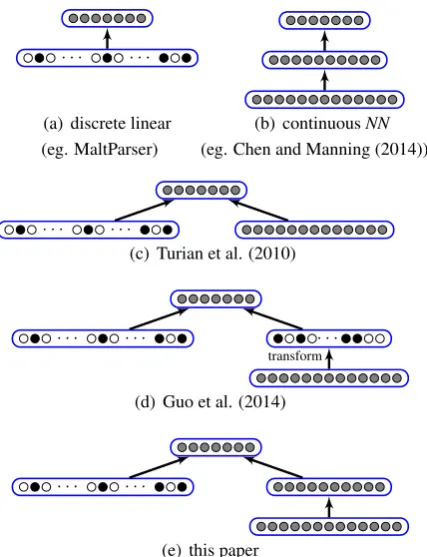
A contrast between a neural network model and a linear model is shown in Figure 1 (a) and (b).
· · · ·
(a) discrete linear (b) continuousNN
· · · ·
(eg. MaltParser) (eg. Chen and Manning (2014))
(c) Turian et al. (2010)
· · · ·
transform
(d) Guo et al. (2014)
· · · ·
(e) this paper
Figure 1: Five deterministic transition-based parsers with discrete and continuous features.
A neural network model takes continuous vector representations of words as inputs, which can be pre-trained using large amounts of unlabeled data, thus containing more information. In addition, us-ing an extra hidden layer, a neural network is ca-pable of learning non-linear relations between au-tomatic features, achieving feature combinations automatically.
Discrete manual features and continuous fea-tures complement each other. A natural question that arises from the contrast is whether traditional discrete features and continuous neural features can be integrated for better accuracies. We study this problem by constructing the neural network shown in Figure 1 (e), which incorporates the dis-crete input layer of the linear model (Figure 1 (a)) into the NN model (Figure 1 (b)) by conjoining
[image:1.595.311.525.200.479.2]it with the hidden layer. This architecture is con-nected with previous work on incorporating word embeddings into a linear model.
In particular, Turian et al. (2010) incorporate word embeddings as real-valued features into a CRF model. The architecture is shown in Figure 1(c), which can be regarded as Figure 1(e) with-out the hidden layer. Guo et al. (2014) find that the accuracies of Turian et al can be enhanced by discretizing the embedding features before com-bining them with the traditional features. They use simple binarization and clustering to this end, find-ing that the latter works better. The architecture is shown in Figure 1(d). In contrast, Figure 1(e) di-rectly combines discrete and continuous features, replacing the hard-coded transformation function of Guo et al. (2014) with a hidden layer, which can be tuned by supervised training.1
We correlate and compare all the five systems in Figure 1 empirically, using the SANCL 2012 data (Petrov and McDonald, 2012) and the stan-dard Penn Treebank data. Results show that the method of this paper gives higher accura-cies than the other methods. In addition, the method of Guo et al. (2014) gives slightly better accuracies compared to the method of Turian et al. (2010) for parsing task, consistent with Guo et al’s observation on named entity recognition (NER). We make our C++ code publicly avail-able under GPL at https://github.com/
SUTDNLP/NNTransitionParser.
2 Parser
We take Chen and Manning (2014), which uses the arc-standard transition system (Nivre, 2008). Given an POS-tagged input sentence, it builds a projective outputy by performing a sequence of state transition actions using greedy search. Chen and Manning (2014) can be viewed as a neutral alternative of MaltParser (Nivre, 2008).
Although not giving state-of-the-art accuracies, deterministic parsing is attractive for its high pars-ing speed (1000+ sentences per second). Our in-corporation of discrete features does not harm the overall speed significantly. In addition, determin-istic parsers use standard neural classifiers, which allows isolated study of feature influences.
1Yet another alternative structure is to directly combine
the two types of inputs, and replacing the input layer of (b) using them. Wang and Manning (2013) compared this archi-tecture with (c) using a CRF network, finding that the latter works better for NER and chunking.
3 Models
Following Chen and Manning (2014), training of all the models using a cross-entropy loss objective with a L2-regularization, and mini-batched Ada-Grad (Duchi et al., 2011). We unify below the five deterministic parsing models in Figure 1.
3.1 Baseline linear (L)
We build a baseline linear model using logistic re-gression (Figure 1(a)). Given a parsing statex, a vector of discrete featuresΦd(x) is extracted
ac-cording to the arc-standard feature templates of Ma et al. (2014a), which is based on thearc-eager templates of Zhang and Nivre (2011). The score of an actionais defined by
Score(a) =σ Φd(x)·−→θd,a,
where σ represents the sigmoid activation func-tion,−→θdis the set of model parameters, denoting
the feature weights with respect to actions,acan be SHIFT, LEFT(l) and RIGHT(l).
3.2 Baseline Neural (NN)
We take the Neural model of Chen and Manning (2014) as another baseline (Figure 1(b)). Given a parsing statex, the words are first mapped into continuous vectors by using a set of pre-trained word embeddings. Denote the mapping asΦe(x).
In addition, denote the hidden layer asΦh, and the
ith node in the hidden asΦh,i(0≤i≤ |Φh|). The
hidden layer is defined as
Φh,i= Φe(x)·−→θh,i3,
where−→θhis the set of parameters between the
in-put and hidden layers. The score of an actionais defined as
Score(a) =σ Φh(x)·−→θc,a,
where −→θc,a is the set of parameters between the
hidden and output layers. We use thearc-standard featuresΦe as Chen and Manning (2014), which
is also based on thearc-eagertemplates of Zhang and Nivre (2011), similar to those of the baseline modelL.
3.3 Linear model with real-valued
embeddings (Turian)
statex, the score of an actionais defined as
Score(a) =σ Φd(x)⊕Φe(x)
·(−→θd,a⊕−→θc,a)
,
where⊕is the vector concatenation operator. 3.4 Linear model with transformed
embeddings (Guo)
We apply the method of Guo et al. (2014), com-bining embeddings into the linear baseline by first transforming into discrete values. Given a statex, the score of an action is defined as
Score(a) =σ Φd(x)⊕d(Φe(x) )
·(−→θd,a⊕−→θc,a)
,
where d is a transformation function from real-value to binary features. We use clustering of em-beddings fordas it gives better performances ac-cording to Guo et al. (2014). Following Guo et al. (2014), we use compounded clusters learnt by K-means algorithm of different granularities. 3.5 Directly combining linear and neural
features (This)
We directly combine linear and neural features (Figure 1(e)). Given a statex, the score of an ac-tion is defined as
Score(a) =σ Φd(x)⊕Φh(x)
·(−→θd,a⊕−→θc,a)
,
where Φh is the same as theNN baseline. Note
that likedin Guo,Φhis also a function that
trans-forms embeddingsΦe. The main difference is that
it can be tuned in supervised training.
4 Web Domain Experiments
4.1 Setting
We perform experiments on the SANCL 2012 web data (Petrov and McDonald, 2012), using the Wall Street Journal (WSJ) training corpus to train the models and the WSJ development corpus to tune parameters. We clean the web domain texts fol-lowing the method of Ma et al. (2014b). Au-tomatic POS tags are produced by using a CRF model trained on the WSJ training corpus. The POS tags are assigned automatically on the train-ing corpus by ten-fold jackkniftrain-ing. Table 1 shows the corpus details.
Domain #Sent #Word TA WSJ-train 30,060 731,678 97.03
WSJ-dev 1,336 32,092 96.88 WSJ-test 1,640 35,590 97.51 answers 1,744 28,823 91.93 newsgroups 1,195 20,651 93.75 reviews 1,906 28,086 92.66
Table 1: Corpus statistics of our experiments, where TA denotes POS tagging accuracy.
NN Turian This
88 89 90
91 -T +T
(a) WSJ
NN Turian This
79 80 81 82
-T +T
(b) answers
NN Turian This
79 80 81
82 -T +T
(c) newsgroups
NN Turian This
80 81 82
83 -T +T
[image:3.595.345.488.61.156.2](d) reviews
Figure 2: Dev results on fine-tuning (UAS).
Following Chen and Manning (2014), we use the pre-trained word embedding released by Col-lobert et al. (2011), and seth= 200for the hidden layer size, λ = 10−8 for L2 regularization, and α= 0.01for the initial learning rate of Adagrad.
4.2 Development Results
Fine-tuning of embeddings. Chen and
Man-ning (2014) fine-tune word embeddings in su-pervised training, consistent with Socher et al. (2013). Intuitively, fine-tuning embeddings allows in-vocabulary words to join the parameter space, thereby giving better fitting to in-domain data. However, it also forfeits the benefit of large-scale pre-training, because out-of-vocabulary (OOV) words do not have their embeddings fine-tuned. In this sense, the method of Chen and Manning resembles a traditional supervised sparse linear model, which can be weak on OOV.
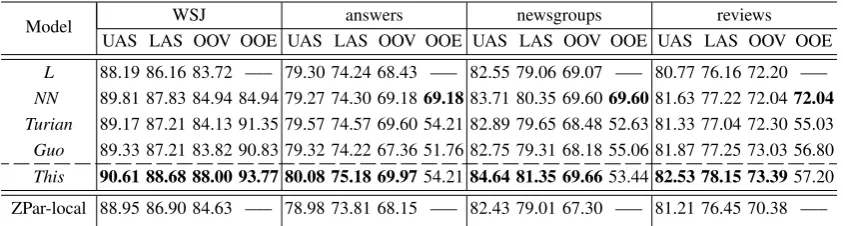
[image:3.595.324.510.203.401.2]Model WSJ answers newsgroups reviews UAS LAS OOV OOE UAS LAS OOV OOE UAS LAS OOV OOE UAS LAS OOV OOE L 88.19 86.16 83.72 —– 79.30 74.24 68.43 —– 82.55 79.06 69.07 —– 80.77 76.16 72.20 —– NN 89.81 87.83 84.94 84.94 79.27 74.30 69.1869.1883.71 80.35 69.6069.6081.63 77.22 72.0472.04 Turian 89.17 87.21 84.13 91.35 79.57 74.57 69.60 54.21 82.89 79.65 68.48 52.63 81.33 77.04 72.30 55.03 Guo 89.33 87.21 83.82 90.83 79.32 74.22 67.36 51.76 82.75 79.31 68.18 55.06 81.87 77.25 73.03 56.80 This 90.61 88.68 88.00 93.77 80.08 75.18 69.9754.2184.64 81.35 69.6653.4482.53 78.15 73.3957.20 ZPar-local 88.95 86.90 84.63 —– 78.98 73.81 68.15 —– 82.43 79.01 67.30 —– 81.21 76.45 70.38 —– C&M(2014) 89.56 87.55 79.15 79.15 79.82 74.63 67.78 67.78 83.39 79.72 67.95 67.95 81.60 76.91 68.83 68.83
Table 2: Main results on SANCL. All systems are deterministic.
parameters. Therefore, such methods can expect better cross-domain accuracies.
We empirically compare the modelsNN,Turian andThis by fine-tuning (+T) and not fine-tuning (-T) word embeddings, and the results are shown in Figure 2. As expected, the baseline NN model gives better accuracies on WSJ with fine-tuning, but worse cross-domain accuracies. Interestingly, our combined model gives consistently better ac-curacies with fine-tuning. We attribute this to the use of sparse discrete features, which allows the model to benefit from large-scale pre-trained embeddings without sacrificing in-domain perfor-mance. The observation onTurianis similar. For the final experiments, we apply fine-tuning on the NN model, but not to the TurianandThis. Note also tat for all experiments, the POS and label em-bedding features of Chen and Manning (2014) are fine-tuned, consistent with their original method.
Dropout rate. We test the effect of dropout
(Hin-ton et al., 2012) during training, using a default ra-tio of 0.5 according to Chen and Manning (2014). In our experiments, we find that the dense NN model and our combined model achieve better per-formances by using dropout, but the other models do not benefit from dropout.
4.3 Final Results
The final results across web domains are shown in Table 2. Our logistic regression linear parser and re-implementation of Chen and Manning (2014) give comparable accuracies to the percep-tron ZPar2and Stanford NN Parser3, respectively.
It can be seen from the table that both Turian andGuo4 outperformL by incorporating
embed-2https://sourceforge.net/projects/zpar/, version 0.7. 3http://nlp.stanford.edu/software/nndep.shtml
4We compound six clusters of granularities 500, 1000,
1500, 2000, 2500, 3000.
ding features. Guo gives overall higher improve-ments, consistent with the observation of Guo et al. (2014) on NER. Our methods gives signifi-cantly5 better results compared with Turian and
Guo, thanks to the extra hidden layer.
Our OOV performance is higher than NN, because the embeddings of OOV words are not tuned, and hence the model can handle them effectively. Interestingly, NN gives higher accuracies on web domain out-of-embedding-vocabulary (OOE) words, out of which 54% are in-vocabulary.
Note that the accuracies of our parsers are lower than the best systems in the SANCL shared task, which use ensemble models. Our parser enjoys the fast speed of deterministic parsers, and in partic-ular the baseline NN parser (Chen and Manning, 2014).
5 WSJ Experiments
For comparison with related work, we conduct ex-periments on Penn Treebank corpus also. We use the WSJ sections 2-21 for training, section 22 for development and section 23 for testing. WSJ con-stituent trees are converted to dependency trees us-ing Penn2Malt6. We use auto POS tags consistent
with previous work. The ZPar POS-tagger is used to assign POS tags. Ten-fold jackknifing is per-formed on the training data to assign POS auto-matically. For this set of experiments, the parser hyper-parameters are taken directly from the best settings in the Web Domain experiments.
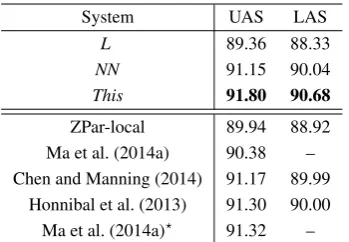
The results are shown in Table 3, together with some state-of-the-art deterministic parsers. Com-paring the L, NN and This models, the observa-tions are consistent with the web domain.
System UAS LAS
L 89.36 88.33
NN 91.15 90.04
This 91.80 90.68
ZPar-local 89.94 88.92 Ma et al. (2014a) 90.38 – Chen and Manning (2014) 91.17 89.99
[image:5.595.95.270.61.182.2]Honnibal et al. (2013) 91.30 90.00 Ma et al. (2014a)? 91.32 –
Table 3: Main results on WSJ. All systems are de-terministic.
Our combined parser gives accuracies competi-tive to state-of-the-art deterministic parsers in the literature. In particular, the method of Chen and Manning (2014) is the same as ourNN baseline. Note that Zhou et al. (2015) reports a UAS of 91.47% by this parser, which is higher than the results we obtained. The main results include the use of different batch size during, while Zhou et al. (2015) used a batch size of 100,000, we used a batch size of 10,000 in all experiments. Honnibal et al. (2013) applies dynamic oracle to the deter-ministic transition-based parsing, giving a UAS of 91.30%. Ma et al. (2014a) is similar to ZPar local, except that they use the arc-standard transitions, while ZPar-local is based onarc-eagertransitions. Ma et al. (2014a)?uses a special method to process
punctuations, leading to about 1% UAS improve-ments over the vanilla system.
Recently, Dyer et al. (2015) proposed a de-terministic transition-based parser using LSTM, which gives a UAS of 93.1% on Stanford conver-sion of the Penn Treebank. Their work shows that more sophisticated neural network structures with long term memories can significantly improve the accuracy over local classifiers. Their work is or-thogonal to ours.
6 Related Work
As discussed in the introduction, our work is re-lated to previous work on integrating word embed-dings into discrete models (Turian et al., 2010; Yu et al., 2013; Guo et al., 2014). Along this line, there has also been work that uses a neural net-work to automatically vectorize the structures of a sentence, and then taking the resulting vector as features in a linear NLP model (Socher et al., 2012; Tang et al., 2014; Yu et al., 2015). Our re-sults show that the use of a hidden neural layer
gives superior results compared with both direct integration and integration via a hard-coded trans-formation function (e.g binarization or clustering). There has been recent work integrating contin-uous and discrete features for the task of POS tagging (Ma et al., 2014b; Tsuboi, 2014). Both models have essentially the same structure as our model. In contrast to their work, we systemati-cally compare various ways to integrate discrete and continuous features, for the dependency pars-ing task. Our model is also different from Ma et al. (2014b) in the hidden layer. While they use a form of restricted Boltzmann machine to pre-train the embeddings and hidden layer from large-scale ngrams, we fully rely on supervised learning to train complex feature combinations.
Wang and Manning (2013) consider integrat-ing embeddintegrat-ings and discrete features into a neu-ral CRF. They show that combined neuneu-ral and dis-crete features work better without a hidden layer (i.e. Turian et al. (2010)). They argue that non-linear structures do not work well with high di-mensional features. We find that using a hid-den layer specifically for embedding features gives better results compared with using no hidden lay-ers.
7 Conclusion
We studied the combination of discrete and con-tinuous features for deterministic transition-based dependency parsing, comparing several methods to incorporate word embeddings and traditional sparse features in the same model. Experiments on both in-domain and cross-domain parsing show that directly adding sparse features into a neural network gives higher accuracies compared with all previous methods to incorporate word embeddings into a traditional sparse linear model.
Acknowledgments
We thank the anonymous reviewers for their con-structive comments, which helped to improve the paper. This work is supported by the Singapore Ministry of Education (MOE) AcRF Tier 2 grant T2MOE201301 and SRG ISTD 2012 038 from Singapore University of Technology and Design.
References
labeled non-projective dependency parsing. In
EMNLP-CONLL, pages 1455–1465.
Danqi Chen and Christopher Manning. 2014. A fast and accurate dependency parser using neural net-works. InEMNLP, pages 740–750.
Jinho D. Choi and Andrew McCallum. 2013. Transition-based dependency parsing with selec-tional branching. InACL, pages 1052–1062. Ronan Collobert, Jason Weston, L´eon Bottou, Michael
Karlen, Koray Kavukcuoglu, and Pavel Kuksa. 2011. Natural language processing (almost) from scratch. The Journal of Machine Learning Re-search, 12:2493–2537.
John Duchi, Elad Hazan, and Yoram Singer. 2011. Adaptive subgradient methods for online learning and stochastic optimization. The Journal of Ma-chine Learning Research, 12:2121–2159.
Chris Dyer, Miguel Ballesteros, Wang Ling, Austin Matthews, and Noah A. Smith. 2015. Transition-based dependency parsing with stack long short-term memory. InACL, pages 334–343.
Yoav Goldberg, Francesco Sartorio, and Giorgio Satta. 2014. A tabular method for dynamic oracles in transition-based parsing. Transactions of the Asso-ciation for Computational Linguistics, 2:119–130. Carlos G´omez-Rodr´ıguez and Daniel
Fern´andez-Gonz´alez. 2015. An efficient dynamic oracle for unrestricted non-projective parsing. In ACL-IJCNLP, pages 256–261.
Jiang Guo, Wanxiang Che, Haifeng Wang, and Ting Liu. 2014. Revisiting embedding features for sim-ple semi-supervised learning. InProceedings of the 2014 Conference on EMNLP, pages 110–120. Geoffrey E Hinton, Nitish Srivastava, Alex Krizhevsky,
Ilya Sutskever, and Ruslan R Salakhutdinov. 2012. Improving neural networks by preventing co-adaptation of feature detectors. arXiv preprint arXiv:1207.0580.
Matthew Honnibal, Yoav Goldberg, and Mark Johnson. 2013. A non-monotonic arc-eager transition system for dependency parsing. InProceedings of the 17th CONLL, pages 163–172.
Ji Ma, Yue Zhang, and Jingbo Zhu. 2014a. Punctu-ation processing for projective dependency parsing. InACL (Volume 2: Short Papers), pages 791–796. Ji Ma, Yue Zhang, and Jingbo Zhu. 2014b. Tagging
the web: Building a robust web tagger with neural network. InACL, pages 144–154.
Joakim Nivre, Johan Hall, and Jens Nilsson. 2004. Memory-based dependency parsing. InCoNLL. Joakim Nivre. 2008. Algorithms for deterministic
in-cremental dependency parsing. Computational Lin-guistics, 34(4):513–553.
Slav Petrov and Ryan McDonald. 2012. Overview of the 2012 shared task on parsing the web. InNotes of the First Workshop on Syntactic Analysis of Non-Canonical Language (SANCL).
Richard Socher, Brody Huval, Christopher D Manning, and Andrew Y Ng. 2012. Semantic compositional-ity through recursive matrix-vector spaces. In Pro-ceedings of the 2012 Joint Conference on EMNLP-CONLL, pages 1201–1211.
Richard Socher, John Bauer, Christopher D. Manning, and Ng Andrew Y. 2013. Parsing with composi-tional vector grammars. InACL, pages 455–465. Duyu Tang, Furu Wei, Nan Yang, Ming Zhou, Ting
Liu, and Bing Qin. 2014. Learning sentiment-specific word embedding for twitter sentiment clas-sification. InACL, pages 1555–1565.
Yuta Tsuboi. 2014. Neural networks leverage corpus-wide information for part-of-speech tagging. In Pro-ceedings of the 2014 EMNLP, pages 938–950. Joseph Turian, Lev-Arie Ratinov, and Yoshua Bengio.
2010. Word representations: A simple and general method for semi-supervised learning. In Proceed-ings of the 48th ACL, pages 384–394.
Mengqiu Wang and Christopher D. Manning. 2013. Effect of non-linear deep architecture in sequence labeling. InIJCNLP, pages 1285–1291.
Mo Yu, Tiejun Zhao, Daxiang Dong, Hao Tian, and Di-anhai Yu. 2013. Compound embedding features for semi-supervised learning. In NAACL, pages 563– 568.
Mo Yu, Matthew R Gormley, and Mark Dredze. 2015. Combining word embeddings and feature embeddings for fine-grained relation extraction. In
NAACL.
Yue Zhang and Stephen Clark. 2008. A tale of two parsers: Investigating and combining graph-based and transition-graph-based dependency parsing. In
EMNLP, pages 562–571.
Yue Zhang and Joakim Nivre. 2011. Transition-based dependency parsing with rich non-local features. In
Proceedings of the 49th ACL, pages 188–193. Yue Zhang and Joakim Nivre. 2012. Analyzing
the effect of global learning and beam-search on transition-based dependency parsing. In COLING 2012: Posters, pages 1391–1400.
Yuan Zhang, Tao Lei, Regina Barzilay, Tommi Jaakkola, and Amir Globerson. 2014. Steps to ex-cellence: Simple inference with refined scoring of dependency trees. InACL, pages 197–207.