Classifying Relations via Long Short Term Memory Networks
along Shortest Dependency Paths
Yan Xu,†Lili Mou,†Ge Li,†∗Yunchuan Chen,‡Hao Peng,†Zhi Jin†∗ †Software Institute, Peking University, 100871, P. R. China
{xuyan14,lige,zhijin}@sei.pku.edu.cn,{doublepower.mou,penghao.pku}@gmail.com
‡University of Chinese Academy of Sciences, [email protected]
Abstract
Relation classification is an important re-search arena in the field of natural lan-guage processing (NLP). In this paper, we present SDP-LSTM, a novel neural net-work to classify the relation of two enti-ties in a sentence. Our neural architecture leverages the shortest dependency path (SDP) between two entities; multichan-nel recurrent neural networks, with long short term memory (LSTM) units, pick up heterogeneous information along the SDP. Our proposed model has several dis-tinct features: (1) The shortest dependency paths retain most relevant information (to relation classification), while eliminating irrelevant words in the sentence. (2) The multichannel LSTM networks allow ef-fective information integration from het-erogeneous sources over the dependency paths. (3) A customized dropout strategy regularizes the neural network to allevi-ate overfitting. We test our model on the SemEval 2010 relation classification task, and achieve anF1-score of 83.7%, higher
than competing methods in the literature.
1 Introduction
Relation classification is an important NLP task. It plays a key role in various scenarios, e.g., in-formation extraction (Wu and Weld, 2010), ques-tion answering (Yao and Van Durme, 2014), med-ical informatics (Wang and Fan, 2014), ontol-ogy learning (Xu et al., 2014), etc. The aim of relation classification is to categorize into pre-defined classes the relations between pairs of marked entities in given texts. For instance, in the sentence “A trillion gallons of [water]e1 have
been poured into an empty [region]e2 of outer
∗Corresponding authors.
space,” the entities water and region are of rela-tionEntity-Destination(e1, e2).
Traditional relation classification approaches rely largely on feature representation (Kambhatla, 2004), or kernel design (Zelenko et al., 2003; Bunescu and Mooney, 2005). The former method usually incorporates a large set of features; it is difficult to improve the model performance if the feature set is not very well chosen. The latter ap-proach, on the other hand, depends largely on the designed kernel, which summarizes all data infor-mation. Deep neural networks, emerging recently, provide a way of highly automatic feature learning (Bengio et al., 2013), and have exhibited consid-erable potential (Zeng et al., 2014; dos Santos et al., 2015). However, human engineering—that is, incorporating human knowledge to the network’s architecture—is still important and beneficial.
This paper proposes a new neural network, SDP-LSTM, for relation classification. Our model utilizes the shortest dependency path (SDP) be-tween two entities in a sentence; we also design a long short term memory (LSTM)-based recurrent neural network for information processing. The neural architecture is mainly inspired by the fol-lowing observations.
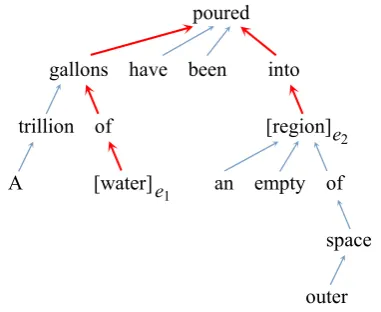
• Shortest dependency paths are informative (Fundel et al., 2007; Chen et al., 2014). To determine the two entities’ relation, we find it mostly sufficient to use only the words along the SDP: they concentrate on most relevant information while diminishing less relevant noise. Figure 1 depicts the dependency parse tree of the aforementioned sentence. Words along the SDP form a trimmed phrase ( gal-lons of water poured into region) of the orig-inal sentence, which conveys much informa-tion about the target relainforma-tion. Other words, such asa,trillion,outer space, are less infor-mative and may bring noise if not dealt with properly.
• Direction matters. Dependency trees are a kind of directed graph. The dependency re-lation betweenintoandregionisPREP; such relation hardly makes any sense if the di-rected edge is reversed. Moreover, the enti-ties’ relation distinguishes its directionality, that is,r(a, b)differs fromr(b, a), for a same given relationrand two entitiesa, b. There-fore, we think it necessary to let the neu-ral model process information in a direction-sensitive manner. Out of this consideration, we separate an SDP into two sub-paths, each from an entity to the common ancestor node. The extracted features along the two sub-paths are concatenated to make final classi-fication.
• Linguistic information helps. For exam-ple, with prior knowledge of hyponymy, we know “water is a kind of substance.” This is a hint that the entities, water and region,
are more ofEntity-Destination
rela-tion than, say, Communication-Topic.
To gather heterogeneous information along SDP, we design a multichannel recurrent neu-ral network. It makes use of information from various sources, including words them-selves, POS tags, WordNet hypernyms, and the grammatical relations between governing words and their children.
For effective information propagation and inte-gration, our model leverages LSTM units during recurrent propagation. We also customize a new dropout strategy for our SDP-LSTM network to alleviate the problem of overfitting. To the best of our knowledge, we are the first to use LSTM-based recurrent neural networks for the relation classification task.
We evaluate our proposed method on the SemEval 2010 relation classification task, and achieve anF1-score of 83.7%, higher than
com-peting methods in the literature.
In the rest of this paper, we review related work in Section 2. In Section 3, we describe our SDP-LSTM model in detail. Section 4 presents quan-titative experimental results. Finally, we have our conclusion in Section 5.
2 Related Work
Relation classification is a widely studied task in the NLP community. Various existing
meth-poured
gallons have been into
trillion of [region]
A [water] an empty of
space
outer
e1
[image:2.595.322.513.65.221.2]e2
Figure 1: The dependency parse tree correspond-ing to the sentence “A trillion gallons of water have been poured into an empty region of outer space.” Red lines indicate the shortest dependency path between entities waterandregion. An edge
a → b refers toabeing governed by b. Depen-dency types are labeled by the parser, but not pre-sented in the figure for clarity.
ods mainly fall into three classes: feature-based, kernel-based, and neural network-based.
In feature-based approaches, different sets of features are extracted and fed to a chosen classifier (e.g., logistic regression). Generally, three types of features are often used. Lexical features concen-trate on the entities of interest, e.g., entitiesper se, entity POS, entity neighboring information. Syn-tactic features include chunking, parse trees, etc. Semantic features are exemplified by the concept hierarchy, entity class, entity mention. Kamb-hatla (2004) uses a maximum entropy model to combine these features for relation classification. However, different sets of handcrafted features are largely complementary to each other (e.g., hyper-nyms versus named-entity tags), and thus it is hard to improve performance in this way (GuoDong et al., 2005).
bene-fit from combining convolution kernel and syntac-tic features. Plank and Moschitti (2013) introduce semantic information into kernel methods in ad-dition to considering structural information only. One potential difficulty of kernel methods is that all data information is completely summarized by the kernel function (similarity measure), and thus designing an effective kernel becomes crucial.
Deep neural networks, emerging recently, can learn underlying features automatically, and have attracted growing interest in the literature. Socher et al. (2011) propose a recursive neural network (RNN) along sentences’ parse trees for sentiment analysis; such model can also be used to clas-sify relations (Socher et al., 2012). Hashimoto et al. (2013) explicitly weight phrases’ importance in RNNs to improve performance. Ebrahimi and Dou (2015) rebuild an RNN on the dependency path between two marked entities. Zeng et al. (2014) explore convolutional neural networks, by which they utilize sequential information of sen-tences. dos Santos et al. (2015) also use the convo-lutional network; besides, they propose a ranking loss function with data cleaning, and achieve the state-of-the-art result in SemEval-2010 Task 8.
In addition to the above studies, which mainly focus on relation classification approaches and models, other related research trends include in-formation extraction from Web documents in a semi-supervised manner (Bunescu and Mooney, 2007; Banko et al., 2007), dealing with small datasets without enough labels by distant super-vision techniques (Mintz et al., 2009), etc.
3 The Proposed SDP-LSTM Model
In this section, we describe our SDP-LSTM model in detail. Subsection 3.1 delineates the overall ar-chitecture of our model. Subsection 3.2 presents the rationale of using SDPs. Four different infor-mation channels along the SDP are explained in Subsection 3.3. Subsection 3.4 introduces the re-current neural network with long short term mem-ory, which is built upon the dependency path. Sub-section 3.5 customizes a dropout strategy for our network to alleviate overfitting. We finally present our training objective in Subsection 3.6.
3.1 Overview
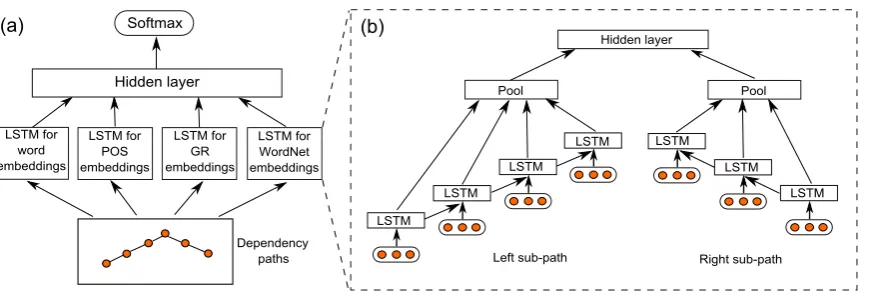
Figure 2 depicts the overall architecture of our SDP-LSTM network.
First, a sentence is parsed to a dependency tree
by the Stanford parser;1 the shortest dependency path (SDP) is extracted as the input of our net-work. Along the SDP, four different types of information—referred to as channels—are used, including the words, POS tags, grammatical rela-tions, and WordNet hypernyms. (See Figure 2a.) In each channel, discrete inputs, e.g., words, are mapped to real-valued vectors, calledembeddings, which capture the underlying meanings of the in-puts.
Two recurrent neural networks (Figure 2b) pick up information along the left and right sub-paths of the SDP, respecitvely. (The path is separated by the common ancestor node of two entities.) Long short term memory (LSTM) units are used in the recurrent networks for effective information prop-agation. A max pooling layer thereafter gathers information from LSTM nodes in each path.
The pooling layers from different channels are concatenated, and then connected to a hidden layer. Finally, we have asoftmaxoutput layer for classification. (See again Figure 2a.)
3.2 The Shortest Dependency Path
The dependency parse tree is naturally suitable for relation classification because it focuses on the ac-tion and agents in a sentence (Socher et al., 2014). Moreover, the shortest path between entities, as discussed in Section 1, condenses most illuminat-ing information for entities’ relation.
We also observe that the sub-paths, separated by the common ancestor node of two entities, provide strong hints for the relation’s directionality. Take Figure 1 as an example. Two entities water and
regionhave their common ancestor node,poured, which separates the SDP into two parts:
[water]e1 →of→gallons→poured
and
poured←into←[region]e2
The first sub-path captures information of e1,
whereas the second sub-path is mainly about
e2. By examining the two sub-paths
sepa-rately, we know e1 and e2 are of relation Entity-Destination(e1, e2), rather than Entity-Destination(e2, e1).
Following the above intuition, we design two recurrent neural networks, which propagate
LSTMOfor wordO embeddings
HiddenOlayer
DependencyO OOOOOOpaths
Softmax
LeftOsub-path Pool
RightOsub-path Pool HiddenOlayer
LSTMOfor POSO embeddings
LSTMOfor GRO embeddings
LSTMOfor WordNetO embeddings
(a) (b)
LSTM
LSTM LSTM
LSTM LSTM
LSTM
LSTM
Figure 2: (a) The overall architecture of SDP-LSTM. (b) One channel of the recurrent neural networks built upon the shortest dependency path. The channels are words, part-of-speech (POS) tags, grammatical relations (abbreviated asGRin the figure), and WordNet hypernyms.
bottom-up from the entities to their common an-cestor. In this way, our model is direction-sensitive.
3.3 Channels
We make use of four types of information along the SDP for relation classification. We call them
channelsas these information sources do not inter-act during recurrent propagation. Detailed channel descriptions are as follows.
• Word representations. Each word in a given
sentence is mapped to a real-valued vector by looking up in a word embedding table. Un-supervisedly trained on a large corpus, word embeddings are thought to be able to well capture words’ syntactic and semantic infor-mation (Mikolov et al., 2013b).
• Part-of-speech tags. Since word
embed-dings are obtained on a generic corpus of a large scale, the information they contain may not agree with a specific sentence. We deal with this problem by allying each input word with its POS tag, e.g., noun, verb, etc. In our experiment, we only take into use a coarse-grained POS category, containing 15 different tags.
• Grammatical relations. The dependency
relations between a governing word and its children makes a difference in meaning. A same word pair may have different depen-dency relation types. For example, “beats
nsubj
−−−→ it” is distinct from “beats −−−→dobj it.” Thus, it is necessary to capture such
gram-matical relations in SDPs. In our experi-ment, grammatical relations are grouped into 19 classes, mainly based on a coarse-grained classification (De Marneffe et al., 2006).
• WordNet hypernyms. As illustrated in
Sec-tion 1, hyponymy informaSec-tion is also useful for relation classification. (Details are not re-peated here.) To leverage WordNet hyper-nyms, we use a tool developed by Ciaramita and Altun (2006).2 The tool assigns a hy-pernym to each word, from 41 predefined concepts in WordNet, e.g., noun.food,
verb.motion, etc. Given its hypernym, each word gains a more abstract concept, which helps to build a linkage between dif-ferent but conceptual similar words.
As we can see, POS tags, grammatical rela-tions, and WordNet hypernyms are also discrete (like words per se). However, no prevailing em-bedding learning method exists for POS tags, say. Hence, we randomly initialize their embeddings, and tune them in a supervised fashion during train-ing. We notice that these information sources con-tain much fewer symbols, 15, 19, and 41, than the vocabulary size (greater than 25,000). Hence, we believe our strategy of random initialization is fea-sible, because they can be adequately tuned during supervised training.
3.4 Recurrent Neural Network with Long Short Term Memory Units
The recurrent neural network is suitable for mod-eling sequential data by nature, as it keeps a
[image:4.595.83.520.60.207.2]ct
~
~ ht
g i
~
o ~ xt
f
t-1
c
ht-1
xt
ht-1
ht-1
xt
~
ht-1
[image:5.595.70.276.61.223.2]xt
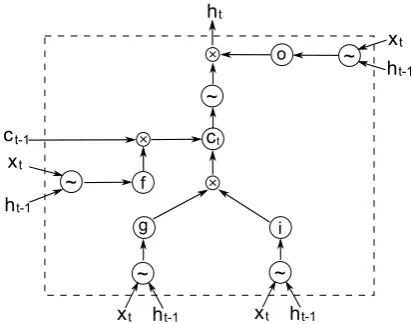
Figure 3: A long short term memory unit. h: hid-den unit. c: memory cell. i: input gate. f: for-get gate. o: output gate. g: candidate cell. ⊗: element-wise multiplication. ∼: activation func-tion.
den state vectorh, which changes with input data at each step accordingly. We use the recurrent net-work to gather information along each sub-path in the SDP (Figure 2b).
The hidden state ht, for the t-th word in the
sub-path, is a function of its previous state ht−1
and the current wordxt. Traditional recurrent
net-works have a basic interaction, that is, the input is linearly transformed by a weight matrix and non-linearly squashed by an activation function. For-mally, we have
ht=f(Winxt+Wrecht−1+bh)
whereWin andWrec are weight matrices for the
input and recurrent connections, respectively. bh
is a bias term for the hidden state vector, andfha
non-linear activation function (e.g.,tanh). One problem of the above model is known as gradient vanishing or exploding. The train-ing of neural networks requires gradient back-propagation. If the propagation sequence (path) is too long, the gradient may probably either grow, or decay, exponentially, depending on the magnitude ofWrec. This leads to the difficulty of training.
Long short term memory (LSTM) units are pro-posed in Hochreiter (1998) to overcome this prob-lem. The main idea is to introduce an adaptive gat-ing mechanism, which decides the degree to which LSTM units keep the previous state and memo-rize the extracted features of the current data in-put. Many LSTM variants have been proposed in the literature. We adopt in our method a variant
introduced by Zaremba and Sutskever (2014), also used in Zhu et al. (2015).
Concretely, the LSTM-based recurrent neural network comprises four components: an input gate it, a forget gateft, an output gateot, and a
mem-ory cell ct (depicted in Figure 3 and formalized
through Equations 1–6 as bellow).
The three adaptive gatesit, ft, and ot depend
on the previous state ht−1 and the current input
xt (Equations 1–3). An extracted feature vector
gtis also computed, by Equation 4, serving as the
candidate memory cell.
it=σ(Wi·xt+Ui·ht−1+bi) (1)
ft=σ(Wf·xt+Uf·ht−1+bf) (2)
ot=σ(Wo·xt+Uo·ht−1+bo) (3)
gt= tanh(Wg·xt+Ug·ht−1+bg) (4)
The current memory cellctis a combination of
the previous cell content ct−1 and the candidate
contentgt, weighted by the input gateitand forget
gateft, respectively. (See Equation 5 below.)
ct=it⊗gt+ft⊗ct−1 (5)
The output of LSTM units is the the recur-rent network’s hidden state, which is computed by Equation 6 as follows.
ht=ot⊗tanh(ct) (6)
In the above equations, σ denotes a sigmoid
function;⊗denotes element-wise multiplication. 3.5 Dropout Strategies
A good regularization approach is needed to al-leviate overfitting. Dropout, proposed recently by Hinton et al. (2012), has been very successful on feed-forward networks. By randomly omitting feature detectors from the network during train-ing, it can obtain less interdependent network units and achieve better performance. However, the conventional dropout does not work well with re-current neural networks with LSTM units, since dropout may hurt the valuable memorization abil-ity of memory units.
As there is no consensus on how to drop out LSTM units in the literature, we try several dropout strategies for our SDP-LSTM network:
• Dropout embeddings;
• Dropout the penultimate layer.
As we shall see in Section 4.2, dropping out LSTM units turns out to be inimical to our model, whereas the other two strategies boost in perfor-mance.
The following equations formalize the dropout operations on the embedding layers, whereD de-notes the dropout operator. Each dimension in the embedding vector,xt, is set to zero with a
prede-fined dropout rate.
it=σ(Wi·D(xt) +Ui·ht−1+bi) (7)
ft=σ(Wf·D(xt) +Uf·ht−1+bf) (8)
ot=σ(Wo·D(xt) +Uo·ht−1+bo) (9)
gt= tanh
Wg·D(xt) +Ug·ht−1+bg
(10)
3.6 Training Objective
The SDP-LSTM described above propagates in-formation along a sub-path from an entity to the common ancestor node (of the two entities). A max pooling layer packs, for each sub-path, the recurrent network’s states, h’s, to a fixed vector by taking the maximum value in each dimension.
Such architecture applies to all channels, namely, words, POS tags, grammatical relations, and WordNet hypernyms. The pooling vectors in these channels are concatenated, and fed to a fully connected hidden layer. Finally, we add asoftmax
output layer for classification. The training objec-tive is the penalized cross-entropy error, given by
J =− nc
X
i=1
tilogyi+λ ω
X
i=1
kWik2F + υ
X
i=1 kUik2F
!
wheret ∈Rnc is the one-hot represented ground truth andy ∈Rnc is the estimated probability for each class bysoftmax. (ncis the number of target
classes.) k · kF denotes the Frobenius norm of a
matrix;ω andυare the numbers of weight matri-ces (forW’s andU’s, respectively). λis a hyper-parameter that specifies the magnitude of penalty on weights. Note that we do not add`2penalty to
biase parameters.
We pretrained word embeddings byword2vec
(Mikolov et al., 2013a) on the English Wikipedia corpus; other parameters are initialized randomly. We apply stochastic gradient descent (with mini-batch 10) for optimization; gradients are computed by standard back-propagation. Training details are further introduced in Section 4.2.
4 Experiments
In this section, we present our experiments in de-tail. Our implementation is built upon Mou et al. (2015). Section 4.1 introduces the dataset; Section 4.2 describes hyperparameter settings. In Section 4.3, we compare SDP-LSTM’s performance with other methods in the literature. We also analyze the effect of different channels in Section 4.4. 4.1 Dataset
The SemEval-2010 Task 8 dataset is a widely used benchmark for relation classification (Hendrickx et al., 2009). The dataset contains 8,000 sentences for training, and 2,717 for testing. We split 1/10 samples out of the training set for validation.
The target contains 19 labels: 9 directed rela-tions, and an undirected Other class. The di-rected relations are list as below.
• Cause-Effect
• Component-Whole
• Content-Container
• Entity-Destination
• Entity-Origin
• Message-Topic
• Member-Collection
• Instrument-Agency
• Product-Producer
In the following are illustrated two sample sen-tences with directed relations.
[People]e1 have been moving back into
[downtown]e2.
Financial [stress]e1 is one of the main
causes of [divorce]e2.
The target labels are Entity-Destination
(e1, e2), and Cause-Effect(e1, e2),
respec-tively.
The dataset also contains an undirectedOther
class. Hence, there are 19 target labels in total. The undirectedOtherclass takes in entities that do not fit into the above categories, illustrated by the following example.
A misty [ridge]e1 uprises from the
[surge]e2.
We use the official macro-averagedF1-score to
0 0.1 0.2 0.3 0.4 0.5 0.6 Dropout rate 70
75 80 85
F1
-sc
or
e (
%
)
(a) Dropout word embeddings
0 0.1 0.2 0.3 0.4 0.5 0.6 Dropout rate 70
75 80 85
F1
-sc
or
e (
%
)
(b) Dropout inner cells of memory units
0 0.1 0.2 0.3 0.4 0.5 0.6 Dropout rate 70
75 80 85
F1
-sc
or
e (
%
)
[image:7.595.78.524.62.193.2](c) Dropout the penultimate layer
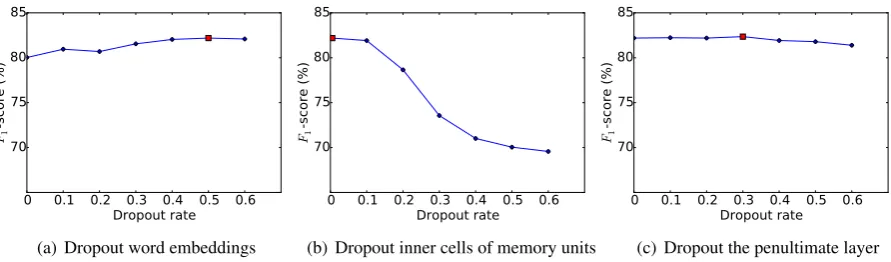
Figure 4: F1-scores versus dropout rates. We first evaluate the effect of dropout embeddings (a). Then
the dropout of the inner cells (b) and the penultimate layer (c) is tested with word embeddings being dropped out by 0.5.
4.2 Hyperparameters and Training Details This subsection presents hyperparameter tuning
for our model. We set word-embeddings to
be 200-dimensional; POS, WordNet hyponymy, and grammatical relation embeddings are 50-dimensional. Each channel of the LSTM network contains the same number of units as its source embeddings (either 200 or 50). The penultimate hidden layer is 100-dimensional. As it is not fea-sible to perform full grid search for all hyperpa-rameters, the above values are chosen empirically. We add `2 penalty for weights with coefficient 10−5, which was chosen by validation from the set {10−2,10−3,· · · ,10−7}.
We thereafter validate the proposed dropout strategies in Section 3.5. Since network units in different channels do not interact with each other during information propagation, we herein take one channel of LSTM networks to assess the ef-ficacy. Taking the word channel as an example, we first drop out word embeddings. Then with a fixed dropout rate of word embeddings, we test the effect of dropping out LSTM inner cells and the penultimate units, respectively.
We find that, dropout of LSTM units hurts the model, even if the dropout rate is small, 0.1, say (Figure 4b). Dropout of embeddings im-proves model performance by 2.16% (Figure 4a); dropout of the penultimate layer further improves by 0.16% (Figure 4c). This analysis also provides, for other studies, some clues for dropout in LSTM networks.
4.3 Results
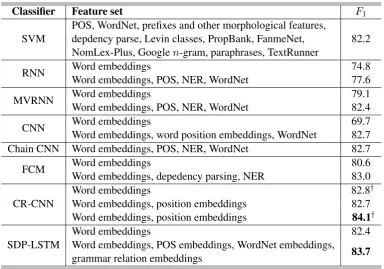
Table 4 compares our SDT-LSTM with other state-of-the-art methods. The first entry in the
ta-ble presents the highest performance achieved by traditional feature engineering. Hendrickx et al. (2009) leverage a variety of handcrafted features, and use SVM for classification; they achieve an
F1-score of 82.2%.
Neural networks are first used in this task in Socher et al. (2012). They build a recursive neural network (RNN) along a constituency tree for re-lation classification. They extend the basic RNN with matrix-vector interaction and achieve anF1
-score of 82.4%.
Zeng et al. (2014) treat a sentence as sequen-tial data and exploit the convolutional neural net-work (CNN); they also integrate word position information into their model. dos Santos et al. (2015) design a model called CR-CNN; they pro-pose a ranking-based cost function and elaborately diminish the impact of theOtherclass, which is not counted in the officialF1-measure. In this way,
they achieve the state-of-the-art result with theF1
-score of 84.1%. Without such special treatment, theirF1-score is 82.7%.
Yu et al. (2014) propose a Feature-rich Com-positional Embedding Model (FCM) for relation classification, which combines unlexicalized lin-guistic contexts and word embeddings. They achieve anF1-score of 83.0%.
Our proposed SDT-LSTM model yields anF1
-score of 83.7%. It outperforms existing compet-ing approaches, in a fair condition of softmax with cross-entropy error.
It is worth to note that we have also conducted two controlled experiments: (1) Traditional RNN without LSTM units, achieving an F1-score of
Classifier Feature set F1
SVM POS, WordNet, prefixes and other morphological features,depdency parse, Levin classes, PropBank, FanmeNet, 82.2 NomLex-Plus, Googlen-gram, paraphrases, TextRunner
RNN Word embeddingsWord embeddings, POS, NER, WordNet 74.877.6
MVRNN Word embeddingsWord embeddings, POS, NER, WordNet 79.182.4
CNN Word embeddingsWord embeddings, word position embeddings, WordNet 69.782.7
Chain CNN Word embeddings, POS, NER, WordNet 82.7
FCM Word embeddingsWord embeddings, depedency parsing, NER 80.683.0
CR-CNN Word embeddings 82.8
†
Word embeddings, position embeddings 82.7
Word embeddings, position embeddings 84.1†
[image:8.595.107.492.60.329.2]SDP-LSTM Word embeddingsWord embeddings, POS embeddings, WordNet embeddings, 82.483.7 grammar relation embeddings
Table 1: Comparison of relation classification systems. The “†” remark refers to special treatment for theOtherclass.
the effectiveness of LSTM and directionality in re-lation classification.
4.4 Effect of Different Channels
This subsection analyzes how different channels affect our model. We first used word embeddings only as a baseline; then we added POS tags, gram-matical relations, and WordNet hypernyms, re-spectively; we also combined all these channels into our models. Note that we did not try the latter three channels alone, because each single of them (e.g., POS) does not carry much information.
We see from Table 2 that word embeddings alone in SDP-LSTM yield a remarkable perfor-mance of 82.35%, compared with CNNs 69.7%, RNNs 74.9–79.1%, and FCM 80.6%.
Adding either grammatical relations or Word-Net hypernyms outperforms other existing meth-ods (data cleaning not considered here). POS tag-ging is comparatively less informative, but still boosts theF1-score by 0.63%.
We notice that, the boosts are not simply added when channels are combined. This suggests that these information sources are complementary to each other in some linguistic aspects. Nonethe-less, incorporating all four channels further pushes theF1-score to 83.70%.
Channels F1
Word embeddings 82.35
+POS embeddings (only) 82.98
+GR embeddings (only) 83.21
+WordNet embeddings (only) 83.03
+POS+GR+WordNet embeddings 83.70
Table 2: Effect of different channels.
5 Conclusion
In this paper, we propose a novel neural network model, named SDP-LSTM, for relation classifi-cation. It learns features for relation classifica-tion iteratively along the shortest dependency path. Several types of information (word themselves, POS tags, grammatical relations and WordNet hy-pernyms) along the path are used. Meanwhile, we leverage LSTM units for long-range infor-mation propagation and integration. We demon-strate the effectiveness of SDP-LSTM by evalu-ating the model on SemEval-2010 relation clas-sification task, outperforming existing state-of-art methods (in a fair condition without data clean-ing). Our result sheds some light in the relation classification task as follows.
relations.
• Classifying relation is a challenging task due to the inherent ambiguity of natural lan-guages and the diversity of sentence expres-sion. Thus, integrating heterogeneous lin-guistic knowledge is beneficial to the task.
• Treating the shortest dependency path as two sub-paths, mapping two different neural net-works, helps to capture the directionality of relations.
• LSTM units are effective in feature detec-tion and propagadetec-tion along the shortest de-pendency path.
Acknowledgments
This research is supported by the National Basic Research Program of China (the 973 Program) un-der Grant No. 2015CB352201 and the National Natural Science Foundation of China under Grant Nos. 61232015 and 91318301.
References
Michele Banko, Michael J. Cafarella, Stephen Soder-land, Matthew Broadhead, and Oren Etzioni. 2007.
Open information extraction for the web. In
Pro-ceedings of twentieth International Joint Conference on Artificial Intelligence, volume 7, pages 2670– 2676.
Yoshua Bengio, Aaron Courville, and Pierre Vincent. 2013. Representation learning: A review and new
perspectives. IEEE Transactions on Pattern
Analy-sis and Machine Intelligence, 35(8):1798–1828. Razvan C. Bunescu and Raymond J. Mooney. 2005.
A shortest path dependency kernel for relation
ex-traction. In Proceedings of the conference on
Hu-man Language Technology and Empirical Methods in Natural Language Processing, pages 724–731. Razvan Bunescu and Raymond Mooney. 2007.
Learn-ing to extract relations from the web usLearn-ing
mini-mal supervision. In Proceedings of the 45th
An-nual Meeting of the Association of Computational Linguistics, volume 45, pages 576–583.
Yun-Nung Chen, Dilek Hakkani-Tur, and Gokan Tur. 2014. Deriving local relational surface forms from dependency-based entity embeddings for
unsuper-vised spoken language understanding. In Spoken
Language Technology Workshop (SLT), 2014 IEEE, pages 242–247.
Massimiliano Ciaramita and Yasemin Altun. 2006. Broad-coverage sense disambiguation and informa-tion extracinforma-tion with a supersense sequence tagger. In Proceedings of the 2006 Conference on Empiri-cal Methods in Natural Language Processing, pages 594–602.
Marie-Catherine De Marneffe, Bill MacCartney, and Christopher D. Manning. 2006. Generating typed dependency parses from phrase structure parses. In Proceedings of the International Conference on Language Resources and Evaluation, volume 6, pages 449–454.
Cıcero Nogueira dos Santos, Bing Xiang, and Bowen Zhou. 2015. Classifying relations by ranking with
convolutional neural networks. In Proceedings of
53rd Annual Meeting of the Association for Compu-tational Linguistics, pages 626–634.
Javid Ebrahimi and Dejing Dou. 2015. Chain based
rnn for relation classification. InProceedings of the
2015 Conference of the North American Chapter of the Association for Computational Linguistics: Hu-man Language Technologies, pages 1244–1249.
Katrin Fundel, Robert K¨uffner, and Ralf Zimmer. 2007. Relexłrelation extraction using dependency
parse trees. Bioinformatics, 23(3):365–371.
Zhou GuoDong, Su Jian, Zhang Jie, and Zhang Min. 2005. Exploring various knowledge in relation
ex-traction. InProceedings of the 43rd Annual Meeting
on Association for Computational Linguistics, pages 427–434.
Kazuma Hashimoto, Makoto Miwa, Yoshimasa Tsu-ruoka, and Takashi Chikayama. 2013. Simple cus-tomization of recursive neural networks for semantic
relation classification. InProceedings of the 2013
Conference on Empirical Methods in Natural Lan-guage Processing, pages 1372–1376.
Iris Hendrickx, Su Nam Kim, Zornitsa Kozareva, Preslav Nakov, Diarmuid ´O S´eaghdha, Sebastian Pad´o, Marco Pennacchiotti, Lorenza Romano, and
Stan Szpakowicz. 2009. Semeval-2010 task
8: Multi-way classification of semantic relations
between pairs of nominals. In Proceedings of
the Workshop on Semantic Evaluations: Recent Achievements and Future Directions), pages 94–99.
Geoffrey E. Hinton, Nitish Srivastava, Alex Krizhevsky, Ilya Sutskever, and Ruslan R.
Salakhut-dinov. 2012. Improving neural networks by
preventing co-adaptation of feature detectors. arXiv
preprint arXiv:1207.0580.
Sepp Hochreiter. 1998. The vanishing gradient
problem during learning recurrent neural nets and
problem solutions. International Journal of
Un-certainty, Fuzziness and Knowledge-Based Systems, 6(02):107–116.
Nanda Kambhatla. 2004. Combining lexical, syntac-tic, and semantic features with maximum entropy
models for extracting relations. InProceedings of
Tomas Mikolov, Ilya Sutskever, Kai Chen, Greg S. Cor-rado, and Jeff Dean. 2013a. Distributed representa-tions of words and phrases and their
compositional-ity. InAdvances in Neural Information Processing
Systems, pages 3111–3119.
Tomas Mikolov, Wen-tau Yih, and Geoffrey Zweig. 2013b. Linguistic regularities in continuous space
word representations. In Proceedings of the 2013
Conference of the North American Chapter of the Association for Computational Linguistics: Human Language Technologies, pages 746–751.
Mike Mintz, Steven Bills, Rion Snow, and Dan Ju-rafsky. 2009. Distant supervision for relation
ex-traction without labeled data. InProceedings of the
Joint Conference of the 47th Annual Meeting of the ACL and the 4th International Joint Conference on Natural Language Processing of the AFNLP: Vol-ume 2-VolVol-ume 2, pages 1003–1011. Association for Computational Linguistics.
Lili Mou, Hao Peng, Ge Li, Yan Xu, Lu Zhang, and Zhi Jin. 2015. Discriminative neural sentence
modeling by tree-based convolution. arXiv preprint
arXiv:1504.01106.
Barbara Plank and Alessandro Moschitti. 2013. Em-bedding semantic similarity in tree kernels for
do-main adaptation of relation extraction. In
Proceed-ings of the 51st Annual Meeting of the Association for Computational Linguistics, pages 1498–1507. Richard Socher, Jeffrey Pennington, Eric H. Huang,
Andrew Y. Ng, and Christopher D. Manning. 2011. Semi-supervised recursive autoencoders for
predict-ing sentiment distributions. In Proceedings of the
Conference on Empirical Methods in Natural Lan-guage Processing, pages 151–161.
Richard Socher, Brody Huval, Christopher D. Man-ning, and Andrew Y. Ng. 2012. Semantic composi-tionality through recursive matrix-vector spaces. In
Proceedings of the 2012 Joint Conference on Empir-ical Methods in Natural Language Processing and Computational Natural Language Learning, pages 1201–1211.
Richard Socher, Andrej Karpathy, Quoc V. Le,
Christo-pher D. Manning, and Andrew Y. Ng. 2014.
Grounded compositional semantics for finding and
describing images with sentences. Transactions
of the Association for Computational Linguistics, 2:207–218.
Chang Wang and James Fan. 2014. Medical
rela-tion extracrela-tion with manifold models. In
Proceed-ings of the 52nd Annual Meeting of the Association for Computational Linguistics (Volume 1: Long Pa-pers), volume 1, pages 828–838.
Mengqiu Wang. 2008. A re-examination of
depen-dency path kernels for relation extraction. In
Pro-ceedings of the Third International Joint Conference on Natural Language Processing, pages 841–846.
Fei Wu and Daniel S. Weld. 2010. Open information
extraction using wikipedia. In Proceedings of the
48th Annual Meeting of the Association for Compu-tational Linguistics, pages 118–127.
Yan Xu, Ge Li, Lili Mou, and Yangyang Lu. 2014. Learning non-taxonomic relations on demand for
ontology extension. International Journal of
Soft-ware Engineering and Knowledge Engineering, 24(08):1159–1175.
Xuchen Yao and Benjamin Van Durme. 2014. Infor-mation extraction over structured data: Question
an-swering with freebase. InProceedings of the 52nd
Annual Meeting of the Association for Computa-tional Linguistics, pages 956–966.
Mo Yu, Matthew Gormley, and Mark Dredze. 2014. Factor-based compositional embedding models. In
NIPS Workshop on Learning Semantics.
Wojciech Zaremba and Ilya Sutskever. 2014. Learning
to execute. arXiv preprint arXiv:1410.4615.
Dmitry Zelenko, Chinatsu Aone, and Anthony Richardella. 2003. Kernel methods for relation
extraction. The Journal of Machine Learning
Re-search, 3:1083–1106.
Daojian Zeng, Kang Liu, Siwei Lai, Guangyou Zhou, and Jun Zhao. 2014. Relation classification via
convolutional deep neural network. InProceedings
of COLING 2014, the 25th International Confer-ence on Computational Linguistics: Technical
Pa-pers, pages 2335–2344.