Database Anomalous Activities: Detection and Quantification
Elisa Costante
1, Sokratis Vavilis
1, Sandro Etalle
1, Jerry den Hartog
1, Milan Petkovi´c
1,2and Nicola
Zannone
11Eindhoven University of Technology, Den Dolech 2, Eindhoven, The Netherlands 2Philips Research Europe, High Tech Campus 34, Eindhoven, The Netherlands
{e.costante, s.vavilis, s.etalle, j.d.hartog, m.petkovic, n.zannone}@tue.nl
Keywords: Data Misuse, Data Leakage, Database Activity Monitoring, Data Leakage Quantification.
Abstract: The disclosure of sensitive data to unauthorized entities is a critical issue for organizations. Timely detection of data leakage is crucial to reduce possible damages. Therefore, breaches should be detected as early as possible, e.g., when data are leaving the database. In this paper, we focus on data leakage detection by monitoring database activities. We present a framework that automatically learnsnormaluser behavior, in terms of database activities, and detects anomalies as deviation from such behavior. In addition, our approach explicitly indicates the root cause of an anomaly. Finally, the framework assesses the severity of data leakages based on the sensitivity of the disclosed data.
1
INTRODUCTION
Data leakage, i.e. the (un)intentional distribution of sensitive data to an unauthorized entity (Shabtai et al., 2012), has a significant impact on businesses in terms of money, reputation or legal issues. Data and information represent a core asset for many or-ganizations and thus they should be protected from unauthorized disclosure.
Timely detection of data leakage is important to reduce costs and comply with legislation. For in-stance, the new EU data protection regulation imposes strict breach notification policies, requiring organiza-tions to notify data protection authorities of a breach within 24 hours (Information Age, 2012).
In this paper we focus on data leakage detection by monitoring database activities in terms of SQL transactions. Observing SQL activities enables for a prompt reaction by allowing early detection of a leak-age, i.e. when the information leaves the database.
In this paper we tackle three main problems. First, despite the considerable amount of research in the area (Fonseca et al., 2007; Kamra et al., 2007; Roich-man and Gudes, 2008; Wu et al., 2009; BockerRoich-mann et al., 2009; Mathew and Petropoulos, 2010; Gafny et al., 2010; Santos et al., 2012), there are still sev-eral problems with current SQL-based solutions for database leakage detection. The main problem of such solutions is their black-box approach: when a potential leakage occurs, an alarm with adeviation
degree, an anomaly score, or a probability valueis raised. Unfortunately, these values are not sufficient to explain the root cause of a violation and offer lit-tle help to seal the leakage. Second, current solutions have a high false positive rate and their validation has been limited to controlled environments: in a real sys-tem (with thousands of transactions per minute) even a 5% of false positive rate is unacceptable. Finally, existing solutions are not able to distinguish leakages based on the sensitivity of the data leaked.
The contribution of our solution is twofold:
• We propose a data-leakage detection model that i) automatically learnsnormal behaviorby observ-ing database activities and flags deviations from such behavior as anomalies; and ii) explicitly in-dicates the root cause of an anomaly, e.g. whether the anomaly depends on the tables, data values or data quantity accessed. The monitoring is done by tapping into the communication with the database server to observe which (SQL) queries users sub-mit, and what data go back and forward.
• Once an anomaly is detected, we propose to quan-tify the leakage based on the sensitivity of the data involved. We use a data model to represent the se-mantics of information and the relations between different pieces of information. To quantify data leakage, concepts and instances in the model are annotated with sensitivity values representing the cost of their unauthorized disclosure.
2
MOTIVATING SCENARIO
To protect data from unauthorized disclosure, ac-cess control solutions are usually employed. Despite this, incidents leaking sensitive information still hap-pen. An example is the data breach happened at the Samaritan Hospital, where two nurses illegitimately accessed and modified medical records1. Access con-trol is not enough to protect from data leakage either because in some domains such as healthcare, certain actions cannot be blocked (e.g., accessing patient’s medical records in case of emergency), or because it is not possible to specify fine-grained access control policies (e.g., not allow users to access more than a certain amount of data records).
As an example, assume the information system of a hospital is only accessed by its employees. In addi-tion, doctors and nurses can access Electronic Health Record (EHR) of all the patients of the hospital. No-tice that, such an assumption is very common in hos-pitals where data availability is crucial to emergen-cies. Bob, a geriatrician at the hospital, could easily engage in behaviors that can be classified as threats (TTT). For example, TTT111) Bob might look for EHR of
his colleagues to check if someone has AIDS; orTTT222)
he might know that a famous singer has been hos-pitalized for a minor surgery, and look for his room number to pay him a visit later; orTTT333) he might read
the EHRs of teenagers while, being a geriatrician, he should only access EHRs of elderly patients.
Some threats, however, might be more serious than others. For example, let assume that a doc-tor usually accesses 20 EHRs per day. Suppose that one day TTT444) the doctor reads 500 records
contain-ing theaddressof patients at the hospital, orTTT555) 100
records containing thediseasesuffered by the patients (amongst which there are AIDS or mental disorder). Both situations represent a threat because of the un-usual number of records that has been accessed. How-ever, the second threat should be considered more se-vere because more sensitive data are at risk.
3
RELATED WORK
In this section we discuss the existing Data Leak-age Prevention (DLP) solutions. First, we present an overview of solutions general to DLP, and then we dive into solutions specific to Database Activity Mon-itoring (DAM), the area where we place our contribu-tion. Finally, we discuss the main limitations of the available DAM solutions.
1 http://www.timesunion.com/local/article/Letters-warn-of-access-to-files-4340178.php
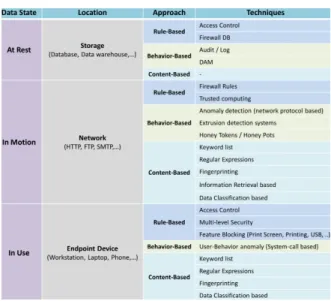
Table 1: General DLP Solutions Overview.
General DLP Solutions Data leakage can happen
at a different location within an organization, e.g. at a database level, at a network level or at workstation level. DLP systems differ according to which part of an organization perimeter they aim to protect from leakages. Usually, data inside an organization can be in three different states namely,data-in-use, data-in-motion, and data-at-rest. Data-in-use are data cur-rently in process, located at network endpoints such as workstations, laptops and other devices; data-in-motion are data moving through the network that may leave the organization perimeter (e.g., data transmit-ted over FTP or e-mail); data-at-rest are data resid-ing in repositories such as database servers. Table 1 presents an overview of the existing DLP solutions categorized with respect to data states. For example, in (Carvalho and Cohen, 2007) the focus is essentially on data-in-motion and specifically on the e-mail pro-tocol.
DLP solutions can also differ for the approach used to detect a leakage. The approaches that are usually adopted are rule-based,behavior-based and
content-based. In the rule-based approach a set of predefined policies are used to define which oper-ations are allowed or not. Such an approach is used, e.g., in access control mechanisms and fire-walls, where a set of rules regulates the access to resources and data. In the behavior-based approach the permitted usage of data is defined by observing users’ behavior: DAM technologies apply this ap-proach to detect leakage of data-at-rest. With re-spect to data-in-motion, network behavior monitor-ing, such as anomaly detection and extrusion detec-tion systems (Koch, 2011), or Honeypots (Spitzner,
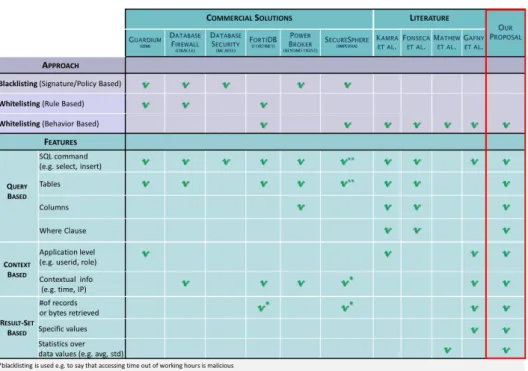
Table 2: Specific DAM Solutions Overview.
2003) can be used to detect unusual behavior. Fi-nally, the content-based approach to DLP directly fo-cuses on data values. Such an approach includes the use of keywords, regular expressions, text clas-sification (Hart et al., 2011), and information re-trieval (Gessiou et al., 2011; G´omez-Hidalgo et al., 2010) to detect the presence of sensitive data leaving the organization perimeter.
Commercial DLP systems usually offer a more holistic solution by integrating several of the afore-mentioned approaches. For instance, MyDLP (http://www.mydlp.com/), focuses on both data-in-use and data-in-motion. In particular, MyDLP moni-tors the network traffic (data-in-motion) to detect data leakage using content-based techniques. In addition, it regulates the usage of data-use by controlling in-put/output interfaces of workstations.
Specific DAM Solutions DAM provides a solution
to detect unusual and unauthorized access to database records at a very early stage. Several database activ-ity monitoring tools are available both in the academic and in the business sectors. Table 2 shows a compar-ison between currently available solutions. The com-parison is done over two dimensions: theapproach
andfeaturesused to detect data leakages.
The approach to detect leakages can be of three types: blacklisting,rule-based whitelistingand
behavior-based whitelisting. The blacklisting ap-proach detect leakages based onunauthorizedactions
defined on the shapeof well-known threats or unde-sired behavior. In contrast, the whitelisting approach detect leakages as deviations fromauthorizedactions. The ways authorized actions are defined differs be-tween rule-based and behavior-based whitelisting. In the first approach authorized actions have to be man-ually specified in rules, while with the latter approach the authorized actions are automatically learned by observing user database activities.
Featurescan be defined as the aspects of database transactions taken into account while defining rules and policies (blacklisting and rule-based whitelist-ing), or while learning normal behavior profiles (behavior-based whitelisting). Features can be clas-sified into query-based (related to the syntax of the SQL query),context-based(related to contextual in-formation, e.g. where, from whom and when the SQL query has been submitted), andresult-set based (re-lated to the data retrieved by a SQL query).
As shown in Table 2, most of the commercial so-lutions (with the exclusion of FortiDB and Secure-Sphere) use rules (black or white listing) to define unauthorized behavior that may indicate data leakage. In contrast, solutions originating from the academia mostly use a behavior-based whitelisting. With this approach three main steps are necessary to build a de-tection system: i) define the features that represent a normal behavior profile; ii) learn profiles by observ-ing database activities; and iii) detect anomalies by catching deviations from such profiles. Existing
so-lutions applying this approach mainly differ for the feature set used to profile users, for the algorithms used to learn normal behavior, and for the accuracy (in terms of false positive rates) of the detection model. For example, in (Kamra et al., 2007)normal profiles
are built using purely query-based features, i.e. the
tableandcolumns accessed by a user role; when a new query arrives, it is matched against the profiles. In case a mismatch between the predicted role and the actual role of the user performing the query exist, an alarm is raised. Another query-based approach is the one in (Fonseca et al., 2007), wherenormal behavior
profiles are built based on a graph of valid sequence of queries. With this model if an attacker executes valid queries but in an incorrect order (not in the paths of the graph) an anomaly flag is raised.
At the best of our knowledge the work in (Mathew and Petropoulos, 2010) is the only one to build nor-mal profilesby using result-set based features. Here, therecordsretrieved by SQL queries are modeled in such a way that it is possible to know what data val-ues a user usually accesses. Note that also FortiDb and SecureSphere use result-set based features such as thenumber of recordretrieved. However, in those solutions the values of such features have to be de-fined a-priori and are not learned by observing users’ activities. Finally, Gafny et al. (2010) propose to add context-based features such as who submitted the query (userid), at what time (timestamp), and from which location (IP address) to build behavior profiles.
Limitations Existing approaches do not completely
solve the problem of data leakage. For instance, blacklisting approaches are not able to detect certain types of leakage if they are not known in advance. Whitelisting partially solves this problem since, by defining thenormal behavior of users, it allows the detection of both known and unknown types of leak-age. However, in the rule-based whitelisting, an ex-tensive knowledge of internal processes and autho-rizations is required to define policies of authorized actions. Behavior-based whitelisting does not require such a knowledge and it is more time-effective since authorized behavior is learned by observing users’ in-teractions with the database. The main challenge with behavior-based whitelisting is to identify the features for profiling thenormal behaviorthat leads to the best accuracy, i.e. reduces the number of false positives.
With regard to the features, a more extended fea-ture set would intuitively enable the construction of more detailed user profiles, leading to better detec-tion results. Indeed, a pure query-based approach may leave undetected situation where a malicious user performs a valid query, though accessing values
for which he should have no interest. For example, with such approach the treatsTTT111,TTT222, and TTT333
intro-duced in Section 2 would not be detected, since the doctor is performing a valid query for his role.
Using result-set features partially solves the pre-vious problem, allowing the detection of situations where the SQL query is legitimate, but the data val-ues accessed are anomalous. Therefore, it is able to detect those threats, which are missed by only con-sidering the query-based feature. However, looking at data values in isolation is not sufficient. Indeed, it does not allows the detection and discrimination of threats like TTT444 andTTT555 where the anomaly involves
not only the data values retrieved by a query, but also their amount and sensitivity.
4
APPROACH
Based on literature review in Section 3, whitelist-ing approaches are more suitable for database activ-ity monitoring because they are able to detect both known and unknown data leakage types. In addition, especially in complex and dynamic environments, the definition of authorization rules might require a large amount of time and resources that the automatic self-learning behavior-based approach can save.
For this reason, we propose a framework that uses a behavior-based whitelisting approach to learn nor-mal behavior profiles and to detect deviations from such profiles as anomalies. Intuitively, if behavior profiles are built by combining query, result-set and context based features, it is possible to detect a wider set of data leakage threats. To this end, our approach builds profiles that encompass these different types of features. In addition, our approach is white-box in the sense that it allows the identification of the root causes of a data leakage and thus the quantification of its severity based on the sensitivity of the leaked in-formation. This makes it possible to prioritize alarms and therefore to reduce the impact of false positives. Furthermore, we intend to perform the detection of anomaliesper set of and not per single query. This way, we can detect situations where a single query is not malicious, but nqueries together are (e.g.,TTT444
might be carried out by several small queries instead of a single one which might be more suspicious).
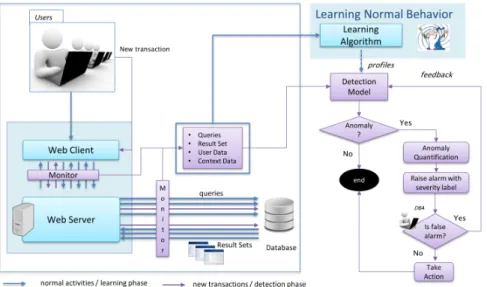
Figure 1 presents a general overview of our frame-work. Our solution is divided in two distinct phases: learning and detection. During the learning phase, users’ activities, in terms of SQL queries to the database, are monitored for a certain period. Such period should be long enough to capture normal database access patterns of each user. The data
col-Figure 1: Detection Framework Description.
lected during this period are used to learnnormal be-havior profiles. Such profiles are fine-grain and user-based in the sense that they are able to model infor-mation such as which user is accessing which tables and columns, which values is retrieving, at what time and from which location. Profiles are generated with a learning algorithm that is able to deal with flows of large amount of data. Note that in this phase anoma-lous behavior might be already part of the data col-lected, e.g., a malicious user is already operating. To deal with such situation we apply outlier detection techniques to highlightanomaloustransactions before the learning, to analyze and possibly discard them from the learning.
Once profiles have been defined, they are incorpo-rated in a detection model and the detection phase can take place. During detection, each new transaction of a useru is analyzed and matched against his profile. If the transaction does not match the user’s profile, an anomaly alarm is raised. The alarm clearly states why the transaction does not match the user profile, e.g. because he is accessing an unusual table, or at unusual time, or accessing unusual amount of data.
Detected anomalies are then further analyzed and labeled with a severity degree. The severity degree depends on the sensitivity of the data involved in the transaction. To measure the sensitivity we employ a data model that is specific to the application domain. The data model provides semantic information about the relationships (e.g., data hierarchy, inference) be-tween pieces of information. Finally, the data model is annotated with the sensitivity, necessary for the quantification.
As an example of our quantification approach we use threat TTT444 (Section 2). Figure 2 shows an
ex-Figure 2: Data Model Example.
ample of data model for healthcare domains. Blue nodes represent the type of information (e.g., demo-graphic or medical data), while green nodes represent different instances of a certain type of information (e.g., personal e-mail or paracetamol medication). We make this distinction, as the sensitivity is defined both in terms of the information type and the value.
Each node in the model is annotated with a sen-sitivity value which represents the cost of its disclo-sure. Note that in cases where sensitivity is not ex-plicitly defined, it is propagated downwards through the data hierarchy. For instance, prescription inher-its the sensitivity ofmedical data. Dashed lines rep-resent inference relationships between the instances, along with the probability that the disclosure of a piece of information makes it possible to infer another piece of information. As an example, a patient treated withAnti-RetroViral(ARV)is most probably infected by theHIVvirus. When the sensitivity of an instance is not explicitly defined, then it is calculated as the weighted average of the sensitivities of all the inferred instances. For example, the sensitivity of information
aboutParacetamolis calculated as 34, while the sen-sitivity ofTamifluis explicitly set to 60. By utilizing such annotated data model we i) map the data values accessed by the anomalous query to the data model; and ii) measure the severity of the anomaly.
Once an anomaly is detected and evaluated, it has to be analyzed by a security officer to determine whether it is a real or a false alarm. In the first case, he can take the necessary actions, while in case of a false alarm a feedback is sent back to the detection model, so that the system can automatically learn from its own mistakes and thus reduce the false positive rate.
Note that the proposed solution is not only use-ful for leakage detection, but also for accountability purposes. Moreover, the monitoring and analysis of how data is actually accessed can help in discovering access patterns that are allowed but undesired; in this case security officers might act on the access policies to solve the problem.
5
CONCLUSION
Prompt detection of data leakages is essential to reduce the damages they can cause to an organization. Data leakages can be detected by observing anomalies in the way data is accessed within the organization perimeter. Focusing the analysis on database activi-ties improves the chances of detecting the leakage at a very early stage. In this paper we proposed a DAM solution to detect anomalous database activities and to quantify them according to the sensitivity of the data leaked.
Our aim is to further develop the proposed frame-work, and to validate it by the means of extensive tests on real data, coming from different operational envi-ronments. The main goal of the validation phase is to show that the system is able to detect a wide range of data leakage attacks, while keeping a low rate of false positive. We are testing our approach in collab-oration with an industrial partner in the area of service management. Preliminary results confirm that our ap-proach improves performance, in terms of false pos-itive, if compared with other solutions on the same dataset.
ACKNOWLEDGEMENTS
This work has been partially funded by the THeCS project in the Dutch National COMMIT program.
REFERENCES
Bockermann, C., Apel, M., and Meier, M. (2009). Learn-ing SQL for database intrusion detection usLearn-ing context-sensitive modelling. InDetection of Intrusions and Mal-ware, and Vulnerability Assessment, LNCS 5587, pages 196–205. Springer.
Carvalho, V. R. and Cohen, W. W. (2007). Preventing infor-mation leaks in email. InProceedings of SIAM Interna-tional Conference on Data Mining.
Fonseca, J., Vieira, M., and Madeira, H. (2007). Integrated intrusion detection in databases. InDependable Comput-ing, LNCS 4746, pages 198–211. Springer.
Gafny, M., Shabtai, A., Rokach, L., and Elovici, Y. (2010). Detecting data misuse by applying context-based data linkage. InProceedings of Workshop on Insider Threats, pages 3–12. ACM.
Gessiou, E., Vu, Q. H., and Ioannidis, S. (2011). IRILD: an Information Retrieval based method for Information Leak Detection. InProceedings of European Conference on Computer Network Defense, pages 33–40. IEEE. G´omez-Hidalgo, J. M., Martın Abreu, J. M., Nieves, J.,
San-tos, I., Brezo, F., and Bringas, P. G. (2010). Data leak pre-vention through named entity recognition. In Proceed-ings of International Conference on Social Computing, pages 1129–1134. IEEE.
Hart, M., Manadhata, P., and Johnson, R. (2011). Text clas-sification for data loss prevention. InPrivacy Enhancing Technologies, LNCS 6794, pages 18–37. Springer. Information Age (2012). New EU data laws to include 24hr
breach notification.
Kamra, A., Terzi, E., and Bertino, E. (2007). Detecting anomalous access patterns in relational databases. The VLDB Journal, 17(5):1063–1077.
Koch, R. (2011). Towards next-generation intrusion detec-tion. InProceedings of International Conference on Cy-ber Conflict, pages 1–18. IEEE.
Mathew, S. and Petropoulos, M. (2010). A data-centric ap-proach to insider attack detection in database systems. InRecent Advances in Intrusion Detection, LNCS 6307, pages 382–401. Springer.
Roichman, A. and Gudes, E. (2008). DIWeDa - Detecting Intrusions in Web Databases. InData and Applications Security XXII, LNCS 5094, pages 313–329. Springer. Santos, R., Bernardino, J., Vieira, M., and Rasteiro, D.
(2012). Securing Data Warehouses from Web-Based Intrusions. In Web Information Systems Engineering, LNCS 7651, pages 681–688. Springer.
Shabtai, A., Elovici, Y., and Rokach, L. (2012). A Sur-vey of Data Leakage Detection and Prevention Solutions. SpringerBriefs in Computer Science. Springer.
Spitzner, L. (2003). Honeypots: Catching the insider threat. InProceedings of Computer Security Applications Con-ference, pages 170–179. IEEE.
Wu, G., Osborn, S., and Jin, X. (2009). Database intru-sion detection using role profiling with role hierarchy. InSecure Data Management, LNCS 5776, pages 33–48. Springer.