Language Models as Representations for Weakly-Supervised NLP Tasks
Fei Huang and Alexander Yates Temple University
Broad St. and Montgomery Ave. Philadelphia, PA 19122 [email protected]
Arun Ahuja and Doug Downey Northwestern University
2133 Sheridan Road Evanston, IL 60208
[email protected] [email protected]
Abstract
Finding the right representation for words is critical for building accurate NLP systems when domain-specific labeled data for the task is scarce. This paper investigates guage model representations, in which lan-guage models trained on unlabeled corpora are used to generate real-valued feature vec-tors for words. We investigate ngram mod-els and probabilistic graphical modmod-els, includ-ing a novel lattice-structured Markov Random Field. Experiments indicate that language model representations outperform traditional representations, and that graphical model rep-resentations outperform ngram models, espe-cially on sparse and polysemous words.
1 Introduction
NLP systems often rely on hand-crafted, carefully engineered sets of features to achieve strong perfor-mance. Thus, a part-of-speech (POS) tagger would traditionally use a feature like, “the previous token isthe” to help classify a given token as a noun or adjective. For supervised NLP tasks with sufficient domain-specific training data, these traditional fea-tures yield state-of-the-art results. However, NLP systems are increasingly being applied to texts like the Web, scientific domains, and personal commu-nications like emails, all of which have very differ-ent characteristics from traditional training corpora. Collecting labeled training data for each new target domain is typically prohibitively expensive. We in-vestigate representations that can be applied when domain-specific labeled training data is scarce.
An increasing body of theoretical and empirical evidence suggests that traditional, manually-crafted
features limit systems’ performance in this setting for two reasons. First, feature sparsity prevents sys-tems from generalizing accurately to words and fea-tures not seen during training. Because word fre-quencies are Zipf distributed, this often means that there is little relevant training data for a substantial fraction of parameters (Bikel, 2004), especially in new domains (Huang and Yates, 2009). For exam-ple, word-type features form the backbone of most POS-tagging systems, but types like “gene” and “pathway” show up frequently in biomedical liter-ature, and rarely in newswire text. Thus, a classifier trained on newswire data and tested on biomedical data will have seen few training examples related to sentences with features “gene” and “pathway” (Ben-David et al., 2009; Blitzer et al., 2006).
Further, because words are polysemous, word-type features prevent systems from generalizing to situations in which words have different meanings. For instance, the word type “signaling” appears pri-marily as a present participle (VBG) in Wall Street Journal (WSJ) text, as in, “Interest rates rose, sig-naling that . . . ” (Marcus et al., 1993). In biomedical text, however, “signaling” appears primarily in the phrase “signaling pathway,” where it is considered a noun (NN) (PennBioIE, 2005); this phrase never appears in the WSJ portion of the Penn Treebank (Huang and Yates, 2010a).
Our response to these problems with traditional NLP representations is to seek new representations that allow systems to generalize more accurately to previously unseen examples. Our approach depends on the well-known distributional hypothesis, which states that a word’s meaning is identified with the contexts in which it appears (Harris, 1954; Hin-dle, 1990). Our goal is to develop probabilistic
guage models that describe the contexts of individ-ual words accurately. We then construct represen-tations, or mappings from word tokens and types to real-valued vectors, from these language models. Since the language models are designed to model words’ contexts, the features they produce can be used to combat problems with polysemy. And by careful design of the language models, we can limit the number of features that they produce, controlling how sparse those features are in training data.
In this paper, we analyze the performance of language-model-based representations on tasks where domain-specific training data is scarce. Our contributions are as follows:
1. We introduce a novel factorial graphical model representation, a Partial-Lattice Markov Random Field (PL-MRF), which is a tractable variation of a Factorial Hidden Markov Model (HMM) for lan-guage modeling.
2. In experiments on POS tagging in a domain adap-tation setting and on weakly-supervised informa-tion extracinforma-tion (IE), we quantify the performance of representations derived from language models. We show that graphical models outperform ngram rep-resentations. The PL-MRF representation achieves a state-of-the-art 93.8% accuracy on the POS tagging task, while the HMM representation improves over the ngram model by 10% on the IE task.
3. We analyze how the performance of the different representations varies due to the fundamental chal-lenges of sparsity and polysemy.
The next section discusses previous work. Sec-tions 3 and 4 present the existing representaSec-tions we investigate and the new PL-MRF, respectively. Sec-tions 5 and 6 describe our two tasks and the results of using our representations on each of them. Sec-tion 7 concludes.
2 Previous Work
There is a long tradition of NLP research on rep-resentations, mostly falling into one of four cate-gories: 1) vector space models of meaning based on document-level lexical cooccurrence statistics (Salton and McGill, 1983; Turney and Pantel, 2010; Sahlgren, 2006); 2) dimensionality reduction tech-niques for vector space models (Deerwester et al., 1990; Honkela, 1997; Kaski, 1998; Sahlgren, 2005; Blei et al., 2003; V¨ayrynen et al., 2007); 3) using clusters that are induced from distributional similar-ity (Brown et al., 1992; Pereira et al., 1993;
Mar-tin et al., 1998) as non-sparse features (Lin and Wu, 2009; Candito and Crabbe, 2009; Koo et al., 2008; Zhao et al., 2009); 4) and recently, language models (Bengio, 2008; Mnih and Hinton, 2009) as represen-tations (Weston et al., 2008; Collobert and Weston, 2008; Bengio et al., 2009), some of which have al-ready yielded state of the art performance on domain adaptation tasks (Huang and Yates, 2009; Huang and Yates, 2010a; Huang and Yates, 2010b; Turian et al., 2010) and IE (Ahuja and Downey, 2010; Downey et al., 2007b). In contrast to this previous work, we de-velop a novel Partial Lattice MRF language model that incorporates a factorial representation of latent states, and demonstrate that it outperforms the pre-vious state-of-the-art in POS tagging in a domain adaptation setting. We also analyze the novel PL-MRF representation on an IE task, and several repre-sentations along the key dimensions of sparsity and polysemy.
Most previous work on domain adaptation has fo-cused on the case where some labeled data is avail-able in both the source and target domains (Daum´e III, 2007; Jiang and Zhai, 2007; Daum´e III and Marcu, 2006; Finkel and Manning, 2009; Dredze et al., 2010; Dredze and Crammer, 2008). Learn-ing bounds are known (Blitzer et al., 2007; Man-sour et al., 2009). Daum´e III et al. (2010) use semi-supervised learning to incorporate labeled and unla-beled data from the target domain. In contrast, we investigate a domain adaptation setting where no la-beled data is available for the target domain.
3 Representations
A representation is a set of features that describe instances for a classifier. Formally, let X be an instance set, and let Z be the set of labels for a classification task. A representation is a function
R:X → Y for some suitable feature spaceY (such asRd). We refer to dimensions ofYas features, and for an instancex∈ X we refer to values for partic-ular dimensions ofR(x)as features ofx.
3.1 Traditional POS-Tagging Representations
Representation Feature
TRAD-R ∀w1[xi=w]
∀s∈Suffixes1[xiends withs]
1[xi contains a digit]
NGRAM-R ∀w0,w00P(w0ww00)/P(w)
HMM-TOKEN-R ∀k1[yi∗=k]
HMM-TYPE-R ∀kP(y=k|x=w)
I-HMM-TOKEN-R ∀j,k1[yi,j∗=k]
BROWN-TOKEN-R ∀j∈{−2,−1,0,1,2}
∀p∈{4,6,10,20}prefix(yi+j, p)
BROWN-TYPE-R ∀pprefix(y, p)
LATTICE-TOKEN-R ∀j,k1[yi,j∗=k]
[image:3.612.70.303.57.252.2]LATTICE-TYPE-R ∀kP(y=k|x=w)
Table 1: Summary of features provided by our repre-sentations. ∀a1[g(a)] represents a set of boolean
fea-tures, one for each value of a, where the feature is true iff g(a) is true. xi represents a token at position
i in sentence x, wrepresents a word type, Suffixes =
{-ing,-ogy,-ed,-s,-ly,-ion,-tion,-ity},k(andk) represents a value for a latent state (set of latent states) in a latent-variable model,y∗represents the optimal setting of latent statesyforx,yi is the latent variable forxi, andyi,jis
the latent variable forxiat layerj. prefix(y,p) is thep
-length prefix of the Brown clustery.
wordxiin the sentence. Dimensions for each latent
vector include indicators for the word type ofxiand
various orthographic features. Table 1 presents the full list of features in TRAD-R. Since our IE task classifies word types rather than tokens, this base-line is not appropriate for that task. Below, we de-scribe how we can learn representationsRby using a variety of language models, for use in both our IE and POS tagging tasks. All representations for POS tagging inherit the features from TRAD-R; all repre-sentations for IE do not.
3.2 Ngram Representations
N-gram representations model a word type w in terms of the n-gram contexts in which w appears in a corpus. Specifically, for word w we generate the vectorP(w0ww00)/P(w), the conditional prob-ability of observing the word sequencew0to the left andw00 to the right ofw. The experimental section describes the particular corpora and language mod-eling methods used for estimating probabilities.
3.3 HMM-based Representations
In previous work, we have implemented several representations based on HMMs (Rabiner, 1989), which we used for both POS tagging (Huang and Yates, 2009) and IE (Downey et al., 2007b). An HMM is a generative probabilistic model that gen-erates each wordxi in the corpus conditioned on a
latent variableyi. Eachyi in the model takes on
in-tegral values from1toK, and each one is generated by the latent variable for the preceding word, yi−1.
The joint distribution for a corpusx= (x1, . . . , xN)
and a set of state vectors y = (y1, . . . , yN) is
given by: P(x,y) = QiP(xi|yi)P(yi|yi−1).
Us-ing Expectation-Maximization (EM) (Dempster et al., 1977), it is possible to estimate the distributions forP(xi|yi)andP(yi|yi−1)from unlabeled data.
We construct two different representations from HMMs, one for POS tagging and one for IE. For POS tagging, we use the Viterbi algorithm to pro-duce the optimal settingy∗of the latent states for a given sentencex, or y∗ = arg maxyP(x,y). We use the value ofyi∗as a new feature forxithat
repre-sents a cluster of distributionally-similar words. For IE, we require features for word typesw, rather than tokens xi. We use the K-dimensional vector that
represents the distribution P(y|x = w) as the fea-ture vector for word type w. This set of features represents a “soft clustering” ofwinto K different clusters. We refer to these representations as HMM-TOKEN-R and HMM-TYPE-R, respectively.
Because HMM-based representations offer a small number of discrete states as features, they have a much greater potential to combat feature sparsity than do ngram models. Furthermore, for token-based representations, these models can potentially handle polysemy better than ngram language models by providing different features in different contexts. We also compare against a variation of the HMM from our previous work (Huang and Yates, 2010a), henceforth HY10. This model independently trains
M separate HMM models on the same corpus, ini-tializing each one randomly. We can then use the Viterbi-optimal decoded latent state of each inde-pendent HMM model as a separate feature for a to-ken. We refer to this language model as an I-HMM, and the representation as I-HMM-TOKEN-R.
each type is restricted to having exactly one latent state that may generate it. Brown et al. describe a greedy agglomerative clustering algorithm for train-ing this model on unlabeled text. Followtrain-ing Turian et al. (2010), we use Percy Liang’s implementation of this algorithm for our comparison, and we test runs with 100, 320, and 1000 clusters. We use fea-tures from these clusters identical to Turian et al.’s.1 Turian et al. have shown that Brown clusters match or exceed the performance of neural network-based language models in domain adaptation experiments for named-entity recognition, as well as in-domain experiments for NER and chunking.
4 A Novel Lattice Language Model Representation
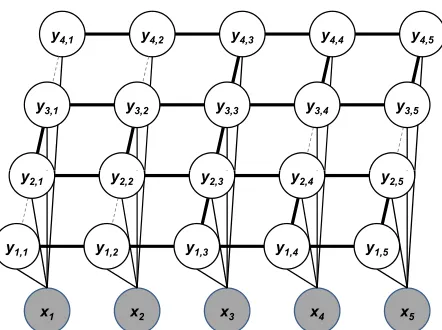
[image:4.612.317.538.50.215.2]Our final language model is a novel latent-variable language model with rich latent structure, shown in Figure 1. The model contains a lattice ofM×N la-tent states, whereNis the number of words in a sen-tence and M is the number of layers in the model. We can justify the choice of this model from a lin-guistic perspective as a way to capture the multi-dimensional nature of words. Linguists have long argued that words have many different features in a high dimensional space: they can be separately de-scribed by part of speech, gender, number, case, per-son, tense, voice, aspect, mass vs. count, and a host of semantic categories (agency, animate vs. inani-mate, physical vs. abstract, etc.), to name a few (Sag et al., 2003). Our model seeks to capture a multi-dimensional representation of words by creating a separate layer of latent variables for each dimension. The values of theM layers of latent variables for a single word can be used as M distinct features in our representation. The I-HMM attempts to model the same intuition, but unlike a lattice model the I-HMM layers are entirely independent, and as a re-sult there is no mechanism to enforce that the layers model different dimensions. Duh (2005) previously used a 2-layer lattice for tagging and chunking, but in a supervised setting rather than for representation learning.
Let Cliq(x,y) represent the set of all maximal cliques in the graph of the MRF model forxandy.
1
Percy Liang’s implementation is available at
http://metaoptimize.com/projects/wordreprs/. Turian et al. also tested a run with 3200 clusters in their experiments, which we have been training for months, but which has not finished in time for publication.
y4,1
y3,1
y
y4,2
y3,2
y
y4,3
y3,3
y
y4,4
y3,4
y
y4,5
y3,5
y
x1 y2,1
y1,1
x2 y2,2
y1,2
x3 y2,3
y1,3
x4 y2,4
y1,4
x5 y2,5
y1,5
Figure 1: The Partial Lattice MRF (PL-MRF) Model for a 5-word sentence and a 4-layer lattice. Dashed gray edges are part of a full lattice, but not the PL-MRF.
Expressing the lattice model in log-linear form, we can write the marginal probabilityP(x) of a given sentencexas:
X
y
Q
c∈Cliq(x,y)score(c,x,y)
P x0,y0
Q
c∈Cliq(x0,y0)score(c,x0,y0)
where score(c,x,y) = exp(θc ·fc(xc,yc)). Our
model includes parameters for transitions between two adjacent latent variables on layerj: θtrans
i,s,i+1,s0,j
foryi,j = sandyi+1,j =s0. It also includes
obser-vation parameters for latent variables and tokens, as well as for pairs of adjacent latent variables in differ-ent layers and their tokens:θobs
i,j,s,wandθobsi,j,s,j+1,s0,w
foryi,j =s,yi,j+1=s0, andxi=w.
Computationally, the lattice MRF is preferable to a na¨ıve Factorial HMM (Ghahramani and Jordan, 1997) representation, which would require O(2M)
parameters for an M-layer model. However, ex-act training and inference in supervised settings are still intractable for this model (Sutton et al., 2007), and thus it has not yet been explored as a language model, which requires even more difficult, unsuper-vised training. Training is intractable in part because of the difficulty in enumerating and summing over the exponentially-many configurationsyfor a given x. We address this difficulty in two ways: by modi-fying the model, and by modimodi-fying the training pro-cedure.
4.1 Partial Lattice MRF
certain edges between latent layers of the model (dashed gray edges in Figure 1). Let c = bN2c, where N is the length of the sentence. If i < c
andj is odd, or if j is even and i > c, we delete edges between yi,j andyi,j+1. The same lattice of
nodes remains, but fewer edges and paths. A cen-tral “trunk” ati = c connects all layers of the lat-tice, and branches from this trunk connect either to the branches in the layer above or the layer below (but not both). The result is a model that retains most2 of the edges of the full model. Additionally, the pruned model makes the branches conditionally independent from one another, except through the trunk. For instance, the right branch at layers 1 and 2 in Figure 1 (y1,4, y1,5, y2,4, and y2,5) are
dis-connected from the right branch at layers 3 and 4 (y3,4, y3,5, y4,4, and y4,5), except through the trunk
and the observed nodes. As a result, excluding the observed nodes, this model has a low tree-width of 2 (excluding observed nodes), and a variety of ef-ficient dynamic programming and message-passing algorithms for training and inference can be readily applied (Bodlaender, 1988).3 Our inference algo-rithm passes information from the branches inwards to the trunk, and then upward along the trunk, in timeO(K4M N).
As with our HMM models, we create two repre-sentations from PL-MRFs, one for tokens and one for types. For tokens, we decode the model to com-putey∗, the matrix of optimal latent state values for sentence x. For each layer j and and each possi-ble latent state value k, we add a boolean feature for token xi that is true iff y∗i,j = k. For types,
we compute distributions over the latent state space. Let y be the column vector of latent variables for wordx. For each possible configuration of valuesk of the latent variablesy, we add a real-valued fea-tures forx given by P(y = k|x = w). We refer to these two representations as LATTICE-TOKEN-R and LATTICE-TYPE-R, respectively.
4.2 Parameter Estimation
We train the PL-MRF using contrastive estimation, which iteratively optimizes the following objective function on a corpusX:
X
x∈X
log
P y
Q
c∈Cliq(x,y)score(c,x,y)
P
x0∈N(x),y0
Q
c∈Cliq(x0,y0)score(c,x0,y0)
2
AsM, N→ ∞, 5 out of every 6 edges are kept. 3c.f. a tree-width of min(M,N) for the unpruned model
where N(x), the neighborhood of x, indicates a set of perturbed variations of the original sentence x. Contrastive estimation seeks to move probability mass away from the perturbed neighborhood sen-tences and onto the original sentence. We use a neighborhood function that includes all sentences which can be obtained from the original sentence by swapping the order of a consecutive pair of words. Training uses gradient descent over this non-convex objective function with a standard software package (Liu and Nocedal, 1989) and converges to a local maximum (Smith and Eisner, 2005).
For tractability, we modify the training procedure to train the PL-MRF one layer at a time. Letθi
rep-resent the set of parameters relating to features of layer i, and let θ¬i represent all other parameters.
We fixθ¬0 = 0, and optimizeθ0 using contrastive
estimation. After convergence, we fixθ¬1, and
opti-mizeθ1, and so on. We use a convergence threshold
of10−6, and each layer typically converges in under 100 iterations.
5 Domain Adaptation for a POS Tagger
We evaluate the representations described above on a POS tagging task in a domain adaptation setting.
5.1 Experimental Setup
We use the same experimental setup as in HY10: the Penn Treebank (Marcus et al., 1993) Wall Street Journal portion for our labeled training data; 561 MEDLINE sentences (9576 types, 14554 tokens, 23% OOV tokens) from the Penn BioIE project (PennBioIE, 2005) for our labeled test set; and all of the unlabeled text from the Penn Treebank WSJ por-tion plus a MEDLINE corpus of 71,306 unlabeled sentences to train our language models. The two texts come from two very different domains, mak-ing this data a tough test for domain adaptation.
We use an open source Conditional Random Field (CRF) (Lafferty et al., 2001) software package4 de-signed by Sunita Sarawagi and William W. Cohen to implement our supervised models. Let X be a training corpus,Zthe corresponding labels, andR
a representation function. For each token xi in X,
we include a parameter in our CRF model for all featuresR(xi)and all possible labels inZ.
Further-more, we include transition parameters for pairs of consecutive labelszi, zi+1.
For representations, we tested TRAD-R, NGRAM-R, HMM-TOKEN-R, I-HMM-TOKEN-R (between 2 and 8 layers), and LATTICE-TOKEN-R (8, 12, 16, and 20 layers). Following HY10, each latent node in the I-HMMs have 80 possible values, creating808 ≈ 1015 possible configurations of the
8-layer I-HMM for a single word. Each node in the PL-MRF is binary, creating a much smaller number (220 ≈ 106) of possible configurations for each word in a 20-layer representation. NGRAM-R was trained using an unsmoothed trigram model on the Web 1Tgram corpus. To keep the feature set manageable, we included the top 500 most common ngrams for each word type, and then used mutual information on the training data to select the top 10,000 most relevant ngram features for all word types. We incorporated ngram features as binary values indicating whether xi appeared with the
ngram or not. We also report on the performance of Brown clusters and Blitzer et al.’s Structural Correspondence Learning (SCL) (2006) technique, which uses manually-selected “pivot” words (like “of”, “the”) to learn domain-independent features. Finally, we compare against the self-training CRF technique from HY10.
5.2 Results and Discussion
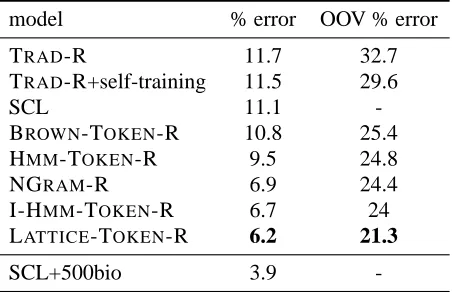
For each representation, we measured the accuracy of the POS tagger on the biomedical test text. Ta-ble 2 shows the results for the best variation of each kind of model — 20 layers for the PL-MRF, 7 lay-ers for the I-HMM, and 1000 clustlay-ers for the Brown clustering. All language model representations sig-nificantly outperform the SCL model and the TRAD-R baseline. The novel PL-MTRAD-RF model outperforms the previous state of the art, the I-HMM model, and much of the performance increase comes from a 11.3% relative reduction in error on words that ap-pear in biomedical texts but not in newswire texts. Both graphical model representations significantly outperform the ngram model, which is trained on far more text. For comparison, our best model, the PL-MRF, achieved a 96.8% in-domain accuracy on sec-tions 22-24 of the Penn Treebank, about 0.5% shy of a state-of-the-art in-domain system (Shen et al., 2007) with more sophisticated supervised learning.
We expected that language model representations perform well in part because they provide meaning-ful features for sparse and polysemous words. To test this, we selected 109 polysemous word types
model % error OOV % error
TRAD-R 11.7 32.7
TRAD-R+self-training 11.5 29.6
SCL 11.1
-BROWN-TOKEN-R 10.8 25.4
HMM-TOKEN-R 9.5 24.8
NGRAM-R 6.9 24.4
I-HMM-TOKEN-R 6.7 24
LATTICE-TOKEN-R 6.2 21.3
SCL+500bio 3.9
-Table 2: PL-MRF representations reduce error by 7.5% relative to the previous state-of-the-art I-HMM, and ap-proach within 2.3% absolute error a SCL+500bio model with access to 500 labeled sentences from the target do-main. 1.8% of the tags in the test set are new tags that do not occur in the WSJ training data, so an error rate of 3.9+1.8 = 5.7% error is a reasonable bound for the best possible performance of a model that has seen no exam-ples from the target domain.
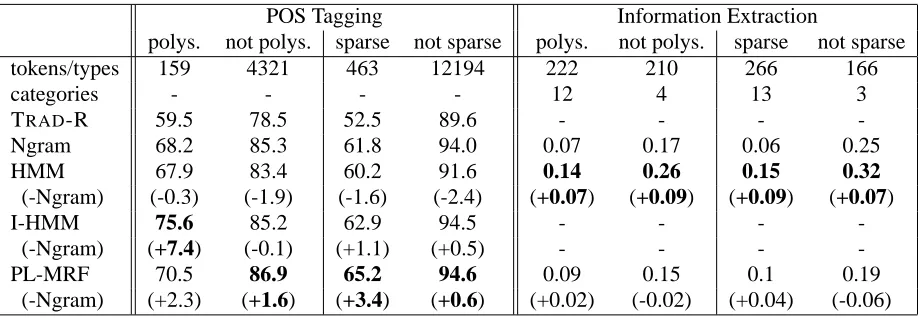
from our test data, along with 296 non-polysemous word types, chosen based on POS tags and manual inspection. We further define sparse word types as those that appear 5 times or fewer in all of our unla-beled data, and non-sparse word types as those that appear at least 50 times in our unlabeled data. Table 3 shows results on these subsets of the data.
As expected, all of our language models outper-form the baseline by a larger margin on polysemous words than on non-polysemous words. The mar-gin between graphical model representations and the ngram model also increases on polysemous words, presumably because the Viterbi decoding of these models takes into account the tokens in the sur-rounding sentence. The same behavior is evident for sparsity: all of the language model representations outperform the baseline by a larger margin on sparse words than not-sparse words, and all of the graphical models perform better relative to the ngram model on sparse words as well. Thus representations based on graphical models address two key issues in build-ing representations for POS taggbuild-ing.
6 Information Extraction Experiments
[image:6.612.315.541.55.201.2]inves-POS Tagging Information Extraction
polys. not polys. sparse not sparse polys. not polys. sparse not sparse
tokens/types 159 4321 463 12194 222 210 266 166
categories - - - - 12 4 13 3
TRAD-R 59.5 78.5 52.5 89.6 - - -
-Ngram 68.2 85.3 61.8 94.0 0.07 0.17 0.06 0.25
HMM 67.9 83.4 60.2 91.6 0.14 0.26 0.15 0.32
(-Ngram) (-0.3) (-1.9) (-1.6) (-2.4) (+0.07) (+0.09) (+0.09) (+0.07)
I-HMM 75.6 85.2 62.9 94.5 - - -
-(-Ngram) (+7.4) (-0.1) (+1.1) (+0.5) - - -
-PL-MRF 70.5 86.9 65.2 94.6 0.09 0.15 0.1 0.19
[image:7.612.77.536.53.212.2](-Ngram) (+2.3) (+1.6) (+3.4) (+0.6) (+0.02) (-0.02) (+0.04) (-0.06)
Table 3: Graphical models consistently outperform ngram models by a larger margin on sparse words than not-sparse words. On polysemous words, the difference between graphical model performance and ngram performance grows for POS tagging, where the context surrounding polysemous words is available to the language model, but not for information extraction. For tagging, we show number of tokens and accuracies. For IE, we show number of types, categories, and AUCs.
tigate a set-expansion task in which we’re given a corpus and a few “seed” noun phrases from a se-mantic category (e.g. Superheroes), and our goal is to identify other examples of the category in the cor-pus. This is a weakly-supervised task because we are given only a handful of examples of the category, rather than a large sample of positively and nega-tively labeled training examples.
Existing set-expansion techniques utilize the dis-tributional hypothesis: candidate noun phrases for a given semantic class are ranked based on how sim-ilar their contextual distributions are to those of the seeds. Here, we measure how performance on the set-expansion task varies when we employ different representations for the contextual distributions.
6.1 Methods
The set-expansion task we address is formalized as follows: given a corpus, a set of seeds from some semantic categoryC, and a separate set of candidate phrasesP, output a ranking of the phrases inP in decreasing order of likelihood of membership inC.
For any given representationR, the set-expansion algorithm we investigate is straightforward: we cre-ate a prototypical “seed representation vector” equal to the mean of the representation vectors for each of the seeds. Then, we rank candidate phrases in increasing order of the distance between the candi-date phrase representation and the seed representa-tion vector. As a measure of distance between rep-resentations, we compute the average of five
stan-dard distance measures, including KL and Jensen-Shannon divergence, and cosine, Euclidean, and L1 distance. In experiments, we found that improving upon this simple averaging was not easy—in fact, tuning a weighted average of the distance measures for each representation did not improve results sig-nificantly on held-out data.
Because set expansion is performed at the level of word types rather than tokens, it requires type-based representations. We compare HMM-TYPE-R, NGRAM-HMM-TYPE-R, LATTICE-TYPE-R, and BROWN-TYPE-R in this experiment. We used a 25-state HMM, and the same PL-MRF as in the previous section. Following previous set-expansion experi-ments with n-grams (Ahuja and Downey, 2010), we employ a trigram model with Kneser-Ney smooth-ing for NGRAM-R. For Brown clusters, instead of distance metrics like KL divergence (which assume distributions), we rank extractions by the number of matches between a word’s BROWN-TYPE-R fea-tures and seed feafea-tures.
6.2 Data Sets
model AUC HMM-TYPE-R 0.18
BROWN-TYPE-R 0.16 LATTICE-TYPE-R 0.11
NGRAM-R 0.10
[image:8.612.124.246.54.137.2]Random baseline 0.10
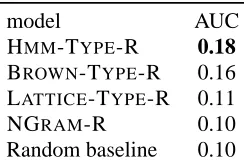
Table 4: HMM-TYPE-R outperforms the other methods, improving performance by 12.5% over Brown clusters, and by 80% over the traditional NGRAM-R.
using this corpus.
To obtain examples of multiple semantic cat-egories, we utilized selected Wikipedia “listOf” pages from (Pantel et al., 2009) and augmented these with our own manually defined categories, such that each list contained at least ten distinct examples oc-curring in our corpus. In all, we had 432 exam-ples across 16 distinct categories such as Countries, Greek Islands, and Police TV Dramas.
6.3 Results
For each semantic category, we tested five differ-ent random selections of five seed examples, treating the unselected members of the category as positive examples, and all other candidate phrases as nega-tive examples. We evaluate using the area under the precision-recall curve (AUC) metric.
The results are shown in Table 4. All represen-tations improve performance over a random base-line, equal to the average AUC over five random or-derings for each category, and the graphical models outperform the ngram representation. HMM-TYPE-R performs the best overall, and Brown clustering with 1000 clusters is comparable (320 and 100 clus-ter perform slightly worse).
As with POS tagging, we expect that language model representations improve performance on the IE task by providing informative features for sparse word types. However, because the IE task classifies word types rather than tokens, we expect the rep-resentations to provide less benefit for polysemous word types. To test these hypotheses, we measured how IE performance changed in sparse or polyse-mous settings. We identified polysepolyse-mous categories as those for which fewer than 90% of the category members had the category as a clear dominant sense (estimated manually); other categories were consid-ered non-polysemous. Categories whose members
had a median number of occurrences in the cor-pus less than 30 were deemed sparse, and others non-sparse. IE performance on these subsets of the data are shown in Table 3. Both graphical model representations outperform the ngram representation more on sparse words, as expected. For polysemy, the picture is mixed: the PL-MRF outperform n-grams on polysemous categories, whereas HMM’s performance advantage over n-grams decreases.
One surprise on the IE task is that the LATTICE-TYPE-R performs significantly less well than the HMM-TYPE-R, whereas the reverse is true on POS tagging. We suspect that the difference is due to the issue of classifying types vs. tokens. Because of their more complex structure, PL-MRFs tend to de-pend more on transition parameters than do HMMs. Furthermore, our decision to train the PL-MRFs using contrastive estimation with a neighborhood that swaps consecutive pairs of words also tends to emphasize transition parameters. As a result, we believe the posterior distribution over latent states given a word type is more informative in our HMM model than the PL-MRF model. We measured the entropy of these distributions for the two models, and found thatH(PPL-MRF(y|x =w)) = 9.95bits,
compared with H(PHMM(y|x = w)) = 2.74bits,
which supports the hypothesis that the drop in the PL-MRF’s performance on IE is due to its depen-dence on transition parameters. Further experiments are warranted to investigate this issue.
7 Conclusion and Future Work
Our investigation into language models as represen-tations shows that graphical models can be used to combat polysemy and, especially, sparsity in rep-resentations for weakly-supervised classifiers. Our novel factorial graphical model yields a state-of-the-art POS tagger for domain adaptation, and HMMs improve significantly over all other representations in an information extraction task. Important direc-tions for future research include models for han-dling polysemy in IE, and richer language models that incorporate more linguistic intuitions about how words interact with their contexts.
Acknowledgments
References
Arun Ahuja and Doug Downey. 2010. Improved extrac-tion assessment through better language models. In
Proceedings of the Annual Meeting of the North Amer-ican Chapter of the Association of Computational Lin-guistics (NAACL-HLT).
Shai Ben-David, John Blitzer, Koby Crammer, Alex Kulesza, Fernando Pereira, and Jenn Wortman. 2009. A theory of learning from different domains. Machine
Learning, (to appear).
Y. Bengio, J. Louradour, R. Collobert, and J. Weston. 2009. Curriculum learning. In International
Confer-ence on Machine Learning (ICML).
Yoshua Bengio. 2008. Neural net language models.
Scholarpedia, 3(1):3881.
Daniel M. Bikel. 2004. Intricacies of Collins Parsing Model. Computational Linguistics, 30(4):479–511. David M. Blei, Andrew Y. Ng, and Michael I. Jordan.
2003. Latent dirichlet allocation. Journal of Machine
Learning Research, 3:993–1022, January.
John Blitzer, Ryan McDonald, and Fernando Pereira. 2006. Domain adaptation with structural correspon-dence learning. In EMNLP.
John Blitzer, Koby Crammer, Alex Kulesza, Fernando Pereira, and Jenn Wortman. 2007. Learning bounds for domain adaptation. In Advances in Neural
Infor-mation Processing Systems.
Hans L. Bodlaender. 1988. Dynamic programming on graphs with bounded treewidth. In Proc. 15th
Interna-tional Colloquium on Automata, Languages and Pro-gramming, pages 105–118.
P. F. Brown, P. V. deSouza, R. L. Mercer, V. J. D. Pietra, and J. C. Lai. 1992. Class-based n-gram models of natural language. Computational Linguistics, pages 467–479.
M. Candito and B. Crabbe. 2009. Improving generative statistical parsing with semi-supervised word cluster-ing. In IWPT, pages 138–141.
R. Collobert and J. Weston. 2008. A unified architecture for natural language processing: Deep neural networks with multitask learning. In International Conference
on Machine Learning (ICML).
Hal Daum´e III and Daniel Marcu. 2006. Domain adap-tation for statistical classifiers. Journal of Artificial
Intelligence Research, 26.
Hal Daum´e III, Abhishek Kumar, and Avishek Saha. 2010. Frustratingly easy semi-supervised domain adaptation. In Proceedings of the ACL Workshop on
Domain Adaptation (DANLP).
Hal Daum´e III. 2007. Frustratingly easy domain adapta-tion. In ACL.
S. C. Deerwester, S. T. Dumais, T. K. Landauer, G. W. Furnas, and R. A. Harshman. 1990. Indexing by latent semantic analysis. Journal of the American Society of
Information Science, 41(6):391–407.
Arthur Dempster, Nan Laird, and Donald Rubin. 1977. Likelihood from incomplete data via the EM algo-rithm. Journal of the Royal Statistical Society, Series
B, 39(1):1–38.
D. Downey, M. Broadhead, and O. Etzioni. 2007a. Lo-cating complex named entities in web text. In Procs.
of the 20th International Joint Conference on Artificial Intelligence (IJCAI 2007).
Doug Downey, Stefan Schoenmackers, and Oren Etzioni. 2007b. Sparse information extraction: Unsupervised language models to the rescue. In ACL.
Mark Dredze and Koby Crammer. 2008. Online methods for multi-domain learning and adaptation. In
Proceed-ings of EMNLP, pages 689–697.
Mark Dredze, Alex Kulesza, and Koby Crammer. 2010. Multi-domain learning by confidence weighted param-eter combination. Machine Learning, 79.
Kevin Duh. 2005. Jointly labeling multiple sequences: A Factorial HMM approach. In 43rd Annual Meeting of
the Assoc. for Computational Linguistics (ACL 2005), Student Research Workshop.
Jenny Rose Finkel and Christopher D. Manning. 2009. Hierarchical bayesian domain adaptation. In
Proceed-ings of HLT-NAACL, pages 602–610.
Zoubin Ghahramani and Michael I. Jordan. 1997. Facto-rial hidden markov models. Machine Learning, 29(2-3):245–273.
Z. Harris. 1954. Distributional structure. Word,
10(23):146–162.
D. Hindle. 1990. Noun classification from predicage-argument structures. In ACL.
T. Honkela. 1997. Self-organizing maps of words for natural language processing applications. In
Proceed-ings of the International ICSC Symposium on Soft Computing.
Fei Huang and Alexander Yates. 2009. Distributional representations for handling sparsity in supervised se-quence labeling. In Proceedings of the Annual
Meet-ing of the Association for Computational LMeet-inguistics (ACL).
Fei Huang and Alexander Yates. 2010a. Exploring representation-learning approaches to domain adapta-tion. In Proceedings of the ACL 2010 Workshop on
Domain Adaptation for Natural Language Processing (DANLP).
Fei Huang and Alexander Yates. 2010b. Open-domain semantic role labeling by modeling word spans. In
Jing Jiang and ChengXiang Zhai. 2007. Instance weight-ing for domain adaptation in NLP. In ACL.
S. Kaski. 1998. Dimensionality reduction by random mapping: Fast similarity computation for clustering. In IJCNN, pages 413–418.
T. Koo, X. Carreras, and M. Collins. 2008. Simple semi-supervised dependency parsing. In Proceedings of the
Annual Meeting of the Association of Computational Linguistics (ACL), pages 595–603.
J. Lafferty, Andrew McCallum, and Fernando Pereira. 2001. Conditional random fields: Probabilistic mod-els for segmenting and labeling sequence data. In
Pro-ceedings of the International Conference on Machine Learning.
D. Lin and X Wu. 2009. Phrase clustering for discrimi-native learning. In ACL-IJCNLP, pages 1030–1038. D.C. Liu and J. Nocedal. 1989. On the limited
mem-ory method for large scale optimization.
Mathemati-cal Programming B, 45(3):503–528.
Y. Mansour, M. Mohri, and A. Rostamizadeh. 2009. Do-main adaptation with multiple sources. In Advances in
Neural Information Processing Systems.
Mitchell P. Marcus, Mary Ann Marcinkiewicz, and Beat-rice Santorini. 1993. Building a large annotated cor-pus of English: the Penn Treebank. Computational
Linguistics, 19(2):313–330.
S. Martin, J. Liermann, and H. Ney. 1998. Algorithms for bigram and trigram word clustering. Speech
Com-munication, 24:19–37.
A. Mnih and G. E. Hinton. 2009. A scalable hierarchi-cal distributed language model. In Neural Information
Processing Systems (NIPS), pages 1081–1088.
P. Pantel, E. Crestan, A. Borkovsky, A. M. Popescu, and V. Vyas. 2009. Web-scale distributional similarity and entity set expansion. In Proc. of EMNLP.
PennBioIE. 2005. Mining the bibliome project.
http://bioie.ldc.upenn.edu/.
F. Pereira, N. Tishby, and L. Lee. 1993. Distributional clustering of English words. In Proceedings of the
Annual Meeting of the Association for Computational Linguistics (ACL), pages 183–190.
Lawrence R. Rabiner. 1989. A tutorial on hidden Markov models and selected applications in speech recognition. Proceedings of the IEEE, 77(2):257–285. Ivan A. Sag, Thomas Wasow, and Emily M. Bender. 2003. Synactic Theory: A Formal Introduction. CSLI, Stanford, CA, second edition.
M. Sahlgren. 2005. An introduction to random index-ing. In Methods and Applications of Semantic
Index-ing Workshop at the 7th International Conference on Terminology and Knowledge Engineering (TKE).
M. Sahlgren. 2006. The word-space model:
Us-ing distributional analysis to represent syntagmatic
and paradigmatic relations between words in high-dimensional vector spaces. Ph.D. thesis, Stockholm
University.
G. Salton and M.J. McGill. 1983. Introduction to
Mod-ern Information Retrieval. McGraw-Hill.
L. Shen, G. Satta, and A. Joshi. 2007. Guided learn-ing for bidirectional sequence classification. In
Pro-ceedings of the 45th Annual Meeting of the Associa-tion of ComputaAssocia-tional Linguistics (ACL 2007), pages
760–767.
Noah A. Smith and Jason Eisner. 2005. Contrastive esti-mation: Training log-linear models on unlabeled data. In Proceedings of the 43rd Annual Meeting of the
As-sociation for Computational Linguistics (ACL), pages
354–362, Ann Arbor, Michigan, June.
Charles Sutton, Andrew McCallum, and Khashayar Ro-hanimanesh. 2007. Dynamic conditional random fields: Factorized probabilistic models for labeling and segmenting sequence data. J. Mach. Learn. Res., 8:693–723.
Joseph Turian, Lev Ratinov, and Yoshua Bengio. 2010. Word representations: A simple and general method for semi-supervised learning. In Proceedings of the
Annual Meeting of the Association for Computational Linguistics (ACL), pages 384–394.
P. D. Turney and P. Pantel. 2010. From frequency to meaning: Vector space models of semantics. Journal
of Artificial Intelligence Research, 37:141–188.
J. J. V¨ayrynen, T. Honkela, and L. Lindqvist. 2007. Towards explicit semantic features using independent component analysis. In Proceedings of the
Work-shop Semantic Content Acquisition and Representa-tion (SCAR).
Jason Weston, Frederic Ratle, and Ronan Collobert. 2008. Deep learning via semi-supervised embedding. In Proceedings of the 25th International Conference
on Machine Learning.
![Table 1: Summary of features provided by our repre-sentations.length prefix of the Brown clusterthe latent variable for{a value for a latent state (set of latent states) in a latent-variable model,states in sentencetrue iff∀ a 1[ g ( a ) ] represents a set](https://thumb-us.123doks.com/thumbv2/123dok_us/1303173.660032/3.612.70.303.57.252/summary-features-provided-sentations-clusterthe-variable-sentencetrue-represents.webp)