Automatic inference of the temporal location of situations in Chinese text
Nianwen Xue
Center for Computational Language and Education Research University of Colorado at Boulder
Colorado, U.S.A.
Abstract
Chinese is a language that does not have mor-phological tense markers that provide explicit grammaticalization of the temporal location of situations (events or states). However, in many NLP applications such as Machine Transla-tion, Information Extraction and Question An-swering, it is desirable to make the temporal location of the situations explicit. We describe a machine learning framework where differ-ent sources of information can be combined to predict the temporal location of situations in Chinese text. Our experiments show that this approach significantly outperforms the most frequent tense baseline. More importantly, the high training accuracy shows promise that this challenging problem is solvable to a level where it can be used in practical NLP applica-tions with more training data, better modeling techniques and more informative and general-izable features.
1 Introduction
In a language like English, tense is an explicit (and maybe imperfect) grammaticalization of the tempo-ral location of situations, and such tempotempo-ral location is either directly or indirectly defined in relation to the moment of speech. Chinese does not have gram-maticalized tense in the sense that Chinese verbs are not morphologically marked for tense. This is not to say, however, that Chinese speakers do not at-tempt to convey the temporal location of situations when they speak or write, or that they cannot inter-pret the temporal location when they read Chinese
text, or even that they have a different way of repre-senting the temporal location of situations. In fact, there is evidence that the temporal location is rep-resented in Chinese in exactly the same way as it is represented in English and most world languages: in relation to the moment of speech. One piece of evi-dence to support this claim is that Chinese temporal expressions like8U(“today”),²U(“tomorrow”) and U(“yesterday”) all assume a temporal deixis that is the moment of speech in relation to which all temporal locations are defined. Such temporal expressions, where they are present, give us a clear indication of the temporal location of the situations they are associated with. However, not all Chinese sentences have such temporal expressions associated with them. In fact, they occur only infrequently in Chinese text. It is thus theoretically interesting to ask, in the absence of grammatical tense and explicit temporal expressions, how do readers of a particular piece of text interpret the temporal location of situa-tions?
There are a few linguistic devices in Chinese that provide obvious clues to the temporal location of situations, and one such linguistic device is aspect markers. Although Chinese does not have grammat-ical tense, it does have grammatgrammat-icalized aspect in the form of aspect markers. These aspect markers often give some indication of the temporal location of an event. For example, Chinese has the perfective as-pect markerand L, and they are often associated with the past. Progressive aspect markerX, on the other hand, is often associated with the present. In addition to aspect, certain adverbs also provide clues to the temporal location of the situations they are
sociated with. For example,®or®² (”already”), often indicates that the situation they are associated with has already occurred and is thus in the past.3, another adverbial modifier, often indicates that the situation it modifies is in the present. However, such linguistic associations are imperfect, and they can only be viewed as tendencies rather than rules that one can use to deterministically infer the temporal location of a situation. For example, while ® in-deed indicates that the situation described in (1) is in the past, when it modifies a stative verb as it does in (1b), the situation is still in the present.
(1) a. ¦ he
[®] already
finish
T this
8 project
" .
”He already finished the project.”
b. ¥I China
[®] already
Pk has
) produce
.? world-class ^
software DE
Ä: foundation
"
.
”China already has the foundation to pro-duce world-class software.”
More importantly, only a small proportion of verb instances in any given text have such explicit tempo-ral indicators and therefore they cannot be the whole story in the temporal interpretation of Chinese text. It is thus theoretically interesting to go beyond the obvious and investigate what additional information is relevant in determining the temporal location of a situation in Chinese.
Being able to infer the temporal location of a situ-ation has many practical applicsitu-ations as well. For example, this information would be highly valu-able to Machine Translation. To translate a lan-guage like Chinese into a lanlan-guage like English in which tense is grammatically marked with inflec-tional morphemes, an MT system will have to in-fer the necessary temporal information to determine the correct tense for verbs. Statistical MT systems, the currently dominant research paradigm, typically do not address this issue directly. As a result, when evaluated for tense, current MT systems often per-form miserably. For example, when a simple sen-tence like “¦/he ²U/tomorrow £/return þ °/Shanghai” is given to Google’s state-of-the-art
Machine Translation system1, it produces the out-put “He returned to Shanghai tomorrow”, instead of the correct “he will return to Shanghai tomorrow”. The past tense on the verb “returned” contradicts the temporal expression “tomorrow”. Determining the temporal location is also important for an Infor-mation Extraction task that extracts events so that the extracted events are put in a temporal context. Similarly, for Question Answering tasks, it is also important to know whether a situation has already happened or it is going to happen, for example.
In this paper, we are interested in investigating the kind of information that is relevant in inferring the temporal location of situations in Chinese text. We approach this problem by manually annotating each verb in a Chinese document with a “tense” tag that indicates the temporal location of the verb2. We then formulate the tense determination problem as a classification task where standard machine learn-ing techniques can be applied. Figurlearn-ing out what linguistic information contributes to the determina-tion of the temporal locadetermina-tion of a situadetermina-tion becomes a feature engineering problem of selecting features that help with the automatic classification. In Sec-tion 2, we present a linguistic annotaSec-tion framework that annotates the temporal location of situations in Chinese text. In Section 3 we describe our setup for an automatic tense classification experiment and present our experimental results. In Section 4 we focus in on the features we have used in our exper-iment and attempt to provide a quantitative as well as intuitive explanation of the contribution of the in-dividual features and speculate on what additional features could be useful. In Section 5 we discuss related work and Section 6 concludes the paper and discusses future work.
2 Annotation framework
It is impossible to define the temporal loca-tion without a reference point, a temporal deixis. As we have shown in Section 1, there is con-vincing evidence from the temporal adverbials like U(“yesterday”), 8U(“today”) and ²U
1http://www.google.com/language tools
£“tomorrow”) that Chinese, like most if not all lan-guages of the world, use the moment of speech as this reference point. In written text, which is the pri-mary source of data that we are dealing with, the temporal deixis is the document creation time. All situations are temporally related to this document creation time except in direct quotations, where the temporal location is relative to the moment of speech of the speaker who is quoted.
In addition to the moment of speech or document creation time in the case of written text, Reference Time and Situation Time are generally accepted as important to determining the temporal location since Reichenbach (1947) first proposed them. Situation Time is the time that a situation actually occurs while Reference time is the temporal perspective from which the speaker invites his audience to con-sider the situation. Reference Time does not nec-essarily overlap with Situation Time, as in the case of present perfective tense, where the situation hap-pened in the past but the reader is invited to look at it from the present moment and focus on the state of completion of the situation. Reference Time is in our judgment too subtle to be annotated consistently and thus in our annotation scheme we only consider the relation between Situation Time and the document creation time when defining the temporal location of situations. Another key decision we made when formulating our annotation scheme is to define an abstract “tense” that do not necessarily model the ac-tual tense system in any particular language that has grammatical tense. In a given language, the gram-matical tense reflected in the morphological system may not have a one-to-one mapping between the grammatical tense and the temporal location of a sit-uation. For example, in an English sentence like “He will call me after he gets here”, while his “getting here” happens at a time in the future, it is assigned the present tense because it is in a clause introduced by “after”. It makes more sense to ask the annota-tor, who is necessarily a native speaker of Chinese, to make a judgment of the temporal location of the situation defined in terms of the relation between the Situation Time and the moment of speech rather than by such language-specific idiosyncracies of another language.
Temporal locations that can be defined in terms of the relation between Situation Time and the moment
of speech are considered to be absolute tense. In some cases, the temporal location of a situation can-not be directly defined in relation to the moment of speech. For example in (2), the temporal location of k¿(“intend”) cannot be determined independently of that ofß³(“reveal”). The temporal location of k¿ is simultaneous with ß³. If the temporal location of ß³ is in the past, then the temporal location ofk¿ is also in the past. If the temporal location ofß³ is in the future, then the temporal location ofk¿ is also in the future. In this spe-cific case, the situation denoted by the matrix verb ß³ is in the past. Therefore the situation denoted byk¿ is also located in the past.
(2) ¦ he
also
ß³ reveal
Ûd Russia
k¿ intend
3 in
8
next c ten years S
within , ,
to
K Iran
Jø provide
Éì
weapons . .
“He also revealed that Russia intended to pro-vide weapons to Iran within the next ten years.”
Therefore in our Chinese “tense” annotation task, we annotate both absolute and relative tenses. We define three absolute tenses based on whether the sit-uation time is anterior to (in the past), simultaneous with (in the present), or posterior to (in the future) document creation time. In addition to the absolute tenses, we also define one relative tense, future-in-past, which happens when a future situation is em-bedded in a past context. We do not assign a tense tag to modal verbs or verb particles. The set of tense tags are described in more detail below:
2.1 Present tense
A situation is assigned the present tense if it is true at an interval of time that includes the present moment. The present tense is compatible with states and ac-tivities. When non-stative situations are temporally located in the present, they either have an imperfec-tive aspect or have a habitual or frequenimperfec-tive reading which makes them look like states, e.g.,
(3) ¦ he
~~ often
ë\
attend r outdoors
¹Ä activities
" .
2.2 Past tense
Situations that happen before the moment of speech (or the document creation time) are temporally lo-cated in the past as in (4):
(4) ¥ Chinese
< personnel
9 and
{
Chinese nationals S
safely l
withdraw from ¾ Chad
" .
“Chinese personnel and Chinese nationals safely withdrew from Chad.”
2.3 Future tense
Situations that happen posterior to the moment of speech are temporally located in the future. Future situations are not simply the opposite of past situa-tions. While past situations have already happened by definition, future situations by nature are charac-terized by uncertainty. That is, future situations may or may not happen. Therefore, future situations are often linked to possibilities, not just to situations that will definitely happen. A example of future tense is given in (5):
(5) ¬ conference
²c next year
3 in
#\·
Singapore
Þ1 hold
"
.
“The conference will be held in Singapore next year.”
2.4 Future-in-past
The temporal interpretation of one situation is often bound by the temporal location of another situation. One common scenario in which this kind of depen-dency occurs is when the target situation, the situa-tion we are interested in at the moment, is embedded in a reference situation as its complement. Just as the absolute “tense” represents a temporal relation be-tween the situation time and the moment of speech or document creation time, the relative “tense” rep-resents a relation between the temporal location of a situation and its reference situation. Although theo-retically the target situation can be anterior to, simul-taneous with, or posterior to the reference situation, we only have a special tense label when the target situation is posterior to the reference situation and the reference situation is located in the past. In this case the label for the target situation is future-in-past as illusrated in (6):
(6) úi company
ó personnel
ß³ reveal
5 “
(S2 Star 2
6 ”
ÿÁ
trial
version =ò soon
¡
face the world " .
“The company personnel revealed that ‘Star 2’ trial version would soon face the world.”
2.5 No tense label
Modals and verb particles do not receive a tense la-bel:
(7) ¢» Kosovo
Õá
independence U may
Úu cause
ÖÏ riot
§ . éÜI
UN
< personnel
® already
O
prepare l withdraw
" .
“Kosovo independence may cause riot. UN personnel have already prepared to leave.”
3 Experimental results
The tense determination task is then a simple five-way classification task. Theoretically any standard machine learning algorithm can be applied to the task. For our purposes we used the Maximum En-tropy algorithm implemented as part of the Mallet machine learning package (McCallum, 2002) for its competitive training time and performance tradeoff. There might be algorithms that could achieve higher classification accuracy, but our goal in this paper is not to pursue the absolute high performance. Rather, our purpose is to investigate what information when used as features is relevant to determining the tem-poral location of a situation in Chinese, so that these features can be used to design high performance practical systems in the future.
The annotation of 42 articles yielded 5709 verb instances, each of which is annotated with one of the five tense tags. For our automatic classification experiments, we randomly divided the data into a training set and a test set based on a 3-to-1 ratio, so that the training data has 4,250 instances while the test set has 1459 instances. As expected, the past tense is the most frequent tense in both the training and test data, although they vary quite a bit in the proportions of verbs that are labeled with the past tense. In the training data, 2145, or 50.5% of the verb instances are labeled with the past tense while in the test data, 911 or 62.4% of the verb instances are labeled with the past tense. The 62.4% can thus be used as a baseline when evaluating the automatic classification accuracy. This is a very high baseline given that the much smaller proportion of verbs that are assigned the past tense in the training data.
Instead of raw text, the input to the classifica-tion algorithm is parsed sentences from the Chinese Treebank that has the syntactic structure information as well as the part-of-speech tags. As we will show in the next section, information extracted from the parse tree as well as the part-of-speech tags prove to be very important in determining the temporal loca-tion of a situaloca-tion. The reason for using “correct” parse trees in the Chinese Treebank is to factor out noises that are inevitable in the output of an auto-matic parser and evaluate the contribution of syntac-tic information in the “ideal” scenario. In a realissyntac-tic setting, one of course has to use an automatic parser.
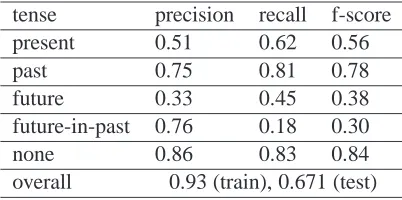
The results are presented in Table 1. The overall accuracy is 67.1%, exceeding the baseline of choos-ing the most frequent tense in the test, which is 62.4%. It is worth noting that the training accu-racy is fairly high, 93%, and there is a steep drop-off from the training accuracy to the test accuracy al-though this is hardly unexpected given the relatively small training set. The high training accuracy never-theless attests the relevance of the features we have chosen for the classification, which we will look at in greater detail in the next section.
tense precision recall f-score
present 0.51 0.62 0.56
past 0.75 0.81 0.78
future 0.33 0.45 0.38
future-in-past 0.76 0.18 0.30
none 0.86 0.83 0.84
[image:5.612.313.514.218.318.2]overall 0.93 (train), 0.671 (test)
Table 1: Experimental results
4 What information is useful?
Our classification algorithm scans the verbs in a sen-tence one at a time, from left to right. Features are extracted from the context of the verb in the parse tree as well as from previous verbs the tense of which have already been examined. We view fea-tures for the classification algorithm as information that contributes to the determination of the temporal location of situations in the absence of morpholog-ical markers of tense. The features we used for the classification task can all be extracted from a parse tree and the POS information of a word. They are described below:
• Verb Itself: The character string of the verbs, e.g.,Pk(“own”),´(“be”), etc.
• Verb POS: The part-of-speech tag of the verb, as defined in the Chinese Treebank. There are three POS tags for verbs, VE for existential verbs such as k(“have, exist”), VC for cop-ula verbs like´(“be”), VA for stative verbs like p(“tall”), and VV for all other verbs.
of the compound is used as a feature in com-bination with the compound type. The possi-ble values for the position are first and last, and the compound type is one of the six defined in the Chinese Treebank: VSB, VCD, VRD, VCP, VNV, and VPT. An example feature might be “last+VRD”.
• Governing verb and its tense: Chinese is an SVO language, and the governing verb, if there is one, is on the left and is higher up in the tree. Since we are scanning verbs in a sentence from left to right, the tense for the governing verb is available at the time we look at the target verb. So we are using the character string of the gov-erning verb as well as its tense as features. In cases where there are multiple levels of embed-ding and multiple governing verbs, we select the closest governing verb.
• Left ADV: Adverbial modifiers of the target verb are generally on the left side of the verb, therefore we are only extracting adverbs on the left. We first locate the adverbial phrases and then find the head of the adverbial phrase and use character string of the head as feature.
• Left NT: NT is a POS in the Chinese Treebank for nominal expressions that are used as tem-poral modifiers of a verb. The procedure for extracting the NT modifers is similar to the pro-cedure for finding adverbial modifiers, the only difference being that we are looking for NPs headed by nouns POS-tagged NT.
• Left PP: Like adverbial modifiers, PP modifiers are also generally left modifiers of a verb. If there is a PP modifier, the character string of the head preposition combined with the char-acter string of the head noun of its NP com-plement is used as a feature, e.g., “3+Ïm” (“at+period”).
• Left LC: Left localizer phrases. Localizers phrases are also called post-positions by some and they function similarly as left PP modifiers. If the target verb has a left localizer phrase modifier and the character string of its head is used as a feature, e.g.,±5(“since”).
• Left NN: This feature is intended to capture the head of the subject NP. The character string of the head of the NP is used as a feature.
• Aspect marker. Aspect markers are grammati-calizations of aspect and they immediately fol-low the verb. If the target verb is associated with an aspect marker, the character string of that aspect marker is used as a feature, e.g., “”.
• DER: DER is the POS tag for , a charac-ter which introduces a resultative construction when following a verb. When it occurs together with the target verb, it is used as a feature.
• Quantifier in object: When there is a quantifier in the NP object for the target verb, its character string is used as a feature.
• Quotation marks: Finally the quotation marks are used as a feature when they are used to quote the clause that contains the target verb.
our future work. The training set used here is suffi-cient to show the efficacy of the features, but to im-prove the tense classification to a satisfactory level of accuracy, more training data need to be annotated.
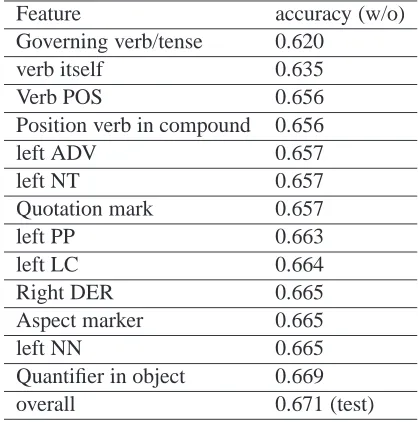
Feature accuracy (w/o)
Governing verb/tense 0.620
verb itself 0.635
Verb POS 0.656
Position verb in compound 0.656
left ADV 0.657
left NT 0.657
Quotation mark 0.657
left PP 0.663
left LC 0.664
Right DER 0.665
Aspect marker 0.665
left NN 0.665
Quantifier in object 0.669
[image:7.612.70.279.126.337.2]overall 0.671 (test)
Table 2: Feature Performance
Features like adverbial, prepositional, localizer phrase modifiers and temporal noun modifiers pro-vide explicit temporal information that is relevant in determining the temporal location. The role of the governing verb in determining the temporal location of a situation is also easy to understand. As we have shown in Section 2, when the target verb occurs in an embedded clause, its temporal location is necessar-ily affected by the temporal location of the govern-ing verb of this embedded clause because the tempo-ral location of the former is often defined in relation to that of the latter. Not surprisingly, the governing verb proves to be the most effective feature. Quota-tion marks in written text change the temporal deixis from the document creation time to the moment of speech of the quoted speaker, and the temporal lo-cation in quoted speech does not follow the same patterns as target verbs in embedded clauses. As-pect markers are tied closely to tense, even though the contributions they made are small due to their rare occurrences in text.
The relevance of other features are less obvious. The target verb itself and its POS made the most contribution other than the governing verb. It is im-portant to understand why they are effective or
use-ful at all. In a theoretic work on the temporal inter-pretation of verbs in languages like Chinese which lacks tense morphology, Smith and Erbaugh (2005) pointed out that there is a default interpretation for bounded and unbounded situations. Specifically, bounded situations are temporally located in the past by default while unbounded situations are located in the future. The default interpretation, by defini-tion, can be overwritten when there is explicit evi-dence to the contrary. Recast in statistical terms, this means that bounded events have a tendency to be lo-cated in the past while unbounded events have a ten-dency to be located in the present, and this tenten-dency can be quantified in a machine-learning framework. Boundedness has many surface manifestations that can be directly observed, and one of them is whether the verb is stative or dynamic. The target verb it-self and its POS tag represents this information. Re-sultatives in the form of resultative verb compound and the DER construction, quantifiers in the object are other surface reflections of the abstract notion of boundedness. The fact that these features have contributed to the determination of the temporal lo-cation of situations to certain extent lends support to Smith’s theoretical claim.
5 Related work
Ye (2007) did approach this problem with ma-chine learning techniques. She used Chinese-English parallel data to manually map the tense in-formation from English to Chinese and trained a Conditional Random Field classifier to make predic-tions about tense. She used only a limited number of surface cues such as temporal adverbials and aspect markers as features and did not attempt to model the lexical aspect information such as boundedness, which we believe would have helped her system per-formance. Her data appeared to have a much larger percentage of verb instances that have the past tense and thus her results are mostly incomparable with that of ours.
6 Conclusion and future work
We have defined the automatic inference of the tem-poral location of situations in Chinese text as a ma-chine learning problem and demonstrated that a lot more information in the form of features contributes to the solution of this challenging problem than pre-viously realized. The accuracy on the held-out test is a significant improvement over the baseline, the proportion of verbs assigned the most frequent tense (the past tense). Although there is a large drop-off from the training accuracy to the test accuracy due to the lexical nature of the features, the high training accuracy does show promise that this challenging problem is solvable with a larger training set, bet-ter modeling techniques and more refined features. In the future we will attempt to solve this problem along these lines and work toward a system that can be used in practical applications.
Acknowledgments
We would like to thank Hua Zhong and Kaiyun Chen for their efforts to annotate the data used in our ex-periments. Without their help this work would of course be impossible.
References
Andrew Kachites McCallum. 2002.
Mal-let: A machine learning for language toolkit. http://mallet.cs.umass.edu.
Mari Olson, David Traum, Carol Vaness Dykema, Amy Weinberg, and Ron Dolan. 2000. Telicity as a cue to temporal and discourse structure in Chinese-English
Machine Translation. In Proceedings of NAACL-ANLP 2000 Workshop on Applied interlinguas: prac-tical applications of interlingual approaches to NLP, pages 34–41, Seattle Washington.
Mari Olson, David Traum, Carol Vaness Dykema, and Amy Weinberg. 2001. Implicit cues for explicit gen-eration: using telicity as a cue for tense structure in a Chinese to English MT system. In Proceedings of Machine Translation Summit VIII, Santiago de Com-postela, Spain.
Hans Reichenbach. 1947. Elements of Symbolic Logic. The MacMillan Company, New York.
Carlota S. Smith and Mary Erbaugh. 2005. Tempo-ral interpretation in Mandarin Chinese. Linguistics, 43(4):713–756.
Nianwen Xue, Fei Xia, Fu dong Chiou, and Martha Palmer. 2005. The Penn Chinese TreeBank: Phrase Structure Annotation of a Large Corpus. Natural Lan-guage Engineering, 11(2):207–238.
Nianwen Xue, Zhong Hua, and Kai-Yun Chen. 2008. Annotating “tense” in a tenseless language. In Pro-ceedings of the Fifth International Conference on Lan-guage Resources and Evaluation, Marrakech, Mo-rocco.