On the Role of Lexical Features in Sequence Labeling
Yoav Goldberg∗and Michael Elhadad
Ben Gurion University of the Negev Department of Computer Science POB 653 Be’er Sheva, 84105, Israel {yoavg|elhadad}@cs.bgu.ac.il
Abstract
We use the technique of SVM anchoring to demonstrate that lexical features extracted from a training corpus are not necessary to obtain state of the art results on tasks such as Named Entity Recognition and Chunk-ing. While standard models require as many as 100K distinct features, we derive models with as little as 1K features that perform as well or better on different do-mains. These robust reduced models in-dicate that the way rare lexical features contribute to classification in NLP is not fully understood. Contrastive error analy-sis (with and without lexical features) in-dicates that lexical features do contribute to resolving some semantic and complex syntactic ambiguities – but we find this contribution does not generalize outside the training corpus. As a general strat-egy, we believe lexical features should not be directly derived from a training corpus but instead, carefully inferred and selected from other sources.
1 Introduction
Common NLP tasks, such as Named Entity Recognition and Chunking, involve the identifi-cation of spans of words belonging to the same phrase. These tasks are traditionally reduced to a tagging task, in which each word is to be clas-sified as either Beginning a span, Inside a span, or Outside of a span. The decision is based on the word to be classified and its neighbors. Fea-tures supporting the classification usually include
∗Supported by the Lynn and William Frankel Center for Computer Sciences, Ben Gurion University
the word forms themselves and properties derived from the word forms, such as prefixes, suffixes, capitalization information, and parts-of-speech. While early approaches to the NP-chunking task (Cardie and Pierce, 1998) relied on part-of-speech information alone, it is widely accepted that lexi-cal information (word forms) is crucial for build-ing accurate systems for these tasks. Indeed, all the better-performing systems in the CoNLL shared tasks competitions for Chunking (Sang and Buchholz, 2000) and Named Entity Recognition (Tjong Kim Sang, 2002; Tjong Kim Sang and De Meulder, 2003) make extensive use of such lexical information.
Is this belief justified? In this paper, we show that the influence of lexical features on such se-quence labeling tasks is more complex than is gen-erally assumed. We find that exact word forms aren’t necessary for accurate classification. This observation is important because relying on the exact word forms that appear in a training corpus leads to over-fitting, as well as to larger models.
In this work, we focus on learning with Support Vector Machines (SVMs) (Vapnik, 1995). SVM classifiers can handle very large feature spaces, and produce state-of-the-art results for NLP ap-plications (seee.g. (Kudo and Matsumoto, 2000; Nivre et al., 2006)). Alas, when trained on pruned feature sets, in which rare lexical items are re-moved, SVM models suffer a loss in classifica-tion accuracy. It would seem that rare lexical items are indeed crucial for SVM classification performance. However, in Goldberg and Elhadad (2007), we suggested that the SVM learner is us-ing the rare lexical features for sus-inglus-ing out hard cases rather than for learning meaningful general-izations. We provide further evidence to support this claim in this paper.
We show that by using a variant of SVM – Anchored SVM Learning(Goldberg and Elhadad, 2007) with a polynomial kernel, one can learn accurate models for English NP-chunking (Mar-cus and Ramshaw, 1995), base-phrase chunking (CoNLL 2000), and Dutch Named Entity Recog-nition (CoNLL 2002), on a heavily pruned feature space. Our models make use of only a fraction of the lexical features available in the training set (less than 1%), and yet provide highly-competitive accuracies.
For the Chunking and NP-Chunking tasks, the most heavily pruned experiments, in which we consider only features appearing at least 100 times in the training corpus, do show a small but signif-icant drop in accuracy on the testing corpus com-pared to the non-pruned models exposed to all available features in the training data. We pro-vide detailed error analysis of a development set in Section 6, revealing the causes for these differ-ences. We suggest one additional binary feature in order to account for some of the performance gap. Moreover, we show that the differences in accuracy vanish when the lexicalized and unlexi-calized models are tested on text from slightly dif-ferent sources than the training corpus (Section 7). This goes to show that with an appropriate learning method, orthographic and structural (in the form of POS tag sequences) information is suf-ficient for achieving state-of-the-art performance on these kind of sequence labeling tasks. This does not mean semantic information is not needed for these tasks. It does mean that current models capture only a tiny amount of such semantic in-formation through rare lexical features, and in a manner that does not generalize well.
We believe this data motivates a different strat-egy to incorporate lexical features into classifica-tion models: instead of collecting the raw lexical forms appearing in a training corpus, we should at-tempt to actively construct a feature space includ-ing lexical features derived from external sources. The feature representation of (Collobert and We-ston, 2008) could be a step in that direction. We also believe that hard cases for sequence labeling (POS ambiguity, coordination, long syntactic con-structs) could be directly approached with special-ized classifiers.
1.1 Related Work
This work complements a similar line of results from the parsing literature. While it was
ini-tially believed that lexicalization of PCFG parsers (Collins, 1997; Charniak, 2000) is crucial for obtaining good parsing results, Gildea (2001) demonstrated that the lexicalized Model-1 parser of Collins (1997) does not benefit from bilexical information when tested on a new text domain, and only marginally benefits from such informa-tion when tested on the same text domain as the training corpora. This was followed by (Bikel, 2004) who showed that bilexical-information is used in only 1.49% of the decisions in Collins’ Model-2 parser, and that removing this informa-tion results in “an exceedingly small drop in per-formance”. However, uni-lexical information was still considered crucial. Klein and Manning (2003) bridged the gap between lexicalized and unlexi-calized parsing performance, providing a compet-itive unlexicalized parsing model, relying on ical information for only a few closed-class lex-ical items. This was recently followed by (Mat-suzaki et al., 2005; Petrov et al., 2006) who intro-duce state-of-the-art nearly unlexicalized PCFG parsers.
Similarly for discriminative dependency pars-ing, state-of-the-art parsers (McDonald, 2006; Nivre et al., 2006) are highly lexicalized. How-ever, the model analysis in (McDonald, 2006) reveals that bilexical features hardly contribute to the performance of a discriminative MST-based dependency parser, while Kawahara and Uchimoto (2007) demonstrate that minimally-lexicalized shift-reduce based dependency parsers can produce near state-of-the-art accuracy.
of the role played by rare lexical features in SVM models. We distinguish the information brought to the model by such features from the role they play in a specific learning method.
2 Learning with Less Features
We adopt the common feature representation in which each data-point is represented as a sparse
D dimensional binary-valued vector f. Each of the D possible features fi is an indicator
func-tion. The indicator functions look at properties of the current or neighbouring words. An example of such functionfi is 1 iff the previous
word-form is DOG, 0 otherwise. The lexical (word-form) features result in extremely high-dimensional (yet very sparse) feature vectors – each word-form in the vocabulary of the training set correspond to (at-least) one indicator function. Due to the Zipfian distribution of language data, many of the lexical features are very rare, and ap-pear only a couple times in the training set. Ide-ally, we would like our classifiers to learn only from robust features: consider only features that appear at leastk times in the training data (rare-feature pruning). These (rare-features are more likely to appear in unseen test data, and thus such features can support more robust generalization.
However, we find empirically that performing such feature pruningpriorto learning SVM mod-els hurts the performance of the learned modmod-els. Our intuition is that this sensitivity to rare lexi-cal features is not explained by the richness of in-formation such rare features bring to the model. Instead, we believe that rare lexical features help the classifier because they make the data artifi-ciallymore separable. To demonstrate this claim, we experiment with anchored SVM, which intro-duces artificial mechanical anchors into the model to achieve separability, and make rare lexical fea-tures unnecessary.
3 Learning Method
SVM are discriminative, max-margin, linear clas-sifiers (Vapnik, 1995), which can be kernelized. For the formulation of SVMs in the context of NLP applications, see (Kudo and Matsumoto, 2001). SVMs with a polynomial kernel of degree 2 were shown to provide state-of-the-art perfor-mance in many NLP application, see for example (Kudo and Matsumoto, 2000; Nivre et al., 2006; Isozaki and Kazawa, 2002; Goldberg et al., 2006).
SVMs cope with inseparable data by introduc-ing asoft-margin– allowing some of the training instances to be classified incorrectly subject to a penalty, controlled by a parameterC.
Anchored SVM As we show in Section 5, the soft-margin heuristic performs sub-optimally for NLP tasks when the data is inseparable. We use in-stead theAnchored Learningheuristic, introduced in (Goldberg and Elhadad, 2007). The idea behind anchored learning is that some training instances are inherently ambiguous. This ambiguity stems from ambiguity in language structure, which can-not be resolved with a given feature representa-tion. When a data-point cannot be classified, it might be due to missing information, which is not available in the data representation. Instead of al-lowing ambiguous items to be misclassified during training, we make the training data artificially sep-arable. This is achieved by adding a unique feature to each training example (ananchor). These an-chor features cause each data-point to be slightly more similar to itself than to any other data point. At test time, we remove anchor features.
In terms of kernel-based learning, anchored learn-ing can be achieved by redefinlearn-ing the dot product between two vectors to take into account the iden-tity of the vectors:xi·ancxj =xi·xj+δij.
The classifier learned over the anchored data takes into account the fine interactions between the various inseparable data points. In our ex-periments, SVM models over anchored data have many more support vectors than soft-margin SVM models. However, the anchored models generalize much better when less features are available.
Relation to L2 SVM The classic soft-margin SVM formulation uses L1-penalty for misclassi-fied instances. Specifically, the objective of the learner is to minimize 1
2||w||2 +C
P
iξi subject
to some margin constraints, wherew is a weight vector to be learned andξi is the misclassification
error for instancei. This is equivalent to maximiz-ing the dual problem:
PM
i=1αi−12Pi,jαiαjyiyjK(xi, xj)
Another variant is L2-penalty SVM (Koshiba and Abe, 2003), in which there is a quadratic penalty for misclassified instances.
Here, the learning objective is to minimize: 1
2||w||2+12C
P
iξ2i or alternatively maximize the
dual:Piαi− 12Pi,jαiαjyiyj(K(xi, xj) +δCij).
SVM-anchoring reduces to L2-SVM with C=1. How-ever, for the case of non-linear kernels, anchored and L2-SVM produce different results, as the an-choring is applied prior to the kernel expansion. Specifically for the case of the second-degree polynomial kernel, L2-SVM aims to maximize:P
iαi−12Pi,jαiαjyiyj((xi·xj+ 1)2+δCij),
while the anchored-SVM variant would maxi-mizes:Piαi−12Pi,jαiαjyiyj(xi·xj+δij+1)2.
In our experiments, as discussed in Section 5.4, we find that anchored-SVM and soft-margin SVM with tuned C value both reach good re-sults when we reduce the amount of lexical fea-tures. Anchored-SVM, however, does not require fine-tuning of the error-parameter C since it in-sures separability. As a result, we learn anchored-SVM models quickly (few hours) as opposed to several days per model for C-tuned soft-margin SVM. Anchored-SVMs also provide an easy ex-planation of the role of features in terms of sepa-rability. Therefore, we use anchored-SVMs in our experiments as the learning method, but we expect that other learning methods are capable of learning with the same reduced feature sets.
4 Experiment Setup
How important are the rare lexical features for learning accurate NLP models? To investigate this question, we experiment with 3 different NLP sequence-labeling tasks. For each task, we train a sequence of polynomial kernel (d=2) SVM classi-fiers, using both soft-margin (C=1) and anchored SVM. Each classifier is trained on a pruned fea-ture set, in which only feafea-tures appearing at least
ktimes in the training data are kept. We vary the pruning parameter k. Pruning is performed over all the features in the model, but lexical features are most affected by it.
For all the models, we use the B-I-O represen-tation, and perform multiclass classification using pairwise-voting. For our features, we consider properties of tokens in a 5-token window centered around the token to be classified, as well as the two previous classifier predictions. Results are re-ported as F-measure over labeled identified spans. Polynomial vs. Linear models The polynomial kernel of degree 2 allows us to efficiently and im-plicitly include in our models all feature pairs. Syntactic structure information as captured by pairs of POS-tags and Word-POS pairs is certainly important for such syntactic tasks as Chunking
and NER, as demonstrated by the many systems described in (Sang and Buchholz, 2000; Tjong Kim Sang, 2002). By using the polynomial ker-nel, we can easily make use of this information without intensive feature-tuning for the most suc-cessful feature pairs.
L1-SVM, L2-SVM and the choice of the C pa-rameterThroughout our experiments, we use the “standard” variant of SVM, L1-penalty soft mar-gin SVM, as implemented by the TinySVM1
soft-ware package, with the defaultC value of 1. This setting is shown to produce good results for se-quence labeling tasks in previous work (Kudo and Matsumoto, 2000), and is what most end-users of SVM classifiers are likely to use. As we show in Sect.5.4, fine-tuning the C parameter reaches better accuracy than L1-SVM with C=1. How-ever, as this fine-tuning is computationally expen-sive, we first report the comparison L1-SVM/C=1 vs. anchored-SVM, which consistently reached the best results, and was the quickest to train. Feature Pruning vs. Feature SelectionOur aim in this set of experiments is not to find the optimal set of lexical features, but rather to demonstrate that most lexical items are not needed for accurate classification in sequence labeling tasks. To this end, we perform very crude frequency based fea-ture pruning. We believe better motivated feafea-ture selection technique taking into account linguistic (e.g. prune only open-class words) or statistic in-formation could result in slightly more accurate models with even fewer lexical items.
5 Experiments and Results
5.1 Named Entity Recognition (NER)
We use the Dutch data set from the CoNLL 2002 shared task (Tjong Kim Sang, 2002). The aim is to identify named entities (persons, locations, orga-nizations and miscellaneous) in text. The task has two stages: identification of the entities, and clas-sification of the identified entities into their corre-sponding types. We focus here on the identifica-tion task.
Features: We use the following properties for each of the relevant tokens: word-form, POS, ORT, prefix1, prefix2, prefix3, suffix1, suffix2, suffix3. The ORT feature can take one of the fol-lowing values: {number, digit, contains-hyphen, capitalized, all-capitalized, URL, punctu-ation, regular}.
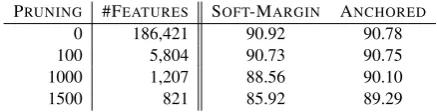
PRUNING #FEATURES SOFT-MARGIN ANCHORED
0 186,421 90.92 90.78
100 5,804 90.73 90.75
1000 1,207 88.56 90.10
1500 821 85.92 89.29
Table 1: Named Entity Identification results (F-score) on dev set, with various pruning thresholds.
Results are presented in Table 1. Without fea-ture pruning, we achieve an F-score of 90.9. This dataset proved to be quite resilient to feature prun-ing. Pruning features appearing less than 100 times results in just a slight decrease in F-score. Extremely aggressive pruning, keeping only fea-tures appearing more than 1,000 or 1,500 times in the training data, results in a big drop in F-score for the soft-margin SVM (from about 91 to 86). Much less so for the Anchored-SVM. Using An-chored SVM we achieve an F-score of 90.1 after pruning withk= 1,000. This model has 1207 ac-tive features, and 27 unique acac-tive lexical forms. 5.2 NP Chunking
The goal of this task (Marcus and Ramshaw, 1995) is the identification of non-recursive NPs. We use the data from the CoNLL 2000 shared task: NP chunks are extracted from Sections 15-18 (train) and 20 (test) of the Penn WSJ corpus. POS tagged are automatically assigned by the Brill Tagger. Features: We consider the POS and word-form of each token.
PRUNING #FEATURES SOFT-MARGIN ANCHORED
0 92,805 94.12 94.08
1 46,527 93.78 94.09
2 32,583 93.58 94.00
5 18,092 93.42 94.01
10 10,812 93.00 93.98
20 5,952 92.48 93.92
50 2,436 92.33 93.96
[image:5.595.71.290.62.118.2]100 1,168 91.94 93.83
Table 2: NP-Chunking results (F-score), with var-ious pruning thresholds.
Results are presented in Table 2. Without fea-ture pruning (k = 0), the soft-margin SVM per-forms slightly better than the Anchored-SVM. Ei-ther of the results are state-of-the-art for this task. However, even modest pruning (k = 2) hurts the soft-margin model significantly. Not so for the anchored-SVM. Even with relatively aggres-sive pruning (k = 100), the anchored model still achieves an impressive F-score of 93.83.
Remark-ably, in that last model, there are only 1,168 active features, and only 209 unique active lexical forms.
5.3 Chunking
The goal of the Chunking task (Sang and Buch-holz, 2000) is the identification of an assortment of linguistic base-phrases. We use the data from the CoNLL 2000 shared task.
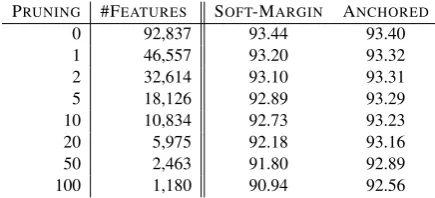
Features: We perform two experiments. In the first experiment, we consider the POS and word-form of each token. In this setting, feature pruning resulted in a bigger loss in performance than in the two previous tasks. Preliminary error analysis revealed that many errors are due to tagger errors, especially of the present participle forms. This led us to the second experiment, in which we added as features the 2- and 3- letter suffixes for the word to be classified (but not for the surrounding words). Results are presented in Tables 3 and 4. In the first experiment (POS + Word), the non-pruned soft-margin model is the same system as the top-performing system in the original shared task, and yields state-of-the-art results. Unlike the NP-chunking case, here feature pruning has a rela-tively large impact on the results even for the an-chored models. However, the anan-chored models are still far more robust than the soft-margin ones. Withk= 100pruning, the soft-margin model suf-fers a drop of 2.5 F points, while the anchored model suffers a drop of only 0.84 F points. Even after this drop, the anchoredk = 100model still performs above the top-third system in the CoNLL 2000 shared task. This anchoredk = 100model has 1,180 active features, and only 209 unique ac-tive lexical features.
The second experiment (POS + word-form + suffixes for main word) adds crude morphological information to the learner, helping it to avoid com-mon tagger mistakes. This additional information is helpful: pruning withk = 100leads to an ac-curate anchored model (93.12 F) with only 209 unique lexical items. Note that with the addition of the suffix features, the pruned model k = 20 beats the purely lexical model (no suffix features) with no pruning (93.51 vs. 93.44) with 10 times less features. When we combine suffixes and all lexical forms, we still see a slight advantage to the lexical model (93.73 vs. 93.12 with pruning atk= 100).
PRUNING #FEATURES SOFT-MARGIN ANCHORED
0 92,837 93.44 93.40
1 46,557 93.20 93.32
2 32,614 93.10 93.31
5 18,126 92.89 93.29
10 10,834 92.73 93.23
20 5,975 92.18 93.16
50 2,463 91.80 92.89
100 1,180 90.94 92.56
Table 3: Chunking results (F), with various prun-ing thresholds. Experiment 1. Features: POS, Word.
PRUNING #FEATURES SOFT-MARGIN ANCHORED
0 104,304 93.73 93.69
1 72,228 93.56 93.68
2 57,578 93.50 93.64
5 37,210 93.35 93.62
10 23,968 93.26 93.56
20 14,060 92.84 93.51
50 6,326 92.28 93.37
100 3,340 91.83 93.12
Table 4: Chunking results (F), with various prun-ing thresholds. Experiment 2. Features: POS, Word,{Suff2, Suff3}of main Word.
we replaced any explicit word-forms by 2- and 3-letter suffixes. This gives us the complete word form of many function words, and a reasonable amount of morphological marking. Results are presented in Table 5. Surprisingly, this infor-mation proves to be quite robust. Without fea-ture pruning, both the anchored and soft-margin model achieve near state-of-the-art performance of 93.25F. Pruning with k = 100 hurts the re-sult of the soft-margin model, but the anchored model remains robust with an F-score of 93.18. This last model has 2,563 active features. With further pruning (k = 250), the result of the an-chored model drops to 92.87F (still 3rd place in the CoNLL shared task), with only 1,508 active features in the model.
5.4 Fine-tuned soft-margin SVMs
For the sake of completeness, and to serve as a bet-ter comparison to the soft-margin SVM, we report results of some experiments with both L1 and L2 SVMs, with tunedCvalues. NP-chunking perfor-mance with tuned C values and various pruning thresholds is presented in Table 6.
For these results, the C parameter was tuned on a development set using Brent’s 1-dimension minimization method (Brent, 1973). While tak-ing about 40 hours of computation to fit, the
fi-PRUNING #FEATURES SOFT-MARGIN ANCHORED
0 19,910 93.25 93.23
100 2,563 92.87 93.18
[image:6.595.71.289.62.161.2]250 1,508 92.40 92.87
Table 5: Chunking results (F), with various prun-ing thresholds. Experiment 3. Features: POS , Suff2, Suff3 .
K L1 (C) L2 (C) ANCHORED
0 94.12 (1.0001) 94.09 (2.6128) 94.08 50 93.79 (0.0524) 93.71 (0.0082) 93.96 100 93.72 (0.0567) 93.59 (0.0072) 93.83 Table 6: NP-Chunking results (F), with various pruning thresholdsK, for L1 and L2 SVMs with tunedCvalues
nal results catch up with those of the anchored-SVM but still remain slightly lower. This further highlights our main point: accurate models can be achieved also with mostly unlexicalized mod-els, and the lexical features do not contribute sub-stantial semantic information, but rather affect the separability of the data. This is nicely demon-strated by SVM-anchoring, in which lexical infor-mation is practically replaced by artificial seman-tically void indexes, but similar performance can also be achieved by fine-tuning other learning pa-rameters.
6 Error Analysis
Our experiments so far indicate that very aggres-sive feature pruning hurts performance slightly (by about 0.5F point). The feature-pruned models are still accurate, indicating that lexical features con-tribute little to the classification accuracy. We now investigate the differences between the lexicalized and pruned models, in order to characterize the kind of information that is available to the lexi-calized models but missing from the pruned ones. In the next section, we also verify that pruned-models are more stable than the fully lexicalized ones when tested over different text genres and do-mains.
achieves an F-score of 93.24, vs. 92.59 for the suffix-based pruned anchored-SVM model. (The pruned anchored-SVM model (k= 100) from ex-periment 2, achieve a slightly higher F-score of 92.84)
We investigate only those chunks which are identified correctly by one model but not by the other. Overall, there are 440 chunks (363 unique) which are identified correctly only by the lexical-ized model, and 258 chunks (232 unique) only by the pruned model.
Where the pruned model is always wrong Some errors are unique to the pruned model.
Over 45 of the cases that are identified correctly only in the lexicalized model (more than 10%) are due to the words “including” (18 cases) and “If” (9 cases), as well as other -ing forms such as “fol-lowing”, “according”, “rising” and “suspecting.”
The word “including” appears 80 times in the training data, always tagged as VBG and func-tioning as a PP chunk, which is an odd chunk for VBGs. The lexicalized model easily picked up on this behaviour, while the pruned model couldn’t. Similarly, the word “following/VBG” appears 32 times, 20 of which as PP, and the word “according/VBG” 53 times, all of them as PP. The pruned model could not distinguish those from the rest of the VBGs and tagged them as VPs. What seems to happen in these cases, is that certain verbal forms participate in idiomatic constructions and behave syntactically as preposi-tions. The POS tagger does not pick this ambigu-ity in function and contributes only the most likely tag for the words (VBG). Lexical models learn that certain VBGs are “becoming” prepositions in the observed dataset. These words do not appear as specific features in the pruned models, and hence these usage shifts are often misclassified. Interest-ingly, the pruned model did learn that verbal forms can sometimes be PPs: it made use of that infor-mation by mis-identifying 11 verbal VBGs and 6 verbal VBNs as PPs.
The word “If/IN”, unlike most prepositions, it always starts an SBAR rather than a PP chunk in the corpus. The pruned model learned this be-haviour correctly for the lower-cased “if/IN”, but missed the upper-cased version appearing in 79 sentence initial locations in the corpus.
These cases are caused by a mismatch between the POS tag and the syntactic function observed in the chunked dataset.
Additional cases include the adverbs (Already, Nearby, Soon, Maybe, Perhaps, once, Then): they are sometimes not chunked as ADVP but are left outside of any chunk. Some one-word ADJP chunks being chunked as NPs (short, general, sure, worse, . . . ) (6 cases) and some are chunked as ADVPs (hard, British-born, . . . ) (4 cases).
There are 10 cases where the pruned model splits an NP into ADVP and NP, such as:
[later] [this week], [roughly][18 more U.S. stores]. In addition, the pruned model failed to learn the con-struction “typical of”, resulting in 2 NP chunks such as:[The more intuitive approach typical].
Some mistakes of the pruned model seem like mistakes/pecularities of the annotated corpus, which the lexicalized model found a way to work around. Consider the following gold-standard cases from the annotated corpus:
- [ VP seems ] [ ADVP rarely ] [ VP to cut ] - [ ADVP just ] [ PP after ]
- [ VP is ] [ NP anything ] [ O but ] [ VP fixing ] - [ ADJP as high ] [ PP as ] [ NP 8.3 % ] - [ ADJP less ] [ PP than ] [ ADJP rosy ] - [ NP 40 % ] [ PP to ] [ NP 45 % ]
Which were each identified as a single chunk by the pruned model. It can be argued these are mis-takes in the tagged dataset.
Where the lexical model is sometimes better Both models fail on conjunctions, but the lexical-ized model do slightly better. Conjunction error types come in two main varieties, either chunking [x][and][y] instead of [x and y] (pruned: 21 cases, lex: 14 cases) or chunking [x and y] instead of [x][and][y] (pruned: 26 cases, lex: 24 cases).
Joining VP and NP into an NP, due to a verb/adj ambiguity. For exam-ple chunking [NP fired six executives] in-stead of [VP fired] [NP six executives], or [NP keeping viewers] instead of
[VP keeping] [NP viewers]. 12 such cases are resolved correctly only by the lexicalized model, and 5 only by the pruned one.
SBAR/PP confusion for words such as: “as”,“after”,“with”,“since” (both ways). 13 cases for the pruned model, 6 for lexicalized one. Where both model are similar
Merging back-to-back NPs: Both models tend to erroneously join back-to-back NPs to a sin-gle NP, e.g. : [NP Westinghouse this year], or
on 16 cases the other model succeeded on. Joining NP and VP into an NP due to Verb/Noun ambiguity and tagger mistakes:
- [NP the weekend] [VP making] →[NP the weekend making] - [NP the competition] [VP can] →[NP the competition can]
(lexicalized: 6 errors, pruned: 8 errors)
And splitting some NPs to VP+NP due to the same reasons:
- [VP operating] [NP profit] - [VP improved] [NP average yield]
(lexicalized: 5 errors, pruned: 7 errors)
The word “that” is confused between SBAR and NP (5 mistakes for each model)
Erroneously splitting range NPs,e.g.:
- [about $115][to][$125](2 cases for each model). Where the pruned model is better
There are some cases where the pruned models is doing better than the lexicalized one:
VP wrongly split into VP and ADJP: - [remains] [banned]
4 mistakes for lexicalized, 1 for pruned VP wrongly split into VP and VP:
- [were scheduled] [to meet] - [used] [to complain]
3 mistakes for lexicalized, 1 for pruned VP wrongly split into ADVP and VP:
- [largly][reflecting] - [selectively][leaking]
6 mistakes for lexicalized, 1 for pruned PP and SBAR confusion:
- of, with, As, after
9 mistakes for lex, 5 for pruned
VP chunked as NP due to tagger mistake: - [NP ruling], [NP drives], [NP cuts]
6 mistakes for lex, 2 for pruned “that” tagged as NP instead of SBAR:
2 mistakes for lex, 0 for pruned
To conclude
Both the pruned and the fully lexicalized models have problems dealing with non-local phenomena such as coordination and relative clauses, as well as verb/adjective ambiguities and VBG/Noun am-biguities. They also perform poorly on embeded syntactic constructions (such as an NP containing an ADJP), and on identification of back-to-back NPs, which often requires semantic knowledge.
Both models suffer from tagging mistakes of the underlying tagger and systematic ambiguity be-tween the morphological tag assigned by the tag-ger and the syntactic tag in which the word
oper-ates (e.g., “including” used as a preposition). The main advantage of the fully lexcialized model is in dealing with:
• Some coordinated constructions.
• Some cases of verb/adjective ambiguities. • Specific function words not seen much in
training.
• Idiomatic usages of some VBG/VBN forms functioning as prepositions.
The first two items are semantic in nature, and hint that lexical features do capture some semantic in-formation. While this might be true on the spe-cific corpus, we believe that such corpus-derived semantic knowledge is very restricted, is not gen-eralizable, and will not transfer well to other cor-pora, even on the same genre. We provide evi-dence for this claim in Section 7.
The last two items are syntactic. We address them by introducing a slightly modified feature model.
6.1 Another chunking Experiment
Based on the observations from the error analy-sis, we performed another pruned-chunking exper-iment, with the following features:
• Word and POS for a -2,+2 window around the current token, and 2-and-3-letter suffixes of the token to be classified (same as Experi-ment 2 in Section 5.2 above).
• Features of words appearing as a preposi-tion (IN) anywhere in the training set are not pruned (this result in a model with 310 unique lexical items afterk= 100pruning). • An additional binary feature indicating for
each token whether it can function as a PP. The list of possible-PP forms is generated by considering all tokens seen inside a PP in the training corpus. It can be easily extended if additional lexicographic resources are avail-able, without retraining the model.
This last proposed feature incorporates important lexical knowledge without relying on features for specific lexical forms, and is more generalizable. The accuracy of this new model on the develop-ment and test set with various pruning thresholds is presented in Table 7.
CORPUS SOURCE CONTENT #TOKENS
[image:9.595.326.509.158.216.2]WSJ 4 articles from wsj.com business Magazine, business 2,671 Jaguar Wikipedia page on Jaguar Well edited text, animals 5,396 FreeWill Wikipedia page on Free Will Well edited text, philosophy 9,428 LJ-Life 4 LiveJournal posts Noisy teenage writing, life 870
Table 8: Corpus Variation Text Sources
PRUNING #FEATURES SOFT-MARGIN ANCHORED Dev Set
0 92,989 93.71 –
100 4,066 – 93.22
Test Set
0 92,989 93.68 –
100 4,066 – 93.26
Table 7: Chunking results (F), with various prun-ing thresholds. Experiment 4. Features: POS, Word , Suff2, Suff3 for main word, CanBePrep .
vs. 93.73). The pruned model performance im-proves in both cases, more so on the development set (93.12 to 93.22 on the test set, 92.84 to 93.26 on the development set). The new model helps bridging the gap between the fully lexicalized and the pruned model, yet we still observe a lead of 0.4F for the fully lexicalized model. We now turn to explore how meaningful this difference is in real-world situation in which one does not operate on the Penn-WSJ corpus.
7 Corpus Variation and Model Performance
When tested on the exact same resource as the models are trained on, the fully lexicalized model still has a slight edge over the pruned ones. How well does this lexical knowledge transfer to dif-ferent text genres? We compare the models’ per-formance on text from various genres, ranging from very similar to the training material (re-cent articles from the WSJ Business section) to a well-edited but different domain text (“Featured-content” wikipedia pages) to a non-edited noisy text (live-journal blog posts from the “life” cate-gory). As we do not have gold-annotated data for these text genres, we analyze the few differences between the models, manually inspecting the in-stances on which the models disagree.
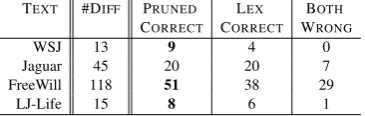
Table 8 describes our test corpora for this ex-periment. We applied the fully-lexicalized and the pruned (k = 100) anchored models described in Section 6.1 to these texts, and compared the chunking results. The results are presented in Ta-ble 9.
When moving outside of the canonic training
TEXT #DIFF PRUNED LEX BOTH
CORRECT CORRECT WRONG
WSJ 13 9 4 0
Jaguar 45 20 20 7
FreeWill 118 51 38 29
[image:9.595.87.276.165.227.2]LJ-Life 15 8 6 1
Table 9: Comparison of Models’ performance on different text genres
corpus, the fully lexicalized model have no advan-tage over the heavily pruned one. On the contrary, the pruned models seem to have a small advantage in most cases (though it is hard to tell if the differ-ences are significant). This is true even for texts in the very same domain, genre and editing guide-lines as the training corpus was derived from.
8 Discussion
References
Daniel M. Bikel. 2004. Intricacies of collins’ parsing model. Computational Linguistics, 30(4).
Richard P. Brent, 1973. Algorithms for Minimization without Derivatives, chapter 4. Prentice-Hall. Claire Cardie and David Pierce. 1998. Error-driven
pruning of treebank grammars for base noun phrase identification. InACL-1998.
Eugene Charniak. 2000. A maximum-entropy-inspired parser. InProc of NAACL.
Michael Collins. 1997. Three generative, lexicalized models for statistical parsing. InProc of EACL. Ronan Collobert and Jason Weston. 2008. A unified
architecture for natural language processing: Deep neural networks with multitask learning. InProc. of ICML.
Jenny Rose Finkel, Trond Grenager, and Christopher Manning. 2005. Incorporating non-local informa-tion into informainforma-tion extracinforma-tion systems by gibbs sampling. InProc of ACL.
Daniel Gildea. 2001. Corpus variation and parser per-formance. InProc of EMNLP.
Yoav Goldberg and Michael Elhadad. 2007. SVM Model Tampering and Anchored Learning: A Case Study in Hebrew. NP Chunking. InACL2007. Yoav Goldberg, Meni Adler, and Michael Elhadad.
2006. Noun Phrase Chunking in Hebrew: Influence of Lexical and Morphological Features. In COL-ING/ACL2006.
Hideki Isozaki and Hideto Kazawa. 2002. Efficient Support Vector Classifiers For Named Entity Recog-nition. InCOLING2002.
Daisuke Kawahara and Kiyotaka Uchimoto. 2007. Miniamlly lexicalized dependency parsing. InProc of ACL (Short papers).
Dan Klein and Christopher D. Manning. 2003. Accu-rate unlexicalized parsing. InProc. of ACL.
Yoshiaki Koshiba and Shigeo Abe. 2003. Comparison of L1 and L2 support vector machines. InProc. of the International Joint Conference on Neural Net-works, volume 3.
Taku Kudo and Yuji Matsumoto. 2000. Use of Sup-port Vector Learning for Chunk Identification. In CoNLL-2000.
Taku Kudo and Yuji Matsumoto. 2001. Chunking with support vector machines. InNAACL ’01.
Mitch P. Marcus and Lance A. Ramshaw. 1995. Text Chunking Using Transformation-Based Learn-ing. In3rd ACL Workshop on Very Large Corpora.
Takuya Matsuzaki, Yusuke Miyao, and Jun’ichi Tsujii. 2005. Probabilistic cfg with latent annotations. In Proc of ACL.
Ryan McDonald. 2006. Discriminative Training and Spanning Tree Algorithms for Dependency Parsing. Ph.D. thesis, University of Pennsylvania.
Joakim Nivre, Johan Hall, and Jens Nillson. 2006. MaltParser: A Data-Driven Parser-Generator for Dependency Parsing. InLREC2006.
Slav Petrov, Leon Barrett, Romain Thibaux, and Dan Klein. 2006. Learning accurate, compact, and inter-pretable tree annotation. InProc of ACL.
Lev Ratinov and Dan Roth. 2009. Design challenges and misconceptions in named entity recognition. In Proc of CONLL.
Erik F. Tjong Kim Sang and S. Buchholz. 2000. Intro-duction to the CoNLL-2000 shared task: chunking. InCoNLL-2000.
Fei Sha and Fernando Pereira. 2003. Shallow parsing with conditional random fields. InProc of NAACL. Erik F. Tjong Kim Sang and Fien De Meulder.
2003. Introduction to the CoNLL-2003 Shared Task: Language-Independent Named Entity Recog-nition. InCoNLL-2003.
Erik F. Tjong Kim Sang. 2002. Introduction to the CoNLL-2002 Shared Task: Language-Independent Named Entity Recognition. InCoNLL-2002. Vladimir Vapnik. 1995. The nature of statistical
learn-ing theory. Sprlearn-inger-Verlag New York, Inc.