Improving AOR Method for a Class of Two-by-Two
Linear Systems
Cuixia Li1, Shiliang Wu2 1
College of Mathematics, Chengdu University of Infromation Technology, Chengdu, China 2
School of Mathematics and Statistics, Anyang Normal University, Anyang, China E-mail: lixiatk@126.com, wushiliang1999@126.com, [email protected] Received October 18, 2010; revised December 10, 2010; accepted December 15, 2010
Abstract
In this paper, the preconditioned accelerated overrelaxation (AOR) method for solving a class of two-by-two linear systems is presented. A new preconditioner is proposed according to the idea of [1] by Wu and Huang. The spectral radii of the iteration matrix of the preconditioned and the original methods are compared. The comparison results show that the convergence rate of the preconditioned AOR methods is indeed better than that of the original AOR methods, whenever the original AOR methods are convergent under certain condi-tions. Finally, a numerical example is presented to confirm our results.
Keywords: Preconditioner, AOR Method, Convergence, Comparison
1. Introduction
Sometimes we have to solve the following linear systems
,
Hx f (1.1)
where
1 2
,
I B D
H
C I B
is non-singular with
1 , 2 ,
, .
ij p p ij n p n p ij n p p ij p n p
B b B b
C c D d
Systems such as (1.1) are important and appear in many different applications of scientific computing. For example, (1.1) are usually faced when the following gen- eralized linear-squares problem is considered
1
min ,
n
T x
Ax b W Ax b
where W is the variance-covariance matrix. One can see
[2-5] for details.
As is known, the linear systems (1.1) can be solved by direct methods or iterative methods. Direct methods are widely employed when the order of the coefficient ma-trix H is not too large, and are often regarded as robust
methods. The memory and the computational
require-ments for solving the large linear systems may seriously challenge the most efficient direct methods available to- day. The alternative is to use iterative methods establi- shed for solving the large linear systems. Naturally, it is necessary that we make the use of iterative methods in-stead of direct methods to solve the large sparse linear systems. Meanwhile, iterative methods are easier to im-plement efficiently on high performance computers than direct methods.
As is known, there exist three well-known classical it-erative methods, i.e., Jacobi, Gauss-Seidel and succes-sive overrelaxation (SSOR) method, which were fully covered in the excellent books by Varge [6] and Young [7]. To make the convergence rate of SSOR method bet-ter, accelerated overrelaxation (AOR) method was pro-posed in [8] by Hadjidimos.
To solve the linear systems (1.1) with the AOR itera-tive method, based on the structure of the matrix H, the
matrix H is split as follows
1 2
0 0
. 0 0
B D
H I
B C
(1.2)
The AOR iterative method for solving (1.1) is estab-lished as follows
1
, , 0,1,
i i
w r
x T x wg i (1.3) where w0, Tw r, is iteration matrix and is of the
237
1
1 ,
2 1
1 2
0 0 0
1
0 0 1
1 1
w r
B D
I
T w I w
B
rC I C
w I wB wD
w r C wrCB w I wB wrCD
and
0 . I
g f
rC I
Obviously, if wr, then the AOR method reduces to the SOR method.
The spectral radii of the iteration matrix is decisive for the convergence and stability of the method, and the smaller it is, the faster the method converges when the spectral radii is smaller than 1. To accelerate the conver-gence rate of the iterative method solving the linear sys-tems (1.1), preconditioned methods are often used. That is,
, PHxPf
where the preconditioner P is a non-singular matrix. If the matrix PH is expressed as
1
2
,
I B D
PH
C I B
then the preconditioned AOR method can be defined by
,
1 , 0,1,
w r
i i
x T x wg w i (1.4)
where
1
,
1 2
1
1 1
w r
w I wB wD
T
w r C wrC B w I wB wrC D
and
0 . I
g Pf
rC I
In this paper, according to the idea of [1] by Wu and Huang, a new preconditioner is proposed to improve the convergence rate of the AOR method. Be similar to the work of [1] and [9], we compare the spectral radii of the iteration matrix of the preconditioned and the original methods. The comparison results show that the conver-gence rate of the preconditioned AOR methods is indeed superior to that of the original AOR methods, whenever the original AOR methods are convergent (to see the next section).
For convenience, we shall now briefly explain some of the terminology and lemmas. Let
n ni j
C c be an n n real matrix. Bydiag C
, we denote then n di- agonal matix coinciding in its diagonal with cii. For
ij ,A a B
bij n n , we write AB if aij bijholds for all i j, 1, 2, , . n Calling A is nonnegative
if A0,
aij 0; ,i j1, 2, , n
,we say that A B 0if and only if AB These definitions carry immedi-
ately over to vectors by identifying them with n1 ma- trices.
denotes the spectral radius of a matrix.Lemma 1.1 [6] Let An n be a nonnegative and
irreducible n n matrix. Then
1) A has a positive real eigenvalue equal to its spec-
tral radius
A ;2) for
A ,there corresponds an eigenvector x0; 3)
A is a simple eigenvalue of A.4)
A increases when any entry of A increases.Lemma 1.2 [10] Let A be a nonnegative matrix.
Then
1) If x Ax for some nonnegative vector x,
0
x , then
A .2) If Axx for some positive vector x, then
A . Moreover, if A is irreducible and if
0xAxx for some nonnegative vector x, then ( )A
and x is a positive vector.
The outline of this paper is as follows. In Section 2, the spectral radii of the iteration matrix of the original and the preconditioned methods are compared. In Sec-tion 3, a numerical example is presented to illustrated our results.
2. Preconditioned AOR Methods and
Comparisons
Now, let us consider the preconditioned linear systems,
,
Hx f (2.1)
where H
IS H
and f
IS f
with 0. 0 0 S S
According to [1], here S is taken as as follows
12 23
1, ,1
0
0 0
0 0 0
.
0 0 0
0 0 0
p p
p p p
b b S
b b
Naturally, we assume that there at least exists a non-zero number in the elements of S.
By simple computations, we obtain
1 1
2
I B S I B I S D H
C I B
with
1 1
11 12 21 12 22 1 12 2 21 23 31 22 23 32 2 23 3
1 11 2 1 12 1 1
.
p p
p p
p p p pp p p
B S I B
b b b b b b b b
b b b b b b b b b
b b b b b b b b
Be similar to (1.2), H can be expressed as
1 1
2
0 0
.
0 0
B S I B I S D H I
C B
Then the preconditioned AOR method for (2.1) is de-fined as follows:
1
, , 0 0,1,
i i
w r
x T x wg w i (2.2)
where
, 1 1
1 1
2
1 1
1
w r
T w I w B S I B w r C
wrC B S I B w I S D w I
wB wrC I S D
and
0 . I
g f
rC I
The following theorem is given by comparing the spectral radii of the iteration matrix Tw r, and the
origi-nal iteration matrix Tw r, .
Theorem 2.1 Let the coefficient matrix H be
irre-ducible, B10 with diag B
1 0 , B20, C0 ,0
D , 0 w 1 and 0 r 1. Then
1)
Tw r,
Tw r, , if
Tw r, 1; 2)
Tw r,
Tw r, , if
Tw r, 1. Proof. By simple computations, we obtain
1
,
2
1
1
1 1
0 0
w r
w I wB wD
T
w r C w I wB
wr
CB CD
(2.3)
Clearly, if the matrix H satisfies B10, B20,
0
C and D0 with 0 w 1 and 0 r 1, then
, 1
0 0
0 and Tw r 0.
CB CD
Since the matrix H is irreducible, by observing the
structure of (2.3), it is not difficult to get that the matrix ,
w r
T is irreducible. Similarly, the matrix Tw r, is
non-negative and irreducible with diag B
1 0.By Lemma 1.1, there is a positive vector x such that
, ,
w r
T xx
Where
Tw r, . Obviously, 1 is impossible,otherwise the matrix H becomes singular. So we will
mainly discuss two cases: 1 and 1.
Case 1: 1. Since Tw r, xxTw r, x T w r, x, we get
1, ,
1
1
,
0
0 0 0
0 0
0
1 .
0
w r w r
w r
wS I B wSD
T x T x x
wrCS I B wrCSD
S w I B wD
x rCS
S
T I x rCS
S
x rCS
Since S 0 and S 0, then we get
0 0
0 and 0.
0 0
S S
x x
rCS rCS
If 1, then Tw r, x T w r, x0 but not equal to zero
vector. By Lemma 1.2, we get
Tw r,
Tw r, . That is, 1) holds.Similarly, 2) holds with 1, which completes the proof. □
It is well known that when wr, AOR iteration is reduced to SOR iteration. The following corollary is eas-ily obtained.
Corollary 2.1 Let the coefficient matrix H be
irre-ducible, B10 with diag B
1 0, B20, C0,0
D and 0 w 1. Then
1)
Tw
Tw , if
Tw 1;2)
Tw
Tw , if
Tw 1.Next, we consider the following preconditioners. Let the matrix S in (2.1) be defined by
0 0 . 0
S S
There exist the following three forms for S, that is,
1) If n p p, then
11 22
,1 ,
0 0 0 0
0 0 0 0
.
0 0 0
n p n p n p n p p
c c S
c c
2) If n p p, then
11 22
,1 ,
0 0
0 0
.
0
n p n p n p n p p
c
c S
c c
239
3) If n p p, then
11 22
,1 ,
0 0
0 0
. 0
0 0 0
p p p
n p p
c c
S
c c
Naturally, we assume that there at least exists a non-zero number in the elements of S. For the sake of sim-plicity, we assume that n p p, H can be expressed as
1
1 2I B D
H
S I B C I B SD
with
1
11 11 12 11 12 1 11 1 21 22 21 22 22 2 22 2
,1 ,2 ,
p p
p p
n p n p n p p
S I B C
c b c c b c c b
c c b c b c c b
d d d
where
,1 ,1 11 , ,1 ,2 ,2 ,1 12 , ,2
, , ,1 1 , ,
, ,
.
n p n p n p n p n p n p n p n p n p n p n p
n p p n p p n p p n p n p n p p
d c b c b
d c c b c b
d c c b c b
The matrix H is split as follows
1
1 20 0
.
0 0
B D
H I
S I B C B SD
Then the preconditioned AOR method for (2.1) is of the following form:
1
, , 0 0,1,
i i
w r
x T x wg w i
where
, 1 ,
w r
T w IwJwrK
11
2 ,B D
J
S I B C B SD
1
1
1
0 0
, K
S I B C I B S I B C D
and
1
0 . I
g f
r S I B C I
Similarly, the following theorem and corollary are given by comparing the spectral radii of the iteration ma- trix Tw r, and the original iteration matrix Tw r, .
Theorem 2.2 Let the coefficient matrix H be
irre-ducible,B10with diag B
1 0, B20, C0, D0,0 w 1 and 0 r 1. Then
1)
Tw r,
Tw r, , if
Tw r, 1; 2)
Tw r,
Tw r, , if
Tw r, 1.Corollary 2.2 Let the coefficient matrix H be irre-ducible,B10with diag B
1 0, B20, C0, D0, and 0 w 1. Then1)
Tw
Tw , if
Tw 1;2)
Tw
Tw , if
Tw 1.3. A Numerical Example
Now let us consider the following example to illustrate the results.
Example 3.1
1 2
,
I B D
H
C I B
where
1 2
1 ij , 2 ij ,
p p n p n p
B b B b
ij n p p,C c and D
dij p n pwith
1 1
1
, 1, 2, , , 50
1 1 , ,
40 40
1, , 1, 2, ,
ii
ij
b i p
b i j
j i
i p j p
1 1 1 , ,
40 40 1
2, , , 1, 2, , 1
ij
b i j
i j i
i p j p
2 2
1 , 1, 2, , ,
40
1 1
, ,
40 40
1, , 1, 2, ,
ii
ij
b i n p
b i j
p j p i
i n p j n p
2 1 1 , ,
40 40 1
2, , , 2, , 1
ij
b i j
i j p i
i n p j n p
Table 1. The spectral radii of the AOR and preconditioned AOR iteration matrix.
n p w r
Tw r,
Tw r,
Tw r,5 3 0.95 0.8 0.1153 0.1081 0.1088
10 6 0.9 0.5 0.2591 0.2513 0.2524
15 5 0.9 0.85 0.3379 0.3351 0.3358
20 10 0.75 0.6 0.5422 0.5376 0.5379
30 18 0.8 0.75 0.7005 0.6960 0.6982
40 30 0.5 0.3 0.9582 0.9575 0.9579
50 25 0.9 0.5 1.1774 1.1796 1.1793
60 20 0.8 0.5 1.3923 1.3957 1.3948
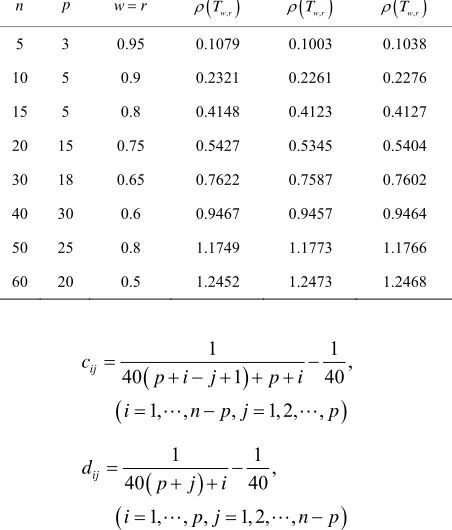
Table 2. The spectral radii of the SOR and preconditioned SOR iteration matrix.
n p wr
Tw r,
Tw r,
Tw r,5 3 0.95 0.1079 0.1003 0.1038
10 5 0.9 0.2321 0.2261 0.2276
15 5 0.8 0.4148 0.4123 0.4127
20 15 0.75 0.5427 0.5345 0.5404
30 18 0.65 0.7622 0.7587 0.7602
40 30 0.6 0.9467 0.9457 0.9464
50 25 0.8 1.1749 1.1773 1.1766
60 20 0.5 1.2452 1.2473 1.2468
1 1
,
40 1 40
1, , , 1, 2, ,
ij
c
p i j p i
i n p j p
1 1 ,
40 40
1, , , 1, 2, ,
ij
d
p j i
i p j n p
Tables 1, 2 display the spectral radii of the corres-ponding iteration matrix with different parameters w,
r and p. These calculations are performed using
Mat-lab 7.1.
Obviously, from Table 1, it easy to known that
Tw r,
Tw r, 1 and
, , 1
w r w r
T T
. That
is, these are in concord with Theorem 2.1 and 2.2. From Table 2, it is easy to know that
Tw
Twand
Tw
Tw when
Tw 1. That is, these arein concord with Corollary 2.1 and 2.2.
4. Acknowledgements
This research was supported by NSFC (11026040, 11026083).
5. References
[1] S.-L. Wu and T.-Z. Huang, “A Modified AOR-Type It-erative Method for L-Matrix Linear Systems,” Australian & New Zealand Industrial and Applied Mathematics Journal, Vol. 49, 2007, pp. 281-292.
[2] J.-Y. Yuan, “Iterative Methods for Generalized Least Squares Problems,” Ph.D. Thesis, IMPA, Rio de Janeiro, Brazil, 1993.
[3] J.-Y. Yuan, “Numerical Methods for Generalized Least Squares Problems,” Journal of Computational and Ap-plied Mathematic, Vol. 66, No. 1-2, 1996, pp. 571-584.
doi:10.1016/0377-0427(95)00167-0
[4] J.-Y. Yuan and A. N. Iusem, “SOR-Type Methods for Generalized Least Squares Problems,” Acta Mathemati-cae Applicatae Sinica, Vol. 16, 2000, pp. 130-139.
doi:10.1007/BF02677673
[5] J.-Y. Yuan and X.-Q. Jin, “Convergence of the General-ized AOR Method,” Applied Mathematics and Computa-tion, Vol. 99, No. 1, 1999, pp. 35-46.
doi:10.1016/S0096-3003(97)10175-8
[6] R. S. Varga, “Matrix Iterative Analysis,” Springer Series in Computational Mathematics: 27, Springer-Verlag,
Ber-lin, 2000.
[7] D. M. Young, “Iterative Solution of Large Linear Sys-tems,” Academic Press, New York, 1971.
[8] A. Hadjidimos, “Accelerated over Relaxtion Method,”
Mathematics of Computation, Vol. 32, No. 141, 1978, pp.
149-157. doi:10.1090/S0025-5718-1978-0483340-6 [9] X.-X. Zhou, Y.-Z. Song, L. Wang and Q.-S. Liu,
“Pre-conditioned GAOR Methods for Solving Weighted Lin-ear Least Squares Problems,” Journal of Computational and Applied Mathematics, Vol. 224, No. 1, 2009, pp.
242-249. doi:10.1016/j.cam.2008.04.034
[image:5.595.59.285.307.572.2]