ISSN Print: 2164-2818
DOI: 10.4236/ojml.2019.93016 May 31, 2019 165 Open Journal of Modern Linguistics
Transitive and Attitudinal Aspects in a
Functional Analysis of Academic
Discourse in Spanish
Natalia Ignatieva
Department of Applied Linguistics, National Autonomous University of Mexico, Mexico City, Mexico
Abstract
This paper presents a systemic functional analysis of three types of processes in academic texts: verbal, mental and relational. It intends to explore how certain process types in Spanish are related to the expression of evaluation in academic texts. Our study draws on Systemic Functional Linguistics and, in particular, on the Appraisal Theory, which explores evaluative aspects of the language, here we shall analyze only one of its subsystems, ATTITUDE. Our analysis is based on student texts collected at the Faculty of Arts, belonging to two disciplines: literature and history, but to only one genre: question-answer. The preliminary results show certain differences between the two corpora: in the literature texts clauses with appraisal prevail and JUDGMENT is the pre-ferred means of expressing ATTITUDE, while the history texts prefer clauses without appraisal and APPRECIATION prevails among the subtypes of ATTITUDE.
Keywords
Academic Writing, Text, Process, Evaluation, Interpersonal, Appraisal, Appreciation, Judgement
1. Introduction
This paper presents a systemic functional (SF) analysis of three types of clauses: verbal, mental and relational in academic texts, from the ideational and inter-personal perspectives. This work forms part of the on-going research study de-veloped at the National Autonomous University of Mexico (UNAM) which, in its turn, is included in the SAL (Systemics across Languages) project in its Latin American version. The goal of the SAL project is to analyze verbal processes How to cite this paper: Ignatieva, N.
(2019). Transitive and Attitudinal Aspects in a Functional Analysis of Academic Dis-course in Spanish. Open Journal of Modern Linguistics, 9, 165-178.
https://doi.org/10.4236/ojml.2019.93016
Received: March 19, 2019 Accepted: May 28, 2019 Published: May 31, 2019
Copyright © 2019 by author(s) and Scientific Research Publishing Inc. This work is licensed under the Creative Commons Attribution International License (CC BY 4.0).
http://creativecommons.org/licenses/by/4.0/
DOI: 10.4236/ojml.2019.93016 166 Open Journal of Modern Linguistics (“verbs of saying”) as one of the most important types within the SF verbal ty-pology and their use in different types of discourse across registers and genres. As an international project, the SAL also aims at involving as many different languages as possible in this study. We had already participated in the SAL project before with the study of verbal processes in academic texts in Spanish within the systemic functional framework and had carried out a lexicogrammatical analysis of the verbal clauses (Ignatieva, 2011; Ignatieva & Rodríguez-Vergara, 2015).
The present project extends this research to other types of processes. We be-gin our analysis with processes because, according to the SF framework, the construction of a sentence as a meaning-making unit starts with choosing a process type which describes the world of experience and at the same time orga-nizes the participants of the situation described. In other words, we are carrying out a transitivity analysis of academic texts.
Besides, we decided to combine transitivity analysis with the Appraisal Theory perspective, i.e. we want to observe how students express their attitude in aca-demic writing and what linguistic resources they choose for this purpose. Final-ly, we are interested in the interaction of transitive and attitudinal aspects of academic writing, that is, we want to see what processes students choose in their texts and if these process types are related to the expression of appraisal in the clauses that contain them. We are planning to analyze all types of clauses (ver-bal, mental, relational, material, behavioral and existential) throughout discip-lines (literature, history and geography) and genres (question-answer, essay, re-view, report and article). We shall be using student texts from the CLAE corpus (Corpus of Academic Language in Spanish (CLAE, 2009)): the product of one of our previous studies (Ignatieva & Colombi, 2014), as well as other student texts recollected at the UNAM.
So our main goal is to examine the relation between certain process types and the expression of evaluation in the clauses containing them. This relation be-tween ideational and interpersonal meanings and, as a consequence, bebe-tween the systems of TRANSITIVITY and APPRAISAL, was mentioned by Martin and White (2005) in their analysis of different types of discourse. In accordance with this, our study has to do with two levels of analysis: lexicogrammatical and dis-course semantic, and two systems: TRANSITIVITY and APPRAISAL. Although there are studies which connect some process types with different kinds of eval-uation (Hyland, 1999; Chen, 2007; Lavid, 2008; etc.) they do not treat this prob-lem from the angle adopted in this work, besides most of these studies take Eng-lish as the basis for their exploration.
DOI: 10.4236/ojml.2019.93016 167 Open Journal of Modern Linguistics
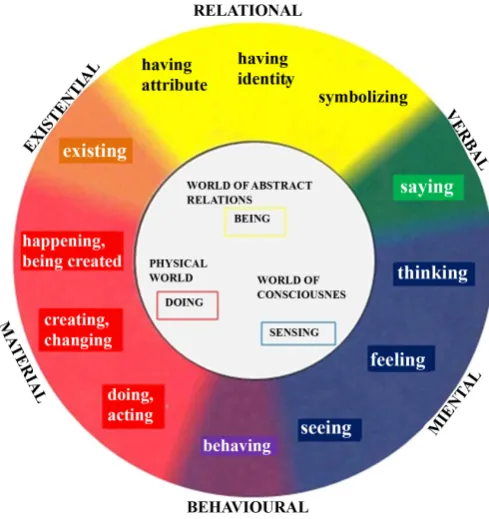
Figure 1. Transitivity “wheel” (adapted from Halliday (1994)).
Here we want to explore academic texts of only one genre (question-answer) but two disciplines (literature and history). The starting point will be a TRANSITIVITY analysis of these texts followed by an APPRAISAL analysis trying to reveal the interaction of these two systems. Our goal is to explore how ideational (expe-riential) and interpersonal meanings unfold in student writing and how writers use different options for encoding semantic categories of ATTITUDE.
2. Systemic Functional Perspectives on TRANSITIVITY and
ATTITUDE
Our study draws on Systemic Functional Linguistics (SFL) created by M. A. K. Halliday (1976, 1985, 1994) and developed by other exponents of this theory (Martin, 1985, 1992; Matthiessen, 1995; Thompson, 1996; etc.). The theory presents a holistic model of language and its social context which conceives lan-guage as a meaning construing resource.
DOI: 10.4236/ojml.2019.93016 168 Open Journal of Modern Linguistics types of meaning: ideational, interpersonal and textual.
Ideational meanings and, in particular, experiential ones, are those that a writer or speaker manipulates to codify his experiences in the exterior and inte-rior world. They are materialized in the clause via a linguistic system of TRANSITIVITY that concerns different combinations of participants organized around a process in the clause. It refers to “a way of representing patterns of ex-perience (…) of imposing order on the endless variation and flow of events” (Halliday, 1994: p. 106). In other words, it is the organization of the sentence which construes the world of experience into a set of process types. Halliday di-vides processes into six types: “material”, “mental”, “relational”, “verbal”, “beha-vioral” and “existential”.
Textual meanings are occupied with the information flow and they organize and distribute ideational and interpersonal meanings into a coherent text.
Interpersonal meanings have to do with social relations, i.e. how people inte-ract, how they express and interchange their opinions. Their basic systems are MODALITY which defines the type of exchange (giving and demanding infor-mation or giving and demanding services) and EVALUATION (Martin & White, 2005). Thus, the metafunctional approach to analysis is important as this approach can facilitate our recognizing the ways in which “interpersonal mean-ings relate to ideational choices in the discourse” (Hood, 2010). So, our main in-terest concerns the interaction between the ideational and interpersonal mean-ings realized through TRANSITIVITY and APPRAISAL systems, respectively.
The APPRAISAL system is a theoretical perspective for examining evaluative aspects of language within the SFL framework. Created within the Sydney School of SFL, this theory presents one of the systems of textuality (Martin & White, 2005), which models linguistic resources, giving cohesion to the text from the point of view of values, attitudes and the author’s stance. Thus, the Appraisal makes it evident how an affective-evaluative language contributes to textual co-herence on the discursive semantic level.
The APPRAISAL system is divided into three subsystems: ATTITUDE, ENGAGEMENT and GRADUATION; here we shall analyze only one subsys-tem, ATTITUDE. As a construct, ATTITUDE models linguistic resources which are grouped under the term of evaluation in some other theories (e.g. Thompson & Hunston, 2000). The subsystem of ATTITUDE includes linguistic options to express emotions (affect), to appraise things and abstract entities using aesthetic criteria (appreciation) and to evaluate persons on the basis of ethical criteria (judgement). In accordance with that, the ATTITUDE subsystem is also divided into three regions: AFFECT, APPRECIATION and JUDGEMENT (Martin & White, 2005: pp. 35-36). To sum up, the model of APPRAISAL provides “a basis for a theoretically informed analysis of the interpersonal meanings” construed in the student texts (Hood, 2010).
DOI: 10.4236/ojml.2019.93016 169 Open Journal of Modern Linguistics that the Appraisal Theory in its basic terms has a universal potential, i.e. it can be applied to Spanish or any other language. Therefore, there is a need for more applications of this theory in order to prove its total or partial applicability and see if there is any specificity for particular languages.
3. Construing Evaluation
In order to register all the cases of expressing attitude we tried to single out lin-guistic categories that would help us to describe not only evaluation in the text but also the interaction of ideational and interpersonal meanings. As it was al-ready noticed within the SFL, evaluation can be expressed in the text deploying a wide range of linguistic means. According to Thompson and Hunston (2000), each kind of evaluation draws differently on resources of grammar, therefore, there are different ways of encoding evaluation in the clause. Thus, processes can realize evaluation intrinsically, i.e. an attitudinal meaning can be infused into the process itself, e.g.:
1) Cardenio ama a Luscinda. (L8)
“Cardenio loves Luscinda”
where attitude is expressed as an affective process amar (love). Although the ex-periential meaning (as a piece of information conveyed by the author) may do-minate in this context, its interpersonal meaning (as denoting feelings) still im-plies affect with positive polarity. The processes in which its ideational meaning is infused with attitudinal meaning usually belong to the group of mental processes, Hunston (1995) calls them “verbs of attribution”, another example would be:
2) Lo que le interesa es señalar los hechos concretos. (H9)
“What interests him is to note concrete facts”
In 2) a mental process interesar (interest) expresses affect with positive polar-ity denoting some sort of inclination. Other groups of processes can also encode evaluation, e.g. some verbal processes which take Target as the second partici-pant in the act of communication (the first being Sayer), e.g.:
3) Don Quijote la justifica (a Dulcinea). (L1)
“Don Quijote justifies her”
In 3) we have a case of judgement with positive polarity because this state-ment implies that Don Quijote says positive things about Dulcinea in order to improve her image. Verbal processes like justificar represent a closed set; they are called “processes of verbal impact” by Matthiessen (1995: p. 285) and include verbs like acusar (accuse), felicitar (congratulate), elogiar (praise), etc., with no verbalization at all either as Verbiage or locution (Caffarel, 2006: p. 90), i.e. they incorporate “the message” in the verb meaning.
Another way of realizing evaluation is by means of a nominal group (NG), e.g.:
4) …y le cuenta su tristeza. (L12)
“and she tells him (about) her sadness”
DOI: 10.4236/ojml.2019.93016 170 Open Journal of Modern Linguistics which is analyzed as an example of affect with negative polarity. Both nouns (as in 4)) and adjectives (as in 5)) can encode attitude within a noun group, in the latter case an adjective functions as an epithet (inteligente y libre) modifying a noun (elección). 5) is an example of judgement with a positive value introduced by the relational process ser (be):
5) El amor y el casamiento entre dos jóvenes debe ser una elección
inteligente y libre. (L15)
“Love and marriage between two young people must be an intelligent and free election”
Another form of including evaluation in the clause is with the help of an attribute, e.g.:
6) Para Bloch, la observación es importante. (H1)
“For Bloch, observation is important”
7) Cardenio se vuelve salvaje… (L 8)
“Cardenio becomes savage”
In 6) we can observe a relational process ser (be) that is linked with an attribute importante (important) to be analyzed as a case of appreciation with positive polarity while in 7) another relational process volverse together with an attribute salvaje encodes judgement with a negative value. Evaluation can also be realized by a clause, usually it is a projected clause with a verbal 8) or mental 9) process in the projecting clause, e.g.:
8) Él afirma que nadie tiene porqué hablar mal de élla. (L13)
“He affirms that nobody has to speak badly of her”
9) Entonces debe entenderse que la realidad histórica… es digna de ser
tomada como objeto de estudio. (H4)
“So it should be understood that a historic reality … is worthy to be taken as an object of study”
Example 8) presents a case of judgement with positive polarity expressed by a clause, that is projected by a verbal process afirmar (affirm). In 9) the projected clause encodes appreciation with positive polarity and the projecting process in this case is mental. Finally, evaluation can be realized by an adjunct, e.g.:
10) Don Quijote… se sabe como buen caballero (L7)
“Don Quijote recognizes himself as a good gentleman”
11) El Quijote con mucho enfado responde saber quién es él en persona
(L10).
“Quijote responds very angrily that he knows who he is in person”
In 10) judgement with positive polarity is associated with a mental process saber, while in 11) the verbal process is accompanied by an adjunct to express affect with negative polarity.
To sum up, a process, a NG, an attribute, a clause and an adjunct were taken as operative categories which embody linguistic realization of evaluation.
4. Corpus and Method
DOI: 10.4236/ojml.2019.93016 171 Open Journal of Modern Linguistics collected at the Faculty of Philosophy and Arts of the National Autonomous University of Mexico, belonging to two disciplines: literature (15 texts) and his-tory (10 texts), but to only one genre: question-answer, which is an assignment that students have to do in class as part of their term examination. In its initial form the texts were handwritten, then they were transcribed and digitalized by the researcher.
The method used in this study combined three complementary types of analy-sis: quantitative, qualitative and contrastive. We quantified the number of claus-es and the number of each procclaus-ess type in the two corpora: literature texts and history texts. Then we distinguished between the clauses that express appraisal and those that are neutral while the clauses with appraisal were classified in three groups according to the division of the attitude system into the subtypes: affect, appreciation and judgement. Finally, we compared the results of our two corpo-ra and drew conclusions.
In order to code appraisal we tried using the same criteria that had already been applied to English corpora (Hood, 2010). For deciding between the catego-ries of our analysis we basically used conceptual criteria; we also relied on a pa-raphrase test and deferred to authorities checking similar examples in the text-books (O’Donnell, Zappavigna, & Whitelaw, 2008). For difficult cases, we orga-nized discussions within the project meetings where we tried to arrive at solu-tions that the majority of the research participants would support.
5. Data and Initial Analysis
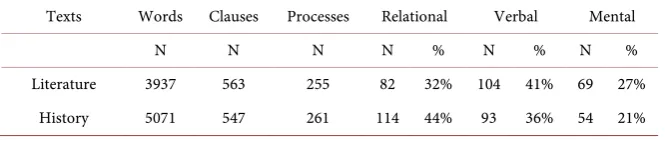
In accordance with our method, we began with counting the number of words and clauses in our corpora and registered the frequency of verbal, mental and relational processes in these clauses, the results are presented in tabular form below.
We can appreciate from Table 1 that the processes analyzed in the literature corpus (LC) amount to 255: 82 of them are relational, 104 are verbal and 69 are mental while in the history corpus (HC) the number of the processes is 261: 114 are relational, 93 are verbal and 54 are mental.
[image:7.595.209.542.654.725.2]Figure 2 presents the total frequency of each process type in our two corpora where in the LC verbal processes clearly take the lead and amount to 41%, rela-tional processes are in second place while in the HC is vice versa, relarela-tional processes are in the first place followed by verbal processes. Mental processes are less frequent in both corpora and take the third place.
Table 1. Process frequency in our corpora.
Texts Words Clauses Processes Relational Verbal Mental
N N N N % N % N %
DOI: 10.4236/ojml.2019.93016 172 Open Journal of Modern Linguistics
Figure 2. Total frequency of each process type in our corpora.
The next step is to detect and analyze all the clauses that express attitude into two groups: those that express evaluative meanings and those that do not. Table 2 makes the results of this analysis available.
As can be appreciated from Table 2, clauses that encode some type of evalua-tion prevail in the LC where they almost double those that are neutral. The HC displays quite a different picture where most clauses lack evaluation and only a quarter of them contain evaluative elements.
Next, we divided clauses containing evaluation into positive and negative ac-cording to their polarity, the resulting data are given in Table 3.
As shown in Table 3, positive evaluation dominates in both corpora: 67% in the LC and 78% in the HC, we can also see that a numeric value of negative evaluation in literature texts is higher than that of history texts.
Now we are going to observe which of the three types of processes under analysis is more associated with evaluation.
Table 4 makes it evident that in the LC 61% among the relational clauses, 62% among the verbal ones and 78% among the mental are associated with some sort of appraisal while these numbers for the HC are respectively: 25%, 24% and 26%, respectively.
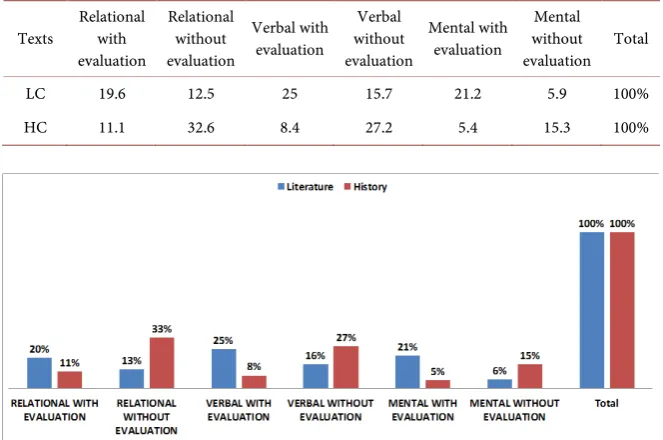
The total results are also shown in Figure 3 where there is a visual representa-tion of the three types of processes associated or not with evaluarepresenta-tion. The processes are given in percentages in relation to all the clauses within each cor-pus. Thus, it becomes evident that in the LC, verbal processes take the lead (25%) as far as an association with appraisal is concerned; they are followed by mental processes (21%) and relational ones (20%). As for the HC, its numbers are quite smaller: 11% for relational processes (first place), 8% for the verbal and 5% for the mental (Table 5).
DOI: 10.4236/ojml.2019.93016 173 Open Journal of Modern Linguistics
Table 2. Frequency of clauses with and without evaluation.
Texts Processes Processes with evaluation Processes without evaluation
N % N %
Literature 255 168 66% 87 34%
[image:9.595.210.536.190.256.2]History 261 65 25% 196 75%
Table 3. Frequency of clauses with positive and negative evaluation.
Texts Positive Negative
N % N %
Literature 113 67% 55 33%
[image:9.595.208.540.292.379.2]History 51 78% 14 22%
Table 4. Frequency of clauses with and without evaluation within each process type.
Texts Relational with evaluation
Relational without evaluation
Verbal with evaluation
Verbal without evaluation
Mental with evaluation
Mental without evaluation
N % N % N % N % N % N %
[image:9.595.208.540.411.631.2]Literature 50 61% 32 39% 64 62% 40 38% 54 78% 15 22% History 29 25% 85 75% 22 24% 71 76% 14 26% 40 74%
Table 5. Frequency of clauses with and without evaluation within each corpus.
Texts Relational with evaluation
Relational without evaluation
Verbal with evaluation
Verbal without evaluation
Mental with evaluation
Mental without evaluation Total
LC 19.6 12.5 25 15.7 21.2 5.9 100%
HC 11.1 32.6 8.4 27.2 5.4 15.3 100%
Figure 3. Three types of processes in relation to evaluation.
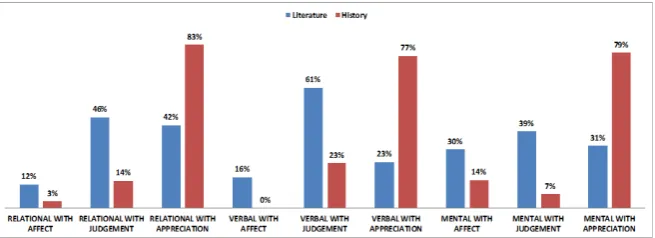
DOI: 10.4236/ojml.2019.93016 174 Open Journal of Modern Linguistics have 39% of JUDGEMENT, 31% of APPRECIATION and 30% of AFFECT. As a result, verbal clauses with JUDGEMENT occupy the first place in the literature texts.
In the HC the picture is totally different, APPRECIATION stands out as overwhelmingly dominant in the three types of clauses: 83% among the relation-al clauses versus 14% of JUDGEMENT and 3% of AFFECT; 77% among the verbal clauses versus 23% of JUDGEMENT and 0% of AFFECT; 79% among the mental clauses versus 7% of JUDGEMENT and 14% of AFFECT. Consequently, relational clauses with APPRECIATION take first place in the HC.
[image:10.595.211.539.372.491.2] [image:10.595.232.517.522.707.2]Finally, we registered ATTITUDE realization in our corpus in terms of the linguistic categories mentioned above. The results can be observed in Figure 5. An attribute turns out to be the most typical expression of ATTITUDE in the student texts of both corpora, although much more so for the HC as compared to the LC. It is followed by a process but only for the LC; in the HC, on the con-trary, a process seems to be scarcely used at all. A projected clause and a nominal group show similar values in both corpora while an adjunct results to be the least typical resource in the LC, but more widely used in the HC. So, the differences between the two corpora in the linguistic realization of ATTITUDE concern mainly two categories: a process and an adjunct.
Figure 4. Three domains of ATTITUDE as associated with the tree types of processes.
DOI: 10.4236/ojml.2019.93016 175 Open Journal of Modern Linguistics
6. Discussion and Conclusion
In this paper, we tried to examine the relation between the types of processes and the expression of evaluation at the semantic discursive level. We wanted to explore how choices that students make from the system of transitivity interact with the choices they make from the appraisal system. Transitivity analysis car-ried out in this research showed differences in the student corpora: in the LC verbal clauses prevail over relational ones which are in second place and in the HC relational processes dominate verbal ones while mental processes are the least frequent of the three types under study in both corpora.
Analyzing the APPRAISAL system we could observe still more differences between the two corpora. Thus, in the LC, clauses with evaluation prove to be dominant; they almost double the number of the clauses without evaluation. In the HC it is quite the reverse, most clauses (75%) are neutral and do not contain evaluative elements. This difference seems to be striking if we take into consid-eration that both literature and history texts belong to the same genre (ques-tion-answer).
We can also notice that expressing appraisal students are more inclined to-ward positive evaluation as compared with negative: in the LC the former sur-passes the latter more than twice; in the HC, more than thrice, which may be the result of the fact that students’ critical capacity of analysis is not yet fully devel-oped. This tendency toward positive evaluation seems to be one of the very few points where the two corpora are similar.
As for the type of process associated more with evaluative aspects, verbal processes outnumber the mental and relational clauses and result in first place in the LC while in the HC the first place belongs to relational processes. This is not surprising taking into account that, in general, verbal processes are most fre-quent in the LC and relational processes prevail in the HC. This finding looks logical if we consider the semantics of verbal processes which serve to express opinions, attitudes and feelings, among other things and therefore, are essential in the LC. In the same way, the meaning of relational processes which express a state of things explains their wide use in history texts (Moss & Chamorro Mi-randa, 2011).
DOI: 10.4236/ojml.2019.93016 176 Open Journal of Modern Linguistics The exploration of a linguistic realization of attitude revealed that an attribute turned out to be the most frequent means of appraisal expression in both corpo-ra, which could be expected taking into account the fact that an attribute is cha-racteristically associated more with relational processes which have a high fre-quency in both literature and history texts.
The second place in the LC is occupied by a process itself. As we have men-tioned earlier, an attitudinal meaning can be encoded in the process itself, this is characteristic of verbal and mental processes. On the other hand, verbal and mental processes have a projecting capacity and projection often acts to construe interpersonal meaning (Thompson, 2004) and functions to encode the writer’s stance or attitude (Forey, 2008). As expected, then, the second most frequent means of expressing attitude in the HC, and the third in the LC, is a clause, most often it is a projected clause. This is in accordance with some other studies that suggest that projecting clauses function as “an interpersonal lens through which the projected clause is interpreted” (Coffin & Hewings, 2004: p. 162).
So our analysis made it evident that there are more differences than similari-ties between student literature and history texts although both belong to the same genre. Thus, a question-answer in literature is a text with a predominance of verbal processes, an abundance of evaluative elements (mostly positive) where judgement prevails; besides, an attribute and a process are the preferred means of expressing attitude. In the area of history a question-answer is a text where relational processes dominate; the style is mostly neutral as the number of evalu-ative elements is not high, and when they do occur their purpose is usually to express appreciation with the help of an attribute or projected clause.
So we obtained an interesting picture of the interaction of TRANSITIVITY and APPRAISAL systems registering frequent links between certain process types and the expression of attitude. Consequently, we observed a complex in-terplay of the lexicogrammatical and semantic discursive aspects of academic texts which finally points to a close relation between the ideational and inter-personal functions of the language.
Besides, this study may contribute to our better understanding of genre cha-racteristics in student texts and at the same time show the significance of their variation across disciplines. The results of our analysis may find a wide applica-tion in the teaching of academic writing, especially in university settings. A functional approach to writing instruction may help students to construe a text on a semantic basis (beginning with types of processes) and to exploit evaluative elements in order to express their opinions and take a stance on the topic of writing.
The tendencies that we discovered in our exploration of student writing from the functional perspective need to be confirmed by exploring more corpora and comparing the data from different genres and disciplines.
Acknowledgements
DOI: 10.4236/ojml.2019.93016 177 Open Journal of Modern Linguistics
the humanities: A systemic functional study is carried out thanks to a grant from
the National Autonomous University of Mexico.
Conflicts of Interest
The author declares no conflicts of interest regarding the publication of this pa-per.
References
Caffarel, A. (2006). A Systemic Functional Grammar of French: From Grammar to Dis-course. London: Continuum.
Chen, L. (2007). Analysing Attitude: Positive Verbal Process Sub-Functions and Media Bias. RASK, International Journal of Language and Communication, 25, 25-55. CLAE (2009). El lenguaje académico en español. Análisis binacional de textos en las
hu-manidades. http://www.lenguajeacademico.info
Coffin, C., & Hewings, A. (2004). IELTS Preparation for Tertiary Writing: Distinctive In-terpersonal and Textual Strategies. In L. Ravelli, & R. Ellis (Eds.), Academic Writing in Context: Social-Functional Perspectives on Theory and Practice (pp. 153-171). London: Continuum.
Forey, G. (2008). Projecting Clauses: Interpersonal Realization of Control and Power in Workplace Texts. In G. Forey, & G. Thompson (Eds.), Text Type and Texture (pp. 151-172). London: Equinox.
Halliday, M. A. K. (1976). System and Function in Language. London: Oxford University Press.
Halliday, M. A. K. (1985). Spoken and Written Language. Geelong: Deakin University Press.
Halliday, M. A. K. (1994/2004). An Introduction to Functional Grammar. London: Ar-nold.
Hood, S. (2010). Appraising Research: Evaluation in Academic Writing. London: Pal Grave Macmillan. https://doi.org/10.1057/9780230274662
Hunston, S. (1995). A Corpus Study of Some English Verbs of Attribution. Functions of Language, 2, 133-158. https://doi.org/10.1075/fol.2.2.02hun
Hyland, K. (1999). Academic Attribution: Citation and the Construction of Disciple Nary Knowledge. Applied Linguistics, 20, 341-367. https://doi.org/10.1093/applin/20.3.341
Ignatieva, N. (2011). Verbal Processes in Student Academic Writing in Spanish from a Systemic Functional Perspective. Lenguaje, 39, 447-467.
Ignatieva, N., & Colombi, M. C. (2014). CLAE: Corpus del lenguaje académico en español de México y los Estados Unidos: Un análisis sistémico funcional. México: UNAM. Ignatieva, N., & Rodríguez-Vergara, D. (2015). Verbal Processes in Academic Language
in Spanish: Exploring Discourse Genres within the Systemic Functional Framework. Functional Linguistics, 2, 1-10. https://doi.org/10.1186/s40554-015-0014-9
Kaplan, N. (2007). La teoría de la valoración: Un desarrollo de los estudios sobre la evaluación en el lenguaje. In A. Bolívar (Ed.), Análisis del discurso. Por qué y para qué (pp. 45-66). Caracas: Universidad Central.
DOI: 10.4236/ojml.2019.93016 178 Open Journal of Modern Linguistics Martin, J. (1985). Factual Writing: Exploring and Challenging Social Reality. Oxford:
Oxford University Press.
Martin, J. (1992). English Text. Philadelphia, PA: John Benjamins.
https://doi.org/10.1075/z.59
Martin, J., & White, P. R. (2005). The Language of Evaluation. New York: Palgrave Mac-millan. https://doi.org/10.1057/9780230511910
Matthiessen, C. M. I. M. (1995). Lexicogrammatical Cartography: English Systems. Tokyo: International Language Sciences.
Moss, G., & Chamorro Miranda, D. (2011). La pedagogía de la simplificación: La en señanza de historia por medio de pista y pesca. In (Re)Construcción: Discurso, identidad y nación en los manuales escolares de historia y y de ciencias sociales (pp. 269-320). Chile: Editorial Cuarto Propio.
Moss, G., & Mizuno, G. (2015). Las voces del texto. In N. Barletta Manjarrés, & D. Chamorro Miranda (Eds.), El texto escolar y el aprendizaje (pp. 89-117, Se gunda edición). Colombia: Universidad del Norte.
Navarro, F. (2014). Gradación y compromiso en escritura académica estudiantil de humanidades. Análisis contrastivo desde la Teoría de la Valoración. Estudios de Lingüística Aplicada, 60, 9-33.
O’Donnell, M., Zappavigna, M., & Whitelaw, C. A (2008). Survey of Process Type Classi-fication over Difficult Cases. In C. Jones, & E. Ventola (Eds.), From Language to Mul-timodality: New Developments in the Study of Ideational Meaning (pp. 47-64). Lon-don: Equinox.
Thompson, G. (1996/2004). Introducing Functional Grammar. London: Arnold.