HOW NORMALIZATION CAN BE
THE ACTUAL BEHAVIOR
Wong Ling Chai,
Faculty of Business, Economics
ARTICLE INFO ABSTRACT
The evolution Abnormal overcome focuses mobile Previous practice; through suggested practice administered via a snowball SEM) of the findings
Copyright © 2018, Wong Ling Chai et al. This is an open use, distribution, and reproduction in any medium, provided
INTRODUCTION
The issue of energy consumption on a mobile become critical when the development
applications does not analogous to battery technology
al., 2011; Perrucci et al., 2011). As mobile phone
limited in size, the capacity of the battery increasingly insufficient to support the multi mobile phone (Carroll and Heiser, 2010). encourages energy management by the user
battery life on their mobile phone (Chen et al
emerging technology claims to have application in place to help save the battery consumption
phones (Ahmad et al., 2015; Jenkin et al., 2011).
latest energy efficient technology is only available mobile phone, and most consumers will only
phone every three years (Androulidakis et al
situation has caused mobile phone battery usage a whole while the mobile phones attempt to demanding application (Sperling and Mains, researchers disagree that improved technology meaningful energy conservation; they strongly behavior is key achieved the green practice 2014; Osbaldiston and Sheldon, 2003).
ISSN: 0975-833X
Article History: Received 20th March, 2018 Received in revised form 25th April, 2018 Accepted 16th May, 2018 Published online 28th June, 2018
Citation: Wong Ling Chai, Oswald Aisat Igau and towards the Actual Behavior of Green Practice on Mobile Phone Key words:
Normalization;
Theory of Planned Behavior Green Practice on Mobile Phone
*Corresponding author
RESEARCH ARTICLE
BE LINKED WITH THEORY OF PLANNED BEHAVIOR
BEHAVIOR OF GREEN PRACTICE ON MOBILE
Chai, Oswald Aisat Igau and
*Stephen L. Sondoh
Economics and Accountancy, Universiti Malaysia Sabah,
ABSTRACT
evolution of mobile phones into smart multi-functional mobile Abnormal Battery Drain (ABD) issue. This has spurred the need for overcome ABD concern. However, far too little attention has been focuses on ABD. Hence, this paper aims to conceptualize the actual mobile phones by integrating the Theory of Planned Behavior and Previous studies have found that current green marketing has practice; the intention does not come with actual behavior. Actual through normalization of green practice across the board. Therefore, suggested to be integrated with the Theory of Planned Behavior to practice can be achieved. Apart from conceptualization, the paper administered questionnaires to be distributed among mobile phone
snowball sampling technique. The Partial Least Square-Structural approach has been used for data analysis. The final section
findings and limitations of the study.
open access article distributed under the Creative Commons Attribution provided the original work is properly cited.
mobile phone has of new mobile
technology (Ding et
phone batteries are battery is becoming multi-usage of current 2010). This limitation user to prolong their
et al., 2015). Current application and hardware consumption on mobile 2011). However, the available in the latest buy a new mobile
et al., 2015). This usage to increase as run more energy-Mains, 2015). Several technology will bring us strongly believed that
practice (Brosch et al.,
Theory of Planned Behavior integrated, because this theory or sustainable behavior studies Unlike TPB, normalization accounted products that are initially regarded normality, gradually become accepted
everyday life (Rettie et al., 2014).
asserted that intention did not and normalization is required order to create the actual green 2011; Zaharia and Zaharia, 2014). conceptualize the integration of case of actual behavior in green
Literature Review
Green practice on mobile phone
phones such as reminders, the note-taking apps, and even media go green by decreasing the used WWF, 2015). However, development applications out spaced battery Mobile phone producers like Huawei, put little into energy efficiency
International Journal of Current Research
Vol. 10, Issue, 06, pp.70321-70331, June, 2018
and Stephen L. Sondoh Jr.. 2018. “How Normalization can be linked Green Practice on Mobile Phone”, International Journal of Current Research, 10, (06), 70321
BEHAVIOR TOWARDS
MOBILE PHONE
Sondoh Jr.
Sabah, Sabah, Malaysia
mobile computers have led to a serious for green practice in mobile phone to been paid to the green practice that actual behavior of green practice on and Normalization Process Theory. failed to predict the actual green green practice only can be achieved Therefore, normalization is strongly to ensure the actual behavior in green paper also proposes a total of 400 self-phone users, in main cities in Malaysia
Structural Equation Modelling (PLS-section of this paper involves a discussion
ribution License, which permits unrestricted
Behavior (TPB) was chosen to be was employed in the most green studies (Joshi and Rahman, 2015). accounted for the behaviors and regarded as outside the range of accepted as normal and as part of 2014). A number of prior research bring about the actual behavior, required to be integrated with TPB in
green behavior cases (Rettie et al.,
2014). This paper therefore aims to of normalization in TPB in the green practice on mobile phones.
hone: The functions of mobile
the alarm clock, news, magazine, media players are helping society used of energy (Fendelman, 2015; development of new mobile phone
battery technology (Ding et al., 2011).
Huawei, Xiaomi and Micromax efficiency and environmental wastage
INTERNATIONAL JOURNAL OF CURRENT RESEARCH
minimization when manufacturing their products ; Telstra is one of only major mobile phone producers to have interior procedures to upcycle and recycle broken or obsolete mobile phones (Matthews, 2016). The issue of ABD is prevalent enough in the evolution of mobile phones that some researchers have gone on to produce an energy controller application for mobile phone to save energy such as smartphone Clone Cloud Execution (Chun and Maniatis, 2009)
ARIVU (Anand et al., 2012), and SOMA (Bojic et al., 2012).
ARIVU is a scalable power aware middleware that able to control and reduce the energy consumption when user playing
the games through online (Wang et al., 2012; Anand et al.,
2012). Openmoko Neo Free runner smart phone was introduced to energy efficacy concept (Carroll and Heiser, 2010). In Malaysia, research into mobile phone applications and energy usage was also carried out, which conducted in qualitative study and proposed both software base and
hardware for green purpose (Ahmad et al., 2015). Based on the
discussion above, researchers suggested that, mobile phone technology was claimed to assist in a user “going green”. On the other hand, several researchers strongly disagree with the
statement, such as Brosch et al (2014) who argues that
changing consumer behavior is more vital than relying on technology. Choong (2008) mentioned that the latest green technology is useless if consumers failed to change their behavior to conserve the energy.
Low et al (2011) mentioned that the improving of technology will only lead to the greater use of energy, as consumers will increasingly depend on technology to save energy as opposed to actual physical actions. Osbaldiston and Sheldon (2003) share the same view, where energy conservation behavior needs to be internalized if it is to be sustained. In addition, based on consumer’s feedback gathered from the Apple Store and the Play Store, energy saving application alone cannot help
to save the battery life (Duan et al., 2011). Thus, it can be
concluded that, improving and advancements of physical technologies only transfer the impact of energy consumed by human and is not able to solve the energy problem alone
(Tsuda, et al., 2017; Kempton and Schipper, 1994). Hence, the
most effective way to achieve energy conservation must emphasize behavioral aspects or change in the consumer behavior (Seniwoliba and Yakubu, 2015). Incidentally, limited studies focused green practice on mobile phone except the
study conducted by green mobile network (Androulidakis et
al., 2015; Wang et al., 2012; Wiart, 2012). Whereas Kong et al
(2014) strongly urge that, green marketing be encouraged in specific product or services instead of doing at general actual purchase or general purchase intention.
The concept of green practice in mobile phone was developed in this study, as a response to the limited studies emphasizing green practice on mobile phone. Green practice on mobile phone in this study is based on the nonstructural energy
conservation (Low et al., 2011; Seniwoliba and Yakubu,
2015). Those green practice includes action that are carried out before going to bed, effectively managing the internet connection, charged the phone effectively, utilizing the power saving mode of the mobile phone, and finally reducing the
number of charge on the mobile phone (Androulidakis et al.,
2015). The green practice on mobile phone in this also will be measured by five-point frequency scale: never, sometimes, often, very often, and always (Frantz and Mayer, 2014;
Markowitz et al., 2012).
Theory of planned behavior: The Theory of Planned
Behavior (TPB) was created by Ajzen (1985) to improve the predictive power and overcome the weaknesses of the Theory Reasoned Action (TRA) (Ajzen, 1991). To date, TPB had been applied to environmental studies including those that focus on
green product consumption (Paul et al., 2016), and a wide
assortment of human practices such as weight reduction (Schifter and Ajzen, 1985) and smoking discontinuance (Godin
et al., 1992). TPB is the most frequently model, clarifying how behavioral expectations are framed in studies of this nature
(Mancha and Yoder, 2015; Sanchez-Medina et al., 2014). TPB
is a theory that focuses on expectation or status to act as the most proximal determinant of conduct (Rivis and Sheeran, 2003).TPB also provides more specific information that can better guide the development if compared with the Technology Acceptance Model (TAM) (Yen and Chang, 2015; Guah, 2010; Mathieson, 1991). TAM is used togive data or broad results about the hobbies and conduct of clients of the
framework in getting the data innovation framework (Abbad et
al., 2009; Wiyono et al., 2008; Loiacono et al., 2007). The
current study focuses on behavior instead of technology, with TPB also being widely employed in other environmentally-focused studies. Hence, TPB was employed in the current study.
Attitude: Attitude is considered as the first antecedent of
behavioral intentions (Ajzen, 1989). The belief here refers to behavioral beliefs (Conner and Armitage, 1999); when a person has a positive belief, he or she will intend to show a specific matching behavior (Mishra, Akman, and Mishra, 2014). In contrast, if the result showed a negative behavior, they will have a negative attitude towards that particular behavior (Ajzen, 1985). Attiude also being widely applied in green marketing contexts and significantly impacting the behavioral intention (Maichum, Parichatnon, and Peng, 2016).Chen and Tung (2014) defined attitude as the goodness and badness for consumers to stay at a green hotel, the desire to stay at green hotel, pleasant or unpleasant to stay at green hotel, favorable or unfavorable to stay at green hotel, positive feeling or negative feeling to stay at green hotel. The attitude in a study carried out by Finlinson (2005) in energy conservation behavior refers to attitude toward helping the electronic device to last longer, attitude toward time consumed for the deviceto boot up, attitude toward saving money, and attitude toward the cooler room. When attitude is narrowed down to green practices, it can be defined as the thinking of the consumer that they are adequately conserving energy, wise to conserve energy, used to conserve energy, and believe that other people should conserve energy (Macovei, 2015a; Macovei, 2015b; Van-Den-Berg, 2007). Based on the discussion above, the attitude is yet to be conceptualized in green practices on mobile phones. Therefore, in the current study will conceptualize attitude in the context of green practices on mobile phones with the belief that performing green practices will be based on the individual’s like or dislike (favorable or unfavorable behavior) in regards to the activity
(Ajzen 1985; De-Vries et al., 2011).
Subjective norm: Subjective norm is based on the specific
belief that someone agrees or disagrees with a displayed
behavior (Davis et al., 1989). An individual will intend to
show a specific behavior if they perceive that others of a higher or more valued status potentially think that they should engage in this behavior (a person of value to the subject could also include a family member, friend, or doctor) (Bamberg,
2003; Courneya and Mcauley, 1995). This was determined by asking respondents to define whether other people who are important would tend to agree or disagree if they displayed a certain behavior (Ajzen, 1989).Subjective norm also refers to other people like a roommate, parents, orresident assistant’s opinions which may influence a person to agree or disagree to display certain behavior (Finlinson, 2005). According to the study in energy conservation that was carried out by Clement
et al (2014), subjective norm refers to people that are important to the consumer who will support the consumer's effort to conserve energy, those important people will take action for energy conservation, and will think that the consumer needs to take initiatives for energy conservation. A six point scale from strongly disagree to strongly agree was
applied to the study (Clement et al., 2014; Muralidharan, and
Sheehan, 2016; Macovei, 2015b). From the energy conservation point of view, the subjective norm is seen as a conviction in the matter of whether energy conservation must be executed or not (Seniwoliba and Yakubu, 2015). To date, there is a noticeable lack of studies which have conceptualized the subjective norm in the cases of green practices on mobile phone; therefore subjective norm in green practices on mobile phones was conceptualized as people who are important and close (i.e. friends and family members) who will positively or negatively be involved in mobile phone energy conservation
(Davis et al., 1989). This concept was found to be similarto the
subjective norm that was applied in the study by Clement et
al., (2014) on energy conservation, where subjective norm was
defined as that which is important to the consumer and will support the consumer’s effort to perform the green practices.
Perceived behavioral control: Perceived Behavioral Control
(PBC) is defined as one’s perception of the difficultly of
performing a certain behavior (Orbeil et al., 1997). Ajzen
(1988) included these determinants to predict that behavioral intention is not fully controllable by a person. These controls reflect past experiences and also anticipate that there are
impediments (Ajzen, 1991; Ajzen, 1988). Madden et al Ajzen
(1992) compared the theory of planned behavior and the theory of reasoned action found out that, the participation of PBC and behavioral intention is able to improve predictions in certain behavior. Giles and Cairns (1995) used the Theory of Planned Behavior to predict the intention to donate blood and blood donor behavior and found that strong support for PBC has important implications for a person's motivation. Based on the TPB, PBC will impact the actual behavior of a person (Ajzen, 1991).
There are aspects of this theory which must be considered, as noted by Eagly and Chaiken (1993), including the causal relationship between PBC and intention; it is questionable because the statement implies that people wished to carry out an activity or achieve a goal only because they have control over the behavior. It may be true that the perception of control and self-efficacy usually increases the tendency to behave, but this relationship may be less reasonable to be evaluated for negative behavior. People will often assume that they have control over things such as, for example, the ability to wear a swimsuit to a wedding reception or smoke in a public place, but it does not mean that this belief encourages them to perform behaviors that negatively evaluate this (Eagly and Chaiken, 1993). A recent study by Macovei (2015a) with PBC assumes that consumers will have the wisdom to attempt energy conservation themselves as well as enough time and resources for using other alternatives for energy saving
purposes. However, PBC is yet to be widely conceptualized for mobile phones. Therefore, the conceptualization of PBC in this study refers to the mobile phone user’s knowledge or discerning the responsible and harmful behavior for maintaining green practices on mobile phones (Ajzen, 1991). This concept is similar to the studies that were conducted in energy conservation research, where the consumer was assumed to have the adequate knowledge and wisdom to achieve green practices on mobile phones (Hsu and Fu, 2012; Macovei, 2015a).
Behavioral intention: Behavioral Intention (BI) refers to a
person’s intention to act in a certain way (Fishbein and Ajzen, 1977). BI also was conceptualized in many other green studies to represent the actual behavior (Han and Kim, 2010; Hsu and Chan, 2015).The green purchase intention for hotel by Han and Kim (2010) defined as consumer willingness, planning, and effort to stay at the green hotel. Behavioral intention as defined in the study that carried out in young generation’s green behavior defined as the intention to avoiding using products that are perceived as wasteful or not environmentally friendly, switching to the ecological products, choosing the least harmful products, putting effort towards recycling materials, and considering the environment when purchasing products
(Kanchanapibul et al., 2014). BI plays the role of an immediate
antecedent for actual behavior and is also known as the function of attitude, subjective norms, and perceived
behavioral control (Kaplan et al., 2016; Hsu and Chan, 2015).
They indicate BI as a degree to which a person has formulated conscious plans whether to perform or not perform certain
behaviors (Kaplan et al., 2016). Similarly to Kisaka (2014), BI
is claimed as the major determiner of actual behavior, and those intentions were affected by subjective norm, perceived behavioral control, and attitude. BI was predicted collectively by subjective norm, attitude toward the behavior, as well as perceived behavioral control (Sutton, 1998).
In the cases of energy conservation, BI refers to the degree to which a person intends to adopt some actions, such as buying electricity-saving products, influencing others on saving
electricity, and carrying out electricity-saving actions (Liu et
al., 2015). Similarly, Seniwoliba and Yakubu (2015) defined
BI as a person’s intention to behave in a certain way to save
energy (Smith et al., 2007; Ajzen, 2006; Dodds et al., 1991).
According to the discussion above, the BIis yet to be conceptualized in green practices on mobile phones. Therefore,
in this study the concept of BI has been adapted from Liu et al.
(2015) and Seniwoliba and Yakubu (2015), which defined BI as the degree to which a person intends, and their willingness, to engage in green practices on mobile phone. In addition, this theory is suggested by the previous study to be linked with
Normalization (Rettie et al., 2011, 2014; Sunstein and Reisch,
2013). This mainly caused by a number of prior research asserted that intention failed to predict the actual behavior
(Chikaji et al., 2015; Hsu and Chan, 2015; Gleim et al., 2015).
For example, research done in go green by recycling behavior
from Chikaji et al (2015) found that, behavioral intention
failed to predict the actual behavior. Similar results were found
in the study by Hosseinpour et al (2015) and Doszhanov and
infant stage among Malaysian researchers (Sharaf et al., 2015; Rashid, 2009). Most importantly, these studies focus on the intention to purchase green products rather than their actual
usage (Amin and Uthamaputhran, 2015; Sharaf et al., 2015;
Loo et al., 2014; Kanchanapibul et al., 2014; Wang, 2014; Ong
et al., 2014; Hosseinpour et al., 2015). For example, Kong et
al. (2014) found that Malaysian’s intention to purchase green
products is significantly caused by green corporate perception, eco-label, and green product. However, the study did not support the claim that intention will actually lead to actual action. Hence, it is suggested that the relationship between intention and actual behavior be studied in relation to the green practice among Malaysian consumers (Moons and De Pelsmacker, 2012; Gleim and Lawson, 2014). Moreover, the gap between behavioral intention and actual behavior can be
filled by normalization (Anderson et al., 2010; Rettie et al.,
2014). In order to improve the link between intention-actual behavior, it is suggested that normalization should be used to fill the gap between behavioral intention and actual behavior (Sunstein and Reisch, 2013; Liebig and Rommel, 2014). According to Peter (2011), consumers’ intention to consume green products in their daily practice requires them to go through the normalization. At the same time, the studies from
Zaharia and Zaharia (2014) and Rettie et al. (2014) suggested
that future research should explore normalization on how effectively it will help to form the actual behavior. This
followed by Thogersen et al (2012) which found out that,
normalization helps consumer to make final decisions in green product purchase behavior. However, for energy conservation behavior, specifically on a mobile phone, normalization has yet to be conceptualized and linked with the theory of planned behavior for emphasizing the actual mobile phone green
practice (Rettie et al., 2011). Therefore, this study needs to be
carried out to fill the gap by adding normalization as the mediator between behavioral intention and actual behavior and of mobile phone’s green practice.
Normalization: The term “normalization” was coined in the
late 1950s when people started to challenge the modern drive for creating a normal life, and the increase public focus on smaller groups in society, like the elderly or disabled (Wolfensberger, 1999). The founder of normalization was made to access the rationale that impedes individual examples of life and states from ordinary living. Those lives and states are as close as could be expected under the circumstances in the general lifestyles of society (Abberley, 1987). Based on Nirje (1969), normalization is a process that accepts or rejects an individual or group and to some degree, their social conduct from being incorporated into typical life, whereby social conduct could be expected to form the basic model of life. The normalization concept from the sociological perspective under the findings by Foucault (1988) defined the components of the normative culture formed by the element of social normality. It also refers to the process of people assuming certain ideals or action thought of as normal or taken as granted in their daily life for financial management (Foucault, 1999). Social normalization refers to the reaction of the social looking for the equableness (Wolfensberger, 1980). He defined normalization as the utilization of socially esteemed intents to empower individuals to lead socially esteemed lives, the utilization of socially regularizing intents to give life conditions which are in any event in the same class as those of the normal native, the upgrade of the conduct, appearance, experience, and status of the handicapped individual. In the case of challenge learning, Chappell (1992) stated that in the 1970s, the backers of
normalization tried strenuous endeavors by utilizing
normalization as an instrument for individual’s challenges learning. It implies distinctive things to diverse individuals, advances after some time, and becomes a powerful tool that holds major influence to evaluate services for people with learning difficulties. Similarly, Normalization Process Theory (NPT) gives a set of sociological instruments to comprehend and clarify the social procedures through which new or adjusted practices of considering, ordering, and sorting out work are operationalized in medical services and other
institutional settings (Murray et al., 2010). Based on studies
carried out by Rosenbrock et al. (2000), normalization can be
characterized as a procedure in which a factor that was already considered as unprecedented is turned into a perceived standard activity. Limited studies and data have addressed what normalization means for green practices on mobile phones, specifically as mobile phones were categorized as a personalized product, the setting of normalization was based
on individual levels (Androulidakis et al., 2015; Weiss and
Lockhart, 2012; Oztaş, 2015). In other words, an individual user is the one who performs the judgment on which green practices are normal to them before they carry out the actual behavior (Schultz, 1999). The concept of normalization was formed based on Foucault (1999) referring to the process that people assume certain ideals or actions are normal or abnormal. Those assumptions, thinking, and judgments are able to form a strong coherence to help the new practice to be widely accepted (Johnson and May, 2015; Pantzar and Ruckenstein, 2015). Consumers are likely to adopt the green behavior which they think is normal only when they can accept
and practice it in normal life through normalization (Rettie et
al., 2011, 2014).
Development of Hypotheses
The relationship between attitude and behavioral
Intention: The positive significant relationship between
attitude and BI for household energy saving was confirmed by Abrahamse and Steg (2009). This result was similar to the study that was conducted in residential energy conservation by Macey and Brown (1983), where attitude influences the BI of residential energy conservation. A recent study also found that attitude has the strongest influence on energy conservation
intention among the 2000 students in Malaysia (Low et al.,
2016). The saving energy study conducted by Chen (2016) also found that a consumer’s attitude was significantly affected by the intention of that consumer to make the energy saving. In this study, green practices on mobile phones also aim to save battery energy. Attitude is taken to have a similar relationship on BI as the hypothesis below:
H1: Attitude has a positive effect on consumers’ behavioral intentions towards green practices on mobile phones.
The relationship between subjective norm and behavioral
intention: Subjective norm was found as the second strongest
factor, after attitude, for predicting BI for energy conservation
among the university students studied (Low et al., 2016).
Research conducted on renewable energy technologies (solar water heaters) indicated that a positive significant relationship was found between subjective norm and BI to use renewable energy technologies (Chen, Xu, and Frey, 2016). Another
study conducted by Wang et al. (2014) on household
electricity-saving behavior also defined subjective norm having the positive and significant relationship in residents’
intention of energy-saving behavior. In the current study, green practices on mobile phones aims to save the battery energy on the phone which can be likened to general energy saving. Thus, in line with this discussion, the following hypothesis is formulated:
H2: Subjective norms have a positive effect on consumers’ behavioral intentions towards green practices on mobile phones.
The relationship between perceived behavioral control and
behavioral intention: A significant positive relationship was
found between PBC and BI to switching off a computer whenever leaving a desk, or intention to use video
conferencing in the office instead of traveling (Greaves et al.,
2013). The research conducted on household energy saving found that PBC was significant towards intention to perform
energy saving behavior (Webb et al., 2013; Klockner, 2013).
This result substantiates the study by Han (2015) which indicates that consumers intended stay at the green hotel can be predicted by attitude, subjective norm, and PBC. Pollard (2015) identified the relationship between attitude, subjective norm, and PBC toward intention for computer energy saving were positively related and significant. In the current study, green practices on mobile phones aims to save battery energy which is similar to energy saving behaviors. Accordingly, it is posited that:
H3: Perceived behavioral control has a positive effect on consumers’ behavioral intentions towards green practice son mobile phones.
The relationship between behavioral Intention and actual
behavior in green practices on mobile phones: A
consumers’ intention was claimed to be able to bring out the
actual behavior in the organic study (Wee et al., 2014). In the
study on the use of herbs as part of health practices and treatment of diseases, it was found that behavioral intention significantly affects actual behavior (Ismail and Mokhtar, 2016). Wu and Chen (2014) claimed that BI is able to predict actual green consumption adequately. However, based on Pollard (2015), this situation happened because the workers of ten forget what they intended to do; those behaviors werenot in their normal daily routine. Hsu and Huang (2010) conclude that TPB constructs are able to predict BI, but BI does not necessarily lead to actual behavior due to the gap in actual behavior. People cannot remember their intentions after a year (Hsu and Huang, 2010). Another reason that has affected the issue of intention/actual behavior is that the longer the distance between the intention and behavior, the greater the likelihood of a change of intentions (Ajzen and Fishbein, 2005; Ajzen, 2011). In green practices on mobile phones, actual behavior still remains unknown since limited studies have been conducted in this specific field. Therefore, the hypothesis below was formedto predict the relationship:
H4: Behavioral intention has a positive effect on a consumer’s actual behavior in green practices on mobile phones.
The relationship between behavioral intention and
normalization: There is a significant relationship between BI
and normalization. In the study by Sznitman (2008), new drug takers intended to take drugs when they perceived that behavior as normal, and this is followed by addiction after they practice taking drugs routinely.
This is supported by Parker et al. (2002) who found that drug
users started to take drugs when they perceived their intention as normal. This similar relationship has also been found in corruption behavior as studied by Ash forth and Anand (2003), where a person intends to be corrupt when corruption is perceived as normal and they ultimately adopts corrupted behavior. When they succeed the first time, they will try to be corrupt routinely which becomes the norm to them (Ashforth and Anand, 2003). The discussion above shows that when a person intends to do something, they perceive it as normal. In the context of green practices on mobile phones, it is assumed a consumer’s BI to conserve mobile phone battery leads them to perceive that particular intention as normal. Therefore, the below is hypothesized:
H5: Behavioral intention has a positive effect on normalization of the green practices on mobile phones.
The relationship between normalization and Green
practices on mobile phones: There is a significant
relationship between normalization and actual behavior
regarding green practices in consumers’ daily lives (Rettie et
al., 2014; Purushottam, 2014). Several countries such asChina,
Indonesia, Japan, Korea, and Thailand are showing the beginnings of sustainable consumption as part of a normal and even aspirational lifestyle (Zhao and Schroeder, 2010). Normalization as defined by Font and Villarino (2015) is able to influence people to make actual behavior. Johnston and Tan (2015) stated the major reason consumers do not buy green products is because green behavior is not promoted as the mainstream. In the case of actual behavior of green practices on mobile phones, it is assumed consumers have a similar relationship between normalization and the actual behavior. The hypothesis below was formed:
H6: Normalization has a positive effect on the actual behavior of green practices on mobile phones.
The Mediation Effect of Normalization between Behavioral Intention and Actual Behavior of Green Practices on
Mobile Phones: Mediation was used to explain how an
independent variable influences an outcome (Gunzler et al.,
2013). The investigation process of the current study defined how normalization influenced actual behavior in green practices on mobile phones. In other words, the study aims to explore the link of normalization between the BI (cause) and green practices on mobile phones (effect). The mediation effect of normalization between BI and actual behavior was found by Weick (2012). This finding was also supported by Velmans (1999) and Mayer (1996). Based on the discussion above, limited studies used normalization as mediator between BI and actual behavior. Thus, the below hypothesis below was formulated to fill the gap between BI and actual behavior:
H7: Normalization mediates the relationship between behavioral intention and actual behavior of green practices on mobile phones.
The mediation effect of behavioral intention between attitude, subjective norm, PBC and green practices on
mobile phones: The role of BI as mediation was discovered in
the previous study by Dhaha and Ali (2014) on factors that affect adoption rates and satisfaction with third generation
(3G) mobile phones. Mafabi, et al. (2017) also found that BI
norm, PCB, and knowledge sharing behavior. This finding was supported by Taylor and Todd (1995). Thus far, few researches use BI as mediator between attitudes, subjective norm, PCB, and actual behavior specifically in green practices on mobile phones. Therefore, the current study hypothesized BI as a mediator in this study and thus the hypotheses below were derived:
H8: Behavioral intention mediates the relationship between attitude and actual behavior of green practices on mobile phones.
H9: Behavioral intention mediates the relationship between subjective norm and actual behavior of green practices on mobile phones.
H10: Behavioral intention mediates the relationship between perceived behavioral control and actual behavior of green practices on mobile phones.
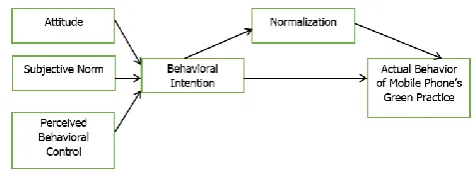
Proposed theoretical framework: Attitude, subjective norm,
and PBC were expected to have a significant relationship to BI for green practices on mobile phones. Aside from this, the BI was expected to have a significant role in normalization and actual behavior. This follows the expectation, whereas normalization also exhibited a significant relationship to the actual behavior of green practices on mobile phones.
This research expected to show that normalization could mediate between BI and actual behavior of green practices on mobile phones. It is based on the guidelines proposed by Baron and Kenny (1986) in mediation:
First, the BI of the green practices on mobile phonesmust have a significant effect on the normalization when regressing the mediator on the independent variable (Sznitman, 2008; Leitch and Motion, 2007; Parker et al., 2002).
Secondly, the independent variable (BI of green practices on mobile phones) must have a significant effect on the dependent variable (actual behavior of green practices on mobile phones), when regressing the dependent variable on the independent variable (Pollard, 2015; Alias, et al., 2015; Wu and Chen, 2014; Webb et al., 2013).
Third, the mediator (normalization) must have a significant effect on the dependent variable (actual behavior of green practices on mobile phones), when regressing the dependent variable on both the independent variable and mediating variable (Rettie et al., 2014; Purushottam, 2014; Zaharia and Zaharia, 2014; Sunstein and Reisch, 2013).
[image:6.595.311.557.52.91.2]However Zhao, Lynch Jr, and Chen (2010) disagree with the guidelines formed by Baron and Kenny (1986), where the independent does not have to significantly affect the dependent variables. There are also times when the total effect is not significant but there is still evidence of mediation. This usually happens when the independent to dependent variable effect is weak, but the relationship for A and B is stronger as shown in figure 3.1. The research needs to explain theoretically that there is a relationship between BI and actual behavior of mobile phone’s green practice.
Figure 3.1. Mediation effect of Normalization
Moreover, Hair, Hult, Ringle, and Sarstedt (2014) mention that researchers need to follow "Preacher and Hayes (2004, 2008) bootstrap the sampling distribution of the indirect effect, which works simple and multiple mediator models" (p.223). In addition, this method is suitable for PLS-SEM, which makes no assumption about the shape of the variables’ distribution or the sampling distribution of the statistics. It can then be applied
to a small sample size (Hair et al., 2014; Preacher and Hayes,
2008). Normalization is therefore shown to qualify to be a mediator in this study. BI will have a mediation impact on attitude, subjective norm, PBC and actual behavior of green practices on mobile phones. Based on the discussion above, the hypotheses of this study were defined as below:
H1: Attitude has a positive effect on consumers’ BI towards
green practices on mobile phones.
H2: Subjective norms have a positive effect on consumers’ BI
towards green practices on mobile phones.
H3: PBC has a positive effect on consumers’ BI towards green
practices on mobile phones.
H4: BI has a positive effect on consumers’ actual behavior of
green practices on mobile phones.
H5: BI has a positive effect on normalization of green
practices on mobile phones.
H6: Normalization has a positive effect on the actual behavior
of green practices on mobile phones.
H7: Normalization mediates the relationship between BI and
actual behavior of the green practices on mobile phones.
H8: BI mediates the relationship between attitude and actual
behavior of green practices on mobile phones.
H9: BI mediates the relationship between subjective norm and
actual behavior of green practices on mobile phones.
H10: BI mediates the relationship between PBC and actual
behavior of green practices on mobile phones.
4.1. Proposed Framework
RESEARCH METHODOLOGY
In this study, a self-administered survey will be applied to examine the veracity of the hypotheses.
[image:6.595.315.552.636.723.2]Persons 18 years old and over will be used as the demographic guideline as this age group has the ability to determine normal behavior and energy-conservative behavior. The snowball sampling method (based in Kota, Kinabalu, Kuching, and Selangor) will be used for data collection in this study as this method can produce in-depth results relatively quickly given the amount of data to be collected (Atkinson and Flint, 2001). The total sample size for this study will be 400 respondents which exceeds the sample size requirement calculated by G-Power analysis. There are five measurements for attitude which were adapted from the Van den Berg (2007) study. Five
measurements were also adapted from Clement et al (2014)
and Zhang et al (2014) for subjective norm. PBC of green
practices on mobile phones only employed four items from the
Ajzen (1991), Macovei (1995), and Zhang et al. (2014)
studies. There are five items employed as the measurement for BI, which are adapted from Soderlund and Ohman (2006), Macovei (2015a), Chen and Tsai (2007), and Mancha and Yoder (2015) studies. Actual behavior of green practices on mobile phones only employed four items which adapted from
Androulidakis et al. (2015) study. SEM-PLS will be used for
the whole framework to ensure contribution of normalization is able to be linked with Theory of Planned Behavior in the content of green practices on mobile phones.
Conclusion
In sum, normalization had been linked and integrated with TPB as suggested by previous studies as mentioned and discussed above. The result of the hypothesis testing will be presented in a later study. In addition, conceptualized theory emerged from this paper offer some insights into green practices on mobile phones that might useful for marketers and developers, giving insight into normal consumer behavior and promoting green behavior in a way that promotes normalization. However, this study was conducted in Malaysia and therefore does not represent a comprehensive picture of mobile phone use across the developed world. The findings of this study are relevant in Malaysia’s specific context and do not sum up normalization of green practices in other nations. Taking this into account, the present research is a valuable tool to improve comprehension of normalization of green practices on mobile phones.
REFERENCES
Abbad, M. M., Morris, D. and De-Nahlik, C. 2009. “Looking Under the Bonnet: Factors Affecting Student Adoption of
E-learning Systems in Jordan”, International Review of
Research in Open and Distance Learning, Vol. 10 No. 2, pp. 1-13.
Abberley, P. 1987. “The Concept of Oppression and the
Development of a Social Theory of Disability”, Disability,
Handicap & Society, Vol. 2 No.1, pp. 5-19.
Abrahamse, W. and Steg, L. 2009.“How do Socio-demographic and Psychological Factors Relate to Households’ Direct and Indirect Energy Use and Saving”,
Journal of Economic Psychology, Vol. 30 No. 5, pp. 711-720.
Ahmad, R.W., Gani, A., Hamid, S.H.A., Xia, F. and Shiraz, M., 2015. “A Review on Mobile Application Energy Profiling: Taxonomy, State-Of-The-Art, And Open
Research Issues”, Journal of Network and Computer
Applications, No.58, pp.42-59.
Ajzen, I. 1985. From intentions to actions: A theory of planned
behavior. In Action control (pp. 11-39). Springer Berlin
Heidelberg.
Ajzen, I. 1988. Attitudes, Personality and Behavior.Milton
Keynes: Open University Press.
Ajzen, I. 1989. Attitude Structure and Behavior. S. J. Breckler
and A. G. Greenwald (eds.), Hillsdale, NJ: Lawrence Erlbaum. New York: Springer Verlag.
Ajzen, I. 1991. “The Theory of Planned Behavior’,
Organizational Behavior and Human Decision Processes, Vol. 50 No. 2, pp. 179-211.
Ajzen, I. 2006. Constructing a TPB questionnaire: Conceptual
and Methodological Considerations, available at:
http://www.people.umass.edu/aizen/pdf/tpb.measurement.p
df (accessed 1 April 2015).
Ajzen, I. 2011. “The Theory of Planned Behavior: Reactions
and Reflections”, Psychology & Health, Vol. 26 No. 9, pp.
1113-1127.
Ajzen, I. and Fishbein, M. 2005. “The Influence of Attitudes
on Behavior”, The Handbook of Attitudes, Vol.173 No.
221, pp. 173-221.
Amin, M., Uthamaputhran, S. and Ali, F. 2015. “The Effectiveness of Green Product Positioning and Marketing Strategies towards Purchase Intention in Malaysia”,
International Journal of Innovation and Learning, Vol. 17 No. 4, pp. 516-528.
Anand, B., Ananda, A. L., Chan, M. C. and Balan, R. K. 2012. “ARIVU: Making Networked Mobile Games Green-A
Scalable Power-Aware Middleware”, MONET , Vol. 17,pp.
21-28.
Anderson, J., Richard, H. and Thaler, C. R. 2010.“Nudge:
Improving Decisions about Health, Wealth, and
Happiness”, Economics and Philosophy, Vol. 26 No.3, pp.
369-376.
Androulidakis, I., Levashenko, V. and Zaitseva, E.m 2016.“An Empirical Study on Green Practices of Mobile Phone
Users”, Wireless Networks, 22(7), pp.2203-2220.
Ashforth, B. E. and Anand, V. 2003.“The Normalization of
Corruption in Organizations”, Research in Organizational
Behavior, Vol. 25 No. 2003, pp. 1-52.
Atkinson, R. and Flint, J. 2001.“Accessing Hidden and Hard-to-reach Populations: Snowball Research Strategies”,
Social Research Update, Vol. 33 No.1, pp. 1-4.
Bamberg, S. 2003.“How does Environmental Concern Influence Specific Environmentally Related Behaviors? A
New Answer to An Old Question”, Journal of
Environmental Psychology, Vol. 23 No. 1, pp. 21-32. Baron, R. M. and Kenny, D. A. 1986.“The Moderator–
mediator Variable Distinction in Social Psychological
Research: Conceptual, Strategic, and Statistical
Considerations”, Journal of Personality and Social
Psychology, Vol. 51 No.6, pp. 1173-1182.
Bojic, I., Podobnik, V. and Petric, A. 2012. “Swarm-oriented Mobile Services: Step towards Green Communication,”
Expert Systems with Applications, Vol. 39 No. 9, pp. 7874-7886.
Brosch, T., Patel, M. K. and Sander, D. 2014.“Affective Influences on Energy-related Decisions and Behaviors”,
Frontiers in Energy Research, 2(11), pp. 1-12.
Carroll, A. and Heiser, G. 2010. An Analysis of Power
Consumption in a Smartphone. In USENIX Annual
Technical Conference (Vol. 14, pp. 21-21).
Chappell, A. L. 1992. “Towards a Sociological Critique of the
Normalization Principle”, Disability, Handicap, and
Chen, C. F. and Tsai, D. 2007.“How destination image and
evaluative factors affect behavioral intentions?”, Tourism
management, Vol. 28 No.4, pp. 1115-1122.
Chen, C. F., Xu, X. and Frey, S. 2016. “Who Wants Solar Water Heaters and Alternative Fuel Vehicles? Assessing Social–psychological Predictors of Adoption Intention and
Policy Support in China”, Energy Research and Social
Science, Vol. 15No. 2016, pp. 1-11.
Chen, M. F. 2016. “Extending the Theory of Planned Behavior Model to Explain People's Energy Savings and Carbon Reduction Behavioral Intentions to Mitigate Climate
Change in Taiwan–moral Obligation Matters”, Journal of
Cleaner Production, Vol. 112 No. 2015, pp. 1746-1753. Chen, M.F. and Tung, P.J. 2014. “Developing an Extended
Theory of Planned Behavior Model to Predict Consumers’
Intention to Visit Green Hotels”, International Journal of
Hospitality Management, Vol. 36 No.2014, pp.221-230. Chen, X., Ding, N., Jindal, A., Hu, Y.C., Gupta, M. and
Vannithamby, R. 2015. “Smartphone Energy Drain in the
Wild: Analysis and Implications”, ACM SIGMETRICS
Performance Evaluation Review, Vol. 43 No.1, pp.151-164.
Chikaji, A. I., Karami, M., Mansor, N. N. A., Ndaliman, M. A., Alkali, A. U., Saleh, A. U. and Noor, H. B. M. 2015. “Green Product, Green Consumers and Green Marketing in
Malaysia”, International Journal of Interactive Digital
Media, Vol. 2 No.3, pp. 19-24.
Choong, W.W., 2008. Conceptual Model of Energy Awareness
Development Process (Doctoral Dissertation, Universiti Teknologi Malaysia).
Chun, B.G. and Maniatis, P., (2009). “Augmented Smartphone
Applications Through Clone Cloud Execution”, In HotOS ,
Vol. 9, pp. 8-11.
Clement, C. A., Henning, J. B. and Osbaldiston, R.
(2014).“Integrating Factors that Predict Energy
Conservation: The Theory of Planned Behavior and Beliefs
about Climate Change”, Journal of Sustainable
Development, Vol. 7 No.6, pp. 46-70.
Conner, M. and McMillan, B. 1999. “Interaction Effects in the Theory of Planned Behavior: Studying Cannabis Use”,
British Journal of Social Psychology, Vol. 38No. 2, pp. 195-222.
Courneya, K. S. and Mcauley, E. 1995. “Reliability and Discriminant Validity of Subjective Norm, Social Support,
and Cohesion in an Exercise Setting”,Journal of Sport and
Exercise Psychology, Vol. 17 No.1993, pp. 325–337. Davis, F. D., Bagozzi, R. P. and Warshaw, P. R. 1989. “User
Acceptance of Computer Technology: a Comparison of
Two Theoretical Models”, Management Science, Vol. 35
No. 8, pp. 982-1003.
De Vries, P.W., Knol, E. and Qeam, B.V. 2011.“Serious gaming as a means to change adolescents’ attitudes towards
saving energy; Preliminary results from the
EnerCitiescase”, Accepted paper for ‘EDEN annual
conference.
Dhaha, I. S. Y. A. and Ali, A. Y. S. 2014.“Mediating Effects of Behavioral Intention between 3g Predictors and Service
Satisfaction”, Malaysian Journal of Communication, Vol.
30 No. 2014, pp. 107-128.
Ding, F., Xia, F., Zhang, W., Zhao, X. and Ma, C. 2011. Monitoring Energy Consumption of Smartphones. In
Internet of Things (Ithings/Cpscom), 2011 International Conference on and 4th International Conference on Cyber, Physical and Social Computing (pp. 610-613). IEEE.
Dodds, W.B., Monroe, K.B. and Grewal, D. 1991. “Effects Of Price, Brand, And Store Information On Buyers' Product
Evaluations”, Journal of Marketing Research, pp.307-319.
Doszhanov, A. and Ahmad, Z. A. 2015. “Customers’ Intention to Use Green Products: the Impact of Green Brand
Dimensions and Green Perceived Value”, In SHS Web of
Conferences. pp. 1-18.
Duan, R., Bi, M. and Gniady, C. 2011. Exploring Memory
Energy Optimizations in Smartphones. Green Computing
Conference and Workshops (IGCC), 2011 International. pp. 1-8.
Eagly, A. H. and Chaiken, S. 1993. The Psychology of
Attitudes. San Diego, California: Harcourt Brace Jovanovich College Publishers.
Fendelman, A. 2015. How are cell phones different from smartphones? available at: http://cellphones.about.com/ od/coveringthebasics/q
t/cellphonesvssmartphones.htm.(accessed27 April 2015).
Finlinson, S. 2005. Increasing Organizational Energy
Conservation Behaviors: Comparing the Theory of Planned Behavior and Reasons Theory for Identifying Specific Motivational Factors to Target for Change
(Doctoral Dissertation, Ohio University).
Fishbein, M. and Ajzen, I. 1977.“Attitude-behavior Relations: A Theoretical Analysis and Review of Empirical
Research”, Psychological Bulletin, Vol. 84 No.5, pp.
888-918.
Foucault, M. 1988. Technologies of the Self: A Seminar with
Michel Foucault. LH Martin, H. Gutman, and PH Hutton, Eds. London: Tavistock.
Foucault, T. 1999. “Order Flow Composition and Trading
Costs in a Dynamic Limit Order Market”, Journal of
Financial markets, Vol. 2 No. 2, pp. 99-134.
Frantz, C. M. and Mayer, F. S. 2014. “The Importance of Connection to Nature in Assessing Environmental
Education Programs”, Studies in Educational Evaluation,
Vol. 41 No. 2014, pp. 85-89.
Giles, M. and Cairns, E. 1995. “Blood Donation and Ajzen's Theory of Planned Behavior: An Examination of Perceived
Behavioral Control”, British Journal of Social Psychology,
Vol. 34 No. 2, pp. 173-188.
Gleim, M. and J. Lawson, S. 2014. “Spanning the Gap: An Examination of the Factors Leading to the Green Gap”,
Journal of Consumer Marketing, Vol.31 No.7, pp. 503-514.
Gleim, M. and J. Lawson, S. 2014. “Spanning the Gap: An Examination of the Factors Leading to the Green Gap”,
Journal of Consumer Marketing, Vol. 31 No. 7, pp. 503-514.
Gleim, M.R., Lawson, S.J. and Robinson, S.G. 2015. “When Perception Isn’t Reality: An Examination Of Consumer
Perceptions Of Innovation”, Marketing Management
Journal, Vol. 25 No.1, pp.16-26.
Godin G., Valois P., Lepage, L. and Desharnais R. 1992. “Predictors of Smoking Behavior: An Application of
Ajzen's Theory of Planned Behavior”, British Journal of
Addiction, Vol.87 No.9, pp. 1335-1343.
Greaves, M., Zibarras, L. D. and Stride, C. 2013. “Using the Theory of Planned Behavior to Explore Environmental
Behavioral Intentions in the Workplace” Journal of
Environmental Psychology, Vol. 34 No. 2013, pp. 109-120.
Guah, M. 2010. Healthcare Delivery Reform and New
Technologies: Organizational Initiatives: Organizational Initiatives. New York: IGI Global.
Gunzler, D., Chen, T., Wu, P. and Zhang, H. 2013. Introduction to Mediation Analysis with Structural
Equation Modeling. Shanghai Archives of Psychiatry, Vol.
25 No. 6, pp. 390-394.
Hair, J. F., Hult, G. T. M., Ringle, C. and Sarstedt, M. 2014. A
Primer on Partial Least Squares Structural Equation Modeling (PLS-SEM). Thousand Oaks: Sage.
Han, H. 2015. “Travelers' Pro-environmental Behavior in a Green Lodging Context: Converging Value-belief-norm
Theory and the Theory of Planned Behavior” Tourism
Management, Vol. 47 No. 2015, pp. 164-177.
Han, H. and Kim, Y. 2010. “An Investigation of Green Hotel Customers’ Decision Formation: Developing an Extended
Model of the Theory of Planned Behavior”, International
Journal of Hospitality Management, Vol. 29 No.4, pp. 659–668.
Hosseinpour, M., Mohamed, Z., Rezai, G., Shamsudin, M. N. and AbdLatif, I. 2015. “How Go Green Campaign Effects
on Malaysian Intention towards Green Behavior”, Journal
of Applied Sciences, Vol. 15 No. 6, pp. 929-933.
Hsu, C. H. and Huang, S. 2010. “Formation of Tourist
Behavioral Intention and Actual Behavior”, In Service
Systems and Service Management (ICSSSM), 2010 7th International Conference IEEE, pp. 1-6.
Hsu, H. G. and Fu, H. Y 2012. “The Construction of an Informal Energy Education Course: An Investigation of the Changing Knowledge and Different Behavioral Intentions
of College Students”, International Journal of the
Computer, the Internet and Management, Vol. 20 No.2, pp. 1-5.
Hsu, Y. C. P. and Chan, F. 2015. “Surveying Data on Consumer Green Purchasing Intention: A Case in New
Zealand”, International Journal of Business and Social
Research, Vol. 5 No.5, pp. 1-14.
Ismail, S. and Mokhtar, S. S. M. 2016. “Moderating Role of Perceived Benefit on the Relationship between Attitude
and Actual Purchase”, International Review of
Management and Marketing, Vol. 6 No. 7, pp. 22-28. Jenkin, T.A., McShane, L. and Webster, J., 2011. “Green
information technologies and systems: Employees’
perceptions of organizational practices”, Business &
Society, 50(2), pp.266-314.
Johnson, M. J. and May, C. R. 2015. “Promoting Professional Behavior Change in Healthcare: What Interventions Work, and Why? A Theory-led Overview of Systematic
Reviews”, BMJ Open, Vol. 5 No.9, pp. 1-14.
Johnstone, M. L. and Tan, L. P. 2015. “Exploring the Gap between Consumers’ Green Rhetoric and Purchasing
Behavior”, Journal of Business Ethics, Vol. 132 No.2, pp.
311-328.
Joshi, Y. and Rahman, Z. 2015. “Factors Affecting Green Purchase Behavior and Future Research Directions”,
International Strategic Management Review, Vol. 3 No.1-2, pp.128-143.
Kanchanapibul, M., Lacka, E., Wang, X. and Chan, H. K. 2014. “An Empirical Investigation of Green Purchase
Behavior among the Young Generation”, Journal of
Cleaner Production, Vol. 66 No. 2014, pp. 528-536. Kaplan, S., Janstrup, K. H. and Prato, C. G. 2016. “To Report
or Not to Report: Applying the Theory of Planned Behavior to Understand the Intentions to Report Cycling
Incidents by Young Adults”, Transportation Research
Board 95th Annual Meeting, Vol. 3 No. 7, pp. 2779-2783.
Kempton, W. and Layne, L. L. 1994. “The Consumer's Energy
Analysis Environment”, Energy Policy, Vol. 22. No. 10,
pp. 857-866.
Kisaka, S. E. 2014. “The Impact of Attitudes owards Saving, Borrowing and Investment on the Capital Accumulation Process in Kenya: An Application of the Theory of Planned
Behavior”, Research Journal of Finance and Accounting,
Vol. 5 No. 9, pp. 2222-2847.
Klockner, C. A. 2013. “A Comprehensive Model of the
Psychology of Environmental Behavior—A
Meta-analysis”, Global Environmental Change, Vol. 23 No.5,
pp. 1028-1038.
Kong, W., Harun, A., Sulong, R. S. and Lily, J. 2014.“The Influence of Consumers Perception of Green Products on
Green Purchase Intention”, International Journal of Asian
Social Science, Vol. 4 No. 8, pp. 924-939.
Leitch, S. and Motion, J. 2007. “Retooling the Corporate Brand: A Foucauldian Perspective on Normalization and
Differentiation”, The Journal of Brand Management, Vol.
15 No. 1, pp. 71-80.
Liebig, G. and Rommel, J. 2014. “Active and Forced Choice for Overcoming Status Quo Bias: A Field Experiment on the Adoption of “No Junk Mail” Stickers in Berlin,
Germany”, Journal of Consumer Policy, Vol. 37 No. 3, pp.
423-435.
Liu, P. L., Lai, H. C., Yu, Y. C., Liu, H. P., Chen, P. Y., Chen, C. C., Tuan, Y.M. and Kuo, H. S. 2015. Understanding Household Electricity Saving in Taiwan through the Theory of Planned Behavior: Focusing on Differences
between User Types. Industrial Engineering and
Engineering Management (IEEM), 2015 IEEE
International Conference.pp. 554-558.
Loiacono, E. T., Watson, R. T. and Goodhue, D. L. 2007.“WebQual: An Instrument for Consumer Evaluation
of Web Sites”, International Journal of Electronic
Commerce, Vol. 11 No. 3, pp.51-87.
Loo, W. H., Yeow, P. H. P. and Eze, U. C. 2014. “A study of Green IT Behavior among Individual Consumers:
Responsible Acquisition of Computers”, InAustralasian
Conference on Information System.1-10.
Low, S. T., Abdul, H. and Choong, W. W. 2011. Promoting Energy Conservation Behavior: A Plausible Solution to
Energy Sustainability Threat. In International Conference
on Social Science and Humanity, Singapore.pp. 1-15. Macey, S. M. and Brown, M. A. 1983. “Residential Energy
Conservation the Role of Past Experience in Repetitive
Household Behavior”, Environment and Behavior, Vol. 15
No. 2, pp. 123-141.
Macovei, O. I. 2015a. “Determinants of Consumers’ Pro-Environmental Behavior–Toward an Integrated Model”,
Journal of Danubian Studies and Research, Vol. 5 No. 2, pp. 261-275.
Macovei, O. I. 2015b. “Applying the Theory of Planned Behavior in Predicting Pro-environmental Behavior: The
Case of Energy Conservation”, Acta Universitatis
Danubius. Œconomica, Vol. 11 No. 4, pp. 15-32.
Madden, T. J., Ellen, P. S. and Ajzen, I. 1992. “A Comparison of the Theory of Planned Behavior and the Theory of
Reasoned Action”, Personality and Social Psychology
Bulletin, Vol. 18 No.1, pp. 3-9.
Mafabi, S., Nasiima, S., Muhimbise, E. M., Kaekende, F., & Nakiyonga, C. 2017. “The mediation role of intention in
knowledge sharing behavior”, VINE Journal of Information
Maichum, K., Parichatnon, S. and Peng, K.C. 2016. “Application of the Extended Theory of Planned Behavior Model to Investigate Purchase Intention of Green Products
among Thai Consumers”, Sustainability, Vol.8 No.10,
pp.1077-1099.
Mancha, R. M. and Yoder, C. Y. 2015.“Cultural Antecedents of Green Behavioral Intent: An Environmental Theory of
Planned Behavior”, Journal of Environmental Psychology,
Vol. 43 No. 2015, pp. 145-154.
Markowitz, E. M., Goldberg, L. R., Ashton, M. C. and Lee, K.
2012. “Profiling the “Pro‐Environmental Individual: A
Personality Perspective”, Journalof Personality, Vol. 80
No.1, pp. 81-111.
Mathieson, K. 1991. “Predicting User Intentions: Comparing the Technology Acceptance Model with the Theory of
Planned Behavior”, Information Systems Research, Vol. 2
No. 3, pp. 173–191.
Matthews, R. 2016. “The World’s Greenest Mobile Phones”, https://globalwarmingisreal.com/2016/03/31/greenest-mobile-phones/ (accessed 12 November 2017).
Mayer, R. E. 1996. “Learning Strategies for Making Sense Out of Expository Text: The SOI Model for Guiding Three
Cognitive Processes in Knowledge Construction”,
Educational Psychology Review, Vol. 8 No. 4, pp. 357-371. Mishra, D., Akman, I. and Mishra, A. 2014. “Theory of Reasoned Action Application for Green Information
Technology Acceptance”, Computersin Human Behavior,
Vol. 36 No. 2014, pp.29-40.
Moons, I. and De Pelsmacker, P. 2012. “Emotions as
Determinants of Electric Car Usage Intention”, Journal of
Marketing Management, Vol. 28 No. 3-4, pp. 195-237. Muralidharan, S. and Sheehan, K. 2016. “Tax” and “Fee”
Message Frames as Inhibitors of Plastic Bag Usage Among Shoppers: A Social Marketing Application of the Theory of
Planned Behavior. Social Marketing Quarterly, 22(3),
pp.200-217.
Murray, E., Treweek, S., Pope, C., MacFarlane, A., Ballini, L., Dowrick, C., Finch, T., Kennedy, A., Mair, F., O'Donnell, C. and Ong, B.N. 2010. “Normalization Process Theory: A Framework for Developing, Evaluating and Implementing
Complex Interventions”, BMC medicine, Vol. 8 No. 1, pp.
63-74.
Nirje, B. 1969. “The Normalization Principle and Its Human
Management Implications”, Changing Patterns in
Residential Services for the Mentally Retarded, pp. 179-195.
Ong, D. L. T., Ong, V. C. P., Ho, O. T., Liew, C. L. and Liew, W. C. 2014. “Understanding Consumers' Intention in Socially Responsible Purchasing in Malaysia using the
Theory of Reasoned Action”, Journal of Business and
Policy Research, Vol. 9 No. 1, pp.207-218.
Orbeil, S., Hodgldns, S. and Sheeran, P. 1997.
“Implementation Intentions and the Theory of Planned
Behavior”, Personality and Social Psychology Bulletin,
Vol. 23 No.9, pp. 945-954.
Osbaldiston, R. and Sheldon, K.M. 2003. “Promoting Internalized Motivation for Environmentally Responsible Behavior: A Prospective Study of Environmental Goals”,
Journal of Environmental Psychology, 23(4), pp.349-357. Oztaş, Y. B. B. 2015. “The Increasing Importance of Mobile
Marketing in the Light of the Improvement of Mobile Phones, Confronted Problems Encountered in Practice,
Solution Offers and Expectations”, Procedia-Social and
Behavioral Sciences, Vol. 195 No. 2015, pp. 1066-1073.
Pantzar, M. and Ruckenstein, M. 2015. The Heart of Everyday Analytics: Emotional, Material and Practical Extensions in
Self-tracking Market. Consumption Markets & Culture,
Vol. 18 No. 1, pp. 92-109.
Parker, H., Williams, L. and Aldridge, J. 2002. “The Normalization of ‘Sensible’ Recreational Drug Use Further Evidence from the North West England Longitudinal
Study”, Sociology, Vol. 36 No. 4, pp. 941-964.
Paul, J., Modi, A. and Patel, J., 2016. “Predicting Green Product Consumption Using Theory of Planned Behavior
and Reasoned Action”, Journal of Retailing and Consumer
Services, 29, pp.123-134.
Perrucci, G.P., Fitzek, F.H. and Widmer, J. 2011. Survey on Energy Consumption Entities on the Smartphone
Platform.In Vehicular Technology Conference (VTC
Spring), 2011 IEEE 73rd (pp. 1-6).IEEE.
Peter, P.L. 2011. The Willingness To Pay For Green And Fair
Trade Product Types (Doctoral dissertation, Master Thesis, Erasmus University, Rotterdam).
Pollard, C. 2015. “Applying the Theory of Planned Behavior to Individual Computer Energy Saving Behavioral Intention
and Use at Work.”, in Americas Conference on Information
Systems, pp. 1-18.
Preacher, K. J. and Hayes, A. F. 2004. “SPSS and SAS Procedures for Estimating Indirect Effects in Simple
Mediation Models”, Behavior Research Methods, Vol. 36
No. 4, pp. 717-731.
Preacher, K. J. and Hayes, A. F. 2008. “Asymptotic and Resampling Strategies for Assessing and Comparing
Indirect Effects in Multiple Mediator Models”, Behavior
Research Methods, Vol. 40 No.3, pp. 879-891.
Purushottam, N. 2014. “Sustainable Consumption and
Emerging Markets: Challenges and Pathways”, The
Business and Management Review, Vol. 5 No.1, pp. 169-179.
Rashid, N. R. N. A. 2009. “Awareness of Eco-label in
Malaysia’s Green Marketing Initiative”, International
Journal of Business and Management, Vol. 4 No. 8, pp. 132-141.
Rettie, R., Barnham, C. and Burchell, K. 2011. “Social Normalisation and Consumer Behaviour: Using Marketing
to Make Green Normal”, working paper, Kingston
Business School, Kingston University.
Rettie, R., Burchell, K. and Barnham, C. 2014. “Social Normalisation: Using Marketing to Make Green Normal”,
Journal of Consumer Behaviour, Vol. 13No.1, pp.9-17. Rivis, A. and Sheeran, P. 2003. “Descriptive Norms as An
Additional Predictor in the Theory of Planned Behavior: A
Meta-analysis. Current Psychology: Developmental,
Learning, Personality”, Social, Vol. 22 No. 3, pp.218-233.
Rosenbrock, R., Dubois-Arber, F., Moers, M., Pinell, P., Schaeffer, D. and Setbon, M. 2000. “The Normalization of
AIDS in Western European Countries”, Social Science and
Medicine, Vol. 50 No.11, pp. 1607-1629.
Sanchez-Medina, A., Romero-Quintero, L. and Sosa-Cabrera, S. 2014. “Environmental Management in Small and Medium-sized Companies: An Analysis from the
Perspective of the Theory of Planned Behavior”, PLOS
One,Vol. 9 No. 2, pp. 1-12.
Schifter, D. E. and Ajzen, I. 1985. “Intention, Perceived Control, and Weight Loss: An Application of the Theory of
Planned Behavior”, Journal of Personality and Social
Psychology, Vol. 49 No. 3, pp. 843-851.
Schultz, P. W. 1999. “Changing Behavior with Normative Feedback Interventions: A Field Experiment on Curbside