ISSN Print: 2327-5219
DOI: 10.4236/jcc.2019.75003 May 27, 2019 29 Journal of Computer and Communications
Interoperable e-Infrastructure Services in
Arabia
Salem Al-Agtash
1,2,3, Roberto Barbera
41Department of Computer Science and Engineering, Santa Clara University, Santa Clara, CA, USA
2Arab States Research and Education Network GmbH, Dusseldorf, Germany
3Department of Computer Engineering, German-Jordanian University, Amman, Jordan (On Leave)
4Department of Physics and Astronomy of the University of Catania, Catania, Italy
Abstract
e-Infrastructures became critical platforms that integrate computational re-sources, facilities and repositories globally. The coordination and harmoniza-tion of advanced e-Infrastructure project developed with partners from Eu-rope, Latin America, Arabia, Africa, China, and India contributed to devel-oping interoperable platforms based on identity federation and science gate-way technologies. This paper presents these technologies to support key ser-vices in the development of Arabia networking and serser-vices platform for re-search and education. The platform provides scientists, teachers, and students with seamless access to a variety of advanced resources, services, and applica-tions available at regional e-Infrastructures in Europe and elsewhere. Users simply enter the credentials provided by their home institutions to get au-thenticated and do not need digital certificate-based mechanisms. Twenty applications from five scientific domains were deployed and integrated. Re-sults showed that on average about 35,000 monthly jobs are running for a to-tal of about 17,500 CPU wall-clock hours. Therefore, seamlessly integrated e-Infrastructures for regional e-Science activities are important resources that support scientists, students, and faculty with computational services and lin-kage to global research communities.
Keywords
e-Infrastructure, Science Gateway, Identity Federation, Computational Services
1. Introduction
Research and education are now globalized and require efficient communication How to cite this paper: Al-Agtash, S. and
Barbera, R. (2019) Interoperable e-Infrastructure Services in Arabia. Journal of Computer and Communications, 7, 29-41.
https://doi.org/10.4236/jcc.2019.75003
Received: April 8, 2019 Accepted: May 24, 2019 Published: May 27, 2019
Copyright © 2019 by author(s) and Scientific Research Publishing Inc. This work is licensed under the Creative Commons Attribution International License (CC BY 4.0).
DOI: 10.4236/jcc.2019.75003 30 Journal of Computer and Communications and innovative services, literally named e-Infrastructure or cyber-infrastructure. An e-Infrastructure ranges from the physical supply of research networks to providing access to data for virtual research communities. It includes organiza-tions and services as diverse as national and international multi-purpose grids, supercomputer infrastructure, data grids and repositories, tools for visualization, simulation, data management, storage, analysis and collection, tools for support with regard to methods or analysis as well as remote access to research instru-ments and very large research facilities.
Today, research has increasingly become computationally and data-intensive and of inter-disciplinary nature. Therefore, new tools are needed to analyze, model and visualize diverse datasets to support a new science paradigm as well as to develop complex applications to solve pressing problems and issues. In general, these tools are made accessible on dedicated research and education networks that connect universities and research institutes at large. Providing seamless access to global distributed tools, applications, and repositories as well as sharing of grid, cloud and high-performance computing resources have be-come a global trend. Virtual research communities have been formed on e-infrastructures to address new scientific challenges through collaboration. Unfortunately, a variety of e-infrastructures are still isolated and context insensi-tive. Therefore, their interoperability to create larger computational capacities is seen critical to address the requirements of cross-continental research commun-ities and for the development of research and education and the advancement of science and technology, worldwide, [1] [2] [3].
Interoperability is a property referring to the ability of diverse systems and organizations to work and interoperate together. It defines standards and policy guidelines for services and applications between regional e-infrastructures and integration of operations, including: storage and hosting of content delivery; services/applications for research and educational community; network com-munication tools and resources; and virtual learning environments. With inte-roperability, research communities in computationally intensive scientific areas such as genomics, climate change, and medical diagnostics can easily interact and take advantage of the distributed computing resources: scientific applica-tions and tools, data repositories, CPUs and storage disks.
DOI: 10.4236/jcc.2019.75003 31 Journal of Computer and Communications computing and storage resources, data and researchers from all over the world. The global knowledge bases of open access data, document and education repo-sitories, which have been built by the CHAIN-REDS project, are meant to serve both researchers and scientists at the global level [7].
Arabia has been developing its e-Infrastructure that is made up of networks and services through close coordination with their European counterparts. Its ultimate objective is to build a more cohesive platform for robust scientific col-laboration. Interoperability and coordination of these e-Infrastructures to inter link continentally and to create larger computational capacities has been identi-fied as a critical mission in the development of research and education and for the socio-economical welfare of the region. A number of Arabian countries in-terconnect with regional e-Infrastructures either using the commodity Internet or have links to Europe with limited capacity [7]. This, of course, poses a limita-tion in capacity use and dramatically impacts on the development of research collaborations and innovation in general. Services and resources need also to be developed as well to justify the investment necessary to build up the regional e-Infrastructure. Providing Arab young scientists with viable tools and services for seamless access to first-class advanced computing resources and facilities through high-speed dedicated networks to allow them to integrate with their peers worldwide is indeed a challenging task that has not yet been given much attention.
This paper contributes to the development of tools to harmonize ubiquitous interoperation between regional e-infrastructures and help research communi-ties to benefit from these infrastructures. The results of this paper build on the collaboration models that have been established by many projects and initiatives between the different e-infrastructures in Europe, Latin America, China, India, Africa, and Arabia in the framework of the EU FP7 funded projects [8] [9] [10]. These models provided tools for the harmonization of e-infrastructures to help researchers in the region benefit from services provided outside their local net-works. It will be shown how emerging regional e-Infrastructure in Arabia has customized existing technical and organizational best practices to be able to pro-vide services on top of the high bandwidth network and make a balance between scalability and pervasiveness. The remaining sections of this paper are organized as follows: a background of e-Infrastructure development is given in Section 2. Sections 3 and 4 provide brief technical details on the interoperation platform enabled by identity federations and science gateway. Illustration on a prelimi-nary development is given in Section 5. Finally, conclusions are drawn in Section 6.
2. Regional E-Infrastructure
DOI: 10.4236/jcc.2019.75003 32 Journal of Computer and Communications has become critical to take advantage of today’s research and education ad-vanced resources and be able to integrate with research communities at the global level to address issues of common concern. The development of Arabia regional network and its global interoperation through variety of European funded projects, including [8] [10] [11], have tackled many of the networking challenges and issues as well as interoperability of services.
Regional e-Infrastructures exist to connect national research and education high-speed communication networks. The European GÉANT, US Internet2, Canadian CANARIE, Asia-Pacific APAN, and Latin American CLARA are ex-amples of regional networks. So far, the coordination between the regional e-Infrastructure efforts has been restricted to basic operational, organizational and technology know-how and exchanges. The upsurge of other paradigms, such as virtualization and cloud computing, represent additional trends in the light of a global e-Infrastructure landscape. In Arabia, the evolution of e-Infrastructures, foreseen cross border connectivity, established international linkages and capacities, and created Arabian Global Exchange points in London and Fujairah are seen as major developments. These are enhanced with federated identity and science gateway platforms that are necessary to provide key services necessary to sustain Arabia e-Infrastructure. The interoperable e-Infrastructure allows young scientists to seamlessly use varieties of applications, services and repositories in a large-scale ubiquitous computing environment.
In Europe, GÉANT connects 3900 institutions in more than 40 countries and provide education, science, and research services to more than 30 million stu-dents, teachers and researchers. The Asia-Pacific Advanced Network APAN connects several countries and support interlinks and services to many scientists. In Latin America, RedCLARA has played an important role in developing the interconnection between 16 Latin American countries’ education and research networks. UbuntuNet provides coordination for network infrastructure in the Southeastern region of Africa.
3. Interoperations
Interoperations between regional e-Infrastructures allow global access to shared resources, computing services, and data repositories. CHAIN-REDS has enabled five regional operation centers worldwide to interoperate with the European Grid Infrastructure (EGI). The objective is to support the use of advanced tech-nologies and resources and to interface with the EGI. It has provided links to data repositories, open access document repositories, and open access education repositories [9] [12] [13]. Cloud computing emerge as a comprehensive tech-nology to provide wider access to computational infrastructures. CHAIN-REDS has also enabled cloud infrastructure and provided cloud middleware via cloud data management and open cloud computing interfaces.
DOI: 10.4236/jcc.2019.75003 33 Journal of Computer and Communications these communities are:
The African Population and Health Research Center The Latin America Giant Observatory
Genome and protein structure prediction using TreeThreader Bio-molecules and molecular dynamics simulation using GROMACS
Quantum chemistry and physics of materials using ABINIT calculations based on density functional theory
Arabia is highly regarded as a region of emerging economy and is host to many western universities and businesses. The aim of the Arabia e-infrastructure is to provide faculties, researchers, and students with ubiquitous and reliable services for networking and computing as well as the open access to e-Science environments and European data resources. As the access to data-driven and computer-intensive resources and services is the basis of innovation improve-ment and the advanceimprove-ment of knowledge in the academic communities, Arabia e-infrastructure targets:
Connecting education networks to provide scalable inter-domain services, grid and cloud infrastructures. Having such a virtual access to the services and data lacked in the Arabian institutions will enable researches to join the modern research fields like bioinformatics for example.
Creating the needed protocols to identify priorities and to provide research-ers in Arabian academic institutions with the needed processing at super-computing facilities upon request.
Create an open and a trusted infrastructure to hold the highly accessed scien-tific information to engage research data sharing and to conduct joint re-search activities.
Create mechanisms, strategies, and business models for inter-commercial services to optimize and sustain related investments.
Create a shared cross-countries multi-disciplinary innovation environment. Create data strategies, standards, certification schemes, and ontologies to
manage data usage and to harmonize the procedures regulating the delivery of virtual research services. Accordingly, partnership of research organiza-tions with industry can be reinforced.
Support trans-national software implementations and trainings.
Propose flexible trans-national business models to ensure financial sustaina-bility.
Develop and distribute the standards codes and know-hows among the par-ticipating research communities.
Improve trans-national competitiveness and productivity between partici-pating institutes and companies.
Promote a change of culture of research communities towards open data. Arabia e-infrastructure is able to assemble mass of people, knowledge and
DOI: 10.4236/jcc.2019.75003 34 Journal of Computer and Communications
4. Identity Federation
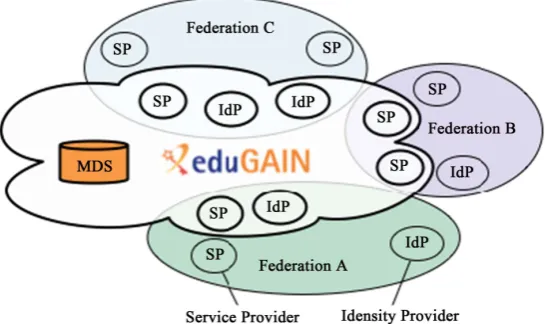
Identity federation is based on facilitating user identities across several domains through single sign-on [14]. It is a mechanism to authenticate a user across mul-tiple sites in a domain or across independent domains using open standards. The objective is to give a user the flexibility to federate his/her multiple accounts us-ing one set of credentials (usually, username and password). The Liberty Identity Federation Framework is a common industry standard for the laws of federated identity and user-centric data exchanges among trusted domains. The Security Assertion Markup Language (SAML), with its implementation done by Shibbo-leth, is the most widely adopted standard used to exchange the authentication and authorization data [15]. New open source protocols like Higgins, policy frameworks like Shibboleth (Anon., n.d.) and decentralized frameworks like OpenID are also used as means of federating identities. Many commercial ser-vice providers offer identity management and authentication serser-vices. Facebook and Google are common social identity providers. These capabilities allow ser-vice developers to integrate their different identities into their serser-vices by enabl-ing user identities to be sourced from several directories (e.g., LDAP) and ex-poses different authentication interfaces that can be embedded in external ap-plications (e.g., OpenID).
The Research and Education Identity Federations—REFEDS—represents stakeholders from NRENs, industry, business, and research and education communities [16]. Its objective is to address the needs of research and education identity federations worldwide and promote the development of access and identity management technology, policies and processes. REFEDS is a commu-nity of practice that plays an important role in developing policies for in-ter-federation, privacy, assurance, and relationship with partner communities as well as for marketing and supporting emerging federations. It is actively engaged in access and identity work and supportive of standards-compliant develop-ments to enhance international collaboration.
DOI: 10.4236/jcc.2019.75003 35 Journal of Computer and Communications Figure 1. Interconnection of federations through eduGAIN.
5. Science Gateway
Science gateways are becoming popular tools used by research communities to interact with e-Infrastructures and to access shared data, software, educational resources, and computational services [4] [18]. The tools represent communi-ty-specific set of applications and data collections that are integrated together via a web portal or a desktop application. They provide access to resources and ser-vices available at the grid infrastructure [19] [20]. The tools also allow users to analyze and share large volumes of data and to run scientific applications and simulations on grid and super computers. Science gateways can offer a variety of services including virtualization, job execution, access to data collections, and applications. Interoperability between different e-Infrastructures and integration of operations are key aspects of science gateways. A number of Arabian coun-tries have adopted the Catania Science Gateway Framework for implementation by the CHAIN-REDs Project [9]. The project has promoted the uptake and use of Science Gateways supporting projects such as agINFRA, DCH-RP, Earth-Server, and eI4Africa with 1000 people registered, 25 integrated applications, and 2500 open access document repositories.
5.1. Architecture
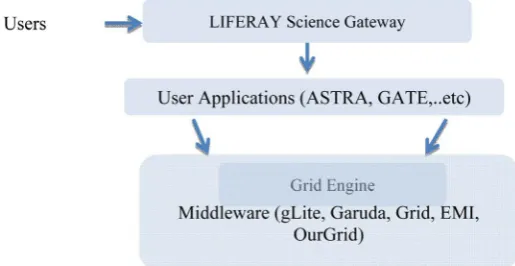
DOI: 10.4236/jcc.2019.75003 36 Journal of Computer and Communications Figure 2. Science gateway model.
Interoperability is facilitated through science gateways. It allows diverse sys-tems and organizations to work and interoperate together. Standards and policy guidelines are defined for services and applications between regional e-Infrastructures and integration of operations, including: Storage and hosting of content delivery; Services/applications for research and educational community; Network com-munication tools and resources; Grid computing and coordination; and Virtual learning environments.
With interoperability, research communities in computationally intensive areas such as genomics, climate change, and medical diagnostics can easily inte-ract and take advantage of distributed computing resources: scientific applica-tions and tools, data repositories, CPUs and storage disks.
5.2. High Level Interface
High-level interfaces are provided to users for quick access to distributed com-puting and storage resources. It provides a set of well-defined and domain spe-cific applications for a smooth access, while preserving security imposed by the distributed e-Infrastructure and the topology of the sensible information ma-naged. Several web and Grid technologies have been adopted and deployed for different VRCs to ensure compliance of authentication and authorization re-quirements. The highest component in the authorization/authentication hie-rarchy is integrated in the Science Gateway and supports a Single Sign On me-chanism across all services a given user is entitled to use. SAML is used for the credentials communication, on the basis of Shibboleth System [21]. Identity Federations are being deployed in different regional networks to simplify access to services for users working in different locations.
When a user signs into the science gateway and is authenticated and autho-rized to run an application, a proxy certificate is issued to secure Grid transac-tions. Robot certificates are used and managed on the multi-threaded eToken server, stored in different USB eToken PRO 32/64 KB smart cards [22].
5.3. USE Cases
DOI: 10.4236/jcc.2019.75003 37 Journal of Computer and Communications different sets of user requirements, have been identified, mainly: Molecular dy-namics—GROMACS, Materials science—ABINIT, Astronomy—LAGO, Popu-lation and health—APHRC, and Proteomics—TreeThreader [9]. The GROMACS software package is used for molecular dynamics simulations. This kind of studies presents a huge computational demand. 14 European, Arab and Indian Grid sites have already been enabled with two GROMACS versions. ABINIT requires massive calculations in the Density Functional Theory with di-rect applications in the fields of quantum chemistry and material physics. ABINIT has been installed in 6 European and Arabian sites. LAGO represents the Latin America Giant Observatory that relies on Water Cherenkov Detectors in 9 Latin American countries. APHRC represents the African Population and Health Research Centre for research in a wide range of topics related to societal health and wellbeing. This use case is mainly devoted to assigning Persistent IDentifiers (PIDs) to the wide plethora of datasets that APHRC manages and curates. This is of strategic importance as these datasets are widely used by al-most every country in Africa in order to improve societal health and wellbeing. The TreeThreader is the leading method for protein structure prediction, and it is exceedingly time consuming. The code is already available to the desktop computing community, and is now made available on e-Infrastructure, with virtual machines launched from physical servers belonging to the China ROC and managed with OpenStack.
6. Preliminary Development
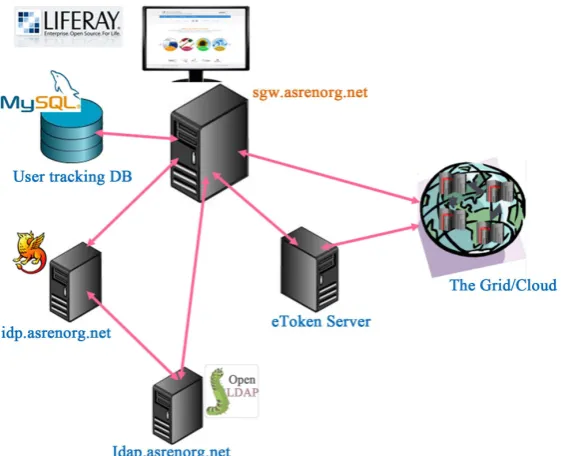
[image:9.595.233.514.475.703.2]We give here insights on the preliminary development of the Pan-Arab e-Infrastructure through identity federation and science gateway. Deployment is taking place at sites in Jordan, Egypt, Algeria and Morocco. Figure 3 gives the
DOI: 10.4236/jcc.2019.75003 38 Journal of Computer and Communications architectural layout of the deployment. The science gateway server installs Life-ray with federations made through idp.asrenorg.net and authorization through ldap.asrenorg.net. Users login to sgw.asrenorg.net, and when authenticated and authorized for use, ASREN eToken server issues the proxy certificate needed for Grid transactions. The core of the eToken server is a “lightweight” grid crypto. It holds the web services to access the smart cards and interacts with the automatic proxy renewal server. A Java multi-platform client is configured for inter-service communication via HTTPS. The eToken server is built on top of the Apache Tomcat Application Server and is configured to accept authorized requests.
6.1. The ASREN Identity Federation
The ASREN identity federation is based on the concept of setting up a common framework for the Arab education and research institutions to manage access to online resources, services and repositories. Researchers, users, scientists, and students use their own credentials at their home institutions (identity providers) for access. The federation framework facilitates authentication and authorization using the Shibboleth implementation of the SAML standard, to allow interope-ration. It serves as the basis of the pan-Arab e-Infrastructure development. In this framework, we propose federations at the national level aggregating local Identity providers and service providers within universities and research institu-tions. The Arabian countries will establish the federainstitu-tions. In the meantime, when there is no national federation initiative, ASREN federation plays the role of an aggregate federation for all.
6.2. The ASREN Science Gateway
The ASREN Science Gateway builds on the EUMEDGRID Science Gateway, which has been implemented using the Catania Science Gateway Framework, to give users access to the distributed computing environment. Its basic elements are developed using standard portlets in the common Liferay portal framework supported by web 2.0 interfaces that easily integrate with many technologies. Users access the portal with specific roles and privileges and are allowed to run applications embedded in the Science Gateway. Applications are interfaced to the underlying e-infrastructure via a set of independent middleware services and are accessible through decoupled authentication and authorization processes. The Identity Federation based on SAML 2.0 provides the authentication and authorization is governed by a set of agreements. Several applications have been made available to scientists with seamless access. These include ASTRA, BES, ClustalW, CMSquares, GATE, Octave, Phylogenetics, and Sonification.
6.3. Testing Results
DOI: 10.4236/jcc.2019.75003 39 Journal of Computer and Communications performance, the server is built on top of the Apache Tomcat Application Server and configured to accept requests only from a set of authorized “clients” (i.e., the Science Gateways). The grid proxies generated by the server on request and are accessible by a Representational State Transfer (REST) API. The adoption of Apache Tomcat as an Application Server ensures scalability and high perfor-mance, with a cache mechanism implemented at the eToken Server.
The original pilot test-bed, built in the first phase of EUMEDGRID, has smoothly evolved into a production service counting 38 sites, for a total of about 4000 CPU cores and 600 TB of disk storage. Twenty applications from five scientific domains have been deployed on the EUMEDGRID infrastructure to be integrated in ASREN science gateway. The results of the application test show that about 35,000 jobs are running on average each month for a total of about 17,500 CPU wall clock hours.
6.4. Sustainability of E-Infrastructures in the Region
The ultimate goal is to implement, manage and extend sustainable Pan-Arab e-Infrastructures dedicated for research and education communities. The e-Infrastructure provides vital resources for the deployment of services that are authenticated for access to a large group of Arab scientists in more than 1000 in-stitutions. Several efforts can be made to stimulate interest and increase usage of e-Infrastructures across the region. These include: 1) region-wide awareness campaign on computing resources, services, and applications that are available to scientific communities; 2) top-down approach to support the decision making process towards the integration in the global research and education networks for sharing experiences, learning from best practice models, and enhance colla-boration with other regional communities; 3) stimulate government spending on research with funding focused on projects that are computationally intensive to address problems and issues of regional importance.
7. Conclusion
DOI: 10.4236/jcc.2019.75003 40 Journal of Computer and Communications scales to support scientists, students, and faculty across the region with resources and services.
Acknowledgements
The authors would like to acknowledge the financial support of the European Commission in context of EUMEDGRID, EUMEDCONNECT, and CHAIN-REDs projects. Special thanks are to Yousef Torman, Ola Samara, Ashraf Alhuseini, Ramez Qunaibi, Mohamad Alshami, and Dr. Ahmad Bargash for their valuable contributions.
Conflicts of Interest
The authors declare no conflicts of interest regarding the publication of this pa-per.
References
[1] Bruce, H., Huang, W., Penumarthy, S. and Börner, K. (2007) Designing Highly Flexible and Usable Cyberinfrastructures for Convergence. In: Bainbridge, W.S. and Roco, M.C., Eds., Progress in Convergence—Technologies for Human Wellbeing, The New York Academy of Sciences, Boston, Volume 1093, 161-179.
https://doi.org/10.1196/annals.1382.013
[2] Barbera, R., Fargetta, M. and Rotondo, R. (2011) A Simplified Access to Grid Re-source by Science Gateways. Proceedings of the International Symposium on Grids and Clouds, Taipei, 19-25 March 2011, 23.https://doi.org/10.22323/1.133.0023 [3] Barbera, R., Andronico, G., Donvito, G., Falzone, A., Keijser, J.J., La Rocca, G.,
Mi-lanesi, L., Maggi, G.P. and Vicario, S. (2011) A Grid Portal with Robot Certificates for Bioinformatics Phylogenetic Analyses. Concurrency and Computation, Practice and Experience, 23, 246-255.https://doi.org/10.1002/cpe.1682
[4] Wilkins-Diehr, N. (2007) Science Gateways—Common Community, Interfaces to Grid Resources. Concurrency and Computation, Practice and Experience, 19, 743-749.https://doi.org/10.1002/cpe.1098
[5] Huang, H.Y., et al. (2010) Identity Federation Broker for Service Cloud. Proceed-ings of the 2010 International Conference on Service Sciences, Hangzhou, 13-14 May 2010, 115-120.https://doi.org/10.1109/ICSS.2010.46
[6] Ahuja, J. (2003) Identity Management: A Business Strategy for Collaborative Com-merce. Information Systems Control Journal, 6, 1-5.
[7] Al-Agtash, S. (2012) Arab e-Infrastructures Status Report. http://www.asrenorg.net [8] European Commission—Information Society and Media: Final Report of
e-Research 2020. The Role of e-Infrastructures in the Creation of Global Virtual Research Communities. https://publications.europa.eu
[9] Coordination and Harmonization of Advanced e-Infrastructure Network.
https://science-gateway.chain-project.eu
[10] Eumedconnect Project. http://www.eumedconnect3.net [11] Eumedgrid-Support Project. http://www.eumedgrid.org
DOI: 10.4236/jcc.2019.75003 41 Journal of Computer and Communications View. Journal of Grid Computing, 9, 155-184.
https://doi.org/10.1007/s10723-011-9187-y
[13] Andronico, G., Balaž, A., Banda, T., Barbera, R., Becker, B., Chattopadhyay, S., Chen, G., Ciuffo, L., Dhekne, P., Gavillet, P., Jalife, S., Kondoro, J., Lin, S., Mare-chal, B., Masoni, A., Matyska, L., Merrouch, R., Mitsos, Y., Nan, K., Napis, S., Nas-sar, S., Paganoni, M., Prnjat, O., Qian, D., Qjan, S., Reale, M., Ruggieri, F., Sener, C., Singh, D., Torman, Y., Voss, A., West, D. and Wright, C. (2011) e-Infrastructures for International Cooperation. In: Computational and Data Grids, IGI Global, Her-shey, 141-190.https://doi.org/10.4018/978-1-61350-113-9.ch006
[14] Identity Federations. http://en.wikipedia.org/wiki/Federated_identity_management [15] Security Assertion Markup Language. http://saml.xml.org
[16] REFEDs. https://refeds.org
[17] EduGain Project. https://edugain.org
[18] Ardizzone, V., Barbera, R., Calanducci, A., Fargetta, M., La Rocca, G., Monforte, S., Pistagna, F., Rotondo, R. and Scardaci, D. (2011) The DECIDE Science Gateway. Proceedings of the 3rd International Workshop on Science Gateways for Life Sciences, London, 8-10 June 2011. http://ceur-ws.org/Vol-819
[19] Anjomshoaa, A., et al. (2005) Job Submission Description Language (JSDL) Specifi-cation Version 1.0. Global Grid Forum, Lemont, OGF Grid Final Documents No. 56.
[20] Foster, I., Grimshaw, A., Lane, P., Lee, W., Morgan, M., Newhourse, S., Pickles, S., Pulsipher, D., Smith, C. and Theimer, M. (2008) Open Grid Services Architecture Basic Execution Services. OGF Grid Final Documents No. 108.
http://www.ogf.org/documents/GFD.108.pdf
[21] Shibboleth. http://shibboleth.internet2.edu