First-Order Probabilistic Models for Coreference Resolution
Aron Culotta and Michael Wick and Andrew McCallum Department of Computer Science
University of Massachusetts Amherst, MA 01003
{culotta,mwick,mccallum}@cs.umass.edu
Abstract
Traditional noun phrase coreference res-olution systems represent features only of pairs of noun phrases. In this paper, we propose a machine learning method that enables features over sets of noun phrases, resulting in a first-order proba-bilistic model for coreference. We out-line a set of approximations that make this approach practical, and apply our method to the ACE coreference dataset, achiev-ing a 45% error reduction over a com-parable method that only considers fea-tures of pairs of noun phrases. This result demonstrates an example of how a first-order logic representation can be incorpo-rated into a probabilistic model and scaled efficiently.
1 Introduction
Noun phrase coreference resolutionis the problem of clustering noun phrases into anaphoric sets. A standard machine learning approach is to perform a set of independent binary classifications of the form “Is mentionacoreferent with mentionb?”
This approach of decomposing the problem into pairwise decisions presents at least two related diffi-culties. First, it is not clear how best to convert the set of pairwise classifications into a disjoint cluster-ing of noun phrases. The problem stems from the transitivity constraints of coreference: Ifaandbare coreferent, andbandcare coreferent, thenaandc
must be coreferent.
This problem has recently been addressed by a number of researchers. A simple approach is to per-form the transitive closure of the pairwise decisions. However, as shown in recent work (McCallum and Wellner, 2003; Singla and Domingos, 2005), bet-ter performance can be obtained by performing rela-tional inferenceto directly consider the dependence among a set of predictions. For example, McCal-lum and Wellner (2005) apply a graph partitioning algorithm on a weighted, undirected graph in which vertices are noun phrases and edges are weighted by the pairwise score between noun phrases.
A second and less studied difficulty is that the pairwise decomposition restricts the feature set to evidence aboutpairsof noun phrases only. This re-striction can be detrimental if there exist features of sets of noun phrases that cannot be captured by a combination of pairwise features. As a simple exam-ple, consider prohibiting coreferent sets that consist only of pronouns. That is, we would like to require that there be at least one antecedent for a set of pro-nouns. The pairwise decomposition does not make it possible to capture this constraint.
In general, we would like to construct arbitrary features over a cluster of noun phrases using the full expressivity of first-order logic. Enabling this sort of flexible representation within a statistical model has been the subject of a long line of research onfirst-order probabilistic models(Gaifman, 1964; Halpern, 1990; Paskin, 2002; Poole, 2003; Richard-son and Domingos, 2006).
Conceptually, a first-order probabilistic model can be described quite compactly. A configura-tion of the world is represented by a set of
He
President Bush
Laura Bush
She 0.2
0.9 0.7
[image:2.612.79.295.60.150.2]0.4 0.001 0.6
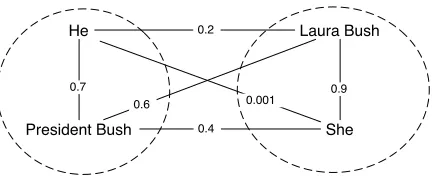
Figure 1: An example noun coreference graph in which vertices are noun phrases and edge weights are proportional to the probability that the two nouns are coreferent. Partitioning such a graph into disjoint clusters corresponds to performing coreference res-olution on the noun phrases.
cates, each of which has an associated real-valued parameter. The likelihood of each configuration of the world is proportional to a combination of these weighted predicates. In practice, however, enu-merating all possible configurations, or even all the predicates of one configuration, can result in in-tractable combinatorial growth (de Salvo Braz et al., 2005; Culotta and McCallum, 2006).
In this paper, we present a practical method to per-form training and inference in first-order models of coreference. We empirically validate our approach on the ACE coreference dataset, showing that the first-order features can lead to an 45% error reduc-tion.
2 Pairwise Model
In this section we briefly review the standard pair-wise coreference model. Given a pair of noun phrasesxij = {xi, xj}, let the binary random
vari-able yij be 1 ifxi andxj are coreferent. Let F =
{fk(xij, y)}be a set of features overxij. For
exam-ple,fk(xij, y)may indicate whetherxi andxj have
the same gender or number. Each featurefkhas an
associated real-valued parameter λk. The pairwise
model is
p(yij|xij) =
1
Zxij
expX
k
λkfk(xij, yij)
whereZxijis a normalizer that sums over the two
settings ofyij.
This is a maximum-entropy classifier (i.e. logis-tic regression) in whichp(yij|xij)is the probability
thatxiandxjare coreferent. To estimateΛ ={λk}
from labeled training data, we perform gradient as-cent to maximize the log-likelihood of the labeled data.
Two critical decisions for this method are (1) how to sample the training data, and (2) how to combine the pairwise predictions at test time. Systems of-ten perform better when these decisions complement each other.
Given a data set in which noun phrases have been manually clustered, the training data can be cre-ated by simply enumerating over each pair of noun phrases xij, where yij is true if xi and xj are in
the same cluster. However, this approach generates a highly unbalanced training set, with negative ex-amples outnumbering positive exex-amples. Instead, Soon et al. (2001) propose the following sampling method: Scan the document from left to right. Com-pare each noun phrase xi to each preceding noun
phrasexj, scanning from right to left. For each pair
xi, xj, create a training instancehxij, yiji, whereyij
is 1 ifxiandxj are coreferent. The scan forxj
ter-minates when a positive example is constructed, or the beginning of the document is reached. This re-sults in a training set that has been pruned of distant noun phrase pairs.
At testing time, we can construct an undirected, weighted graph in which vertices correspond to noun phrases and edge weights are proportional to
p(yij|xij). The problem is then to partition the graph
into clusters with highintra-clusteredge weights and lowinter-clusteredge weights. An example of such a graph is shown in Figure 1.
Any partitioning method is applicable here; how-ever, perhaps most common for coreference is to perform greedy clustering guided by the word or-der of the document to complement the sampling method described above (Soon et al., 2001). More precisely, scan the document from left-to-right, as-signing each noun phrase xi to the same cluster
as the closest precedingnoun phrase xj for which
p(yij|xij) > δ, where δ is some classification
Choosing the closest preceding phrase is common because nearby phrases are a priori more likely to be coreferent.
We refer to the training and inference methods de-scribed in this section as the Pairwise Model.
3 First-Order Logic Model
We propose augmenting the Pairwise Model to enable classification decisions over sets of noun phrases.
Given a set of noun phrasesxj ={xi}, let the
bi-nary random variableyj be 1 ifallthe noun phrases
xi ∈xj are coreferent. The featuresfkand weights
λk are defined as before, but now the features can
represent arbitrary attributes over the entire set xj. This allows us to use the full flexibility of first-order logic to construct features about sets of nouns. The First-Order Logic Model is
p(yj|xj) =
1
Zxj
expX
k
λkfk(xj, yj)
where Zxj is a normalizer that sums over the two
settings ofyj.
Note that this model gives us the representational power of recently proposed Markov logic networks (Richardson and Domingos, 2006); that is, we can construct arbitrary formulae in first-order logic to characterize the noun coreference task, and can learn weights for instantiations of these formulae. How-ever, naively grounding the corresponding Markov logic network results in a combinatorial explosion of variables. Below we outline methods to scale train-ing and prediction with this representation.
As in the Pairwise Model, we must decide how to sample training examples and how to combine inde-pendent classifications at testing time. It is impor-tant to note that by moving to the First-Order Logic Model, the number of possible predictions has in-creased exponentially. In the Pairwise Model, the number of possible y variables is O(|x|2), where
x is the set of noun phrases. In the First-Order Logic Model, the number of possibley variables is
O(2|x|): There is ay variable for each possible el-ement of the powerset of x. Of course, we do not enumerate this set; rather, we incrementally instan-tiateyvariables as needed during prediction.
A simple method to generate training examples is to sample positive and negative cluster examples
uniformly at random from the training data. Positive examples are generated by first sampling a true clus-ter, then sampling a subset of that cluster. Negative examples are generated by sampling two positive ex-amples and merging them into the same cluster.
At testing time, we perform standard greedy ag-glomerative clustering, where the score for each merger is proportional to the probability of the newly formed clustering according to the model. Clustering terminates when there exists no addi-tional merge that improves the probability of the clustering.
We refer to the system described in this section as First-Order Uniform.
4 Error-driven and Rank-based training of the First-Order Model
In this section we propose two enhancements to the training procedure for the First-Order Uniform model.
First, because each training example consists of a subset of noun phrases, the number of possible training examples we can generate is exponential in the number of noun phrases. We propose an error-driven sampling method that generates training ex-amples from errors the model makes on the training data. The algorithm is as follows: Given initial pa-rameters Λ, perform greedy agglomerative cluster-ing on traincluster-ing documentiuntil an incorrect cluster is formed. Update the parameter vector according to this mistake, then repeat for the next training docu-ment. This process is repeated for a fixed number of iterations.
exam-fc
y12
x2
x1
y23
x3 y13 fc
[image:4.612.106.262.65.208.2]fc ft
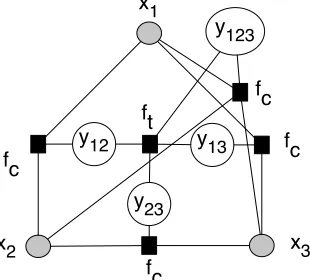
Figure 2: An example noun coreference factor graph for the Pairwise Model in which factorsfcmodel the
coreference between two nouns, andftenforce the
transitivity among related decisions. The number of
yvariables increases quadratically in the number of
xvariables.
ple and one “nearby” positive example. In particular, when agglomerative clustering incorrectly merges two clusters, we select the resulting cluster as the negative example, and select as the positive example a cluster that can be created by merging other exist-ing clusters.1 We then update the weight vector so that the positive example is assigned a higher score than the negative example. This approach allows the update to only penalize the difference between the two features of examples, thereby not penaliz-ing features representpenaliz-ing any overlapppenaliz-ing coreferent clusters.
To implement this update, we use MIRA (Mar-gin Infused Relaxed Algorithm), a relaxed, online maximum margin training algorithm (Crammer and Singer, 2003). It updates the parameter vector with two constraints: (1) the positive example must have a higher score by a given margin, and (2) the change toΛ should be minimal. This second constraint is to reduce fluctuations in Λ. Let s+(Λ,xj) be the unnormalized score for the positive example and
s−(Λ,xk) be the unnormalized score of the neg-ative example. Each update solves the following
1
Of the possible positive examples, we choose the one with the highest probability under the current model to guard against large fluctuations in parameter updates
fc
y12
x2
x1
y23
x3
y13 fc
fc ft
y123
[image:4.612.350.505.70.210.2]fc
Figure 3: An example noun coreference factor graph for the First-Order Model in which factorsfcmodel
the coreference between sets of nouns, and ft
en-force the transitivity among related decisions. Here, the additional node y123 indicates whether nouns
{x1, x2, x3} are all coreferent. The number of y
variables increases exponentially in the number of
xvariables.
quadratic program:
Λt+1 = argmin
Λ
||Λt−Λ||2
s.t.
s+(Λ,xj)−s−(Λ,xk)≥1
In this case, MIRA with a single constraint can be efficiently solved in one iteration of the Hildreth and D’Esopo method (Censor and Zenios, 1997). Ad-ditionally, we average the parameters calculated at each iteration to improve convergence.
We refer to the system described in this section as First-Order MIRA.
5 Probabilistic Interpretation
In this section, we describe the Pairwise and First-Order models in terms of the factor graphs they ap-proximate.
For the Pairwise Model, a corresponding undi-rected graphical model can be defined as
P(y|x) = 1
Zx Y
yij∈y
fc(yij, xij)
Y
yij,yjk∈y
whereZxis the input-dependent normalizer and fac-torfc parameterizes the pairwise noun phrase
com-patibility asfc(yij, xij) = exp(Pkλkfk(yij, xij)).
Factor ft enforces the transitivity constraints by
ft(·) = −∞ if transitivity is not satisfied, 1
oth-erwise. This is similar to the model presented in McCallum and Wellner (2005). A factor graph for the Pairwise Model is presented in Figure 2 for three noun phrases.
For the First-Order model, an undirected graphi-cal model can be defined as
P(y|x) = 1
Zx Y
yj∈y
fc(yj,xj)
Y
yj∈y
ft(yj,xj)
where Zx is the input-dependent nor-malizer and factor fc parameterizes the
cluster-wise noun phrase compatibility as
fc(yj,xj) = exp(Pkλkfk(yj, xj)). Again,
factor ft enforces the transitivity constraints by
ft(·) = −∞if transitivity is not satisfied, 1
other-wise. Here, transitivity is a bit more complicated, since it also requires that if yj = 1, then for any
subset xk ⊆ xj, yk = 1. A factor graph for the
First-Order Model is presented in Figure 3 for three noun phrases.
The methods described in Sections 2, 3 and 4 can be viewed as estimating the parameters of each fac-tor fc independently. This approach can therefore
be viewed as a type of piecewise approximationof exact parameter estimation in these models (Sutton and McCallum, 2005). Here, each fc is a “piece”
of the model trained independently. These pieces are combined at prediction time using clustering al-gorithms to enforce transitivity. Sutton and McCal-lum (2005) show that such a piecewise approxima-tion can be theoretically justified as minimizing an upper bound of the exact loss function.
6 Experiments
6.1 Data
We apply our approach to the noun coreference ACE 2004 data, containing 443 news documents with 28,135 noun phrases to be coreferenced. 336 doc-uments are used for training, and the remainder for
testing. All entity types are candidates for corefer-ence (pronouns, named entities, and nominal enti-ties). We use the true entity segmentation, and parse each sentence in the corpus using a phrase-structure grammar, as is common for this task.
6.2 Features
We follow Soon et al. (2001) and Ng and Cardie (2002) to generate most of our features for the Pair-wise Model. These include:
• Match features - Check whether gender, num-ber, head text, or entire phrase matches
• Mention type (pronoun, name, nominal)
• Aliases - Heuristically decide if one noun is the acronym of the other
• Apposition - Heuristically decide if one noun is in apposition to the other
• Relative Pronoun - Heuristically decide if one noun is a relative pronoun referring to the other.
• Wordnet features - Use Wordnet to decide if one noun is a hypernym, synonym, or antonym of another, or if they share a hypernym.
• Both speak - True if both contain an adjacent context word that is a synonym of “said.” This is a domain-specific feature that helps for many newswire articles.
• Modifiers Match - for example, in the phrase “President Clinton”, “President” is a modifier of “Clinton”. This feature indicates if one noun is a modifier of the other, or they share a modi-fier.
• Substring - True if one noun is a substring of the other (e.g. “Egypt” and “Egyptian”).
The First-Order Model includes the following fea-tures:
• Enumerate each pair of noun phrases and com-pute the features listed above. All-Xis true if all pairs share a featureX,Most-True-Xis true if the majority of pairs share a featureX, and
Most-False-Xis true if most of the pairs do not
• Use the output of the Pairwise Model for each pair of nouns. All-Trueis true if all pairs are predicted to be coreferent,Most-Trueis true if most pairs are predicted to be coreferent, and
Most-Falseis true if most pairs are predicted
to not be coreferent. Additionally, Max-True
is true if the maximum pairwise score is above threshold, andMin-Trueif the minimum pair-wise score is above threshold.
• Cluster Size indicates the size of the cluster.
• Count how many phrases in the cluster are of each mention type (name, pronoun, nom-inal), number (singular/plural) and gender (male/female). The featuresAll-X and
Most-True-Xindicate how frequent each feature is
in the cluster. This feature can capture the soft constraint such that no cluster consists only of pronouns.
In addition to the listed features, we also include conjunctions of size 2, for example “Genders match AND numbers match”.
6.3 Evaluation
We use theB3 algorithm to evaluate the predicted coreferent clusters (Amit and Baldwin, 1998). B3
is common in coreference evaluation and is similar to the precision and recall of coreferent links, ex-cept that systems are rewarded for singleton clus-ters. For each noun phrasexi, letci be the number
of mentions inxi’s predicted cluster that are in fact
coreferent withxi(includingxiitself). Precision for
xi is defined as ci divided by the number of noun
phrases in xi’s cluster. Recall for xi is defined as
thecidivided by the number of mentions in the gold
standard cluster forxi. F1is the harmonic mean of
recall and precision.
6.4 Results
In addition to Pairwise, First-Order Uniform, and First-Order MIRA, we also compare against Pair-wise MIRA, which differs from First-Order MIRA only by the fact that it is restricted to pairwise fea-tures.
Table 1 suggests both that first-order features and error-driven training can greatly improve perfor-mance. The First-Order Model outperforms the
Pair-F1 Prec Rec
First-Order MIRA 79.3 86.7 73.2
Pairwise MIRA 72.5 92.0 59.8
First-Order Uniform 69.2 79.0 61.5
[image:6.612.323.528.57.128.2]Pairwise 62.4 62.5 62.3
Table 1: B3 results for ACE noun phrase
corefer-ence. FIRST-ORDER MIRA is our proposed model that takes advantage of first-order features of the data and is trained with error-driven and rank-based methods. We see that both the first-order features and the training enhancements improve performance consistently.
wise Model in F1 measure for both standard train-ing and error-driven traintrain-ing. We attribute some of this improvement to the capability of the First-Order model to capture features of entire clusters that may indicate some phrases are not coreferent. Also, we attribute the gains from error-driven training to the fact that training examples are generated based on errors made on the training data. (However, we should note that there are also small differences in the feature sets used for error-driven and standard training results.)
Error analysis indicates that often nounxi is
cor-rectly not merged with a clusterxj when xj has a strong internal coherence. For example, if all 5 men-tions of France in a document are string identical, then the system will be extremely cautious of merg-ing a noun that is not equivalent toFranceintoxj, since this will turn off the “All-String-Match” fea-ture for clusterxj.
To our knowledge, the best results on this dataset were obtained by the meta-classification scheme of Ng (2005). Although our train-test splits may differ slightly, the best B-Cubed F1 score reported in Ng (2005) is 69.3%, which is considerably lower than the 79.3% obtained with our method. Also note that the Pairwise baseline obtains results similar to those in Ng and Cardie (2002).
7 Related Work
“learning as search optimization” (LASO) (Daum´e III and Marcu, 2005b; Daum´e III and Marcu, 2005a). Like the current paper, LASO is also an error-driven training method that integrates predic-tion and training. However, whereas we explic-itly use a ranking-based loss function, LASO uses a binary classification loss function that labels each candidate structure as correct or incorrect. Thus, each LASO training example containsallcandidate predictions, whereas our training examples contain only the highest scoring incorrect prediction and the highest scoring correct prediction. Our experiments show the advantages of this ranking-based loss func-tion. Additionally, we provide an empirical study to quantify the effects of different example generation and loss function decisions.
Collins and Roark (2004) present an incremental perceptron algorithm for parsing that uses “early up-date” to update the parameters when an error is en-countered. Our method uses a similar “early update” in that training examples are only generated for the firstmistake made during prediction. However, they do not investigate rank-based loss functions.
Others have attempted to train global scoring functions using Gibbs sampling (Finkel et al., 2005), message propagation, (Bunescu and Mooney, 2004; Sutton and McCallum, 2004), and integer linear pro-gramming (Roth and Yih, 2004). The main distinc-tions of our approach are that it is simple to imple-ment, not computationally intensive, and adaptable to arbitrary loss functions.
There have been a number of machine learning approaches to coreference resolution, traditionally factored into classification decisions over pairs of nouns (Soon et al., 2001; Ng and Cardie, 2002). Nicolae and Nicolae (2006) combine pairwise clas-sification with graph-cut algorithms. Luo et al. (2004) do enable features between mention-cluster pairs, but do not perform the error-driven and rank-ing enhancements proposed in our work. Denis and Baldridge (2007) use a ranking loss function for pro-noun coreference; however the examples are still pairs of pronouns, and the example generation is not error driven. Ng (2005) learns a meta-classifier to choose the best prediction from the output of sev-eral coreference systems. While in theory a meta-classifier can flexibly represent features, they do not explore features using the full flexibility of
first-order logic. Also, their method is neither error-driven nor rank-based.
McCallum and Wellner (2003) use a conditional random field that factors into a product of pairwise decisions about pairs of nouns. These pairwise de-cisions are made collectively using relational infer-ence; however, as pointed out in Milch et al. (2004), this model has limited representational power since it does not capture features ofentities, only of pairs of mention. Milch et al. (2005) address these issues by constructing a generative probabilistic model, where noun clusters are sampled from a generative process. Our current work has similar representa-tional flexibility as Milch et al. (2005) but is discrim-inatively trained.
8 Conclusions and Future Work
We have presented learning and inference proce-dures for coreference models using first-order fea-tures. By relying on sampling methods at training time and approximate inference methods at testing time, this approach can be made scalable. This re-sults in a coreference model that can capture features oversetsof noun phrases, rather than simplypairsof noun phrases.
This is an example of a model with extremely flexible representational power, but for which exact inference is intractable. The simple approximations we have described here have enabled this more flex-ible model to outperform a model that is simplified for tractability.
A short-term extension would be to consider fea-tures over entireclusterings, such as the number of clusters. This could be incorporated in a ranking scheme, as in Ng (2005).
Future work will extend our approach to a wider variety of tasks. The model we have described here is specific to clustering tasks; however a similar for-mulation could be used to approach a number of lan-guage processing tasks, such as parsing and relation extraction. These tasks could benefit from first-order features, and the present work can guide the approx-imations required in those domains.
Acknowledgments
We thank Robert Hall for helpful contributions. This work was supported in part by the Defense Advanced Research Projects Agency (DARPA), through the Department of the Interior, NBC, Acquisition Services Division, under con-tract #NBCHD030010, in part by U.S. Government concon-tract #NBCH040171 through a subcontract with BBNT Solutions LLC, in part by The Central Intelligence Agency, the National Security Agency and National Science Foundation under NSF grant #IIS-0326249, in part by Microsoft Live Labs, and in part by the Defense Advanced Research Projects Agency (DARPA) under contract #HR0011-06-C-0023. Any opinions, findings and conclusions or recommendations expressed in this mate-rial are the author(s)’ and do not necessarily reflect those of the sponsor.
References
B. Amit and B. Baldwin. 1998. Algorithms for scoring coref-erence chains. InProceedings of the Seventh Message Un-derstanding Conference (MUC7).
Razvan Bunescu and Raymond J. Mooney. 2004. Collective information extraction with relational markov networks. In
ACL.
Y. Censor and S.A. Zenios. 1997. Parallel optimization : the-ory, algorithms, and applications. Oxford University Press. Michael Collins and Brian Roark. 2004. Incremental parsing
with the perceptron algorithm. InACL.
Koby Crammer and Yoram Singer. 2003. Ultraconservative online algorithms for multiclass problems. JMLR, 3:951– 991.
Aron Culotta and Andrew McCallum. 2006. Tractable learn-ing and inference with high-order representations. InICML Workshop on Open Problems in Statistical Relational Learn-ing, Pittsburgh, PA.
Hal Daum´e III and Daniel Marcu. 2005a. A large-scale explo-ration of effective global features for a joint entity detection and tracking model. InHLT/EMNLP, Vancouver, Canada. Hal Daum´e III and Daniel Marcu. 2005b. Learning as search
optimization: Approximate large margin methods for struc-tured prediction. InICML, Bonn, Germany.
Rodrigo de Salvo Braz, Eyal Amir, and Dan Roth. 2005. Lifted first-order probabilistic inference. In IJCAI, pages 1319– 1325.
Pascal Denis and Jason Baldridge. 2007. A ranking approach to pronoun resolution. InIJCAI.
Jenny Rose Finkel, Trond Grenager, and Christopher Manning. 2005. Incorporating non-local information into information extraction systems by gibbs sampling. InACL, pages 363– 370.
H. Gaifman. 1964. Concerning measures in first order calculi.
Israel J. Math, 2:1–18.
J. Y. Halpern. 1990. An analysis of first-order logics of proba-bility.Artificial Intelligence, 46:311–350.
Xiaoqiang Luo, Abe Ittycheriah, Hongyan Jing, Nanda Kamb-hatla, and Salim Roukos. 2004. A mention-synchronous coreference resolution algorithm based on the Bell tree. In
ACL, page 135.
A. McCallum and B. Wellner. 2003. Toward conditional mod-els of identity uncertainty with application to proper noun coreference. InIJCAI Workshop on Information Integration on the Web.
Andrew McCallum and Ben Wellner. 2005. Conditional mod-els of identity uncertainty with application to noun corefer-ence. In Lawrence K. Saul, Yair Weiss, and L´eon Bottou, editors,NIPS17. MIT Press, Cambridge, MA.
Brian Milch, Bhaskara Marthi, and Stuart Russell. 2004. BLOG: Relational modeling with unknown objects. In
ICML 2004 Workshop on Statistical Relational Learning and Its Connections to Other Fields.
Brian Milch, Bhaskara Marthi, Stuart Russell, David Sontag, Daniel L. Ong, and Andrey Kolobov. 2005. BLOG: Proba-bilistic models with unknown objects. InIJCAI.
Vincent Ng and Claire Cardie. 2002. Improving machine learn-ing approaches to coreference resolution. InACL.
Vincent Ng. 2005. Machine learning for coreference resolu-tion: From local classification to global ranking. InACL. Cristina Nicolae and Gabriel Nicolae. 2006. Bestcut: A graph
algorithm for coreference resolution. In EMNLP, pages 275–283, Sydney, Australia, July. Association for Compu-tational Linguistics.
Mark A. Paskin. 2002. Maximum entropy probabilistic logic. Technical Report UCB/CSD-01-1161, University of Califor-nia, Berkeley.
D. Poole. 2003. First-order probabilistic inference. InIJCAI, pages 985–991, Acapulco, Mexico. Morgan Kaufman. Matthew Richardson and Pedro Domingos. 2006. Markov
logic networks.Machine Learning, 62:107–136.
D. Roth and W. Yih. 2004. A linear programming formulation for global inference in natural language tasks. InThe 8th Conference on Compuational Natural Language Learning, May.
Parag Singla and Pedro Domingos. 2005. Discriminative train-ing of markov logic networks. InAAAI, Pittsburgh, PA. Wee Meng Soon, Hwee Tou Ng, and Daniel Chung Yong Lim.
2001. A machine learning approach to coreference resolu-tion of noun phrases.Comput. Linguist., 27(4):521–544. Charles Sutton and Andrew McCallum. 2004. Collective
seg-mentation and labeling of distant entities in information ex-traction. Technical Report TR # 04-49, University of Mas-sachusetts, July.