510
VAE-PGN based Abstractive Model in Multi-stage Architecture
for Text Summarization
Hyungtak Choi1, Lohith Ravuru1, Tomasz Dryja ´nski2, Seonghan Ryu1, Donghyun Lee1, Hojung Lee1and Inchul Hwang1
1 Samsung Research, Samsung Electronics Co. Ltd., Seoul, Korea 2Samsung R&D Institute, Warsaw, Poland
{ht777.choi, loki.ravuru, t.dryjanski, seonghan.ryu, dh.semko.lee, hojung76.lee, inc.hwang}@samsung.com
Abstract
This paper describes our submission to the TL;DR challenge. Neural abstractive summa-rization models have been successful in gener-ating fluent and consistent summaries with ad-vancements like the copy (Pointer-generator) and coverage mechanisms. However, these models suffer from their extractive nature as they learn to copy words from the source text. In this paper, we propose a novel abstrac-tive model based on Variational Autoencoder (VAE) to address this issue. We also propose a Unified Summarization Framework for the generation of summaries. Our model elimi-nates non-critical information at a sentence-level with an extractive summarization mod-ule and generates the summary word by word using an abstractive summarization module. To implement our framework, we combine submodules with state-of-the-art techniques including Pointer-Generator Network (PGN) and BERT while also using our new VAE-PGN abstractive model. We evaluate our model on the benchmark Reddit corpus as part of the TL;DR challenge and show that our model outperforms the baseline in ROUGE score while generating diverse summaries.
1 Introduction
Text summarization is the task of producing an ac-curate summary by preserving essential informa-tion from a long text document. This is a chal-lenging and significant task, as it can be applied to many real-world applications such as summariz-ing news articles, social media, web pages, blogs or long text documents. Many approaches have been proposed to solve the text summarization problem (See et al.,2017;Liu,2019b;Gehrmann et al.,2018). Extractive summarization generates a summary by selecting important phrases or sen-tences from the source text. This approach mainly uses ranking the importance of phrases or
sen-tences to select only important information (Liu,
2019b). Whereas the abstractive approach gener-ates entirely new phrases or sentences that cap-ture the meaning of the source text. In this pa-per, we focus on a few challenges that need to be addressed in generating an abstractive summariza-tion of a given text.
The first challenge comes from the difficulty in preserving the contents of a large source text in the generated summary. The state-of-the-art mod-els for abstractive summarization use a sequence-to-sequence attention model with a copy mecha-nism (Gu et al., 2016; See et al., 2017), to se-lect the relevant content of the source text. But these models suffer from their extractive nature of generating summaries due to the copy mechanism (Boutkan et al.,2019;Chawla et al.,2019). We in-troduce a VAE-based PGN model to overcome this extractive nature. Another challenge is to elimi-nate non-critical information from the source text.
Gehrmann et al.(2018) employ a word-level con-tent selection model to focus on only critical infor-mation, but handling critical information at word-level is difficult in long sentences because of the repetition of many common words. Our approach handles the critical information by using a multi-stage model with a sentence-level selection (ex-tractive) and abstractive summarization modules.
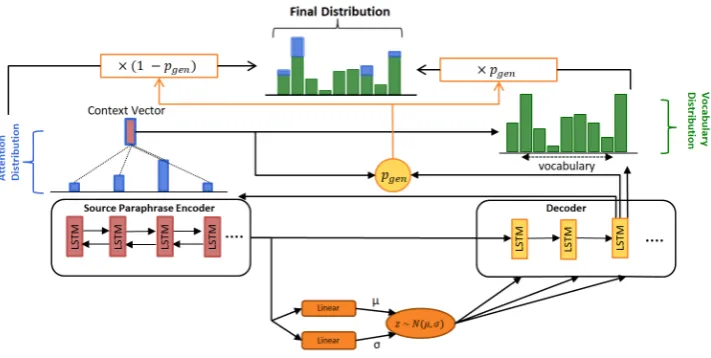
Figure 1: Overview of VAE-PGN, combining a pointer-generator network based encoding for copying the content related words and a VAE-based encoding for generating the variations.
baselines on this task.
The contributions of our work are as follows:
• We develop VAE-based PGN to address the diversity issue and generate abstractive sum-maries.
• We propose a new architecture that excludes less important information at the first stage.
2 Related Work
2.1 Extractive Summarization
Zhang et al. (2018) use a latent variable extrac-tive model where sentences are viewed as la-tent variables and sentences with activated vari-ables are used to infer gold summaries. Dong et al. (2018) utilize a policy gradient reinforce-ment learning algorithm to select a sequence of sentences that maximize ROUGE scores. Zhou et al. (2018) use a novel end-to-end neural net-work framenet-work for extractive document summa-rization by jointly learning to score and select sen-tences. Motivated by BERT (Devlin et al.,2018), which has achieved state-of-the-art performance on multiple NLP tasks, Liu (2019b) use a fine-tuned BERT model to score the sentences. This model is used by our work for extractive summa-rization module.
2.2 Abstractive Summarization
The work on attention-based encoder-decoder models (Rush et al., 2015; Chopra et al., 2016) created a surge of research interest in text gener-ation approaches. Recent abstractive summariza-tion models adopt the attensummariza-tion mechanism ( Bah-danau et al.,2015), and a pointer-network to copy
infrequent words and entities to the target sentence (See et al., 2017; G¨ulc¸ehre et al., 2016; Nallap-ati et al.,2016;Gu et al.,2016). Gehrmann et al.
(2018) use content selector that can be used for a bottom-up attention that restricts the ability of abstractive summarizers to copy words from the source text.
2.3 Diversity
In this work, the diversity of summarization refers to generating words that are different from the source text. VAEs have become more and more popular (Hu et al.,2017;Shen et al.,2017) in gen-erating diverse sentences through learning a high-level latent variable representation of the context.
Bowman et al. (2015) points out that generating sentences from a continuous space like VAE is of higher grammatical quality compared to other techniques such as Beam Search.
3 Proposed Architecture
In this section, we explain the proposed architec-ture to resolve the problems discussed above.
3.1 VAE-PGN Model
An LSTM encoder encodes source text. From the final state of the encoder, we sample a latent variable over a Gaussian distribution. An LSTM decoder is used to generate the summary. Each decoding step uses the latent variable from the encoder and an attention mechanism to generate a probability distribution over the vocabulary. A pointer-generator network is used in tandem to aid in copying words from the source text.
Now we define the notations used in the rest of the paper. We represent the training data as
{si, ti}Ni=1. It containsN content-summary pairs.
s = (ws1, ws2, ..., wsp) represents source text of lengthp, andt = (wt1, w2t, ..., wqt) represents the target summary of lengthq. The source and target embeddings of a wordwi, are represented aseswi
andet
wi respectively.
The embeddings of words from the source text are encoded by a bidirectional LSTM Encoder.
hs=EN Ces(esw1, ews2, esw3, ..., eswp) (1)
whereEN Ces is the bidirectional LSTM encoder andhsis the final encoder state of the source text. Since we use a bi-directional encoder, the hidden states of forward and backward encoder are con-catenated, and passed through a feed-forward net-work to geths. The final state of encoder is passed through two feed-forward layers to getµandσ re-spectively.
µ=Linear1(hs)andσ =Linear2(hs) (2)
AlthoughLinear1,Linear2 layers are both
feed-forward layers, they are labelled separately here to reflect that the weights are updated differently during backpropagation. The latent variable which encodes the representation of the source sentence is modelled as a one-dimensional tensor whose di-mensions is a hyperparameter. We set this hy-perparameter is initialized to dimensions of the encoder and decoder. A random variable from theN(0, I)normal distribution is sampled and is transformed to the requiredN(µ, σ)distribution.
z0 ∼ N(0, I)−→z∼ N(µ, σ) (3)
The LSTM decoder is initialized with the final state of the encoderhs. The input to the decoder at every time step isz⊕ewt, which is a concatenation
of the latent variablezand embeddings of the pre-vious word (ewt). During training,ewt is the
em-bedding of the previous word of target paraphrase
and while testing, it is embedding of the word gen-erated by the decoder at step t-1.
The loss function is the sum of the cross-entropy loss calculated between the target and the generated summary, the Coverage loss, and the Kullback-Leibler Divergence (KL-D) loss calcu-lated between the N(0, I) distribution and the gen-eratedN(µ, σ)distribution. The loss function can be formalized as follows:
L(θ, φ;xs, xt) =Eqφ(z|xs)[logpθ(x
t|z, xs)]
+λX
i
min(ati, cti)−KL(qφ(z|xs)||p(z)) (4)
3.2 Multi-Stage Architecture
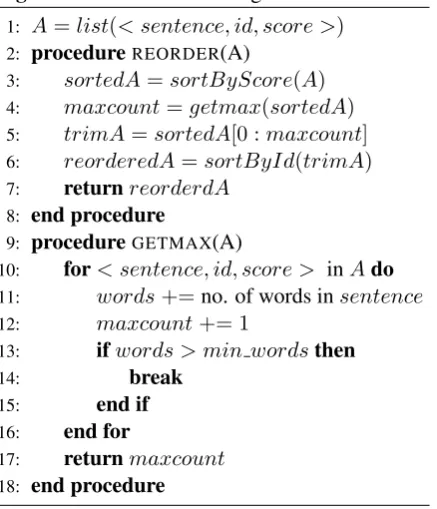
Gehrmann et al.(2018) studies the effect of elim-inating duplicate or insignificant words by per-forming a word-level content selection. Motivated by the content selection, we use a sentence level selection before generating an abstractive sum-mary as described by the Algorithm1.
Algorithm 1Multi-Stage Architecture
1: Train two language models, one using BERT-SUM for extractive summarization and the other using PGN or VAE-PGN for abstractive summarization.
2: Get scores for sentences from the source text using BERTSUM
3: Reorder the sentences using Algorithm2 4: Generate abstractive summary using the
Ab-stractive model (PGN or VAE-PGN)
We obtain a score for each sentence through a high-performance extractive summarization model based on fine-tuned BERT called BERT-SUM (Liu,2019b). The scored sentences are then reordered using the Algorithm2. Also, the number of input sentences for the abstractive summary was selected dynamically according to the parameter
min words in Algorithm 2. This hyperparame-ter is tuned based on the average target summary length of a given dataset. As a result, abstractive summarization can be performed with the filtered input in which the unimportant sentences are re-moved.
4 Experiments
4.1 Datasets and Experimental Setup
pro-Algorithm 2Order Preserving Selection
1: A=list(< sentence, id, score >)
2: procedureREORDER(A)
3: sortedA=sortByScore(A) 4: maxcount=getmax(sortedA)
5: trimA=sortedA[0 :maxcount] 6: reorderedA=sortById(trimA) 7: returnreorderdA
8: end procedure
9: procedureGETMAX(A)
10: for< sentence, id, score > inAdo 11: words+=no. of words insentence
12: maxcount+= 1
13: ifwords > min wordsthen
14: break
15: end if
16: end for
17: returnmaxcount
18: end procedure
vide a corpus consisting of approximately 3 mil-lion content-summary pairs mined from Reddit. The competition organizers split the dataset into training, validation and test datasets.
CNN/Daily Mail corpus (Hermann et al.,
2015; Nallapati et al., 2016): We use the non-anonymized version (See et al., 2017) of the dataset which contains pairs of online news arti-cles and their summaries. The dataset contains ap-proximately 287,000 training pairs, 13,368 valida-tion pairs, and 11,490 testing pairs.
The VAE implementation of paper Bowman et al. (2015), Gavrilov (2017) and the PGN im-plementation of paper See et al. (2017), Kumar
(2019) are used as references for abstractive mod-ule. The BERTSUM implementation of paperLiu
(2019b),Liu(2019a) is used as a reference for the extractive module.
Extractive Summarization and Abstractive Summarization modules are finetuned on each datasets for obtaining respetive results. Apart from the minimum words generated, we borrow all hyperparameters from baseline code imple-mentations. Theminwordsparameter is tuned by
setting it to the average target summary length and doing to a grid-search based fine-tuning around the initialized value.
4.2 Metrics and Baselines
ROUGE (Lin,2004) metric is used as an automatic evaluation metric. Rouge-N (R-n) scores refer to the n-gram overlap between the generated and the
reference summary. Rouge-L (R-L) score refers to the Longest Common Subsequence based overlap score. All scores are calculated using the virtual machine provided by competition (2018) on the TIRA platform that uses thetagucci(2019) project to calculate the scores. We compared models us-ing a validation set, choose the best scored models and then evaluated them on the official test set due to resource and time constraints.
PGNis the pointer-generator model with copy and coverage mechanism. VAE-PGNis the VAE-based pointer-generator model with copy and cov-erage mechanism as shown in Figure 1. Unified PGN and Unified VAE-PGN refer to the Uni-fied Architecture with PGN and VAE-PGN mod-els used for respective abstractive summarization modules.
[image:4.595.75.294.74.329.2]4.3 Results
Table 1: Results on CNN-DM test dataset
Model R-1 R-2 R-L
PGN 38.86 16.70 35.38 VAE-PGN 39.06 16.93 35.61
Unified PGN 39.00 16.65 29.08 Unified VAE-PGN 39.32 17.07 29.43
The results on the test set of CNN/Daily Mail dataset are presented in Table1. The results show that VAE-PGN model performs better than the PGN model by achieving higher ROUGE scores. Although the unified model increases the R-1 and R-2 scores on both the abstractive models, there is a reduction in R-L score. We expect this de-cline to be caused by using different tokeniza-tion techniques used in the abstractive model (uses Stanford NLP tokenizer) and the extractive model (uses BERT tokenizer).
Table 2: Results on Reddit data validation set
Model R-1 R-2 R-L
PGN 18 3 13
VAE-PGN 18 3 12
Unified PGN 19 4 15
Unified VAE-PGN 20 4 14
Table 3: Results on Reddit data test set
Model R-1 R-2 R-L
[image:4.595.307.525.617.686.2]The results on the validation set and the test set are presented in Table 2 and Table 3 respec-tively. The results show that the unified architec-ture model outperforms the abstractive model on both VAE and VAE-PGN based models and also the Unified VAE-PGN model gets a better R-1 score than Unified PGN on the validation set. But Unified PGN and Unified VAE-PGN model per-form almost similarly on the test set.
5 Conclusions
In this paper, we propose a Unified VAE-PGN model and an effective multi-stage architecture for abstractive summarization. Our model eliminates non-critical information at sentence-level and also generates diverse summaries using a continuous space representation of the information. We eval-uate our models on the benchmark Reddit datasets as part of the TL;DR challenge and show that our proposed models outperform the baseline models. We plan to include content selection, eliminating word-level non-critical information in the multi-stage architecture in future work.
Acknowledgments
The authors would like to thank Katarzyna Beksa and Katarzyna Podlaska for their helpful review and suggestions.
References
Dzmitry Bahdanau, Kyunghyun Cho, and Yoshua Ben-gio. 2015. Neural machine translation by jointly learning to align and translate. InICLR.
Freek Boutkan, Jorn Ranzijn, David Rau, and Eelco van der Wel. 2019. Point-less: More abstrac-tive summarization with pointer-generator networks.
CoRR, abs/1905.01975.
Samuel R. Bowman, Luke Vilnis, Oriol Vinyals, An-drew M. Dai, Rafal J´ozefowicz, and Samy Ben-gio. 2015. Generating sentences from a continuous space. CoRR, abs/1511.06349.
Kushal Chawla, Kundan Krishna, and Balaji Vasan Srinivasan. 2019. Improving generation quality of pointer networks via guided attention. CoRR, abs/1901.11492.
Sumit Chopra, Michael Auli, and Alexander M. Rush. 2016. Abstractive sentence summarization with at-tentive recurrent neural networks. InProceedings of the 2016 Conference of the North American Chap-ter of the Association for Computational Linguistics: Human Language Technologies, pages 93–98, San
Diego, California. Association for Computational Linguistics.
TL;DR competition. 2018. Tl;dr the abstractive sum-marization challenge.
Jacob Devlin, Ming-Wei Chang, Kenton Lee, and Kristina Toutanova. 2018. BERT: pre-training of deep bidirectional transformers for language under-standing.CoRR, abs/1810.04805.
Yue Dong, Yikang Shen, Eric Crawford, Herke van Hoof, and Jackie Chi Kit Cheung. 2018. Bandit-sum: Extractive summarization as a contextual ban-dit.CoRR, abs/1809.09672.
Daniil Gavrilov. 2017.pytorch rvae.
Sebastian Gehrmann, Yuntian Deng, and Alexander M. Rush. 2018. Bottom-up abstractive summarization.
CoRR, abs/1808.10792.
Jiatao Gu, Zhengdong Lu, Hang Li, and Victor O. K. Li. 2016. Incorporating copying mech-anism in sequence-to-sequence learning. CoRR, abs/1603.06393.
C¸ aglar G¨ulc¸ehre, Sungjin Ahn, Ramesh Nallapati, Bowen Zhou, and Yoshua Bengio. 2016. Pointing the unknown words. CoRR, abs/1603.08148.
Karl Moritz Hermann, Tom´as Kocisk´y, Edward Grefenstette, Lasse Espeholt, Will Kay, Mustafa Suleyman, and Phil Blunsom. 2015. Teach-ing machines to read and comprehend. CoRR, abs/1506.03340.
Zhiting Hu, Zichao Yang, Xiaodan Liang, Ruslan Salakhutdinov, and Eric P. Xing. 2017. Controllable text generation.CoRR, abs/1703.00955.
Atul Kumar. 2019.pytorch rvae.
Chin-Yew Lin. 2004. ROUGE: A package for auto-matic evaluation of summaries. InText Summariza-tion Branches Out, pages 74–81, Barcelona, Spain. Association for Computational Linguistics.
Yang Liu. 2019a.Bertsum.
Yang Liu. 2019b. Fine-tune BERT for extractive sum-marization.CoRR, abs/1903.10318.
Ramesh Nallapati, Bing Xiang, and Bowen Zhou. 2016. Sequence-to-sequence rnns for text summa-rization. CoRR, abs/1602.06‘023.
Alexander M. Rush, Sumit Chopra, and Jason Weston. 2015. A neural attention model for abstractive sen-tence summarization.CoRR, abs/1509.00685.
Tianxiao Shen, Tao Lei, Regina Barzilay, and Tommi Jaakkola. 2017. Style transfer from non-parallel text by cross-alignment. In I. Guyon, U. V. Luxburg, S. Bengio, H. Wallach, R. Fergus, S. Vishwanathan, and R. Garnett, editors, Advances in Neural Infor-mation Processing Systems 30, pages 6830–6841. Curran Associates, Inc.
tagucci. 2019. pythonrouge.
Michael V¨olske, Martin Potthast, Shahbaz Syed, and Benno Stein. 2017. TL;DR: Mining Reddit to learn automatic summarization. InProceedings of the Workshop on New Frontiers in Summarization, pages 59–63, Copenhagen, Denmark. Association for Computational Linguistics.
Xingxing Zhang, Mirella Lapata, Furu Wei, and Ming Zhou. 2018. Neural latent extractive document sum-marization.CoRR, abs/1808.07187.