Unsupervised Induction of Semantic Roles
within a Reconstruction-Error Minimization Framework
Ivan Titov Ehsan Khoddam University of Amsterdam
{titov|e.khoddammohammadi}@uva.nl
Abstract
We introduce a new approach to unsupervised estimation of feature-rich semantic role la-beling models. Our model consists of two components: (1) an encoding component: a semantic role labeling model which predicts roles given a rich set of syntactic and lexi-cal features; (2) a reconstruction component: a tensor factorization model which relies on roles to predict argument fillers. When the components are estimated jointly to minimize errors in argument reconstruction, the induced roles largely correspond to roles defined in an-notated resources. Our method performs on par with most accurate role induction methods on English and German, even though, unlike these previous approaches, we do not incorpo-rate any prior linguistic knowledge about the languages.
1 Introduction
Shallow semantic representations, and semantic role labels in particular, have a long history in linguis-tics (Fillmore, 1968). More recently, with an emer-gence of large annotated resources such as Prop-Bank (Palmer et al., 2005) and FrameNet (Baker et al., 1998), automatic semantic role labeling (SRL) has attracted a lot of attention (Gildea and Jurafsky, 2002; Carreras and M`arquez, 2005; Surdeanu et al., 2008; Hajiˇc et al., 2009; Das et al., 2010).
Semantic role representations encode the under-lying predicate-argument structure of sentences, or, more specifically, for every predicate in a sentence they identify a set of arguments and associate each argument with an underlying semantic role, such
as an agent (an initiator or doer of the action) or a patient (an affected entity). Semantic roles have many potential applications in NLP and have been shown to benefit question answering (Shen and Lap-ata, 2007; Kaisser and Webber, 2007), textual entail-ment (Sammons et al., 2009), machine translation (Wu and Fung, 2009; Liu and Gildea, 2010; Wu et al., 2011; Gao and Vogel, 2011), and dialogue sys-tems (Basili et al., 2009; van der Plas et al., 2009), among others.
Most current statistical approaches to SRL are su-pervised, requiring large quantities of human an-notated data to estimate model parameters. How-ever, such resources are expensive to create and only available for a small number of languages. More-over, when moved to a new domain (e.g., from news corpora to blogs or biomedical texts), the perfor-mance of these models tends to degrade substtially (Pradhan et al., 2008). The scarcity of an-notated data has motivated the research into unsu-pervised learning of semantic representations (Swier and Stevenson, 2004; Grenager and Manning, 2006; Lang and Lapata, 2010; Lang and Lapata, 2011a; Lang and Lapata, 2011b; Titov and Klementiev, 2012a; F¨urstenau and Rambow, 2012; Garg and Henderson, 2012). The existing methods have a number of serious shortcomings. First, they make very strong assumptions, for example, assuming that arguments are conditionally independent of each other given the predicate. Second, unlike state-of-the-art supervised parsers, they rely on a very sim-plistic set of features of a sentence. These fac-tors lead to models being insufficiently expressive to capture the syntax-semantics interface, inadequate
handling of language ambiguity and, overall, in-troduces a restrictive upper bound on their perfor-mance. Moreover, these approaches are especially problematic for languages with freer word order than English, where richer features are necessary to account for interactions between surface realiza-tions, syntax and semantics. For example, the two most accurate previous models (Titov and Klemen-tiev, 2012a; Lang and Lapata, 2011a) both treat the role induction task as clustering of argument signa-tures: an argument signature encodes key syntactic properties of an argument realization and consists of a syntactic function of an argument along with ad-ditional information such as an argument position with respect to the predicate. Though it is possible to design signatures which mostly map to a single role, this set-up limits oracle performance even for English, and can be quite restrictive for languages with freer word order. These shortcomings are in-herent limitations of the modeling frameworks used in previous work (primarily generative modeling or agglomerative clustering), and cannot be addressed by simply incorporating more features or relaxing some of the modeling assumptions.
In this work, we propose a method for effective unsupervised estimation of feature-rich models of semantic roles. We demonstrate that reconstruction-error objectives, which have been shown to be effec-tive primarily for training neural networks, are well suited for inducing feature-rich log-linear models of semantics. Our model consists of two components: a log-linear feature-rich semantic role labeler and a tensor-factorization model which captures inter-action between semantic roles and argument fillers. When estimated jointly on unlabeled data, roles in-duced by the model mostly corresponds to roles de-fined in existing resources by annotators.
Our method rivals the most accurate semantic role induction methods on English and German (Titov and Klementiev, 2012a; Lang and Lapata, 2011a). Importantly, no prior knowledge about the languages was incorporated in our feature-rich model, whereas the clustering counterparts relied on language-specific argument signatures. These languages-specific priors were crucial for their suc-cess. For example, using English-specific argument signatures for German with the Bayesian model of Titov and Klementiev (2012a) results in a drop of
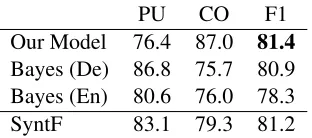
performance from clustering F1 of 80.9% to consid-erably lower 78.3% (our model yields 81.4%). This confirms the intuition that using richer features helps to capture the syntax-semantics interface in multi-lingual settings, reducing the need for language-specific model engineering, as is highly desirable in unsupervised learning.
The rest of the paper is structured as follows. Sec-tion 2 begins with a definiSec-tion of the semantic role labeling task and discusses some specifics of the un-supervised setting. In Section 3, we describe our ap-proach, starting with a general motivation and pro-ceeding to technical details of the model (Section 3.3) and the learning procedure (Section 3.4). Sec-tion 4 provides both evaluaSec-tion and analysis. Finally, additional related work is presented in Section 5.
2 Task Definition
The SRL task involves prediction of predicate argu-ment structure, i.e. both identification of arguargu-ments and assignment of labels according to their under-lying semantic role. For example, in the following sentences:
(a) [AgentMary]opened[P atientthe door]. (b) [P atientThe door]opened.
(c) [P atientThe door]was opened[Agentby Mary].
Mary always takes an agent role for the predicate
open, anddooris always a patient.
In this work we focus on the labeling stage of semantic role labeling. Identification, though an important problem, can be tackled with heuris-tics (Lang and Lapata, 2011a; Grenager and Man-ning, 2006; de Marneffe et al., 2006), with unsuper-vised techniques (Abend et al., 2009) or potentially by using a supervised classifier trained on a small amount of data.
3 Approach
model. The idea which underlines much of latent variable modeling is that a good latent representa-tion is the one which helps us to reconstruct x. In practice, we are not interested in predictingx, asx is observable, but rather interested in inducing ap-propriate latent representations (i.e. r). Thus, it is crucial to design the model in such a way that the goodr(the one predictive ofx) indeed encodes roles, rather than some other form of abstraction.
In what follows, we will refer to roles using their names, though, in the unsupervised setting, our method, as any other latent variable model, will not yield human-interpretable labels for them. We will use the following sentence as a motivating example in our discussion of the model:
[Agent The police] charged [P atient the
demonstrators] [Instrumentwith batons].
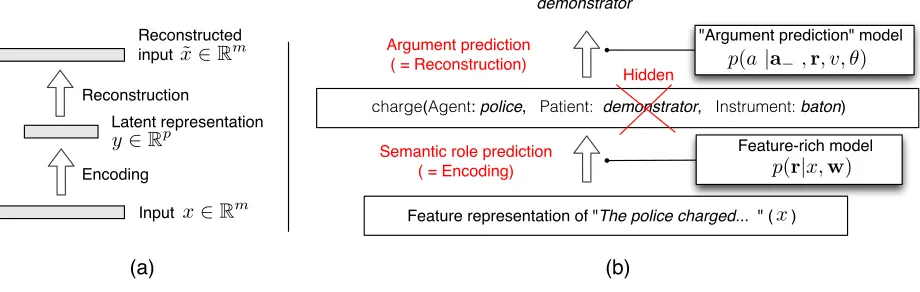
The model consists of two components. The first component is responsible for prediction of argument tuples based on roles and the predicate. In our exper-iments, in this component, we represent arguments as lemmas of their lexical heads (e.g.,batoninstead ofwith batons). We also restrict ourselves to only verbal predicates. Intuitively, we can think of pre-dicting one argument at a time (see Figure 1(b)): an argument (e.g., demonstratorin our example) is predicted based on the predicate lemma (charge), the role assigned to this argument (i.e. Patient) and other role-argument pairs ((Agent,police) and (Instrument,baton)). While learning to predict arguments, the inference algorithm will search for role assignments which simplify this prediction task as much as possible. Our hypothesis is that these assignments will correspond to roles accepted in lin-guistic theories (or, more importantly, useful in prac-tical applications). Why is this hypothesis plausi-ble? Primarily because these semantic representa-tions were introduced as an abstraction capturing the essence of a situation (or a event). And the underly-ing situation and participant roles in this situation (rather than surface linguistic details like argument order or syntactic functions) are precisely what im-pose constraints on admissible argument tuples.
The reconstruction component is not the only part of the model. Crucially, what we referred to above as ‘searching for role assignments to simplify ar-gument prediction’ would actually correspond to
learning another component: a semantic role labeler which predicts roles relying on a rich set of sentence features. These two components will be estimated jointly in such a way as to minimize errors in recov-ering arguments. The role labeler will be the end-product of learning: it will be used to process new sentences, and it will be compared to existing meth-ods in our evaluation.
3.1 Shortcomings of generative modeling
The above paragraph can be regarded as our desider-ata; now we discuss how to achieve them. The stan-dard way to approach latent variable modeling is to use the generative framework: that is to define a family of joint modelsp(x, y|θ)and estimate the parametersθby, for example, maximizing the likeli-hood. Generative models of semantics (Titov and Klementiev, 2012a; Titov and Klementiev, 2011; Modi et al., 2012; O’Connor, 2013; Kawahara et al., 2014) necessarily make very strong independence assumptions (e.g., arguments are conditionally inde-pendent of each other given the predicate) and use simplistic features of x and y. Thus, they cannot meet the desiderata stated above. Importantly, they are also much more simplistic in their assumptions than state-of-the-art supervised role labelers (Erk and Pado, 2006; Johansson and Nugues, 2008; Das et al., 2010).
3.2 Reconstruction error minimization
Generative modeling is not the only way to learn la-tent representations. One alternative, popular in the neural network community, is to instead use autoen-coders and optimize the reconstruction error (Hin-ton, 1989; Vincent et al., 2008). In autoencoders, a latent representationy (their hidden layer) is pre-dicted fromxby an encoding model and then thisy is used to recoverx˜with a reconstruction model (see Figure 1(a)). Parameters of the encoding and recon-struction components are chosen so as to minimize some form of the reconstruction error, for example, the Euclidean distance∆(x,x˜) =||x−x||˜ 2. Though currently popular only within the deep learning com-munity, latent variable models other than neural net-works can also be trained this way, moreover:
Reconstructed input
Encoding Reconstruction
Input
y2Rp
Latent representation
Feature representation of "The police charged... " ( )
Semantic role prediction ( = Encoding)
charge(Agent: police, Patient: demonstrator, Instrument:baton)
demonstrator
Argument prediction ( = Reconstruction)
Hidden
p(r|x,w)
Feature-rich model "Argument prediction" model
(a) (b)
x2Rm ˜
x2Rm
p(ai|a i,r, v, ✓)
x
Figure 1: (a) An autoencoder fromRmtoRp(typicallyp < m). (b) Modeling roles within the reconstruction-error
minimization framework.
• the reconstruction component may be focused on recovering a part ofxrather than the entire x, and, in doing so, can rely not only ony but on the remaining part ofx.
These observations are crucial as they allow us to implement our desiderata. More specifically, the en-coding model will be a feature-rich classifier which predicts semantic roles for a sentence, and the re-construction model is the model which predicts an argument given its role, and given the rest of the ar-guments and their roles. The idea of training linear models by minimizing the reconstruction error was previously explored by Daum´e (2009) and very re-cently by Ammar et al. (2014).
3.3 Modeling semantics within the reconstruction-error framework
There are several possible ways to translate the ideas above into a specific method, and we consider one of the simplest instantiations. For simplicity, in the discussion (but not in our experiments), we assume that exactly one predicate is realized in each sen-tence x. As we mentioned above, we focus only on argument labeling: we assume that arguments a = (a1, . . . , aN), ai ∈ A, are known, and only
their roles r = (r1, . . . , rN), ri ∈ R need to be
induced. For the encoder (i.e. the semantic role la-beler), we use a log-linear model:
p(r|x,w)∝exp(wTg(x,r)),
whereg(x,r) is a feature vector encoding interac-tions between sentencexand the semantic role
rep-resentationr. Any model can be used here as long as the posterior distributions of rolesri can be
effi-ciently computed or approximated (we will see why in Section 3.4). In our experiments, we used a model which factorizes over individual arguments (i.e. a set of independent logistic regression classifiers).
The reconstruction component predicts an argu-ment (e.g., the ith argument ai) given the
seman-tic roles r, the predicate v and other arguments a−i = (a1, . . . , ai−1, ai+1, . . . , aN)with a bilinear
softmax model:
p(ai|a−i,r,v,C,u)=
exp(uT aiCv,rT i
P
j6=iCv,rjuaj) Z(r, v, i) , (1)
ua ∈ Rd (for everya ∈ A) andCv,r ∈ Rk×d(for
every verbv and every roler ∈ R) are model pa-rameters, Z(r, v, i) is the partition function ensur-ing that the probabilities sum to one. Intuitively, embeddings ua, when learned from data, will
en-code semantic properties of an argument: for ex-ample, embeddings for the wordsdemonstratorand
protestor should be somewhere near each other in
Rdspace, and further away from that for the word cat. The product Cv,rua is a k-dimensional
vec-tor encoding beliefs about other arguments based on the argument-role pair (a, r). For example, seeing the argumentdemonstrator in the Patient posi-tion for the predicatecharge, one would predict that theAgentis perhaps the word police, and the role
[image:4.612.80.540.65.211.2](a water)cannon. On the contrary, if thePatient
iscatthen theAgentis more likely to bedogthan
police. In turn, the dot product(Cv,riuai)TCv,rjuaj
is large if these expectations are met for the argu-ment pair(ai, aj), and small otherwise. Intuitively,
this objective corresponds to scoring argument tu-ples according to
h(a,r, v, C,u) =X
i6=j
uT
aiCv,rT iCv,rjuaj, (2)
hinting at connections to (coupled) tensor and matrix factorization methods (Nickel et al., 2011; Yılmaz et al., 2011; Bordes et al., 2011; Riedel et al., 2013) and distributional semantics (Mikolov et al., 2013; Pennington et al., 2014). Note also that the recon-struction model does not have access to any fea-tures of the sentence (e.g., argument order or syn-tax), forcing the roles to convey all the necessary information.
This factorization can be thought of as a general-ization of the notion of selection preferences. Selec-tional preferences characterize the set of arguments licensed for a given role of a given predicate: for ex-ample,Agentfor the predicatechargecan bepolice
ordogbut nottableoridea. In our generalization, we model soft restrictions imposed not only by the role itself but also by other arguments and their as-signment to roles.
In practice, we extend the model slightly: (1) we introduce a word-specific bias (a scalar ba for
ev-erya∈ A) in the argument prediction model (equa-tion (1)); (2) we smooth the model by using a sum of predicate-specific and cross-predicate projection matrices(Cv,r+Cr)instead of justCv,r.
3.4 Learning
Parameters of both model components (w,uandC) are learned jointly: the natural objective associated with every sentence would be the following:
N
X
i=1
logX
r
p(ai|a−i,r, v, C,u)p(r|x,w). (3)
However optimizing this objective is not practical in its exact form for two reasons: (1) marginaliza-tion over r is exponential in the number of argu-ments; (2) the partition functionZ(r, v, i)requires summation over the entire set of potential argument
lemmas. We use existing techniques to address both challenges.
In order to deal with the first challenge, we use a basic mean-field approximation. Namely, instead of computing an expectation ofp(ai|a−i,r,v,C,u)
underp(r|x,w), as in (3), we use the posterior dis-tributionsµis =p(ri =s|x,w)and score the
argu-ment predictions as
p(ai|a−i,µ,v,C,u) = exp (Zφ(µ, v, ii(ai,a)−i)) (4)
φi(ai,a−i) =uTai(
X
s
µisCv,s)T
×X
j6=i
(X
s
µjsCv,s)uaj,
where µ are the posteriors for all the arguments, andφi(a,a−i)is the score associated with
predict-ing lemmaafor the argumenti.
In order to address the second problem, the com-putation of Z(µ, v, i), we use a negative sampling technique (see, e.g., Mikolov et al. (2013)). More specfically, we get rid of the softmax in equation (4) and optimize the following sentence-level objective:
N
X
i=1
[logσ(φi(ai,a−i))
−X
a0∈S
logσ(φi(a0,a−i))], (5)
whereSis a random sample ofnelements from the unigram distribution of lemmas, andσis the logistic sigmoid function.
Assuming that the posteriorsµcan be derived in a closed form, the gradients of the objective (5) with respect to parameters of both the encoding compo-nent (w) and the reconstruction component (C, u and b) can be computed using back propagation. In our experiments, we used the AdaGrad algo-rithm (Duchi et al., 2011) to perform the optimiza-tion.
the role labeler. Moreover, the computations can be sped up substantially by observing that the sum P
sµisCv,s in expression (4) can be precomputed
for all i, and reused across predictions of different arguments of the same predicate. At test time, only the linear semantic role labeler is used, so the infer-ence is straightforward.
4 Experiments
4.1 Data and evaluation metrics
We considered English and German in our experi-ments. For each language, we replicated experimen-tal set-ups used in previous work.
For English, we followed Lang and Lap-ata (2010) and used the dependency version of Prop-Bank (Palmer et al., 2005) released for the CoNLL 2008 shared task (Surdeanu et al., 2008). The dataset is divided into three segments. As in the pre-vious work on unsupervised role labeling, we used the largest segment (the original CoNLL training set, sections 2-21) both for evaluation and learning. This is permissible as unsupervised models do not use gold labels in training. The two small segments (sec-tions 22 and 23) were used for model development. In our experiments, we relied on gold standard syn-tax and gold standard argument identification, as this set-up allows us to evaluate against much of the pre-vious work. We refer the reader to Lang and Lap-ata (2010) for details of the experimental set-up.
There has not been much work on unsupervised induction of roles for languages other than English, perhaps primarily because of the above-mentioned model limitations. For German, we replicate the set-up considered in Titov and Klementiev (2012b). They used the CoNLL 2009 version (Hajiˇc et al., 2009) of the SALSA corpus (Burchardt et al., 2006). Instead of using syntactic parses provided in the CoNLL dataset, they re-parsed it with the MALT dependency parser (Nivre et al., 2004). Similarly, rather than relying on gold standard annotations for argument identification, they used a supervised clas-sifier to predict argument positions. Details of the preprocessing can be found in Titov and Klemen-tiev (2012b).
As in most previous work on unsupervised SRL, we evaluate our model using purity, collocation and their harmonic mean F1. Purity(PU) measures the
average number of arguments with the same gold role label in each cluster,collocation(CO) measures to what extent a specific gold role is represented by a single cluster. More formally:
P U = N1 X
i
max
j |Gj∩Ci|
where if Ci is the set of arguments in the i-th
in-duced cluster,Gj is the set of arguments in thejth
gold cluster, andNis the total number of arguments. Similarly, for collocation:
CO= 1
N X
j
max
i |Gj∩Ci|
We compute the aggregate PU, CO, and F1 scores over all predicates in the same way as Lang and La-pata (2010): we weight the scores for each predi-cate by the number of times its arguments occur and compute the weighted average.
4.2 Parameters and features
we use logistic classifiers independently predicting role distribution for every argument.
For the reconstruction component, both for En-glish and German, we set the embedding dimension-alityd, the projection dimensionalitykand the num-ber of negative samplesnto30,15and20, respec-tively. The model was not sensitive to the parameter |R|, defining the number of roles as long it was large enough (see Section 4.3 for more discussion). For training, we used uniform random initialization and AdaGrad (Duchi et al., 2011). Any model selections (e.g., choosing the number of epochs) was done on the basis of the respective held-out set.
4.3 Results 4.3.1 English
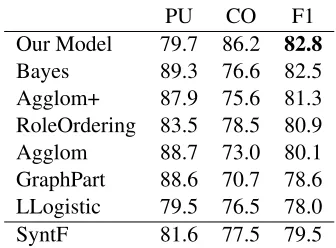
Table 1 summarizes the results of our method, as well as those of alternative approaches and base-lines.
Following (Lang and Lapata, 2010), we use a baseline (SyntF) which simply clusters predicate ar-guments according to the dependency relation to their head. A separate cluster is allocated for each of 20 most frequent relations in the dataset and an additional cluster is used for all other relations. As observed in the previous work (Lang and Lapata, 2011a), this is a hard baseline to beat.
We also compare with previous approaches: the latent logistic classification model (Lang and La-pata, 2010) (labeled LLogistic), the agglomerative clustering method (Lang and Lapata, 2011a) ( Ag-glom), the graph partitioning approach (Lang and Lapata, 2011b) (GraphPart), the global role order-ing model (Garg and Henderson, 2012) ( RoleOrder-ing). We also report results of an improved ver-sion ofAgglom, recently reported by Lang and La-pata (2014) (Agglom+). The strongest previous model isBayes: Bayes is the most accurate (‘cou-pled’) version of the Bayesian model of Titov and Klementiev (2012a), estimated from the CoNLL dataset without relying on any external data. Titov and Klementiev (2012a) also showed that using Brown clusters induced from a large external cor-pus resulted in an 0.5% improvement in F1 but that version is not entirely comparable to other systems induced solely from the CoNLL text.
Our model outperforms or performs on par with
PU CO F1 Our Model 79.7 86.2 82.8
[image:7.612.342.510.53.177.2]Bayes 89.3 76.6 82.5 Agglom+ 87.9 75.6 81.3 RoleOrdering 83.5 78.5 80.9 Agglom 88.7 73.0 80.1 GraphPart 88.6 70.7 78.6 LLogistic 79.5 76.5 78.0 SyntF 81.6 77.5 79.5
Table 1: Results on English (PropBank / CoNLL 2008).
best previous models in terms of F1. Interestingly, the purity and collocation balance is very different for our model and for the rest of the systems. In fact, our model induces at most 4-6 roles (even if |R|is much larger). On the contrary,Bayespredicts more than 30 roles for the majority of frequent pred-icates (e.g., 43 roles for the predicateincludeor 35 for say). Though this tendency reduces the purity scores for our model, this also means that our roles are more human interpretable. For example, agents and patients are clearly identifiable in the model pre-dictions. Our model has similar purity to the syntac-tic baseline but outperforms it vastly according to the collocation metric, suggesting that we go sub-stantially beyond recovering syntactic relations.
In additional experiments, we observed that our model, in some regimes, starts to induce roles spe-cific to individual verb senses or spespe-cific to groups of semantically similar predicates. This suggests that adding a latent variable capturing predicate senses and conditioning the reconstruction component on this variable may not only result in a more infor-mative semantic representation (i.e. include verb senses) but also improve the role induction perfor-mance. We leave this exploration for future work.
4.3.2 German
PU CO F1 Our Model 76.4 87.0 81.4
[image:8.612.109.265.54.123.2]Bayes (De) 86.8 75.7 80.9 Bayes (En) 80.6 76.0 78.3 SyntF 83.1 79.3 81.2
Table 2: Results on German (SALSA / CoNLL 2009).
version of theBayesmodel (denoted asBayes (En)). Recently, Lang and Lapata (2014) evaluated their
Agglom+on a version of the same German SALSA dataset. Their best result is F1 of 79.2%, however, this score and our results are not directly compara-ble. Instead of using the CoNLL dataset, they pro-cessed the corpus themselves. They also relied on syntactic features from a constituent parser whereas we used dependency representations.
The overall picture for German closely resembles the one for English. Our method achieves results comparable to the best method evaluated in this set-ting. Importantly, parameters and features of our model for German and English are identical. On the contrary, one can see that specialization of argu-ment signatures was crucial for the Bayesian model. Also, similarly to English, our method induces less fine-grain sets of semantic roles but achieves much higher collocation scores.
5 Additional Related Work
In recent years, unsupervised approaches to seman-tic role induction have attracted considerable atten-tion. However, there exist other ways to address lack of coverage provided by existing semantically-annotated resources.
One natural direction is semi-supervised role labeling, where both annotated and unannotated data is used to estimate a model. Previous semi-supervised approaches to SRL can be mostly re-garded as extensions to supervised learning by ei-ther incorporating word features induced from un-nannoted texts (Collobert and Weston, 2008; De-schacht and Moens, 2009) or creating some form of ‘surrogate’ supervision (He and Gildea, 2006; F¨urstenau and Lapata, 2009). Benefits from using unlabeled data were moderate, and more significant for the harder SRL version, frame-semantic pars-ing (Das and Smith, 2011).
Another important direction includes cross-lingual approaches (Pado and Lapata, 2009; van der Plas et al., 2011; Kozhevnikov and Titov, 2013) which leverage resources from resource-rich lan-guages, as well as parallel data, to produce anno-tation or models for resource-poor languages. How-ever, both translation shifts and noise in word align-ments harm the performance of cross-lingual meth-ods. Nevertheless, even joint unsupervised induc-tion across languages appears to be beneficial (Titov and Klementiev, 2012b).
Unsupervised learning has also been one of the central paradigms for the closely-related area of relation extraction (RE), where several techniques have been proposed to cluster semantically similar verbalizations of relations (Lin and Pantel, 2001; Banko et al., 2007; Yao et al., 2011). Similarly to SRL, unsupervised methods for RE mostly rely on generative modeling and agglomerative clustering.
From the learning perspective, methods which use the reconstruction-error objective to estimate linear models (Ammar et al., 2014; Daum´e III, 2009) are certainly related. However, they do not consider learning factorization models, and they also do not deal with semantics. Tensor factorization methods used in the context of modeling knoweldge bases (e.g., (Bordes et al., 2011)) are also close in spirit. However, they do not deal with inducing semantics but rather factorize existing relations (i.e. rely on semantics).
6 Conclusions and Discussion
This work introduces a method for inducing feature-rich semantic role labelers from unannoated text. In our approach, we view a semantic role representa-tion as an encoding of a latent relarepresenta-tion between a predicate and a tuple of its arguments. We capture this relation with a probabilistic tensor factorization model. The factorization model (relying on seman-tic roles) and a feature-rich model (predicting the roles) are jointly estimated by optimizing an objec-tive which favours accurate reconstruction of argu-ments given the latent semantic representation (and other arguments). Our estimation method yields a semantic role labeler which achieves state-of-the-art results both on English and German.
approach, virtually any computationally tractable structured model can be used as a role labeler, in-cluding almost any semantic role labeler introduced in the context of supervised SRL (see, e.g., CoNLL shared tasks (Carreras and M`arquez, 2005; Sur-deanu et al., 2008; Hajiˇc et al., 2009)). This opens interesting possibilities to extend our approach to the semi-supervised setting. Previous unsupervised SRL models make too strong assumption and use too limited features to effectively exploit labeled data. For our model, the reconstruction objective can be easily combined with the likelihood objective, yield-ing a potentially powerful semi-supervised method. We leave this direction for future work.
Acknowledgements
This work is partially supported by a Google focused award on natural language understanding. The authors thank Dipanjan Das, Ashutosh Modi, Alexis Palmer and the anonymous reviewers for their suggestions.
References
O. Abend, R. Reichart, and A. Rappoport. 2009. Unsu-pervised argument identification for semantic role la-beling. InACL-IJCNLP.
W. Ammar, C. Dyer, and N. Smith. 2014. Conditional random field autoencoders for unsupervised structured prediction. InNIPS.
Collin F. Baker, Charles J. Fillmore, and John B. Lowe. 1998. The Berkeley FrameNet project. In ACL-COLING.
M. Banko, M. J. Cafarella, S. Soderland, M. Broadhead, and O. Etzioni. 2007. Open information extraction from the web. InIJCAI.
R. Basili, D. De Cao, D. Croce, B. Coppola, and A. Mos-chitti. 2009. Cross-language frame semantics transfer in bilingual corpora. InCICLING.
A. Bordes, J. Weston, R. Collobert, and Y. Bengio. 2011. Learning structured embeddings of knowledge bases. InAAAI.
A. Burchardt, K. Erk, A. Frank, A. Kowalski, S. Pado, and M. Pinkal. 2006. The SALSA corpus: a german corpus resource for lexical semantics. InLREC. X. Carreras and L. M`arquez. 2005. Introduction to the
CoNLL-2005 Shared Task: Semantic Role Labeling. InCoNLL.
R. Collobert and J. Weston. 2008. A unified architecture for natural language processing: Deep neural networks with multitask learning. InICML.
D. Das and N. A. Smith. 2011. Semi-supervised frame-semantic parsing for unknown predicates. InACL. D. Das, N. Schneider, D. Chen, and N. A. Smith. 2010.
Probabilistic frame-semantic parsing. InNAACL. H. Daum´e III. 2009. Unsupervised search-based
struc-tured prediction. InICML.
M.-C. de Marneffe, B. MacCartney, and C.r D. Man-ning. 2006. Generating typed dependency parses from phrase structure parses. InLREC.
K. Deschacht and M.-F. Moens. 2009. Semi-supervised semantic role labeling using the latent words language model. InProceedings of EMNLP.
J. Duchi, E. Hazan, and Y. Singer. 2011. Adaptive sub-gradient methods for online learning and stochastic optimization. The Journal of Machine Learning Re-search, 12:2121–2159.
K. Erk and S. Pado. 2006. Shalmaneser–a toolchain for shallow semantic parsing. InLREC.
C. J. Fillmore. 1968. The case for case. In Bach E. and Harms R.T., editors,Universals in Linguistic Theory, pages 1–88. Holt, Rinehart, and Winston, New York. H. F¨urstenau and M. Lapata. 2009. Graph alignment for
semi-supervised semantic role labeling. InEMNLP. H. F¨urstenau and O. Rambow. 2012. Unsupervised
in-duction of a syntax-semantics lexicon using iterative refinement. InProceedings of the First Joint Confer-ence on Lexical and Computational Semantics. K. Ganchev, J. Graca, J. Gillenwater, and B. Taskar.
2010. Posterior regularization for structured latent variable models. Journal of Machine Learning Re-search (JMLR), 11:2001–2049.
Q. Gao and S. Vogel. 2011. Corpus expansion for statis-tical machine translation with semantic role label sub-stitution rules. InACL:HLT.
N. Garg and J. Henderson. 2012. Unsupervised semantic role induction with global role ordering. InACL. D. Gildea and D. Jurafsky. 2002. Automatic
la-belling of semantic roles. Computational Linguistics, 28(3):245–288.
T. Grenager and C. Manning. 2006. Unsupervised dis-covery of a statistical verb lexicon. InEMNLP. J. Hajiˇc, M. Ciaramita, R. Johansson, D. Kawahara, M.A.
Mart´ı, L. M`arquez, A. Meyers, J. Nivre, S. Pad´o, J. ˇStˇep´anek, P. Straˇn´ak, M. Surdeanu, N. Xue, and Y. Zhang. 2009. The CoNLL-2009 shared task: Syntactic and semantic dependencies in multiple lan-guages. In Proceedings of the 13th Conference on Computational Natural Language Learning (CoNLL-2009), June 4-5.
G. E. Hinton. 1989. Connectionist learning procedures.
Artificial intelligence, 40(1):185–234.
R. Johansson and P. Nugues. 2008. Dependency-based syntactic-semantic analysis with PropBank and Nom-Bank. InCoNLL.
M. Kaisser and B. Webber. 2007. Question answering based on semantic roles. In ACL Workshop on Deep Linguistic Processing.
D. Kawahara, D. Peterson, O. Popescu, and M. Palmer. 2014. Inducing example-based semantic frames from a massive amount of verb uses. InEACL.
M. Kozhevnikov and I. Titov. 2013. Crosslingual trans-fer of semantic role models. InACL.
J. Lang and M. Lapata. 2010. Unsupervised induction of semantic roles. InACL.
J. Lang and M. Lapata. 2011a. Unsupervised semantic role induction via split-merge clustering. InACL. J. Lang and M. Lapata. 2011b. Unsupervised semantic
role induction with graph partitioning. InEMNLP. J. Lang and M. Lapata. 2014. Similarity-driven semantic
role induction via graph partitioning. Computational Linguistics, 40(3):633–669.
D. Lin and P. Pantel. 2001. DIRT – discovery of infer-ence rules from text. InKDD.
D. Liu and D. Gildea. 2010. Semantic role features for machine translation. InColing.
T. Mikolov, K. Chen, G. Corrado, and J. Dean. 2013. Efficient estimation of word representations in vector space. arXiv preprint arXiv:1301.3781.
A. Modi, I. Titov, and A. Klementiev. 2012. Unsuper-vised induction of frame-semantic representations. In
NAACL Workshop on Inducing Linguistic Structure. M. Nickel, V. Tresp, and H.-P. Kriegel. 2011. A
three-way model for collective learning on multi-relational data. InICML.
J. Nivre, J. Hall, and J. Nilsson. 2004. Memory-based dependency parsing. In Proc. of the Eighth Confer-ence on Computational Natural Language Learning, pages 49–56, Boston, USA.
B. O’Connor. 2013. Learning frames from text with an unsupervised latent variable model. Technical report, CMU.
S. Pado and M. Lapata. 2009. Cross-lingual annotation projection for semantic roles. Journal of Artificial In-telligence Research, 36:307–340.
M. Palmer, D. Gildea, and P. Kingsbury. 2005. The proposition bank: An annotated corpus of semantic roles. Computational Linguistics, 31(1):71–106. J. Pennington, R. Socher, and C. D. Manning. 2014.
Glove: Global vectors for word representation. In
EMNLP.
S. Pradhan, W. Ward, and J. H. Martin. 2008. Towards robust semantic role labeling.Computational Linguis-tics, 34:289–310.
S. Riedel, L. Yao, A. McCallum, and B. M. Marlin. 2013. Relation extraction with matrix factorization and uni-versal schemas. InNAACL.
M. Sammons, V. Vydiswaran, T. Vieira, N. Johri, M. Chang, D. Goldwasser, V. Srikumar, G. Kundu, Y. Tu, K. Small, J. Rule, Q. Do, and D. Roth. 2009. Relation alignment for textual entailment recognition. InText Analysis Conference (TAC).
D. Shen and M. Lapata. 2007. Using semantic roles to improve question answering. InEMNLP.
M. Surdeanu, A. Meyers, R. Johansson, L. M`arquez, and J. Nivre. 2008. The CoNLL-2008 shared task on joint parsing of syntactic and semantic dependencies. In
CoNLL 2008: Shared Task.
R. Swier and S. Stevenson. 2004. Unsupervised seman-tic role labelling. InEMNLP.
I. Titov and A. Klementiev. 2011. A Bayesian model for unsupervised semantic parsing. InACL.
I. Titov and A. Klementiev. 2012a. A Bayesian approach to semantic role induction. InEACL.
I. Titov and A. Klementiev. 2012b. Crosslingual induc-tion of semantic roles. InACL.
L. van der Plas, J. Henderson, and P. Merlo. 2009. Do-main adaptation with artificial data for semantic pars-ing of speech. InNAACL.
L. van der Plas, P. Merlo, and J. Henderson. 2011. Scal-ing up automatic cross-lScal-ingual semantic role annota-tion. InACL.
P. Vincent, H. Larochelle, Y. Bengio, and P.-A. Man-zagol. 2008. Extracting and composing robust fea-tures with denoising autoencoders. InICML.
D. Wu and P. Fung. 2009. Semantic roles for SMT: A hybrid two-pass model. InNAACL.
D. Wu, M. Apidianaki, M. Carpuat, and L. Specia, ed-itors. 2011. Proc. of Fifth Workshop on Syntax, Se-mantics and Structure in Statistical Translation. ACL. L. Yao, A. Haghighi, S. Riedel, and A. McCallum. 2011. Structured relation discovery using generative models. InEMNLP.