Multi-word Entity Classification in a Highly Multilingual Environment
Sophie Chesney*,=, Guillaume Jacquet=, Ralf Steinberger=andJakub Piskorski=
=Text and Data Mining Unit, Joint Research Centre, European Commission, Ispra, Italy
*Cognitive Science Research Group, School of Electronic Engineering and Computer Science,
Queen Mary University of London, UK
{firstname.lastname}@jrc.ec.europa.eu
Abstract
This paper describes an approach for the classification of millions of existing multi-word entities (MWEntities), such as or-ganisation or event names, into thirteen category types, based only on the tokens they contain. In order to classify our very large in-house collection of multilingual MWEntities into an application-oriented set of entity categories, we trained and tested distantly-supervised classifiers in 43 languages based on MWEntities extracted from BabelNet. The best-performing clas-sifier was the multi-class SVM using a TF.IDF-weighted data representation. In-terestingly, one unique classifier trained on a mix of all languages consistently per-formed better than classifiers trained for individual languages, reaching an aver-aged F1-value of 88.8%. In this paper, we present the training and test data, includ-ing a human evaluation of its accuracy, de-scribe the methods used to train the classi-fiers, and discuss the results.
1 Introduction
Named Entities (NEs) such as persons, organisa-tions, locations or events are crucial bearers of in-formation as they are often the answers to major text understanding questions. Software to carry out Named Entity Recognition (NER) in free text needs to recognise the relevant strings in text and disambiguate the broad entity types (e.g. Paris Hiltonis a person rather than a location), justifying the term Named Entity Recognition and Classifi-cation (NERC). In this paper we focus on MWEn-tity classification, thereby placing NERC in the context of the study of MWExpressions.
Our work is carried out in a highly multilin-gual environment, and as a result, suitable train-ing corpora are difficult to source. Motivated by this, in addition to a method of MWEntity clas-sification, we also present a technique for auto-matically generating a silver-standard annotated resource of 3.8 million entities for use as train-ing data. This resource incorporates data from 43 different languages, covering multiple language families. MWEntities are often not translated, so it is rather common to find names from one language in amongst entities from another (e.g. French MWEntity ‘institut polytechnique des sci-ences avanc´ees’ found in the Arabic dataset).
It is important to specify that our classification work is exclusively based on internal features of the names; that is, the tokens contained within each MWEntity. No additional external features were extracted. This is due in part to the fact that the contexts of our historically accumulated MWEntities are no longer known. We therefore aim at developing a system that can be widely ap-plied to data sets that do not include, or give access to, such contextual information.
The paper begins with a section on related work (2) and is followed by a section describing the starting point and the objective of our work: the target entity hierarchy (3.1); the set of enti-ties extracted from the BabelNet resource (Nav-igli and Ponzetto, 2012) and the method used for the extraction (3.2); and an evaluation of this BabelNet silver-standard including inter-annotator agreement data (3.3). In Section 4, we present the classification methods we tested, i.e. a baseline approach and two variants of Support Vector Ma-chines. Experiments and results achieved are pre-sented in Section 5, together with a discussion of the results. We conclude with a short summary and a pointer to future work.
2 Related Work
In this task, we work exclusively on the classifi-cation of MWEntities, which are subject to their own idiosyncrasies and difficulties. Though many of the papers discussed below do not necessarily exclude multi-word units in their NERC systems, none of them explicitly focus on MWEntities. Fur-thermore, although a large body of work exists on the study of multi-word expressions more gener-ally, including idioms (Villada Moir´on and Tiede-mann, 2006; Gharbieh et al., 2016), fixed expres-sions such as ‘in short’ and compound nominals such as ‘car park’, work focusing exclusively on multi-word named entities is less prominent in the literature. Here, we are interested in this subset of MWExpressions in the task of Named Entity Clas-sification (NEC), particularly as they tend to be richer in word-internal features, upon which our systems are based.
Early NERC systems began emerging during the 1990s, favouring handcrafted rule-based ap-proaches. Due to the fact that these systems of-fer control over results and straight-forward fine-tuning, many industrial NERC systems continue to be rule-based, at least to some extent (Steinberger, 2012). In an academic context, however, ma-chine learning approaches to automatically detect-ing such rules have become more popular in recent work. The majority of recent NERC systems use supervised learning, relying on large, often manu-ally annotated corpora from which to extract and learn positive and negative features for a particu-lar class of entity. Since such corpora are costly, attention has also turned to distant-supervision, which utilises existing structured resources (e.g. WordNet (Fellbaum, 1998), DBPedia (Auer et al., 2007), Freebase (Bollacker et al., 2008), Babel-Net (Navigli and Ponzetto, 2012), among others) to automatically generate ‘silver-standard’ anno-tated corpora, without incurring the cost associ-ated with gaining access to manually annotassoci-ated corpora (e.g. Fleischman and Hovy (2002), Ling and Weld (2012), Nothman et al. (2013)). We follow this general approach with the production of a large-scale automatically-created MWEntity resource extracted from BabelNet, used to dis-tantly supervise our classifiers. Similarly, weakly-supervised systems use a bootstrapping technique to approach the same issue, starting with a few an-notated examples and automatically expanding the corpus based on these ‘seed’ terms (e.g. Pasca et
al. (2006), Ratinov and Roth (2009)).
In this work, we are interested in drawing a dis-tinction between the recognition of named entities and, most relevant to us, their classification. The task of entity classification has been approached largely through machine learning techniques, util-ising both word-internal features (Durrett and Klein, 2014) and additional contextual informa-tion, such as dictionary definitions (Gangemi et al., 2012) and ‘lexical expansions’ (e.g. synonyms and derivationally related forms) extracted from WordNet, as well as co-occurrence statistics from external corpora (Del Corro et al., 2015).
Very recent work has also moved towards multi-source learning, automatically retrieving ad-ditional semi-structured contextual information, such as webpage titles and URLs, through Web search (Vexler and Minkov, 2016).
Much of the early work in the area of NERC was monolingual, often working on English data. As approaches have advanced, multilingual named entities have received more attention, though the reliance on large corpora often limits the possible coverage. In an attempt to overcome this bottle-neck, Nothman et al. (2013) automatically clas-sify Wikipedia articles into named entity types, exploiting the links between in-text entities and their corresponding Wikipedia pages. The au-thors therefore engineer a silver-standard anno-tated corpus of named entities in nine languages (English, German, French, Polish, Italian, Span-ish, Dutch, Portuguese and Russian), for use as training data for NERC systems. In this work, we approach large-scale multi-word entity classifica-tion in 43 languages, developing a highly multilin-gual NE classification system tailored specifically for MWEntities, using distant-supervision.
3 Extraction of a Multi-Word Entity Silver-Standard Resource from BabelNet
expres-sions. Also, although many publicly available en-tity resources exist, they often are difficult to use in a specific application for a variety of reasons. For example, the provided entity types may not cor-respond to what is required for the specific appli-cation, may be too specific or too coarse-grained, or not provided at all. In these cases, there is a strong need to (re-)annotate an existing resource of MWEntities. To address this goal, we pro-pose a method of creating a silver-standard data set from BabelNet. We defined the required an-notation types for our specific application and ex-tracted the entities and their variants which have the hypernyms corresponding to these annotation types from BabelNet. We conducted a partial man-ual evaluation of the obtained resource, discussed in Section 3.3.
3.1 Named Entity Type Hierarchy
Related to Sekine’s (2002) Extended Named En-tity (ENE) Hierarchy1, our own in-house entity
hierarchy contains nine major classes (person, organisation, location, event, product, identifier, time, number and Other) with altogether almost fifty sub-classes.
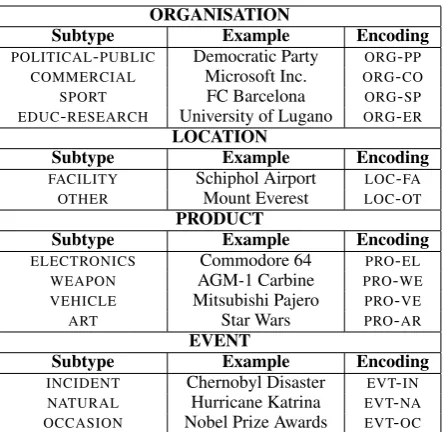
In our existing text processing system, many of these NE categories are already recognised and classified (e.g. persons, cities, email addresses, date expressions), so these are not considered here. In this paper, we focus on classifying MWEntities according to a subset of thirteen categories shown in Table 1, corresponding to the types requiring more fine-grained annotation in our system.
3.2 Automatically-Created Annotated Resource from BabelNet
For the sake of creating resources for each of the named-entity types listed in Table 1, we have ex-ploited BabelNet (Navigli and Ponzetto, 2012), a large multilingual encyclopaedic dictionary and semantic network, created by merging various publicly available linguistic resources, e.g. Word-Net and Wikipedia. BabelWord-Net contains circa 7.7 million NE-related synsets. In order to extract sought-after entities, we used the BabelNet API2.
Since the NE-related BabelNet synsets are not tagged with a specific NE tag, the NE type was inferred by using the hypernym information pro-vided in BabelNet (i.e. using WordNet hypernyms
1http://nlp.cs.nyu.edu/ene/version7_1_
0Beng.html
2http://babelnet.org/guide
ORGANISATION
Subtype Example Encoding
POLITICAL-PUBLIC Democratic Party ORG-PP
COMMERCIAL Microsoft Inc. ORG-CO
SPORT FC Barcelona ORG-SP
EDUC-RESEARCH University of Lugano ORG-ER
LOCATION
Subtype Example Encoding
FACILITY Schiphol Airport LOC-FA
OTHER Mount Everest LOC-OT
PRODUCT
Subtype Example Encoding
ELECTRONICS Commodore 64 PRO-EL
WEAPON AGM-1 Carbine PRO-WE
VEHICLE Mitsubishi Pajero PRO-VE
ART Star Wars PRO-AR
EVENT
Subtype Example Encoding
[image:3.595.308.530.61.277.2]INCIDENT Chernobyl Disaster EVT-IN NATURAL Hurricane Katrina EVT-NA OCCASION Nobel Prize Awards EVT-OC
Table 1: Types used for NE-classification task.
and Wikipedia categories). To be more precise, based on hypernym frequency information for the entire set of named entities contained in BabelNet, for each NE type a list ofpositiveandnegative hy-pernyms was manually created. These lists were subsequently used to extract entities of each par-ticular type. A given NE-related synset was ex-tracted if: (a) there was at least one hypernym for the main sense of the synset in the list of posi-tive hypernyms, and (b) no hypernym for the main sense of the synset was on the list of negative hy-pernyms. For instance, the full list of positive and negative hypernyms for extracting commercial or-ganisation names (ORG-CO) is given in Table 2.
positive hypernyms negative hypernyms
company, periodical, magazine, record company, publisher, air-line, enterprise, corporation, bank, brewery, automobile manufacturer, film production company, lim-ited company, joint-stock company, holding company telephone company, drug company, investment company, shipping company, oil company, elec-tric company, train operating company, telecommunication company, bank holding company, consult-ing company, movconsult-ing company, trans-port company, consultancy, factory, private bank
city, City, settlement, town, metropo-lis, municipality, village, commune, park, capital, earthquake, tsunami, fire, avalanche, hurricane, flood, port, moun-tain, person
Table 2: The list of positive and negative hyper-nyms for the extraction of commercial organisa-tion names (ORG-CO).
[image:3.595.308.526.529.647.2]loca-tion. The list of positive/negative hypernyms for each of the 13 categories varied. However, no list contained more than 100 items.
In total, we obtained circa 3.8 million named entities from BabelNet after expanding each ex-tracted NE-related synset. The left-hand columns in Table 3 provide a breakdown of the number of extracted entities per type.
Entity #Extracted #Filtered Type Entities Entities ORG-PP 214 056 100 373 ORG-CO 440 522 158 502 ORG-SP 285 312 139 578 ORG-ER 271 486 144 137 LOC-FA 1 182 857 469 633 LOC-OT 782 578 207 053
PRO-EL 33 053 8 817
PRO-WE 29 044 10 238
PRO-VE 55 494 17 617
PRO-AR 363 356 141 541
EVT-IN 68 647 38 139
EVT-NA 14 292 7 920
EVT-OC 94 908 54 256
[image:4.595.306.533.63.370.2]TOTAL 3 835 605 1 497 804
Table 3: Number of entities extracted from Babel-Net before and after filtering (see Section 5.2).
3.3 Manual Evaluation of the
Automatically-Created Resource from BabelNet
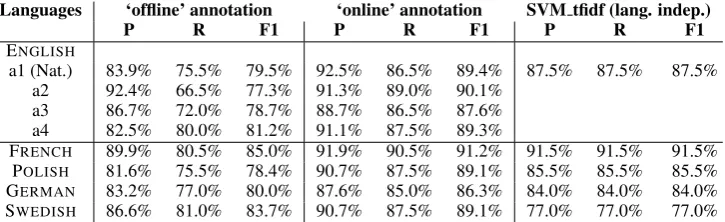
A crucial element of our work consisted of eval-uating the quality of the automatically generated annotated resource from BabelNet. To justify its use as a gold (or ‘silver’) standard resource for this supervised classification task, we conducted a small manual evaluation, shown in Table 5, with native speakers of five different languages (Ger-man, French, Polish, English and Swedish), evalu-ating both the quality of the automatic annotations as well as inter-annotator agreement for English across four annotators (one of whom is a native English speaker).
Each annotator was trained on a trial set of 100 randomly extracted English MWEntities, then tested on a further 200 randomly extracted multi-word entities for their own native language, and an additional 200 for English. The annotators were asked to provide two separate sets of annotations: first, the annotators provided ‘offline’ annotations for each of the entities, selecting from a set of 13 possible entity types (corresponding to the types described in Table 1). The no-guess tag (‘NG’)
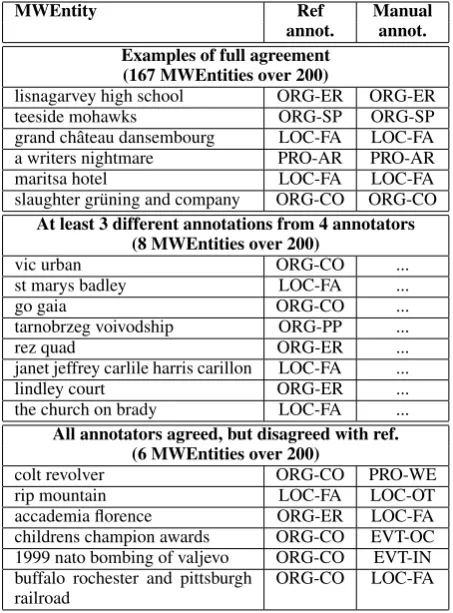
MWEntity Ref Manual
annot. annot. Examples of full agreement
(167 MWEntities over 200)
lisnagarvey high school ORG-ER ORG-ER
teeside mohawks ORG-SP ORG-SP
grand chˆateau dansembourg LOC-FA LOC-FA a writers nightmare PRO-AR PRO-AR
maritsa hotel LOC-FA LOC-FA
slaughter gr¨uning and company ORG-CO ORG-CO At least 3 different annotations from 4 annotators
(8 MWEntities over 200)
vic urban ORG-CO ...
st marys badley LOC-FA ...
go gaia ORG-CO ...
tarnobrzeg voivodship ORG-PP ...
rez quad ORG-ER ...
janet jeffrey carlile harris carillon LOC-FA ...
lindley court ORG-ER ...
the church on brady LOC-FA ... All annotators agreed, but disagreed with ref.
(6 MWEntities over 200)
colt revolver ORG-CO PRO-WE
rip mountain LOC-FA LOC-OT
accademia florence ORG-ER LOC-FA childrens champion awards ORG-CO EVT-OC 1999 nato bombing of valjevo ORG-CO EVT-IN buffalo rochester and pittsburgh
[image:4.595.106.256.184.356.2]railroad ORG-CO LOC-FA
Table 4: Some example of MWEntities to be an-notated.
was used when an annotation decision could not be made with certainty, or when an entity appeared to belong in a category not included in the possi-ble list of tags. Secondly, the annotators were per-mitted to research their secondary guess ‘online’. For consistency, the BabelNet labels were hidden throughout.
Languages ‘offline’ annotation ‘online’ annotation SVM tfidf (lang. indep.)
P R F1 P R F1 P R F1
ENGLISH
a1 (Nat.) 83.9% 75.5% 79.5% 92.5% 86.5% 89.4% 87.5% 87.5% 87.5% a2 92.4% 66.5% 77.3% 91.3% 89.0% 90.1%
a3 86.7% 72.0% 78.7% 88.7% 86.5% 87.6% a4 82.5% 80.0% 81.2% 91.1% 87.5% 89.3%
FRENCH 89.9% 80.5% 85.0% 91.9% 90.5% 91.2% 91.5% 91.5% 91.5%
POLISH 81.6% 75.5% 78.4% 90.7% 87.5% 89.1% 85.5% 85.5% 85.5%
GERMAN 83.2% 77.0% 80.0% 87.6% 85.0% 86.3% 84.0% 84.0% 84.0%
[image:5.595.118.481.62.173.2]SWEDISH 86.6% 81.0% 83.7% 90.7% 87.5% 89.1% 77.0% 77.0% 77.0%
Table 5: Manual annotations on 200 MWEntities randomly extracted for 5 languages from the created resource, compared with the best-performing system (right-most column).
highlight the difficulty of the task: some MWEn-tities are ambiguous, and could easily be anno-tated with different types. For example, ‘buffalo rochester and pittsburgh railroad’could be anno-tated both as a company or a facility. This man-ual evaluation aims to show that, although the re-source we extracted from BabelNet is not perfect, it is consistent enough across annotators and lan-guages to consider it a silver-standard in our ex-periments.
4 MWEntity Classification Approaches
We present two main approaches to the multi-class MWEntity multi-classification problem described above: a baseline using cosine similarity, and two variations of (distantly) supervised Support Vector Machines. We use Scikit-learn (Pedregosa et al., 2011), the machine learning library for Python, for implementing the different approaches.
4.1 Baseline Approach: COSSIM
The baseline approach adopted in this classifica-tion task, hereafter referred to as the COSSIM sys-tem, is modelled on a simple search engine, where query word vectors are compared with document vectors through cosine similarity. In our case, a query word vector is analogous to the expression to be classified, while the document vectors are analogous to vectors representing each category in the training set. The type associated with the cat-egory vector most similar to the query vector is selected as the classification for the query expres-sion. For each category, using a TF.IDF vectori-sation process, we generate a ranking in the im-portance of terms that can be considered a type of ‘topic signature’ (Fleischman and Hovy, 2002) for this category, since words more strongly as-sociated with a particular category receive higher TF.IDF scores. When no token in the
to-be-classified multi-word entity occurs in the training data for a given category, this expression will re-ceive a cosine similarity score of 0 with this cate-gory. If this is the case for all categories, COSSIM is unable to classify the expression and instead outputs a no-guess label (‘NG’). Both the training and test expressions are vectorised with a TF.IDF vectoriser (Pedregosa et al., 2011), with standard L2 normalisation (to normalise for variation in the number of expressions found in each category) and sublinear TF calculations (which log-scales the TF counts).
4.2 SVM Approaches: SVM TFIDF&
SVM COUNTS
4.3 Confidence Thresholds
We were interested in whether we could utilise the scores of the COSSIM, SVM TFIDF, and SVM COUNTS as parameters for maximising for precision or recall in the classification task, as this is particularly relevant in the context of our spe-cific application. We therefore define 5 threshold levels corresponding to the lower percentiles of the scores at 5% intervals (0, 5, 10, 15 and 20%) in order to evaluate whether this method has the de-sired effect, and calculate the exact score thresh-olds usingnumpy.percentile()3. For each
classification with a confidence or similarity score below the threshold, the expression in question is re-classified with the no-guess tag (‘NG’).
Both SVM systems always attempt to classify an expression, so at the 0% threshold there will be no ‘NG’ classifications; however, as detailed in Section 4.1, COSSIMdoes not classify an expres-sion if it has a similarity score of 0 with all possi-ble categories, instead classifying with ‘NG’ also at the 0% threshold.
5 Evaluations
This section provides a brief discussion of the method of cross-validation used in this work and an overview of the preprocessing carried out on the resource automatically generated from Babel-Net, before turning to the experimental method and results of the experiments.
5.1 Cross-Validation
The automatically annotated resource from Ba-belNet is separated into 43 languages, varying in coverage. We use 10-fold shuffle-split cross-validation, split 75% training and 25% testing for all experiments detailed below. The general ap-proach was as follows (any discrepancies from this will be explicitly detailed later where necessary): the data for each language is randomly shuffled (with a constant random state initialisation value for reproducibility) 10 times, and each shuffled version is then separated for training and testing. With this method, it is not guaranteed that each fold will be different, but it is likely with size-able data sets; nonetheless, we favour this tech-nique over k-fold cross-validation as it maximises the training data available, even for the smallest languages in the resource.
3http://www.numpy.org/
5.2 Preprocessing
When preparing the automatically generated re-source from BabelNet for use in the MWEntity classification task, we considered only those en-tities that consist of at least two tokens, and ad-ditionally removed some potentially problematic entries (i.e. entities containing only two tokens in-cluding one with a single character).
In addition, we excluded non-alphanumerical strings and removed all duplicates within each en-tity category. We did not exclude entities which occurred in more than one category, as we argue that removing such cases would lead to a bias in the results.
Following this method of filtering, approxi-mately 1.5 million entries were retained for the experiments. Table 3 provides a breakdown of the initial number of extracted entities per type and the final number of entities that were used for the pur-pose of carrying out the MWEntity classification experiments.
We also experimented with replacing all numer-ical characters with the same token (‘0’), after observing that certain classes contain many simi-larly formatted numerical tokens, such as dates. In these tests, we chose to replace each number char-acter individually, in order to retain some distinc-tions between classes: for example, taken from the Swedish data set, ‘EVT-NA’ contains a large num-ber of dates (‘2004 asiatiske tsunami’ → ‘0000 asiatiske tsunami’), while ‘PRO-WE’ contains mixed alphanumerical strings (‘mp40 schmeisser’ → ‘mp00 schmeisser’). Despite the intuition that replacing numerical characters in this way would create more generalised features for the classes in question, this in fact had little or no positive effect in the classification task using the SVM TFIDF method, and a significantly negative effect with the COSSIM method. Consequently, it was not adopted in the full-scale experiments described below.
5.3 Experiments
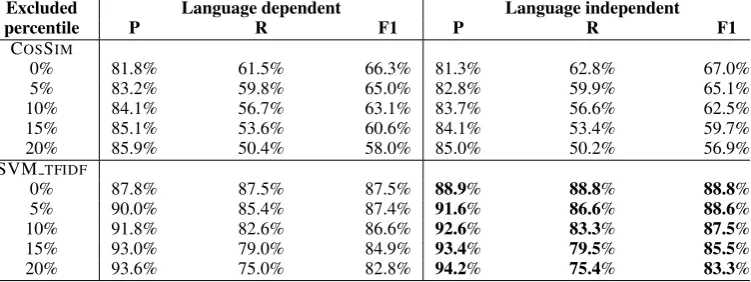
dis-Excluded Language dependent Language independent
percentile P R F1 P R F1
COSSIM
0% 81.8% 61.5% 66.3% 81.3% 62.8% 67.0%
5% 83.2% 59.8% 65.0% 82.8% 59.9% 65.1%
10% 84.1% 56.7% 63.1% 83.7% 56.6% 62.5%
15% 85.1% 53.6% 60.6% 84.1% 53.4% 59.7%
20% 85.9% 50.4% 58.0% 85.0% 50.2% 56.9%
SVM TFIDF
0% 87.8% 87.5% 87.5% 88.9% 88.8% 88.8%
5% 90.0% 85.4% 87.4% 91.6% 86.6% 88.6%
10% 91.8% 82.6% 86.6% 92.6% 83.3% 87.5%
15% 93.0% 79.0% 84.9% 93.4% 79.5% 85.5%
[image:7.595.112.488.63.204.2]20% 93.6% 75.0% 82.8% 94.2% 75.4% 83.3%
Table 6: Average results across the 43 tested languages, with language-dependent or independent ap-proaches, for the 5 tested percentile thresholds.
cuss the comparison between SVM TFIDFand the baseline approach, COSSIM.
The main task compared the performance of language-dependent and language-independent training for the two classification methods, when applied across 43 languages at 5 different thresh-old levels (see Section 4.3 for threshthresh-old defini-tions). The 43 languages correspond mostly to Eu-ropean languages including Russian, plus Arabic.
5.3.1 Language-Dependent Training
For each of the classification methods, SVM TFIDF and COSSIM, a language-specific classifier is built for each of the 43 languages in the resource. Using the method of 10-fold cross-validation described in Section 5.1, the data for each language is separated for training and testing, to allow for a language-by-language comparison on the performance of each classifi-cation method. We compare the performance of SVM TFIDF with the baseline COSSIM across each of the 5 threshold levels for all 43 languages.
5.3.2 Language-Independent Training
In order to fairly compare the performance of a language-independent classifier with those with language-dependent training, testing is still carried out language-dependently (we use the same test sets in both experiments). We create a language-independent training corpus by concatenating each of the language-specific training sets from the pre-vious experiment, and importantly, excluding any duplicate MWEntities, so as to remove any over-lap between training and testing data. Once again, we compare the performance of SVM TFIDFwith the baseline COSSIMacross each of the 5 thresh-old levels for all 43 languages.
5.4 Results
As Table 6 shows, in both experiments, SVM TFIDF is the best-performing classifi-cation method in precision, recall and F1, across all percentile thresholds. The baseline, COSSIM, performs marginally worse in terms of precision, but significantly worse in terms of recall (across all thresholds and both training methods). We exclude a higher percentage of low-scoring classifications in the threshold experiments, leading to a distinct improvement in precision, in the best case increasing by over 5.7% in SVM TFIDF. This supports the intuition that the scores assigned by both the SVM systems and the COSSIM system correlate to the accuracy of the chosen label. This can therefore be viewed as a means of tweaking or prioritising precision over recall or vice versa. Maximising precision with the 20% threshold, when averaged across all languages, we achieve precision of over 94% with the language-independent SVM TFIDF classifier. More specifically, we see precision of over 95% in 16 of the 43 languages tested.
The best system overall is the language-independent SVM TFIDF classifier, significantly outperforming the COSSIM system when trained on both language-dependent and independent data, especially in terms of recall and F1. At its peak, we see a marked difference of over 26% between the two systems in terms of recall, both trained on language-independent data. We also see consistent improvements in precision, re-call and F1 across all percentile thresholds from SVM TFIDFtrained on language-dependent to in-dependent data.
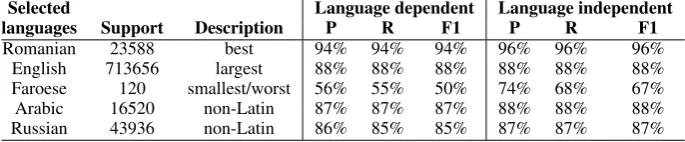
Selected Language dependent Language independent languages Support Description P R F1 P R F1
Romanian 23588 best 94% 94% 94% 96% 96% 96%
English 713656 largest 88% 88% 88% 88% 88% 88%
Faroese 120 smallest/worst 56% 55% 50% 74% 68% 67%
Arabic 16520 non-Latin 87% 87% 87% 88% 88% 88%
[image:8.595.127.470.63.134.2]Russian 43936 non-Latin 86% 85% 85% 87% 87% 87%
Table 7: Results for some specific languages of the 43 tested, with language-dependent or independent approaches, with SVM TFIDFmethod at the 0% percentile threshold.
Selected Language dependent Language independent classes Support Description P R F1 P R F1 EVT-NA 7920 best 96.4% 91.4% 93.6% 96.8% 94.4% 95.6% LOC-FA 469633 largest 89.9% 93.4% 91.7% 90.6% 94.4% 92.1% ORG-CO 158502 worst prec. 76.9% 80.6% 78.5% 81.3% 81.4% 81.4% PRO-EL 8817 worst recall 83.5% 58.6% 67.8% 82.8% 65.3% 72.8%
Table 8: Results for some specific type classes, with language-dependent or independent approaches, with SVM TFIDFmethod at the 0% percentile threshold.
in performance in Faroese, the smallest language in the data set (from an F1 of 50% to 67%), with little or no impact on English, the largest portion of the resource. Similar improvements are seen in the other under-represented languages in the re-source: Ladino (F1 67% to 88%), Luxembour-gish (F1 77% to 88%) and, to a lesser extent, Ro-mansh (F1 81% to 82%). This suggests that utilis-ing cross-lutilis-inguistic data to supplement the trainutilis-ing data for the smaller languages is beneficial.
At the 0% percentile threshold, the language achieving the best results is Romanian, with pre-cision, recall and F1 well above the 88% aver-age for this system, at 96%. Furthermore, we also see minor improvements on languages not us-ing the Latin alphabet, such as Arabic and Rus-sian, suggesting that language-independent train-ing can even improve performance in cases where we would expect that language-specific features would be most useful. This is likely due to the fact that a single-language corpus often contains some portion of international terms.
Table 8 shows that language-independent train-ing also causes a small boost in performance across individual class types. In particular, a marked improvement is made in the ‘PRO-EL’ class, which achieves the worst recall value with language-dependent training, improving by 6.7%. In general, Table 8 demonstrates that performance varies across classes, with a particularly striking difference in recall between the best-performing class (‘EVT-NA’) and the worst (‘PRO-EL’). Given that these two classes are relatively close in size, this suggests class size is not the unique
driv-ing factor in performance and that different NE categories are linguistically diverse.
6 Conclusion and Future Work
We presented an approach to automatically clas-sify MWEntities based only on their internal fea-tures. We described how to construct a silver-standard resource of MWEntities from BabelNet adapted to an application-driven type hierarchy. The classifiers were applied in a highly multilin-gual environment, 43 languages, and we showed how they perform better when trained on all lan-guages combined, with a language-independent training set. With the SVM TFIDF approach, us-ing 10-fold shuffle-split cross-validation on a 1.5 million MWEntity data set, we obtained a preci-sion/recall of 88.9%/88.8% when all expressions are classified, and 94.2%/75.4% when we filter the 20% least confident classifications. We also showed that these results are reasonably stable across languages, being more sensitive to the num-ber of expressions available to train this language than to its scripting. In addition, we demonstrated that, despite the fuzzy delimitation between entity types, for instance between facilities and organi-sations, the classifiers perform reasonably well for all entity types.
identical (e.g.national / nazionale / nacional / na-tionaal).
We will then apply the best-performing classi-fier to our vast and equally highly multilingual in-house collections of MWEntities. As our in-in-house collections also contain MWExpressions that are not entities (e.g. Chief Executive Officer, kilome-tres per hour), we will have to face the challenge of having to identify the expressions that are not covered by the classes we have trained. We hope that the thresholds to exclude the least confident classifications will be efficient at that task.
7 Acknowledgement
This work was carried out while the first author was a member of the Text and Data Mining Unit of the Joint Research Centre, European Commis-sion. The author is now based in the Cognitive Science Research Group at Queen Mary Univer-sity of London.
References
S¨oren Auer, Christian Bizer, Georgi Kobilarov, Jens Lehmann, Richard Cyganiak, and Zachary Ives. 2007. Dbpedia: A nucleus for a web of open data. InProceedings of the 6th International The tic Web and 2Nd Asian Conference on Asian Seman-tic Web Conference, ISWC’07/ASWC’07, pages 722–735, Berlin, Heidelberg. Springer-Verlag. Kurt Bollacker, Colin Evans, Praveen Paritosh, Tim
Sturge, and Jamie Taylor. 2008. Freebase: A collaboratively created graph database for structur-ing human knowledge. InProceedings of the 2008 ACM SIGMOD International Conference on Man-agement of Data, SIGMOD ’08, pages 1247–1250, New York, NY, USA. ACM.
Luciano Del Corro, Abdalghani Abujabal, Rainer Gemulla, and Gerhard Weikum. 2015. Finet: Context-aware fine-grained named entity typing. In
Proceedings of the 2015 Conference on Empirical Methods in Natural Language Processing, pages 868–878. Association for Computational Linguis-tics.
Greg Durrett and Dan Klein. 2014. A joint model for entity analysis: Coreference, typing, and link-ing. Transactions of the Association of Computa-tional Linguistics, 2:477–490.
Asif Ekbal and Sriparna Saha. 2013. Stacked ensem-ble coupled with feature selection for biomedical en-tity extraction. Knowledge-Based Systems, 46:22– 32.
Christiane Fellbaum. 1998. WordNet: An Electronic Lexical Database. Bradford Books.
Michael Fleischman and Eduard Hovy. 2002. Fine grained classification of named entities. InCOLING 2002: The 19th International Conference on Com-putational Linguistics.
Aldo Gangemi, Andrea Giovanni Nuzzolese, Valentina Presutti, Francesco Draicchio, Alberto Musetti, and Paolo Ciancarini. 2012. Automatic typing of dbpe-dia entities. InInternational Semantic Web Confer-ence, pages 65–81. Springer.
Waseem Gharbieh, Virendra Bhavsar, and Paul Cook, 2016. Proceedings of the 12th Workshop on Multi-word Expressions, chapter A Word Embedding Ap-proach to Identifying Verb-Noun Idiomatic Combi-nations, pages 112–118. Association for Computa-tional Linguistics.
Chih-Wei Hsu and Chih-Jen Lin. 2002. A comparison of methods for multiclass support vector machines.
IEEE transactions on Neural Networks, 13(2):415– 425.
Guillaume Jacquet, Maud Ehrmann, Ralf Steinberger, and Jaakko V¨ayrynen. 2016. Cross-lingual link-ing of multi-word entities and their correspond-ing acronyms. In Proceedings of the 10th Lan-guage Resources and Evaluation Conference, Por-toroˇz, Slovenia.
Thorsten Joachims. 1998. Text categorization with support vector machines: Learning with many rel-evant features. InEuropean conference on machine learning, pages 137–142. Springer.
Xiao Ling and Daniel S Weld. 2012. Fine-grained en-tity recognition. InAAAI.
Roberto Navigli and Simone Paolo Ponzetto. 2012. BabelNet: The automatic construction, evaluation and application of a wide-coverage multilingual se-mantic network. Artificial Intelligence, 193:217– 250.
Joel Nothman, Nicky Ringland, Will Radford, Tara Murphy, and James R Curran. 2013. Learning mul-tilingual named entity recognition from wikipedia.
Artificial Intelligence, 194:151–175.
Marius Pasca, Dekang Lin, Jeffrey Bigham, Andrei Lifchits, and Alpa Jain. 2006. Organizing and searching the world wide web of facts-step one: the one-million fact extraction challenge. InAAAI, vol-ume 6, pages 1400–1405.
Yu-ping Qin and Xiu-kun Wang. 2009. Study on multi-label text classification based on svm. In
Fuzzy Systems and Knowledge Discovery, 2009. FSKD’09. Sixth International Conference on, vol-ume 1, pages 300–304. IEEE.
Lev Ratinov and Dan Roth, 2009. Proceedings of the Thirteenth Conference on Computational Natu-ral Language Learning (CoNLL-2009), chapter De-sign Challenges and Misconceptions in Named En-tity Recognition, pages 147–155. Association for Computational Linguistics.
Satoshi Sekine, Kiyoshi Sudo, and Chikashi Nobata. 2002. Extended named entity hierarchy. InLREC. Ralf Steinberger. 2012. A survey of methods to ease
the development of highly multilingual text mining applications. Language Resources and Evaluation, 46(2):155–176.
Reuth Vexler and Einat Minkov, 2016. Proceedings of the Sixth Named Entity Workshop, chapter Multi-source named entity typing for social media, pages 11–20. Association for Computational Linguistics. Bego˜na Villada Moir´on and J¨org Tiedemann, 2006.
Proceedings of the Workshop on Multi-word-expressions in a multilingual context, chapter Iden-tifying idiomatic expressions using automatic word-alignment.
Yiming Yang and Xin Liu. 1999. A re-examination of text categorization methods. In Proceedings of the 22nd annual international ACM SIGIR confer-ence on Research and development in information retrieval, pages 42–49. ACM.
Qiang Ye, Ziqiong Zhang, and Rob Law. 2009. Senti-ment classification of online reviews to travel desti-nations by supervised machine learning approaches.