Proceedings of the 7th Joint Conference on Lexical and Computational Semantics (*SEM), pages 203–213
Term Definitions Help Hypernymy Detection
Wenpeng YinandDan Roth University of Pennsylvania
{wenpeng,danroth}@seas.upenn.edu
Abstract
Existing methods of hypernymy detection mainly rely on statistics over a big corpus, ei-ther mining some co-occurring patterns like “animals such as cats” or embedding words of interest into context-aware vectors. These approaches are therefore limited by the avail-ability of a large enough corpus that can cover all terms of interest and provide suffi-cient contextual information to represent their meaning. In this work, we propose a new paradigm, HYPERDEF, for hypernymy de-tection – expressing word meaning by en-coding word definitions, along with context driven representation. This has two main benefits: (i) Definitional sentences express (sense-specific) corpus-independent meanings of words, hence definition-driven approaches enable strong generalization – once trained, the model is expected to work well in open-domain testbeds; (ii) Global context from a large corpus and definitions provide comple-mentary information for words. Consequently, our model, HYPERDEF, once trained on
task-agnostic data, gets state-of-the-art results in multiple benchmarks1.
1 Introduction
Language understanding applications like textual entailment (Dagan et al.,2013), question answer-ing (Saxena et al., 2007) and relation extraction (Mintz et al.,2009), benefit from the identification of lexical entailment relations. Lexical inference encompasses several semantic relations, with hy-pernymy being one of the prevalent (Roller et al.,
2014;Shwartz et al.,2016), ani.e., “Is-A” relation that holds for a pair of terms2 (x, y) for specific
terms’ senses.
Two families of approaches have been studied for identifying term hypernymy. (i)Pattern
match-1cogcomp.org/page/publication_view/836 2This paper uses “term” to refer to any words or phrases.
ingexploits patterns such as “animals such as cats” to indicate a hypernymy relation from “cat” to “an-imal” (Hearst, 1992; Snow et al., 2004). How-ever, it requires the co-occurrence of the two terms in the same sentence, which limits the recall of this method; (ii)Term representation learning de-pends on a vector embedding of each term, where each entry in the vector expresses an explicit con-text feature (Baroni et al.,2012a;Roller and Erk,
2016; Shwartz et al., 2017) or a latent semantic (Fu et al., 2014;Vulic and Mrksic, 2017;Glavas and Ponzetto,2017).
Both approaches hinge on acquiring context-aware term meaning in a large corpus. The gen-eralization of these corpus-based representation learning paradigms, however, is limited due to the domain specificity of the training data. For ex-ample, an IT corpus hardly mentions “apple” as a fruit. Furthermore, the surrounding context of a term may not convey subtle differences in term meaning – “he” and “she” have highly similar con-text that may not reveal the important difference between them. Moreover, rare words are poorly expressed by their sparse global context and, more generally, these methods would not generalize to the low resource language setting.
Humans can easily determine the hypernymy relation between terms even for words they have not been exposed to a lot, given a definition of it in terms of other words. For example, one can imag-ine a “teaching” scenario that consists ofdefining a term, potentially followed by a few examples of the term usage in text.
Motivated by these considerations and the goal of eventually develop an approach that could gen-eralize to unseen words and even to the low re-source languages scenario, we introduce the fol-lowing hypernymy detection paradigm, HYPER -DEF, where we augment distributional contextual models with that of learning terms representations
from their definitions. This paradigm has an im-portant advantage in its powerful generalization, as definitions are agnostic to specific domains and benchmarks, and are equally available for words regardless of their frequency in a given data set. Consequently, the task of identifying the relation between two terms is enhanced by the knowl-edge of the terms’ definitions. Our model can be applied to any new terms in any domain, given some context of the term usage and their domain-agnostic definitions. Moreover, given our learning approach – we learn also the notion oflexical en-tailmentbetween terms – we can generalize to any lexical relation between terms.
Technically, we implement HYPERDEF by modifying the AttentiveConvNet (Yin and Sch¨utze, 2017), a top-performing system on a textual entailment benchmark (Bowman et al.,
2015), to model the input (x,dx;y,dy), wheredi
(i = x, y) is the definition of termi. In contrast
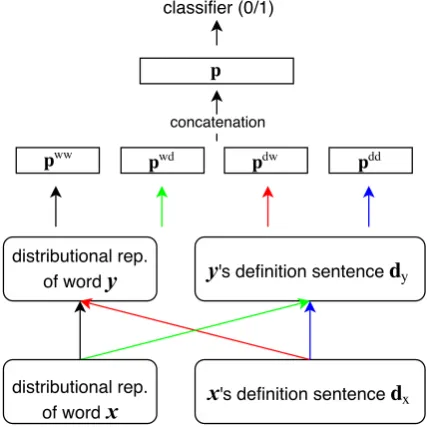
to earlier work which mostly built separate repre-sentations for termsxandy, HYPERDEF instead directly models the representation for each pair in {(x, y), (x, dy), (dx, y), (dx, dy)}, and then
accumulates the four-way representations to form an overall representation for the input.
In our experiments, we train HYPERDEF on a task-agnostic annotated dataset, Wordnet, and test it on a broad array of open-domain hypernymy de-tection datasets. The results show the outstanding performance and strong generalization of the HY -PERDEF model.
Overall, our contributions are as follows:
• To our knowledge, this is the first work in hy-pernymy detection that makes use of term def-initions. Definitions provide complementary knowledge to distributional context, so that our model better tolerates unseen words, rare words and words with biased sense distribution. • HYPERDEF accounts for word sense when
in-ferring the hypernymy relation. This differs from much of the literature, which usually de-rives sense-unaware representative vectors for terms – earlier approaches would say ‘yes’ if the relation holds for some combination of the terms’ senses.
• HYPERDEF has strong generalization capabil-ity – once trained on a task-agnostic definition dataset, it can be used in different testbeds, and shows state-of-the-art results.
2 Related Work
The main novelty of our HYPERDEF lies in the information resourcethat is employed to represent the terms. Prior work in exploring information resources can be put into two categories: under-standing terms by the co-occurring context in raw text, or grounding the terms in open-domain ob-jects.
2.1 Mining Distributional Context from Text Window-based Context Baroni et al. (2012b) build distributional semantic vectors for terms from a concatenation of three corpora: the British National Corpus, WackyPedia and ukWac. Each entry in the vector is the PMI-formulated score from co-occurrence counts. Dimension reduction is conducted by Singular Value Decomposition (SVD) before feeding representation vectors to a classifier.
Dependency-based Context Roller and Erk
(2016) compute a syntactic distributional space for terms by counting theirdependency neighbors across the corpus.
Shwartz et al. (2017) further compare (i) con-texts being parent and daughter nodes in the de-pendency tree, and (ii) contexts being the parent-sister pairs in the dependency tree.
Term Embeddings Unspecialized term embed-dings are not informative signals for detecting specific lexico-semantic relations. Hence, com-munity often explicitly build transformation func-tions from unspecialized embeddings to relation-specialized embeddings. Fu et al. (2014) first use the skip-gram model (Mikolov et al., 2013) to learn generic term embeddings from a large Chinese encyclopedia corpus, then learn a projec-tion funcprojec-tion from the generic space to hypernymy space by annotated hypernymy pairs. Other work trying to specify the generic word embeddings to hypernymy detection task include (Vulic and Mrk-sic,2017;Glavas and Ponzetto,2017).
Other advanced types of term embeddings spe-cific to the hypernymy detection problem in-clude Gaussian distributed embeddings (Vilnis and McCallum, 2015), non-negative embeddings (Chang et al.,2017), magnitude-oriented embed-dings (Nguyen et al.,2017), and so on.
pretrained word embeddings as initial word repre-sentations and specialize them in training. In con-trast, distributional context only acts as one side of information resource to express words, we fo-cus on making use of a second side of information from word definitions to build a more robust sys-tem.
2.2 Grounding Terms to Open-domain Objects
Do and Roth (2012) build Wikipedia representa-tions for input terms – representing the input terms by a set of relevant Wikipedia pages.
Shwartz et al. (2015) represent each term pair as a set of paths which are extracted from different large-scale knowledge resources (DBPedia, Wiki-data, Yago and WordNet), then train a classifier to determine whether the two terms satisfy a relation of interest given those path connections.
Young et al. (2014) map terms to a set of im-ages, then determine the directional inference by conditional probability over statistic of image in-tersection.
Compared with mining of distributional context from text, these works switch the context from words to Wikipedia pages, KB paths or images. So, they share a similar mechanism while differing in the categories of entries in distributional vec-tors.
Our paradigm HYPERDEF shares the same in-spiration with above distributional models. More importantly, It goes beyond the frame of distribu-tional models by exploring a novel information re-source – definitions – to derive the word seman-tics.
3 HYPERDEF Model
In this section, we first give a brief review of a top-performing neural network for textual en-tailment – AttentiveConvNet (Yin and Sch¨utze,
2017), which acts as a base model to encode a pair of texts. Then, we elaborate on the adaptation we make towards AttentiveConvNet so that the result-ing system can better serve the hypernymy detec-tion problem.
3.1 AttentiveConvNet
AttentiveConvNet3(Yin and Sch¨utze,2017) is
es-sentially a Siamese convolutional neural network
3https://github.com/yinwenpeng/Attentive Convolution
(CNN) (LeCun et al.,1998) equipped with an at-tention mechanism. It predicts the relationship of two sentences by accumulating the dominant fea-tures of fine-grained alignments across sentences. The reason we base our system on this model is two-fold: (i) AttentiveConvNet is one of the top-performing systems of modeling sentence pairs in textual entailment, and (ii) AttentiveConvNet implements the fine-grained cross-sentence align-ments in the granularity of local windows; this makes it appropriate to reason between a defini-tional sentence and a term.
We use bold uppercase, e.g., H, for matrices;
bold lowercase, e.g., h, for vectors; bold
lower-case with index, e.g., hi, for columns of H;
for-math[i] to denote the ith entry of vectorh; and
non-bold lowercase for scalars.
AttentiveConvNet, shown in Figure 1, repre-sents a sentence S (S ∈ {S1, S2}) of n words
as a sequence of hidden states hi ∈ Rd (i =
1,2, . . . , n), forming a feature map H ∈ Rd×n,
where d is the dimensionality of hidden states. Each hi has a left context hi−1 and a right
con-texthi+1. Given feature mapsH1andH2for
sen-tencesS1 andS2 respectively, AttentiveConvNet
derives a representation for the pair (S1,S2).
Un-like conventional CNNs over single sentences, At-tentiveConvNet develops an attention mechanism to achieve fine-grained alignments automatically, then puts convolution filters over aligned hidden states together with their context.
Overall, AttentiveConvNet derives the pair rep-resentation in three steps. (i) A matching function determines how relevant each hidden state in sen-tenceS2 is to the current hidden state hi in
sen-tenceS1. All hidden states in S2 are then
accu-mulated by weighted average to form analigned hidden state h˜i. (ii) Convolution for position i inS1 integrates the two aligned hidden states (hi,
˜
hi) with contexthi−1andhi+1. (iii) Max-pooling
over the generated group of hidden states in step (ii) yields a representation for the pair (S1, S2).
Next, we describe these processes in detail.
Generation of Aligned Hidden States. First, a matching functionfe(hi,hSj2)generates a score ei,jto evaluate how relevant the two hidden states hi,hSj2 are.
hi mi
S1 S2
aligned hidden state attentive
convolution
p
row-wise max-pooling
Representation for pair ( , )S1 S2
[image:4.595.310.524.66.280.2]h˜i hi−1 hi+1
Figure 1:AttentiveConvNet models a sent. pair (S1,S2). In our work,Si (i=1,2) can be the definition sentence or
the term itself (we treat a term as a short sentence.)
weighted average of all hidden states inS2:
˜
hi =
X
j
softmax(ei)[j]·hS2
j (1)
Attentive Convolution. A positioniinS1 has
hidden state hi, left context hi−1, right context hi+1 and aligned hidden state h˜i from S2.
At-tentive convolution then generates the higher-level representation for this combination:
mi = tanh(W·[hi−1,hi,hi+1,h˜i] +b) (2)
where parametersW∈Rd×4d,b∈Rd.
Pair Representation Generation.As Equation
2 shows, each mi denotes the inference features
betweenhiand its alignmenth˜iin context.
Atten-tiveConvNet uses max-pooling over {mi} to get the overall representationpfor the pair:
p[i] = max(m1[i],m2[i],· · · ,mn[i]) (3) Finally, the representationpis used in
classifi-cation. The whole model is learned in an end-to-end training4.
3.2 Four-way AttentiveConvNet
AttentiveConvNet originally works on sentence pairs. We formulate the hypernymy detection
4For more details, please refer to (Yin and Sch¨utze,2017).
Figure 2: HYPERDEF – combining distributional
model with definition encoding
problem as {(x, dx;y, dy; 1/0)}. Just as in
(Shwartz et al.,2016) which directly concatenates the term path representation vector with term em-bedding vectors as the classifier input, a simple combination of distributional models and defini-tion encoding for us could be: separately learn-ing the distributional model over term embeddlearn-ing pairs and an AttentiveConvNet model over def-inition pairs, then concatenate their output rep-resentations. However, the analysis over dataset {(x, dx;y, dy; 1/0)} hints that HYPERDEF can
obtain more indicative features by modeling (term, definition), which crosses the distributional mod-els and definition encoding. For example, the def-inition of term “cat” in WordNet is: feline mam-mal usually having thick soft fur and no ability to roar: domestic cats; wildcats. Intuitively, when the system meets the pair (cat, mammal), it should be trivial to get the “hypernymy” decision since “mammal” appears in the definition sentence.
Inspired by this observation, we implement the HYPERDEF paradigm as four-way AttentiveCon-vNets, as Figure 2 shows, i.e., treating the two terms as word sequences as well, then do Atten-tiveConvNet over all four combinations: (x, y),
(x,dy), (dx,y) and (dx,dy).
Assume we get four separate representations:
pww from (x, y), pwd from (x, dy), pdw from
(dx,y) andpdd from (dx, dy), as Section3.1
[image:4.595.85.277.67.315.2]random split lexical split
all –pww –pwd –pdw –pdd all –pww –pwd –pdw –pdd
HYPERDEF(F1) .905 .874 .896 .876 .881 .887 .875 .870 .849 .862
HYPERDEF(AP) .933 .902 .921 .905 .909 .900 .890 .883 .880 .877
w/o attention (F1) .825 .743
w/o definition (F1) .734 .619
[image:5.595.79.524.62.158.2]LSTM+atten. (F1) .757 .685
Table 1: Tune HyperDef onwn dev
(x, dx;y, dy)via concatenation:
p= [pww,pwd,pdw,pdd] (4)
thenpis fed to the final classifier.
AttentiveConvNet over (x, y) resembles the
conventional hypernymy classifiers which take two representation vectors (one for x, the other
for y) as input and output the label. Note that
AttentiveConvNet puts filter weights over (x, y)
to learn more abstract representations; this actu-ally is in common with some literature such as (Fu et al., 2014;Vulic and Mrksic, 2017;Glavas and Ponzetto, 2017), which utilize weights to project generic word representations into specified repre-sentations towards hypernymy annotations.
AttentiveConvNet over (x,dy) and (dx,y)
com-pares a term with the descriptive sentence of the other term; this might provide direct clues, as we discussed in the beginning of this subsection.
AttentiveConvNet over (dx, dy) resembles
lit-erature (Do and Roth, 2012;Young et al.,2014). HYPERDEF provides an alternative resource for interpreting terms, resorting to definitional expres-sions instead of Wikipedia pages or images.
Overall, our HYPERDEF combines strengths of (i) conventional supervised classifiers over context distributions, and (ii) rich interpretation of terms in broader knowledge bases.
3.3 Analysis of HYPERDEF
Our HYPERDEF has the following properties:
• HYPERDEF combines distributional models with definition encoding, but it is not simply a concatenation of two independent subsys-tems. HYPERDEF enables modeling across (distributional context, definition). This is expected to generate more indicative fea-tures than a similar work (Shwartz et al.,
2016), which simply concatenated distribu-tional models with path-based models;
• HYPERDEF employs definitions to provide richer information for the terms. But it does not generate an auxiliary term representation vector from the definitive sentence as the lit-erature (Hill et al., 2016) did. Instead, HY -PERDEF formulates a pair of input elements – each can be a distributional vector or a def-inition representation – into a cross-sentence attention mechanism, which directly yields a compact representation to the pair rather than two separate vectors for the two input ele-ments. This is shown more effective to model the relationship of two pieces of text (Yin and Sch¨utze,2017);
• Distributional models and definitive sen-tences in HYPERDEF provide complemen-tary knowledge. For terms which can not re-trieve a definition, HYPERDEF still works – just turning into a basic distributional model. This work uses WordNet and Wikipedia as example resources for the definition retrieval, more splendid resources will be developed gradually in released HYPERDEF models. We will also provide users the option to type into their definitions;
• WordNet provides term definitions in the sense level, so theHYPERDEF model is es-sentially trained in the sense level. For poly-semy cases in testing, HYPERDEF can sim-ply test on all combinations of definitions, then pick the pair with the highest probabil-ity;
4 Experiments
4.1 Pre-training of HYPERDEF
Dataset Preparation. As we aim to build a strongly generalizing hypernymy detector, the training data we collect here is expected to be task-agnostic. Hence, extracting from structured knowledge resources, such as WordNet ( Fell-baum, 1998), Wikidata (Vrandecic, 2012), DB-Pedia (Auer et al., 2007), and Yago (Suchanek et al., 2007), is preferred. Some literature, e.g., (Shwartz et al., 2015), claim that there is limited coverage for almost all knowledge resources. For example, WordNet does not cover many proper-names (Donald Trump → president) or recent terminology (AlphaGo → computer program). Our data tends to alleviate this challenge, since in testing, descriptive sentences in the HYPER -DEF paradigm can provide the precise and dis-tinct features for terms even if these terms are OOV and in new types.
In this work, we pick one of those knowl-edge resources – WordNet – to collect training data. Specifically, our positive instances consist of (i) all direct hypernymy pairs, and (ii) switched terms from the original hyponymy pairs. Neg-ative instances include (i) pairs with other rela-tions such as antonym, synonym, and (ii) pairs of positive instances after exchanging the two terms. Note that each term is accompanied by its defini-tion in sense level. So we get instances in form (x, dx;y, dy; 1/0), where the binary value “1/0”
indicates whetheryisx’s hypernymy or not.
Al-together, we collect about 900K instances with roughly a 8:1 ratio between negative and positive instances.
In testing, we implement HYPERDEF to re-trieve definitions and distributional context for terms automatically5.
Random and Lexical Dataset Splits. In our pri-mary dataset, we perform a random split, with 80% train, 10% dev, and 10% test.
As pointed out by Levy et al. (2015), super-vised distributional lexical inference methods tend to perform “lexical memorization”, i.e., instead of learning a relation between the two terms, they mostly learn an independent property of termyin
the pair: whethery is a “prototypical hypernym”
or not. Levy et al.(2015) suggest to splitting the
5In the released HYPERDEF model, we will provide an
option for users to input definitions.
train and test sets such that each will contain a dis-tinct vocabulary (“lexical split”), in order to pre-vent the model from overfitting by lexical memo-rization.
In the current phase, we use notationswn train, wn dev, and wn test to refer to the three parts. Note thatwn trainandwn devwill be used to train and tune the HYPERDEF model, whilewn testis set to show how well the model performs in Word-Net domain – it is not expected to act as a testbed in real benchmarks. In experiments, we will com-pare our model inrandomandlexicalsplits.
Training Setup. Given wn train in form {(x, dx;y,dy; 1/0)}, a binary classifier via logistic
re-gression is trained over the pair representation p
obtained from Equation4, predicting1or0for the hypernymy relation. The objective function is im-plemented through negative log-likelihood. Terms and words in definitions are initialized by 300d Word2Vec embeddings (Mikolov et al.,2013) and kept unchanged in training. This benefits the gen-eralization as it ensures that the words in train-ing and the new words in test data lie in the same space. All hidden sizes are 300 as well. The whole system is trained by AdaGrad (Duchi et al.,2011) with initial learning rate 0.02.
We first run the HYPERDEF inwn testto check if it is effective in the WordNet domain. Then we test it in some open-domain benchmarks. Note that all experiments use the HYPERDEF models pretrained overwn train.
4.2 Performance within WordNet
As mentioned in Section 4.1, wn train, wn dev and wn test have two distinct setups: “random split” and “lexical split”, inspired by the “lexical memorization” observation (Levy et al.,2015).
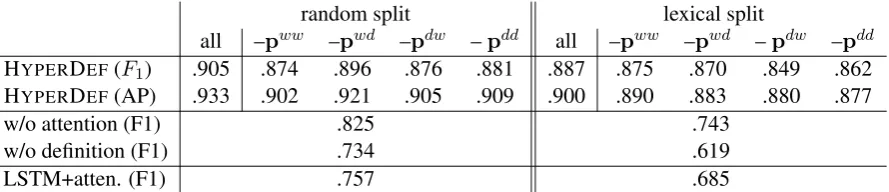
We first tune the parameters in wn train and search the best system layout based on wn dev. F1 and average precision (AP) are reported.
Ta-ble1 lists the performance records, with the first block for “random split” and the second block for “lexical split”.
We first discuss three baselines: (i) “w/o defi-nition”: We discard definitions and only use dis-tributional model, i.e., a logistic regression clas-sifier (LR) over the concatenated (x, y)
learning genuine term relations; (ii) “w/o atten-tion”: We discard the attention mechanism in AttentiveConvNet, resulting in a bi-CNN struc-ture. It works on instances{(x, dx;y,dy; 1/0)},
a vanilla CNN is used to encode the definition sentence into a dense representation vector. So, each term in (x, y) will get two separate
rep-resentation vectors (one is from Word2Vec, the other from the definition); finally totally four rep-resentation vectors are concatenated and fed to the LR. This baseline works much better than “w/o definition” (improvements of 9% ∼ 11%). Their comparison shows that incorporating term definitions in reasoning process is promising; (iii) “LSTM+attention” (Rockt¨aschel et al.,2016). A representative attention mechanism in LSTM (Hochreiter and Schmidhuber, 1997) for textual entailment. We apply it in the same way as our four-way AttentiveConvNet, however, found it performs poorly. We suspect that this is due to two reasons: i) Though there is entailment or hy-pernymy relation between a term pair, e.g., (“cat”, “animal”), unfortunately there is no clear clue of that relation between their definition pairif consid-ering all the information contained in the defini-tions. For example, “cat” – “a small domesticated carnivorous mammal with soft fur, a short snout, and retractile claws. It is widely kept as a pet or for catching mice, and many breeds have been de-veloped”, and “animal” – “a living organism that feeds on organic matter, typically having special-ized sense organs and nervous system and able to respond rapidly to stimuli”. Apparently, we can not infer the whole definition of “animal” by cat’s definition. Instead, their help mainly comes from some key-phrases, such as “domesticated carnivorous mammal”, “living organism” and so on. LSTM, encoding the whole word sequences in attention, potentially would be misled. Our approach relies on convolution filters and max-pooling, excelling in modeling keywords-driving features (Yin et al.,2017). This baseline indicates the overall strength of our system comes from the definition incorporation as well as an appropriate encoder.
Considering the whole table, we observe that: (i) HYPERDEF models have pretty close perfor-mances in “random split” and “lexical split” – mostly within 2∼3%. This strongly indicates that HYPERDEF is less influenced by the “lexical memorization” problem. Our systems, equipped
random lexical
F1 .902 .881
[image:7.595.361.467.63.102.2]AP .915 .891
Table 2: Pretrained HyperDef onwn test
with definition encoding, show promising general-ization (at least in WordNet domain); (ii) Though HYPERDEF models in “all” setup behave simi-larly in random split and lexical split, the detailed contributions ofpww,pwd,pdwandpdddiffer in
the two settings. To be specific, in “wn dev
(ran-dom split)”, there is no clear winner among{pww, pdw,pdd},pwd contributes consistently less than
the other three. In “wn dev (lexical split)”,
in-stead,pwd, pdw andpdd perform similarly while pww performs worst. This indicates that when
dealing with unseen terms, definition-based com-ponents in HYPERDEF play a dominant role.
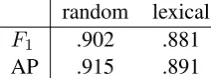
Experiments onwn devenable to store the best
HYPERDEF models – concatenation over the four representations: pww,pwd,pdwandpdd. Then
we reload the pretrained models and report their performance on wn test, as shown in Table 2.
From Table1to Table2, we observe pretty small drop in performance – mostly∼1% . This prelim-inarily demonstrates the strong generalization.
Next, we test the best HYPERDEF models pre-trained on “wn train(lexical split)” in open
do-main benchmarks.
4.3 Performance in Open-domain Datasets
First, we use four widely-explored datasets:
BLESS (Baroni and Lenci, 2011), EVALution
(Santus et al., 2015), Lenci/Benotto (Benotto,
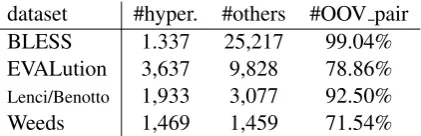
2015), andWeeds(Weeds et al.,2014). They were constructed either using knowledge resources (e.g. WordNet, Wikipedia), crowd-sourcing or both. The instance sizes of hypernymy and “other” re-lation types are detailed in Table 3. We also re-port “#OOV pair”, the prore-portions of unseen term pairs in above four datasets regarding the train-ing set of HYPERDEF, i.e., wn train in Section 4.1. We notice that most term pairs in BLESS and Lenci/Benotto datasets are unseen in wn train.
dataset #hyper. #others #OOV pair BLESS 1.337 25,217 99.04% EVALution 3,637 9,828 78.86% Lenci/Benotto 1,933 3,077 92.50% Weeds 1,469 1,459 71.54%
Table 3: Statistics of four benchmarks. “#OOV pair”: the proportions of unseen term pairs regarding the training set (i.e.,wn trainin Section4.1) of HYPER
-DEF.
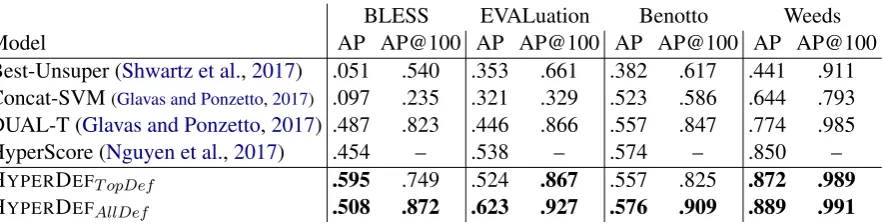
Then, we apply the pre-trained HYPERDEFmodel on the test sets of the four benchmarks, discrim-inating hypernymy from “other” relations. AP and AP@100 are reported. As WordNet sorts sense definitions by sense frequency (Fellbaum,
1998), we test the term pairs in two ways: (i) Only choose the top-1 sense definition to de-note a term, reported as “HYPERDEFT opDef”; (ii)
Keep all sense definitions for those terms, then test on all sense combinations and pick the high-est probability as the term pair score, reported as“HYPERDEFAllDef”.
We compare HYPERDEF with baselines: (i) Best-Unsuper. The best unsupervised method in (Shwartz et al., 2017), implemented by sim-ilarity measurement over weighted dependency-based context vectors; (ii) Concat-SVM(Glavas and Ponzetto,2017). An SVM model with RBF kernel is trained on concatenation of unspecial-ized concept embeddings (Baroni et al., 2012a); (iii)DUAL-T(Glavas and Ponzetto,2017). Using dual tensors, DUAL-T transforms unspecialized embeddings into asymmetrically specialized rep-resentations – sets of specialized vectors – which are next used to predict whether the asymmetric relation holds between the concepts; (iv) Hyper-Score(Nguyen et al., 2017). The state-of-the-art system. It uses a large-scale hypernymy pair set to guide the learning of hierarchical word embed-dings in hypernymy-structured space.
Table 4clearly demonstrates the superiority of our HYPERDEFmodels over other systems. The three baselines Concat-SVM, DUAL-T and Hy-perScore are more in line with HYPERDEF since they did supervised learning over large numbers of annotated pairs. HYPERDEF integrates term defi-nitions, which is shown effective in improving the performance across different testbeds.
In addition, HYPERDEFAllDefconsistently
out-performs HYPERDEFT opDef. This makes sense
as HYPERDEFT opDef may be misled by incorrect
definitions. In addition, the superiority of HY -PERDEFAllDef clearly supports the effectiveness
of HYPERDEF in dealing with polysemy cases. Above four benchmarks are relatively small and contain common words mostly. In real-world ap-plications, there is a need to figure out the hyper-nymy relation between common nouns and proper nouns (Do and Roth, 2012). Taking “(Cham-plin, city)” for example, “Champlin” is not cov-ered by WordNet vocabulary, thus uncovcov-ered by
wn train – the training data of our HYPERDEF model. Motivated, we further test HYPERDEFon the following dataset.
HypeNet Dataset. Shwartz et al.(2016) con-struct this dataset by extracting hypernymy rela-tions from several resources: WordNet, DBPedia, Wikidata and Yago. Like our collected data, term pairs in other relations are considered as negative instances. It maintains a ratio of 1:4 positive to negative pairs.
Similarly, HypeNet dataset has “random split” and “lexical split” as well; their sizes are list in Table5. HypeNet contains lots of locations, e.g., (Champlin, city), and organizations, e.g., (Tele-gram, company) and (Sheetz, company). We first try to extract definitions for those terms from WordNet, if fail, then we extract from Wikipedia pages, treating the first sentence as a definition.
We play HYPERDEF in two different ways, one testing its “pre-trained” model on HypeNet’s test data, the other – “specialized” – training HYPER -DEF on HypeNet’s training data then test on Hy-peNet’s test data like other baselines did.
Table 6 shows: (i) If trained on the specific training data of HypeNet, our system HYPER -DEF can get state of the art performance. This indicates the superiority of our model over base-line systems.
(i) Our pretrained HYPERDEFmodel performs less satisfactorily. Only the result on “Lex. split” is relatively close to the outstanding baselines. This makes sense as baseline systems are specified by the HypeNet training set while our pretrained model comes from a different domain. We studied the dataset and found following problems.
an-BLESS EVALuation Benotto Weeds Model AP AP@100 AP AP@100 AP AP@100 AP AP@100 Best-Unsuper (Shwartz et al.,2017) .051 .540 .353 .661 .382 .617 .441 .911 Concat-SVM(Glavas and Ponzetto,2017) .097 .235 .321 .329 .523 .586 .644 .793 DUAL-T (Glavas and Ponzetto,2017) .487 .823 .446 .866 .557 .847 .774 .985 HyperScore (Nguyen et al.,2017) .454 – .538 – .574 – .850 – HYPERDEFT opDef .595 .749 .524 .867 .557 .825 .872 .989
HYPERDEFAllDef .508 .872 .623 .927 .576 .909 .889 .991 Table 4: System comparison on BLESS, EVALution, Benotto and Weeds datasets
Dataset train dev test #OOV pair HypeNet (rnd) 49.5K 3.5K 17.7K 95.56% HypeNet (lex) 20.3K 1.4K 6.6K 95.33%
Table 5: Statistics of HypeNet dataset. “#OOV pair” is for “test” regarding the “wn train” of HYPERDEF.
Lex. split Rand. split Model P R F1 P R F1
[image:9.595.82.524.61.173.2]HypeNet .809 .617 .700 .913 .890 .901 DUAL-T .705 .785 .743 .933 .826 .876 pre-trained .572 .717 .637 .474 .601 .530 specialized .670 .914 .773 .892 .935 .913
Table 6: System comparison on HypeNet test
other definition – “are an alternative rock band, formed in London, England in 1994 by singer-guitarist Brian Molko and singer-guitarist-bassist Stefan Olsdal” which depicts the article title “Placebo (band)”. This is a common problem due to the am-biguity of entity mentions. To relieve this, we plan to refine the definition retrieval by more advanced entity linking techniques, or retrieve all highly re-lated definitions and test as in polysemy cases (re-call that in Table 4 we showed HYPERDEF has more robust performance while addressing poly-semy terms); (ii) Misleading information in defi-nitions. Our system predicts “1” for the pair (Au-rangabad, India); we analyze the definition of “Au-rangabad”: is a city in the Aurangabad district of Maharashtra state in India. We intentionally re-moved the phrase “in India”, and then the system predicts “0”. This demonstrates that definitions in-deed provide informative knowledge about terms, but a system must be intelligent to avoid being misled; (iii) We miss a common embedding space to initialize single words and (multi-word) entities. To generalize well to new entities, the model has to presume the new entities and the known terms lie in the same representation space. However, most
pretrained embedding sets cover pretty limited en-tities. To learn uniformed word and entity embed-dings, we may need to combine unstructured text corpus, semi-structured data (e.g., Wikipedia) and structured knowledge bases together. We will ad-vance this data preprocessing component – the ac-cess of term definitions and term representations – in our released system.
5 Conclusion
In this work, we introduced a novel approach to detecting hypernymy relations by incorporating term definitions. We extracted a task-agnostic an-notated data from WordNet, then trained a neu-ral network to generate a universal hypernymy de-tector, HYPERDEF. HYPERDEF, once trained, performs competitively in diverse open-domain benchmarks, even though it was not fine-tuned on those benchmark-specific training sets. This val-idates the powerful generalization of our model HYPERDEF. Our hope, and one of the key future directions following this work is to generalize this approach to the low-resource language setting.
Acknowledgments
We thank all the reviewers for providing insight-ful comments and critiques. This research is sup-ported in part by DARPA under agreement number FA8750-13-2-0008, and by a gift from Google.
References
S¨oren Auer, Christian Bizer, Georgi Kobilarov, Jens Lehmann, Richard Cyganiak, and Zachary G. Ives. 2007. Dbpedia: A nucleus for a web of open data. InProceedings of ISWC/ASWC. pages 722–735.
Marco Baroni, Raffaella Bernardi, Ngoc-Quynh Do, and Chung-chieh Shan. 2012b. Entailment above the word level in distributional semantics. In Pro-ceedings of EACL. pages 23–32.
Marco Baroni and Alessandro Lenci. 2011. How we BLESSed distributional semantic evaluation. In Proceedings of the GEMS 2011 Workshop on GE-ometrical Models of Natural Language Semantics. pages 1–10.
Giulia Benotto. 2015. Distributional models for semantic relations: A study on hyponymy and antonymy. PhD Thesis, University of Pisa.
Samuel R. Bowman, Gabor Angeli, Christopher Potts, and Christopher D. Manning. 2015. A large anno-tated corpus for learning natural language inference. InProceedings of EMNLP. pages 632–642.
Haw-Shiuan Chang, ZiYun Wang, Luke Vilnis, and Andrew McCallum. 2017. Unsupervised hypernym detection by distributional inclusion vector embed-ding. CoRRabs/1710.00880.
Ido Dagan, Dan Roth, Mark Sammons, and Fabio Mas-simo Zanzoto. 2013. Recognizing textual entail-ment: Models and applications.
Quang Xuan Do and Dan Roth. 2012. Exploiting the wikipedia structure in local and global classification of taxonomic relations. Natural Language Engi-neering18(2):235–262.
John Duchi, Elad Hazan, and Yoram Singer. 2011. Adaptive subgradient methods for online learning and stochastic optimization. JMLR12:2121–2159. Christiane Fellbaum. 1998. WordNet: An Electronic
Lexical Database. MIT Press.
Ruiji Fu, Jiang Guo, Bing Qin, Wanxiang Che, Haifeng Wang, and Ting Liu. 2014. Learning semantic hi-erarchies via word embeddings. In Proceedings of ACL. pages 1199–1209.
Goran Glavas and Simone Paolo Ponzetto. 2017. Dual tensor model for detecting asymmetric lexico-semantic relations. In Proceedings of EMNLP. pages 1757–1767.
Marti A. Hearst. 1992. Automatic acquisition of hy-ponyms from large text corpora. InProceedings of COLING. pages 539–545.
Felix Hill, KyungHyun Cho, Anna Korhonen, and Yoshua Bengio. 2016. Learning to understand phrases by embedding the dictionary. TACL4:17– 30.
Sepp Hochreiter and J¨urgen Schmidhuber. 1997. Long short-term memory. Neural computation 9(8):1735–1780.
Yann LeCun, L´eon Bottou, Yoshua Bengio, and Patrick Haffner. 1998. Gradient-based learning applied to document recognition. InProceedings of the IEEE. pages 2278–2324.
Omer Levy, Steffen Remus, Chris Biemann, and Ido Dagan. 2015. Do supervised distributional methods really learn lexical inference relations? In Proceed-ings of NAACL. pages 970–976.
Tomas Mikolov, Ilya Sutskever, Kai Chen, Greg S Cor-rado, and Jeff Dean. 2013. Distributed representa-tions of words and phrases and their compositional-ity. InProceedings of NIPS. pages 3111–3119. Mike Mintz, Steven Bills, Rion Snow, and Daniel
Ju-rafsky. 2009. Distant supervision for relation extrac-tion without labeled data. InProceedings of ACL. pages 1003–1011.
Kim Anh Nguyen, Maximilian K¨oper, Sabine Schulte im Walde, and Ngoc Thang Vu. 2017. Hierarchical embeddings for hypernymy detection and direction-ality. InProceedings of EMNLP. pages 233–243. Tim Rockt¨aschel, Edward Grefenstette, Karl Moritz
Hermann, Tom´aˇs Koˇcisk`y, and Phil Blunsom. 2016. Reasoning about entailment with neural attention. InProceedings of ICLR.
Stephen Roller and Katrin Erk. 2016. Relations such as hypernymy: Identifying and exploiting hearst pat-terns in distributional vectors for lexical entailment. InProceedings of EMNLP. pages 2163–2172. Stephen Roller, Katrin Erk, and Gemma Boleda. 2014.
Inclusive yet selective: Supervised distributional hy-pernymy detection. In Proceedings of COLING. pages 1025–1036.
Enrico Santus, Frances Yung, Alessandro Lenci, and Chu-Ren Huang. 2015. EVALution 1.0: An evolv-ing semantic dataset for trainevolv-ing and evaluation of distributional semantic models. In Proceedings of the 4th Workshop on Linked Data in Linguistics. pages 64–69.
Ashish Kumar Saxena, Ganesh Viswanath Sambhu, Saroj Kaushik, and L. Venkata Subramaniam. 2007. IITD-IBMIRL system for question answering using pattern matching, semantic type and semantic cate-gory recognition. InProceedings of TREC.
Vered Shwartz, Yoav Goldberg, and Ido Dagan. 2016. Improving hypernymy detection with an integrated path-based and distributional method. In Proceed-ings of ACL.
Vered Shwartz, Omer Levy, Ido Dagan, and Jacob Goldberger. 2015. Learning to exploit structured resources for lexical inference. In Proceedings of CoNLL. pages 175–184.
Vered Shwartz, Enrico Santus, and Dominik Schlechtweg. 2017. Hypernyms under siege: Linguistically-motivated artillery for hypernymy detection. InProceedings of EACL. pages 65–75. Rion Snow, Daniel Jurafsky, and Andrew Y. Ng. 2004.
Fabian M. Suchanek, Gjergji Kasneci, and Gerhard Weikum. 2007. Yago: A core of semantic knowl-edge. InProceedings of WWW. pages 697–706.
Luke Vilnis and Andrew McCallum. 2015. Word rep-resentations via gaussian embedding. In Proceed-ings of ICLR.
Denny Vrandecic. 2012. Wikidata: A new platform for collaborative data collection. InProceedings of WWW. pages 1063–1064.
Ivan Vulic and Nikola Mrksic. 2017. Specialis-ing word vectors for lexical entailment. CoRR abs/1710.06371.
Julie Weeds, Daoud Clarke, Jeremy Reffin, David J. Weir, and Bill Keller. 2014. Learning to distinguish hypernyms and co-hyponyms. In Proceedings of COLING. pages 2249–2259.
Wenpeng Yin, Katharina Kann, Mo Yu, and Hin-rich Sch¨utze. 2017. Comparative study of CNN and RNN for natural language processing. CoRR abs/1702.01923.
Wenpeng Yin and Hinrich Sch¨utze. 2017. Attentive convolution. CoRRabs/1710.00519.