Sensible at SemEval-2016 Task 11:
Neural Nonsense Mangled in Ensemble Mess
Nat Gillin
Gillin Inc.
36 Natchez Street, Seahaven, USA [email protected]
Abstract
This paper describes our submission to the Complex Word Identification (CWI) task in SemEval-2016. We test an experimental ap-proach to blindly use neural nets to solve the CWI task that we know little/nothing about. By structuring the input as a series of se-quences and the output as a binary that indi-cates 1 to denote complex words and 0 other-wise, we introduce a novel approach to com-plex word identification using Recurrent Neu-ral Nets (RNN). We also show that it is pos-sible to simply ensemble several RNN clas-sifiers when we are unsure of the optimal hyper-parameters or the best performing mod-els using eXtreme gradient boosted trees clas-sifiers. Our systems submitted to the CWI task achieved the highest accuracy and F-score among the systems that uses neural networks.
1 Introduction
The Deep Learning Tsunami has hit the Natu-ral Language Processing (NLP) and Computational Linguistics field (Manning, 2016). Deep neural nets has shown to be the ultimate hammer in various NLP shared tasks, systems trained on neural nets often emerge as the top systems and/or beat state-of-the-art performance (Collobert et al., 2011; Mikolov et al., 2013; Pennington et al., 2014; Levy et al., 2014; Shazeer et al., 2016; Gupta et al., 2015; Jean et al., 2015; Kreutzer et al., 2015; Sultan et al., 2014; Sul-tan et al., 2015)
In the concluding remarks of the Google’s Deep Learning course on Udacity1, Vincent Vanhoucke
1https://www.udacity.com/course/deep-learning–ud730
said,“What’s really cool about those [neural net ap-plication] examples is that you don’t have to know much about the problem you’re trying to solve”. Armed with basic knowledge of deep learning and neural nets and almost zero familiarity of the prob-lem, we attempt to treat the Complex Word Iden-tification (CWI) task as a binary classification task using Long Short-Term Memory (LSTM) Recur-rent Neural Nets (RNN) with Gated RecurRecur-rent Units (GRU).
2 Neural Network and Deep Learning
Neural Networks are powerful at modelling various modalities, e.g. signals, text, images, videos. As the name suggests, neural network is inspired by the brain’s synaptic transmission mechanism that trans-mits signalling molecules (aka neurotransmitters) to different signal receptors (aka neurons) throughout our body. Metaphorically, we can emulate a neu-ron as a computational unit and consider the neuro-transmitters as real number inputs and outputs that pass from a neuron to another. Each input to a neu-ron comes with a associated weight and the neuneu-ron will process the different inputs (often by summing them) and passing it to a non-linear function which will provide an output value.
For instance, we can think of a neuron as a typi-calAND/ORlogic gate. Given two binary inputsx1
andx2 and abias unit with input 1 and a varying
weights, we pass it to a neuron that sums the prod-uct of the weights and input and passes the sum to a non-linear function that outputs a booleanyvalue of 0 if the sum is below 0 and 1 if the sum is above 0.
From the left graph and table in Figure 1, we see
Figure 1: Single Neuron to Emulate anORGate (left) andANDGate (right)
[image:2.612.117.502.359.689.2]that the neuron emulates anORlogic gate where it outputs 1 when either of the input is a positive input and outputs 0 when both inputs are 0s. Similarly, right graph and table in Figure 1 presents a neural depiction of aANDlogic gate.
If we consider the 2nd row in the left table of Fig-ure 1, thebiaswith the value of1and inputsx1= 0
andx1 = 1 are fed into neuro to produce they
out-put. Within the neuron, it first sums the inputs and the associated weights up (i.e. w0 *bias+w1 *x1
+ w1 * x1). Then using a non-linear thresholding
function, the neuron outputsy = 1since the sum is
larger than 0. Thus the neuron fulfils the function of an ORthat accepts a 1 and 0 input bit to produce a positive bit.
The problem gets more complicated when we want to use neurons to emulate an exclusive ORXOR
logic gate, to get a positive binary output, only one of the inputs can be positive andXORreturns a nega-tive output when there are more than one or less than one positive input(s).
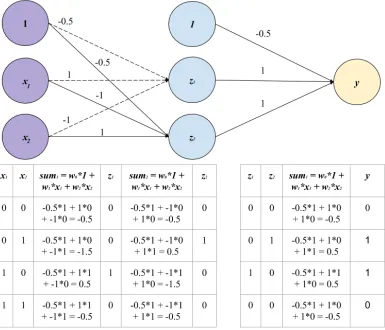
We can split the XORproblem into small logical expressions:
XOR= [x1AND NOTx2] OR [NOTx1ANDx2]
As shown in Figure 2, we can emulate an XOR
gate by stacking two layers of neurons. On the first layer, we solve for
(i) z1to represent [x1AND NOTx2] with weights
-0.5, 1 and -1 attached to thebias,x1andx2
(ii) z2 to represent [NOTx1 ANDx2] with weights
-0.5, -1 and 1 attached to thebias,x1andx2.
At the second layer, we apply the same weights we use for the ORgates and feed z1 andz2 as the
input to produce the XOR outputs. Interestingly, if we look at the first layer, we notice that thez1andz2
will never both be 1s. Often the network architecture we use to solve theXORexample is referred to as a
feed-forward multi-layered network.
The logic gates examples motivate the simple use of single neurons and the effect of stacking layers of neurons to produce the desired outcome2. Hence the
notion, “Deep Learning”.
2The logic gates examples are taken from Emily Fox
and Carlos Guestrin machine learning course on Coursera, https://www.coursera.org/learn/ml-foundations
In all the logic gate examples we have manually assigned the weights that are associated with the neurons and it perfectly predicts the desired XOR
outputs. In practice, these weights has to be trained using pairs of input bits and their respective outputs. The rest of the paper will not go through the neu-ral network architecture used in our submission in the same level of detail as this section. Goldberg (2015) and Cho (2015) provides a great read on us-ing deep learnus-ing and neural networks for NLP tasks and the formal mathematical descriptions of how to train the networks.
3 Recurrent Neural Net
A Recurrent Neural Net (RNN) is an architecture of deep neural network that chains up neurons in a se-quential manner. The Elman Network is the simplest formulation of RNN; it allow arbitrarily sized struc-tured inputs to be represented by a fixed-size vector observing the structured properties of the input (El-man, 1990).
Figure 3: Emulate an XOR Gate with RNN
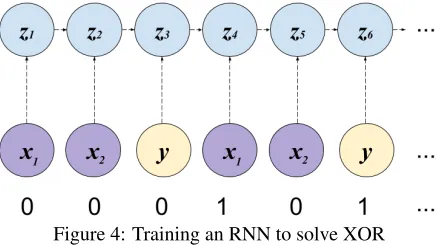
[image:3.612.317.536.530.653.2]Returning to theXORproblem, instead of using a feed-forward multi-layered network, we can change the problem into a sequential one. Figure 3 shows how the inputs can be chained in a sequential man-ner in candence,x1,x1,y,x1,x1,y, ... (input input output, input input output, ...). And at the end of the sequence, the network can predict the output of the last set of inputs without an output.
Figure 4: Training an RNN to solve XOR
Figure 4 presents a naive method to chain the in-puts xi, outputs y and hidden units zi to train an
Despite its simplicity, RNN produces competitive results for sequence tagging (Xu et al., 2015) and language modelling (Mikolov et al., 2010). How-ever, it is hard to train effectively due to the vanish-ing gradient problem; the gradients in the later steps of the sequence quickly diminishes during back-propagation (Rumelhart et al., 1988) and they don’t reach the earlier inputs.
To solve the vanishing gradients problem, Hochreiter and Schmidhuber (1997) introduced the Long Short-Term Memory (LSTM). The intuition is to introduce a “memory cell” to preserve the gra-dients; at every input state, a gate is used to con-trol how much of the new input should be kept in the memory cell how much it should forget. Cho et al. (2014) proposed a similar “memory” device, Gated Recurrent Unit (GRU), to control that add ex-tra weight matrices to learn what long-distance rela-tionships to remember or forget.
4 Complex Word Identification
Complex Word Identification (CWI) is task of iden-tifying difficult words in a text automatically. Usu-ally, it is structured as a subtask prior to lexical sim-plification where a difficult words from a text is sub-stituted to simpler ones (Specia et al., 2012; Shard-low, 2013). The inputs of the task is a target word and the context sentence in which it occurs. For ex-ample, given the underlined word and the context sentence,
The short words math or maths are often used for arithmetic , geometry or basic al-gebra by young student and their schools.
The desired output for the inputs would either be a 1 to indicate that the target word is complex and 0 if the target word is not.
4.1 Complex Word Identification with RNN
Neural network has opened a Pandora box where engineers can stack the network in different archi-tectures to train their desired models for almost any NLP task. The sequential nature of language pro-duction fits the recurrent structure of the RNN and engineers can easily redesign any NLP task into a sequence prediction task.
Knowing little about the task, we lemmatize and lowercase the sentence3and restructure the CWI
in-puts as a sequence where the target word is separated by a placeholder symbol< s >followed by the
con-text sentence, e.g.
arithmetic< s >the short word math or math are often use for arithmetic , geome-try or basic algebra by young student and their school.
Then we fit all the training instances into an RNN network with GRU to output the binary labels. How-ever, we are unsure of the optimal hyper-parameters for the model, so we trained 180 models with vary-ing embedding sizes(10, 20, 50, 100, 200, 1000),
GRU sizes(10, 20, 50, 100, 200, 1000) andno. of epoch(1, 3, 5, 7, 10).
We select the top model with the lowest labelling error on the training labels as ourBaseline sub-mission. Since we do not know the variance between the training and evaluation data, we select outputs from the top 5 models with the lowest training er-ror and train an eXtreme Boosted Trees regressor (Friedman, 2001; Chen and Guestrin, 2016) to pro-duce a single output label.
The open-source implementation of our sys-tem can be found on https://github.com/ alvations/stubboRNNess. It is based on the Passage RNN4and XGBoost5Ensemble libraries.
5 Results
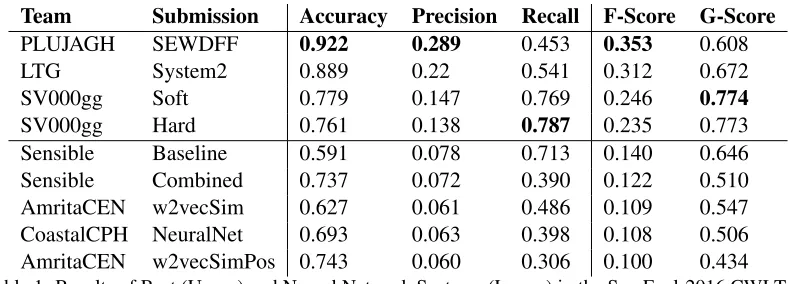
Table 1 presents the results of the best systems and the neural network systems from the CWI task in SemEval-2016 (Paetzold and Specia, 2016). We have submitted our systems under the team name,
Sensible.
The CWI task was evaluated based on classic ac-curacy, precision recall and F-score metric. Addi-tionally, the organizers decided to account for the harmonic mean between the accuracy and recall and they called it the G-Score.
The top teams used a variety of heuristics and classificatoin based techniques. PLUJAGH-SEWDFF uses frequency thresholding where they
Team Submission Accuracy Precision Recall F-Score G-Score
PLUJAGH SEWDFF 0.922 0.289 0.453 0.353 0.608 LTG System2 0.889 0.22 0.541 0.312 0.672 SV000gg Soft 0.779 0.147 0.769 0.246 0.774
[image:5.612.107.506.53.195.2]SV000gg Hard 0.761 0.138 0.787 0.235 0.773 Sensible Baseline 0.591 0.078 0.713 0.140 0.646 Sensible Combined 0.737 0.072 0.390 0.122 0.510 AmritaCEN w2vecSim 0.627 0.061 0.486 0.109 0.547 CoastalCPH NeuralNet 0.693 0.063 0.398 0.108 0.506 AmritaCEN w2vecSimPos 0.743 0.060 0.306 0.100 0.434
Table 1: Results of Best (Upper) and Neural Network Systems (Lower) in the SemEval-2016 CWI Task
consider any word that occurs less than 147 times in the simple English Wikipedia to be complex. Sim-ilarly, LTG-System2 uses threshold features to train a decision tree classifier. SV000gg combines 23 dif-ferent systems uses soft and hard voting ensemble, their pre-ensembled systems includes threshold- and lexicon-based heuristics and machine learning clas-sifiers trained on 69 distinct linguistic features.
CoastalCPH’s NeuralNet system extracted an ar-ray of features (including parts-of-speech, frequen-cies, character perplexity and embeddings) and they train a deep neural network with 2 hidden layers. AmritaCEN’s w2vecSim trained an SVM classifier using Word2Vec embeddings and the similarity be-tween the target word, in addition, they used char-acter and token based features to train the classifier. Their w2vecSimPossystem added a POS feature to train the classifier.
Among the neural network systems, our baseline system achieved the highest F- and G-score. We are also the only team that restructured the target word and sentence to train recurrent neural net to predict the output label. One possible reason for the poor performance of our systems is due to the train-ing data size of the task. The traintrain-ing data contains 2,237 labelled instances while the test data contains 88,221 instances. Given more data, we believe that our system can scale towards accuracies compara-tive to the top systems.
Although our ensemble system performed poorly in the harmonic scores, we see that it achieves rea-sonably high accuracy close to the top systems. Our ensemble system was penalized due to the low re-call and rate. Provided that we have more training data, the recall should proportionally increase and
improve our ensemble system.
6 Conclusion
In this paper, we motivated the use of deep learning and neural nets in NLP applications and introduced basic notions of feed-forward and recurrent neural nets through theXORexample. And as expected, we can easily build a relatively competitive system with little understanding of the task by restructuring the inputs as a sequence to train an RNN classifier.
We have introduced a novel approach using RNN to solve the complex word identification task and showed that we can easily ensemble several RNN classifiers if we are unsure of the optimal hyper-parameters or the best performing models using ex-treme gradient boosted trees classifiers.
Acknowledgments
We thank Jimmy Callin, Jon Dehdari and Yoav Goldberg for the pointers on the literature review sections on (Recurrent) Neural Nets.
References
T. Chen and C. Guestrin. 2016. XGBoost: A Scalable Tree Boosting System. ArXiv e-prints.
Kyunghyun Cho, Bart Van Merri¨enboer, Caglar Gul-cehre, Dzmitry Bahdanau, Fethi Bougares, Holger Schwenk, and Yoshua Bengio. 2014. Learn-ing phrase representations usLearn-ing rnn encoder-decoder for statistical machine translation. arXiv preprint arXiv:1406.1078.
Ronan Collobert, Jason Weston, L´eon Bottou, Michael Karlen, Koray Kavukcuoglu, and Pavel Kuksa. 2011. Natural language processing (almost) from scratch.
The Journal of Machine Learning Research, 12:2493– 2537.
Jeffrey L Elman. 1990. Finding structure in time. Cog-nitive science, 14(2):179–211.
Jerome H Friedman. 2001. Greedy function approxima-tion: a gradient boosting machine. Annals of statistics, pages 1189–1232.
Yoav Goldberg. 2015. A primer on neural network mod-els for natural language processing. arXiv preprint arXiv:1510.00726.
Rohit Gupta, Constantin Orasan, and Josef van Genabith. 2015. Reval: A simple and effective machine transla-tion evaluatransla-tion metric based on recurrent neural net-works. In Proceedings of the 2015 Conference on Empirical Methods in Natural Language Processing, pages 1066–1072, Lisbon, Portugal, September. Sepp Hochreiter and J¨urgen Schmidhuber. 1997. Long
short-term memory. Neural computation, 9(8):1735– 1780.
S´ebastien Jean, Orhan Firat, Kyunghyun Cho, Roland Memisevic, and Yoshua Bengio. 2015. Montreal neu-ral machine translation systems for wmt15. In Pro-ceedings of the Tenth Workshop on Statistical Ma-chine Translation, pages 134–140, Lisbon, Portugal, September.
Julia Kreutzer, Shigehiko Schamoni, and Stefan Riezler. 2015. Quality estimation from scratch (quetch): Deep learning for word-level translation quality estimation. In Proceedings of the Tenth Workshop on Statistical Machine Translation, pages 316–322, Lisbon, Portu-gal, September. Association for Computational Lin-guistics.
Omer Levy, Yoav Goldberg, and Israel Ramat-Gan. 2014. Linguistic regularities in sparse and explicit word representations. InCoNLL, pages 171–180. Christopher D Manning. 2016. Computational
linguis-tics and deep learning. Computational Linguistics. Tom´aˇs Mikolov, Martin Karafi´at, Luk´aˇs Burget, Jan
ˇCernock´y, and Sanjeev Khudanpur. 2010. Recurrent neural network based language model. InProceedings of the 11th Annual Conference of the International Speech Communication Association (INTERSPEECH 2010), volume 2010, pages 1045–1048.
Tomas Mikolov, Ilya Sutskever, Kai Chen, Greg S Cor-rado, and Jeff Dean. 2013. Distributed representa-tions of words and phrases and their compositionality. InAdvances in neural information processing systems, pages 3111–3119.
Gustavo Henrique Paetzold and Lucia Specia. 2016. Complex word identification. In Proceedings of the
10th International Workshop on Semantic Evaluation (SemEval 2016), San Diego, California.
Jeffrey Pennington, Richard Socher, and Christopher D Manning. 2014. Glove: Global vectors for word rep-resentation. InEMNLP, volume 14, pages 1532–1543. David E Rumelhart, Geoffrey E Hinton, and Ronald J Williams. 1988. Learning representations by back-propagating errors.Cognitive modeling, 5(3):1. Matthew Shardlow. 2013. A comparison of techniques to
automatically identify complex words. In51st Annual Meeting of the Association for Computational Linguis-tics Proceedings of the Student Research Workshop, pages 103–109, Sofia, Bulgaria, August.
Noam Shazeer, Ryan Doherty, Colin Evans, and Chris Waterson. 2016. Swivel: Improving embed-dings by noticing what’s missing. arXiv preprint arXiv:1602.02215.
Lucia Specia, Sujay Kumar Jauhar, and Rada Mihalcea. 2012. Semeval-2012 task 1: English lexical simpli-fication. In Proceedings of the Sixth International Workshop on Semantic Evaluation, pages 347–355. Md Arafat Sultan, Steven Bethard, and Tamara
Sum-ner. 2014. DLS@CU: Sentence Similarity from Word Alignment. In Proceedings of the 8th International Workshop on Semantic Evaluation (SemEval 2014), pages 241–246, Dublin, Ireland, August.
Md Arafat Sultan, Steven Bethard, and Tamara Sum-ner. 2015. DLS@CU: Sentence Similarity from Word Alignment and Semantic Vector Composition. In Pro-ceedings of the 9th International Workshop on Seman-tic Evaluation (SemEval 2015), pages 148–153, Den-ver, Colorado, June.
Liling Tan. 2014. Pywsd: Python implementations of word sense disambiguation (wsd) technologies [soft-ware]. https://github.com/alvations/pywsd.
Wenduan Xu, Michael Auli, and Stephen Clark. 2015. Ccg supertagging with a recurrent neural network. In