Modelling semantic acquisition in second language learning
Ekaterina Kochmar
The ALTA Institute University of Cambridge
Ekaterina Shutova
Computer Laboratory University of Cambridge
Abstract
Using methods of statistical analysis, we investigate how semantic knowledge is ac-quired in English as a second language and evaluate the pace of development across a number of predicate types and content word combinations, as well as across the levels of language proficiency and na-tive languages. Our exploratory study helps identify the most problematic areas for language learners with different back-grounds and at different stages of learning.
1 Introduction
Acquisition of semantic knowledge and vocabu-lary of a second language (L2), including appro-priate word choice and awareness of selectional preference restrictions, are widely recognised as important aspects of L2 learning by native speak-ers, language teachers and learners themselves. Previous research demonstrated strong correla-tion between semantic knowledge and proficiency level (Shei and Pain, 2000;Alderson, 2005), and argued that the use of collocations makes one’s speech more native-like (Kjellmer, 1991; Aston,
1995;Granger and Bestgen,2014). James(1998) noted that learners often equate L2 mastery with mastery of L2 vocabulary, and Leacock et al.
(2014) mention an experiment in which teachers of English ranked word choice errors among the most serious errors in L2 writing. At the same time, it has also been argued that acquisition of semantic knowledge proceeds on a word-by-word basis with each word being acquired as a separate construct (Gyllstad et al.,2015), and acquisition of content word combinations knowledge is slow and uneven, presenting challenges even at high profi-ciency levels (Bahns and Eldaw,1993;Laufer and Waldman,2011;Thewissen,2013).
Native speakers are believed to be experts in their own language (James, 1998), and the lan-guage norm is usually set based on their prefer-ences (Wulff and Gries, 2011). Apart from er-rors, learner English is often characterised by dif-ferences in the probabilistic distribution of lexical items which are expressed in under- or overuse of certain constructions (De Cock,2004;Durrant and Schmitt,2009;Laufer and Waldman,2011;Wulff and Gries,2011). In this paper, we adopt statistical approach and assume that native and learner lan-guage are characterised by different distributions. We investigate how non-native use of language de-velops and how closely it approximates native use at different levels of proficiency.
The native language distribution is modelled us-ing a combination of theBritish National Corpus (BNC) andukWaC, while learner language distri-butions are modelled using Cambridge Learner
Corpus (CLC). CLC covers various L1
back-grounds as well as 6 language proficiency lev-els defined by the Common European
Frame-work of Reference for Languages(CEFR) (
Coun-cil of Europe,2011a), ranging from “basic” (A1-A2) to “independent” (B1-B2) to “proficient” (C1-C2). In contrast to much of previous research, we run the experiments both on a wider scale, using a large corpus of learner English, and to finer level of granularity, exploring learner devel-opment across proficiency levels. Table1defines the amount and range of linguistic constructions that the learners are expected to be familiar with at different levels. Specifically, we explore:
(1) the pace of semantic knowledge and vocabu-lary acquisition across levels;
(2) the influence of one’s L1 on the development of semantic knowledge;
(3) acquisition and development of selectional preference patterns across levels.
Level Descriptor
A1 Has a verybasic repertoire of wordsandsimple phrasesrelated topersonal detailsandparticular concrete situations.
A2 Uses basic sentence patterns withmemorised phrases,groups of a few wordsand formulae in order to communicate limited information insimple everyday situations.
B1 Has enough language to get by, withsufficient vocabularyto express him/herself with some hesitation and circumlocutions on topics such asfamily, hobbies and interests, work, travel, and current events.
B2 Has asufficient range of languageto be able to give clear descriptions, express viewpoints onmost general topics, without much conspicuous searching for words, using some complex sentence forms to do so. C1 Hasa good command of a broad range of languageallowing him/her to select a formulation to express him/
herself clearly in an appropriate style ona wide range of general, academic, professional or leisure topics without having to restrict what he/she wants to say.
[image:2.595.86.515.64.221.2]C2 Shows great flexibility reformulating ideas in differing linguistic forms to conveyfiner shades of meaning precisely, to give emphasis, to differentiate and to eliminate ambiguity. Also has agood command of idiomatic expressions and colloquialisms.
Table 1: CEFR descriptors of general linguistic and vocabulary range (Council of Europe,2011b)
2 Previous research
Within NLP, it is more typical to explore learner language from the perspective of automated as-sessment or error detection and correction ( Lea-cock et al.,2014) which focus on the contrast be-tween learner and native language in terms of er-rors in L2, rather than from a language develop-ment perspective. The latter was studied more ex-tensively by Second Language Acquisition (SLA) researchers. Previous research looked into vocab-ulary acquisition and language development as-sessing passive, or receptive, vocabulary knowl-edge (Gyllstad et al., 2015) and trying to esti-mate the vocabulary that the learners might un-derstand at different proficiency levels (Nation,
2006; Bergsma and Yarowsky, 2013). The vo-cabulary size tests of the type proposed byNation
(2012) were shown to not be appropriate to test
productive vocabulary knowledge as they suffer
from overestimation of the vocabulary size ( Gyll-stad et al.,2015). Using learner writing to estimate the productive vocabulary size provides more reli-able results, but previous studies in this area were performed on a smaller scale, either focusing on a limited number of proficiency levels (Gilquin and Granger,2011;Granger and Bestgen,2014), L1s (Gilquin and Granger, 2011; Granger and Bestgen,2014;Siyanova-Chanturia,2015), or on overall smaller datasets (Grant and Ginther,2000;
Granger and Bestgen,2014).
It is widely accepted that vocabulary develops over time, and richer vocabulary is characteristic of better language knowledge (Laufer and Wald-man,1995;Grant and Ginther,2000). Moreover, as students become more proficient writers, they do not only start operating with an overall larger
vocabulary, but also become more precise in their word choice which is reflected in the increase of the type-token ratio (TTR) (Ferris,1994;Engber,
1995;Frase et al.,1999;Grant and Ginther,2000). However, the methodology of tagging the word choice and measuring TTR similar to that adopted inGrant and Ginther(2000) fails taking the
omis-sionsinto account, while the method proposed in
this paper helps alleviate this problem.
With respect to the development of selectional preference patterns and phraseological knowl-edge, Siyanova-Chanturia (2015) show that L2 learners even at lower levels do not just focus on single words acquisition but also attend to combinatorial linguistic mechanisms. The studies of Durrant and Schmitt (2009) and Granger and Bestgen(2014) suggest that intermediate learners tend to overuse high frequency collocations (such
ashard work) and underuse lower-frequency
col-locations (such as immortal souls), while as pro-ficiency in the language increases, this balance changes. Durrant and Schmitt (2009) argue that learners at the lower proficiency levels seem to over-rely on forms which are common in the lan-guage, and Paquot and Granger (2012) note that this might be related to the fact that learners feel confident using such common forms.
An interesting observation concerns the pace of semantic knowledge development: for in-stance,Laufer and Waldman(1995) observed that advanced learners’ vocabulary is too varied to remain stable across different samples of writ-ing.Laufer and Waldman(2011) andNesselhauf
less proficient counterparts.Thewissen(2008) ar-gue that higher-level learners attempt a much wider range of lexical phrases which are not al-ways error-free, and produce a large number of near-hits as compared to their lower intermediate counterparts.Paquot and Granger(2012) conclude that at an advanced level, learners take more risks, try out more complex lexical phrases and as a re-sult, produce errors, but those are of a different, more ‘advanced’ nature than the basic errors typi-cal of earlier stages.
A number of studies looked into L1 influence on L2 development (Siyanova-Chanturia, 2015;
Paquot and Granger,2012). Typically, researchers report negative effects of L1 transfer (Lorenz,
1999; Gilquin, 2007; Nesselhauf, 2005; Laufer and Waldman,2011;Paquot and Granger,2012), but some research also suggests that the learn-ers whose L1 belongs to the same language fam-ily as English are more likely to make fewer mistakes than the learners from other L1 back-grounds (Waibel, 2008; Alejo Gonzalez, 2010;
Gilquin and Granger,2011). 3 Experimental setup
We focus on three types of content word combina-tions that are some of the most frequent in learner writing and have previously been found challeng-ing for language learners (Lorenz, 1999; Paquot and Granger, 2012): adjective–noun (AN), verb– direct object (VO) and subject–verb (SV). We (1) investigate how the use of the predicating words (adjectives andverbs) within these combinations develops over time,1 and (2) look into how their selectional preference patterns change across lev-els of language proficiency. We do not focus on
collocations specifically for two reasons: firstly,
there is a lot of disagreement in defining colloca-tions (cf. Foster(2010),Nesselhauf(2005),Hoey
(1991)), and secondly, learners have been shown to have difficulties with all types of content word combinations, including those that are referred to as ‘free’ (Paquot and Granger,2012).
3.1 Data
Learner data: We have extracted the data for our experiments from the Cambridge Learner Corpus (CLC), which is a 52.5 million-word corpus of
1We combine adjectives in ANand verbs inVOand SV combinations under the term ofpredicating wordsbecause we assume that they impose the selectional restrictions on the arguments (nouns) within the corresponding combinations.
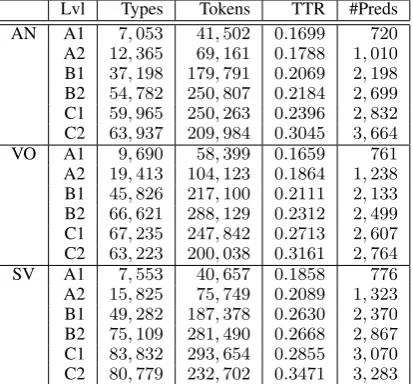
[image:3.595.314.521.63.255.2]Lvl Types Tokens TTR #Preds AN A1 7,053 41,502 0.1699 720 A2 12,365 69,161 0.1788 1,010 B1 37,198 179,791 0.2069 2,198 B2 54,782 250,807 0.2184 2,699 C1 59,965 250,263 0.2396 2,832 C2 63,937 209,984 0.3045 3,664 VO A1 9,690 58,399 0.1659 761 A2 19,413 104,123 0.1864 1,238 B1 45,826 217,100 0.2111 2,133 B2 66,621 288,129 0.2312 2,499 C1 67,235 247,842 0.2713 2,607 C2 63,223 200,038 0.3161 2,764 SV A1 7,553 40,657 0.1858 776 A2 15,825 75,749 0.2089 1,323 B1 49,282 187,378 0.2630 2,370 B2 75,109 281,490 0.2668 2,867 C1 83,832 293,654 0.2855 3,070 C2 80,779 232,702 0.3471 3,283
Table 2: Overall statistics
learner English collected by Cambridge Univer-sity Press and Cambridge English Language As-sessment (Nicholls, 2003). It comprises essays written during examinations in English by lan-guage learners with over 80 L1s and represent-ing all6CEFR levels (Council of Europe,2011a). Since the learners are not restricted in the word choice,2 we believe that the range of vocabulary used in the essays is representative of what is in learners’ active lexicon and, therefore, reflects se-mantic knowledge internalised at this point.
We have extracted the word combinations from the full CLC parsed with the RASP (Briscoe et al.,
2006). Table 2 summarises learner data: we in-clude the number oftypes(unique combinations),
tokens (overall number of combinations),
type-token ratio(T T R) as well as the number of
pred-icates for each level. Table 2 demonstrates that the overall number of the combinations and predi-cates as well asT T Rconstantly increase from A1 through to C2, with the largest increase between levels A2 and B1,3when the learners transfer from
beginnersto intermediateand start using the
vo-cabulary beyond basic and simple, and between levels C1 and C2, when learners are expected to masteridiomatic expressionsandcolloquialisms.
Native data: To estimate the general linguistic and vocabulary range of a native speaker, we have extracted the statistics on the use ofANs,VOs and SVs and the predicates from a combination of the BNC (Burnard,2007) and ukWaC (Ferraresi et al.,
2It can be argued that vocabulary selection is restricted by essay prompts; we address this issue in§5.
2008), which together amount to more than2 bil-lion words. For consistency, the native data has also been parsed with RASP (Briscoe et al.,2006).
3.2 Statistical methods
Distribution similarity: We measure the simi-larity between two distributions using Kullback-Leibler (KL) divergence (MacKay,2003) which for distributionsQandPis defined as:
DKL(P||Q) =
X
i
P(i)logP(i)
Q(i) (1)
In our experiments, P is the distribution in the learner data and Q is the distribution in the na-tive data. The closer the two distributions are, the lower the value ofDKL. To support the results, we
additionally measure the Pearson correlation coef-ficient (P CC) between the predicates and content word combinations in the learner and native data.
P CC is higher for the more similar distributions.
Argument clustering: To address the issue of data sparsity, we estimate selectional preferences (SP) over argument classes as well as individ-ual arguments. We obtain SP classes using spec-tral clustering of nouns with lexico-syntactic fea-tures, which has been shown effective in previous lexical classification tasks (Brew and Schulte im Walde, 2002; Sun and Korhonen, 2009). Spec-tral clustering partitions the data relying on a ma-trix that records similarities between all pairs of data points. We use Jensen-Shannon divergence to measure the similarity between feature vectors for nounswiandwjas follows:
dJS(wi, wj) = 12dKL(wi||m) +12dKL(wj||m),
(2) where dKL is the KL divergence, and m is the
average ofwi and wj. We construct the
similar-ity matrix S computing similarities Sij asSij =
exp(−dJS(wi, wj)). The matrixSencodes a
sim-ilarity graphGover the nouns, whereSij are the
adjacency weights. The clustering problem can then be defined as identifying the optimal parti-tion, orcut, of the graph into clusters, such that the intra-cluster weights are high and the inter-cluster weights are low. We cluster2,000most frequent nouns in the BNC, using their grammatical rela-tions as features. The features consist of verb lem-mas occurring in the subject, direct object and in-direct object relations with the given nouns in the RASP-parsed BNC. The feature vectors are con-structed from the corpus counts and normalized by
the sum of the feature values.
Selectional preference model: Once the SP classes are obtained, we quantify the strength of association between a given predicate and each of the classes. We adopt an information theoretic measure proposed byResnik (1993) for this pur-pose. Resnik first measuresselectional preference
strength(SPS) of a predicate in terms ofKL
diver-gence between the distribution of noun classes oc-curring as arguments of the predicate,p(c|v), and the prior distribution of the noun classes,p(c):
SPSR(v) =
X
c p(c|v) log p(c|v)
p(c) , (3)
whereRis the grammatical relation for which SPs are computed. SPS measures how strongly the predicate constrains its arguments. Selectional as-sociation with a particular argument class is then defined as a relative contribution of that argument class to the overall SPS of the predicate:
AssR(v, c) = SPS1
R(v)p(c|v) log p(c|v)
p(c) (4)
We extractVOandSVrelations, map the argument heads to SP classes and quantify selectional asso-ciation of a given predicate with each SP class. 4 Experimental results
We run a series of experiments to test the aspects of semantic knowledge acquisition outlined in§1.
4.1 Pace of semantic knowledge acquisition
Table2shows that at the lower levels learners op-erate with quite a small vocabulary. Many pre-vious studies argued that learners at lower lev-els tend to overuse high frequency lexical items, whereas over time they expand their vocabulary with less frequent lexical items. It has also been argued that semantic knowledge acquisition is an unsteady process (see§2). First, we explore how exactly the semantic knowledge develops across proficiency levels, and investigate whether content word choice error rates – the proportion of word combinations where the predicate in chosen inap-propriately as, for example, in *choose decision instead ofmake decision, or*actual roominstead
ofcurrent room– decrease over time.
For that, we identify 10 frequency bands for predicating words within each combination type using native English data. Each band covers from
frequent ones) unique adjectives inANs, and sim-ilarly from 281 to 3,676 verbs in VOs, and 297 to3,367verbs inSVs. For instance, band1 con-tains such adjectives as big andgood, and verbs
give,goandsee, while band10contains adjectives
behaviouristicanddecipherable, and verbsfactor,
garnishandmesmerise. It is reasonable to expect
that learners are familiar with the “simpler” words from band1even at the lower proficiency levels, while they might find words from band10 much more challenging. In order to quantitatively assess this, we measure the proportion of new predicating words used at each level and map it to the identi-fied frequency bands. Next, we estimate the error rates for each level and for each frequency band.
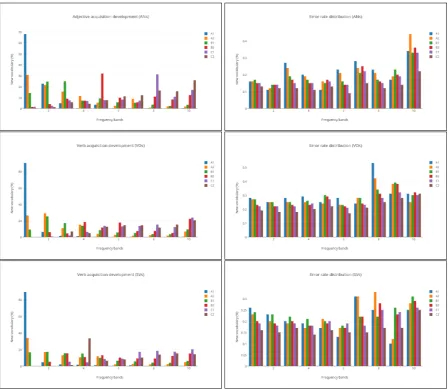
Figure1 shows the distribution of the new vo-cabulary acquired at each level mapped against the frequency bands, as well as the distribution of the error rates across the frequency bands at each level.4 While we observe that, as expected, learners expand their vocabulary acquiring words from lower frequency bands, the following trends are worth noting: most of the verb predicates in VOs andSVs that the learners know at level A1 are covered by frequency band1. At A2 and B1 they still expand their vocabulary with some verbs from band1, but starting with level B2 none of the new vocabulary comes from this band. Most new verbs inVOs at level C2 are covered by band10, and in SVs by band4. For adjectives, most new vocabu-lary at A1 and A2 comes from band1, at B1 – band
3, at B2 – band5, at C1 – band8and at C2 – band
10. Predictably, the error rates decrease towards the higher proficiency levels and within the higher frequency bands. The highest error rates are ob-served on the bands covering less frequent words: for example, even though the error rates are over-all lower for C2 level, the highest error rate for C2 is associated with band 10 for all three types of combinations which confirms that semantic acqui-sition is challenging even at advanced levels.
While these results corroborate previous find-ings and show quantitatively how semantic knowl-edge develops across levels, we look further into how it approximates native English. In particular, it is reasonable to assume that the variety of En-glish used by language learners at the lower pro-ficiency levels is more dissimilar to the native En-glish both for predicates and content word
com-4More detailed description is available atwww.cl.cam.
ac.uk/˜ek358/vocab-acquisition.html.
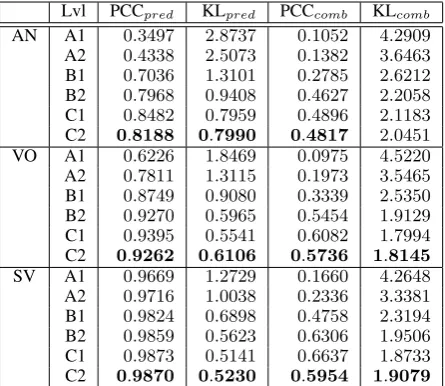
Lvl PCCpred KLpred PCCcomb KLcomb AN A1 0.3497 2.8737 0.1052 4.2909 A2 0.4338 2.5073 0.1382 3.6463 B1 0.7036 1.3101 0.2785 2.6212 B2 0.7968 0.9408 0.4627 2.2058 C1 0.8482 0.7959 0.4896 2.1183 C2 0.8188 0.7990 0.4817 2.0451 VO A1 0.6226 1.8469 0.0975 4.5220 A2 0.7811 1.3115 0.1973 3.5465 B1 0.8749 0.9080 0.3339 2.5350 B2 0.9270 0.5965 0.5454 1.9129 C1 0.9395 0.5541 0.6082 1.7994 C2 0.9262 0.6106 0.5736 1.8145
SV A1 0.9669 1.2729 0.1660 4.2648 A2 0.9716 1.0038 0.2336 3.3381 B1 0.9824 0.6898 0.4758 2.3194 B2 0.9859 0.5623 0.6306 1.9506 C1 0.9873 0.5141 0.6637 1.8733 C2 0.9870 0.5230 0.5954 1.9079 Table 3: Predicates (pred) and combinations (comb) distributions
binations, while it approximates native language distributions at upper levels. To test that, we cal-culateP CCandKL(see§3.2) and expect that to-wards C2 levelP CC increases and approximates
1.0, whileKLdecreases and approximates0.0. Table 3 presents theP CC and KLvalues for the distribution of the adjectives and verbs in columns marked withpredfor predicating words, and for combinations in columns marked with
comb. These values show that P CC steadily
in-creases while KL steadily decreases from level A1 through to level C1, with the biggest “jump” between levels A2 and B1 for the adjectives and verbs in SVs, and A1 and A2 for the verbs in VOs. However, we note that at level C2 predicating words distribution is less similar to native English distribution than at level C1 for all types of com-binations – we mark these values in the table in bold. We hypothesise that at level C2 the learners are already familiar with the basic vocabulary and start experimenting with the use of novel construc-tions which might result in a quite distinct variety of English (seeThewissen(2008) andPaquot and Granger(2012) for similar hypotheses). To inves-tigate this further, we identify 10 predicates per combination type such that after removing them from the list of predicates,KLbetween the learner and native distribution improves (see Table4).
[image:5.595.299.522.62.255.2]Figure 1: Predicates acquisition and error rate distribution across levels.
represent frequent words that are overused by the learners. We calculate the average error rates for the combinations with these predicates (column “ErR”) and compare them to the average error rate over all predicates for each level (in parentheses). For adjectives and verbs inVOs the error rates are comparable or below the average error rate at the lower levels, and higher than the average at the upper levels. Verbs in SVs demonstrate an oppo-site trend: at the lower levels error rates associated with the use of these predicates are higher than av-erage, while at the upper levels they are compara-ble or lower. We conclude that the differences in the distributions at the lower levels are caused by the overuse of the basic vocabulary, while towards the upper levels it is due to occasionally incorrect use of more diverse vocabulary.
The rightmost columns of Table3also compare the distribution of the ANs, VOs and SVs in the learner data to those in the native English data. We
note that, similarly to the distribution of the pred-icates, the use of the content word combinations becomes more similar to native use towards higher levels of language proficiency, and to further con-firm our hypothesis about the peculiar use of lan-guage at C2, we observe a disruption of this trend at C2 level for VOs and SVs. We also note that the development goes at quicker pace between A1 through to B2, and slows down at the upper levels.
4.2 L1 effects
knowl-Lvl Predicates #B ErR adj A1 dear, mobile, favorite, other, national, 1.5 0.15
blue, nice, pink, international, young (0.16) A2 dear, mobile, favorite, local, national, 1.5 0.14
nice, social, blue, pink, young (0.16) B1 dear, best, nice, national, wealthy, 1.4 0.15
beautiful, big, good, english, funny (0.17) B2 dear, good, british, nice, wealthy, 1.3 0.15
best, national, wonderful, important, big (0.16) C1 dear, national, upward, wealthy, british, 1.8 0.17
english, negative, bad, full, important (0.15) C2 wealthy, national, dear, full, british, 1.4 0.15
important, further, current, serial, european (0.13) v A1 buy, paint, like, watch, go, 1.1 0.28 V O wear, bring, play, provide, make (0.28)
A2 buy, paint, provide, like, go, 1.2 0.26
watch, attend, wear, book, confirm (0.27) B1 buy, watch, include, provide, like, 1.2 0.22
go, spend, offer, film, love (0.27) B2 include, provide, spend, rent, support, 1.1 0.26
contain, follow, raise, create, cover (0.24) C1 include, excel, improve, concern, provide, 1.4 0.21
solve, show, reach, spend, allow (0.22) C2 spend, broaden, offer, earn, solve, 1.3 0.21
allow, require, cover, use, enable (0.19) v A1 cost, make, use, park, have, 1.1 0.31 SV show, find, say, wish, take (0.25)
A2 cost, use, include, make, provide, 1.1 0.27
park, say, attend, find, show (0.22) B1 include, like, wish, watch, provide, 1.4 0.22
require, spend, set, decrease, amaze (0.23) B2 increase, like, include, reward, decrease, 1.4 0.20
interest, spend, provide, require, involve (0.20) C1 increase, decrease, include, spend, like, 1.2 0.20
change, say, show, improve, apply (0.19) C2 include, increase, spend, frame, live, 1.3 0.16
[image:7.595.57.291.60.363.2]like, require, provide, set, base (0.16)
Table 4: Top10predicates contributing to the differ-ence between learner and native language distribution
edge in L2, while one may expect to observe slower learning pace for speakers of more distant L1s (Gilquin and Granger,2011).
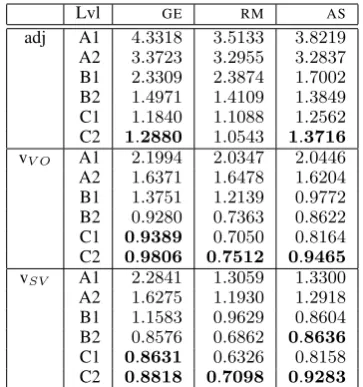
To test to what extent L1 exerts influence on L2 semantic knowledge acquisition, we consider three language groups – Germanic L1s (GE) that belong to the same group as English (EN), Ro-mance L1s (RM) that represent a different group within the same family of the Indo-European lan-guages, and Asian L1s (AS) representing a group of languages most distant from English among the three.5 We measure KL divergence for the three pairs,GE–EN,RM–ENandAS–EN, on the distribu-tion of the predicates.
The results reported in Table 5 contradict our original assumption as we observe that the vari-ety of English used by speakers of Romance L1s is closer to native English than the variety used by speakers of Germanic L1s. Furthermore, the vari-ety of English used by speakers of Asian L1s, es-pecially at the lower levels, is more similar to na-tive English than the variety used by Germanic L1
5GE include Danish, Dutch, German, Norwegian and Swedish;RMinclude French, Italian, Portuguese, Romanian and Spanish;ASinclude Thai, Vietnamese and different vari-eties of Chinese.
Lvl GE RM AS
adj A1 4.3318 3.5133 3.8219 A2 3.3723 3.2955 3.2837 B1 2.3309 2.3874 1.7002 B2 1.4971 1.4109 1.3849 C1 1.1840 1.1088 1.2562 C2 1.2880 1.0543 1.3716
vV O A1 2.1994 2.0347 2.0446 A2 1.6371 1.6478 1.6204 B1 1.3751 1.2139 0.9772 B2 0.9280 0.7363 0.8622 C1 0.9389 0.7050 0.8164 C2 0.9806 0.7512 0.9465
vSV A1 2.2841 1.3059 1.3300 A2 1.6275 1.1930 1.2918 B1 1.1583 0.9629 0.8604 B2 0.8576 0.6862 0.8636
C1 0.8631 0.6326 0.8158 C2 0.8818 0.7098 0.9283 Table 5: Predicate distributions per language groups (KL)
speakers. We hypothesise that since Asian L1s are very different from English, the speakers of these languages may prefer to use prefabricated phrases more often than speakers of Germanic L1s, which makes their language more native-like. Similar hypotheses have been formulated earlier: for ex-ample, Gilquin and Granger (2011) noted that learners, especially at the lower levels, are likely to repeat expressions that are familiar to them and ap-pear to be safe, andHulstijn and Marchena(1989) noted that learners tend to rely on “play-it-safe” strategy rather than experiment unless they are confident in their vocabulary knowledge. We as-sume that speakers of Germanic L1s might feel more confident in their semantic knowledge and as a result be more “adventurous” in their use of English than speakers of Asian L1s. Our exper-iments on the individual L1s within each group show same trends as observed for L1 groups.
4.3 Selectional preference patterns
Finally, we investigate how selectional prefer-ence patterns develop across proficiency levels and whether they approximate native English patterns. For each predicate in learner and native data, we form argument clusters using the methodology de-scribed in§3.2, estimate SP strength for the predi-cates at each level using eq.3, and then applyKL
[image:7.595.325.507.61.255.2] [image:7.595.58.289.61.366.2]Lvl PCC KL PCCcl KLcl AN A1 0.1661 0.1481 0.2835 0.1980 A2 0.4375 0.0843 0.5449 0.1149 B1 0.5808 0.0494 0.5597 0.0897 B2 0.6133 0.0395 0.5940 0.0765 C1 0.6526 0.0372 0.6408 0.0729 C2 0.6428 0.0364 0.5866 0.0762
VO A1 0.4959 0.0966 0.5976 0.1533 A2 0.3893 0.0917 0.5414 0.1430 B1 0.6181 0.0579 0.7429 0.0810 B2 0.6759 0.0412 0.6987 0.0749 C1 0.7172 0.0354 0.7576 0.0634 C2 0.7168 0.0379 0.7609 0.0645
[image:8.595.75.291.62.255.2]SV A1 0.6069 0.1254 0.4475 0.1722 A2 0.6061 0.0956 0.4934 0.1604 B1 0.6053 0.0837 0.5008 0.1538 B2 0.6500 0.0612 0.4248 0.1515 C1 0.6539 0.0553 0.4972 0.1306 C2 0.6599 0.0595 0.5164 0.1418 Table 6: Selectional preference distribution
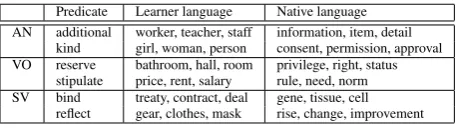
Predicate Learner language Native language AN additional worker, teacher, staff information, item, detail
kind girl, woman, person consent, permission, approval VO reserve bathroom, hall, room privilege, right, status
stipulate price, rent, salary rule, need, norm SV bind treaty, contract, deal gene, tissue, cell
reflect gear, clothes, mask rise, change, improvement
Table 7: Examples of the most strongly associated arguments
learner data become more similar to those in native language towards upper levels. BothANs andVOs show the biggest improvements between A2 and B1, and we observe the disruption in this trend at the levels A2 and C2 (we mark those in bold).
Next, we look into the set of predicates that have the most different SP patterns in the learner and native language, and using eq.4, identify the argu-ment cluster that is most strongly associated with each of these predicates in the learner and native data. For the sake of space, in Table7we present only some illustrative examples from different lev-els and combination types.6 The experiments sug-gest that the difference between the learner and na-tive SP models might be due to the learners’ use of concrete nouns with the adjectives and verbs where native speakers prefer abstract nouns.
To further investigate this hypothesis, we iden-tify10predicates per combination type and profi-ciency level with the most distinct selectional pref-erence patterns. Using the MRC Psycholinguistic Database (Wilson, 1988), we calculate the aver-age concreteness score for the arguments clusters in learner and native data. Our results show that
6Full lists are available at www.cl.cam.ac.uk/
˜ek358/vocab-acquisition.html.
at the lower levels learners use more concrete ar-guments than native speakers, with the difference statistically significant at 0.05 with t-test, while the difference becomes less pronounced towards C1-C2 levels. Our results for productive vocabu-lary knowledge corroborate previous findings on the relation between receptive vocabulary knowl-edge and acquisition of abstract concepts (Tanaka et al.,2013;Vajjala and Meurers,2014).
The results show that the difference in selec-tional preference patterns between the learner and native language is due to the concreteness of the selected arguments. This may reflect (1) the dif-ficulty in acquiring semantics of abstract concepts in L2, or, alternatively, (2) L1-based instructional practices that may focus first on teaching concrete concepts before abstract concepts. The awareness of this discrepancy can serve as further guidance for language instructors and learners, and help make one’s language use more native-like.
5 Discussion and conclusions
[image:8.595.72.301.289.353.2]dif-ferent proficiency levels.
We admit that potential topic and genre bias of learner exams data is a limitation of our corpus-based approach. We believe that corpus-corpus-based studies of the type presented in this paper will fa-cilitate further research into semantic knowledge development, although it is possible that learner corpora provide only limited access to productive learner vocabulary. AsSiyanova-Chanturia(2015) notes “in an ideal world, one would use the same topic across and within all tested levels, but in a language classroom, this is hardly possible”. The future work will investigate possible solutions for this problem such as (1) augmentation of the data with other learner corpora, (2) use of fill-in-the-gaps exercises that test vocabulary knowledge di-rectly, and (3) sampling of the native data to more closely reflect the selection of topics in the learner data.
Acknowledgments
We are grateful to the BEA reviewers for their helpful and instructive feedback. Ekaterina Kochmar’s research is supported by Cambridge English Language Assessment via the ALTA In-stitute. Ekaterina Shutova’s research is supported by the Leverhulme Trust Early Career Fellowship.
References
J. C. Alderson, editor. 2005. Diagnosing Foreign Lan-guage Proficiency: The Interface between Learning and Assessment. London; New York: Continuum. R. A. Alejo Gonzalez. 2010. L2 Spanish acquisition
of English phrasal verbs: a cognitive linguistic anal-ysis of L1 influence. InM. C. Campoy-Cubillo, B. Belles-Fortuno, & M. L. Gea-Valor (eds.), Corpus-based approaches to English language teaching, London, UK: Continuum, pages 149–166.
G. Aston. 1995. Corpora in language pedagogy: Matching theory and practice. In G. Cook & B. Seidlhofer (eds.), Principle and Practice in Applied Linguistics: Studies in Honour of H.G. Widdowson, Oxford: Oxford University Press, pages 257–270. J. Bahns and M. Eldaw. 1993. Should we teach EFL
students collocations? System21:101–114.
S. Bergsma and D. Yarowsky. 2013. Learning Domain-Specific, L1-Specific Measures of Word Readability. TAL54(1):203–226.
C. Brew and S. Schulte im Walde. 2002. Spectral clus-tering for German verbs. InProceedings of EMNLP. pages 117–124.
E. Briscoe, J. Carroll, and R. Watson. 2006. The Sec-ond Release of the RASP System. InProceedings of the 21st International Conference on Computational Linguistics and 44th Annual Meeting of the Associ-ation for ComputAssoci-ational Linguistics (COLING-ACL 2006) Interactive Presentation Sessions. pages 59– 68.
L. Burnard, editor. 2007. Reference Guide for the British National Corpus. Research Technologies Service at Oxford University Computing Services. The Council of Europe. 2011a. Common European
Framework of Reference for Languages: Learning, Teaching, Assessment.
The Council of Europe. 2011b. Forms for detailed analysis of examinations or tests.
S. De Cock. 2004. Preferred sequences of words in NS and NNS speech. Belgian Journal of English Lan-guage and Literature (BELL), New Series 2:225– 246.
P. Durrant and N. Schmitt. 2009. To what extent do native and non-native writers make use of colloca-tions? International Review of Applied Linguistics 47:157–177.
C. Engber. 1995. The relationship of lexical profi-ciency to the quality of ESL compositions. Journal of Second Language Writing4:139–155.
A. Ferraresi, E. Zanchetta, M. Baroni, and S. Bernar-dini. 2008. Introducing and evaluating ukWaC, a very large web-derived corpus of English. In Pro-ceedings of the 4th Web as Corpus Workshop (WAC-4). pages 47–54.
D. Ferris. 1994. Lexical and syntactic features of ESL writing by students at different levels of L2 profi-ciency.TESOL Quarterly28:414–420.
P. Foster. 2010. Rules and routines: a consideration of their role in the task-based language production of native and non-native speakers. InM. Bygate, P. Skehan, & M. Swain (eds.), Researching pedagogic tasks: Second language learning, teaching and test-ing, Harlow, UK: Longman, pages 75–93.
L. Frase, J. Faletti, A. Ginther, and L. Grant. 1999. Computer Analysis of the TOEFL Test of Written English. Technical report, Princeton, NJ: Educa-tional Testing Service.
G. Gilquin. 2007. To err is not all. What corpus and elicitation can reveal about the use of collocations by learners. Zeitschrift fur Anglistik und Amerikanistik 55:273–291.
S. Granger and Y. Bestgen. 2014. The use of colloca-tions by intermediate vs. advanced non-native writ-ers: A bigram-based study. International Review of Applied Linguistics in Language Teaching (IRAL) 52:229–252.
L. Grant and A. Ginther. 2000. Using Computer-Tagged Linguistic Features to Describe L2 Writing Differences. Journal of Second Language Writing 9(2):123–145.
H. Gyllstad, L. Vilkait/e, and N. Schmitt. 2015. As-sessing vocabulary size through multiple-choice for-mats: issues with guessing and sampling rates. International Journal of Applied Linguistics (ITL) 166(2):278–306.
M. Hoey. 1991. Patterns of lexis in text. Oxford: Ox-ford University Press.
J. Hulstijn and E. Marchena. 1989. Avoidance: Gram-matical or semantic causes? Studies in Second Lan-guage Acquisition11(3):241–255.
C. James. 1998. Errors in Language Learning and Use: Exploring Error Analysis. London: Longman. G. Kjellmer. 1991. A mint of phrases. In K. Aijmer & B. Altenberg (eds.), English Corpus Linguistics: Studies in Honour of Jan Svartvik, Harlow, Essex: Longman, pages 111–127.
B. Laufer and T. Waldman. 1995. Vocabulary Size and Use: Lexical Richness in L2 Written Production. Applied Linguistics16(3):307–322.
B. Laufer and T. Waldman. 2011. Verb-noun colloca-tions in second language writing: a corpus analysis of learners’ English. Language Learning61:647– 672.
C. Leacock, M. Chodorow, M. Gamon, and J. Tetreault. 2014. Automated Grammatical Error Detection for Language Learners. Morgan & Claypool Publish-ers, second edition.
G. Lorenz. 1999. Adjective intensification e Learners versus native speakers. A corpus study of argumen-tative writing. Rodopi, Amsterdam.
D. J. C. MacKay. 2003.Information Theory, Inference, and Learning Algorithms (First ed.). Cambridge University Press.
I. S. P. Nation. 2006. How Large a Vocabulary Is Needed For Reading and Listening? The Canadian Modern Language Review/La Revue canadienne des langues vivantes63(1):59–82.
I. S. P. Nation. 2012. Vocabulary Size Test Instructions and Description. https://www.victoria.ac.nz/lals/about/staff/paul-nation.
N. Nesselhauf. 2005.Collocations in a learner corpus. John Benjamins, Amsterdam.
D. Nicholls. 2003. The Cambridge Learner Corpus: Error coding and analysis for lexicography and ELT. InProceedings of the Corpus Linguistics 2003 Con-ference. pages 572–581.
M. Paquot and S. Granger. 2012. Formulaic language in learner corpora. Annual Review of Applied Lin-guistics32:130–149.
P. Resnik. 1993. Selection and Information: A Class-based Approach to Lexical Relationships. Technical report, University of Pennsylvania.
C. C. Shei and H. Pain. 2000. An ESL Writer’s Collo-cation Aid. Computer Assisted Language Learning 13(2):167–182.
A. Siyanova-Chanturia. 2015. Collocation in begin-ner learbegin-ner writing: A longitudinal study. System 53:148–160.
L. Sun and A. Korhonen. 2009. Improving Verb Clustering with Automatically Acquired Selectional Preferences. InProceedings of EMNLP. pages 638– 647.
S. Tanaka, A. Jatowt, M. P. Kato, and K. Tanaka. 2013. Estimating Content Concreteness for Finding Com-prehensible Documents. InProceedings of the sixth ACM international conference on Web search and data mining (WSDM’13). pages 475–484.
J. Thewissen. 2008. The phraseological errors of French-, German-, and Spanish speaking EFL learn-ers: Evidence from an error-tagged learner corpus. InProceedings from the 8th Teaching and Language Corpora Conference (TaLC8). pages 300–306. J. Thewissen. 2013. Capturing L2 Development
Through Learner Corpus Analysis. Modern Lan-guage Journal (special issue on capturing the dy-namics of L2 development through learner corpus analysis)97:77–101.
S. Vajjala and D. Meurers. 2014. Readability Assess-ment for Text Simplification: From Analyzing Doc-uments to Identifying Sentential Simplifications. In-ternational Journal of Applied Linguistics, Special Issue on Current Research in Readability and Text Simplificationpages 1–23.
B. Waibel. 2008. Phrasal verbs: German and Italian learners of English compared. VDM, Saarbrucken, Germany.
M. D. Wilson. 1988. The MRC Psycholinguistic Database: Machine Readable Dictionary, Version 2. Behavioral Research Methods, Instruments and Computers20:6–11.