Copyright © 1998, American Society for Microbiology. All Rights Reserved.
Evaluation of the VITEK 2 System for Rapid Identification
of Medically Relevant Gram-Negative Rods
GUIDO FUNKE,1* DOMINIQUE MONNET,2† CHIARADEBERNARDIS,1 ALEXANDERVONGRAEVENITZ,1ANDJEAN FRENEY2
Department of Medical Microbiology, University of Zu¨rich, CH-8028 Zu¨rich, Switzerland,1and UPRES EA 1655, Institut de Sciences Pharmaceutiques et Biologiques de Lyon,
Faculte´ de Pharmacie Rockefeller, F-69373 Lyon Cedex 08, France2 Received 17 February 1998/Returned for modification 23 March 1998/Accepted 7 April 1998
The new VITEK 2 system (bioMe´rieux) was evaluated at two independent sites with the identification card for gram-negative bacilli (ID-GNB card). Of the 845 strains tested, which represented 70 different taxa be-longing to either the family Enterobacteriaceae or the nonenteric bacilli, 716 (84.7%) were correctly identified at the species level. Thirty-two (3.8%) additional strains were identified to the species level after the perfor-mance of simple, rapid manual tests (oxidase, hemolysis, indole reaction, motility, and pigmentation). For 80 (9.5%) strains, these additional tests did not lead to an identification at the species level but the correct species identification was given among the organisms listed. Only 7 (0.8%) strains were misidentified, and 10 (1.2%) were not identified. Mistakes were randomly distributed over different taxa. Due to the new, more sensitive fluorescence-based technology of the VITEK 2 system, final results were available after 3 h. Since our evalu-ation was mainly a stress test, it is predicted that the VITEK 2 system in conjunction with the ID-GNB card would perform well under conditions of a routine clinical laboratory in identifying members of the family Enterobacteriaceae and selected species of nonenteric bacteria. This system is a promising, highly automated new tool for the rapid identification of gram-negative bacilli from human clinical specimens.
Clinical microbiologists and physicians generally agree that it is important for the management of infections caused by gram-negative rods to rapidly and correctly identify these bac-teria. For nearly three decades, automated identification sys-tems for gram-negative rods (and other bacteria as well) have been developed and commercialized, but only a few of them (e.g., ATB [bioMe´rieux], MicroScan [Dade], and VITEK [bio-Me´rieux]) are nowadays significantly present on the market. The new VITEK 2 system (bioMe´rieux, Marcy l’Etoile, France) differs fundamentally from the previous VITEK system by pro-viding definitive identification results for gram-negative rods (including both members of the family Enterobacteriaceae and nonenteric bacilli) within 3 h (4). This is due to a new fluores-cence-based technology that is more sensitive in detecting met-abolic changes and that, therefore, by additional continuous monitoring of reactions, provides much faster identifications (4). This paper reports on the evaluation of the new VITEK 2 system for identification of gram-negative rods. The emphasis of our study was on a stress test rather than on a weighted laboratory profile (6). It is concluded that the new VITEK 2 system is a promising new tool for identifying gram-negative rods regarding both speed and accuracy.
MATERIALS AND METHODS
Strains, culture conditions, and inoculum preparation. Of the 845 strains
included in the present study, 298 came from the culture collections of the Department of Medical Microbiology, University of Zu¨rich, Switzerland, and the Laboratoire de Bacte´riologie, Faculte´ de Me´decine Rene´-Laennec, Lyon, France. All strains had been identified by established methods (2, 3, 7, 11, 13), and the identities of a few of them had also been confirmed by the Nosocomial Pathogens
Laboratory Branch at the Centers for Disease Control and Prevention (Atlanta, Ga.) as well as the Special Bacteriology Laboratory at the same institution. The other 547 strains included were fresh clinical strains (,4 weeks old) isolated in either of the two laboratories contributing to this study. These strains had also been identified by established methods (2, 3, 7, 11, 13). Discrepancies that occurred between the laboratory identification and the VITEK 2 identification were resolved with the API 50 CHE, ID 32 GN, and API 20 NE systems, as well as the biotype 100 carbon substrate assimilation panel (all from bioMe´rieux).
The stock culture strains were subcultured twice and the fresh clinical isolates were subcultured once on MacConkey agar plates for 18 to 24 h at 37°C, except for Chryseobacterium indologenes, a Methylobacterium sp., Moraxella spp., and
Pasteurella spp., which were grown on sheep blood agar plates (Columbia base
[Difco, Detroit, Mich., or bioMe´rieux]) for 18 to 24 h at 37°C before they were tested in the VITEK 2 system. A bacterial suspension was adjusted to a McFar-land standard of 0.5 in 2.5 ml of a 0.45% sodium chloride solution with an ATB 1550 densitometer (bioMe´rieux). The time between preparation of the suspen-sion and card filling was less than 30 min.
ID-GNB card and VITEK 2 system.The identification card for gram-negative
bacilli (ID-GNB card) for the VITEK 2 system is a 64-well plastic card contain-ing 41 fluorescent biochemical tests, includcontain-ing 18 enzymatic tests for aminopep-tidases and -osidases. Substrates used for detection of aminopepaminopep-tidases are usu-ally coupled with 7-amino-methylcoumarin (7AMC); substrates for detection of -osidases are usually coupled with 4-methylumbelliferone (4MU). The 18 test substrates are as follows: 4MU-a-arabinopyranoside, 4MU-a-D-galactoside,a-L
-glutamic acid-7AMC, 4MU-b-D-cellobiopyranoside, 4MU-b-D-galactoside, 4MU-b -D-glucoside, 4MU-b-D-glucuronide, 4MU-b-D-mannopyranoside,
4MU-N-acetyl-b-D-glucosaminide, 4MU-N-acetyl-b-D-galactosaminide, 4MU-b-D-xyloside,
glutaryl-glycyl-arginine-7AMC,g-L-glutamic acid-7AMC, 4MU-phosphate,L
-pro-line-7AMC,L-pyroglutamic acid-7AMC,L-lysine-7AMC, and Z-arginine-7AMC. Furthermore, the ID-GNB card includes 18 fermentation tests (adonitol,L -arab-inose,D-cellobiose,D-galacturonate,D-glucose, glucose-1-phosphate,D
-glucuro-nate, inositol, 5-keto-gluco-glucuro-nate,D-maltose,D-mannitol,D-melibiose, palatinose, D-raffinose,L-rhamnose, sucrose,D-sorbitol, andD-trehalose), 2 decarboxylase
tests (ornithine and lysine), and 3 miscellaneous tests (urease, utilization of ma-lonate, and tryptophane deaminase).
The card was automatically filled by a vacuum device and automatically sealed. It was manually inserted in the VITEK 2 reader-incubator module (incubation temperature, 35.5°C), and every card was automatically subjected to a kinetic fluorescence measurement every 15 min. The results were interpreted by the ID-GNB database after the incubation period of 3 h. All used cards were auto-matically discarded in a waste container.
The ID-GNB database contained 101 different taxa of gram-negative rods.
Quality control.Eight strains were used as quality controls every day during
the evaluation. The strains were Brevundimonas diminuta ATCC 11568,
Entero-bacter sakazakii ATCC 51329, Klebsiella pneumoniae ATCC 35657, Klebsiella
* Corresponding author. Mailing address: Department of Medical Microbiology, University of Zu¨rich, Gloriastrasse 32, CH-8028 Zu¨rich, Switzerland. Phone: 141-1-634-2701. Fax: 141-1-634-4906. E-mail: [email protected].
† Present address: Department of Gastrointestinal Infections, Stat-ens Serum Institut, 2300 Copenhagen S, Denmark.
1948
on May 15, 2020 by guest
http://jcm.asm.org/
oxytoca ATCC 43863, Proteus vulgaris ATCC 13315, Shigella sonnei ATCC 25931, Sphingobacterium spiritivorum ATCC 33861, and Stenotrophomonas maltophilia
ATCC 17666. All eight quality control strains had to be identified correctly in order to allow identification of the test strains.
Reporting of results.Identification scores provided by the VITEK 2 software
were not considered; rather, the interpretation of the results given by the soft-ware was used. There were five different categories of results: (i) “correctly identified” meant that a strain was unambiguously correctly identified at the species level (i.e., the correct identification was the only one given); (ii) “low discrimination resolved” meant that the correct identification was obtained after simple, immediate additional tests (oxidase, hemolysis, indole, motility, and pigmentation) were performed; (iii) “low discrimination not resolved” meant that the correct identification was given, among others, but that the simple, immediate additional tests did not lead to the final correct identification of the strains; (iv) “misidentified” meant incorrectly identified strains; (v) “not identi-fied” meant that no identification was given at all.
RESULTS
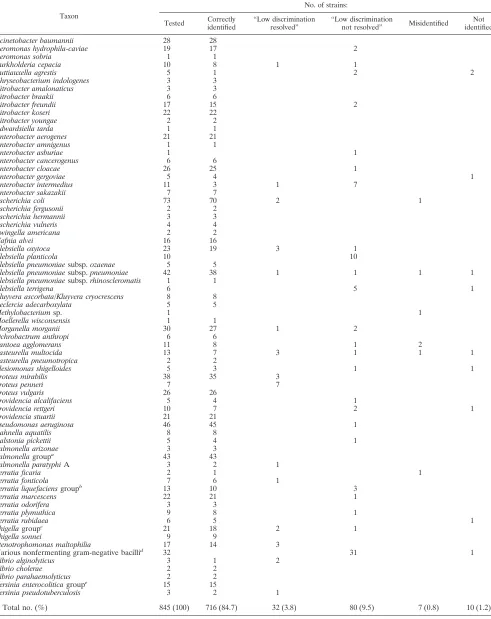
The results of the testing of 845 strains are listed in Table 1. Six hundred and fifty (76.9%) strains were Enterobacteriaceae, and 195 (23.1%) were nonenteric bacilli. Overall, 84.7% of all bacteria were correctly identified (88.2% of the Enterobacteri-aceae and 73.3% of the nonenteric bacilli). Thirty-two (3.8%) strains were correctly identified by additional, simple, rapid tests (see Reporting of results, above). About half of the 80 (9.5%) strains not identified at the species level after applica-tion of the five simple addiapplica-tional tests belonged to the Entero-bacteriaceae (42 of 80), and the other half belonged to the nonenteric rods (38 of 80). Only 7 strains (0.8%) were misi-dentified, and 10 (1.2%) were not identified (which implied not that the organisms were misidentified but that they were treat-ed as such).
No significant differences were observed between the two lab-oratories that tested the system: one institution found 86.7% correct identifications, 2.2% identifications of “low discrimina-tion resolved”, 9.1% identificadiscrimina-tions of “low discriminadiscrimina-tion not resolved”, 0.8% misidentifications, and 1.2% no identifica-tions, whereas the other laboratory observed 82.2%, 5.9%, 10.0%, 0.8%, and 1.1%, respectively.
To carry out a stress test of the system, we included strains belonging to 70 different taxa in our evaluation (Table 1). However, more strains of the most frequently encountered gram-negative bacilli in the routine clinical laboratory, namely Escherichia coli (8.6% of all isolates tested), Pseudomonas aeruginosa (5.4%), Salmonella spp. (5.1%), and K. pneumoniae subsp. pneumoniae (5.0%), were tested than other and more rarely isolated species. When combined, 96.1% of the strains belonging to these four taxa were correctly identified.
In a pragmatic approach, the manufacturer had categorized infrequently encountered and relatively inert nonfermenting bacilli in a group designated “various nonfermenting gram-negative bacilli” (Table 1). These were responsible for 31 of 80 (38.8%) cases in which the identification was interpreted as “low discrimination not resolved”. If these strains were exclud-ed from the evaluation, 88.0% of the strains would have been correctly identified; an additional 3.9% would have been cor-rectly identified after application of simple additional tests. Other taxa with a relatively high percentage of “low discrimi-nation not resolved” results included Enterobacter intermedius, Klebsiella planticola, and Klebsiella terrigena. However, the sys-tem evaluated did not claim to identify the latter two species (which are found very rarely in humans) but these two species always appeared together with Klebsiella oxytoca and K. pneu-moniae subsp. pneupneu-moniae as identification.
The reliability and reproducibility of the system were dem-onstrated by the fact that during only 3 days of the entire evaluation period of 1.5 months was one of the eight quality control strains not correctly identified. The stability of the
system was also demonstrated by retesting the 7 misidentified strains and the 10 nonidentified strains for which the same results were observed upon retesting.
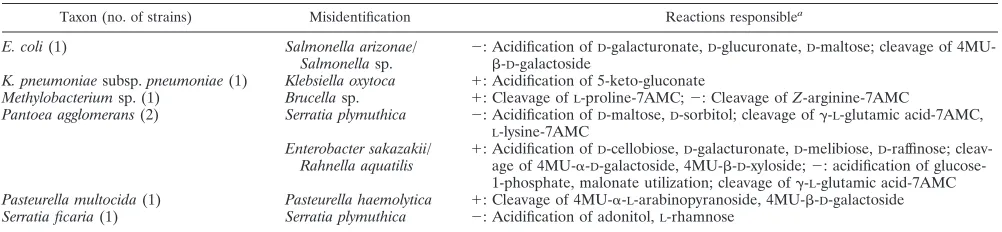
The strains which were misidentified or not identified did not belong to any particular taxon but were distributed over different taxa (Table 1). The problematic reactions for the misidentified strains are outlined in Table 2. None of these reactions was significantly more frequently observed than others.
DISCUSSION
The evaluation presented in this report was mainly a stress test of the system since its database was challenged by a diverse group of organisms, including species which are very rarely encountered in the routine clinical laboratory. An accuracy rate of 88.5% identification to the species level after 3 h (in-cluding the strains for which simple, rapid tests had to be performed) is, in our view, acceptable, although other authors demand a 90% accuracy level (8). The critical point is how to interpret the data for the 9.5% of strains which were identified as “low discrimination not resolved.” The VITEK 2 database does not recommend further tests other than those five simple, immediate ones because the system is aiming at rapid identi-fication for which time-consuming supplementary tests are contraindicated and/or not often performed in a routine clin-ical laboratory. However, experienced clinclin-ical microbiologists may easily find and carry out additional tests which may even-tually lead to the identification at the species level of the 9.5% of strains identified as “low discrimination not resolved.”
It is likely that if a system performs well in a stress test (like the VITEK 2 system in conjunction with the ID-GNB card) it will also do so in a weighted laboratory profile (6). Therefore, it is predicted that the evaluated system may also perform well under the conditions of a routine clinical laboratory.
The fact that nonenteric bacilli were not identified as well as Enterobacteriaceae can be explained by the slower metabolism of some nonenteric bacteria, leading to ambiguous results in the reaction wells. It has also been observed in evaluations of other automated identification systems for gram-negative bac-teria that nonenteric bacilli are usually not identified as well as Enterobacteriaceae (8, 9, 10, 12).
One major advantage of the new VITEK 2 system is its speed in reliably identifying gram-negative rods within 3 h. This is basically achieved by the more sensitive fluorescence-based technology used in the system. By increasing the number of substrates from the previous Vitek GNI1(30 tests) to the ID-GNB card (41 tests), a broader and more detailed database has been built by the company and allows a better discrimina-tion between related taxa. However, even the more sensitive fluorescence-based technology used in the ID-GNB card did not significantly change the outcome of the identifications of some slowly metabolizing nonfermenting bacteria, which were categorized as “various nonfermenting gram-negative bacilli.” Additional taxa included in this group which were not explicitly tested by us included Alcaligenes spp., Bordetella avium, Bor-detella bronchiseptica, CDC group IVc-2 bacteria, Comamonas spp., Pseudomonas alcaligenes, Pseudomonas mendocina, Pseu-domonas pseudoalcaligenes, and Oligella spp. Scientifically, it might be desirable to identify every strain (even the nonfer-menters) at the species level, but it has been stated before, and we agree with this opinion, that identification of certain mem-bers of non-Enterobacteriaceae to the species level may be unnecessary (6), particularly from the clinical point of view. Other medically relevant gram-negative rods which were not tested in our evaluation include Agrobacterium radiobacter, Chryseobacterium meningosepticum, Flavimonas oryzihabitans,
VOL. 36, 1998 VITEK 2 EVALUATION FOR GRAM-NEGATIVE RODS 1949
on May 15, 2020 by guest
http://jcm.asm.org/
Taxon
No. of strains:
Tested identifiedCorrectly “Low discriminationresolved” “Low discriminationnot resolved” Misidentified identifiedNot
Acinetobacter baumannii 28 28
Aeromonas hydrophila-caviae 19 17 2
Aeromonas sobria 1 1
Burkholderia cepacia 10 8 1 1
Buttiauxella agrestis 5 1 2 2
Chryseobacterium indologenes 3 3 Citrobacter amalonaticus 3 3
Citrobacter braakii 6 6
Citrobacter freundii 17 15 2
Citrobacter koseri 22 22
Citrobacter youngae 2 2
Edwardsiella tarda 1 1
Enterobacter aerogenes 21 21
Enterobacter amnigenus 1 1
Enterobacter asburiae 1 1
Enterobacter cancerogenus 6 6
Enterobacter cloacae 26 25 1
Enterobacter gergoviae 5 4 1
Enterobacter intermedius 11 3 1 7
Enterobacter sakazakii 7 7
Escherichia coli 73 70 2 1
Escherichia fergusonii 2 2
Escherichia hermannii 3 3
Escherichia vulneris 4 4
Ewingella americana 2 2
Hafnia alvei 16 16
Klebsiella oxytoca 23 19 3 1
Klebsiella planticola 10 10
Klebsiella pneumoniae subsp. ozaenae 5 5
Klebsiella pneumoniae subsp. pneumoniae 42 38 1 1 1 1
Klebsiella pneumoniae subsp. rhinoscleromatis 1 1
Klebsiella terrigena 6 5 1
Kluyvera ascorbata/Kluyvera cryocrescens 8 8 Leclercia adecarboxylata 5 5
Methylobacterium sp. 1 1
Moellerella wisconsensis 1 1
Morganella morganii 30 27 1 2
Ochrobactrum anthropi 6 6
Pantoea agglomerans 11 8 1 2
Pasteurella multocida 13 7 3 1 1 1
Pasteurella pneumotropica 2 2
Plesiomonas shigelloides 5 3 1 1
Proteus mirabilis 38 35 3
Proteus penneri 7 7
Proteus vulgaris 26 26
Providencia alcalifaciens 5 4 1
Providencia rettgeri 10 7 2 1
Providencia stuartii 21 21
Pseudomonas aeruginosa 46 45 1
Rahnella aquatilis 8 8
Ralstonia pickettii 5 4 1
Salmonella arizonae 3 3
Salmonella groupa 43 43
Salmonella paratyphi A 3 2 1
Serratia ficaria 2 1 1
Serratia fonticola 7 6 1
Serratia liquefaciens groupb 13 10 3
Serratia marcescens 22 21 1
Serratia odorifera 3 3
Serratia plymuthica 9 8 1
Serratia rubidaea 6 5 1
Shigella groupc 21 18 2 1
Shigella sonnei 9 9
Stenotrophomonas maltophilia 17 14 3
Various nonfermenting gram-negative bacillid 32 31 1
Vibrio alginolyticus 3 1 2
Vibrio cholerae 2 2
Vibrio parahaemolyticus 2 2 Yersinia enterocolitica groupe 15 15
Yersinia pseudotuberculosis 3 2 1
Total no. (%) 845 (100) 716 (84.7) 32 (3.8) 80 (9.5) 7 (0.8) 10 (1.2)
aIncludes Salmonella choleraesuis, S. enteritidis, S. paratyphi B, S. paratyphi C, S. typhi, and S. typhimurium. bIncludes Serratia grimesii, S. liquefaciens, and S. proteamaculans.
cIncludes Shigella boydii, S. dysenteriae, and S. flexneri.
dIncludes Acinetobacter lwoffii, Moraxella spp., Pseudomonas fluorescens, Pseudomonas putida, and Pseudomonas stutzeri. eIncludes Yersinia aldovae, Y. enterocolitica, Y. frederiksenii, Y. intermedia, and Y. kristensenii.
1950
on May 15, 2020 by guest
http://jcm.asm.org/
[image:3.612.55.546.69.688.2]Brucella spp., and Burkholderia pseudomallei. It is important to realize that the conclusions drawn in this paper apply to the tested taxa only and that the performance of the VITEK 2 system for some rarely encountered nonfermenting gram-neg-ative rods is not known at present and requires further inves-tigations.
Obviously, the VITEK 2 system in conjunction with the ID-GNB card represents an improvement regarding speed com-pared with the previous VITEK system. In our evaluation, 88.5% of all strains were correctly identified after 3 h, whereas in the evaluation of O’Hara et al., applying the previous GNI1 card, only 47% of all enteric strains were identified in 3 h or less (8). Robinson et al., applying the previous GNI1 card, observed a cumulative percentage of 50.8% correct identifica-tions after 4 h when a less diverse group of organisms was tested, which included 20.9% E. coli strains and 15.6% P. ae-ruginosa strains (10). Pfaller et al., also using the GNI card on the VITEK system, found after 4 h 58% of the enteric bacteria and 15% of the nonenteric bacteria correctly identified (9).
As for the work flow in a routine clinical bacteriology labo-ratory, the VITEK 2 system could be integrated like any other automated identification system. It seems to be possible to start the identification of gram-negative rods from primary cultures, since, for inoculation of a ID-GNB card, a suspension of a 0.5 McFarland standard only has to be prepared in a small volume of saline. Other advantages of the VITEK 2 system are the decreased turnaround and hands-on times since the system is nearly fully automated. We calculated a hands-on time of about 20 min for 10 strains, which included collection of all needed material, preparation of the suspension, filling and loading of the cards into the system, and collection of the computer printouts or review of the identifications. The high degree of automation may also improve accuracy. It has been demonstrated previously that the results obtained with the ID-GNB card are independent of the media (except eosine methylene blue agar and salmonella-shigella agar) on which strains are cultured (1). Factors affecting the quality of the identification are the age of the culture (8- to 24-h cultures are best) and the inoculum (McFarland standard of 0.5 or slightly higher is best) but not the age of the inoculum suspension (5). During the evaluation we did not encounter difficulties regard-ing air bubble formation while fillregard-ing the cards. Gas formation within the reaction wells by some species during the kinetic reading was taken into account by a specific software algo-rithm. The ID-GNB card can be considered safe and resistant to contamination as it is a fully closed system to which no reagents have to be added.
As mentioned before, the database contains a larger number of taxa than are usually encountered in the ordinary routine
clinical laboratory. It was noted that the taxonomy used in the database was up to date. Furthermore, it is emphasized that our evaluation data were valid at the time of our evaluation but that another important value of a commercial identification system lies beyond this performance and must be the capability of manufacturers to maintain or even improve the perfor-mance of an identification system over time.
Unfortunately, the effective costs of performing an analysis on the VITEK 2 using the ID-GNB card could not be calcu-lated at the time of writing this article since the system has not been introduced into the market. However, costs for labor are minimized since the number of manual steps needed has been reduced to a minimum.
Evaluations of the VITEK 2 system (applying the ID-GNB card) by other authors, in particular by directly comparing it with other manual or automated identification systems, are encouraged in order to confirm or contradict the results of our study.
ACKNOWLEDGMENTS
We thank bioMe´rieux (La-Balme-les-Grottes, France) for kindly providing the VITEK 2 system and ID-GNB cards. G.F. is a recipient of an ESCMID research fellowship.
Mireille Desmonceaux and Rachel Cogne are gratefully acknowl-edged for their continuous support in data analysis.
REFERENCES
1. Cuziat, R., S. Cagne`s, R. Cogne, M. Desmonceaux, M. Guicherd, and D.
Monget.1997. Influence of isolation media on the identification of
gram-negative rods using the Vitek II system, abstr. P258. Clin. Microbiol. Infect.
3(Suppl. 2):54.
2. Ewing, W. H. 1986. Edwards and Ewing’s identification of
Enterobacteri-aceae, 4th ed. Elsevier Science Publishing, Inc., New York, N.Y.
3. Farmer, J. J., III, B. R. Davis, F. W. Hickman-Brenner, A. McWorther, G. P.
Huntley-Carter, M. A. Asbury, C. Riddle, H. G. Wathen-Grady, C. Elias, G. R. Fanning, A. G. Steigerwalt, C. M. O’Hara, G. K. Morris, P. B. Smith,
and D. J. Brenner. 1985. Biochemical identification of new species and
biogroups of Enterobacteriaceae isolated from clinical specimens. J. Clin. Microbiol. 21:46–76.
4. Gayral, J. P., R. Robinson, and D. Sandstedt. 1997. A new integrated system for microbiological testing: the Vitek II system, abstr. P254. Clin. Microbiol. Infect. 3(Suppl. 2):53.
5. Guicherd, M., S. Cagne`s, R. Cogne, R. Cuziat, and M. Desmonceaux. 1997. Robustness of gram-negative rod identification with the Vitek II system, abstr. P256. Clin. Microbiol. Infect. 3(Suppl. 2):53.
6. Miller, J. M. 1991. Evaluating biochemical identification systems. J. Clin. Microbiol. 29:1559–1561.
7. O’Hara, C. M., S. B. Roman, and J. M. Miller. 1995. Ability of commercial identification systems to identify newly recognized species of Citrobacter. J. Clin. Microbiol. 33:242–245.
[image:4.612.49.550.80.196.2]8. O’Hara, C. M., G. L. Westbrook, and J. M. Miller. 1997. Evaluation of Vitek GNI1and Becton Dickinson Microbiology Systems Crystal E/NF identifi-cation systems for identifiidentifi-cation of members of the family Enterobacteriaceae and other gram-negative, glucose-fermenting and non-glucose-fermenting TABLE 2. Reactions responsible for misidentifications in the strains tested
Taxon (no. of strains) Misidentification Reactions responsiblea
E. coli (1) Salmonella arizonae/
Salmonella sp. 2: Acidification ofb-D-galactosideD-galacturonate,D-glucuronate,D-maltose; cleavage of 4MU-K. pneumoniae subsp. pneumoniae (1) Klebsiella oxytoca 1: Acidification of 5-keto-gluconate
Methylobacterium sp. (1) Brucella sp. 1: Cleavage ofL-proline-7AMC;2: Cleavage of Z-arginine-7AMC
Pantoea agglomerans (2) Serratia plymuthica 2: Acidification ofD-maltose,D-sorbitol; cleavage ofg-L-glutamic acid-7AMC, L-lysine-7AMC
Enterobacter sakazakii/
Rahnella aquatilis 1: Acidification ofage of 4MU-a-DD-galactoside, 4MU-b--cellobiose,D-galacturonate,D-xyloside;D-melibiose,2: acidification of glucose-D-raffinose; cleav-1-phosphate, malonate utilization; cleavage ofg-L-glutamic acid-7AMC Pasteurella multocida (1) Pasteurella haemolytica 1: Cleavage of 4MU-a-L-arabinopyranoside, 4MU-b-D-galactoside Serratia ficaria (1) Serratia plymuthica 2: Acidification of adonitol,L-rhamnose
a1, false-positive reactions (with regard to the database);2, false-negative reactions (with regard to the database).
VOL. 36, 1998 VITEK 2 EVALUATION FOR GRAM-NEGATIVE RODS 1951
on May 15, 2020 by guest
http://jcm.asm.org/
bacilli. J. Clin. Microbiol. 35:3269–3273.
9. Pfaller, M. A., D. Sahm, C. O’Hara, C. Ciaglia, M. Yu, N. Yamane, G.
Scharnweber, and D. Rhoden.1991. Comparison of the AutoSCAN-W/A
rapid bacterial identification system and the Vitek AutoMicrobic system for identification of gram-negative bacilli. J. Clin. Microbiol. 29:1422–1428. 10. Robinson, A., Y. S. McCarter, and J. Tetreault. 1995. Comparison of Crystal
Enteric/Nonfermenter system, API 20E system, and Vitek automicrobic sys-tem for identification of gram-negative bacilli. J. Clin. Microbiol. 33:364–370. 11. Siegrist, H. H., M. Altwegg, A. Wenger, H. Isenrich, and A. von Graevenitz.
1987. Evaluation of a small “conventional” identification system for fermen-tative gramnegative rods using a computerized data base. Zentbl. Bakteriol. Mikrobiol. Hyg. A 266:370–378.
12. Stager, C. E., and J. R. Davis. 1992. Automated systems for identification of microorganisms. Clin. Microbiol. Rev. 5:302–327.
13. Weyant, R. S., C. W. Moss, R. E. Weaver, D. G. Hollis, J. G. Jordan, E. C.
Cook, and M. I. Daneshvar. 1996. Identification of unusual pathogenic
gram-negative aerobic and facultatively anaerobic bacteria, 2nd ed. Williams & Wilkins, Baltimore, Md.