Proceedings of NAACL-HLT 2018, pages 464–468
Self-Attention with Relative Position Representations
Peter Shaw Google
Jakob Uszkoreit Google Brain [email protected]
Ashish Vaswani Google Brain [email protected]
Abstract
Relying entirely on an attention mechanism, the Transformer introduced by Vaswani et al. (2017) achieves state-of-the-art results for machine translation. In contrast to recurrent and convolutional neural networks, it does not explicitly model relative or absolute po-sition information in its structure. Instead, it requires adding representations of abso-lute positions to its inputs. In this work we present an alternative approach, extend-ing the self-attention mechanism to efficiently consider representations of the relative posi-tions, or distances between sequence elements. On the WMT 2014 English-to-German and English-to-French translation tasks, this ap-proach yields improvements of 1.3 BLEU and 0.3 BLEU over absolute position representa-tions, respectively. Notably, we observe that combining relative and absolute position rep-resentations yields no further improvement in translation quality. We describe an efficient implementation of our method and cast it as an instance of relation-aware self-attention mech-anisms that can generalize to arbitrary graph-labeled inputs.
1 Introduction
Recent approaches to sequence to sequence learn-ing typically leverage recurrence (Sutskever et al., 2014), convolution (Gehring et al., 2017; Kalch-brenner et al., 2016), attention (Vaswani et al., 2017), or a combination of recurrence and atten-tion (Bahdanau et al.,2014;Cho et al.,2014; Lu-ong et al.,2015;Wu et al.,2016) as basic building blocks. These approaches incorporate information about the sequential position of elements differ-ently.
Recurrent neural networks (RNNs) typically compute a hidden state ht, as a function of their
input at timet and a previous hidden stateht−1,
capturing relative and absolute positions along the
time dimension directly through their sequential structure. Non-recurrent models do not necessar-ily consider input elements sequentially and may hence require explicitly encoding position infor-mation to be able to use sequence order.
One common approach is to use position encod-ings which are combined with input elements to expose position information to the model. These position encodings can be a deterministic func-tion of posifunc-tion (Sukhbaatar et al.,2015;Vaswani et al.,2017) or learned representations. Convolu-tional neural networks inherently capture relative positions within the kernel size of each convolu-tion. They have been shown to still benefit from position encodings (Gehring et al., 2017), how-ever.
For the Transformer, which employs neither convolution nor recurrence, incorporating explicit representations of position information is an espe-cially important consideration since the model is otherwise entirely invariant to sequence ordering. Attention-based models have therefore used posi-tion encodings or biased attenposi-tion weights based on distance (Parikh et al.,2016).
In this work we present an efficient way of incorporating relative position representations in the self-attention mechanism of the Transformer. Even when entirely replacing its absolute position encodings, we demonstrate significant improve-ments in translation quality on two machine trans-lation tasks.
Our approach can be cast as a special case of ex-tending the self-attention mechanism of the Trans-former to considering arbitrary relations between any two elements of the input, a direction we plan to explore in future work on modeling labeled, di-rected graphs.
2 Background
2.1 Transformer
The Transformer (Vaswani et al., 2017) em-ploys an encoder-decoder structure, consisting of stacked encoder and decoder layers. Encoder layers consist of two sublayers: self-attention followed by a position-wise feed-forward layer. Decoder layers consist of three sublayers: self-attention followed by encoder-decoder self-attention, followed by a position-wise feed-forward layer. It uses residual connections around each of the sublayers, followed by layer normalization (Ba et al.,2016). The decoder uses masking in its self-attention to prevent a given output position from incorporating information about future output po-sitions during training.
Position encodings based on sinusoids of vary-ing frequency are added to encoder and decoder input elements prior to the first layer. In contrast to learned, absolute position representations, the authors hypothesized that sinusoidal position en-codings would help the model to generalize to se-quence lengths unseen during training by allowing it to learn to attend also by relative position. This property is shared by our relative position repre-sentations which, in contrast to absolute position representations, are invariant to the total sequence length.
Residual connections help propagate position information to higher layers.
2.2 Self-Attention
Self-attention sublayers employhattention heads. To form the sublayer output, results from each head are concatenated and a parameterized linear transformation is applied.
Each attention head operates on an input se-quence, x = (x1, . . . , xn) of n elements where
xi ∈ Rdx, and computes a new sequence z =
(z1, . . . , zn)of the same length wherezi ∈Rdz.
Each output element, zi, is computed as
weighted sum of a linearly transformed input el-ements:
zi= n
X
j=1
αij(xjWV) (1)
Each weight coefficient,αij, is computed using
a softmax function:
αij =
expeij
Pn
k=1expeik
Andeijis computed using a compatibility
func-tion that compares two input elements:
eij = (xiW Q)(x
jWK)T
√
dz
(2)
Scaled dot product was chosen for the compat-ibility function, which enables efficient computa-tion. Linear transformations of the inputs add suf-ficient expressive power.
WQ,WK,WV ∈Rdx×dz are parameter matri-ces. These parameter matrices are unique per layer and attention head.
3 Proposed Architecture
3.1 Relation-aware Self-Attention
We propose an extension to self-attention to con-sider the pairwise relationships between input ele-ments. In this sense, we model the input as a la-beled, directed, fully-connected graph.
The edge between input elements xi andxj is
represented by vectors aVij, aKij ∈ Rda. The mo-tivation for learning two distinct edge represen-tations is that aVij and aKij are suitable for use in eq. (3) and eq. (4), respectively, without requiring additional linear transformations. These represen-tations can be shared across attention heads. We useda=dz.
We modify eq. (1) to propagate edge informa-tion to the sublayer output:
zi= n
X
j=1
αij(xjWV +aVij) (3)
This extension is presumably important for tasks where information about the edge types se-lected by a given attention head is useful to down-stream encoder or decoder layers. However, as ex-plored in 4.3, this may not be necessary for ma-chine translation.
We also, importantly, modify eq. (2) to consider edges when determining compatibility:
eij =
xiWQ(xjWK+aKij)T
√
dz
(4)
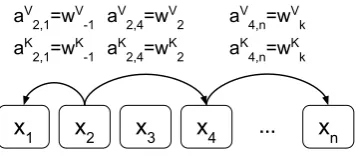
x1 x2 x3 x4 … xn
aV 2,1=w
V -1
aK 2,1=w
K -1
aV 2,4=w
V 2
aK 2,4=w
K 2
aV 4,n=w
V k
aK 4,n=w
[image:3.595.93.272.69.147.2]K k
Figure 1: Example edges representing relative posi-tions, or the distance between elements. We learn rep-resentations for each relative position within a clipping distancek. The figure assumes2 <= k <= n−4.
Note that not all edges are shown.
3.2 Relative Position Representations
For linear sequences, edges can capture infor-mation about the relative position differences be-tween input elements. The maximum relative po-sition we consider is clipped to a maximum abso-lute value ofk. We hypothesized that precise rel-ative position information is not useful beyond a certain distance. Clipping the maximum distance also enables the model to generalize to sequence lengths not seen during training. Therefore, we consider2k+ 1unique edge labels.
aKij =wclip(K j−i,k)
aVij =wclip(V j−i,k)
clip(x, k) = max(−k,min(k, x))
We then learn relative position representations wK = (wK
−k, . . . , wKk )andwV = (wV−k, . . . , wVk)
wherewK
i , wVi ∈Rda.
3.3 Efficient Implementation
There are practical space complexity concerns when considering edges between input elements, as noted by Veliˇckovi´c et al. (2017), which consid-ers unlabeled graph inputs to an attention model.
For a sequence of length n and h attention heads, we reduce the space complexity of storing relative position representations from O(hn2d
a)
to O(n2da) by sharing them across each heads.
Additionally, relative position representations can be shared across sequences. Therefore, the over-all self-attention space complexity increases from O(bhndz)toO(bhndz+n2da). Givenda = dz,
the size of the relative increase depends on n bh.
The Transformer computes self-attention effi-ciently for all sequences, heads, and positions in
a batch using parallel matrix multiplication opera-tions (Vaswani et al.,2017). Without relative posi-tion representaposi-tions, eacheij can be computed
us-ingbhparallel multiplications ofn×dzanddz×n
matrices. Each matrix multiplication computeseij
for all sequence positions, for a particular head and sequence. For any sequence and head, this requires sharing the same representation for each position across all compatibility function applica-tions (dot products) with other posiapplica-tions.
When we consider relative positions the repre-sentations differ with different pairs of positions. This prevents us from computing all eij for all
pairs of positions in a single matrix multiplication. We also want to avoid broadcasting relative po-sition representations. However, both issues can be resolved by splitting the computation of eq. (4) into two terms:
eij =
xiWQ(xjWK)T +xiWQ(aKij)T
√
dz
(5)
The first term is identical to eq. (2), and can be computed as described above. For the second term involving relative position representations, tensor reshaping can be used to computenparallel multi-plications ofbh×dzanddz×nmatrices. Each
ma-trix multiplication computes contributions to eij
for all heads and batches, corresponding to a par-ticular sequence position. Further reshaping al-lows adding the two terms. The same approach can be used to efficiently compute eq. (3).
For our machine translation experiments, the re-sult was a modest 7% decrease in steps per sec-ond, but we were able to maintain the same model and batch sizes on P100 GPUs as Vaswani et al. (2017).
4 Experiments
4.1 Experimental Setup
We use the tensor2tensor1library for training and evaluating our model.
We evaluated our model on the WMT 2014 machine translation task, using the WMT 2014 English-German dataset consisting of approxi-mately 4.5M sentence pairs and the 2014 WMT English-French dataset consisting of approxi-mately 36M sentence pairs.
Model Position Information EN-DE BLEU EN-FR BLEU Transformer (base) Absolute Position Representations 26.5 38.2
Transformer (base) Relative Position Representations 26.8 38.7
[image:4.595.92.507.62.131.2]Transformer (big) Absolute Position Representations 27.9 41.2 Transformer (big) Relative Position Representations 29.2 41.5
Table 1: Experimental results for WMT 2014 English-to-German (EN-DE) and English-to-French (EN-FR) trans-lation tasks, using newstest2014 test set.
For all experiments, we split tokens into a 32,768 word-piece vocabulary (Wu et al.,2016). We batched sentence pairs by approximate length, and limited input and output tokens per batch to 4096 per GPU. Each resulting training batch con-tained approximately 25,000 source and 25,000 target tokens.
We used the Adam optimizer (Kingma and Ba, 2014) withβ1 = 0.9,β2 = 0.98, and = 10−9.
We used the same warmup and decay strategy for learning rate as Vaswani et al. (2017), with 4,000 warmup steps. During training, we employed la-bel smoothing of valuels = 0.1 (Szegedy et al.,
2016). For evaluation, we used beam search with a beam size of 4 and length penaltyα= 0.6 (Wu
et al.,2016).
For our base model, we used 6 encoder and de-coder layers, dx = 512, dz = 64, 8 attention
heads, 1024 feed forward inner-layer dimensions, and Pdropout = 0.1. When using relative
posi-tion encodings, we used clipping distancek= 16,
and used unique edge representations per layer and head. We trained for 100,000 steps on 8 K40 GPUs, and did not use checkpoint averaging.
For our big model, we used 6 encoder and de-coder layers, dx = 1024, dz = 64, 16 attention
heads, 4096 feed forward inner-layer dimensions, andPdropout= 0.3for EN-DE andPdropout= 0.1
for EN-FR. When using relative position encod-ings, we usedk= 8, and used unique edge repre-sentations per layer. We trained for 300,000 steps on 8 P100 GPUs, and averaged the last 20 check-points, saved at 10 minute intervals.
4.2 Machine Translation
We compared our model using only relative po-sition representations to the baseline Transformer (Vaswani et al.,2017) with sinusoidal position en-codings. We generated baseline results to iso-late the impact of relative position representations from any other changes to the underlying library and experimental configuration.
For English-to-German our approach improved performance over our baseline by 0.3 and 1.3 BLEU for the base and big configurations, respec-tively. For English-to-French it improved by 0.5 and 0.3 BLEU for the base and big configurations, respectively. In our experiments we did not ob-serve any benefit from including sinusoidal posi-tion encodings in addiposi-tion to relative posiposi-tion rep-resentations. The results are shown in Table1.
4.3 Model Variations
We performed several experiments modifying var-ious aspects of our model. All of our experi-ments in this section use the base model configura-tion without any absolute posiconfigura-tion representaconfigura-tions. BLEU scores are calculated on the WMT English-to-German task using the development set, new-stest2013.
We evaluated the effect of varying the clipping distance,k, of the maximum absolute relative po-sition difference. Notably, fork ≥ 2, there does not appear to be much variation in BLEU scores. However, as we use multiple encoder layers, pre-cise relative position information may be able to propagate beyond the clipping distance. The re-sults are shown in Table2.
k EN-DE BLEU
0 12.5
1 25.5
2 25.8
4 25.9
16 25.8 64 25.9 256 25.8
Table 2: Experimental results for varying the clipping distance,k.
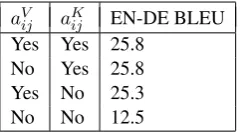
[image:4.595.369.466.547.649.2]be sufficient, but further work is needed to deter-mine whether this is true for other tasks. The re-sults are shown in Table3.
aVij aKij EN-DE BLEU
Yes Yes 25.8 No Yes 25.8 Yes No 25.3
[image:5.595.122.243.111.177.2]No No 12.5
Table 3: Experimental results for ablating relative po-sition representationsaV
ijandaKij.
5 Conclusions
In this paper we presented an extension to self-attention that can be used to incorporate rela-tive position information for sequences, which im-proves performance for machine translation.
For future work, we plan to extend this mecha-nism to consider arbitrary directed, labeled graph inputs to the Transformer. We are also inter-ested in nonlinear compatibility functions to com-bine input representations and edge representa-tions. For both of these extensions, a key consid-eration will be determining efficient implementa-tions.
References
Jimmy Lei Ba, Jamie Ryan Kiros, and Geoffrey E Hin-ton. 2016. Layer normalization. arXiv preprint arXiv:1607.06450.
Dzmitry Bahdanau, Kyunghyun Cho, and Yoshua Ben-gio. 2014. Neural machine translation by jointly learning to align and translate. arXiv preprint arXiv:1409.0473.
Kyunghyun Cho, Bart Van Merri¨enboer, Caglar Gul-cehre, Dzmitry Bahdanau, Fethi Bougares, Holger Schwenk, and Yoshua Bengio. 2014. Learning phrase representations using rnn encoder-decoder for statistical machine translation. arXiv preprint arXiv:1406.1078.
Jonas Gehring, Michael Auli, David Grangier, De-nis Yarats, and Yann N Dauphin. 2017. Convolu-tional sequence to sequence learning. arXiv preprint arXiv:1705.03122.
Nal Kalchbrenner, Lasse Espeholt, Karen Simonyan, Aaron van den Oord, Alex Graves, and Koray Kavukcuoglu. 2016. Neural machine translation in linear time. arXiv preprint arXiv:1610.10099. Diederik Kingma and Jimmy Ba. 2014. Adam: A
method for stochastic optimization. arXiv preprint arXiv:1412.6980.
Minh-Thang Luong, Hieu Pham, and Christopher D Manning. 2015. Effective approaches to attention-based neural machine translation. arXiv preprint arXiv:1508.04025.
Ankur P Parikh, Oscar T¨ackstr¨om, Dipanjan Das, and Jakob Uszkoreit. 2016. A decomposable attention model for natural language inference. InEmpirical Methods in Natural Language Processing.
Sainbayar Sukhbaatar, Jason Weston, Rob Fergus, et al. 2015. End-to-end memory networks. InAdvances in neural information processing systems. pages 2440–2448.
Ilya Sutskever, Oriol Vinyals, and Quoc V Le. 2014. Sequence to sequence learning with neural net-works. InAdvances in neural information process-ing systems. pages 3104–3112.
Christian Szegedy, Vincent Vanhoucke, Sergey Ioffe, Jon Shlens, and Zbigniew Wojna. 2016. Rethinking the inception architecture for computer vision. In Proceedings of the IEEE Conference on Computer Vision and Pattern Recognition. pages 2818–2826.
Ashish Vaswani, Noam Shazeer, Niki Parmar, Jakob Uszkoreit, Llion Jones, Aidan N Gomez, Łukasz Kaiser, and Illia Polosukhin. 2017. Attention is all you need. InAdvances in Neural Information Pro-cessing Systems. pages 6000–6010.
Petar Veliˇckovi´c, Guillem Cucurull, Arantxa Casanova, Adriana Romero, Pietro Li`o, and Yoshua Bengio. 2017. Graph attention networks. arXiv preprint arXiv:1710.10903.