CEC Theses and Dissertations College of Engineering and Computing
2017
Contextualizing Secure Information System
Design: A Socio-Technical Approach
Abdul Rahim Charif
Nova Southeastern University,[email protected]
This document is a product of extensive research conducted at the Nova Southeastern UniversityCollege of Engineering and Computing. For more information on research and degree programs at the NSU College of Engineering and Computing, please clickhere.
Follow this and additional works at:https://nsuworks.nova.edu/gscis_etd
Part of theComputer Sciences Commons
Share Feedback About This Item
This Dissertation is brought to you by the College of Engineering and Computing at NSUWorks. It has been accepted for inclusion in CEC Theses and Dissertations by an authorized administrator of NSUWorks. For more information, please [email protected].
NSUWorks Citation
Abdul Rahim Charif. 2017.Contextualizing Secure Information System Design: A Socio-Technical Approach.Doctoral dissertation. Nova Southeastern University. Retrieved from NSUWorks, College of Engineering and Computing. (999)
Contextualizing Secure Information System Design: A Socio-Technical Approach
By
Abdul Rahim Charif
A Dissertation submitted in partial fulfillment of the requirements for the degree of Doctor of Philosophy
in
Information Assurance
College of Engineering and Computing Nova Southeastern University
i
An Abstract of a Dissertation Submitted to Nova Southeastern University in Partial Fulfillment of the Requirements for the Degree of Doctor of Philosophy in Information Systems
Contextualizing Secure Information System Design: A Socio-Technical
Approach
by
Abdul Rahim Charif
Secure Information Systems (SIS) design paradigms have evolved in generations to adapt to IS security needs. However, modern IS are still vulnerable and are far from secure. The development of an underlying IS cannot be reduced to “technological fixes” neither is the design of SIS. Technical security cannot ensure IS security. Generations of SIS design paradigms have evolved, all with their own sets of shortcomings. A SIS design paradigm must meet well-defined requirements, yet contemporary paradigms do not meet all these requirements. Current SIS design paradigms are not easily applicable to IS. They lack a comprehensive modeling support and ignore the socio-technical organizational role of IS security. This research introduced the use of action research in design science research. Design science paradigm was leveraged to introduce a meta-design artifact explaining how IS requirements including security requirements can be incorporated in the design of SIS. The introduced artifact CSIS provided design comprehensiveness to emergent and changing requirements to IS from a socio-technical perspective. The CSIS artifact meets secure system meta-design requirements. This study presented a secure IS design
ii
Acknowledgments
I wish to thank my supervisor for his important comments concerning the dissertation and for his support to my research endeavors. I would like to thank my parents, for their immense support throughout this PhD research process. Gratitude also goes to my colleagues and friends, whose support I have always appreciated.
iii
Table of Contents
Abstract i
Acknowledgements ii
Table of Contents iii
List of Tables v
List of Figures vi
Chapters 1. Introduction 1.1. Introduction 1
1.2. Research Problem and Argument 3
1.3. Importance of Research Problem 5
1.4. Definition of Terms 8
1.5. Summary 9
2. Literature Review 2.1. Introduction 10
2.2. IS Design Approaches 10
2.2.1. Formal life cycle approach (classical) 10
2.2.2. Structured approaches 11
2.2.3. Prototyping approaches 12
2.2.4. Sense-making approaches 13
2.2.5. Trade Union approaches 13
2.2.6. Emancipatory approaches 14
2.2.7. Socio-technical and participative approaches 15
2.3. Business Process and Business Process Realization 16
2.4. SIS Design Approaches 17
2.4.1. Traditional SIS design (Frist and Second generations) 17
2.4.2. Contemporary SIS design (Third and Fourth generations) 18
2.5. Summary 23
3. Research Design and Methodology 3.1. Introduction 24
3.2. Problem Identification and Motivation 25
3.3. Definition of the objective for a solution 26
3.4. Design and Development 29
3.5. Demonstration 40
3.6. Evaluation 42
3.6.1. Evaluation using Action research 45
3.7. Research Setting and Organization Selection 52
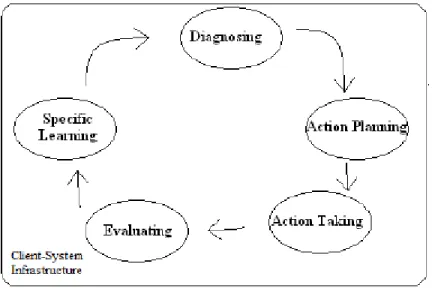
3.7.1. Diagnosis 55
3.7.2. Action Planning 58
3.7.3. Action Taking 60
3.7.4. Evaluation 60
3.8. Data Analysis 61
3.9. Validity Criteria for Action Research 63
iv
4. Journey to Cloud Cadence – Action Research
4.1. Introduction 65
4.2. Adopting a New Source Control Paradigm 65
4.3. Background and Participants 69
4.4. Research Strategy and Position of Researcher 70
4.5. Source Control Management System Project 73
4.5.1. Research Cycle One 73
4.5.2. Research Cycle Two 85
4.5.3. Research Cycle Three 87
4.5.4. Research Cycle Four 90
4.5.5. Research Cycle Five 92
4.6. Focus Group for Design Artifact Refinement and Evaluation 94
4.6. Discussion 101 4.7. Conclusion 102 5. Conclusion 5.1.Introduction 104 5.2. Research Findings 105 5.3. Research Results 107
5.4. Research Validity Criteria 108
5.5. Research Contributions 111
5.6. Implications for Practice 113
5.7. Limitations 113
5.8. Future Research 114
5.9. Conclusion 115
Appendix 117
v
List of Tables
Table 1. An Overview of Contemporary SIS design approaches 19
Table 2. RBAC Limitations in IS 28
Table 3. Booking Use Case 40
Table 4. Design Evaluation Methods Applicability 44
Table 5. Overview of Action Research Processes 55
Table 6. Diagnosis Action Questions 58
Table 7. Action Planning Questions 59
Table 8. Evaluating Action Questions 62
Table 9. Research Participants 71
Table 10. Design Science Research Validity Criteria 104
Table 11. Research Hypotheses 107
vi
List of Figures
Figure 1. The RBAC Model 28
Figure 2. The OrBAC Model 32
Figure 3. CSIS Design Artifact 35
Figure 4. SIS Design Method Research Model to Test Security Awareness 38
Figure 5. Booking Co. Secure Business Process Realization 41
Figure 6. The Action Research Cycle 48
Figure 7. Cyclic Process of Action Research 52
Figure 8. Revised CSIS Design Artifact 89
Figure 9a. Management System Prototype for Distributed Version Control System Based on CSIS Design Artifact 97
Figure 9b. Management System Prototype for Distributed Version Control System Based on CSIS Design Artifact 97
Chapter 1
Introduction
1.1. Introduction
The advances in network communication introduced growing use of global
communications in information systems (IS). The increased dependency on computer communications and IS increased the threat of incidents related to information security. According to the U.S. Information Security Oversight Office, estimated costs associated with information security were $5.2 billion in 2010 (ISOO, 2015). ISOO reports indicate that information security continues to be the main driver of all IS costs. Cybercrime continues to cost billions of dollar to organizations. The importance of this research stems from this ongoing and well-known issue in IS security research; organizations continue to lose substantial amounts of money due to failure in securing IS. According to the most recent US cybercrime survey (Burg et al., 2014), out of the 500 respondents who did report their losses, the average annual monetary loss was approximately $415,000 for each organization. A great increase compared to prior years (Peters, 2009). In 2014, three in four respondents to the US State of cybercrime survey detected a security event in the past 12 months, and more than a third said the number of security incidents detected increased over the previous year.
In response, to ensure the security of information systems, researchers and practitioners have created different secure information system (SIS) design methods. Siponen et al., (2006) called for additional research as the review of existing methods indicate the need
for development of theoretically and empirically grounded SIS design methods. The existing SIS design methods are theoretically underdeveloped and lacking “serious research” (Baskerville, 1992) or filled with “nonsense” (Olnes, 1994 p. 628).
Siponen et al., (2006) contended that as the design theory approach has proved successful in prescribing better design processes for emergent classes of systems, reframing
development of SIS design methods as a design science activity is a promising way to advance past this problem.
Siponen et al., (2006) defined six meta-design requirements to be met for a secure information system design. Siponen et al., (2006) asserted that the design of a secure information system cannot be reduced to technological fixes. Different SIS approaches cover different levels of IS but the models lack the comprehensiveness needed (Siponen, 2002). The overall aim of this research was to produce a SIS design method that is theoretically and empirically grounded. In pursuing this aim, this research developed a design artifact that includes security as a functional requirement in all stages of system design. The research problem and the research argument is described in Section 1.1. Importance of investigating the research problem is argued in Section 1.2. The definitions adopted in this study for the purposes of clarity and consistency of terms are described in Section 1.3. Literature review of secure IS design is discussed in chapter 2. The design science research process model is discussed in chapter 3 (Peffers et al., 2008). Action research and research findings are discussed in chapter 4. Finally, concluding the study in chapter 5.
1.2. Research Problem and Argument
Too often, information security is an afterthought in organizations. Organizations spend time and effort on designing and implementing security solutions for their IS as a repercussion of implementing the IS itself. However, these efforts are not as effective since security design aspects were not considered during the initial IS design and due to a lack of proper understanding of organizational context. The existing SIS design methods, at least the ones that can be integrated easily into IS or software development process have a narrow technical focus ignoring organizational aspects (Siponen, 2002; Siponen et al., 2006).
Other methods that take a socio-technical stance towards the organizational role of IS security e.g. viable systems (Karyda et al., 2001) suffer from applicability issues. Such methods cannot be integrated into IS development process. The need for a SIS design method that provides comprehensive modeling of technical and formal aspects of IS is being felt and is becoming more evident in literature (Siponen et al., 2006). Despite the wealth of literature in IS security, emergent SIS design approaches continue to fail in securing IS in organizations.
Information security design aspects have been ignored in IS development methods. In the literature, there has been a call for a SIS design method that goes beyond implementation of technical controls and includes organizational aspects (Siponen, 2002; Siponen et al., 2006). The research problem investigated in this study is how to design a secure
included in all IS development stages including design stages (D'Aubeterre et al., 2008). However, such modeling does not consider the context at which the organization operates under and thus does not provide design comprehensiveness (Siponen et al., 2006). This research argued that in order to secure the processes of information system in an
organization, it is fundamental to understand the context of organizational processes and activities. Capturing the context of processes and activities within IS is essential to understand IS security requirements.
This dissertation contended that in order for secure information system design to be successful, a proper understanding of the context of the underlying information system activities and business processes is essential. Information systems security research needs to mature from mechanistic tendencies and ground itself in contextualism (Tejay, 2008). When considering the relevance and applicability of a given approach, one should bear in mind the context of the organization and environment where an approach will be applied. Using the context of activities to evaluate IS security allows for more control over IS. Therefore, incorporating the context of activities and processes when defining security requirements ensures the security of the information system design and helps incorporate security in all IS design stages.
The challenge for organizations lies in the ability to include IS security design aspects in the IS development process. This research study extended the existing body of
knowledge in SIS design in three areas. First, this research study addressed a gap in the existing research by developing a theoretically grounded and comprehensive approach on
how to design a secure IS that can be integrated into all IS development stages. Second, this research study investigated how to integrate socio-technical aspects in IS
development stages using the context of processes in IS and organization. Finally, there has been limited research in examining the dynamics of access control during security requirement analysis and design stages (D'Aubeterre et al., 2008). This research included IS security requirements along with access control dynamics in all IS design stages.
1.3. Importance of Research Problem
All SIS design methods come with their own shortcomings. Siponen (2002) outlined the evolution of SIS design methods in literature in terms of their influencing disciplines: “IS security, computer security, practitioners, database security, and cryptology”. Siponen (2002) also extended the generational classification of IS design approaches originally proposed by Baskerville (1992) to include disciplines of security (see Appendix A).
Early SIS design generations “naturalistic-mechanistic” were mainly advocated by practitioners and computer science researchers. Such approaches are means oriented, they are aimed at finding out what can be done, or what should the organization do with the help of available technical solutions. These design approaches fail to ensure the security of IS because they only focus on technical aspects of SIS design and do not take IS security requirements as a point of departure during IS design. Early SIS design generations failed to provide comprehensive security coverage to all aspects of system design.
Later generations were focused on IS modeling aspects. Unlike mechanistic methods, this generation considers organizational requirements during IS design. However, they focus heavily on business process modeling and information modeling. The objective in this approach is to extend security issues into workflow and business process management. Rohm et al., (1998) and Herrmann & Pernul (1999) suggested a layered framework according to which the security (mainly confidentiality and integrity) requirements of business processes can be modeled.
The responsibility modeling approach was first proposed in the third generation (Dobson, 1990) based on the idea that finding and modeling work responsibilities as the key point of departure for securing system. This idea was later adopted by Backhouse
& Dhillon (1996) and McDermott & Fox (1999) using a socio-technical lens rather than a modeling approach. Applicability to SIS design is a major concern when it comes to responsibility modeling since there is no model that explains how responsibilities can be integrated into IS design process. The viable approach of Hutchinson and Warren (2000) is incorporated into the third generation domain due to the technical organizational role attributed to IS security. Limitations of third generation approach are discussed in detail in literature review section.
The emerging “socio-technical” generation takes the organizational security requirements as a first step in developing SIS design and does not just replace the organization's unique information security requirements for a generic list of predefined protection means
acknowledges the interaction between people and technology. It highlights the interrelatedness of social and technical aspects of an organization as a whole.
Securing the technical aspects of an organization cannot be achieved without considering social aspects of processes. This generation includes soft system approach by James (1996), responsibility modeling (Dhillon, 1997), and survivable systems (Karyda et al., 2001).
The responsibility modeling SIS design approach believe that the security requirements can be modeled by exploring the role responsibilities in organizations Dhillon (1997). Karyda et al., (2001) argued that instead of focusing on secure IS, research should focus on viable IS. In other words, a secure system should survive or be survivable in the face of attacks. The “Orion strategy” proposed by James (1996) stems from Checklands (1981) soft system methodology. James (1996) was the first to embed user participation in designing secure IS. The Orion strategy emphasizes participation of people in defining what needs to be done in terms of managing security in information systems.
Emergent literature focuses on socio-technical approaches to IS design, perhaps the biggest problem with the existing socio-technical design paradigm is developmental duality, i.e., they do not provide any guidance as to how their design approaches could be integrated into the IS development process (Baskerville, 1992). Applicability to
information system and software development (Baskerville, 1992) is needed to explore whether the secure information system design approach can be integrated into
have an applicable socio-technical approach for secure IS design that includes security requirements from both aspects (social and technical).
1.4. Definitions of Terms
Three classes of definitions are required to establish the conceptual boundaries of this research. For the purposes of this dissertation, definitions of select terms used are provided.
Information System is defined as an aggregate of information handling activities at a technical, formal and informal level of an organization (Liebenau & Backhouse, 1990). This is consistent with Karyda et al., (2001) view of an information system as “a human activity system comprising five elements, namely hardware, software, data, procedures and, above all, people…in order to support human activities in the context of an
organization.” (Karyda et al., 2001 p. 454.). The hardware, software, and data comprise
the technical level. Procedures comprise the formal level. The formal level is bounded by rules used to control organizations. This research proposes to model the context of procedures, behaviors and human activities and define the context of procedures in terms of rules in the formal level to control organization. Finally, people or the informal
character of information systems is expressed in people’s assumptions, expectations, beliefs and informal goals, which comprise the informal level of an information system.
Information System Security has been traditionally defined by computer science researchers from a technical perspective adopting the CIA triad (Bishop, 2003). This
definition does not align with the view of IS security adopted in this research. The organizational role in information security is socio-technical. The definition adopted in this dissertation considered information systems security as a well-informed sense of assurance that information risks and controls are in balance (Anderson, 2003). This definition aligns well with this research as it acknowledges the existence of formal levels in information systems in terms of organizational control.
Business Process and Business Process Modeling (BPM) have many definitions as discussed in the literature review. This research followed the definition by D'Aubeterre et al., (2008a) which views a business process as a set of coordinated activities, enacted by human or software agents that exchange knowledge resources to achieve business objectives.
1.5. Summary
This research investigated secure IS design. The research problem was introduced in chapter 1. Discussion of relevant literature on secure IS design approaches is presented in chapter 2. The research design and methodology are presented in chapter 3. Action research is presented in chapter 4. Findings, implications, and limitations of this study are presented in chapter 5. Conclusions are presented in chapter 6.
Chapter 2
Literature Review
2.1. Introduction
In the first section, the evolution of IS development methodologies in terms of
generations and paradigms is presented (Hirschheim & Klein, 1992). Generations and paradigms in SIS design are then presented (Siponen, 2002). An explanation for positioning this research in socio-technical paradigm is then presented. This review provided a basis for the suggested approach based on organization based access control (OrBAC) (Kalam et al., 2003) as the kernel theory.
2.2. IS Design Approaches
IS development (ISD) methodologies as portrayed by (Hirschheim & Klein, 1992) are presented first. Chronologically, there are seven generations of ISD approaches (Formal, Structured, Prototyping, Sense-making, Trade-union, Emancipatory and Socio-technical) approaches. These methodologies fall within four paradigms (functionalism, social relativism, radical structuralism, neo-humanism) based on their ontological and epistemological assumptions (Hirschheim & Klein, 1992).
2.2.1. Formal life cycle approach (classical)
The earliest of ISD generations was inspired by system development approach in software engineering. This generation was known as the formal, traditional or classical approach. The term software engineering started in the early 70’s, which referred to
well-structured methods and tools for program design, implementation, and testing once system requirements are given.
Too many projects were failures, the importance of information systems planning for determination of requirements and priorities of projects was noted in IS management. Blumenthal (1969) suggested “planned evolution” as a methodology for orderly,
organization-wide IS development based on his experience with systems development. IS development depended on codified techniques that eventually were formalized into a “methodology”.
IS are built from the requirements elicited by the system analyst from the users. User requirements elicitation was considered difficult but not a noncontroversial exercise. Users provided information is the basis for IS requirements. This rational strategy formed what is called a “System Development Life Cycle” (SDLC). SDLC is the “classical” ISD approach which iterates through five general steps (requirements analysis, design,
implementation, testing, and evolution). According to Elliot (2004), SDLC "originated in the 1960s, to develop scale functional business systems in an age of large-scale business conglomerates. Information systems activities revolved around heavy data processing and number crunching routines".
2.2.2. Structured approaches
The formal SDLC approach suffered from major problems that led to the development of the structured approach (Hirschheim & Klein, 1992). From a system developer
perspective, the design of the system is almost impossible because of changing user requirements. From the users’ perspective, it was hard to know in advance what the implemented system should look like. To address these issues, a more structured approach was suggested using a “sign off” and the “structured walk through” (Hirschheim & Klein, 1992).
The sign off allows the system analyst to work to an agreed specification that was signed off by the users. The structured work through allows the users to have an understanding of what the finished product would look like as they were formally “walked through” the details of the system design during formal sessions. IS development was still perceived as a technical process, although the social consequences were acknowledged and somewhat considered in the structured walkthrough.
2.2.3. Prototyping approaches
In the late 80’s, the structured and formal approaches became problematic as they slowed down the design and development of systems. Users could no longer wait for a formal life cycle to finish, the implemented system would no longer meet the user requirements after two or three years of development. The idea emerged that users needed to
experience the application software to better understand what the application would look like. Naumann & Jenkins (1982) and Earl (1978) suggested using a prototyping approach. A prototype is a scaled-down variant of the final system that exhibits some of its salient features to allow the users to get a feel of the interface and the computational power.
2.2.4. Sense-making approaches
One concern behind the structured approaches was problem formulation. Some argued that it can be easily tackled using a scientific approach to problem-solving (Newell & Simon, 1972). Checkland (1981) had a different perspective with his soft system
methodology (SSM). Checkland (1981) believed that there must be a richer interpretation of the “problems of problem formulation”. “Problems” or user requirements are not easily articulated, it may be misleading to assume that a problem exists rather that one is constructed between various stakeholders (Hirschheim & Klein, 1992).
Following this approach and as an extension of SSM, “sense making” methodologies emerged. The argument behind this approach is the need to develop approaches that would lead to a better mutual understanding between users and developers to avoid problem formulation. “sense making” can be defined as “the modes in which a group interacts to interpret their environment and arrive at socially shared meanings” (Klein
and Hirschheim, 1987, p.302). System development in “sense making” is perceived as a social process. However, the projects that surfaced from sense making approach never matured into a complete methodology (Klein and Hirschheim, 1987).
2.2.5. Trade Union approaches
In trade union approaches, system development is seen as part art, part science, and part class politics; it’s conceived as a very much social process rather than a technical one. It was a reaction to the negative social effects of generation 1 and 2 approaches. The
approach argues that control of system development should be in the hands of the workforce rather than management (Kubicek, 1983). Proponents of this approach felt that a socio-technical approach is a form of deceit to reduced worker resistance to systems that served mostly the interest of managers and offered little to improve worker position. A set of projects immersed that introduced a set of general guidelines, tools, and techniques that would allow the trade union to dictate the system direction (Hirschheim & Klein, 1992). However, there is not much research on evaluation of this approach.
2.2.6. Emancipatory approaches
An emancipatory approach is merely a conceptual approach supported by the emancipatory ideals. There are no developed projects that adopted the emancipatory theme. The emancipatory approach conceives system development as a social process and sees the need for sense-making (called “mutual understanding” in this approach). The difference from other approaches is in the orientation towards emancipation through rational and emancipatory discourse.
The goal of systems development is a system that would not only support emancipatory discourse but also a mutual understanding of all its users. Hershihem & Klien (1994) explored the emancipatory principles and discussed how they might be applied in information systems development. Existing ISD methodologies only partially embrace emancipatory principles (Hershihem & Klien 1994).
2.2.7. Socio-technical and participative approaches
System development in this approach is seen as part art and part science. It is viewed jointly as a social and technical process. The structured and prototyping approaches progressed the field greatly, but there were few issues identified by IS research (Mumford (1998); Land & Hirschheim (1983)). IS researchers felt that sign offs and structured walk-throughs were potentially helpful but were fundamentally misguided in their ability to elicit true user involvement (Hirschheim & Klein, 1992). System development had traditionally focused on the technical systems rather than the social systems. This led to information systems that might have been technically sophisticated but was not ideal from a social or work standpoint (Hirschheim & Klein, 1992).
The socio-technical approach adopted in this study suggest that interventions should lead to an improved social as well as technical systems. System development in the socio-technical approach uses system development as a vehicle to rethink the social work environment in which the new system would be implemented. According to (Hirschheim & Klein, 1992) all socio-technical approaches should focus on having the users not only be involved in systems development but take control of the process; and having systems development to be used to redesign the work situation leading to an improve social and technical system.
2.3. Business Process and Business Process Realization
D'Aubeterre et al., (2008) argued that SIS design must incorporate security as a
functional requirement in the early stages of requirement specification and analysis of IS. To do so, there must be an understanding of how business processes are coordinated to achieve their objective. This allows eliciting security requirements from the context of business processes. A business process is a set of coordinated activities, enacted by human or software agents that exchange knowledge resources to achieve business objectives (D'Aubeterre et al., 2008). An organization’s business processes comprise value activities that create customer value (Porter & Millar, 1985). These activities must be coordinated to achieve the business goals effectively. Business processes require coordination mechanisms to manage the interdependencies of their constituent activities (Malone, 1987).
The security of knowledge resources must be ensured. Information and knowledge resources sharing may lead to possible unauthorized access and usage which in turn would cause loss of assets. An organization may incur significant costs without
appropriate and timely authorization access to information resources when performing business activities (D'Aubeterre et al., 2008).
From an IS perspective, IS researchers are moving away from the security technical viewpoint toward a socio-organizational perspective (D'Aubeterre et al., 2008). This movement may lead to more holistic IS security research where organizational security aspects are incorporated in the design and development of SIS. Hence, capturing the
business process context will allow integrating security in the design and development of SIS.
2.4. SIS Design Approaches
Secure IS design was inspired by many disciplines including IS development and
computer science approaches. Baskerville (1992) provided an overview of conventional SIS design approaches (normative standards, risk management, formal methods, and common sense principles). More recently, Siponen (2002) conducted an analysis of contemporary SIS design approaches (see Appendix A.). Some of these methods either lack serious research or suffer from development duality. These methods cannot be easily integrated to IS development process (Siponen, 2002).
2.4.1. Traditional SIS design (First and Second generations)
The first and second generation (Naturalistic-Mechanistic) of SIS design were focused on what can be done as opposed to what needs to be done from a technical point of view. This generation was described in Baskerville (1992) which included normative standards, risk management, formal methods, and common sense principles. Normative standards referred to checklists, management and maturity standards. The idea behind checklists is to write down what are the possible security solutions that can be identified and turn it into a list.
Risk Management (RM) can be described as an interpretive means-oriented technical communication tool to help manager understand risks. Formal methods suggest that IS or
software development should be carried out by formal methods. These formal methods are supported by the use of logic and mathematical modeling. However, both RM and formal methods suffer from development duality. Common sense principles are developed on the basis of practical experience and neglecting related work.
2.4.2. Contemporary SIS design (Third and Fourth generations)
Modern SIS design approaches consist of the third generation (IS modeling approaches) and the fourth generation (socio-technical approaches) (see Appendix A.). Siponen organized contemporary SIS design approaches based on an analytical framework of research objective, organizational role of IS security, research approach, applicability, and the meta-model for IS design process. In consensus with Baskerville (1992), Dhillon & Backhouse (2001) and D'Aubeterre et al., (2008), Siponen (2002) believes that the organizational role of IS security (see Table 1) should be socio-technical.
Researchers call for alternative SIS design approaches that embrace the social and socio-technical view. Third generational approaches focused on IS modeling, and fourth
generational methods emphasize socio-technical design. This explains why contemporary approaches are classified under two different generations, as they differ in their
underlying assumption of the organizational role of IS security. Virtual methodology (Hitchings, 1996) and the Orion strategy (James, 1996) are aligned within the fourth generation (socio-technical) while other approaches are aligned within the third generation (IS modeling).
Table 1. An Overview of Contemporary SIS design approaches (adopted from Siponen (2002))
The Information modeling approach is considered in the “IS modeling” generation. This approach is motivated by the desire to build security notations (Hirshheim et al., 1995), specifically for developing secure databases. The organizational role of IS security is purely technical. However, this approach is hard to integrate into IS development since this approach adopts a low-level (technical) database development oriented view (Siponen, 2002).
The security modeling and business process approach was suggested by a group of German researchers (Röhm et al., 1998). They suggest a framework where confidentiality and integrity requirements of a business process can be modeled. The framework
consists of a three-layered architecture for business process security. In the third layer, the high-level security requirements of business processes are graphically analyzed. In
the second layer, these are translated into more a formal, intermediate language, and the security elements are identified and divided into security blocks. This framework is mainly concerned with layer three. The third layer provides five perspectives.
The perspectives are informational, functional, dynamic, organizational and business process perspective. The perspectives are created using entity relationship diagrams, state transition diagrams, and data flow diagrams to model information and business aspects (Pernul et al., (1992); Hermman & Permul (1999)). They argued that information modeling is needed to communicate the security requirements between the different people involved in the development in question (Herrman & Pernul 1998 p. 766). While this approach may succumb the problems of development duality. Researchers did not explain how this approach can be integrated into IS development. In addition, the focus is on technical systems so the organizational role of IS security is purely technical. This, in turn, ignores socio-technical and participative aspects of IS design. While dissemination of information is discussed in the design paradigm, eliciting security requirements from stakeholders is not addressed.
The responsibility modeling approach argued that security requirements are found by understanding the role responsibilities in organizations. Backhouse & Dhillon (1996) and (Dhillon, 1997) among other researchers (McDermott & Fox, 1999) argued for using responsibility as a basis for IS security development. A major problem with this approach is development duality with the exception of McDermott & Fox (1999) which is clearly
applicable to IS development approach. McDemott & Fox (1999) view varies from technical to socio-technical in terms of the organizational role of IS security.
Viable and survivable system approaches (Hutchinson & Warren (2000); Karyda et al., (2001)) are theoretically grounded on Beers viable system model (Beer, 1984). The model consists of five systematic functions, which need to be performed in order for an organization to be viable (or survivable). These systematic functions are:
1- System One: the ‘operational elements’ that produce the system and interact with the external environment. These elements are themselves viable systems.
2- System Two: the ‘co-ordination’ functions that ensure that the operational elements work harmoniously.
3- System Three: the ‘control’ activities, which maintain and allocate resources to the operational elements.
4- System Four: the ‘intelligence’ functions that consider the system as a whole -its strategic opportunities, threats, and future direction. They also interface with the environment.
5- System Five: the ‘identity’ function, which identifies self-awareness in the system.
However, the SIS design approach taken by Krayda et al., (2001) is quite radical; shifting focus from secure system to what is called viable or survivable IS. “We propose a new framework for building secure information systems, or as we suggest them to be called, viable information systems” (Karyda et al., 2001 p. 453). The organization role of IS
security is socio-technical. Albeit, Karyda et al., (2001) does not explain how this
approach can be applied to IS design process, it is a possible venue for research."security-modified IS development approach" was used to describe approaches that are influenced by IS or software development methods.
The theoretical lens varies in these approaches as they belong to different generations. Approaches from the third generation (IS modeling) are logical modeling (Baskerville, 1989), Spiral approach (Booysen & Eloff, 1995) and IS security planning methodology (Straub & Welke, 1998). Approaches from the fourth generation (socio-technical) include the Orion strategy approach proposed by James (1996), and virtual Methodology
approach proposed by Hitchings (1995).
Focusing on what needs to be done and using a security modified IS development approach, two SIS development approaches can be integrated into IS development process (James, 1996; Hitching, 1995). James (1996) introduced Orion strategy, which suggests that security problems and potential problem situations existing within business organizations should be in effect, handed back to the people who use, and are responsible for, those systems (James, 1996). James (1996) was perhaps the first to embed user participation in the designing secure IS. James (1996) was closer to the social view on the organizational role of IS security following Checklands (1981) soft system methodology.
This research took a similar approach to James (1996) and Hitchings (1995) by considering the socio-technical role but with a few minor differences. However, the
focus is on eliciting requirements in terms of business process contexts and capturing security requirements. This allows minimizing user involvement unlike James (1996) which is considered to be more radical towards the social view. The novelty in the approach in this study is that it described how contextual, emergent and changing requirements can be incorporated into the design of IS meeting all meta-design
requirements as defined by Siponen et al., (2006). The approach explained not only what needs to be done, but also how it can be done.
2.5. Summary
Literature review on the evolution of secure information system has been provided since 70’s following Baskerville (1999) and Siponen (2002). Design approaches have matured to meet the need for modern information systems. Based on the review, there seems to be a consensus that the role of IS security must be socio-technical. Secure information system design with socio-technical aspects in mind is the goal of this study. The conceptual modeling of context has been used in different areas of research (Myers, 1997) e.g. modeling reasoning and expert systems (Brézillon, 2015). Context graphs have also been used in modeling tasks and practices (Dichev, 2001). The use of context graphs has also been suggested to model experiences Batarseh et al., (2013). (Batars eh, Gonzalez, & Knauf, 2013)
Chapter 3
Research Design and Methodology
3.1. IntroductionThis research followed design science research paradigm in IS to develop a method for SIS design (March & Smith, 1995). A distinction between design science and design science research is made here. Design science is research into or about design; and design science research, which this research follows, is research using design as a research method or technique (Vaishnavi & Kuechler, 2004). A brief introduction to design science and design science research in IS is presented first. Design science research methodology process model (Perffers et al., 2007) is then followed.
Design science research is motivated by the need to improve the environment by introducing new creative and innovative artifacts (Simon, 1996). The design science paradigm originated from engineering and sciences of the artificial (Simon, 1996). Design science in IS research creates and evaluates information technology artifacts intended to solve identified organizational problems. The artifacts should demonstrate a contribution to knowledge (Gregor & Hevner, 2013).
The application domain for design science includes people, organizations, and technical systems (Hevner, 2007). The result of design science research in IS is a purposeful information technology artifact created to address an important organizational problem.
The artifact must be described effectively, enabling its implementation and application in an appropriate domain (Hevner et al., 2004).
Design science research involves the creation of new knowledge through design of novel or innovative artifact and analysis of the use and/or performance of such artifact along with reflection and abstraction to improve and understand the behavior of aspects of information systems (Vaishnavi & Kuechler, 2004). Design science research in IS is conducted within design processes and produces four types of design artifacts (March & Smith, 1995). The artifacts could be methods, models, constructs, and instantiations. The artifacts are designed to address unsolved problems. They are evaluated with respect to the utility provided in solving those problems (Hevner et al., 2004). The overall design science research process model includes six steps: problem identification and motivation, definition of the objectives for a solution, design and development, demonstration, evaluation, and communication (Peffers et al., 2007). These steps are discussed in the next subsections.
3.2. Problem Identification and Motivation
Hevner et al., (2004) argued that IS research is conducted in two complementary
balanced phases, a behavioral science paradigm and a design science paradigm. The goal of the behavioral paradigm is to provide Truth (justified theory or true statements
corresponding with real world phenomena) while the design science paradigm is focused on Utility (building artifacts that are effective).
The behavioral science research paradigm develops theories and justifications to explain or predict a phenomenon related to business needs. The driving business need in this study is securing IS from starting with early design stages. Practitioners who are managing, designing and implementing IS fail to secure the business interactions and operation of people within organizations and information technology. Following the design science research paradigm, this research built and evaluated an artifact designed to meet this driving business need and provided applicable knowledge to secure business processes.
3.3. Definition of the Objectives for a Solution
The objective was to provide a secure information system design that meets well-defined criteria (Siponen et al., 2006). The solution was presented as an artifact using design science. Design science artifacts in IS are theoretically grounded on a design theory or “kernel” theory (Markus et al., 2002). Design theories are prescriptive theories, based on scientific theory, technical information, and imagination that explain how the process of designing an information system can be feasibly and effectively carried out for a
particular set of requirements (Walls et al., 1992).Design theories are considered as practical knowledge used to support design activities (Goldkuhl, 2004). This research introduced a nascent design theory as per (Gregor & Hevner, 2013) to address the identified problem discussed in the previous section.
A secure design must capture socio-technical aspects of IS, it must also understand the context of organizational processes and activities. These contexts are captured in the
suggested artifact using Organization Based Access Control (OrBAC) context model (Cuppens & Miège, 2003). The next section contrasts Role-Based Access Control (RBAC) in IS with OrBAC and describes how OrBAC is used in the design artifact.
Confidentiality is often enforced using a form of authorization known as access control. Many theoretical access control models exist. The discretionary access control did not adopt well to IS in organizations (Ferraiolo et al., 1995). The introduction of databases required users to own information to run their operations and activities. The security of business processes in organizations became a burden. The role-based access control (RBAC) access control model (see Figure 1) was one of the early models that introduced the concept of “Role” (Ferraiolo et al., 1995). The design of RBAC states that a user can fulfill a role, and therefore that user can own the information related to that role. The security design aspect of IS relies predominantly upon security specialists towards building a dedicated group of IS roles using technical methods. Security specialist will create user roles (system wide access control LDAP in windows) and\or application specific roles (payroll system within organizational IS).
RBAC strictly focuses on roles. The roles are statically defined by the experts (e.g. user, admin) and do not follow organizational roles and context. During IS design stages, these roles are what define security controls that need to be placed in terms of authorizations and not requirements as defined by IS users.
Figure 1. Basic RBAC as in NIST Standard 359-2004
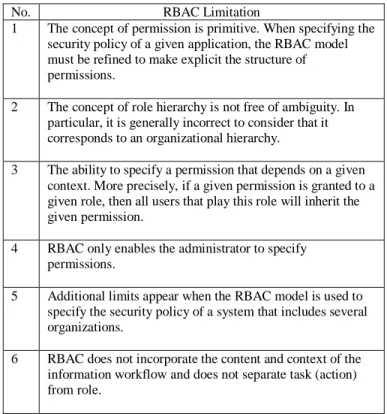
There are limitations when adopting RBAC in terms of access control methodology in IS design. These limitations are listed along with limitations found in (Kalam et al., 2003) that inhibit dynamic access control in Table 2. These RBAC limitations are contributing to SIS failure in capturing the nature of processes in IS, which in turn creates room for vulnerable IS. Control of IS access must consider the custom nature of organizations and clear the confusion between actions and roles.
Table 2. RBAC Limitations in IS
No. RBAC Limitation
1 The concept of permission is primitive. When specifying the security policy of a given application, the RBAC model must be refined to make explicit the structure of permissions.
2 The concept of role hierarchy is not free of ambiguity. In particular, it is generally incorrect to consider that it corresponds to an organizational hierarchy.
3 The ability to specify a permission that depends on a given context. More precisely, if a given permission is granted to a given role, then all users that play this role will inherit the given permission.
4 RBAC only enables the administrator to specify permissions.
5 Additional limits appear when the RBAC model is used to specify the security policy of a system that includes several organizations.
6 RBAC does not incorporate the content and context of the information workflow and does not separate task (action) from role.
The existing SIS design methods merely define general strategies and principle functions for IS design and do not explicitly state how these strategies can be integrated into IS development as previously mentioned. They also do not explain the dynamics of access control in such IS. The objective of this research was to create a design method that would fully explain the security design aspects in all SIS development stages, from requirement analysis to design and implementation stages.
Surely enough the design theory behind the proposed SIS design approach requires both, a unique type of IT solution (IT product design) and a unique design strategy (IS
development approach) to satisfy unique “meta-requirements” (Markus et al., 2002). Notably, meta-requirements for SIS design have been proposed by Siponen et al., (2006). In the next section, the artifact that incorporates context from an IS perspective into SIS design model is presented. Meta-notations to represent analyzed security requirements in the design of IS are presented.
3.4. Design and Development
OrBAC constructs are considered when defining secure IS requirements in the proposed design method. The OrBAC model was originally proposed in the literature as an alternative to existing access control models to specifically address the problem of specifying contextualized and emergent technical security rules (Kalam et al., 2003). Unlike other access control models, OrBAC can apply rules that specify contextual permissions for specific circumstances. An example would be an IT technician gaining administrator privileges to a core service to introduce a hotfix when the actual
administrator is not available. Alternatively, in health care, a physician having special permissions in the context of urgency. In addition, from a control perspective, the OrBAC model can specify granular authorization including prohibitions, obligations, and
recommendations; unlike classical access control models which are only restricted to permissions.
Cuppens and Miege (2003) define an organization as an organized group of active entities, i.e. subjects, playing some role or other. A subject plays a role in the organization corresponding to some agreement between the subjects to form an organization. Kalam et al., (2003) used organizations as an abstraction layer between subjects and roles, objects, and views, action, and activities. The definition of the context also depends on the organization. Contexts are used to specify the concrete circumstances for organizations and are only defined by concrete entities. The entities, organization, subject, object, action, and context are linked together by the relationship Define (see Appendix C).
OrBAC is a contextualized access control method that addresses the limitations of RBAC. Conceptualizing access control in processes using OrBAC provides the comprehensiveness required and adaptation to IS security requirements. Adoption of context from the OrBAC model allows modeling the complexity of socio-technical IS or the human activity system. OrBAC constructs are considered when defining secure IS requirements in the design method. The objective of OrBAC is to specify the access
control policy at the organizational level that is independent (abstract) of the implementation of this policy.
The abstract level defines the concepts of organization, role, activity, view, context and security rules to express the abstract policy. The abstract policy, specified at the
organizational level, is specified-using roles, activities, and views, which respectively abstract the concrete subject, actions, and objects. The role of a subject is simply called a role as in the RBAC model.
The organization employs a subject so it defines that role. On the other hand, an action is an abstraction of activity. Different organizations may consider activities to belong to different actions. The abstraction of an object is called a view. A view is an
organizational concept used to structure the policy specification for using objects, i.e. a view groups objects on which the same security rules apply.
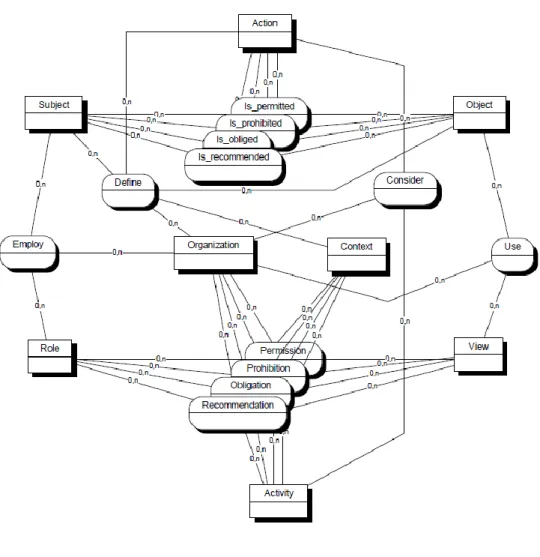
In OrBAC, one can define that a subject may have the permission, prohibition or
obligation to do an activity on some object given an associated context is true (see Figure 2). The formalism of the OrBAC model uses first-order logic notations which allow each organization to specify its own security rules. These security rules are represented using an array of first order predicates. Notations and constructs from the OrBAC model are adopted in the design method. Even though OrBAC constructs are adopted, the unique contribution of this work is an artifact that describes how an IS can be securely designed using these simple constructs:
Organizations (org): a central entity of OrBAC may represent multiple organizations or an organized group of subjects.
Subjects (s): person, actor, entity or an automated agent.
Figure 2. OrBAC model (El Kalam et al., 2003)
Actions (a): means for subjects to access objects.
Objects (o): static entities e.g. files, records.
Roles (r): a set of subjects to which the same security rule applies.
Activities (alpha): a set of actions to which the same security rule applies.
Views (v): a set of objects to which the same security rule applies.
The context concept has been introduced in the OrBAC model in order to express
dynamic rules (Cuppens & Miège, 2003). Contexts correspond to any constraint that joins a subject, an action, and an object. Contexts may be temporal, spatial, user-declared, prerequisite or provisional. Cuppens & Miege (2003) defined the following contexts:
Temporal (depends on the time at which the subject is requesting an access to the system)
Spatial (depends on the subject location)
User-declared (depends on the subject objective)
Prerequisite (depends on characteristics that join the subject, the action, and the object)
Provisional (depends on previous actions the subject has performed in the system).
The CSIS artifact suggests adopting context from the OrBAC model using a socio-technical lens to incorporate security during requirement analysis phase to ensure secure business processes. A business process context is defined from people’s point of view. In the CSIS artifact, context must be with the same level of abstraction as the organization. Contexts must validate roles, activities, and views. This way the required level of abstraction from explicit implementations of actions can be provided as actions are separate from roles.
As with current literature, this research ontology on security is described as a functional requirement in the analysis and modeling of business processes. This helps achieve the
research goal in incorporating security analysis and design into the overall IS analysis and design methodology. The conceptualization used in the CSIS artifact is consistent with OrBAC access control model from an IS point of view.
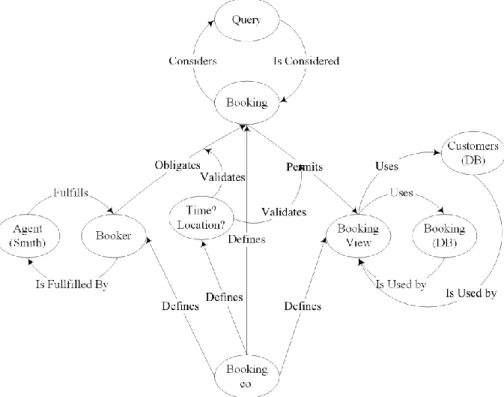
OrBAC constructs are used to define security IS requirements in the suggested design method. The nascent design theory (Gregor & Hevner, 2013) in this conceptualization is that the underlying process activity implementation i.e. interaction between subjects, objects and actions is completely abstracted. This allows the method schematic to be drawn in an abstract, holistic and systematic manner. The following rules represent the modeling concepts for secure business processes during requirement analysis.
Organizations define the abstract Roles, Activities, and Views:
o A subject fulfills an organizational role. Organizational roles are fulfilled by subjects.
o An activity is considered a set of actions; actions are a simple operation that collectively represents an activity.
o A view uses a set of objects. objects are used by a view.
A role may have the permission, prohibition, recommendation or obligation to do an activity coordinated on some view if and only if the given context is true.
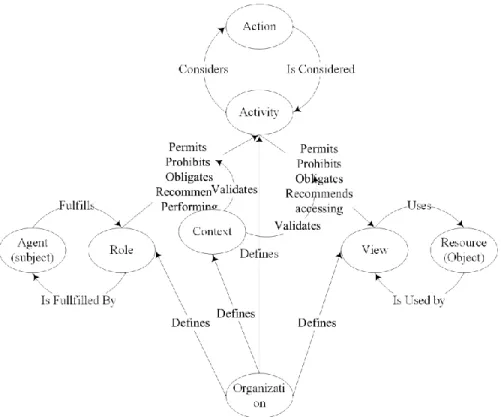
Using these rules, an artifact to describe how an IS can be designed with security in mind can be deduced. This artifact is considered a design artifact for Contextual SIS (CSIS) design (see Figure 3). The artifact presented in Figure 3 will allow IS practitioners to
embed IS security requirements in all IS design and development stages, from requirement analysis, design and through the implementation of IS.
Figure 3. CSIS Design Artifact
An organization aims to achieve a business objective and defines a set of general roles to achieve these objectives. An agent assigned by the organization fulfills these roles. The agent is restricted by the activities allocated to that role. These activities are the business processes required to achieve the business objective. Each activity is restricted by
The view is specific to certain objects and is only granted based on the allocated activity. IS practitioners are responsible for defining these allocations based on business and IS requirements. These requirements are also used to extract the business process context. The defined context is used to check whether the role is obligated, prohibited, obligated or recommended to perform the given activity on the given view.
The changing and shifting organizational requirements can be accounted for using organizational context (Siponen et al., 2006). The developed artifact uses an activity context as a core control to IS security. After the implementation of the IS, contexts can be tweaked to account for those changes. A change in the nature of activity conducted in IS reflects back to the context that validates the activity to ensure the security of said activity and view.
The artifact can be driven to later stages. Requirements analysis stage can define the organizational roles, views, and activities. The context of these activities can be defined during design stages. The actual entities subjects, objects, and actions are later defined during the implementation of IS. However, a strict review process on context change must be done by security experts to ensure the emergent contexts based on business needs do not affect the state of information security assurance in IS.
Using context, different sets of high-level activities and scenarios can be accounted. IS resources (objects) should only be available to agents (subjects) when the agent's associated action falls under his/her role and that role is known to have activities that
require viewing these resources (objects). This form of control allows for much more agility in terms of adaptation to requirements based on organization needs and at the same time be able to easily find access anomalies based on context nature.
Situation awareness theory (Endsley, 1995) is used to measure IS practitioners awareness of security policies, regulations, and constraints generated by the CSIS artifact.
Endsly (1995) defines situation awareness as “the ability to perceive the status, attributes, and dynamics of relevant elements in the environment”. Situation awareness is
the perception of environmental elements with respect to time or space, the
comprehension of their meaning, and the projection of their status after some variable has changed, such as time, or some other variable, such as a predetermined event. It involves being aware of what is happening in the vicinity, in order to understand how information, events, and one’s own actions will affect goals and objectives.
D'Aubeterre et al., (2008) extended situation awareness theory to define security awareness, which “assess the comprehension of security policies and constraints in the analysis of security requirements”. The utility of the CSIS artifact is assessed by
assessing the security awareness generated by the CSIS artifact against the best known SIS design methods, namely, secure activity resource coordination (SARC)
conceptualization of secure business process (D'Aubeterre et al., 2008), security enriched use cases (Siponen et al., 2006) in capturing the security requirements and security aspects of IS. The research model to test security awareness generated by these SIS
design methods is presented in Figure 4. Hypotheses are discussed in the next subsection.
It is evident that the CSIS artifact should be informationally equivalent (Larkin & Simon, 1987) to other SIS design methods. CSIS must ensure that it completely captured IS and business process requirements with no information loss. This describes the first research hypothesis.
Figure 4. SIS Design Method Research Model to Test Security Awareness
H1: SIS design developed using CSIS artifact is informationally equivalent to SIS design developed using security enriched use cases or SARC.
CSIS artifact enabled the use of multiple contexts e.g. temporal, spatial, etc., the design of IS will be context-aware (Abowd et al., 1999). CSIS artifact must generate higher
security awareness of security requirements of IS than other SIS design methods. IS practitioners and security experts should develop a higher level of security awareness when using CSIS as opposed to other SIS design methods.
H2: SIS design developed using CSIS artifact will generate higher security awareness than SIS developed using security enriched use cases or SARC.
The individuals’ characteristics influence the perception and interpretation of reality (D’Aubeterre et al., 2008). These characteristics influence the user’s comfort with
reading diagrams (Allen & March, 2006). This research tested if users with experience in IS analysis and security would develop a higher level of security awareness using CSIS than individuals without experience.
H3: SIS design developed using CSIS artifact will generate higher security awareness than SIS developed using security enriched use cases or SARC for experienced IS practitioners and security experts.
The next section demonstrates how the CSIS design artifact can be used in the design of SIS. The demonstration provides evidence for supporting the first hypothesis. A use case scenario is described in the following section.
3.5. Demonstration
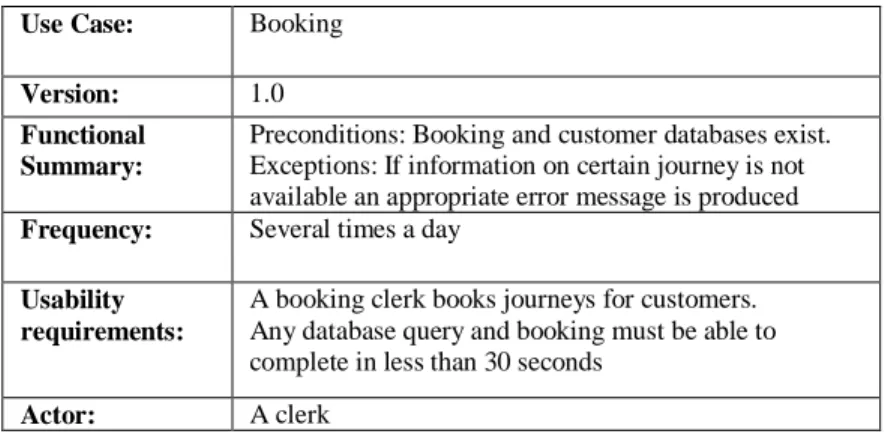
The artifact must show evidence that it is useful. During demonstration stage, the artifact is used to solve one or more instances of the problem using knowledge of how to use the artifact to solve the problem (Peffers et al., 2007). The utility of the CSIS design artifact is in providing awareness and knowledge about functional security requirements to business analysts in order to systematically translate complex business processes into a secure design. Here, a demonstrative example is provided in Table 3. In the next section, field-testing and rigorous evaluation in the application domain is discussed. The example is adopted from IS literature (Jaaksi, 1998; Siponen, 2002).
Table 3. Booking Use Case (Jaaksi, 1998; Siponen, 2002) Use Case: Booking
Version: 1.0
Functional Summary:
Preconditions: Booking and customer databases exist. Exceptions: If information on certain journey is not available an appropriate error message is produced
Frequency: Several times a day
Usability requirements:
A booking clerk books journeys for customers. Any database query and booking must be able to complete in less than 30 seconds
Actor: A clerk
The following are the conceptual modeling rules:
Booking organization defines the abstract Booking Roles, Activities and Views:
o A booking agent fulfills a booking role. Agents fulfill booking roles.
o A booking activity is considered a set of booking database queries; booking database queries are considered booking activities.
o A booking view uses a set of databases, booking, and customers. Booking and customers databases are used by the booking view.
Any booking agent fulfilling the booking role may have the permission,
prohibition, recommendation or obligation to run booking activities coordinated on booking view if and only if the given booking process context is true. A booking agent (see Figure 5) who fulfills the booking role books journeys for customers, several times a day. A temporal context may validate a period where the agent is requesting access to the system. A spatial context may validate whether the agent is at the booking agency during the process. Other contexts can be user declared based on the Booking Co. organization needs Figure 5.
The demonstrative scenario shows evidence for supporting the first research hypothesis. The resulting artifact encapsulates information captured in a use case scenario. SIS design developed using CSIS artifact is informationally equivalent to SIS design developed using security enriched use cases.
3.6. Evaluation
During evaluation stage, artifact support to solving the problem is observed and
measured. In addition, the evaluation stage must determine whether the artifacts meets validity criteria. Evaluation involves comparing the objectives of a solution to actual observed results from use of the artifact in the demonstration (Peffers et al., 2007). Qualitative action research is used to ensure the artifacts rigor. At the end of evaluation stage, it must be decided whether to iterate back to design to try to improve the
effectiveness of the artifact or to continue on to communication and leave further improvement to subsequent projects.
The initial relevance cycle defines acceptance criteria for the ultimate evaluation of the research results. The output must be returned to the environment for study and evaluation in the application domain. A design artifact must be evaluated to demonstrate its validity, utility, quality, and efficacy (Gregor & Hevner, 2013). Validity means that the artifact works and does what it is meant to do; and, is dependable in operational terms in
achieving its goals. The utility criteria assess whether the achievement of goals has value outside the development environment (Gregor & Hevner, 2013). Because design is inherently an iterative and incremental activity, the evaluation phase provides essential
feedback to the construction phase as to the quality of the design process and the design product under development (Hevner et al., 2004).
Hevner et al., (2004) suggested that the nature of the problem, characteristics of the artifact, and available resources should drive the selection of the evaluation method. The goal of evaluation is to establish that the design artifact fulfills the requirements and constraints of the problem domain and therefore it is complete and effective. A rigorous design evaluationmay draw from many potential techniques, such as analytics, case studies, experiments, or simulations (Hevner et al., 2004). A summary of possible
evaluation methods and their applicability to the CSIS design artifact is listed in Table 4.
An observational case study and field study are viable evaluation methods for the CSIS artifact. Observing the use of the artifact allows the researcher to validate if the artifact achieved its goal of securing the organizational business process in IS design successfully and in an efficient manner. Such validation can be conducted if the design artifact can be studied in a controlled experiment to study if the secure design is operational and usable. However, simulation with artificial data may not be sufficient for evaluating the artifact based on its socio-technical nature.
Analytical evaluation methods such as static analysis and dynamic analysis may not be suitable for evaluating the artifact. The design artifact is, in essence, a design method based on knowledge as operational principles (Gregor & Hevner, 2013). Static and dynamic qualities would not validate what the artifact is supposed to achieve. With