M U LT I D I M E N S I O N A L P R I VA C Y
Q U A N T I F I C AT I O N F O R U S E R E M P O W E R M E N T
Dem Fachbereich Informatik der Technischen Universität Darmstadt vorgelegte
Dissertation
zur Erlangung des akademischen Grades Doktor-Ingenieur (Dr.-Ing.)
von
Spyridon Boukoros, Dipl.-Ing., geboren in Athen
Referenten: Professor Dr. Stefan Katzenbeisser Professor Dr. Carmela Troncoso Professor Dr. Max Mühlhäuser Tag der Einreichung: 25.02.2019
Tag der Prüfung: 10.04.2019
powerment, February
This work is licensed under a Creative Commons “Attribution-NonCommercial-NoDerivatives4.0International”license.
"Our life is what our thoughts make it." — Marcus Aurelius, Meditations
A B S T R A C T
As we are living in an interconnected world, serious privacy concerns have been raised due to the ever increasing data collection. As a re-sult, many privacy-preserving methodologies have been proposed for various domains. However, in order to argue about the effectiveness of such methodologies, it is necessary to quantify privacy. Further-more, such a quantification should be within the grasp of users and developers, as an important factor of any technology is adoption. In this thesis, we design privacy metrics in order to investigate the pri-vacy guarantees offered by various defenses. In addition, we develop tools that can be used either by system designers for developing more privacy-preserving applications, or by users to estimate their privacy. The analysis in performed on three domains where millions of users already contribute data.
The first part of this thesis investigates a previously unexplored di-mension of location privacy: mobile crowdsourcing, where users share streams of their location data. In this thesis we shed light as to whether traditional location privacy mechanisms can be directly applied in this scenario. We elaborate on why this use case is radically different than the widely studied case of location-based services. Then, using novel privacy metrics, and realistic utility functions and datasets, derived di-rectly from crowdsourcing projects, we highlight why existing privacy defenses are inadequate. In order to enable further research in this direction and spawn privacy-preserving crowdsourcing applications, we provide some best-practices guidelines, directions for the develop-ment of novel defense mechanisms, and we show how our work can be used as a tool to measure privacy and utility loss.
In the second part of the thesis, we explore the privacy guarantees of aggregation schemes in smart metering, by modeling privacy as an indistinguishability game. In particular, we explore how many house-hold have to be aggregated in order to provide meaningful privacy guarantees. We explain why such a modeling is flexible, able to simu-late a variety of adversaries with different background information, and how the proposed game can be re-purposed to investigate as to whether single profiles belong in an aggregate or not. We investigate various aggregation sizes for privacy leakage, as well as, properties of an aggregate that affect the privacy guarantees.
The last part of this thesis investigates privacy in microdata publica-tion. A tool is proposed, that enables users to estimate their privacy level, based on a set of preferences they want to share with a service provider (eg., movies watched, music listened to etc.), a-priori sharing them. The tool does not require full access to the providers’ database
describe the underlying privacy metric and the algorithms composing the tool. Using actual user data and comparing the tool’s results with a well established privacy metric, we show that the tool is able to approximate users’ privacy levels.
The privacy evaluation in the domain of mobile crowdsourcing highlights that the utility functions of the domain are different than those used in traditional location-privacy literature. For this reason, the utility-privacy trade-off of various defenses is different than the one observed in the scenario of location-based services, allowing us to understand why existing defenses are not deployed in practice by crowdsourcing projects. For the domain of smart metering, our work illustrates that aggregation-based privacy mechanisms are inadequate for small or medium sized aggregates of electricity consumption data. Users’ electricity consumption patterns can be quite distinct, and with some auxiliary information sensitive data can be leaked from the aggregated report. Last, the user-friendly tool proposed for the domain of microdata publications, as well as the metrics and tools developed for the domains of mobile crowdsourcing and smart metering, can enable non-technical users to better understand the privacy risks of sharing unprotected data, and guide application developers towards developing privacy-preserving systems.
Z U S A M M E N FA S S U N G
Da wir in einer vernetzten Welt leben, treten vermehrt ernsthafte Bedenken hinsichtlich des Datenschutzes aufgrund der ständig zuneh-menden Datenerhebung auf. Infolgedessen wurden viele Methoden zum Schutz der Privatsphäre für verschiedene Domänen vorgeschla-gen. Um jedoch die Wirksamkeit dieser Methoden zu zeigen, ist es erforderlich die Privatsphäre zu quantifizieren. Darüber hinaus sollte eine solche Quantifizierung unter Kontrolle der Nutzer und Entwickler liegen, da Verwendbarkeit ein wichtiger Faktor für jede Technologie ist. In dieser Arbeit entwerfen wir Datenschutzkennzahlen, um die Daten-schutzgarantien zu untersuchen, die verschiedene Schutzmechanis-men bieten. Darüber hinaus entwickeln wir Werkzeuge, die entweder von Systementwicklern für die Entwicklung weiterer Datenschutz-Tools verwendet werden können oder von Benutzern, um ihre Privat-sphäre einzuschätzen. Die Analyse wurde in drei Datensammlungen durchgeführt, zu denen Millionen von Benutzern bereits Daten beitra-gen.
Der erste Teil dieser Arbeit untersucht eine bisher unerforschte Di-mension des Datenschutzes von Standorten: mobiles Crowdsourcing, bei dem Benutzer Streams ihrer Standortdaten gemeinsam nutzen. In dieser Arbeit untersuchen wir, ob traditionelle Mechanismen für den Schutz von Standortdaten direkt auf dieses Szenario angewendet werden können. Wir erläutern, warum sich dieser Anwendungsfall grundlegend von dem weithin untersuchten Fall ortsbasierter Dienste unterscheidet. Dann verwenden wir neuartige Datenschutzkennzahlen, realistische Hilfsfunktionen und Daten, die direkt aus Crowdsourcing-Projekten stammen, um zu zeigen, dass heutige Verteidigungsmecha-nismen der Privatsphäre unzureichend sind. Um weitere Forschung zu animieren Privatsphäre schützende Crowdsourcing-Anwendungen hervorzubringen, stellen wir einige Best Practice-Richtlinien sowie An-weisungen für die Entwicklung neuartiger Abwehrmechanismen vor, und wir zeigen, wie unsere Arbeit als Instrument zur Messung der Pri-vatsphäre und des einhergehenden Verlustes von Nutzen verwendet werden kann.
Im zweiten Teil der Arbeit untersuchen wir die Garantien für den Datenschutz von Aggregationsverfahren in Smart Metering durch Modellierung der Privatsphäre als Ununterscheidbarkeits-Spiel. Ins-besondere untersuchen wir, wie viele Haushalte zusammengefasst werden müssen, um angemessene Privatsphäre zu gewährleisten. Wir erklären, warum eine solche Modellierung flexibel ist sowie eine Vielzahl von Angreifern mit unterschiedlichen Hintergrundinforma-tionen simulieren kann und wie das vorgeschlagene Spiel wieder
gehört oder nicht. Wir untersuchen verschiedene Aggregationsgrößen auf das Eindringen in die Privatsphäre sowie welche Eigenschaften eines Aggregats die Datenschutzgarantien beeinflussen.
Der letzte Teil dieser Arbeit untersucht den Datenschutz bei der Veröffentlichung von Mikrodaten. Es wird ein Tool vorgeschlagen, mit dem Benutzer das Privatsphäre-Niveau ihrer Sammlung von Präferenzen (z. B. angesehene Filme, gehörte Musik, usw.) einschätzen können, um zu beurteilen, ob sie diese mit den Diensteanbietern teilen möchten. Das Tool erfordert jedoch keinen vollständigen Zu-griff auf die Datenbank der Anbieter sondern verlässt sich auf die Auswahl der Benutzer und deren Beliebtheit. Wir beschreiben die zugrunde liegende Datenschutzmetrik und die Algorithmen, aus de-nen das Tool besteht. Anhand von tatsächlichen Benutzerdaten und dem Vergleich der Ergebnisse des Tools mit einer bereits etablierten Datenschutzkennzahl zeigen wir, dass das Tool eine Schätzung des Datenschutz-Niveaus ermöglicht.
Die Bewertung der Privatsphäre im Bereich des mobilen Crowd-sourcing hebt hervor, dass die Utility-Funktionen der Domäne anders sind als diejenigen, die in der traditionellen Literatur zum Thema Standortdatenschutz verwendet werden. Aus diesem Grund unter-scheidet sich der Kompromiss von Nutzen und Privatsphäre zwischen den verschiedenen Schutzmechanismen von dem, der im Szenario ortsbasierter Dienste beobachtet wurde. Das erlaubt uns zu verste-hen, warum bestehende Abwehrmechanismen in der Praxis nicht in Crowdsourcing-Projekten eingesetzt werden. Für den Bereich Smart Metering zeigt unsere Arbeit, dass aggregationsbasierte Mechanis-men zum Schutz der Privatsphäre für kleine oder mittlere Aggre-gate von Stromverbrauchsdaten unzureichend sind. Die Stromver-brauchsmuster der Benutzer können sehr unterschiedlich sein, sodass mit einigen Hilfsinformationen vertrauliche Daten aus dem Aggregat abgeleitet werden können. Das vorgeschlagene benutzerfreundliche Werkzeug für die Domäne von Mikrodatenpublikationen sowie die en-twickelten Metriken und Werkzeuge für die Bereiche mobiles Crowd-sourcing und Smart Metering können nicht-technischen Benutzern ein besseres Verständnis der Datenschutzrisiken bei ungeschützter Freigabe von Daten ermöglichen und leiten Anwendungsentwickler in Richtung Entwicklung von Systemen zum Schutz der Privatsphäre.
A C K N O W L E D G M E N T S
First and foremost, I would like to express my gratitude to my advisor Prof. Stefan Katzenbeisser for giving me the opportunity to join his group and guiding my research. It is common knowledge that a Ph.D. journey can be tough sometimes, with lots of ups and downs. Luckily, he was always there to make things easier. I would also like to thank my colleagues in the SecEng group for all the fun we had the last years. Especially, I would like to thank Niklas Büscher for helping me on numerous occasions during my first years in research. I would also like to thank Sheikh Mahbub Habib and Jörg Daubert for the many helpful research discussions we had.
During my Ph.D., I visited EPFL for three months and worked under the guidance of Prof. Carmela Troncoso. I am grateful to her for intro-ducing new exciting research topics to me, and a great collaboration. Working closely with her has benefited me both as a researcher and as a person. Furthermore, I would like to thank EPFL’s SPRING group for their hospitality during those three months. It was a memorable research and personal experience.
During my conference trips and my research visit to EPFL, I met and collaborated with Igor Bilogrevic and Mathias Humbert. I cannot thank them enough for all the research discussions we had that helped shaping this thesis and other publications.
The last years I have been lucky enough to meet many incredible people and share a large part of my daily life with them. I would like to thank Carel for having an amazing time both in and out of office. Also, thanks for teaching me so many stuff and mentoring me in various aspects of my life. During a rough period, I was lucky to share an office with Salman. That alone made things seem much easier. Many thanks also to Nikos, Pavlos, George and Stelios for all the fun times! I hope we will have many more.
Special thanks to my parents Panagiotis and Sofia, and my sister Vicky. Their unconditional love and support always leaves me speech-less. Last but by no means least, I would like to thank Christina. This thesis would not have been possible without her support and love. Thanks for being there on both good and bad days.
C O N T E N T S
1 i n t r o d u c t i o n 1
2 p r i va c y i n m o b i l e c r o w d s o u r c i n g a p p l i c at i o n s 9
2.1 Mobile crowdsourcing . . . 9
2.2 Related work . . . 11
2.2.1 POIs and the uniqueness of human mobility . . 11
2.2.2 Privacy mechanisms . . . 12
2.2.3 Attacks on geo-located data . . . 14
2.2.4 Privacy quantification . . . 15
2.3 MCS applications under study . . . 15
2.3.1 Safecast . . . 16
2.3.2 Radiocells . . . 17
2.4 Privacy risks in current MCS applications . . . 18
2.4.1 Safecast . . . 19
2.4.2 OpenStreetMaps . . . 23
2.5 Protecting location privacy in MCS . . . 23
2.5.1 Defenses . . . 24
2.5.2 Measuring privacy . . . 25
2.5.3 Measuring utility . . . 26
2.6 Existing LPPMs performance in MCS scenarios . . . . 27
2.6.1 Experimental setup . . . 27
2.6.2 Defenses implementation . . . 28
2.6.3 Privacy gain . . . 31
2.6.4 Utility-privacy trade-off . . . 37
2.7 Towards privacy-preserving mobile crowdsourcing . . 46
2.7.1 A tool for the systematic evaluation of LPPMs for MCS . . . 47
2.7.2 Towards effective defenses . . . 48
2.7.3 Best practices for mobile crowdsourcing developers 48 2.8 Chapter Summary . . . 49
3 p r i va c y a s s e s s m e n t o f a g g r e g at i o n s c h e m e s i n s m a r t m e t e r i n g 51 3.1 Smart metering . . . 51
3.2 Related work . . . 53
3.2.1 Privacy mechanisms for smart metering . . . 53
3.2.2 Privacy quantification . . . 55
3.3 Aggregation privacy model . . . 56
3.3.1 Smart grid aggregation model . . . 56
3.3.2 Requirements of privacy notions for aggregation in the smart grid . . . 56
3.3.3 Smart grid privacy model . . . 57
3.4 Methodology . . . 60
3.4.1 Smart grid datasets . . . 61
3.4.2 Evaluation approach . . . 62 3.4.3 Decision functions . . . 63 3.5 Case studies . . . 64 3.6 Dataset analysis . . . 75 3.7 Chapter Summary . . . 79 4 m e a s u r i n g p r i va c y i n h i g h d i m e n s i o na l m i c r o -d ata c o l l e c t i o n s 81 4.1 Microdata releases and privacy . . . 81
4.2 Related work . . . 83
4.2.1 Reidentification attacks . . . 83
4.2.2 Privacy quantification . . . 84
4.3 Privacy assessment mechanism . . . 85
4.3.1 Overview of the system . . . 85
4.3.2 System’s internal logic . . . 85
4.4 Evaluation . . . 90
4.4.1 Datasets . . . 90
4.4.2 Designing the experiments . . . 91
4.4.3 Validity of the model . . . 94
4.5 Privacy thermometer . . . 97
4.6 Chapter Summary . . . 98
5 c o n c l u s i o n 99
L I S T O F F I G U R E S
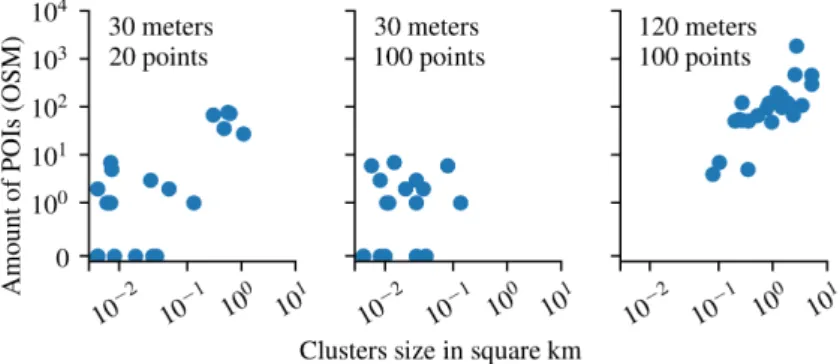
Figure2.1 Cluster size and amount of POIs per user. . . . 22
Figure2.2 GeoInd noise magnitude. . . 29
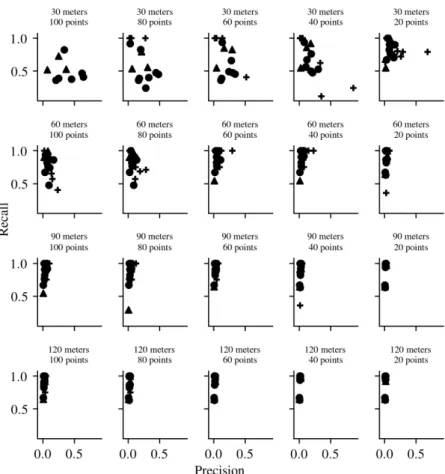
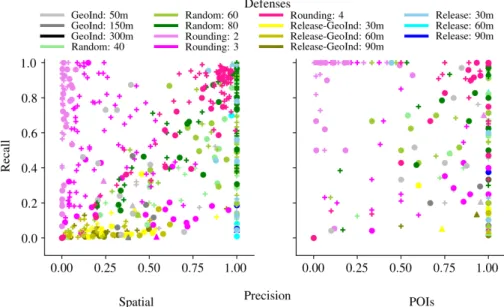
Figure2.3 Safecast privacy gain. . . 30
Figure2.4 Precision and recall results in Tokyo. . . 33
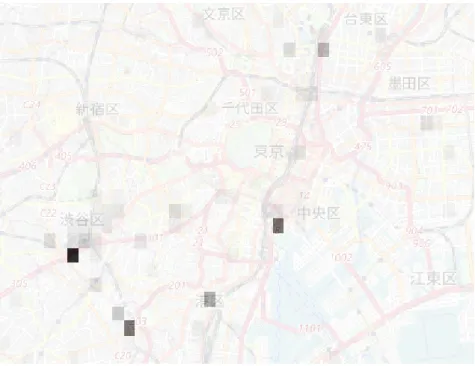
Figure2.5 Clusters’ size and points of interests (POIs) per cluster in Tokyo. . . 34
Figure2.6 Spatial precision and recall for Safecast. . . 35
Figure2.7 POIs precision and recall for Safecast. . . 35
Figure2.8 Radiocells privacy gain. . . 36
Figure2.9 Spatial precision and recall for Radiocells. . . . 37
Figure2.10 POIs precision and recall for Radiocells. . . 37
Figure2.11 Measurement error in Tokyo using a distance-based metric. . . 38
Figure2.12 Measurement error in Tokyo’s radiation values. 39 Figure2.13 Measurement error in Fukushima’s radiation values. . . 39
Figure2.14 Users’ prior probabilities in Tokyo. . . 41
Figure2.15 Hotspot detection in Tokyo. . . 44
Figure2.16 Hotspot detection in Fukushima. . . 45
Figure2.17 Utility loss in Radiocells. . . 46
Figure2.18 Location privacy framework. . . 47
Figure3.1 The proposed privavy game AggG. . . 58
Figure3.2 Smart metering load profiles. . . 65
Figure3.3 Comparison of the four decision functions. . . 66
Figure3.4 The effect of the window parameter on a deci-sion function. . . 67
Figure3.5 Distinguishing advantage for the UMASS, GO-VAU, and Dataport datasets. . . 67
Figure3.6 Comparison of the decision functions for dif-ferent aggregation sizes. . . 68
Figure3.7 Impact of temporal resolution. . . 69
Figure3.8 The combined decision function over different aggregation sizes. . . 70
Figure3.9 Imprecision for too large aggregation sizes. . . 71
Figure3.10 Detectability of single appliances. . . 72
Figure3.11 Distinguishability of various appliances. . . 73
Figure3.12 Correlation of device properties and adversarial advantage. . . 74
Figure3.13 Indistinguishability game vs membership in-ference. . . 75
Figure3.14 Mean load profiles for the datasets. . . 76
Figure . Correlation of profiles with the average. . . . . Figure3.17 Mean load profile for the generated dataset. . 79 Figure3.18 Comparison of the decision functions for the
generated dataset. . . 80 Figure4.1 The proposed privacy quantification tool. . . . 86 Figure4.2 Number of items in user profiles. . . 92 Figure4.3 Items’ popularity. . . 93 Figure4.4 Evaluation of the tool on the Yahoo! Movies
dataset. . . 94 Figure4.5 Evaluation of the tool on the Yahoo! Music
dataset. . . 95 Figure4.6 Evaluation of the tool on the Netflix dataset. . 95 Figure4.7 EU energy efficiency label. . . 97 Figure4.8 Example of privacy label for the Netflix dataset. 98
L I S T O F TA B L E S
Table2.1 Safecast API dataset statistics. . . 19 Table2.2 Safecast and Radiocells measurements per region. 27 Table2.3 Category changes, for each of the radiation
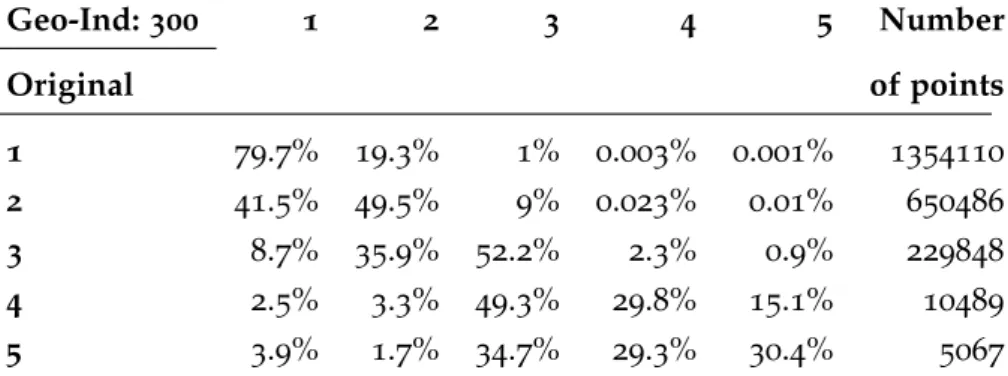
danger groups, after applying Geo-Ind300in Fukushima. . . 42 Table2.4 Category changes, for each of the radiation
dan-ger groups, after applying the Rounding2 in Fukushima. . . 42 Table3.1 Smart grid datasets. . . 61 Table3.2 Usable buildings per dataset. . . 62 Table3.3 Adversarial advantage for different timeslots. . 70 Table3.4 Characteristic properties of particular
appli-ances (average values). . . 72 Table4.1 Microdata datasets. . . 91 Table4.2 Comparison of the average anonymity set and
user’s privacy levels. . . 96
A C R O N Y M S
MSE mean squared error
a c r o n y m s xv
MLE maximum likelihood estimation
NILM non-intrusive appliance load monitoring POI points of interest
LBS location-based service MCS mobile crowdsourcing GeoInd geo-indistinguishability
LPPM location privacy-preserving mechanism GPS global positioning system
1
I N T R O D U C T I O NThe need for privacy has always been relevant. From the ancient Greek times there has been a distinction between the public and the private. However, advances in technology played an important role to the shape of later privacy definitions. A very early definition of privacy was by Judge Cooley in 1879, referring to it as the right to be left alone [51]. In a later definition in 1967, Westin refers to privacy as individual’s ability to control or delete information about themselves as well as, decide how such information is communicated [154]. The
advances in telecommunications though, have changed the way infor-mation is transmitted, stored and processed. Nowadays, Nissenbaum’s work on contextual integrity, amongst others, frames privacy as an appropriate flow of information and recognizes five key parameters: data subject, sender, recipient, information type, and transmission principle [117].
Today’s massive and detailed collection of information about indi-viduals violates their privacy and in order to preserve it, only relevant and the minimum information necessary for specific tasks needs to be collected. The collected information though, should not allow the inference of unintended sensitive information. However, preventing inference attacks from published data turns out to be a rather compli-cated issue, and the main motivating problem of this thesis.
Humans are social beings and belong to many different groups and social circles and hence, it is only natural that with the widespread adoption of the Internet, such behavior would extend to the web. Indeed, depending on their interests, people participate in various online communities, forums and web-platforms. Contrary to real life though, where people (usually) carefully choose what information they share with whom, such an attitude is not yet common on the web. In addition, it is not usually clear to people what kind of sensitive information published data carry.
It is known that as little as one’s queries to online search engines re-veal her interests [131,138,147]. Lately, people have been outsourcing
their preferences, photos, videos or even DNA test results to social media. Such data however can be used for discrimination. It is known that recruiters and hiring managers systematically search applicants social media profiles [43,118]. More specifically, candidates have been
disqualified because of posts they publish on their profiles, unprofes-sional screen names, inappropriate photos or too frequent posting [72].
Furthermore, advances in machine learning and the abundance of available data enable rather dangerous inferences. It has been
strated that sensitive data such as religion, sexual preference, location or health history can be inferred directly or indirectly from someone’s online activity [96]. Moreover, the photos someone publishes can be
used to predict markers of depression [133].
Private personal information can also be inferred from shared location data. Smartphones have embedded global positioning sys-tem (GPS) receivers or use the device’s sensors for localization pur-poses. An increasing number of applications use the device’s position to offer location-based services (LBSs). Such services may send noti-fications about nearby friends, interesting locations based on users’ preferences and weather or traffic alerts. Furthermore, besides assisting users, various companies collect useful statistics from users’ where-abouts. Such measurements, however, carry extremely sensitive data to providers, as workplaces or home addresses can be determined [74,97].
Moreover, social relationships as well as routines can also be inferred [36,75]. For example, being in close proximity with someone during
weekend nights might suggest that this person is a friend, while a ro-mantic involvement can be inferred (with some probability) by people spending several nights together. Even though various anonymization techniques might be applied to location datasets, re-identification at-tacks are still possible because, as little as the combination of home and work location, or the shops one visited, is enough to uniquely identify individuals [56,57,157].
Smartphones however, are not the only devices with Internet connec-tion capabilities and sensors. Nowadays, many other devices, capable of measurements and an Internet connection, are part of modern houses. Smart devices that measure the electricity consumption in households can pose a serious privacy threat. Such devices collect data regarding the electricity usage of all appliances in a household. Even though such a data collection has not a malicious purpose, but rather to allow energy providers to better manage the distribution of energy, post-processing of the collected data can reveal sensitive information about the owner. For instance, by looking into the usage patterns of such smart devices, one can infer when a building is occupied, how many people are present, peoples’ sleeping patterns or even movie and music preferences.
As it is clear that individuals’ privacy can be violated by vari-ous technologies used in everyday life, many privacy defenses have been proposed for a variety of domains. Such privacy-preserving technologies frequently rely (but not only) on cryptography, aggrega-tion, selective hiding, anonymizaaggrega-tion, noise addition or generalization. However, in order to argue about the effectiveness of privacy preserv-ing technologies, there is a need to define what privacy is and ways to quantify it. Even though various privacy definitions are abstract enough to define privacy in many domains, such as indistinguishabil-ity or adversarial error, the specifics of each area, such as the nature
i n t r o d u c t i o n 3
of the collected data, are quite distinct. For instance, measuring how private one is when sharing his location data, which is in the form of coupled coordinates with time, is different than measuring one’s privacy in microdata publication, which is in essence a collection of his preferences in a domain. Furthermore, as it will become clear in Chapter 2, even collected data of the same nature require different treatment depending on the resolution in which they were gathered. Hence, it follows naturally that privacy quantification must be treated as a domain dependent problem.
However, simply proposing privacy metrics and tools does not guar-antee that they will be used. A fundamental problem of any proposed technology is adoption. First, researchers need to demonstrate the pri-vacy dangers involved in the publication of raw user data in order to sensitize users, and deploy ready to use privacy-enhancing technolo-gies. In order to sensitize users, the proposed privacy tools need not only to inform the users about their privacy levels, but through them raise awareness, something that can happen by using understandable concepts to measure privacy and usability friendly techniques such as visual results. Thus, once users are educated about privacy and start demanding more privacy-preserving tools in their daily life, pri-vacy can be incorporated in industrial production pipelines. Hence, application developers and service providers should also be able to grasp privacy quantification results and have access to intuitive tools. Thus, there is also a need for privacy measurement frameworks that can easily be extended by them according to their needs.
c o n t r i b u t i o n
This thesis focuses on privacy quantification. As already discussed, privacy is domain dependent and hence, we focus on three domains selected based on the amount of current or potential data contributors. Namely, these domains are mobile crowdsourcing (MCS), smart me-tering, and microdata collection. The domains of MCS and microdata datasets have millions of data contributors as location and preferences collection through mobile devices and online services respectively, are widely deployed. Smart metering is still at an early stage with experimental projects running on various areas around the world, however, it might soon be the standard way of electricity measuring for millions of users. For each of the aforementioned domains, we collected publicly available data from actual service providers. We designed privacy metrics and developed tools based on easily under-standable concepts by users and practitioners. Then, we evaluated users’ privacy by performing attacks on the collected data. Finally, as a very important factor of the successful application of any privacy-protection mechanism is the utility degradation of the data protected,
we evaluated the privacy-utility trade-off whenever we had access to the datasets’ utility functions.
Our contributions are as follows:
1. We perform the first in-depth study on location privacy in the context of MCS. Contrary to the existing paradigm of LBSs, where users reveal their location seldom to the provider, in the case under study users upload continuously measurements. In order to understand the extent of the privacy danger, we perform various inference attacks (e.g., identifying workplaces, social re-lationships, and even sensitive information such as religious views) on the collected data from two representative applica-tions which make their contributors’ data publicly available on their websites. Since MCS is a previously unexplored area of lo-cation privacy, we investigate if and to which extend previously proposed location privacy-preserving mechanisms (LPPMs) can be used. To this end, we propose two privacy metrics, based on statistical measures developed for binary classification and information retrieval, that capture the privacy gain provided by the LPPMs with respect to the identification of areas and points of interest. Furthermore, we also consider new utility measures that quantify the accuracy of the aggregated values of data collectively gathered at these locations. Our experimental evaluation on real data shows that mechanisms based on sharing only a part of users’ location history do not bring any privacy benefits to MCS users, essentially because the geo-located data is in general reported over a long period of time (more than a day) and contains too many locations. Mechanisms that change the reported position to a random one close to the original, tend to provide better privacy but only for strong privacy parameters that in turn significantly affect the resulting utility. Techniques that reduce the localization precision though, seem to be the best suited mechanisms privacy-wise. However, we show that none of the LPPMs provide an acceptable privacy-utility trade-off for the MCS applications we study hence, they can not be applied by practitioners. Finally, we show how the attacks and defenses of this chapter can be combined in a tool, that we have open-sourced, in order to enable new research on LPPMs for the MCS scenario and the design of privacy friendly MCS applications by developers.
2. Considering the emergence of smart devices in modern house-holds, we study smart meters as it is the new paradigm for measuring electrical consumption. More specifically, as smart metering is a well studied area, we focus on the privacy quantifi-cation of one of the most prominent privacy protection
mecha-i n t r o d u c t mecha-i o n 5
nisms, that of aggregation. The underlying idea is that if various energy consumptions profiles, from different users, are aggre-gated and then reported to the energy provider, individuals are protected as the distinguishing patterns in their own profiles will disappear. In this thesis we examine whether aggregated user consumption data offers such privacy guarantees and how the size of the aggregate affect the privacy protection. In order to be able to quantify users’ privacy, we first model privacy as a cryptographic game, using an indistinguishability notion. In this game, two single energy load profiles and an aggregated one are given to an adversary, with the goal of selecting which of the two profiles is included in the aggregate. The privacy metric in this case, is how much better an adversary performs than random guessing. The analysis of the privacy for individual households for different aggregation sizes, using real energy consumption data with more than700households, shows that an average household is insufficiently protected in aggregates of just a few load profiles. On average, an adversary can distinguish two typical load profiles forming an aggregate with very high (> 80%) probability, when reporting energy consumption infor-mation every15minutes. Even for larger aggregation sizes, the adversarial advantage is rather high. Furthermore, we examine the influence of various parameters, e.g., temporal resolution, on the detectability of a household within an aggregate. Finally, we show that single energy-hungry appliances can be detected in the aggregates of a handful of households with significant advantage.
3. Finally, considering that users tend to spend significant time on the Internet and knowingly or not their personal preferences are collected on a daily basis, we study users’ privacy in microdata collections. The dangers in the specific scenario are well studied and it is demonstrated that with minimal information users can be re-identified in pseudonymized microdata collections [73,113, 115]. We develop a tool that enables users to approximate their
privacy level, given a set of preferences they want to share with a service provider, before actually sharing their data. Hence, users can consciously decide (wrt privacy) whether to share or not their data. The tool works with published statistics about a user’s items and hence, does not require access to provider’s database. We describe the algorithm running in the tool and the privacy metric that evaluates users’ privacy levels. We evaluate the effectiveness of our tool using actual datasets from service providers. Last, aiming to make the tool user friendly, we de-scribe the benefits of visual results against numerical scores, and describe the tool’s visual representation.
o u t l i n e
Following our contributions in the aforementioned fields, this thesis is split into three chapters. Chapter2is about location privacy in mobile crowdsourcing. Chapter3is about privacy assessment of aggregation schemes in smart metering. Then, in Chapter4, we develop a tool for measuring users privacy levels on microdata collections. We conclude this thesis in Chapter5.
i n t r o d u c t i o n 7
p u b l i c at i o n s
This thesis consists of work done in the following publications:
• S. Boukoros, M. Humbert, S. Katzenbeisser, C. Troncoso. “On (The Lack Of) Location Privacy in Crowdsourcing Applications.” In: USENIX Security Symposium, 2019
• N. Büscher, S. Boukoros, S. Bauregger, and S. Katzenbeisser. ”Two is not enough: Privacy assessment of aggregation schemes in smart metering” In: Privacy Enhancing Technologies Sympo-sium,2017, pp.198–214.1
• S. Boukoros and S. Katzenbeisser. “Measuring privacy in high dimensional microdata collections.” In: International Conference on Availability, Reliability and Security,2017, pp.15:1–15:8. During the course of the Ph.D., the following papers were also published:
• A. Borgwart, S. Boukoros, H. Shulman, C. van Rooyen, and M. Waidner. “Detection and forensics of domains hijacking” In: IEEE Global Communications Conference,2015, pp.1–6
• N. Matyunin, N. A. Anagnostopoulos, S. Boukoros, M. Heinrich, A. Schaller, M. Kolinichenko, and S. Katzenbeisser. “Tracking private browsing sessions using CPU-based covert channels.” In: ACM Conference on Security & Privacy in Wireless and Mobile Networks,2018, pp.63–74
• A. Taha, S. Boukoros, J. Luna, S. Katzenbeisser, and N. Suri. “QRES: Quantitative reasoning on encrypted security SLAs.” In:
arXiv preprint arXiv:1804.04426,2018
• S. Boukoros, N. P. Karvelas, and S. Katzenbeisser. “A lightweight protocol for privacy preserving division.” In: IEEE Wireless Communications and Mobile Computing Conference,2017, pp. 717-722
• S. Boukoros, A. Nugaliyadde, A. Marnerides, C. Vassilakis, P. Koutsakis, and K.W. Wong. “Modeling server workloads for campus email traffic using recurrent neural networks.” In: Inter-national Conference on Neural Information Processing,2017, pp. 57-66
• S. Boukoros, A. Kalampogia, and P. Koutsakis. “A new highly accurate workload model for campus email traffic.” In: IEEE International Conference on Computing, Networking and Com-munications,2016, pp.1-7
2
P R I VA C Y I N M O B I L E C R O W D S O U R C I N GA P P L I C AT I O N S
S. Boukoros, M. Humbert, S. Katzenbeisser, C. Troncoso.
“On (The Lack Of) Location Privacy in Crowdsourcing Applica-tions.” In: USENIX Security Symposium,2019
Published Content Published Content
Ethical considerations
This chapter includes experiments with actual user data published online. For the work on this chapter, we did not collect any personal data other than that made publicly available by the crowdsourcing projects we study. During our experiments we have limited our infer-ences to the minimum to prove the privacy threats posed by public data sharing. All data reported is aggregated or anonymized such that no individual’s data is exposed. We have notified the service providers about our findings, and we have provided them with code to implement the defenses so that they can take appropriate measures. At end of this project, all collected and inferred data were deleted. The code from this section will be made available so that it can be used by crowdsourcing applications and improved by the research community. This procedure has been approved by EPFL’s1
ethics committee. 2.1 m o b i l e c r o w d s o u r c i n g
Crowdsourcing is a participative online activity in which the under-taking of a task is outsourced to a group of individuals [34]. This new
paradigm of distributing a fragmented task, is an efficient, scalable business model that allows the cheap (or often free) massive collection of data. Indicative of the growth of this data collection methods is the appearance of over 2,000crowdsourcing platforms[1,84] in the last
years [146]. Furthermore, according to recent industrial reports [58],
in the last decade 85% of top global brands have already adopted crowdsourcing, and in 2018 75% of the world’s highest performing enterprises would use crowdsourcing.
As mobile crowdsourcing (MCS), we refer to a special type of crowd sourcing where participants collect geo-located data. Similar to other 1 Partner institution in this study.
applications where users’ data are collected, the goal is to share it with central servers to attain a particular objective. A straightforward use case of crowdsourced geo-located data is mapping, e.g., map generation from volunteered GPS data [2], or map enrichment using
geo-tagged photos [3]. Other applications crowdsource the collection
of diverse geo-located measurements, such as cellular or WiFi signal quality to localize antennas [4–10], weather data to improve weather
predictions [11], or transportation data for accurate real-time traffic
information [12, 13]. Other geo-located crowdsourcing applications
pursue improving citizens’ experience. For instance, in Kamino [14]
users publish their favorite routes, and in Stereopublic [15] they report
quiet places.
As of 2018, OpenStreetMaps [2], a map generation project from
contributed GPS points, reports 4.3 million users,2 with 1 million active map editors contributing over 4billion GPS points. Similarly, OpenSignal [8], a popular network-measuring application, reports
over20million users.3Safecast [16], a citizen science project collecting
environmental data, currently reports over75million measurements from approximately three thousand users. Many other applications are available [3–15], and the ecosystem is growing due to the
appear-ance of platforms aimed at easing the development of crowdsourcing applications [1,84]. Large IT companies such as Google [17], Microsoft
[18] and Mozilla [6] are also beginning to rely on crowdsourcing, e.g.,
collecting data from billions of users’ devices to build WiFi location databases.
Crowdsourcing data collection also enables the provision of scien-tific or humanitarian services that otherwise would be unattainable due to high cost or lack of sentiment. An example is the Safecast project that provides real-time and historical radiation measurements around the world, valuable for many scientific disciplines and pub-lic health. Additionally, many of these projects offer an open-source, free alternative to commercial services. For instance, OpenStreetMaps maps can be used and edited by anyone as an alternative to Google or Apple maps.
MCS can bring great benefits for organizations and society. However, the collection and sharing of geo-located data raises serious privacy concerns. It is known that location data can be used to identify points of interests (POIs) [74,77,97], infer users whereabouts and preferences,
or de-anonymize anonymous traces [157]. This risk increases when
considering auxiliary publicly available information [36,93,119], and
persists even when protections are put in place [129, 130]. Recent
scandals related to the publication of data by fitness applications [19, 20] or irresponsible data analysis by transportation companies [21]
exemplify the potential impact of these threats. 2 https://wiki.openstreetmap.org/wiki/Stats
2.2 r e l at e d w o r k 11
Over the last decade the research community has proposed a vast number of location privacy-preserving mechanisms (LPPMs) to ad-dress these issues [128], and can even provide strong differentially
private guarantees [33,45,70] and even offer optimal utility [44,122].
Even though it seems like the location privacy question is technically solved, the reality is that these LPPMssolely focus on one use case. They are generally geared towards location-based services (LBSs) in which whenever users need a service, they reveal their location to a provider (e.g., to find nearby restaurants). In this context utility is user-centric and hinges on the precision of the reported locations. In MCS applica-tions, on the contrary, geo-located data is often shared continuously and over long periods and, while the data utility is still correlated with the location precision, it is foremost tied to the values of the measurements reported at these locations (e.g., WiFi signal strength, or radiation level). Moreover, MCS utility cannot be captured with a user-centric approach as, by definition, MCS benefits from aggregating data collected by a large amount of users.
Chapter outline
The rest of this chapter is organized as follows. We first discuss related work in the field of location privacy in Section2.2. We subsequently introduce the three datasets used throughout this chapter in Section 2.3. Then, in Section2.4we validate the privacy threat of publishing raw continuous location data. Section2.5describes the LPPMs tested and the privacy and utility metrics. In Section 2.6 we present the experimental results while in Section 2.7 we discuss how the this chapter’s results and code can be used to enable new research on privacy preserving MCS, and best practices for developers.
2.2 r e l at e d w o r k
We now present related work regarding the uniqueness of users’ trajectories, ways to extract points of interest from trajectories, location privacy attacks, defenses and privacy quantification. We refer the reader to the following surveys for further information about the security and privacy landscape of location data [79,98,128,148].
2.2.1 POIs and the uniqueness of human mobility
Given a collection of a user’s location reports, one is able to infer where this person frequents. We present some of the most widely used strategies for POIs extraction in the next paragraph. Furthermore, we discuss various works that illustrate why human mobility can be used as identifier.
2.2.1.1 Extracting POIs
Extracting users’ POIs, from a collection of location data, is a first step for enabling various other attacks. Traditionally, POIs are extracted using machine learning techniques, a paradigm we also follow in this chapter. Cho [50] used machine learning to infer users’ POIs
and predict their next destination. For the POIs extraction relied on clustering techniques and decision trees while for the prediction part on Markov models. Hoh et al. [87] aimed to enhance security and
privacy in traffic-monitoring systems. As part of their work they conducted a case study to infer users’ home addresses from collected geo-located data. They relied on the K-means algorithm to create clusters and then using heuristics they were able to detect individuals’ home locations. Urner et al. [151] studied the effects of various input
features to machine learning algorithms for next place prediction. In order to extract the places a user stayed for a least a certain duration, i.e., their POIs, they also usedK-means clustering.
2.2.1.2 Uniqueness of human mobility
Several studies have examined individuals’ trajectories and their uniqueness. Gonzalez et al. [80] studied anonymized mobile phone
data. They explored the statistical properties of the population’s mobil-ity patterns such as the distance between consecutive calls or returning to a specific place. Their results indicate that human trajectories have a high degree of temporal and spatial regularity. Similarly, studying anonymized phone data, Song et al. [142] explored to which degree
human mobility is predictable. Their results highlight that individual’s trajectories are predictable despite of the distance users cover. In other words, an individual’s location data history is a unique identifier. In the same direction, de Montjoye et al. [57] investigated how the
uniqueness of mobility traces decays depending on their resolution. They show that uniqueness cannot be avoided by lowering the resolu-tion of a dataset. Zang et al. [157] analyzed call records from millions
of users in the US where they extracted users’ top POIs. Their results illustrate that anonymization of location data does not work as the top-NPOIs per user have very small anonymity sets.
2.2.2 Privacy mechanisms
A commonly used privacy-preserving mechanism is the perturba-tion of the actual locaperturba-tion with noise. The state of the art in spatial obfuscation is geo-indistinguishability [33]. This mechanism adapts
differential privacy notions to location data, offering privacy guaran-tees independent from the adversary’s prior information. It is known however that the application of independent noise to continuous re-leases of correlated locations leads to privacy loss. Chatzikokolakis
2.2 r e l at e d w o r k 13
et al. [45] tackled this problem by proposing a more efficient
mech-anism. Their proposed mechanism examines if continuous releases of locations are correlated and decides whether new noise should be applied to the releases. In order to enhance the utility of the perturbed locations, Chatzikokolakis et al. [44] proposed a mechanism called
optimal remapping. Based on prior information about users’ locations, the newly reported locations are being re-mapped to places that offer the same privacy guarantees but higher utility. This remapping takes into account both the prior probability of all nearby locations as well as, the distance from the perturbed location.
Hoh et al. [88] proposed a LPPM based on hiding locations. The
algorithm uses information from all users in the system to decide if individual locations should be revealed. Furthermore, the system uses a novel time-to-confusion privacy metric, specifying how long an individual can be tracked. Huang et al. [89] developed a scheme to
both maintain quality of service, defined by the provider, and privacy. In their system, users’ mobile devices have two states, one in which they maintain a communication identifier when transmitting data and one that is silent. They exploit the time in between switching rounds, and hence communication identifiers, to provide privacy by breaking the link between previous and current identifier.
Generalization techniques have been proposed in the context of location privacy. Bamba et al. [37] developed a framework for
anony-mous location-based queries to LBS providers. Their system operates on a discretized map and users can specify their desired privacy level (defined by k-anonymity orl-diversity) and the temporal and spatial resolution. The framework then receives users’ requests, fur-ther anonymizes them and then forwards them to the cooperating LBS providers, which need to have a part of the system installed on their side. Gruteser and Grunwald [83] also developed a centralized
framework for location privacy. The underlying idea is that a desired degree of anonymity, measured byk-anonymity, can be achieved by generalizing reported location, as the reported wider area will include further k-1users.
Generative models, from actual user data, have also been proposed as LPPMs. Chen et al. [47] explored the use of differentially private N-grams, i.e. a probabilistic model from sequential items for next item prediction. Their generative model takes as input actual sequen-tial user data. Then, creates a differensequen-tially private variableN-gram model by adaptively adding noise to the model’s levels. Acs et al. [29]
explored privacy preserving spatio-temporal density releases. Using actual user trajectories they keep a sample of locations per user and then they perturb the time series to preserve privacy. Finally, they re-leased privacy-preserving statistics for the city of Paris. Bindschaedler and Shokri [41] proposed a generative model for creating synthetic
from actual traces in order to achieve low utility loss. Furthermore, the privacy of trajectories is maintained as the original seeds that generate the traces have been crafted in such a way that maintain users’ indistinguishability.
2.2.3 Attacks on geo-located data
Various attacks in the literature have highlighted the danger of sharing raw geo-located data. Krumm [98] studied collected location data from
volunteers. Using heuristics and clustering techniques he was able to retrieve a large amount of subjects’ home addresses. Furthermore, by reverse geo-coding those addresses, he was able to retrieve some of the subjects names. Using three defenses, spatial cloaking, simple noise addition (not geo-indistinguishability) and generalization he further explored how much obscuration is required to maintain users’ privacy. Freudiger et al. [74] analyzed the privacy threat by LBSs.
They identified various ways that individuals share location data with providers and several attacks (e.g., identification of work/home locations, extract POIS etc.) that the provider can carry out on the data. Their experimental results highlight that even when users share a small amount of location data, they can be uniquely identified. Gambs et al. [77] explored the re-identification risks in location data.
Using clustering techniques they extracted each users’ POIs, from a set of raw location data, and used them as states for Markov models. Furthermore, they also calculated the probability of transiting from one state to another. Then, they were able to build de-anonymizers for anonymous datasets. Similarly, using hidden Markov models, Mathew et al. [112] show how an adversary, by having access to geo-located
data, can predict users’ future movements.
Besides the geo-located data someone shares, auxiliary sources of data can de-anonymize individuals or enable inference attacks. Khazbak and Cao [93] explored if co-location information can
de-anonymize mobility traces. Using two location datasets, they devel-oped models based on maximum likelihood estimation (MLE) and hidden Markov models to infer users’ past locations in anonymized datasets, based on available information from other co-located people. Backes et al. [77] studied whether location data can reveal social
rela-tionships. Using machine learning they show that individuals’ traces are more similar to those within their social circles than strangers. Furthermore, they explored if and to what extend various counter-measures can be applied to mitigate such inference attacks.
In the front of countering proposed location privacy defenses, Pyrge-lis et al. [130] evaluated the effectiveness of aggregation in geo-located
data. Using a game-based privacy metric (similar to the one we pro-pose in Chapter 3) over real user data, they investigated both the effectiveness on raw and differentially private datasets. Their work
2.3 m c s a p p l i c at i o n s u n d e r s t u d y 15
highlights that aggregation does not offer strong privacy guarantees. Moreover they studied various parameters affecting the privacy of the aggregate such as density of observations or timing. Last, they show that large amount of noise could be introduced to protect users’ privacy in the aggregate however this has detrimental results on the utility of the data. Xu et al.[156], also focusing on aggregation, show
that an adversary can reconstruct individuals’ trajectories using only the aggregated data. They developed an unsupervised framework that exploits the uniqueness of human trajectories for different parts of the day and achieved up to91% recovery accuracy in their experimental results over actual user data.
2.2.4 Privacy quantification
Shokri et al. [139] proposed a framework for evaluating LPPMs and a
novel privacy metric based on distortion. This measure captures the adversary’s correctness regarding users’ original traces when LPPMs are in place. Shokri et al. [140] also developed a framework to
quan-tify location privacy. The platform supports well known attacks and defenses and privacy is defined as the adversarial correctness. Oya et al. [122] studied the design of optimal LPPMs. Their results illustrate
that even if mechanisms are optimized over the expected adversarial error, there are aspects of privacy that are not taken into account. Hence, they proposed the use of conditional entropy and worst-case loss as auxiliary privacy measures.
Our contribution
Contrary to previous works, in this chapter we propose a framework to quantify privacy in the context of mobile crowdsourcing. In our anal-ysis, we test the effectiveness of the geo-indistinguishability defense, and two of its variants. Moreover, we test location hiding techniques and a generalization method. Similar to previous work, we use an automated way to extract users’ POIs and hence, infer sensitive in-formation about them. However, the proposed privacy metrics are novel, easily understood by developers and users, and are better suited to the crowdsourcing scenario where users release streams of their location data. Finally, we rely on realistic utility functions to evaluate the privacy-utility trade off in the datasets under study.
2.3 m c s a p p l i c at i o n s u n d e r s t u d y
In this section, we introduce the two crowdsourcing applications stud-ied in detail in this chapter. In Section2.4.2we also briefly investigate OpenStreetMaps [2] to assess the generalizability of our results.
2.3.1 Safecast
Safecast [16] is an international, volunteer-centered, organization
whose goal is to monitor the global radiation levels and detect ab-normalities in near real time. Safecast crowdsources the collection of radiation data. It provides users with open hardware devices that col-lect radiation measurements every5seconds. The measurements are published in three ways: (i) as raw measurements available through an API, (ii) as curated measurements available as a bulk download and (iii) visualized as an interactive map.
2.3.1.1 Safecast API dataset
Safecast provides an API to access raw radiation measurements. Radi-ation measurements contain the user’s name, a unique user ID, the device’s ID, latitude and longitude, a UTC timestamp, and the radi-ation value and units. No registrradi-ation is required to access this data and Safecast’s privacy policy reads4
: “All data collected by Safecast is released under a CC0public domain designation. Anyone is free to use with no licensing restrictions. We have done this to enable the most flexibility in it’s use by others”.
Using this API we retrieved data for all users who had at least 30measurements. We obtained almost64million measurements col-lected between 2011and 2017, from 551 users. Many users provide their actual name (often including their surname) or use identifying nicknames, and some add metadata to the measurements explaining the purpose of the trip in which the data were collected. Before using this dataset in our study, we dropped all entries in which the latitude, longitude, timestamp or the username were empty. We also removed data uploaded by several users belonging to one organization under a unique ID (e.g., corporations or universities), and we converted all UTC times to the local time determined by the measurement’s coordi-nates. After this process, the dataset has52.8million measurements from539users.
2.3.1.2 Safecast curated dataset
This dataset, available as a bulk download, is the source of Safe-cast’s interactive map. The curation steps, involving sanity filters and manually-maintained exceptions, are explained on Safecast’s web-site.5
It contains64.2million measurements from608users, collected from2011to2017. We removed IDs corresponding to organizations, malformed entries, and converted all UTC times to local. After this process, the dataset has almost56.7million measurements from537 users (534of which also appear in the API dataset).
4 https://blog.safecast.org/faq/licenses/ 5 https://safecast.org/tilemap/methodology.html
2.3 m c s a p p l i c at i o n s u n d e r s t u d y 17
2.3.1.3 Safecast utility
The Safecast project uses the collected data to study different phenom-ena related to radiation. We consider two of the possible uses of the data.
First, we consider the visualization of radiation on the interactive map. Safecast computes the visualized radiation levels from the crowd-sourced measurements. For a given region of interest, the map values are obtained as follows. First, Safecast filters the measurements within the region and computes the average radiation at each location over the last270days. Second, they discretize the area to2.25million grid points (1500 discrete locations per axis). The displayed map is cre-ated using nearest-neighbor interpolation on the points of the grid using the averaged radiation measurements. The reported radiation is measured in counts per minute (cpm), expressing how many ionized particles are detected per minute by a monitoring instrument. This use case represents a scenario in which the measurements process-ing required to obtain the goal (the interactive map) is in principle amenable to noise.
A second case of interest, related to Safecast’s concern about public safety, is the detection of ’hotspots’ – specific areas where radiation is above a pre-defined threshold. These ’hotspots’ indicate locations where radiation could be harmful. Once identified, Safecast might send experts to perform on-site examination to better understand the causes and consequences of such dangerous measurements. Therefore, it is important that the localization of hotspots is rather exact in spatial terms.
2.3.2 Radiocells
Radiocells [5] is an open-source community project whose goal is
to provide an open-source alternative to commercial, closed source, network geo-location databases. Additionally, they aim to provide raw data on telecommunication infrastructure that can be use for diverse experiments. Radiocells crowdsources the collection of measurements via a mobile application called ‘Radiobeacon’.6
This application al-lows users to take continuous measurements as they perform daily activities. Users can choose when to start measuring and when to stop, and when to upload the measurements to the Radiocells server. Furthermore, they can select a specific area where measurements will not be recorded, e.g., to protect their home locations from appearing in the dataset. However, previous work shows that this kind of defense is rather fragile [86].
2.3.2.1 Radiocells dataset
The raw data uploaded to the server is publicly available for download. The data is licensed under Creative Commons Attribution-ShareAlike 3.0Unported and ODbL licences aimed at not restricting the use of the data.7
Amongst other information, measurements include: signal strength, cell (antenna) ID, location, timestamp, and smartphone’s model, software, OS version, and manufacturer. Contrary to Safecast, this dataset does not contain usernames in an effort to preserve users’ privacy. However, the combination of the smartphone characteristics, the location, and the network provider is likely to represent a quasi-identifier. We downloaded data for2013to2017, obtaining25million measurements. To separate users, we grouped the measurements ac-cording to phone manufacturer, phone model, country and network operator. We dropped cases where we observed a tuple (country, man-ufacturer, model, operator) with multiple revisions of the operating system, as we cannot distinguish OS up/down-grading by a user from multiple users with a different configuration. We obtained998 poten-tial unique users, of which we only kept those that had more than 100 measurements. We inspected the remaining measurements for spatial inconsistencies. To this end, we calculated the required speed to travel between contiguous measurements. We removed users whose maximum speed was more that200km/h (i.e., faster than a train). The final dataset contains568users and about4million measurements. 2.3.2.2 Radiocells utility
The Radiocells database, amongst other purposes, can be used for antenna or device geolocation. Contrary to Safecast, Radiocells does not provide explanations or code as to how they produce their map of antennas. Thus, we use the location function described by OpenCellID [4], another crowdsourcing project aimed at geo-locating antennas.
This function defines the location of an antenna as the average of the latitudes and longitudes of the measurements referring to this antenna. Such results are useful to enable scientific studies about the signal quality in specific places and the distribution of antennas. Furthermore, the Radiocells database can be used (online or offline) for device geolocation [22]. Users can query either a local instance
of the database or Radiocell’s online service to find their coordinates based on the nearest antenna and their device’s signal strength. 2.4 p r i va c y r i s k s i n c u r r e n t m c s a p p l i c at i o n s
In this section, we assess the privacy risks associated to existing crowd-sourcing applications data publication approaches using well-known inference techniques. We study both Safecast and OpenStreetMaps, 7 https://radiocells.org/license
2.4 p r i va c y r i s k s i n c u r r e n t m c s a p p l i c at i o n s 19
Table2.1: Safecast API dataset statistics.
Measurements Users Avg measurements Distinct days
<10k 213 3331 5
10k-100k 230 38341 20
100k-1M 87 270,387 105
>1M 10 1,958,760 632
since they provide identifiable information about their users, enabling us to validate our inferences against information available in other online platforms. We do not perform any attacks on the Radiocells dataset, as it did not include users’ actual names and hence, we were not able able to collect ground truth. However, this by no means indicates that users are sufficiently protected. It is known that if anonymized or pseudonimized datasets are correlated with auxiliary sources of information, then they can be de-anonymized [113,115] (we
elaborate on this issue in Chapter 4). We stress that our exploration barely scratches the surface of what can be learned from the published data. A determined adversary with enough resources could exploit the published data sources to infer much more information about users. 2.4.1 Safecast
We evaluate privacy risks for Safecast users on theSafecast API dataset (see Section 2.3.1). This dataset contains usernames and raw geo-located measurements. We split the users in the dataset into four groups according to the amount of reported measurements they have. For each group, Table 2.1shows the number of users, their average amount of measurements, and the average number of days in which they took at least one measurement. From each group we select the 10 users with the most measurements that provide their real names as targets for inference. Since in the group with the most measurements there are only4users with real names, we end up with34target users. This allows us to manually validate our inferences in reasonable time. 2.4.1.1 Identifying POIs
Inspired by previous works which show that clustering is a neces-sary step to extract POIs [50,69,74,87, 97, 112,151] we rely on the
density-based clustering algorithm (DBSCAN) [69] to find work places.
Contrary to other clustering algorithms (such as K-Means), DBSCAN is robust to noise and outliers and does not require to specify the num-ber of clusters a priori. The algorithm receives as input all locations (also referred to as points) reported by a user, the minimum required amount of points per cluster, and the maximum allowed distance
between the cluster’s points. DBSCAN starts by randomly selecting a point c. Then, it finds all points pthat are in distance from this point. Then, from the pointspreachable from the first point, it tries to find more pointsqwhereqare reachable directly frompbut not from c. If at the end of this procedure the minimum points have not been reached, it moves to another random point and starts all over again. In order to use the reported locations which are in tuples of latitudes and longitudes, we converted all distances to radians first. Moreover, we used a ball tree data structure to speed up the neighbors queries. The algorithm outputs a label for every location, indicating to which cluster it belongs, or if it has been labeled as noise.
2.4.1.2 Identifying workplaces
We run DBSCAN on every users’ measurements during working hours (Monday to Friday from9AM to5PM), and we keep the five clusters with the highest number of points.8
In many cases these are rather large clusters with too many POIs. To ease manual validation we use X-means clustering [125] to split the large clusters, and consider as
POI the centroid of the two largest subclusters. We end up with at most10POIs per user. We use the MapQuest API [23] to obtain these
locations’ addresses and, if existing, the names of businesses at those coordinates. Note that we could have collected all POIs in the clusters (such as corporations, parks, restaurants etc.) and filtered out those not related to workplaces (manually or automatically).
The size of the clusters depends on how DBSCAN is configured. We consider two parameter settings: atightconfiguration that attempts to collect strong evidence of a POI before proceeding to manual check, and alooseconfiguration which provides more candidates but many false positives to be filtered manually. The tightconfiguration requires that there are many points in a cluster (at least75), that these points are very close (30meters, roughly the size of a small building), and that the user spends significant time there (at least 30minutes per day with measurements) to avoid false positives related to commuting patterns. The loose configuration does not consider the 30-minutes constraint and relaxes the number and distance between points in an adaptive manner. Starting from 80points separated by60meters, if no clusters are found we increase the distance by30meters (up to120 meters maximum) and decrease the number of points by15(down to 35points).
Using the tight configuration, we recover and validate the workplace in7cases out of the34(21% recovery rate). The loose configuration can reach a recovery rate of35%. For validation we relied on professional social networks such as LinkedIn or the users’ personal webpages. For 9 non-validated cases the users did not have a page or had too
2.4 p r i va c y r i s k s i n c u r r e n t m c s a p p l i c at i o n s 21
common names to find their correct information. We consider the results for these users not to be necessarily wrong but inconclusive.
If we look at the different users’ groups, in the loose configuration we find the workplaces for40% of the users with less than10k mea-surements, 20% of the users with10k-100k measurements, 50% of the users with100k-1M measurements, and25% of the users with more than1M measurements. This shows that, surprisingly, the amount of shared data does not seem to be correlated to the privacy risk. On the contrary, it seems to be highly dependent on the collection patterns of the users. Generally, we observe that people fall in two categories. Those who travel to specific places in order to take measurements, and thus their work/home addresses cannot be inferred, and those who measure radiation in the area they live in. The Safecast co-founders, who are the top contributors in terms of data points, fall in the first category, explaining the low inference power for users with more than 1M measurements.
Our results confirm recent findings in the literature regarding per-sonal information inferences from location data[61,66]. Yet, we want
to stress that the threat may be worse for MCS, due to the volume of data exposed by participants. For reference, Safecast’s lowest con-tributing group has on average 3k measurements per user (see Table 2.1) while in the Twitter analysis performed by Drakonakis et al. [61]
only the top contributing users (less than0.06%) have more than3k geolocated tweets. Thus, even if the number of MCS users is not as large as social networks’ users, we expect a significant fraction of them to be vulnerable to attacks.
Finally, we note that the results are also limited by our manual validation effort. If we take all POIs in a cluster as candidates, instead of taking the centroids, the chances of identifying sensitive POIs increase, but so does the cost the attack. For instance, using the API of OpenStreetMaps9
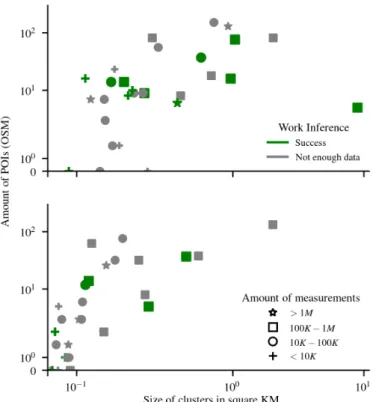
we can see in Figure2.1 that using the tighter configuration, we find clusters covering less than0.5km2 containing less than10POIs in total, whereas in the looser configuration we find larger regions containing between 10 and200 POIs. Larger clusters contain more POIs to be examined, which increases the possibility of false positives. Nevertheless, we note that the semantics of locations often make it easy to filter out false positives, e.g., lakes or parks can be usually discarded as workplaces.
2.4.1.3 Other POIs
A deep analysis of the times and semantics of the POIs identified by DBSCAN can reveal other sensitive information about users. Among others, we could infer two users’ membership to specific organizations: one member of the Scientology church who reported many points from the Church of Scientology Celebrity Centre in a major city; and a 9 https://wiki.openstreetmap.org/wiki/Overpass_API
Figure2.1: Cluster size and amount of POIs per user. Looser setting –35% success (top) and tight setting –21% success (bottom).
Masonic lodge member who regularly visited the lodge headquarters. We could verify this information online for both users. Second, we identified two work-related activities: a US-based scientist working on a paper regarding radiation around a lake in the Southern part of the US, and a photographer working in a Japanese city. We validated the former inference using Research Gate, and the latter on the webpage of the artist. Finally, we could also follow the education steps of a European PhD student. Her points of interest over time reveal the university where she obtained her master’s degree, an exchange with another European university in the framework of the Erasmus project, and the university where she is completing her doctoral studies. We verified these facts on her CV available online.
2.4.1.4 Inferring social links
Knowing from previous work [54, 64] that co-locations can unveil
social links, we examine whether crowdsourced geo-located measure-ments can also be used for this purpose. We identify pairs of users with similar latitude, longitude, and time of measurement in the whole Safecast API dataset. More advanced methods, such as measuring the amount of time two users are co-located or the number of different locations where two users jointly report their locations [36,54,153],
![Figure 2.3: Safecast privacy gain: Spatial (left) and POIs (right). Amount of measurements per user + : <10k, : [10k,50k], N : >50k](https://thumb-us.123doks.com/thumbv2/123dok_us/9534180.2829541/46.892.251.738.339.883/figure-safecast-privacy-gain-spatial-pois-right-measurements.webp)