ORIGINAL ARTICLE
A modified analytical technique for Jeffery–Hamel
flow using sumudu transform
Sushila
a,*
, Jagdev Singh
b, Y.S. Shishodia
c aDepartment of Physics, Jagan Nath University, Rampura, Chaksu, Jaipur 303901, Rajasthan, India b
Department of Mathematics, Jagan Nath University, Rampura, Chaksu, Jaipur 303901, Rajasthan, India c
Jagan Nath University, Rampura, Chaksu, Jaipur 303901, Rajasthan, India Received 30 May 2013; revised 19 August 2013; accepted 19 October 2013 Available online 18 November 2013
KEYWORDS Jeffery–Hamel flow; Homotopy perturbation method; Sumudu transform; Fluid mechanics; Nonlinear equation
Abstract The main objective of this paper is to present a reliable approach to compute an approx-imate solution of Jeffery–Hamel flow by using the modified homotopy perturbation method cou-pled with sumudu transform. The method finds the solution without any discretization or restrictive assumptions and avoids the round-off errors. The fact that this technique solves nonlin-ear problems without using Adomian’s polynomials can be considered as a clnonlin-ear advantage of this algorithm over the decomposition method. The numerical solutions obtained by the proposed method indicate that the approach is easy to implement and computationally very attractive.
ª2013 Production and hosting by Elsevier B.V. on behalf of University of Bahrain.
1. Introduction
Internal flow between two plates is one of the most applicable cases in mechanics, civil and environmental engineering. In simple cases, the one-dimensional flow through tube and par-allel plates, this is known as Couette–Poisseuille flow, has an exact solution, but in general, like most of fluid mechanic equations, a set of nonlinear equations must be solved which make some problems for analytical solution.
The flow between two planes that meet at an angle was first analyzed by Jeffery (1915) and Hamel et al. (1916) and so, it is known as Jeffery–Hamel flow, too. They worked mathematically on incompressible viscous fluid flow through
convergent-divergent channels. They presented an exact similar-ity solution of the Navier–Stokes equations. In the special case of two-dimensional flow through a channel with inclined plane walls meeting at a vertex and with a source or sink at the vertex and have been studied extensively by several authors and dis-cussed in many textbooks e.g. (Rosenhead, 1940; White, 1991; Esmali et al., 2008; Joneidi et al., 2010; Ganji et al., 2009; Inc et al., 2013).Sadri (1997)has denoted that Jeffery–Hamel is used as a asymptotic boundary condition to examine a steady two-dimensional flow of a viscous fluid in a channel. But, here some symmetric solutions of the flow have been considered, although asymmetric solutions are both possible and of physical interest (Sobey and Drazin, 1986).
Most of the scientific problems such as Jeffery–Hamel flow and other fluid mechanic problems are inherently nonlinear. Except a limited number of these problems, most of them do not have an exact solution. There exists a wide class of litera-ture dealing with the problems of approximate solutions to nonlinear equations with various different methodologies,
* Corresponding author. Tel.: +91 9461673365.
E-mail addresses:[email protected],sushila.jag@gmail. com(Sushila),[email protected](J. Singh),yad.shi@gmail. com(Y.S. Shishodia).
Peer review under responsibility of University of Bahrain.
University of Bahrain
Journal of the Association of Arab Universities for
Basic and Applied Sciences
www.elsevier.com/locate/jaaubas www.sciencedirect.com
1815-3852ª2013 Production and hosting by Elsevier B.V. on behalf of University of Bahrain. http://dx.doi.org/10.1016/j.jaubas.2013.10.001
called perturbation methods. But, the perturbation methods have some limitations e.g., the approximate solution involves a series of small parameters which poses difficulty since major-ity of nonlinear problems have no small parameters at all. Although appropriate choices of small parameters some times lead to an ideal solution, in most of the cases unsuitable choices lead to serious effects in the solutions. Therefore, an analytical method is welcome which does not require a small parameter in the equation modeling the phenomenon. The homotopy perturbation method (HPM) was first introduced and developed by He (1999, 2005, 2006a, 2006b, 2012). It was shown by many authors that this method provides improvements over existing numerical techniques (Ganji and Ganji, 2008; Ganji et al., 2008, 2009; Rashidi et al., 2009; Yildirim and Sezer, 2010; Noor et al., 2013; Mirzabeigy et al., 2013). In recent years, many authors have paid attention to study the solutions of linear and nonlinear partial differen-tial equations by using various methods combined with the La-place transform (Khuri, 2001; Khan et al., 2012; Gondal and Khan, 2010; Singh et al., 2013a) and sumudu transform (Singh et al., 2011, 2013b).
In this paper, we present a modified analytical technique namely the modified homotopy perturbation method (MHPM) coupled with sumudu transform to obtain the approximate solution of nonlinear equation governing Jeffery–Hamel flow. The MHPM coupled with sumudu trans-form provides the solution in a rapid convergent series which may lead to the solution in a closed form. The advantage of this method is its capability of combining two powerful methods for obtaining exact and approximate solutions for nonlinear equations.
2. Sumudu transform
In early 90’s,Watugala (1993)introduced a new integral trans-form, named the sumudu transform and applied it to the solu-tion of ordinary differential equasolu-tion in control engineering problems. The sumudu transform is defined over the set of functions
A¼ ffðtÞj9M;s1;s2>0;jfðtÞj<M ejtj=sj;if t2 ð 1Þj ½0;1Þg by the following formula
fðuÞ ¼S½fðtÞ ¼Z 1
0
fðutÞetdt;u2 ðs
1;s2Þ: ð1Þ Some of the properties of the sumudu transform were estab-lished byAsiru (2001). Further, fundamental properties of this transform were established byBelgacem et al. (2003), Belgacem and Karaballi (2006), Belgacem (2006). In fact it was shown that there is a strong relationship between sumudu and other integral transform, seeKilicman et al. (2011). In particular the relation between sumudu transform and Laplace transforms was proved inKilicman and Eltayeb (2010). The sumudu transform has scale and unit preserving properties, so it can be used to solve problems without resorting to a new frequency domain. 3. Mathematical model
Consider the steady unidirectional flow of an incompressible viscous fluid flow from a source or sink at the intersection
between two rigid plane walls that the angle between them is 2aas it is shown inFig. 1.
The velocity is assumed only along radial direction and de-pends on randh. Conservation of mass and momentum for two-dimensional flow in the cylindrical coordinate can be ex-pressed as the following (Schlichting, 2000)
1 r @ @rðrUrÞ þ 1 r @ @rðrUhÞ ¼0; ð2aÞ q Ur @Ur @r þ Uh r @Ur @h U2 h r ¼ @P @rþ 1 r @ðrsrrÞ @r þ 1 r @srh @r srh r ; ð2bÞ q Ur @Uh @r þ Uh r @Uh @h UrUh r ¼ 1 r @P @hþ 1 r2 @ðrsrhÞ @r þ 1 r @shh @h srh r ; ð2cÞ
wherePis the pressure term,UrandUhare the velocities inrandh
directions, respectively. Stress components are defined as follows: srr¼l 2 @Ur @r 2 3divðU~Þ ; ð3aÞ shh¼l 2 1 r @Uh @h þ Ur r 2 3divðU~Þ ; ð3bÞ srh¼l 2 @ @r Uh r þ 1 r @Ur @h : ð3cÞ
ConsideringUh= 0 for purely radial flow leads to continuity
and Navier–Stokes equations in polar coordinates become q r @ @rðrUrÞ ¼0; ð4aÞ Ur @Ur @r ¼ 1 q @P @rþt @2Ur @r2 þ 1 r @Ur @r þ 1 r2 @2Ur @h2 Ur r2 ; ð4bÞ 1 qr @P @hþ 2t r2 @Ur @h ¼0: ð4cÞ
The boundary conditions are At centerline of the channel:@Ur
@h ¼0;
On the wall of the channel:Ur¼0: ð5Þ
From Eq.(4a)
gðhÞ rUr; ð6Þ
using dimensionless parameter fðxÞ gðhÞ
gmax
; xh
a; ð7Þ
and with eliminatingPfrom Eqs.4b and 4c, an ordinary dif-ferential equation is obtained for the normalized function pro-filef(x):
f000þ2aRefðxÞf0ðxÞ þ4a2f0ðxÞ ¼0: ð8Þ According to the relation Eqs. (5)–(7), the boundary condi-tions will be
fð0Þ ¼1; f0ð0Þ ¼0; fð1Þ ¼0: ð9Þ The Reynolds number is
Re¼gmaxa t ¼ Umaxra t Divergent Channel:a>0 Convergent Channel:a<0 : ð10Þ whereUmaxis the velocity at the center of the channel (r= 0). 4. Basic idea of MHPM coupled with sumudu transform To illustrate the basic idea of this method, we consider a gen-eral nonlinear non-homogenous partial differential equation of the form:
LUþRUþNU¼gðxÞ; ð11Þ
whereLis the highest order linear differential operator,Ris the linear differential operator of less order thanL,N repre-sents the general nonlinear differential operator and g(x) is the source term. By applying the sumudu transform on both sides of Eq.(11), we get
S½U ¼unX n1 k¼0 UðkÞð0Þ uðnkÞ þu n S½gðxÞ unS½RUþNU ¼0: ð12Þ Now applying the inverse sumudu transform on both sides of Eq.(12), we get
U¼GðxÞ S1½unS½RUþNU; ð13Þ
where G(x) represents the term arising from the source term and the prescribed initial conditions. Now we construct the fol-lowing homotopy
U¼GðxÞ pðS1½unS½RUþNUÞ
; ð14Þ
In view of the HPM, we use the homotopy parameter p to expand solution U¼X 1 m¼0 pmU m ð15Þ
and the nonlinear term can be decomposed as NU¼X
1
m¼0 pmH
m; ð16Þ
for some He’s polynomials (Ghorbani, 2009; Mohyud-Din et al., 2009) that are given by
HmðU0;U1; :::;UmÞ ¼ 1 m! @m @pm N X1 i¼0 piUi ! " # p¼0 ; m¼0;1;2;3;. . . ð17Þ
Substituting Eqs.15 and 16in Eq.(14), we get X1 m¼0 pmU m¼GðxÞ p S1 unS RX 1 m¼0 pmU mþ X1 m¼0 pmH m " # " #! ; ð18Þ Comparing the coefficient of like powers ofp, the following approximations are obtained
p0:U0ðxÞ ¼GðxÞ; p1:U 1ðxÞ ¼ S1½unS½RU0ðxÞ þH0ðUÞ; p2:U 2ðxÞ ¼ S1½unS½RU1ðxÞ þH1ðUÞ; ð19Þ p3:U3ðxÞ ¼ S1½unS½RU2ðxÞ þH2ðUÞ:
Proceeding in this same manner, the rest of the components Umcan be completely obtained and the series solution is thus
entirely determined. Finally, we approximate the analytical solutionUby truncated series
U¼Lim
N!1 XN m¼0
Um: ð20Þ
The above series solutions generally converge very rapidly. 5. Solution of the problem
In this section, we apply the MHPM coupled with sumudu transform to obtain an approximate analytical solution of Eq.(8). By applying the sumudu transform on the both sides of Eq.(8), we have
S½fðxÞ ¼1þau2u3S½2aReff0þ4a2f0: ð21Þ Taking inverse sumudu transform on both sides of Eq.(21), we get
fðxÞ ¼1þ1 2ax
2S1½u3S½2aReff0þ4a2f0: ð22Þ Now applying the HPM, we get
X1 m¼0 pmfmðxÞ ¼1þ1 2ax 2 p S1 u3S 2aRe X 1 m¼0 pmHmðxÞ ! þ4a2 X 1 m¼0 pmf0 mx ! " # " #! ; ð23Þ
where Hm, is He’s polynomials that represent the nonlinear
terms. So He’s polynomials are given by X1
m¼0 pmH
mðxÞ ¼fðxÞf0ðxÞ: ð24Þ
The first few components of He’s polynomials, are given by H0ðxÞ ¼f0ðxÞf00ðxÞ;
H1ðxÞ ¼f0ðxÞf10ðxÞ þf1ðxÞf00ðxÞ; ð25Þ H2ðxÞ ¼f0ðxÞf20ðxÞ þf1ðxÞf10ðxÞ þf2ðxÞf00ðxÞ;
.. .
Comparing the coefficients of like powers ofp, we have p0 :f0ðxÞ ¼1þ 1 2ax 2 ; ð26Þ p1:f1ðxÞ ¼ a a 2 120Rex 6þ 1 12ðReaþ2aaÞx 4 ; ð27Þ p2:f2ðxÞ ¼ 4 15a 2 a 3 2880Re 2x10 a 2 1344ð9Re 2 þ18aReÞx8 a 240ð5Re 2þ20aReþ20a2Þ x6i; ð28Þ .. .
where a¼f00ð0Þto be determined from the boundary condi-tions. The solutions of the Eq. (8), when pfi1, will be as follows:
fðxÞ ¼f0ðxÞ þf1ðxÞ þf2ðxÞ þ : ð29Þ
6. Results and discussion
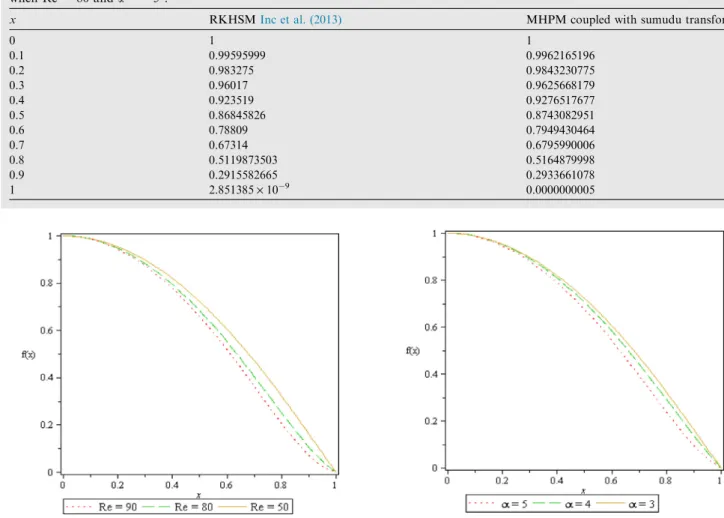
Eq. (8)is solved analytically using the MHPM coupled with sumudu transform. Table 1 shows comparison between the RKHSM (Inc et al., 2013) and MHPM coupled with sumudu transform for f(x) when Re = 80 and a=5. Figs. 2–4 illustrate the effects of Reynolds number and steep angle of the channel on velocity profile.
Table 1 The comparison between the RKHSM (withH= 0) (Inc et al., 2013) and MHPM coupled with sumudu transform forf(x) when Re = 80 anda=5.
x RKHSMInc et al. (2013) MHPM coupled with sumudu transform
0 1 1 0.1 0.99595999 0.9962165196 0.2 0.983275 0.9843230775 0.3 0.96017 0.9625668179 0.4 0.923519 0.9276517677 0.5 0.86845826 0.8743082951 0.6 0.78809 0.7949430464 0.7 0.67314 0.6795990006 0.8 0.5119873503 0.5164879998 0.9 0.2915582665 0.2933661078 1 2.851385·109 0.0000000005
Figure 2 Velocity diagram via MHPM coupled with sumudu transform for different values of Re whena= 3.
Figure 3 Velocity diagram via MHPM coupled with sumudu transform for different values of Re whena=5.
Figure 4 Velocity diagram via MHPM coupled with sumudu transform for different values ofawhen Re = 50.
7. Conclusions
In this paper, the MHPM coupled with sumudu transform is applied successfully to find the analytical solution of Jeffery– Hamel flow. The results of the present method are in excellent agreement with the RKHSM (Inc et al., 2013) and the ob-tained solutions are revealed graphically. In this paper, we use Maple Package to calculate the He’s polynomials. Also from figures, we can find some results as follows:
(1) When a> 0 and steep of the channel is divergent, an increase in the values of Reynolds number decreases the velocity as shown inFig. 2whena= 3.
(2) Whena< 0 and the steep of the channel is convergent, the velocity increases with the increase in Reynolds num-ber as depicted inFig. 3whena=5.
(3) When Reynolds number is fixed, there is an inverse rela-tion between divergence angle of the channel and the velocity of the fluid as shown inFig. 4.
References
Asiru, M.A., 2001. Sumudu transform and the solution of integral equation of convolution type. International Journal of Mathemat-ical Education in Science and Technology 32, 906–910.
Belgacem, F.B.M., 2006. Introducing and analysing deeper sumudu properties. Nonlinear Studies 13 (1), 23–41.
Belgacem, F.B.M., Karaballi, A.A., 2006. Sumudu transform fundamental properties investigations and applications. Journnal of Applied Math-ematics and Stochastic Analysis [Article ID 91083, 23 pages]. Belgacem, F.B.M., Karaballi, A.A., Kalla, S.L., 2003. Analytical
investiga-tions of the sumudu transform and applicainvestiga-tions to integral production equations. Mathematical problems in Engineering 3, 103–118. Esmali, Q., Ramiar, A., Alizadeh, E., Ganji, D.D., 2008. An
approximation of the analytical solution of the Jeffery–Hamel flow by decomposition method. Physics Letters A 372, 3434–3439. Ganji, Z.Z., Ganji, D.D., 2008. Approximate solutions of thermal boundary-layer problems in a semi-infinite plate by using homot-opy perturbation method. International Journal of Nonlinear Sciences and Numerical Simulation 9 (4), 415–422.
Ganji, Z.Z., Ganji, D.D., Jafari, H., Rostamian, M., 2008. Application of HPM to coupled system of PDE. Topological Methods in Nonlinear Analysis 31, 341–348.
Ganji, Z.Z., Ganji, D.D., Esmaeilpour, M., 2009. Study on nonlinear Jeffery–Hamel flow by two He’s semi-analytic method and com-parison with numerical results. Computers and Mathematics with Applications 58, 2107–2116.
Ghorbani, A., 2009. Beyond adomian’s polynomials: he polynomials. Chaos, Solitons & Fractals 39, 1486–1492.
Gondal, M.A., Khan, M., 2010. Homotopy perturbation method for nonlinear exponential boundary layer equation using Laplace transfor-mation, He’s polynomials and pade technology. International Journal of Nonlinear Sciences and Numerical Simulation 11 (12), 1145–1153. Hamel, G., Bewgungen, S., Flussigkeiten, Z., 1916. Jahresbericht der
Deutschen Mathematiker-Vereinigung 25, 34–60.
He, J.H., 1999. Homotopy perturbation technique. Computer Meth-ods in Applied Mechanics and Engineering 178, 257–262. He, J.H., 2005. Homotopy perturbation method for bifurcation of
nonlinear problems. International Journal of Nonlinear Sciences and Numerical Simulation 6, 207–208.
He, J.H., 2006a. Some asymptotic methods for strongly nonlinear equation. International Journal of Modern Physics B 20, 1141–1199. He, J.H., 2006b. New interpretation of homotopy perturbation method. International Journal of Modern Physics B 20, 2561–2568.
He, J.H., 2012. Asymptotic methods for solitary solutions and compactons. Abstract and Applied Analysis [Article ID 916793, 130 pages].
Inc, M., Akgu¨l, A., Kilicman, A., 2013. A new application of the reproducing kernel Hilbert space method to solve MHD Jeffery– Hamel flows problems in nonparallel walls. Abstract and Applied Analysis [Article ID 239454, 12 pages].
Jeffery, G.B., 1915. The two-dimensional steady motion of a viscous fluid. Philosophical Magazine Series 6 (29), 455–465.
Joneidi, A.A., Domairry, G., Babaelahi, M., 2010. Three analytical methods applied to Jeffery–Hamel flow. Communications in Nonlinear Science and Numerical Simulation 15, 3423–3434. Khan, M., Gondal, M.A., Kumar, S., 2012. A new analytical solution
procedure for nonlinear integral equations. Mathematical and Computer Modelling 55, 1892–1897.
Khuri, S.A., 2001. A Laplace decomposition algorithm applied to a class of nonlinear differential equations. Journal of Applied Mathematics 1, 141–155.
Kilicman, A., Eltayeb, H., 2010. On the applications of laplace and sumudu transforms. Journal of the Franklin Institute 347 (5), 848– 862.
Kilicman, A., Eltayeb, H., Ariffin, M.A.K., 2011. A note on the comparison between laplace and sumudu transforms. Bulletin of the Iranian Mathematical Society 37 (1), 131–141.
Mirzabeigy, A., Yazdi, M.K., Yildirim, A., 2013. Nonlinear dynamics of a particle on a rotating parabola via the analytic and semi-analytic approaches. Journal of the Association of Arab Univer-sities for Basic and Applied Sciences 13, 38–43.
Mohyud-Din, S.T., Noor, M.A., Noor, K.I., 2009. Traveling wave solutions of seventh-order generalized KdV equation using He’s polynomials. International Journal of Nonlinear Sciences and Numerical Simulation 10, 227–233.
Noor, M.A., Noor, K.I., Khan, S., Waseem, M., 2013. Modified homotopy perturbation method for solving system of linear equations. Journal of the Association of Arab Universities for Basic and Applied Sciences 13, 35–37.
Rashidi, M.M., Ganji, D.D., Dinarvand, S., 2009. Explicit analytical solutions of the generalized Burger and Burger–Fisher equations by homotopy perturbation method. Numerical Methods for Partial Differential Equations 25 (2), 409–417.
Rosenhead, L., 1940. The steady two-dimensional radial flow of viscous fluid between two inclined plane walls. Proceeding of the Royal Society A 175, 436–467.
Sadri, R., 1997. Channel entrance flow, PhD thesis, Dept. Mechanical Engineering, the University of Western Ontarion.
Schlichting, H., 2000. Boundary-Layer Theory. McGraw Hill, New York.
Singh, J., Kumar, D., Sushila, 2011. Homotopy perturbation sumudu transform method for nonlinear equations. Advances in Theoret-ical and Applied Mechanics 4, 165–175.
Singh, J., Kumar, D., Kumar, S., 2013a. New treatment of fractional Fornberg–Whitham equation via Laplace transform. Ain Shams Engineering Journal [doi.org/10.1016/j.asej.2012.11.009].
Singh, J., Kumar, D., Kilicman, A., 2013b. Homotopy perturbation method for fractional gas dynamics equation using sumudu transform. Abstract and Applied Analysis [Article ID 934060, 8 pages].
Sobey, I.J., Drazin, P.G., 1986. Bifurcation of two-dimensional channel flows. Journal of Fluid Mechanics 171, 263–287. Watugala, G.K., 1993. Sumudu transform – a new integral transform
to solve differential equations and control engineering problems. International Journal of Mathematical Education in Science and Technology 24 (1), 35–43.
White, F.M., 1991. Viscous Fluid Flow. McGraw-Hill.
Yildirim, A., Sezer, S.A., 2010. Effects of partial slip on the peristaltic flow of a MHD Newtonian fluid in an asymmetric channel. Mathematical and Computer Modelling 52 (3–4), 618–625.