A Brief Tutorial on Live Virtual Machine Migration From a
Security Perspective
Diego Perez-Botero
Princeton University, Princeton, NJ, USA
[email protected]
ABSTRACT
Virtualization has gained traction in a wide variety of con-texts. The rise of Cloud Computing and the wide adoption of the OpenFlow API in computer networks are just a few examples of how virtualization has changed the foundations of computing. In general, the term ”virtualization” refers to the process of turning a hardware-bound entity into a software-based component. The end result of such procedure encapsulates an entity’s logic and is given the name of Vir-tual Machine (VM). The main advantage of this technique is that multiple VMs can run on top of a single physical host, which can make resource utilization much more efficient. Of particular interest are those VMs with high availability re-quirements, such as the ones deployed by cloud providers, given that they generate the need to minimize the downtime associated with routine operations.
VMs can deal with availability constraints much more grace-fully than their physical equivalents. While physical hosts have to be powered down for maintenance, the VMs that they serve can migrate to execute on other physical nodes. It is also common to migrate VMs when load balancing is needed in the physical plane. The process of migrating VMs without any perceptible downtime is known as Live Virtual Machine Migration and is the topic of this paper. This non-trivial problem has been studied extensively and popular hy-pervisors (e.g. Xen, VMware, OpenVZ) have now put rea-sonable solutions to practice. After covering thepre-copy
and post-copy approaches to live VM migration, a variety of design decisions will be discussed along with their pros and cons. Having set the necessary theoretical background, a security-focused survey will be carried out, documenting the state-of-the-art in Live VM Migration exploits and coun-termeasures.
1.
SYSTEM VS PROCESS MIGRATION
The problem of process migration was thoroughly studied during the 90’s. Unfortunately, the fact that applications are strongly connected with the OS by way of open sockets, file descriptors and other resource pointers makes process migration very difficult. In some cases (e.g. shared mem-ory between processes), such migration is not even possible unless processes are partitioneda priori [1].Migrating an entire OS with its applications is a much more manageable procedure, especially in the presence of a Vir-tual Machine Monitor (VMM). VMMs expose a narrow in-terface to the OS, so the entity to be migrated encapsulates
most of the complexity. That is, the details of what is oc-curring inside the VM can be ignored during migration.
2.
LIVE VM MIGRATION STRATEGIES
In this section, we will consider the most common setting for Live VM Migration: a clustered server environment. The three main physical resources that are used under such con-ditions are memory, network and disk [2]. While memory can be copied directly from one host to another, local disk and network interface migration are not trivial.To be able to preserve open network connections and to avoid network redirection mechanisms, a VM should retain its original IP address after migration. If the migration is within the same LAN, which is the norm in a clustered server environment, this can be done by generating an unsolicited ARP reply advertising the new location for the migrated VM’s IP [2].
Local disk migration should not be needed inside a server farm. Data centers use network-attached storage (NAS) de-vices, which can be accessed from anywhere inside the clus-ter. Thus, secondary storage doesn’t have to be migrated with the VM. Consequently, in a clustered server en-vironment, the Live VM Migration problem is re-duced to finding a way of consistently transferring VM memory state from one host to another.
2.1
Memory Migration
Memory migration can be divided into three phases [3]: • Push phase: The source VM continues running while
certain pages are pushed across the network to the new destination. To ensure consistency, pages modi-fied during this process must be resent.
• Stop-and-copy phase: The source VM is stopped, pages are copied across to the destination VM, then the new VM is started.
• Pull phase: The new VM starts its execution and, if it accesses a page that has not yet been copied, this page is faulted in across the network from the source VM.
Most migration strategies select either one or two of the above phases. While thepre-copy approach combines push with stop-and-copy, the post-copy approach combines pull with stop-and-copy.
2.2
Pre-Copy
As pointed out by [4], Xen1 usespre-copyas its live migra-tion strategy. Thepre-copy algorithm proposed by [2] uses an iterative push phase, followed by a minimal stop-and-copy. The iterative nature of the algorithm is the result of what is known asdirty pages: memory pages that have been modified in the source host since the last page transfer must be sent again to the destination host. At first, iteration i
will be dealing with less dirty pages than iteration i−1. Unfortunately, the available bandwidth and workload char-acteristics will make it so that some pages will be updated at a faster rate than the rate at which they can be transferred to the destination host. At that point, the stop-and-copy procedure must be executed. A 5-step view of thepre-copy
technique is shown in Figure 1:
Figure 1: pre-copy algorithm. Taken from [2]
The stop-and-copy phase is when the CPU state and any re-maining inconsistent pages are sent to the new host, leading to a fully consistent state. Determining the time to stop the pre-copy phase is non-trivial, since there exists a trade-off betweentotal migration timeanddowntime. If it is stopped too soon, more data must be sent over the network while both the source and the destination are down, leading to a larger downtime. Nonetheless, if stopped too late, some time will be wasted on pages that are written too often and defeat any pre-copy efforts. As explained by [3], most server work-loads exhibit a small, but frequently updated set of pages known aswritable working set (WWS)orhot pages, that can only be transferred during the stop-and-copy stage. Depend-ing on the workload characteristics, [2] registered downtimes with thepre-copytechnique of only 60 ms and 210 ms with normal applications, and a worst-case 3.5 second downtime with an intentionally ”diabolical” workload.
2.2.1
Availability Concerns
The pre-copy algorithm actively scans memory pages and sends them through the network. As such, CPU resource
1Xen is a very popular Open Source Type-I Hypervisor.
http://www.xen.org
and bandwidth consumption should be monitored to mini-mize service degradation. A reasonable heuristic is to start off with low bandwidth usage, transferring the relatively static memory pages without any perceivable impact on qual-ity of service. Afterwards, more bandwidth and CPU re-sources can be allocated to the migration process incremen-tally to be able to transfer frequently-updated pages. This would culminate with the maximum throughput (high per-formance impact) for a short period of time to reduce thehot pagesto a minimum before the stop-and-copy phase begins.
2.3
Post-Copy
Post-copy migration defers the memory transfer phase un-til after the VM’s CPU state has already been transferred to the target and resumed there. As opposed to pre-copy, where the source host handles client requests during the mi-gration process,post-copydelegates service execution to the destination host. In the most basic form,post-copyfirst sus-pends the migrating VM at the source node, copies minimal processor state to the target node, resumes the virtual ma-chine at the target node, and begins fetching memory pages from the source over the network. Variants of post-copy arise in terms of the way pages are fetched. The main bene-fit of this approach is that each memory page is transferred
at most once, thus avoiding the duplicate transmission over-head of pre-copy [5]. Figure 2 contrasts the pre-copy and the post-copy procedure timelines:
Figure 2: The timeline of (a)pre-copy vs (b)post-copy
migration. Taken from [5]
There are three main ways of handling page fetching in post-copy schemes [5]:
• Post-Copy via Demand Paging: after the VM resumes at the target, page faults are serviced by requesting the referenced page over the network from the source node. Usually, this results in unacceptable total migration times andapplication degradation.
• Post-Copy via Active Pushing: a better way to tackle residual dependencies if to proactively push the pages from the source to the target, even as the VM contin-ues executing at the target machine. Page faults can
be serviced with higher priority than the other pages being pushed.
• Post-Copy via Pre-Paging: this approach extends the active pushing technique by estimating the spatial lo-cality of the VM’s memory access pattern in order to anticipate the occurrence of major page faults. This way, the transmission window of the pages being pushed changes in real time with each new page fault to min-imizeapplication degradation.
2.3.1
Performance Concerns
As shown by [5], hybrid post-copy schemes provide lower total migration times than pre-copy because the writable working set issue is eliminated. Unfortunately, downtime is increased due to the way page faults are handled. Therefore, this migration strategy might be optimal for environments in which low network overhead is critical.
3.
DIVISION OF RESPONSIBILITIES
When performing Live VM Migration, the operation can be either VMM-intensive or OS-intensive. Depending on the decision made, either the OS kernel or the VMM will need to be modified. Under some circumstances, the developer is forced to go for one option or the other. For example, OS-intensive procedures might not be possible if a closed-source OS is being used, such as Windows 7.3.1
Managed Migration (VMM-based)
In case of managed migration, the migration is performed by the daemons running in the management VMs of the source and the destination. These daemons are responsible for creating a new VM on the destination machine, and coor-dinating transfer of live system state over the network. Let us consider the case in which live migration is being run in
pre-copymode. In the initial round, all the pages are trans-ferred and subsequently only those pages that were dirtied in the previous rounds (as indicated by a dirty bitmap) are migrated. Xen uses shadow page tables to log dirty pages. The shadow tables are populated using guest page tables and reset after each phase of pre-copying. When pre-copy phase is no longer beneficial, a control message is sent to the OS to suspend itself in a state suitable for migration on host, and prepare for resumption on the destination. The dirty bitmap is scanned for remaining inconsistent memory pages, and these are transferred to the destination along with the VM’s check-pointed CPU register state [3].
3.2
Self Migration (OS-Based)
In this design, no modifications are required to the VMM. The implementation aspects are present within the OS it-self. The destination machine must run a migration stub to listen for incoming migration requests, create an appro-priate empty VM, and receive migrated system state. No modifications are necessary for a source machine. Let us consider the case in which live migration is being run in pre-copy mode. Difficulty arises in transferring a consistent OS checkpoint, as the OS must continue to run in order to trans-fer its final state. The solution is to logically checkpoint the OS on entry into its final two stages of the stop-and-copy phase. In the pre-final stage, only migration is allowed and a shadow buffer is updated with the current dirty pages. In
the last stage, contents of the shadow buffer are transferred to complete the migration [3].
4.
VIRTUALIZATION OPTIONS
Virtualization offers many benefits such as live migration, re-source consolidation, isolation, intrusion prevention/detection, and checkpointing. However, the overhead of virtualization cannot always be justified [6]. Regardless, Live Migration is a very valuable tool. For this reason, considerable research has been made to reap the benefits of native performance while still being able to conduct Live Migration.
4.1
Virtualized Environment
Virtualized environments are the common denominator when it comes to cloud computing, grid computing, and data cen-ters in general. Native performance is sacrificed in order to accomplish higher resource utilization by executing var-ious VMs on each host. Applications in this setting are usually I/O and network intensive, so virtualized devices suffice as no specialized operations are required. Most im-portantly, scalability is easily achievable in virtualized en-vironments, since instances of the same service can be dy-namically spawned or eliminated.
Live VM Migration is a very important operation in this context. It serves as the means through which the virtual-to-physical host mapping can be altered to achieve load bal-ancing, energy efficiency, and easy hardware maintenance, among other administrative tasks.
4.2
No Virtualization
Virtualization technology adds an extra layer of abstraction with at least three unwanted effects [1]:
• Capability lag: VMMs typically expose ”lowest com-mon denominator” virtual devices to enhance porta-bility. This leads to the inability to use the highest performance features of specialized physical devices, such as GPU-accelerated video decoding.
• Additional software management: VMMs can intro-duce additional complexity into software management (Xen has 200K lines of code in the hypervisor itself [7]). Virtualization typically does not reduce the total number of software components running on a system. Hence, there are more lines of code to manage, more patches to apply, etc.
• Performance hit: In many applications, virtualized performance is within an acceptable margin of native performance and, therefore, the additional layers of software introduced through virtualization are toler-ated, but there are also cases where it is not. Kozuch et al. [1] show how a parallel robotics simulator suffers a 40% slowdown in a standard VM configuration.
Non-virtualized live migration is very challenging. The ba-sic idea is the same as described in section 3.2 (Self Migra-tion), but even migration to another machine with the same hardware presents new difficulties. Even non-deterministic aspects of the boot process (e.g. BIOS and/or OS might enu-merate the devices in a different order or use different IRQs)
stand in the way of a successful migration [1]. Kozuch et al. [1] propose modifications to device drivers and the OS ker-nel that would make it possible to conduct live self-migration of non-virtualized OS instances, but the complexity of the operation makes it seem much more error-prone than its virtualized counterpart.
In terms of security, the presence of a hypervisor (virtualiza-tion) increases the possible attack vectors between co-hosted VMs. The NoHype architecture for cloud computing elim-inates the hypervisor attack surface by enabling the guest VMs to run natively on the underlying hardware while main-taining the ability to run multiple VMs concurrently [7]. Such a feat is made possible by the very unique character-istics of cloud computing (e.g. pre-allocation of processor cores and memory resources, use of virtualized I/O devices, etc.). A live migration mechanism is yet to be proposed for the NoHype context, so non-virtualized live migration is a very relevant topic in cloud computing.
4.3
On-Demand Virtualization
Kooburat and Swift [6] show that virtualized and native execution are not necessarily mutually exclusive. Their on-demand virtualizationproposal attempts to enable switches between both execution modes on-the-fly. They leverage the existing hibernation mechanism found in modern Oper-ating Systems to capture system state and modify the re-sume kernel to boot up the machine in the other execution mode. Throughout the conversion, active connections re-main open. Nonetheless, the downtime of their initial pro-totype is around 90 seconds, which is unacceptable. If a live native-to-virtualized conversion technique is developed, the non-virtualized live migration challenges detailed by [1] could be avoided.
5.
THE SECURITY PROBLEM
Live VM migration includes a lot of state transfer through the network. During the procedure, protecting the contents of the VM state files is an important consideration as the volatile state being transferred may contain highly sensitive information like passwords and encryption keys. A secure channel is at times not enough for protection. Mutual vali-dation among the hosts involved in the migration might even be a more important issue to be considered [3].
Live VM Migration, like any other network-bound process, is susceptible to network attacks such as ARP spoofing, DNS poisoning, and route hijacking. If an attacker somehow man-ages to place himself between the source and the destina-tion host, he can then conduct passive (sniffing) or active (man-in-the-middle) attacks. The fact that the live migra-tion procedure is usually carried out inside a LAN makes it even more likely for a network attack to be successful, es-pecially in situations where different third-parties run their VMs inside the same network subnet, which is the case in cloud computing.
6.
THREAT MODEL
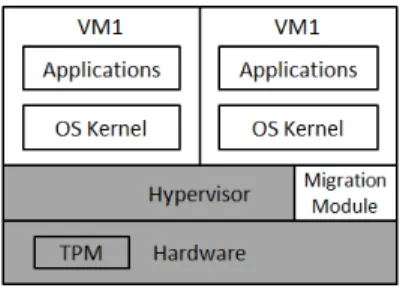
OurTrusted Computing Base (TCB), shown in Figure 3, is comprised by the hardware and the hypervisor, excluding its Live Migration Module. Given that the traditional hy-pervisor modules are trusted, co-hosted VMs do not pose a
threat for the migration source and destination VMs, tak-ing into account that the non-migration-related operations provided by the VMM cannot be used as an attack vector. Such assumption could be held true by employing a hard-ened hypervisor, such as HyperSafe [8].
The migration source and destination VMs are untrusted to each other, so mutual authentication and attestation mech-anisms must be in place. Since the main usage scenario for Live VM Migration is in the cloud computing context, we also assume that other VMs inside the same network seg-ment are untrusted third parties (potential attackers), but that the cloud provider is trusted. Last but not least, the communication medium (LAN) is taken to be untrusted and prone to interception by malicious parties. As a result, we focus our attention on remote LAN-bound threats. The mi-gration module can be directly targeted by a remote party, but the migration process itself is also exposed to attacks, given that it takes place over the untrusted network infras-tructure.
Figure 3: TCB for Live VM Migration. Gray com-ponents are trusted. White comcom-ponents are outside the TCB.
7.
DETECTING MIGRATION OF VIRTUAL
MACHINES
The first thing to consider in order to evaluate the viability of possible attacks to Live VM Migration is whether migra-tion processes can be detected by an attacker located outside the source and destination hosts. That is, we must find a way to detect migration processes inside a network without relying on methods that are restricted to co-hosted VMs (e.g. the cache-based side-channel from [9]).
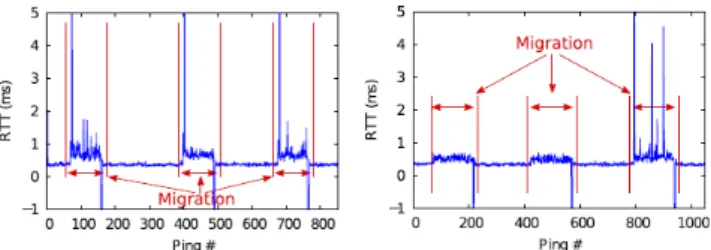
Konig and Steinmetz [10] show that the round-trip time (RTT) of ICMP packets is a promising metric for remotely detecting VM migration processes. By targeting a VM with ICMP packets, they can determine when that specific VM is migrating to another physical machine. As shown in Fig-ure 4, a generalized increase in round-trip time is observed throughout the entire migration process. Additionally, a peak round-trip time at the beginning of the migration pro-cess is detected, as well as packet loss at the end. The packet loss at the end of the migration phase is caused by the vir-tual machine’s CPU being stopped while its registers are transferred to the target machine [10]. When the VM ing migrated is under high CPU load, the RTT peaks be-have differently. This might be due to the fact that mem-ory pages are being updated more frequently, leading to a greater amount of hot pages, which demands another net-work traffic pattern (a larger transfer at the end, before the
stop-and-copy phase).
Figure 4: Remote detection of live migration process with low CPU load (left) and high CPU load (right). Taken from [10]
Konig and Steinmetz’s results confirm the feasibility of con-ducting network attacks on Live VM Migration operations. If remote detection of migration initiation was not possible, ARP flooding and other aggressive network attacks would need to be activated for long periods of time, resulting in noticeable performance degradation and easy detection by Intrusion Detection Systems (IDS).
8.
THREATS AND ATTACKS
Live VM Migration threats can be classified into 3 different classes [11]:
• Control Plane: The communication mechanisms em-ployed by the VMM to initiate and manage live VM migrations must be authenticated and resistant to tam-pering. An attacker may be able to manipulate the control plane of a VMM to influence live VM migra-tions and gain control of a guest OS.
• Data Plane: The data plane across which VM mi-grations occur must be secured and protected against snooping and tampering of guest OS state. Passive at-tacks against the data plane may result in leakage of sensitive information from the guest OS, while active attacks may result in a complete compromise of the guest OS.
• Migration Module: The VMM component that imple-ments migration functionality must be resilient against attacks. If an attacker is able to subvert the VMM using vulnerabilities in the migration module, the at-tacker may gain complete control over both the VMM and any guest OSes.
8.1
Control Plane
As a part of the control level threat, an attacker can ma-nipulate the control realm of a VMM to arbitrarily initiate VM migration and thereby gain control of a guest OS. The possible loopholes at the control plane include [3]:
• Incoming Migration Control: By initiating unautho-rized incoming migrations, an attacker may cause guest VMs to be live migrated to the attacker’s machine and hence gain full control over guest VMs.
• Outgoing Migration Control: By initiating outgoing migrations, an attacker may migrate a large number of guest VMs to a legitimate victim VMM, overloading it and causing disruptions or a denial of service. • False Resource Advertising: In an environment where
live migrations are initiated automatically to distribute load across a large number of servers, an attacker may be able to falsely advertise available resources via the control plane. By pretending to have a large num-ber of spare CPU cycles, the attacker may be able to influence the control plane to migrate a VM to a com-promised VMM.
8.2
Data Plane
Melvin Ver [12] shows how packet sniffing of VMware VMo-tion’s live migration process with widely-available tools like Wireshark2 can reveal sensitive information in plain text,
even when encryption is enabled. For example, the content of the files that the VM’s legitimate user is currently viewing can be captured that way.
Figure 5 shows a logical view of a Man-in-the-Middle (MiTM) condition. As previously mentioned, there are a variety of network attacks that can generate the necessary conditions for an attacker to become part of the data path between the migration source and destination.
Figure 5: Man-in-the-Middle attack against a Live VM Migration. Taken from [11]
These attacks are not theoretical. Tools like Xensploit3work
against Xen and VMware migrations. An example of this functionality was shown at the Black Hat DC Briefings 20084 by Oberheide et al.:
1. The attacker tries to gain root access to the target virtual machine via an SSH session before the VM mi-gration happens:
Figure 6: Failed attempt at gaining root access through an SSH session 2http://www.wireshark.org 3 http://blogs.iss.net/archive/XenSploit.html 4 http://www.blackhat.com/html/bh-dc-08/bh-dc-08-main.html
2. The attacker intercepts the Live VM Migration and uses a hex editor to modify the SSH module’s user authentication code before sending the memory pages to the destination host:
Figure 7: Hex editor view of authentication code 3. Attacker tries to gain root access again after VM
mi-gration is completed:
Figure 8: Successful attempt at gaining root access through an SSH session
As seen in the example above, even if the VM and the VMM are secure against a particular threat under normal condi-tions, the migration procedure can render traditional secu-rity measures useless and compromise an entire system.
8.3
Migration Module
As the migration module provides a network service over which a VM is transferred, common software vulnerabilities such as stack, heap, and integer overflows can be exploited by a remote attacker to subvert the VMM. Given that VM migration may not commonly be viewed as a publicly ex-posed service, the code of the migration module may not be scrutinized as thoroughly as other code [11].
9.
SECURITY MECHANISMS
Research in the area of VM migration mainly focused on optimizing migration performance through live migration. While the semantics and performance of live VM migration are well explored, the security aspects have received very lit-tle attention [13]. The threats as described in the previous section require that appropriate solutions be applied at ev-ery level. Mutual authentication of source and destination hosts is necessary for a secure migration. Also, migration ca-pabilitiesand access policies should be introduced to allow administrators to manage migration policies [3].
9.1
vTPM
Trusted computing is an approach to building systems such that their integrity can be verified. It is based on the concept of transitive trust where initial trust in a hardware module is delegated to other system components [13]. The industry-standard trusted hardware module is the Trusted Platform Module (TPM). The full TPM specification by the TCG consortium can be found online5.
5
http://www.trustedcomputinggroup.org
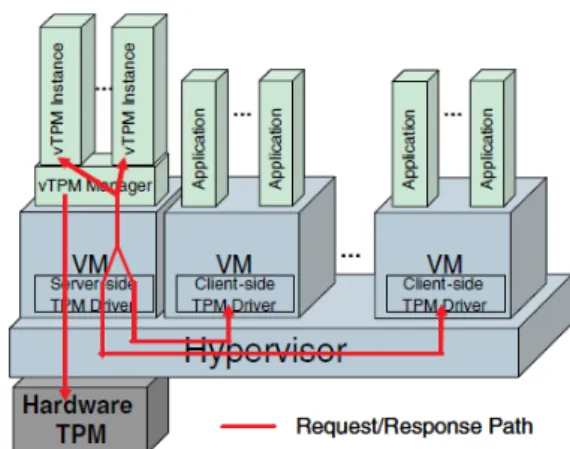
Berger et al. [14] identify the requirements for a virtual TPM (vTPM) and propose a vTPM design that supports running vTPMs in memory or on a cryptoprocessor. This architecture has been implemented on the Xen hypervisor. Central to this architecture is a privileged VM (Dom0 in the case of Xen) dedicated to running vTPMs. This VM has access to the hardware TPM and coordinates all requests to it. This VM also runs a vTPM manager that manages all the communication between a VM and its vTPM. VMs can optionally be configured to use vTPMs. On starting a VM that is configured to have a vTPM, a corresponding vTPM instance is started as a user-space process in the privileged VM [13].
Figure 9 shows the vTPM architecture proposed by [14]. Each vTPM instance is assigned a unique 4-byte identifier that never leaves the privileged VM. This unique number is mapped to a unique interrupt (number) that is assigned to the VM. The VM uses this interrupt to communicate with its vTPM. The vTPM-to-interrupt id mapping is stored in the XenStore6in the case of the Xen hypervisor along with
the VM-to-vTPM instance mapping. On receiving a vTPM request, the backend driver prepends the instance number to the request using the mapping table. Communication is then managed using a split device driver model. The front end driver resides inside the VM and the back end driver in the privileged VM. To aid with the split device driver model, a special feature in Xen called the xen-bus is em-ployed. The xen-bus enables a VM to map a portion of its memory as shared and allow the privileged VM to access it. Since communication happens using shared memory, unau-thorized access to vTPMs by co-hosted VMs is not possible [13].
Figure 9: vTPM Architecture. Taken from [14]
9.2
Secure VM-vTPM Migration
The extension of trusted computing to virtualized systems using vTPMs allows applications in the VM to use the vTPM for secure storage and to report platform integrity. In order to ensure the correct operation of applications after migra-tion, the vTPM must be migrated alongside the VM. Secure VM-vTPM migration is the name given to such operation.
6XenStore is an information storage space shared between
Proposals for vTPM designs have been accompanied by pro-posals for vTPM migration [13].
9.2.1
Berger et al.’s Proposed Protocol
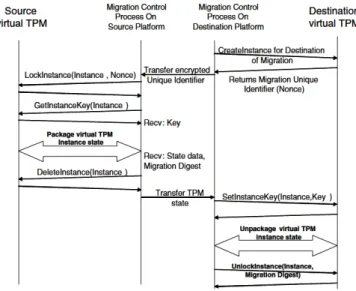
In [14], Berger et al. assume that the destination is trustwor-thy and propose the protocol shown in Figure 10 for migra-tion between identical platforms. They state that it can be used alongside live VM migration. A migration-controlling process initiates the transfer by creating a new vTPM instance at the destination. Then, it creates a nonce and transfers it to the source in encrypted form. The key used for encryption is not clear. At the source, this nonce is used to lock the vTPM to prevent further changes to it. The vTPM is then encrypted using a newly generated symmetric key, which is in turn encrypted using the virtual Storage Root Key (vSRK) of the vTPM’s parent instance. The encrypted state information includes keys, counters, any permanent flags, authorization and transport sessions, and data. A hash of each of the mentioned parts is added to an internal migration digest. The vTPM is deleted from the source and the encrypted state is transferred to the destina-tion host along with the migradestina-tion digest. The authors state that the vSRK of the parent vTPM instance is transferred to the destination using mechanisms applicable to migratable TPM storage keys7. At the destination, the received binary object is decrypted to extract the vTPM state. The digest is verified and, if no violations are detected, the vTPM is un-locked using the nonce and restarted. Since the vTPM keys are assumed to be independent from the hardware TPM keys, no key regeneration occurs.
Figure 10: vTPM Migration as proposed by [14]
9.2.2
Masti et al.’s Proposed Protocol
Figure 11 shows a high-level view of Masti et al.’s secure VM-vTPM Migration protocol. The protocol proceeds in four phases. Initially, the source and destination mutually authenticate each other and agree upon confidentiality and integrity preserving cryptographic mechanisms for protect-ing the rest of the transfer process. Next, the source sends
7Refer to the TPM specification
(http://www.trustedcomputinggroup.org).
an attestation request to the destination to ensure that the VM is migrated to a secure platform. Having ensured the authenticity and integrity of the destination platform, the source then locks the VM and vTPM and transfers them se-curely using the previously agreed upon cryptographic prim-itives. Then, the destination checks the integrity of the re-ceived VM and its vTPM. If no violations are detected, the destination imports the VM-vTPM pair (which is implemen-tation specific) and sends an acknowledgment to the source on success. Finally, in the last phase, the source deletes the migrated VM and vTPM to prevent duplication and informs the destination that the migration is complete. The desti-nation then resumes the newly received VM and its vTPM. The various phases of the protocol can be linked to a sin-gle session explicitly (using a session identifier) or implicitly (by ensuring that each phase depends on any of the previous phases) [13].
The outlined protocol design assumes that the source and the migrating VM are trusted by the destination. This is reasonable in a setting where dynamic platform state mea-surement occurs ensuring that any malicious state changes to the source platform and the VM are detected and han-dled. Ideally, after the entire migration, the migrated VM should be able to report its new configuration to the destina-tion on demand. This is meaningful only in a context where dynamic state measurements are enabled because otherwise, the VM could just replay its state before the migration [13].
Figure 11: High-Level Outline of vTPM Migration as proposed by [13]
9.3
Secure Protocols and Live Migration
The semantics of VM migration are important because any changes to the VM should be synchronized with the vTPM. For the migration of a powered off VM or a suspended VM, only a secure transfer protocol is required. Live migration is more complex due to the need to synchronize VM changes with the vTPM, which makes the relative timing of vTPM and VM resumption at the destination important. Since some live migration techniques allow the VM to be started on the destination before it is stopped at the source, en-suring consistency between VM state and its vTPM is very difficult. Also, secure migration may not start the VM at the destination immediately after the transfer. This complicates the usage of live VM migration with vTPMs.A secure Live VM Migration protocol with the security guar-antees provided by the protocols covered in this section
(au-thentication, confidentiality, replay resistance, non-repudiation, atomicity, integrity, etc.) is yet to be seen in practice. While challenging, such end result does not seem impossible to at-tain, as pointed out by Berger et al [14].
10.
CONCLUSIONS AND FUTURE WORK
Secure Live VM Migration has not received the amount of attention that it deserves. There is a clear trend towards delegating computation to the Cloud and, at the same time, Live VM Migration is becoming an everyday operation inside clustered server environments. Considering that security is defined by the ”lowest common denominator”, the existence of vulnerabilities in current migration mechanisms nullifies strong security guarantees provided by secure hardware and hypervisors (or lack thereof).There is much ground for improvement when it comes to securing the two Live VM Migration network-related planes (control and data). A cloud computing context with the Trusted Computing Base (TCB) described in this paper could benefit from strategies used in other contexts. For example, VoIP and other next-generation multimedia ser-vices use a three-level security stack (signaling, key exchange and media) that could be ported to Live VM Migration to address network attacks. Schemes detailed in [15], such as S/MIME+MIKEY for secure signaling and key exchange, can be coupled with AES-encrypted live migration data to achieve confidentiality and integrity. In addition, the fact that the cloud provider is part of the TCB can be leveraged to deploy PKI-based mutual authentication protocols. Secure Live VM-vTPM Migration and Non-Virtualized Live Migration are also interesting research topics. While the for-mer would aid at hardening secure hypervisor architectures (e.g. HyperSafe [8]), the latter would help in eliminating the need for a hypervisor in the first place (e.g. NoHype [16]).
11.
REFERENCES
[1] M. A. Kozuch, M. Kaminsky, and M. P. Ryan, “Migration without virtualization,” inProceedings of
the 12th conference on Hot topics in operating systems, HotOS’09, (Berkeley, CA, USA), pp. 10–10, USENIX Association, 2009.
[2] C. Clark, K. Fraser, S. Hand, J. G. Hansen, E. Jul, C. Limpach, I. Pratt, and A. Warfield, “Live migration of virtual machines,” inProceedings of the 2nd conference on Symposium pr & Implementation -Volume 2, NSDI’05, (Berkeley, CA, USA), pp. 273–286, USENIX Association, 2005.
[3] S. Venkatesha, S. Sadhu, S. Kintali, and S. Barbara, “Survey of virtual machine migration techniques,”
Memory, 2009.
[4] P. S. Pisa, N. C. Fernandes, H. E. T. Carvalho, M. D. D. Moreira, M. E. M. Campista, L. H. M. K. Costa, and O. C. M. B. Duarte, “Openflow and xen-based virtual network migration.,” inWCITD/NF
(A. Pont, G. Pujolle, and S. V. Raghavan, eds.), vol. 327 ofIFIP International Federation for Information Processing, pp. 170–181, Springer, 2010. [5] M. R. Hines and K. Gopalan, “Post-copy based live
virtual machine migration using adaptive pre-paging and dynamic self-ballooning,”Proceedings of the 2009
ACM SIGPLANSIGOPS international conference on Virtual execution environments VEE 09, p. 51, 2009. [6] T. Kooburat and M. Swift, “The best of both worlds with on-demand virtualization,” inProceedings of the 13th USENIX conference on Hot topics in operating systems, HotOS’13, (Berkeley, CA, USA), pp. 4–4, USENIX Association, 2011.
[7] E. Keller, J. Szefer, J. Rexford, and R. B. Lee, “Eliminating the Hypervisor Attack Surface for a More Secure Cloud,” inACM Conference on Computer and Communications Security, Oct. 2011. [8] Z. Wang and X. Jiang, “Hypersafe: A lightweight
approach to provide lifetime hypervisor control-flow integrity,” inIn Proceedings of the 31st IEEE Symposium on Security and Privacy, 2010.
[9] T. Ristenpart, E. Tromer, H. Shacham, and S. Savage, “Hey, you, get off of my cloud: exploring information leakage in third-party compute clouds,” inProceedings of the 16th ACM conference on Computer and communications security, CCS ’09, (New York, NY, USA), pp. 199–212, ACM, 2009.
[10] A. K¨onig and R. Steinmetz, “Detecting migration of virtual machines,” inProceedings of the 10th W¨urzburg Workshop on IP: Joint ITG, ITC, and Euro-NF Workshop ¨Visions of Future Generation
Networks¨(EuroView2011),
Julius-Maximilians-Universit¨at W¨urzburg, Lehrstuhl f¨ur Informatik III, Aug 2011.
[11] J. Oberheide, E. Cooke, and F. Jahanian, “Empirical exploitation of live virtual machine migration,”
Electrical Engineering, no. Vmm, 2008. [12] M. Ver, “Dynamic load balancing based on live
migration of virtual machines: Security threats and effects,” 2011.
[13] R. Jayaram Masti, “On the security of virtual machine migration and related topics,” 2010.
[14] S. Berger, R. C´aceres, K. A. Goldman, R. Perez, R. Sailer, and L. Doorn, “vtpm: Virtualizing the trusted platform module,” inIn USENIX Security, pp. 305–320, 2006.
[15] D. Perez-Botero and Y. Donoso, “Voip eavesdropping: A comprehensive evaluation of cryptographic
countermeasures,” inNetworking and Distributed Computing (ICNDC), 2011 Second International Conference on, pp. 192 –196, sept. 2011. [16] E. Keller, J. Szefer, J. Rexford, and R. B. Lee,
“Nohype: virtualized cloud infrastructure without the virtualization,”SIGARCH Comput. Archit. News, vol. 38, pp. 350–361, June 2010.
![Figure 1: pre-copy algorithm. Taken from [2]](https://thumb-us.123doks.com/thumbv2/123dok_us/9579417.2835155/2.892.85.434.340.623/figure-pre-copy-algorithm-taken-from.webp)