Procedia Technology 11 ( 2013 ) 861 – 869
2212-0173 © 2013 The Authors. Published by Elsevier Ltd. Open access under CC BY-NC-ND license.
Selection and peer-review under responsibility of the Faculty of Information Science & Technology, Universiti Kebangsaan Malaysia. doi: 10.1016/j.protcy.2013.12.269
ScienceDirect
The 4th International Conference on Electrical Engineering and Informatics (ICEEI 2013)
Predicting Malay Prominent Syllable Using Support Vector
Machine
Nur `Athifah Arifin, Sabrina Tiun*
Faculty of Information Science and Technology,Universiti Kebangsaan Malaysia, 43600 Bangi, Selangor, Malaysia.
Abstract
The prediction of prominent syllable using Support Vector Machines (SVMs) is proposed in this paper. As much as 50 sentences out of 400 sentences from Malay syntax-prosody speech text has been selected as training and testing data set. SVM was trained to classify the prominent syllable in the sentences according to the feature presented. A prominent word can be categorized as prominent syllables but the prominent syllable has the potential not to classify as prominent word. Using training data, we trained it to obtain a model and the model will be used to predict instances with testing data set. The kernel function namely Radial Basis Function (RBF) is used to find the best cross validation accuracy of training data with parameter, Cand Ȗ. The SVM technique also compared with a Naïve Bayes (NB) classifier and the comparison clearly claims that the proposed technique based architecture outperforms on all experiments. Using SVM classifier, the percentage accuracy of the classification archived rate of 88.7304 % while 88.3024 % using the Naïve Bayes (NB). The results showed that SVM is conveniently classified because the performance shown is better than NB.
© 2013 The Authors. Published by Elsevier B.V.
Selection and peer-review under responsibility of the Faculty of Information Science and Technology, Universiti Kebangsaan Malaysia.
Keywords:Support Vector Machine (SVM); Naïve Bayes (NB); Radial Basis Function (RBF)
* Corresponding author: Sabrina Tiun. Tel.: 6 03 89216730; fax: +6 03 89256732+0-000-000-0000 .
E-mail address:[email protected]
© 2013 The Authors. Published by Elsevier Ltd. Open access under CC BY-NC-ND license.
Selection and peer-review under responsibility of the Faculty of Information Science & Technology, Universiti Kebangsaan Malaysia.
1. Introduction
Nowadays, researchers have done research to enhance synthesis quality by improving the prosody control mechanism in Text-to-Speech (TTS) system. A significant problem contributes to TTS is the lack of high quality speech synthesis in managing the prosodic elements of speech such as intonation, accentuation, prosodic phrases, hesitation, rhythm, and speech rate. Rajeswari et al.[23] reported that modeling of prosody plays a vital role when high quality of TTS systems expected. Specifically, there are two kinds of prosodic features in prosodic prominence which are pitch accent and stress accent. It is hard to distinguish stress accents and pitch accent because the stress accent is correlated with syllable nuclei duration and frequency while the pitch accent more on fundamental frequency (F0) movements and syllable energy.
Ross and Ostendorf [26] explained prominence (or prominent syllable) occurs when a syllable perceived as stronger as or more salient than other syllables in the utterance. This statement proved by Terken [32] which stated a linguistic segment is typically defined as prominent when it perceived to stand out of its context. Therefore, the syllables classify as prominent if it contains one of these prosodic prominences in the utterance. According to Wang et al. [34], the detection and quantification of prominence in speech play an important role in many applications, since it concerns the small questions of how speech produced and segments contrasted, e.g. prominence aids the decoding in speech recognition, and hence used for syntactic parsing. Usually, a prominent word contains prominent syllables but the prominent syllable does not belong to prominent word.
The growth of electronic information stored in text format document via the Internet or intranet performed widely by companies today. In order to save time and personnel, an automated system for classifying documents or information is needed. The two areas of automatic learning are machine learning and data mining. Machine learning is a scientific discipline related to the design and development of algorithms that allow computers to learn from giving training data [31]. Generally, the learning algorithms categorize into two taxonomies namely unsupervised learning and supervised learning according to whether an output vector needs to supervise the learning process. Thus, its goal is to build a concise model of distribution of the class labels, in terms of a predictor function [3]. Gartner stated that the use of machine learning methods in the application of scientific can accelerate business and cut the cost of the process [10]. The supervised learning methods such as k-Nearest Neighbor (k-NN) [9, 11, 35], Support Vector Machine (SVM) [19, 20, 22, 28] and Naïve Bayes (NB) [29] are used in classification. As mentioned earlier, the most popular algorithm namely SVM is preferable and explored by researchers because of its ability to meet the highest accuracy with promising results with a strong theoretical foundation. Dumais et al. [8] described that SVM is the most accurate classifier and fastest trainer where it maximizes the margin between positive and negative examples.
This paper presents a study on prediction of prominent syllable using Support Vector Machine (SVM) by using training and testing data set which contains 50 sentences. In our approach, the syllables are classified in predefined group and test based on the accuracy of classification in the last results. To explore such an interesting possibility, we also consider using the Naïve Bayes (NB) technique to compare weather which technique is more effective and which one has better performance in classification. Thus, our Malay prosody modelling in an open source TTS system can be localized and enhanced.
The rest of the paper organizes as follows. Section 2 describes a literature review about the previous researches. Section 3 briefly discusses the learning algorithms such as SVM and NB, features choice, experimental data and setup. Section 4 and 5 mainly present the findings and results comparison of this experiment. Finally, Section 6 draws the overall views and conclusion from this study.
2. Background and Related Research
More precisely, many studies have been performed in text classification and speech area. Bartlett et al. [1] developed an English syllabus system to improve the accuracy of Letter-to-Phoneme conversion. They also proposed a novel discriminative approach to automatic syllabus based on structured SVMs. Based on the observation, the word error rate for English reduced to 33% and the system performed well also in other languages. Furthermore, the prosody model used in the syllable based on speech synthesizer DEMOSTHENES has also been investigated by Ivan [14]. It displays good properties and demonstrates close relations between the prosodic segments and sentence
constituents in the TTS system DEMOSTHENES. The basic prosodic elements are syllable segments that carry basic prosodic attributes of pitch, duration and loudness (stress, accent).
A study of abstract prosodic in the Text-to-Speech (TTS) system was conducted by Ross and Ostendorf [26]. Note that, the TTS technologies required high quality speech synthesis to make it useful in more applications. Therefore, prosody is the components of synthesis technology with the greatest need for improvement. They described the computational models for the product of abstract prosodic labels for synthesis like accent place, symbolic tones and relative prominence level from text that tags with part-of-speech labels and marked for prosodic constituent structure. The result showed that prediction experiments using decision tree probability functions with Markov sequence assumptions show an improvement in accuracy of prominence location prediction.
Mitra et al. [19] demonstrate a new approach in text classification of noisy document titles using a least square Support Vector Machine (LS-SVM) to classify them according to categories. The percentage of accuracy achieved is over 99.9 % and higher than K-Nearest Neighbor (k-NN) and Naïve Bayes (NB). LS-SVM with GRBF kernel and LSI technique adopted enables it to classify noisy text titles with a high degree of precision.
3. Materials and Methods 3.1. Support Vector Machine (SVM)
Support Vector Machine (SVM) is a data classification technique that developed by Boser et al. [14] in 1992. SVM is based on the Structural Risk Minimization principle from computational learning theory [33]. In the SVM, the positive and negative samples of data sets are separated by a hyperplane with minimizes margin. Before the classification procedure, the data sets label with certain value and attributes based on the feature selection are divided into two which are training data set and testing data set. In some cases, the Kernels method is used to convert the data into a feature space where a limit of linear classifier may not separate the positive and negative data happened. Because of this, an understanding of how SVM works effectively using the number of decisions such as how to reprocess the data, what kernel need to use and how to setting the limits of the kernel in SVM are required in the training phase [6]. One of the advantages of SVM is it able to learn independently in the dimension of the feature space with the lowest true error found from hypothesis, h. Instead, a model complexity of SVM is unaffected by the number of features during the training phase. Joachims [15] explained that SVMs measure the complexity of hypotheses, h based on the margin where they separate the data and not the number of features. According to Kotsiantis [17], SVM is well suited to deal with learning tasks, where the number of features is large with respect to the number of training instances.
3.2. Data/ Documentation
In this section, out of 400 sentences in Malay syntax-prosody speech text from a corpus created by Unit Terjemahan Melalui Computer Malay speech Synthesizer (UTMK-MSS) system, only 50 sentences selected randomly for prediction of prominent and non-prominent syllable. Despite, 30 sentences are applied to obtain a learning model that will be used to predict the value of testing data set having of 20 sentences. The voice of recording is a Malay native speaker from Selangor with an educational background. More importantly, the preparation of collection, corpus specification and annotation were concerned to support the quality speech corpus production. Besides, the data are well prepared in order to improve speed of learning performance.
3.3. Feature Selection
SVM data are generated from the features and value of a syllable. By defining a set of features in training and testing data, we can perform the classification and evaluate the percentage accuracy with predetermined categories. The feature selection is included word level and syllable level. In the sentences, there are prominent words that belong to prominent syllables. Each word will be split into syllables based on vowel and constants. The specify features for this experiment as follows:
x Feature 1: Part-of-Speech (POS)
The words classified based on the eight parts of speech such as verb, noun, pronoun, adjective, adverb, preposition, conjunction and interjection. In this experiment, we use the open-source POS tagger tool by Tan Tien Ping to acquire part-of-speech of each word in the data set.
x Feature 2: Syllable Type
N. H. Samsudin [21] proposed a Malay Speech Synthesizer consist of 4 structural syllables in Malay Sound System namely C, V, CV, and VC. On Malay phonological rules, the syllable consists of a vowel and a consonant. There are two types of syllables which are open syllable (ending with a vowel) and closed syllable (ending with a consonant). Table 1 presents value for each of the syllable structures:
Table 1. The value for syllable type
Syllable Type Value
C 1
V 2
CV 3
VC 4
x Feature 3: Syllable Length
The syllable length is measured by calculating each character in the syllable.
x Feature 4: Syllable Position
We consider using three syllable positions like start, middle and final. The value of syllable with position start will be represented as 1, middle position is represented as 2 and the final position is 3. For example, the word “makan”. After passing through the syllabification process, the word “makan” are converted to syllable “ma” and “kan”. Therefore, the syllable positions for word “makan” are starting and final indicate by value 1 and 3. Table 2 shows the corresponding values use for syllable position.
Table 2. The value of syllable position
Syllable Position Value
Start 1
Middle 2
Final 3
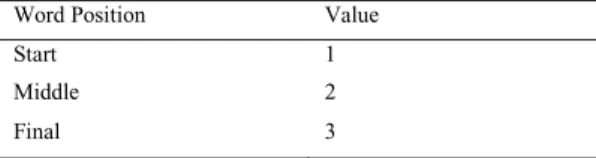
x Feature 5: Word Position
In a sentence, some of the words separate by phrasal break. Thus, the word position is evaluated as word before or after the phrasal break.
Table 3. The value of word position
Word Position Value
Start 1
Middle 2
Final 3
3.4. SVM Data Format
Before the classification is conducted using training and testing data, the data must be converted into an SVM data format. The SVM data format is categorized based on label, index and value. The label is represented as ‘classes or category' of classification. In this study, we want to predict the prominent syllable or non-prominent. Thus, the prominent syllable indicates by ‘+1' while ‘-1' is for non-prominent syllable. On the other hand, the index is usually a continuous integer which is in ordered indexes while the value is real (floating point) numbers. For example, the SVM data for the sentence below transform based on the chosen features and values. Table 4 shows the data for this example:
[Label] [index1]: [value1] [index2]: [value2]…. [Label] [index1]: [value1] [index2]: [value2]…. Input sentence: “Saya *makan nasi”
Syllabification: sa.ya ma.*kan na.si
Table 4. Example of SVM data format
Prominent/ Non-Prominent
Feature 1 Value Feature 2 Value Feature 3 Value Feature 4 Value Feature 5 Value Info (#) -1 1 1 2 3 3 2 4 1 5 1 sa -1 1 1 2 3 3 2 4 3 5 1 ya -1 1 3 2 3 3 2 4 1 5 2 ma +1 1 2 2 3.1 3 3 4 3 5 2 kan -1 1 2 2 3 3 2 4 1 5 3 na -1 1 2 2 3 3 2 4 3 5 3 si 3.5. Experimental Setup
In this experiment, the goal is to predict the prominent syllable using the classification technique which is SVM Using the machine learning algorithms, the training data will produce the learn model and its use with testing results to classify the prominent syllable. There are two data mining tools represent by two techniques including LibSVM for Support Vector Machine (SVM) and WEKA for Naïve Bayes to test this experiment [6, 12].
3.5.1 Support Vector Machine (SVM)
Support Vector Machine (SVM) technique is a binary classifier with very fast and effective algorithm for solving a text classification problem. In this learning system, SVM uses generalization theory to prevent over-fitting by controlling the hyperplane margin measures while optimization theory provides the linear functions to find hyper planes with most margin. By separating linear hyper plane with the dimensionality of the data which increase by
SVMs, the generalization performance of the model is controlled. The hyperplane with the most margins in the higher dimensional space between two sets of classes such as positive and negative sets maximize where it is the closest data points. In the classification, the data separate into a training set and test set which consists of target values and attributes. The SVM is trained to predict the target values using the attributes of the learning model that generate.
In this study, we used the LibSVM tools to test both of data sets using SVM technique. The LibSVM supports the features such as different SVM formulations, efficient multicast classification, cross validation for model choice, various kernels basic (including linear, polynomial, sigmoid and radial basis function (RBF)). There involve two steps using LibSVM: 1) the training set data test to build a model by using svm_trainmodule ; 2) the model used to predict the testing data set by using svm_predictmodule. Kernel function such as Radial Basis Function (RBF) with parameter Cand value Ȗare considered to find the best choice for cross validation accuracy in the training data set. On the other hand, the model is tested using k-fold cross validation techniques where k= 5,…, k=10 to estimate the percentage accuracy of classification.
3.5.2 Naïve Bayes (NB)
Naïve Bayes (NB) classifier known as a simple Bayesian classifier based on Bayes' theorem. Naïve Bayes using an assumption which is attributes value are conditionally independent in a given class. When a test applied to large databases, it gives high accuracy and speed. A Naïve Bayes model consists of several models such as multivariate Bernoulli model (also known as a binary independence model), Poisson naïve Bayes model and multinational model. According to Schneider [29], the difference between these models is the Poisson model and the multinational model use word occurrence frequencies, while the multivariate Bernoulli model use binary word frequencies. The multinational model is the most suitable model use of text classification because it determines a document in a class.
This experiment required WEKA software to apply the Naïve Bayes technique. It supports data mining tasks such as processing, classification, clustering, association rules and regression. However, we only emphasized the pre-processing and classification in this evaluation. The Naïve Bayes classifier uses to measure the percentage accuracy of single features and all features in the data set. The percentage accuracy of the training data set estimate by using a cross validation method. Generally, the several folds, nfigure before the cross validation of data set carried.
4. Analysis and Results
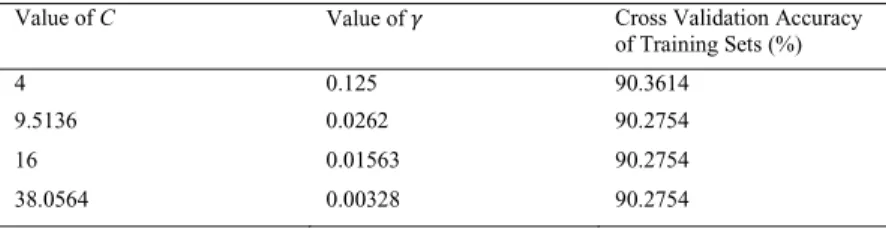
The result in Table 5 presented the cross validation accuracy of training data using parameter Cand value Ȗfor SVM. We consider the RBF kernel function to find the best measure C DQG Ȗ ZLWK -fold cross validation to the training data set and accurately predict testing data. The RBF is chosen to demonstrate the classification because it maps non-linear samples into a higher dimensional space. The other reasons is the number of hyper limits which influences the complex of model choice is less than polynomial kernel and it has fewer numerical difficulties [13].
Table 5. The cross validation accuracy of training data using parameter CDQGYDOXHȖIRU690
Value of C Value of ߛ Cross Validation Accuracy of Training Sets (%)
4 0.125 90.3614
9.5136 0.0262 90.2754
16 0.01563 90.2754
38.0564 0.00328 90.2754
Therefore, the best value of (CȖLVZLWKDJRRGFURVV-validation rate 90.2614 %. The performance of each technique is determined by running k-fold cross validation using parameter C DQGYDOXHȖ1HYHUWKHOHVV ZH
only use k-fold cross validation for NB classifier because the parameter CDQGYDOXHȖDUHQRWUHTXLUHG:HFRPSDUH
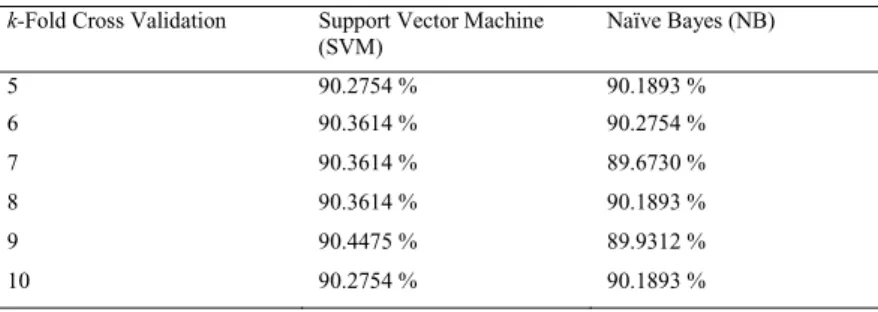
selection or learning algorithms as well as to prevent the over-fitting problem between the training data and testing data. Table 6 presents the cross validation accuracy on SVM and NB classifiers.
Table 6. The cross validation accuracy on SVM and NB
k-Fold Cross Validation Support Vector Machine (SVM) Naïve Bayes (NB) 5 90.2754 % 90.1893 % 6 90.3614 % 90.2754 % 7 90.3614 % 89.6730 % 8 90.3614 % 90.1893 % 9 90.4475 % 89.9312 % 10 90.2754 % 90.1893 %
Table 7 presents the percentage accuracy of classification for single features and all features using SVM and NB techniques. We conducted the training and testing to generate the model. The model was tested using the testing data and give the percentage accuracy of classification.
Table 7. The percentage accuracy of classification for single features and all features using SVM and Naïve Bayes
Features Support Vector Machine (SVM)
Naïve Bayes (NB)
Part-Of-Speech 89.1583 % Naïve Bayes (NB) Syllable Type 89.0157 % 88.4451 % Syllable Length 89.0157 % 88.4451 % Syllable Position 89.0157 % 88.4451 % Word Position 89.0157 % 88.4451 %
5. Discussion
It has seen from Table 7, single features trained and tested using SVM achieve better accuracy than Naive Bayes classifier and exhibits good performance in classification tasks. This indicated that 88.7304 % of all features were correctly classified as prominent syllable while 11.2696 % classified as non-prominent syllable on SVM. However, 88.3024 % are classified as prominent syllable and 11.6976 % as non-prominent syllable using Naive Bayes techniques. The ability to learn independently of dimensional the feature space allow SVM to handle and separate the data even the number of features are large.
The issue of comparing two or more learning algorithms based on a performance metric, and proposes using k-fold cross validation followed by a proper hypothesis test than directly comparing the average accuracy by Salzburg [27] with the result aligned in the Table 6 . As shown in Table 6, the difference between SVM and Naïve Bayes learning algorithms on the percentage accuracy of cross validation showed that SVM gives a good performance than Naïve Bayes where this algorithm can predict the unknown data and classified it more accurately. The training data trained by the SVM classifier does not over-fitting the testing data. It definitely shows the better cross validation and accuracy of testing data.
6. Conclusion
A word is split into some syllables and a prominent word can possess prominent syllable. Otherwise, the prominent syllable does not belong to a prominent word because some of the syllables are non-prominent. Using five features that included syllable and word level, we trained the positive and negative data set with SVM and classify the prominent syllable in sentences. More importantly, the feature selection applied to get better
performance and enhance the prediction ability of SVM. Due to the time limitation, the improvements of this experiment in the future will be done. In our opinion, the SVM technique can meet good performance, robustness and fastest in this classification. The further development in this field will be focused on how to improve the SVM performance using other useful learning algorithm.
Acknowledgements
The dataset of 50 sentences was collected from the site: http://www.ftsm.ukm.my/MalaySpeechCorpus. For the Malay POS Tagger, we used G2P of Malay Pronunciation tool developed by Tan Tien Ping to obtain the part-of-speech for syllable. Besides, we used LIBSVM and WEKA tool to predict and classify the data downloaded from http://www.csie.ntu.edu.tw/~cjlin/libsvm/ and http://www.cs.waikato.ac.nz/ml/weka/citing.html.
References
[1] Bartlett S, Kondrak G, Cherry C. Automatic syllabification with structured SVMs for Letter-To-Phoneme conversion. Proceedings of the Conference 46th Annual Meeting of the Association for Computational Linguistics: Human Language Technologies; 2008. p. 568-576. [2] Ben-Hur A, Weston J. A user's guide to Support Vector Machines. Methods in Molecular Biology; 2012. p. 223-239.
[3] Bhattacharya I, Bhatia M. P. S. SVM classification to distinguish Parkinson disease patients. Proceedings of the 1st Amrita ACM-W Celebration of Women in Computing, India; 2010. article No. 4.
[4] Boser B E, Guyon I M, Vapnik V N. A training algorithm for optimal margin classifier. Proceedings of the Annual ACM Workshop on COLT, Pittsburgh; 1992. p. 144-152.
[5] Cam-Tu N, Trung-Kien N, Xuan-Hieu P, Le-Minh N, Quang-Thy H. Vietnamese word segmentation with CRFS and SVMs: An investigation. Proceedings of the 20th Pacific Asia Conference on Language, Information and Computation; 2006. p. 215-222.
[6] Chung Chang C, Jen Lin C. LIBSVM: A library for Support Vector Machine. ACM Transactions on Intelligent Systems and Technology; 2011. vol. 2, issue No. 4, article 27.
[7] Dou Q, Bergsma S, Jiampojamarn S, Kondrak G. Ranking approach to stress prediction for Letter-to-Phoneme conversion. Proceedings of the 47th Annual Meeting of the ACL and the 4th IJCNLP of the AFNLP; 2009. p. 118-126.
[8] Dumais S, Platt J, Heckerman D. Inductive Learning Algorithms and Representations for Text Categorization. Proceedings of the Seventh International Conference on Information and Knowledge Management (CIKM); 1998. p. 148-155.
[9] Feng Y, Wu Z, Zhou Z. Multi-label text categorization using k-Nearest Neighbor approach with M-Similarity. Proceedings of the 12th International Conference on String Processing and Information Retrieval (SPIRE); 2005. p. 155-160.
[10] Gartner T. A survey of kernels for structured data. ACM SIGKDD Explorations Newsletter; 2003. p. 49-58.
[11] Gil-García R, Pons-Porrata A. A New Nearest Neighbor Rule for Text Categorization. Proceedings of the 11th Iberoamerican Congress in Pattern Recognition (CIARP); 2006. p. 814-823.
[12] Hall M, Eibe F, Holmes G, Pfahringer B, Reutemann P, Witten I H. The WEKA Data Mining Software: An Update. SIGKDD explorations; 2009. vol. 11.
[13] Hsu C H, Chang C C, Lin C J. A practical guide to Support Vector classification”, Department of Computer science; 2010.
[14] Ivan K, Karel P. Prosody modeling for syllable-based speech synthesis. Faculty of Informatics Faculty of Informatics Masaryk University Brno Masaryk University Brno, Czech Republic Czech Republic.
[15] Joachims T. Text categorization with Support Vector Machines: Learning with many relevant features. University at Dortmund Informatik LS8, Baroper Str. 301, Dortmund, Germany.
[16] Joachims T. 1999. Making large-scale SVM learning practical. Advances in Kernel Methods - Support Vector Learning, B. Schölkopf & C. Burges and A. Smola (ed.), MIT-Press; 1999.
[17] Kotsiantis S B. 2007. Supervised machine learning: A review of classification technique. Informatica; 2007. p. 249-268.
[18] Lewis D D, Schapire R E, Callan J P, Papka R. Training algorithms for linear text classifiers. Proceedings of the 19th Annual International ACM SIGIR Conference on Research and Development in Information Retrieval; 1996. p. 298-306.
[19] Mitra V, Wang C-J, Banerjee S. Text classification: A Least Square Support Vector Machine approach. Applied Soft Computing Journal; 2007. p. 908-914.
[20] Shahizan O, Lizawati M Y, Juhana S, Zarina S. Pengelasan dokumen web di Bursa Malaysia menggunakan pendekatan Support Vector Machine (SVM). Jurnal Teknologi Maklumat & Multimedia; 2009. p. 47 -60.
[21] N. H. Samsudin. A Malay speech synthesizer. Final Year Undergraduate Project Report, School of Computer Science, Universiti Sains Malaysia, Penang, Malaysia; 2003.
[22] Noraini J, Masnizah M , Shahrul A N. Poetry classification using Support Vector Machine. Journal of Computer Science;2012. p. 1441-1446. [23] Rajeswari K C, Uma M P. Prosody modeling techniques for Text-to-Speech synthesis systems- A survey. International Journal of Computer
[24] Rong-En F, Pai-Hsuen C, Chih Jen L. Working set selection using second order information for training Support Vector Machines. Journal of Machine Learning Research; 2005. p. 1889-1918.
[25] Rosenberg A. A tool for Automatic ToBI annotation. Department of Computer Science, Queens College (CUNY), USA.
[26] Ross K, Ostendorf M. Prediction of abstract prosodic labels for speech synthesis. Journal of the Computer Speech and Language; 1996. p. 155-185.
[27] Salzberg S. On comparing classifiers: Pitfalls to avoid and a recommended approach. Data Mining Knowledge Discovery; 1997. p. 317 -328. [28] Samer A. M, Ananthakrishan G, Enflo L. Automatic Prominence Classification in Swedish. Center for Speech Technology, Royal Institute
of Technology (KTH), Lindstedtsvägen 24, SE-10044, Stockholm.
[29] Schneider K-M. Techniques for improving the performance of Naive Bayes for text classification. Proceedings of the 6th International Conference, CICLing; 2005. p. 682-693.
[30] Silverman et. al. ToBI: A standard for labeling English prosody. Proceedings of the International Conference on Spoken Language Processing, Banff, Canada; 1992. p. 867–870.
[31] Shigeo A. Support Vector Machine for pattern classification. Springer-Verlag London Limited; 2005.
[32] Terken J. Fundamental frequency and perceived prominence of accented syllables. Journal of the Acoustical Society of America; 1999. p. 1768- 1776.
[33] Vapnik V N. The nature of statistical learning theory. Springer, New York; 1995.
[34] Wang D, Narayana S. An acoustic measure for word prominence in spontaneous speech. IEEE Transactions on Audio, Speech and Language Processing; 2007. vol. 15, issue. 2, p. 690-701.
[35] Yang Y, Chute, C G. An example-based mapping method for text categorization and retrieval. Journal of ACM Transactions on Information Systems (TOIS); 1994. p. 252 - 277.