Akbari, I., Onireti, O., Imran, A., Imran, M. A., and Tafazolli, R. (2016) How
reliable is MDT-based autonomous coverage estimation in the presence of user and
BS positioning error? IEEE Wireless Communications Letters, 5(2), pp. 196-199.
There may be differences between this version and the published version. You are
advised to consult the publisher’s version if you wish to cite from it.
http://eprints.gla.ac.uk/132549/
Deposited on: 08 December 2016
Enlighten – Research publications by members of the University of Glasgow
http://eprints.gla.ac.uk
How Reliable is MDT Based Autonomous
Coverage Estimation in the Presence of User and
BS Positioning Error?
Iman Akbari, Member, IEEE, Oluwakayode Onireti, Member, IEEE, Ali Imran, Member, IEEE, Muhammad Ali
Imran, Senior Member, IEEE, and Rahim Tafazolli, Senior Member, IEEE
Abstract—Minimization of drive test (MDT) has recently been
standardized by 3GPP as a key self organizing network (SON) feature. MDT allows coverage to be estimated at the base station (BS) using user equipment (UE) measurement reports with the objective to eliminate the need for drive tests. However, most MDT based coverage estimation methods recently proposed in literature assume that UE position is known at the BS with 100% accuracy, an assumption that does not hold in reality. In this paper we develop an analytical model that allows the quantification of error in MDT based autonomous coverage estimation (ACE) as a function of error in UE as well as BS positioning. Our model also allows characterization of error in ACE as function of standard deviation of shadowing.
Index Terms—Self-organization, coverage estimation, position
estimation error
I. INTRODUCTION
Timely cell outage detection is a major problem in state of the art wireless cellular systems. In legacy cellular networks cell outages are generally detected through a combination of following: 1) Field drive tests, 2) hardware or software failure alarms at the operation and maintenance center (OMC), 3) complaints raised by customers. These methods are manual and suffer from inherent delay. Reliability of these methods is also limited because of the human error factor and low spatio-temporal granularity of the reports and alarms available at OMC or measurements gathered through drive tests. On the other hand, cell densification is emerging as a dominant strategy for increasing cellular system capacity and quality of service in wake of 5G [1]. With increasing cell density the rate of cell outage is also bound to increase. Aforementioned, manual cell outage detection methods cannot cope with the complexity and rate of cell outages expected in emerging ultra-dense networks, in cost effective and reliable fashion.
To overcome this challenge, 3GPP has recently standardized a self-organizing network (SON) use case, called minimization of drive test (MDT) [2], [3]. Hapsari et al. [2] describes in detail the solution adopted in 3GPP MDT whilst Baumann et al. [3] demonstrates that MDT can reduce drive tests. With MDT standardized, BSs will have access to user equipment (UE) reported measurements that will consist of reference signal received power (RSRP) of the serving and neighboring
This work was made possible by NPRP grant No. 5-1047-2437 from the Qatar National Research Fund (a member of The Qatar Foundation) and the support from EPSRC student grant (no: A89099J) under the Doctoral Training Grants (DTG) program. The statement made herein are solely the responsibility of the authors.
cells among other measurement reports. These measurements are called MDT measurements. Using MDT measurements level of coverage in an area of interest can be estimated without conducting expensive and time consuming drive tests or waiting for customer complaints. Cell outages can thus be detected by applying data analytics and machine learning techniques of various types [4], [5] on the MDT reports. However, most of these recently proposed methods that esti-mate coverage using MDT with different algorithms e.g., grey prediction,k-nearest neighbor anomaly detector (k-NNAD) [4] are beleaguered by one common challenge. These methods assume that UE position is accurately known at the BS. This assumption does not reflect reality faithfully as even the most accurate UE positioning methods have non-zero error range [6], [7]. In this paper we address this challenge by analyzing and quantifying the error in coverage estimation caused by the error in UE positioning. To the best of our knowledge our recent study in [8] was the first one to look into effect of UE positioning error on coverage estimation through MDT.
In this paper we extend that work by incorporating the impact of shadowing and BS position inaccuracy into the quantification of error in coverage estimation. Significance of this work lies in the fact that results obtained can be used to calibrate the estimated coverage through MDT, for given values of standard deviation of shadowing and UE and BS positioning error range, in area under consideration. The rest of the paper is organized as follows: In Section II, we discuss the autonomous coverage estimation (ACE) framework. In Section III, we derive the cell coverage probability of the ACE scheme for the channel model with both pathloss and shadowing, while Section IV gives the derivation for the pathloss dominant channel model. In Section V, we present the numerical results which show that our analytical derivations are very accurate. Conclusions are drawn in Section VI.
II. AUTONOMOUSCOVERAGEESTIMATIONFRAMEWORK
We consider an ACE scheme which exploits the measure-ment reports gathered by the UE. In such a system, UE mea-surement reports are tagged with their geographical location information and sent to their serving BS. After retrieving the measurements, the serving BS further appends its geographical location information and forwards them to a trace collection entity (TCE), which can then generate the coverage map. The reported geographical coordinates of the UE and BSs are obtained from positioning techniques, such as observed time
system (A-GPS) [6]. However, these techniques are prone to errors, and hence, the reports may be tagged to a wrong location. Given a reported UE position, o, with coordinates
(c, d), we assume that its actual location is within a circular
disc with radius rwhich is centered ato, as illustrated in Fig. 1(a). Furthermore, the actual position of the BS also lies within a circular disc with radius ecentred at its reported position.
For analytical tractability, we consider a single cell deploy-ment scenario where RSRP measuredeploy-ment reports are gathered by the UE. Since MDT measurement reports are based on long term averaged received power, only the shadowing and pathloss effects are taken into consideration in our analysis. The signal propagation model we employ for obtaining the RSRP is as follows Pr(p) = p p0 −η Pt P l(p0) Φ, (1)
where Pr(p), Pt andη denote RSRP at distance pfrom the
BS, transmit power and pathloss exponent, respectively. The parameter p0 denotes the reference distance with a known
pathloss, P l(p0). The shadowing effect is modeled by the
random variable, Φ, which follows a log-normal distribution such that10 log10Φfollows a zero mean Gaussian distribution with standard deviation σ in dB. The error in coverage estimation as a result of such autonomous scheme is evaluated by assessing the reliability of radio frequency (RF) coverage on the measurement based on the fundamental metric of cell coverage probability.
1) Cell Coverage Probability: In general, the cell coverage
probability can be defined as
C= 1 A
Z
P[Pr(p)≥γ] dA, (2)
and can be thought of equivalently as the average fraction of the UE who at any time achieves a target RSRP, γ, i.e. the average fraction of network area that is in coverage at any time. Hence, given a circular radial distance R from the BS, we are interested in computing the percentage of area with RSRP greater than or equal to γ.
2) Error in Coverage Estimation via ACE: The cell
cover-age probability obtained from (2) will be the same as the ACE scheme when the tagged geographical location information are accurate. However, the ACE scheme becomes sub-optimal when the reported UE and BS positions deviate from the actual, thus leading to a much lower cell coverage probability. Hence, we define the error in coverage estimation via ACE, which quantifies how its estimated coverage probability de-viates from the actual cell coverage probability over a fixed area, as follows DA= C − CCACE ∗100% (3)
where C and CACE are the actual cell coverage
probabil-ity given in (2) and the coverage probabilprobabil-ity estimated from the ACE scheme, respectively, over a fixed area, A. In the following sections we derive the coverage probability of the ACE scheme.
III. CELLCOVERAGEPROBABILITY WITHACE Here we consider the scenario where both shadowing and pathloss are the dominant factors in the channel propagation
(a) BS and UE positioning (b) Calculating the angles
Fig. 1. (a) UE with reported positiono, its actual position lies within the circular disc with radiusrcenteredo.(b) shows the triangle created in (a).
model. The probability that the reported RSRP (in dB) at a distance p from the BS will exceed the threshold γ, i.e.
P[Pr(p)≥γ] can be obtained from [9] as
P[Pr(p)≥γ] = 1 2 − 1 2erf a+bln p R , (4) wherea= γ(dBm)−Pt(dBm)+P l(p0)(dB)+10ηlog10 R p0 σ√2 , andb= (10ηlog10e)/σ √2
when there are no errors in UE and BS location information. In the same way, cell coverage probabil-ity of the ACE scheme without error in location information can be expressed as C=12−R12 Z R 0 perfa+bln p R dp. (5)
A. UE Geographical Location Information Error
Now we consider the case with error in the geographical location information reported by the UE to their serving BS. As stated earlier, the actual location of a UE lies within a circular disc centered at the reported location. Consequently, its actual location with reference to its reported location can be modeled as
p(κ, φ) =pp2+κ2−2pκcosφ, (6)
where 0 ≤ κ≤ r and 0 ≤ φ ≤2π. Note that κand φ are used to define all possible actual UE positions. The PDF of the distance and direction of the UE’s actual location with respect to its reported position are 1r and 21π, respectively. Therefore, the modified P[Pr(p)≥γ] as a result of the inaccuracies in
the UE’s location information can be obtained as
P[Pr(p)≥γ] =Eκ,φ{P[Pr(p(κ, φ))≥γ]}= (7) 1 2πr Z r 0 Z 2π 0 P [Pr(p(κ, φ))≥γ] dφdκ,
whereEis the expectation. This further simplifies as
P[Pr(p)≥γ] = 1 2πr Z r 0 Z 2π 0 1 2− 1 2erf a+b 2ln (p(κ, φ))2 R2 dφdκ, (8)
by substituting (4) into (7). Consequently, the actual percent-age of the areaAin coverage due to the ACE scheme can be obtained as CACE = 1 A Z P[Pr(p)≥γ]dA= (9) 1 πrR2 Z R 0 Z r 0 Z 2π 0 p 1 2− 1 2erf a+b 2ln (p(κ, φ))2 R2 dφdκdp.
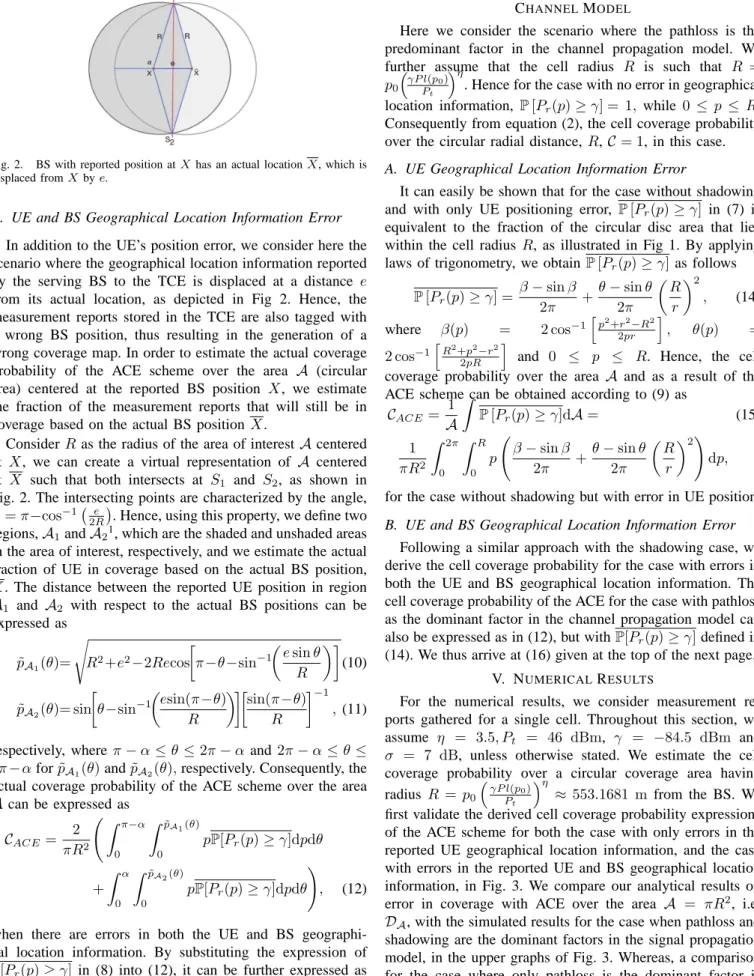
Fig. 2. BS with reported position atXhas an actual locationX, which is displaced fromX bye.
B. UE and BS Geographical Location Information Error
In addition to the UE’s position error, we consider here the scenario where the geographical location information reported by the serving BS to the TCE is displaced at a distance e
from its actual location, as depicted in Fig 2. Hence, the measurement reports stored in the TCE are also tagged with a wrong BS position, thus resulting in the generation of a wrong coverage map. In order to estimate the actual coverage probability of the ACE scheme over the area A (circular area) centered at the reported BS position X, we estimate the fraction of the measurement reports that will still be in coverage based on the actual BS position X.
ConsiderR as the radius of the area of interestAcentered at X, we can create a virtual representation of A centered at X such that both intersects at S1 and S2, as shown in
Fig. 2. The intersecting points are characterized by the angle,
α=π−cos−1 e
2R
. Hence, using this property, we define two regions,A1andA21, which are the shaded and unshaded areas
in the area of interest, respectively, and we estimate the actual fraction of UE in coverage based on the actual BS position,
X. The distance between the reported UE position in region
A1 and A2 with respect to the actual BS positions can be
expressed as ˜ pA1(θ)= s R2+e2−2Recos π−θ−sin−1 esinθ R (10) ˜ pA2(θ)= sin θ−sin−1 esin(π −θ) R sin(π −θ) R −1 , (11) respectively, where π−α≤θ≤2π−αand2π−α≤θ≤
3π−αforp˜A1(θ)andp˜A2(θ),respectively. Consequently, the
actual coverage probability of the ACE scheme over the area
A can be expressed as CACE = 2 πR2 Z π−α 0 Z p˜A1(θ) 0 pP[Pr(p)≥γ]dpdθ +Z α 0 Z p˜A2(θ) 0 pP[Pr(p)≥γ]dpdθ ! , (12)
when there are errors in both the UE and BS geographi-cal location information. By substituting the expression of
P[Pr(p)≥γ] in (8) into (12), it can be further expressed as
(13) which is given at the top of the next page.
1Note that the sum of the areas of the two region is such thatA
1+A2=A
IV. ACE COVERAGEPROBABILITY: PATHLOSSONLY
CHANNELMODEL
Here we consider the scenario where the pathloss is the predominant factor in the channel propagation model. We further assume that the cell radius R is such that R = p0
γP l(p
0)
Pt
η
. Hence for the case with no error in geographical location information, P[Pr(p)≥γ] = 1, while 0 ≤ p ≤R.
Consequently from equation (2), the cell coverage probability over the circular radial distance,R,C= 1, in this case.
A. UE Geographical Location Information Error
It can easily be shown that for the case without shadowing and with only UE positioning error, P[Pr(p)≥γ] in (7) is
equivalent to the fraction of the circular disc area that lies within the cell radius R, as illustrated in Fig 1. By applying laws of trigonometry, we obtainP[Pr(p)≥γ]as follows
P[Pr(p)≥γ] = β−sinβ 2π + θ−sinθ 2π R r 2 , (14) where β(p) = 2 cos−1hp2+r2−R2 2pr i , θ(p) = 2 cos−1hR2+p2−r2 2pR i
and 0 ≤ p ≤ R. Hence, the cell coverage probability over the area A and as a result of the ACE scheme can be obtained according to (9) as
CACE= 1 A Z P[Pr(p)≥γ]dA= (15) 1 πR2 Z 2π 0 Z R 0 p β−sinβ 2π + θ−sinθ 2π R r 2! dp,
for the case without shadowing but with error in UE position.
B. UE and BS Geographical Location Information Error
Following a similar approach with the shadowing case, we derive the cell coverage probability for the case with errors in both the UE and BS geographical location information. The cell coverage probability of the ACE for the case with pathloss as the dominant factor in the channel propagation model can also be expressed as in (12), but withP[Pr(p)≥γ]defined in
(14). We thus arrive at (16) given at the top of the next page.
V. NUMERICALRESULTS
For the numerical results, we consider measurement re-ports gathered for a single cell. Throughout this section, we assume η = 3.5, Pt = 46 dBm, γ = −84.5 dBm and
σ = 7 dB, unless otherwise stated. We estimate the cell
coverage probability over a circular coverage area having radius R = p0 γP l(p 0) Pt η ≈ 553.1681 m from the BS. We
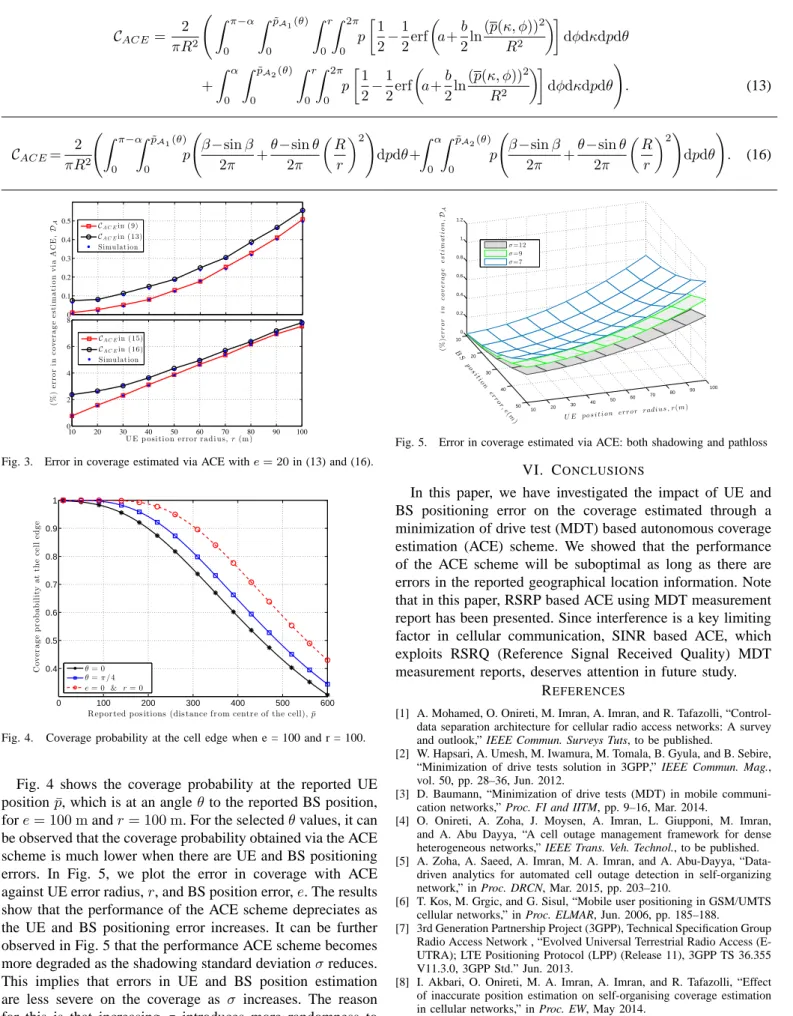
first validate the derived cell coverage probability expressions of the ACE scheme for both the case with only errors in the reported UE geographical location information, and the case with errors in the reported UE and BS geographical location information, in Fig. 3. We compare our analytical results on error in coverage with ACE over the area A = πR2, i.e.
DA, with the simulated results for the case when pathloss and shadowing are the dominant factors in the signal propagation model, in the upper graphs of Fig. 3. Whereas, a comparison for the case where only pathloss is the dominant factor is presented in the lower graph of Fig. 3. We note that our analytical results tightly matches with the simulation.
CACE= 2 πR2 Z π−α 0 Z p˜A1(θ) 0 Z r 0 Z 2π 0 p 1 2− 1 2erf a+b 2ln (p(κ, φ))2 R2 dφdκdpdθ +Z α 0 Z p˜A2(θ) 0 Z r 0 Z 2π 0 p 1 2− 1 2erf a+b 2ln (p(κ, φ))2 R2 dφdκdpdθ ! . (13) CACE= 2 πR2 Z π−α 0 Z p˜A1(θ) 0 p β−sinβ 2π + θ−sinθ 2π R r 2! dpdθ+ Z α 0 Z p˜A2(θ) 0 p β−sinβ 2π + θ−sinθ 2π R r 2! dpdθ ! . (16) 0 0.1 0.2 0.3 0.4 0.5 10 20 30 40 50 60 70 80 90 100 0 2 4 6 8
Fig. 3. Error in coverage estimated via ACE withe= 20in (13) and (16).
0 100 200 300 400 500 600 0.4 0.5 0.6 0.7 0.8 0.9 1
Fig. 4. Coverage probability at the cell edge when e = 100 and r = 100.
Fig. 4 shows the coverage probability at the reported UE positionpˉ, which is at an angleθto the reported BS position,
fore= 100 mandr= 100 m. For the selectedθvalues, it can
be observed that the coverage probability obtained via the ACE scheme is much lower when there are UE and BS positioning errors. In Fig. 5, we plot the error in coverage with ACE against UE error radius,r, and BS position error,e. The results show that the performance of the ACE scheme depreciates as the UE and BS positioning error increases. It can be further observed in Fig. 5 that the performance ACE scheme becomes more degraded as the shadowing standard deviationσreduces. This implies that errors in UE and BS position estimation are less severe on the coverage as σ increases. The reason for this is that increasing σ introduces more randomness to the received signal; hence randomness created by the UE positioning error would have more impact on a lowerσ.
10 20 30 40 50 10 20 30 40 50 60 70 80 90 100 0 0.2 0.4 0.6 0.8 1 1.2
Fig. 5. Error in coverage estimated via ACE: both shadowing and pathloss
VI. CONCLUSIONS
In this paper, we have investigated the impact of UE and BS positioning error on the coverage estimated through a minimization of drive test (MDT) based autonomous coverage estimation (ACE) scheme. We showed that the performance of the ACE scheme will be suboptimal as long as there are errors in the reported geographical location information. Note that in this paper, RSRP based ACE using MDT measurement report has been presented. Since interference is a key limiting factor in cellular communication, SINR based ACE, which exploits RSRQ (Reference Signal Received Quality) MDT measurement reports, deserves attention in future study.
REFERENCES
[1] A. Mohamed, O. Onireti, M. Imran, A. Imran, and R. Tafazolli, “Control-data separation architecture for cellular radio access networks: A survey and outlook,” IEEE Commun. Surveys Tuts, to be published.
[2] W. Hapsari, A. Umesh, M. Iwamura, M. Tomala, B. Gyula, and B. Sebire, “Minimization of drive tests solution in 3GPP,” IEEE Commun. Mag., vol. 50, pp. 28–36, Jun. 2012.
[3] D. Baumann, “Minimization of drive tests (MDT) in mobile communi-cation networks,” Proc. FI and IITM, pp. 9–16, Mar. 2014.
[4] O. Onireti, A. Zoha, J. Moysen, A. Imran, L. Giupponi, M. Imran, and A. Abu Dayya, “A cell outage management framework for dense heterogeneous networks,” IEEE Trans. Veh. Technol., to be published. [5] A. Zoha, A. Saeed, A. Imran, M. A. Imran, and A. Abu-Dayya,
“Data-driven analytics for automated cell outage detection in self-organizing network,” in Proc. DRCN, Mar. 2015, pp. 203–210.
[6] T. Kos, M. Grgic, and G. Sisul, “Mobile user positioning in GSM/UMTS cellular networks,” in Proc. ELMAR, Jun. 2006, pp. 185–188.
[7] 3rd Generation Partnership Project (3GPP), Technical Specification Group Radio Access Network , “Evolved Universal Terrestrial Radio Access (E-UTRA); LTE Positioning Protocol (LPP) (Release 11), 3GPP TS 36.355 V11.3.0, 3GPP Std.” Jun. 2013.
[8] I. Akbari, O. Onireti, M. A. Imran, A. Imran, and R. Tafazolli, “Effect of inaccurate position estimation on self-organising coverage estimation in cellular networks,” in Proc. EW, May 2014.
[9] T. S. Rappaport, Wireless Communications - Principles and Practice, 2nd ed. Prentice Hall, 2002.