Bridging the Gap between
Machine and Language using
First-Class Building Blocks
Inauguraldissertation
der Philosophisch-naturwissenschaftlichen Fakult¨at der Universit¨at Bern
vorgelegt von
Toon Verwaest
von Belgien
Leiter der Arbeit: Prof. Dr. O. Nierstrasz
Institut f ¨ur Informatik und angewandte Mathematik
Copyright © 2012 Toon Verwaest. Software Composition Group University of Bern
Institute of Computer Science and Applied Mathematics Neubr ¨uckstrasse 10
CH-3012 Bern
http://scg.unibe.ch/
ISBN: 978-1-105-51835-5
This work is licensed under the Creative Commons Attribution–ShareAlike 3.0 License. The license is available athttp://creativecommons.org/licenses/by-sa/3.0/. This dissertation is available athttp://scg.unibe.ch.
Acknowledgments
My adventure in Bern started more than four years ago, in October 2007. This page is too short to capture the gratitude I have towards all those who have contributed in any way to this dissertation.
First I’d like to extend my gratitude to Oscar Nierstrasz for supporting me throughout my time at the Software Composition Group. He gave me the freedom to develop my own research project, and provided invaluable sup-port in formulating my thoughts. It is thanks to his well-organized research group that developing this thesis almost seemed effortless.
I thank Marcus Denker for his continued support and interest in my work. I very much enjoyed our discussions about research; especially while ex-ploring the Swiss mountains. I’d like to thank him for reviewing this thesis, writing the Koreferat, and accepting to be on the PhD committee.
I thank Torsten Braun for accepting to chair the PhD defense.
I am especially grateful to my bachelor student Olivier Fl ¨uckiger, and mas-ter students Camillo Bruni and David Gurtner for the many weeks we have spent discussing, and programming on Pinocchio. Without your optimism and input this thesis would not have been possible!
I am much obliged to my co-authors Camillo Bruni, David Gurtner, Adrian Lienhard, Oscar Nierstrasz, Mircea Lungu, Niko Schwarz, Erwann Wernli, and Olivier Fl ¨uckiger for the stressful days (and nights) writing the papers that formed the base of this dissertation.
I would like to thank Camillo Bruni, Erwann Wernli, Olivier Fl ¨uckiger, and Niko Schwartz for struggling through earlier drafts of this dissertation, and for helping to shape it into what it is today.
I thank all former and current members of the Software Composition Group: Marcus Denker, Tudor Gˆırba, Orla Greevy, Adrian Kuhn, Adrian Lienhard, Mircea Lungu, Fabrizio Perin, Lukas Renggli, Jorge Ressia, David R ¨othlis-berger, Niko Schwarz, and Erwann Wernli. I thank Gabriela Ar´evalo for introducing me to this wonderful group. I am thankful to Therese Schmidt,
and especially to Iris Keller, for taking almost all administrative tasks off my shoulders.
I thank my bachelor students Daniel Langone, Camillo Bruni, and master student Sandro De Zanet, for the fun projects we worked on.
I am thankful to myHilfsassistantsCamillo Bruni for theProgramming Lan-guageslecture, and Raffael Krebs for the Compiler Constructionlecture, for greatly reducing my additional workload.
I thank my friend Adrian Kuhn for the hours of hacking (and drinking) together, especially during the first year of my PhD.
I am grateful to my parents for believing in me, for their support, and espe-cially for the many nice visits.
I thank my dear friends Sandro De Zanet, Raffael Krebs, and Camillo Bruni for the many dinners, drinks, games, days of skiing, hikes,etc. You have made my stay in Switzerland a pleasant one!
Above all, I’m indebted to Laura S´anchez Serrano for joining me in Bern, and for sticking through yet another thesis. I thank her for supporting me, taking over chores, and listening to me complain during the writing phase; but also for the many adventures we have lived together.
Toon Verwaest February 20, 2012
Abstract
High-performance virtual machines (VMs) are increasingly reused for pro-gramming languages for which they were not initially designed. Unfor-tunately, VMs are usually tailored to specific languages, offer only a very limited interface to running applications, and are closed to extensions. As a consequence, extensions required to support new languages often entail the construction of custom VMs, thus impacting reuse, compatibility and performance. Short of building a custom VM, the language designer has to choose between the expressiveness and the performance of the language. In this dissertation we argue that the best way to open the VM is to eliminate it. We present Pinocchio, a natively compiled Smalltalk, in which we identify and reify three basic building blocks for object-oriented languages.
First we define a protocol for message passing similar to calling con-ventions, independent of the actualmessage lookupmechanism. The lookup is provided by a self-supporting runtime library written in Smalltalk and compiled to native code. Since it unifies the meta- and base-level we obtain a metaobject protocol (MOP).
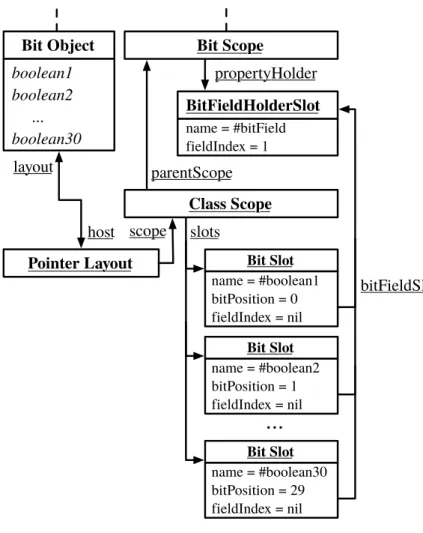
Then we decouple the language-level manipulation of state from the machine-level implementation by extending the structural reflective model of the language withobject layouts,layout scopesandslots.
Finally we reify behavior using AST nodes andfirst-class interpreters sep-arate from the low-level language implementation.
We describe the implementations of all three first-class building blocks. For each of the blocks we provide a series of examples illustrating how they enable typical extensions to the runtime, and we provide benchmarks vali-dating the practicality of the approaches.
Contents
1 Introduction 1
1.1 Contributions . . . 3
1.2 Outline . . . 4
2 Object-Oriented Building Blocks 7 2.1 Communication: Efficient Message Dispatch . . . 7
2.1.1 Lookup Cache . . . 8
2.1.2 Virtual Method Tables . . . 8
2.1.3 Inline Caches . . . 8
2.1.4 Method Inlining . . . 10
2.1.5 Customization . . . 11
2.2 Data: Object Format and Management . . . 11
2.2.1 Hardware Constraints . . . 12
2.2.2 Garbage Collection Constraints . . . 13
2.3 Code: Method Structure . . . 15
2.3.1 AST . . . 15
2.3.2 Bytecode . . . 16
2.3.3 Threaded Code . . . 17
2.3.4 Native Code . . . 20
2.4 Code: Method Behavior . . . 20
2.4.1 Recursive interpretation . . . 21
2.4.2 Manual stack management . . . 21
2.4.3 Stack-mapped context frame . . . 22
2.4.4 Register-Based Execution . . . 23
2.5 Summary . . . 23
3 Background and Problems 25 3.1 Reflection . . . 25
3.1.1 Discrete and Continuous Behavioral Reflection . . . 26
3.1.2 Separation of base and meta-level . . . 27
3.1.3 Partial Behavioral Reflection . . . 27
3.1.4 High-level reflective API . . . 28
3.1.5 AOP . . . 29
3.2 Generating Tailored Virtual Machines . . . 29
3.3 Problem 1: The Tyranny of a Closed VM . . . 30
Contents
3.5 Problem 3: Low-Level Execution Model . . . 33
3.6 Summary . . . 34
4 First-Class Message Lookup 35 4.1 The Message is the Medium . . . 36
4.2 See Pinocchio Run . . . 38
4.2.1 Invocation Conventions . . . 39
4.2.2 Lookup and Apply . . . 39
4.2.3 Avoiding Meta-regression . . . 41
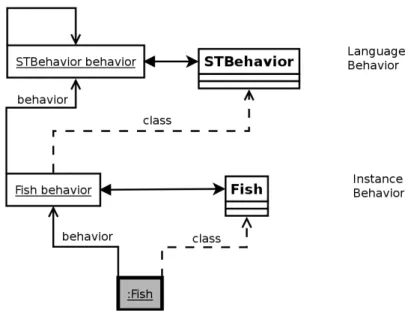
4.2.4 Separation of Class and Behavior . . . 42
4.2.5 Native Compilation . . . 42
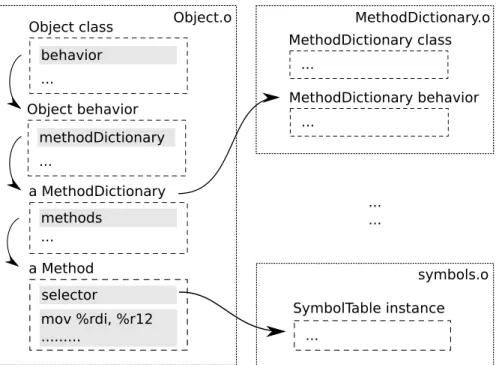
4.2.6 Bootstrapping Pinocchio . . . 44
4.2.7 Performance . . . 45
4.2.8 Metrics . . . 46
4.3 Evaluation and applications . . . 46
4.3.1 Reconfiguring the meta-level . . . 47
4.3.2 Changing lookup semantics . . . 49
4.4 Discussion . . . 49
4.5 Related Work . . . 52
4.6 Summary . . . 53
5 First-Class Object Layouts 55 5.1 Flexible Object Layouts in a Nutshell . . . 56
5.2 First-Class Slots . . . 58
5.2.1 Primitive Slots . . . 59
5.2.2 Customized Slots . . . 60
5.2.3 Virtual Slots . . . 65
5.2.4 Implementation and Performance . . . 66
5.3 First-Class Layout Scopes . . . 67
5.3.1 Bit Field Layout Scope . . . 67
5.3.2 Property Layout Scope . . . 69
5.4 Stateful Traits . . . 72
5.4.1 Traits . . . 73
5.4.2 Stateful Traits . . . 74
5.4.3 Installing State of Stateful Traits . . . 74
5.4.4 Installing Behavior of Stateful Traits . . . 76
5.5 Inspecting Objects . . . 76
5.6 Dynamic Structure Modifications . . . 77
5.6.1 Modification Model . . . 77
5.6.2 Building and Installing . . . 78
5.6.3 Pharo Class Installer . . . 79
5.6.4 Metrics . . . 80
5.7 Related Work . . . 80
5.7.1 Language Extensions . . . 81
5.7.2 Meta Modeling . . . 81
5.7.4 Object Relational Mapping . . . 82
5.7.5 First-Class Slots . . . 83
5.7.6 Unified Slots and Methods . . . 83
5.7.7 Dynamic Software Update . . . 84
5.8 Summary . . . 84
6 First-Class Interpreters 87 6.1 First-Class Interpreters in a Nutshell . . . 88
6.2 Implementing Custom Interpreters . . . 90
6.2.1 A Simple Debugger . . . 90
6.2.2 Alias Interpreter . . . 92
6.2.3 Recursive Interpreters . . . 97
6.3 Minimizing the Interpreter Stack . . . 102
6.4 Performance . . . 103
6.5 Related Work . . . 104
6.5.1 Tower Approach to First-Class Interpreters . . . 104
6.5.2 Meta-circular Interpreters . . . 105
6.5.3 Dealing with Infinity . . . 105
6.6 Summary . . . 106 7 Conclusions 107 7.1 Future Work . . . 108 7.1.1 Research Directions . . . 108 7.1.2 Practical Steps . . . 109 Bibliography 111
1
Introduction
Initial prototypes of programming languages are easily implemented as ab-stract syntax tree (AST) interpreters written in high-level languages. Nev-ertheless, evolving these implementations into efficient interoperable run-times requires a large development effort and deep knowledge of compiler optimization techniques. This has spawned a lot of research to reduce the cost by reusing existing language implementations.
At the top layer, dynamic programming languages often provide bend-able semantics that are used to modify the language from within. Reflec-tion is a well-studied technique that allows programs to inspect and modify their own structure and behavior. It provides a window into the internal structure and execution details of the language from within the language. This makes it a key component forself-sustainability, the evolution of a lan-guage from within. Extensive meta programming facilities are introduced which let users tailor a language to their needs, ranging from Java annota-tions [138] to full-blown language workbenches such as Helvetia [122] and SugarJ [52]. Reflection is mostly implemented as an add-on to program-ming languages, rendering it unable to modify the underlying runtime im-plementation. For example if we would like to change the method lookup semantics in standard Smalltalk implementations, we can at most emulate the new semantics on top of the standard virtual machine (VM) in terms of the old semantics. This imposes a performance and memory penalty, and makes it clear that reflection can only go so far without proper support from the underlying implementation.
In the middle layer, virtual machines for object-oriented languages are typ-ically programmed using a fixed set of bytecodes. This provides a degree of freedom since the bytecodes might provide a more adaptable language than
Chapter 1. Introduction
the language it supports. This approach is for example taken by Groovy [66], jRuby [82], Scala [128],etc., targeting the Java VM (JVM). Nevertheless these VMs are typically sealed from the language they support. The bytecodes are designed specifically for a particular language and its current language features. An alien VM exhibits limitations and baked-in assumptions origi-nating from the original language, obstructing the efficient implementation of the new language. New languages cannot extend the capabilities of a VM from within the runtime.
At the bottom layer, some VMs are constructed so that they can easily be adapted. They are constructed in a meta-circular fashion [78, 80, 143], built from reusable components [70], or generated from high-level models [123]. The resulting VMs are still sealed from the language they support however. Any application running on top of the resulting VM is limited to the features that were chosen for a given compiled version of the VM. This is a problem especially if a combination of two conflicting extensions is required.
In summary, a language designer works either on top of the VM using either the language or bytecode, and is limited to emulation and simula-tion of unsupported features, or he changes the VM itself which forces him to abandon compatibility. This indicates the need for adaptable, reconfig-urable and retargetable runtime support.
We state our thesis as follows: Thesis:
To make object-oriented language implementations reusable we need to reify three fundamental building blocks (1) the communication be-tween objects, (2) the gap bebe-tween the system-level and language-level view of data, and (3) the interpretation of code.
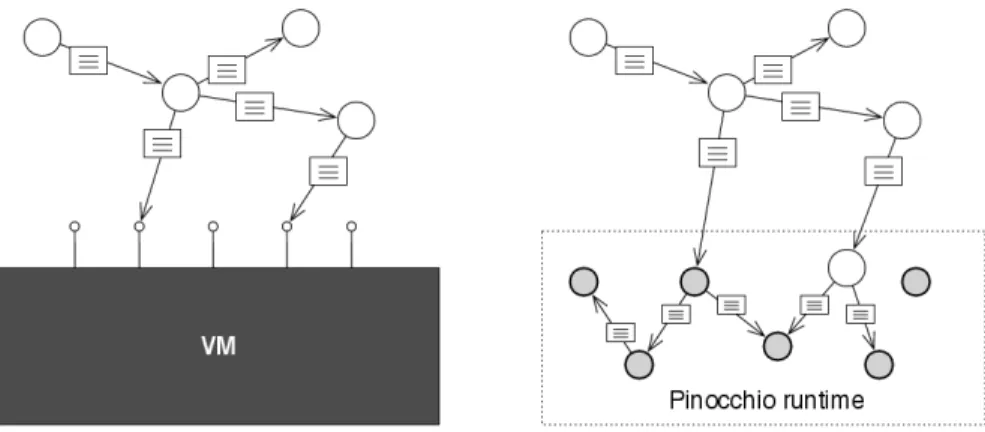
In this dissertation we argue that the best way to open the VM is to eliminate it. Instead, we identify three fundamental building blocks of object-oriented runtimes, and describe how to build up an open runtime from the bottom up by relying on those building blocks:
Communication. To promote freedom of language on a per-object basis we divide method invocation into two parts: a message passing protocol and a reifiedmessage lookupmechanism.
The message passing protocol reuses the native application binary interface (ABI) calling conventions as the most basic mechanism of communication. By using native function calls to implement message sending, we limit the assumptions about language used by the target object to a bare minimum, and we maintain interoperability with ABI compatible applications.
On top of this messaging protocol, we provide a library for Smalltalk lookup semantics. It is implemented as a self-supporting runtime
li-1.1. Contributions
brary compiled to native code, while maintaining the standard poly-morphic behavior of Smalltalk at the meta-level. Since it unifies the meta- and base-level, we obtain a metaobject protocol (MOP). Infinite meta-recursion is avoided by using pre-filled inline caches.
Data. To increase the expressiveness of the programming language in terms of its object structure, we decouple the language-level manipulation of state from the machine-level implementation. We extend the struc-tural reflective model of the language withobject layouts,layout scopes andslots, allowing programmers to build objects in terms of high-level reusable object fragments rather than being limited by simple object extension through subclassing.
Code. To ease language experimentation and debugging, we reify behavior using AST nodes andfirst-class interpretersseparate from the low-level language implementation. Instead of requiring complex code transfor-mations or needing to modify a low-level VM, first-class interpreters support light-weight language extensions through subclassing. We provide separate implementations of the first-class building blocks and show how they are beneficial for the evolution of the runtime by making it more customizable and easier to debug.
1.1
Contributions
1. Unified meta- and base-level
By generating the whole runtime from a high-level meta-circular spec-ification that is formally late-bound, we attain polymorphism at the meta-level. The use of the same language for both the meta-level as well as the base-level ensures that meta-programs are as reconfig-urable as normal base-level applications. In Chapter 4, we will illus-trate the flexibility of the model by implementing a method tracer and a prototype-based language.
2. Customizable object layouts
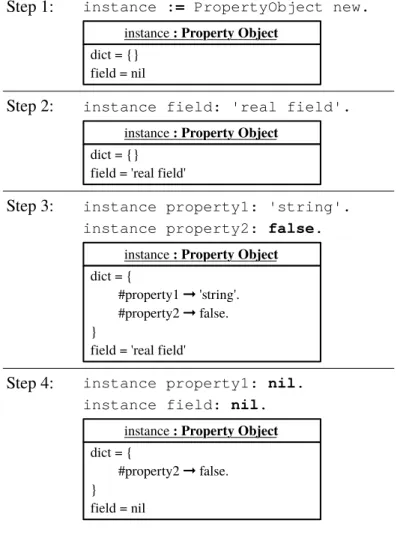
We specify a framework for defining custom layouts of objects built from a set of basic building blocks that have an implicit hardware specification. This allows language developers to build elaborate ob-ject models without having to hook into the compiler, while giving greater customization power to developers with high performance or low memory requirements. In Chapter 5, we exemplify this approach by presenting a typical set of use-cases, including a hybrid between Smalltalk-80 arrayed objects and Python-style hash-table objects. This work has first appeared in [146].
3. Customizable dynamic code update mechanism
Chapter 1. Introduction
and the class installer infrastructure so that they can be customized. This serves as entry point for building dynamic code update mecha-nisms that are required to support more elaborate schemes of appli-cation and language evolution. We show the usefulness of our model by drastically improving the performance of the Pharo1class builder. This work has first appeared in [147].
4. First-class interpreters
By introducing first-class meta-circular interpreters to the runtime we provide a clear object-oriented interface to building custom interpreters. This is especially useful for building interpreters with lower perfor-mance but higher flexibility requirements such as customizable de-buggers. In Chapter 6, we show how this setup can be used to easily implement elaborate debugger support such as theobject-flow debugger [92]. This work has first appeared in [145].
We provide implementations of the contributions in two different systems: Pinocchio is a Smalltalk in which different execution styles have been
pro-totyped. It implements AST, bytecode, and direct-threaded interpre-tation using stack-based opcodes, and native compilation targeting register-based hardware. First-class interpreters are implemented in the interpreter flavors of Pinocchio, whereas unification of the meta-and base-level have been explored in the native compiled version. All versions are bootstrapped by cross-compilation from Pharo Small-talk [15]. While being an experimental runtime with few implemented primitives, it is practically usable as standard Smalltalk environment with competitive dynamic language performance.
PlayOut is an implementation of customizable object layouts on top of Pharo Smalltalk and Helvetia [122]. PlayOut requires no changes to the Pharo VM while exhibiting no negative performance impact.
1.2
Outline
This dissertation is structured as follows:
Chapter 2 identifies three fundamental building blocks of object-oriented languages. It provides an overview of low-level implementation de-tails for these building blocks, and their implications for the resulting runtimes.
Chapter 3 gives an overview of the related work. In particular we describe the state of the art in meta-circular VMs and object-oriented reflection. We then discuss the problems with those approaches.
1.2. Outline
Chapter 4 replaces the traditional VM with a native communication inter-face for objects. We describe Pinocchio, the implementation of our pro-totype that implements a self-supporting runtime library for Small-talk. The runtime library itself is also implemented in Smalltalk and unifies the meta-level with the base-level such that objects from either level are indistinguishable. This provides Smalltalk-based objects with a compiler-generated metaobject protocol.
Chapter 5 introduces layouts, layout scopesand slots as structural abstrac-tions used by language tools to construct classes and compile meth-ods. We modify the language tools so that they solely rely on the pro-vided higher-level interface rather than being hardwired towards the low-level structural model used by the garbage collector. We show in various examples that by doing so we can easily implement new language abstractions and local customizations related to the state of objects.
Chapter 6 shows how first-class interpreters avoid having to build complex code transformations, or decompile low-level code, to modify the ap-plication semantics for language experimentation and debugging. We exemplify our approach by implementing three non-trivial debuggers. Chapter 7 concludes the dissertation and outlines future work.
2
The Building Blocks of
Object-Oriented Runtimes
In this chapter we shed light on the low-level implementation details of ef-ficient object-oriented runtimes. We identify three fundamental building blocks used by the implementations, and explain how they impact perfor-mance.
Communication. Section 2.1 shows how efficient message sending is tradi-tionally implemented.
Data. Section 2.2 explains the trade-offs of different run-time representa-tions of objects. It discusses how objects are typically encoded at the lower level and how this influences the higher level.
Code. Section 2.3 focuses on different ways to encode and evaluate meth-ods, and Section 2.4 explains the semantic operations performed by the code.
2.1
Communication: Efficient Message Dispatch
In procedural languages, functions are said to beearly-bound,i.e., they di-rectly call each other. Dynamic object-oriented languages on the other hand support polymorphism throughlate-boundmessage sends. Rather than di-rectly calling a function, message passing between objects is used to dynam-ically select which method is activated. Message dispatch is a central feature of object-oriented languages. For the language to be efficient, it is important
Chapter 2. Object-Oriented Building Blocks
that virtual message dispatch be fast. There is a myriad of techniques to implement efficient message dispatch. In this section we will discusslookup caches,virtual method tables,inline caches,method inlining, andcustomization.
2.1.1
Lookup Cache
In dynamically typed languages, the message is looked up in the message dictionaries of the inheritance hierarchy. To limit the lookup time, Small-talk traditionally uses a global lookup cache (GLC) that maps the selector and class onto the related method [65, 89]. The size of the GLC is typically decided up front to limit memory usage. A GLC with 256 entries is reported to be effective about 90% of the time [89]. Alternatively lookup caches can be stored locally on a per-class basis.
While providing a more modest speedup than the following optimiza-tions, lookup caches have the advantage that they can be used by purely in-terpretive implementations. All of the following optimizations are generally implemented in context of a statically compiled or JIT-compiled application for maximum performance.
2.1.2
Virtual Method Tables
In statically typed languages like Simula, C++, Java,etc., objects that require virtual method dispatch traditionally contain a pointer to avirtual method tablein their object header. Since types specify exactly what methods are supported by their implementors, the different methods can be numbered. Virtual method invocation is simply implemented by direct access of the vir-tual method table. This implementation method incurs two types of costs, a direct cost and an indirect cost [46]. The direct cost comes from having to select the right target procedure at runtime. The indirect cost stems from optimizations such as inlining that cannot be performed because the target of a call is unknown at compile time.
2.1.3
Inline Caches
Around 90% of sites where message are sent aremonomorphic[41, 144, 27], i.e., only have one receiver type. Inline caching, storing the method related to the expected type at the send site, drastically reduces the direct cost of message sending in natively compiled dynamic languages. Inline caching is implemented as follows. Initially a send site isunlinked. For example, the following Smalltalk message send:
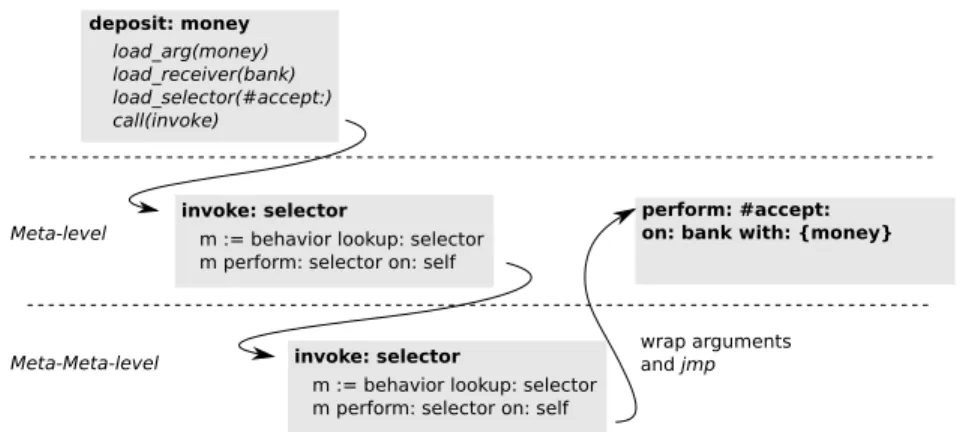
bank accept: money
is typically compiled to the following pseudo native code:
load bank load money
2.1. Communication: Efficient Message Dispatch
load #accept: call invoke
The code first loads the receiver (bank), the arguments (money) and the se-lector (#accept:), and then calls to a meta-levelinvokefunction which per-forms a full invocation sequence.
Message sends arelinkedas a side-effect of theinvokefunction. It stores the type of the receiver and the implementation of the message used during the invocation at the send site. Before a subsequent message send, the type of the new receiver is compared with the cached receiver type. If the type is the same, the cached method is directly reused. This avoids the cost of a full message lookup whenever the cachehits.
In the context of a GLC the cost of a message lookup is fairly mini-mal. The more significant overhead is due to the fact that the CPU exe-cutes instructions in a pipelined, out-of-order fashion: for higher perfor-mance, multiple instructions in a single sequence are handled in parallel1. Pipelined CPUs are best at handling calls to static targets. Since the code statically identifies the target, the CPU can up-front ensure that the target code is loaded in the instruction cache, and prefill the CPU pipeline with its code. Dynamic targets are partially supported using abranch target buffer, a specialized cache that stores the expected target for each location using a dynamic call. This allows the CPU tospeculativelycontinue execution [25]. However, if all calls are dynamic, the branch target buffer quickly overflows, once more incurring large penalties due to pipeline stalls and instruction cache misses. Inline caches avoid this overhead by dynamically rewriting the code so that the cached method is the static target. In practice the call to
invokeis replaced at run time by a direct call to the cached method. Instead of loading the selector, the cached type is loaded for type-checking. This transforms the previous code into:
load bank load money
load Bank // Instead of #accept:.
call Bank>>accept: // Instead of invoke.
By directly calling the cached method, the CPU can properly prefetch its code.
To complement this implementation, all methods have apreamblethat performs the required type-checking. If the type check fails, the pream-ble falls back to theinvokemethod to perform a full lookup. Since cached methods do not get the selector passed in anymore, methods store their own selector for falling back toinvoke. A typical preamble looks as follows:
// Execute the method if receiver is of the expected type. // The expected_type is passed in via the caller, bound to // Bank by the code above.
1Parallel handling of instructions is only done where the CPU can prove there is no data dependency between the instructions.
Chapter 2. Object-Oriented Building Blocks
cmp type_of(receiver), expected_type je body
// Otherwise, load the selector and fall back to invoke.
load #accept: jmp invoke body:
...
Because of the high cost of message lookup, the failing lookups may still take up a large amount of time. For example, by relying only on monomor-phic inline caches, Self still spent up to 25% of its time handling inline cache misses [74]. Polymorphic inline cachesfurther reduce overhead by caching multiple methods where a limited set of receiver types is expected [74]. In practice this causes the runtime system to allocate a short piece of executable memory in a buffer. Rather than calling toinvokeor to acached_method, the send site is modified to call to this buffer. The buffer itself contains code that branches based on already encountered types:
cmp type_of(receiver), Bank je Bank>>accept: cmp type_of(receiver), Person je Person>>accept: ... load #accept: call invoke_extend_cache
Whenever a new type of receiver is encountered, the cache grows dynami-cally. However, when the number of encountered types exceeds a statically determined value, it is degenerated to a so-calledmegamorphicsend site. The polymorphic inline cache is removed and replaced with an invoke that al-ways performs a full lookup.
Since inline caches avoid the memory indirection of virtual method ta-bles, and improve branch target prediction, they have shown to have com-petitive performance [47].
2.1.4
Method Inlining
Profile-guided receiver class predictionandstatic class hierarchy analysisfurther mitigate the direct and indirect cost of message dispatch [35, 67, 4]. A vir-tual method is compiled by merging all its statically found implementations into a single native function. At run-time aclass testis performed to select the right implementation of the method within the function. This allows the static compiler to mitigate the indirect cost of virtual method dispatch by inlining the whole combined method, and optimizing every branch. It can further mitigate the direct cost of dispatch as well by inlining multiple methods that dispatch on the same receiver. Additionally it can result in im-proved performance by avoiding an indirect data access, avoiding potential data cache misses and resulting pipeline stalls.
2.2. Data: Object Format and Management
Since in the previously described setup it is more cumbersome to sup-port dynamic loading of code, other research replaced the class test with a method test[40]. Objects still refer to a virtual method table, and the call-site loads the address of the target method from the table. Rather than jumping to the retrieved address however, it is compared to the original address of the inlined code as guard for the inlined code. If the guard succeeds, the inlined code is directly executed. Otherwise the retrieved code is executed. This setup incurs the overhead of an extra load, but it ensures that code can easily be replaced at runtime while mitigating the cost of call-sites that remain unaffected by loaded code.
In dynamic runtimes, method inlining can still be performed by using runtime type feedback [75]. This type information is automatically collected in the context of PICs. Type feedback has been shown to compete with static type inference [3]. Dynamic method inlining is especially important for in-teractive systems that are extensible at run time.
2.1.5
Customization
While methods can be inherited in object-oriented languages, this has an ad-verse effect on optimization techniques. Since different subtypes may have usage patterns of inherited methods, the expected types may differ signifi-cantly. This reduces the effectiveness of optimization techniques.
Self relies oncustomization[29] to limit the scope, and thus increase the effectiveness, of inline caches and method inlining. Customization is the process of customizing a method towards an expected type. In particular, in Self all inherited methods arecopied downto the inheriting clone family. By copying down methods the compiler statically knows the type of the re-ceiver in every activation. This means that the target methods of messages sent to the receiver (self) are statically known, and thus can be inlined. Ad-ditionally, by copying down methods, dynamic lookups through multiple inherited message dictionaries are replaced by a single lookup in the dictio-nary containing all copied methods.
2.2
Data: Object Format and Management
The exact possible layouts of objects in memory is theobject format sup-ported by the programming language. The format definitions are mostly constrained by how memory is managed in the programming language, whether it be manually managed or automatically. In this section we shed light on the different constraints coming from the hardware, as well as from garbage collection techniques.
Chapter 2. Object-Oriented Building Blocks
2.2.1
Hardware Constraints
Languages that let their users manage the memory of their programs often support highly customizable object formats. Since they do not need to pro-vide optimized solutions for managing the memory they are more liberal in the object formats they support. The only rules imposed on the object format come from hardware and the OS for performance reasons. In this section we will introduce the most relevant hardware constraints.
Data structure alignmentimproves reading and writing speed since CPUs do not read out single bytes at a time [45]. For example, reading out aword that is not aligned requires reading out two separate words, masking out the relevant substructures and merging them together. Bigger structures are often aligned on larger boundaries since the CPU reads out multiple words at the same time2. To ensure data alignment compilers sometimes need to insert dummy elements into data structures, a technique calleddata structure padding. In C developers can take alignment into account by struc-turing their objects so that fields that require less space than a single align-ment unit are grouped together, avoiding space overhead due to unneces-sary padding, in turn reducing pressure on data caches.
Data cache localityis an important property that benefits from the insight a developer has in his own applications. Most modern CPUs rely on multi-level caching. The caches are divided into relatively small blocks (e.g., 64 bytes), calledcache lines. Memory is not loaded into the caches based on the exact size of used objects, but rather in the size of the cache lines. By moving related objects together, we increase the chance that the memory holding a subsequently accessed object is alreadyhot,i.e., will already be loaded into the data cache as a side-effect of a previously loaded object [45, 25]. In mod-ern high-performance CPUs (and multi-core CPUs), cache misses dominate the execution cost since they are two to three orders of magnitude more ex-pensive than the execution of single instructions [45, 25].
Unlike most high-level garbage collected languages, manually managed languages allow developers to inline objects into other objects. This does not only avoid unnecessary pointers, reducing the pressure on the data caches, but also ensures that the contained objects are close to their containers. This is most effective for arrays of a fixed type, increasing the speed of bulk op-erations for which cache locality is even more important.
Since memory allocation is fairly expensive, even in manually managed languages, systems languages often allow objects to be allocated on the stack directly. This eases memory reclamation since the data is automatically given back to the system when the frame in which the object was allocated is left. It also improves data cache locality since the stack is almost always hot.
Unfortunately, the performance of a manually memory-managed appli-2Some instructions do not enforce data alignment but are just faster when their arguments are aligned. For this reason the Mac OS X ABI enforces 16-byte stack alignment on function calls by testing the alignment whenever the code jumps to system libraries.
2.2. Data: Object Format and Management
cation is not always adequate since not all developers using systems pro-gramming languages have the knowledge required to structure their ap-plications favorably: In practice, caches are under-exploited [26]. Another example of a common mistake is to declare independent global variables in the same context, while they are supposed to be used by different threads. If the compiler places the variables in the same data cache line, the resulting performance suffers due tofalse sharing[79, 25]: on each write to the variable in one thread, the cache line of the second thread needs to be updated via a slower cache, even though logically there is no need.
Another downside to the approach of letting developers handle their memory manually is that it often results inmemory leaks(forgetting to free up unreferenced memory),dangling pointers(the use of pointers to already freed memory),etc., that are difficult to debug [131]. While systems programming languages give the control to the user, there is a lack of adequate tools to detect such bugs. In either case, manual memory management is a very complex task that takes away a lot of time otherwise better spent on solving the problem at hand, but it is often desirable for memory- and performance-critical applications.
2.2.2
Garbage Collection Constraints
In a response to the previously described problems with manual memory management, many modern programming languages make use of a garbage collector.
Initially concerns were raised about the performance of automatic mem-ory management. Nevertheless, similar to compilers obviating the need for hand-written assembler code, high-performance garbage collected runtimes automatically apply complex optimizations at run-time that are difficult to statically perform. For example, generational GCs are easily modified to op-timize data cache locality [33]. Thread-local heaps can avoid false sharing in many cases [12]. Escape analysis has been used to relieve pressure from the GC by converting heap allocations into stack allocations, and byscalar replacement, avoiding object allocation by mapping their instance variables directly onto registers [28, 88]. However, since the user cannot declare his intent in the programming language directly, the GC is only left with recon-structing the assumptions through analysis.
The object format of garbage collected languages is imposed by their GC. It is designed for minimum GC code complexity, minimal allocation overhead, and maximum data cache locality. The number of paths through the GC code is decreased by limiting the number of object types. Allocation overhead is often avoided by using immediate values,i.e., values that are not allocated on the heap. The cache locality is increased by directly storing structural meta-data required by the GC in the object header so that the class does not need to be loaded.
Chapter 2. Object-Oriented Building Blocks
Immediate values. Most objects in garbage collected languages are allo-cated on the heap. They are passed around in the running program by ref-erence, speeding up passing the object and ensuring consistency throughout the program. Nevertheless heap allocation is expensive.
This overhead can be reduced by encoding a limited set of data types, e.g., integers, as immediate values. Because of data alignment used in most VMs, the references to objects do not vary in all bits of a pointer’s value. In case of 32 bit (4 byte) or larger object alignment, the least significant two bits of the pointer are always zero. These bits are available to the language to encode (at least) three extra data types directly in the pointer, rather than allocating them on the heap. There are two requirements for data types to be suitable for immediate encoding: (1) the value needs to be immutable since it is passed by copying, and (2) the data type must fit in the bits re-maining after applying the tag bits. Traditionally 32 bit Smalltalk systems encode small integers as signed 31 bit tagged pointers. Some VMs, such as the V8 JavaScript VM, also encode characters as immediate values. This is particularly useful when performing a lot of string operations. Floats are a third potential immediate value. All of these types of values can be encoded in the available space in a pointer minus the tag bits.
The downside of using tagged pointers is that it is asymmetric. All lo-cations that dereference object pointers need to be aware that the pointer might actually be an encoded data type. Having to test for different ob-ject encodings introduces an overhead on standard operations. In case the code executes natively, more code space is required to test for the different cases. This overhead is offset by the speed increase by avoiding object allo-cation and by having direct access to the encoded value through the tagged pointer. The overhead is further reduced by applying static and dynamic optimizations that eliminate superfluous type guards.
A second criticism of tagged pointers is that they are not useful given that JIT compilation can perform the so-calledunboxingof these values at runtime where required, without having to manually ensure it everywhere in the code. However, by solely relying on JIT compilation for unboxing, not all sites will run optimally (those that are not yet optimized), the JIT compiler has more work and will thus optimize the code slower, and start-up is slower. The last point is especially crucial for short-lived scripts.
Object headers. Objects generally store meta-level information in an ob-ject extension known as theobject header. The object header implies a mem-ory overhead for objects, so is generally as small as possible. On the other hand, by storing meta-data directly in the object itself the language im-proves data cache locality and avoids indirections for object manipulation and garbage collection. Just like there is a wide variety of object encodings, there is a variety of object headers.
Dynamically typed object-oriented languages need at least a link from the object to type information that is used to look up methods at runtime. In
2.3. Code: Method Structure
class-based languages this link points to the class. Since a class pointer is re-quired for inline caching, even highly optimized prototype-based languages rely on an internal class-like object to store behavior.
While garbage collected languages could look at the class to decide how to handle an instance, it is more efficient to get the meta-information directly from the object. For this purpose object headers often include multiple bits that are relevant to the GC, including the size and type of the object. The commonly usedmark-and-sweepGC requires one bit per object to mark the object as being used. Reference counting garbage collectors on the other hand require more space to store the number of references to the object. In both cases the object header encodes the exact size of the object, and which segment of the object contains pointers to other objects.
Languages that frequently store objects in dictionaries require good dic-tionary performance. This is the case especially for languages using hash tables as native object representation,e.g., Python. There are two basic op-erations on objects used to support dictionary access, hashing and equality. To improve the performance of dictionary access, objects often use a portion of the object header to store theidentity hash.
2.3
Code: Method Structure
A layer of interpretation is often introduced between the CPU and the ac-tual code. This provides language developers with a choice between differ-ent code formats. We give an overview of the most common formats: AST nodes, bytecodes, threaded code, and native code. We discuss the trade-offs between the different formats in terms of understandability, memory usage, and performance.
2.3.1
AST
The most high-level execution format that is widely used is the AST (ab-stract syntax tree) [81]. ASTs represent the essential structure of methods defining its behavior. After semantic analysis has been applied to match variable declarations and uses, they form a DAG (directed acyclic graph). Interpreters can walk the resulting DAG to evaluate the code. ASTs are very close to the original source of a program, making it an ideal format for in-terpretation and debugging. For ease of implementation, most interpreter prototypes rely solely on nested AST evaluation.
By representing AST nodes as objects, the interpreter can rely on poly-morphism to evaluate the AST nodes by recursively descending the DAGs. This results in a very fine-grained call-stack that does not only keep track of activations, but also of the exact position within the AST. These call-stack operations are however superfluous since they dynamically keep track of state that is statically known. For example, suppose we are executing the following nested expression:
Chapter 2. Object-Oriented Building Blocks
(a + b) * c
During execution the runtime will push the values related toaand b on the operand stack. Before sending the message+, however, it will need to remember that after returning, the message*needs to be sent. This is re-membered by pushing the expression* con a separate expression stack. This does not only imply direct execution overhead related to managing the expression stack, but also indirect overhead from additional cache and pipeline pressure.
The overhead of evaluating a nested AST can be reduced by flattening the DAG at compile-time in depth-first order. To keep track of the position within the resulting list of expressions it suffices to store the method or func-tion and a singleprogram counterfor each activation. For extra performance, the counter can be mapped onto a register and only needs to be written back to the stack on activations. The disadvantage of flattening the AST is that the original nesting is not preserved. However, by storing extra meta-data in the nodes this structure can be recovered for debugging. Alternatively, a debugger can regenerate this information on-the-fly when required.
2.3.2
Bytecode
Even after flattening its DAG, the resulting AST still has a performance and memory downside. By encoding code in objects, the resulting AST uses more space than necessary for execution. Especially if the AST nodes are reified in the base-language, all AST nodes have an object header and use full pointers to link to their members. When no care is taken to allocate the AST nodes optimally by placing related AST nodes near each other, a single function might require several cache lines to be loaded, adding even more unnecessary data cache pressure.
Bytecode does not suffer from these problems since it is encoded mini-mally. They encode language-level operations using bytes, just like native code, but provide codes generally not offered by a general purpose CPU. This allows bytecodes to express language-level concepts more concisely than native code. An additional advantage over native code is that byte-codes are portable across multiple architectures. By writing an interpreter for bytecodes in a language supported by the required targets, the language can automatically be made available on all those platforms.
The evaluation of bytecodes is similar to that of flattened AST nodes. Since bytes are not objects, a bytecode interpreter is more complex than an AST evaluator. A bytecode interpreter relies on bit-masking and a multi-way branch (such as aswitchstatement or abranch table) to map the bytes onto their semantic operations. Rather than reading out operands from the expression objects, operands are decoded from the bytecodes or additional follow-up bytes. While expression objects can directly link to operand
ob-2.3. Code: Method Structure
jects, bytes cannot easily directly encode other objects3. This is simplified by storing such objects close to the bytecode, for example in a literal frame or a constant pool, and using the operand as an index into this literal frame.
Direct bytecode interpretation is not particularly efficient [53]. Addi-tionally it is criticized to be too far from the source code [42, 37]. This makes bytecodes a bad medium for understanding the source code. To understand the code, the bytecodes need to be decompiled or interpreted by an appli-cation. Debuggers that handle bytecodes rely on external meta-data to map the bytecodes back onto the original source code. For further dynamic opti-mizations it is most useful to have a high-level view on the source code, to understand and optimally encode the intent of the program. By using byte-codes as a source for optimizations, most of the intent is hidden between im-plementation details, making it harder to recover the original design. Nev-ertheless, given that without dynamic optimizations bytecodes can easily achieve higher performance than AST evaluation, bytecodes remain a more popular code format for more advanced interpreters.
2.3.3
Threaded Code
Profiling where AST evaluators and bytecode interpreters spend most of their time reveals that the main dispatch loop shows up high in the rank-ing. While the dispatch loop is a very simple piece of code that only chooses how to evaluate instructions, the CPU has to return to it before each instruc-tion. The code then jumps to the implementation of the actual next opcode implementation. This implies two branches for each evaluated instruction: an indirect branch (computed jump to the return address on the stack) from the previous instruction back to the dispatch loop, and a conditional branch from the dispatch loop to the next instruction. Since all conditional branches occur in the same dispatch loop, the branch target predictor of the CPU can-not possibly properly predict the branch taken, resulting in costly pipeline stalls between instructions.
To minimize the overhead, other types ofvirtual machine instruction sets are used. Threaded code4[9] removes the need for a centralized dispatch loop by directly storing the target interpreter function addresses in sequence as the main code representation. Whenever an instruction finishes evalua-tion it can directly jump to the next instrucevalua-tion without having to first re-turn to a main dispatch loop. Threaded code improves performance over bytecode interpretation, further closing the performance gap between inter-pretation and native code compilation. Threaded code is however easier to port across platforms than complete native code compilers. Since there is a one-to-one mapping between both formats, it is easy to generate equivalent threaded code on-the-fly while loading bytecode.
3By mixing bytecodes with object pointers the resulting methods become harder to garbage collect, resulting in performance overhead. The garbage collector would require knowledge of all bytecodes to find references to other objects.
Chapter 2. Object-Oriented Building Blocks
There are two main threaded code encodings that are of interest: Direct-threaded code contains machine addresses in a thread of code,i.e.,
a simple array of code pointers. During execution the runtime keeps track of the current location within the thread using pointer that repre-sents the program counter. Interpretation is started by jumping to the value at the initial program counter. Whenever an instruction finishes it increases the program counter and direct jumps to its value without further need for decoding. The program counter namely points at the address of the implementation of the next instruction.
The following code implements apush_trueinstruction:
push_true:
stack_push(true); goto **(pc += 1);
The code is labeled so that can be used as jump target. The operand to be pushed on the stack is decoded from the thread by reading out the value directly following the current program counter. At the end the instruction directly jumps to the next instruction by increasing the program counter and jumping to its value, the address of the next in-struction.
A problem with this code style is that the CPU cannot properly predict where the code wants to go next [54]. Suppose in a specific thread
push trueis followed bypush false:
void* thread[] = { ..., &&push_true,
&&push_false, ... };
Since the CPU seesgoto **(pc += 1)rather thangoto push false, it cannot properly prefetch the instruction code. It has to wait until the target address at**(pc += 1)is available before it can load the code into the pipeline. While the branch target predictor normally helps by guessing the target based on previous executions, the multitude of opcode combinations occurring over all threads generally trashes this cache.
As the example shows, direct-threaded code requires being able to refer to native code fragments as jump targets. This is problematic [116, 53] since ANSI-C does not supportcomputed jump(indirect branch) needed to jump to dynamically provided addresses. Most C imple-mentations,e.g., GNU C, do however provided a version of computed jump.
Context threaded code (subroutine threaded code) relies on generated native code to sequence interpreter operations [13]. Rather than just using
2.3. Code: Method Structure
pointers to the fragments that encode the semantics of instructions, subroutine threading relies on sequences of native calls to instruc-tion funcinstruc-tions. The following code implementspush_trueas context threaded instruction:
void push_true() {
stack_push(true); }
The previous thread is encoded as:
void thread() { ... push_true(); push_false(); ... }
This reintroduces the overhead of having single call-and-return se-quences per instruction, but it avoids the overhead of not knowing what the next instruction is. Since the CPU directly executes the thread itself, thanks to thereturn stack buffer5it can pre-fetch the code related to next instruction, avoiding pipeline stalls.
The difficulty of subroutine threading is that native code needs to be generated and placed in executable memory. Rather than having full control over the execution in an interpreter, the runtime has to coop-erate with the hardware to manage execution.
Because of the trade-offs involved, it depends on the hardware which of both previously described techniques is faster. Both, however, result in faster execution than vanilla bytecode execution.
Since threaded code uses full pointers to link to opcodes rather than sin-gle bytes, many more operations can directly be supported than in byte-code sets. To further increase the time spent doing useful work, superin-structions optimize threaded code by combining opcodes into larger single opcodes [116, 56]. Superinstructions reduce the need for reading and dis-patch opcodes. If the superinstructions are generated at compile-time, the compiler can apply optimizations across opcodes that would otherwise be impossible. Useful combinations can be detected using static analysis of existing applications. Superinstructions reduce the size of threaded code, and decrease the required number of dispatches and resulting branch mis-predictions [55]. Nevertheless they require more memory for native code, increasing pressure on the instruction cache.
5The CPU relies on a return stack buffer since return addresses are mutable on the native stack. The buffer is used as specialized branch target predictor. The CPU cannot be certain thatpush truedoes not modify the return address to jump somewhere else than returning to thread(and subsequently callpush false).
Chapter 2. Object-Oriented Building Blocks
The approach of relying on static analysis might however not fit appli-cations that are dynamically loaded on top of the VM. For this reason, an-other approach [116] detects used opcode sequences at runtime. By stati-cally meta-describing the implementations of primitive opcode fragments they can be copied and combined in a cache for superinstructions at run-time.
A difficulty in implementing direct-threaded interpreters in a higher-level language like C is that C compilers are designed to optimize nor-mal user applications. The instructions of threading interpreters are imple-mented at a higher granularity than functions, using only fragments of func-tions. C compilers generally expect to optimize full functions as one block, which does not generete the optimal code for threaded instruction imple-mentations. While not very portable across compiler versions, BrouHaHa [104] instead relies on specifically generated code by manually annotating variables with register names [105]. The newer LuaJIT interpreter [113] re-lies on handwritten assembler code for optimal performance.
2.3.4
Native Code
The previously defined code formats can limit themselves to operations that are first-class in the language. All required meta-level actions,e.g., setting up a stack frame for activation, are implicit in the base-level operations. Since there is generally a mismatch between the language and the target hardware, compiling complex application-level operations fully to native code requires additional support code to be generated. For example to com-pile Smalltalk bytecodes to native X86 or X86-64 assembler, bytecodes are translated into one of the following three native code types:
• a single native instruction, like memory access or copying a register (accounts for ca. 175 Smalltalk-80 bytecodes),
• an expanded assembler template (their function is similar to CPU mi-crocode,e.g., copying a memory range),
• a function call (e.g., opcodes that send messages).
The last case is used for code that is too expansive to inline. Instead the code calls to a meta-level library function that implements the required operation. Code that supports a programming language is provided in a so-called run-time library.
2.4
Code: Method Behavior
During execution a so-calledcontinuation keeps track of the run-time state within the used code format. There are two sides to a continuation: the runtime stackand theenvironment. The runtime stack is split up into the con-trol stateand theoperand stack. The control state captures the function-call
2.4. Code: Method Behavior
nesting and the state within these functions. The operand stack contains the values required to evaluate expressions, and values resulting from evaluat-ing expressions. The environment captures the data involved in activations: local variables, receiver and arguments.
2.4.1
Recursive interpretation
AST interpreters are easily written at a high level using theinterpreter pat-ternorvisitor pattern. The interpreter recursively visits code while manually managing the environments. The host language, rather than the interpreter itself, keeps track of the runtime stack. The environment is represented as heap-allocating environment frames that link to the return frame, and the lexical outer frame to support lambdas.
There are multiple disadvantages to the recursive approach however. Firstly by letting the host-language manage the recursion, the number of features easily provided to the base-language is limited to the set of stack-operations provided by the host-language. Secondly, by intertwining level recursion with meta-level recursion the stack frames used for base-level recursion will be larger than required since also the meta-base-level state is stored in each frame. This state is irrelevant, however, since it can be reconstructed fully from the state of the application alone. For example, suppose the following interpreter method evaluates an array of statements and returns the result of evaluating the last statement:
visitStatements: statements
↑ 1 to: statements size do: [ :pc | (statements at: pc) accept: self ]
The only data essential to keep track of evaluation are thestatementsarray and the index into the array (pc). Nevertheless, the language in which the interpreter is written also keeps track of the state of the interpreter. This information is superfluous since there is only one possible position between statement evaluations: at the end of theto:do:loop.
2.4.2
Manual stack management
To get full control over the run-time state of an application the stack can be manually managed. Within a single method the state is explicitly repre-sented by aprogram counter. Calls and returns require storing and restoring of this program counter. If this strategy is used on top of another language, the final runtime has two runtime stacks: one for the interpreter and one for the application. The interpreter itself is generally implemented as a loop that evaluates application-level code and does not require much stack space. The application stack will only contain the state required for the evaluation of the application and is therefore minimal.
As an alternative stack design the environment and the operand stack can be embedded into a single context frame that is wired in sequence to
Chapter 2. Object-Oriented Building Blocks
form the runtime stack. The advantage of embedding stack and environ-ment is that it gives a first-class representation of the runtime state of an activation. Additionally, it is easy to reorganize the stack at runtime to im-plement language extensions that are otherwise hard to accomplish. Back-tracking has been implemented on top of Smalltalk as an example use of first-class context objects [90].
2.4.3
Stack-mapped context frame
The downside of all the above approaches is that the context objects are al-located on the heap. Since activations happen at a much higher rate than any other activity in VMs, this accounts for a large percentage of object al-locations and gives a large overhead to the garbage collector. Additionally, since these objects are heap-allocated they likely belong to different cache lines, causing extra strain on the CPU’s memory management unit between method activations. This has a major impact on the performance of the run-time.
A first solution to this problem is to fix the size of context objects and cache them [89]. This avoids overhead in the garbage collector since they can be explicitly freed on return. In case a context object is captured by a closure it cannot be freed. Nevertheless the fixed size of the objects ensures it will not fragment the cache. However, captured contexts do separate log-ically consecutive calling contexts, increasing the risk of data cache misses. Additionally, every activation requires the runtime to write a back-pointer to the return context into the new context frame.
The overhead is alleviated by allocating the activation frames directly on a stack [106]. Frames are allocated by increasing the stack pointer, and are removed by decreasing the stack pointer. This wires stack frames together in the order of activations, ensuring that the related memory is most likely already loaded in the data cache. It however brings with it three difficulties: Firstly, implementing closures is harder in a stack-mapped setup than in the others. Since context objects are not regular objects but part of a stack, they automatically disappear and potentially get overwritten when the method or closure is left. Values that are captured by a closure and have to live on beyond the life-span of the original activation would get lost. Sim-ple static analysis of code can identify exactly which values need to be kept alive beyond the life-span of a stack frame. These values are stored in a sep-arate, heap-allocated,remote array. By sharing the array between a context and the closures that capture it, the values are also shared, and can live on even though the frame they originated from has already terminated.
The second disadvantage is that stack frames are not as flexible as con-text objects, since they are implicitly sequenced. To support the same fea-tures as separately heap-allocated context objects, a lot of extra administra-tion has to be performed. However, since most base-level code relies on regular activations it makes sense to improve performance in favor of
regu-2.5. Summary
lar use.
A final disadvantage is that a pre-allocated stack can overflow on deep recursion. This is solved in some approaches by not just implementing the stack as a single large chunk of memory, but rather a series of stack pages. On every activation the runtime checks if there is still space within the cur-rent stack page, and if not, it uses a next stack page to allocate the frame. The first stack frame of a stack page contains a pointer totrampoline code,i.e., meta-level code that overcomes the limitation that the CPU expects the stack frames to be laid out in sequence. The trampoline code restores the previ-ous stack page and returns to the top stack frame on that page. This setup avoids stack overflows, and is still faster than allocating separate context frames since it is more coarse-grained. Alternatively the virtual memory manager’s page protection can be used to dynamically allocate extra stack pages or free unused pages. In that case the page protection traps are used as hardware-supported trampolines.
2.4.4
Register-Based Execution
Just like in hardware, there are two main execution models in software for handling operands: stack-based and register-based. The model used by a language does not necessarily directly relate to the model used by hardware. On the contrary, many languages such as Java and Smalltalk rely on a stack-based bytecode-set, while being available for register-stack-based processors such as the X86.
Stack-based bytecode has the advantage of being smaller than register-based bytecode since often the operands are passed implicitly, relative to the stack pointer. In register-based languages the code always has to spec-ify which variables are used in the operation. Register-based bytecode was found to be 26% larger than the equivalent [132].
Register-based bytecode has the advantage that it is not bound to a stack-based view of its application. This implies for example that superfluous values never need to be popped from the stack. Since there are fewer codes to be executed the final execution time is lower than for the stack-based alternative, in part due to the overhead of dispatching bytecodes [132].
2.5
Summary
We have identified three main building blocks of object-oriented languages: • Message sending as communication between objects,
• the object encoding that declares how objects are laid out in memory, and how they are managed,
• method structure and behavior that encode the semantics of single methods.
Chapter 2. Object-Oriented Building Blocks
We have explained the differences between the major design choices for all building blocks and how they impact performance. In the next chapter we will talk about how current approaches allow the user to hook into the de-fined building blocks, and the limitations thereof.
3
Background and Problems
In this chapter we discuss two main approaches that are targeted at making runtimes reusable. They form the basis of the related work we build upon. In Section 3.1 we give an introduction to run-time reflection, an approach that is designed to give applications the illusion that they have direct access to their own meta-level from within their runtime. In Section 3.2 we pro-vide insights in the alternative approach of generating high-performance VMs from meta-circular implementations to streamline the development of new interpreters. The differences between our work and the related work are presented inline in the relevant chapters (Section 4.5, Section 5.7, and Section 6.5).
3.1
Reflection
Computational reflectionrefers to the ability of computer programs to reason about their own structure and behavior at runtime [134, 95]. Reflective sys-tems distinguish thebase(application) level from themeta(semantic) level. Reflection entails thereificationof meta-level entities to the base level, that is, semantic entities are reified as ordinary application entities. (If we ask a Java object for its class, we obtain an ordinary Java object representing that class.)
Structural reflectionis concerned with reification of the structure of the program,i.e., its data and code. Behavioral reflectionis concerned with reifi-cation of the behavior of the program,i.e., itsinterpretation. Reflection can be further refined intointrospectionandintercession. Introspection is purely con-cerned with reifying meta-level concepts to reason about them at the base
Chapter 3. Background and Problems
level. For example, we may ask an object what fields it has so we can print them all. Intercession, on the other hand, allows us to manipulate reified meta-level entities andreflectchanges back to the meta-level. In Smalltalk, one can change the class of an object at runtime, immediately causing that object’s behavior to change. Such changes effect acausal connectionbetween the reified entities and the meta-level entities they represent [95].
Some typical uses of reflection are found in (i) debugging tools; (ii) GUIs for object structures; (iii) code instrumentation and analysis tools; (iv) dy-namic code generation; and (v) language extensions. Several different ap-proaches to behavioral reflection have been realized over the years.
Smith introduced the notion of computational reflection and he illus-trated his model through the implementation of a reflective dialect of Lisp, called 3-Lisp [134]. 3-Lisp applications can contain specialreifierfunctions that take reifications of aspects of the interpreter as arguments: the current expression, the environment in which the expression is being executed and the continuation of the application. In Smith’s model these reifiers conceptu-ally run in the scope of the interpreter since they operate on the application from the point of view of the interpreter. Adding support for reifiers to a language thus adds the ability toadd linesto the code of the interpreter from within the application context. It also creates the illusion that below every interpreter, there is another interpreter that evaluates the interpreter and all reifications requested by the application on top. Reflection is therefore sup-ported by an infinitetower of interpreters.
3.1.1
Discrete and Continuous Behavioral Reflection
Behavioral reflection in most systems isdiscrete, which means that reflec-tive computations are initiated at a discrete point by calling a reflecreflec-tive pro-cedure and only lasting until this propro-cedure returns [98]. For example, a method wrapper that makes a method asynchronous only affects the partic-ular wrapped method, not all the methods in the whole system.
Continuous behavioral reflectionrefers to reflective computations that mod-ify existing structures of the meta-interpreters, thus having a continuous ef-fect on the base level computation [98]. Software transactional memory, for example, entails a continuous change to the semantics of a language which can benefit from invasive changes to the runtime [69].
Smith’s “tower of interpreters” approach is fundamentally discrete since the behavior of interpreters can only be extended, not modified. Existing meta-behavior cannot be mutated, strictly limiting custom reflective ior to the base-level code explicitly triggering this custom reflective behav-ior. Simmonset al. extended the discrete reflective tower to a continuous model of reflection by introducingfirst-class interpreters in Refci (reflective extension by first-class interpreters) [133]. In Refci, changes can be applied to the interpreter by explicitly wrapping around the meta-interpreter. These wrappers are then used to interpret of all code to which the modified