Unleashing Operational Process Mining
Edited byRafael Accorsi
1, Ernesto Damiani
2, and Wil van der Aalst
3 1 Universität Freiburg, DE,[email protected]2 Università degli Studi di Milano – Crema, IT, [email protected]
3 Eindhoven University of Technology, NL,[email protected]
Abstract
This report documents the program and the outcomes of Dagstuhl Seminar 13481 “Unleashing Operational Process Mining”. Process mining is a young research discipline connecting compu-tational intelligence and data mining on the one hand and process modeling and analysis on the other hand. The goal of process mining is to discover, monitor, diagnose and improve real processes by extracting knowledge from event logs readily available in today’s information sys-tems. Process mining bridges the gap between data mining and business process modeling and analysis. The seminar that took place November 2013 was the first in its kind. About 50 process mining experts joined forces to discuss the main process mining challenges and present cutting edge results. This report aims to describe the presentations, discussions, and findings.
Seminar 25.–29. November, 2013 – www.dagstuhl.de/13481
1998 ACM Subject Classification H.2.8 Database Applications (Data mining), H.2.1 Logical Design (Data models), K.6 Management of Computing and Information Systems
Keywords and phrases Process mining, Big data, Conformance checking
Digital Object Identifier 10.4230/DagRep.3.11.154
1
Executive Summary
Rafael Accorsi Ernesto Damiani Wil van der Aalst
License Creative Commons BY 3.0 Unported license
© Rafael Accorsi, Ernesto Damiani, and Wil van der Aalst
Society shifted from being predominantly “analog” to “digital” in just a few years. This has had an incredible impact on the way we do business and communicate. Gartner uses the phrase “The Nexus of Forces” to refer to the convergence and mutual reinforcement of four interdependent trends: social, mobile, cloud, and information. The term “Big Data” is often used to refer to the incredible growth of data in recent years. However, the ultimate goal is not to collect more data, but to turn data into real value. This means that data should be used to improve existing products, processes and services, or enable new ones.
Event dataare the most important source of information. Events may take place inside a machine (e.g., an X-ray machine or baggage handling system), inside an enterprise information system (e.g., an order placed by a customer), inside a hospital (e.g., the analysis of a blood sample), inside a social network (e.g., exchanging e-mails or twitter messages), inside a transportation system (e.g., checking in, buying a ticket, or passing through a toll booth), etc.
Except where otherwise noted, content of this report is licensed under a Creative Commons BY 3.0 Unported license
Unleashing Operational Process Mining,Dagstuhl Reports, Vol. 3, Issue 11, pp. 154–192 Editors: Rafael Accorsi, Ernesto Damiani, and Wil van der Aalst
Dagstuhl Reports
current data historic data resources/ organization data/rules control-flow de jure models resources/ organization data/rules control-flow de facto models e x p lo re p re d ic t re c o m m e n d d e te c t c h e c k c o m p a re p ro m o te d is c o v e r e n h a n c e d ia g n o s e cartography navigation auditing event logs models “pre
mortem” “post mortem”
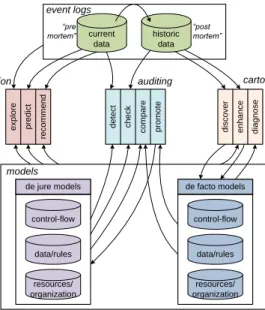
Figure 1Overview of the different process mining tasks (taken from “Process Mining: Discovery, Conformance and Enhancement of Business Processes”).
Process mining aims to discover, monitor and improve real processes by extracting knowledge from event logsreadily available in today’s information systems1. The starting point for process mining is anevent log. Each event in such a log refers to anactivity (i.e., a well-defined step in some process) and is related to a particularcase(i.e., aprocess instance). The events belonging to a case areordered and can be seen as one “run” of the process. Event logs may store additional information about events. In fact, whenever possible, process mining techniques use extra information such as theresource(i.e., person or device) executing or initiating the activity, thetimestamp of the event, ordata elements recorded with the event (e.g., the size of an order).
Event logs can be used to conduct three types of process mining. The first type of process mining isdiscovery. A discovery technique takes an event log and produces a model without using any a-priori information. Process discovery is the most prominent process mining technique. For many organizations it is surprising to see that existing techniques are indeed able to discover real processes merely based on example behaviors stored in event logs. The second type of process mining isconformance. Here, an existing process model is compared with an event log of the same process. Conformance checking can be used to check if reality, as recorded in the log, conforms to the model and vice versa. The third type of process mining isenhancement. Here, the idea is to extend or improve an existing process model thereby using information about the actual process recorded in some event log. Whereas conformance checking measures the alignment between model and reality, this third type of process mining aims at changing or extending the a-priori model. For instance, by using timestamps in the event log one can extend the model to show bottlenecks, service levels, and throughput times.
Process mining algorithms have been implemented in various academic and commercial
1 Process Mining: Discovery, Conformance and Enhancement of Business Processes by W. M. P. van der
systems. The corresponding tools are being increasingly relevant in industry and have proven to be essential means to meet business goals. ProM is the de facto standard plat-form for process mining in the academic world. Examples of commercial tools are Disco (Fluxicon), Perceptive Process Mining (before Futura Reflect and BPM|one), QPR ProcessAn-alyzer, ARIS Process Performance Manager, Celonis Discovery, Interstage Process Discovery (Fujitsu), Discovery Analyst (StereoLOGIC), and XMAnalyzer (XMPro). Representatives of ProM community and the first three commercial vendors participated in Dagstuhl Seminar 13481 “Unleashing Operational Process Mining”.
The Dagstuhl Seminar was co-organized with theIEEE Task Force on Process Mining(see http://www.win.tue.nl/ieeetfpm/). The goal of this Task Force is to promote the research, development, education and understanding of process mining. Sixty organizations and over one hundred experts have joined forces in the IEEE Task Force on Process Mining.
Next to some introductory talks (e.g., an overview of the process mining field by Wil van der Aalst), 31 talks where given by the participants. The talks covered the entire process mining spectrum, including:
from theory to applications,
from methodological to tool-oriented,
from data quality to new analysis techniques, from big data to semi-structured data, from discovery to conformance, from health-care to security, and from off-line to online.
The abstracts of all talks are included in this report.
It was remarkable to see that all participants (including the academics) were very motivated to solve real-life problems and considered increasing the adoption of process mining as one of the key priorities, thereby justifying the title and spirit of the seminar, namely “Unleashing the Power of Process Mining”. This does not imply that there are not many foundational research challenges. For example, the increasing amounts of event data are creating many new challenges and new questions have emerged. Such issues were discussed both during the sessions and on informal meetings during the breaks and at the evening.
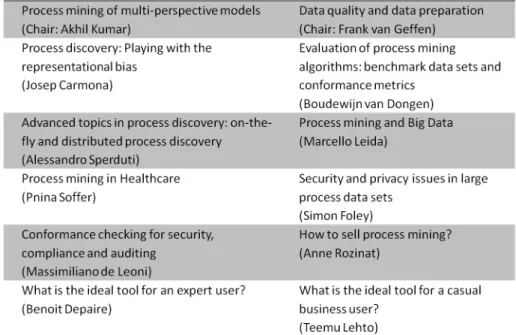
Half of the program was devoted to discussions on a set of predefined themes. These topics were extracted based on a questionnaire filled out by all participants before the seminar.
1. Process mining of multi-perspective models (Chair: Akhil Kumar)
2. Data quality and data preparation (Chair: Frank van Geffen)
3. Process discovery: Playing with the representational bias (Josep Carmona)
4. Evaluation of process mining algorithms: benchmark data sets and conformance metrics (Chair: Boudewijn van Dongen)
5. Advanced topics in process discovery: on-the-fly and distributed process discovery (Chair: Alessandro Sperduti)
6. Process mining and Big Data (Chair: Marcello Leida)
7. Process mining in Healthcare (Chair: Pnina Soffer)
8. Security and privacy issues in large process data sets (Chair: Simon Foley, replacing Günter Müller)
9. Conformance checking for security, compliance and auditing (Chair: Massimiliano De Leoni, replacing Marco Montali)
11. What is the ideal tool for an expert user? (Chair: Benoit Depaire)
12. What is the ideal tool for a casual business user? (Chair: Teemu Lehto)
Summaries of all discussions are included in this report. The chairs did an excellent job in guiding the discussions. After the each discussion participants had a better understanding of the challenges that process mining is facing. This definitely include many research challenges, but also challenges related to boosting the adoption of process mining in industry.
The social program was rich and vivid, including an exclusion to Trier’s Christmas market, a night walk to ruins, table football, table tennis, and late night discussions.
Next to this report, a tangible output of the seminar is a special issue of IEEE Transactions on Services Computing based on the seminar. This special issue has the title “Processes Meet Big Data” and will be based on contributions from participants of this seminar (also open to others). This special issue of IEEE Transaction on Service-Oriented Computing is intended to create an international forum for presenting innovative developments of process monitoring, analysis and mining over service-oriented architectures, aimed at handling “big logs” and use them effectively for discovery, dash-boarding and mining. The ultimate objective is to identify the promising research avenues, report the main results and promote the visibility and relevance of this area.
Overall, the seminar was very successful. Most participants encouraged the organizers to organize another Dagstuhl Seminar on process mining. Several suggestions were given for such a future seminar, e.g., providing event logs for competitions and complementary types of analysis before or during the seminar. These recommendations were subject of the discussion sessions, whose summaries can be found below.
2
Table of Contents
Executive SummaryRafael Accorsi, Ernesto Damiani, and Wil van der Aalst . . . 154 Overview of Talks
Knowledge and Business Intelligence Technologies in Cross-Enterprise Environments (KITE.it)
Antonio Caforio. . . 161 To Unleash, or not to Unleash, that is the Question!
Josep Carmona . . . 161 Mining Collaboration in Business Process
Paolo Ceravolo . . . 161 Agile Process Mining?
Jonathan Cook . . . 162 Sesar Lab Activities
Ernesto Damiani . . . 163 Building Better Simulation Models with Process Mining
Benoit Depaire . . . 163 Mining the Unknown Security Frontier from System Logs
Simon N. Foley . . . 163 Beyond Tasks and Gateways: Towards Rich BPMN Process Mining
Luciano Garcia-Banuelos . . . 164 Working with BPMN in ProM
Anna A. Kalenkova. . . 164 Benchmarking Process Mining Algorithms on Noisy Data: Does Log Sanitization Help?
Akhil Kumar . . . 165 Analytics for Case Management and other Semi-Structured Environments
Geetika T. Lakshmanan . . . 165 Continuous Data-driven Business Process Improvement for SAP Order To Cash process
Teemu Lehto . . . 165 QPR ProcessAnalyzer (Tool Demo)
Teemu Lehto . . . 166 Big Data Techniques for Process Monitoring
Marcello Leida . . . 166 Process Mining and BigData
Marcello Leida . . . 166 On the Suitability of Process Mining to Produce Current-State Role-based Access Control Models
Declarative Process Mining with ProM
Fabrizio Maria Maggi . . . 167 Scientific Workflows within the Process Mining Domain
Ronny S. Mans . . . 168 Conformance Analysis of Inventory Processes using Process Mining
Zbigniew Paszkiewicz . . . 168 Predictive Security Analysis@Runtime – Lessons Learnt from Adaptation to Indus-trial Scenarios
Roland Rieke . . . 169 Data Collection, Integration, and Cleaning for Process Mining: Reflections on Some Projects
Stefanie Rinderle-Ma . . . 169 Disco (Tool Demo)
Anne Rozinat . . . 170 DPMine/P Complex Experiment Model Markup Language as Applied to ProM
Sergey A. Shershakov. . . 170 A Process Mining-based Analysis of Intentional Noncompliance
Pnina Soffer . . . 171 Outpatient Process Analysis with Process Mining: A Case Study
Minseok Song . . . 171 PROMPT: Process Mining for Business Process Improvement
Alessandro Sperduti. . . 171 SecSy: Security-aware Synthesis of Process Event Logs
Thomas Stocker . . . 172 ProM 6.3 (Tool Demo)
Eric Verbeek. . . 172 Process Mining in China - Recent Work on Event Quality
Jianmin Wang . . . 172 Turning Event Logs into Process Movies: Animating What Has Really Happened Massimiliano de Leoni . . . 173 Introducing Process Mining at Rabobank
Frank van Geffen . . . 173 Discussion Sessions
Discussion Session 1: Process Mining of Multi-Perspective Models . . . 174 Discussion Session 2: Data Quality and Data Preparation . . . 175 Discussion Session 3: Process Discovery: Playing with the Representaional Bias . . 177 Discussion Session 4: Evaluation of Process Mining Algorithms: Benchmark Data Sets and Conformance Metrics . . . 178 Discussion Session 5: Advanced Topics in Process Discovery: On-the-fly and Distributed Process Discovery . . . 179 Discussion Session 6: Process Mining and Big Data . . . 181
Discussion Session 7: Process Mining in Health-care . . . 183
Discussion Session 8: Security and Privacy Issues in Large Process Data Sets . . . 184
Discussion Session 9: Conformance Checking for Security, Compliance and Auditing185 Discussion Session 10: How to Sell Process Mining? . . . 187
Discussion Session 11: What is the Ideal Tool for an Expert User? . . . 188
Discussion Session 12: What is the Ideal Tool for a Casual Business User? . . . 189
3
Overview of Talks
3.1
Knowledge and Business Intelligence Technologies in
Cross-Enterprise Environments (KITE.it)
Antonio Caforio (University of Salento, IT) License Creative Commons BY 3.0 Unported license
© Antonio Caforio
Main reference L. Fischer (Ed.), “Delivering Competitive Advantage through BPM – Real-World Business Process Management,” Excellence in Practice Series, ISBN 978-0-9849764-5-4, Future Strategies Inc., 2012.
URL http://futstrat.com/books/CompetitiveAdvantage.php
In this talk Antonio Caforio described the work ongoing in an Italian industrial research project, Knowledge and business Intelligence Technologies in cross-enterprise Environments (KITE.it), that aims to support the creation and management of processes in the Value Networks (VN). The main project outcomes are methodologies and platforms to enable the alignment of processes with the organizations’ goals in the VN and the measurement of the VN effectiveness. A focus will be made on the Aeroengine Maintenance, Repair and Overhaul (MRO) and its main Overhaul process to understand how process mining can help improve
the management of this process.
3.2
To Unleash, or not to Unleash, that is the Question!
Josep Carmona (UPC – Barcelona, ES)License Creative Commons BY 3.0 Unported license
© Josep Carmona
In this talk Josep Carmona introduced two very different approaches for unleashing (or not) process mining, that are being developed in my group. The first one, based on the use of portfolio-based algorithm selection techniques, is devoted to guide the application of process mining algorithms by using a recommender system. The second one, totally opposed to the first, aims at providing a process-oriented computing environment for the exploration and creation of process mining algorithms. These two approaches are meant to cover a wide variety of process mining practices and, together with existing frameworks, offer a new perspective to the field.
3.3
Mining Collaboration in Business Process
Paolo Ceravolo (University of Milan, IT)License Creative Commons BY 3.0 Unported license
© Paolo Ceravolo
Main reference F. Frati, I. Seeber, “CoPrA: A Tool For Coding and Measuring Communication In Teams,” in Proc. of the 7th IEEE Int’l Conf. on Digital Ecosystems and Technologies (DEST’13), pp. 43–48, IEEE, 2013.
URL http://dx.doi.org/10.1109/DEST.2013.6611327
Observing the evolution of several research programs focusing on collaborating communities, we encounter a call for diachronic analysis. It follows that Process Mining can contribute in refining and enriching the next generation of these studies. In whatever way, this implies to understand the research questions that are driving the analysis on collaborative process
to then identify the challenges for evolving Process Mining techniques. In this talk, Paolo Ceravolo looked back on the evolution of some area related to collaborative process and pointing out open issue and interesting research directions.
3.4
Agile Process Mining?
Jonathan Cook (New Mexico State University, US) License Creative Commons BY 3.0 Unported license
© Jonathan Cook
Joint work of Cook, Jonathan; Bani-Hani, Imad
Agile software development methodologies are in some sense a reaction to overly prescriptive development processes, and to a large extent desired to throw out a strict process model and move the team collaboration and project management off the computer and make it human centric. Thus we see management tools such as white boards with sticky notes being used to manage the project. Can such a process be mined effectively? We argue yes, because agile methodologies still embody practices that should result in some regular, observable patterns of behavior or at least constraints over what activities take place when. For some examples, test driven design should show itself in the activity of creating a test case (or more) before a feature is implemented; time-boxed iteration should show itself in very regular release tagging; continuous integration should show itself in regular feature merges into the main build; and refactoring should show itself in particular code edit patterns or commit messages. Knowing the process (or practices) that a project team is performing will help them in assessing their own agility and potentially show them areas where they could improve. Beyond the set of recommended practices, agile processes should be flexible; thus very closed-form control-flow process mining algorithms should probably not work well on an agile process (and if they do, it may not be very agile). Open model mining algorithms such as DeclareMiner, which infers particular LTL rule patterns, should be much more suitable for agile process mining. Other aspects of process mining, such as role mining, organizational structure mining, and social network mining may help in agile process mining; for example, an agile team may have a goal to be as interactive and collaborative as possible, sharing duties equally, but in practice they may slip into very specific roles without realizing it. Finally, before pursuing agile process mining, we are creating qualitative methods (e.g., a questionnaire) for measuring the agility of a process, and have defined five dimensions over which to measure agility: team (level of interaction and collaboration practices); customer (level of customer involvement); iteration (level of true iterative practices); testing (level of test-centric practices); and design (level of ongoing refactoring effort). In this talk, Jon Cook asked 3–6 questions in each area and then create a radial chart showing the level of agility for each dimension and giving a visualization of overall agility.
3.5
Sesar Lab Activities
Ernesto Damiani (Università degli Studi di Milano – Crema, IT) License Creative Commons BY 3.0 Unported license
© Ernesto Damiani
Secure Service-oriented Architectures Research (SESAR) Lab within the Computer Science Department of the Università degli Studi di Milano. The research activities are mainly focused on the following subjects ranging from Service-oriented Architectures to Knowledge Management over Open Source Development Paradigms and Security. The staff is composed by full time Professors, Researchers, Post-Docs, PhDs and Research Collaborators. The research activities are carried out in collaboration with Italian and European partners, within national and international research projects and agreements with enterprises. The Lab offers to University students the chance to carry out degree theses, stages for the acknowledgment of university credits, and the opportunity to participate to the activities carried out in each research project, achieving experiences for the future work activities.
3.6
Building Better Simulation Models with Process Mining
Benoit Depaire (Hasselt University – Diepenbeek, BE)License Creative Commons BY 3.0 Unported license
© Benoit Depaire
Joint work of Depaire, Benoit; Martin, Niels; Caris, An
Simulation models are a useful tool to run complex what-if scenarios and to make informed decisions. However, these simulation models are often constructed in a highly subjective way (through interviews, documents how processes should be executed and guesstimates on simulation parameters). In this talk Benoit Depaire argued that process mining holds the tools and potential to construct more reliable simulation models. We presented a SWOT analysis of business process simulation based on the current state of the art in literature, presented a framework how simulation and process mining could be linked together and identified different challenges where the process mining community should focus on.
3.7
Mining the Unknown Security Frontier from System Logs
Simon N. Foley (University College Cork, IE)License Creative Commons BY 3.0 Unported license
© Simon N. Foley
Joint work of Foley, Simon N.; Pieczul, Olgierd
The scale and complexity of modern computer systems has meant that it is becoming increasingly difficult and expensive to formulate effective security policies and to deploy efficacious security controls. As a consequence, security compliance tends to focus on those activities perceived to be critical, with an assumption that the other activities, known or unknown, are not significant. However, often it is these side-activities that can lead to a security compromise of the system. While security controls provide monitoring and enforcement of the critical activities related to the security policy, effectively, little is known about the nature of the other activities. Our preliminary results show that such activities can
be modeled and do exist in real-world systems. In this talk, Simon Foley demonstrated how process mining techniques can be explored in practice to discover and check for perturbations to these activities in system logs.
3.8
Beyond Tasks and Gateways: Towards Rich BPMN Process Mining
Luciano Garcia-Banuelos (University of Tartu, EE) License Creative Commons BY 3.0 Unported license
© Luciano Garcia-Banuelos
During the last decade, process mining techniques have reached a certain level of sophistication and maturity, evidenced by the availability of a range of functional academic prototypes and commercial tools in the field. In parallel to these developments, BPMN has emerged as a widely adopted standard for modeling and analyzing business processes. BPMN offers a rich set of constructs for modeling business processes in a structured way, including sub-processes with interrupting and non-interrupting boundary events and multi-instance activities as well as a comprehensive set of event types. Surprisingly though, the bulk of research in process mining in general, and automated process model discovery in particular, has focused on the problem of discovering process models consisting purely of tasks and control-flow dependencies (in essence: tasks and some types of gateways). In this talk, Luciano Garcia-Banuelos presented his initial work on automated discovery of rich BPMN process models, meaning process models that make use of the BPMN notation beyond its “task and gateways” subset. He discussed initial achievements and key challenges he had identified so far.
3.9
Working with BPMN in ProM
Anna A. Kalenkova (NRU Higher School of Economics – Moscow, RU) License Creative Commons BY 3.0 Unported license
© Anna A. Kalenkova
ProM is a tool for implementing and integrating process mining algorithms within a standard environment. ProM plugins support plenty of different process model formats, among them are Petri nets, transition systems, casual nets, fuzzy models and others which are widely used by researchers. But at the same time it might be rather difficult for an inexperienced user (or for an external customer) to estimate the result of applying process mining techniques and understand the semantics of process models. This indicates that there is a need for ProM to support commonly known process modeling standards also. BPMN (Business Process Modeling Notation) is a process modeling and executing notation understandable by a wide audience of analytics and developers. Representing process models in this standard way will give an ability to bridge the gap between ProM and variety of process modeling tools. Also BPMN gives a holistic view on the process model: BPMN diagrams could be enhanced with roles, interactions, timers, conformance/performance info, etc. In her talk, Anna Kalenkova gave an overview of ProM functionality related to BPMN. Import/export capabilities and internal BPMN meta-model were discussed. Also the plugins which implement conversions from different formalisms to BPMN and vice-versa were considered.
3.10
Benchmarking Process Mining Algorithms on Noisy Data: Does
Log Sanitization Help?
Akhil Kumar (Pennsylvania State University, US) License Creative Commons BY 3.0 Unported license
© Akhil Kumar
Akhil Kumar proposed a technique to sanitize noisy logs by first building a classifier on a subset of the log and applying the classifier rules to remove noisy traces from the log. The technique is evaluated on synthetic logs from six benchmark models of increasing complexity on both behavioral and structural recall and precision metrics. The results show that mined models thus produced from sanitized log are superior on the evaluation metrics. They show better fidelity to the reference models and are more compact. The rule based approach generalizes to any noise pattern. The rules can be explained and modified.
3.11
Analytics for Case Management and other Semi-Structured
Environments
Geetika T. Lakshmanan (IBM TJ Watson Research Center – Cambridge, US) License Creative Commons BY 3.0 Unported license
© Geetika T. Lakshmanan
There is considerable scope for both predictive and descriptive analytics in case management and other semi-structured environments. Predictive analytics could provide guidance to a case worker handling a current case instance on the likelihood of a future task occurrence or attribute value. By training a classifier such as a decision tree on a set of completed case execution traces, the classifier can be used to make predictions about the likelihood of occurrence of a task execution or predict the value of a continuous variable in the case such as time for a currently running case instance. Descriptive analytics could be applied to provide insight about correlations and patterns derived from historically completed instances of a case. In order to be applied in a real world setting, these analytics require solving an array of challenges. In addition to providing easily consumable results, these analytics have to be highly confident of the predictions and correlations they compute. In her talk, Geetika Lakshmanan provided an overview of the challenges of applying predictive and descriptive analytics to case management and other real world settings.
3.12
Continuous Data-driven Business Process Improvement for SAP
Order To Cash process
Teemu Lehto (QPR Software – Helsinki, FI) License Creative Commons BY 3.0 Unported license
© Teemu Lehto
This talk was a business-driven case study for sharing experiences (1) SAP is the leading ERP system globally measured by revenue. (2) SAP creates great quality records for process mining purposes. (3) Order to cash is a critical importance business process for organizations. (4) Order to cash is not as systematic or optimized as one could think of.
3.13
QPR ProcessAnalyzer (Tool Demo)
Teemu Lehto (QPR Software – Helsinki, FI)License Creative Commons BY 3.0 Unported license
© Teemu Lehto
This talk is a demo of a commercial Process Mining tool QPR ProcessAnalyzer.
3.14
Big Data Techniques for Process Monitoring
Marcello Leida (Khalifa University – Abu Dhabi, AE)License Creative Commons BY 3.0 Unported license
© Marcello Leida
Joint work of Leida, Marcello, Andrej Chu, Basim Majeed
Main referenceM. Leida, A. Chu, “Distributed SPARQL Query Answering over RDF Data Streams,” in Proc. of 2013 IEEE Int’l Congress on Big Data (BigData’13), pp. 369–378, IEEE, 2013.
URL http://dx.doi.org/10.1109/BigData.Congress.2013.56
Modern Business process analysis requires an extremely flexible data model and a platform able to minimize response times as much as possible. In order to efficiently analyze a large amount of data, this talk illustrated novel technologies that rely on an improved data model supported by a grid infrastructure, allowing storing the data in-memory across many grid nodes and distributing the workload, avoiding the bottleneck represented by constantly querying a traditional database. Both process data and domain knowledge are represented using standard metadata formats: process logs are stored as RDF triples referring to company specific activities. The data collected by the process log monitor is translated to a continuous flow of triples that capture the status of the processes. This continuous flow of information can be accessed through the SPARQL query language used to extract and analyze process execution data. Although the query engine has been developed as part of a Business Process Monitoring platform, it is a general purpose engine that can be used in any system that requires scalable analysis of semantic data. The system presented has some unique features such as grid-based infrastructure, extreme scalability, efficient real-time query answering and an on the fly access control layer that were presented in detail during the talk.
3.15
Process Mining and BigData
Marcello Leida (Khalifa University – Abu Dhabi, AE) License Creative Commons BY 3.0 Unported license
© Marcello Leida
This discussion session focused on the various big data technologies and how can they be applied to process mining area.
3.16
On the Suitability of Process Mining to Produce Current-State
Role-based Access Control Models
Maria Leitner (Universität Wien, AT)
License Creative Commons BY 3.0 Unported license
© Maria Leitner
Joint work of Leitner, Maria; Rinderle-Ma, Stefanie
Main reference M. Leitner, “Delta analysis of role-based access control models,” in Proc. of the 14th Int’l Conf. on Computer Aided Systems Theory (EUROCAST’13), Part I, LNCS, Vol. 8111, pp. 507–514, Springer, 2013.
URL http://dx.doi.org/10.1007/978-3-642-53856-8_64
Role-based access control (RBAC) is the de facto standard for access control in process-aware information systems. With existing techniques in organizational mining, we can adapt these to derive not only organizational models but also RBAC models. In a case study, we evaluated role derivation, role hierarchy mining, organizational mining, and staff assignment mining on the suitability to derive RBAC models. We compared the derived models to the original and evaluated the results with quantitative measures. Furthermore, we adapted delta analysis to the RBAC domain to investigate the similarity of RBAC models and to analyze differences between the models. As an example, we analyzed the structural similarity using error correcting graph matching. With this approach, we can not only identify RBAC misconfiguration but also detect violations of the original RBAC policy.
References
1 Maria Leitner, Anne Baumgrass, Sigrid Schefer-Wenzl, Stefanie Rinderle-Ma, and Mark Strembeck: A Case Study on the Suitability of Process Mining to Produce Current-State RBAC Models. Business Process Management Workshops. LNBIP. Springer, pp. 719–724 (2013)
2 Maria Leitner: Delta Analysis of Role-based Access Control Models: Proceedings of the 14th International Conference on Computer Aided Systems Theory (EUROCAST 2013). LNCS. Springer, pp. 507–514 (2013) (in press)
3.17
Declarative Process Mining with ProM
Fabrizio Maria Maggi (University of Tartu, EE)License Creative Commons BY 3.0 Unported license
© Fabrizio Maria Maggi
The increasing availability of event data recorded by contemporary information systems makes process mining a valuable instrument to improve and support business processes. Starting point for process mining is an event log. Typically, three types of process mining can be distinguished: (a) process discovery (learning a model from example traces in an event log), (b) conformance checking (comparing the observed behavior in the event log with the modeled behavior), and (c) model enhancement (extending models based on additional information in the event logs, e.g., to highlight bottlenecks). Existing process mining techniques mainly use procedural process modeling languages for describing the business processes under examination. However, these languages are suitable to be used in stable environment where process executions are highly predictable. In turbulent environments, where process executions involve multiple alternatives, process models tend to be complex and difficult to understand. In this talk, Fabrizio Maggi introduced a new family of process mining techniques based on declarative languages. These techniques are very suitable to be
used for analyzing less structured business processes working in environments where high flexibility is required. These techniques have been implemented in the process mining tool ProM and range from process discovery to models repair and extension, to offline and online conformance checking.
3.18
Scientific Workflows within the Process Mining Domain
Ronny S. Mans (Eindhoven University of Technology, NL)License Creative Commons BY 3.0 Unported license
© Ronny S. Mans
Within the process mining domain there is currently no support for the construction and execution of a workflow which describes all analysis steps and their order, i.e. a scientific workflow. In the tool demo we demonstrated how we have integrated the scientific workflow management system RapidMiner with the process mining framework ProM 6. That is, several interesting workflows, consisting of multiple process mining tasks, will be constructed and executed.
3.19
Conformance Analysis of Inventory Processes using Process
Mining
Zbigniew Paszkiewicz (Poznan University of Economics, PL) License Creative Commons BY 3.0 Unported license
© Zbigniew Paszkiewicz
Case study: Conformance analysis of inventory processes using process mining Production companies monitor deviations from the assumed procedures to satisfy quality requirements. In his talk, Zbigniew Paszkiewicz showed how process mining contributes to quality management efforts by analysis event logs about inventory operations registered in a warehouse management system. The analyzed company has pointed six aspects to be scrutinized: 1. conforming to model: inventory process instances must follow a pre-defined de jure model; 2. First In First Out policy: products that were produced first must be shipped first; the FIFO rule must be satisfied within particular product families; 3. quality assurance: all the pallets before being shipped to a client must be checked by the quality department; 4. process performance: a particular pallet cannot be stored in the warehouse for more than fourteen days; additional constraints concern the execution time of particular activities related to pallet management; 5. pallet damage handling: a pallet in disrepair must be transported to a special storage area; all the storekeepers are responsible for handling damaged pallets in this way; 6. work distribution: all the shifts should perform an equal amount of work; storekeepers taking pallets from production lines should not be involved in their shipping from the warehouse, and vice-versa. Conformance checking analysis has been performed with both ProM and commercial tools. Unwanted and repeatable parts of inventory processes in their business contexts have been identified with our novel RMV method. Unwanted and repeatable parts are represented as activity patterns which encompass the definition of activities and social relations among process participants. Preliminary results confirm that the RMV method provides useful insights about collaboration among process participants.
3.20
Predictive Security Analysis@Runtime – Lessons Learnt from
Adaptation to Industrial Scenarios
Roland Rieke (Fraunhofer SIT – Darmstadt, DE) License Creative Commons BY 3.0 Unported license
© Roland Rieke
Joint work of Rieke, Roland; Repp, Jürgen; Zhdanova, Maria; Eichler, Jörn
Main reference R. Rieke, J. Repp, M. Zhdanova, J. Eichler, “Monitoring Security Compliance of Critical
Processes,” in Proc. of the 22th Euromicro Int’l Conf. on Parallel, Distributed and Network-Based Processing (PDP’14), IEEE CS, to appear.
The Internet today provides the environment for novel applications and processes which may evolve way beyond pre-planned scope and purpose. Security analysis is growing in complexity with the increase in functionality, connectivity, and dynamics of current electronic business processes. Technical processes within critical infrastructures also have to cope with these developments. To tackle the complexity of the security analysis, the application of models is becoming standard practice. However, model-based support for security analysis is not only needed in pre-operational phases but also during process execution, in order to provide situational security awareness at runtime. This talk given by Roland Rieke presented an approach to support model-based evaluation of the security status of process instances. In particular, challenges with respect to the assessment whether instances of processes violate security policies or might violate them in the near future were addressed. The approach is based on operational formal models derived from process specifications and security compliance models derived from high-level security and safety goals. Events from process instances executed by the observed system are filtered for their relevance to the analysis and then mapped to the model of the originating process instance. The applicability of the approach is exemplified utilizing processes from several industrial scenarios. Lessons learnt from the adaptation of the method to the scenarios are addressed. In particular, event model abstraction, process instance identification, semi-automatic model mining, and cross process instance reasoning is discussed. Furthermore, the need for a method to derive measurement requirements from security and dependability goals is motivated and a meta model aiming at an integrated security strategy management is presented.
3.21
Data Collection, Integration, and Cleaning for Process Mining:
Reflections on Some Projects
Stefanie Rinderle-Ma (Universität Wien, AT) License Creative Commons BY 3.0 Unported license
© Stefanie Rinderle-Ma
Joint work of Rinderle-Ma, Stefanie; Ly, Linh Thao; Mangler, Jürgen; Indiono, Conrad; Dunkl, Reinhold; Kriglstein, Simone; Wallner, Günter; Binder, Michael; Dorda, Wolfgang; Duftschmid, Georg; Fröschl, Karl Anton; Gall, Walter; Grossmann, Wilfried; Harmankaya, Kaan; Hronsky, Milan; Rinner, Christoph; Weber, Stefanie
Main reference L. Thao Ly, C. Indiono, J. Mangler, S. Rinderle-Ma, “Data Transformation and Semantic Log Purging for Process Mining,” in Proc. of the 24th Int’l Conf. on Advanced Information Systems Engineering (CAiSE’12), LNCS, Vol. 7328, pp. 238–253, Springer, 2012.
URL http://dx.doi.org/10.1007/978-3-642-31095-9_16/
In this talk, Stefanie Rinderle-Ma highlighted some process mining challenges from her own projects. The first project is EBMC2 which is a joint work between University of Vienna and Medical University of Vienna on patient treatment processes in skin cancer. The goal of the project is to discover the actual treatment processes and compare them with skin cancer
guidelines in order to analyze possible deviations. Though several data sources are available several data integration and quality problems occur, e.g., with respect to activity granularity and time. The second project is on higher education processes (HEP) where we tried to mine reference processes based on semantic log purging. Finally, some results on visualizing process difference graph including instance traffic are presented.
References
1 Michael Binder, Wolfgang Dorda, Georg Duftschmid, Reinhold Dunkl, Karl Anton Fröschl, Walter Gall, Wilfried Grossmann, Kaan Harmankaya, Milan Hronsky, Stefanie Rinderle-Ma, Christoph Rinner, Stefanie Weber: On Analyzing Process Compliance in Skin Cancer Treatment: An Experience Report from the Evidence-Based Medical Compliance Cluster (EBMC2). Int’l Conf on Advanced Information Systems Engineering (CAiSE’12), pp. 398– 413 (2012)
2 Linh Thao Ly, Conrad Indiono, Jürgen Mangler, Stefanie Rinderle-Ma: Data Transform-ation and Semantic Log Purging for Process Mining. Int’l Conf on Advanced InformTransform-ation Systems Engineering (CAiSE’12), pp. 238–253 (2012)
3 Simone Kriglstein, Günter Wallner, Stefanie Rinderle-Ma: A Visualization Approach for Difference Analysis of Process Models and Instance Traffic. Int’l Conf on Business Process Management (BPM’13), pp. 219–226 (2013)
3.22
Disco (Tool Demo)
Anne Rozinat (Fluxicon Process Laboratories, NL) License Creative Commons BY 3.0 Unported license
© Anne Rozinat
This talk presented Disco, a professional tool for process mining practitioners.
3.23
DPMine/P Complex Experiment Model Markup Language as
Applied to ProM
Sergey A. Shershakov (NRU Higher School of Economics – Moscow, RU) License Creative Commons BY 3.0 Unported license
© Sergey A. Shershakov
In his talk, Sergey Shershakov considered DPMine/P, a new language for modeling domain-specific Process Mining experiments, and tool support for this language based on ProM platform. The language under development aims at the unification of the separate phases of an experiment into a single sequence, that is an experiment model, support of looping constructs and other execution threads controls, provision of a clear but flexible (and, what is important, expandable) semantics. DPMine/P language is considered at the level of ProM tool as a set of plug-ins and data objects (which are the input and output data for the plug-ins). A description of some modules and examples of their use is provided.
3.24
A Process Mining-based Analysis of Intentional Noncompliance
Pnina Soffer (University of Haifa, IL)License Creative Commons BY 3.0 Unported license
© Pnina Soffer
Business process workarounds are specific forms of incompliant behavior, where employees intentionally decide to deviate from the required procedures although they are aware of them. Detecting and understanding the workarounds performed can guide organizations in redesigning and improving their processes and support systems. In this talk, Pnina Soffer presents her work on building specific types of workarounds found in practice, and defining corresponding log patterns for detecting them by process mining. Pnina analyzed logs of 5 real-life processes and find correlations between the frequency of specific workaround types and properties of the processes and of specific activities. The analysis results promote the understanding of workaround situations and sources.
3.25
Outpatient Process Analysis with Process Mining: A Case Study
Minseok Song (UNIST, KR)License Creative Commons BY 3.0 Unported license
© Minseok Song
In the talk of Minseok Song, a case study with a real life log from a hospital in Korea is explained. Based on the outpatients, event log in the hospital, he derived the process model and compared it with the standard model in the hospital. In addition, he conducted performance analysis to make a simulation model and analyzed the process patterns according to patient types. According to the result of comparing the event log and their standard process model, the matching rate was as 89.01%. That is, they relatively well understood workflows of outpatients and the process was well-managed by the hospital. Using the performance analysis result, he generated the simulation model. The simulation shows that the 10% increase of patients makes the largest change in consultation waiting time. Thus, he recommended less than 10% of increase. He extracted the process models and analyzed the process patterns according to patient types. The most frequent pattern of each patient type was discovered. The patterns are used to build a smart guidance app in the ubiquitous healthcare system in the hospital. As a future work, he will analyze more processes such as call clinical pathways, payment processes, etc.
3.26
PROMPT: Process Mining for Business Process Improvement
Alessandro Sperduti (University of Padova, IT) License Creative Commons BY 3.0 Unported license
© Alessandro Sperduti
This talk presented the PROMPT project and some of the results achieved by the Italian partners. Specifically, I present the basic ideas underpinning: a software for importing data from target information systems; a role mining algorithm; an approach for automatic selection of values for discovery algorithms parameters; a family of algorithms for on-the-fly process discovery. Work in progress is outlined as well.
3.27
SecSy: Security-aware Synthesis of Process Event Logs
Thomas Stocker (Universität Freiburg, DE)License Creative Commons BY 3.0 Unported license
© Thomas Stocker
One difficulty at developing mechanisms for business process security monitoring and auditing is the lack of representative, controllably generated test runs to serve as an evaluation basis. SecSy tries to fill this gap by providing tool support for event log synthesis. The novelty is that it considers the activity of an “attacker” able to purposefully infringe security and compliance requirements or simply manipulate the process’ control and data flow, thereby creating deviations of the intended process model. The resulting logs can be readily replayed on a reference monitor, or serve as input for auditing tools based upon, e.g., process mining.
3.28
ProM 6.3 (Tool Demo)
Eric Verbeek (Eindhoven University of Technology, NL) License Creative Commons BY 3.0 Unported license
© Eric Verbeek
Process mining has emerged as a way to analyze business processes based on event logs. These events logs need to be extracted from operational systems and can subsequently be used to discover or check the conformance of processes. ProM is a widely used tool for process mining. Earlier versions of ProM were distributed under the CPL license, required a GUI to run, and came with all functionality in a single bundle. As a result, it was not possible to run a mining algorithm form, say, a command line prompt, and we had problems using third-party libraries that came with a conflicting license. ProM 6 overcomes these problems, and ProM 6.3 is the latest version in this line of ProM releases. ProM 6.3 can be downloaded from http://www.promtools.org/prom6.
3.29
Process Mining in China - Recent Work on Event Quality
Jianmin Wang (Tsinghua University Beijing, CN)License Creative Commons BY 3.0 Unported license
© Jianmin Wang
Business process management has been used in Chinese enterprises widely in last 10 years. Investigating the accumulated event logs will enhance their competition capacities. However, the event quality is often not good enough. In this talk, Jianmin Wang introduced his recent work on event quality. 1) He studied the efficient techniques for recovering missing events. Advanced indexing and pruning techniques based on Petri net unfolding theories are developed to improve the recovery efficiency. 2) A generic pattern based matching framework was proposed, which is compatible with the existing structure based techniques. To improve the matching efficiency, he devised several bounds of matching scores for pruning. 3) An algorithm of mining the non-free choice structure from the dirty log with missing event was also introduced. Finally, the academic research groups in China are emulated and future research directions of our group are presented.
3.30
Turning Event Logs into Process Movies: Animating What Has
Really Happened
Massimiliano de Leoni (University of Padova, IT) License Creative Commons BY 3.0 Unported license
© Massimiliano de Leoni
Today’s information systems log vast amount of data which contains information about the actual execution of business processes. The analysis of this data can provide a solid starting point for business process improvement. This is the realm of process mining, an area which has provided a repertoire of many analysis techniques. Despite the impressive capabilities of existing process mining algorithms, dealing with the abundance of data recorded by contemporary systems and devices remains a challenge. Of particular importance is the capability to guide the meaningful interpretation of this “ocean” of data by process analysts. To this end, insights from the field of visual analytics can be leveraged. The talk discussed an approach where process states are reconstructed from event logs and visualised in succession, leading to an animated history of a process. This approach is customizable in how a process state, partially defined through a collection of activity instances, is visualized: one can select a map and specify a projection of activity instances on this map based on their properties. The approach is implemented as plug-in for process-mining framework ProM. The talk will also show the application to a case study with one of Australia’s largest insurance companies: Suncorp.
3.31
Introducing Process Mining at Rabobank
Frank van Geffen (Rabobank – Utrecht, NL)License Creative Commons BY 3.0 Unported license
© Frank van Geffen
Our challenge is to match the customer needs of tomorrow. The speed and complexity of today’s changes require a different approach to process improvement. Process mining, or automated business process discovery, is a bpm technique that helps in gaining insight in how processes are actually performed, how systems are used and how people work together. Through the explosive growth of data and significant advances in analysis and visualization technology it’s possible to unlock valuable process information by analyzing transaction data. The use of automated business process discovery techniques yield new valuable insights. Process analysis done this way becomes fact based, full, for real and fast. Frank van Geffen told about his experience with introducing this new technology at Rabobank. Based on his practical experience, he stated the specific value of this technique for Rabobank. Besides the successes, Frank will also share the pitfalls he encountered and what measures can be taken to circumvent these obstacles.
4
Discussion Sessions
The seminar comprised 12 discussion sessions. Figure 2 depicts their organization and the chairs of each sessions. The following provides a summary of these discussion sessions, as reported by the discussion chairs.
Figure 2Overview of discussions sessions.
4.1
Discussion Session 1: Process Mining of Multi-Perspective Models
The motivation for this group was to discuss whether it would help to explore multiple perspectives in developing process mining algorithms. The group started out by identifying multiple perspectives in addition to the control flow perspective, i.e.:Data
Resource/role/organizational Inter-process communication
Time, costs, risks, energy consumption State of a process
Performance Context
The discussion mainly centered on the data and organizational perspectives. We sum-marize the main issues discussed.
The complexity problem
To deal with the added complexity of multiple perspectives, one could start from a control flow model and enhance it with data related conditions at choice nodes and roles associated with tasks in the model. This may not always work because in some examples of BPMN model discovery it leads to a “spaghetti model.” Yet it was felt that each new perspective potentially adds value. Two approaches discussed are: 1) Treat each perspective as a layer of an onion, where the order of layers would be situation and need dependent; 2) Analyze each perspective separately, and integrate them. However, it was noted that a clean separation may not always be possible.
Representation Problem
While different perspectives can be used for filtering, clustering and alignment, how do we visualize them? An appeal of the control flow model lies in the ease of its visual representation as a graph. Some aspects can be added to this model by means of conditions and rules at gateway nodes, and association of roles with tasks. However, security constraints like binding and separation of duties would be hard to show. There is also need to avoid clutter and give users an ability to select what perspectives they wish to see and to zoom in-out, etc. as is done with maps. Further, multidimensional information could be displayed in 2-D by pairwise cartography.
Log issues
To perform multi-perspective mining the log must include additional data beyond events and timestamps. Thus, the need for additional data in logs was discussed. It was also noted that data can help to discover causality relationships and thus lead to inference of control flow also. The limits of our analysis capability are naturally limited by the information provided by a user in the log. The group felt it would also be interesting to think about extending the XES standard to include event data.
Conclusions
This discussion group sees value in research on multi-perspective process mining. It sees research challenges in the representation and complexity problems. It is felt that multiple perspectives can be analyzed serially or separately based on user questions and data availability Finally, a need is perceived for user-definable interfaces that allow selection of perspectives, zoom feature, etc. and for extending the XES standard to represent event data in a log.
4.2
Discussion Session 2: Data Quality and Data Preparation
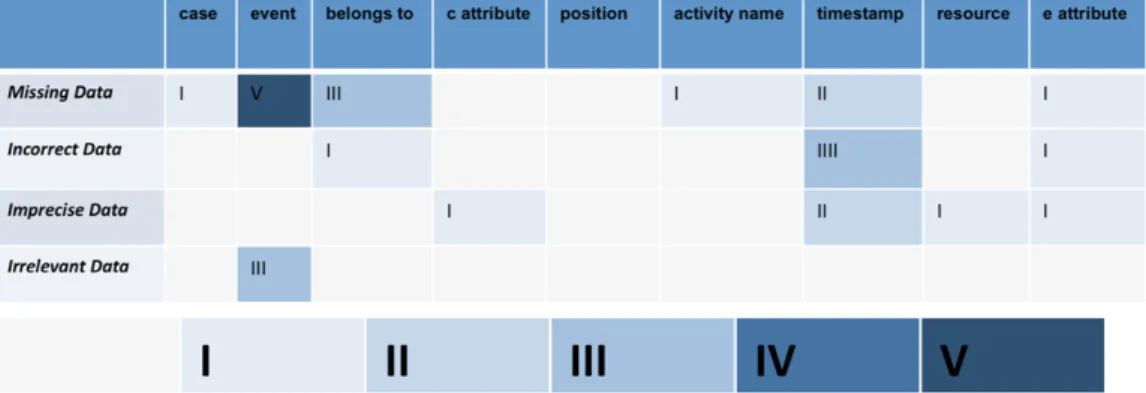
The purpose of the discussion was to gain insights into practical data quality and preparation challenges experienced by the participants. To this end, we first collected typical data challenges from the group and then presented our own challenges, which we had prepared. Frank discussed some challenges based on two real examples from the Rabobank to make it concrete. To summarize the data quality problems/issues regarding thedata quality, we used an existing framework2 to categorize the challenges we had collected in the group and before: It became apparent during the discussions that missing events and timestamp problems were the most frequently issues mentioned. The discussion session discussed further data quality issues, which for the sake of space will not be described in detail here.
Turning to thedata preparation, we added the data preparation phase “Obtaining” before “Cleaning”, “Integration”, “Selection”, and “Transformation” as a result of the discussion.
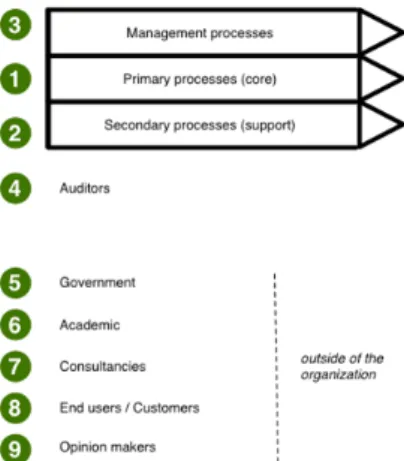
To position the discussed activities in the context of a process mining project, we used an existing lifecycle model3 that also illustrates the iterative nature of data preparation, validation, data cleaning, etc. This is depicted in Fig. 4.
2 R. P. Jagadeesh Chandra Bose, Ronny S. Mans, Wil M. P. van der Aalst. Wanna Improve Process
Mining Results? It’s High Time We Consider Data Quality Issues Seriously. BPM Center Report BPM-13-02, BPMcenter.org, 2013
Figure 3Data quality categories.
Figure 4Lifecycle for data preparation.
The complete list of collected data preparation challenges is the following:
Obtaining: Diverse data sources; Very large datasets; Transportation of data; Same tables for different processes; What’s the right process / activity scope?; Lack / mismatch between technical (data) documentation and reality; Access to different domain roles / function for understanding.
Cleaning: Validation following individual cases (verifying data quality); Removing duplic-ates; Correcting date-timestamps; Action codes translation to real names (human-readable, URL to semantic action); What’scase_idpointing at? (customers / products / docu-ments / complaints / combinations.); Sampling (understanding data); Server times vs. Local times.
Integration: Merging data sources; How to deal with large blobs full of free text?; Large file size, long waiting time; Usage of different separator<quotes>; Which merging sequence / order of steps? (when to merge which data / first merge then proces view or visa versa / automation).
Selection: Connecting multiple case IDs to follow end-to-end process; What amount of data is required? (as much as possible, prize, anonymizing, decision criteria); Does the dataset need to be enriched?; Sampling (criteria?).
Transformation: Formatting: activities in columns, you lose loops and assume a pre-specified process is followed; Server times vs. Local times; Which environment is receiving the prepared data? (Disco sets other standards than Rapid miner, Tableau or Click view for example); Working with / without weekends and night-shifts (adjusting timestamps to match the organizations opening and closing times); Multiplecase_id’s (customer_id, product_id, document_id,update_id,session_id,authorization_id).
The discussion then elicited the following questions and action points: Questions
How to teach checking and communicating data requirements for process mining? Are there tools to help with the understanding of the data properties?
What are the consequences of the different data quality levels from the manifesto on certain process analysis questions?
When to use sampling and according to which criteria?
Could there be a tool to automatically guide through the data preparation process? Organize seminars together with the database community?
Actions
Share data sets online. Share best practices.
BPI Challenge: compare and summarize the submissions to gain insight in the different approaches
4.3
Discussion Session 3: Process Discovery: Playing with the
Representaional Bias
The goal of this discussion was to identify the main challenges the representational bias brings into the process discovery discipline. One of the initial discussion run through the proper notion, specially what characterizes a discovery algorithm in terms of the implicit bias it has.
Right after discussing the general notion, the group has identified two different levels from which the representational bias can be considered:
thelogical level: where aspects like the semantics of the model (imperative/declarative), the patterns to be represented, and even the ability to transform the derived models is an important issue.
the user level: where quality metrics related to the user must be taken into account, e.g., truthfulness, readability, multi-perspective, are examples of this.
Both of these levels are by themselves challenging, and it is agreed that very few work has been done into guiding process discovery algorithms for satisfying them.
At thelogical level, there are well-known examples of patterns that differentiate discovery algorithms: expressive power, concurrency, skip/duplicate activities, non-free-choiceness, hierarchy, loops or cancellation are typical examples of patterns that not all algorithms have. On the other hand, process discovery is harden by the presence of other problems like noise, incompleteness, concept drift (it seems is less stringent in practice). In addition, the granularity of event information has been identified as a problematic issue, but also the selection of parameters given a particular process discovery technique. One promising direction has been identified, which may alleviate some of the problems before: define log features that can help into making decisions and transformations into the log for improving the discovery.
At theuser level, an issue which is important is the current situation of process discovery algorithms: do the current users know their bias? the discussion group has identified as a challenge the user explanation of each algorithm’s bias. Apart from that, other factors like execution time available for discovery, expected truthfulness of the model, or desired
readability are crucial factors that the user may want to determine when using an algorithm. Again, very few techniques posses the aforementioned abilities.
General challenges have been identified, which listed below:
1. How to control the representational bias of process discovery algorithms? the conclusion of the discussion group was that it seems an important aspect, although few techniques offer it. One example is the ability of certain algorithms, like the inductive miner or the miners implementing the theory of regions, to focus the search of a model to certain quality criteria established a priori.
2. Meta-discovery: both at the logical and at the user level, it seems relevant to decide generically the representation. An example now comes handy: declarative models are known to be good in “turbulent” scenarios, while imperative models may better fit structured scenarios. One can use domain knowledge, log features or the like to decide it. The same can apply at a more concrete level, like what particular formalism may be better for the user, e.g., BPMN or Petri nets.
3. Industrial bias: the fact that industry is mostly considering standards like BPMN does not mean that process discovery algorithms should only aim at discovering these models. It is better to concentrate on the identification of patterns that may then be translated to the visual representation in terms of a particular formalism. Also, the group has identified the importance of having transformations between formalisms, even in the presence of precision losses or similar inaccuracies.
As starting point for further actions, the group has created a Dropbox folder where related papers will be collected in order to iterate over the literature and find synergies. As future work, it may be possible to trigger some collaborations in different dimensions (writing a report, joint efforts, and the like).
4.4
Discussion Session 4: Evaluation of Process Mining Algorithms:
Benchmark Data Sets and Conformance Metrics
In this discussion session, we considered the maturity of the process mining community. While the research on process mining is maturing, the need arises for a clear benchmarking methodology, such that (a) researchers canobjectively comparetheir results and performance against other researchers results and (b) researchers caneasily exchange comparison results. The methodology should be language independent and community accepted.
During the discussion, we established that a model, when drawn by a process modeling specialist, is always created for a particular purpose. The purpose of a model should always be considered by process mining researchers in their evaluations, i.e. comparing process mining techniques should only be done for those techniques that serve the same purpose. In many papers today, comparisons are made without looking at the purpose of the models, thus leading to false comparisons. During our discussion, we identified several purposes, such as:
Prediction, i.e. answering “what if?” questions,
Happy flow discovery, i.e. visualizing the main process flow,
Perfect representation, i.e. models that very accurately show what behavior was observed, Performance analysis, i.e. models that provide insights into the performance of an “as-is” situation, and
Deviation discovery, i.e. where models explicitly show deviations from reference models, business rules, etc.
Depending on the purpose of a model, several aspects of the model may be more or less important, hence when evaluating the quality of a process model against an event log, several dimensions should be considered. During the discussion, we identified the following dimensions for which we believe language independent metrics should be developed:
Replay fitness, i.e. the fraction of the observed behavior that fits a model,
Precision, a measure for the amount of behavior allowed by a model, but not observed, Simplicity, which quantifies the understandability of the model given the behavior it expresses,
Generalization, which quantifies to what extent the model generalizes from the observed behavior, and
Level of decomposition, hierarchical or otherwise, quantifying how “flat” a model is. When comparing process mining techniques, it is important to realize that optimality can often not be reached in all dimensions, i.e. models may be Pareto optimal. During the discussion, we came to the conclusion that there is currently no clear methodology for evaluating process mining techniques. Therefore, a full methodology will be proposed in a paper to be written by several participants of the Dagstuhl seminar.
To conclude, some clear points were made that should be considered already today when comparing process mining techniques to existing work:
Compare new techniques withall existing techniques serving thesame purpose, Compare new techniques against many, randomly generated datasets,
Compare new techniques onpublic, real-life datasets available in the 3TU datacenter and Alwayspublish synthetic data in the 3TU datacenter and preferably publish real life data too.
4.5
Discussion Session 5: Advanced Topics in Process Discovery:
On-the-fly and Distributed Process Discovery
The goal of this discussion was to identify the main challenges posed by on-the-fly and distributed process discovery.
On-the-fly process discovery requires the compliance to the typical stream processing constraints: i) since it is impossible to store the complete stream, only a finite memory budget is allowed; ii) backtracking over a data stream is not feasible, so discovery algorithms are required to make only one pass over data, taking bounded time per event; iii) it is important to quickly adapt the process model to cope with evolving processes (concept drift); iv) the approach must deal with variable system conditions, such as fluctuating stream rates. Some on-the-fly discovery algorithms able to generate control-flow models and DECLARE models have already be defined. The success of these algorithms has been evaluated using traditional metrics defined for off-line process discovery. Thus it was debated how to define a proper evaluation measure for stream discovery tasks. It was agreed that the use of some of the data from the stream to evaluate fitness, precision, and other already defined measures can be considered a satisfactory solution, especially if these measures are then integrated over time. After some discussion, the addition of the social and data perspectives was recognized as an important first challenge. Considering on-the-fly both social and data perspectives is not obvious since the process model may change over time (concept drift). It was suggested that, concerning the data perspective, a possible solution could be to define a stability index over the control-flow and when the control-flow is stable, learn rules for choice points. When this problem is considered from a declarative point of view, a critical issue is whether the