A MDE Approach for the Development of
CMS-based Web Applications
Francisco Jos´
e Cabral Cardoso
Disserta¸c˜
ao para obten¸c˜
ao do Grau de Mestre em
Engenharia Inform´
atica e de Computadores
J´
uri
Presidente:
Prof. Jos´
e Manuel Nunes Salvador Tribolet
Vogal:
Prof. Andr´
e Ferreira Ferr˜
ao Couto e Vasconcelos
Orientador:
Prof. Alberto Manuel Rodrigues da Silva
Co-Orientador:
Eng. Jo˜
ao Paulo Pedro Mendes de Sousa Saraiva
Acknowledgements
We all have others with whom we work, with whom we talk, with whom we despair, with whom we laugh, and with whom we dream. All of these people, one way or another, influence what we do and who we are. The work leading to this dissertation was a long journey that would not have been possible without the help of many. To thank them all, I shall give a small text that does not do justice to all the help that I got. First and foremost, I would like to thank Professor Aberto Silva, my adviser, who gave me the opportunity to do this work, for his constant availability and guidance. I would like to thank, also, Eng. Jo˜ao Saraiva, my co-adviser, both for having initiated me into some of the technologies required in my research, and for his support throughout all my work.
I am grateful to Altitude Software, the company where I was working in the last year, for providing me not only the means to do my dissertation in parallel, but also an healthy and enjoyable environment to work in. I am deeply indebted with all the Altitude Software team, in particular, to my project managers, for all the numerous discussions that helped me to shed light into the more obscure parts of this work, motivation and comprehension.
I couldn’t have reached this stage in my life if it wasn’t for my mother, Sid´onia Cabral, who always supported me and provided me with all she could. No words could even begin to express how much I truly owe her; thus, I can only try to express my gratitude, and my regret for the little availability and little time devoted to her over this last year of hard work.
Finally, regardless of all the remaining help, none of this work would have happened without the enduring support, encouragement, and sacrifices of my lovingly girlfriend Andreia Medeiros. I heart-feelingly thank her for all their patience and ability to lead me through the most difficult phases of my work. I thank her, also, for her analytical reasoning that helped me countless times during my work. Discussing the most difficult problems with her allowed me, time and again, to make things clearer in my head.
Lisboa, Thursday 22nd October, 2009 Francisco Cardoso
Abstract
Content Management Systems (CMS) are typically regarded as critical software platforms for the success of organizational web sites and intranets. Although most current CMS systems allow their extension through the addition of modules, these are usually built using the typical source-code-oriented software development process, which is slow and error-prone. On the other hand, a MDE-oriented development process is centered on models, which represent the system and are used to automatically generate all the artifacts of a system, such as source-code and documentation.
To simplify the development of CMS-based web applications, this dissertation proposes a Model-Driven Engineering approach to address the design and creation of CMS-based web applications in a graphical fashion, in the form of an UML Profile, which will permit the design of a web application using typical domain concepts (e.g., user, role, permission, web page), and subsequent code generation and deployment to a target platform. The UML modeling and model transformation is supported by ProjectIT-Studio tool, which was extended in the context of this work to support the proposed language. We also propose a simple methodology, guidelines and inter-related processes for the development of CMS-based web applications using the UML-based domain specific language, named by CMS-ML, supported by the ProjectIT-Studio CASE tool for model design and transformation.
The dissertation validation is given along the work with simple examples and complemented with a complex and complete case study, which describes one application of the proposal, a fictional CMS-based web application: theMyWebHome.
Resumo
Os Sistemas de Gest˜ao de Conte´udo (CMS) s˜ao geralmente considerados como plataformas de software cr´ıticas para o sucesso de web sites e intranets organizacionais. Embora a maioria dos sistemas CMS actuais permitirem a sua extens˜ao atrav´es da adi¸c˜ao de m´odulos, estes s˜ao geralmente constru´ıdos uti-lizando o processo de desenvolvimento de software t´ıpico baseado em c´odigo-fonte, que ´e lento e sujeito a erros. Por outro lado, um processo de desenvolvimento orientado ao MDE ´e centrado em modelos, que representam o sistema e s˜ao utilizados para gerar automaticamente todos os artefatos de um sistema, tais como o c´odigo-fonte e documenta¸c˜ao.
Para simplificar o desenvolvimento de aplica¸c˜oes web baseadas em CMS, esta disserta¸c˜ao prop˜oe uma abordagem de engenharia baseada em modelos para abordar a concep¸c˜ao e cria¸c˜ao de aplica¸c˜oes web baseadas em CMS baseado de uma forma gr´afica, na forma de um perfil UML, o que ir´a permitir a concep¸c˜ao de uma aplica¸c˜ao web utilizando conceitos de dom´ınio t´ıpicos (por exemplo, utilizador, papel, permiss˜ao, p´agina web), e gera¸c˜ao de c´odigo e a posterior instala¸c˜ao numa plataforma de destino.
Propomos tamb´em uma metodologia simples, orienta¸c˜oes e processos inter-relacionados para o de-senvolvimento de aplica¸c˜oes web baseadas em CMS utilizando uma linguagem especifica a um dom´ınio baseada no UML, denominada por CMS-ML, apoiada pela ferramenta CASE ProjectIT-Studio para a concep¸c˜ao do modelo e a sua transforma¸c˜ao .
A valida¸c˜ao da disserta¸c˜ao ´e dada ao longo do trabalho, com exemplos simples e complementada com um caso de estudo complexo e completo, que descreve uma aplica¸c˜ao da proposta, uma aplica¸c˜ao web baseada em CMS fict´ıcia: oMyWebHome.
Keywords
Model Driven Engineering
Domain Specific Languages
Platform Independent Models
Content Management Systems
Model Transformation
Palavras Chave
Engenharia baseada em Modelos
Linguagens Espec´ıficas a um Dom´ınio
Modelos Independentes da Plataforma
Sistemas de Gest˜
ao de Conte´
udos
Transforma¸c˜
ao de Modelos
Contents
1 Introduction 1 1.1 Context . . . 1 1.2 Motivation . . . 2 1.3 Problem Definition . . . 2 1.4 Thesis Statement . . . 41.5 Outline of the Dissertation . . . 4
2 Related Work 6 2.1 Content Management Systems - CMS . . . 6
2.1.1 Why Choose a CMS Approach? . . . 6
2.1.2 How to build a CMS-Based Application Nowadays . . . 7
2.1.3 CMS References . . . 8
2.1.4 Enterprise Content Management - ECM . . . 9
2.2 Model-Driven Engineering for Web Applications . . . 9
2.2.1 Acceleo . . . 11
2.2.2 UML-Based Web Engineering - UWE . . . 11
2.2.3 Web Modeling Language - WebML . . . 12
2.2.4 XIS2 . . . 13
2.3 Discussion . . . 14
2.4 Summary . . . 15
3 Domain Specific Language for CMS-based Web Applications 16 3.1 Domain Specific Languages: An Abstraction Layer Over a Domain . . . 16
3.2 CMS-based Web Applications Domain . . . 17
3.3 CMS-ML: CMS Modeling Language . . . 19
3.3.1 CMS-ML Enumeration Literals . . . 22
3.3.2 CMS-ML Class Elements . . . 24
3.3.3 CMS-ML Associations . . . 25
3.3.4 CMS-ML Model Views for the Development of CMS-based Web Applications . . . 26
3.4 Summary . . . 33
4 Transformation Processes and Technical Details 34 4.1 ProjectIT-Studio CASE Tool Overview . . . 34
4.2 Platform Independent Model and Platform Specific Model . . . 36
4.3 Transformation Processes . . . 36
4.3.1 PIM-to-PSM Transformation . . . 37
4.3.2 PSM-to-Code Transformation . . . 39
4.5 CMS-ML Model Transformation Process . . . 40
4.5.1 UML2 Model to CMS-ML Model Representation . . . 42
4.5.2 CMS-ML Model Representation toCMS Platform Artifacts . . . 44
4.6 Summary . . . 46
5 Methodology for the Development of based Web Applications Using the CMS-ML Language 47 5.1 CMS-ML Approach Development Actors . . . 48
5.2 Platform-Level Development . . . 49
5.2.1 CMS Platform Analysis . . . 49
5.2.2 Model-To-Code Templates and Templates Tests . . . 51
5.3 Project-Level Development . . . 51
5.3.1 Model Design . . . 52
5.3.2 Model-To-Code Transformation and CMS Platform Artifacts Tests . . . 58
5.3.3 Deploy CMS Platform Artifacts and CMS Web Application Tests . . . 59
5.4 Summary . . . 59
6 Evaluation and Case Study 60 6.1 CMS-ML Evaluation: MyWebHome Case Study . . . 60
6.1.1 Requirements . . . 60
6.1.2 CMS-ML Model . . . 61
6.1.3 Conclusions . . . 63
6.2 Transformation and Tool Support Evaluation . . . 64
6.3 Summary . . . 65
7 Conclusions 66 7.1 Main Contributions . . . 66
7.2 Future Work . . . 66
A The MyWebHome Case Study 69 A.1 MyWebHome CMS-ML Model . . . 69
A.2 MyWebHome on Joomla . . . 78
List of Figures
1.1 ProjectIT-MDD’s architecture (adapted from [65]) . . . 2
2.1 Acceleo overview diagram . . . 11
2.2 The WebML Meta-Model Package . . . 12
2.3 XIS Views Organization (extracted from [62]) . . . 13
3.1 CMS-based Web Application Feature Model . . . 18
3.2 Generic CMS Platform Architecture . . . 19
3.3 CMS Modeling Language Goals . . . 20
3.4 CMS-ML Platform Independent Meta-Model: Elements and Associations . . . 21
3.5 CMS-ML Platform Independent Meta-Model: Enumerations and Literals . . . 21
3.6 Conceptual WebApplication Model . . . 27
3.7 CMS-ML Model Views . . . 27
3.8 CMS-ML Views and Meta-Model . . . 28
3.9 WebApplication View Example . . . 29
3.10 WebPages View Example . . . 29
3.11 WebPages Structure View Example . . . 30
3.12 WebPages Hierarchy View Example . . . 31
3.13 Roles View Example . . . 31
3.14 WebPages Permissions View Example . . . 31
3.15 WebPageName WebPage Permissions View Example . . . 32
3.16 Roles Hierarchy View Example . . . 32
3.17 Users View Example . . . 32
4.1 Overview of ProjectIT-Studio (extracted from [52]) . . . 35
4.2 Overview ofProjectIT-Studio MDDGenerator (adapted from [64] page 275) . . . 35
4.3 Relation between PIM and PSM . . . 36
4.4 Conceptual view of PIM to PSM transformation . . . 37
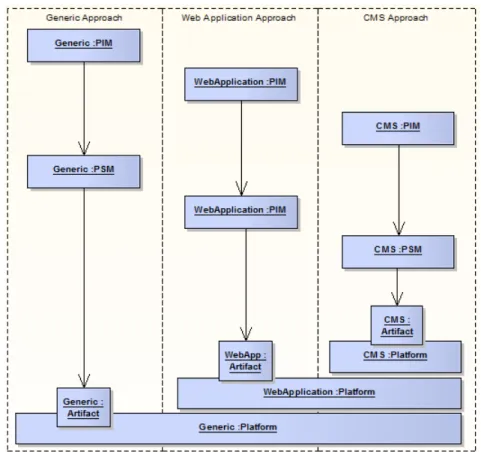
4.5 MDA approach, Web Application Approach and CMS Web Application Approach . . . . 38
4.6 The PIM-to-PSM Transformation Process . . . 39
4.7 ThePSM-to-Artifact Transformation Process . . . 39
4.8 Forward, Reverse and Round-Trip Transformation (adapted from [64] page 158) . . . 40
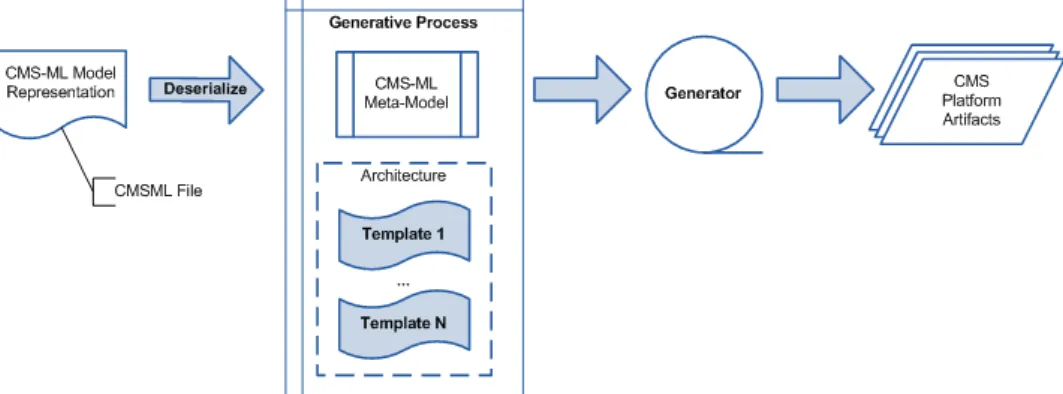
4.9 Overview of the Transformation Process of CMS-ML Models . . . 41
4.10 CMS-ML Project Structure in ProjectIT-Studio . . . 41
4.11 Generator XML configuration file for the ProjectIT-Studio MDDGenerator . . . 42
4.12 The first step of theCMS-ML Model Transformation Process, the UML2 Model to CMS-ML Model Representation . . . 42
4.14 The CMS-ML representation for theWebPage example . . . 43
4.15 The second step of the CMS-ML Model Transformation Process, the CMS-ML Model Representation to CMS Platform Artifacts . . . 44
4.16 Template example for the creation of allWebPages defined in theWebApplication model. 45 4.17 Architecture example with six templates . . . 46
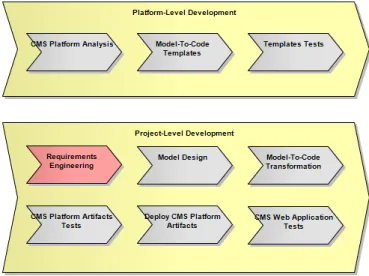
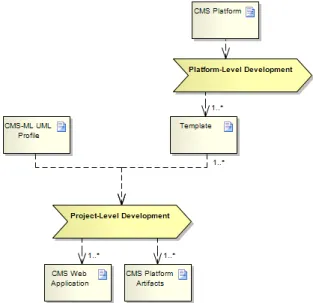
5.1 Development Processes Overview . . . 47
5.2 Artifacts Flow Overview . . . 48
5.3 Project-Level Development Process Overview . . . 50
5.4 CMS Platforms Domains Intersections . . . 50
5.5 Project-Level Development Process Overview . . . 52
5.6 SimExe: (a) current project structure; (b)WebApplication View . . . 53
5.7 SimExe: (a) current project structure; (b)WebPages View . . . 54
5.8 SimExe: (a) current project structure; (b)WebPages Structure View . . . 54
5.9 SimExe: (a) current project structure; (b)SimExe Page WebPage Structure . . . 55
5.10 SimExe: (a) current project structure; (b)WebPages Hierarchy View . . . 56
5.11 SimExe: (a) current project structure; (b)Roles View . . . 56
5.12 SimExe: (a) current project structure; (b)WebPages Permissions View . . . 57
5.13 SimExe: (a) current project structure; (b)Roles Hierarchy View . . . 58
5.14 SimExe: (a) current project structure; (b)Users View . . . 58
6.1 MyWebHome Model Macro View . . . 62
6.2 MyWebHome Projects WebPage Structure . . . 63
6.3 MyWebHome Model Macro View . . . 64
A.1 (top)WebApplication View; (bottom)MyWebHome WebApplication tagged values . . . . 69
A.2 WebPages View . . . 70
A.3 (top)WebPages Structure View; (bottom left)C1 Container tagged values; (bottom cen-ter)C2 Container tagged values; (bottom right)C3 Container tagged values . . . 70
A.4 Home WebPage View . . . 70
A.5 Projects WebPage View . . . 71
A.6 Academic WebPage View . . . 71
A.7 Interests WebPage View . . . 72
A.8 Project X WebPage View . . . 72
A.9 Project Y WebPage View . . . 72
A.10LEIC WebPage View . . . 73
A.11MEIC WebPage View . . . 73
A.12Photography WebPage View . . . 73
A.13About Me WebPage View . . . 74
A.14WebPages Hierarchy View . . . 74
A.15 (top)Roles View; (bottom top)collaborator Role tagged values, collaborator role is local to theProjects web page; (bottom bottom) author Role tagged values . . . 75
A.16Roles Hierarchy View . . . 75
A.17WebPages Permissions View . . . 75
A.18 (top) Projects WebPage Permissions View; (bottom top) webpage permission type for association 1; (bottom bottom) webcomponent permission for associations 2 to 6 . . . 76
A.19 (top)Users View; (bottom) fracar User tagged values . . . 77
A.21Projects web page on joomla - figure A.5 . . . 79
A.22Academic web page on joomla - figure A.6 . . . 80
A.23Interests web page on joomla - figure A.7 . . . 81
A.24Project X web page on joomla - figure A.8 . . . 81
A.25Project Y web page on joomla - figure A.9 . . . 82
A.26LEIC web page on joomla - figure A.10 . . . 82
A.27MEIC web page on joomla - figure A.11 . . . 83
A.28Photography web page on joomla - figure A.12 . . . 84
A.29About Me web page on joomla - figure A.13 . . . 85
A.30MyWebHome roles on joomla - figure A.19. The joomla CMS doesn’t support roles cre-ations, so both the roles defined in theMyWebHome, ”author” and ”collaborator”, where mapped to the joomla roles ”Administrator” and ”Editor”, respectively. . . 85
A.31Home web page on drupal - figure A.4 . . . 86
A.32Projects web page on drupal - figure A.5 . . . 87
A.33Academic web page on drupal - figure A.6 . . . 88
A.34Interests web page on drupal - figure A.7 . . . 89
A.35Project X web page on drupal - figure A.8 . . . 89
A.36Project Y web page on drupal - figure A.9 . . . 90
A.37LEIC web page on drupal - figure A.10 . . . 90
A.38MEIC web page on drupal - figure A.11 . . . 91
A.39Photography web page on drupal - figure A.12 . . . 91
A.40About Me web page on drupal - figure A.13 . . . 92
List of Tables
Chapter 1
Introduction
This dissertation describes the work developed during one year at the Information Systems Groups at INESC-ID Lisboa, regarding the Master Thesis in Information Systems.
The research work presented in this dissertation is concerned with the specification of a domain specific language [81, 31, 77] for the development of CMS-based web applications [11], representing these web applications in a model that is portable across platforms, easy to use and with a high degree of expressiveness.
This introductory chapter starts with the identification of the work context and motivation, followed by the problem definition that is the origin of this research work. These two sections are crucial to present the thesis statement, which is done after these. Finally, the outline of the dissertation is presented.
1.1
Context
This dissertation describes the work developed during one year at the Information Systems Group of INESC-ID Lisboa, regarding the Master Thesis in Information Systems, in strict collaboration with the ProjectIT-Studio development team, and was supervised by PhD Alberto Manuel Rodrigues da Silva.
This work focuses in the development of CMS-based web applications [11] and takes place in the context of ProjectIT-MDD, which is ProjectIT’s functional component related to the area of information systems modeling and Model-Driven Engineering (MDE) [56]. This component allows the specification of models, transformations between models defined in different languages, and the automatic generation of artifacts (such as source-code and documentation) [54]. Figure 1.1 presents a high-level overview of the ProjectIT-MDD architecture; the shaded package indicates the sub-component of ProjectIT-MDD which was developed in the context of this work - the CMS-ML Meta-Model.
The ProjectIT approach is language-independent, because the UMLModeler allows the architect to specify the semantics that are inherent to a specific UML profile. The XIS2 [36] is an example of an UML2 profile for the development of software systems with the ProjectIT-MDD, section 2.2.4 introduces this language with more details.
Besides the XIS2 meta-model the ProjectIT-MDD must also support another meta-model, one that is specifically focused in the CMS-based web applications domain.
This work describes the specification of a modeling language for the development of CMS-based web applications, which aims to offer more simplify in the task of complex CMS-based web applications development and increase overall quality and productivity; along with the creation of the ProjectIT-MDD sub-component to support the language meta-model, which is primarily focused on making the user look upon the ProjectIT approach as an easy and efficient way to model CMS-based web applications.
Figure 1.1: ProjectIT-MDD’s architecture (adapted from [65])
1.2
Motivation
Since the born of the world wide web, several methodological approaches, such as model-driven develop-ment (MDD/MDE) [44], try to provide support for software applications by means of abstract mechanisms that make easy the conceptualization and development of applications [53]. The development approaches that enable the specification of applications independently of the target platform, have gained a large popularity in the scientific community and offers several benefits, identified in section 2.2.
Besides the MDE approach, there’re several other approaches for the development of web applications, such as the classical software coding, visual web editors, web formularies, among others.
Along with the MDE approach [56], an initiative that has been gaining support recently is the usage of DSLs (Domain-Specific Languages) [77]. A DSL provides a different perspective of software development that consists of building abstractions, this way, a DSL can be viewed as a front-end to a framework, providing a different development style.
Web applications are a family of applications developed with various technologies and platforms. One of these web applications are the CMS-based web applications. These web applications are developed on top of CMS software platforms and present great potential not only because they automates site content management, but also allows nontechnical writers to contribute articles directly into the system via a web interface. These web applications also allows an easy user access management and a great level of extension by providing mechanisms that allows the addition of individual components (also known as modules) that can be bound to the web application [11, 53], section 2.1 presents a more detailed view over the CMS systems.
Surprisingly, not many proposal were presented for the development of CMS-based web applications, most of the existing proposals are based in visual web editors and web formularies. Thus there’s an untapped opportunity that brings together the MDE approach and web applications based on CMS platforms, which has an associated set of advantages that combines the advantages of both sides.
1.3
Problem Definition
The previous sections described the context and the motivation of this dissertation work. This section describes the problems that originated this research work. The ultimate goal of this work is to significantly reduce most of the problems described in this section.
The development of web applications is a very complex activity, involving nontrivial issues in various areas such as technology and human resources. Despite the efforts made to overcome the issues related with this activity, these issues are still frequently found in web software development projects, with its negative consequent aspects in terms of project scope, time, budget and quality in the application and documentation.
Another issue in web development is that, nowadays, web application developers need to use many technologies, sometimes several different technologies in the same project; this influences their perfor-mance and the system quality. Also, most common development tools lack of a web application multiple views, making the application understanding and analysis a very difficult task.
The technology diversity makes development difficult in terms of reuse, portability and quality assur-ance, in all projects. Also, frequent changes of business needs can be observed in many cases, and web applications need to reflect such changes in a timely manner, which leads again to the development issues already mentioned.
Thus, currently are used frameworks for developing web applications, such as Django [14] and Ruby On Rails [49], which dramatically simplify and reduce the amount of developments. Although, these frameworks doesn’t eliminates all the coding tasks nor does provides mechanisms for content management and extensions that allows the addition of modules to the web application.
As mentioned before, several types of web applications exist nowadays, one of them is the CMS-based web applications that are gaining more popularity in the web development community. However, there aren’t relevant researches and proposals for development approaches of CMS-based web applications that follow a structured, standard and systematic approach, like the methodologies and best practices proposed by the software engineering community [63].
The current CMS platforms have difficulties to support the design and implementation of so-called data-intensive web applications, defined as web applications for accessing and maintaining large amounts of structured data, typically stored as records in a database management system, like online trading and e-commerce applications, institutional web sites of private and public organizations, digital libraries, corporate portals, and community sites.
For a large site with hundreds or thousands of pages and components that needs to be added or updated frequently with multiple authors, CMS-based web applications configuration and development becomes more difficult and complex. This means that the traditional method of browser-based development, used for the development of CMS-based web applications, loses efficiency when the site complexity increases. Although there exists many MDE approaches for web and general applications,currently there are no significant MDE approaches for CMS-based web applications. Therefore, there’s a possibility to explore on the development of CMS-based web applications, which led to the origin of this work.
The most critical issue to consider when developing a web application is the developer. The developers must have, not only an extensive web development experience, but must also be well-experienced with a wide variety of conventional programming languages, databases, and platforms. This experience will be essential to ensuring that:
• The web application will meet both immediate and evolving business needs;
• Provide rapid web applications development and deployment of a broad range of business and technologies;
We believe that enabling all the features and capabilities of CMS-based web applications along with a simple and powerful MDE approach for the development of these web applications can be achieved by the development of a rich domain specific language and a set of activities for the language usage. Furthermore we think that such a proposal can drive the choose of web applications to be more oriented
to CMS platforms and to a more mature development approach based on models, and applicable to a broader set of projects.
1.4
Thesis Statement
This dissertation’s thesis is thatit is possible to simplify the task of complex CMS-based web applications development and improve overall quality by making a domain specific language that is coherent, portable, powerful and easy to use.
In the context of this work, effort has been made towards to design and develop a domain specific language for CMS-based web applications, in order to study and explore the MDE approach and the model transformation properties and capabilities. Furthermore, this work proposes a development approach for using this domain specific language, with a set of well defined actors, processes, activities and artifacts.
To evaluate and validate the concepts and the approach proposed in this dissertation, one fictional case study is presented where the CMS modeling language is applied. The case study describes in detail how to develop a CMS-based web application using the domain specific language and demonstrate, by example, what are the benefits of this new CMS-based web applications development approach. To demonstrate the potential for platform independency, the case study is deployed in two distinct CMS platforms.
1.5
Outline of the Dissertation
This work comprises the following structure:
• Introduction. The first chapter establishes what the subject of concern of this dissertation is. Specifically, it presents the dissertation context and motivation, defines the problem that is subja-cent to the work and presents this thesis statement.
• Related Work. Chapter 2 presents some key concepts of CMS, the benefits of using a CMS, how they are developed and some state-of-the-art CMS references. After, the focus shifts to the MDE approach for web applications, with an introduction of a small set of MDE initiaves for applications development. Finally, a discussion about the MDE initiaves is presented, along with a quantitative comparison between them, according to some relevant dimensions.
• Domain Specific Language for CMS-based Web Applications. Chapter 3 begins with a simple description of what is a DSL and its benefits, followed by an analysis of the CMS domain, which is the background to build the DSL. This chapter then presents a proposal of an UML Profile as a development approach that allows a rather different way of developing CMS-based web applications. The proposal includes a set of UML stereotypes for classes, associations and enumeration literals, along with a set of views for the development of CMS-based web applications; all of these are detailed in this chapter.
• Transformation Processes an Technical Details. Chapter 4 introduces the ProjectIT-Studio CASE tool, used in the context of the work. Then two key concepts in model transformations are presented, the PIM and PSM, furthermore, a description is given about the transformation processes required to transform the platform independent model to a platform specific model and therefore to specific platform artifacts. After defining the model transformation process, this chapter describes an important transformation characteristic, the transformation direction. Finally, the chapter ends with a detailed description of the transformation process developed for the language proposal with the ProjectIT-Studio tool.
• Methodology for the Development of based Web Applications Using the CMS-ML Language. In order to use the domain specific language in a systematically and consistently way, from project to project, chapter 5 presents the proposal for the development of CMS-based web applications, using the domain specific language presented in chapter 3. This chapter begins with the identification of the actors required for the development process and then proceeds with the definition of two development processes: the platform-level development and the project-level development. Each development process has different goals and activities that are defined in the respective sections.
• Evaluation and Case Study. To evaluate and validate the approach proposed in this dissertation, chapter 6 describes how the CMS Model Language was used in the development of one fictional web application, presenting the desired requirements, the model aligned with the requirements and a set of conclusions about the model design phase. Similarly, an evaluation is presented for the model transformation process and the supporting tool, the ProjectIT-Studio.
• Conclusion. Chapter 7 concludes this dissertation, summarizes the main contributions of this dissertation and discusses which new areas of research are opened in field of the CMS Modeling Language.
• Bibliography. Lists the bibliographical references that were found relevant either for research purposes or for the development of the proposal itself.
• The MyWebHome Case Study. Appendix A contains additional information about the My-WebHomecase study, introduced in chapter 6.
Chapter 2
Related Work
The previous chapter stated that the ultimate goal of this work is to provide a new approach for the development of CMS-based web applications, which aspires to present more benefits than other approaches used nowadays, and presented some of the reasons for pursuing this goal. In order to hit such a high goal, an analysis to current CMS references and MDE initiaves is required to be able to define a domain specific language that is effective in its domain: the CMS-based web applications domain.
This chapter presents some concepts and products that are somehow related to this thesis work. The chapter is divided into three main sections: (1) a brief introduction to CMS, how to developed web applications with a CMS, a short analysis of some CMS references and an introduction to a related type of systems, the Enterprise Content Management systems (ECM); (2) the introduction of the paradigm of Model Driven Engineering (MDE) and a related standard, the MDA, and an analysis of some of MDE initiatives; and (3) a discussion about some MDE initiatives along with a quantitative comparison between them.
2.1
Content Management Systems - CMS
The main goal of this section is to introduce the CMS concept, describe how to develop a web application using a generic CMS and present some current CMS references.
Content Management Systemsare software platforms, used to manage (create, update and delete) and publish content in a structured form. A special type of CMS are the Web Content Management Systems (WCMS) designed to simplify the management and publication of web content on web systems [7]. CMS allows users without technical knowledge to create and maintain content in a quickly and easily way, helping them in the system content organization and visual appearance.
One of the more useful feature of a CMS is its ability to separate the visual style of the content that is added to the system, this way the content and the visual style may change in time, independently of each other [11].
In a CMS approach, content is the first class entity, everything in the application focuses in content and content management.
2.1.1
Why Choose a CMS Approach?
Each CMS product has an unique combination of benefits, but all of them share the same main benefits of a generic CMS. Some of the advantages of a generic CMS are [7, 11]:
• The process of creation, edition and publish of content on a web site is much more simple and requires no technical knowledge;
• Time-to-publish is reduced, allowing the site content to be updated faster;
• An easier management of users and theirs operations;
• Consistent management of meta-data through content template structures. This delivers a signifi-cantly improved search process;
• Facilitates the management of sites with many authors and editors publishing substantial quantities of content;
• It is possible to extend the site capabilities through product specific extensions.
In addition to these advantages, there are specific advantages relative to the development and deploy-ment of CMS-based web application, such as [11]:
• The browser-based interface and a site creation wizard makes the configuration and instantiation of the application very easy and quick;
• No technological knowledge is required for the development.
Because of these advantages and the future perspective for CMS-based web applications, this disser-tation focuses on the development process of this type of web applications.
2.1.2
How to build a CMS-Based Application Nowadays
As presented in the previous section, a CMS approach is definitely a good approach for web applications development. This section briefly presents how a CMS-based application is developed and maintained, using the most common approach, a web-based formulary.
How a CMS-based web application is developed nowadays? Like any web application, the initial planning stages are the most crucial to ensure a successful design, content, usability, and much more. When the web application objectives are defined, the next step is to choose and install a CMS product. Independently of the specific CMS product chosen, the development of a web application using a specific CMS is almost standardized and are very similar for all products [39]. The majority of the web CMS uses online editing rather than push-publishing, which means it allows users to create and manage web pages and their content by using a web browser [9], this way the development of a CMS-based web application is done by only using a web browser.
The maintenance and creation of elements, such as web pages and users, on a CMS-based web appli-cation is done through an administrative web page. In order to create any element a set of information must be provided, such as the title, description, etc. For example if we want to create content in a web page, the user must provide a name and text for the content. Some elements must be related to others, such as the relation between users and roles; this relation is usually explicitly created in the formulary.
Any out-of-the-box CMS product comes with a great set of features, but sometimes they are not enough to satisfy the requirements or a very specific feature is required for a web application project, so most CMS platforms provide extension mechanisms in the form of components or modules. This way, a simple CMS platform installation can be trivially extended with the inclusion of new features in the form of modules.
The simplicity and familiarity of a browser-based web application development and maintenance makes this approach very easy and requires no technical knowledge, although it can become a complex task when the application complexity increases and the web application usually is not completely specified in the beginning of the project.
2.1.3
CMS References
The previous section defined what a CMS is, some of its advantages and described the common devel-opment method of CMS-based web applications. In this section some CMS products are analyzed to understand how CMS platforms works in practice and the way they differ from other products, with the goal to compare distinct platforms. The CMS platforms initiatives chosen were: Drupal [15], Joomla [26] and WebComfort [83].
Although there are many other CMS products currently available, this thesis presents this set because their features and user interfaces constitutes a good representation of the current state of the art of web CMS platforms.
In the last years many CMS platform products (Joomla, Drupal, WebComfort , Typo3 [79], Ez Publish [17], JBoss [24], Plone [47], and much more) have been developed. These products try to provide all the features of a basic CMS, plus some extra features, but all of them have the same goal and advantages of a generic CMS, presented in the previous section.
It’s not in the scope of this work to make an exhaustive analysis of CMS, the thesis of Jo˜ao Carmo [11] has a good comparison between some CMS products and focus especially on the WebComfort, which is the theme of his dissertation.
A popular and updated source of CMS comparison is the CMS Matrix [73]. The CMS Matrix tries to provide an extensive comparison between CMS products through a great set of state of the art CMS features.
Drupal
Drupal is a CMS system with blog and wiki-like traits, the ability to run many sites and manage many users with variable roles and permissions [1] (chapter 1). Functionality, scalability, and customizability at every level has been prized over usability and aesthetics [32]. Its extreme flexibility and scalability requires a steep learning curve and a lot of time to realize the benefits. For that reason, initially Drupal can seem too amorphous and lacking in definition.
It’s build on relevant standards, open-source technologies (PHP [46] and MySQL [71]) and aims to enhance the collaboration of individuals and groups by collectively produce, discuss, and share information and ideas [32]. With a central interest in and focus on communities and collaboration, Drupal’s flexibility allows the collaborative production of online information systems and communities [1].
Drupal principles focus on [1]: modular and extensible; quality coding; standards-based; low resource demands; open source; ease of use; and collaboration.
Joomla
Joomla is a CMS developed by Mambo. It is written in PHP and runs with an Apache web server or IIS and MySQL database system.
Joomla’s a very popular CMS, the primary reason it is so popular is the user interface aesthetics that the application offers to even the most novice users. Also, the vast array of extensions for Joomla makes it possible to deploy a system that can do almost anything, from chat rooms, to online auctions, to classified ads, to inventory management [32].
The installation and configuration of this product is almost done by ”next” button clicks. The application development is likely very easy, simple and intuitive for basic features and basic management.
WebComfort
WebComfort is a R&D project aimed to the study, development and evaluation of CMS platform and its potential. It’s promoted by SIQuant [68] and developed with Microsoft ASP.NET 2.0 technology and Microsoft SQL Server [10].
WebComfort has the capability to extend itself, this is crucial nowadays, and it’s done through the addiction of modules. One particularity of this CMS is the workflow capability [53]. It is possible to define workflow and associate it with a web page or a component, and give them a sequence of related activities, thus making those component more powerful and activity oriented [53]. The authorization and security policies are also very well defined according to a flexible role-based mechanism [10]. In fact the access policies of WebComfort are very well designed, it’s possible to define a role and its permissions to a web page or web component. The complexity and richness of roles and access mechanisms of WebComfort are subject for a whole chapter alone, so we will not discuss this theme in this work.
The software architecture of WebComfort is based in the classical three layer architecture [10]: data, logical and presentation. The presentation layer is based on ASP.NET and defines the system visual component. The logical layer defines a set of components and elements responsible for the business logic and rules [53]. The last layer, the data layer, is responsible for the data access operations [11].
2.1.4
Enterprise Content Management - ECM
The previous sections introduced CMS as a good approach to effectively manage content and support web applications. This section briefly presents another approach that’s very popular in the management of content, in a more enterprise and document oriented way.
In many organizations, the content must be managed so that it is used to achieve business goals. Central to this strategy are the tools and technologies of the Enterprise Content Management (ECM), which manage the complete life-cycle of content, from birth to death [29].
ECM are advanced systems, may be thought as an extension to the CMS, that offers all the features of a CMS plus has the capability of document management related to organizational processes [29]. This way, ECM allows the management of organizations unstructured information [39]. The technologies used by these systems allow capturing, managing, storing, delivering, and preserving information to support business processes [39].
Typically, unstructured content enters organization IT infrastructure from a variety of sources. Re-gardless of how a piece of content enters, it has a life-cycle. ECM technology allows the organization to follow a document through its life-cycle [29]. Unstructured Data can be of various types and forms, physical (like paper) or electronic (like email and spreadsheet).
The installation, configuration, development and maintenance of these systems are much more complex than in the CMS described above, andis not part of this dissertation scope.
2.2
Model-Driven Engineering for Web Applications
This section presents the Model-Driven Architecture (MDA), which is the standard behind MDE and the advantages of adopting a MDE-based approach, followed by a description of MDE for general and web applications. Then, some MDE initiatives related to this work are presented, namely: Acceleo [2], WebML [84], UWE [80] and XIS [62].
As mentioned before, the focus of this dissertation is to develop CMS-based web applications in model-driven way. Model-Driven Engineering (MDE) is based on the systematic use of models as primary engineering entities during the solution specification [61]. MDE technologies that combine domain specific modeling languages and transformation engines [56], are a good approach to address platform complexity
and the inability of third-generation languages to alleviate this complexity and express domain concepts effectively.
The benefits afforded by MDE are productivity, quality improvements and platform abstraction. These benefits come from various sources [55, 61, 56]:
• Design models are easier and faster to produce and test;
• Some development tasks are automated;
• Design effort is focused on applications, not on platform details;
• Reuse of designs and tests between platforms or releases;
• Standardized common notations avoid retraining of engineers;
• Sometimes leads to a soft learning curve.
MDA [45] was proposed by the OMG [44] and it defines an approach to information systems specifica-tion that separates the specificaspecifica-tion of the system funcspecifica-tionality from the specificaspecifica-tion of the implementa-tion of funcimplementa-tionalities on a specific technological platform and provides a set of guidelines for structuring specifications expressed as models [56].
MDA proposes two models, the Platform Independent Model (PIM) and the Platform Specific Model (PSM), to map a real-world problem to a computer system [55]. The PIM reflects the conceptual model of the target system. The PSM describes a model that is specific to the target platform, later, the PIM and PSM concepts will be described in more detail.
Another characteristic that’s very popular in MDA is that it enables different applications to be integrated by explicitly relating their models; this facilitates integration and interoperability and supports system evolution (deployment choices) as platform technologies change [76].
As stated above, MDA is a powerful approach and provides an architecture that assures [8, 16, 6]:
• Portability: Increase application reuse and reduce the cost and complexity of application devel-opment and management.
• Cross-platform Interoperability: Use rigorous methods to guarantee that standards based on multiple implementation technologies all implement identical business functions.
• Platform Independence: Reduce the time, cost and complexity with re-targeting applications for different platforms.
• Productivity: Allows developers, designers and system administrators to use a language and concepts they are comfortable with, while allowing seamless communication and integration across the teams.
In the past years many methodological approaches (OOHDM [74], WebML [84], UWE [80], XIS2 [62], Acceleo [2], and much more) have been proposed for the model-driven development of software systems. These approaches try to provide support for systems development, by means of abstract mechanisms that make easy the conceptualization and development of these systems.
The following sub-sections, presents an analyses of some MDE for general or web applications ap-proaches, in order to clarify the concepts of each initiative and the way each one differs from similar initiatives.
2.2.1
Acceleo
Acceleo is used for generating source code for heterogeneous technical platforms. It complies with the MDA approach in the way that it drives development towards models to increase the software development productivity. Acceleo is used to decrease realization time effort of software projects and to improve quality. It allows the generation of files using UML, MOF, and Eclipse Modeling Framework (EMF) modules [27]. Acceleo is based on the latest research advances and best practices and offers many advantages, such as: high customizability, interoperability, good learning curve and traceability management [6].
Modules are Acceleo plug-ins for code generation and each one is specific to some technology. There are a set of ready-to-use modules available for JEE, C#, Java, PHP and Python, but it’s possible to add other modules [28]. The modules mechanism allows this language to generate applications code for, theorically, any platform, even for new technologies.
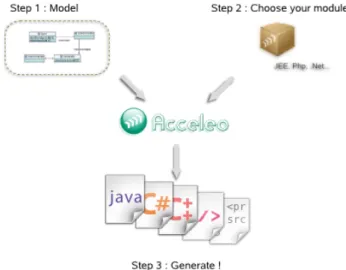
Figure 2.1 shows a simplistic macro view of the Acceleo: models, modules, acceleo engine and the process result - the code.
Figure 2.1: Acceleo overview diagram
2.2.2
UML-Based Web Engineering - UWE
UML-based Web Engineering (UWE) is a software engineering approach for development of applications in the web domain, based on OMG standards, such as UML, MDA, OCL, XMI and more, that focuses on models and model transformation [33]. The UWE notation is tailored for an intuitive modeling of web applications [34]. It comprises a development process and tool support for semi-automatic construction of Web applications. UWE models make early validation possible because a well designed model allows the requirements validation before the system development. One of the distinguishing features of UWE is its compliance with standards, because modeling with UWE is based on UML and on UML extension - the so-called UML profile [33]. The UWE profile is defined as an extension of the UML meta-model. Meta modeling and conformance with standards enable the use of existing tools or the development of plug-ins for tools already in use. UWE comprises [35]:
• A modeling language for the graphical representation of models of web applications;
• A method (technique) supporting semi-automatic generation;
• A process supporting the development life-cycle of web applications;
UWE focuses on systematization, automatic generation and its main characteristic is the use of UML for all models [35]:
• ”pure” UML whenever possible;
• For the web specific features, such as nodes and links of the hypertext structure, the UWE profile includes stereotypes, tagged values and constraints defined for the modeling elements.
UWE is supported by some case-tools, like ArgoUML [4] (ArgoUWE [5]) and MagicDraw [37] (Mag-icUWE [38]).
2.2.3
Web Modeling Language - WebML
WebML addresses the high-level, platform-independent specification of data-intensive web applications and targets web sites that require such advanced features as the one-to-one personalization of content and the delivery of information on multiple devices, like PCs, PDAs, digital televisions, and WAP phones [42].
WebML enables designers to express the core features of a site at a high level, without commit-ting to detailed architectural details [43]. WebML concepts are associated with an intuitive graphic representation, which can be easily supported by CASE tools and effectively communicated to the non-technical members of the development team (e.g., with the graphic designers and the content producers) [42]. WebML also supports an XML syntax, which instead can be inputted to software generators for automatically producing the implementation of a web application [42].
Figure 2.2 shows the WebML meta-model package.
Figure 2.2: The WebML Meta-Model Package
The specification of a web application in WebML consists of four orthogonal perspectives [43, 42]:
• Structural Model: it expresses the data content of the site, in terms of the relevant entities and relationships.
• Hypertext Model: it describes one or more hypertext that can be published in the site. Each different hypertext defines a so-called site view. Site view descriptions in turn consist of two sub-models:
– Composition Model: it specifies which pages compose the hypertext, and which content units make up a page.
– Navigation Model: it expresses how pages and content units are linked to form the hypertext. Links are either non-contextual, when they connect semantically independent pages, or con-textual, when the content of the destination unit of the link depends on the content of the source unit.
• Presentation Model: it expresses the layout and graphic appearance of pages, independently of the output device and of the rendering language, by means of an abstract XML syntax. Presentation specifications are either page-specific or generic.
• Personalization Model: users and user groups are explicitly modeled in the structure schema in the form of predefined entities called User and Group. The features of these entities can be used for storing group-specific or individual content.
2.2.4
XIS2
XIS2 is a R&D project which main goal is the analysis, development and evaluation mechanisms to produce information systems in a more abstract, high-level, efficient and productive way than it is done currently [59]. XIS2 project is mainly based on three emergent best practices, namely: it is based on high-level models or specifications; it is architecture-centric; and it is based on generative programming techniques [60]. XIS2 evolved from XIS and is supported by a case-tool named ProjectIT-Studio.
The XIS2 approach is based on models, specified in UML and focuses on software architectures and development process. This approach has some crucial processes [62]:
1. The UML profile definition (XIS2/UML), with the system elements definition, their relationships and their meta-element association. This profile, along with the functional requirements, allows the system to be modeled, this model is UML-based and is transformed to XMI.
2. The definition of the XMI-to-XIS2 transformation template. This template specifies a set of rules for the transformation of XMI elements to XIS2/XML elements.
3. The definition of software architecture templates for the transformation of XIS2/XML elements to software components.
Figure 2.3: XIS Views Organization (extracted from [62])
The XIS2 specifies an application through three main views [59, 62], illustrated in figure 2.3:
• Entities view: basically it’s a domain model with a logical representation of ”high-level” entities that are defined on top of the domain entities.
• Use Cases View: it’s a common use case model and may contain an extension to describe the use cases relation with business entities.
• User Interfaces View: is used to define the interaction spaces of a system and the navigation flow between them.
– NavigationSpace View: describes the navigation flow between the identified interaction spaces.
– InteractionSpace View: describes the contents and the overall organization of the different interaction spaces.
2.3
Discussion
This section presents a brief analysis of the MDE approaches mentioned in the previous section. This analysis pretends to give a notion of some factors that are relevant to this type of approaches, such as: the use of platform independent models, the visual aspect of the model language and expressiveness, the destiny platforms and the separation of concerns.
The analysis presented in this section was based in scientific articles [61, 51, 41, 28, 16] about each approach and the usage of each one in simple case studies. The analysis covers eight dimensions:
• Platform Independent Models- if the initiative proposes a set of concepts that are sufficient and independent of the underlying platforms.
• Domain Models- the ability to model the entities that are relevant to the problem domain in a traditional way, by using classes. The relationships between entities are modeled using simple associations, aggregations and inheritance.
• Navigation Models - to describe the navigation flow between the model spaces. This view is useful to support navigability management.
• Visually Clean- if the concepts are structured in a form that is not confused and easily compre-hended.
• Separation-Of-Concerns- if the structure of the concepts are logically organized, the views shows only concepts that are someway related with the view goals.
• Usability- if the developers can use the language in an efficienlty way.
• Effectiveness- if the model-to-code transformation is effective and produces the right and all the required system artifacts.
• Specific Platforms- the family of platforms supported by the approach, for example: generates code for generic applications or only for web applications; and the effectiveness of the model-to-code transformation.
The table 2.1 presents a quantitative comparison between the analyzed approaches, the ranking goes from 1 to 5, being 5 the best ranking.
Each MDE initiative analyzed in this work varies in many aspects and concepts, but each one is effective and efficiently in model design, with a high degree of abstraction and easy to use, as shown in table 2.1.
There are several aspects relative to model-based applications development; some of them are visual aspects, relative to language characteristics, supported models, model views, application organization,
Acceleo UWE WebML XIS
Platform Independent Models 4 3 4 4
Domain Models 5 5 5 5 Navigation Models 3 4 5 4 Visually Clean 4 3 4 4 Separation-Of-Concerns 3 4 4 4 Usability 3 3 4 4 Effectiveness 5 5 5 5
Specific Platforms Generic Platforms Web Platforms Web Platforms Generic Platforms
Table 2.1: Comparison between MDE initiatives
and more. Anderson discussed several aspects relative to model-based design [3], namely: models must be visually clean; elements of the model must be sufficiently clear and distinct to avoid confusion or misinterpretations; it must be possible to visually highlight that one element is part of another element.
2.4
Summary
This chapter presented the CMS concept, some of its benefits, three state of the art CMS products and a brief notion of ECM systems. Following, some state of the art approaches of MDE for general and web applications where briefly mentioned along with an introduction of the MDE and MDA concepts. Finally a discussion and quantitative comparison between the referred approaches was presented.
Chapter 3
Domain Specific Language for
CMS-based Web Applications
This chapter presents the concepts which provide the context for the development and usage of the domain specific language for CMS-based web applications, which is the subject of this work. In order to define a DSL, this chapter begins by explaining what a DSL is and why one should adopt a domain specific language approach. Then a brief definition of the domain for the language is given, followed by the identification of a platform independent meta-model for CMS-based web applications, with a group of stereotypes extending UML2 class elements. Finally a set of views are identified and defined for an efficiently language usage and separation-of-concerns in the application development process.
The main goal of this chapter is to present an UML-based language for the development of CMS-based web applications, which follows a model driven development approach and provides a way to make CMS-based web applications definition portable to other platforms.
3.1
Domain Specific Languages: An Abstraction Layer Over a
Domain
According to Deursen [81], a domain specific language (DSL) is a programming language or executable specification language that offers, through appropriate notations and abstractions, expressive power fo-cused on, and usually restricted to, a particular problem domain. As such, a DSL can be used to generate members of a family of systems in an application domain. A well-designed DSL is based on a thorough understanding of the underlying application domain, giving exactly the expressive power to generate required family members easily.
Potential advantages of DSLs include reduced time-to-market, reduced maintenance costs, and higher portability, reliability, optimizability, and testability [81, 82]. A prerequisite for the design of a DSL is a detailed analysis and structuring of the application domain.
DSLs have limited focus; they aren’t like generic programming languages that don’t have a specific domain focus. The first step when adopting a DSL approach is to identify an abstraction, then build a DSL to more easily represent the component or system. Thus a common trigger to using a DSL is when one has the awareness that it is possible to simplify the representation of a component or system.
DSLs have the potential to realize, among others, the following benefits [31, 81, 72]:
• Improving Development Productivity: the heart of the appeal of a DSL is that it provides means to more clearly communicate the intent of a part or the whole of a system.
• Communicating with Domain Experts: A hardest part of software projects, the most common source of project failure, is communicating with the customers and users. By providing a clear yet precise language to deal with domains, a DSL can help improve this communication.
• Change in Execution Context: a common driver for using a DSL is when we want to support in different underlying environments.
There are some problems associated with a DSL approach, which must be consider if this work will specify one for the CMS domain. Fundamentally, the reason why one shouldn’t use a DSL is because there aren’t any benefits in the situation or the cost of building one DSL isn’t worthy. Even when DSLs are applicable they do come with problems that are specific to each case.
A common though to remember when discussing these problems is the close relationship between a DSL and the underlying component that it’s representing. Many of the costs and benefits of DSLs get confused with the costs and benefits of that component or system. Most of the time a DSL is nothing more than an alternative front-end to a framework.
Many issues exist when adopting a DSL approach [31, 77], but here are stated some of the most relevant to this work:
• Cost of Building: a DSL always takes some time and effort to build, essential because of the domain analysis.
• Language Resistance: languages are hard to learn and sometimes only bring more complexity to the underlying component. But DSLs tend to be limited and simple which makes them easier to learn, this is reinforced by their closeness to the domain.
• Hard to Design: a common concern is that language design is hard and therefore is beyond the skill level of most project teams. As with the language resistance problem, again we need to remember that DSLs are limited in expressiveness, thus the effort to design and understand them is much less than for a general purpose language.
Despise the disadvantages of a DSL, the proposal presented in this work adopts a DSL approach because the benefits have more weight than the disadvantages, mainly, theImproving Development Pro-ductivity is a highly desired property in a language for the model-driven development of CMS-based web applications. Two disadvantages lies with the language development and not with the usage, so they are not a drawback in our proposal; a third disadvantage is related with the language learning curve, which can be exceeded with a simple and well documented domain specific language.
3.2
CMS-based Web Applications Domain
To define a domain specific language, it’s crucial to understand and limit the target domain. This section introduces the domain of the proposal, the CMS-based web applications domain, and its scope in order to define a domain specific language capable to express any application in it and support a bare minimum of features needed for this domain.
The domain analysis is like a systems analysis, except that the goal is to support the development of families of related systems, not just one-of-a-kind production [72]. Several domain analysis methodologies exists, of which ODM (Organization Domain Modeling [67]), FODA (Feature-Oriented Domain Analysis [30]), and DSSA (Domain-Specific Software Architectures [72]) are best known. The most important result of domain analysis is a feature model [13]. A feature model covers the commonalities and variabilities of software family members, as well as the dependencies between the variable features. The feature model
documents feature rationales, stakeholders, constraints (for example features may exclude each other), binding sites, and priorities [30].
Figure 3.1 shows the feature model for CMS-based web applications domain. This model only captures the essential generic elements of a generic CMS and some of them may not exist in a small set of CMS platforms. The feature model will allow the specification of the DSL to be concise and, ideally, to be done directly to the end users of the language who are likely to be domain specialists.
The domain analysis was based on the use of some CMS platforms [26, 15, 83] and through the analysis of scientific literature on the subject [7, 70, 25, 39] and specially the work of Jo˜ao Carmo[11].
In this project, the feature model of the CMS framework is essentially used to produce a DSL. More precisely, the feature model is used to express a generic CMS platform and help in the specification of an UML-based DSL. As already mentioned above, it is important to avoid a situation where a new DSL has to be defined for each new target CMS platform, so the goal is an ”unified” DSL for CMS-based web applications.
Figure 3.1: CMS-based Web Application Feature Model
In a very simplistic and generic fashion, a CMS-based web application is composed by a variable set of dynamic and/or static web pages. Dynamic web pages can be defined hierarchically, configured and presented in a controlled way by the CMS platform [70]. Each dynamic web page can have a set of modules, spatially arranged in the web page accordingly to some dynamic containers defined in a visual style by the designers. Additionally, it’s possible to define and manage different visual themes, which together set out the layout aspects of the entire application, a specific page or just a module/content [11]. Also, CMS platforms allows the management of users together with the management of roles and permissions to provide a generic and flexible mechanism for access control that adapts easily to different requirements and organizational business [11]. Some CMS platforms allows a more focused access man-agement like defining local roles that exist only in the context of a single web page, this is not shown in the feature model because the majority of the CMS platforms do not support this type of access management [11]. Although, this domain analysis cannot ignore this feature because it represent a great advantage for web applications and increases the roles management flexibility.
Besides the feature model, an architectural analysis is required. This work domain is not very architecture-restricted, because each CMS platform can adopt a specific platform, entire distinct from an-other CMS platform. This way, CMS platforms can be represented with a generic architecture illustrated in figure 3.2.
The generic CMS platform architecture is centered on a ”CMS Core” and some type of repository, the most common repository are relational databases and files. Many CMS platforms also provide an
API that offers a set of operations over the platform, like create a new user or a new web page, edit permissions of role on a web page, and all kind of possible operations over the platform. Finally, for a successful CMS platform, extension mechanisms must exist for visual styles, languages (if the CMS platform supports multi-language), web components or modules, and other extensions [7].
Figure 3.2: Generic CMS Platform Architecture
Usually, the best way, or the only way, to manipulate a CMS platform (for example create web pages or users) is through the API or Repository, shown in figure 3.2. How to access the CMS platform is completely at the discretion of developers and the platform capabilities.
Summarizing, the main concepts of the target domain are: web pages, web components, roles, users, visual styles and possible multi-languages. The goal is to define a language capable to express these elements and the relations between them while not arresting them to any specific platform. Clearly, the technological platform and the repository type of each CMS platform can take several forms and may be at different levels of complexity. This is the biggest challenge in the development of the DSL, to warranty that it’s completely transparent from the underlying CMS architecture and technological platform.
For now, the scope of the DSL will be limited to these elements,not being possible to model new web components, visual styles and languages. This means that, the modeling of web components, visual styles and languages, resumes to their identification and configuration, presuming that all these elements are already developed and deployed in the target CMS platform.
For example: if a web application will use the visual style VS1, then it’s required to map the VS1 (through a platform specific mapping mechanism) to some visual style that already exists in the target platform; or if a web component of type WCT1 will be added to a container, then there is the need to map the web component type to a platform specific web component type. This language restriction will be explained in more detail in Chapter 4 and in the case study of Chapter 6.
3.3
CMS-ML: CMS Modeling Language
The previous section presented an analysis of the CMS-based web applications domain in which the proposal of this work is focused and defines a DSL for the development in this domain. Although the domain and its scope are small and simple, the platform independency is a high goal to achieve, especially in a domain where several technological possibilities exist and new ones are always emerging. This section presents a proposal of a domain specific language for CMS-based web applications.
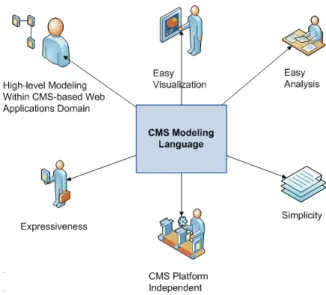
Stated in the previous sections were some benefits for using a DSL and some characteristics that are desired for the DSL defined in this dissertation. Synthesizing the desired benefits, the set of major goals for the CMS Modeling Language is illustrated in figure 3.3. How the language will achieve these goals will be described throughout this section and in Chapter 5, when the concepts and techniques that enables the goals are presented.
Figure 3.3: CMS Modeling Language Goals
The DSL, called by CMS Modeling Language (CMS-ML), defined in this work has the form of an UML profile. An UML profile provides a generic extension mechanism for customizing UML models for particular domains and platforms. Profiles are defined using stereotypes, tagged values, and constraints that are applied to specific model elements and associations [42].
Often the essence of the domain boundary doesn’t lie in the characteristics of the specific language, but in the intent of either the developers or users of this language. If a developer uses the CMS-ML for the development of CMS-based web applications then it stays a DSL, but if somehow he uses the CMS-ML in a general purpose manner or in another domain, then it’s no longer a DSL because the language domain boundaries where ”transposed”.
Calling some concepts a DSL is mostly about helping to describe them to others and knowing whether the techniques in this dissertation are likely to be relevant to build and using the CMS-ML DSL.
The CMS-ML is oriented towards the development of interactive software systems, and its main goal is to allow the modeling of the various aspects of CMS-based web applications, in a way that should be as simple and efficient as possible.
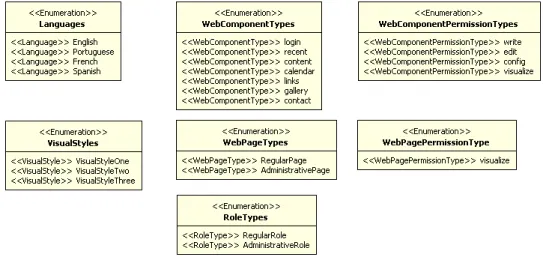
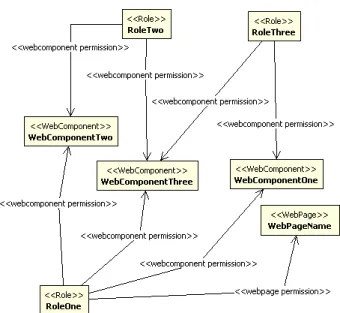
For presentation reasons, the meta-model is presented on two viewpoint, illustrated in figures 3.4 and 3.5: (1) a viewpoint showing all the stereotypes that extends from UML class elements and UML association elements; and (2) a viewpoint showing the enumerations and the stereotypes that extends from UML enumeration literals that are required to set tagged values of some UML class and association elements.
Notice that, all the enumerations literals shown in figure 3.5 are only examples and the reason they are there is to show the stereotype applications on the enumeration literals.
The meta-model identifies the class elements, associations and enumeration literals which when com-bined provide a web application specification that is simple and enough to produce artifacts in a CMS platform, independently of the platform details. The reader shall see in Chapters 5 and 6 that it’s very possible to produce rich platform independent models of CMS-based web applications with the meta-model defined here and generate the corresponding web application in different CMS platforms.
The CMS-ML language defined in the form of a meta-model pretends to be platform independent, simple, powerful, complete and flexible enough to support various CMS technological platforms and to provide the developers with a complete tool to produce CMS-based web applications in a way that is more oriented to the paradigm of Model Driven Engineering/Development (MDE/MDD).
Figure 3.4: CMS-ML Platform Independent Meta-Model: Elements and Associations
The class elements of the meta-model have a set of attributes or tagged values required to completely define each one. For example: to instantiate aWebComponent to manage content, the analyst must: (1) create aWebComponent element; (2) set the elementtype tagged value (that has the type WebCompo-nentType) with theContent literal defined in the enumeration WebComponentTypes; (3) finally, define the elementcontent tagged value with the content of the component.
Figure 3.5: CMS-ML Platform Independent Meta-Model: Enumerations and Literals
The profile file, defined in this chapter and used in the case study was specifically developed for the CASE tool adopted in this work, theProjectIT-Studio[23]. Although, the CMS-ML DSL is independent of the CASE tool and it’s possible to define a profile file for other CASE tools, such as the Enterprise Architect [69] or the Rational Rose [22].
The process of defining a profile in ProjectIT-Studio UMLModeler involves only the creation of a CMS-ML Profile within a model with all the stereotypes defined in this chapter. In order to improve the reusability of the profile, it is usually a good idea to define a CMS-ML Profile in a separate UML model file, and at a later time apply the CMS-ML Profile to another UML model file.
Because the CMS-ML language is simple and doesn’t have many elements, the user can create only one diagram within the CMS-ML Profile with all the required stereotypes. Note that a Profile is only a container of Stereotypes and other Profile Packages, and is not associated with any particular semantics. The CMS-ML class elements, associations and enumeration literals are defined in the following
![Figure 1.1: ProjectIT-MDD’s architecture (adapted from [65])](https://thumb-us.123doks.com/thumbv2/123dok_us/10167216.2918827/14.892.241.649.112.374/figure-projectit-mdd-s-architecture-adapted-from.webp)