Understanding Remote Collaboration in
Video Collaborative Virtual Environments
A thesis
submitted in partial fulfilment
of the requirements for the Degree
of
Doctor of Philosophy
in the
University of Canterbury
by
J¨
org Hauber
Examining CommitteeAssoc. Prof. Andy Cockburn, University of Canterbury Supervisor Prof. Mark Billinghurst, HIT Lab NZ Co-Supervisor Dr. Holger Regenbrecht, University of Otago Assoc. Supervisor Dr. Dean Owen, University of Canterbury Assoc. Supervisor Prof. Robert E. Kraut, Carnegie Mellon University Examiner
Dr. Leila Alem, Csiro ICT Centre Examiner
University of Canterbury
2008
Publications from this dissertation
Material from this dissertation has been previously published in the peer-reviewed papers, posters, and extended abstracts listed below. The chapters of this thesis that relate to each publication are noted. I also comment on my individual contribution to each of these papers in the alongside paragraphs.
1. Hauber, J., Regenbrecht, H., Hills, A., Cockburn, A. and Billinghurst, M. (2005) Social Presence in Two- and Three-dimensional Videoconferencing. Presented at PRESENCE 2005, 8th Annual International Workshop on Pres-ence, (London, Sep. 21-23, 2005). (Chapter 4)
2. Hills, A., Hauber, J. and Regenbrecht, H. (2005) Videos in Space: A study on Presence in Video Mediating Communication Systems. Presented at the 15th International Conference on Artificial Reality and Telexistence (ICAT 2005), (Christchurch, Dec. 5-8, 2005). (Chapter 5)
3. Regenbrecht, H., Haller, M., Hauber, J., Billinghurst, M. (2006) Carpeno: Interfacing Remote Collaborative Virtual Environments with Table-Top In-teraction. Virtual Reality - Systems, Development and Applications, 10(2) (September 2006). Springer/London, 95–107. (Chapter 6)
4. Hauber, J., Regenbrecht, H., Billinghurst, M., and Cockburn, A. (2006) Spatiality in videoconferencing: trade-offs between efficiency and social pres-ence. In Proceedings of the 2006 20th Anniversary Conference on Computer Supported Cooperative Work (Banff, Alberta, Canada, November 04-08, 2006). CSCW ’06. ACM Press, New York, NY, 413–422. (Chapter 6)
5. Hauber, J. (2006) Improving Video-Mediated Communication with a Col-laborative Virtual Environment Approach. Doctoral Colloquium Abstract, ACM Conference on Computer Supported Co-operative work (CSCW ’06), Banff, Alberta, Canada, November 2006.
6. Hauber, J., Regenbrecht, H., Billinghurst, M., Teoh, H. (2006) Presence in Video-mediated Communication: Does being there help to come to-gether? Poster, ACM Conference on Computer Supported Co-operative work (CSCW ’06), Banff, Alberta, Canada, November 2006. (Chapter 7)
Most of the papers resulted from collaborative work. My contributions to these papers were (numbers correspond to list numbers above):
1. This study was run by me with the assistance of Aimee Hills and under the supervision of Dr. Regenbrecht. I was responsible for experiment design and data analysis. I also wrote the paper with help from Dr. Regenbrecht, Dr. Cockburn, and Dr. Billinghurst.
2. This study was designed and conducted collaboratively by Aimee Hills and me, again under supervision and assistance of Dr. Regenbrecht. However, I analysed the gathered data separately and wrote most of the paper.
3. The Carpeno project was primarily a research effort by Dr. Regen-brecht and Dr. Haller. I helped with the implementation of the proto-type and conducted two informal user studies during its demonstration at two local conferences. I also wrote the part of the paper describing findings of these studies. The experiences gathered with both hardware and user feedback influenced the design of my follow-up experiments.
4. This was my own research. My supervisors Dr. Regenbrecht, Dr. Billinghurst, and Dr. Cockburn consulted me during the design and data analysis phase and repeatedly reviewed the resulting paper I wrote.
5. This extended abstract was written by me with assistance of my super-visors Dr. Cockburn and Dr. Billinghurst.
6. This poster was designed by me and reflected my ideas for the design of a study that I carried out later in a slightly modified form (see Chapter 7).
Abstract
Video-mediated communication (VMC) is currently the prevalent mode of telecommunication for applications such as remote collaboration, telecon-ferencing, and distance learning. It is generally assumed that transmitting real-time talking-head videos of participants in addition to their audio is ben-eficial and desirable, enabling remote conferencing to feel almost the same as face-to-face collaboration. However, compared to being face-to-face, VMC still feels distant, artificial, cumbersome, and detached. One limitation of standard video-collaboration that contributes to this feeling is that the 3D context between people and their shared workspace given in face-to-face col-laboration is lost. It is therefore not possible for participants to tell from the video what others are looking at, what they are working on, or who they are talking to.
Video Collaborative Virtual Environments (video-CVEs) are novel VMC interfaces which address these problems by re-introducing a virtual 3D con-text into which distant users are mentally “transported” to be together and interact with the environment and with each other, represented by their spa-tially controllable video-avatars. To date, research efforts following this ap-proach have primarily focused on the demonstration of working prototypes. However, maturation of these systems requires a deeper understanding of human factors that emerge during mediated collaborative processes.
This thesis contributes to a deeper understanding of human factors. It in-vestigates the hypothesis that video-CVEs can effectively support face-to-face aspects of collaboration which are absent in standard video-collaboration. This hypothesis is tested in four related comparative user studies involv-ing teams of participants collaboratinvolv-ing in video-CVEs, through standard video-conferencing systems, and being face-to-face. The experiments apply and extend methods from the research fields of human-computer interaction, computer-supported cooperative work, and presence.
Empirical findings indicate benefits of video-CVEs for user experience dimensions such as social presence and copresence, but also highlight chal-lenges for awareness and usability that need to be overcome to unlock the full potential of this type of interface.
Table of Contents
List of Figures viii
List of Tables xi
Chapter 1: Introduction 1
1.1 Research context . . . 2
1.2 Problem statement and research hypothesis . . . 2
1.3 Contributions . . . 4
1.3.1 Methodological contributions . . . 4
1.3.2 Substantive contributions . . . 4
1.4 Structure of this thesis . . . 5
Chapter 2: Background 8 2.1 Getting a grip on communication . . . 9
2.1.1 Shannon and Weaver’s model of communication . . . . 9
2.1.2 Interpersonal communication . . . 12
2.1.3 Collaboration . . . 17
2.1.4 Criticisms of transmission models . . . 20
2.1.5 Summary . . . 21
2.2 Mediated communication . . . 22
2.2.1 Media characteristics . . . 22
2.2.2 Media selection . . . 30
2.2.3 Remote collaboration in shared workspaces . . . 32
2.3 Video-mediated communication . . . 35
2.3.1 Review of empirical work in video-mediated communi-cation . . . 36
2.3.2 Improving video-mediated communication . . . 47
2.4 Using virtual reality (VR) as a communication medium . . . . 57
2.4.2 Collaborative virtual environments (CVE) . . . 63
2.4.3 The affordances of CVEs for remote collaboration . . . 64
2.4.4 Examples of CVEs . . . 67
2.4.5 Empirical research in CVEs . . . 70
2.5 Chapter summary . . . 73
Chapter 3: Research Approach 75 3.1 A CVE approach to video-conferencing . . . 75
3.1.1 The video-CVE “cAR/PE!” . . . 77
3.2 Method . . . 82
3.2.1 A comparative approach . . . 83
3.2.2 Independent measures . . . 84
3.2.3 Dependent measures . . . 87
3.3 Overview of the experiments . . . 88
Chapter 4: Experiment: “Desert Survival Game” 93 4.1 Experiment design . . . 95 4.1.1 Experimental task . . . 95 4.1.2 Experiment conditions . . . 96 4.1.3 Apparatus . . . 97 4.1.4 Participants . . . 97 4.1.5 Procedure . . . 98 4.1.6 Measures . . . 100 4.2 Data analysis . . . 100
4.2.1 Social presence as quality of the medium . . . 100
4.2.2 Social presence as the experience of the other . . . 101
4.2.3 Exploratory questionnaire items . . . 101
4.2.4 Scale validity . . . 102
4.2.5 Correlations . . . 103
4.2.6 Age and simulator experience effects . . . 103
4.3 Results . . . 103
4.3.1 Social presence as a quality of the medium . . . 103
4.3.2 Social presence as the experience of the other . . . 103
4.3.4 Scale validity . . . 107
4.3.5 Correlations . . . 108
4.3.6 Age and simulator experience effects . . . 109
4.3.7 User observation in condition vCVE . . . 109
4.4 Discussion . . . 111
4.5 Experiment summary . . . 112
Chapter 5: Experiment: “Dream House” 114 5.1 Experiment design . . . 115 5.1.1 Experimental task . . . 115 5.1.2 Experiment conditions . . . 116 5.1.3 Apparatus . . . 117 5.1.4 Participants . . . 118 5.1.5 Procedure . . . 119 5.1.6 Measures . . . 119 5.2 Data analysis . . . 120 5.2.1 Social presence . . . 120 5.2.2 Physical presence . . . 121 5.2.3 Correlations . . . 121 5.2.4 Reliability analysis . . . 121 5.2.5 Preference ratings . . . 121
5.2.6 Exploration of other factors . . . 121
5.3 Results . . . 122
5.3.1 Differences in social presence . . . 122
5.3.2 Differences in physical presence . . . 122
5.3.3 Correlations . . . 122
5.3.4 Reliability analysis . . . 123
5.3.5 User comments and preference . . . 124
5.3.6 Gender and relationship effects . . . 125
5.4 Discussion . . . 125
5.5 Experiment summary . . . 126
Chapter 6: Experiment: “Dogs and Owners” 127 6.1 Experiment design . . . 129
6.1.1 Experimental task . . . 129 6.1.2 Experiment conditions . . . 130 6.1.3 Apparatus . . . 132 6.1.4 Participants . . . 134 6.1.5 Procedure . . . 135 6.2 Measures . . . 136 6.2.1 Social presence . . . 136 6.2.2 Copresence . . . 136 6.2.3 Usability parameters . . . 137 6.2.4 Video recordings . . . 137 6.3 Data analysis . . . 137 6.3.1 Social presence . . . 137 6.3.2 Copresence . . . 137 6.3.3 Usability parameters . . . 138 6.3.4 Video analysis . . . 138 6.3.5 Preference . . . 138 6.3.6 Correlations . . . 138 6.3.7 Scale validity . . . 138 6.3.8 Gender effects . . . 138 6.4 Results . . . 139 6.4.1 Social presence . . . 140 6.4.2 Copresence . . . 140 6.4.3 Usability parameters . . . 141 6.4.4 Preference . . . 142 6.4.5 Video analysis . . . 143 6.4.6 Correlations . . . 145 6.4.7 Scale validity . . . 146 6.4.8 Gender effects . . . 146 6.5 Discussion . . . 146 6.6 Experiment summary . . . 148
Chapter 7: Experiment: “Celebrity Quotes” 149 7.1 Experiment design . . . 150
7.1.2 Experiment scenario . . . 153 7.1.3 Experiment conditions . . . 154 7.1.4 Apparatus . . . 156 7.1.5 Participants . . . 158 7.1.6 Procedure . . . 159 7.2 Measures . . . 160 7.2.1 Social presence . . . 160 7.2.2 Physical presence . . . 160
7.2.3 Items on awareness, copresence, and ease of use . . . . 161
7.2.4 Video recordings . . . 161
7.2.5 Communication transcripts . . . 161
7.3 Data analysis . . . 162
7.3.1 Social presence . . . 162
7.3.2 Physical presence . . . 163
7.3.3 Copresence, awareness, and ease of use . . . 163
7.3.4 Preference . . . 163
7.3.5 Correlations . . . 163
7.3.6 Linguistic features analysis . . . 163
7.3.7 View analysis . . . 164 7.4 Results . . . 165 7.4.1 Questionnaire results . . . 165 7.4.2 Results preference . . . 170 7.4.3 Correlations . . . 172 7.4.4 Transcription analysis . . . 172 7.4.5 Video analysis . . . 180 7.5 Discussion . . . 181
7.5.1 The impact of the “remoteness” of a video-CVE . . . . 181
7.5.2 Gender effects . . . 182
7.5.3 Transcription analysis . . . 184
7.5.4 Reciprocal awareness issues in the vCVE conditions . . 185
7.6 Experiment summary . . . 186
Chapter 8: Discussion 187 8.1 User experience of spatial virtual video-conferencing . . . 188
8.1.1 Gender effect . . . 189
8.1.2 Spatiality and the feeling of being face-to-face . . . 190
8.1.3 Transportation and the feeling of being face-to-face . . 190
8.2 User behaviour in spatial virtual video-conferencing . . . 191
8.3 Striving for the gold standard: a trade-off . . . 192
8.4 Future work . . . 195
8.4.1 Possible directions for human factors research . . . 195
8.4.2 Possible directions for video-CVE interface design . . . 197
8.5 Critical reflection . . . 199 8.5.1 Reliability . . . 200 8.5.2 Construct validity . . . 201 8.5.3 Discriminant validity . . . 201 8.5.4 External validity . . . 202 8.5.5 Internal validity . . . 204 Chapter 9: Conclusion 206 9.1 Summary of experiments . . . 207
9.1.1 Experiment “Desert Survival Game” . . . 207
9.1.2 Experiment “Dream House” . . . 208
9.1.3 Experiment “Dogs & Owners” . . . 209
9.1.4 Experiment “Celebrity Quotes” . . . 209
9.2 Key questions addressed in this work . . . 210
9.3 Main contributions . . . 212 9.3.1 Methodological contributions . . . 212 9.3.2 Substantive contributions . . . 213 9.3.3 Minor contributions . . . 215 9.4 Conclusion . . . 215 References 216 Appendix A: Questionnaires 240 A.1 Desert Survival Game . . . 240
A.2 Dream House . . . 247
A.3 Dogs & Owners . . . 251
Appendix B: Factor Analysis 258 B.1 Experiment “Desert Survival Game”: Exploratory
question-naire items. . . 258
Appendix C: Transcription analysis 260
C.1 Transcription excerpt . . . 260 C.2 LIWC2001 Output Variable Information . . . 264
List of Figures
1.1 Two people collaborating in three different media conditions. . 3
2.1 Shannon and Weaver’s model of communication. . . 10
2.2 The Shannon-Weaver model of interpersonal communication (simplified from DeVito (1998)). . . 13
2.3 The Lasswell formula (from Lasswell 1948). . . 15
2.4 A simple model for collaboration. . . 18
2.5 Richness of different communication media (from Daft et al. (1987)). . . 23
2.6 Example of a bipolar scale. . . 26
2.7 Social presence of several communication media (from Short et al. (1976)). . . 27
2.8 The Networked Minds definition of social presence (from Biocca et al. (2001)) . . . 29
2.9 A general framework of presence (from IJsselsteijn and Riva (2003)). . . 59
2.10 The relationship between physical presence and social presence (from IJsselsteijn et al. (2001)). . . 61
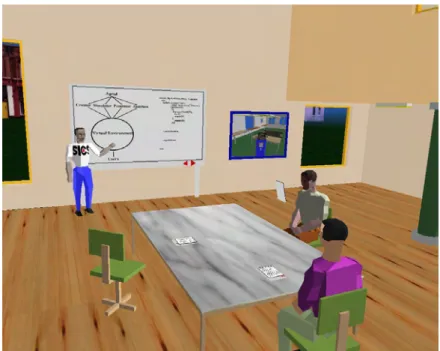
2.11 An example of a CVE. . . 65
3.1 Examples of avatars in online 3D worlds. . . 76
3.2 Video avatars in Vertegaal et al.’s “Gaze-2” . . . 76
3.3 The cAR/PE! virtual conferencing room. . . 77
3.4 A video-avatar in cAR/PE!. . . 78
3.5 The Mona Lisa effect. . . 79
3.6 Examples for gaze awareness in cAR/PE!. . . 80
3.7 The cAR/PE! network architecture (adapted from Regenbrecht et al. (2006) . . . 82
3.9 Transportation in shared spaces and examples. . . 86
3.10 Artificiality of shared spaces and examples. . . 87
4.1 Conditions in the experiment “Desert Survival Game”. . . 96
4.2 A video-conferencing workspace. . . 99
4.3 Results social presence as quality of the medium. . . 104
4.4 Results social presence as experience of the other. . . 105
4.5 Average and standard errors of extracted factors. . . 106
4.6 A frequently observed avatar navigation sequence. . . 110
5.1 The condition vCVE in the experiment “Dream House”. . . . 116
5.2 The condition sVC in the experiment “Dream House”. . . 117
5.3 A participant sitting at one of the workstations. . . 118
6.1 An example set of dogs and owners. . . 130
6.2 Conditions in the experiment “Dogs & Owners”. . . 131
6.3 Social presence averages and standard errors. . . 140
6.4 Copresence average ratings and standard errors. . . 141
6.5 Interaction between conditions and gender for social presence. 147 7.1 An example set of quotes and photos. . . 151
7.2 The “Map-o-Mat” mapping application. . . 152
7.3 The virtual room used in the experiment “Celebrity Quotes”. . 154
7.4 Conditions in the experiment “Celebrity Quotes”. . . 155
7.5 The video analysis application. . . 165
7.6 Social presence by gender and medium. . . 166
7.7 Physical presence by gender and medium. . . 167
7.8 Physical presence and social presence in two vCVE conditions. 168 7.9 Awareness by gender and medium. . . 169
7.10 “Ease of use” by gender and medium. . . 170
7.11 Standard linguistic dimensions that showed significant effects. 175 7.12 Linguistic dimensions from the category “Psychol. Processes”. 176 7.13 Linguistic dimensions from the category “Relativity”. . . 177
7.14 Additional linguistic dimensions. . . 178
7.15 References to quotes. . . 179
7.17 Typical positioning of team members in condition FtF. . . 181 8.1 Social presence, averaged over all experiments. . . 188 8.2 The trade-off between spatiality and the ease of interactions. . 193 8.3 The cost-benefit matrix for spatial tele-collaboration. . . 194
List of Tables
2.1 Benefits of visual information for grounding subtasks (from
Fussell et al. (2000)). . . 19
2.2 Constraints of different media for grounding processes (from Olson and Olson (2000)). . . 25
2.3 Example items of the NWM measure of social presence. . . 30
2.4 Grounding costs and examples (from Clark and Brennan (1991). 32 2.5 Elements of workspace awareness (from Gutwin (1997)). . . . 34
2.6 Cross-media studies by task and conditions compared. . . 37
2.7 Cross-media studies: product measures and results. . . 39
2.8 Cross-media studies: process measures and results. . . 42
2.9 Cross-media studies: satisfaction measures and results. . . 44
2.10 User studies in CVE-research. . . 71
3.1 The four experiments in chronological order. . . 88
3.2 Types of measures applied in the four studies . . . 89
3.3 The experimental conditions and their level of transportation. 90 3.4 The experimental conditions and their level of spatiality. . . . 90
3.5 Overview of participants recruited in the four experiments. . . 92
4.1 Results social presence as experience of the other. . . 104
4.2 Factor analysis of exploratory questionnaire items. . . 105
4.3 Results of exploratory questionnaire items. . . 107
4.4 Factor loadings for social presence as quality of the medium. . 107
4.5 Reliability of the NWM measure of social presence. . . 108
5.1 Factor analysis of social presence. . . 123
6.1 The conditions in the experiment “Dogs & Owners”. . . 130
6.2 Results of eleven usability items. . . 142
6.4 Correlations experiment “Dogs and Owners” . . . 145
7.1 Correlations experiment “Celebrity Quotes” . . . 172
7.2 Effects in category “Standard Linguistic Dimensions”. . . 173
7.3 Effects in the category “Psychological Processes”. . . 174
7.4 Effects in category “Relativity”. . . 176
7.5 Effects in additional word categories. . . 177
8.1 Discriminant Validity . . . 202
9.1 Summary of the four conducted experiments. . . 208
Acknowledgements
Many people supported me during the last few years and I want to ac-knowledge them here.
A special thanks must go to my supervisors: Andy Cockburn for his pa-tience and invaluable guidance during our weekly meetings; Mark Billinghurst for his belief in my abilities, and for always having been available when it really counted; Holger Regenbrecht for the fruitful collaboration with the University of Otago, and for the numerous long conversations we had that reached well beyond work-related topics; and finally Dean Owen for intro-ducing me to the world of psychology.
Thank you also to all staff and students at the HIT Lab NZ who helped me out in so many ways and who I enjoyed sharing so many joyful moments with.
I would also like to take this opportunity to thank Aimee Hills, Gor-don Wetzstein, Manuela Waldner, Daniel Wickeroth, Daniel Kerse, Anne Williams, Hon Leng Teoh, and Mira Hattal who helped run the experiments and contributed their time and effort.
Finally, I am grateful to all the encouragement and support I have re-ceived from friends and family, above all from my girlfriend Sandra who went through all this with me.
Thank you all!
Furthermore, I would like to acknowledge DaimlerChrysler Research and Technology, and Marratech for providing access to their video-conferencing software and applications.
This research was financially supported by a University of Canterbury Doctoral Scholarship, and by a doctoral scholarship of the German Academic Exchange Service (DAAD).
Abbreviations
ANOVA analysis of variance
AO audio-only
AV audio-video
cAR/PE! collaborative Augmented Reality for Presentation and Engineering CAVE cave automatic virtual environment CSCW computer supported cooperative work CVE collaborative virtual environment DSG desert survival game
FtF face-to-face
HCI human computer interaction HMD head-mounted display
IPQ I-Group Presence Questionnaire LIWC Linguistic Inquiry and Word Count LBE Location-Based Entertainment MMOG massively multiplayer online game MRA mixed reality architecture
MUDs Multi-User Dungeons
NWM Networked Minds PD prisoner’s dilemma SD standard deviation SE standard error sVC standard video-conferencing vCVE video-CVE
vCVE desk desktop-based video-CVE vCVE im immersive video-CVE VE virtual environment
VMC video-mediated communication VR virtual reality
vTab video table
Chapter 1
Introduction
The goal of real-time telecommunication media is to collapse the space between geographically dispersed groups and create the illusion that people are together, when in fact they are not. Modern video-conferencing tech-nology promises to deliver such an illusion, often heralding video-mediated communication (VMC) to be the next best thing to being face-to-face. This claim seems not too far-fetched if one considers the advantage of being able to see the facial expressions of the other person during video conversations which are absent in normal telephone calls. Compared to being face-to-face, however, even VMC still feels distant, artificial, cumbersome, and detached. One shortcoming of common video-collaboration that contributes to this feeling is that the 3D context between people and their shared workspace given in face-to-face collaboration is lost. It is therefore not possible for participants to tell from the video what others are looking at, what they are working on, or who they are talking to – all of which can cause issues for coordinating their collaborative activities.
Video Collaborative Virtual Environments (video-CVEs) are novel VMC interfaces which seek to address these problems by re-introducing a virtual 3D context into which distant users are mentally “transported” to be to-gether and interact with the environment and with each other. Although working prototypes of video-CVEs have demonstrated their technical feasi-bility, research into the value of video-CVEs to support remote collaboration is still in its infancy, and the human factors involved are not well understood. This thesis addresses this lack of understanding by investigating, from the user’s perspective, whether video-CVEs can effectively support otherwise missing face-to-face aspects of collaboration.
1.1 Research context
This research aligns with the field of Computer Supported Cooperative Work (CSCW), an area in the study of Human-Computer Interaction (HCI) that “examines how people work together in groups and how groupware technolo-gies can support collaboration” (Ishii et al. 1994).
CSCW emerged as an identifiable inter-disciplinary research field in the early 1980s, a time in which networked personal workstations could be first used to communicate and work with others. In order to tackle the complex challenges posed by real-time distributed collaboration, CSCW advocates a “user-centred” design philosophy, in which the development and the evolution of interactive systems is tightly coupled with systematic evaluation and user-tests:
“. . . Trial and error from creative system builders is too slow a dis-covery process. What is required is a better understanding of group work, the extent of the possibilities of the design space of technology features, and evaluation of systems in use that leads to a theory of computer supported cooperative work, which in turn can help us di-rect subsequent inventions of new ways to do group work.” (Olson et al. 1993).
One area of CSCW focuses on real-time communication through video and audio. Researchers studied the value of different media conditions for remote collaboration (e.g. Chapanis 1975, Olson and Olson 2000), identi-fied limitations of conventional video-conferencing setups (e.g. Gaver 1992, Whittaker 1995), and explored new interface approaches to improve VMC (e.g. Sellen 1992, Ishii et al. 1993, Nguyen and Canny 2005). This thesis extends this area by investigating the opportunities and challenges posed by the interface approach of video-CVEs.
1.2 Problem statement and research hypothesis
The problem that this research addresses is that collaborating via standard video-conferencing systems feels artificial, cold, impersonal, and cumbersome
(a) Collaboration through a standard video-conferencing system
(b) Face-to-Face collaboration (c) Collaboration in a video-CVE
Figure 1.1: Two people collaborating in three different media conditions.
compared to face-to-face interaction1.
One cause of this problem is that standard video-conferencing systems do not provide the 3D frame of reference that we normally take for granted in face-to-face collaboration (see Figure 1.1(b)), and which affords a range of natural non-verbal communication cues including pointing in space, gaze direction, or proximity behaviour.
Video Collaborative Virtual Environments (CVEs) are novel video-conferencing interfaces which integrate spatially controllable video planes (video-avatars) of participants in a 3D virtual environment where they as-sume individual positions and viewing angles (see Figure 1.1(c)).
Video-1Within this thesis, “standard video-conferencing systems” refer to VMC systems, like
that depicted in Figure 1.1(a), which provide “talking-head” videos of participants to-gether with audio for communication next to a shared workspace area.
CVEs are inherently spatial and therefore afford forms of interaction which more closely resemble spatial face-to-face interaction.
The derived main hypothesis of this thesis is that geographically dis-persed people who collaborate in video-CVEs feel and behave more similarly to being face-to-face than if they collaborate through standard video-conferencing systems.
This hypothesis is investigated and tested in four related comparative user studies involving participants collaborating in video-CVEs, through standard video-conferencing systems, and while being face-to-face. The studies apply process and satisfaction measures to assess and compare user experience fac-tors and collaborative behaviour between these conditions.
The main goal of this research is to enhance our understanding of the opportunities and challenges posed by video-CVEs as a new communications medium.
1.3 Contributions
This thesis contributes substantive and methodological knowledge to the field of CSCW.
1.3.1 Methodological contributions
The methodological contributions made by this thesis concern the develop-ment and maturation of methods in the study of VMC.
1. Exploration and advancement of measures to discriminate user experi-ence dimensions and collaboration patterns between variants of VMC interfaces.
2. Three collaborative tasks for use when studying remote collaboration.
1.3.2 Substantive contributions
The substantive contributions made by this thesis concern research findings of the impact ofspatiality and transportation on user experience and
collab-oration. Spatiality and transportation are two inherent interface character-istics (Benford et al. 1996) that set CVEs apart from standard video-conferencing systems. Spatiality concerns an interface’s level of support for fundamental physical spatial properties such as containment, topology, dis-tance, orientation, and movement. Transportation concerns the degree to which an interface mentally “transports” its users into some new remote space in order to meet with others.
1. Research findings addressing thespatiality aspect of video-CVEs reveal improvements for the user experience such as an increase of social pres-ence, but also uncover usability issues that still need to be overcome to reach the ease and efficiency of face-to-face collaboration.
2. Research findings addressing the transportation aspect of video-CVEs show only a weak correlation between the level of transportation of a video-CVE and the face-to-face-like experience and behaviour it affords.
3. Further findings include the detection of a gender effect, according to which video-CVEs are of more value for male users.
1.4 Structure of this thesis
Chapter 2 is about communication. It lays the theoretical foundations and reviews previous work for this research. First, it explains models and theories for interpersonal communication and collaboration that help us understand the challenges we face when mediating collaboration by means of technology. To foster this understanding, several communication media are also reviewed and characterised according to existing classifications. Then, it concentrates on the mediation of collaboration by means of video-conferencing technology. It gives an overview of cross-media studies involving audio, video, and face-to-face collaboration, and reviews different approaches to improving VMC that are reported in literature. Finally, the chapter outlines the concept of using shared virtual reality applications as a communications medium, presents examples of CVEs, and reviews related work from that area.
Chapter 3 introduces the video-CVE prototype “cAR/PE!”(Regenbrecht et al. 2004), which combines VMC and CVEs, and which serves as the re-search platform for this work. Then, it explains the rere-search approach pur-sued in this thesis to increase our understanding of human factors of video-CVEs. Finally, it gives an overview of how the research approach is realised in the four user experiments that are described in the four subsequent chapters.
Chapter 4 presents findings from the experiment “Desert Survival Game”. There are no well established metrics that apply for comparing variants of VMC interfaces. Thus, the approach taken in this experiment was to trial subjective measures that have previously been used in similar cross-media studies for their sensitivity to discriminate between standard video-conferencing, video-CVEs, and face-to-face conditions. The considered mea-sures included two social presence scales, and a questionnaire addressing subjective communication quality. Results were also explored for first indi-cations, where video-CVEs push the collaborative experience further towards the face-to-face gold standard.
Chapter 5 presents findings from the experiment “Dream House”. This experiment re-applied one of the social presence scales that was found to be useful in experiment “Desert Survival Game” to strengthen the previous result. In addition, it trialled a physical presence scale for its ability to dis-criminate between a standard video-conferencing system and a video-CVE, and whether or not participants’ physical presence ratings and social presence were related.
Chapter 6 presents findings from the experiment “Dogs & Owners”. This study concentrated on the impact of the spatiality aspect of video-CVEs. In particular, it tested the hypothesis that face-to-face-like collaboration can be approximated by creating a sense of spatiality in VMC. This hypothesis was tested based on subjective questionnaire data and video analysis.
Chapter 7 presents findings from the experiment “Celebrity Quotes”. This study concentrated on the impact of the transportation aspect of
video-CVEs. In particular, it tested the hypothesis that face-to-face-like collab-oration can be approximated by increasing the level of transportation of a video-CVE. This hypothesis was tested based on subjective questionnaire data, video analysis, and a conversation transcript analysis.
Chapter 8 discusses the overall findings and the implications that can be drawn from them and proposes directions for future work.
Chapter 2
Background
The research field of Computer Supported Cooperative Work (CSCW) investigates how collaborative activities and their coordination can be sup-ported by means of computer systems. The aim of this thesis is to contribute knowledge to the CSCW area of real-time distributed groupware, that is, computer systems that allow multiple people to collaborate with each other at the same time but from different places. Understanding the challenges of real-time distributed groupware presupposes a fundamental understanding of interpersonal communication. This chapter establishes such an understand-ing and thus lays the foundations for this work.
Section 2.1 explains fundamental communication terminology and mech-anisms involved in interpersonal communication and collaboration based on Shannon and Weaver’s (1949) transmission model of communication. Sec-tion 2.2 highlights how different telecommunicaSec-tion media affect collaborative processes and illustrates the challenges designers of these systems are facing to provide people with the support they need to accomplish their remote collaborative goals. Section 2.3 focuses on video-mediated communication. It contains a review of a series of empirical studies that established a body of knowledge with regards to the value of video-conferencing as a medium to support remote collaboration. It also summarises new interface approaches and directions researchers are investigating in an attempt to improve VMC. Finally, Section 2.4 outlines the concept of Collaborative Virtual Environ-ments (CVE) as a novel telecommunication medium.
2.1 Getting a grip on communication
This work involves human-to-human communication, so this chapter begins by explaining the human communication process itself. The three models presented are all based on Shannon and Weaver’s (1949) transmission model of communication. They are contrasted with each other in the following sections. Section 2.1.1 starts with the original transmission model, which considers communication merely as an information processing problem. Sec-tion 2.1.2 presents Warren Weaver’s adaptaSec-tions to the original transmission model to also approximate interpersonal communication processes. Finally, Section 2.1.3 introduces a simple transmission model for interpersonal collab-oration that further extends the previously explained transmission models.
Explaining the individual communication models with an explicit focus on the differences between them clarifies the terminology involved and estab-lishes a good theoretical understanding of the matter.
2.1.1 Shannon and Weaver’s model of communication
Human communication is complex and the research field that studies it is scattered. Scholars in the field of communication hold widely divergent views of what communication is and on the best way to study it. To date, there is no uniform theory that can account for all aspects of communication. Instead, Griffin (2005, page 21) argues that “it is reasonable to talk about a field of communication theory, in which a variety of different communication theories, models, and traditions coexist, all trying to answer questions of practical relevance that emerge when humans interact.”
Shannon and Weaver (1949) developed one of the earliest and most influ-ential communication models which considers the transmission of information from a source to a destination as the basic mechanism of communication. It is therefore referred to as thetransmission model of communication (Figure 2.1).
According to Shannon and Weaver, a communication system comprises the following fundamental elements:
Information Source Transmitter Signal Received Signal Message Message Receiver Destination Noise Source
Figure 2.1: Shannon and Weaver’s (1949) transmission model of communi-cation.
The information source: Typically, the source is a person with a reason for engaging in communication.
The message: At the beginning of a communication process, the source formulates a message as a symbolic representation of an idea it wants to communicate to the destination.
The transmitter: The transmitter accepts a message and transforms it into a signal that can be sent to a remote receiver.
The channel: Once a signal is encoded, it is then sent through the channel.
The receiver: Signals sent via the channel are picked up by the receiver which converts them back into the message that can be perceived and un-derstood by the destination.
The destination: The destination can now perceive and interpret the re-constructed message as presented by the receiver.
Noise: From the moment a message is formulated by the source until it is reconstructed at the destination, interfering noise causes loss of information. As a consequence, the message at the destination is always a distorted version of the message sent.
As an example, consider person A calling person B using a phone system: Person A is the source, person B is the destination. Person A formulates a message, consisting of a series of spoken words that have associated mean-ings. The microphone in the telephone acts as thetransmitter and converts these spoken messages into electrical signals. These signals are then sent via the telephone channel (a set of wires) that is capable of carrying electrical impulses. The signals are thenreceived by the telephone speaker at the desti-nation, which transforms them back into sound waves that can be perceived and understood by Person B.
Communication fails if the received message does not carry the minimum information necessary to reduce uncertainty at the destination. In Shannon’s view, information refers solely to the reduction of uncertainty. The amount of information a message carries is determined by the number of alterna-tives when selecting the message. The more open-ended and unpredictable the message, the higher its level of information. In this context informa-tion should not be confused with meaning. The relainforma-tion between noise and information can be described by the simple equation:
Channel Capacity =Information + Noise
Shannon initially developed this model from an engineering perspective with the goal of maximizing the level of information a given channel could carry by minimizing the interfering noise. In his view, communication is simply an information processing problem. The impact a message can have on the destination, or whether the symbols that are transmitted from sender to receiver convey the desired meaning, was of no interest to Shannon. He writes, “the semantic aspects of communication are irrelevant to the engi-neering aspects” (Shannon and Weaver 1949, page 99).
With its technical focus, Shannon’s model in its original form was nei-ther capable of providing a general analogy of human communication, nor was it intended to do so. However, Warren Weaver, the co-author of “The Mathematical Theory of Communication”, was more interested in the philo-sophical implications of the model and discussed those in an interpretative essay that follows Shannon’s mathematical derivations in the same book. In his essay, he discussed the relevance of Shannon’s communication model not
only for the transmission of symbols, but also for the transmission of the desired meaning conveyed by the symbols and thus applied the concept of information loss to interpersonal communication. It might be due to this essay that Shannon’s diagram of information flow appears in almost every communication textbook.
The next section explains an adapted transmission model, and highlights how the changes undertaken correspond to the general characteristics of in-terpersonal communication.
2.1.2 Interpersonal communication
Griffin (2005, page 52) defines interpersonal communication as the “process of creating unique shared meaning”. There are a number of elements that set interpersonal communication apart from other forms of communication (e.g. mass communication). In interpersonal communication there are few participants involved, the participants are in close physical proximity to each other, there are many sensory channels used, and the feedback is immediate (Gouran et al. 1994).
With these definitions in mind, two main aspects emerge where Shannon’s communication model does not fit: First, interpersonal communication is dy-namic and bilateral, and can therefore not be conceived as a linear and literal transmission of information from a sender to a receiver. Second, interper-sonal communication is primarily about the exchange of meaning. A model therefore must also account for the semantic levels of communication. In this regard, Roszak (1986) criticises the unique way in which Shannon de-fines information as merely a measure of the difficulty in transmitting the sequences produced by some information source. Consequently, as Roszak points out, Shannon’s model is incapable in distinguishing messages with valuable meaning from pure nonsense.
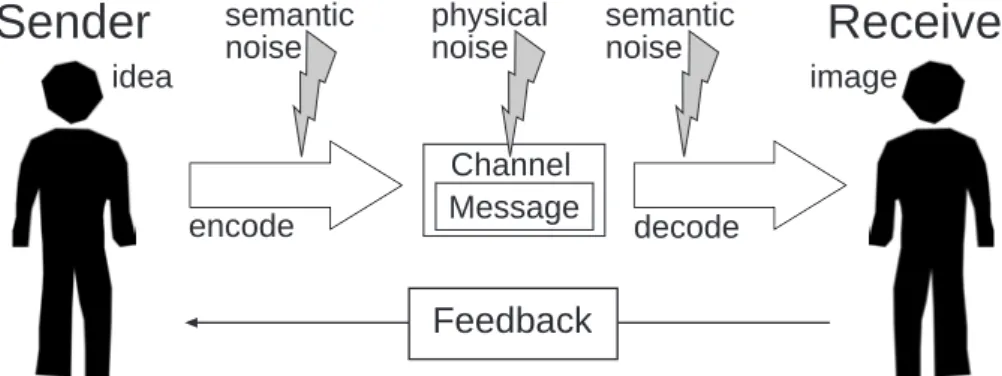
Figure 2.2 shows an adapted version of the Shannon-Weaver model which incorporates several modifications to remedy these shortcomings. A sender encodes an idea into a message and sends it via a channel to a receiver who decodes the message and tries to reconstruct an image of the idea. Commu-nication is successful if the image created at the receiver side corresponds to
the initial idea of the sender.
Sender
Receiver
Feedback Message Channel encode decode semantic noise semantic noise physical noise idea imageFigure 2.2: The Shannon-Weaver model of interpersonal communication, simplified from DeVito (1998, page 12).
Feedback: Knowing the success or failure of a sent message is important for the sender as it provides guidance when selecting the content and the encoding strategy of following messages. In face-to-face communication, the receiver can indicate successful decoding of a message into something mean-ingful by the occasional “mm-hm”, “yes, I see”, subtle head nods, smiles, and so on. Knowing that a receiver has been able to decode messages allows the sender to continue encoding in the same manner, or even to speed up. On the contrary, if a receiver indicates a potential decoding error with a surprised look or a “sorry?”, “hold on”, and so on, it gives the sender the chance to re-peat, re-encode, and clarify. This self regulating mechanism between sender and receiver is accounted for in the adapted communication model by the addition of a feedback loop1. The inclusion of feedback significantly changes
the conception of communication from being a static and one-way informa-tion transmission of informainforma-tion to being a dynamic system with the purpose of meaning transfer in which sender and receiver are mutually dependent.
1The concept of feedback was introduced by Norbert Wiener (1948) roughly at the same
Including meaning: While the terms encoding and decoding of messages were merely used in the context of signal (symbol) conversion in the original model, the same terms are used in the adapted model within a higher seman-tic context. The sender is the encoder who converts ideas into messages. The receiver acts as the decoder who tries to reconstruct an adequate image of the initial idea by means of interpretation. In interpersonal communication, decoding and encoding are therefore referred to as complex cognitive (instead of technical) processes. Therefore, in a telephone call it is not enough for a receiver to only hear a message properly; he or she must understand it in order for communication to be successful.
Semantic noise: Including the semantic level into a model of communi-cation introduces a new problem. What, for example, if the sender and the receiver speak entirely different languages? In that case verbal communica-tion is bound to fail as the receiver is not capable of decoding the messages the sender encoded. This problem is accounted for in the adapted model through the inclusion of semantic noise at the decoding as well as the encod-ing side. At a basic level, in order for communication to be successful and to reduce semantic noise to a minimum, it is necessary that the sender and receiver share a common set of vocabulary, or more generally, a common set of meaning-to-symbol-associations. The decoding of messages can be tricky if they contain a certain level of ambiguity. In these cases, the decoding process involves a lot of interpretation where contextual factors such as the current situation, the relationship between sender and receiver, and personal experiences play crucial roles.
The Lasswell Formula: The impact of the relation between sender and receiver, as well as the impact of the choice of the appropriate channel, is of pivotal importance for communication processes. Building on the adapted Shannon-Weaver model, the sociologist Lasswell therefore recommended the consideration of five elements when studying the social aspects of communi-cation (see Figure 2.3).
Lasswell’s primary interest was in mass communication. Therefore he explicitly included the effects of communication as a separate element.
How-Who? Sender Says What? Messenger In What Medium? Channel To Whom? Receiver With What Effect? Impact
Figure 2.3: The Lasswell formula (Lasswell 1948).
ever, breaking down communication into the given five elements is also help-ful for studying interpersonal communication. Guided by this framework, the following sections briefly outline selective findings from communication studies that are relevant to this thesis.
Message and channel: Messages in interpersonal communication can be composed as verbal or nonverbal expressions, which are then conveyed via the auditory and visual channels2. While verbal messages (e.g. spoken or written words) carry the formal content of a message, non-verbal messages add to and complete their meaning, provide feedback from listeners, and facilitate coordination. Argyle (1992, pages 8-12) lists the tone of voice, pauses, gestures, and gaze as non-verbal signals a speaker typically emits while speaking. Likewise, he finds vocalisations, gestures, facial expressions, posture, and gaze to be typical non-verbal signals mainly for the purpose of feedback on the side of the listener.
Eye-contact and gaze direction play a significant role in human social behaviour in general and in the coordination process during conversations in particular (Kendon 1967). As Argyle and Cook (1976) point out, speak-ers and auditors use gaze during face-to-face convspeak-ersations to exchange and maintain roles, to regulate turn-taking behaviour, to signal attention or bore-dom, and to give and seek feedback in the form of short glances.
When engaged in a conversation, people are not always aware of the many non-verbal messages they are permanently encoding, sending, receiving, and decoding. Yet, according to Argyle and Dean (1965), the choice and the fre-quency of certain non-verbal messages are neither random nor independent of
2The olfactory and tactile channels also play roles in interpersonal communication.
each other. Argyle and Dean (1965) suggest a theory in which an equilibrium for a certain level of intimacy is developed between people, where intimacy is a joint function of eye-contact, physical proximity, intimacy of topic, or smiling. There is a certain level of intimacy participants feel comfortable with and which they try to maintain. Therefore, if the intimacy equilibrium is disturbed because of the increase or decrease of one component, other components compensate to re-establish the equilibrium. For example, if two people increase the physical distance between themselves, they decrease their level of intimacy, which they can then re-establish by an increase in smiling or eye-contact (for example).
Sender and receiver: Communication styles differ between people. The impact of culture, power relations, social class, or gender have been studied in depth. Findings in that field reach far beyond the scope of this thesis. The next paragraphs can therefore only selectively show two types of differences that can be expected when comparing communication first between friends and strangers, and second, between men and women. Differences based on the familiarity and gender of communicators were selected based on their relevance during the remainder of this thesis.
As previously mentioned, for successful decoding of messages, sender and receiver have to share a common set of vocabulary orcommon ground, which is some shared information that can be taken for granted and that each assumes the other possesses (Argyle 1992, page 9). Between people who know one another well or who belong to the same group or community, or who work together, there is extensive common ground (Clark 1985). It can therefore be expected that the better people know each other, the easier it is for them to communicate. In contrast, when strangers meet for the first time, they have to get to know each other and build up a common ground during the course of the conversation. Communication patterns are then likely to be dominated by social protocols that reflect appropriate behaviour for politeness, respect, and friendliness. Sharing an idea with a stranger thus involves more work and is therefore less efficient.
Men and women tend to communicate in different ways, especially when talking to a same gender friend. There is a general consensus in the literature
that women engage more in self-disclosure, and talk about more intimate top-ics to other women, while men avoid externalising emotion and instead are more oriented toward some external task, competition, or activity sharing. Wright (1982) summarises that “for men friendship tends to be a side-by-side relationship, with the partners mutually oriented to some external task or activity; while for women friendship tends to be a face-to-face relationship, with the partners mutually oriented to a personalised knowledge of and con-cern for one another.” Hall (1990) reviewed findings of several studies on non-verbal gender differences which are aligned with this characterisation. These findings include that female faces are more expressive, that women smile more, and that women gaze more at others than males do.
Effect: Lasswell introduced the question for possible effects or outcomes to the study of communication. An outcome of particular interest for the study of mass media is, for example, the degree to which a sender is able to per-suade or deceive his audience. In the context of cooperative communication, however, it is assumed that both sender and receiver have a common problem that they are trying to solve. The desired outcome of communication in this case would be that a message is understood and ultimately helps the sender and receiver to reach their common goal.
The next section explains the concept of collaboration as a special case of interpersonal communication.
2.1.3 Collaboration
Section 2.1.1 introduced the general Shannon-Weaver model of communica-tion, Section 2.1.2 showed how this model can be applied to describe the process of interpersonal communication. This section focuses on collabora-tive interpersonal communication, the type of human-to-human interaction that is at the centre of CSCW research.
Collaboration generally refers to the process of people being engaged in joint, interdependent activities in order to achieve a common goal3. A
classi-3For an in-depth review of different definitions of the term “collaboration”, please refer
cal example for collocated, synchronous collaboration would be a round-table meeting where participants discuss various documents and have to achieve a defined goal (find the best solution/decision for a problem) within a limited time frame. Collaboration, like interpersonal communication, is the process of creating unique shared meaning, where the body of accumulated shared meaning serves as the basis for joint action that leads to solving the task at hand. Figure 2.4 shows a simple model for collaboration, which is a further extension of Shannon-Weaver model of interpersonal communication discussed earlier. Message Channel decode Context Context noise noise noise encode decode decode encode
Shared
Situation
Model
Figure 2.4: A simple model for collaboration.
Collaboration is driven by the exchange of messages. Participants engage in both sender and receiver roles and therefore both encode/send messages and receive/decode messages from each other, including feedback. During the process of collaboration, every participant develops his or her own men-tal Situation Model which contains the available information, possible alter-native solutions, evaluation of alteralter-natives, and so on. The largest part of the collaborative effort for participants is to expand each other’s situation models and maximise overlap. (The overlap represents participants’ shared understanding which is the common ground from where a solution for the task at hand can evolve.)
Grounding: Accumulating common ground is an interactive process and is fundamental to all collective actions (Clark and Brennan 1991). To succeed in grounding a message, that is to make it part of their common ground, it is crucial for participants to ensure that a message has been understood as it was intended. The way in which participants ground their messages depends on the individual situation.
• Verbal grounding: grounding is evident in spoken conversations. As previously mentioned, listeners may signal their understanding in form of positive feedback, also referred to as acknowledgements or backchan-nel responses. For other, more subtle forms of verbal grounding refer to Clark and Brennan (1991).
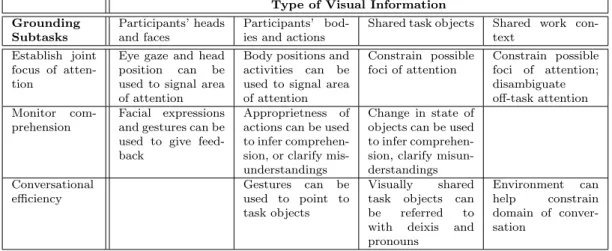
• Non-verbal grounding: Fussell et al. (2000) collected different types of visual (non-verbal) information and highlighted their relevance for three grounding subtasks. Table 2.1 is an adapted version of their table. It shows the different forms of body language people can use to coordinate each other’s attention and give feedback. Fussell et al. (2000) also considered the often neglected role of shared objects and a shared work context on facilitating grounding.
Type of Visual Information Grounding
Subtasks
Participants’ heads and faces
Participants’ bod-ies and actions
Shared task objects Shared work con-text
Establish joint focus of atten-tion
Eye gaze and head position can be used to signal area of attention
Body positions and activities can be used to signal area of attention Constrain possible foci of attention Constrain possible foci of attention; disambiguate off-task attention Monitor com-prehension Facial expressions and gestures can be used to give feed-back
Approprietness of actions can be used to infer comprehen-sion, or clarify mis-understandings
Change in state of objects can be used to infer comprehen-sion, clarify misun-derstandings Conversational efficiency Gestures can be used to point to task objects Visually shared task objects can be referred to with deixis and pronouns
Environment can help constrain domain of conver-sation
Table 2.1: Benefits of four types of visual information for three grounding subtasks (adapted from Fussell et al. (2000)).
Least collaborative effort: When trying to ground their utterances, par-ticipants strive to encode their messages in the most efficient and appropri-ate way possible. An important general rule that underlies the grounding processes is theprinciple of the least collaborative effort, according to which participants in conversations always try to minimise their collaborative effort – the work that both do from the initiation of each contribution to its mutual acceptance (Clark and Brennan 1991).
For example, being able to point at a visually shared object during a col-laboration allows for a very easy, brief, and concise way of referencing through a deictic utterance (e.g. “this one”) and therefore helps to reduce collabo-rative effort. It can therefore be expected that participants use indicative gestures (pointing, looking, touching) whenever possible to refer to nearby objects they attend to, as gestures come at a lower collaborative cost than having to describe the objects verbally. However, Clark and Wilkes-Gibbs (1986) point out that in real conversations minimizing effort does not nec-essarily always lead to the formulation of the shortest and most appropriate utterances. Rather, starting with an improper utterance and then repairing it together with the other participant, or splitting up one complicated utter-ance into multiple smaller parts can involve less work than having to plan and encode one flawless message in the first place.
2.1.4 Criticisms of transmission models
Message-centred transmission models are attractive to several academic dis-ciplines because of their simplicity, generality, and quantifiability. However, many communication theorists consider them misleading and misrepresenta-tions of the nature of some aspects of human communication.
Reddy (1979), for example, argues theconduit metaphor of sending mes-sages that contain units of retractable meaning is oversimplified as it does not reflect the complex cognitive processes that are necessary for sender and receiver to actually make sense of a message. A communication theory should conceive of meaning as being actively constructed rather than being passively extracted, and should therefore account for the powerful human ability of interpretation. Furthermore, Carey (1989) points out that communication
models where the receiver is a passive target who merely has to unpack and accept mirrored images of ideas that exist in the sender’s mind would allow the sender not only to share ideas but also to control and manipulate people. This, however, neglects that the receiver can interpret and evaluate the con-tent of a message, and then decide whether to accept, ignore, or oppose it. These possibilities are not considered in transmission models. Other points of criticism include that transmission models generally overlook the context and the dynamic changes of the context in which communication takes place, and that they do no justice to the impact of the relationship between sender and receiver.
These issues must be kept in mind when applying the previously intro-duced transmission models in the remainder of this work.
2.1.5 Summary
The last sections explained communication in terms of the transmission of messages between a source and a destination. Starting with Shannon and Weaver’s (1949) general model of communication, basic communication ter-minology was introduced. Successive sections then applied the principle of message exchange first to interpersonal communication, and second to col-laboration between people.
The goal of interpersonal communication is to establish a shared under-standing between sender and receiver. Communication between people is effective if shared, unique meaning can be created. Communication between people is furthermore efficient if the creation of shared meaning involves the least possible effort. Communication is more efficient if people can choose the easiest from different available communication channels to formulate their messages, and if they can easily monitor if the messages they sent were un-derstood by others the way they were intended to.
Although conceiving human communication mainly in terms of exchang-ing messages is simplified and does not do many aspects of human commu-nication justice, it serves as a useful model for the following sections, which will discuss how the exchange of messages is influenced by the use of different telecommunication media.
2.2 Mediated communication
If it is impossible for people to be at the same place at the same time, they can use telecommunication technology to bridge the distance that lies between them. A large variety of communication-mediating technologies are available. Section 2.2.1 characterises different types of media in the context of social presence and media richness theory, as well as in terms of their ability to support grounding mechanisms. Section 2.2.2 outlines theoretical considerations found in the literature that draw connections between media characteristics and media use. Section 2.2.3 then focuses on strategies that were implemented to mediate situation awareness in situations where distant persons collaborate in shared applications and online workspaces.
2.2.1 Media characteristics
Telecommunication media differ in their characteristics and have been cate-gorised in numerous ways. Media can for example be coarsely distinguished as being synchronous (supporting communication in real time), or asyn-chronous (supporting non-real time communication) (Johansen 1988). More finely grained classifications characterise different media according to:
• their richness in terms of their ability to convey ambiguous information.
• the techniques they allow for grounding.
• their degree of salience of the interpersonal relationship in the in-teraction (social presence as a subjective quality of a communication medium).
• the degree to which they support a sense of “being together with an-other” (social presence as psychological state).
In the following, these four classifications and theories are explained in more detail.
Media richness
Daft and Lengel (1984, 1986, 1987) developed the concept of media richness in an attempt to match the appropriate type of medium with the level of ambiguity of a given task. Communication media have an intrinsic “richness” based on their support for instant feedback, the number of available channels and cues, language variety, and personalization. Daft and Lengel suggest that the richer a medium is, the better it can handle ambiguous situations which often include disagreements, confusion, or a lack of understanding.
Communication Media Face-to-face Telephone Media Richness high low
Written, addressed documents (e.g. note, memo, letter)
Unaddressed documents
(e.g. flier, bulletin, standard report)
Figure 2.5: Richness of different communication media, adapted from Daft et al. (1987, page 358).
Figure 2.5 shows the hierarchy of a selection of communication media (Daft et al. 1987, page 358). Face-to-face is the richest communication medium. The telephone medium is less rich, because visual cues and body language are filtered out, putting emphasis on language content and audio cues to reach understanding. Telephone conversations, however, allow for fast feedback and are personal, because they allow for natural language. Asyn-chronous, written media are low in richness, because they do not provide rapid mutual feedback and inhibit any audio cues. Visual cues are reduced to those on the paper. Further differences in richness among written media are determined based on the level of personalization they support (addressed
versus unaddressed documents).
Media and grounding
As noted in Section 2.1.3, achieving common ground is pivotal to all coop-erative activities. When people interact with each other at a distance, the communication medium used has a considerable impact on the possible ways common ground can be established. Clark and Brennan (1991) therefore suggested that any medium that supports cooperative work can be char-acterised in terms of the ways it supports grounding. They provided the following framework containing eight constraints that a medium may impose on communication between two or more participants:
• Copresence: Participants share the same physical environment
• Visibility: Participants can see each other
• Audibility: Participants can use speech to communicate
• Cotemporality: Messages are received immediately after they are sent
• Simultaneity: Participants can send and receive messages at the same time
• Sequentiality: Participants’ turns cannot get out of sequence
• Reviewability: Messages can be reviewed
• Revisability: Messages can be revised
By placing different media in this framework, differences as well as sim-ilarities between them emerge that help us understand and distinguish the ways in which different media may allow the acquisition of common ground. Table 2.2 graphically underlines the different nature of synchronous and asynchronous media. It also shows where asynchronous media can potentially outperform synchronous media, namely in situations where it is beneficial if messages can be reviewed and revised ex post.
Medium Copresence Visibilit y Audibilit y Cotemp o ralit y Sim ult aneit y Sequen tia lit y Review a bilit y Revisa bilit y Face-to-Face • • • • • • Videoconference • • • • • Telephone • • • • Instant Messaging • • • • • Answering Machine • • E-mail • • Letter • •
Table 2.2: Constraints of different media for grounding processes (adapted from Olson and Olson (2000)).
Social presence as a subjective quality of medium
In an attempt to determine the relative effectiveness of different media chan-nels for social communication, Short et al. (1976) developed the “Social Pres-ence Theory”. It is based on Douglas’s (1957) premise that every interaction between two persons involves an “interparty” as well as an “interpersonal” as-pect, where the interparty component is task-focused, and the interpersonal component is concerned with developing and maintaining some personal re-lationship.
Morley and Stephenson (1969) subsequently argued that there is a balance between the interparty and the interpersonal component which is affected by a certain communication medium, or, more accurately, by the amount and the combination of non-verbal cues that a certain communication medium supports. In telephone conversations, for example, with the absence of the visual channel which is mostly associated with the interpersonal channel, this balance is shifted more towards the interparty side. Morley and Stephenson explain that, therefore, people talking over the phone are likely to be less concerned with the presentation of the self, and more task-oriented.
Short et al. believed that “the degree of salience of the other person in the interaction and the consequent salience of the interpersonal relationships is
an important hypothetical construct... (page 65)”, which they term “Social Presence”.
Social presence is conceived to be a quantifiable property of a communica-tion medium as perceived by a person who is using the medium. The absence or existence of certain verbal or non-verbal cues in a communication medium contribute to its social presence as they affect the interparty/interpersonal balance in one way or the other. However, as social presence is understood as a perceptual or attitudinal dimension of the user, it can not simply be “calculated” by adding the number of existing communication channels, but rather results from a user’s “cognitive synthesis” thereof.
The semantic differential technique: Social presence, although a prop-erty of the communication itself, is subjectively experienced by a user in the form of a “mental set” towards the medium, and can therefore only be mea-sured subjectively. For assessing social presence, Short et al. applied the semantic differential technique which was developed by Osgood et al. (1957). This technique was an attempt to measure the subjective meaning of any concept (real objects as well as abstract constructs) in the form of a discrete point within a semantic space that was spanned by dimensions empirically determined through factor analysis. In an attempt to find factors that de-termine the meaning of a particular concept, Osgood et al. applied multiple seven-step scales having a bipolar (verbal opposites) form and defined by adjectives. The underlying assumption is that thinking in terms of opposites is “natural” to the human species. Figure 2.6 shows an example.
good bad
Figure 2.6: Example of a bipolar scale.
In the course of multiple studies that Osgood et al. conducted, they iden-tified the dimensionsEvaluation(e.g. good-bad),Potency (e.g. strong-weak) and Activity (e.g. active-passive) to be the three predominant dimensions that underlie human judgement and which span the human semantic space.
Figure 2.7: Social presence of several communication media, (Short et al. 1976, page 71).
Short and his colleagues also experimented with several semantic dif-ferential scales to assess some social and emotional capabilities of different telecommunication media. Among the numerous bipolar pairs applied, they found one recurring factor emerge from scales such as unsociable–sociable, insensitive–sensitive, cold–warm, and impersonal–personal which reflected the social presence of a medium. Media with a high degree of social presence were judged as being warm, personal, sensitive, and sociable.
The application of semantic differential scales to evaluate subjective me-dia qualities is “the most commonly used measure of social presence”(Biocca et al. 2003, page 465). Figure 2.7 shows the ordering of social presence of several media as the result of two initial studies.
Face-to-face is rated highest in social presence, followed by visual, non-visual, and written media. Furthermore, the social presence ratings differ for “mono-aural speaker” and “multispeaker audio”, suggesting that social presence may vary even between two versions of the same medium. Short et al. (1976) therefore assume that social presence “depends upon not only the visual non-verbal cues transmitted, but also more subtle aspects such as the apparent distance or the realness of the other.”
Short et al. (1976) consider media with higher social presence not sim-ply as the better or more effective medium. Rather, the suitability of any medium depends on the fit between the social presence of a medium and the social presence required by the task. Therefore, the outcome of individuals communicating may be more affected by the social presence of the medium in tasks that involve a higher interpersonal or emotional component than in mere factual information transfer or simple problem-solving tasks.
Social presence as psychological state
Short et al. (1976) coined and popularised the use of the term “social pres-ence” in the late 1970s. Since then, with the emergence of a presence research community (see Section 2.4.1) in the early 1990s, it has been broadened to include the “extent to which other beings (living or synthetic) also exist in the world and appear to react to you” (Heeter 1992), the “feeling that the people with whom one is collaborating are in the same room” (Mason 1994), and the “sense of being together” (de Greef and IJsselsteijn 2001) (for a detailed review of social presence definitions see Biocca et al. (2003)).
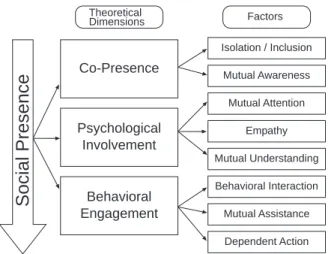
Biocca et al. (2001) recently attempted to integrate all existing definitions into one single, broader social presence theory. They argue that such a theory contributes to a wider understanding of social behaviour in mediated environments and allows researchers to better predict and measure differences among media interfaces.
Biocca et al. define mediated social presence as:
“the moment-by-moment awareness of the co-presence of another sentient being accompanied by a sense of engagement with the other (i.e., human, animate, or artificial being). Social presence varies from