Glasgow Theses Service http://theses.gla.ac.uk/
Alnowaiser, Khaled Abdulrahman (2016) Garbage collection
optimization for non uniform memory access architectures.
PhD thesis.
http://theses.gla.ac.uk/7495/
Copyright and moral rights for this thesis are retained by the author
A copy can be downloaded for personal non-commercial research or study This thesis cannot be reproduced or quoted extensively from without first obtaining permission in writing from the Author
The content must not be changed in any way or sold commercially in any format or medium without the formal permission of the Author
When referring to this work, full bibliographic details including the author, title, awarding institution and date of the thesis must be given
G
ARBAGE
C
OLLECTION
O
PTIMIZATION
FOR
N
ON
U
NIFORM
M
EMORY
A
CCESS
A
RCHITECTURES
K
HALED
A
BDULRAHMAN
A
LNOWAISER
SUBMITTED IN FULFILMENT OF THE REQUIREMENTS FOR THE DEGREE OF
Doctor of Philosophy
S
CHOOL OF
C
OMPUTING
S
CIENCE
C
OLLEGE OFS
CIENCE ANDE
NGINEERINGU
NIVERSITY OFG
LASGOWJUNE 2016
Abstract
Cache-coherent non uniform memory access (ccNUMA) architecture is a standard design pattern for contemporary multicore processors, and future generations of architectures are likely to be NUMA. NUMA architectures create new challenges for managed runtime sys-tems. Memory-intensive applications use the system’s distributed memory banks to allocate data, and the automatic memory manager collects garbage left in these memory banks. The garbage collector may need to access remote memory banks, which entails access latency overhead and potential bandwidth saturation for the interconnection between memory banks. This dissertation makes five significant contributions to garbage collection on NUMA sys-tems, with a case study implementation using the Hotspot Java Virtual Machine.
It empirically studies data locality for a Stop-The-World garbage collector when tracing con-nected objects in NUMA heaps. First, it identifies a locality richness which exists naturally in connected objects that contain a root object and its reachable set— ‘rooted sub-graphs’. Second, this dissertation leverages the locality characteristic of rooted sub-graphs to develop a new NUMA-aware garbage collection mechanism. A garbage collector thread processes a local root and its reachable set, which is likely to have a large number of objects in the same
NUMA node. Third, a garbage collector thread stealsreferences from sibling threads that
run on the same NUMA node to improve data locality.
This research evaluates the new NUMA-aware garbage collector using seven benchmarks of an established real-world DaCapo benchmark suite. In addition, evaluation involves a widely used SPECjbb benchmark and Neo4J graph database Java benchmark, as well as an artificial benchmark. The results of the NUMA-aware garbage collector on a multi-hop NUMA architecture show an average of 15% performance improvement. Furthermore, this performance gain is shown to be as a result of an improved NUMA memory access in a ccNUMA system.
Fourth, the existing Hotspot JVM adaptive policy for configuring the number of garbage collection threads is shown to be suboptimal for current NUMA machines. The policy uses outdated assumptions and it generates a constant thread count. In fact, the Hotspot JVM still uses this policy in the production version. This research shows that the optimal number of garbage collection threads is application-specific and configuring the optimal number of garbage collection threads yields better collection throughput than the default policy. Fifth, this dissertation designs and implements a runtime technique, which involves heuristics from dynamic collection behavior to calculate an optimal number of garbage collector threads for each collection cycle. The results show an average of 21% improvements to the garbage collection performance for DaCapo benchmarks.
Acknowledgements
All my praises be to Allah, the almighty, for granting me the strength and patience to com-plete this research successfully.
I would like to express my deepest gratitude and appreciation to my supervisor, Dr. Jeremy Singer, for his encouragements, guidance, and support. I am grateful for his advice and inspiration. I also extend my gratitude to Dr. Paul Cockshott for all the interesting and challenging discussion, which helped me shaping this research in a coherent way.
I am grateful to my sponsor, Prince Sattam bin Abdulaziz University for funding this PhD research. I would like to thank the support team and colleagues in the School of Computing Science for providing me with all help to complete this research.
Finally and most importantly, I offer my gratefulness to my family for their constant care, encouragement, and support throughout my life. I am thankful to my wife and children for their support and patience.
TABLE OF CONTENTS
Abstract I Acknowledgments II 1 Introduction 1 1.1 Overview . . . 1 1.2 Thesis Statement . . . 4 1.3 Contributions . . . 5 1.4 Publications . . . 5 1.5 Thesis Outline . . . 6I
STATE OF THE ART
8
2 Literature Survey 9 2.1 Basic Garbage Collection Algorithms . . . 102.1.1 Mark-Sweep Collection . . . 11
2.1.2 Mark-Compact Collection . . . 11
2.1.3 Copying Collection . . . 12
2.2 Parallel Garbage Collection . . . 13
2.3 Heap Partitioning . . . 17
2.3.1 Thread-local Heaps . . . 18
2.4 NUMA Heaps . . . 21
2.5 Object Locality . . . 23
2.5.1 Cache Locality Optimization . . . 24
2.5.2 Memory Page Locality Optimization . . . 26
2.6 Object Clustering . . . 30
2.7 Data Placement Policies . . . 31
2.8 Conclusion . . . 33
3 Technical Background 34 3.1 Introduction . . . 35
3.2 Parallel Architectures . . . 36
3.2.1 Distributed Memory Architectures . . . 37
3.2.2 Shared Memory Architectures . . . 38
3.3 Non-Uniform Memory Access Architecture . . . 40
3.4 NUMA Memory Allocation Policies . . . 43
3.5 Virtual to Physical Memory Page Mapping . . . 44
3.5.1 Memory Pages . . . 45
3.6 Java Virtual Machine and Garbage Collection . . . 47
3.6.1 The Copying Collector . . . 49
3.6.2 The Mark-Compact Collector . . . 52
3.6.3 The Parallel Scavenge Optimizations for NUMA Machines . . . 53
3.7 Conclusion . . . 54
4 Experimental System Infrastructure 55 4.1 Hardware Setup . . . 56
4.2 Benchmarks . . . 56
4.2.1 DaCapo Benchmark Suite . . . 57
4.2.3 GCBench . . . 60
4.2.4 Neo4j / LiveJournal . . . 60
4.3 Conclusion . . . 61
II
CONTRIBUTIONS
62
5 A Study of Reference Locality 63 5.1 Introduction . . . 645.2 Rooted Sub-Graphs . . . 65
5.3 Implementation . . . 68
5.4 Limitations . . . 69
5.5 Experimental Setup . . . 70
5.6 Reference Locality Evaluation . . . 72
5.6.1 Locality-distributed Rooted Sub-graph . . . 72
5.6.2 Rooted Sub-graph Locality Analysis . . . 75
5.6.3 GC Impact on Rooted Sub-graph Locality . . . 79
5.7 Related Work . . . 82
5.8 Conclusion . . . 84
6 NUMA-Aware Garbage Collector 86 6.1 Introduction . . . 87
6.2 Motivation . . . 88
6.3 NUMA-Aware Copying Collector . . . 89
6.3.1 Data Structures . . . 90
6.3.2 Algorithm . . . 91
6.3.3 Optimization Schemes . . . 92
6.4 NUMA-Aware Garbage Collector Evaluation . . . 93
6.4.1 Evaluation Metrics . . . 93
6.4.2 Relative NUMA Locality Trace . . . 94
6.4.3 Pause Time and VM Time Analysis . . . 97
6.5 Related Work . . . 103
6.6 Conclusion . . . 105
7 NUMA-Aware Garbage Collection Thread Management 107 7.1 Introduction . . . 108
7.2 Hotspot GC Threads Management . . . 110
7.3 Impact of Varying the Number of Collector Threads on Throughput . . . . 112
7.4 Static Optimization . . . 116 7.5 Dynamic Optimization . . . 121 7.6 Related Work . . . 125 7.6.1 NUMA GC Characterization . . . 125 7.6.2 Causes of Congestion . . . 125 7.6.3 Reducing Congestion . . . 127 7.7 Conclusion . . . 127
III
CONCLUSION
128
8 Conclusion 129 8.1 Thesis Statement Revisited . . . 1308.2 Contributions . . . 131
8.3 Future Research Directions . . . 133
8.3.1 Experimental Setup Generalization . . . 134
8.3.2 NUMA Architectures without Cache Coherency . . . 135
A Gradient-Ascent Algorithm 137
LIST OF TABLES
LIST OF TABLES
3.1 NUMA delay time between nodes. . . 36
3.2 First 290 virtual pages were mapped to memory nodes in a round robin order.
Then, transparent huge pages are used to map every 512 virtual page to a
memory node. . . 47
4.1 Benchmarks and heap configuration . . . 57
6.1 Optimization schemes for NUMA-aware garbage collection. . . 93
LIST OF FIGURES
LIST OF FIGURES
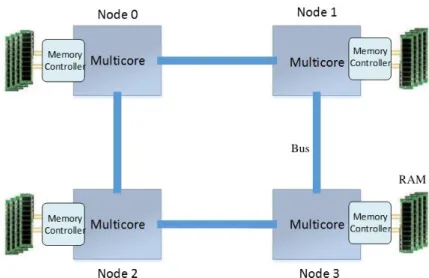
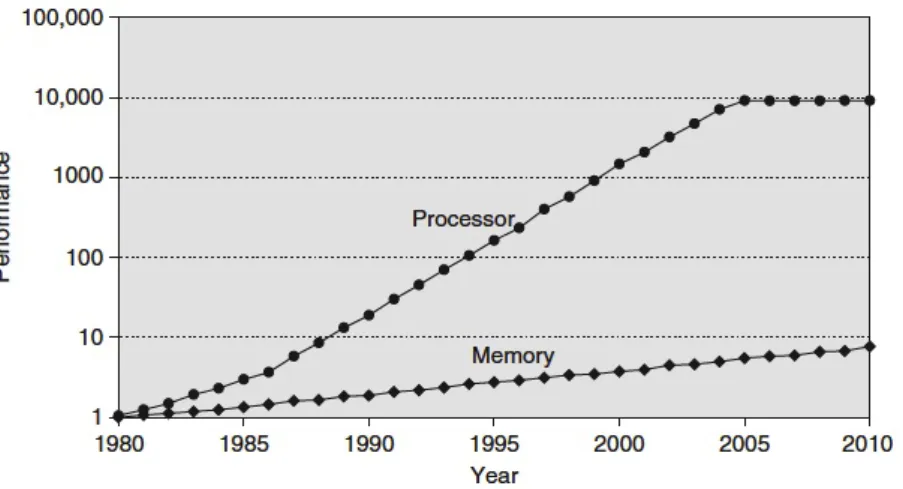
1.1 An example of a NUMA architecture . . . 2
3.1 The performance gab between processor and access to main memory. Source:
[Hennessy and Patterson, 2011a] . . . 36
3.2 A standard multicore UMA architecture diagram. . . 39
3.3 A standard multi-hop multicore NUMA architecture diagram. . . 39
3.4 AMD Opteron 6366 NUMA architecture topology. This diagram is
gener-ated by lstopo tool [Broquedis et al., 2010]. . . 41
3.5 AMD NorthBridge micro-architecture. Source [Conway and Hughes, 2007] 42
3.6 Memory Request . . . 43
3.7 Hierarchical Page table for 4KB page size on 64-bit x86 Linux. Source
[AMD, 2015] . . . 45
3.8 Hierarchical Page table for 2MB page size. Source [AMD, 2015] . . . 46
3.9 JVM data areas . . . 48
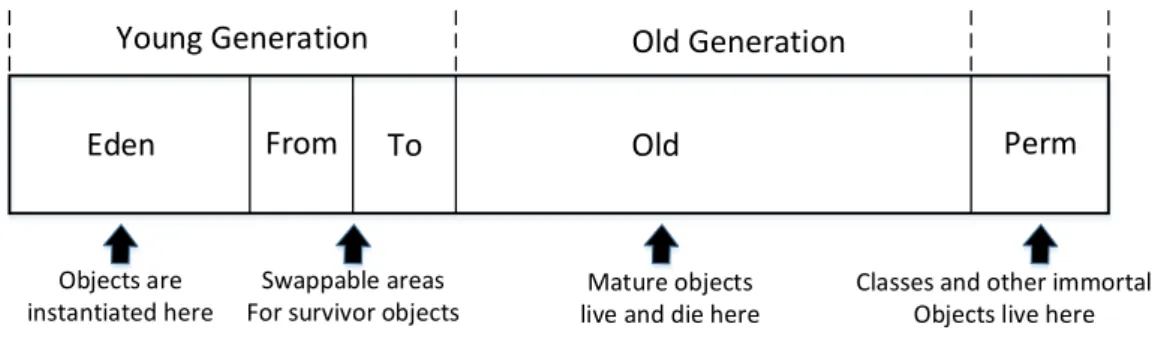
3.10 A schematic view of the heap spaces: Eden and survivor spaces (the young
generation) and the old generation . . . 49
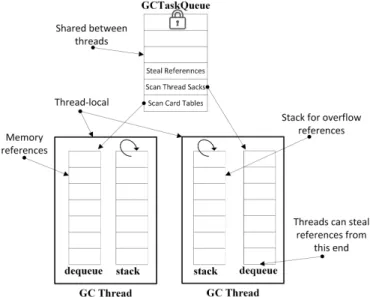
3.11 A diagram of the GCTask and thread-local data structure. . . 50
LIST OF FIGURES
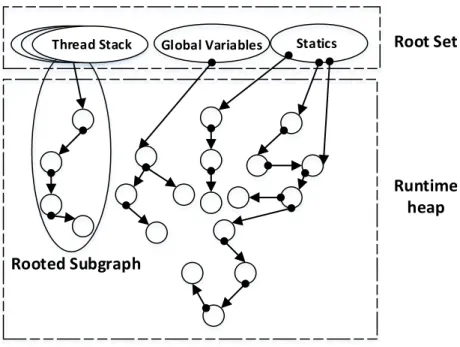
5.2 Rooted subgraphs for X and Y can be different depending on who first marks
the node Z. The result is non-deterministic. . . 70
5.3 An explanatory example of heat map results . . . 71
5.4 A snapshot of GCBench rooted subgraph locality in a single collection.
Ref-erences point to objects that are distributed across multiple NUMA nodes. . 73
5.5 The correlation between Rooted sub-graph locality and thesize of the
sub-graph for GCBench. Large-sized sub-sub-graphs are more likely to cross
multi-ple memory nodes. . . 74
5.6 A snapshot of DaCapo and SPECjbb2005 rooted sub-graphs locality in all
collections. Locality of sub-graphs is represented by diagonal black squares, which show that a high proportion of objects are located in the same root
memory node. The color key is the same as in Figure 5.4. . . 78
5.7 A snapshot of SPECjbb2005 rooted sub-graph locality in a single collection.
The GC pollutes sub-graph locality, though over 50% of references remain
in the root’s memory node. The Color key is the same as in Figure 5.4. . . . 81
6.1 Various topology-aware GC schemes. a) aggressive scheme only processes
thread-local tasks b) hybrid scheme distributes tasks across all nodes but steals from local threads only. c) relaxed scheme processes random tasks
from any node . . . 90
6.2 Relative NUMA Locality Trace results for evaluated workloads. On average,
53% of objects are NUMA-local within rooted sub-graphs. . . 95
6.3 Relative NUMA Locality Traces for various root types: old-to-young, thread
stacks, and class loader roots. Old-to-young rooted sub-graphs exhibit
rela-tively low locality. . . 96
6.4 GC time (i.e. pause time) for our three optimization schemes. For small
heaps (e.g. DaCapo programs), hybrid scheme gives the best results, whereas aggressive scheme is more effective for programs with larger heaps. (The
default JVM is labelled Org.) . . . 98
6.5 VM time (i.e. end-to-end execution time) for our three optimization schemes.
At least one scheme provides better VM execution time than default (labelled
Org) in most cases. . . 99
6.6 GC time and VM time comparison between local access, remote access, and
the default JVM. GC and VM times for remote access is higher than local
LIST OF FIGURES
6.7 GC time scaling with heap size for Neo4j/LiveJournal. GC time decreases
with heap size for our optimized versions, whereas the original
implementa-tion does not show any scaling. . . 102
6.8 VM time scaling with heap size for Neo4j/LiveJournal. VM time decreases
with increased heap size for our optimized versions, whereas the original
implementation does not show any scaling. . . 103
7.1 Hotspot JVM policy for setting a dynamic number of garbage collection
threads. . . 111
7.2 Minor collection throughput varies with number of collector threads (higher
is better) . . . 113
7.3 Major collection throughput varies with number of collector threads (higher
is better) . . . 114
7.4 Off-node memory events over interconnect links between nodes; each line represents per-node average memory events over all four links (lower is better).117
7.5 Fitted quadratic curves for benchmark GC throughput observations for minor
collections . . . 119
7.6 Fitted quadratic curves for benchmark garbage collection throughput
obser-vations for major collection . . . 120
7.7 Garbage collection pause time comparison for various garbage collection
threading policies (lower is better) . . . 121
7.8 Comparison of overall application performance for various garbage
collec-tion threading policies (lower is better) . . . 122
7.9 Schematic diagram for adaptive runtime GC threads management system. . 123
7.10 Gradient ascent optimization searches for optimal value which is on the top of the hill, where the slope is zero. At any point to the left, the slope value is positive, indicating that optimal direction is forward. If the point is to the
right, the slope is negative and the direction is back. . . 123
7.11 Gradient ascent algorithm to optimize the number of GC threads . . . 124
7.12 Illustrative graphs showing how the number of collector threads varies over
ACRONYMS
AMD Advanced Micro Devices
CPU Central Processing Unit
DCT DRAM Controller
DSM Distributed Shared Memory
JNI Java Native Interface
JVM Java Virtual Machine
LLC Last Level Cache
MCT Memory Controller
NUMA Non-Uniform Memory Access
PLAB Promotion Local Allocation Buffer
QPI QuickPath Interconnect
SMP Symmetric Multiprocessor Chip
SRI System Request Interface
THP Transparent Huge Page
TLAB Thread Local Allocation Buffer
CHAPTER
1
INTRODUCTION
This chapter introduces the context of garbage collection optimization for non-uniform mem-ory access architectures. It also presents the motivation to carry out this research followed by the thesis statement. The chapter reports the main contributions and publications of this research and concludes by outlining the dissertation structure.
1.1
Overview
The revolution in semiconductor technologies, marked by the prevalence of multicore
pro-cessors, has created high computational capacity resources to enhance program performance. Programmers split the code into several segments and use a parallel programming model to enable the execution of some segments in parallel. Today, data-intensive applications, for example databases, data analytic engines, and application servers, have consumed available CPU and memory resources on server-class machines. This increasing growth in applica-tions’ computation needs has demanded a rapid expansion on hardware resources.
Since the transition from unicore to multicore processors [Sutter and Larus, 2005], the core counts have increased consistently and an optimistic forecast suggests that the number of
cores will continue to follow Moore’s law [Moore, 2000] (the number of transistors is
dou-bled every 18 months). However, memory has an unequal technological development pace as compared to multicore processors. The processor-memory performance gap means that
1.1. OVERVIEW
Figure 1.1: An example of a NUMA architecture
merely adding more cores to the processor does not improve program performance automat-ically because the memory bandwidth is unable to handle the increased memory traffic. As a result, this multicore architecture has hit the “memory wall” [McKee, 2004] and limited the core counts. Therefore, increasing the memory bandwidth is a big challenge for multicore processor designers.
One way to augment the memory bandwidth and reduce access latency is to distribute the memory physically across the processors while maintaining a shared address space. This architecture is called Distributed Shared Memory (DSM). Processors can access any memory address, however, the access latency depends on the distance between data in memory and the processor accessing it. Although DSM systems usually comprise a network of machines, DSM can also be implemented in a single machine. This architecture is referred as Non-Uniform Memory Access (NUMA) architecture [Hennessy and Patterson, 2011b].
NUMA systems involve multiple Central Processing Unit (CPU)sockets, each has a
multi-core processor chip. In this design, sockets are connected through a network of high speed links, e.g. Intel QuickPath Interconnect (QPI) [Intel, 2016] and AMD HyperTransport
tech-nologies [AMD, 2016b]. A multicore processor and its memory forms aNUMA node, where
cores of the same NUMA node incur symmetric memory access latency to the local memory and asymmetric access latency to the “remote” memory. Figure 1.1 depicts an example of multicore-based multiprocessor NUMA architecture.
The implications of NUMA architecture for software design/development are significant. A threaded application may exhibit performance degradation when running on multi-ple NUMA nodes. Application data can be allocated in any NUMA node and threads may need to access remote memory to execute the code. A non NUMA-aware memory alloca-tion policy could impair applicaalloca-tion performance by raising off-node communicaalloca-tions and
1.1. OVERVIEW
increasing access latency, saturating some interconnection links, or by putting pressure on the local-node’s memory hierarchy due to imbalanced allocation. There are several tools to monitor these events (Chapter 4 describes the LIKWID tool).
Cache coherency for prevalent NUMA architectures participates into two issues. First, cache coherency limits scaling up the number of cores due to the difficulties of managing cached data across large number of cores. Second, a ccNUMA system incurs performance challenge when multiple cores share a cache line but not data in the cache line. This “false sharing” necessitate cache invalidation and cause performance degradation. However, this dissertation shows that NUMA remote accesses are more serious problem than cache coherency. Section 6.4.3 discusses this issue in more detail.
Managed runtime systems, for example the Java Virtual Machine (JVM), abstract low-level details such as memory management and hardware configuration. However, many runtime system deployments manage program execution in a NUMA-agnostics fashion. In fact, they usually devolve memory management, thread scheduling, and/or other components to the operating system. Operating system’s tools for NUMA management, for example mem-ory allocation policies, could be inefficient without programmer’s intervention. The default memory allocation policy is to allocate memory from the NUMA node of first core touch-ing it, however, applications could involve imbalanced memory allocations between nodes, which may cause some node to saturate. Therefore, higher level of NUMA management would be required to explicitly manage program execution.
Garbage collection is a performance critical component of managed runtime systems. A garbage collector reclaims the memory occupied by dead (unreachable) objects, which is no longer needed by the application. Detecting unreachable objects can be done by identifying the reachable objects. To identify and preserve the reachable objects, a garbage collector traverses the reference graph starting from “root” objects, for example global and static vari-ables. The reference graph may contain references to objects that are distributed across the NUMA nodes. Therefore, the garbage collection threads may incur additional overhead when accessing remote NUMA nodes. Furthermore, a copying and a compacting garbage collector could relocate a reachable object to a different NUMA node. Data locality, which is keeping data close to the core accessing it, could be changed due to the relocation opera-tion by the garbage collector. Consequently, applicaopera-tion threads would access remote data, causing the performance to degrade.
The goal of this research is to investigate improvements to the garbage collection of the Hotspot JVM running on NUMA architecture. Previous research has reported inefficient garbage collection performance when running on NUMA machines, for example [Gidra et al., 2011]. There exist several techniques to improve NUMA garbage collection per-formance [Tikir and Hollingsworth, 2005, Ogasawara, 2009, Gidra et al., 2015]. However,
1.2. THESIS STATEMENT
these techniques use a common mechanism, which involves inspecting every reachable ob-ject’s location before processing it. This mechanism may require a complex heap layout or expensive memory access samples. In addition, these techniques utilize the system’s full computation resources to execute the garbage collection workload. In the NUMA context, consuming all cores for garbage collection may increase off-node traffic, hence degrading the garbage collection performance.
This dissertation provides novel approaches to improve NUMA garbage collection. Instead of inspecting every reachable object, this research proposes inspecting a small set of the
reachable objects,the root set. This research hypothesizes that the majority of references in
the transitive closure of a root reference reside in the same NUMA node as the root (Section 5.2).
By exploiting this locality characteristic, garbage collection performance gains improve-ment. In addition, this research proposes a runtime garbage collection thread management policy. This policy responds to the changes of collection performance by dynamically
chang-ing the number of garbage collection threads. TheseNUMA-awaretechniques are shown to
improve the garbage collection performance.
1.2
Thesis Statement
Given that NUMA systems partition the memory into multiple nodes, and a multi-threaded application can allocate data in any NUMA node, parallel garbage collection involves off-node communications costs when collecting garbage memory. This research asserts that NUMA topology awareness can improve garbage collection performance. By obtaining data location, garbage collection threads can process NUMA-local data. In addition, NUMA congestion caused by the increased number of scheduled garbage collection threads can be alleviated by dynamically adapting the number of threads.
This assertion is demonstrated by the following:
• The implementation of a NUMA-aware garbage collector, which takes into account the object location when copying/promoting objects in a generational NUMA heap.
• The implementation of adaptive garbage collection thread management policy that dy-namically adapts the number of scheduled threads based on the collection throughput.
• An evaluation of the NUMA-aware garbage collector and the adaptive garbage col-lection thread management policy on seven benchmarks of an established real-world DaCapo benchmark suite, a widely used SPECjbb benchmark, Neo4J graph database Java benchmark, and an artificial benchmark.
1.3. CONTRIBUTIONS
1.3
Contributions
This work contributes to NUMA-based garbage collection in a number of ways:
• Development of the rooted sub-graph hypothesis [Alnowaiser, 2014], which states that a high proportion of objects in a root’s transitive closure reside in the same NUMA node as the root (Chapter 5). This hypothesis is evaluated and the results show that 80% of objects reside in the same node as root. The introduction of rooted sub-graph notion and its use to make garbage collection NUMA-aware is a major contribution of this research.
• Development of root reference classification and distribution strategy, which enables garbage collection threads to process NUMA-local rooted sub-graphs [Alnowaiser and Singer, 2016] (Chapter 6).
• Development of a NUMA-local work stealing strategy to allow garbage collection threads to steal from NUMA local queues [Alnowaiser and Singer, 2016] (Chapter 6). Our new garbage collection that uses aware root classification and NUMA-local work stealing performs 15% on average better than the default Hotspot JVM.
• An investigation of the impact of scheduling large number of garbage collection threads on collection throughput and NUMA off-node traffic (Chapter 7).
• Development of an adaptive garbage collection thread policy to schedule an appropri-ate number of threads (Chapter 7).
Our adaptive garbage collection thread management policy shows 21% and 5% on average performance improvement for DaCapo and overall benchmarks, respectively.
1.4
Publications
The work presented in this dissertation has led to the following publications:
1. Khaled Alnowaiser. A Study of Connected Object Locality in NUMA Heaps. In Pro-ceedings of the Workshop on Memory Systems Performance and Correctness, MSPC
14, pages 1:1–1:9, New York, NY, USA, 2014. ACM.http://dx.doi.org/10.
1145/2618128.2618132. [Alnowaiser, 2014]
2. Khaled Alnowaiser and Jeremy Singer. Topology-Aware Parallelism for NUMA Copy-ing Collectors, chapter Languages and Compilers for Parallel ComputCopy-ing: 28th Inter-national Workshop, LCPC 2015, Raleigh, NC, USA, September 9-11, 2015, pages
1.5. THESIS OUTLINE
191–205. Springer International Publishing, http://dx.doi.org/10.1007/
978-3-319-29778-1_12. [Alnowaiser and Singer, 2016]
We intend to publish the outcomes of Chapter 7, which is the adaptive garbage collection thread management policy, in the near future.
1.5
Thesis Outline
The remainder of this dissertation is organized as follows:
Chapter 2: Literature Survey
This chapter reviews related work that focuses on optimizing garbage collection. Various approaches to deal with garbage collection in NUMA architectures, from graph traversal order, object locality, heap partitioning, to several data placement policies are discussed. My approach in this chapter is to combine description, discussion, and scrutiny of related work on the context of this dissertation. This approach would shed light on my motivation to carry out this research.
Chapter 3: Technical Background
This chapter provides a technical background on hardware and software systems used in this research. It refers to manufacturers’ manuals, white papers, and illustrations explaining processors and memory management in the Linux operating system. It also presents and discusses NUMA architectural design and implementation for AMD processors. In addition, this chapter includes detailed description of the garbage collection policies (including the
copying collector,minor collectionand the mark-compact collectormajor collection) in the
Hotspot JVM of OpenJDK.
Chapter 4: Experimental System Infrastructure
The experimental system infrastructure used for the work in this dissertation is fixed to one hardware and one software platform. In this chapter, I describe these system configurations. The work in this dissertation has been evaluated with seven benchmarks of an established real-world DaCapo benchmark suite, a widely accepted SPECjbb benchmark, Neo4J graph database Java benchmark, and an artificial benchmark. For every benchmark, this chapter describes the program and its memory allocation behavior. In addition, it show some of the configurable options that are used in the experimentation.
1.5. THESIS OUTLINE
Chapter 5: A Study of Reference Locality
Chapter five reports an observational study for connected object’s locality when garbage col-lector threads traverse the reference graph. Based on the results of this study, this chapter (Chapter 6) develops the rooted sub-graph hypothesis, which is the basis for my optimiza-tions presented in this research.
Chapter 6: NUMA-Aware Garbage Collector
This chapter utilizes rooted sub-graph hypothesis to improve garbage collection perfor-mance. It applies NUMA awareness to the copying collector with three optimization schemes. These schemes aim to enhance NUMA locality by processing NUMA-local objects and re-duce NUMA congestion by utilizing off-node resources. Heap scalability is also discussed with reference to the proposed optimization schemes.
Chapter 7: NUMA-Aware Garbage Collection Thread Management
This chapter investigates the correlations between the number of scheduled garbage collec-tion threads and colleccollec-tion throughput. It also investigates NUMA congescollec-tion when varying the number of garbage collection threads. The results lead to the creation of NUMA-aware garbage collection thread management policy. This policy tracks collection throughput and adapts, if needed, the number of threads at runtime.Chapter 8: Conclusion
Chapter eight concludes the work presented in this thesis and explores opportunities for further work.
Part I
CHAPTER
2
LITERATURE SURVEY
The garbage collector accesses memory intensively to reclaim dead memory and preserve live objects that the application needs. This excessive access incurs latency overhead due to the fact that the garbage collection exhibits poor temporal and spatial locality behavior [Jones et al., 2011]. In fact, the garbage collector is shown to get worse locality behavior when the heap is created in a system with NUMA architecture. The JVM can allocate objects in any NUMA node. As the program execution pauses to reclaim memory, the parallel garbage collection treats the live object set as a graph and each collector thread processes multiple sub-graphs. Objects in a sub-graph could be dispersed across different NUMA nodes; causing the garbage collector to pay additional remote memory access overhead. In the context of generational heaps, objects may be relocated to new addresses, possibly on remote NUMA nodes. When the program resumes execution, the new object layout could impose remote accesses; hence causing additional latency overhead.
This chapter reviews state of the art garbage collection optimization on NUMA architectures. It presents locality improvement research for garbage collection in a hierarchical order from a cache line to the virtual memory space. This presentation includes the discussion of the effect of improving object locality, in the virtual memory space, on the physical memory space represented by NUMA architecture. Furthermore, this chapter discusses the advantages and disadvantages of existing NUMA heap optimizations and identifies gabs that form the basis of this research.
2.1. BASIC GARBAGE COLLECTION ALGORITHMS
garbage collection algorithms. Section 2.2 presents parallel techniques applied to garbage collection. Section 2.5 surveys various optimization schemes to improve object locality. Object segregation techniques are reviewed in Section 2.6. Section 2.3 investigates several
heap partitioning strategies, whereas Section 2.4 exploresNUMApartitioning schemes and
related techniques to improve object locality. Section 2.7 discusses various data placement policies and Section 2.8 summarizes this chapter.
2.1
Basic Garbage Collection Algorithms
The virtual machines reserve a space for the heap which contains program’s dynamically allocated data. A program may refer to any process that requires heap space. This includes the kernel, file managers, network daemons, runtime systems and user applications. In this dissertation, programs refer to Java-based applications. During program execution, threads
mutate the heap by allocating new objects or changing the connectivity between objects. When a running program abandons access to some objects in the heap, those objects are
consideredgarbage and they become subject to reclamation. The space occupied by those
“dead” objects should return to the program for reuse or to the operating system.
The basic garbage collection functions consist of two parts [Wilson, 1992]:
1. It must distinguish between the live objects and the dead objects.
2. It reclaims the dead memory and makes it available to the program to use it.
Liveness is a global criterion that garbage collection uses to identify live objects. When program execution pauses for garbage collection, the set of values that a program can ma-nipulate directly are those held in the processor registers, those on the program stack that are in the stack frames (these include the local variables), and those held in the global variables.
These globally visible variables are called theroot set. Heap objects that are directly
reach-able from the root set or indirectly by traversing pointers from the root set are considered
live and must be preserved. Therefore, thelive object setis treated as a directed path graph,
where nodes denote live objects and edges denote references. Any other unreachable object is considered garbage and its space can be safely reclaimed. This is a conservative estimate of live objects.
There are four algorithms, in which any garbage collection scheme relies on: mark-sweep collection, mark-compact collection, copying collection, and reference counting [Jones et al., 2011]. The following sections present the basic algorithms of these four garbage collection schemes. They are meant to give a brief description of their sequential implementation prior to consider parallel versions when running on multicore processors.
2.1. BASIC GARBAGE COLLECTION ALGORITHMS
2.1.1
Mark-Sweep Collection
Mark-sweep collection [McCarthy, 1960] operates recursively on the reference graph to
mark reachable objects as live and sweep unmarked objects. The two basic functions of
mark-sweep algorithm are as follows:
• Garbage Detection: Starting from the root set, garbage collection traverses the refer-ence graph and objects that are reachable from the root set are marked live. Marking is done by altering a field in the object header or using a bitmap side table.
• Garbage Reclamation: Unmarked objects are swept and their space is recycled and returned to the allocator for reuse.
Memory fragmentation is a major problem with mark-sweep collection. Recycled space of small object size may not be continuous to fit larger objects. In addition, object temporal locality may change because new objects will be allocated in the reclaimed memory adja-cent to different-age objects. Section 2.5.1 describes previous research on improving object temporal locality. In the context of NUMA architecture, new objects may scatter across var-ious NUMA nodes. In addition to the poor temporal locality, garbage collection threads may incur additional overhead to process objects in remote NUMA nodes.
2.1.2
Mark-Compact Collection
Mark-compact collection [Saunders, 1964] overcomes the problem of fragmentation
oc-curred to mark-sweep collector. Live objects are moved and compacted into a continuous
space. The remaining “continuous” free space is returned to the allocator. Garbage detection and collection is as follows:
• Garbage Detection: The marking phase traces the reference graph and marks the reachable objects.
• Garbage Reclamation: Live objects are relocated and compacted such that they be-come adjacent to the other live objects.
Object locality of the compaction order is important. Arbitrary order compaction does not consider the original order or object connectivity, which may lead to poor spatial locality. Alternatively, sliding compaction keeps object order as allocated by mutator threads. Modern mark-compact collectors implement sliding compaction [Jones et al., 2011].
The major disadvantage of compaction collection is the need for multiple passes over the live object set including the marking pass and the sliding pass. These multiple passes increase the
2.1. BASIC GARBAGE COLLECTION ALGORITHMS
time overhead. In addition, compaction for NUMA heaps is significant because object spatial locality is likely to change after sliding live objects to heap sides. Section 2.4 describes various improvements to object spatial locality.
2.1.3
Copying Collection
Copying collection remedies the heap fragmentation by moving the live object set to a con-tiguous area. In contrast to the compaction collection, copying collection requires only one pass over the live objects. In a semispace copying collector [Cheney, 1970b], live objects in one space are moved to the other space, making subsequent allocations fast. The main disadvantage is, it reduces the heap size by half and may change object locality. However, several studies take advantage of moving objects by improving object temporal locality, for example Huang et al. [2004], and spatial locality, for example Gidra et al. [2013] .
• Garbage Detection: The copying collector traverses the reference graph and it moves an object to its new location as the collector reaches it (one pass).
• Garbage Reclamation: Once the live objects scavenged to the new space, the old space is recycled and reused by the allocator.
2.1.4
Reference Counting
Reference counting algorithm operates directly on the heap objects to identify liveness prop-erty of each object [Collins, 1960]. Instead of traversing the reference graph to determine the live object set and infer garbage objects, each object has a counter that is incremented/decre-mented whenever a reference to that object is created or destroyed. The basic functions of reference counting algorithm are as follows:
• Garbage Detection: Since each object has a reference counter to keep track of the amount of references to it, any object contains one or more references in its reference counter is considered as live.
• Garbage Reclamation: Objects with zero reference are no longer reachable by the running program and are subject to reclamation. Furthermore, when reclaiming a dead object, garbage collection must decrement reference counters of objects referenced by the dead object. This process may propagate through the reachable set of the reclaimed object.
2.2. PARALLEL GARBAGE COLLECTION
Reference counting distributes memory management costs throughout program execution. In addition, it can reclaim memory as soon as an object becomes dead. However, refer-ence counting algorithm has several disadvantages. Firstly, it is unable to collect cyclic data structures, which contain references to themselves, for example doubly-linked lists [McBeth, 1963]. Self-referential data structures are common in programming languages, although their frequency varies between applications [Bacon and Rajan, 2001]. Second, reference count manipulations must be atomic in order to avoid race conditions between mutator threads. Third, the mutator threads exhibit time overhead when manipulating reference counters. Fourth, the references size that a reference counter may have could be equal to the num-ber of objects in the heap. This storage overhead can be significant in today’s application large heap size.
There are several approaches to solve some of reference counting problems, for example combining tracing algorithms with reference counting [Blackburn and McKinley, 2003]. The next section will review the parallel garbage collection algorithms, which are implemented to collect multicore processors.
2.2
Parallel Garbage Collection
Contemporary hardware provides abundant parallel processing units that can reduce the pro-gram execution time. In a concurrent garbage collection, threads execute with the mutator threads in the same time. However, parallel garbage collection is referred to the Stop-The-world garbage collection, where mutator threads must halt to collect the heap. Parallel al-gorithms and techniques are widely adopted and tracing garbage collection policies employ parallelism to reduce pause time overhead. Essentially, the collection work must show that there is enough work to be undertaken by multiple cores and that work is divisible between the collector threads. This research considers a stop-the-world collector, in which the collec-tion work includes four main tasks:
1. Enumerating the root set, which is a group of root references, e.g. static fields, threads stacks, and globals
2. Scanning and tracing the root set to discover potential live objects
3. Processing the live object set
4. Reclaiming the garbage space
2.2. PARALLEL GARBAGE COLLECTION
Parallelizing task (1) requires partitioning the potential root areas, where root references are likely to be found. As described in Section 3.6, there are many root areas and each collector thread scans one or more areas. The copying collector, in particular, divides the card table, which records inter-generational references, into a number of chunks equal to the number of garbage collection threads. The resulting scanned references constitute the root set. Task (2) works on identifying live objects, which need to remain in the heap. Every root reference may form a sub-graph of reachable objects. In this task, the garbage collector traces the transitive closure of each root reference. Since task (1) is expected to generate many roots, parallelism in task (2) is straightforward such that each garbage collector thread traces a number of roots and their reachable object set. Once live objects have been identified, the garbage collector in task (3) processes them in parallel. The copying collector copies the live object set to a different space and the compaction collector compacts them to one side of the space.
The reference graph may have references that are shared between multiple sub-graphs; hence, caution is needed to avoid parallel threads re-processing those objects. The copying collec-tor combines tasks (1) and (2), i.e. as a garbage colleccollec-tor thread discovers a live object, it copies/promotes the live object to the target space immediately. In contrast, the compaction collector requires multiple passes to process the live objects. Task (4) refers to the sweeping or compaction phases. After processing the live object set, the garbage space becomes ready for reclamation.
Parallel garbage collection algorithms encounter common parallelism issues, which could minimize the parallel hardware utilization gains. For instance, garbage collection threads need to synchronize on the root area tasks, i.e. task (1), which may lead to lock contention. In addition, the transitive closure size of each root is likely to be different; thus, load balancing is required to utilize the parallel hardware effectively.
The driving goal of many parallel collectors is to keep the processors busy processing the workload. Few collectors consider the memory implications when designing the parallel collection algorithms. In the next section, we will present processor-oriented and memory-oriented parallel garbage collection algorithms.
Processor-oriented Parallel Collection
One of the earliest works on parallel garbage collection for Java is Flood et al. [2001] col-lector. Various techniques have been incorporated in their parallel colcol-lector. Initially, the
parallel phase is preceded by a static task partitioningstage, task (1), where an augmented
number of tasks are prepared to enable the parallel phase to start with. These tasks are added to a shared queue in order to distribute them across the garbage collection threads. However,
2.2. PARALLEL GARBAGE COLLECTION
this conventional parallel technique suits the systems with uniform memory access archi-tecture. In NUMA architecture, garbage collection threads compete on the shared queue to acquire tasks, which may direct threads to process remote memory. Additional time overhead is expected when tasks are distributed without considering the memory locality.
When a garbage collection thread runs out of work, itpeekson other busy threads andsteals
a reference. Work stealing aims at balancing the load over the collector threads. A thread chooses two random queues and compares their sizes, then takes a reference from the larger queue. Work stealing is facilitated with the Arora double ended queue [Arora et al., 2001]. A thread uses one queue end to push and pop references and the stealing threads pop references from the other end. All queue operations are performed in a thread-safe manner. Since the work stealing algorithm randomly selects the queues, a non-local queue could be chosen.
Endo et al. [1997] propose a different mechanism to balance the load over marking threads.
They createa stealable mark queue for each thread and wrap it with a lock to synchronize
the access. A marker thread pushes references into its local queue and periodically checks its stealable queue size, and if it is empty, the thread gives up all non-local reference to the stealable queue. Once the local queue becomes empty, the marker thread acquires references from its stealable queue, and if it is empty, it steals half of the references of another pending stealable queue.
Instead of using work stealing for load balancing, Wu and Li [2007] implement a task push-ing algorithm for parallel markpush-ing collection. Collector threads trace the reference graph and push un-processed references into local marking stacks. Occasionally, each thread gives up part of its references and pushes them into non-local queues. They choose to implement
N xN single producer/single consumer queues to accommodate pushed references, where
N is the total number of collector threads. Idle threads circulate over appropriate non-local
queues and acquire references. For instance, when threadiruns out of work, it searches for
references available in queueiof another garbage collection threadj, i.e. [j,i].
The task pushing design in this work aims for avoiding synchronization overhead on shared
queues. Every thread gets its local queue andN−1non local queues. However, the memory
footprint of this design is proportional to the number of collector threads. In fact, as the number of cores increases, we would expect a large space overhead to run the task pushing algorithm. This dissertation proposes implementing a double-ended queue per NUMA node, which is far less than per-thread queue.
Iyengar et al. [2012] study the scalability of the marking phase of the C4 algorithm [Tene et al., 2011]. C4 is the continuously concurrent compacting collector, which is a concurrent mark-compact collector. They report that the duty cycles of the marking phase get worse as the number of threads increases. A primary source of this problem is the contention of work sharing in marking tasks, where multiple threads attempt to atomically update words in a side
2.2. PARALLEL GARBAGE COLLECTION
bitmap. They modify the parallel marking algorithm of the mark-compact collection policy to reduce the bitmap update contention overhead. The main idea is to split the bitmap into
N multiple sections and every section is processed by a single thread. The implementation
involves creating N queues for each thread participating in the marking work such that a
thread is able to push references to any queue but drain its own queue only. Every marking thread participates in the reference graph traversal and distributes references according to their bitmap section into the corresponding queue.
In the context of NUMA architecture, every bit in the bitmap maps to a word in the heap; thus, the bitmap size is relatively small to fit in modern large cache sizes. In addition, the cache line is big enough to accommodate multiple words; thus, false sharing would occur with high probability. Furthermore, the JVM allocates the bitmap data structure at the ini-tialization phase and it is likely to reside in a single NUMA node. Therefore, the collector threads would saturate the bandwidth of that node.
Memory-oriented Parallel Collection
We have shown that processor-oriented parallel techniques for garbage collection attempt to generate many units of work that are amenable for task working and task stealing. However, memory locality is not generally taken into account in such algorithms. This section surveys memory-oriented parallel techniques to improve the garbage collection locality.
Shuf et al. [2002b] implement a locality-based traversal algorithm. They devise a type-affinity allocation scheme in which related objects of prolific (frequently instantiated) types are co-allocated into clusters of parents and children. At collection time, the garbage collec-tor threads exploit inherent locality of prolific types, and trace reachable object sets, which are likely to be close to each other. They split the heap into several chunks and process local objects in each chunk. References to remote objects are pushed into a shared queue to be processed later on, possibly by other threads.
In their work, Shuf et al. take various implementation decisions to improve locality. For in-stance, the chunk size is set to be equivalent to the TLB buffer size in order to minimize page misses. In addition, garbage collection threads select roots in top-most stack frames because they are likely to be in cache. For copying collectors, this locality-based traversal algorithm reduces the pause time by 10%. However, for non-copying collectors, the algorithm does not impact the garbage collection performance.
Chicha and Watt [2006] in similar work divide the heap into regions and create a trace queue for each region. The garbage collection threads process local objects only in each region. In contrast to Shuf et al. [2002b], remote objects are pushed into the trace queue of the appropriate region. This mechanism improves the cache locality; however, they consider a sequential case where there is no issue for load balancing.
2.3. HEAP PARTITIONING
Oancea et al. [2009] change the work granularity of parallel garbage collection threads to heap partition level. They create a work list for each heap partition to store local objects and a queue for each processor to hold off-partition objects that were discovered in each region. In this way, a heap partition is owned by a single garbage collection thread at a time, which obviates the need for queue synchronization. Since the heap partitions are not mapped to NUMA topology, a collector thread may own a remote heap partition and increase off-node traffic.
Zhou and Demsky [2012] implement master/slave architecture for parallel mark-compact garbage collection. The master core manages the collection phases and distribute memory to individual cores for allocation. At collection time, every core collects its local heap in-dependently. Whenever there is a reference to remote object, the owner core sends a mark message to the master core. The master core forwards the message to the appropriate core, which adds the reference to its marking queue.
One of the key design decisions here is that the hardware, a Tilera processor, uses lightweight messaging exchange support between cores. This feature minimizes queuing operations and synchronizations as compared to Shuf et al. [2002b], Chicha and Watt [2006], and Oancea et al. [2009].
Previous work discussed in this section does not study memory-oriented garbage collection for NUMA architectures. In a recent work by Gidra et al. [2015], the heap is partitioned and every partition is mapped to a NUMA node, similar to the Tikir and Hollingsworth [2005] and Ogasawara [2009] heap layout. A garbage collection thread is allowed to collect its local memory only. If a garbage collection thread encounters a reference to a remote object, it sends a message to the appropriate NUMA node to process that object. In contrast to Zhou
and Demsky [2012] collector, the communication infrastructure contains asoftwarechannel
between each pair of nodes. For work stealing, idle garbage collection threads steal work from any node, which could improve memory allocation imbalance between NUMA nodes. Section 2.4 discusses NUMA aware garbage collection in detail.
2.3
Heap Partitioning
The last section presented memory-oriented parallel garbage collection techniques, which generally depend on partitioning the heap. There are many criteria to partition the heap. Objects possess various characteristics which make them distinguishable and amenable to different collection policies. For example, objects live for a spectrum of lifetimes, construct different connectivity patterns, or occupy a wide range of memory sizes. Memory manage-ment often produces benefits when discriminating objects and applying different collection mechanisms on them [Blackburn et al., 2002, Jones et al., 2011]. These benefits include
2.3. HEAP PARTITIONING
reduced pause time, lower space overhead, and better locality. In this section, various heap partitioning schemes that improve garbage collection locality will be presented.
2.3.1
Thread-local Heaps
One way to partition the heap is to split the heap into two partitions: one partition accommo-dates objects that are accessible by many threads and the second partition contains objects that have exclusive access by the thread creating them. Many techniques have been em-ployed to classify objects according to their accessibility. The allocator executes specialized
allocation methods to allocate objects in a thread-localheapletfor single thread access or in
a global shared heap for multi-thread accesses.
This partitioning scheme enhances object locality by grouping objects that are accessible by a thread in one heap section; hence better memory page and cache locality in return. In addition, it enables the collector to pause an individual thread and collect the thread’s heaplet without interrupting and pausing other threads. In fact, this scheme is proposed originally to reduce the cost of synchronization between mutator and collector threads [Jones and King, 2005]. Garbage collection requires this synchronization for the entire collection time, in stop-the-world collection, where all mutator threads must halt, and for a particular phase in concurrent collection, which pauses the threads to scan the roots. As a result, allocating singly-accessed objects in the heaplets improves locality of the mutator and the collector threads, reduces synchronization and pauses costs as well.
Functional languages, for example Haskell, have the ability to distinguish, ahead of time, between mutable and immutable objects. In addition, functional languages semantics enable the runtime system to duplicate immutable objects. Researchers exploit these features to allo-cate immutable and mutable objects into different heap sections and apply different garbage collection policies to each section. However, these techniques entail many challenges and several optimizations.
Doligez and Leroy [1993] design a concurrent generational garbage collector for ML type system. The heap layout consists of two generations: the young, which corresponds to the multiple thread-local heaplets and contain immutable objects, and the global, which con-tains mutable and survived immutable objects. Copying collection is applied to the heaplets to move live objects to the global heap and the global heap runs mark-sweep collection mechanism.
This memory manager strictly prohibits pointers from the global heap to the heaplets or between the heaplets. When a pointer is made pointing to an object in the heaplet, the collector clones the object and places it in the global heap. In addition to copying the object, the collector copies the transitive closure that descends from the object. Object(s) in the
2.3. HEAP PARTITIONING
heaplets will have the address of the new copies to avoid copying them in the next minor collection.
Anderson [2010] partitions the heap similar to the Doligez and Leroy [1993] heap layout and applies the same collection policies. Moreover, the memory manager forbids pointers from the global heap to the thread-local heaplets and between heaplets to allow independent and asynchronous heaplet collection. Although the Haskell language is able to determine object mutability ahead of time, Anderson observes that mutable objects are subject to mutation for short time then become immutable. In contrast to Doligez’s heap layout, Anderson allocates mutable and immutable objects in the heaplets. However, he tackles the problem of pointers between the heap sections in a different way. When a pointer to an object in a heaplet is written to an object in the global heap, a write barrier is called to collect that heaplet and copy live objects to the global heap. In this case, the pointer will point to an object in the global heap.
Since access to mutable objects are expected, the number of heaplet collections would in-crease. Two optimizations have been proposed to overcome this overhead. First, Anderson
analyses the root cause of the minor collection time overhead and found that the
stackwalk-ing work constitutes largely to the collection time. The stackwalking refers to traversing
the frames on the execution stack. Therefore, stackwalking optimization, for example data caching, was able to reduce the overhead by 50%. Second, intuitively, the existence of mu-table objects in the heaplets will frequently initiate garbage collection; thus the write barrier clones and allocate objects in the global heap. In contrast to Doligez and Leroy, Anderson at-tempts to optimize the cost of global heap space consumption, which is caused by the cloned objects, and increases the number of major collections.
Mutable objects tend to be more common in object-oriented languages than functional lan-guages. The ability to split objects according to their mutability and the management of heaps’ cross-section pointers may require different techniques.
Steensgaard [2000] designs the heap layout to have generational partitions. The young and old generations contain per-thread heaplet as well as a shared heap for shared objects. All partitions are collected with a copying collector. The minor collection moves live objects,
whether private or shared, to the old generation. Nonetheless, all heap partitions are col-lected in the same time. This limitation enforces the mutators to rendezvous and a single thread copies live objects in the shared heap only to the old generation. After that, all threads collect their heaplets concurrently and resume normal execution independently. Although heaplets are collected concurrently, latency in Steensgaard’s collector does not benefit from this parallelism since the shared heap is collected as well. Major collection works similarly as the minor collection but objects are copied to a new section in the old generation.
2.3. HEAP PARTITIONING
accessors and shared objects. Escape analysis results enable specialized allocation methods to create objects in the appropriate location, whether in the heaplets or in the shared heap. However, static analysis imposes several drawbacks when classifying objects as shared or private. On one hand, the decision is based on the allocation site; all objects created by this site are considered shared whenever it contains a shared objects, no matter how many objects are private. On the other hand, if an object lives long as private, and then becomes shared, the analysis will treat it as a shared object till its death.
In contrast to the static analysis technique, Domani et al. [2002] determine that, at runtime, the status of an object whether it is shared or private using write barriers. Object locality state is indicated by a bit stored in a bitmap. Objects are initially allocated in local heaplets except objects that are global by nature, for example Class objects; thus they are allocated in the shared heap. When an update to a pointer is required, a write barrier is invoked to check if a private object becomes a descendant of a shared object. A write or read barrier is a mechanism for the garbage collector to execute memory management code when a read or write to an object occurs. If this is true, the private object and its descendant objects are marked as shared objects in the bitmap. The collector applies a mark-sweep algorithm to collect the heaplets and the shared heap and the whole heap is compacted whenever there is not enough space. A thread performs a minor collection independently from other threads on local objects only when the heaplet is full. Major collection is initiated if the shared heap is full or when the heaplets cannot satisfy local allocation requests.
A major drawback of Domani et al. is that the write barrier does extensive work in traversing and marking globally accessible objects and their descending objects. Jones and King [2005] avoid the write barrier overhead by taking a snapshot of the heap at runtime and incorporate static analysis. Initially, objects are allocated in the shared heap. At certain point in the exe-cution order, the runtime system takes a snapshot of the classes loaded up to that point. After that, the snapshot is statically analysed and objects are classified as strictly local, optimisti-cally local, and global. According to the analysis results, a number of specialized versions of methods are generated and fed to the JIT compiler and to the interpreter to allocate objects into appropriate heap sections. Pointers are forbidden from global objects to the heaplets or between the heaplets; therefore, every thread collects its own heaplet independently from other threads.
Marlow and Peyton Jones [2011] study the effect of promoting private objects to the global heap. The results show that promoting the transitive closure of a pointer written to a shared object incurs high cost. Consequently, instead of promoting the transitive closure of an object, the memory manager accepts pointers from the shared heap to the private heaplets and protects private object accesses by read barriers rather than write barriers. Whenever an access to a private object is requested, the read barrier checks if the private object is owned by the thread itself then it grants an access to the object directly. Otherwise, the read
2.4. NUMA HEAPS
barrier works as a guard asking the owner thread to move the object to the global heap. The heap layout then consists of per-thread heaplets each with two parts. The first part acts as
a traditional nursery with a copying collector. The second part is called the sticky heap,
which contains objects that lack read barriers, hence are private and immovable and this part is collected with mark-sweep collector. The shared heap is collected with a stop-the-world collector.
Cohen et al. [2006] attempt to cluster the sub-heaps to reduce the number of thread-local heaplets and the number of objects in the shared heap. The main idea behind this work is that a number of threads share a sub-heap where allocated objects are accessed only by those threads. At collection time, only these threads are suspended while other threads remain executing. They use a clustering software module [Mancoridis et al., 1999, Harman et al., 2005] technique, which is based on a hill climbing algorithm to find optimum heap clusters.
The clustering technique works by creating aThread Dependency Graph(TDG), a directed
graph that represents threads as nodes and dependencies between threads as edges. The
dependency indicates threads’ accesses to an object. For instance, if objectOis accessed by
ThreadAandB, then a dependency is created between threads A and B. The graph is built
using system traces of previous runs and fed into parallel hill climbs. The results provide the proposed heap layout which consists of a number of sub-heaps where each sub-heap is mapped to one or more threads and a shared heap to accommodate objects that break the heap clusters. Experiments show that heap clustering reduces the number of sub-heaps and the total number of shared objects in the shared heap.
2.4
NUMA Heaps
The heap partitioning schemes described in the last section focus on various object charac-teristics. This section surveys a physical memory heap partitioning criterion, the NUMA heap. Heaps in modern machines are physically partitioned between NUMA nodes. There-fore, object placement techniques for NUMA heaps have gained attention recently due to the growing availability of NUMA machines. Moving objects between NUMA nodes can potentially improve mutator threads performance by placing objects frequently accessed by threads of a NUMA node into the same node.
Tikir and Hollingsworth [2005] study the impact of applying dynamic page placement tech-niques, which are used for applications with regular memory access patterns, on Java ap-plications. They examine three placement policies on the SPECjbb2000 Java application. First, static-optimal: a technique that has the access information of each heap allocation. Objects are placed in a memory page local to the processor accessing them. Second, prior-knowledge: this technique knows the access information about surviving objects and
mi-2.4. NUMA HEAPS
grates them to memory pages local to the processor accessing them the most at garbage col-lection time. Third, object-migration: measures the access frequency for each object since the start of execution and the garbage collector uses this information to migrate objects to the processor’s local memory pages.
The study results show that the prior-knowledge policy provides the best results in both the young and the old generation. In addition, the object-migration technique reduces the non-local memory accesses in the old generation. Therefore, the authors suggest to partition the heap according to the system’s NUMA topology. The heap will have the following layout: the Eden space of the young generation and the old generation are segregated into a number of segments equal to the number of NUMA nodes. They did not partition the survivor space because the experiments showed low memory accesses to the survivors; hence low potential benefit from partitioning this space. This heap layout is implemented and evaluated using a simulator. Calculating the memory access frequencies is the crucial component of this research; however, the values were obtained from previous runs of the workload and fed to the simulator in advance. The results show a reduction of non-local memory accesses by 40% compared to the original heap layout in the Hotspot JVM.
Ogasawara [2009] criticizes the method used to calculate the memory access information, which was based on trace file processing. The inaccuracy of matching memory access events
with objects and the time consumed by the garbage collector to find out thepreferred location
of an object in which it will be moved to; drive the researcher to consider an easier and lower overhead technique to calculate the preferred object location. He employs heuristic information to determine the preferred object location and calls this the dominant-thread (DoT) information. Heuristics include the thread identifier that acquires the object lock or reserves the object. This information is available in the object header and getting it incurs very low overhead. In case an object does not hold this information, the object gets the preferred location calculated for the object referencing it directly or indirectly.
Moreover, the heap layout is similar to Tikir’s heap, however, Ogasawara partitions the sur-vivor space as well. The old generation consists of a number of segments matching the number of NUMA nodes. The Eden space in the young generation consists of multiple seg-ment groups. Each group contains multiple segseg-ments to reflect the NUMA topology. In addition, the survivor space contains one segment group only. Mutators request memory from the corresponding segment in the Eden space. The allocation policy is not strict so it can extend the memory from the next segment as needed.
Garbage collector threads identify the preferred location of a survivor object using the dom-inant thread information. First, the preferred location of objects directly pointed at from the thread stacks is the NUMA node of the thread running on it and, which can be retrieved by system calls. Second, for objects that are locked or reserved, the preferred location is the
2.5. OBJECT LOCALITY
thread identifier stored in the object header. Third, other objects use their parent’s preferred location. The garbage collector moves the live object set to the preferred locations in the survivor space or the old generation.
Gidra et al. [2013] relate NUMA heap partitioning to the memory allocation policy that pro-vides potential scalability benefits over increased core counts. They study the memory allo-cation behavior of multi-threaded appliallo-cations and conclude that, as a common programming practice, the initialization phase is done by a single thread. Given that Linux memory
alloca-tion policy for NUMA systems uses First-Touchpolicy [LinuxMemPolicy, 2015], memory
pages of the Eden space will be mapped to a single NUMA node; causing future allocation requests to be satisfied from a single node, which saturates the memory bandwidth and the cross-chip interconnection link of that node. Accordingly, they suggest to interleave mem-ory pages of the Eden space to avoid memmem-ory imbalance issue, however, interleaved memmem-ory policy ruins memory locality because objects will be scattered across all NUMA nodes. In addition, the young generation accommodates short-lived objects that are mainly accessed by the thread creating them; hence, fragmenting the young generation in correspondence to the NUMA topology, similar to Tikir and Ogasawara studies, is likely to improve the mutator and collector threads locality.
Another observation is that long-lived objects in the old generation benefit much from mem-ory balanced allocation policy. When the garbage collector uses the interleaved memmem-ory pol-icy, survivor objects would be distributed across the NUMA nodes, providing better memory bandwidth of the memory controllers and the off-chip interconnect links. Gidra’s NUMA-Aware Parallel Scavenge (NAPS), a stop-the-world throughput-oriented garbage collector in the Hotspot JVM, employs fragmented space in the young generation and interleaved mem-ory policy in the old generation and experimental results show that stop-the-world collector is able to scale well.
2.5
Object Locality
Object oriented programming languages, for example Java, make extensive use of dynami-cally allocated heap objects. The memory manager allocates an object in the heap and returns a reference to it. Any access to that object is through its reference. This kind of memory allocation gives the memory manager the ability and flexibility to allocate and relocate ob-jects in any space within the runtime heap boundaries. The memory manager needs only to ensure that the object’s reference is up to date since it is the only way to access the object. The flexibility of object movement in the runtime heap challenges the garbage collector to manage spatial and temporal locality. Therefore, a large body of research works on im-proving object locality. It spans a wide range of subjects: from placing frequently accessed

![Figure 3.4: AMD Opteron 6366 NUMA architecture topology. This diagram is generated by lstopo tool [Broquedis et al., 2010].](https://thumb-us.123doks.com/thumbv2/123dok_us/10226132.2926453/56.892.221.778.162.1076/figure-opteron-architecture-topology-diagram-generated-lstopo-broquedis.webp)
![Figure 3.5: AMD NorthBridge micro-architecture. Source [Conway and Hughes, 2007]](https://thumb-us.123doks.com/thumbv2/123dok_us/10226132.2926453/57.892.179.826.127.534/figure-amd-northbridge-micro-architecture-source-conway-hughes.webp)
![Figure 3.7: Hierarchical Page table for 4KB page size on 64-bit x86 Linux. Source [AMD, 2015]](https://thumb-us.123doks.com/thumbv2/123dok_us/10226132.2926453/60.892.181.819.139.528/figure-hierarchical-page-table-page-size-linux-source.webp)
![Figure 3.8: Hierarchical Page table for 2MB page size. Source [AMD, 2015]](https://thumb-us.123doks.com/thumbv2/123dok_us/10226132.2926453/61.892.183.808.138.517/figure-hierarchical-page-table-page-size-source-amd.webp)