i
LINKING PERFORMANCE MANAGEMENT TO PUBLIC PERCEPTIONS OF POLICE EFFECTIVENESS: A CASE OF QUEENSTOWN CLUSTER POLICE STATIONS, EASTERN CAPE (2009-2011)
by
MZIWONKE BAZEL BIBI
Submitted in partial fulfilment of the requirements for the degree of:
MASTER OF PUBLIC ADMINISTRATION
In the subject of
PUBLIC ADMINISTRATION
FACULTY OF MANAGEMENT AND COMMERCE
At the
UNIVERSITY OF FORT HARE
Supervisor: Doctor O Nzewi
ii
DECLARATION
I declare that “Linking performance management to public perceptions of police effectiveness: a case of Queenstown cluster police stations, eastern cape 2009-2011” is my own work and that all sources I have used or quoted have been indicated and acknowledged by means of complete references. This study has not been submitted before for any degree or examination at any University
……… 14 February 2014.0
M. B. BIBI DATE
iii ABSTRACT
This study investigated the relationship between SAPS performance management and measurement assessment patterns and public perceptions of the effectiveness of SAPS. The Performance Management System (PMS) and the Performance Measurement System (PMS1) of SAPS were investigated and it was looked at whether there is a correlation between them.
The two internal measurement systems i.e. PMS and PMS1 were compared with the perception of the community about service delivery effectiveness of SAPS. Seven police stations in the Queenstown Cluster participated in the study. Semi-structured interviews were used to gather data from the Cluster Commander, Station Commanders, Production personnel and members of the community.
The findings indicated that SAPS has challenges in implementing PMS. Matters of honesty and trust were seen as contributing factors to these challenges. The internal performance management tools do not take into consideration the needs of the community. This transpired on the results of internal performance management which indicated police stations and their members to be performing satisfactory while the community is not satisfied with the police station performance.
iv
DEDICATION
This thesis is dedicated to my wife Boniwe Bibi and to my two boys Zusakhe and Mandilakhe for their support and encouragement to my studies.
v
ACKNOWLEDGEMENTS
I would like to express my sincere gratitude and appreciation for the completion of this dissertation to the following people who contributed to this research:
Doctor O Nzewi, for her guidance, patience and motivation. If it was not for her patience this study could have easily been abandoned.
Brigadier NomaXhosa Klaas my supervisor at work, for her support and understanding during the time I was conducting this research and when I was still doing my course work, had it not been for her this research could have just ended as a dream.
Brigadier Ndlanjwa, Brigadier Mesane and all the Station Commanders for their participation in this research.
All members of the public who willingly granted me an opportunity to interview them.
My wife Boniwe for her patience during my many hours of absence due to this study.
My two sons for their encouragement
Finally to my Minister Rev XX Vatela for his support and taking his time to read my chapters and advise.
vi
ABBREVIATIONS AND ACRONYMS APR: Annual performance review
APRR: Annual performance review report
BSC: Balanced Score Card
CAS: Case Administration System
CMC: Core Management Criteria
EA: Executive Authority
GIS: Geographical Information System
HOD: Head of Department
KPA: Key Performance Area
KRA: Key Result Area
PA: Performance Agreement
PA1: Performance Appraisal
PC: Performance Chart
PEP: Performance Enhancement Plan
PMS: Performance Management System
PMS1: Performance Measurement System PPA: Personal Performance Agreement
PSNI: Police Service Northern Ireland
SAPS: South African Police Service
SC: Station Commander
SMS: Senior Management Services
vii
CLARIFICATION OF TERMS
Performance Agreements: A performance agreement is a method of establishing expectations, accountability and consequences for not meeting a set standard of execution excellence. Two or more parties agree on the actions the performer will execute and agree on the expected results from executing those actions. Oftentimes, there are consequences if the performer doesn't deliver as agreed.
Public Services: are those services provided by governments (local, municipal, or larger-scale) to the public. The need for services that no individual can or will pay for, but that benefit all by their presence, is one of the justifications for taxation. Examples of such services are sewage, trash disposal, and street cleaning. On a larger scale, public education, security and public health services (in countries that have them) are also public services.
Public service delivery: is the implementation of those services and making sure they reach those people and places they're intended to.
Vigilantism: Taking the law into one's own hands and attempting to effect justice according to one's own understanding of right and wrong; action taken by a voluntary association of persons who organize themselves for the purpose of protecting a common interest, such as liberty, property, or personal security; action taken by an individual or group to protest existing law; action taken by an individual or group to enforce a higher law than that enacted by society's designated lawmaking institutions; private enforcement of legal norms in the absence of an established, reliable, and effective law enforcement body (Dictionary, 2012)
Production employees: refers to employees who are not holding management position. Those employees who practically perform policing functions such as crime prevention and detective work.
Non Commissioned Officers: This term refers to employees in the police service and the army who are not yet in the officers rank, which is lieutenant and higher. In SAPS it includes constables, sergeants and warrant officers.
LIST OF APPEDIXES AND ANNEXURE APPENDIXES
Appendix A1 Interview questions Group A Appendix A2 Interview questions Group B Appendix A3 Interview questions Group C
viii ANNEXURES
Annexure A Performance Agreement
Annexure B Performance Enhancement Plan Annexure C Vispol Template
Annexure D Detective Template Annexure E Individual Assessment
Annexure F Rag Document
ix Contents
1. INTRODUCTION………1
1.1 BACK GROUND………...1
1.2 MOTIVATION FOR THE STUDY………...3
1.3 STATEMENT OF THE PROBLEM……….4
1.4 OBJECTIVES OF THE STUDY………..5
1.5 RESEARCH QUESTIONS………..5
1.6 SIGNIFICANCE OF THE STUDY………..6
1.7 ETHICAL CLEARANCE………..6
1.8 LIMITATION AND DELIMITATIONS……….6
1.9 OUTLINE OF CHAPTERS………..6 1.10 CONCLUSION………...7 2. LITERATURE REVIEW………8 2.1 INTRODUCTION………..8 2.2 THEORETICAL FRAMEWORK………..8 2.2.1 Motivational Theories………..9
2.2.2 Goal Setting Theory………10
2.2.3 Expectancy Theory……….12
2.2.4 Criticisms against Expectancy Theory………..13
2.2.5 Organisational Theory………..14
2.2.6 Relevance of Motivational Theories to Performance Management……….15
2.3 CONCEPTUAL FRAMEWORK………..16
2.3.1 Performance Management………16
2.3.2 Performance Measurement………..27
2.3.3 Legislative Framework for Performance Management………35
2.4 PERFORMANCE MANAGEMENT AND MEASUREMENT APPLICATION IN PRACTICE………...36
2.4.1 Performance Management in the Public Service……….36
2.4.2 Performance Management in the South African Police Service (SAPS)………39
2.4.3 Performance Management other Police Services………..45
2.4.4 Performance Measurement system in the South African Police Service (SAPS) ………...51
x
2.5 CONCLUSION……….63
3. RESEARCH METHODOLOGY AND DATA COLLECTION METHODS ... 64
3.1 Introduction………..…….64
3.2 Research design and methodology………..64
3.3 Data Collection Method………..65
3.3.1 Primary Data Source... 65
3.3.2 Secondary Data Sources ... 66
3.4 Population, Sampling and Method………66
3.5 Data Analysis………..68
3.6 LIMITATIONS OF THE STUDY………69
3.7 Conclusion………69
4. PRESENTATION, ANALYSIS AND INTERPRETATION OF THE FINDINGS ... 71
4.1 Introduction………..71
4.2 Respondent group A………..71
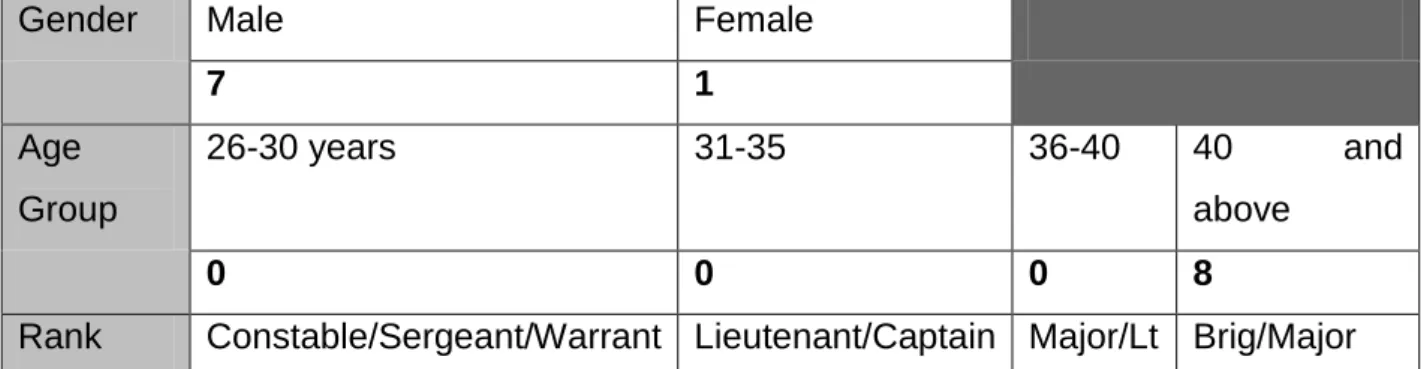
4.2.1 Biographical profile of respondent group A ... 71
4.2.2 Performance management system improves police performance ... 73
4.2.3 Relationship of individual performance management system (PMS) with organisational performance measurement system (Performance Chart). ... 74
4.2.4 Community involvement in the assessment of individual members. ... 74
4.2.5 Community involvement in assessment of the organisation ... 75
4.2.6 Problem in the implementation of PMS... 75
4.2.7 Understanding of PMS by commanders ... 76
4.2.8 PMS linkage to organisation performance (strategic) plan ... 76
4.3 Respondent group B (9-29)………...76
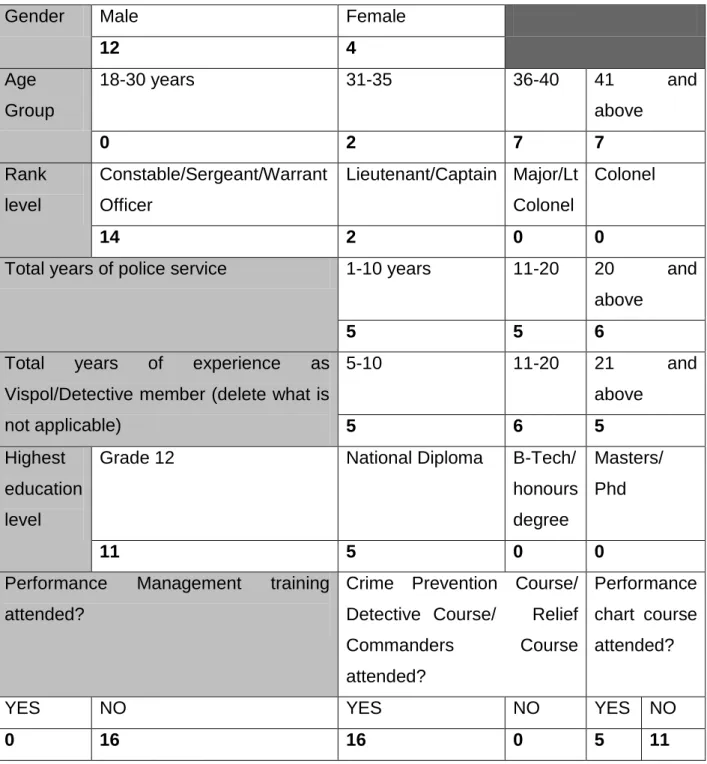
4.3.1 Biographical profile of respondents Group B ... …77
Table 4.2: The following table illustrates the biographical profile of ... 77
respondents group B. ... 77
4.3.2 PMS in SAPS improves performance ... 78
4.3.3 Role of the community in the assessment of members ... 79
4.3.4 Effectiveness of SAPS Performance Management System ... 79
4.3.5 Utilisation of Vispol/ Detective templates to improve effectiveness of PMS ... 80
4.3.6 Relationship of individual PMS with organisational performance plan ... 80
4.3.7 Ability of commanders to assess members ... 81
4.4 Respondent group C (30-50)……….81
xi
Table 4.3: The following table illustrates the biographical profile of ... ……..81
respondents group C ... 81
4.4.2 Role played by the respondents in policing ... 82
4.4.3 Community involvement in the PMS of the police officials in their police station ………82
4.4.4 Community involvement in the performance measurement system of the police station ... 83
4.4.5 Community understanding of the performance measurement of their police station ... 83
4.4.6 Community involvement in the performance planning of the police station ... 83
4.4.7 Knowledge of policing priorities by the community ... 83
4.4.8 Community satisfaction by the police service delivery in their area ... 84
4.5.1 Comparison of the findings with secondary data... 84
4.5 Themes emergent from the interviews………85
4.5.1 Effectiveness of Performance Management System and Performance Measurement System ... 85
4.5.2 Relationship between Performance Management System and Performance Measurement System (Performance Chart) ... 85
4.5.3 Short comings in the implementation of the PMS ... 86
One of the research objectives was to determine whether there were serious problems encountered in the implementation of both the individual and organisational SAPS assessment. The respondents were asked to indicate whether there were short comings in the implementation of PMS. ... 86
4.5.4 Understanding of PMS by SAPS management ... 87
Again to determine if there were problems on the implementation of PMS,the respondents were asked whether the police management understand the PMS. ... 87
4.6.6 Involvement of community in police station Performance (Strategic) Planning 88 4.6.7 Relationship between Performance Management System and Performance (Strategic) Planning of SAPS ... 89
4.6.8 Community satisfaction perception on service delivery comparison with effectiveness of the police as reflected by the PMS and Performance Measurement System tools of the saps ... 89
4.7 Summary………..…90
5. RECOMMENDATIONS AND CONCLUSION ... ..91
5.1 INTRODUCTION……….91
5.2 RESEARCH OBJECTIVES………...91
The following objectives were indicated in chapter one of this study:………91
xii
5.3.1 Effectiveness of Performance Management System and Performance
Measurement System ... 91
5.3.2 Relationship between Performance Management System and Performance Measurement System (Performance Chart) ... 92
5.3.3 Short comings in the implementation of the PMS ... 92
5.3.4 Understanding of PMS by SAPS management ... 92
5.3.5 Understanding and involvement of community in Performance Management and Measurement System. ... 92
5.3.6 Involvement of community in police station Performance (Strategic) Planning 93 5.3.7 Relationship between Performance Management System and Performance (Strategic) Planning of SAPS ... 93
5.3.8 Community satisfaction perception of service delivery comparison with effectiveness of the police as reflected by the PMS and Performance Measurement System tools of the saps ... 93
5.4 RECOMMENDATIONS REGARDING FURTHER RESEARCH……….94
5.5 CONCLUSION………..94
ANNEXURES ... 101
APPENDIXES ... 116
ETHICAL CLEARANCE ... 122
1 CHAPTER 1
1. INTRODUCTION
The main purpose of performance management is to ensure that the organization achieve its main objectives as set in the organization strategic plan. The strategic plans are developed to address service delivery needs of the customers of that organization. Proper assessment patterns of individuals can lead to good community perception about the organisation’s performance. Performance management and development system is created to ensure individual members contribute to the achievement of organizational strategic plan and that members are developed to be capable of performing their function to the benefit of the organization.
A problem statement with regard to performance management system assessment patterns in SAPS had been given, objectives of the study with relevant research questions had been articulated and the preliminary review of literature was dealt with. Legislative framework for performance management had been dealt with and comparison of SAPS performance management and measurement system with other police agencies had been done.
1.1 BACK GROUND
The South African Police Service (SAPS) has a vision of creating a safe and secure environment for all the people in South Africa. The SAPS strategic plan 2010-2014 South African Police Service 2 (2010:1) indicates the mission of the police as to:- I. “Prevent and combat anything that may threaten the safety and security of any
community;
II. Investigate all crimes that threaten the safety and security of any community; Ensure offenders are brought to justice; and
III. Participate in endeavors to address the root causes of crime”.
The SMS handbook by the Department of Public Service and Administration (2006) gives directives on performance management and development for the Senior Management Services (SMS) members. The handbook regulates that the SMS members sign performance agreement (PA). The Republic of SA public service regulation, Department of Public Service and Administration 1 (2001) directs that performance management and development of members other than SMS members
2
must also be developed by the executive authority. The purpose of these regulations is to ensure that public service employees fulfill their function which is to deliver service to the people.
The South African police Service produced National Instruction 1/2005, South African Police Service 1 (2005) to deal with performance management and development of employees from salary level 1 to 12. According to NI 1/2005 a member of SAPS must have a Performance Enhancement Process Instrument (SAPS 557) which will be used to measure the actual performance of an individual against the agreed performance indicators between the employee and the supervisor. Performance Enhancement Process (PEP)” means the process that defines, assesses, reinforces and promotes the job related behaviour and outputs expected of an employee. The employee’s performance is measured on quality, quantity, standard and time. The points are allocated on a scale of 1-5 with one being poor and five being excellent, South African Police Service 1, (2005). Employees’ developmental needs are also identified and addressed in the PEP document. SMS handbook (2006) requires that members of Senior Management Services (SMS) performance be measured using performance agreement between the employee and his supervisor. The National Commissioner of the SAPS decided that all Station Commanders whether they are on SMS or not, will be assessed using performance agreement. Non SMS members who are not Station Commanders are assessed through performance enhancement process instrument (SAPS 557). These tools are applied to both police officials and civilian employees.
SAPS have a computerised organisational measurement system called Performance Chart. This performance measurement system was developed to reflect on the accomplishing of SAPS mission and achievement of targeted results by assessing organizational performance according to inputs, outputs, outcomes, effectiveness and efficiency. Performance chart is also used as a guide to assist managers when assessing individuals so as to see if individual performances are assisting in achieving organizational objectives. Five performance measurement determinants are utilised by the Performance Chart System, these are; Strategic direction, Performance framework, Strategy institutionalization, Performance measures and performance assessment. (South African Police Service Training Division, 2010).
3 1.2 MOTIVATION FOR THE STUDY
It had been noted that in most cases Station Commanders and their subordinates are rated as performing satisfactory by their managers while the organizational measurement instrument indicate that the police stations they are working in or are in charge of, do not perform satisfactorily.
The crime statistics of Queenstown cluster police stations from 2008/2009 to 2010/2011 financial year showed a steady increase of crime. The crime statistics for all crimes is as follows for these financial years
2008/2009 13953
2009/2010 14295
2010/2011 16225
Queenstown cluster consist of seven police stations: Queenstown, Ezibeleni, Ilinge, Lady Frere, Tylden, Sterkstroom and Glen Grey. The above crime statistics is for all the above police stations. The statistics according to SAPS website (South African Police Service 4, 2012) indicate an increase of 14% between 2008/2009 and 2010/2011.
The situation becomes even worse when both the Performance Management System(individual) and Performance Chart(organizational) indicate both the Station Commanders, their subordinates and their Police Station as performing satisfactory while the community they serve show dissatisfaction with the service rendered through acts of vigilantism. On the website, Oil in its article “vigilantism claims 7 more lives” (2011) it was indicated that seven suspected criminals were killed in mob justice in the Eastern Cape during the month of June to July 2011. The document indicated that three people suspected to be thieves were killed in Flagstaff while four people were killed necklecing style in Port Elizabeth.
Cornish, J.J (2010) wrote about five people that were killed in mob justice in South Africa on 04 August 2010. She further mentions that these killings brought the death toll due to mob justice in South Africa to 17 until the above date.
These possible discrepancies have resulted in the interest to explore the relationship between performance management system assessment patterns and public
4
perceptions of the effectiveness of the police in rendering services. Service Delivery is not a privilege in a democratic society but a rightful expectation of citizens. According to South African department of public service and administration (2006) the effectiveness of the public service will be judged only by its capability to deliver services which satisfy basic needs of all South African.
1.3 STATEMENT OF THE PROBLEM
There are two critical problems identified for the purposes of this research. Firstly it had been observed that the SAPS performance assessment tools for the individuals i.e. performance agreement (PA) and performance enhancement process (PEP) in most cases do not relate to the Organizational measurement tool (Performance chart). Individuals are assessed to be performing satisfactory while the organization they are working in is assessed to be performing poorly.
Secondly in some cases both the performance management system (individual performance assessment) and the organizational measurement tool (Performance Chart for the police station) indicate the individuals and the police station to be performing satisfactory while the community perception indicate dissatisfaction by the community in the police performance. This research thus aimed to examine these two discrepancies in the use and management of SAPS performance management facilities.
Bruce (2012) argues that the problem with policing is that police services are not effective, people from disadvantaged background do not have enough money to hire private security companies for their protection as their richer counter parts. He further argues that more than 80% crimes committed in South Africa are towards these poor communities.
Fig 1: Problem identification framework
Individual Assessment: PEP & PA
Organisational Assessment
Performance Chart
Community Perceptions Reliable
assessment of SAPS
5
The above figure tries to provide a framework towards understanding the problem. In simply terms the research investigated the above mentioned discrepancies and argued that a credible or reliable assessment of SAPS performance could be achieved where individual and organizational performance is mirrored in the perceptions of the community as an indicator for police effectiveness within a community.
1.4 OBJECTIVES OF THE STUDY
The overall objective of this study was to determine whether the implementation of performance management system, the assessment patterns, applied to SAPS members in police stations has a positive effect on the perceptions of the communities they serve regarding service delivery as interpreted through Batho Pele principles. The actual objectives of the study were the following:-
1. To determine the extent of discrepancy between the individual performance assessment tools and the organizational measurement tool.
2. To determine whether the organizational and individual assessment tools relate to the community’s perceptions regarding effectiveness of the police in rendering services.
3. To determine whether there are serious problems encountered in the implementation of both the individual and organizational SAPS assessments? 4. To make proposal or recommendations to rectify the discrepancy if they exist.
1.5 RESEARCH QUESTIONS
Are there discrepancies between the reporting outcomes of individual and organizational SAPS performance assessments tools?
What are the serious challenges encountered in the implementation of both the individual and organizational SAPS assessments?
To what extent do the individual and organizational SAPS performance assessments mirror the perception of the community in terms of SAPS performance in delivering its core mandate of crime fighting?
What could be done to improve correlation between SAPS individual assessment and organizational assessment tools with community perceptions of SAPS performance?
6 1.6 SIGNIFICANCE OF THE STUDY
The study provided information that can be used to:
1. Enhance the understanding of the importance of performance management system in the SAPS.
2. Improve the application of the performance management system in SAPS. 3. Be of be of academic value as the source of reference information to other
students.
1.7 ETHICAL CLEARANCE
An ethical clearance was obtained from the University of Fort Hare by the researcher.
1.8 LIMITATION AND DELIMITATIONS
This study was limited to police stations in the Queenstown cluster; Eastern Cape Province of South Africa. The period that was covered was from 2009/2010 to 2011/2012 financial year. Research findings would have been more embracing if more police stations were covered by the survey. However, the research is financially constrained and given the completion period of the study, a comprehensive coverage was not possible.
1.9 OUTLINE OF CHAPTERS
This is the research plan in which the researcher explains what he did and how he went about doing it. The research was separated into five chapters as follows:- Chapter one: this chapter dealt with the introduction and rational of the study. It further covered problem statement, research question, research Problem, aim and objectives of the study, significance of the study, limitations and delimitation of the study and definition of terms.
Chapter two: this chapter dealt with literature review regarding the implementation and effective utilization of performance management system’s assessment patterns and how it is perceived by the community in terms of effectiveness of the police. Conceptual Framework and theoretical framework contribution to performance management assessment patterns were discussed. Instruction, orders, annual reports, annual performance plans and statistics relating to performance management and service delivery were discussed.
7
Chapter three: this chapter concentrated on the research methodology and design. It also dealt with data collection and verification.
Chapter four: this chapter dealt with the field work of the researcher putting main emphasis on analysis, interpretation and employment of result of the research findings.
Chapter five: this is the last chapter in which a summary of the study will be specified. Recommendation and alternative solution to identified problems will be provided.
1.10 CONCLUSION
The main purpose of this research is to create awareness about the way public servants in particular SAPS define, interpret and implement PMS. The consequences of which have been disparity and inconsistency between what the department regard as good performance and expectations of the community. The disparity was analyzed in terms of theories in which goal setting theory was explained in contrast to the imposition of goals to individual. It has been made clear that if the organizations goals are published and members are allowed to participate in setting themselves goals they will be committed. The expectancy theory which links the reward to the needs of the employees was dealt with to influence the way managers set rewards in PMS. However the main purpose of my research was to establish if there is linkage between the assessments of individuals and the organization, in SAPS with the expectations of the community they serve. This is based on the number of mob justice cases reported around the country which indicates dissatisfaction by the community in services rendered by the police.
8 CHAPTER 2
2. LITERATURE REVIEW 2.1 INTRODUCTION
The South African Police Service as an organ of state is compelled by the Constitution of the republic, (1996:111) chapter 10 to utilise resource effectively, efficiently and economically. The Public Service Act 103 0f 1994 section 41 (e) (National Assembly, 1994) directs the Minister to issue regulations regarding the effective, efficient and economic use of resources. The Public Service Regulations were issued and deal with performance management and development of the Public Service. The treasury regulation, National Treasury, (2001:13-15) directs that the Head of department should compile a strategic plan which must contain priorities of that department. The department is then required to develop a performance evaluation instrument to measure it against those priorities. The South African Police Service (SAPS) introduced performance measurement system in order for the SAPS to be able to measure its performance against the priorities set in the organisation’s strategic plan. This chapter will deal with the performance management system concept generally, performance management as applied by SAPS and comparison of performance management system with other police agencies. Performance measurement system will also be discussed generally and as applied by SAPS and a comparison with other police agencies will be done. Motivational theories will also be discussed in order to link organisational performance to individual performance and motivation.
2.2 THEORETICAL FRAMEWORK
Three theories will be used in this research, goal setting theory, expectancy theory and organisational theory. These theories are from process theory group which examines how motivation takes place (Unknown, 2013). These theories are relevant for this study in that goal setting theory deals with the setting of goal and performance management and measurement deal with goal setting, objective setting and setting of priories. Expectancy theory deals with individual efforts which lead to a particular outcome. If the employee believes that he/she can achieve that outcome he/she becomes motivated to work towards that outcome. Organisational theory
9
deals with the interaction of the organisation with its environment and both performance management system and performance management system in the public sector need to interact with its environment which is different stakeholders that include customers by getting performance feedback from external sources (Laegaard, 2006:9).
2.2.1 Motivational Theories
Lindner (1998:1) asserts that in the past the employees were seen as just another input in the production process. This understanding was, however altered through research called Hawthorn studies conducted by Elton Mayo from 1924 to 1932 (Lindner, 1998:1). Dickenson as quoted by Lindner (1998:1) stated that this study showed that not only money motivates workers; their behaviour is related to their attitude. Through Hawthorn studies new management approach on employee relations was developed in which the desires and motivation of workers was given priority.
In his article on understanding employee motivation Lindner defines motivation as a tendency to act in a particular way so that you can reach your desired goals. He further notes definitions of different writers about motivation. Kreinter, (1995) as noted by Lindner (1998:2) defines motivation as purpose and direction behaviour which is derived from a psychological process. Sims (2002:55) defines motivation as a combination of mental and physical efforts and the environment that leads to a particular behaviour by individuals or groups. Chaudhuri (2010:148) concurs with the above writers as he defines motivation as process which begins with a motive that then leads to a particular behaviour in order to achieve a specific goal. He further states that due to the importance of motivation in production, motivation theories were developed. Chaudhuri (2010:149) thus identified three types of motivation theories: content theories which look at what motivate people-; process theories which look at how a particular behaviour originates, how to sustain or stop that behaviour and reinforcement theories which deals with reward and punishment (Chaudhuri, 2010:149).
For the purposes of this study motivation will be defined as a behaviour that comes from within a person that leads to a particular action in order to achieve a particular goal.
10
Three theories will be utilized in this study. They are a goal setting theory of Locke and Latham, Vroom’s expectancy theory as expanded by Porter and Lawler and organisational theory.
2.2.2 Goal Setting Theory
To quote Nel (2008:346) “any idea that is not translated into specific goals will stay an idea; however, objectives and goals dictate our purpose and function”. Edwin Locke (2006:265) in his Goal Setting theory reasons that individuals are motivated by working towards a specific goal. Robbins (1996) as quoted by Swanepoel (2003:331) states that Locke argues that all things being equal (e.g. skills, abilities and resources) goal setting theory insinuates that the harder the goal the higher the performance.
Miner (2006:160-178) illustrates goal setting theory by Locke and Latham as being in three phases.
1. Phase 1
The original research goal of Locke was meant to establish correlation between intended achievement levels with actual performance levels (Miner, 2006:160). According to Miner (2006:160) Locke hypothesised that when the levels of intended achievement are high they lead to higher performance levels.
The hypothesis of Locke could be interpreted as meaning that if there are high goals set, performance improvement will be more evident that when there are no goals set. Miner (2006:162) further states that goals should be accepted for performance effect to take place and that goal difficulty should be within the accepted level.
2. Phase 2
In this phase Miner (2006:164) asserts that Locke insinuates that:
I. Difficulty of the goal stimulates individuals to put more effort towards the task. II. Goals stimulate people to keep to their undertaking.
III. People get focused to a significant behaviour when there are set goals.
This phase also dealt with commitment to the goals. However, one must note that although a level of importance is put into how goals are set; (e.g. assigned,
11
participatively set or self-set), there is no conclusive evidence that the way goals are set affect performance (Miner 2006:165).
Additionally, when feedback is given about goal progress, goal setting leads to greater performance (Miner 2006:165). People believe in working towards a known objective e.g. pack ten bags of potatoes an hour. Swanepoel (2003:331) in concurrence with the above observes three factors associated with goal setting theory:
I. Continuous feedback to employees about progress made towards achieving set goals. This feedback shows differences between what has already been done and what needs to be done.
II. There is no concrete research evidence to say that self-set goals lead to higher motivation therefore better performance than assigned goals. However, he indicates that joint setting of goals between the individual and supervisor increase the possibility of goals being accepted and therefore employees getting committed.
III. Commitment to goals is seen as a requirement. Research concludes that when goals are made public commitment is likely to be available.
3. Phase 3
In phase three Chesney and Locke (1991) as cited in (Miner, 2006:169) link goal setting theory with organizational goals or business strategy.
It can be argued that these phases relate goal setting theory to performance management system (PMS). This is because goal setting theory deals with the improvement of performance at an individual to an organizational level. Performance Management System is also concerned with improving the individual performance in order to achieve the organizational objectives.
In their article “New Directions in Goal Setting Theory” Locke and Latham (2006:265) note some mediators between goals and performance:
I. Hard or difficult goals improve effort than easy or no goals. II. Goals bring focus to relevant action by ignoring irrelevant action.
III. Goal influence on performance also depends on the availability of knowledge and skill for a specific task.
12
Locke and Latham (2006:266) also indicate advances in goal setting theory. They confirm eight categories of studies that advanced goal setting theory: i.e. Goal Choice, Learning Goals, Framing, Affect, Group Goals, Goals and Traits, Macro-Level Goals and Goals and Subconscious Priming. These studies show a progression from the original research which concentrated only on intended performance level in relation to actual performance level to looking at other aspects that may play part in holding firm the goal setting theory.
According to Miner (2006:163) the problem that was identified is that because tough goals are more difficult to reach, there should be a negative relationship between expectancy and performance. A positive relationship between goal difficulty and performance is endorsed by goal setting theory. In contrast expectancy theory indicates a positive relationship between self-efficacy/expectation of success and performance level. This lead Locke and Latham to agree that goal setting theory is not in conflict with expectancy theory.
2.2.3 Expectancy Theory
The Expectancy theory of Vroom is grounded on a conviction that individual effort results in performance and that performance results in rewards which might be positive or negative. If the reward is affirmative the employee will be more encouraged (Lindner, 1998:2). Expectancy theory addresses process of behavioural choice. It explains why people choose particular behaviour over the other. Anon (2008:48-49) and Miner (2006:97) explain that expectancy theory argues that individuals have personal goals and expectations of achieving those goals which motivates them. People make choices within a group of alternatives. Anon (2008:49) further asserts that skills, knowledge, experience, capability and personality contribute to employee’s performance.
Victor Vroom examines three factors of expectancy theory which are Valence, expectancy and Instrumentality (Miner, 2005:67-68).
1. Valence
It is stated that people have a particular satisfying feeling when they achieved an outcome which they deem good for them. Valence is said to be associated with that feeling of achieving that particular outcome. Valence is according to Vroom (2012:2) the value an individual places into a reward. (Miner (2006:97) further states that
13
outcomes could be valence on their own or they may just be leading to other outcomes which may be the actual satisfaction that the individual need. For example performing very well in a job may lead to promotion, promotion may be a first level outcome and the actual valence for an individual may be recognition by the society which is obtained through having a certain position.
2. Expectancy
Miner (2006:98) explains expectancy as the belief a person has that if he/she perform a task successfully he/she will achieve the desired outcome. Vroom (2012:2) further asserts that it is based on an individual’s past experience, confidence and assumed difficulty of the task. This expectancy according to Illumination (2008:48) talks to the power of belief an individual has about a possibility of reaching a particular job performance. The stronger the belief the more chances an individual will work hard towards achieving that performance level. Issues like relevant training assist in enforcing that belief.
3. Instrumentality
According to (Illumination, 2008:48) instrumentality is the belief that if an individual perform successfully a particular task he/she will achieve a desired reward. The reward must be needed by the individual. Rewards could be different things e.g. money, promotion, satisfaction of achievement. Miner (2006:98) explains instrumentality as the belief that an individual if he performed the required action he/she will receive the valences expected.
The main difference between expectancy and instrumentality is that expectancy refers to power of one’s belief that he/she has an ability to perform to a particular level. This means an employee can perform successfully a particular task. Instrumentality is then the belief an employee has that if he performs to that particular level which is required he/she will receive the desired reward (illumination, 2008:48).
2.2.4 Criticisms against Expectancy Theory
Vroom (2012:4) cited some scholars that criticized Vrooms expectancy theory like Porter and Lawler (1968), Graen (1969) Lawler (1971) and Lawler and Porter (1967). Their argument was that Vrooms theory is too simplistic (Vroom, 2012:4). Lawler maintains that the simplicity of Vroom’s model can be deceptive in that it could make
14
people believe that if an employer makes reward, like promotion or increase in salary, employees will automatically increase their performance. This according to Lawler is not always true as it depends on whether the employees value the reward. For example if promotion comes with relocation, an employee could see a possibly family dislocation and the reward will not be enticing to him/her (Vroom, 2012:4). Both Lawler and Porter did not reject the expectancy theory as a fallacy; however, they saw a need to improve it.
1. Porter and Lawler Model
Porter and Lawler takes the expectancy theory from the direction of Victor Vroom, however, they go a step further than linking motivation to performance (Miner, 2005:68). Miner (2005; 2006) examines variables that take the expectancy theory forward as mentioned by porter L and Lawler E. They are:-
I. Importance of Valence, how much does an employee need the reward?
II. Effort Reward probability: a belief whether different rewards depend on different effort.
III. Effort: the energy used to do a specific job.
IV. Capability and qualities an individual has on long term.
V. Role perception: how much effort one needs to perform the job effectively
VI. Performance: how an individual succeed on small tasks that lead to the total job. VII. Rewards: are they what a person desire
VIII. Perceived equitable rewards: what rewards do people consider as fair. IX. Satisfaction: do the rewards satisfy the desires of the person.
Thus one sees a detailed improvement on Vroom’s theory. If one looks at Porter and Lawler model one could see that for the expectancy theory to work, understanding employee’s needs is crucial.
2.2.5 Organisational Theory
Laegaard (2006:10) asserts that future organisations need to be able to adapt to the fast changing world. The organisation must have information system that communicates results as feedback, e.g. customer satisfaction and accounting figures. Laegaard (2006:10-11) further examines levels and perspectives in organisational theory. There is a need for relationship and influence from society and other organisations. The three levels that Laegaard deals with are;
15
I. Social psychological level which focuses on the individual and interpersonal relations.
II. Structural level which focuses on the organisation in general with its different departments.
III. Macro level which focuses on the organisation as a player in relation to other organisations and society.
Laegaard (2006:73) refers to organisational theory as an open perspective theory. This accentuates the necessity for closer linkage between an organisation and its surroundings characterised by mutual dependence. Scott as mentioned by Laegaard (2006:73) explains the organisation as “a system of mutual dependent activities that cables varying coalitions of participants. The organisation depends on its surroundings environment, which has a fundamental influence on the organisation”. Van Tonder (2006:14) alluded to the above statement by defining organisational theory as a set of related models and principles that intends to offer a conceivable explanation of, and for, the nature and function of the organisation, and how the organisation impacts or is impacted on by its environment and the people with whom it interacts. Both Laegaard (2006) and van Tonder (2006) highlight the need for the organisation to take into account the environment from which it is functioning. A metaphor explanation by Van Tonder (2006:15) of the organisation, is equating an organisation to a machine. Van Tonder states that if a power generating machine environment is suddenly exposed to changing conditions such as below freezing point temperatures, the machine might stop operating (Van Tonder, 2006:15). This means that the environment is important to the organisation.
2.2.6 Relevance of Motivational Theories to Performance Management
The purpose of performance management is to improve productivity in the work place. Theory has shown that for employees to perform better they need to know what goals they are working towards. Goal setting theory gives that direction to employers. Currently, most employers set goal for the employees’ with-out taking into consideration what their employees feel or need. Although the literature states that the research did not show significant impact in assigned goals and self-set goals but it does show enthusiasm by employees towards achieving jointly set goals. Therefore understanding goal setting theory could assist the employers.
16
Expectancy theory deals with the actual needs of individual employees. Where employers are of the view that as they are the ones who pay employees’ salaries and as such are responsible to direct expectations and neglect individual expectations of employees, there is bound to be problems. Expectancy theory indicates that understanding individual employee’s expectancy by employers could assist them in modelling their performance management system. Their reward system could be directly linked to the needs of their employees.
Organisational theory indicates a need by the organisations to look and understand the needs of the society from which they operate. This became more important in the public sector as the society is the tax payer who by implication pays the salary of public servants. It becomes imperative therefore for the society to play part or be considered by the organisation as the relevant contributor to the success of the organisation.
Thus for the purpose of this research, the researcher motivates that all three theories explained above, expectancy theory, goal setting theory and organisational theory will be relevant in this research.
2.3 CONCEPTUAL FRAMEWORK
This section will examine two main areas of performance, its management and its measurement. The section begins with performance management and deals with its cycle which involves performance management and planning, performance measurement and evaluation, performance development and outcome of performance management process. Performance Measurement will also be dealt with under this section. Three types of performance measurement will be dealt with; Balanced Score Card, Stake Holder Analytical Framework and Viable System Model. Legislative framework related to performance management system and performance measurement system will also be dealt with.
2.3.1 Performance Management
According to Shaw and Atkinson (2006:174) the concept of performance management is based on the understanding that the success of the organisation can be obtained through a strategic and inclusive holistic approach which includes goal setting, performance appraisal and development into one logical framework with intent to align individual performance goals with broader organisational objectives.
17
Shaw and Atkinson (2006:174) also indicate some principles underlying this concept:
I. That it is linked to the organisational objectives and long term strategic goals; II. It is integrative because it does not only align individual and organisational
objectives, it also connects different facets of human resource management such as organisational development, human resource development and employee reward;
III. It promotes communication understanding between the employee and the manager as it is built on the agreement between these two people.
Nel et.al (2008:493) concurs with the above authors by defining performance management as an inclusive approach and course of action towards successful management of individuals and groups to ensure that their shared objectives as well as organizational strategic objectives are achieved. Nel et.al (2008:494) further states that performance management has a process. Bennet and Minty (1999) as mentioned by Nel at el (2008:494) indicates that the purpose of the performance management process is three fold:
I. It is a strategic plan execution process; II. It is used for changing culture;
III. It gives input to other HR systems like HR development and remuneration.
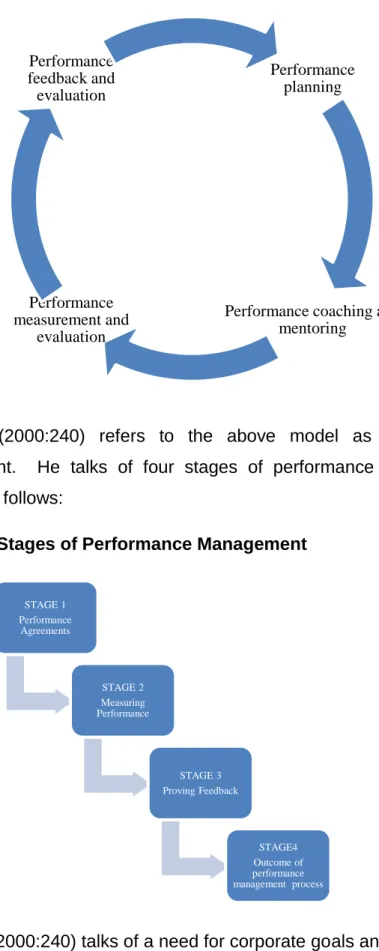
Nel at el (2008:494) divides the performance management process into four activities that overlap each other as per figure 2.1 below:
18 Figure 2.1 Performance Management Cycle
Stredwick (2000:240) refers to the above model as stages of performance management. He talks of four stages of performance management which are depicted as follows:
Figure 2.2 Stages of Performance Management
Stredwick (2000:240) talks of a need for corporate goals and value to be shared, that an objective of an individual and the organisation should always be aligned. An
Performance planning
Performance coaching and mentoring Performance measurement and evaluation Performance feedback and evaluation STAGE 1 Performance Agreements STAGE 2 Measuring Performance STAGE 3 Proving Feedback STAGE4 Outcome of performance management process
19
example of this alignment in terms of objectives for sales department will be that an organisational goal for sales will be £100 million consisting of defined product mix that gives profit. This will then be divided into divisional targets then cascaded down to sales target of an individual of say £500 000.
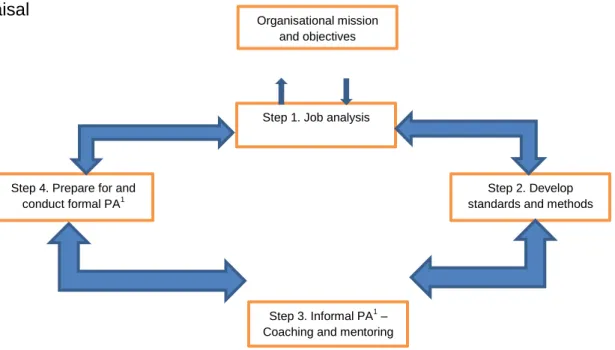
Lussier (1999:271-272) observes the connection between the organisation’s mission and objectives and the performance appraisal (PA1) process. A feedback loop should exist between the organisational mission and objectives and performance agreements. The employees need to be measured against the achievement of organisational goals (Lussier, 1999:272).
Figure 2.3 Relationship between organisational objectives and Performance Appraisal
Performance appraisal process by Stredwick shows a clear link between organisational strategic process and individual performance. This shows that there is a connection between the organisational performance measurement and individual performance management.
Shaw and Artkinson (2006:176) talk of performance management cycle which has three stages:
I. Objective setting,
II. Performing and development, III. Performance review.
Step 3. Informal PA1 – Coaching and mentoring Organisational mission
and objectives
Step 2. Develop standards and methods Step 4. Prepare for and
conduct formal PA1
20
All these processes are more or less the same rational process with authors putting emphasis in different ways on different stages of the performance management process. For the purpose of this research, the next section examines in detail critical imperatives of this process. These are performance planning, performance measurement and evaluation, performance development (coaching and mentoring) and performance management outcomes.
1. Performance Planning
It is necessary for performance management process to be planned in order for it to produce expected results. Planning includes deciding on the direction and defining of expectations. The employer and the employee discuss the strategic objectives of the organisation and how to best achieve these objectives. The employee objectives (expectancy theory) are discussed and aligned to the needs of the organisation (Nel et al, 2008:494). It is at this stage that goals (goal setting theory) are set for the employee. Shaw and Atkinson (2006:177) are of the view that it is Eurocentric for goals to be jointly set by the supervisor and the employee. Culture is said to determine how goals are set. For instance, in the United States of America the goals will mostly be assigned to an employee by an authority figure. This is also the case in China where culture dictates that authority should be respected (Shaw and Atkinson: 2006:177). It is however, believed that jointly set goals are more effective and motivational than the allocated goals. According to Nel et.al (2008:494) it is at this stage that the assessor and the assessing method are determined. In the planning stage it should be explained who is going to assess and which assessment tools will be used for assessment. Agreements are made at this stage as to how the employee will be measured and what evidence will be used for assessment as seen in Strendwick’s articulation of the stages. This means that standards will be clearly set per each performance area. Strendwick (2000:242) refers to this stage as establishment of performance agreement. Strendwick (2000:240) states that at this stage organisational goal should be shared so that an individual performance agreement could be linked to that of the organisation. Strendwick’s (2000:242) arguments concurs with Shaw and Atkinson (2006:177) that at this step of the process the measuring process should be dealt with and the measuring tool should be agreed upon. Shaw and Atkinson (2000:177) further state that developmental plans of the individuals should be discussed at this stage. This will assist the
21
supervisor in organising training, coaching and other ways of developing an individual. At the end, an agreement document which will have all these key responsibilities, expected standard of performance, and the role of each person in achieving the expected goals is drafted and signed by both parties (Nel, 2008:495).
2. Performance measurement and evaluation
Strendwick (2000:243) suggest that for performance to be measured there is a need for standards to be developed. This involves establishing targets. The target could be quantified outputs and or improvement targets. Level of competency of the individual should be taken into consideration when setting targets, the targets could then be set so that it is not very difficult to achieve while it is also not too easy to achieve. Locke and Latham (2006:265) provided evidence that goal setting improve individual performance and that targets need to be stretched so that they can also be a motivators.
The targets need to be set in a SMART way. This means that they have to be specific. The employee should know exactly what is it that is expected from him/her. They should be so clear that there can be no dispute relating to understanding of the goal. The targets should be measurable, it should be easy to say the goal was achieved or not achieved. They should be achievable, this means that though the goals should not be easy but the competency of the incumbent should be such that he/she can stretch him/herself to be able with an effort to achieve the goals. The goals need to be realistic so that the employee could believe that he/she can achieve them. They should have time limits. It must be clear when a particular target must be achieved (Strendwick, 2000:244).
It is imperative for the employee to receive feedback about his work performance. According to Strendwick (2000:253-254) there are two methods of providing feedback to the employees; the traditional method in which the supervisor gives feedback to the employee in a one to one meeting situation and the employee to a lesser extent provide self-assessment. The second method has developed in recent years is the Multi-rater appraisal. In this form of appraisal feedback comes from a number of sources, including colleagues, subordinates, internal and external customers, and this information is fed back to the employee. The organisational theory talks to this multi-rater appraisal system in which the environment from which
22
the organisation operates participate in giving feedback about the performance of the organisation. Nel et al (2008:497) believes that the traditional method is a more favoured method as it is easy to use. Nel (2008:497) also assert that the supervisor is a well-placed person to evaluate an employee as the supervisor is exposed to daily performance of the employee. The disadvantage of this method is that it might be difficult for the supervisors to be honest as the supervisor might be influenced by relations he/she has with employees (Nel at el, 2008:497).
This traditional approach is qualified in some organisations by allowing the higher level in the organisation to consider the results as a whole. In the South African Police Service this is done through the counter signing of the assessment documents at the higher level. E.g. a Chief work-study officer’s performance management is the responsibility of the Deputy Director work-study who is the immediate supervisor of the Chief work-study officer. The Director who is the Provincial Head Organisational Development counter signs the Chief work-study officer’s performance management system evaluation.
Nel (2008:496) is of the opinion that for measurement to take place effectively it depends on the assessor and the assessing system. Nel (2008:496) also reasons that there should be a reasonable time for the assessor to observe the performance. The following assessors could therefore be utilised as sources of feedback: Peers, who can give a different perspective about the employee’s performance. However, feedback from peers should be viewed with circumspection as possibility of friendship preference can twist the value of the information provided. Subordinates can also be a source of feedback. They understand the capabilities of the supervisor to delegate, communicate, plan etc. However, subordinates feedback can also be influenced by relations with the supervisor. If the relations are poor negative feedback can be given while if there are good relations the need to maintain relations could surpass the actual value of the evaluation. Self-Appraisal is said to be more motivational to the employees as they see themselves as being involved in the Performance Management System. The employees believe that they could also add value to the organisation especially if the system involved goal setting. This method also has its own disadvantages such as one being soft to him/her. Traditionally this feed-back is given to employees through scheduled one on one meeting between the assessor and the assessed person.
23 I. Interviews
Strendwick (2000:254-258) observes that these interviews are conducted in scheduled times. Usually once a year, however, most organisations noted the importance of the performance management system and decided to have the interviews more frequently. The PMS interviews should be evaluative and developmental. Developmental performance management is utilised for decision making and performance improvement strategies. However, for administrative decisions such as salary increases, promotions, bonuses and transfers, evaluative performance management is utilised. One can argue that developmental PMS is more concerned with future while evaluative PMS focuses on past performance (Lussier, 1999:271).
Before interview the manager should talk to the employee about the employee’s performance. He/she should be well trained on how to handle performance management interview and should be able to approach the interview in a way that is more problem -solving (Nel, 2008:503). Strendwick (2000:257) suggest that both parties should complete part of the documentation. The manager will deal with the employee performance as compared to the measures that were agreed upon; ratings are dealt with at this stage. The employee comments as to how he or she feels about his performance based on the same measures the manager utilised. The parties then suggest any developmental needs that were identified. It is imperative for the manager after the interview to continuously communicate with the employee about his performance.
In some organisations one PMS is used for both developmental and evaluative purposes. When both developmental and evaluative performance are conducted together, employees might be reluctant to admit that they have developmental needs as this can be interpreted as if they are not performing to the required standard. This could make it difficult for employees to argue for salary increases or promotions. It is better for the two types of interviews to be separated and the developmental interview to precede the evaluative interview. This will make it possible for the manager to identify and implement training needs. This will prevent an employee from blaming lack of development as cause for not achieving goals. The traditional method as can been seen has its disadvantages. If one source of feedback is accepted there is always a room for bias.
24 II. Multi-Rater Feedback:
The second method mentioned by Strendwick (2000:259) is the 360 degree appraisal. Some authors refer to this system as multi-rater. Strendwick asserts that the multi-rater system assist managers who find it difficult to assess employees. The data is collected from different sources which could include supervisors, subordinates, peers and customers etc. This way the validity of the feedback information is improved. It is said that consensus needs to be reached with regard to sources of feedback between the employee and whoever is given the task of managing the system. This could lead to confidentiality being undermined. This system also assist in preventing an argument in which the supervisor rate the employee as below average and giving reason for that, while the employee feels he/she performs well and the supervisor is just mentioning isolated incidents. Nel et.al (2008:498) points out that the feedback is obtained from all around the employee. This leads to employees being able to see a wider perspective of how they are regarded as performing from different sources including their peers, customers and suppliers.
Shaw and Atkinson (2006:188) observe that the companies that utilise the multi-rater system utilise a questioner in which some skill, behaviours and abilities of the employee are measured in a rating scale. Shaw and Atkinson (2006:188) further alluded to the fact that the multi-rater system was initially introduced for developmental evaluation and later it is also used for other HR activities such as promotions, salaries and downsizing purposes.
Advantages of multi-rater system
An advantage of the multi-rater system is that each employee receives an all-inclusive view of how he/she performs. It highlights how one’s performance affects the others (Nel, 2009:499). According to Shaw and Atkinson (2006:189) it also gives a better view as to how the organisation and the people within the organisation are perceived with regard to effectiveness. Strendwick (2000:263) concurs with Shaw and Atkinson in that the employees are more likely to change their action if the feedback is from different sources as they cannot dispute the findings. Strendwick (2000:264) further argues that using multi source feedback indicates to employees how serious the organisation is regarding performance management. The system
25
assists employees in drafting their developmental plans as it shows where the strength and weaknesses of the employee are.
Disadvantages of the Multi-rater system
The system is time consuming and costly. One feedback source in big companies like the SAPS could end up with overload of feedback to supply. Because the feedback sources come from different back grounds some might find it difficult to understand the contents of the questioner, especially those that relate to the employees’ achievement of their objectives. This might lead to incorrect feedback (Strendwick, 2000:264). In some countries and organisations with excessive power culture, the evaluation of seniors by juniors can be taboo and might lead to the rater being too soft to his superior. According to Nel et.al (2008:499) managers do not respond sufficiently to the information obtained in the feedback. Confidentiality cannot be guaranteed which leads to people not giving correct information.
The thing that needs to be addressed in this system is how to implement it in big organisation at lower cost. There is a need to look at whether less involvement of employees in deciding about the sources of feedback could damage the effectiveness of the system. This could be done with a view of improving confidentiality of the system. Shaw and Atkinson (2006:189) cited De Nisi and Kruger (2000) suggestion that feedback should be followed by goal setting.
The ideal of organisational theory that the organisation is linked to its environment is mostly relevant in the multi rater system as the society can be utilised as sources of
feedback during the appraisal of employees.
3 Performance Development
In order for the set objectives to be achieved effectively it is paramount for the competency level of employees to be reflected upon. The inclusion of competency framework in the performance management system assist in the identification of developmental needs and resources needed. The supervisor plays an important part here by monitoring and revising performance expectations and objective (Shaw and Atkinson, 2006). According to Lussier (1999:267) employers have to teach employees how to perform a task. This is done through training and development. Lussier (1999:267) defines training as a method of attaining skills necessary to