Capstone Projects and Master's Theses Capstone Projects and Master's Theses
12-2018
Homework Without Barriers
Homework Without Barriers
Hailey EdwardsCalifornia State University, Monterey Bay
Follow this and additional works at: https://digitalcommons.csumb.edu/caps_thes_all
Recommended Citation Recommended Citation
Edwards, Hailey, "Homework Without Barriers" (2018). Capstone Projects and Master's Theses. 366.
https://digitalcommons.csumb.edu/caps_thes_all/366
This Capstone Project (Open Access) is brought to you for free and open access by the Capstone Projects and Master's Theses at Digital Commons @ CSUMB. It has been accepted for inclusion in Capstone Projects and Master's Theses by an authorized administrator of Digital Commons @ CSUMB. For more information, please contact [email protected].
Homework Without Barriers Hailey Edwards
Abstract
Assigning equitable homework to students from low socioeconomic status (SES)
families is a common challenge for elementary school teachers. Often, teachers assign traditional homework activities such as weekly packets, history projects, and library research. Unfortunately, the research indicates that students often do not have access to materials, parental help, and/or other resources which their SES advantaged peers may have. This study is important because students should have the opportunity to continue their learning outside of the classroom, and involve their families in their learning. After interviewing teachers at Sand Dune Elementary School, I have used what I have learned to identify action options to resolve the issue of assigning
homework to these students. One of the benefits of this project included an opportunity for participants to share their homework assignments that transcend socioeconomic barriers. This was beneficial for research, and provided concrete suggestions for
improvement. The action options chosen and discussed at the end of this study are, (1) assigning reading as only homework, (2) assigning reading and incomplete classwork as homework, and (3) assign monthly homework projects.
Homework Without Barriers
Imagine an elementary school classroom with twenty-five students and one teacher. The teacher is a middle-class woman who attended K-12 schools in suburban areas. The teacher’s educational background has always encouraged homework assignments, and she did not have any negative influences from homework on her academic career. Her parents had the time to help her with the assignments, previous education to ensure they were helping her with the correct answers, they spoke the language written on the assignments, and had a majority of the resources necessary for her success. Aside from suffering from occasional boredom or fatigue, this teacher has alway been able to complete her homework. Many would agree that this teacher’s previous education was ideal, and fairly privileged. Now, she finds herself in a
classroom with twenty-five students where the majority are low income families. She attempts to recreate many of the assignments she was given in her childhood. She sends home weekly packets which contain math worksheets, spelling words, and writing prompts. She creates science projects asking for students to use household items to conduct a study. She asks for students to conduct research on their own outside of the classroom, using resources such as the library, the computer, or a bookstore. To her dismay, the homework packets are often returned incomplete or incorrect. She learns that the household items she believed were common, were not found in the students’ homes and therefore her students could not complete the study. She learns that her students had difficulty finding research outside of school, because they did not have
computers or their parents could not take them to the library. This teacher sees that her students can not complete their homework assignments, but does not see the
assignments themselves as an issue. Instead, she views the students and their families as the issue. She begins to grow resentful of her students who continuously turn in blank or incomplete assignments, believing that they are not committed to their
education. She is disappointed to hear that some students lack the physical resources to complete their homework, but refuses to supply these students with these items because she believes it is unfair to the other students who use their own resources. She views the parents and family members of these students as undedicated or lazy for not helping their child. This teacher believes that these poor, low income students are simply less intelligent and incapable of learning. Unfortunately, this teacher represents many elementary school teachers across America. What this teacher, and many other teachers, do not understand is that these students are not receiving equitable
opportunities to achieve in their homework assignments. This teacher was not willing to change her homework assignments after repeatedly receiving blank or incorrect papers because she believed that all students has the same advantages at home. However, she does not take into account the working hours of parents, possible language
barriers, or lack of specific resources which influence homework completion. The result due to this misinformation is many students being undereducated and severely
disadvantaged at a young age. The students in this classroom would have suffered greatly academically by this teacher’s ignorance towards the issue and unwillingness to change. These students from low socioeconomic families would have begun to believe
their teacher did not care about them, and that their education was not valued. While at home, the parents of these students believe in the value of education and want the best for their child, their students attend school just to be told the opposite by their teacher.
Literature Review
How can elementary school teachers serve low-income students and families by assigning homework that addresses socioeconomic disadvantages? Meaning, what can teachers do to ensure they assign homework that is fair to students from lower
socioeconomic backgrounds. Throughout various texts and studies, people have researched the role of homework in the lives of students, and which students benefit from this traditional assignment. The socioeconomic disadvantages involved in homework assignments have led to a decrease in student success. Homework has been studied and challenged by many different teachers and researchers in an effort to make this assignment a more equitable and attainable for students. This issue is
important to the United States educational system since each student is valuable and deserving of a quality education.
Socioeconomic status (SES) refers to the combination of both the family’s income, as well as their educational background. A low socioeconomic status, often referred to as a disadvantaged socioeconomic status, would apply to families who are in/near poverty and do not have an extensive educational background. The issue for these students who are considered disadvantaged is that they are often the first
students to fall behind in our traditional education system (Ronning, 2011). Homework is a task that is done within the home, outside of school, and without the teacher’s help. It
is the agreement between the student and the teacher that they will complete the work, and that they are capable of doing so because the material was covered in class. However, it is common and expected for elementary school students to receive
assistance from their parents when they are completing homework. Parent involvement, in this context, refers to the amount of assistance the parents are capable of providing their children in their educational career. SES and parent involvement are correlated in education, because students one standard deviation below the mean automatically lose the value of their parent’s involvement (McNeal, 2001). To clarify, students who are of lower SES status immediately begin to struggle, regardless of parent involvement. There is even inequity in the accessibility of parent involvement itself: where some students have parents who are equipped to assist traditional homework assignments, while other parents are not. For example, if a parent is “unable to visit the school for events and activities” because they are working and the family is in need of that income, they are not at a vantage point to assist with a particular homework assignment (Lee & Bowen, 2006). The opportunity that presents itself here is for teachers to assign
homework which can address these socioeconomic disadvantages and allow low-income families to offer their own parent involvement.
Many students who are of low socioeconomic status are receiving homework that is not beneficial to their learning, and this presents an issue in our education system and for these families. According to the literature, disadvantaged families gain negative associations with school-based activities and parental involvement in homework
have negative associations helping their children with homework due to a number of SES factors. For example, these families may feel negatively towards homework due to financial struggles in a need to finish the assignments. In the study from Davidovitch and Yavich (2017), it was stated that “not all students” had the access to complete their homework, which is especially true for students in low SES families. The first example of a barrier that stands between disadvantaged students and homework completion is a lack of resources or access to resources.
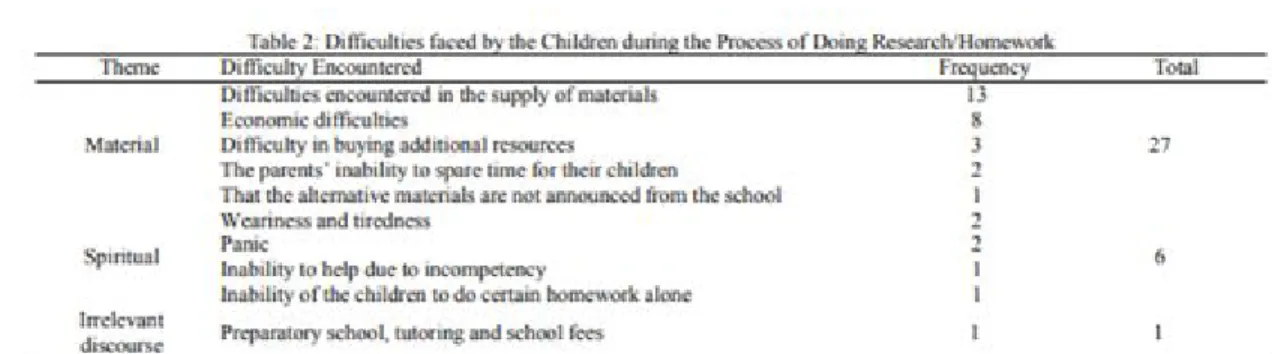
Figure 1. This chart is from a study of 26 parents who were asked about the difficulties faced as they helped their child with homework (Keskin & Ozer, 2015).
As shown in Figure 1 (Keskin & Ozer, 2015), a theme for difficulties faced for homework completion is “materials” and under the “difficulty encountered” there are a range of issues. Time, money, and supplies are commonly problematic for the students and parents of these students as they attempt to complete the homework which was assigned to them. When teachers assign homework with the expectation that these students will need outside materials, it can diminish the purpose of the assignment
when students are not capable of completing it. In addition to homework being a
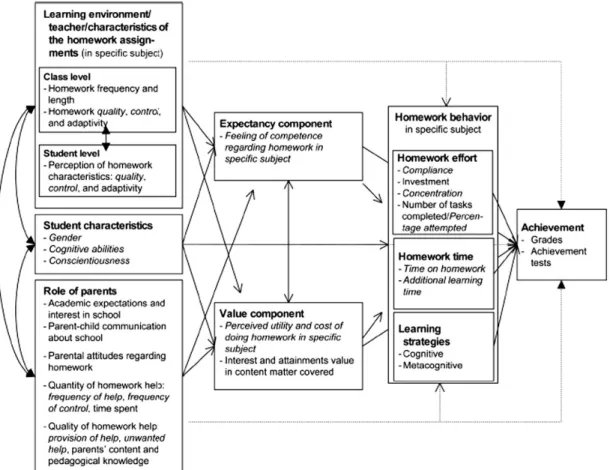
resource issue, parental involvement also contributes to the problem. Figure 2 (Flunger et all., 2017) demonstrates the “Role of Parents” and which intersectional factors
contribute to student achievement in terms of grades and test scores. To focus on the areas relevant to this review, the bottom left of the chart demonstrates the “Role of Parents” and in what ways the parents can contribute to their child’s education. Moving towards the right side of the chart, it is shown how this parental contribution in
combination with resources leads to student academic success.
Figure 2. This chart shows the intersecting factors within creating and completing
homework. The “Role of Parents” section demonstrates what is expected of the parents during homework in order to reach academic “Achievement” (Flunger et all., 2017).
Studying the figure above, it is apparent that the parental role is essential for students, as well as the resources parents are capable of providing. Beyond the need for
resources, time is also a major factor for students and parents when completing homework. Many parents can literally not afford the time to spare when it comes to helping their children with their at-home assignments (Keskin & Ozer, 2015). Now, a lack of resources or difficulty accessing resources for homework completion is an issue itself, but how does this directly affect student success? Or more directly, why should teachers care about this problem? The purpose of homework is to enhance learning, however, what has been shown through these peer reviewed studies is that homework assignments are creating academic barriers for low socioeconomic students. As
discussed in the study from Ronning (2011), homework can often “amplify existing inequalities” within the traditional school system. This issue arises early, where students from low socioeconomic backgrounds begin to fall behind and a learning gap is created (Kroboth, 2016).
Since these studies have shown that access to complete these homework assignments is limited for students from disadvantaged backgrounds, how do we begin to find homework without barriers? As shown in multiple studies (Costa, Cardoso, Lacerda, Lopes, & Gomes 2016; Vatterott, 2017; Keskin & Ozer, 2015), students need to find purpose in their homework assignments. Meaning, children need to feel and understand that their homework will benefit their lives, or they will not complete it. In addition to this, students need to be fully capable of completing their homework, not needing to worry about materials, time, money, or other resources they do not have.
The study from Cooper, Robinson, and Patall (2006) calls for a complete reexamination on homework, and encourages all of those in the process who create it to identify its “unintended consequences.” Throughout the literature provided, these consequences have been shown through the depletion of student success in school. In the study from Vatterott (2017), a teacher named Tracy Simmons incorporated an individualized homework program where students were given the opportunity to create goals for themselves and work towards their achievement. In this way, students are able to determine what homework assignment is feasible for them within their socioeconomic setting. This type of homework allowed the opportunity for students to explore education outside the restrictions of materials, time, and money. Another approach was taken at the Marion County School District located in Florida, where homework was eliminated completely as a requirement (Maier, 2017). Instead, the parents at this school were encouraged to spend time reading with their child. The importance of parent
involvement in homework presents itself here again, where this method of learning is slightly more accessible because it requires less materials. It has also been noted that if teachers decrease repetivity and the amount of homework overall, students are not as bored and more likely to complete their homework (Costa et al., 2016; Keskin, 2015). While boredom may not seem like it is a socioeconomic issue, it can be due to the fact that these students may not have parents who have the time to encourage their
students to finish their assignments. Now that the issue itself has been presented, and alternative ideas have been explored, the questions still stands; why should our
educational system work to solve the issue of homework inequity for socioeconomically disadvantaged students?
The involvement of all students within the United States public education system is a national interest. Providing education to our students depends on the understanding that students learn differently from each other. When it comes to homework, this is an essential tool used to improve their learning outcomes. If this homework does not evolve, cater, and accommodate students from lower socioeconomic backgrounds, our country is missing a crucial part of our population. When families of low SES are
included in the homework process the outcomes for these students are highly
beneficial, which is why creating assignments which can involve these parents can be so essential (Domina, 2005). This is why it is important to study and improve the many ways in which teachers assign and assess homework from students from low
socioeconomic families.
Method
The concern framing this project is whether teachers are assigning homework which involves parents and families of low socioeconomic status. Parent involvement is crucial to the child’s learning, and often the purpose of assigning homework. When teachers assign homework that is not relevant to low socioeconomic families, the work can be useless or even harmful to a child’s academic career. To understand the
methods teachers may use in order to address homework in low socioeconomic status families, the participants chosen in this method are teachers at a low SES school.
Context
For this research, all names of the city, school, and teachers have been replaced with pseudonyms. The city where this elementary school is located is Fog Town. Fog Town is a smaller community located near the ocean, and just a few miles from an agricultural empire. An older city, many of the roads are cracked and abundant with potholes. There are many family owned and operated businesses, and housing is very expensive, but lower quality and often rundown. Sand Dune Elementary School is also very small, with classrooms that are all inside grey, concrete walls. A giant black, metal gate surrounds the buildings, and the only parking lot is for staff members and holds only about 20 vehicles. From the outside, visitors can see a large mural of Sand Dune’s mascot, the Jellyfish. Walking onto the campus, the office is centrally located, but
difficult to find as a newcomer. The school’s library was once a classroom, but has been shifted to hold bookshelves and two long tables for the children to read at. For the 2017-2018 academic year, Sand Dune Elementary School had an enrollment of 403 students. Of this enrollment, 71.7% students qualified for free or reduced school lunch programs (https://www.ed-data.org/). As stated from Ed-Data, a partnership of the California Department of Education, students who qualify for free or reduced priced meals are a proxy to measure low-income enrollment. Looking at the data provided, Sand Dune Elementary School clearly has a high number of students who are low-income because they are qualifying for these free lunch programs.
Participants and Participant Selection
various grades. These teachers were selected to provide insight on assigning
homework at this particular school. This is relevant to the study because these teachers have experience assigning homework and face varying levels of parent involvement. As teachers at this low socioeconomic status school, they have had to determine what will best benefit their students’ learning.
Chelsea Seashell.A female kindergarten teacher at Sand Dune Elementary School, in her late twenties. In her sixth year of teaching, she has previously taught first grade. However, this is her first year teaching a kindergarten class. She has been at Sand Dune Elementary School for all six years of her teaching and has undergone many curriculum changes, due to the school restructuring its academic approach.
Breanna Coasta.A female fifth grade teacher’s assistant at Sand Dune Elementary School, in her late twenties. She is currently in a credential program and this is her first year in a fifth grade classroom. Previously, she has worked in preschools and afterschool programs where homework assignments were worked on.
Researcher
As a student who has gone through the public school education system in California my entire life, I understand some of the struggles facing homework assignments and parent involvement. Having two very young parents who had limited educations above the high school level, I often felt as though my peers had more opportunity to complete their homework. In addition to this, I did not have access to academic resources outside of the classroom such as a tutor. As a future teacher, this is an issue that I find to be imperative for my career. Without understanding these challenges that occur within a
student’s life, it is not possible to teach them or guide them through their development.
Semi-Structured Interview and Survey Questions
1. What do you see as the problem with assigning homework to students within your grade?
2. What is currently being done to improve homework, and do you think this is good, bad, or indifferent? Why?
3. What do you think should be done about homework assignments? 4. What do you think are the challenges to improving homework?
5. Is there anything else that you would like to say about homework and/or the improvement of student learning outside the classroom?
Procedure
In order to conduct this study, I began by contacting two educators at Sand Dune Elementary School. These two educators have varying levels of experience in the field, which I knew would be beneficial to this Action Research Project. Since these two teachers did not have the same educational experiences, their approach towards homework assignments had the potential to vary greatly. Both teachers had expressed difficulties when attempting to assign homework to their low socioeconomic income students.
Data Analysis
Emergent themes which come across the interviews was the need for parental involvement, and parents could not be involved through packets of homework. Both participants overwhelmingly agreed that student success was linked to practicing
their academic abilities. In addition to this, the participants both agreed that assigning too much homework was harmful to families since this reduced the quality time the parents could spend with their children.
Results
For this Capstone Project, Sand Dune Elementary School teachers were
interviewed to see what they think could be done to improve homework assignments at a low socioeconomic school. This is important because the equity of students’ learning outcomes is at risk if homework assignments are not adjusted to the needs of the students and their families. Based on an analysis of the data and the relevant research literature three themes emerged (see Table 1). Evidence-based decision making required evaluating each potential Action Option by the following criteria: whether the option is resourcefully equitable; holds equitable parent involvement; and encourages student achievement. Based upon the review of literature on the issue of socioeconomic inequities in homework assignments, the three criteria listed, which will evaluate the three action options provided, are essential towards solving the issue. Equitable resources ties into the main issue where students may not have all the physical
resources necessary to complete their homework. Equitable parent involvement is used to measure whether or not a student could be successful in completing the assignment based on varied opportunities for parent help. If a parent does not have the time to help their child, could the child still complete the work which was assigned by their teacher? Or, could the action option be a better option for the parent in a low socioeconomic household. Finally, the criteria of encouraging student achievement is relevant because
the success of the student is vital when assigning homework assignments. Based on the evaluation of each Action Option an action will be recommended and justified. Table 1
Evaluation of Action Options
Resourcefully Equitable Equitable Parent Involvement Encourages Student Achievement Assigning Reading as Homework and Sending Parent Communication
High Medium Medium
Assign Reading and Incomplete Classwork as Homework
High Medium Low
Assign Monthly Homework Projects
Low Medium High
Option 1: Assigning Reading as Homework and Sending Parent Communication
The first action option which will be presented is assigning reading as homework and sending a parent letter to the home. In the interview with Sand Dune Elementary’s teacher, Chelsea Seashell, she states that assigning simple tasks such as reading with students for twenty to thirty minutes a night “shows parent involvement” and
simultaneously “easier on her and parents” (Interview, November 1st, 2018). This means, students report whether they are reading with their parents, so parent
to assign homework which would usually come back to the classroom incomplete and the students would not stress over homework that could not be completed due to their socioeconomic status. The teacher’s assistant at Sand Dune Elementary, Breanna Coasta, states that “reading every night is something that they [students and parents] can do together” (Interview, November 15th, 2018). This is another positive towards this action option, because encouraging parent involvement in low socioeconomic families is crucial to student success. As stated previously in the literature by Keskin and Ozer (2015), many parents can not take the time to help their children with homework due to the absolute finical need to be at work. This is a crucial element to enhancing student learning outside of the classroom, in an equitable way. Finally, the school from the study by Maier (2017) emphasized that their approach of only assigning nightly reading was in an effort to create more equitable learning outcomes. I think in addition to the reading, a parent letter or any form of parent communication on a regular basis could improve the homework process and improve student success. Chelsea Seashell mentioned that the Ready Math program which they used at Sand Dune Elementary School included a take home parent letter with each section (Interview, November 1st, 2018). Chelsea Seashell provided an example of a Ready Math take home parent letter (Appendix 1), which was read and analyzed for this research. The parent letter explained the lesson the students had learned. However, this parent letter faces resource and educational issues for low income families which were mentioned throughout the literature.
The second action option provided would be for the teachers at Sand Dune Elementary School to assign reading and incomplete classwork as homework. This way, students have the opportunity to finish work they had missed, without the need for additional resources. Chelsea Seashell argued that it was important to “assign kids homework they know already,” in order to increase the chances of receiving completed work (Interview, November 1st, 2018). The student teacher at Sand Dune Elementary School, Breanna Coasta, mentioned that oftentimes “assignments that do not get completed at school typically turn into homework” (Interview, November 15th, 2018). This educator believed that students needed to complete this work, and if it was not done in class for any reason, it could be completed at home. As discussed by Ronning (2011), low SES students are routinely the first students who are disadvantaged by our education system. So, if students are presented with the opportunity to complete their homework outside of the classroom, they are given a chance to try again. Perhaps what could not have been finished in the classroom setting, could be done within the home. In addition to this, students will not fall further behind in school because their homework will not be additional work added to the assignment which was not completed during class time.
Option 3: Assign Monthly Homework Projects
The last action option choice would be to assign monthly homework projects. In
assigning monthly homework projects, students and their families are given the choice to complete the assignments with a wider time frame. This addresses the
Dune Elementary, Chelsea Seashell mentioned “sending things home is important for parents to understand what is happening in class” (Interview, November 1st, 2018). This point is important because a monthly homework assignment could be paired with more frequent explanations of what the students are doing in class. So, while homework may be reduced to a monthly basis, parents could still be updated through take home letters or email announcements. The teacher assistant at San Dune Elementary, Breanna Coasta, explained that their fifth grade classroom conducts “a monthly STEAM project,” which seems to be received well by the parents (Interview, November 15th, 2018). If other subjects could be turned into a monthly project as well, perhaps this could work to combat against socioeconomic disadvantages. As discussed by Domina in 2005, when teachers create assignments which give space for parental involvement, it can be extremely beneficial for the students. With a monthly project, there is plenty more opportunity for parents to become involved, because the parents would have the chance to plan a time to complete the project with their children. As discussed in the review of the literature, a common theme for difficulties faced for homework completion is “materials” and under the “difficulty encountered” in Figure 1 there are a range of issues (Keskin &Ofer, 2015). So, if the teachers would accomodate to the needs of these families, resources would not need to be an issue.
Conclusion
In conclusion, the recommendation from this action research project would be for teachers to assign nightly reading as homework and send regular communication with the student’s family. The teachers overwhelmingly agreed that reading time at home
was important for all families and was a great way for students to learn and bond with their family members. Especially after seeing the Ready Math take home letter and learning through the literature the meaningful impact which parent involvement in low SES families can make on their student’s academic success, it is clear that parent involvement and communication is a necessary course of action. While the other two options provide more opportunities to learn outside of the classroom with project-making and completing assignments, they are not the most resourcefully equitable. However, this highlights a particular limitation for the action option chosen, which is that reading will only improve the student’s language skills. Unfortunately, this option does not
provide the best outcome for learning other subjects through homework activities, which puts more pressure on the teacher to clarify these subjects during class time. With the requirement that there is constant parental communication, there is the possibility that some parents will still not be receptive to the teacher’s efforts. However, this action option is a reflection of the prioritization of family inclusion within student learning and homework. Addressing socioeconomic barriers is crucial in order for student success, and this action option reflects the breaking down of these barriers.
Action Research Project Documentation and Reflection
This action research project focused on the issue of homework assignments and parental involvement for low socioeconomic income families. I chose to conduct this project due to my previous experiences in elementary school classrooms with low income families, where I noticed students struggled to complete their homework. Through previous conversations with teachers from these schools, I discovered they
often did not assign homework due to these factors. Once I recognized this as an issue, I researched homework assignments as an issue of socioeconomic inequity. After learning more about the issue and how students from low SES families struggle to complete their homework assignments, I interviewed teachers at an elementary school with a low SES population. Through these interviews, I began to see the issue of
homework assignments for low SES students more broadly, understanding that parental involvement is a key factor in student success. Once I heard what these teachers did to modify their homework assignments around these students needs, I began to create action options for these teachers. The action options which I created were based upon both the reading and research conducted in the literature review, as well as the
interviews from the teachers who volunteered to participate in the study. A modification which was made during this project would be shifting the focus issue from just being a problem of assigning homework to students, to focusing on how to involve parents in homework assignments. At the start, it seemed as though the student work seemed to be the critical issue. However, through research and discussion with experts, it became very clear that there was a lack of involvement of those parents and other family
members when it came to homework assignments. So far, teachers appear to be in agreement that homework assigned to students from low SES backgrounds needs to be adjusted to fit their needs. However, it becomes very difficult for these teachers to find a realistic way of implementing this. Often, factors such as limited time, resources, and parent involvement influence the quality of homework which a teacher is capable of assigning to their students. Due to these factors of limitation, teachers often struggle
when attempting to create equitable homework assignments. The action options I created as a result of this research project kept these factors of limitation in mind. The three action options presented in the Action Research Project were assigning reading as the only homework, assigning nightly reading and incomplete classwork as
homework, or assigning monthly homework projects. From the start of the project, I wish I would have known that parent involvement is the most complex factor revolving
around the issue of equitable homework assignments. While I understood where parents could have a major positive impact on their child’s homework, I did not fully understand that a lack of parent involvement or interest in school could affect their student’s success so heavily. As a future teacher, I am thankful for this knowledge. I now know that parent involvement, especially parents of low socioeconomic
backgrounds, is the largest factor in whether or not students complete their homework. The literature and the teachers overwhelmingly agreed that without parent contribution or interest, students will fall behind on their classwork and homework. As I enter the field, I feel more prepared to have these conversations with parents. Through this Action Research Project, I am more empowered to discuss with parents about their role in their child’s education. Since I have a deeper understanding of how crucial parent
involvement is for children to complete homework assignments, I will be capable of creating homework assignments which can include families from lower socioeconomic backgrounds.
Synthesis and Integration
has prepared me for my professional career in education. Through the required coursework, this Action Research Project, and the Major Learning Outcomes, I have developed professionally and will graduate prepared to enter a teaching credential program. The first Major Learning Outcome (MLO) from CSUMB is stated below.
MLO 1: Developing Educator
Students think, write, and speak critically about the general knowledge, skills, dispositions, and responsibilities of a California public educator in classroom, school, community, State, and National contexts. Students acquire introductory pedagogical skills and apply perspectives of the Educational Foundations to their developing professional practices.
As a developing educator, this MLO emphasizes the necessary pedagogical skills needed for my development. Through previous Liberal Studies coursework, I have been taught the responsibilities as a California public educator within a school. One of these responsibilities would be encouraging and creating student academic success. Through this Action Research Project, I have discovered that students from low socioeconomic backgrounds fall behind in student success rates very quickly. The focus issue of homework inequity for socioeconomically disadvantaged students contributes to a lack of student success. This MLO supports my idea that adjusting homework assignments to fit the various needs of low SES students is beneficial for our public school system.
MLO 2: Diversity and Multicultural Scholar
Students evaluate their own and others' experiences as influenced by social identities, socialization practices, and societal institutions from both historical and contemporary perspectives. Students critically examine the value of diversity and multiculturalism. Students inform their educational practices and perspectives by applying concepts and theories of diversity and multiculturalism.
The second MLO discusses how as a student at CSUMB, through my required coursework, I have reflected on my own social identity and how deep the effects of multiculturalism have on our education system. This MLO also discussed socialization and societal institutions, and how students are expected to critically examine these in relation to diversity. Since students from low socioeconomic backgrounds experience disadvantages in education, traditional homework assignments as an educational practice continue to oppress them. It is critical to take the perspectives of low SES students and apply theories of diversity to fully educate these students. Especially in cases where low SES students are also our students of color, it is crucial as an
educator to understand the systems of oppression against them that exist in our societal practices, which may also be represented in our education system.
MLO 4: Social Justice Collaborator
reflective practice to become ethically and socially responsible educators working toward a just and sustainable world. Students identify and pursue paths for social change. Students collaborate with stakeholders to
advocate for access, equity, and justice in public education and other societal institutions.
The fourth MLO greatly contributes to the purpose of the Action Research Project, where the access and ethical responsibility to education are the main issue at hand. For students who are socioeconomically disadvantaged, teachers should be held responsible both socially and ethically to accommodate to their needs and provide them with educational outcomes. With the issue of homework assignments, low SES students should have the opportunity to advance their learning outside of the classroom beyond any material barriers. The ideas in this MLO have been reflected in almost every Liberal Studies course I have taken, and therefore has provided me with great knowledge on how to become a social justice collaborator in an educational setting.
References
Cooper, H., Robinson, J., & Patall, E. (2006). Does homework improve academic achievement? A synthesis of research, 1987–2003. Review of educational research.
Costa, M., Cardoso, A., Lacerda, C., Lopes, A., & Gomes, C. (2016). Homework in primary education from the perspective of teachers and pupils. Procedia-Social and Behavioral Sciences, 217.
Davidovitch, N. & Yavich, R. (2017). Views of Students, Parents, and Teachers on Homework in Elementary School. International Education Studies.
Domina, T. (2005). Leveling the home advantage: Assessing the effectiveness of parental involvement in elementary school. Sociology of education.
Flunger, B., Trautwein, U., Nagengast, B., Lüdtke, O., Niggli, A., & Schnyder, I. (2017). A person-centered approach to homework behavior: Students’ characteristics predict their homework learning type. Contemporary Educational Psychology. Keskin, S. & Ozer, U. (2015). Evaluating the Difficulties Faced by Primary School
Students in Doing Homework/Research From Parents’ Point of View. Procedia-Social and Behavioral Sciences.
Kroboth, J. (2016), "Benefits of Promoting College Awareness for Low Income Middle and High School Students." Capstone Projects and Master's Theses.
Lee, J., & Bowen, N. (2006). Parent involvement, cultural capital, and the achievement gap among elementary school children. American educational research journal.
Maier, H (2017). School District Nixes Homework for Elementary Students. Principal Leadership, 18(2). Retrieved from
http://link.galegroup.com/apps/doc/A527333039/AONE?u=csumb_main&sid=AO NE&xid=9e1a0e0f
McNeal, R. (2001). Differential effects of parental involvement on cognitive and
behavioral outcomes by socioeconomic status. The Journal of Socio-Economics. Núñez, J., Suárez, N., Rosário, P., Vallejo, G., Valle, A., & Epstein, J. (2015).
Relationships between perceived parental involvement in homework, student homework behaviors, and academic achievement: Differences among
elementary, junior high, and high school students. Metacognition and Learning.
Volume 3, 375-406.
Rønning, M. (2011). Who benefits from homework assignments?. Economics of Education Review.