Developing strategic self-descriptions of SMEs
Jan-Peter Vos*
Department of Organisation Science, Eindhoven University of Technology, P.O. Box 513, 5600 MB Eindhoven, The Netherlands
Abstract
It is widely accepted that there exists a managerial gap in many small and medium-sized enterprises (SMEs) to participate successfully in new technologies. One of the problems experienced by intermediaries to SMEs in this respect relates to the poor skills of the latter to reflect on themselves strategically. In this paper a Quick Scan is presented that consultants and technology brokers can use to support managers of SMEs in developing strategic self-descriptions that highlight the need for innovation. The Quick Scan teaches managers to make sense of various strategic concepts. During the use of the Quick Scan it appeared that managers of SMEs have indeed poor skills to reflect upon their companies strategically. It is concluded that managers appreciate the systematic and integral strategic perspective offered to them. Intermediaries value the potential of the Quick Scan to initiate strategic sense-making in the context of SMEs.
q2004 Published by Elsevier Ltd.
Keywords:Strategy; small and medium-sized enterprises; Self-reference
1. Introduction
It is widely accepted that there exists a managerial gap in many small and medium-sized enterprises (SMEs) to participate successfully in new technologies (Morgan and Crawford, 1996; Buratti and Penco, 2001). Still not much research has been carried out on companies that are not particularly innovative, but which must necessarily cope with changes in their environments that impact their businesses (Tidd et al., 1997: 70). One of the problems experienced by intermediaries to SMEs in this respect relates to the poor skills of the latter to reflect on themselves strategically (Vos et al., 1998: 227). That is, intermediaries experience that the management of SMEs has difficulties to describe their company’s external and internal world in a language that is complex enough to do justice to the complexities of the ‘real’ world. As a consequence, the management is trapped within their limited possibilities to deal with their impossibility to innovate. Intermediaries, like technology brokers, may aid the management of SMEs in handling this paradoxical situation by developing strategic self-descriptions. However, as of yet, little attention has been paid in technology and innovation transfer literature to the problems associated with developing strategic self-descrip-tions of SMEs. Within this paper an approach is presented that may aid intermediaries to solve this problem.
The approach centers on self-referential difficulties in observing one’s strategic identity.
Within social systems theory, communication is regarded as being self-referential (Luhmann, 1984). The concept of self-reference (Spencer-Brown, 1972; von Foerster, 1979, 1981) implies that when a social system reflects upon its existence it finds out that both itself and its environment are an internal construction. That is, the social system stumbles upon a self-referential circle: the system is what the environment is not and the environment is what the system is not. The social system needs to conclude tautologically thatit is what it isandthe environment is what it is. As a result of these tautologies it appears that paradoxically
social systems cannot identify themselves while identifying themselves. In other words, the act of self-observation is the ‘blind spot’ of the self-observation.
Consultants, technology brokers and innovation intermediaries should acknowledge the self-referential problems involved in developing strategic self-descriptions of SMEs. In this paper a Quick Scan will be presented that may aid in the support of the management of SMEs in this respect. In Section 2, some considerations will be given with respect to the observation of strategic self-observation. In Section 3, a literature review is presented about strategic management concepts that may aid in the strategic self-description of SMEs. Next, a strategic management model is presented that relates these strategic concepts to each other alongside with a procedure for both an ‘outside– in’ and an ‘inside – out’ strategic self-description. After that, 0166-4972/$ - see front matterq2004 Published by Elsevier Ltd.
doi:10.1016/j.technovation.2004.02.014
www.elsevier.com/locate/technovation
* Tel.:þ31-402-472-170; fax:þ31-402-468-054.
the design of the Quick Scan is elaborated upon and some important issues in applying the Quick Scan will be discussed. Finally, conclusions will be drawn with respect to the use of the tool as a means to establish strategic self-descriptions of SMEs.
2. Observing strategic self-observations
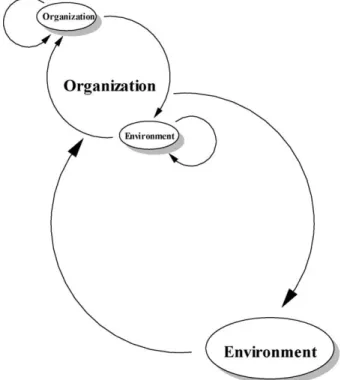
While observing SMEs busy with observing themselves it is important to acknowledge the self-referential phenomena involved. These phenomena appear because of what Spencer-Brown (1972) calls the ‘re-entry’ of the distinction between organization and environment within the organization (Fig. 1).
As a result of the re-entry, the organization stumbles upon the tautologies that it is what it is and that the environment is what it is. While considering these tautologies, the organization stumbles upon the paradox that while observing itself it is not observing itself. This paradox appears because no observation can observe
howandwhatit observes simultaneously.
The fact that observation is hindered by self-referential tautological and paradoxical reasoning indicates that there is a limit to the knowledge organizations can obtain about themselves and their environment. It seems therefore quite ironic that, while reflecting upontheir being there, social systems find out that they stumble upon a problem, which they have already solved by means of blissful self-ignorance, i.e.their existence.
The tautological and paradoxical problems indicate that identity is the blind spot of self-observation. Observing one’s
identity is a highly contingent affair because one can make use of a sheer unlimited amount of distinctions or concepts to indicate oneself. In addition, there seems to be a great dependence on the initial distinctions used to escape the tautological and paradoxical problems. Within organization studies, Nelson and Winter label this phenomenon ‘path dependency’ (Nelson and Winter, 1982). In supporting SMEs to describe themselves, intermediaries can make use of two distinct starting points in describing organizations strategically. One can take either the environment or the organization as starting point. The former relates to ‘out-side – in’ strategies like Porter (1985) and the latter to ‘inside – out’ strategies like the core competence view by
Prahalad and Hamel (1990, 1994) and the dynamic capabilities view of organizations (Teece and Pisano, 1994; Teece and Pisano, 1997). These strategic management approaches are the two most dominant and competing views to explain strategic success. As will be described next, both the ‘outside – in’ and the ‘inside – out’ approaches to strategy do not acknowledge the self-referential problems involved with strategy making.
Porter states that sustaining competitive advantage involves dealing with competitive forces within a sector of industry to become distinct from competitors. The competitive forces determine the rules of the game in doing business within a sector of industry. According to Porter, organizations act wisely if they obey these strategic rules. This implies that within Porter’s strategic reality it is not wise if organizations try to change the strategic rules, for that leads to a stuck-in-the-middle position within the sector of industry. The only two ways of becoming distinct are by adopting a ‘cost leadership’ strategy or a ‘strategy of differentiation’. Because Porter beliefs the strategic rules within a sector of industry are objective, all competitors will observe the same strategic rules and choose a strategy to become distinct accordingly. Paradoxically, this will result in the situation that strategy no longer concerns doing things differently, but by doing things the same as your competitors do. After all, if all organizations adopt either a strategy of ‘cost leadership’ or ‘differentiation’, ironically, the only way to become distinct from your competitors is to enact a ‘stuck-in-the-middle’ strategy that, according to Porter, should be avoided at all expense.
In addition, the most popular strategic management movement of the 1990s is not preserved of self-defeating reasoning. In recent years, one of the most used ‘buzzwords’ in strategic management was the notion of ‘core competence’. According to Prahalad and Hamel, the founding fathers of this concept and who disputed the competitive advantage concept of Porter, the existence of core competences of organizations is independent of the markets served by these organizations. This means that a core competence can be applied in diverse independent markets. However, in their book ‘Competing for the Future’ they state that the capabilities of organizations that need to be regarded as core competences eventually need to be determined by Fig. 1. Strategic re-entry.
customers. That is, market success determines. the core competences of organizations. It appears, paradoxically, that core competences should be regarded as both dependent and independent of the markets served at the same time. This leads to the situation that the ‘inside – out’ approach to strategy as recommended by Prahalad and Hamel, ironically, needs to be accompanied by the ‘outside – in’ approach of Porter, which they so fiercely attack, in order to determine an organization’s core competences.
As a result of these self-referential paradoxes,neitherthe ‘outside – in’ nor the ‘inside – out’ approach can claim superiority in explaining strategic success. For this reason, both starting points seem to be equally valid and consequently, intermediaries should be able to support the management of SMEs to describe their strategy in both ways. How this can be done, will be the subject of the next section.
3. Strategic management concepts
Since the linguistic turn in philosophy, it has become clear that we communicate with each other in language-games by means of concepts (Wittegenstein, 1953; Searle, 1979). That is, we give meaning to the word depending on the way we speak about it. In this sense, it is not so important what strategic management concepts mean, it is what you can make them mean (Vos, 2002: 43– 44). Take for example the notion of ‘core competence’ (Prahalad and Hamel, 1990). Throughout their entire book,Prahalad and Hamel (1994)remain vague about what core competences actually are. Notwithstanding this, since the launch of the core competence concept, several authors have made checklists that enable managers to determine if their company has core competences (e.g.Stalk et al., 1992; Bartness and Cerny, 1993).
In describing the strategy of SMEs by means of strategic management concepts an important methodological issue needs to be dealt with. This issue relates to the strategic
concepts necessary to make sense of the strategy of SMEs. In choosing these concepts, two distinct options exist. The first option relates to the a priori deductive selection of strategic concepts considered relevant for the description of strategies from the perspective of the intermediary. As opposed to this, the second option relates to the a posteriori inductive selection of strategic concepts based upon the concepts in use by the management of SMEs. Due to the limited skills of SMEs in reflecting upon themselves, it appears to be wise to choose the strategic concepts beforehand. In this way a more rich and dense strategic self-description emerges than was possible otherwise.
In strategic literature, many strategic management con-cepts can be found that should aid companies in formulating competitive strategies.Ansoff (1965), for example, stresses the importance of decisions about which combinations of products and markets companies should or should not engage in.Miles and Snow (1978)stress the importance of decisions concerning the various ways companies are able to make the future happen. The importance of ‘added value’ and ways it can be sustained is stressed byPorter (1985). The need for insights in the current competitive environment to gain ‘strategic supremacy’ is stressed by D’Aveni (1999). The strategic importance of decisions concerning the structure of organizations is stressed byMintzberg (1979). Strategic resources or investments and their importance were stressed by Pfeffer and Salancik (1978) and recently by
Kaplan and Norton (1996). The concept of the experience curve highlights the risk of undercapitalization of strategic assets (Ghemawat, 1985). The strategic importance of operational excellence appeared from the concept of ‘lean production’ (Womack et al., 1991) and ‘Business Process Reengineering’ (Hammer and Champy, 1994). The use of strategic concepts functions as a double-edged sword for members of organizations because they enable and constrain the strategic sensemaking (Weick, 1979, 1987) at the same time. They enable sensemaking regarding strategic content Table 1
Strategic management concepts
Outside – in strategy Inside – out strategy
Strategic concept as an enacted thing in the systemic dimension
Product – Market-Combination (Ansoff, 1965) Core Competence (Prahalad and Hamel, 1990, 1994) Business (Abell, 1980) Dynamic Capabilities (Teece et al., 1994, 1997) The Business Choice The Competence Choice
Strategic concept as enacted upon within the time dimension
Future (Miles and Snow, 1978) Resources (Pfeffer and Salancik, 1978) Product-Life-Cycle (numerous authors) Strategic Assets (Kaplan and Norton, 1996) Added Value (Porter, 1985) Experience Curve (Ghemawat, 1985)
The Vision Choice The Assets Choice
Strategic concept as enacted upon by actors within the social dimension
Competitive Forces (Porter, 1985) Performance Indicators (Rockart, 1979)
Game Theory (Brandenburger and Nalebuff, 1995) Lean Manufacturing (Womack et al., 1991)
Strategic Supremacy (D’Aveni, 1999) Business Process Reengineering (Hammer and Champy, 1994) The Tactics Choice The Performance Choice
because the strategic concepts unfold self-reference and they constrain the sensemaking because they prohibit unfolding self-reference in other, perhaps strategically more, useful ways. Nonetheless this observation, inTable 1
some important strategic concepts found in strategic literature are listed. The rows of this table exist in three dimensions that decompose the meaning produced within communication processes (Luhmann, 1984: 112 – 114). They can be used to observe how various strategic concepts function in making sense of the external and internal environment of companies.
In the search for strategic concepts it appeared that almost all strategic concepts found in literature relate to concepts successfully launched by ‘Harvard Business Review’, ‘California Management Review’, ‘Sloan Man-agement Review’, etc. (Vos, 2002: 43 – 45). Apparently, only strategic management theorists are interested in formulating strategic reference points that should aid companies in gaining competitive advantage. Strategists conducting empirical research after strategic concepts merely seem to restrict themselves by only testing the relationships between strategic concepts and strategic performance as hypothesized by strategic management theorists. Readers for example of ‘Strategic Management Journal’ are regularly confronted with this type of research. Naturally, the use of strategic concepts as displayed in each cell ofTable 1involves strategic choice (Child, 1972, 1997). For this reason, each cell was given a name accordingly: i.e. the business, vision, tactics, competences, assets and performance choice.
4. Strategic management model
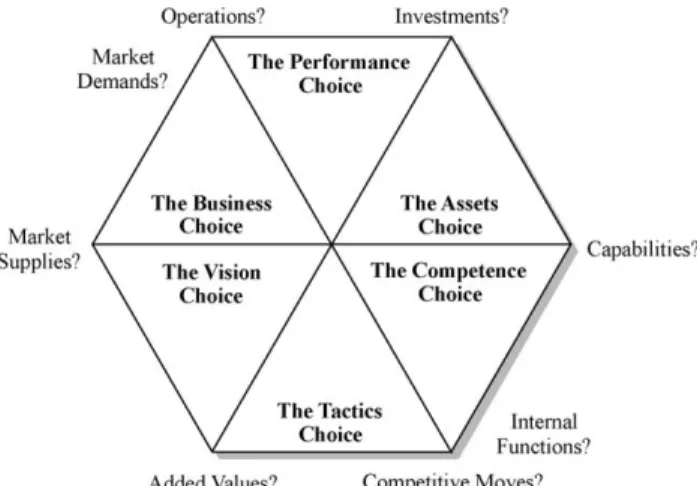
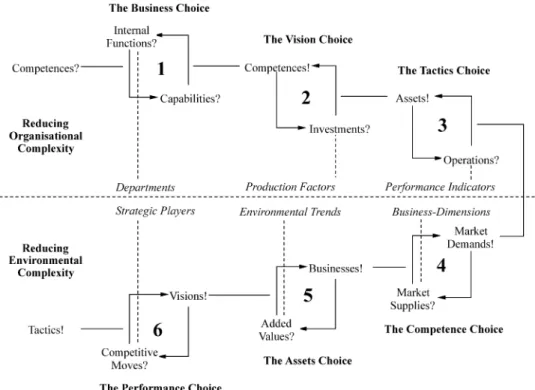
The strategic concepts and choices found in strategic literature can be linked to each other in the following way (Fig. 2). The strategic management model centers on the six strategic choices and connects the strategic concepts found in literature to each other.
† The choice to connect the strategic concepts of demand (market) and supply (products) to each is the business choice, which relates to the way companies choose to do business while planning to sell their goods or services to customers.
† The choice to connect the strategic concept of added value to the unity of a supply and a demand, i.e. a business, is calledthe vision choice, which relates to the way companies choose to make their business appealing while planning to sell their goods or services to customers.
† The choice to connect the strategic concept of competi-tive move to the unity of an added value and a business, i.e. a vision, is calledthe tactics choice, which relates to the way companies choose to make their visions come true while planning to sell their goods or services to customers.
† The choice to connect the strategic concept of capability to the unity of a competitive move and a vision, i.e. a tactic, is calledthe competence choice, which relates to the knowledge and skills companies ought necessary to make their tactics succeed while planning to realize their goods or services.
† The choice to connect the strategic concept of investment to the unity of a capability and a tactic, i.e. a competence, is calledthe assets choice, which relates to the resources companies choose to actualize their competences while planning to realize their goods or services.
† The choice to connect the strategic concept of operations to the unity of an investment and a competence, i.e. an asset, is calledthe performance choice, which relates to the way companies choose to deploy and manage their assets while planning to realize their goods or services. Within the strategic management model, the environ-ment of companies is represented by the business, vision and tactics choice and the organization of companies by the competence, assets and performance choice. In order to move from the outside to the inside, the competitive moves (tactics choice) need to be linked relatively to the responsible internal functions or departments (competence choice). Likewise, in order to move from the inside to the outside, the operations (performance choice) need to be linked relatively to their businesses (business choice). By means of both links, the intermediary is able to confront the management of SMEs with the questionto what extent the company is able to do business with its customers as planned (‘outside – in’) andto what extent is the company able to develop the competences it planned by the competitive moves it enacts(‘inside – out’).
This strategic management model can aid in the description of the strategy as enacted by the management of SMEs. In observing the way managers make sense of strategic concepts, the notion of operational self-reference becomes important (Luhmann, 1984: 600 – 602). Operational self-reference implies that on some point in Fig. 2. Strategic management model.
the strategic sensemaking process, managers are constrained by the outcome of choices made earlier. In other words, all strategic concepts are to be related to each other in such a way that they become path dependent. By means of this path dependency, we are able to model both the ‘outside – in’ and ‘inside – out’ approaches to strategy. The ‘outside – in’ approach starts the strategic self-description of an SME at the business choice. Likewise, the ‘inside – out’ approach starts at the competence choice.
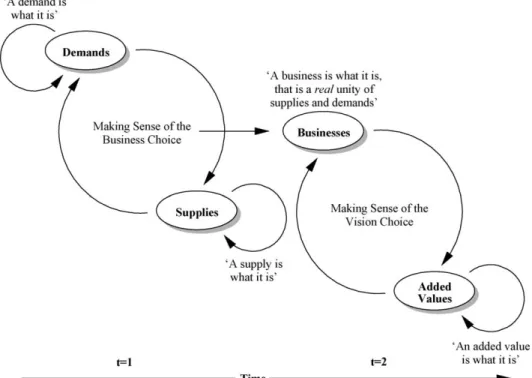
In making clear how the strategic management model works in observing this path dependency, an example of the way the business and vision choice are related to each other is given (Fig. 3). First, one needs to make sense of the business choice. To define a business on t¼1; one must solve the self-referential problem that the market supplies depend on the market needs and vice versa. As a result of this chicken-and-egg problem, two tautologies need to be dealt with, such that the intermediary finds out what the SME does in actual ‘reality’: (1) the SME supplies what it supplies and (2) the customer demands what he demands. When both supply and demand are being defined, one has defined a business.
Subsequently, the vision choice presents itself ont¼2: Solving this chicken-and-egg problem makes the strategic sensemaking process path dependent because in order to define a vision, the management and the intermediary ‘only’ need to deal with the tautology that ‘an added value is what it is’. That is because the chicken-and-egg problem consisting of the relationship between businesses and added values is already solved partly because of the already existing or ‘real’ businesses ont¼2:
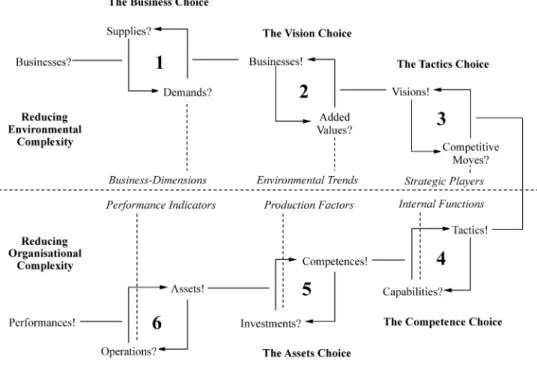
The same logic applies to the remaining choices, which implies the following procedure for the ‘outside – in’-approach to an SME’s strategy (Fig. 4).
† Ont¼1;businesses need to be defined ex nihilo or ‘out-of-the-blue’ dependent on the distinction between market supplies and customer demands. For this, the business-dimensions can be used (Abell, 1980): ‘what?’ for the customer functions, ‘how?’ for the solutions offered and ‘who?’ to address the specifics of the customer.
† On t¼2; visions need to be defined dependent on the distinction between the already existing ‘real’ businesses and the concept of temporal added values (trends). For this, the DESTEP-factors can be used (Botter, 1988). The word DESTEP is in fact an acronym, within which D relates to demographic issues, E to economic issues, S to social issues, T to technological issues, E to ecological issues and P to political issues.
† On t¼3; tactics need to be defined dependent on the distinction between the already existing ‘real’ visions and the concept of competitive moves. For this, the extension of the model of competitive forces by Porter (1985) and
Brandenburger and Nalebuff (1995)may be used.The latter have used game theory to determine competitive moves to outplay or use specific strategic players. The strategic roles distinguished by them, besides companies, are customers, suppliers, substitutors and complementors.
† Ont¼4;competences need to be defined dependent on the distinction between the already existing ‘real’ tactics and the concept of capabilities. For this, the three internal functions frequently brought up with respect to
the structures of organizations may be used: research and development (R&D), production and sales (Woodward, 1965: 125).
† On t¼5; assets need to be defined dependent on the distinction between the already existing ‘real’ competences and the concept of investments. For this, the production factors may be used (Weggeman, 1997). Nowadays, knowledge appears to be the one important production factor besides the traditional production factors such as capital, ground and material. In the ‘networked-society’, relationships also are an important strategic production factor, which companies can invest in strategically. † Ont¼6;performances need to be defined dependent on
the distinction between the already existing ‘real’ assets and the concept of operations. For this, performance indicators can be used (Rockart, 1979). On the operational level, three important indicators can be used: time, quality and costs. Time relates to the throughput time of processes, quality to the presence of required characteristics and costs to the offers brought to realize the output of processes. On the business level, three other performance indicators can be used: productivity, effectivity and efficiency. Pro-ductivity relates to the proportion of turnover and offerings realized, effectivity to the proportion of planned turnover and realized turnover and efficiency to the proportion of offerings realized and offerings planned. While making sense of the performance choice, companies should consider whether their performances should be redefined or not in making the future happen.
For the observation of an ‘inside – out’ approach to strategy, the next procedure applies (Fig. 5).
† On t¼1; competences need to be defined ‘out-of-the-blue’ dependent on the distinction between internal functions (e.g. the departments R&D, marketing and production) and capabilities.
† On t¼2; assets need to be defined dependent on the distinction between the already existing or ‘real’ compe-tences and the investment-concept (e.g. the investment in resources like knowledge, capital, ground, material and relations).
† Ont¼3;performances need to be defined dependent on the distinction between the already existing ‘real’ assets and the operations-concept (e.g. with the performance-indicators quality, time and costs on the operational level and productivity, effectivity and efficiency on the business level). † Ont¼4;businesses need to be defined dependent on the distinction between market supplies (‘how?’) and the ‘real’ performances that are related to the extent the customer (‘who?’) demands (‘what?’) are met.
† On t¼5; visions need to be defined dependent on the distinction between the already existing ‘real’ businesses and the added value concept (i.e. the way management uses trends (e.g. DESTEP) to define added values).
† On t¼6; tactics need to be defined dependent on the distinction between the already existing ‘real’ visions and the concept of competitive moves (i.e. the moves made by other strategic players in the business).
5. The Quick Scan
From previous research, it appeared that the Quick Scan should meet the following styling requirements in order to Fig. 4. Procedure for ‘outside– in’ approach to strategic self-observation.
be able to operate as effectively as possible within specific time constraints (Vos et al., 1998). Some considerations about the time necessary to conduct a Quick Scan will be discussed in Section 6.
† Focus on several businesses at the same time. It turned out that most SMEs were active in more than one business. Consequently, the Quick Scan should enable the description of more than one business strategy. This functionality is fulfilled by the use of tables or matrices because matrices enable the description of various demands, supplies, added values, competitive moves, capabilities, investments and operations at the same time.
† Focus on present and future strategies at the same time. It turned out that the future strategies defined by respondents could differ in level of ambition to a considerable degree. Therefore, in order to get insight in the impact of proposed strategic changes it was chosen to describe both the present and future business strategies. This is done by means of the matrices described above. The upper left corner of a matrix is used to describe the present strategies and the lower right corner to describe the strategies of the future. The tables resulting therefore resemble the so-called ‘diagonal matrices’, i.e. matrices whereby the upper right and lower left corner of the tables are empty.
† Focus on strategic concepts that are of ‘real’ strategic imperative to the company. It turned out that the limited time available should be used as productive as possible. Therefore, the Quick Scan should aid in
focusing the respondents in addressing the issues that are key to the success of their company’s strategy from their point of view. To fulfill this requirement, each business, vision, tactic, competence, asset and performance is scored on its level of distinctiveness and indistinctiveness, respectively. The measuring-scale chosen for each cell of the various matrices has an even amount of measuring points (very distinct, not so distinct, not so indistinct and very indistinct) in order to enforce the respondents a verdict.
The design of the Quick Scan is depicted inFig. 6. As can be seen, each strategic choice is represented by means of a matrix. Take, for instance, the vision choice whereby the added values of a company’s businesses need to be defined with respect to their corresponding environmental trends. Within the corresponding matrix, a company’s businesses are listed in the rows and the relevant environmental trends in the columns. Each added value to be defined is rendered at the point of intersection of the relating business and environ-mental trend. In observing the strategic reality experienced by the management of SMEs, the strategic management model can aid in the description of a vast amount of empirical grounded strategic concepts. When, for instance, only one strategic concept per strategic choice is defined, 16 ¼1 operation needs to be defined strategically. In the case of two businesses but two added values for each business and two competitive moves for each vision but two capabilities for each tactic, etc. respondents need to define 26¼64 strategic operations. Likewise, in the case of three empirical grounded strategic concepts per strategic choice, 36¼729 operations need to be defined. Because it is to be expected that managers Fig. 5. Procedure for ‘inside – out’-approach to strategic self-observation.
of SMEs do not find it very sensible to deal with enormous amounts of operations, let alone of what they are able to do so, the model should also aid in describing the way they reduce the complexity involved in dealing with their strategic reality as a whole. That is, the Quick Scan should be able to combine several added values for distinct businesses, several competitive moves for distinct visions, several capabilities for distinct tactics, several investments for distinct compe-tences and several operations for the deployment of distinct assets. In doing so, the intermediary can determine how managers of SMEs have meaningfully reduced the complex-ity of the ‘real world’. How this can be done, is described in the next section.
For each strategic choice the same instruction applies while filling the matrices of the Quick Scan. Take for example the vision choice (Fig. 7). At this point during the Quick Scan, real businesses are already defined. As a result, the ‘only’ self-referential problem that needs to be solved
by both the respondents and the intermediary concerns the reciprocal relationship between added values and environmental trends. In discovering the visions of the respondents that are imperative in the creation of their strategic reality, the intermediary should first list the SME’s businesses in the rows of the vision-matrix. Subsequently, the intermediary should incite the respondents in listing relevant environmental trends that they wish to start (‘to lead’) or are aware to exist (‘to follow’) for their businesses. For the SME’s present and future strategies, the respondents and intermediary should define how the company tries to take advantage of the relevant environmental trends for their businesses. After that, if possible, the social researcher should try to bring some ‘system in the madness’ by trying to relate several cells in the matrix, i.e. added values, to each other in a way that is meaningful to explain the strategic actions of the company through the eyes of the respondents. If this succeeds, Fig. 6. The design of the Quick Scan.
the resulting visions are ‘real’ in the sense that they are imperative to the respondents in making their company’s future happen. The intermediary should, however, double check whether these visions are grounded empirically. If the intermediary and respondents cannot come to a meaningful reduction of the added values, they should all be regarded as distinct strategic visions and be presented as such in the subsequent tactics-matrix. During the empirical research, it has often appeared that the conversations about the company’s competitive moves, the ‘real’ visions of the company emerged.
6. Discussion
One may wonder on this point, why the strategic management model is applied in a counter-clockwise instead of clockwise manner during a Quick Scan. This choice was made on theoretical grounds. Applying the model counter-clockwise, as presented here, implies that the intermediary starts the Quick Scan by either the business choice or the competence choice; the clockwise application starts at either the tactics choice or the performance choice. In both cases, however, the intermediary must seek for meaningful patterns in the way the respondents describe their company’s strategy with respect to the various strategic concepts. In the counter-clockwise application one abstains from the operational level to prevent that one needs to deal enormous amounts of ‘day-to-day’ details, on which the focus is in the clockwise application of the Quick Scan. Just because the management of SMEs has difficulties to put their company’s strategy into perspective, at least that is the argument of this paper, the communication about such details should be avoided. Otherwise, ironically, the management might get caught up in the way they communicate about the course of the company in their
own limited language. Therefore, the counter-clockwise application of the strategic management model is more appropriate for establishing strategic self-descriptions of SMEs. The clockwise application of the model, however, comes of hand in the case that managers use abstract dreamlike language that has little to do with their ‘real’ reality. In that case, the clockwise filling of the matrices may enforce managers to speak about their company’s strategy in a more down-to-earth approach.
The time necessary to conduct a Quick Scan depends on one’s intentions to determine whether an SME iseitherable to do business with its customers as planned (‘outside – in’)
or able to develop the competences it planned by the competitive moves it enacts (‘inside – out’). One can, for instance, plan to describe only a company’s present strategy or plan to describe both the present and future strategies. In either case, experimentally it has become clear that ‘1 h per strategic choice’ applies as a rule-of-thumb. This implies that the self-description of a company’s present strategy amounts to approximately six hours and the discussion about a company’s possible future strategy amounts also to a minimum of 6 h. Naturally, if the management is in the dark with respect to the company’s future, the Quick Scan about the future takes more time. We have learned that carrying out a Quick Scan in less than 6 h, gives the management of SMEs too little time to learn to use the language necessary to reflect upon their company strategically. It appeared that pushing this 6 h limit downwards goes at the expense of the development of the basis necessary to change a company’s future direction.
7. Conclusions
The Quick Scan as presented here has been in development since 1996. It has been used extensively both Fig. 7. Filling a matrix with empirically grounded data.
in academic research and innovation consultancy. Until now, the strategies of some 30 SMEs have been described. The findings thus far indicate our hypothesis to be true, i.e. managers of SMEs have poor skills in reflecting upon their companies strategically. These limited skills make companies in a sense out of control. It has occurred regularly, for instance, that managers have no explicit business definitions, which make companies the plaything of their customers. After all, a company can only experience freedom of choice when it has limited its possibilities to choose from (Child, 1997; Luhmann, 2000). The managers who were interviewed saw the Quick Scan as an opportunity to broaden their view and appreciated the systematic and integral perspective offered to them. In addition, during the sessions, it appeared that managers of SMEs rarely spoke to each other about their company’s strategy. As such, the Quick Scan is an enabler for managers to make sense of their company’s strategy collectively.
Intermediaries appraise the option to observe a company
both ‘outside – in’ and ‘inside – out’. Undeservedly, this ‘both/and’ option has had very little attention in strategic literature. Especially in the context of suppliers and engineer-to-order firms, the option to observe companies ‘inside – out’ appeared to be very helpful. These companies, in their own words, do not have ‘products of their own’ and instead of offering products they offer capabilities to realize and/or design the products of their customers. Most SMEs we have visited in the past appear to be capability-oriented. For this reason, it was striking to find that within strategy-literature so little is known about the strategic problems of this type of companies (an exception to this rule is: Vanvan Gunsteren, 1987).
The intermediaries that worked with the Quick Scan valued the fact that the strategic management model is constructivistic by nature, i.e. it is of less importance what strategic management concepts mean, it is what you can make them mean in specific contexts. In the experience of these intermediaries, most strategic management concepts are prescriptive instead of descriptive. As such, they seem to miss the point that, within the context of SMEs, the problem is not so much to define a distinctive strategy dependent upon new strategic concepts, for that is their day-to-day business, but to get managers of SMEs talking to each other meaningfully about what attracts their attention as individuals with respect to the company’s external and internal environment. The fact that the Quick Scan supports such a line of reasoning seems to be a distinctive characteristic of the tool.
Acknowledgements
The author would like to thank the Dutch organizations SENTER, EG-Liaison, FME/CWM and Syntens for their support in the development of the Quick Scan.
References
Abell, D.F., 1980. Defining the Business: the Starting Point of Strategic Planning, Prentice-Hall, Englewood Cliffs, NJ.
Ansoff, H.I., 1965. Corporate Strategy: an Analytic Approach to Business Policy for Growth and Expansion, McGraw-Hill, London.
Bartness, A., Cerny, K., 1993. Building competitive advantage through a global network of capabilities. California Management Review 35(2), 78 – 103.
Botter, C.H., 1988. Industrie en Organisatie: een Overzicht en Uitzicht, 15e druk, Kluwer Bedrijfswetenschappen, ’s-Gravenhage, pp. 95 – 96. Brandenburger, A.M., Nalebuff, B.J., 1995. The right game: use game
theory to shape strategy. Harvard Business Review 73(4), 57 – 71. Buratti, N., Penco, L., 2001. Assisted technology transfer to SMEs: lessons
from an exemplary case. Technovation 21(1), 35 – 43.
Child, J., 1972. Organizational structure, environment and performance: the role of strategic choice. Sociology 6, 1 – 22.
Child, J., 1997. Strategic choice in the analysis of action, structure, organizations and environment: retrospect and prospect. Organization Studies 18(1), 43 – 76.
D’Aveni, R.A., 1999. Strategic supremacy through disruption and dominance. Sloan Management Review 40(3), 127 – 135.(p. 128). von Foerster, H., 1979. Cybernetics of cybernetics. In: Krippendorff, K.,
(Ed.), Communication and Control in Society, Gordon and Breach, New York, pp. 5 – 8.
von Foerster, H., 1981. Observing Systems, Intersystems Publications, Seaside, CA.
Ghemawat, P., 1985. Building strategy on the experience curve. Harvard Business Review 63(2), 143 – 149.
van Gunsteren, L.A., 1987. Planning for technology as a corporate resource: a strategic classification. Long Range Planning 20(2), 51 – 60. Hammer, M., Champy, J., 1994. Reengineering the Corporation:
A Manifesto for Business Revolution, Brealey, London.
Kaplan, R.S., Norton, D.P., 1996. The Balanced Scorecard: Translating Strategy into Action, Harvard Business School Press, Boston, MA. Luhmann, N., 1984. Soziale Systeme: Grundribeiner allgemeinen Theorie,
Suhrkamp, Frankfurt am Main.
Luhmann, N., 2000. Organisation und Entscheidung, Westdeutscher Verlag, Wiesbaden.
Miles, R.E., Snow, C.C., 1978. Organizational Strategy, Structure and Process, McGraw-Hill, London.
Mintzberg, H., 1979. The Structuring of Organizations: a Synthesis of the Research, Prentice-Hall International, London.
Morgan, E.J., Crawford, N., 1996. Technology broking activities in Europe: a survey. International Journal of Technology Management 12(3), 360 – 367.
Nelson, R., Winter, S., 1982. An Evolutionary Theory of Economic Change, Belknap Press, Cambridge, MA.
Pfeffer, J., Salancik, G.R., 1978. The External Control of Organizations, Harper and Row, New York.
Porter, M.E., 1985. Competitive Advantage: Creating and Sustaining Superior Performance, Collier Macmillan, London.
Prahalad, C.K., Hamel, G., 1990. The core competency of the corporation. Harvard Business Review 68(3), 79 – 82.
Prahalad, C.K., Hamel, G., 1994. Competing for the Future, Harvard Business School Press, Boston, MA.
Rockart, J., 1979. Chief executives define their own data needs. Harvard Business Review 57(2), 81 – 93.
Searle, J.R., 1979. Expression and Meaning, Cambridge University Press, Cambridge.
Spencer-Brown G., 1972. Laws of Form. 1st American ed., Julian Press, New York.
Stalk, G., Evans, P., Lawrence, L.E., 1992. Competing on Capabilities: The New Rules of Corporate Strategy. Harvard Business Review 70(2), 57 – 69.
Teece, D.J., Pisano, G., 1994. The dynamic capabilities of firms: an introduction. Industrial and Corporate Change 3(3), 537 – 556. Teece, D.J., Pisano, G., Shuen, A., 1997. Dynamic capabilities and strategic
management. Strategic Management Journal 18(7), 509 – 533. Tidd, J., Bessant, J.R., Pavitt, K., 1997. Managing Innovation: Integrating
Technological, Market and Organizational Change, Wiley, Chichester, p. 70.
Vos, J.-P., 2002. The Making of Strategic Realities: An Application of the Social Systems Theory of Niklas Luhmann, Eindhoven University Press, Eindhoven.
Vos, J.-P., Keizer, J.A., Halman, J.I.M., 1998. Diagnosing constraints in knowledge of SMEs. Technology Forecasting and Social Change 58(3), 227 – 239.
Weggeman, M.C.D.P., 1997. Kennismanagement: inrichting en besturing van kennisintensieve organisaties, Scriptum Management, Schiedam. Weick, K.E., 1979. The Social Psychology of Organizing, Second ed.,
Addison-Wesley, Reading, MA.
Weick, K.E., 1987. Substitutes for strategy. In: Teece, D.J., (Ed.), The Competitive Challenge: Strategies for Industrial Innovation and Renewal, Ballinger, Cambridge MA, pp. 221 – 233.
Wittegenstein, L., 1953. Philosophical Investigations, Blackwell, Oxford. Womack, J.P., Jones, D.T., Roos, D., 1991. The Machine that Changed the
World: the Story of Lean Production, Harper Perennial, New York. Woodward, J., 1965. Industrial Organization: Theory and Practice, Oxford
University Press, London.
Jan-Peter Vos(MSc, PhD) is an Assistant Professor at the Department of Organization Science and Marketing of the Eindhoven University of Technology. He lectures organization theory and is concerned with the application of social systems theory to the field of organization studies. In addition, he is a member of the research group that explores empirically the risks involved with the way technology and knowledge-intensive organizations manage innovation.