1
Constructions, perceptions and
expectations of being disabled and
young
A critical disability perspective
Jenny Slater
A thesis submitted for partial fulfilment of the requirements of the
Manchester Metropolitan University for the degree of Doctor of Philosophy
Department of Psychology
2
Contents
List of figures and DVDs ... 6
Acknowledgements ... 7
Abstract ... 8
Introduction, Theoretical Perspectives Introduction ... 9
Covering letter: Dear Mr. Reasonable ... 10
Defining disability (or not) ... 14
Queer(y)ing ... 19
Queer(y)ing ethnography ... 20
Queer(y)ing writing ... 23
Queer(y)ing myself ... 24
Queer(y)ing ethics ... 26
The structure of my thesis ... 28
Section One: Theorising and Contextualising Youth and Disabliity
Chapter One, Playing grownup: interdisiplinary thinking about youth and adulthood Introduction ... 34Defining youth in the UK ... 37
Hitting the benchmarks of adulthood ... 39
The positioning of youth in youth research ... 41
Youth as Active, Youth for Sale, Youth as Passive ... 42
Youth as Active ... 42
Youth for Sale ... 45
Youth as Passive ... 46
Discussion ... 49
Chapter Two, Disability and Youth as Passive in British Political Climates Introduction ... 51
Researching disabled youth and transition ... 52
Young and disabled people under the coalition government ... 55
The representation of disability in current political climates ... 57
3
The danger of disposability for disabled youth ... 65
Discussion ... 66
Chapter Three, Youth for Sale and The Aesthetic Project of Youth Introduction ... 68
Feminist-disability theory ... 69
Positioning the dis/abled female body within the popular media ... 70
Youth, embodiment and time ... 75
Youth means beauty means health ... 80
Discussion ... 81
Chapter Four, Is Youth Queer? Disability, Youth as Active and Productive Possibility Introduction ... 83
Identity politics, queer theory and CDS ... 84
‘Kids are kids’: Postcolonial theory, disability and developmental discourse ... 88
Children’s literature and the colonisation of childhood ... 92
Youth and mimicry ... 95
Binary breakers: Hybridity, youth, disability and Deleuze ... 98
Discussion ... 100
Intermission… ...102
Section Two: Analysis and Synthesis through the Lived-Experiences of
Young Disabled People
Chapter Five, Method/ology Introduction ... 105Methodological influences: Futurology, CDS and the new sociology of childhood ... 108
Justifying utopia as method ... 111
A critically young methodology ... 115
Research contexts: Recruitment and methods ... 117
Explore ... 117
Youth Forum (YF) ... 122
Colin ... 128
Iceland ... 131
Ethics ... 137
4
Procedural ethics ... 142
Ethics, ethnography and friendship ... 143
Ethically leaving the field ... 148
Dealing with data ... 149
Approach to analysis ... 153
Answering research questions through and with the lives of young disabled people ... 157
Discussion ... 160
Chapter Six, Disabled Youth as Active; Questioning Youth Culture Introduction ... 161
Disabled youth’s access to space ... 162
Youth subcultural studies: Averse to disability? ... 169
Feminist critiques of youth culture and disabled young people ‘doing youth’ ... 177
Cripping youth culture: Disabled youth (and their parents) challenging the youth/adult divide 184 Discussion ... 191
Chapter Seven, Disabled Youth Becoming-Independent-Adult: Cripping Youth as Active Introduction ... 195
Youth, disability and becoming-adult ... 196
Disabled youth and dangers of adulthood mimicry ... 199
Mocking adulthood, cripping independence ... 204
Autonomy, the personal pronoun and people with labels of intellectual impairment ... 213
Discussion ... 218
Chapter Eight, Disabled Youth, Gender and Sexuality: Cripping Youth for Sale ... 220
Introduction ... 220
Thinking about sexuality, gender and the body with disabled youth ... 221
Disabled youth queering disability ... 231
Discussion ... 239
Discussion, Learning with and about youth, disability and becoming-in-the-world-together ... 241
Introduction ... 241
The Dangers of not questioning normativity for disabled youth ... 243
Research repositioning disabled youth as active and politically resilient ... 245
Learning from and about youth and disability, and the lived-experiences of young disabled people ... 248
5
Goodbye Mr Reasonable ... 256
Appendices ...260
Appendix One: ‘Report from the Future’ booklet used with Explore ... 261
Appendix Two: ‘My day in the future’ used with Explore ... 265
Appendix Three: Example of ‘Instructions from time travelling guru’ used with Explore ... 266
Appendix Four: Example of final art piece, Explore 1 ... 267
Appendix Five: Example of final art piece, Explore 2 ... 268
Appendix Six: Participant Information Sheet, Cameras Workshop, Youth Forum... 269
Appendix Seven: Best-ever Future Worlds Project Accessible Summary ... 270
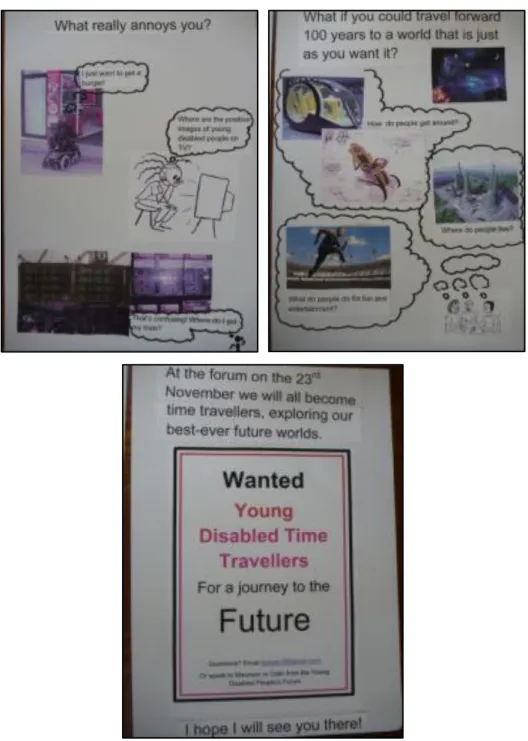
Appendix Eight: Introductory posters used with Youth Forum ... 277
Appendix Nine: Participant Information Sheet, Parent, Explore ... 278
Appendix Ten: Participant Information Sheet, Futures Workshops, Youth Forum ... 279
Appendix Eleven: Consent Form, Young Person, Explore ... 280
Appendix Twelve: Consent Form, Parent, Explore ... 281
Appendix Thirteen: Consent Form, Young Person, Youth Forum ... 282
Appendix Fourteen: Consent Form, Iceland... 283
Appendix Fifteen: Sooboo’s ‘A Day in the Life’ ... 284
6
List of figures and DVDs
Figure 1: Signifiers of Adulthood ... 40
Figure 2: Youth as Active, Youth for Sale, Youth as Passive ... 48
Figure 3: Photo created by Facebook group: “We demand David Cameron undergoes psychological assessment” ... 64
Figure 4 Pause's environmentally friendly 'Rainbow World' ... 122
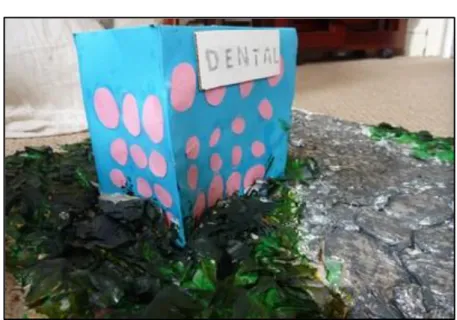
Figure 5 Sooboo's 'Green Land with Warm Winds and a Dentist' ... 122
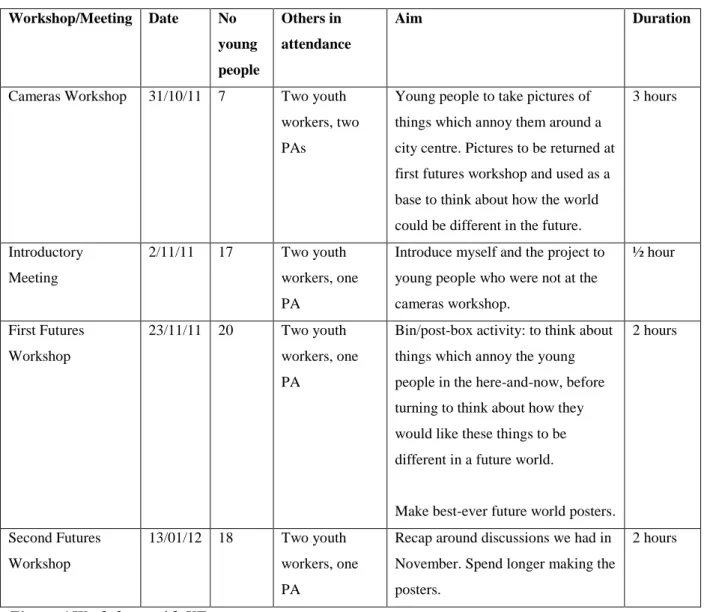
Figure 6 Workshops with YF ... 124
Figure 7 Introductory Posters used in YF ... 127
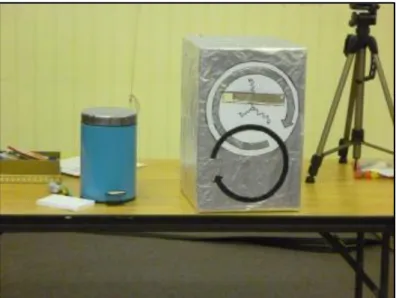
Figure 8 Bin/post-box activity, first futures workshop with YF ... 128
Figure 9 UK Fieldwork Timeline ... 130
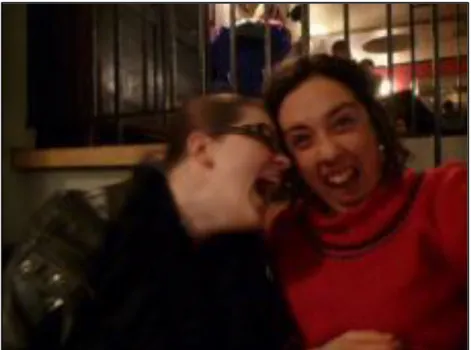
Figure 10 Embla and I on a trip downtown ... 135
Figure 11 Freyja, Embla and I having dinner at my apartment ... 136
Figure 12 Ethical Concerns with Explore and YF ... 139
Figure 13 Balancing Power with Explore and YF ... 142
Figure 14 Ethics timeline, Iceland ... 147
Figure 15 Levels of analysis ... 155
Figure 16 Photographs taken at YF capturing the physical inaccessibility of space ... 163
Figure 17 Photograph illustrating a physical barrier to public transport ... 165
Figure 18 Photographs illustrating sensory barriers to public transport ... 165
Figure 19 Photographs illustrating confusing timetabling information ... 166
Figure 20 Colin unable to enter a bookshop despite the “iconic figure of the wheelchair user” (Titchkosky, 2011, 81). ... 167
Figure 21 The dentist in Sooboo's final art piece ... 176
Figure 22: Pause’s 'Report from the Future’: "My life in the future" ... 180
Figure 23 Pause's “ordinary castle” for her friends, and “rainbow castle” for her family. ... 189
Figure 24: "Treat me normally" poster ... 198
Figure 25: Princess Hanna 'Report from the Future': "You have landed in your future world: what do you see?" ... 229
Figure 26 Aimee Mullins image used in Breaking through Limitations ... 233
Figure 27 Stacey Herald and Alison Lapper pictures used in Breaking through Limitation ... 237
Figure 28 Alison Lapper Statue displayed in Trafalgar Square ... 238
DVD 1: Futures Recruitment Presentation, Explore final art pieces DVD 2: EJ1234 Futures Animation
7
Acknowledgements
For the opportunity to tell the story of my thesis, I have a number of people to thank.
Firstly, I am grateful to my young disabled participants for sharing their thoughts, feelings and creative pursuits around ‘youth’ and ‘disability’. I also owe gratitude to the staff working within the organisations I spent time. I extend an especially big thank you to Freyja and Embla. What I have learnt from these young women is immeasurable; they have made me see the world differently.
I thank my academic comrades. Those that have made me feel so at home in the world of critical disability studies: members of the Disability Research Forum in Sheffield; Critical Disability Studies at MMU; the regular cohort at Theorising Normalcy and the Mundane and those at the Centre of Disability Studies at the University of Iceland. These are all arenas I would not have discovered without my undergraduate tutor, colleague and friend, Rebecca Mallett (the one who taught me everything I know). For this, Rebecca, I will always be grateful. Furthermore, I have been privileged to have the most engaged and engaging supervisors anyone could hope for, Rebecca Lawthom and Dan Goodley. Dan, thank you for guiding me and encouraging me to wander into places I never thought I’d go.
My brilliant friends who have put up with me/put the world to rights with me over the last few years of course need a mention. A special thanks to Sarah for looking after me and indulging my whisky-drinking whims over the last few months of writing up. Also Siân for the many trips over the Pennines when a pint was called for, and Rosie and those at Yeomans road: with you lot around I know I’ll always be well fed. Similar gratitude goes to Jóna and Bjarni, my Icelandic Mum and Dad.
To Mum, Dad, Bob, Jim, Dan, Uncle A and Steph: thanks for everything. Words could never express how much you lot have taught me and what you mean to me. You’re just ace. xxxxxxxxxxxxxxxxxx
8
Abstract
This thesis takes a critical disability studies (CDS) approach to explore the concepts of ‘youth’ and ‘disability’. I ask how normative conceptions of youth and disability impact upon the lives of young disabled people and consider how, as youth and disability researchers, we can position young disabled people as active and politically resilient. I argue that thinking about youth, disability and lived-experiences of disabled youth, can teach us less oppressive ways of conceptualising disability and youth, through the notion of becoming-in-the-world-together (Shildrick, 2009).
The method/ology I employ is transdisciplinary, postconventionalist (Shildrick, 2009) and auto/ethnographic. Following Hughes, Goodley and Davis (2012) I utilise theories as and when I see them fit for my political purpose. The thesis is divided into two sections. Section One theorises and contextualises youth and disability; whereas Section Two introduces fieldwork and contains three chapters of analysis. There were three contexts to fieldwork. The first two involve using a variety of creative methods to ask two groups of young disabled people in northern England for their utopian, best-ever future world ideas. I call this The Best-Ever Future Worlds Project. The third research context is a three month ethnography with young people involved in the Independent Living Movement (ILM) in Iceland. The stories, ideas and theorisations of all these young people help me to question, queer and crip discourses of youth, adult and disability.
Findings highlight the ableism of adulthood and the falsity of conceptualising youth as a time of becoming-independent-adult. I argue it is more useful, inclusive and
representative of young people’s lives to consider youth, not as a time of becoming-independent, but a time of expanding networks of interdependency. We see dangerous relationships between disability, youth and sexuality functioning to posit disabled people’s bodies as a) childlike (Johnson, Walmsley, & Wolfe, 2010), b) asexual
(Garland-Thomson, 2002; Liddiard, 2012), and c) the property of others, to be subject to intervention (Barton, 1993; McCarthy, 1998). The importance of questioning normative discourses of disability and youth for young disabled people therefore becomes clear. I argue this has to take place both inside and outside academia. Reconceptualising youth and disability requires intersectional approaches to research, transdisciplinary
9
Introduction
Theoretical Perspectives
Introduction
My thesis takes you through my PhD journey of conducting research at the intersection of youth and disability. As hinted at in the title, Constructions, perceptions and
expectations of being disabled and young: A critical disability perspective, I will not only consider the situation of disabled young people. Rather, I will think-through what it means to ‘be young’, to ‘be disabled’ and to ‘be disabled youth’ using the theoretical tools offered to me by critical disability studies (CDS). The approach I have taken to writing is different from your ‘traditional’ PhD thesis. By outlining my theoretical perspectives in this introduction I justify my approach to writing. I start by addressing what I mean by disability and a CDS perspective. I argue that a CDS approach demands intersectionality. The ambiguity and questioning of queer theory sits well with my intersectional approach to research. Drawing on Gibson-Graham’s (1999) term ‘queer(y)ing’ I outline how an approach that continually queer(y)s ethnography, the process of academic writing, myself, and finally, ethics, leads to the auto/ethnographic, reflexive, postconventionalist (Shildrick, 2009) approach which guides my research.
I begin, however, with a letter. In summer 2011 I was asked in a supervision meeting about my direct style of writing: who is the imagined reader of my thesis? Mulling the question over, I realised my imagined audience was not you (academic/disability scholar/I hope, ally?), but somebody I now know as Mr Reasonable: the figure embodying the problem of adult ableism. I decided I would address Mr Reasonable directly in what I think of as a covering letter. I readdress him periodically as the thesis continues. The covering letter begins to explain why I feel it is important to think about youth and disability together; justifications which are extrapolated over the first four chapters of my thesis. I also use the letter to introduce my research questions. Some of the theories I name in this letter are not fully defined within it, but outlined later in this chapter, or you are directed to where I offer more detailed explanations. If you are not yet sure who I mean by Mr Reasonable, I predict that by the end of the letter you will have brought to mind a few Mr Reasonables of your own. For that, I can only apologise.
10 Covering letter: Dear Mr. Reasonable
Dear Mr Reasonable,
We come across each other less often than we used to. Engagement in CDS has allowed me to surround myself with a motley crew of unreasonable, non-normative folk. You are still a part of my life, but I try to make our encounters infrequent, and they are generally more indirect. I see you on my television and hear you on my radio. Sadly, my family, friends, colleagues and comrades have increasing numbers of Mr Reasonable stories to tell… but I am lucky enough to keep you distant. You are probably wondering why I am writing to you. I am addressing my thesis to you, Mr Reasonable, and all your
Reasonable Friends. In this covering letter I explain, a) what I hope we will learn
together through my thesis; b) why I am addressing my thesis to you; and, c) why I think we should be learning through the media of youth and disability.
So who are you, Mr Reasonable? What you are not is the overtly nasty person that it is easy to be angry with. In fact, you could be that person I occasionally find myself describing as ‘alright really’. But as my thesis continues, we will see that this is dangerous. You live by and do not question ‘reasonable’ rules. This results in aversive prejudice that is difficult to challenge (Deal, 2007). You attempt (though, I would argue, inevitably fail) to be what Garland-Thomson (2002, 10) calls the ‘normate’: “the
corporeal incarnation of culture’s collective, unmarked, normative characteristics”. You try to embody the “normative, dominating, unexamined power that underlies the
rationality of Eurocentric culture and thought” (Smith, 2004). Yet you do not see that in your attempts to be normative, you are oppressing and restricting the non-normative. I argue throughout my thesis that not questioning the normative leads to dangerous implicit beliefs that hinder the lives of those not meeting up to your normative and normalised standards. Disabled youth are one of these groups. My thesis challenges normativity through and with the lives of disabled youth.
Why youth? Why disability? In short, because I feel the disruptiveness of youth and disability challenge your normative ways of thinking. I will use them to highlight and question your dangerous, but oh so reasonable rules. These rules are not necessarily written laws, but rules that become so engrained that they stand as ‘fact’ (Deal, 2007;
11 Stein, 2010). Titchkosky (2000) refers to (untrue) ‘facts’ about disability as ‘official textbooks’ of disability. Textbooks teach us that disability is a tragedy and disabled people are deficient, dependent and burdensome. Disability scholars and activists (including, we will see, my young disabled participants) have and are challenging this engrained falsity. Your reasonable rules result in ‘official textbooks’ about other non-normatives too. ‘Official textbooks’ of women (critiqued by feminists), ‘official
textbooks’ of people of colour (critiqued within critical race and postcolonial studies and by anti-race activism) and ‘official textbooks’ of lesbian, gay, bisexual and transgender (LGBT) and queer people (critiqued through queering). I argue throughout my thesis that the day-to-day actions of young people are constantly challenging the ‘official textbook’ of youth, yet, we see in Chapter One, there seems little in the way of academic
engagement with this textbook. Youth research often focuses on young people’s future endeavours as, it is hoped, normative adults. The first four chapters of my thesis critically and theoretically engage with official textbooks of youth in order to contextualise my thesis. Taking a transdisciplinary approach, I borrow from theorisations of my non-normative comrades to aid my task.
I also come to youth as youth is what I know, youth is what I am, youth is what I have been, youth, you will see in Chapter One, is what I thought I should ‘grow out of’ when I began my PhD. But youth is what I am now more than happy to be part of. By the end of this thesis, you will understand what I mean when I urge you to inhabit a culture of critical youth. As a youth I have come across, been frustrated by, disciplined by and not known how to respond to many Mr Reasonables. You are the Reasonable Teacher with your reasonable rules, reasonable exams and reasonable lesson plans. The teacher that believes it is only reasonable to stratify and separate children out from the moment they enter the school grounds; punishing those whom refuse to conform (Davis & Watson, 2001). You are the Reasonable Careers Advisor whose lecture I left on my undergraduate course when she asserted that if we did not ‘speak properly’, dared to utter an ‘erm’ or an ‘um’ in a job interview, we would remain unemployed. You are the Reasonable
Academic who told me this was ‘just the way it is’ when I pointed out the ableism of that careers advice. You are the Reasonable Boss that told my Mum she needed to “man up and grow some balls” in order to survive work in the public sector: the workplace will not change to accommodate you, so you must change to accommodate it. You are the Reasonable Landlord, the Reasonable Councillor and the Reasonable Politician that live dogmatically by the reasonable, bureaucratic rules of Western neoliberal individualism
12 (Titchkosky, 2011). We see in Chapter Two that in current political times your cries to ‘be reasonable – we have to draw the line somewhere!’ are heard more loudly, and more harmfully, than ever (Titchkosky, 2012).
We see in Chapter Three that you endeavour to embody a commodified ‘youthfulness’. Yet, youth also confuses you; the perceived disruptiveness of youth and disability challenge your reasonable rules. As a threat to your reasonable way of being, you demonise the constituted populations of youth and disability (Slater, 2012b). Using the metaphor of paving stones Chandler (2010) conceptualises disability as the ‘crack’ between stones. I argue in Chapter Four that youth could be considered the ‘crack’ between childhood and adulthood. Writing of disability, Chandler says:
“We ignore cracks as we move quickly from one space to the next, swiftly moving from the problem of disability to its solution, from living with pride to living with shame. Cracks can also be wondrous, conjoining two parts separated. So I say, from the body of disability studies and the body of my own experience, let us resist the imperative to move swiftly from one paving stone to the next; let us trip up in the cracks and dwell in the liminal spaces of disability. These trips may be painful and these in-between spaces may be uncomfortable, but we will find that we are not alone in these trips. We know things grow in the cracks, flowers and the like.”
(Chandler, 2010)
“We know things grow in cracks, flowers and the like”, expresses what I argue throughout. The stories of young disabled people, a group wrongly and dangerously constituted as passive and unproductive, need to be shared in order to show us the vivacious, blooming potential of disabled youth. These stories challenge current
conceptions of how things should (reasonably) be, to instead think about more enabling ways of becoming-in-the-world-together (Shildrick, 2009). I will argue that disability and youth inhabit similarly liminal spaces, and each proves useful in the theorising of the other. By alerting us to the impossibility of the normate, looking through the lens of disability can help to uncover implicit beliefs around adulthood which restrict more than just disabled youth. Considering what ‘blindness time’ can offer ‘culture standard time’, Michalko (2010) writes that blindness time offers “time for normalcy, to develop self-understanding…and this is fucking cool.” “Fucking cool” is exactly how I would sum up a CDS, intersectional, queer and, critically young way of looking at the world. I take up this intersectional, transdisciplinary perspective throughout my thesis.
13 In my thesis I theorise through and with the lives of young disabled people, via a host of engagements with queer, feminist, postcolonial and CDS literature, in order to consider the following research questions.
1. What dangers do young disabled people face if normative discourse remains unquestioned?
Exploring question one, I show the timely urgency of questioning normativity for young disabled people, and the dangers they face if we fail to do this. These arguments
highlight the need for research question two.
2. How can disability researchers share the stories of young disabled people in order to reposition them as active and politically resilient?
Question two is both theoretical and methodological. I define ‘political resilience’ not as something located within an individual but, like Runswick-Cole and Goodley (2013, 67) a relational concept located “in a network of resources including material resources, relationships, identity, bodies and minds, power and control, community participation, community cohesion and social justice”. I begin with the assumption that disabled young people are active and politically resilient. Yet, I argue that disabled youth are
dangerously are routinely positioned as passive. I seek ways to reposition disabled youth as active and politically resilient. To address research question two I employ what Hughes, Goodley and Davis (2012) call ‘plunder as method’; stripping theories of “any tasty morsel that can be devoured” (Hughes, et al., 2012, 316) for the political purpose of my thesis. This theoretical experimentation allows me to learn from youth and disability in order to address questions three and four.
3. What can disability and the lived-experiences of young disabled people teach us about youth?
Question three follows others with CDS whom consider the lives of disabled people not as tragic but celebratory. In counter-distinction to the assumption of disability as
unproductive and burdensome, I ask what the disability and the lived-experiences of disabled youth can teach us about youth (Shildrick, 2004, 2009). First using disability as a conceptual lens to illuminate the ableism inherent to discourses of youth and adulthood, I turn to consider how the lived-experiences of young disabled people pose alternative and more inclusive ways of conceptualising youth and adulthood. Living at the
14 importance of challenging engrained and oppressive discourses of disability. Hence, research question four.
4. What can youth and the lived-experiences of young disabled people teach us about disability?
To borrow Titchkosky’s (2000) phrase, through my thesis I cast a critical eye over official textbooks of youth and disability. I consider what youth and disability have to learn from one-another. As a Reasonable Person, you try fit neatly into the safe, middle ground of current British neoliberal politics (something you will be hearing a lot more about). I offer you this warning: I will argue throughout that the not-fitter-inners, those inhabiting the liminal spaces that are youth and disability, have a lot of teach you.
Let us learn together, Mr Reasonable. Love and kisses,
Jen x
Over the remainder of this chapter, I outline how the research questions will be addressed. I begin with a definition of disability (or not).
Defining disability (or not)
The first thing to ask when I claim a CDS approach is what I mean by disability. British disability studies (DS) rests upon foundations carved by the Union of the Physically Impaired Against Segregation (UPIAS) and the development of the British social model of disability. The social model separated impairment, a perceived lack of or difference in bodily function, and disability, societal barriers, be these physical or attitudinal, which hinder the lives of disabled people (Oliver, 1990). This was a radical step in disability politics. The ‘problem’ of disability was removed from disabled people and considered as the product of unequal economic market relations. The social model gave disabled people language to shift disability from a medicalised problem residing within an individual, to a problem of societal injustice. To be a disabled person was to be a person with an impairment who was disabled by society. Disability was hence made an identity to base politics upon, and brought into the world of identity politics (Davis, 2002). British DS grew up alongside this identity politics and activism. The gains made by disabled people through the separation of impairment and disability should not be
15 underestimated. I both celebrate these political gains and believe that strategic
essentialism (Spivak, 1988) continues to play a role in disability movements; an argument I develop throughout my thesis.
For my project, however, a social model definition of disability which considers disability purely as based within society and outside the body is not useful. Firstly, it reifies the ‘fact’ of impairment. “The social model – in spite of its critique of the medical model – actually concedes the body to medicine and understands impairment in terms of medical discourse” (Hughes & Paterson, 1997, 326). To be a ‘disabled person’ is to have restrictions placed upon one by a society that devalues people with impairments; yet, the impairment remains as ‘fact’. Secondly, attention is shifted away from the body. As I discuss in Chapter Three, feminist critiques have problematised talk of the body being restricted within DS (Crow, 2012; Morris, 1992, 1998; Thomas, 1999). Shifting the attention away from the body in the early days of disability politics was for good reason. Previous medical focus constructed the disabled body as deficient, in need of
intervention, rehabilitation and, ultimately, extermination. Therefore, to remove the gaze from the disabled body, and challenge a disabling society was key to the political
struggle of disabled people. Nevertheless, the body and issues of embodiment are important to my research, especially due to their prevalence in discourses surrounding youth (Featherstone, 1982).
As DS evolved, so did approaches to discuss ‘the body’ within it. Some have taken a critical realist perspective to talk about the body (Shakespeare, 2006a; Shakespeare & Watson, 2001). Critical realists maintain the ‘brute fact’ of impairment as biological limitation – whether or not this limitation is important to the individual - and assume the reality of a body untouched by culture (Goodley & Runswick-Cole, 2012a). Sitting with the Nordic Relational Model of disability (Tøssebro, 2004), critical realists see disability as a relational concept between ‘really’ impaired bodies and socio-cultural environments; the mismatch of which restricts possibility (Shakespeare, 2006a). Neither, however, do I find this conception useful. Although it means the body can enter conversation, it
maintains the reality of impairment and removes bodies from discourse and culture (Goodley & Runswick-Cole, 2012a). Both social model and critical realist perspectives create disabled/non-disabled dualities which are not helpful to my work (Tregaskis & Goodley, 2005).
16 Hughes and Patterson (1997), on the other hand, call for a sociology of impairment. Drawing on post-structuralism, they argue we need to consider impairment and the body as part of, rather than separate to, socio-cultural discourse. These arguments resonate. My thesis is about questioning the meanings we give to things, and how this constricts what people can do and be. I consciously use the term 'disability' ambiguously and situate my work within CDS. As Goodley (2011, 157) writes: “while critical disability studies may start with disability, they never end with it”. CDS is an interdisciplinary theoretical endeavour that seeks to capture and interpret the lived experience of disability whilst disturbing traditional conceptions of dis/ability and difference more widely (Campbell, 2009; Goodley, 2011). Campbell (2009) poses that we step back from the academic discussion of disability, removing the gaze from the disabled body, to instead focus upon the construction of ability. In my musings over youth I remain vigilant to ableism and utilise Campbell’s definition of ableism as:
“A network of beliefs, processes and practices that produces a particular kind of self and body (the corporeal standard) that is projected as the perfect, species-typical and therefore essential and fully human. Disability then is cast as a diminished state of being human.”
(Campbell, 2009, 44)
I argue in Chapter One that ‘the corporeal standard’ body is inherently adult. An ableist perspective is an adultist perspective; and an adultist perspective is innately ableist. Ableism and adulthood are therefore integral to any discussions of youth and disability. Furthermore, wrapped up in both are a host of other intersectional identities. To consider difference more widely than just disability, CDS demands intersectionality (Goodley, 2011). Research questions three and four reflect my intersectional approach: what can disability and the lived-experiences of young disabled people teach us about youth? And what can youth and the lived-experiences of young disabled people teach us about disability? I take disability to consider discourses surrounding youth. I also take the phenomena of youth and consider what it tells us about disability. My work sits at the intersection of youth and disability. At no point do I stop at an analysis of disability. It is obvious, yet depressingly routinely denied, that disabled young people are also gendered, sexed, raced, classed beings (Goodley, 2011; Priestley, 2003). Thus, it is imperative for me to take an intersectional approach: considering the axes of gender, sexuality, race, class, and so on. Listening to young disabled participants over Section Two supports this assertion.
17 I therefore adopt what Shildrick (2009) has coined a postconventionalist approach to disability. To adopt a postconventionalist approach is to resist defining disability, instead appreciating it as slippery, fluid, heterogeneous and deeply intersectional (Shildrick, 2009, 3). To define, Shildrick argues, is to normalise rather than destabilise the categories we separate human beings into. At the crux of my thesis is questioning categorisation: be this in relation to disability, age, or other intersectional categories. Shildrick (2009) argues that to identify as ‘differently embodied’ is to be classed as the exception to the norm, rather than as one amongst an infinite number of possibilities. As I argue throughout, youth and disability are both ‘differently embodied’ entities; Others to the mythical able-bodied adult. By not adhering to a strict definition of disability, I have the freedom to use disability to question the mythical norm we are both defined in relation to and encouraged to strive towards (Davis, 2002, 2010), whilst simultaneously contesting the meanings we apply to ‘disability’.
By refusing to pin down disability, however, I am not denying the possibility of either identifying or being constituted as a disabled person, nor the significance disability plays in the lives of disabled people. Rather, I argue that there are infinite different forms of embodiment (Shildrick, 2009), which may at times be uncomfortable or painful, but equally, joyful and liberating (Morris, 1991). Disability and impairment are relational concepts: mediated by social, historical, economic, cultural and political factors (Davis, 2008; Longmore, 2003; Timimi, Gardner, & McCabe, 2010); time (Chandler, 2010; Ferris, 2010; Michalko, 2010; Stein, 2010; Titchkosky, 2007, 2011); and space (Hansen & Philo, 2007; Titchkosky, 2011). Different embodiments alter the way we live in the world but the consequential living is not merely a result of impairment or disability. Numerous factors intersect, influence and bounce off one-another to produce socio-economic and political inequalities (Crenshaw, 1989). The way we live is mediated by, yet not restricted to: our embodied physicalities that alter what our bodies can do (Morris, 1991; Shildrick, 2009); material and environmental factors which prevent or allow us to act in certain ways (Oliver, 1990); messages we are delivered through discourse and culture about what we should do and be (Reeve, 2002) in comparison to ‘normal’ and favoured ways of living and being (Davis, 2010); and our own personal agency and resilience (Goodley, 2005) – all fluid factors that change throughout our lives. We rely on heavily loaded frames handed to us through discourse and culture to define what we mean by disability (Gergen, 2008). As a society, we value some forms of
18 embodiment over others, and have chosen to label some bodies as ‘impaired’ and gone on to ‘disable’ these bodies (people) (Davis, 2002; Shildrick, 2009; Wendell, 2010).
Troubling the dominant discourse that disability is tragedy is at the heart of CDS (Barnes, 2003; Goodley, 2011; Oliver, 1990). Drawing on and learning from feminist theory, some have used postconventional de/reconstructive conceptions of disability to argue that far from tragedy, disability offers us all opportunity and possibility (Goodley, 2001; Roets & Goedgeluck, 2007; Shildrick, 2009). Garland-Thomson (2002, 2) suggests that integration and transformation are both key to a feminist-disability project:
“integration suggests achieving parity by fully including that which has been excluded and subordinated. Transformation suggests re-imagining established knowledge and the order of things”. I take this postconventional de/reconstructive position (Roets & Goedgeluck, 2007) to ask what disability as a concept can teach us about youth, child, adulthood, and living in the world together. Put in Garland-Thomson’s (2002) words, I first integrate disability into the conceptualisation of and discussions around youth (arguing that they have been overlooked). I then go on to play my (small) part in transforming discourses of youth by re-imagining through and with disability and the lives of young disabled people. I explain the structure of my thesis in the final section of this chapter.
As a fluid concept, I use disability differently at different times during my thesis. If disability is such a slippery concept, how can I do fieldwork with disabled people? I address the issue of recruitment further in Chapter Five, but here I again reiterate that by refusing to pin down disability I am not denying the lived-reality of disability or disabled people's lives. Western societies are constructed around binaries: disabled/non-disabled; man/women; straight/gay; good/bad; right/wrong. As Spivak (1988) reminds us, there are times when it is strategically necessary to maintain these categories. As Shildrick (2009, 3) puts it although “their power may be based on an illusion, [...] its operation is all too real. What matters is that we do not mistake the challenge to the effects of binary opposition as the limit of what is possible and necessary”.There is a lived reality of 'being disabled' (“its operation is all too real”) and being disabled has consequences (“the effects of binary opposition”), but what this means varies from person to person over time and space: our own dis/abled relationships to and with disability will change throughout our lives (Longmore, 2003; Watson, 2002). I aim in this thesis not just to document and challenge the oppression (“the effects of binary opposition”) faced by
19 young disabled people. I rather use disability and youth to rethink our becoming-in-the-world-together: to challenge “the limit of what is possible and necessary” (Shildrick, 2009, 3). As I argue over Section Two, however, it is important for both these battles to be happening simultaneously, as part of a wider war against ableist adulthood
normativity.
Queer(y)ing
Queer theory allows for a questioning of normativity which makes space for ‘otherwise’ discourses (Shildrick, 2009). I draw on ideas emerging from queer theory throughout my thesis (Chapter Four outlines the emergence of queer theory). I use queer as a verb: to queer, to make others think differently, to disrupt the status-quo. Gibson-Graham (1999) uses the term queer(y)ing to describe questioning to seek out possibility and change. Queer(y)ing is an integral part of imagining otherwise with disabled youth, not only when directly considering issues around sexuality, but also in order to “mobilize a productive positivity” (Shildrick, 2009, 149). I outline this further in relation to specific research methods in Chapter Five. Now, however, I consider how a queer(y)ing
positionality sits with my writing style.
Halberstam (1998, 13) refers to a queer methodology as a scavenger methodology, “that uses different methods to produce information on subjects who have been deliberately or accidentally excluded”. Although not excluded from research per se, disabled youth are rarely included in the more ‘liberating’ academic paradigms, such as the new sociology of childhood and youth subcultural studies, and CDS engagement with youth is similarly rare (Priestley, 2003; Shakespeare, 2006b; Wickenden, 2010). Disabled young people come low down the list of people asked about large-scale possibility and change. The phrase ‘scavenger methodology’ sits with my ‘plundering’ (Hughes, et al., 2012), intersectional approach to research. Research question two asks: how can disability researchers share the stories of young disabled people in order to reposition them as active and politically resilient? The transdisciplinary scavenging of theories is imperative to addressing this question. I explain below that my personal justification for research is its political motivation. Like Hughes et al. (2012, 316) I therefore treat “theory as a resource”. I agree that “any intellectual system or social theory is fair game when it comes to building a case for emancipation or for sharpening the tools that are of value in opposing, discrimination, exclusion and oppression” (Hughes, et al., 2012, 315-316).
20 Throughout my thesis I call upon theories as and when they are helpful to me. Theories developed as political tools should be deployed as and when necessary. I believe nobody should claim ownership of a particular theory (discussed further in relation to queer theory in Chapter Four). The status given to certain theories over others concerns me; ‘academic elitism’ meaning the views of some are valued over others, leaving some side-lined by research processes (considered further in relation to methodology in Chapter Five). I value the theorisations of Foucault and Bhabha no more than those of my young disabled participants. If a theory sparks off an idea of my own, I utilise it. To justify this, through my writing I map how this idea came about. If an idea comes to me through the words or actions of friends, family or research participants my approach is much the same. This results in an essay-based style of writing where specific theories are
introduced at the time of utilisation (I signpost later to where disciplines and theories are introduced).
Queer(y)ing ethnography
“For us, inquiry is a passionate, embodied, and emotional process as well as an intellectual issue, carried on in the heat (or cool) of our action”
(Roets & Goedgeluck, 2007) “Yes! This is what it feels like to me! My research has taken me places I never imagined, introduced me to fantastic people, let me think things I never thought I´d think, given me space I never thought I´d have, let me be someone I didn´t know I could be. Research isn´t just about me - expert, naive, whatever - researcher learning about disability and youth. Perhaps it´s egotistical, but for me research has been about me and my relationships with the world around me. My relationships to youth and disability.”
(Research diary, 27th February 2012, after spending time with young disabled activists in Iceland, reading the above paper and drinking hot chocolate in my favourite Reykjavik cafe)
I introduce my fieldwork fully in Chapter Five where I explain my ethnographic approach to research with disabled youth. With its roots in cultural anthropology, ethnography is about a researcher immersing herself in a culture to try capture and represent their day-to-day experiences (Atkinson & Hammersley, 1994). I certainly feel immersed in the worlds of youth and disability: both theoretically, through reading and writing, and in an embodied sense, by spending time and building relationships with young disabled people; and the two undoubtedly overlap. It is said that an ethnographer is either making the strange familiar (when the ‘research field’ is the space of an Other);
21 or rendering the familiar strange (when, for example, practitioners’ own working
environments become the ‘research field’). My intersectional approach to research means neither idiom resonates. I may be considered a young person, yet not a disabled person. Perhaps, or perhaps I am not ‘youth’. I am not ‘disability’. Youth is familiar, yet disability is strange? Neither does this feel right. My postconventionalist approach questions disability, a questioning that is applied to youth throughout. Without denying my normatively embodied privilege, which at time separates me from my disabled comrades, I do relate to disability: through, with and alongside my disabled friends, family and comrades.
Jackman (2010, 116) queer(y)s what we mean by ‘the field’ in ethnography, arguing that the “field is as much a social and cultural construction as the identities and practices that commonly concern queer studies scholars.” During my fieldwork I built relationships with young disabled people. Further detailed in Chapter Five, there were three strands to this. The first two strands were carried out with two groups of young disabled people in the North of England. I asked young disabled people to imagine travelling forward in time, and tell me what they would find if the world had transformed so it was ‘just as they liked it’. I termed this section of fieldwork, The Best-Ever Future Worlds Project. The third strand involved spending time with young disabled activists leading Iceland’s independent living movement (ILM). With this in mind, I wonder what would be
considered my ‘research field’. My own physical locations, the places I have reflected on my research, have crossed countries. ‘A-ha’ moments occurring as I drink coffee, talk, swim, walk, dream. Perhaps ‘the field’ was the physical locations I spent time with participants. Or, as I was asking young disabled people to take me on a journey to their utopian, best-ever future worlds, could we view ‘the field’ as the future worlds the young people took me to? Did we together craft and explore our own best-ever-future fields? And together is key here: I was in no sense an objective researcher, but took part in the imagining process (Goltz, 2009). I feel similarly to Heckert (2010, 48) when he writes that, “my experience of research [...] cannot be fitted neatly into separate boxes with borders between theory and data, storytelling and practice; it has been rhizomatic, anarchic, queer”.
I cannot wholly separate the stories of research participants from my own. As is often the case in ethnography, throughout the thesis my stories are intertwined with those of my participants (Denzin, 1998). As Spry (2001, 727) writes: “human experience is chaotic
22 and messy, requiring a pluralism of discursive and interpretive methods that critically turn texts back upon themselves in the constant emancipation of meaning”. In agreement, I situate my work as a postconventionalist auto/ethnographic project (Spry, 2001),
immersed in CDS and sitting at the intersection of youth and disability. Spry (2001, 710) defines autoethnography as “a self-narrative that critiques the situatedness of self with others in social contexts”. CDS, auto/ethnography and queer theory all share a
commitment to uncertainty, fluidity and becoming subjects (Adams & Holman Jones, 2011, 10). I believe research is relational (Roets & Goedgeluck, 2007; Tregaskis, 2004; Tregaskis & Goodley, 2005). A queer(y)ing auto/ethnographic approach blurs the boundaries between self and Other (Adams & Holman Jones, 2011; Spry, 2001). Advocates argue that one of the strengths of autoethnography is its tendency to make audiences consider their place within writing (Holman Jones & Adams, 2010; Spry, 2001); inviting them “to engage in the author’s subject matter” (Denzin, 1998, 321). My queer(y)ing methodology includes the stories of audiences, both imagined (you have already met Mr Reasonable, and in Chapter Two you witness my imagined conversation with welfare minister, Lord Freud) and lived (the interpretations and stories that will resonate with those who read it). I use my own stories, alongside stories of others, to consider the goings-on at the intersection of youth and disability. I choose the term auto/ethnography with a forward slash, over autoethnography to highlight that the aim of thesis is not to tell my story, but to stress that my story is significant and tangled amongst the stories of others (Ellis, 2007).
I concur with Roets and Geodgeluck (2007) that research is a “passionate, embodied and emotional process”, and one that I am undoubtedly a part of. Both feminist and CDS scholars have argued that ‘scientific’ approaches to research (including ethnography), claiming to be objective, have silenced and added to the oppression of marginalised groups. In denying researcher subjectivity researchers privilege the viewpoint of those already in power (Barnes & Mercer, 1997; Haraway, 1988; Morris, 1992; Oakley, 1981). In feminist ethnographic research, researchers are encouraged to keep a research diary in which they record and critically reflect upon their place within the setting, and their biases, thoughts and feelings about the research process (Schwandt, 1997; Watt, 2007). This adds to and is analysed alongside the researcher´s ‘data’ (Kleinsasser, 2000). The process of qualitative inquiry is emergent (Denzin & Lincoln, 1994): the researcher is taken on a journey, unsure at the beginning where she will end up at the end. Self-reflection must be an iterative and on-going process.
23 Queer(y)ing writing
I draw on feminist notions of researcher reflexivity (Guillemin & Gillam, 2004). I often refer to my thesis, as opposed to traditional references to the thesis, or, in the case of those working within inclusive or participatory paradigms, our thesis. I do this to
reiterate the subjective, but also because although I draw upon inclusive methodologies, I do not consider my research methods truly inclusive or participatory (considered further in Chapter Five). Although this thesis allows space for the sharing and development of ideas around youth and disability, I believe the person it will have the biggest influence on is me. My voice is overt throughout. Like Watt (2007), my approach to writing was not a conscious decision resulting from immersion in qualitative theory, but a way to organise my thoughts and not lose track of ideas. I write lots, fairly rapidly, and relate to Richardson (1998, 346) when she says, “I write because I want to find something out. I write in order to learn something that I didn´t know before I wrote it. I was taught, however, as perhaps you were, too, not to write until I knew what I wanted to say, until my points were organized and outlined.” The way I work is probably similar to many researchers. I read stuff and think about stuff. During this time, stuff happens in my life. I hear stories of stuff happening in the lives of my friends. I chat about stuff to people. All of this stuff affects the other stuff, both in terms of the stuff I then choose to do, and the way I think about and conceptualise stuff. I then, and perhaps this is where my writing differs from some more traditionally academic texts, write about this myriad of stuff reflexively, in relation to youth and disability. As a result, my writing it is littered with stories of myself, my friends and my family, moving in, out and through the phenomena of ‘youth’ and ‘disability’. I think of this as a process of ´writing-to-sort-my-head-out’, or as Kleinsasser (2000) perhaps more coherently puts it: writing to unlearn.
My thesis is therefore structured in a series of essays. It is somewhat structured by time: chapters flow into one-another which reflects my own thought processes over the research period (which are continually shaken about, and built differently, only for the process to begin again). Section One is comprised of my own theorising which uses CDS frameworks and the conceptual lenses of youth and disability to think about youth and disability. Section Two theorises around the lived-experiences, stories, thoughts and
24 feelings of young disabled participants. I interweave my own stories and the stories of my participants with a medley of transdisciplinary critical theories demanded by my intersectional approach. It is important, therefore, that I queer(y) not just my approach to research; not just the world around me; not just ‘youth’ and ‘disability’; but also myself. Queer(y)ing myself
“The autoethnographic means telling a story about how much we – children and parents, researchers and subjects, authors and readers – worry about fitting in, about normal, about being accepted, loved, and valued. The queer means telling a story about being half in and half out of identities, subject positions, and discourses and having the courage to be fluid in a world relentlessly searching for stability and certainty. The reflexive means understanding the way stories change and can change.”
(Adams & Holman Jones, 2011, 114)
After graduating I fairly easily fell into my funded PhD. At the same time many of my friends, along with tens of thousands of other young people were struggling to find work. My Mum and Dad were in the company of many others stressed, overworked and bullied through macho competitive managerial systems in a shrinking UK public sector,
eventually leading to unemployment. At the same time disabled people such as my uncle were fighting to receive support and benefits crucial to their quality of life/survival, whilst being scapegoated as burdensome drains on society (Garthwaite, 2011). As
outlined further in Chapter Two, for many, the UK is not currently an easy place to live.
Growing up with my lovely Marxist father I was constantly reminded that “philosophers have interpreted the world, Jen, but the point is to change it”, and it is a sentiment that has stuck. It is unsurprising then that I have felt uneasy in my pleasant reading-chatting-drinking-coffee-travelling-around life as a PhD student.
Part way through writing this thesis I told some friends, my Mum and my brother, that I was having a relationship with a girl. From my teenage years onwards I have felt hemmed in by questions around my continued un-coupled status: “have you got a
boyfriend?”, “have you got a boyfriend yet?”, “when will you get a boyfriend?”, “will
you ever get a boyfriend??” To Mum’s credit, she never asked, yet I could see her ears
prick up at any mention of a boy’s name: “Tom? Who’s he? Is he nice?” My discomfort with these questions was not so much because of the heterosexual expectation, or a desire to be with a girl, but more, as participants in Goltz’s (2009, 574) study put it, the “you
25 When I was 15 my best mate ‘came out’ to me in a German class. “Jen, I need to tell you something”, Paul whispered. “What?” I replied, “I’m gay”. I was not particularly
shocked and do not remember my response, but I do remember him ‘coming out’ to the
chemistry class a few weeks later. It was just before his 16th birthday: “Sixteen Paul, you
know what that means?” a lad in the class jibed, “you’ll be legal! That’s unless you’re...”, “yeah, it’s different if you’re gay”, Paul bravely replied. I remember proudly recounting the story to Mum: “I don’t see why people have to ‘come out’ like that, it shouldn´t have to be such a big deal”, Mum replied. It was a big deal though. Another friend, openly gay before Sam’s declaration, was routinely beaten-up for the crime.
Four years later, as an undergraduate CDS student, I was introduced to queer theory. I remember trying to convince my Mum how cool it was. “It’s like, why do we put people in these boxes? Why do you have to be gay or straight? That’s what queer theory’s about. I’ve never thought about it before. You shouldn’t have to declare yourself one thing or the other”. Mum did not seem particularly impressed: “I don’t know, Jen, one day you just fall in love with somebody”. I remember being a bit disappointed by her ‘it’s just common sense’ reaction (though really, queer theory, as my Mum realised, is just ‘common sense’). At the age of 23, immersed in various critical theories troubling
normativity, and blessed with a brilliantly non-normative family, I was not worried to tell Mum of my new same-gender relationship. Yet, neither was I surprised when she
responded, “How long have you known you were gay then?” I explained to her that ‘coming out gay’ was not what I was doing. I just wanted to share with her a relationship that I was excited about. “It’s not about her being a girl; it’s just people, i’nt it?” Mum smiled, “Ohhhh, I knew you’d say that!”
Mum went on to reassure me, “you’re Dad doesn’t care what anybody does”. Knowing my Dad, I know he, like my Mum, doesn’t care what “anybody does”, in terms of
sexuality anyway. If I declared I voted Tory, joined the British National Party or enlisted in the army, he and my Mum would care what I did. I later laughed about Mum’s
reassurance with my brother: why should Dad care “what anybody does”? Mum’s statement, however, appears reasonable, because people do care “what people do”. People continue to suffer for ‘what they want to do’. These two statements signal that even in my wonderful, ‘liberal’, nothing-but-supportive family, there are expectations and norms around what people should do and be. By asking when I “knew” I was gay,
26 and assuring me “Dad doesn’t care what anybody does”, the heterosexual expectation emerges through their stalwart attempts to not impose anything (so long as you’re happy).
Exploring stories such as this is where why thesis begins. What expectations do we put on young people growing-up? How do these vary when we consider infinite intersecting factors shaping lives? I share this story because it highlights how my immersion in theory (queer, disability, feminist, and so on) has given me the time and space to consider youth and disability and my place within it. I wonder if without them I would have been able to resist the heterosexual expectation: would I have been able to, wanted to, or considered, coming out ‘not-straight’? Secondly, it highlights the hybridity of identity. When I was 15 and Paul told me he was gay, I never considered that just a few years later my geeky bassoon-playing buddy would be an international drag queen. Neither did I consider that maybe I was ‘not-straight’ either. I do know, however, that my experiences of coming out ‘not-straight’ with the words CDS has given me and the circles it has allowed me access to, were decidedly easier (not a big deal), than for my friends in a big Yorkshire comprehensive school (definitely a big deal). Through my studies, I have been able to, and have enjoyed the process of queer(y)ing myself and the world around me. I have been given the opportunity to grow into a queer(y)ing space. Critics have deemed autoethnography a self-indulgent process (Sparkes, 2002), a critique that has not passed me by. Perhaps my enjoyment of this process is why my research feels so self-indulgent.
I am maybe not disability, perhaps on the fringes of youth, and maybe not-straight-but-not-gay-either. If I am honest, I can ‘pass’ as any one of the privileged positions these identities entail (I consider the implications of this ‘passing’ as I continue through my thesis). However, these fluid and between positionalities, along with my other
intersecting identities of female, white, PhD student, from Wakefield, Yorkshire, affect how I do research. Researching at the intersection of ‘youth’ and ‘disability’ has been an iterative process: it has had a profound impact on me, which has impacted on how I do my research, which has impacted on me, and so on. Whether or not it is self-indulgent, to not write myself into my thesis would seem not only ‘bad research’, but unethical
(Kleinsasser, 2000). Queer(y)ing ethics
27 My auto/ethnographical stance brings with it ethical concerns. In sharing my stories, I am also sharing the stories of others (Ellis & Bochner, 2000). I have told you about my friends who cannot find work; my Mum and Dad, uncle and brothers; Tom, Paul, the jibing boy in the chemistry class, and the short-lived female-female relationship. Adams and Holman Jones (2011, 109) ask, “what of the stories we want to tell because they are so important and enraging and courageous and hopeful but don’t because they are not ours – alone – to tell?” I can seek the consent of my participants, yet the partial and connected nature of stories (Ellis, 2007) means that in telling any story, I am going to tread on the stories of others. This is particularly pertinent as many of my research participants have become close friends (Ellis, 2007) (further extrapolated in Chapter Five). I feel, however, that the ethical benefits of a queer(y)ing auto/ethnographical approach, outweigh the dilemmas. Importantly, these ethical concerns have forced me to take ethics beyond procedural concerns. Moreover, I follow Etherington (2007) and Guillemin and Gillam (2004) in seeing the sharing of stories as an ethical practice.
Broadly, I would not be using auto/ethnography to conduct my research if the political motivation did not sit with my subjective ethical position: to consider, from the
intersection of ‘youth’ and ‘disability’ how we can more inclusively, more ethically, become-in-the-world-together (Shildrick, 2009). Ellis (2007) writes of ‘relational ethics’. Closely linked to a feminist ethics of care, relational ethics “recognizes and values mutual respect, dignity, and connectedness between researcher and researched, and between researchers and the communities in which they live and work” (Ellis, 2007, 4). Ellis goes on, “central to relational ethics is the question, “What should I do now?” rather than the statement “This is what you should do now”.” Relational ethics sits with the ambiguous nature of my research: there are no definite answers around how I should conduct research, rather, a constant queer(y)ing of my ethical position is necessary. Emergent research requires an emergent ethical position (Ellis, 2007). A queer(y)ing auto/ethnographic approach means this is done overtly. Worrying about ethics alone and with others has been a constant force in my research: whether it be the ethics of being paid to read books when people around me are struggling to survive; the ethics of writing about, and therefore reifying an already scrutinising gaze on disabled youth (Priestley, 2003); or the ethics of blurring the boundaries between friendships and research (Brooks, 2006; Ellis, 2007; Tillmann-Healy, 2003). All of these worries emerge and are further extrapolated throughout my thesis. Perhaps Josselson is correct, however, when she writes:
28
“I would worry most if I stopped worrying, stopped suffering for the disjunction that occurs when we try to tell the Other’s story. To be uncomfortable with this work, I think, protects us from going too far. It is with our anxiety, dread, guilt, and shame that we honor our
participants. To do this work we must contain these feelings rather than deny, suppress, or rationalize them. We must at least try to be fully aware of what we are doing.”
(Josselson, 1996, 70)
The structure of my thesis
The approach I have set out requires my thesis to take an unconventional, or perhaps postconventional shape. Rather than outline all the theories that I will draw upon now, I call upon theories as and when I need them. I outline where you can find them in relation to specific chapters below, along with where and how I address my research questions. Including this introduction and the final discussion there are ten chapters, which I
separate into two broad sections. Section One: Theorising and Contextualising Youth and Disability contains Chapters One to Four. Here I plot the theoretical landscape and contextualise youth and disability. At the end of Section One there is an intermission, where I write again to Mr Reasonable and consider what we have learnt so far. Chapter Five: Method/ology introduces my fieldwork and young disabled participants, bringing us into Section Two Analysis and Synthesis through the Lived-Experiences of Young Disabled People. Over Section Two I engage with data, applying theories and arguments from Section One in the three analysis chapters. As my letter to Mr Reasonable shows, my analysis of ‘youth’ was a process that started before I considered beginning a PhD. The analysis of the situation was (and continues to be) an on-going process. I will now further distinguish Sections One and Two, before going on to detail specific chapters.
Section One has two purposes. Firstly, it contextualises youth, disability and the positioning of young disabled people. Theoretical contextualisation begins in Chapter One through engagement with disciplines that have considered youth and disability. Political and policy contextualisation happens in Chapter Two. I argue the timely importance of questioning and rethinking youth and disability as I begin to address research question one: what dangers do young disabled people face if normative
discourse remains unquestioned? We see young disabled people’s positioning as passive marks them as disposable. Thus I argue the importance of research question two: how can disability researchers share the stories of young disabled people in order to reposition them as active and politically resilient? Section One also explains why I believe it is
29 productive to think of youth and disability together and therefore justifies research
questions three and four: what can disability and the lived-experiences of young disabled people teach us about youth? And what can youth and the lived-experiences of young disabled people teach us about disability? The former of these questions I begin to theoretically address in Section One, as I use disability as a conceptual lens to highlight the ableism of youth and adulthood. I address the latter two research questions more fully however in Section Two through the embodied lived-experiences of young disabled people.
Chapter Five explains my method/ology and approach to analysis, before Section Two synthesises Section One’s theorisations with data generated through fieldwork. I continue to address research question one; as the lived-experiences of disabled youth ‘make real’ the dangers young disabled people face if normative discourse remains unquestioned. Again, we see the importance of research question two: how can disability researchers share the stories of young disabled people in order to reposition them as active and politically resilient? Interdisciplinary exploration demanded by this question allows me to share the stories, thoughts and creativity of young disabled participants to highlight their active political engagement. Furthermore, this approach also allows me to rethink youth and disability, thus addressing research questions three and four: what can
disability and the lived-experiences of young disabled people teach us about youth? What can youth and the lived-experiences of young disabled people teach us about disability?
Outline of chapters
Chapter One, Playing Grown-up: Interdisciplinary thinking about youth and adulthood sets the theoretical tone. Through critical readings of social scientific literature around youth and disability, I outline a framework which considers constructs of youth under the headings Youth as Passive, Youth for Sale and Youth as Active. CDS is my conceptual lens to interrogate confusing and contradictory representations of youth, and ask where disabled youth fit in. I justify my reasons for considering adulthood within any
theorisations of youth. Rather than directly answer any research questions in this chapter I outline the need for further interrogations of youth and disability. An interrogation I continue as I move on to directly address research questions over the remainder of my thesis. A paper based on this chapter is available in Youth: Responding to Lives—An International Handbook (Slater, 2013, f.c.).
30 Chapter Two, Disability and Youth as Passive in British Political Climates
contextualises my research within welfare-cutting neoliberal Britain. In Chapter One I highlight that disabled young people are routinely relegated to the realms of Youth as Passive. In Chapter Two I ask where those construed as passive are left in a consuming society. This chapter therefore bridges Youth as Passive and Youth for Sale to address research question one: what dangers do young disabled people face if normative discourse remains unquestioned? I consider both academic research and policy
documents around young disabled people and I introduce a Foucauldian analysis (also drawn upon in later chapters) to consider rhetoric surrounding disabled youth in relation to cuts to public services in Britain. I outline the urgency of repositioning disabled youth as active and politically engaged. Thus, I justify the importance of research question two: how can disability researchers share the stories of young disabled people in order to reposition them as active and politically resilient? A question I continue to address through transdisciplinary engagement over Section Two.
Chapter Three, Youth for Sale and the Aesthetic Project of Youth continues to address research question one: what dangers do young disabled people face if normative
discourse remains unquestioned? However, I take a different approach to that of Chapter Two. I take a feminist-disability perspective to consider Youth for Sale; a gendered, commodified and abstracted notion of youth I argue we are encouraged to embody, despite age. I consider the potential consequences of Youth for Sale for disabled youth. I follow these arguments up in Chapter Eight in relation to the lived-experiences of my young disabled participants. A paper based upon this chapter is available in a special issue of Societies called Embodied Action, Embodied Theory: Understanding the Body in Society (Slater, 2012c).
Chapter Four, Is Youth Queer? Disability, Youth as Active and Productive Possibility marks a turning point in the thesis as I consider youth and disability as entities of marginality that force us to think otherwise. I outline why I believe it is productive to think about youth and disability alongside one-another. Thus, I extrapolate the thought behind research questions three and four: what can disability and the lived-experiences of young disabled people teach us about youth? And what can youth and the
lived-experiences of young disabled people teach us about disability? In this chapter I further discuss distinctions between British DS and CDS. I relate these debates to the emergence
31 of queer theory. I outline how postcolonial and Deleuzoguattarian theories can help me think-through ‘inbetweenness’ of youth and disability in later analysis chapters.
This concludes the theorising and contextualising Section One, the majority of which was thought-through in the first year of my research. I reflect back on what we have learnt over this section, by again addressing Mr Reasonable. The positive possibility of Chapter Four’s theorisations feeds us Chapter Five, Method/ology in which I introduce my fieldwork with young disabled people in. Chapter Five explains the methodological influences of my work, before detailing the actual methods of research and outlining how I approached analysis.
Chapter Six, Disabled Youth as Active; Questioning Youth Culture is the first analysis chapter. It begins with the assertion that young disabled people are routinely denied access to youth cultures (Priestley, 2003). However, rather simply documenting
oppression, I engage with youth subcultural studies to question what we mean when we speak of ‘youth culture’. This engagement allows me two avenues. Firstly, engaging with feminist critiques of youth subcultural texts allows me to address research question two, how can disability researchers share the stories of young disabled people in order to reposition them as active and politically resilient? I show disabled youth actively negotiating time and space within segregated setting, rarely associated with youth culture. Secondly, it allows me to address research questions three: what can disability and the lived-experiences of young disabled people teach us about youth? Disabled youth teach us about the exclusionary nature of youth culture. I pose it could therefore be more productive to think about cultures of critical youth.
Chapter Seven, Disabled Youth Becoming-Independent-Adult: Cripping Youth as Active continues to address research question one: what dangers do young disabled people face if normative discourse remains unquestioned? I consider the lived-consequences of disabled youth being considered outside a discourse of youth as becoming-adult. I find disabled youth challenging disability as a difference in order to fight for their place within normative conceptions of adulthood. Young disabled people address research question four: what can youth and the lived-experiences of young disabled people teach us about disability? Disabled youth teach us that disabled people are “no different from any other person and that we like to be treated equally” (transcript from research