Comparison and Evaluation of
Financing Options for Energy
Performance Contracting Projects
Final Manual Nr. 2
Version_071112
Reported by Graz Energy Agency Ltd
with input from Berlin Energy Agency Ltd
and from EC-project partners
The sole responsibility for the content of this manual lies with the authors. It does not represent the opinion of the Community. The European Commission is not responsible for any use that may be made of the information contained therein.
Content
Content
1
Summary... 4
2
Motivation and Overview... 6
2.1 Introduction... 6
2.2 Structure of the Manual ... 9
2.3 Some Energy-Contracting Basics and Definitions and Links to Finance Glossaries ... 9
3
Customer Needs for Financing Energy-Contracting
Projects... 14
3.1 A Systematic Approach... 14
3.2 Customer Demand Profile ... 15
4
Credit Financing for Energy Performance
Contracting... 17
4.1 Introduction to Credit Financing... 17
4.2 Credit Financing Features and Customer Demand... 19
4.2.1 Direct Financing Costs ... 19
4.2.2 Legal aspects ... 21
4.2.3 Collateral (Securities)... 22
4.2.4 Taxation... 24
4.2.5 Balance Sheet and Accounting Issues ... 25
4.2.6 Management effort /Transaction Costs... 26
5
Leasing Financing for Energy Performance
Contracting... 28
5.1 Introduction to Leasing Financing... 28
5.2 Operate and Finance Leasing Common Features and Customer Demand ... 30
5.3 Operate Leasing Features and Customer Demand... 31
5.3.1 Direct Financing Cost ... 32
5.3.2 Legal Aspects... 32
5.3.3 Collateral (Securities)... 33
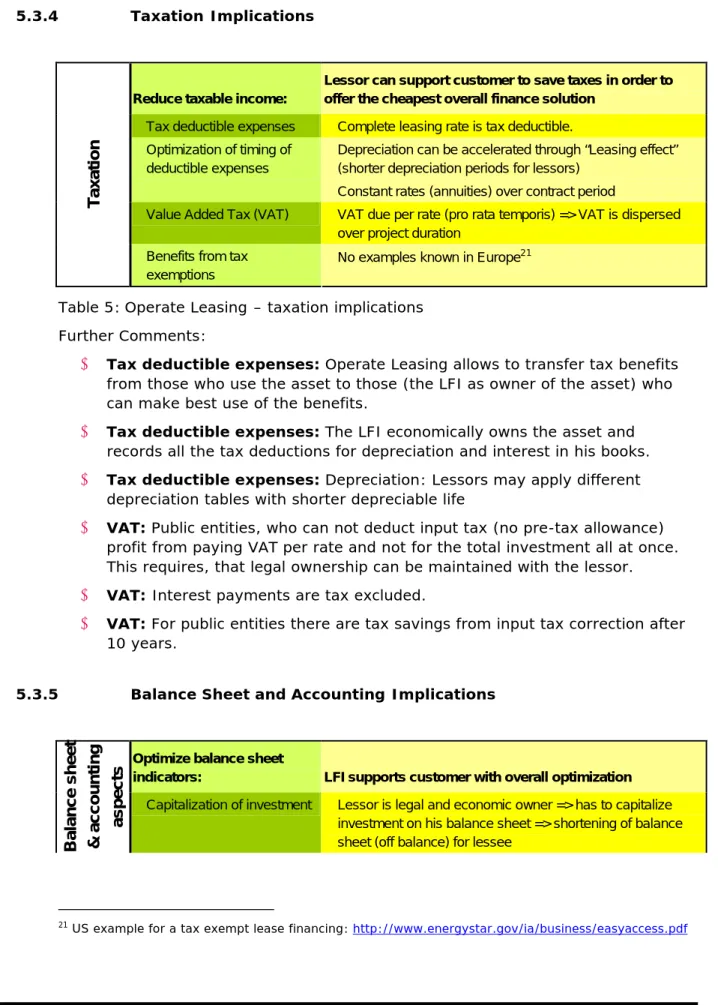
5.3.4 Taxation Implications ... 34
5.3.5 Balance Sheet and Accounting Implications ... 34
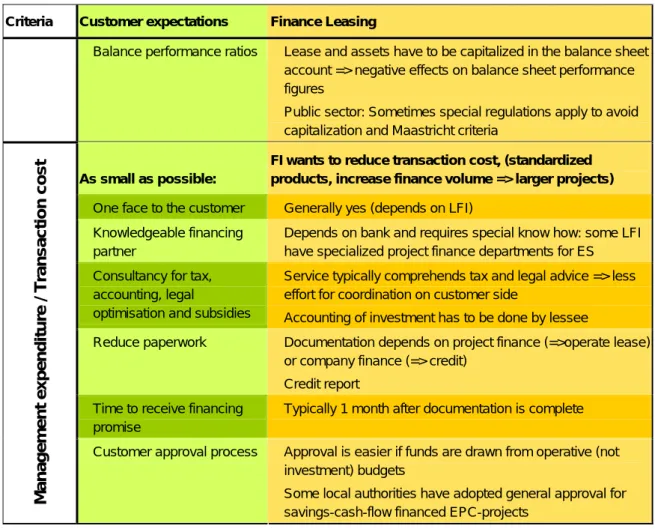
5.3.6 Management Expenditure and Transaction Cost ... 35
5.4 Finance Leasing Features and Customer Demand ... 36
6
Cession and Forfeiting of Contracting Rates ... 39
6.1 Introduction... 39 6.2 Cession of Contracting Rates as Security for Credit- or
Lease-6.3 Forfeiting... 41
6.3.1 Financial Aspects ... 42
6.3.2 Legal Aspects... 43
6.3.3 Securities ... 44
6.3.4 Taxation... 45
6.3.5 Balance Sheet & Accounting Aspects ... 45
6.3.6 Management expenditure / Transaction cost... 46
7
Other EPC-Financing Issues ... 47
7.1 Credit Subsidy Programmes (EIB, KfW), Credit Protection, Risk Mitigation … ... 47
7.2 BASE ... 47
7.3 US EPC Models ... 48
7.4 Energy Efficiency Project Financing Protocol (IEEPFP)... 49
7.4.1 Introduction and current issues ... 49
7.5 Potential other Financing Instruments... 50
7.5.1 Mezzanine Financing ... 50
8
Comparison and Conclusions ... 51
8.1 Comparison and Evaluation of Financing Offers with Customer Needs ... 51
8.2 Conclusions and Recommendations ... 53
8.3 Recommendations for Preparation of Financing ... 56
8.3.1 How to Determine Your Specific Financing Demand Profile? ... 56
8.3.2 Standardized Financing Project Flow... 56
8.3.3 Description of Project Documentation to be provided by Customer ... 57
8.3.4 FI’s Wish List for Securities ... 57
8.3.5 Major Banks and Leasing Institutions in Austria... 58
Figures... 59
Tables ... 59
Bibliography... 60
9
Annex ... 61
9.1 Annex 1: Template Project Description Form to be provided to Financing Institutes (short version) ... 62
9.2 Annex 2: Template Project Description Form to be provided to Financing Institutes... 68
9.3 Annex 3: List of major banks and Financial Institutions in Austria .... 84
9.4 Annex 4: Comparison and Evaluation Matrix: Customer Expectations and Properties of Financing Options ... 86
1 Summary
1
Summary
Availability of financial resources is one of the key success factors for the implementation of Energy-Contracting1 projects. (Pre-) Financing energy efficiency investments has become increasingly burdensome for ESCo’s as well as their customers, because they reach their credit lines, credit liabilities and fixed assets burden balance sheets and Basel II and international accounting guidelines like US GAP cast their shadows.
Consequently, innovative finance options like operate, finance lease or “pure” Forfeiting options have to be considered (and developed further!) and compared to classical finance instruments like credits. Also the question of who is best capable of providing financing – customer, ESCo or a finance institution (FI) as a third party has to be considered. ESCo’s are not necessarily the best source for finance themselves. But they can certainly help to arrange for financing.
The approach of this manual is to start from the perspective of ESCo’s and their customers (companies, real estate owners or public institutions), who wish to lend money for project financing (demand side). We introduce a comprehensive
customer demand profile to describe the customers financing requirements and
specific framework. The customer demand profile encompasses criteria such as 1. Direct financing cost
2. Legal aspects
3. Securities/collateral required 4. Taxation implications
5. Balance sheet & accounting implications 6. Business Management expenditures
On the financial supply side, we describe properties of different finance offers (credit financing, operate and finance leasing and forfeiting) with regard to the criteria introduced in the customer demand profile. The properties are also summarized in a comprehensive matrix in the appendix.
To conclude, we compare the above financing offers with the customer demand, discuss their advantages and disadvantages and give recommendations for the finance preparation. We consider factors such as financing cost and fees, tax aspects, balance sheet effects, credit lines, Maastricht criteria, applicability of subsidies as well as suitable project sizes.
1 Also referred to as “ESCo or Energy Service”. We prefer the term “Energy-Contracting” to emphasize the difference to a standard fuel supply or maintenance contract, which does not imply any outsourcing
As a result we advocate a comprehensive look at the sum of all business
implications of any finance option. A sole look at direct financing cost as
expressed in interest rates or fees will not deliver your optimal financing solution. The best finance package depends on the borrower’s background, subsidies as well as the specific project cash flow. And it requires the integration of bookkeeping and tax consultancy into the financing decision.
The proposed customer demand profile offers this comprehensive perspective and may serve as a checklist to be adapted to the specific situation of the customer. Likewise, the attached comparison and evaluation matrix of the different finance options allows taking a comprehensive look at the variety of implications, which can be individually adapted to compare concrete finance offers.
Finally we propose to take advantage of innovative financing options, which in return require knowledgeable (leasing) Finance Institutions. For future
development, e.g. a “pure” Forfeiting finance option based on selling the future project cash flow to an FI would be a very desirable from the customer perspective. This kind of finance model would also help to overcome some of the current balance sheet problems and share project risks according to the project partner’s strength and capabilities.
If you have questions or remarks to this manual, your feed back is highly welcome. You can reach the authors at Grazer Energy Agency Ltd, attention to Jan W. Bleyl ([email protected]).
2 Motivation and Overview
2
Motivation and Overview
2.1
Introduction
Energy-Contracting2 is widely promoted as an instrument to overcome obstacles against the implementation of energy efficiency investments. Especially for the public sector this model of Public-Private-Partnership is considered to be one of the most effective tools to enhance energy efficiency in buildings and has been
successfully implemented especially in Germany and Austria with other European countries following the example. Also other end-use sectors like commercial buildings3 are under development. The European Commission shares this view and promotes the concept within its directive on “Energy End-use Efficiency and Energy Services”4 issued in 2006.
Availability of adequate financial resources for the efficiency investments is a key success factor for the implementation of Energy-Contracting like energy
performance contracting (EPC). At the same time EPC projects generate future
cash flow from energy cost savings. These savings can be used to (partly)
re-finance the energy efficiency investments. The savings are guaranteed by an ESCo and backed by a payment obligation in case of non-performance.
Nevertheless, (pre-) financing of energy efficiency investments has become
increasingly burdensome for Energy Service Company (ESCo’s) as well as for their customers: Market partners reach their credit lines, credit liabilities and fixed assets burden balance sheets and require more equity capital. And also Basel II and
international accounting guidelines like US GAP cast their shadows. And the EPC concept is not understood well enough.
Consequently, innovative finance alternatives like operate or finance lease and Forfeiting options have to be considered and compared to classical finance instruments like credits. Also the question of who is best capable of providing financing – customer, ESCo or a Finance Institution (FI) as a third party has to be considered?
In the past, the financing and the energy efficiency (EE) community have had rather little contact. The EE approach is often from a prevailingly technical perspective rather than a business or finance oriented one. EE-actors are not necessarily educated in business management matters. They often have a technical, environmental systems or communicative background, using different
2 Also referred to as “ESCo or Energy Service”. We prefer the term “Energy-Contracting” to emphasize the difference to a standard fuel supply or maintenance contract, which does not imply any outsourcing of risks or provision of guaranties for the overall system performance (see also figure 2-2).
approaches and languages then actors form the economics world. Conversely the same applies for the financing community.
One goal of this manual is to bring the complex landscape of financing closer to those professionals, who’s business it is to develop and implement energy efficiency projects. We want to educate EE-project developers and multipliers such as energy agencies or others to become more knowledgeable partners to financing institutions and real estate owners and vice versa.
This goal shall be achieved by
1. bridging “language barriers” between the financing and the energy
efficiency communities in order to facilitate a mutual understanding, 2. developing a systematic approach (“customer demand profile” and
“comparison and evaluation matrix”) to describe the complexity of financing demand and offers from a customer perspective (real estate owners or ESCo’s) and
3. selecting and describing those financing issues, that are relevant to the
finance of energy efficiency projects and Energy-Contracting,
4. providing tools to determine and optimize your individual financing
solution.
External financing has implications on a variety of factors such as direct financing
cost but also provision of securities, taxation and financial statements aspects. The sole look at direct financing cost, as expressed in interest rates or fees, will not deliver an optimal financing solution.
The key message of this manual is to promote a comprehensive look at the
sum of all business implications of any external financing option before taking a
financing decision. To put in other words: The best suited financing solution is shown at the bottom line of the profit and loss account and not just at the lowest interest rate. Depending on the specific situation of the debtor, the goal is to optimize the sum the effects.
The scope of this manual is limited to external financing offers such as credits,
operate and finance leasing, cession and Forfeiting. Self- and project
financing are not dealt with in this manual. Also the wide field of subsidies are not subject of this manual.
Methodologically the findings of this manual are derived from long-term practical
experiences of energy efficiency and Energy-Contracting experts as well as financing professionals. Their backgrounds are from Energy Agencies, ESCo and financial institutions. Additionally interviews with stake holders such as real estate owners have been conducted.
2 Motivation and Overview
As a result of this manual:
1. EE actors will have a better understanding of the functioning and
importance of financing issues for the implementation of Energy Efficiency measures and Energy-Contracting.
2. Financing institutions and real estate owners will have more
knowledgeable partners with regard to financing issues and in return gain an insight into the nature of Energy Efficiency projects. And maybe develop better suited finance tools for energy-contracting projects like “pure
forfeiting”.
3. The development of the building refurbishment market with a potential 5 to 10 billion €/a5 will be supported.
This manual has received support from a number of institutions and individuals: We thank for financial assistance from the Intelligent Energy - Europe Programme6 and the Austrian “Lebensministerium”7. The work has been continued within Task XVI „Competitive Energy Services“ run by the IEA (International Energy Agency) Demand Side Management Implementing Agreement (http://dsm.iea.org/). Daniel Schinnerl, Graz Energy Agency8 and Alexandra Waldmann, Berlin Energy Agency9 have written a chapter of this manual. The EUROCONTRACT partners10 have given helpful comments. Special thanks to Mark Suer, Raiffeisen Leasing for his valuable inputs and to Alexander Linke, Kommunalkredit Public Consulting. If you have questions or remarks to this manual, your feed back is highly welcome. You can reach the authors at Grazer Energy Agency Ltd, attention to Jan W. Bleyl ([email protected]).
5 Berlin Energy Agency 2006
6http://ec.europa.eu/energy/intelligent/index_en.html 7http://umwelt.lebensministerium.at/
8www.grazer-ea.at.at 9www.berliner-e-agentur.de
2.2
Structure of the Manual
We give a short introduction to Energy Performance Contracting and financing issues. The introduction is supplemented with some basic remarks and definitions on ES and EPC. It also contains commented links to finance glossaries.
In chapter 3 we describe financing requirements from the borrowers perspective (demand side), which is in our case either real estate owners or ESCo’s. This will result in a financing demand profile - a structured list and description of the most important financing aspects and effects (business, securities, tax and balance sheet). The profile will be used throughout the manual to compare financing demand to different financing alternatives.
Chapters 4, 5 and 6 describe the “financial supply side”: Credit, operate and finance lease as well as cession and forfeiting alternatives. Standard properties of these financing alternatives with regard to the customer demand profile are described and summarized in a matrix.
Chapter 8 delivers a comparison between major aspects of the customer demand profile and the different financing alternatives. We conclude with general and concrete recommendations for the preparation of an EPC project financing.
2.3
Some Energy-Contracting Basics and Definitions
and Links to Finance Glossaries
Here we focus on some key concepts and definitions only, assuming that the reader has a basic knowledge on Energy-Performance-Contracting. More references on the implementation of EPC projects can be obtained from the author or from the
following links: www.grazer-ea.at, www.bundescontracting.at, „Leitfaden Energiespar-Contracting“ published by dena11 or from the brochure „Die Energiesparpartnerschaft. Ein Berliner Erfolgsmodell“12.
The energy service approach shifts the focus away from the sale of secondary or final energy carriers like electricity or fuel towards the desired benefits and services derived from the use of the energy, e.g. the lowest cost of keeping a room warm or air-conditioned. The knowledge and experience of an energy service provider
(ESCo) is used to provide the energy service requirement at least cost to the end user.
The before mentioned EC directive on “Energy End-use Efficiency and Energy Services” defines Energy-Contracting as “the physical benefit, utility or good derived from a combination of energy with energy efficient technology
and/or with action, which may include the operations, maintenance and control necessary to deliver the service, which is delivered on the basis of a
11 Deutsche Energie Agentur, 4. Auflage, Dezember 2004
2 Motivation and Overview
contract and in normal circumstances has proven to leadto verifiable and measurable or estimable energy efficiency improvement and/or primary
energy savings”.
Furthermore the directive also defines "Energy service company" (ESCo) as a company that delivers energy services, energy efficiency programmes and other energy efficiency measures in a user’s facility, and accepts some degree of technical and sometimes financial risk in so doing. The payment for the services delivered is based (either wholly or in part) on meeting quality performance standards and/or energy efficiency improvements.
The next chart follows an energy added value chain gives an overview of classical energy supply and the two basic energy service models (energy supply contracting (ESC) and energy performance contracting (EPC)) and indicates typical measures:
2-1: Energy added value chain, two basic Energy-Contracting models and typical efficiency measures
At supply contracting, efficient energy supply, including purchasing of final energy is contracted (comparable to district heating). As for energy performance
contracting, is on demand side measures in the building itself.
Energy performance contracting is a service package that can be arranged
specifically to the needs of the building owner and thus quasi is a modular system. This means the client defines what components he wants to outsource and what components he carries out himself. For example, financing can be provided either by the ESCo or the building owner. What is decisive is who can provide better financing conditions. This means the contracting package in no way automatically includes external financing.13 Other partial tasks, such as ordinary operation management or fault clearance, can be taken over by the building owner himself just as well. ENERGY PERFORMANCE CONTRACTING (EPC) lighting, measurement & controls, peak load managem., insulation, user motivation, … Useful Energy
13 This topic has been elaborated in more detail: Bleyl, Jan W.; Suer, Mark: Comparison of Different Finance Options for Energy Services. In: light+building. International Trade Fair for Architecture and
=> NWh SUPPLY CONTRACTING (ESC) replacing boilers, fuel change, biomass heating, CHP plant, solar systems, … Final energy Wh Standard SUPPLIER (UTILITY) electricity, district heating, heating oil, … Secondary/ final energy Secondary/ final energy Primary energy Primary energy coal, natural gas, crude oil, … => M
The central elements of an energy service package are summarized in the following chart: 3. 4. 1. 2. Financing,
Subsidies Operat.&mainten., Troubleshooting, Optimization, User motivation Project development, Rough planning (Functional) Specifications, Tendering, Construction, Initial start up
Service
Package
„Energy-Contracting“
r
f
if
r
f
if
Fuel purchase Outsourcing ofeconomic and technical performance risks ! Function-, performance
and price warranties ! Added
value:
=> Energy-Contracting is the gua antee, that the overall system
per orms to spec ications ! Over the whole contract term !
Outsourcing of
economic and technical performance risks ! Function-, performance
and price warranties ! Added
value:
=> Energy-Contracting is the gua antee, that the overall system
per orms to spec ications ! Over the whole contract term !
5.
2-2: ELC: Energy-Contracting: A modular package with success guaranties
As for energy services, transfer of technical and economic implementation and operating risk as well as takeover of function, performance and price warranties by the ESCo play a crucial role. These elements create added value compared to in house solutions and are guaranteed in the CR-EPC-contract. In other words: Contracting is more than putting together individual components. The contracting concept incorporates incentives and guarantees, that - throughout the contract term - the entire system performs according to specifications.
At energy performance contracting, the building owner and energy service provider enter into a long-term contractual relationship. Short-term focusing on profit will not lead to success for either of the parties involved. The term “Energy Saving Partnership”, which has been given to the energy performance contracting
campaign of the Berlin Senate mentioned above, expresses this well.
Building technology measures can mostly be refinanced from the future energy cost savings within a project period of 10 years. This is not true for building construction measures, such as building envelope insulation, with today’s energy prices. Therefore, the building owner has to participate in financing the building measures e.g. by means of a building cost allowance, (which may, e.g., also be taken from maintenance reserve funds or subsidies), and/or paying a residual value at the end of the contract (see figure “business model …”). CR-EPC models can also be implemented with a leasing finance partner.
2 Motivation and Overview
The EPC business model is shown in the following chart:
Performance Contracting - Business Model
contribution to building costs(e.g. subsidies) or payment of the residual value to the contractor contribution to building costs (e.g. subsidies) or payment of the residual
value to the contractor Payment to ESCo for • prefinancing the investment
• increased comfort + added value (NEBs) • maintenance and repair
• taking over risks
EPC contract
contract ends Payment to ESCo for
• prefinancing the investment
• increased comfort + added value (NEBs) • maintenance and repair
• taking over risks
EPC contract
contract ends Service life of the investment Energy costs
after refurbishment
Saving investment
Overall energy costs (new) •...
Service life of the investment Energy costs
after refurbishment
Saving investment
Overall energy costs (new) •... Actual costs = baseline Actual state annual costs Time Overall energy costs (old) fuel; electricity; maintenance; repair (substitute investment); personnel expenditure; other Actual costs = baseline Actual state annual costs Time Overall energy costs (old) fuel; electricity; maintenance; repair (substitute investment); personnel expenditure; other
Accounting adjustments (yearly):
• energy price (reference prices from baseline) • climate (outer temperature by # of “degree days”) • changes in utilization of facility
Financial advantage for facility owner
O&m cost
Financial advantage for facility owner Financial advantage for facility owner
O&m cost
Figure 1:Business Model of Energy Performance Contracting The key features are:
An Energy Service Company (ESCo) plans and realizes energy efficiency
measures and is responsible for their operation and maintenance throughout the contract term.
The ESCo has to guarantee energy cost savings compared to a present state energy cost baseline.
The efficiency investments are (partly) paid back out of the future energy cost savings.
The client continues to pay the same energy costs as before (sometimes even a smaller amount). After termination of the contract, the entire savings will benefit the client.
The ESCo’s remuneration is the contracting rate and depends on the savings achieved. In case of underperformance the ESCo has to cover the short fall. Additional savings are shared between building owner and ESCo.
Based on the previous remarks, we define Energy Performance Contracting (EPC) as
A comprehensive energy service package aiming at the guaranteed improvement of energy and cost efficiency of buildings or production processes. An external Energy Service Company (ESCo) carries out an individually selectable cluster of services (planning, building, operation & maintenance, (pre-) financing, user motivation …) and takes over technical and economical performance risks and guarantees. Most projects include
third party financing. The services are predominantly paid out of future saved energy costs.14
For definitions and information on general financing issues we recommend following these links to web based financing glossaries (in alphabetical order):
h Axone: Glossary with over 5000 financial terms in English, German, French
and Italian. Can be used free of charge for non-commercial use on a query-by-query basis: http://glossary.axone.ch/axone_index_test.cfm
h Deutsche Leasing: Leasing-Glossary, Basics, literature, Basel II and
ratings, … : http://www.deutsche-leasing.de/glossar.html (in German language)
h IATE (= “Inter-Active Terminology for Europe”) is the EU inter-institutional
terminology database. IATE has been used in the EU institutions and agencies since summer 2004 for the collection, dissemination and shared management of EU-specific terminology http://europa.eu.int/eurodicautom/ h Förderland: Leasing-Glossary, basics, …:
http://www.foerderland.de/1072.0.html (in German language) h Kommunalkredit: Finanzierungslexikon
http://www.kommunalkredit.at/DE/finanzierungen/lexikon/lexikon.aspx (in German only)
h International Monetary Fund: (This terminology database contains over
4,500 records of terms useful to translators working with IMF material. It provides versions of terms in a number of languages, without definitions. The database includes words, phrases, and institutional titles commonly encountered in IMF documents in areas such as money and banking, public finance, balance of payments, and economic growth. A number of entries include a usage field within square brackets, denoting the origin of the term -- e.g., [OECD] ---- or a context ---- e.g., [trade]; others contain a cross
reference to related records. Acronyms and currency units are also included: http://www.imf.org/external/np/term/index.asp?index=eng&index_langid=1 h TU-Dresden: German Listing of web-based glossaries:
http://www.iim.fh-koeln.de/dtp/termsamm/wirtschaft/finanzen.html#mehrspr
h Wikipedia: Definitions, discussions: http://de.wikipedia.org/wiki/Leasing (German), http://en.wikipedia.org/wiki/Leasing (English)
14 Following Seefeldt, Leutgöb (2003) “Energy Performance Contracting – Success in Austria and Germany, Dead End for Europe?” eceee paper id #5158.
3 Customer Needs for Financing Energy-Contracting Projects
3
Customer Needs for Financing
Energy-Contracting Projects
3.1
A Systematic Approach
The aim of this chapter is to describe financing requirements from the perspective of professionals, who wish to borrow money in order to implement energy efficiency projects. Relevant actors will in most cases be either real estate owners or ESCo’s, both of which can provide the necessary project financing. Energy Agencies (EA’s) typically have the role of project developers and mediators in the process.
The goal of any finance planning is to minimize overall capital cost, secure liquidity and to reduce transaction cost. But also legal aspects, tax implications and balance sheet issues have to be considered.
Of course, financing needs depend on the individual circumstances of the borrower. And they depend on the specific project. Nevertheless we aim at developing a
customizable methodology for describing generic characteristics of financing
needs for EE projects, which can be adapted to the specific situation. Here we are talking about properties such as financing cost and terms, legal implications, tax and balance sheet effects as well as management expenditure. Only a
comprehensive look at the sum of the financing implications will allow deciding for the best financing option.
These financing characteristics will be put into a demand profile, which can be used to get a structured overview of the different implications of EE project
financing issues. This profile can be applied to different financing options offered on the market in order to find the best suited fit, taking all aspects into account. In order to structure financing implications, the relevant categories are:
1. Direct financing cost (financing conditions, interest rates, fees …)
2. Legal aspects (Rights and duties, ownership, contract cancellation, end of
term regulations …)
3. Required collateral (securities) by financing institution
4. Taxation implications (VAT and purchase tax, corporate income tax,
acquisition of land tax …)
5. Balance sheet & accounting implications (who activates the investment
(=> on or off balance?), balance sheet effects like credit lines, performance indicators Maastricht criteria …)
6. Management expenditure (transaction cost, comprehensive consultancy
These six categories will be used throughout the manual to structure the different implications of financing issues. The result is a profile of
requirements for financing products from the perspective of the borrower, which is either ESCo’s or their customers (company or building owners, public institutions).
3.2
Customer Demand Profile
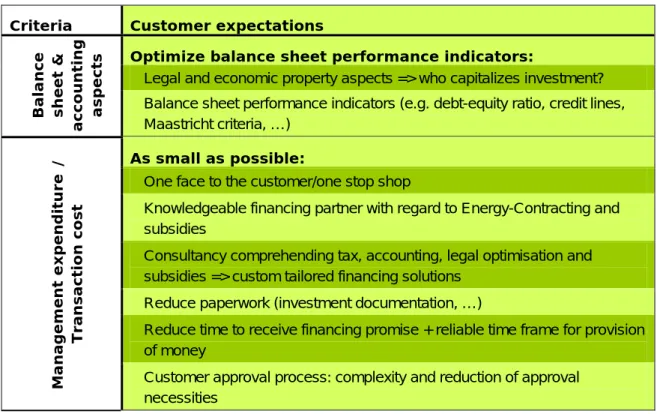
The customer demand profile lists standard properties which may vary with specific projects and players. In order to facilitate the overview, the different criteria are grouped and presented in a table:
Criteria Customer expectations Costs as low as possible:
9Low interest rates, fees and other cost
9Extent of financing: as high as possible (100 % external finance)
Direct fin a ncin g cost
9Subsidies: Compatibility, eligibility
Legal implications:
9Financing term: affordable, adjustable terms during contract period
9What can be financed? Financing of complete energy service investments including soft cost
9Cancellation of contract: flexibility and conditions
9Legal and economic property aspects
Legal as
pe
cts
9Transfer of ownership at end of term
Reduce collateral requested and own risks:
9Preferably project based finance: => repayment from future project incomes/savings
9Financial securities (equity capital, bonds, insurances, guarantees …) as low as possible
9Tangible securities / collateral (entry in land register, mortgage, …)
Coll
ater
al/
Securiti
es
9Personal (e.g. personal liability)
Reduce taxable income and use tax exemptions:
9Increase of tax deductible expenses
9Optimization of timing of deductible expenses (e.g. depreciation, interest, …)
9Value Added Tax (VAT)
Taxati
on
3 Customer Needs for Financing Energy-Contracting Projects
Criteria Customer expectations
Optimize balance sheet performance indicators:
9Legal and economic property aspects => who capitalizes investment?
Balance sheet & accounting aspects
9Balance sheet performance indicators (e.g. debt-equity ratio, credit lines, Maastricht criteria, …)
As small as possible:
9One face to the customer/one stop shop
9Knowledgeable financing partner with regard to Energy-Contracting and subsidies
9Consultancy comprehending tax, accounting, legal optimisation and subsidies => custom tailored financing solutions
9Reduce paperwork (investment documentation, …)
9Reduce time to receive financing promise + reliable time frame for provision of money Man a ge me nt ex pen d it ure / Transaction cost
9Customer approval process: complexity and reduction of approval necessities
Table 1:Customer demand profile
The classification of some criteria is not always unambiguous and depends on the reader’s individual experiences and preferences. To the authors it was more important to have all relevant aspects considered and to facilitate an overview by grouping the different aspects in categories. Amendments are welcomed
Of course all descriptions are of a general nature and may vary with the specific project and the actors involved. Nevertheless the customer demand profile presented, can serve as a checklist and as a template to be adapted to the specific situation of the borrower and the project.
4
Credit Financing for Energy Performance
Contracting
4.1
Introduction to Credit Financing
Credit (or loan) financing means that a lender (FI) provides a borrower
(customer) with capital for a defined purpose over a fixed period of time. Borrowers in our case can be either ESCo’s or real estate owners. A credit is settled over a fixed period of time, with a number of fixed instalments (debt service). These instalments have to cover the amount borrowed, plus interest rates, as well as other transaction costs such as administrative fees. Loans are disbursed against a proof of purchase in order to secure the earmarked use of the funds.
FI
Customer
Credit line Debt service + Securities Investment SecuritiesAsset
Figure 2:General Scheme for Credit Finance
A credit serves in fact as an extension of the total amount of capital that an
enterprise can use to do its business, i.e. deliver services or produce goods. Credits are also referred to as committed assets or loan capital.
Credits require a creditworthy borrower. This means that a credit has to be backed by the ability of the borrower to perform the debt service. It is assumed that this ability is linked to a certain level of equity capital, typically 20-30 % of the loan. The creditworthiness of a borrower (together with the project chances and risks), will be reflected in the amount of securities needed to cover the lender's risks associated with handing out a credit. Where public entities are debtors or in cases where credits are backed by public entities, credit ratings are generally high.
The borrower is both economic and legal owner of the investment made with a loan. Therefore the investment is capitalized on his balance sheet which, in return, downgrades his equity-to-assets ratio. A reduced share in equity means less capital to do business with and also results in a reduced ability to get further credits (credit line).
4 Credit Financing for Energy Performance Contracting
Another factor that influences the borrower’s possibilities to receive a credit is connected to “BASEL II”. It means that, clients are evaluated by international uniform criteria and divided in classes, which declare the creditworthiness. It is expected, that credits will be more difficult to obtain and that they will cost more. Especially for small and medium enterprises.
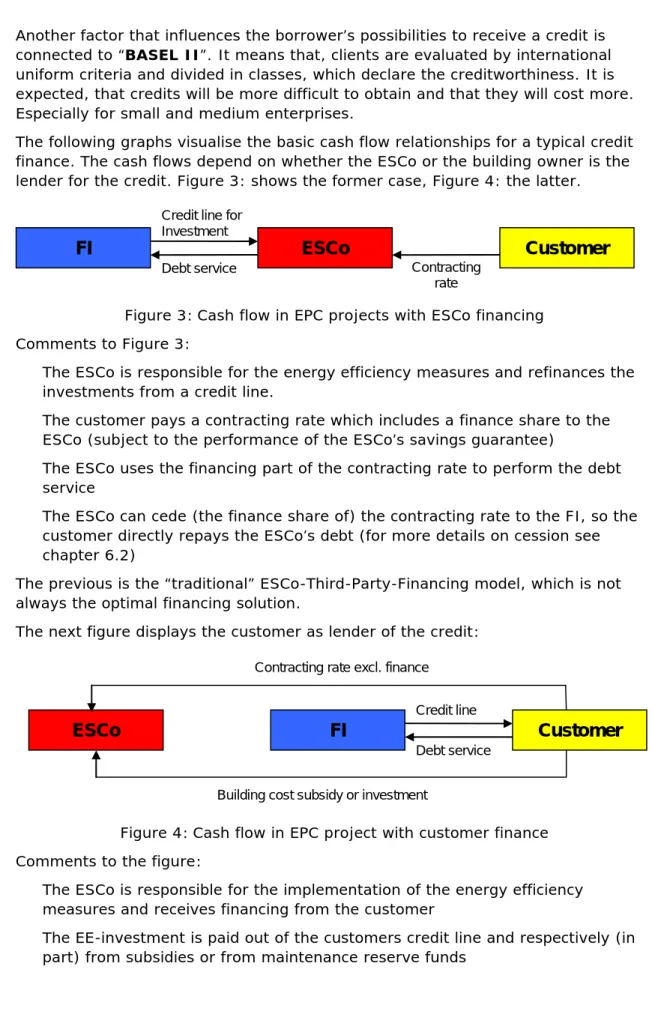
The following graphs visualise the basic cash flow relationships for a typical credit finance. The cash flows depend on whether the ESCo or the building owner is the lender for the credit. Figure 3: shows the former case, Figure 4: the latter.
FI
Customer
Contracting rate Credit line for
Investment Debt service
ESCo
Figure 3:Cash flow in EPC projects with ESCo financing Comments to Figure 3:
The ESCo is responsible for the energy efficiency measures and refinances the investments from a credit line.
The customer pays a contracting rate which includes a finance share to the ESCo (subject to the performance of the ESCo’s savings guarantee)
The ESCo uses the financing part of the contracting rate to perform the debt service
The ESCo can cede (the finance share of) the contracting rate to the FI, so the customer directly repays the ESCo’s debt (for more details on cession see chapter 6.2)
The previous is the “traditional” ESCo-Third-Party-Financing model, which is not always the optimal financing solution.
The next figure displays the customer as lender of the credit:
FI
Customer
Building cost subsidy or investment Credit line Debt service
ESCo
Contracting rate excl. finance
Figure 4:Cash flow in EPC project with customer finance Comments to the figure:
The ESCo is responsible for the implementation of the energy efficiency measures and receives financing from the customer
The customer payments for the investment can be either a building cost subsidy or the remuneration of an equipment supply contract (in the latter case, VAT is due on the complete investment at once)
This model can also be interpreted as an operation-management-EPC The customer finance model is advisable, if the customer has better finance
conditions than the ESCo
In praxis, a synthesis between ESCo and customer finance is advisable. In many cases the customer contributes to the finance with subsidies, from maintenance reserve funds or with an equity capital share.
These and other implications of credit finance will be reasoned in the next
subchapter. In order to facilitate the overview, the properties with respect to the customer demand profile are compiled in tables, with some details explained further.
4.2
Credit Financing Features and Customer Demand
4.2.1 Direct Financing Costs
Costs as low as possible:
9 Interest rates, fees, … 9 Repayment + interest
9 Single payments15:
- Up-front fee (0,1- 0,5% of loan amount) - Commitment Fee
- Administrative Fee (negotiable) - Notary fee
9 Extent of financing 9 Part financing only (typically 70 - 80%)
Direct financing
cost
9 Subsidies: Compatibility, eligibility
9 Yes, reduces loan amount or interest rate16
9 Application by debtor (owner of investment). Typically no support from bank
Further comments: The direct financing cost for a credit is comprised of two categories:
1. Single payments (fees, charges)
h Up-front fee (~0,1 – 0,5% of the credit volume)
15 Values applicable in Austria
4 Credit Financing for Energy Performance Contracting
h Administrative fees (negotiable)
h Disagio (a one off discount of the nominal credit value (e.g. 4 %), which some FI’s charge, when issuing credits)
h Notary fee
2. Regular payments or debt service payments h Repayment of credit
h interest rate
The total credit costs depend on the risks that the lender attributes to the credit, i.e. the risk of not being paid back (non-performing credit). Also the quality of the securities offered, the contract duration the credit volume and the transaction expenditure are reflected in the credit costs.
Some of the payments are negotiable to a certain extent, such as interest rates, the administrative fees that apply, and also the repayment period, others are not such as notary fees. These are predefined in the honorary list for notary services. The structure of the repayment instalments for a credit is often negotiable, but will influence the interest rates, and the repayment period needed.
Extent of financing: A credit can cover up to 90% of the amount of capital
needed asking as a minimum 10 % of equity capital and/or other financial sources from the borrower. Typically, a credit covers 70-80% of the needed capital.
However, the borrower will want to keep his own capital as flexible to use as possible, and will therefore want to keep the amount of his contribution low. The amount of a borrower's equity capital needed will increase with a decreasing creditworthiness.
Subsidies are usually compatible with credits:
A subsidy will reduce the needed credit volume and can be seen as risk sharing instrument, which should reduce the interest rates.
Some government-owned banks (e.g. the Austrian Kommunalkredit17 or the German KfW Banking Group18) offer so called soft-loan programs (subsidized interest rates) for environmental investments with a FI as implementation partner.
Usually, banks are not willing to take care of the subsidy acquisition, leaving this task with the borrower. A trend is however visible with the larger banks to have more expertise in various fields outside their core business, including energy.
17www.kommunalkredit.at
4.2.2 Legal aspects
Legal implications
9 Financing term 9 Flexible: according to customer demand. Usually below useful life time of the investment
9 What can be financed? 9 Complete energy service hardware
9 Cancellation of contract 9 Depends on contract type, usually fixed terms.
9 Short rate penalties apply for premature cancellation
9 Legal and economic property aspects
9 Debtor is legal and economic owner (bank may put retention of title or lien)
9 Transfer of ownership at end of term
9 Debtor remains owner
9 EPC contract may include transfer of ownership
Legal aspect s 9 Responsibility for operation and maintenance
9 Debtor is responsible for o & m at his own risk
The repayment period for a credit can, as has been explained above, be adapted to customer needs. Typically it will however be shorter than the normal useful life time of the investment, for which the credit is used.
Further comments:
Financing term: The possibility of a premature cancellation of the contract or
changing the terms of redemption is available, but implies extra charges for the lost income of the bank and for transaction costs.
When looking at credits for energy service contracts, another typical feature is that a credit covers only the hardware costs of a project.
The debtor of the credit is the legal and economic owner of the investment. Typically this is the ESCo, but also the building owner can of course provide the financing. Depending on who is the borrower of the credit in an EPC project, the effects on taxation and accounting vary (see subchapters 4.2.4 and 4.2.5). The lender generally does not require mandatory operation & maintenance or insurance packages for the assets. These obligations are part of the energy service agreement, not of the financing part.
4 Credit Financing for Energy Performance Contracting
4.2.3 Collateral (Securities)
Reduce securities requested and own risks:
Bank wishes to secure loan. Generally securities are based on the credibility of the debtor, not of the project.
Securities required: ~ 100 % 9 Finance based on project
cash flow
9 No project finance but client finance. Securities based on company cash flow and economic key figures, not project cash flow
9 Financial securities 9 Typically equity capital required (> 20 %)
9 Additional securities like guarantees from parent companies or banks (Hermes, ÖKB, …) depend on individual project
9 Tangible securities 9 Desired/required,
9 Entry in land register, lien on movable objects, reservation of property rights
Securi ties
9 Personal securities 9 Applicable for small projects only
For every loan, a lender asks a security in return. A security has the function to provide the lender the possibility to retrieve the loan. Securities give a lender certain rights that serve to secure his claim against the borrower to pay back the debt.
The lender and receiver of securities is one and the same institution. The securities from the borrower however can have two sources. They can come from the
borrower or another party. The rights of the creditor then extend either to the borrower himself or against further parties, so called “principals“.
Possible securities include:
h Lien on moveable objects and land property h Guarantees and additional debtors (principals) h Retention of titles
h Cession of securities
h Cession of receivables e.g. contracting rates
Moveable objects as well as formal obligations are not considered by banks to be a very valuable security. Securities most valuable to financial institutions are (land) property, and personal securities (Personal liability). On average 55% of the credit sum has to be covered by securities, but variations range from 30% to 80%. At this point, a short differentiation has to be made between cash-flow-related
1. Cash-flow-related lending is also called project finance. Securities
needed in this type of financing are dependent on the expected cash flow of a project. The main risk for a lender in this type of project is the
construction and operation risks. Is a project not constructed, it cannot be operated, and therefore it cannot produce cash flow. Where the
creditworthiness and hence also securities demanded by the lender are depending on the cash flow of a project, the capital or assets of the company implementing a project are not decisive to receive a loan. 2. Balance-sheet-related lending on the other hand will refer back to the
company's assets (valuables) for safeguarding of a credit. Energy Performance Contracting projects are – when financed by a credit – Balance-sheet-related lending (also called asset-based related lending). From the perspective of the FI, the simplest way of securing a credit for an EPC project is that the ESCo’s assets serve as the security.
Cession: The ESCo has the opportunity to sell its claims against the client (the
contracting rate) to a financial institution. An agreement on the amounts to be paid by the client directly to the FI needs to be concluded. The building owner needs to take into account that usually the claims are to be assigned excluding the right of defence, i.e. the bank secures for itself fixed instalments to be paid irrespective of the success of the performance-contracting project. This is called cession of claims and is described more in chapter 6.2.
BASEL II: In the last few years, BASEL II has been an issue hovering above
companies and still is connected to large uncertainties. BASEL II is a set of regulations aiming at an increased stability of international financial markets. Its central topic is the evaluation of borrowers by international uniform criteria and following the classification. A high share of equity capital is an important element of influence for borrowers to reach an advantageous evaluation and creditworthiness. Basel II requires FI’s to be more sensitive towards risks associated with a specific credit. It is expected, that credits will be more difficult to obtain, especially for small and medium enterprises and that they will cost more. In Germany, the new rules are applying from January 2007.
For companies, and especially smaller companies, it is expected that the costs for capital will substantially increase, especially for smaller companies with a lower credit rating (due to e.g. a lower level of equity).
For the public sector credit takers, i.e. municipalities, Basel II will, in a first step not have an effect. This is due to the fact that public authorities as tiers of
government are considered to be principally as creditworthy as national government, in many cases even AAA, the highest rating possible. For Energy Service projects, this could result in more clients financing the projects themselves due to overall better financing conditions.
In a second step, the generally high rating for the public sector will become more differentiated. Among the reasons is the fact that many municipalities own
companies (e.g. utilities) that are organized and operated as private companies and as such these companies are fully under the rules of BASEL II. Since the
4 Credit Financing for Energy Performance Contracting
new evaluation and rating of municipalities will become more important. And there is of course a different financial strength in different municipalities. In the future this will be reflected in differentiated credit ratings.
Excurse: Since the terms ‘securities’ and ‘risk mitigation’ are often used in the
context of EPC projects, it should be explained here that in addition to those securities needed in order to obtain a loan, in an EPC project, the ESCo also has to provide a security to the client as a safeguarding of the savings guarantee given. The security can be in the form of a security note by a bank or a credit insurance company.
4.2.4 Taxation
Reduce taxable income:
9 Tax deductible expenses 9 Interest and depreciation (linear AfA-tables) are tax deductible. Redemption payments are not tax deductible
9 Point in time of deductible expenses
9 Depreciation is typically linear
9 Interest payments decline over time
9 Value Added Tax (VAT) 9 VAT due on total investment at the beginning of project
9 Public entities can not deduct input tax (additional initial cost)
Taxation
9 Benefits from tax exemptions
9 Not known
Credit payments and taxes
Credit payments are relevant to taxes paid in an enterprise. Whereas not all parts of credit payments can be tax deductible, interest rates usually are.
The interest rates are in many cases developing linear, and are decreasing over time. Therefore also the amount that is tax deductible will decrease. Differences may apply according to bank practice or country specifics.
In the case of a credit, the borrower is, as has been stated before, the legal and economic owner who therefore has the investment in his books and must
depreciate it. This depreciation is also tax relevant and can reduce the borrower’s taxable income. The client’s payment of the contracting rate are operation
expenses and therefore also tax deductible.
Value Added Tax
VAT is due on the total of the investment at the beginning of a project. Private companies can retrieve VAT. For public entities that cannot deduct input tax this may result in additional initial costs for a project.
4.2.5 Balance Sheet and Accounting Issues
Optimize balance sheet ratios:
9 Capitalization of investment
9 Debtor is legal and economic owner => Debtor has to capitalize investment Balance sheet & accounti ng aspects 9 Balance performance ratios
9 Loan and assets have to be capitalized in the balance sheet account => negative effects on balance sheet performance figures
9 Public sector: credit treated as additional debt => Borrowing limits of Maastricht criteria apply
These are relevant in the three main issues of h Assets and Liabilities /Ownership
h Balance sheet performance ratios, such as capital structure, equity –debt ratio, …
h Profit and Loss Statement
Who can take or who has to take the debt of a credit into his books, who the assets? In the case of a credit, the borrower has the debt on his books. A debt will always influence a company’s ratio of equity capital. As explained earlier, this will influence credit lines and decrease possibilities to raise capital for further
investments.
The capitalization of the assets depends on the economic ownership of the equipment installed:
h Where the equipment is owned by the ESCo, it is part of his assets in his books and the investment depreciation is subsequently also found in the ESCo’s books. The contracting client books the contracting rate as part of his operation expenses.
h Where the equipment is in the ownership of the contracting client, the assets are also on his balance sheet. The ESCo has the contracting rates as an accrued item (income at later stage, but attributable to time period in which it is in the books) in the books. This procedure is the same for public or private sector clients.
4 Credit Financing for Energy Performance Contracting
4.2.6 Management effort /Transaction Costs
Cost as small as possible: Both FI and Customer want to reduce transaction cost, (standardized products, increase finance volume => larger 9 One face to the customer 9 Generally not the case
9 Knowledgeable financing partner
9 Depends on bank; requires special know how: Energy-Contracting is not a typical core competence of banks
9 Consultancy for tax, accounting, legal
optimisation and subsidies
9 Service is limited to financing. Additional tax, legal service typically not included
9 => higher effort for coordination on customer side
9 Accounting of investment is done by debtor
9 Reduce paperwork 9 Company documentation: last three annual accounts …
9 Some project documentation required: project description, investment plan, earnings & cash flow report …
9 Time to receive financing promise
9 Typically 1 month after documentation is complete
Manage ment effort / Transact ion cost 9 Customer approval process
9 Approval is easier if funds are drawn from operative (not investment) budgets
9 Public entities: credit finance is subject to debt ceilings and may require approval legislative or supervising authority => possibly time consuming
9 Some local authorities have adopted general approval for savings-cash-flow financed EPC-projects (third party financing)
The credit financing model is not a one-stop-shop, especially if the building owner is the one who takes on the credit. There is a considerable amount of paper work to be prepared, and not all is supported by the financial institutions today. In an ideal situation, all efforts and needed documentation could be handled via the lender. A few banks are increasing their know-how and staff capacity regarding
environmental projects, including energy. For smaller local banks this may not be feasible.
The amount of paperwork could be reduced and streamlined; currently the
coordination efforts are still quite intense on the customer side. The amount of time needed from requesting to receiving a credit varies but is usually in the frame of one month, provided that the paperwork is complete.
Part of the problem, it is assumed here, lies with the EPC projects’ complexity and understanding the business model behind it, especially on the side of the banks. The guaranteed savings, essentially a saved cash-flow on the side of the building owner is the key element. But as a risk mitigation instrument, it is not valued enough by banks.
Possible solutions may be to create energy service finance packages, for projects that follow standardised project development procedures. This could applicable e.g. where loans from Development Banks are concerned or global loans are passed onto local banks for emission. Project development standards as propagated in this manual can be a basis for a more streamlined credit procedure. Banks are welcome to discuss the issue with the authors.
5 Leasing Financing for Energy Performance Contracting
5
Leasing Financing for Energy
Performance Contracting
5.1
Introduction to Leasing Financing
Leasing is a way of obtaining the right to use an asset – not the possession of
this asset. Assets in our case mean investments into energy conservation
measures. When leasing an energy conservation investment, you do not buy it. You only pay for the exclusive right to use it.
Leasing is a contract between the owner of the asset (lessor) and the user
(lessee), wherein the former grants exclusive rights to use the assets for a certain period (basic lease term), in return for payment of a lease. The lease is typically paid in annuities to the leasing finance institute (LFI). The lessee can be either an ESCo or the client (building owner) as displayed in Figure 5: and Figure 6:
Basically, there are two types of leases, which are relevant for Energy-Contracting:
operate and finance leasing. Specific characteristics of both are described in
chapters 5.3 and 5.4. Overall leasing characteristics are mentioned in this introductory chapter.
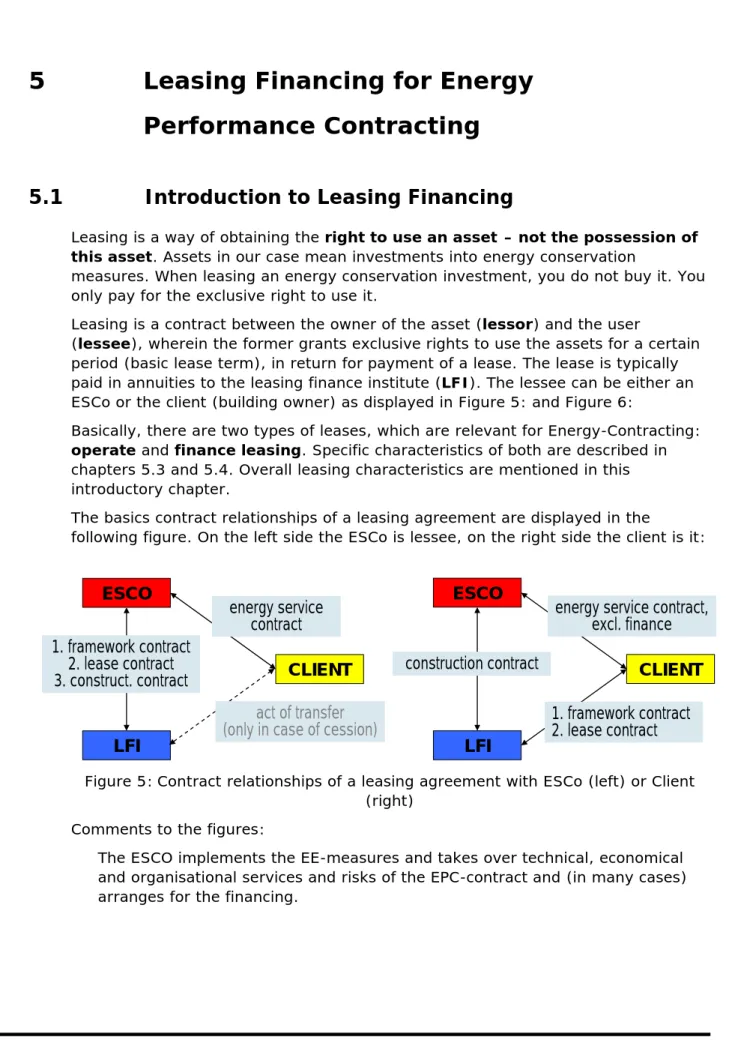
The basics contract relationships of a leasing agreement are displayed in the
following figure. On the left side the ESCo is lessee, on the right side the client is it:
LFI
ESCO
CLIENT
energy service contract,
excl. finance
1. framework contract
2. lease contract
construction contract
LFI
ESCO
CLIENT
energy service
contract
1. framework contract
2. lease contract
3. construct. contract
act of transfer
(only in case of cession)
Figure 5:Contract relationships of a leasing agreement with ESCo (left) or Client (right)
Comments to the figures:
The ESCO implements the EE-measures and takes over technical, economical and organisational services and risks of the EPC-contract and (in many cases) arranges for the financing.
The LFI takes over financial and administrative services and risks and concludes a framework and lease contract either with the ESCo (sometimes including a cession agreement for part of the contracting rate) or with the client.
The LFI signs a construction contract for the energy efficiency investments with the ESCo.
Furthermore leasing models distinguish between full- and part-amortisation (with residual value) contracts as well as contracts including advance payments or not, all of which are applicable to EPC financing.
Sale-and-lease-back contracts are mainly used to finance overall building
refurbishment projects, not just EPC-measures. In many cases the purpose is to cash “hidden reserves” e.g. in public buildings. If a Sale-and-lease-back financing is used for a building project, it is strongly recommended to write minimum
performance standards for thermal refurbishment and require guarantees like maximum energy consumption in the terms of reference.
The typical cash flow relationships of a leasing agreement are displayed in the following figure. Again, on the left the ESCo is lessee, on the right it is the client:
LFI
ESCO
CLIENT
contracting rate excl. finance
investment
1. co-financing (0-20%)
2. leasing rate
LFI
ESCO
CLIENT
1. co-finance (0-20%)
2. finance share of contr.
rates (in case of cession)
contracting rates
investment
leasing rates
Figure 6:Cash flow relationships of a leasing agreement with ESCo (left) and Client (right)
Comments to the figures:
In both cases the LFI pays for and the ESCo builds the energy efficiency investments and arranges for the financing agreements
The LFI should handle Co-financing (e.g. subsidies)
In case of ESCo finance, the finance part of the ESCo’s claims to the client can be ceded to the FI to directly repay the ESCo’s debt (for more details on cession see chapter 6.2).
In case of customer finance, the (financing share) of the contracting rate is paid directly to the LFI as leasing rate. The rest of the contracting rate (operation & maintenance, assets …) share should go directly to the ESCo.
5 Leasing Financing for Energy Performance Contracting
5.2
Operate and Finance Leasing Common Features
and Customer Demand
For both operate and finance leasing the following important properties is characteristic:
h Direct financing cost for leasing often exceed the costs of taking a loan,
because the lessor usually has a broader range of consulting and services included, assumes higher risks and requires fewer securities compared to credit finance.
h Direct financing cost: LFI's often will include subsidy acquisition and
handling in their port folio, thus providing a more comprehensive service to the client.
h Direct financing cost: The lessee is responsible for the operation and maintenance of the asset at his own expense. Typically the lessor will
require the lessee complies with mandatory operation and maintenance regulations. The lessee also bears the economic risk if the asset becomes unusable or sinks. Typically the lessor will obligate the lessee to conclude an
insurance package for his equipment. These features distinguish leasing
from traditional renting.
h Legally, not all energy supply and conservation investments can be leasing
financed though. The technical term is called fungibility or
interchangeability required (by tax laws) of an asset to qualify for operate
leasing: After the basic lease term the asset has to be re-utilizable without suffering substantial damage when being removed from its place of
installation.
In praxis many EPC-measures do not qualify, whereas Supply-Contracting measures do. Still there is room for interpretation and some LFI are more creative than others.
h Legal aspects: In the case of leasing it is important to differentiate between
legal and economic ownership of the asset. Legal ownership secures the control over the asset and serves as a security for the lessor, which is
stronger compared to a lien or a reservation of property rights as applied e.g. in a credit finance.
h Legal aspects: Economic ownership determines on whose books the asset
is accounted for. In the case of finance lease it’s the lessee, in the case of operate lease it’s the lessor. This has important implications on balance sheet ratios and taxations issues.
h Legal aspects: Leasing financing legally requires that no automatic transfer of ownership at the end of the contract term (without
reimbursement) is settled in the energy performance contract. Otherwise it will be considered as a variety of a sales contract. In other words: if a
performance contract includes a definite transfer of ownership to the client at the end of the contract term, a leasing financing is not possible.
Existing EPC model contracts often include a fixed transfer of ownership free of charge after contract termination. These have to be revised if you want to allow for a leasing finance option.
h Collateral/Securities: Some Leasing Finance Institutes (and hopefully
other FI’s as well) have specialized and knowledgeable staff, who have a good understanding of the nature of energy service projects. Based on their analyses of the project, these LFI’s are able to base the refinancing mainly on the project cash flow rather then on the borrower. These LFI may also
perceive fewer risks and require less company collateral or accept project based securities like a cession of project revenues (e.g. feed in tariffs from renewable electricity production).
h Management Expenditure: LFI’s generally offer a comprehensive consultancy comprehending taxation, balance sheet matters and legal
aspects of the energy service project, which suits well with the proposed comprehensive look at all financing implications and should result in an overall cost optimisation. Leasing typically includes consultancy on contract design and management, insurances, commissioning of contractors,
accounting, controlling and payout of invoices, VAT-clearing, to list the most important services. This should result in reduced overall transaction cost. Differentiations between operate and finance lease are described in the next two chapters.
5.3
Operate Leasing Features and Customer Demand
Traditionally operate leasing is used for cars and mobile goods such as moveable machineries, but not limited to these kinds of assets. Operate lease is increasingly used to finance Energy Service investments with, however mostly investments to facilitate supply service contracts.
Applying the operate lease model to Energy-Contracting may offer a number advantages to the lessee like capitalization with lessor resulting in off balance financing, extension of credit lines or reduced trans action cost.
Possible disadvantages may be:
h Only leasable goods qualify (see chapter 5.3.2)
h Premature cancellation of contract at disproportionately high cost
h Even if leasing obligations do not appear on the balance sheet, they have to be disclosed to potential creditors as pending transactions.
These and other implications will be reasoned in the next chapters. In order to facilitate the overview, the comments are compiled in tables, with some details explained further.
With respect to the criteria from the customer profile, the standard operate finance instruments offer the following properties (General leasing properties which apply to both operate and finance lease are described in the previous chapter 5.2).
5 Leasing Financing for Energy Performance Contracting
5.3.1 Direct Financing Cost
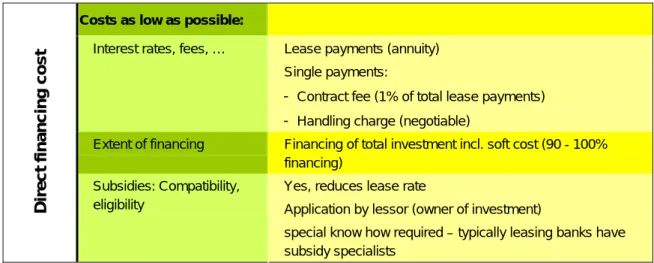
Costs as low as possible:
9Interest rates, fees, … 9Lease payments (annuity) 9Single payments:
- Contract fee (1% of total lease payments)
- Handling charge (negotiable)
9Extent of financing 9Financing of total investment incl. soft cost (90 - 100% financing)
Direct financing cost
9Subsidies: Compatibility, eligibility
9Yes, reduces lease rate
9Application by lessor (owner of investment)
9special know how required – typically leasing banks have subsidy specialists
Table 2:Operate Leasing – direct financing costs
5.3.2 Legal Aspects
Legal implications
9Financing term 9Object oriented: Basic lease term: 40 – 90% (mobile), < 90% (immobile) of useful life
9What can be financed? 9Only leasable energy service investment incl. soft cost (e.g. project development)
9Cancellation of contract 9Generally no cancellation during basic lease term possible 9Legal and economic
property aspects
9Lessor is legal and economic owner 9Transfer of ownership at end
of term
9Lessor remains owner
9EPC contract must not include automatic transfer of ownership to client
Legal aspects
9Responsibility for operation and maintenance
9Lessee has to perform o & m according to lessor's requirements and must insure the investment Table 3:Operate Leasing – legal aspects
Further Comments:
h Financing term: In order to qualify as leasing, the lease term must not
exceed a certain percentage of the asset's estimated useful life-time (90% according to Austrian and German law, 75% of the economic life according to US GAAP).