SEED WORKING PAPER
No. 9
Series on Women’s Entrepreneurship Development and Gender in
Enterprises – WEDGE
Promoting Women’s Entrepreneurship Development
based on Good Practice Programmes:
Some Experiences from the North to the South
by
Paula Kantor
InFocus Programme on Boosting Employment
through
S
mall
E
nterpris
E
D
evelopment
Job Creation and Enterprise Department
ii Copyright © International Labour Organization 2001
Publications of the International Labour Office enjoy copyright under Protocol 2 of the Universal Copyright Convention. Nevertheless, short excerpts from them may be reproduced without authorization, on condition that the source is indicated. For rights of reproduction or translation, application should be made to the ILO Publications Bureau (Rights and Permissions), International Labour Office, CH-1211 Geneva 22, Switzerland. The International Labour Office welcomes such applications.
Libraries, institutions and other users registered in the United Kingdom with the Copyright Licensing Agency, 90 Tottenham Court Road, London W1T 4LP [Fax: (+44) (0)20 7631 5500; e-mail: [email protected]], in the United States with the Copyright Clearance Center, 222 Rosewood Drive, Danvers, MA 01923 [Fax: (+1) (978) 750 4470; e-mail: [email protected]] or in other countries with associated Reproduction Rights Organizations, may make photocopies in accordance with the licences issued to them for this purpose.
ISBN 92-2-112341-3
First published 2001
The designations employed in ILO publications, which are in conformity with United Nations practice, and the presentation of material therein do not imply the expression of any opinion whatsoever on the part of the International Labour Office concerning the legal status of any country, area or territory or of its authorities, or concerning the delimitation of its frontiers.
The responsibility for opinions expressed in signed articles, studies and other contributions rests solely with their authors, and publication does not constitute an endorsement by the International Labour Office of the opinions expressed in them.
Reference to names of firms and commercial products and processes does not imply their endorsement by the International Labour Office, and any failure to mention a particular firm, commercial product or process is not a sign of disapproval.
ILO publications can be obtained through major booksellers or ILO local offices in many countries, or direct from ILO Publications, International Labour Office, CH-1211 Geneva 22, Switzerland. Catalogues or lists of new publications are available free of charge from the above address. Visit our website: http://www.ilo.org/publns
iii
FOREWORD
This Working Paper 9, entitled “Promoting Women’s Entrepreneurship Development based on Good Practice Programmes – Some Experiences from the North to the South”, is published by the ILO’s InFocus Programme on Boosting Employment through Small Enterprise Development (IFP/SEED) as part of the special series on Women’s Entrepreneurship Development and Gender in Enterprises (WEDGE). The Working Paper was initiated by Ms Josiane Capt, formerly of the ILO’s Small Enterprise Development unit, under the ILO’s Action Programme on Small Enterprise Development and Employment during 1998-99. Ms Judith van Doorn participated in directing this research.
With the creation of the InFocus Programme on Small Enterprise Development (IFP/SEED), the ILO has assigned more significance to its efforts on promoting decent work for women in all aspects of their working lives, including women’s entrepreneurship development. One major component of the IFP/SEED programme is on Women’s Entrepreneurship Development and Gender in Enterprises (WEDGE), led by Mr. Gerry Finnegan who has been responsible for the final preparation of this Working Paper.
The ILO would like to acknowledge the thorough and systematic approach that was adopted by the author, Ms Paula Kantor, Assistant Professor, University of Wisconsin-Madison, in identifying relevant good practices from Small Enterprise Development programmes in the developed world that have potential for replication in promoting and supporting women’s entrepreneurship in the developing country context. Thanks to her efforts, a valuable set of findings and recommendations is being made available to a wider audience. These findings are already informing the ILO’s technical work in countries such as Cambodia and People’s Republic of China.
The SEED Working Papers are intended to stimulate and promote exchanges on various aspects of Small Enterprise Development, and the WEDGE Series concentrates on looking at issues relating to women’s entrepreneurship in particular, as well as to gender mainstreaming approaches in small enterprise development. Therefore, we encourage readers to provide comments and suggestions, both in terms of content and presentation of these Working Papers.
Christine Evans-Klock
Director InFocus Programme on Boosting Employment through
Small Enterprise Development .
v
TABLE OF CONTENTS
FOREWORD... iii
TABLE OF CONTENTS ... v
LIST OF ACRONYMS AND ABBREVIATIONS ... vii
GENDER LEXICON... viii
EXECUTIVE SUMMARY ... ix
1. INTRODUCTION... 1
1.1 Why micro and small-scale enterprises? ... 2
1.2 Why gender and microenterprise development? ... 3
1.3 Structure of the paper... 4
2. CONSTRAINTS FACED BY WOMEN ENTREPRENEURS ... 6
3. PROMOTION OF MICRO AND SMALL ENTERPRISE... 9
3.1 What is a successful MSE?... 9
3.2 Good practice criteria ... 12
3.3 Methods of enterprise promotion... 18
4. PROGRAMMES PROMOTING MSES IN DEVELOPED COUNTRIES ... 24
4.1 Methodologies of Service Delivery ... 24
4.2 Sector-specific programmes ... 34
4.3 Incubators ... 36
4.4 Reaching girls ... 40
4.5 Mentoring ... 43
4.6 Access to information ... 45
4.7 Information and communications technology ... 49
4.8 General business training... 50
5. MSE SUPPORT ORGANIZATIONS... 55
6. CONCLUSION ... 60
6.1 Critical Success Factors... 60
6.2 Replicability... 65
6.3 Recommendations ... 66
Appendix 1: MSE Support Services... 69
Appendix 2: Case Studies... 73
vii
LIST OF ACRONYMS AND ABBREVIATIONS
CSBC: Canada Small Business Centre GAD: Gender and Development GDP: gross domestic product
ICT: Information and communications technology ISED: Institute for Social and Economic Development JSBC: Japan Small Business Corporation
MSE: micro and small-scale enterprise
NAWBO: National Association of Women Business Owners NGO: non-governmental organization
OECD: Organization for Economic Co-operation and Development OWBO: Office of Women’s Business Ownership
ROSCA: Rotating savings and credit association SBA: Small Business Administration
SBDC: Small Business Development Center SCORE: Service Corps of Retired Executives SEA: Self-Employment Assistance Programme SEDI: Self-Employment Development Initiative SIYB: Start and Improve Your Business
SME: small and medium-scale enterprise
STEP: Sectoral Training and Empowerment Project
WEDGE: Women’s Entrepreneurship Development and Gender in Enterprises WES-BC: Women’s Enterprise Society of British Columbia
WID: Women in Development
WOBC: Women’s Online Business Center WV: Women Venture
viii
GENDER LEXICON
Gender: refers to the social differences and relations between women and men which are learned, vary widely among societies and cultures, and change over time. The term “gender” is used to analyze the roles, responsibilities, constraints, opportunities and needs of women and men in all areas and in any given context. (Sex refers exclusively to the biological differences between women and men.)
Gender blind: policies and programmes that do not take account of differences between women and men, and consequently are frequently based implicitly on a male actor. Such programmes are often thought to be gender neutral, but because of their implicit focus on male actors, they tend to support men’s needs and interests and neglect those of women. Gender sensitive/aware: policies and programmes that explicitly recognize differences between women and men, and that these differences will impact on the woman or man’s ability to participate in entrepreneurship.
Gender neutral: Gender sensitive policies which represent the current gender division of labour and resources, opportunities and constraints, and seek to intervene in this context without changing it.
Gender specific (women specific): Policies and programmes targeted specifically at women or men (women in the context of this paper) in order to benefit them within the current context of gender relations. Interventions are based on accurate evaluations of society’s gender relations, and they are frequently required in order to redress imbalances (biases) in significant fields.
Gender failures: These are the results of gender blind policies and programmes. An example is the assumption that the market is free from bias, with all society members receiving equal treatment and access. Policies based on this assumption may not assist women who in reality have very different access to and relations with the market compared to men.
Gendered sector: A sector of the economy which is perceived as having the particular dominant attributes of either males or females. Often these sectors are dominated by either women or men, and their respective (perceived) attributes are adopted by/within the sector. The caring sector (such as nursing and day care) tends to be “female” since caring is often perceived in some societies as a “female” attribute.
ix
EXECUTIVE SUMMARY
The purpose of this paper is to examine women’s entrepreneurship support programmes in the context of developed countries in order to formulate recommendations for their replicability in developing countries. The focus is on good practice, and the programmes reviewed in the paper were selected based on a combination of performance criteria and their potential for replicability. The performance criteria used were: outreach/scale, effectiveness, cost efficiency, impact and sustainability.
Why women and MSEs?
The micro and small-scale enterprise (MSE) sector is the focus of this paper due to its central role in employment promotion and economic growth. It is also a sector in which many women earn their livelihood, with women’s entrepreneurship increasing rapidly in many industrialized nations. Many women support themselves and their families through the income they receive from their entrepreneurial activities, making supporting women’s entrepreneurship important to family well-being. Other rationales for supporting women’s entrepreneurship involve efficiency and empowerment arguments. Women’s entrepreneurship makes an important contribution to the economy and thus to development. Therefore, women should be supported in their enterprise endeavours because of the benefits that will accrue to the economy at large. Others perceive the individual benefits women gain through starting a business as the key reason to support women’s entrepreneurship. Women can gain confidence, decision-making experience and a greater sense of control over their lives through starting and managing a business. These outcomes can have broader benefits to the extent that they can affect fertility and family welfare outcomes.
Before women can achieve their potential within the MSE sector, policies and programmes must address the various constraints acting on their abilities to succeed. Women often experience greater constraints on their economic actions relative to men. For example, women may have less freedom to select sectors within which to operate, less access to credit and other productive resources, and less time and opportunity to obtain education and experience relevant to entrepreneurship. These constraints often affect women more than men of the same class due to the different roles and responsibilities women are assigned by society. This means that women tend to have different needs than men regarding entrepreneurship support. If these differences are not recognized in programme design and implementation, women are unlikely to benefit and may be less able to sustain and grow an MSE. This paper addresses how women’s entrepreneurship can best be supported in the light of women’s different needs and interests.
Key Findings Methods of service delivery
Methods of service delivery are important to good practice since they influence all of the performance criteria. Key service delivery models include partnerships and mixed service models.
x
• Partnership models decentralize service delivery under a monitoring agency. This may potentially improve effectiveness and impact by allowing local providers familiar with client needs to deliver services.
• This model is limited by the supply of quality local service providers. There is an important role to be played by various organizations in supporting institutional development and capacity building to create a network of decentralized service providers. • Partnership models require a commitment to constant monitoring of service delivery
mechanisms and outcomes. This is very important in ensuing that programme designs and outcomes are gender sensitive.
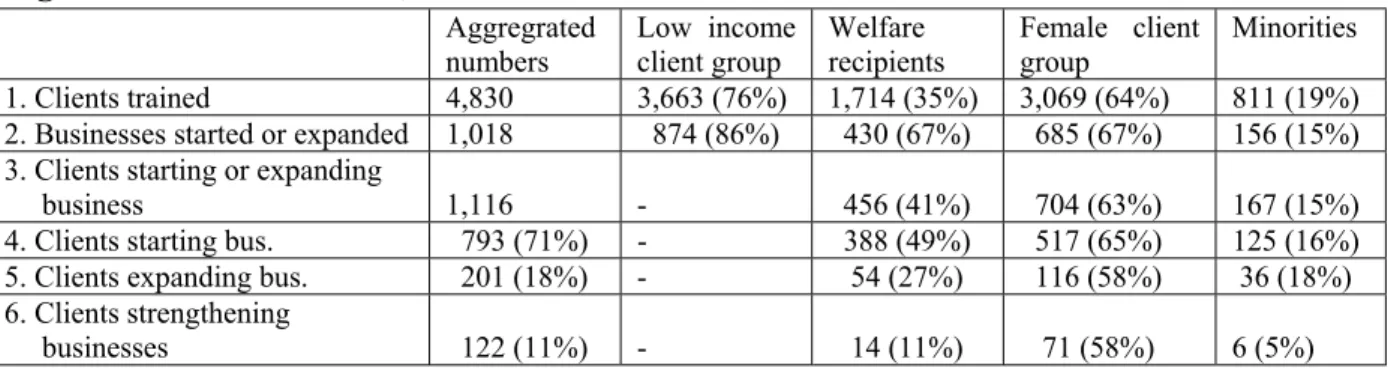
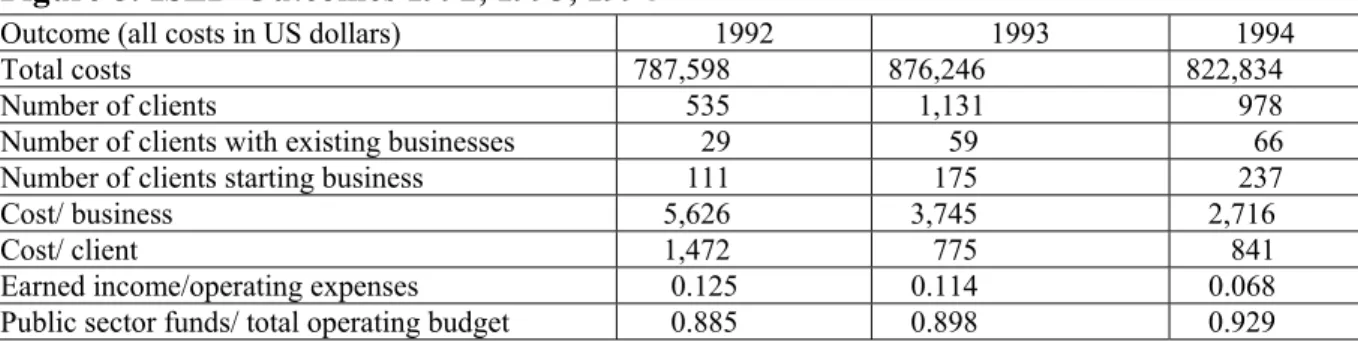
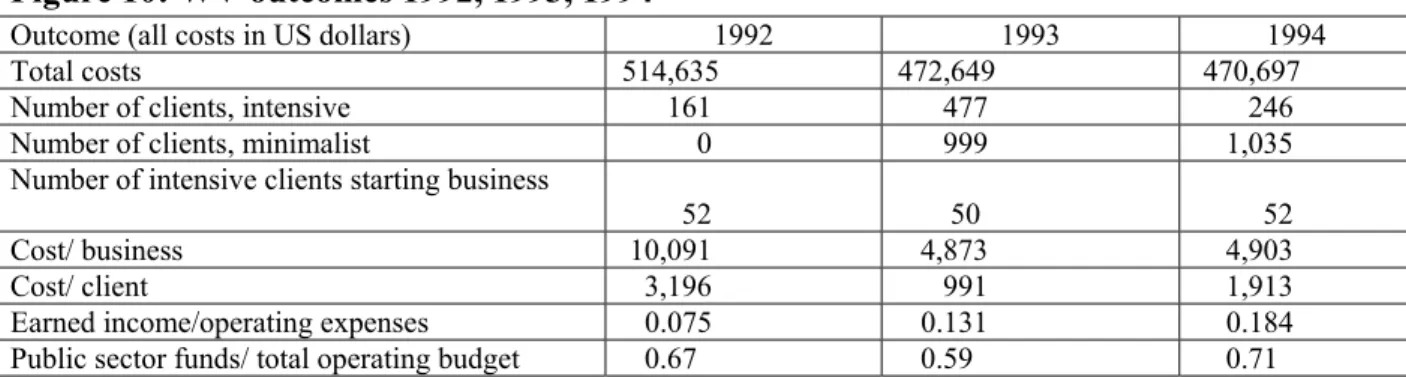
• In mixed service models, one agency delivers services at varying intensities to different levels of clients. This can potentially expand outreach at a lower cost per client and business served. The two mixed service agencies reviewed in this paper showed declines of approximately 40 per cent in costs per client served, and declines of over 50 per cent in costs per business served after introducing minimalist services in conjunction with more intensive services. Outreach (number of clients served) increased by over 100 per cent in one case (see Institute for Social and Economic Development, ISED) and over 800 per cent in the other (see Women Venture, WV).
Sector-specific training
• The provision of training in the skills particular to a sector is a central strategy to help women entrepreneurs move into higher value sectors. It gives them the skills to produce higher quality goods which bring higher prices in the market. This moves them out of the low quality, low price sector within which MSEs often have difficulty competing (see case study, Appendix 2).
• Training women in the skills needed to start businesses at different stages of production, distribution and supply within one industry can create backward and forward linkages among programme participants (see Crasform). This can ease women’s entry into new or male dominated sectors since the women will have the added security of an established network within which to work.
• Service providers will need market analysis skills to aid them in selecting the target sectors for such training programmes.
Incubators
• Incubators can help women who want to expand home-based businesses. They can offer them low cost and low risk access to the productive capacity necessary for expansion. They also can help move women into new sectors by again decreasing the risk involved in start-up by offering access to capital and one-on-one technical and managerial assistance.
• Incubators can have a sector focus (see ACEnet). This can help create networking and mentoring opportunities between business owners and allow them to form group purchase and retailing systems to achieve economies of scale. Sector-specific incubators may have greater potential in helping move women into new sectors due to the targeted auxilliary support services available.
xi
Reaching girls
• Strategies supporting women’s entrepreneurship are short sighted if they do not recognize how society influences girls’ perceptions of what they are capable of doing. Awareness campaigns and educational programmes introducing girls to entrepreneurship are important in expanding their dreams and increasing their confidence. This may then have long-term positive effects on women’s entrepreneurship as girls finish school and enter the workforce.
Mentoring
• Women have shown a keen desire for follow-up training, accessed after trying out ideas learned in more formal training sessions.
• One way agencies have offered follow-up services is through mentoring. Mentoring provides women with a one-on-one or group environment for asking questions and receiving guidance specific to their businesses. The mentors should be experienced business people, preferably women.
• The close interaction between mentor and mentee can increase the effectiveness and impact of the service.
• The intensive delivery can imply high costs; these can be reduced if quality volunteer mentors are available, or if the beneficiaries make a financial contribution in return for the mentoring services.
Access to information
• Information is an important but often under-demanded resource for MSE owners. Decentralizing provision of information by using telephone, fax and online modes of access may increase awareness and usage of the services.
• Using online, telephone and fax-based modes of information provision should improve women’s access to information since they can use the services at times that fit their schedules.
Information and communications technology (ICT)
• The Internet and electronic commerce are key means to improve access to markets for inputs and for sales of finished goods. This can help those producing in areas where access to markets is limited or those whose lack of mobility limits market access.
• ICT can also be used to provide MSE support services such as training. Distance learning may increase women’s access to training since courses can be taken at times suited to the women’s schedules.
• ICT, including e-commerce, represents a growing sector in the global economy. For this reason it is important that women take advantage of the entrepreneurial opportunities available in marketing these technologies. Agencies supporting women’s entrepreneurship should design programmes to help women enter this sector.
xii
General business training
• A constraint women face in starting MSEs is a lack of relevant education and experience. General business training will be vital in filling this gap as long as it is designed to meet women’s needs.
• Business training should also be given to service providers supporting women’s entry in the MSE sector. This can help them focus on entrepreneurship rather than income generation.
• Offering business training to government officials with responsibility for the MSE sector can help them be more effective in policy support for the sector. This training must be gender aware and gender sensitive so that policies also benefit women entrepreneurs. Cross-cutting conclusions
• A vital starting point for service providers who aim to support women’s entrepreneurship is to know their clients. Ongoing gender sensitive needs assessments are the key means of incorporating women’s heterogeneous needs into programme design and implementation.
• Direct service provision meeting the practical business development needs of women entrepreneurs is important. But, without work on a more strategic level addressing the underlying policy and regulatory constraints on women’s opportunities, women will not achieve success in the MSE sector to the same extent as men. Partnerships between direct service providers and advocacy organizations are one way for agencies to work at both levels.
• Women’s entrepreneurship support programmes should give equal importance to non-economic programme outcomes. These include: improved quality of work through lower workloads and greater social protection, improved family well-being and improvements in women’s self esteem. In some cases this may mean supplying non-business services such as childcare, transport assistance and personal development training.
• Replicability of some good practice programmes will be limited by the supply of inputs available, including quality service providers. Developing strategies to ease these bottlenecks in service delivery is a role for the ILO and similar organizations.
Challenges
•
There has been little solid, comparable work done to evaluate the outcomes of MSE support programmes, whether women specific or not. A key future challenge is the development of user-friendly management information systems applicable to a broad range of programme types and methodologies that will assist agencies in monitoring their performance. This will also help in comparing performance across agencies for the purpose of the ongoing development of good practices.•
Many different types of women start MSEs. Much attention is placed on assisting low-income women in this venture. Less attention has been given to moderate-low-income women and their businesses. Research on the employment generation and outputs of these enterprises, as well as their constraints and needs is another direction for the gender and microenterprise development field. Assisting these women entrepreneurs may also offer a new way to assist low-income women into employment or entrepreneurship.xiii
•
Although many of the good practice examples given in this report have worked well in developed countries, their replicability in developing countries in not assured. In the developed country context, Governments provide welfare or welfare substitutes to enable unemployed persons to enter into self-employment of small business. People have opportunities to look beyond their immediate and extended families to provide support to others to get them on the path to business creation and development. Retired persons – assured on a state pension – can spend their free time assisting others. It would be extremely rare to find these features in any developing country context. Therefore, although replication may be possible in a general way, or in relation to selected components of these good practice programmes, sensitivity should be shown to local economic, social and cultural factors before attempting whole-scale replication of some of these programmes.1. INTRODUCTION
With the new sets of problems relating to underdevelopment in the post-World War II period, came different theories of how developed nations could foster the development potential of underdeveloped nations. Modernization theory was influential during the first development decade, leading to large-scale interventions and a focus on industrialization as the path to development. However, by the late 1960s and early 1970s development through large-scale capital investment appeared to be failing as these strategies did not do much to alleviate poverty and unemployment (Moser 1978; Schmitz 1982; Teszler 1993).
Industrialization resulted in capital-intensive industry, dependent on a factor of production not readily available in many developing countries and leaving much of the available unskilled labour force idle (Teszler 1993). This unemployment problem led to the ILO’s employment programme missions and the ‘discovery’ of the informal sector in the early 1970s. Subsequent interest in the microenterprise sector tended to rise and fall with the economic cycle, with the informal sector viewed as an alternative path to development at times of crisis and adjustment in the large-scale capitalist system (Gerry 1987; Dignard and Havet 1995). This was also true in industrialized nations, where from the 1980s attention began to focus on micro and small-scale enterprises as a means to poverty alleviation and unemployment reduction, with these enterprises creating new economic opportunities and increasing competition in the market (Feit 1998; OECD 1998a).
Concurrent with the attention placed on the informal economy in the early 1970s was the growing recognition of women’s role in economic development. The attention on women’s roles focused in particular on how women served development aims, rather than how women were affected by development. The fields of women in development (WID) and gender and development (GAD) grew through the 1980s and 1990s respectively, and within these fields were those focusing on women and microenterprise development. They noted women’s important presence within the micro and small-scale enterprise (MSE) sector in developing countries, a presence also found in small-scale enterprises in developed countries though to a lesser extent. They also worked to make visible the barriers limiting women’s contributions to the MSE sector. In response to women’s important roles within the microenterprise sector and the constraints limiting these roles, programmes were developed to facilitate women’s participation in the economic arena.
In the case of microenterprise development, particularly for microcredit interventions1, the learning pattern has shifted over time from the traditional development model of transfer from developed to developing nations, to the transfer of knowledge and practice from developing to developed countries. However, once microenterprise support programmes were introduced in the North and West, practitioners adapted them to local contexts and made innovations in terms of the programmes offered and their methods of delivery. These innovations are the focus of this paper, with the purpose of sharing the progress made in the industrialized context with practitioners in developing countries. The goal is a more vibrant, sustainable and gender-balanced microenterprise sector across the globe.
1 Due to the wide range of microcredit programmes operating in developing countries, credit provision is not a
1.1 Why micro and small-scale enterprises?
A key rationale for supporting the micro and small-scale enterprise (MSE) sector is its potential to generate output, employment and income (MacIsaac 1996). Many view the sector and its entrepreneurial character as central to innovation, economic growth and job creation. Small-scale enterprises are potentially more flexible, making them better able to adapt to the rapidly changing global economy and the political pressure of rising unemployment (Richardson and Hartshorn 1993; Tanburn 1999; Arzeni Dec97/Jan98).
Numbers available for the size and employment potential of MSEs in industrialized nations justify the programme and policy attention given to MSEs to alleviate their constraints and to improve their potential. In the United States, small and medium enterprises created all net new jobs from 1988-90, with most created by firms with less than 20 employees (Clark and Huston 1993). Similar results are found for 1995, where firms with less than 500 employees created 1.8 million net new jobs, while large firms created only 100,000 (International Small Business Congress, May 1999). In Canada, there are approximately 2.5 million small and medium enterprises with less than 100 employees, and of these about 1.4 million owners are self-employed. Small and medium enterprises in Canada account for 50 per cent of private sector employment and about 43 per cent of private sector output; they accounted for 81 per cent of job growth in 1996-97 compared to 70 per cent in 1995-96 (OECD 1996; International Small Business Congress, May 1999). In OECD countries, over 99 per cent of enterprises in most economies are small and medium enterprises and they account for between 40-80 per cent of private sector employment (International Small Business Congress May 1999). Finally, in Japan in 1994, 99.1 per cent of business establishments were small and medium enterprises, accounting for 78 per cent of employment in non-primary industries and approximately 56 per cent of value added in the manufacturing sector (Japanese Small Business Corporation).
While in general there is enthusiasm for the potential of the MSE sector, some question the claims regarding its employment potential. Particularly in the developing country context, the microenterprise sector is viewed as labour-intensive and thus a means of utilizing a factor of production supplied in abundance. This labour intensity and the resulting employment potential are used in both developing and developed nations as justification for investment in the MSE sector. However, some researchers state that the relationship between entrepreneurship and job creation is difficult to prove statistically (OECD 1998a; Arzeni Dec97/Jan98). Various factors make proving the employment effects of the small-scale sector a challenge. One key problem is isolating the effects of entrepreneurship from other factors influencing the creation of jobs (i.e. is it entrepreneurship or other economic factors driving employment growth?). Another challenge is determining the direction of causation between entrepreneurship and job creation.
Hallberg (1999) takes issue with the view that the MSE sector is inherently more labour intensive and sees evidence of market failures which act to disadvantage MSEs relative to large enterprises as the only justification for interventions to assist the sector. It is the production processes used by MSEs that tend to be more labour intensive; labour intensity is not an inherent characteristic related to small size. MSEs account for a large share of employment in developing and developed nations due to the large number of such firms, and not each firm’s ability to hire large numbers of workers (Hallberg 1999). On the contrary, each individual firm tends to have a low hiring rate (Wilson and Adams 1994). This must be recognized in developing policy to support small-scale enterprises, particularly when job
creation is a primary aim. More research on the effect of MSE expansion on employment generation would help in determining whether support should be aimed at growing existing MSEs or helping new MSEs to start.
1.2 Why gender and microenterprise development?
There are three rationales for focusing on women’s role within the MSE sector. The first is the number of women active in the MSE sector in both developed and developing countries. Across the globe, women-owned businesses account for 25 to 33 per cent of all businesses (Employment NOW Community Initiative 1998). In Europe, women create one third of all new businesses, with 9.5 per cent of women officially counted as self-employed compared to 18.9 per cent of men (Employment NOW Community Initiative 1998). In general, there are two types of businesswomen, those who choose entrepreneurship and those for whom entrepreneurship is the only option for earning an income (European Commission 1998). Both types of entrepreneurs are increasing in number, the first due to the glass-ceiling effect, and the second in response to increasing unemployment and decreasing wages (Turner 1993; European Commission 1998; OECD 1998b). In Europe, entrepreneurship as a way out of unemployment is rather common, with 60 per cent of new enterprises started for this reason in Northern Europe and 70 per cent in Southern Europe (European Commission 1998). In the United States, female entrepreneurship is on the rise, with the number of women-owned firms increasing 103 per cent between 1987-99 and employment and sales increasing 320 per cent and 436 per cent respectively in the same period (National Foundation for Women Business Owners 1999). As of 1999, women-owned firms are 38 per cent of all firms in the United States, representing 9.1 million businesses, employing over 27.5 million people and generating over $3.6 trillion in sales (National Foundation for Women Business Owners 1999). There is no direct evidence regarding how many of these women-owned firms are MSEs. However, there is anecdotal evidence for the United States and other industrialized nations that the majority of women-owned enterprises are of small size.
These numbers clearly represent the importance of women to the MSE sector and illustrate one rationale for ensuring the inclusion of women in programmes and policies to support the sector. If MSEs contribute substantially to the economy, as illustrated by the numbers for MSEs in general, and women account for large numbers of MSEs, it makes sense from an effectiveness perspective to include women in interventions.
A second rationale for targeting women MSE owners is welfare improvement. MSE agencies with socially oriented goals, including poverty alleviation, can use the numbers above to justify women’s inclusion. If MSEs have a role in poverty alleviation, and women play a large role in the sector as well as in providing for the household, then including them in programmes to promote microenterprise development is justified.
A third rationale for intervening to support women in the MSE sector is to contribute to their social and economic empowerment. Entrepreneurship promotion agencies support this rationale with the belief that self-employment and entrepreneurship increase women’s self esteem and confidence, leading to greater control over their lives in social and economic spheres. This can benefit both women and their families.
While the three rationales above may all be ‘true’, in that economic growth, poverty alleviation and women’s social and economic empowerment potentially can result from women’s inclusion in the MSE sector, how women are included is also very important. Whether women are recognized as having different needs than men, or are considered as
experiencing life in the same way as men, will make a difference in the extent to which women achieve their goals.
It is important to consider gender and other dimensions of difference in any programme or policy design situation because of the tendency for gender-blind (or race-blind, class-blind, etc.) design to incur costly unintended consequences. Such supposedly ‘blind’ policies and programmes tend to benefit society’s dominant groups. This is because they do not recognize that others within the community or economy have different needs and interests due to the roles, responsibilities and opportunities assigned to them by society (Kabeer 1994; Kabeer and Subrahmanian 1996; Ohio Women's Business Network 1997; Richardson 1993; Van Der Wees 1995). “Many differences occur because women’s life experiences contrast with those of men in terms of the education they receive, their involvement with their families, their levels of confidence, the social spaces which they occupy and the circles in which they mix” (Truman 1993: 130). Agencies taking a gender blind perspective approach problems from the dominant group’s perspective, generally ensuring that solutions will benefit this group. Even agencies working only with women cannot assume they have a gender sensitive programme. A case study by Ehlers and Main (1998) showed how without a clear grounding in the realities of women’s lives, microenterprise support programmes targeted at women can be designed with the assumption that the entrepreneur is male.
It is important that programme design explicitly recognizes the interests and concerns of all members of the target group in order to ensure that programmes are effective and that all clients benefit. In the microenterprise sector, women comprise a substantial proportion of microentrepreneurs, making women likely members of many client groups and a gender perspective vital to programme success. Without this perspective, interventions are likely to support the interests of a generic group of microentrepreneurs which do not mesh with those of the diverse women or men within the sector. As long as microenterprise service providers do not orient their programmes to women’s needs, women specific programmes remain necessary (The European Observatory for SMEs 1996). As the gender awareness of service providers and programmes improves, the need for separate women’s programmes will decrease somewhat, but there is still likely to be a need for women specific programmes in the foreseeable future.
1.3 Structure of the paper
The purpose of this paper is to examine entrepreneurship support programmes in the developed country context in order to develop recommendations regarding their replicability in supporting women’s entrepreneurship in developing countries. These support programmes are developed to address various constraints operating on both female and male MSE owners. For this reason, chapter 2 discusses these constraints, drawing out those factors affecting all entrepreneurs as well as those affecting women more intensely or exclusively. Chapter 3 focuses on entrepreneurship promotion strategies, discussing the characteristics of a successful microenterprise, the performance criteria used to evaluate good practice, and the various methodologies used to deliver MSE support services. Chapter 4 reviews the good practice programmes selected and discusses their gender sensitivity and replicability. Chapter 5 will examine the various types of organizations involved in entrepreneurship promotion, including their roles, interactions and gender sensitivity, while chapter 6 concludes with recommendations regarding replication in developing countries and how to ensure the gender sensitivity of entrepreneurship promotion strategies.
Key Learning Points from Chapter 1
The MSE sector is perceived as central to economic growth and job creation. Numbers representing its size and contribution to the economy in many developed nations justify interventions in support of the sector’s growth.
There is some academic debate regarding the employment potential of MSEs due to the difficulty in clearly establishing causation between entrepreneurship and employment growth. Often it is the large number of MSEs which result in the large number of jobs created in the sector, and not each MSE’s hiring capacity.
Numbers of women in the MSE sector and their potential contribution to the economy represent an efficiency rationale for supporting women’s entrepreneurship.
These same numbers and the potential for household welfare improvements through women’s entrepreneurship represent a welfare rationale for investing in women’s MSE support programmes. Another rationale for supporting women’s entrepreneurship is its potential social and economic empowerment effects.
Attention must be given to how women are included in MSE support programmes. Differences in needs and experiences between women and men, and among women, must be accounted for if women are to benefit.
2.
CONSTRAINTS FACED BY WOMEN
ENTREPRENEURS
In many regions, the extent to which economic growth, poverty alleviation and empowerment are achieved through the microenterprise sector is limited by various constraints on entrepreneurship development. These constraints often affect both women and men, though women tend to be affected more intensely. This is because of society’s perceptions of women, the roles and responsibilities assigned to women by society, and the unequal power relations between women and men (Carr, Chen et al. 1996). MSE support programmes are designed to alleviate the effects of these constraints and improve the ability of MSEs to be successful. Studies have shown that MSEs in developed and developing countries are affected by similar constraints, though to different extents (Levitsky 1996). This chapter will review the various constraints influencing microenterprises, focusing on the developed country context. Due to this developed country focus, gender exclusive constraints will be only briefly discussed. These constraints result from societal norms that are institutionalized at the macro level and affect only women due to the perceived gender differences (Carr, Chen at al. 1996). A wider range of these constraints operates in the developing country context compared to the developed country context.
Constraints affecting MSEs in general, but women more intensively include: access to financing, information, productive resources and markets; levels of skills and knowledge; relevance of education and experience; effects of market saturation; and compliance costs. Small-scale entrepreneurs often have difficulty gaining access to credit (Dawson 1997; Koper 1993; Spalter-Roth, Soto et al. 1994; Mayoux 1995; Van Der Wees and Romijn 1995; Weidemann 1995; Carter and Kolvereid 1998; Mahot 1998; OECD 1998b; ILO 1999). In some cases this is due to the smaller loans requested by women which are not profitable for formal financial institutions to deliver. In other situations banks may not have enough information about clients, making them unwilling to lend money due to the perceived risk involved. Women often have fewer opportunities than men to gain access to credit for various reasons, including lack of collateral, an unwillingness to use household assets as collateral, the small amounts of credit requested and negative perceptions of female entrepreneurs by loan officers (World Bank 1989; Weidemann 1995; Carr, Chen et al. 1996; OECD 1998b). When women do have access to credit it is often for small amounts, whether this suits their needs or not. Differential access to credit based on gender differences is debated in the literature on microenterprise development, with studies in Australia and Canada finding little difference between women and men in availability of financing (Fischer 1992; Low 1998). When a gender difference is found it is often accounted for not by the sex of the recipient alone, but by differences in sector and amount of loan requested (The European Observatory for SMEs 1996). However, as sector choice tends to be limited by gender, one could say any differential access based on this motive is indirectly caused by gender perceptions.
Information is another resource that small enterprises have difficulty accessing (Downing 1990; Spalter-Roth, Soto et al. 1994; OECD 1998b; ILO 1999). The information can be about markets, suppliers, export opportunities etc. Large enterprises often have greater power, time and resources to both access information for themselves and limit others’ access to it. Information can be obtained through informal networks, as well as through membership in organizations such as trade guilds, associations and unions. Female compared to male MSE owners may have greater difficulty in accessing information because of
difficulties in attending events due to their dual work roles and the resulting time constraints (The European Observatory for SMEs 1996; OECD 1998b; ILO 1999).
Small-scale entrepreneurs often lack access to modern equipment which could improve their productivity (Dawson 1997; Mayoux 1995; Van Der Wees and Romijn 1995; Levitsky 1996). This may be due in part to other constraints, such as those on financing and information. Access to markets for both final goods and inputs is another problem for some MSEs, again due in part to a lack of information (Downing 1990; Mayoux 1995; Levitsky 1996; OECD 1998b; Loucks 1999). The market power of large enterprises may close MSEs out of certain markets. To the extent women are less informed than men and more isolated, they will be more constrained in accessing markets.
A lack of relevant skills and knowledge constrains the growth potential of microenterprises (Mayoux 1995; Levitsky 1996; The European Observatory for SMEs 1996; Loucks 1999). This is compounded by deficiencies in basic education. Women tend to be less likely to have had education and experience relevant to starting and managing a business and thus have less potential for success (Downing 1990; Fischer 1992; Koper 1993; Spalter-Roth, Soto et al. 1994; Carter and Kolvereid 1998). Gaining relevant skills and knowledge also can be more difficult for women since their double work burden and childcare responsibilities make them less able to attend formal and informal training than men.
Market saturation is a major problem for MSEs related to a lack of access to higher value markets and a lack of innovation (Dawson 1997; MacIsaac 1996). Many entrepreneurs, particularly women, are located in low value markets where there are few barriers to entry. The sectors tend to be crowded because of these low barriers. This leads to saturated markets and little room for growth. Without innovation through new product development and access to higher value markets, the potential for success for MSEs in these sectors is low.
The final constraint general to the MSE sector is compliance costs (OECD 1998a). These costs relate to the time and money involved in learning about and meeting government regulations, and the cost of meeting informal penalty costs from things such as favours requested by government officials. While these costs also affect large enterprises, they tend to have smaller effects due to the larger scale of the enterprises, their greater bargaining power and better access to information.
Constraints affecting only women MSE owners within the developed country context include gender roles and responsibilities, occupational segregation and internal constraints. Women’s more demanding role in the family relative to men’s affects their entrepreneurial ability by reducing the time, energy and concentration levels women can apply to their market work (MacIsaac 1996; Employment NOW Community Initiative 1998; ILO 1999). Women may have lower earnings and productivity levels since the amount of time they have available for market work will be limited by the time necessary to care for the family. Their concentration while working may be reduced if there are multiple distractions, leading to a further reduction in productivity and earnings. Responsibility for household welfare also may make women more risk averse, while societal perceptions of women’s gender roles influence their treatment when they step outside of the perceived boundaries of these roles, limiting their access to the resources required for successful entrepreneurship (Downing 1990; The European Observatory for SMEs 1996; Mahot 1998; ILO 1999).
Traditions regarding what work is appropriate for women result in a gendered division of labour in productive work that limits the potential that women have to be successful (Downing 1990; Van Der Wees and Romijn 1995; Weidemann 1995; ILO 1999). Often the activities most readily available to women are those most similar to their domestic tasks. This similarity between the productive and reproductive work women do tends to make their productive work undervalued.
Finally, women tend to face internal constraints resulting from their gender role socialization. Women often lack self-confidence and those personality traits important to entrepreneurialism such as assertiveness, ambition and vision (Fischer 1992; Koper 1993; Spalter-Roth, Soto et al. 1994; Mayoux 1995; The European Observatory for SMEs 1996; ILO 1999). This can make them unwilling to risk and expand their enterprises.
Many constraints influence both females and males in the MSE sector. One must recognize however, that entrepreneurs, whether male or female, are not homogeneous. Therefore not all will face the same constraints or need the same support services. As we will see, this will influence the structure of support agencies and methods of service delivery.
Key Learning Points from Chapter 2
The economic success of both female and male MSE owners of the same class is constrained by many factors. Women may experience these constraints more intensely due to the roles and responsibilities assigned to them as women.
Some of the more common constraints include: access to financing, information, productive resources and markets; levels of skills and knowledge; relevance of education and experience; effects of market saturation; and compliance costs.
Women’s household responsibilities and role as mothers represent a constraint affecting only women. Other constraints exclusive to women and applicable in the developed country context are occupational segregation which limits women’s free choice among economic sectors, and socialization practices which often result in women having less self-confidence and assertiveness compared to men.
The gender dimensions of these constraints and the influence of other characteristics such as race, class, etc. must be recognized in developing programmes to support women in the MSE sector.
3.
PROMOTION OF MICRO AND SMALL ENTERPRISE
3.1 What is a successful MSE?
It is important to start this chapter with a discussion of the characteristics of a successful MSE because it frames the remainder of the paper. It brings out the issue of what the objectives of MSE support agencies should be, and how these determine the goals the agencies work towards. The focus will be on whether economic outcomes define a successful enterprise, or whether non-economic outcomes also are important.
The rationales for intervention to support women’s entrepreneurship as discussed previously, will guide the programme design of support agencies and the objectives they work towards. Those with an efficiency focus will have economic growth through market forces as their objective. They will support MSEs that are more dynamic and be most interested in economic outcomes as indicators of a successful enterprise. The attainment of positive change in these economic indicators marks a successful intervention (Mayoux 1995). Many studies of the success of MSEs (and the larger small and medium-scale enterprises) focus only on economic outcomes such as size, growth, productivity and returns, even those comparing the success of females and males (Fischer 1992; Johnson and Storey 1993).
This singular attention to economic growth and efficiency and the reliance on the market to achieve them have been criticized by gender and development theorists on two grounds. First, the objectives tend to be reductionist in that they focus solely on economic outcomes, with no recognition of possible constraints on the growth potential of certain marginalized groups due to the effects of social and cultural norms. While those taking a gender perspective recognize the problem of low growth in women’s microenterprises, they link this lower potential not to inherent characteristics of women but to an inability to compete freely in the economic sphere due to policy, market and cultural constraints (Mayoux 1995; Chen 1996). They advocate for removal of these constraints in order to improve women’s productivity.
The second ground on which a market-led growth focus can be criticized is its view of the market as an unproblematic, neutral mechanism. Proponents of the market-led growth perspective state that microenterprises unable to compete within the market fail as a result of internal characteristics of the entrepreneurs, and not as a result of structural constraints located within market relations. These less successful enterprises are often those operated by individuals within marginalized groups. Feminist economists question this view of the market as free from bias. Instead, they see the market as influenced by power relations that have an asymmetrical sex, class, race, etc. dimensions (Bakker 1994; Elson 1994). There are non-market forces that define how markets operate, influencing who has access to them. These forces often reflect both resource allocations and social norms, implying that women are doubly constrained in their market access since they often have lower resource endowments than men and are often more directly affected by social norms. In order to develop appropriate interventions to address the market’s ‘gender failures’, gender theorists advocate uncovering the power relations constructing the market and increasing women’s perceptions of their rights to access. The latter can be achieved through organizing and consciousness raising, while the former may require more rigorous research examining gender relations within the economic sphere.
Proponents of a market-led growth model perceive that microenterprises can contribute to the achievement of economic growth mainly through expansion. This illustrates the approach’s unidimensional conception of growth as equal to enterprise expansion. Other goals held by microentrepreneurs are not recognized.
The gender and development literature on microenterprise development disagrees with this unidimensional view and acknowledges that many entrepreneurs have goals other than expansion (Downing 1990; Baud and Bruijne 1993; MacIsaac 1996; Employment NOW Community Initiative 1998; Reddy 1998). In particular, it notes that differences in goals are often gender based, with women microentrepreneurs stating a desire for increased security, maintenance of income, a balance between professional and private life and survival, while men want to expand.
Gender and development theorists are more inclined to recognize these diverse goals due to their application of a broader conception of how to achieve growth. They recognize the importance of different roles in the household’s effort to increase income, incorporating the idea of household survival strategies and interdependencies, as opposed to focusing only on individual enterprise. Chen (1996) explicitly illustrates the various components of such a growth strategy. They include using enterprise income to subsidize either another family member’s search for high income work or a higher growth enterprise, and diversifying household earnings to increase stability in the face of future crises.
Finally, the efficiency rationale for intervention uses market failures as the justification to intervene in the market. Interventions in the case of failure include improving access to resources such as physical capital or information. Some gender theorists find this simplistic in that improving access to resources may not be enough as it ignores the influence of power relations in terms of actual control over resources (Kabeer 1997). Thus, direct productive assistance in regards to access to resources is seen as one aspect of a strategy promoting the success of microenterprises, but other elements are equally important. These other elements include group formation, consciousness raising and using group strength to work for structural change (Piza Lopez 1990; Mayoux 1995). To aid in this, Mayoux (1995) states that developing networks and systems of information exchange may be more important than skills training and human resource development as they will result in more mobilization potential.
The welfare rationale seeks to intervene in the MSE sector in order to alleviate poverty. While this in general is considered a positive goal, from a gender perspective one can criticize the means of its achievement as strategies tend to be reformist rather than radical. Improved distribution of productive resources such as income, education and training is advocated within current economic and social structures, maintaining the status quo as opposed to challenging it (Kabeer and Humphrey 1991). While there may be short-term positive results from a reformist strategy, these may not be sustainable if the underlying inequities in power are not addressed.
Similar to the efficiency rationale, the poverty alleviation rationale ignores power relations in the redistribution of resources, meaning that the issue of actual control over redistributed resources is not considered. Thus, it is likely that poor women will continue to be disadvantaged as the power structures supporting their disadvantage are not addressed.
The use of the state as a mechanism for achieving poverty alleviation also has the potential to be problematic from a gender perspective. The state, like the market, is not gender-neutral and even policies thought to be gender-neutral may be biased towards men. In developing intervention strategies to support the microenterprise sector’s role in poverty reduction, it is important that gender relations are considered both in terms of their influence on interventions and the interventions’ influence on gender relations. This will help to avoid the unintended consequences of ‘gender-blind’ interventions.
Both rationales have an instrumental view of gender, in that gender issues are integrated into programmes in order to achieve ends other than gender equity. Programmes are not formulated as means to improve women’s status, power or quality of life, because these are not recognized development objectives in either rationale. Women are used to facilitate development aims, with no thought to how they will benefit or suffer. Non-economic outcomes are ignored, meaning that while using women’s entrepreneurship to achieve quantitative economic development aims may be successful, the perception of this ‘success’ is often not tempered by an evaluation of non-economic outcomes related to women’s status and quality of life. Factors such as changes in women’s workload, their control over income, decision-making status in the household and community, level of family support, stability of income, and improvement in working conditions all need to be considered in a more holistic evaluation of a successful MSE and an effective MSE programme (Dignard and Havet 1995; Mayoux 1995; MacIsaac 1996).
Edgcomb et al (1996) perceive success as a three dimensional concept, incorporating economic development, human development and community development. This definition incorporates both economic outcomes and welfare levels. A critique of some microenterprise development programmes within the gender and development tradition is that they focus too much on equity issues and ignore the economic feasibility of the activities promoted (Buvinic 1986). This can negate any short-term improvements in women’s social position, as the programmes will not be economically sustainable in the long term. Equally important are the more qualitative outcomes related to human and community development such as acquisition of skills, self-esteem, individual and family well-being (which can account for such things as workload, working conditions, isolation and family support) and community participation (Edgcomb, Klein et al. 1996).
Much of the gender and development literature on microenterprise development makes equity considerations inseparable from other development goals; women are not viewed as means to other ends (Mayoux 1995). By incorporating equity and quality of life considerations, the sought after outcomes of microenterprise development programmes are expanded beyond increasing profits and income of client enterprises to include social issues such as the increased status, quality of life, control and bargaining power of the clients (Dignard and Havet 1995; Weidemann 1995). The ILO continues to have a central role in this, linking gender equality and human rights. It mainstreams gender considerations in its work to promote an enabling policy environment for MSEs, endeavouring to ensure that policies work consistently for both female and male microentrepreneurs (ILO 1999). The ILO’s focus on Decent Work2 for women and men emphasizes a more holistic approach,
embracing social and economic development, as well as the quantity and quality of employment opportunities.
Figure 1: Complexities of designing programmes to support women’s entrepreneurship
One type of programme recommended by some for intervening to promote women’s entrepreneurship involves moving women from low-growth to high-growth sectors of the economy (Chen, 1996; Downing, 1990; Mayoux, 1995). In many cases this is not done to empower women by moving them out of traditionally female occupations, but is advocated for either the economic growth effects of utilizing women’s labour more efficiently or the poverty reduction effects of increasing women’s income since this income is considered essential to the welfare of families (Chen, 1996; Downing, 1990; Weidemann, 1995). Those with a gender equity rationale also support such programmes as a way to open more choices to women within the economy, increasing their confidence and income earning potential.
Dignard and Havet (1995) specifically oppose the strategy of moving women out of low growth activities. They have two main reasons why such a strategy can be inappropriate. The first is that moving women into a new activity where they have little experience or previous exposure can increase both their risk of failure, with disastrous results for household survival, and their dependence on technical assistance and outside support. It may not make for sustainable enterprises. Second, by moving women out of their traditional activities, these strategies are implicitly supporting societies’ undervaluation of this work. This reflects a confusion of the value of the actual work with the value society places on it. The work itself is valuable and important to the economy and household, but is rewarded poorly (Dignard & Havet, 1995). Creating new ‘women’s work’ may not solve the problem of low valuation if the low value is due to perceptions of the work done by women and not actual market valuation. The focus of microenterprise programmes at the policy level therefore should be on changing perceptions about this work by making it visible and valued, as well as improving understanding of the social relations defining women’s work as less valuable than men’s.
What this analysis leaves out, however, is the issue of the feasibility of the sectors women enter in terms of market saturation and demand. If the market is saturated and there is little scope for an increase in demand, then strategies to move women out of their traditional sectors may be appropriate. However, other strategies, such as introducing new technologies leading to the development of new products for different market niches may be just as appropriate. This illustrates the complexity of assessing client needs in the MSE sector and designing strategies to meet these needs with the greatest benefit and least risk to client survival.
3.2 Good practice criteria
Before evaluating approaches to microenterprise promotion and good practice programmes, we must first discuss how to evaluate who is doing what well. This section will examine how the selection of good practices in approaches and content was done, defining and describing criteria of performance. These criteria were used as guides in selecting approaches and programmes. However, as the purpose of this paper is not only describing good practice in women’s entrepreneurship promotion in developed countries, but also involves determining what would be replicable in developing countries, more subjective criteria were also used. The subjective analysis involved an evaluation of what is not being done extensively in developing countries, and what programme types seem to have the best potential for contributing to good practice in the developing country context.
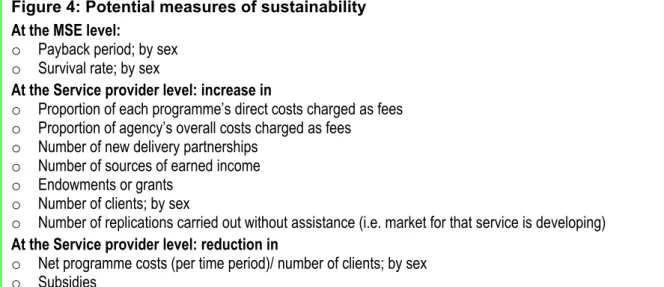
There are five performance criteria that will be used, when possible, to justify the selection of programmes as best practices. They are: outreach/scale, effectiveness, cost efficiency, impact and sustainability (Committee of Donor Agencies for Small Enterprise Development 1998; ILO 1999; McVay 1999). These criteria can be applied at various levels, including the individual enterprise and the service provider, to determine good practice at
Figure 2: Potential indicators of outreach/scale
o Cumulative numbers reached; using; benefiting
o Cumulative number of women (or other target group) reached; using; benefiting
o Women as per cent of total clients
o Number of active clients (in year, month etc.); number of active clients benefiting
o Number of women (or other target group) among active clients; number of active women benefiting
o Number of institutions providing service
o Number of service delivery points
o Number of clients per delivery point
(McVay, 1999; Edgcomb et al, 1996)
these levels. Programmes with a market focus also may include an evaluation of market development in determining good practice at the meso level (McVay 1999).
It is important to note from the start that achieving positive results in all five criteria is very difficult as there are often trade-offs between the different criteria (Committee of Donor Agencies for Small Enterprise Development 1998; ILO 1999). For example, there can be conflict between achieving both outreach/scale and impact, since achieving impact can imply intense work with a small client base (Edgcomb, Klein et al. 1996). Also, financial sustainability and effectiveness may not be compatible, depending on the objectives of the programme. This is particularly the case when an agency’s mission is more socially oriented, and client needs may be wide ranging and their ability to pay low (Loucks 1999; Tanburn 1999). In general, the set of criteria across which a programme is able to perform well will reflect its mission, client base and service delivery method. Next, each of the five criteria will be discussed, including a definition of the criterion, mention of any gender issues related to it and a list of potential indicators.
3.2.1 Outreach/scale
Outreach refers to success in the depth of services provided by an agency to its target group of clients. Is the agency able to provide its services to an adequate number of its target population? How many does it serve in absolute numbers and as a percentage of the total target population? Scale refers to the agency’s ability to reach either a larger proportion of the target population, or a larger population composed of various target groups (Edgcomb, Klein et al. 1996). Indicators of performance in terms of scale and outreach will tend to be target population based, as seen in Figure 2 below.
There are various issues one needs to address in determining how to measure scale. First is whether to focus only on numbers reached, or to bring in more substantive performance issues by focusing on numbers actually using or benefiting from services (McVay 1999). In either of these cases, one can count either currently active clients or cumulative clients (McVay 1999). Both may be interesting depending on the needs of the organization in terms of monitoring performance. Number of active clients within a specific time period can evaluate how well the agency is recruiting clients from time period to time period, while cumulative clients may be better as a long-term evaluation tool. Another issue to consider is whether to include only direct beneficiaries or indirect beneficiaries such as family members or employees as well (McVay 1999). At the institutional level, some may use the number of institutions providing services as a measure of scale, while others view coverage as more essential and count the number of delivery points (McVay 1999).
In some cases, increasing scale may require a diversification of the client base (Edgcomb, Klein et al. 1996). If the current client population is of limited size, or if its
ability to pay for services makes the organization dependent on subsidies, expanding outreach to new populations with a greater ability to pay may be a good way to achieve scale and improve sustainability. This would be a type of mixed service model. Other organizational structures suited to achieving scale in terms of costs and sustainability are partnership arrangements, and organizations that include a microenterprise development programme within a broader programme focus (Edgcomb, Klein et al. 1996).
MSE support agencies must consider gender issues when thinking about outreach and scale. Achieving outreach requires strong recruitment strategies, and these should be gender-specific, especially in cases where women and men do not have access to the same information sources. Determining where women go in the community and who they trust are key to developing recruitment strategies that reach women. Agencies also should consider the impact of scaling up on meeting women’s needs. Women in some target groups, such as poor women or the less educated, may require more intensive assistance. In these cases, small-scale is best for achieving impact. Often women prefer more incremental learning, in a more participatory setting, all of which can take more time and resources (Richardson and Hartshorn 1993). An agency’s desire to scale up to reach a larger client base may mean less time to spend with clients, and a lower level of impact and effectiveness. Later some service delivery approaches will be discussed that may allow for both scale and impact.
3.2.2 Effectiveness
The effectiveness of an agency’s service provision is central to good practice. This is because effectiveness is defined as being relevant to and meeting the needs of clients and achieving the agency’s objectives (Gibson 1999; ILO 1999; Loucks 1999). Being ineffective would imply that the needs of clients would go unserved and the central purpose of MSE support programmes would not be met. While in some cases it may be true that clients do not know what services they need, it is still the role of the provider to educate clients regarding the need for certain services. This is necessary because without an understanding of the usefulness of assistance, clients will not demand it.
Central to achieving effectiveness is an understanding of clients’ needs. This can be gained through ongoing needs assessments, ongoing because needs will change over time with changes in the business climate and the businesses. It is vital that needs assessments be gender sensitive, whether the programme claims to be women-specific or open to both women and men. This refers back to the discussion on why we focus on gender and entrepreneurship promotion. Women have different needs than men due to their different ascribed roles and responsibilities, and this must be recognized in designing programmes. Equally important is the recognition that women are not homogeneous, so that amongst women, just as amongst men, differences in needs also will be found. To be effective, MSE support providers must recognize and address these differences in needs.
Being effective is very important to those service providers following a market-based approach because it reflects a demand-led model, evaluated by client satisfaction levels, willingness to pay and repeat usage. This is a move away from the previous supply-led models that sought to ‘sell’ already designed programmes to beneficiaries who were uncertain of their desirability and worth. Such programmes were often more dependent on donor funds and not very innovative. The current interest in demand-led strategies has the potential to improve programme effectiveness and even sustainability. Distinct measures of effectiveness, because they depend on client needs and agency missions, will be particular to