da|ra Metadata Schema
Version 2.2.1
DOI:10.4232/10.mdsdoc.2.2.1
Brigitte Hausstein, Nicole Quitzsch, Kirsten Jeude,
Natalija Schleinstein, Wolfgang Zenk-Möltgen
da|ra Metadata Schema
Version 2.2.1
DOI:10.4232/10.mdsdoc.2.2.1
Brigitte Hausstein, Nicole Quitzsch, Kirsten Jeude, Natalija
Schleinstein, Wolfgang Zenk-Möltgen
da|ra Registrierungsagentur für Sozial- und Wirtschaftsdaten
Schiff bauerdamm 19
10117 Berlin
Telefon: (030) 30 23 36 11 -314
Telefax: (030) 30 23 36 11 -310
E-Mail: [email protected]
DOI:
DOI:10.4232/10.mdsdoc.2.2.1
ISSN:
1869-0483
(Print)
ISSN:
1869-0491
(Online)
Herausgeber,
Druck und Vertrieb:
GESIS - Leibniz-Institut für Sozialwissenschaften
Unter Sachsenhausen 6-8, 50667 Köln
Contents
1 Introduction ... 7
1.1 The Registration Agency da|ra ... 7
1.2 The Metadata Schema ... 7
1.3 Version 2.2.1 Update ... 8
1.4 A Note about da|ra DOI registration ... 9
2 da|ra Metadata Properties ... 10
2.1 Overview ... 10
2.2 Citation... 12
2.3 da|ra Mandatory Properties ... 13
2.4 da|ra Optional Properties ... 16
3 XML Examples ... 27
3.1 XML Example File (Mandatory Properties) ... 27
3.2 XML Example File (Mandatory and Optional Properties) ... 28
4 XSD Schema ... 35
5 Mappings ... 60
5.1 da|ra Version 1.0 to da|ra Version 2.2.1 ... 60
5.2 da|ra Version 2.2.1 to DataCite Version 2.2. ... 63
1
Introduction
1.1
The Registration Agency da|ra
da|ra operates as the registration agency for social science and economic data jointly run by GESIS and ZBW. da|ra pursues the goal of long-term, persistent identification and availability of research data via allocation of DOI names. In keeping with the ideals of good scientific practice there is a demand for open access to existing primary data so as to not only have the final research results but also be able to reconstruct the entire research process. GESIS (http://www.gesis.org) and ZBW (www.zbw.eu) therefore offer a registration service for social and economic research data in cooperation with DataCite (http://www.datacite.org), an international consortium pursuing the goal of supporting the acceptance of research data as independent citable scientific objects. This infrastructure lays the foundation for long-term, persistent identification, storage, localization and reliable citation of research data.
Benefits of DOI names for research data:
• easier access
• simple citation
• visibility of research
• proof of impact (citation rate)
• traceability of research
• support for secondary analysis
• visibility for data providers
The DOI name is comprised of a unique alphanumeric character string; a prefix and suffix, whereby the prefix always begins with "10" and prefix and suffix are separated by a forward slash. Prefixes are assigned by the International DOI Foundation (IDF) via DataCite. Each data center is assigned its own prefix thus permitting an unlimited number of DOI names. The suffix is agreed by the publication agent in conjunction with da|ra.
Each DOI name permanently identifies the assigned object as an entity regardless of whether the storage location changes. Updated, structured metadata is assigned to the document using the DOI name. The allocation of DOI names to the objects transpires automatically following successful transmission of the metadata per object to be registered.
1.2
The Metad
a
ta Schema
The da|ra metadata schema is a list of core metadata properties chosen for the identification of data and retrieval purposes. Each DOI name is linked to a set of metadata, a collection of bibliographical and content information, which describe in detail the registered datasets (title, author, publication date, copyright etc.) and present the properties of datasets, their structure and contextual relations.
The da|ra metadata schema provides a determined number of mandatory elements – core properties - , that have to be submitted by the publication agent at the time of data registration. Publication agents may also choose to use optional properties to identify their data more clearly.
For all metadata properties the respective names, definitions, attributes, conditions, cardinality (maximum occurrence) as well as value domains are defined. Some properties comply with ISO norms. These norms determine e.g., which code for a language or geographic coverage has to be applied. Controlled vocabularies such as thesauri and classifications are applicable. These vocabularies are complemented by da|ra controlled terms.
Although da|ra complies with the official DataCite Metadata Schema, it has broadened the DataCite metadata by adding some specific properties related to the social sciences and economics.
1.3
Version 2.2.1 Update
The current version 2.2.1 is based on the version 1.0 of the da|ra metadata schema and has been further developed in line with the DataCite metadata schema, Version 2.2, to provide comprehensive support for searching and, particularly, a more extensive description of social and economic research data.
Version 2.2.1 of the da|ra metadata scheme introduces several changes, as noted below: New Properties:
• 4.1.1 Person ID
• 4.1.1.2 URI for authority record Person ID
• 4.2.2.2 URI for authority record Institution ID
• 6.4 Registration agency ID
• 14A Classification extern
• 14A.1 Vocabulary
• 17.1 Kind of description
• 22.1 Time dimension (controlled)
• 22.2 Time dimension (free)
• 22.3 Frequency • 26 Dataset • 26.1 Type of Units • 26.2 Number of Units • 26.4 Type of Data • 26.4 File Name
• 32.1 Kind of Relation
• 32.2 Identifier Type
• 33.1.16.1 PID Type
Omitted Properties:
• Links (element 28 in the version 1.0)
Renaming of Properties:
• 2 alternative title = other titles
• 18 Geographic coverage = Geographic coverage (generic term) (in Version 1.0 the property 16 - population)
Documentation:
The documentation contains new XML examples: a short version with mandatory properties and a long version with mandatory and optional properties. The XSD schema file is attached.
Definitions:
The definitions of the properties of the metadata schema 2.2.1 have been revised and modified for increased clarity.
1.4
A Note about da|ra DOI registration
da|ra obtains the DOI names via the GESIS membership in DataCite. DataCite is accredited as an official DOI registration agency within the DOI foundation (IDF http://www.doi.org).
TIB Hannover acts as a managing agent of DataCite and organizes the control of prefixes and the connection to IDF. The figuration of the suffixes is done by the publication agents and is determined in the Service Level Agreement.
da|ra governs the assignment of DOI names. It functions as the DOI allocation agency and is not commercially oriented. Besides the DOI allocation, da|ra is responsible for the elaboration of the service agreement (Service Level Agreement) together with the publication agents as well as for the administration of metadata. For both the maintenance and the storage of metadata the data centers are responsible.
Ensuring that metadata is persistent does not exclude its modifiability: data producers have the opportunity to amend the metadata whenever and as often as needed.
2
da|ra Metadata Properties
2.1
Overview
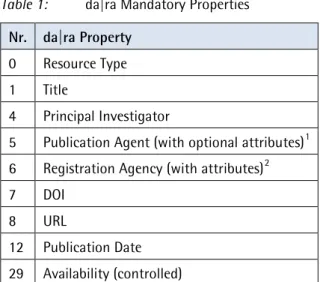
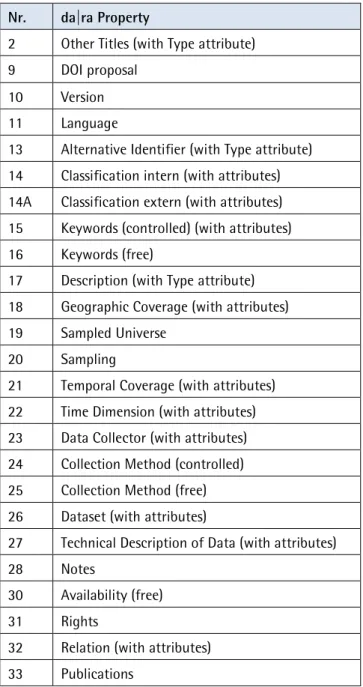
The tables below display in a simple manner the mandatory and optional properties of the metadata schema. Also shown are four administrative properties, three of which are automatically generated by da|ra.
More detail about these properties is provided in following sections of this documentation. The resource that is being described in the documentation is a dataset. The properties listed in Table 1
must be supplied when submitting metadata. The optional properties listed in Table 2may be supplied when submitting metadata.
Table 1: da|ra Mandatory Properties
Nr. da|ra Property
0 Resource Type 1 Title
4 Principal Investigator
5 Publication Agent (with optional attributes)1 6 Registration Agency (with attributes)2 7 DOI
8 URL
12 Publication Date 29 Availability (controlled)
1The details on the publication agent are generated from the user account. It is not part of the metadata set submitted by the
publication agent.
2 The details on the registration agency are generated from the da|ra database. It is not part of the metadata set submitted by the publication agent.
Table 2: da|ra Optional Properties
Nr. da|ra Property
2 Other Titles (with Type attribute) 9 DOI proposal
10 Version 11 Language
13 Alternative Identifier (with Type attribute) 14 Classification intern (with attributes) 14A Classification extern (with attributes) 15 Keywords (controlled) (with attributes) 16 Keywords (free)
17 Description (with Type attribute) 18 Geographic Coverage (with attributes) 19 Sampled Universe
20 Sampling
21 Temporal Coverage (with attributes) 22 Time Dimension (with attributes) 23 Data Collector (with attributes) 24 Collection Method (controlled) 25 Collection Method (free) 26 Dataset (with attributes)
27 Technical Description of Data (with attributes) 28 Notes
30 Availability (free) 31 Rights
32 Relation (with attributes) 33 Publications
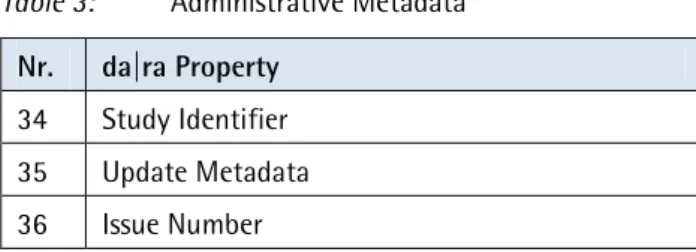
In addition to the metadata provided by the publication agent, there are three administrative metadata properties (Table 3) that da|ra assigns to each da|ra metadata record: the date on which the metadata description was stored/updated by da|ra and a sequence number assigned to the metadata description by da|ra. As a rule, the study identifier is an internal identifier from the system of the publication agent. If the publication agent does not provide this identifier, it will be automatically assigned to the metadata record by da|ra.
Table 3: Administrative Metadata
2.2
Citation
Correct and complete citation of a resource can be created using the following properties:
Principal investigator (Publication Date): Title. Publication agent. Identifier
It may also be desirable to include information (if applicable) from the optional property Version and the mandatory property Resource Type. If so, the recommended form is as follows:
Principal investigator (Publication Date): Title. Version. Publication agent. Resource Type. Identifier
For citation purposes, the Identifier may optionally appear both in its original format and in a linkable, http format, as shown below:
• Fahrenberg, Jochen (2010): Freiburger Beschwerdenliste FBL. Primärdaten der
Normierungsstichprobe 1993. Version 1.0.0. ZPID - Leibniz-Zentrum für Psychologische Information und Dokumentation. doi:10.5160/psychdata.fgjn05an08 http://dx.doi.org/doi: 10.5160/psychdata.fgjn05an08
• Schmitt-Beck, Rüdiger u.a. (2009): Wahlkampf-Panel (GLES). Version 3.0.0. GESIS - Leibniz-Institut für Sozialwissenschaften. doi:10.4232/1.11131.
http://dx.doi.org/doi:10.4232/1.11131
• Weßels, Bernhard u.a. (2011): Landtagswahl Berlin 2011 (GLES). Version 1.0.0. GESIS - Leibniz-Institut für Sozialwissenschaften. doi:10.4232/1.11054.
http://dx.doi.org/doi:10.4232/1.11054
Nr. da|ra Property
34 Study Identifier 35 Update Metadata 36 Issue Number
2.3
da|ra Mandatory Properties
The table below provides a detailed description of mandatory properties which must be submitted to da|ra by the publication agents. For an example of how to make a submission in XML format, please see the XML examples provided in the parts 3 and 4.
The schema file (XSD) for the validation of XML files is available at
(http://www.da|ra.de/fileadmin/media/da|ra.de/Technik/dara_v2.2.1_de_en_19112012.xsd). The schema file contains vocabularies used by da|ra.
The indicators Attribute and Child (A/C) show whether the property being described is an attribute (A) or a child (C) of the corresponding property that has preceded it.
The attribute Occurrence explains if a property can have multiple instances, which is indicated by the notation: Occ.1‐n, meaning that a property must occur once (1), and may occur multiple times (n). A notation of “Req” indicates that an attribute is required if the corresponding property is applied; “Opt” indicates that it is optional.
Nr. da|ra Property Definition A/
C Occ Examples, allowed values, other constraints
0 Resource Type The general type of a resource. 1 da|ra controlled list:
Collection Film
Dataset Image
Grey Literature Text
1 Title Title of a study. 1
4 Principal Investigator Name(s) of principal investigator(s). May be a
corporate or personal name. 1-n Either 4.1 or 4.2 or both 4.1 Name of the Principal
Investigator The name of the person. C 1 Non-Latin types according to ALA/LC
4.1.1 First Name C 1 Hans
4.1.2 Middle Name C 0-1 C.
4.1.3 Last Name C 1 Ackermann
4.1.4 Person ID Unique identifier of the person. May be
supplemented by da|ra, if not submitted. C 0-n e.g., ISNI 0000 1000 0000 1774 (John Smith) ORCID ID: G-1442-2009 (Peter Schwarz) 4.1.4.1 Vocabulary of Person
ID The name of the person ID scheme. A Req required, if 4.1.4 is applied, e.g. Open Researcher and Contributor ID (ORCID http://www.orcid.org), International Standard Name Identifier (ISNI http://www.isni.org) 4.1.4.2 URI Name Authority
Record Persistent identifier of the name of the person ID scheme. A 0-1 http://d-nb.info/gnd/124825109 4.1.4.3 Affiliation The affiliation of the person. A 1 e.g., Institute for Market Research 4.1.4.3.1 Affiliation ID Unique Identifier of the affiliation according
to various schemes. May be supplemented by da|ra if not submitted
C 1 SocioGuide ID 4173
4.1.4.3.2 Vocabulary Affiliation
ID The name of the institution ID scheme. A 1 sowiport/SocioGuide 4.1.4.3.3 URI Vocabulary
Affiliation ID Persistent identifier of the name of the institution ID scheme. A 1 http://www.gesis.org/sowiport/socioguide.html 4.2 Institution The name of the institution. C 1 e.g., Institute for Comparative Social Research
4.2.1 Institution ID Unique identifier of the institution according to various schemes. May be supplemented by da|ra if not submitted.
C 0-n e.g., GKD (Gemeinsame Körperschaftsdatei/The Corporate Body Authority File)
ID 10158795-8
4.2.2. Vocabulary
Institution ID The name of the institution ID scheme. A Req required, if 4.2.1 is applied, e.g. GKD, ISNI etc.
4.2.3 URI Institution
Authority Record Persistent identifier of the name of the institution ID scheme. A 0-1 e.g., http://d-nb.info/gnd/1007681-5
5 Publication Agent The name of a person/institution responsible for making the study available in its present form.
1 The details on the publication agent are generated from the user account. It is not part of the metadata record submitted by the publication agent.
6 Registration Agency Name of the registration agency. 1 da|ra The details on the registration agency are generated from the da|ra database. It is not part of the metadata record submitted by the publication agent.
7 DOI Unique Digital Object Identifier, consisting of a prefix (allocated by the International DOI foundation within DataCite) and a suffix.
1 Assignment by the Publication Agent and da|ra once a user account has been created.
8 URL Each DOI name has an URL to which it
resolves. (Landing Page) A Req e.g., arch13/sdesc2.asp?no=4975&db=D
http://info1.gesis.org/dbkse-12 Publication Date The publication date of the study by the
Publication Agent. 1 ISO 8601 format: YYYY or YYYY-MM-DD
29 Availability
(controlled) Conditions governing the access to primary data. P 1 da|ra controlled list: Keywords in combination with traffic light symbols: Download
Delivery On-site Not available Unknown
2.4
da|ra Optional Properties
The table below provides a detailed description of the optional properties which may be supplied by the Publication Agents to identify the registered resources more clearly (e.g. classification, information on other versions, related resources). For an example of how to make a submission in XML format, please see the XML examples provided in the parts 3 and 4.
The schema file (XSD) for validation of XML files is available at
(http://www.da|ra.de/fileadmin/media/da|ra.de/Technik/dara_v2.2.1_de_en_19112012.xsd). The schema file contains vocabularies used by da|ra.
The indicators Attribute and Child (A/C) show whether the property being described is an attribute (A) or a child (C) of the corresponding property that has preceded it.
The attribute Occurrence explains if a property can have multiple instances, which is indicated by the notation: Occ.1‐n, meaning that a property must occur once (1), and may occur multiple times (n). A notation of “Req” indicates that an attribute is required if the corresponding property is applied; “Opt” indicates that it is optional.
Nr. da|ra Property Definition A/C Occ Annotations, examples, valid values
2 Other Titles Further titles. 0-n e.g., a title in another language, subtitles 2.1 Title Type The type of other titles. A Req Required, if 2 is applied, da|ra controlled list:
1: alternative title; 2: translated title; 3: subtitle; 4: original title
9 DOI Proposal The Publication Agent may suggest a DOI name, if an automatically generated DOI name is not required.
A 0-1 e.g., doi:10.1787/unesco-2011
10 Version The version number of the registered study to which the metadata record refers. It will be generated automatically if not submitted by the Publication Agent.
1 e.g., Version 1.0.0
11 Language The language in which the study is available at the
Publication Agent 0-1 ISO 639-2; e.g. eng, ger
13 Alternate Identifier An identifier other than the primary identifier of the registered study. This may be an identifier from the information system of the Publication Agent as well as from other information systems.
0-n e.g., the dataset number or Handle from Dataverse
13.1 Alternate Identifier
Type The type of the alternative identifier.
A Req Required, if 13 is applied; da|ra controlled list:
ARK|DOI|EAN13|EISSN|Handle|ISBN|ISSN|ISTC|LISSN|LSID|PUR L|UPC|URL|URN
14 Classification
Internal Subject class (e.g. Sociology) from GESIS-Classification, ZA-Classification and JEL (Journal of Economic Literature) Classification.
0-n To support the publication agents, three classification are provided (e.g. Sociology)
14.1 Class ID Unique identifier of the subject class (no notation). A Opt for each class only one identifier; e.g. 1030 demography (GESIS-Classification)
14.2 Vocabulary The name of the applied subject classification system.
A Req e.g., GESIS-Classification, ZA-Classification, JEL-Classification
14.3 URI Classification
Authority Record Persistent identifier of the name of the applied subject classification system.
Nr. da|ra Property Definition A/C Occ Annotations, examples, valid values
14A Classification External
Subject class (e.g. Sociology) from the classification system of the Publication Agent.
Opt e.g., Social Policy 14A.1 Vocabulary The name of the applied classification system of the
Publication Agent.
Opt e.g., SOEP-Classification 15 Keywords
(controlled) Controlled keywords (Thesauri or controlled vocabulary lists) that describe the content of the study in detail.
0-n Keywords from TheSoz, STW, e.g. Agricultural Statistics
15.1 Keyword ID Unique identifier of the keyword. A Opt in STW the Thesaurus Identification Number (TIN); For each keyword only one identifier; e.g. 451923902 15.2 Vocabulary of
Keyword ID The name of the applied Thesauri or controlled vocabulary lists. A Req e.g., STW, TheSoz 15.3 URI Keyword
Authority Record Persistent Identifier of the name of the applied Thesauri or controlled vocabulary lists. A Opt e.g., http://zbw.eu/stw/versions/latest/thsys/70012/about 16 Keywords (free) Free keywords describing the content of the study. 0-n e.g., health care reform
17 Description Description of the study content. 0-n
17.1 Description Type The type of the description. A Req Controlled da|ra List:
1: Abstract
2: SeriesInformation 3: TableOfContents 4: Other
18 Geographic
Coverage Generic term for 18.1 and 18.2 0-n
18.1 Geographic Coverage (controlled)
Nr. da|ra Property Definition A/C Occ Annotations, examples, valid values
18.2 Geographic
Coverage (free) Geographic units on which the study focuses. A The option to indicate certain units, in case they cannot be found in the controlled vocabulary list. (e.g. Northern Germany or FRG without West Berlin). Labelling of the next related higher-level standard unit in the linked field 18.1 (e.g. Germany) is required.
19 Sampled Universe Elements that are the object of the study and to
which any analytic results refer. 0-1 e.g., adults in Eastern and Western Germany 20 Sampling The type of the sample and sample design used to
select the survey respondents to represent the population.
0-1 e.g., standardized instruments for data collection (questions and multiple-choice answers are predefined) 21 Temporal Coverage Generic term for 21.1 und 21.2 0-n
21.1 Temporal Coverage
(controlled) The time period to which the data refer (in case of surveys the time period of field work) A Calendar function, option to leave the day and /or month open; e.g., 1990-10-05 - 1991-10-09; 2002-12; 2005
21.2 Temporal Coverage
(free) The time period to which the data refer (in case of surveys the time period of field work) A Provides the possibility to indicate the temporal coverage, if the calendar mode cannot be applied or as a supplement to 21.1 (information on survey waves, seasons, etc.; e.g. autumn 1989).
22 Time Dimension Generic term for 22.1-22.3 0-n
22.1 Time Dimension (controlled)
Describes the time dimension of the data collection. A da|ra controlled list:
1: Longitudinal
2: Longitudinal.CohortEventBased 3: Longitudinal.TrendRepeatedCrossSection 4: Longitudinal.Panel
5: Longitudinal.Panel.Continuous 6: Longitudinal: Panel: Interval 7: Time Series
8: TimeSeries: Continuous 9: TimeSeries: Discrete 10: Cross-section
Nr. da|ra Property Definition A/C Occ Annotations, examples, valid values
22.2 Time Dimension (free)
Describes the time dimension of the data collection. A Provides the possibility to describe the time dimension if there are no equivalent terms in the controlled
vocabulary. 22.3 Frequency The time frequency at which data is collected at
regular intervals.
A e.g., annually 23 Data Collection The name of a person/institution responsible for
data collection 0-n The data collection relates to the conduction of data surveys (the data collectors can be identical with the principal investigators).
23.1 Person The name of a person C 1 Non-Latin fonts in line with the ALA/LC
23.1.1 First name C 1 Hans
23.1.2 Middle name C 0-1 C.
23.1.3 Last name C 1 Ackermann
23.1.4 Person ID Unique identifier of the person according to various schemes. May be supplemented by da|ra if not submitted.
C 0-n e.g., ISNI 0000 1000 0000 1774 (John Smith) ORCID ID: G-1442-2009 (Peter Schwarz) 23.1.4.1 Vocabulary Person
ID The name of the person ID scheme. A Req e.g., Open Researcher and Contributor ID (ORCID http://www.orcid.org), International Standard Name Identifier (ISNI http://www.isni.org)
23.1.4.2 URI Name Authority
Record3 Persistent identifier of the name of the person ID scheme. A 0-1 http://d-nb.info/gnd/124825109 23.1.4.3 Affiliation The affiliation of the data collector. A 1 e.g., Institute for Market Research 23.1.4.3.1 Affiliation ID Unique identifier of the affiliation according to
various schemes. May be supplemented by da|ra if not submitted.
C 1 e.g., SocioGuide ID 4173
3A Name Authority File provides authoritative data for names of persons, organization, etc. Its purpose is the identification of these entities and, through the use of such controlled vocabulary, to provide
Nr. da|ra Property Definition A/C Occ Annotations, examples, valid values
23.1.4.3.2 Vocabulary
Affiliation ID The name of the institution ID scheme. A 1 e.g., sowiport/SocioGuide 23.1.4.3.3 URI Vocabulary
Affiliation ID Persistent identifier of the name of the institution ID scheme A 1 http://www.gesis.org/sowiport/socioguide.html 23.2 Institution The name of the data collector C 1 e.g., Institute for Social Research
23.2.1 Institution ID Unique Identifier of the institution according to various schemes. May be supplemented by da|ra if not submitted.
C 0-n e.g., GKD (Gemeinsame Körperschaftsdatei) ID 10158795
23.2.2 Vocabulary of
Institution ID The name of the institution ID scheme. A Req Required if 23.2.2 is applied, e.g., GND, ISNI, etc.
23.2.3 URI Institution
Authority Record Persistent Identifier of the name of the institution ID scheme. A 0-1 e.g. http://d-nb.info/gnd/1007681-5 24 Collection mode
(controlled) The method used to collect the data. 0-1 da|ra controlled list:1: Interview 2: Interview: Face-to-face 3: Interview: Telephone 4: Interview: E-mail 5: Interview: CATI 6: Interview: CAPI 7: Self-completed questionnaire
8: Self-completed questionnaire: Paper/pencil 9: Self-completed questionnaire: Web-based 10: Self-completed questionnaire: CASI 11: Self-completed questionnaire: ACASI 12: Coding 13: Transcription 14: Compilation 15: Synthesis 16: Recording 17: Simulation 18: Observation 19: Observation: Field 20: Observation: Laboratory
Nr. da|ra Property Definition A/C Occ Annotations, examples, valid values 21: Observation: Participant 22: Experiments 23: Focus Group 24: Other 25 Collection mode (free)
The method used to collect the data 0-1 Possibility to describe the collection mode if there are no appropriate terms in the controlled vocabulary, e.g. data survey without the investigator in charge
26 Data set Generic term for 26.1 - 26.4 0-n
26.1 Type of Units The type of units describes the entity being analysed
or observed in the study. A Req Required, if 26.2 is applied; da|ra controlled list: 1: Individual 8: Geographic Unit
2: Organization 9: Time Unit
3: Family 10: Text Unit
4: Family: Household family 11: Group
5: Household 12: Object
6: Housing Unit 13: Other
7: Event/Process
26.2 Number of Units The number of units being analysed or observed in
the study. A
e.g., 3759 26.3 Number of Variables The number of variables used in the study A e.g., 210
26.4 Type of Data The type of collected data A e.g. aggregated data, clinical data 27 Technical
descrip-tion of the data Generic term for 30.1-30.5 0-n 27.1 File Name The name of the file to which the respective
fingerprint refers (if necessary indicating the name of the directory).
A An identificated object can contain multiple files with related separated fingerprints.
Allocation via file name: e.g. brpr91os99_pd.txt 27.2 Data format The technical format of the data file. A e.g., STATA, SPSS, SAS, CSV, TXT
27.3 Size Size information on the data file. A e.g., 5 MB
27.4 Data Fingerprint The checksum which confirms the authenticity of the
Nr. da|ra Property Definition A/C Occ Annotations, examples, valid values
27.5 Method Fingerprint Technical procedure generating data fingerprint (if
necessary indicating the name of the directory). A e.g., MD5 28 Notes References to further relevant information on a
study. 0-1 e.g., further studies, number of cases per geographic unit, etc. 30 Availability (free) Additional specification of data availability 0-1 e.g.,”Data usage is subject to written data privacy
agreement.” 31 Rights Any rights information for the study. 0-1 e.g., Copyright
32 Relation Identifiers of related resources. 0-n e.g., urn:nbn:de:bsz:21-opus-2971 32.1 Kind of Relation The relationship of the study being registered and the
related resource. A Req Required if 32 is applied, da|ra controlled list: 1: IsCitedBy 10: IsReferencedBy
2: Cites 11: References 3: IsSupplementTo 12: IsDocumentedBy 4: IsSupplementedBy 13: Documents 5: IsContinuedBy 14: isCompiledBy 6: Continues 15: Compiles 7: IsPreviousVersionOf 16: IsVariantFormOf 8: IsPartOf 17: IsOriginalFormOf 9: HasPart
32.2 Identifier Type The type of the related identifier. A Req required, if 32.1 is applied, da|ra controlled List:
ARK|DOI|EAN13|EISSN|Handle|ISBN|ISSN|ISTC|LISSN|LSID|PUR L|UPC|URL|URN
33 Publications Scientific publications relating to the registered study in terms of content.
0-n
33.1 Structured
recor-ding of publications Structured recording of publications relating to the registered study in terms of content. 0-n
33.1.1 Author C 0-n Either the author or the editor name has to be submitted.
33.1.1.1 First Name Peter
33.1.1.2 Middle Name Karl
Nr. da|ra Property Definition A/C Occ Annotations, examples, valid values
33.1.2 Editor The name of an institution or a person. C 0-n Either the author or the editor name has to be submitted. 33.1.3 Title The title of the publication. C 1 East Germans and West Germans in the mirror of three
questionnaire tests
33.1.4 Year The year of publication. C 0-1 2004
33.1.5 Publisher The name of the publisher. C 0-1 Springer
33.1.6 Publication Place The place of publication. C 0-n Heidelberg, Berlin
33.1.7 Journal/Series C 0-1 The European Journal of Social Science Research
33.1.8 Volume C 0-1 3
33.1.9 Issue C 0-1
33.1.10 Anthology C 0-1
33.1.11 Page The number of pages. C 0-1 258 p. or pp.135-167
33.1.12 ISBN International Standard Book Number C 0-1 978-3-8329-0905-5 33.1.13 ISSN International Standard Serial Number C 0-1
33.1.14 Publication Type The type of the publication. C 0-1 da|ra controlled list:
1: Working Paper 6: Reference book
2: Article 7. Review
3: Report 8. Series
4: Book/Monograph 9: Journal
5: Manuscript 10. Magazine
33.1.15 sowiport ID4 The internal sowiport identifier used to import and
display literature metadata from SOLIS, SSOAR, etc. C 0-1 The internal element in da|ra, repeatable in line with the complex 33 33.1.16 PID Further Persistent Identifiers related to the
publication A Opt e.g., DOI, URN, Handle, PURL
33.1.16.1 PID Type The type of a further Persistent Identifier A Req Required, if 33.1.16 is applied, da|ra controlled list:
ARK|DOI|EAN13|EISSN|Handle|ISBN|ISSN|ISTC|LISSN|LSID|PUR
Nr. da|ra Property Definition A/C Occ Annotations, examples, valid values
L|UPC|URL|URN
33.2 Unstructured recor-ding of publications
Unstructured bibliographic information 0-n
33.2.1 PID Further Persistent Identifiers related to publications A Opt e.g., DOI, URN, Handle, PURL
33.2.1.1 PID Type The type of a further Persistent Identifier A Req Required, if 33.2.1 is applied, da|ra controlled list: see 33.1.16.1
3
XML Examples
3.1
XML Example File (Mandatory Properties)
<?xmlversion="1.0"encoding="UTF-8"?>
<studyxmlns:xsi="http://www.w3.org/2001/XMLSchema-instance" xsi:noNamespaceSchemaLocation="dara_v2.2.1_de_en_19112012.xsd">
<resourceType>2</resourceType>
<studyIdentifier>
<identifier>ZA2345</identifier>
<currentVersion>1.0</currentVersion>
</studyIdentifier>
<titles>
<title>
<language>de</language>
<titleName>European Integration Survey 1992</titleName>
</title>
<title>
<language>en</language>
<titleName>European Integration Survey 1992</titleName>
</title>
</titles>
<principalInvestigators>
<principalInvestigator>
<person>
<firstName>Nilson</firstName>
<middleName></middleName>
<lastName>Norge</lastName>
</person> </principalInvestigator> <principalInvestigator> <institution> <institutionName> <language>de</language>
<name>EMOR, Estland</name>
</institutionName>
<institutionName>
<language>en</language>
<name>EMOR, Estland</name>
</institutionName>
</institution>
</principalInvestigator>
</principalInvestigators>
<dataURLs>
<dataURL>http://info1.gesis.org/dbksearch13/sdesc2.asp?no=2345&db=e&doi=10.4232/1.2345</da taURL> </dataURLs> <doiProposal>10.4232/1.</doiProposal> <publicationDate> <date>1993</date> </publicationDate> <availability> <availabilityControlled>3</availabilityControlled> </availability> </study>
3.2
XML Example File (Mandatory and Optional Properties)
<?xmlversion="1.0"encoding="UTF-8"?><studyxmlns:xsi="http://www.w3.org/2001/XMLSchema-instance" xsi:noNamespaceSchemaLocation="dara_v2.2.1_de_en_19112012.xsd">
<resourceType>2</resourceType>
<studyIdentifier>
<identifier>RA3200</identifier>
<currentVersion>1.0</currentVersion>
</studyIdentifier>
<titles>
<title>
<language>de</language>
<titleName>Polish General Social Survey 1992-1997 </titleName>
</title>
<title>
<language>en</language>
<titleName>Polish General Social Survey 1992-1997 </titleName>
</title>
</titles>
<otherTitles>
<otherTitle>
<language>de</language>
<titleName>Polski Generalny Sondaz Spoleczny 1992-1997</titleName>
<titleType>1</titleType>
</otherTitle>
<otherTitle>
<language>en</language>
<titleName>Polski Generalny Sondaz Spoleczny 1992-1997</titleName>
<titleType>1</titleType> </otherTitle> </otherTitles> <principalInvestigators> <principalInvestigator> <person>
<firstName>Bogdan</firstName>
<middleName>Piotr</middleName>
<lastName>Cichomski</lastName>
<personIDs>
<personID>
<identifier>B-1704-2012 </identifier>
<identifierSchema>ResearcherID</identifierSchema>
<schemaURI>http://www.researcherid.com/ViewProfileSearch.action?criteria.lastName=Cichomski/</ schemaURI> </personID> </personIDs> <affiliation> <affiliationName> <language>de</language>
<name>Institut für Sozialforschung, Warschauer Universität, Polen</name>
</affiliationName>
<affiliationName>
<language>en</language>
<name>Institute for Social Studies, University of Warsaw, Poland</name>
</affiliationName> </affiliation> </person> </principalInvestigator> <principalInvestigator> <institution> <institutionName>
<language>de</language>
<name>Polnische Akademie der Wissenschaften</name>
</institutionName>
<institutionName>
<language>en</language>
<name>Polish Academy of Sciences</name>
</institutionName>
<institutionIDs>
<institutionID>
<identifier>SG5607</identifier>
<identifierSchema>GESIS SocioGuide</identifierSchema>
<schemaURI>http://www.gesis.org/sowiport/socioguide.html</schemaURI>
</institutionID> </institutionIDs> </institution> </principalInvestigator> </principalInvestigators> <dataURLs>
<dataURL>https://info1.basis.org/raedit/SDESC2.ASP?no=3200</dataURL>
</dataURLs> <doiProposal>10.4232/1.3200 </doiProposal> <publicationDate> <date>2000-07-07</date> </publicationDate> <availability> <availabilityControlled>2</availabilityControlled> <availabilityFree> <language>de</language>
<availabilityText>Daten sind für die akademische Forschung und Lehre nur nach schriftlicher Genehmigung des Datengebers zugänglich.</availabilityText>
</availabilityFree>
<availabilityFree>
<language>en</language>
<availabilityText>Data and documents are released for academic research and teaching after the data depositor's written authorization only .</availabilityText>
</availabilityFree>
</availability>
<rights>
<right>
<language>de</language>
<rightsText>Alle Rechte beim Autor</rightsText>
</right>
<right>
<language>en</language>
<rightsText>Author's authorization</rightsText>
</right>
</rights>
<studyLanguage>pol</studyLanguage>
<alternativeIDs>
<alternativeID>
<identifier>2-34-56</identifier>
<type>ISSN</type>
</alternativeID> </alternativeIDs> <classifications> <classification> <classificationExternal> <language>de</language> <schema>POLD Schema</schema> <terms>
<term>Europäische Politik</term> <term>politische Bildung</term>
<term>Wahlverhalten</term> </terms> </classificationExternal> </classification> <classification> <classificationExternal> <language>en</language> <schema>POLD Schema</schema> <terms>
<term>European policy</term> <term>political education</term> <term>electoral behaviour</term> </terms> </classificationExternal> </classification> </classifications> <controlledKeywords> <controlledKeyword>
<schema>TheSozWiss</schema>
<identifiers> <identifier>10035305</identifier> <identifier>10034868</identifier> <identifier>10054725</identifier> <identifier>10038441</identifier> <identifier>10036549</identifier> </identifiers> </controlledKeyword> </controlledKeywords> <freeKeywords> <freeKeyword> <language>de</language> <keywords>
<keyword>Politische Einstellungen und Verhaltensweisen</keyword>
<keyword>Arbeit und Betrieb</keyword>
<keyword>Beruf</keyword>
<keyword>Einkommen</keyword>
<keyword>Gesellschaft und Kultur</keyword>
<keyword>Familie</keyword>
<keyword>Erziehung und Schulwesen</keyword>
<keyword>Religion und Weltanschauung</keyword>
<keyword>Freizeit</keyword>
</keywords>
</freeKeyword>
<freeKeyword>
<language>en</language>
<keywords>
<keyword>Political Attitudes and Behavior</keyword>
<keyword>Work and Industry</keyword>
<keyword>Occupation</keyword>
<keyword>Profession</keyword>
<keyword>Income</keyword>
<keyword>Society</keyword>
<keyword>Culture</keyword>
<keyword>Family</keyword>
<keyword>Education</keyword>
<keyword>School Systems</keyword>
<keyword>Leisure</keyword>
</keywords>
</freeKeyword>
</freeKeywords>
<description>
<language>de</language>
<freetext>Drogenkonsum: Motive, situative Bedingungen, Einflussfaktoren</freetext>
<type>2</type>
</description>
<description>
<language>en</language>
<freetext>use of drugs: motives, situative conditions, influence factors</freetext>
<type>2</type> </description> </descriptions> <geographicCoverages> <geographicCoverage> <language>de</language> <geographicCoverageControlled>PL</geographicCoverageControlled> <freetext>Großstädte</freetext>
</geographicCoverage>
<geographicCoverage>
<language>en</language>
<geographicCoverageControlled>PL</geographicCoverageControlled> <freetext>big cities</freetext>
</geographicCoverage>
</geographicCoverages>
<universes>
<universe>
<language>de</language>
<sampled>Haushaltsmitglieder im Alter von 18 Jahren und darüber</sampled>
</universe>
<universe>
<language>en</language>
<sampled>Adult household members 18 years old and older</sampled>
</universe>
</universes>
<samplings>
<sampling>
<language>de</language>
<method>Mehrstufige geschichtete Zufallsauswahl</method>
</sampling>
<sampling>
<language>en</language>
<method>Multi-stage stratified random sample</method>
</sampling>
</samplings>
<temporalCoverages>
<temporalCoverage>
<language>de</language>
<temporalCoverageFree>Erste Welle </temporalCoverageFree> <temporalCoverageFormal> <startDate> <monthyear>2006-09</monthyear> </startDate> <endDate> <year>2007</year> </endDate> </temporalCoverageFormal> </temporalCoverage> <temporalCoverage> <language>en</language>
<temporalCoverageFree>First wave</temporalCoverageFree> <temporalCoverageFormal>
<startDate>
</startDate> <endDate> <date>2007-01-01</date> </endDate> </temporalCoverageFormal> </temporalCoverage> </temporalCoverages> <timeDimensions> <timeDimension> <language>de</language> <timeDimensionControlled>6</timeDimensionControlled> <timeDimensionFree>jedes vierte Jahr</timeDimensionFree> <frequency>monatlich</frequency>
</timeDimension>
<timeDimension>
<language>en</language>
<timeDimensionControlled>6</timeDimensionControlled> <timeDimensionFree>every four years</timeDimensionFree> <frequency>monthly</frequency>
</timeDimension>
</timeDimensions>
<dataCollectors>
<dataCollector>
<person>
<firstName>Anna</firstName>
<middleName>M.</middleName>
<lastName>Narloch</lastName>
<personIDs>
<personID>
<identifier>C-9327-2012</identifier>
<identifierSchema>ResearcherID</identifierSchema>
<schemaURI> http://www.researcherid.com/rid/C-9327-2012</schemaURI>
</personID>
</personIDs>
<affiliation>
<affiliationName>
<language>de</language>
<name>West Pomeranian University of Technology in Szczecin</name>
</affiliationName>
<affiliationName>
<language>en</language>
<name>West Pomeranian University of Technology in Szczecin</name>
</affiliationName> </affiliation> </person> </dataCollector> <dataCollector> <institution> <institutionName> <language>de</language>
<name>Center of Field Research (ORBS) at the Institute of Philosophy and Sociology, Polish Academy of Science</name>
</institutionName>
<institutionName>
<language>en</language>
<name>Center of Field Research (ORBS) at the Institute of Philosophy and Sociology, Polish Academy of Science</name>
</institutionName>
<institutionIDs>
<institutionID>
<identifier>150820520</identifier>
<schemaURI>http://viaf.org/viaf/150820520</schemaURI> </institutionID> </institutionIDs> </institution> </dataCollector> </dataCollectors> <collectionModesFree> <collectionModeFree> <language>de</language>
<modeFree>Mündliche Befragung </modeFree>
</collectionModeFree>
<collectionModeFree>
<language>en</language>
<modeFree>face-to-face interview</modeFree>
</collectionModeFree> </collectionModesFree> <collectionModeControlled>12</collectionModeControlled> <dataSets> <dataSet> <language>de</language> <unitType>7</unitType> <numberUnits>234</numberUnits> <numberVariables>12</numberVariables> <dataType>1</dataType> <files> <file>
<name>Survey</name>
<format>SPSS</format>
<size>25MB</size>
<fingerprint>b9f16f8a6fc305ec957d87bf1428557a</fingerprint>
<fingerprintMethod>MD5</fingerprintMethod> </file> </files> </dataSet> </dataSets> <notes> <note> <language>de</language>
<text>Zum Datensatz liegt eine englischsprachige Dokumentation vor.</text>
</note>
<note>
<language>en</language>
<text>The documentation of the dataset is available in English.</text>
</note>
</notes>
<relations>
<relation>
<identifier>2 35 560</identifier>
<identifierType>ISBN</identifierType>
<relationType>2</relationType> </relation> </relations> <publications> <publication> <structuredPublication> <doctype>6</doctype> <authorsEditors> <authorEditor> <author>
<firstName>Borgan</firstName>
<middleName>M.</middleName>
</author>
</authorEditor>
<authorEditor>
<editor>
<name>Schmidt, Peter</name>
</editor>
</authorEditor>
</authorsEditors>
<title>Polish Value System</title>
<year>2006</year>
<publisher>Verlag Wissenschaft</publisher>
<places>Berlin</places>
<journal>Politik und Wissenschaft</journal>
<volume>2</volume> <issue>13</issue> <anthology>1</anthology> <pages>23-29</pages> <ISSNs> <ISSN>2-34-56</ISSN> </ISSNs>
<sowiportID>sowiportID0</sowiportID>
<PIDs>
<PID>
<ID>ID2</ID>
<pidType>ARK</pidType>
</PID> </PIDs> </structuredPublication> </publication> <publication> <unstructuredPublication>
<freetext>Polish General Social Surveys. Cumulative Codebook 1992-1997. Institute for Social Studies, University of Warsaw. March 1999. </freetext>
<PIDs>
<PID>
<ID>ID4</ID>
<pidType>ARK</pidType>
</PID>
<PID>
<ID>ID5</ID>
<pidType>ARK</pidType>
</PID> </PIDs> </unstructuredPublication> </publication> </publications> </study>
4
XSD Schema
The XSD Schema and the present documentation will always have the same version number. <?xmlversion="1.0"encoding="UTF-8"?>
<!-- da|ra Metadatenschema v2.2.1 - www.da-ra.de -->
<xs:schemaxmlns:xs="http://www.w3.org/2001/XMLSchema"elementFormDefault="qualified">
<!-- *0. Object Resource Type-->
<xs:elementname="resourceType">
<xs:annotation>
<xs:documentationxml:lang="de">Genereller Typ der Ressource: 1. Sammlung 2: Datensatz 3. Graue Literatur 4. Film 5. Image 6. Text </xs:documentation>
<xs:documentationxml:lang="en">The general type of a resource: 1. Collection 2: Dataset 3. Grey Literature 4. Film 5. Image 6. Text </xs:documentation>
</xs:annotation>
<xs:simpleType>
<xs:restrictionbase="xs:integer">
<xs:minInclusivevalue="1"/> <xs:maxInclusivevalue="11"/> </xs:restriction> </xs:simpleType> </xs:element> <!-- *1.title -->
<xs:elementname="titles">
<xs:complexType>
<xs:sequence>
<xs:elementref="title"minOccurs="1"maxOccurs="1"/>
</xs:sequence>
</xs:complexType>
<xs:uniquename="titleLanguage">
<xs:selectorxpath="title/language"/>
<xs:fieldxpath="."/>
</xs:unique>
</xs:element>
<xs:elementname="title">
<xs:annotation>
<xs:documentationxml:lang="de">Titel des digitalen Objekts.</xs:documentation>
<xs:documentationxml:lang="en">Title of the digital object.</xs:documentation>
</xs:annotation>
<xs:complexTypemixed="false">
<xs:allmaxOccurs="1"minOccurs="1">
<xs:elementref="language"minOccurs="1"maxOccurs="1"/>
<xs:elementname="titleName"minOccurs="1"maxOccurs="1">
<xs:simpleType>
<xs:restrictionbase="nonemptycontentStringType"/>
</xs:simpleType> </xs:element> </xs:all> </xs:complexType> </xs:element> <!-- 2.other titles-->
<xs:elementname="otherTitles">
<xs:complexType>
<xs:sequence>
</xs:sequence>
</xs:complexType>
</xs:element>
<xs:elementname="otherTitle">
<xs:annotation>
<xs:documentationxml:lang="de">Zusätzliche Titel.</xs:documentation>
<xs:documentationxml:lang="en">Further titles.</xs:documentation>
</xs:annotation>
<xs:complexTypemixed="false">
<xs:allmaxOccurs="1"minOccurs="1">
<xs:elementref="language"/>
<xs:elementminOccurs="1"maxOccurs="1"name="titleName">
<xs:simpleType>
<xs:restrictionbase="nonemptycontentStringType"/>
</xs:simpleType>
</xs:element>
<xs:elementname="titleType">
<xs:annotation>
<xs:documentationxml:lang="de">Typ des zusätzlichen Titels: 1: Alternativer Titel
2: Übersetzter Titel 3: Untertitel 4: Originaltitel
</xs:documentation>
<xs:documentationxml:lang="en">The type of other titles: 1: Alternative Title 2: Translated Title 3: Subtitle 4: Original Title </xs:documentation> </xs:annotation> <xs:simpleType>
<xs:restrictionbase="xs:integer">
<xs:minInclusivevalue="1"/> <xs:maxInclusivevalue="4"/> </xs:restriction> </xs:simpleType> </xs:element> </xs:all> </xs:complexType> </xs:element> <!-- *4.principal investigators -->
<xs:elementname="principalInvestigators">
<xs:complexTypemixed="false">
<xs:sequence>
<xs:elementmaxOccurs="unbounded"ref="principalInvestigator"/>
</xs:sequence>
</xs:complexType>
</xs:element>
<xs:elementname="principalInvestigator">
<xs:annotation>
<xs:documentationxml:lang="de">Name einer Person und/oder einer Institution (Primärforscher). </xs:documentation>
<xs:documentationxml:lang="en">Name(s) of principal investigator(s). May be a corporate/institutional or a personal name.</xs:documentation>
</xs:annotation>
<xs:complexTypemixed="false">
<xs:choice>
<xs:elementref="person"maxOccurs="1"minOccurs="1"></xs:element>
</xs:choice>
</xs:complexType>
</xs:element>
<!-- *4.1 person(for data collectors too) -->
<xs:elementname="person">
<xs:annotation>
<xs:documentationxml:lang="de">Name einer Person, die die Studie durchgeführt (Primärforscher) oder die die Daten erhoben hat (Datenerhebung).</xs:documentation>
<xs:documentationxml:lang="en">The name of the principal investigator or the data collector.</xs:documentation>
</xs:annotation>
<xs:complexType>
<xs:sequencemaxOccurs="1"minOccurs="1">
<xs:elementminOccurs="1"maxOccurs="1"name="firstName">
<xs:simpleType>
<xs:restrictionbase="nonemptycontentStringType"/>
</xs:simpleType>
</xs:element>
<xs:elementname="middleName"type="xs:string"minOccurs="0"/>
<xs:elementname="lastName">
<xs:simpleType>
<xs:restrictionbase="nonemptycontentStringType"/>
</xs:simpleType>
</xs:element>
<xs:elementminOccurs="0"name="personIDs">
<xs:complexType>
<xs:sequence>
<xs:elementmaxOccurs="unbounded"name="personID">
<xs:complexType>
<xs:groupref="ID"/>
</xs:complexType>
</xs:element>
</xs:sequence>
</xs:complexType>
</xs:element>
<xs:elementminOccurs="0"ref="affiliation"/>
</xs:sequence>
</xs:complexType>
</xs:element>
<xs:elementname="affiliation">
<xs:annotation>
<xs:documentationxml:lang="de">Zugehörigkeit einer Person, die die Studie durchgeführt (Primärforscher) oder die die Daten erhoben hat (Datenerhebung) zu einer Institution.</xs:documentation>
<xs:documentationxml:lang="en">The affiliation of the principal investigator or the data collector.</xs:documentation>
</xs:annotation>
<xs:complexTypemixed="false">
<xs:sequencemaxOccurs="1"minOccurs="1">
<xs:elementmaxOccurs="2"name="affiliationName">
<xs:complexType>
<xs:allmaxOccurs="1">
<xs:elementref="language"/>
<xs:elementname="name"minOccurs="1"maxOccurs="1">
<xs:simpleType>
<xs:restrictionbase="nonemptycontentStringType"/>
</xs:simpleType>
</xs:element>
</xs:all>
</xs:complexType>
<xs:elementname="affiliationIDs"minOccurs="0">
<xs:complexType>
<xs:sequence>
<xs:elementmaxOccurs="unbounded"name="affiliationID">
<xs:complexType>
<xs:groupref="ID"/>
</xs:complexType> </xs:element> </xs:sequence> </xs:complexType> </xs:element> </xs:sequence> </xs:complexType>
<xs:uniquename="affiliationLanguage">
<xs:selectorxpath="affiliationName/language"/>
<xs:fieldxpath="."/>
</xs:unique>
</xs:element>
<!-- *4.2 institution (for data collectors too) -->
<xs:elementname="institution">
<xs:annotation>
<xs:documentationxml:lang="de">Name einer Institution, die die Studie durchgeführt (Primärforscher) oder die die Daten erhoben hat (Datenerhebung).</xs:documentation>
<xs:documentationxml:lang="en">The institutional name of the principal investigator or of the data collector.</xs:documentation>
</xs:annotation>
<xs:complexType>
<xs:sequencemaxOccurs="1"minOccurs="1">
<xs:elementname="institutionName"maxOccurs="2">
<xs:complexType>
<xs:all>
<xs:elementref="language"/>
<xs:elementminOccurs="1"maxOccurs="1"name="name">
<xs:simpleType>
<xs:restrictionbase="nonemptycontentStringType"/>
</xs:simpleType>
</xs:element>
</xs:all>
</xs:complexType>
</xs:element>
<xs:elementname="institutionIDs"minOccurs="0">
<xs:complexType>
<xs:sequence>
<xs:elementmaxOccurs="unbounded"name="institutionID">
<xs:complexType>
<xs:groupref="ID"/>
</xs:complexType> </xs:element> </xs:sequence> </xs:complexType> </xs:element> </xs:sequence> </xs:complexType>
<xs:uniquename="institutionLanguage">
<xs:selectorxpath="institutionName/language"/>
<xs:fieldxpath="."/>
</xs:unique>
</xs:element>
<!-- *9.doi proposal -->