Full Length Article
Modeling and simulation of adaptive Neuro-fuzzy based intelligent
system for predictive stabilization in structured overlay networks
Ramanpreet Kaur
a,b,⇑, Amrit Lal Sangal
a, Krishan Kumar
caDepartment of Computer Science and Engineering, National Institute of Technology, Jalandhar, Punjab, India b
Department of Information Technology, Jaypee University of Information Technology, Solan, Himachal Pradesh, India c
Department of Computer Science and Engineering, Shaheed Bhagat Singh State Technical Campus, Ferozpur, Punjab, India
a r t i c l e i n f o
Article history: Received 3 April 2016 Revised 30 June 2016 Accepted 30 June 2016 Available online xxxx Keywords: Overlay maintenance Neuro-fuzzy Stabilizationa b s t r a c t
Intelligent prediction of neighboring node (k well defined neighbors as specified by the dht protocol) dynamism is helpful to improve the resilience and can reduce the overhead associated with topology maintenance of structured overlay networks. The dynamic behavior of overlay nodes depends on many factors such as underlying user’s online behavior, geographical position, time of the day, day of the week etc. as reported in many applications. We can exploit these characteristics for efficient maintenance of structured overlay networks by implementing an intelligent predictive framework for setting stabiliza-tion parameters appropriately. Considering the fact that human driven behavior usually goes beyond intermittent availability patterns, we use a hybrid Neuro-fuzzy based predictor to enhance the accuracy of the predictions. In this paper, we discuss our predictive stabilization approach, implement Neuro-fuzzy based prediction in MATLAB simulation and apply this predictive stabilization model in a chord based overlay network using OverSim as a simulation tool. The MATLAB simulation results present that the behavior of neighboring nodes is predictable to a large extent as indicated by the very small RMSE. The OverSim based simulation results also observe significant improvements in the performance of chord based overlay network in terms of lookup success ratio, lookup hop count and maintenance overhead as compared to periodic stabilization approach.
Ó2016 The Authors. Production and hosting by Elsevier B.V. on behalf of Karabuk University. This is an open access article under the CC BY-NC-ND license (http://creativecommons.org/licenses/by-nc-nd/4.0/).
1. Introduction
Structured overlay networks have continued to evolve over the past fifteen years, ranging from simple file sharing system to more sophisticated voice over internet protocol. These structured over-lay networks comprise of a set of commodity machines of regular users arranged in a specialized structure. However, the availability of these machines is driven by the online behavior of their users. Thus, these machines exhibit the dynamic behavior and may remain offline for some duration or permanently leave the network in case of catastrophic failure. This dynamicity can cause structural inconsistencies and may lead to routing failure. The major func-tionality of structured overlay networks is to accommodate this dynamicity by providing an efficient stabilization mechanism to maintain the overlay network structure and resource availability in the face of peer instabilities with minimum overhead.
The fast and efficient repair of local faults is one of the key chal-lenges associated with the resilient structured overlay network development. Till date, researchers are concentrating their efforts on proactive [1–4] and reactive[5–10] stabilization approaches to handle these local faults. However, both proactive and reactive stabilization operations have some drawbacks and are not suitable for certain scenarios. The periodic process involves employing scheduled probing to monitor liveness of neighboring nodes (k well defined neighbors as specified by the dht protocol), whereas reactive maintenance occurs only after causing routing inconsistencies.
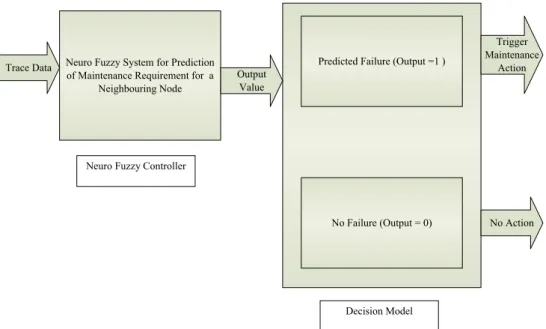
Short-term availability prediction of neighboring nodes can serve as an important basis for scheduling maintenance operation on a particular structured overlay network node. A predictive sta-bilization is about scheduling the next stasta-bilization routine by assessing the risk of failure of neighboring node for some time in the future. In this paper, we mainly concentrate on the develop-ment of affordable system operation by scheduling the next stabi-lization by forecasting the failure of neighboring nodes using Neuro-fuzzy based stabilization controller as shown inFig. 1.
http://dx.doi.org/10.1016/j.jestch.2016.06.015
2215-0986/Ó2016 The Authors. Production and hosting by Elsevier B.V. on behalf of Karabuk University. This is an open access article under the CC BY-NC-ND license (http://creativecommons.org/licenses/by-nc-nd/4.0/).
⇑ Corresponding author at: Department of Computer Science and Engineering, National Institute of Technology, Jalandhar, Punjab, India.
E-mail address:[email protected](R. Kaur). Peer review under responsibility of Karabuk University.
Contents lists available atScienceDirect
Engineering Science and Technology,
an International Journal
j o u r n a l h o m e p a g e : w w w . e l s e v i e r . c o m / l o c a t e / j e s t c h
The Neuro-fuzzy model provides the learning feature of neural network along with the easy interpretability characteristic of fuzzy model make it suitable for modeling a complex system. Neuro-fuzzy model is suitable for the modeling of many real world problems[11]. One such problem is to detect the online behavior pattern of overlay nodes based on their established internet habits of their owners. Many researchers have reported the daily and weekly online/offline behavior pattern of overlay nodes in many overlay network driven applications [12–17]and observed that the four most important factors influencing the online behavior of overlay nodes is: geographical position, day of the week, time of the day and the current online age. The relationship between these parameters is quite complex and non-linear in nature. There-fore, the conventional control mechanisms are not suitable for the predictive stabilization mechanism of structured overlay networks. The remainder of this paper is organized as follows. Sections2 introduces the background of our work by providing a brief intro-duction to the most important contributions in the area of self maintenance in structured overlay networks and on the use of adaptive Neuro-fuzzy inference system. In Section3, we provide the framework of Neuro-fuzzy predictor. Section4introduces our proposed intelligent stabilization scheme. In Section5, we outline the design of experiments and the results of our predictor for the behavior of nodes of Microsoft trace file. Section6concludes this paper.
2. Background
In this section, we first introduce the basic concepts and key factors affecting the online behavior of nodes. Then, we present the most important research contribution in the field of structured overlay maintenance and a brief introduction to the Neuro-fuzzy model chosen for predictive maintenance. These three aspects are the main motivations of our proposed technique as described later in detail.
2.1. Basic Concepts
This section provides a brief introduction to the basic concepts of structured overlay network in relation to the topology
mainte-nance. It includes need of the topology maintenance, churn defini-tion and the driving factors behind the churn behavior of overlay participants.
2.1.1. Structured Overlay Networks
Overlay networks are defined as the distributed system archi-tecture of heterogeneous and unreliable machines to share storage, bandwidth and other resources among all the system participants. These overlay networks support a large number of applications ranging from routing overlays; volunteer computing; enhanced internet services overlays (overlay QoS, naming, and indirection overlays, multicast); distributed computing, internet telephony to media streaming overlays. Though, overlay networks have acquired a negative status for some of its initial applications such as file sharing or media streaming, but present researchers concen-trate their efforts on the increasing use of overlay network for legal applications with huge business potential such as IP telephony. Most of the present research efforts focus on combining the over-lay network’s benefits with online social networks[18,19]and ser-vice oriented architectures [20]. There are mainly two types of overlay networks: structured and unstructured overlay networks. Structured overlay networks are self organized networks with specific structural constraints to guarantee system performance in a small number of probabilistically bounded networking hops. The structural constraints and per-node routing table makes the task of self organization quite cumbersome in dynamic environ-ments. Whereas, unstructured overlay networks are inherently random networks with no performance guarantees and low main-tenance cost.
2.1.2. Churn definition
The churn can be defined as the participation dynamics of over-lay participants. Each participating node may join or leave the overlay at any time. This continuous join and leave operations in a structured overlay network result in content unavailability and outdated routing tables. Because of this dynamics, the routing topology and content availability need to be maintained in order to guarantee overlay network performance. There are mainly two definitions of churn available in the literature:
Neuro Fuzzy System for Prediction of Maintenance Requirement for a
Neighbouring Node Trace Data
Output Value
Predicted Failure (Output =1 )
No Failure (Output = 0)
Trigger Maintenance
Action
No Action Neuro Fuzzy Controller
Decision Model
Fig. 1.A block diagram of proposed predictive stabilization controller.
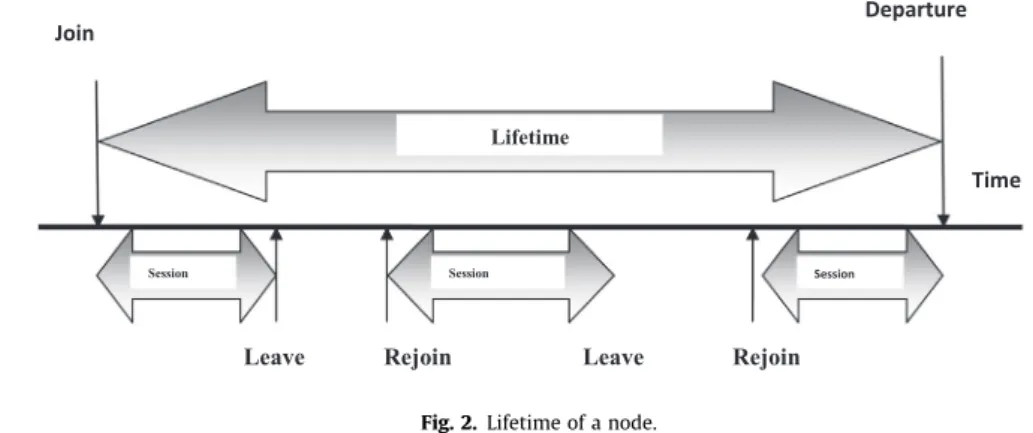
2.1.2.1. Definition (Global Churn). Churn can be defined as a mea-sure of the total number of nodes joining or leaving the overlay network over a given time, also known as node turnover. 2.1.2.2. Definition (Local Churn). Churn is defined as several online (participating in overlay) and offline sessions in a node’s lifetime (starts with initial creation and ends with permanent departure) as shown inFig. 2.
Churn is a constant problem often offsetting the advantages of structured overlay networks. The literature on the structured over-lay networks addresses churn as a legitimate failure scenario to be handled by the inbuilt fault tolerance or self management capabil-ities of structured overlay networks. Researchers have conducted different studies[12–17,21]to understand the churn behavior of participating nodes. These studies have reported the daily or weekly periodic uptime pattern in different file sharing applica-tions[12–15], instant messaging[16]and distributed computing applications [17]. Douceur [21] studies the churn behavior of Microsoft machines and observed that, some of the participating hosts have always on characteristic, while others have cyclic on/off patterns. This cyclic behavior pattern of overlay nodes is exploited by our Neuro-fuzzy predictor to schedule the stabiliza-tion operastabiliza-tion appropriately.
2.1.3. Need of stabilization
The correctness and the performance of structured overlay net-works mainly depend on its up to date routing table entries that together form an overlay topology with specific structural con-straints (e.g. ring structure in the chord overlay network). But, due to their open nature in real world overlay networks experience heavy churn. This dynamism of peer participants in the form of continuous joining, leaving, and failure from the overlay network is known as churn. Thus, an effective topology maintenance mech-anism is required to maintain the structural properties of the struc-tured overlay networks in the face of churn. Stabilization is defined as a process to survive transient failures by updating the routing table entries to ensure the structural integrity of the overlay network.
2.1.3.1. Definition (Stabilization Strategy). A stabilization strategy is required to maintain the structural integrity by keeping the rout-ing table entries (frout-inger tables and successor pointers in case of chord) up to date in case of peer failure. The stabilization algorithm ensures the timely detection of node failures and keeps the routing table full with up-to-date entries.
Thus, the stabilization mechanism is defined as the process of maintaining geometric and routing properties of an overlay network experiencing churn.
2.1.4. Key factors affecting the online behavior of nodes
In order to propose an efficient stabilization mechanism, we need to understand the node dynamicity at a deeper level. This deeper level of node dynamicity understanding is aided by the multiple factors that trigger the dynamic behavior of overlay net-work participants. Following are the main factors that feed the dynamic behavior of network participants:
Varied time zone of peers:The overlay networks are built on heterogenous and geographically distributed hosts. This geo-graphical distribution also affects the online behavior of its par-ticipating hosts due to varied time zone and in turn affects the pattern of churn. The variation in the time zone and distribution of millions of overlay peers affects the online behavior at large.
Working behavior of peers or Heterogeneous habits of users:The behavior of overlay peers is reflected by the established internet habits of their owners that depend on the time and day of the week. Thus, the unavailability of these nodes can be viewed as a completely cyclic.
Daily and weekly behavior pattern are a known feature of all the human driven applications. Many researchers have reported this daily and weekly behavior pattern in many overlay network driven applications[12–17].
Failure of a significant fraction of peers due to Earthquake etc. or software updation:The failure of underlying infrastructure due to hardware or software malfunction can cause severe disrup-tions. The main causes of these sudden disruptions are natural geographical disasters or power outages.
2.2. Related work
The self stabilization is a critical design issue for the efficient working of structured overlay networks. The increased use of structured overlay network for a variety of applications motivates the researchers to focus their research interests towards the devel-opment of efficient maintenance mechanisms to maintain the structure of overlay network inexpensively in dynamic environ-ments. The dynamic behavior of overlay participants may break the entire structure of the overlay network and make it unable to serve the queries. The existing research in this direction can be divided into two main categories: proactive [1,3,4]and reactive [5,9,10]maintenance mechanisms.
The proactive maintenance [1,3,4] approaches keep-up the overlay network structure by using a periodic stabilization mecha-nism, where period is chosen without taking into consideration the churn rate of the overlay network. The performance of the periodic stabilization[1,3,4]technique depends on the stabilization interval chosen. If stabilization interval is selected pessimistically, it may result in performance degradation in case interval chosen is longer
Leave Session Rejoin Session Leave Rejoin Session Lifetime Join Departure Time
Fig. 2.Lifetime of a node.
as compared to the frequency of network change. However, the optimistic choice of stabilization interval may lead to higher over-head as it will select frequent stabilization. Various researchers [22–24]have analysed the various inconsistencies in the perfor-mance of structured overlay networks employing proactive stabi-lization in the face of churn. Krishnamurthy et al. [25] have analytically studied the chord[1] architecture under churn and observed a significant degradation in the routing efficiency due to incorrect or dead entry in the longest finger. Thus; the stabiliza-tion mechanism needs to be triggered frequently to ensure the cor-rect and efficient working of overlay networks. Several researchers [26,27]have proposed an enhancement to the periodic stabiliza-tion in the form of adaptive stabilizastabiliza-tion, where instead of choos-ing a static stabilization interval passively, it will be chosen according to the present network conditions and adjust it dynam-ically. Shafat et al. [28]have extended the periodic stabilization process to handle extreme events like network partitions in the face of churn by introducing a new mechanism of merger. The mer-ger messages will die out when the overlay architecture converges to a ring again. In 2015, Paul et al.[29]has modified this mecha-nism to trigger the merger in a proactive manner by maintaining a knowledge base at each participating node.
In contrast to proactive approaches, reactive approaches [5,9,10] are based on the concept of triggered stabilization in view of sporadic churn behavior. Thus, in these approaches the stabilization will be performed only after the detection of the fail-ure. That means, these approaches have to bear significant
rout-ing inconsistencies in the network before handling the
dynamism. The reactive approaches can be classified into two cat-egories: Lazy[9,10]and Eager maintenance techniques[10]. The lazy techniques come into play only after the detection of failure or when all the routing table entries become stale. Whereas, eager maintenance techniques, trigger the stabilization process as soon as a change is detected. Beernet[30]uses a combination of eager and lazy maintenance mechanism. The main focus of this work is to propose a perfect failure detector as performance of the stabilization mechanism mainly depend on the detection of join/fail events.
A good maintenance strategy should be adaptable to the vary-ing levels of churn with minimum overhead. Performvary-ing periodic maintenance, when it is not needed leads to increased overhead and reactive maintenance occurs only after causing routing incon-sistencies. Although, reactive maintenance has minimum overhead and triggered immediately after the detection of the failure, but this reactive maintenance strategy can be exploited to bring down the network instead of repairing it by congesting the network with maintenance traffic by generating a false detection. Thus; we need a predictive maintenance strategy that comes into play only after predicting the neighboring node’s state and also before causing any routing failures. The ability to predict or estimate the node fail-ure enables to perform preventive maintenance on abnormal nodes instead of all nodes and results in affordable system opera-tion by providing triggered maintenance. The main contribuopera-tion of this paper is to overcome the deficiencies of proactive and reactive maintenance approaches by proposing a new type of maintenance approach that is predictive maintenance. The predictive mainte-nance strategy performs the stabilization after predicting the neighboring node’s state and before any routing inconsistency and results in the affordable, preventive maintenance of some of the nodes only and not all. Moreover, the main driving factor behind the legitimate dynamic behavior of overlay nodes is the established working behavior or internet usage habits of their users or varied time zone of overlay peers[12–17,21]. The predic-tive maintenance approach uses these established internet habits of its peers to schedule a maintenance operation accordingly. Thus, to maintain the overlay network structures without flooding the
overlay network with stabilization messages and continually update the participant’s routing table with the correct entries.
2.3. Neuro-fuzzy network
The complexity and dynamics of structured overlay networks require sophisticated methods for building online adaptive stabi-lization routines for the efficient maintenance of this network. Till date, researchers were mainly focusing on the mathematical mod-els for churn estimation[31,32]and choose the stabilization period accordingly in structured overlay systems. But, due to the difficulty involved in the development of mathematical models for practical systems the use of mathematical models is discouraged. Earlier efforts[12–17,21,33,34]indicate the strongly correlated behavior of overlay nodes over time, which implies that the history based failure predictors, can be used. However, traditional prediction methods cannot be used due to strong variability of node behavior over time (time point where a time series changes the direction: increasing or decreasing). Thus, some researchers propose the use of a combination of traditional AI techniques[35,36]for con-trol of uncertain system with strongly non linear behavior[37– 42]. The fuzzy logic and neural networks are suitable candidates for building intelligent systems due to their complementary nature as shown inTable 1. The Neuro-fuzzy network combines the paral-lel computation and learning capabilities of neural networks with human like explanation abilities of fuzzy systems and makes it suitable prediction technique for complex and dynamic systems. This model is good for short term accurate predictions using a selection of instances in several past inputs. For this reason, we propose the use of the adaptive Neuro-fuzzy prediction system [43–45]to adapt the fuzzy system parameters for predicting the state of neighboring nodes for stabilization scheduling.
3. Neuro-fuzzy prediction framework
In this paper, we have proposed a Neuro-fuzzy modeling frame-work aimed to discover prediction rules for a very complex routing table maintenance problem: the derivation of the properties of neighboring node’s uptime in structured overlay networks. This particular task can be considered of utmost importance, since the study of maintenance scheduling improves the convergence and robustness to accommodate the dynamic behavior of structured overlay network participants.
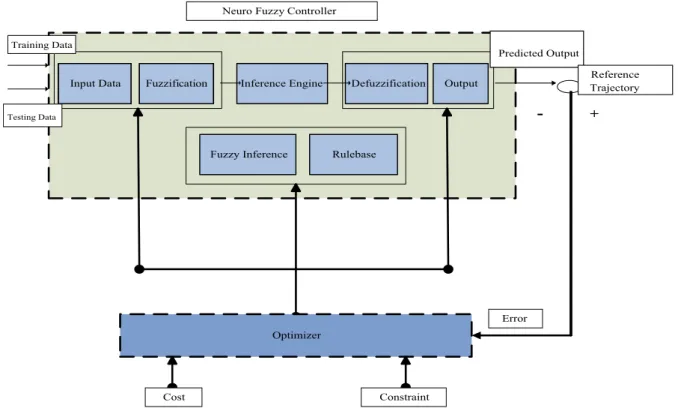
This framework includes several sequential steps to improve the predictive accuracy and the readability of the fuzzy rules. First, a data pre-processing is done to the available raw data by discard-ing the redundant or derived features. Then, a fuzzy rule base is ini-tialized using a competitive learning scheme and then optimized using a Neuro-fuzzy network, trained using the available data. The structure of intelligent, adaptive predictive control for stabi-lization is shown inFig. 3.
Table 1
Complementary nature of fuzzy systems and neural networks.
Features Fuzzy systems Neural Networks
Knowledge representation UU ✗ Uncertainty tolerance UU UU Adaptability ✗ UU Imprecision tolerance UU UU Learning ability ✗ UU Explanation ability UU ✗
Knowledge discovery and data mining ✗ UU
Maintainability Average UU
3.1. Feature selection or data pre-processing
The selection of training data size is critical for the effective working of a Neuro-fuzzy inference mechanism. A large training set size may increase the accuracy of the inference mechanism by regulating it with a large amount of historical data, but it may also cause a heavier burden on the overlay network nodes. So, we use a limited size training data set with important input vari-ables. The incorporation of important input variables results in simpler and more reliable model than the initial fuzzy model that incorporates all possible input variables.
For predictive stabilization, we have used a Microsoft trace [46,47]of 51633 hosts over 35 days. A large amount of information is provided in tabbed format, but as our work is mainly concerned with the online behavior of overlay nodes, we have used only event trace file. In the event trace file, there are mainly two types of host: hosts with always on behavior and hosts with cyclic behavior. As host with always on behavior will not cause any routing failure, so we have conducted our study on the hosts with cyclic behavior only. We have selected four input variables (day of the week, time of the day, cumulative session time and current state of the neigh-bor and one output variable from a set of available data for each participating host. For observing the weekly behavior pattern of participating machines, we have divided our data into four weeks. We then divide the trace file into training and testing data. First two weeks are utilized for fuzzy rule generation, one week for rule optimization using back propagation based learning scheme and the last one week is used for testing the performance of our Neuro-fuzzy model.
3.2. Rule generation from data
The first step of Neuro-fuzzy learning is the rule generation from the given set of training data. The generated fuzzy rules are the fundament part of the knowledge base of the Neuro fuzzy inference system. For this fuzzy rule generation, we consider a
training set of n input and single output representing a dynamic system which can be defined by n variables X1, X2,..., Xn. The stabi-lization operation in the predicted state of the dynamic system can be described by a well known concept of Takagi–Sugeno fuzzy-neural model[48,49]. In the Takagi–Sugeno fuzzy-neural models, the output of each rule is a linear combination of input variables plus a constant term, and the final output is the weighted average of each rule’s output. Fuzzy rules are expressed in the following form:
Rulej:If X1isAj1&X2is Aj2&. . .then class isc1:
where, Xkis thekth input feature and Ajkis the membership func-tion in thejth rule associated with thekth input feature.
In the above defined fuzzy rule expression, antecedents of the rule are the inputs and the consequent is the most likely output with the given combination of inputs. This output will contribute to the final output, which is the weighted average of all the speci-fied rules.
3.3. Rule optimization
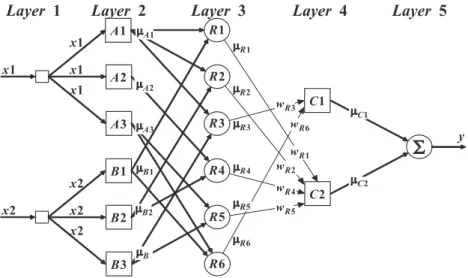
In the fuzzy rule optimization phase, the parameters of the ini-tial fuzzy set are refined using neural network techniques. Here, the rules obtained in the rule generation phase are used to design the neural network with five layers. Each layer of a Neuro-fuzzy system defines a particular step in the Neuro-fuzzy inference mechanism. This inference mechanism is explained in theFig. 4 and is described below:
3.3.1. Layer 1 (Input Layer)
This layer represents the input variables that represent the cur-rent state of the system. The neurons in this layer transmit these input variables directly to their respective membership modules in the next layer.
Input Data Fuzzification
Input Data Fuzzification Inference Engine Defuzzification Output
Fuzzy Inference Rulebase
Optimizer Training Data Testing Data Predicted Output Reference Trajectory Error Neuro Fuzzy Controller
Cost Constraint
+
-
Fig. 3.Basic Structure of Neuro fuzzy model based predictor.
3.3.2. Layer 2 (Fuzzification Layer)
The neurons of this layer convert the scalar values received from the first layer to their corresponding fuzzy values. In short, neurons of this layer contain the definitions of membership func-tions and pass these input membership funcfunc-tions to the fuzzy rule layer.
3.3.3. Layer 3 (Fuzzy rule layer)
This layer is also known as the knowledge base of the predictor. This layer’s neurons represent the fuzzy rules of our defined model. Thus, has number of neurons equal to the number of fuzzy rules. These neurons will receive input from the fixed n nodes of a fuzzi-fication layer representing the antecedent part of the fuzzy rule. The main function of these neurons is to perform the AND opera-tion by product of their respective inputs and pass the output to the next layer.
3.3.4. Layer 4 (Output Membership Layer)
The neurons in this layer represent the output membership sets. Each neuron of this output membership function layer combines all its input by fuzzy union operation. The output of each neuron represents the integrated strength of its input rules.
3.3.5. Layer 5 (Defuzzification Layer)
This layer contains only one neuron that represents the final output of the Neuro-fuzzy system. It takes the input from the out-put fuzzy sets and combines them into single fuzzy set.
The rule optimization procedure involves back propagation based learning to adjust the parameters of the membership func-tions optimally. The presented input output of training data is compared with the model output and error is propagated back-wards through the network from the output layer to the input layer in order to modify the membership function neurons in the layer 2.
4. Proposed intelligent stabilization
In this section, we describe how to use a Neuro-fuzzy based pre-dictive stabilization framework for a dynamic structured overlay network. The dynamic structured overlay network is comprised of multi-state nodes subjected to graceful leaving or sudden failure causing the node to go offline. The cumulative session time attri-bute of a node is discretized in order to harmonize its value for dif-ferent behavior patterns of difdif-ferent nodes. The cumulative session
time of a node is divided into four states ordered from (offline, born, young and aged). The division of these states is based on the approximate remaining up time of the nodes based on their current age and is calculated on the basis of average online time of a node in the training data. In our proposed stabilization frame-work, we have used an equal bin approach of discretization. So, considering a node with an average online time nine (with diurnal behavior), born means, node have just come online (with cumula-tive session time between 1 and 3 and the probability of node going offline in the next prediction interval is almost zero for this state), young with cumulative session time between 4 and 6) and the aged state corresponds to a warning region where the cumula-tive session time varies from 7 to 9 (here the probability of going offline is very high) and the predictor needs to trigger the proactive stabilization operation to avoid failure. Our scheme is mainly designed to handle the failure of the online nodes and the rejoin operation of existing participants will be handled same as that of new node with only exception of retaining old observation.
In the proposed prediction framework, we describe how to use Neuro-fuzzy model[16,21,22,27]to predict the future state of the neighboring node for the time interval tk. This prediction frame-work uses a Neuro-fuzzy identifier to generate the anticipated stabilization output for the future time t where
Tþ1<t<T2
The fuzzy rules and membership functions of this identifier can be trained offline by the actual observed behavior of the neighbor-ing nodes. The future control variable for decision model for this predicted stage is determined in an optimization algorithm for the time interval
T1<t<Tu
WhereTu<T2
This model uses a training data set with four input variables (day of the week, time of the day, cumulative session time and cur-rent state of neighbor) and one output variable (failure). In the training dataset, each neighboring node’s average online time is known a priori. We divide the state of a node into four, non-overlapping intervals and assign four different states to the inter-vals, offline, born, young and aged. In the Neuro-fuzzy model, the history of neighboring node’s online time is used in order to define fuzzy rules. The overall predictive stabilization mechanism is divided into three different phases as shown inFig. 5:
Layer
2
Layer
3
Layer
4
Layer
5
Layer
1
y
x
1
A
1
A
2
A
3
B
1
B
2
x
2
C
1
C
2
x
1
x
1
x
1
x
2
x
2
x
2
B1 A2 B C2 C1 R1 R3 R5 R6 R4R
1
R
5
R
4
R
6
R2R
3
R
2
B
3
A1 wR3 wR6 wR1 wR2 wR4 wR5 A3 B2Fig. 4.Neuro-fuzzy inference system.
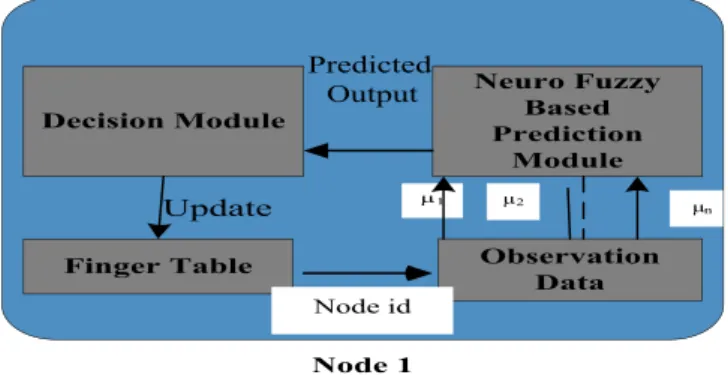
Observation Phase:In this phase, along with regular DHT opera-tions, each overlay node will observe the online behavior of its neighboring nodes and train the Neuro-fuzzy model with this observation data by defining the knowledge base named obser-vation_table for Neuro-fuzzy inference mechanism using this observational data.
Prediction Phase:In this step, after determining the probability behavior of neighboring node using information obtained in the previous step, the Neuro-fuzzy model is used to estimate the future state of neighboring node based on their current state.
Action Phase:Depending on the prediction about the neighbor-ing node, the overlay node will take suitable action that is whether to remain passive or trigger the maintenance process. Our scheme is intended to reduce the maintenance effort being wasted without compromising its performance, and schedule it according to the node’s online and offline behavior.
4.1. Observation phase
To detect and estimate the failure of neighboring nods using Neuro-fuzzy based predictor, every node n of the structured over-lay network has to make observations about the online and off-line behavior of its neighboring nodes at different points of time. This phase will define the step by step procedure of observ-ing peer behavior usobserv-ing the six variables; node id (ID), Day of the Week (DW), Time of the Day (TD), Cumulative Session Time (CST), Current State (CS) and Failure (F). Since, we are considering the weekly periodic behavior of overlay nodes, so a minimum of two week training data is mandatory for the correct working of the predictor. With two weeks training data predictor will get two chances to observe uptime patterns with a periodicity of a week. Previous work[15]has shown that every individual node has its own behavior pattern, and by observing these patterns, we can predict the future behavior of a node with reasonable accuracy.
Each node n stores pointers to k well defined neighbors as spec-ified by the dht protocol. For data collection, every node will peri-odically contact its k neighbors and accordingly update the observation variable values in its observation table in the observa-tion phase. Our model assumes that the offline peers will rejoin the overlay network at later point of time. So, whenever the old partic-ipant comes online it will inform all the neighboring nodes and neighboring nodes can query for its observational data from other nodes, if they are not currently holding one.
The newly joined nodes will get this observation table from its direct successor during the joining process. In addition, every newly joined node has to store its own online time ton (when it
has just joined) and send it to the neighboring nodes, so that they can keep track of its activity. During this periodic local scan, a node’s cumulative session time entry is incremented by 1 if it is online, otherwise cumulative session time will become 0. To min-imize the entries for offline nodes, node n will store its time when it will go offline and the time it will go online next. These steps of observation phase are explained with the help of an algorithm in Fig. 6.
After the observation phase the data collected will be pre-processed and used to derive different intermediate states of the nodes. Now this data will be used for the training of Neuro-fuzzy predictor, which later on can be used to schedule the future stabi-lization action based on the observed state of the neighboring node.
Algorithm: Observation (is executed or each node n in the network in the observation phase)
// In the observation phase, each node n will periodically send and receive status request or status response from neighbouring nodes in its local jurisdiction.
1. while (true) //Repeat this procedure for observation phase 2. WaitForEvent( )
3. If(Event(Periodic_timer_for _prediction) 4. For each entry r in the routing table 5. Send Status_Request (dhtid) 6. Start_timer( dhtid) 7. End for 8.End If
9. If(Event(Received_Status _Request) 10. Send Status_Response (ID, CST) //ID = ID of the respondent
// CST = Is the previous value incremented by 1 each time the node is responding to the status_request, it provides the cumulative session time when multiplied by the period. 11. End If
12. If(Event(Received_Status _Response)
13. update (observation_table) //Add the observation table entries for the corresponding respondent
// ID in the received message to identify the observed node // TD = time of the day( when status request message was sent)
// DW = Day of the week( when status request message was sent)
// CST = Is the previous value incremented by 1 and compare it with received value to check any loss of status response message.
// S = Online (state of the node is online) //Failure = 0
14. End if.
15. If (Event (Timeout (dhtid))) // status response message have not been received. 16. update (observation_table) //Add the observation table entries for the id
//TD = time of the day( when status request message was sent) // DW = Day of the week( when status request message was sent) // CST = 0
// CS = OFFLINE // FAILURE = 1 17. End If 18. End Procedure
Fig. 6.Observation mechanism. Node 1 µ1 µ2 Predicted Output Finger Table Neuro Fuzzy Based Prediction Module Decision Module Observation Data µn Update Node id
Fig. 5.Proposed intelligent stabilization framework of an overlay node.
5. Experiments and results
In our experiments, first, we study the suitability of the pro-posed prediction mechanism by applying the Neuro-fuzzy predic-tion model on the Microsoft trace file[46,47]to predict the online status of the individual node and check the accuracy of our model. Douceur[21] have studied the behavior pattern of participating hosts in Microsoft trace file and concluded that the participants behavior fall in one of the two classes: always on or cyclic on/off. These characteristics suggested that the dynamic hosts have peri-odic behavior and their past connectivity patterns can be used for predicting future failures.
In the second set of experiments, we implement this predictive stabilization framework using chord as an underlying overlay net-work in OverSim[50]based simulation environment and compare its performance with periodic stabilization. In our simulation experiments, we use Microsoft trace’s nodes behavior dataset as an observation sequence for Neuro-fuzzy predictor. The significant performance improvement is observed in terms of lookup success ratio, lookup hop count and maintenance overhead in the proposed predictive stabilization in the chord based overlay network.
5.1. Accuracy of the prediction mechanism
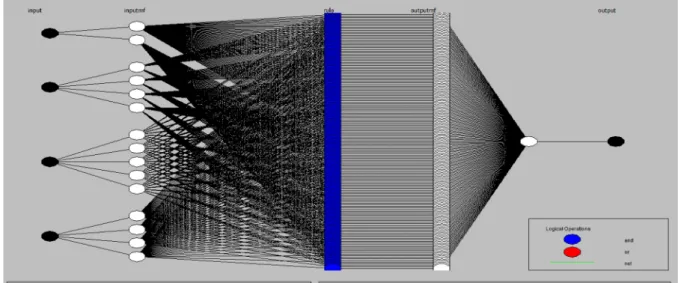
To prove and verify the proposed prediction framework, MATLAB fuzzy logic toolbox[51]is used. This tool provides func-tions for implementation of different common methods such as fuzzy clustering and adaptive Neuro-fuzzy learning. The main components of a fuzzy toolbox are a FIS editor, a membership func-tion editor, the rule editor, the fuzzy inference viewer, and the out-put surface viewer. The fuzzy inference system editor displays the general information about the inference system. In order to display and edit the membership functions associated with all input and output variables, membership function editor is being used. After defining the membership functions appropriately, the fuzzy rule editor is used for defining the rule base. The rule base is the most critical component, as the predictor will work strictly according to the pattern of the rule base and faulty patterns will result in faulty predictions. The rule viewer helps to interpret the entire fuzzy inference process at once. The output surface viewer is a very use-ful tool to visualize the rule base. Using this visualizer, we can observe changes in predictor’s output signal values resulting from
modified input values. The ANFIS editor has a Graphical User inter-face to generate fuzzy structure, to load training and checking data and to perform FIS model tuning by activation of neural network. The generated ANFIS architecture is shown inFig. 7.
The four week node behavior data of a Microsoft trace file [46,47] is used for training, optimizing and testing our Neuro-fuzzy model. This can be achieved by dividing our data into three independent sets: the training, checking, and the testing sets. The first two weeks are used for training subset; the checking subset is of one week; and the testing subset has the remaining one week. The ratio of the training set to checking set to testing set is approx-imately 2:1:1. The fuzzy network is built and its connected weights are adjusted using the training set. Afterward, the performance of the built model is simulated to verify its suitability of generaliza-tion using checking subset. This model can then be evaluated using the testing data set. The quality and predictability of the proposed model are measured in terms of the Root Mean Square Error (RMSE) value. RMSE¼ ffiffiffiffiffiffiffiffiffiffiffiffiffiffiffiffiffiffiffiffiffiffiffiffiffiffiffiffiffiffiffiffiffiffiffiffiffiffiffiffiffiffiffiffiffiffiffiffiffiffiffiffiffiffi XN i¼1 ðpredictediActualiÞ 2 N v u u u u t
where,Nis the total number of observations.
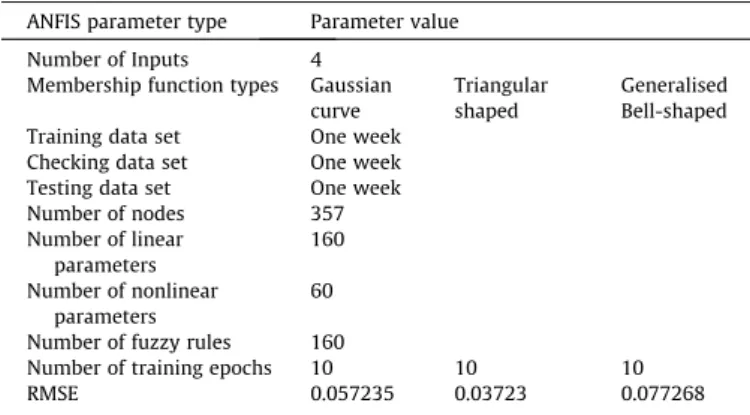
Our Neuro-fuzzy model has 4 inputs and membership function number (2 * 4 * 5 * 4). This system structure feeds 4 inputs into the network. These inputs are selected based on the feature selection procedure explained in Section3. These four parameters are: Day of the Week (DW), Time of the Day (TD), Cumulative Session Time (CST) and Current State (CS).DWhas two membership functions ‘‘Weekday and Weekend”.TDhas four membership functions rep-resented by ‘‘Night, Morning, Afternoon and Evening”.CSThas five membership functions as ‘‘Zero, Low, Medium, High and Very high”.CS,the current state of the system has 4 membership func-tions ‘‘Offline, Born, Young and Aged”.
Table 2summarizes the performance of our model using three different membership function types ‘‘Triangular-shaped, General-ized bell shaped and Gaussian”. The validation results of our model are summarized inTable 2. These results clearly represent that the Triangular-shaped membership function performs effectively and have minimum RMSE error, whereas; the generalized bell shaped membership function produce the worst results.
Fig. 7.The ANFIS architecture implemented in Matlab fuzzy toolbox.
5.2. Predictive stabilization in chord based overlay network
In this section, we experimentally evaluate our predictive stabi-lization approach implemented for a chord based structured over-lay network in a series of experiments on the OverSim [50] simulation framework. OverSim[50]is an Omnet++ based overlay simulation framework for the implementation of structured and
unstructured overlay networks. The different modules for overlay network simulation are implemented in C++ and are defined using NED language. The OverSim architecture supports a variety of underlay network varying from SimpleUnderlay to more real IPV4Underlay. For our experiments, we have used SimpleUnderlay because of its low computation overhead and high accuracy.
The simulation experiments are performed using and updating the existing chord architecture. In our proposed stabilization mechanism, stabilization will not be performed periodically rather it will be scheduled individually for each neighbor by the output of the Neuro-fuzzy based predictor. Our experiments are performed with an initial size of 5000 nodes. The number of successor nodes is set to 4. The detailed information about the simulation parame-ters of chord in OverSim are specified inTable 3. Then, we let these nodes go online and offline, according to the trace file of selected nodes from Microsoft trace file [46,47]. In a set of experiments, we explore the performance improvement in the chord based over-lay network by employing the predictive stabilization and compare it with the traditional periodic stabilization.
5.2.1. Results and analysis
Our experiments highlight and compare the performance of tra-ditional periodic stabilization and proposed predictive stabilization strategy. The performance of proposed predictive stabilization is verified by investigating two performance metrics: lookup success ratio and maintenance overhead.
Lookup success ratio:The performance of structured overlay net-work can be evaluated by the lookup success ratio of the query messages. This feature indicates the ability of structured over-lay network to cope up with the participant failure. The lookup failure will occur mainly due to outdated finger table entries or successor pointers of the overlay participants. The experimental results clearly present the significant performance improve-ment in terms of lookup success ratio by employing predictive stabilization. TheFig. 8illustrates the effect of predictive and Table 3
Parameter values for chord simulation.
Parameters Values
Network Size Max 5000
Routing Semi-recursive
Churn behavior Node’s online and offline pattern observed in trace file Fix finger delay 60 s,120 s
Successor list size 4 Simulation duration 36,000 sec
Fig. 8.Comparison of lookup success Ratio in periodic and predictive stabilization.
Table 2
ANFIS structure information.
ANFIS parameter type Parameter value
Number of Inputs 4
Membership function types Gaussian curve
Triangular shaped
Generalised Bell-shaped Training data set One week
Checking data set One week
Testing data set One week
Number of nodes 357 Number of linear parameters 160 Number of nonlinear parameters 60 Number of fuzzy rules 160
Number of training epochs 10 10 10
RMSE 0.057235 0.03723 0.077268
periodic stabilization over time on the performance of the chord based overlay network. From theFig. 8, it is clear that the per-formance of periodic stabilization depends on the stabilization interval chosen.
Lookup Hop count:The impact of node dynamism and its effect on the performance of structured overlay networks can also be measured as the lookup hop count required for a particular query message. The lookup hop count can be defined as a num-ber of hops between the source node initiating a query and the final destination storing the desired value. In case the finger table contains outdated routing entries, messages will be routed to wrong neighbors, thus needs to be resent or de-routed in order to reach the destination. This will increase the lookup hop count as clearly shown in theFig. 9. TheFig. 9compares the performance of predictive and periodic stabilization in terms of the lookup hop count.
From theFig. 9, it is clear that outdated entries lead to increase in the lookup hop count and again the choice of stabilization inter-val has a significant impact on the performance of periodic stabilization.
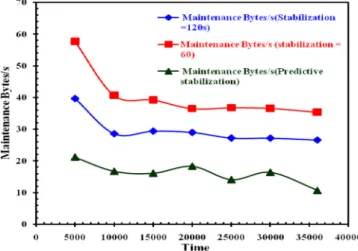
Maintenance overhead:The third metric, maintenance overhead defines the number of maintenance messages required to keep the finger tables up to date. In the traditional periodic
stabiliza-tion mechanism the maintenance overhead will increase with the decrease in stabilization interval. The purpose of this set of experiments is to measure the maintenance overhead in the form of stabilization messages in bytes/s per node using the predictive stabilization mechanism. TheFig. 10studies the reduction in the maintenance overhead by employing predic-tive stabilization. From theFig. 10, it is clear that the mainte-nance overhead in case of predictive stabilization is quite low as compared to periodic stabilization because stabilization traf-fic will be generated based on the output of the neuro fuzzy predictor.
6. Conclusion
In this paper, we have proposed a predictive stabilization approach as a candidate solution for the maintenance of structured overlay network in the face of transient failure of its participant nodes. We have presented the effectiveness of our approach in two phases: First phase checks whether the churn behavior of overlay participants is predictable or not and the second phase mainly concentrates on the application of this predictive behavior to schedule the stabilization action in a chord based overlay envi-ronment. To prove that the behavior of overlay participants is pre-dictable to a large extent and with good accuracy, we tested our prediction technique in the MATLAB fuzzy toolbox. The simulation results indicate that the performance of Neuro-fuzzy based hybrid predictor is valuable, easy to implement and predict the control output with greater accuracy. In the second phase, the perfor-mance of predictive stabilization in the chord based overlay net-work is implemented, evaluated and compared with the traditional periodic stabilization approach in OverSim environ-ment. Experimental results show that the predictive stabilization will significantly improve the performance of structured overlay network by adapting the stabilization interval to the current neigh-boring node status. This adaptation will provide an up to date over-lay structure with low maintenance overhead and high lookup success ratio.
References
[1]I. Stoica, R. Morris, Chord: a scalable peer-to-peer lookup service for internet applications, IEEE/ACM Trans. Networking 11 (1) (2003) 17–32.
[2]F. Kaashoek, D.R. Karger, Koorde: a simple degree-optimal distributed hash table, in: Proceedings of the Second International Workshop on Peer-to-Peer Systems, IPTPS, 2003, pp. 98–107.
[3]B.Y. Zhao, J.D. Kubiatowicz, A.D. Joseph, Tapestry: an infrastructure for fault-tolerant wide-area location and routing, 2001. U. C. Berkeley Technical Report UCB//CSD-01-1141.
[4]A. Rowstron, P. Druschel, Pastry: scalable, decentralized object location, and routing for large-scale peer-to-peer systems, Lect. Notes Comput. Sci. 2218 (2001) 329–350.
[5]B. Leong, B. Liskov, E.D. Demaine, EpiChord: parallelizing the Chord lookup algorithm with reactive routing state management, Proceedings of the 12th International Conference on Networks (ICON’04), 2004, pp. 1243–1259. [6]S. Krishnamurthy, S. El-Ansary, E. Aurell, S. Haridi, Comparing maintenance
strategies for overlays, in: 16th Euromicro conference on parallel, distributed and network-based processing (PDP 2008), 2008, pp. 473–482. doi:10.1109/ PDP.2008.18.
[7]B. Porter, F. Taiani, G. Coulson, Generalized repair for overlay networks, in: Proceedings of the 25th IEEE Symposium on Reliable Distributed Systems, Leeds, UK, 2006, pp. 132–142.
[8]K. Aberer, A. Datta, M. Hauswirth, Route maintenance overheads in DHT overlays, in: In 6th Workshop on Distributed Data and Structures (WDAS), 2004.
[9]A. Ghodsi, L.O. Alima, S. Haridi, Low-bandwidth topology maintenance for robustness in structured overlay networks, in: Proceedings of the 38th Annual Hawaii International Conference on System Sciences, 2005, p. 302a. [10]L.O. Alima, S. El-Ansary, P. Brand, S. Haridi, DKS (N, k, f): a family of low
communication, scalable and fault-tolerant infrastructures for P2P applications, in: 3rd IEEE/ACM International Symposium on Cluster Computing and the Grid (CCGrid2003), IEEE COMPUTER SOC, 2003, pp. 344– 350.
Fig. 9.Comparison of lookup hop count in periodic and predictive stabilization.
Fig. 10.Comparison of maintenance overhead in periodic and predictive stabilization.
[11]M. Najafzadeh, Neuro-fuzzy GMDH based particle swarm optimization for prediction of scour depth at downstream of grade control structures, Engi. Sci. Technol. Int. J. 18 (1) (2015) 42–51.
[12]R. Bhagwan, S. Savage, G. Voelker, Understanding availability, in: International Workshop on Peer-to-Peer Systems, Springer, Berlin Heidelberg, 2003, pp. 256–267.
[13]J. Chu, K. Labonte, B.N. Levine, Availability and locality measurements of peer-to-peer file systems, in: ITCom 2002: The Convergence of Information Technologies and Communications, International Society for Optics and Photonics, 2002, pp. 310–321.
[14]J.W. Mickens, B.D. Noble, Exploiting availability prediction in distributed systems, in: Proceedings of the 3rd Conference on Networked Systems Design & Implementation, vol. 3, USENIX Association, 2006, p. 6.
[15]D. Stutzbach, R. Rejaie, Understanding churn in peer-to-peer networks, in: Proceedings of the 6th ACM SIGCOMM Conference on Internet Measurement, ACM, 2006, pp. 189–202.
[16]S. Guha, N. Daswani, R. Jain, An experimental study of the skype peer-to-peer voip system, in: Proc. IPTPS, 2006.
[17]B. Javadi, D. Kondo, J.M. Vincent, D.P. Anderson, Mining for availability models in large-scale distributed systems: a case study of SETI@home, in: Proc. 17th IEEE/ACM Int’, l Symp. Modelling, Analysis and Simulation of Computer and Telecomm. Systems (MASCOTS), 2009.
[18]S. Ktari, A. Hecker, A peer-to-peer social network overlay for efficient information retrieval and diffusion, in: Future Information Technology, Springer, Berlin Heidelberg, 2011, pp. 24–33.
[19]S. Nilizadeh, S. Jahid, P. Mittal, N. Borisov,, A. Kapadia, Cachet: a decentralized architecture for privacy preserving social networking with caching, in: Proceedings of the 8th ACM International Conference on Emerging Networking Experiments and Technologies (CoNEXT ’12), Nice, France, 2012, pp. 337–348.
[20]R. Khondoker, A. Siddiqui, B. Reuther, P. Mueller, Service orientation paradigm in future network architectures, in: Sixth International Conference on Innovative Mobile and Internet Services in Ubiquitous Computing, Palermo, 2012, pp. 348–351.
[21]J. Douceur, Is remote host availability governed by a universal law?, SIGMETRICS Perform Eval. Rev. 31 (3) (2003) 25–29.
[22]M.J. Freedman, K. Lakshminarayanan, S. Rhea, I. Stoica, Non-transitive connectivity and DHTs, in: Proceedings of the 2nd Workshop on Real Large Distributed Systems, 2005, p. 10.
[23]A. Ghodsi, Distributed k-ary System: Algorithms for Distributed Hash Tables (PhD thesis), KTH Royal Institute of Technology, Sweden, 2006.
[24]R. Kaur, A.L. Sangal, K. Kumar, Analysis of different churn models in chord based overlay networks, in: Recent Advances in Engineering and Computational Sciences (RAECS), 2014, pp. 1–6. Chandigarh.
[25]S. Krishnamurthy, J. Ardelius, An analytical Framework for the Performance Evaluation of Proximity-Aware Structured Overlays, Swedish Institute of Computer Science (SICS), 2008. Technical report.
[26]G. Ghinita, Y.M. Teo, An adaptive stabilization framework form distributed hash tables, in: Proceedings of the 20th International Parallel and Distributed Processing Symposium (IPDPS ’06), IEEE, 2006, p. 29.
[27]M. Castro, M. Costa, A. Rowstron, Performance and Dependability of Structured Peer-to-Peer Overlays, Microsoft, 2003. Technical report.
[28]T.M. Shafat, Partition Tolerance and Data Consistency in Structured Overlay Networks PhD thesis, KTH Royal Institute of Technology, Sweden, 2013. [29]R.R. Paul, P.V. Roy, V. Vlassov, Interaction between Network Partitioning and
Churn in a Self-Healing Structured Overlay Network, in: 21st International Conference on Parallel and Distributed Systems (ICPADS), 2015, pp. 232–241. Melbourne, VIC.
[30] B.M. Candia, Beernet: A Relaxed Approach to the Design of Scalable Systems with Self-Managing Behaviour and Transactional Robust Storage PhD thesis, ICTEAM, Université catholique de Louvain, Louvain-la-Neuve, Belgium, 2010. [31]A. Binzenhofer, K. Leibnitz, Estimating Churn in Structured P2P Networks, in:
20th International Teletraffic Congress, ITC20 2007, Ottawa, Canada, 2007, pp. 630–641.
[32]N. Evans, B. Polot, C. Grothoff, Efficient and secure decentralized network size estimation, in: 11th International IFIP TC 6 Networking Conference, Prague, Czech Republic, 2012, pp. 304–317.
[33]M. Steiner, T. En-Najjary, E.W. Biersack, Long term study of peer behavior in the KAD DHT, IEEE/ACM Trans. Networking 17 (5) (2009) 1371–1384. [34]J.W. Mickens, B.D. Noble, Exploiting availability prediction in distributed
systems, Proceedings of the 3rd conference on Networked Systems Design & Implementation, vol. 3, USENIX Association, 2006, p. 6.
[35]J. Nayak, B. Naik, H.S. Behera, A novel nature inspired firefly algorithm with higher order neural network: performance analysis, Eng. Sci. Technol. Int. J. 19 (1) (2016) 197–211.
[36]P. Ray, D.P. Mishra, Support vector machine based fault classification and location of a long transmission line, Eng. Sci. Technol. Int. J. (2016). Corrected Proof, Available online 20 April 2016 (In Press).
[37]J.S.R. Jang, Input selection for ANFIS learning, Proc. IEEE Int. Conf. Fuzzy Syst. 2 (1996) 1493–1499.
[38]S. Chiu, Selecting input variables for fuzzy models, J. Intell. Fuzzy Syst. 4 (4) (1996) 243–256.
[39]M. Yang, X.R. Li, H. Chen, N.S.V. Rao, Predicting Internet end-to-end delay: an overview, in: Proceedings of the Thirty-Sixth South eastern Symposium on, 2004, pp. 210–214.
[40] H. Ishibuchi, R. Fujioka, H. Tanaka, Neural networks that learn from fuzzy if-then rules, IEEE Trans. Fuzzy Syst. 1 (2) (1993) 85–97.
[41]C.F. Juang, C.T. Lin, An on-line self constructing neural fuzzy inference network and its application, IEEE Trans. Fuzzy Syst. 6 (1) (1998) 12–32.
[42]Y. Li, X. Zhao, L. Jiao, A nonlinear system identification approach based on Neuro-fuzzy networks, Proc .ICSP 3 (2000) 1594–1597.
[43]Y.Y. Lin, J.Y. Chang, C.T. Lin, Identification and prediction of dynamic systems using an interactively recurrent self evolving fuzzy neural network, IEEE Trans. Neural Networks Learn. Syst. 24 (2) (2013) 310–332.
[44]R.H. Abiyev, Fuzzy wavelet neural network based on fuzzy clustering and gradient techniques for time series prediction, Neural Comput. Appl. 20 (2) (2011) 249–259.
[45]C. De-Wang, Jun-Ping Zhang, Time series prediction based on ensemble ANFIS, Proceedings of the 2005 International Conference on Machine Learning and Cybernetics, vol. 6, 2005, pp. 3552–3556 (Guangzhou, China).
[46] Microsoft trace downloads http://fta.scem.uws.edu.au/index.php?n=Main. Download.
[47]B. Javadi, D. Kondo, A. Iosup, D. Epema, The failure trace archive: enabling the comparison of failure measurements and models of distributed systems, J. Parallel Distrib. Comput. 73 (8) (2013) 1208–1223.
[48]M. Sugeno, G.T. Kang, Structure identification of fuzzy model, Fuzzy Sets Syst. 28 (1988) 15–33.
[49]T. Takagi, M. Sugeno, Fuzzy identification of systems and its applications to modelling and control, IEEE Trans. Syst. Man Cybern. 15 (1985) 116–132. [50] I. Baumgart, B. Heep, S. Krause, OverSim: a flexible overlay network simulation
framework, in: 2007 IEEE Global Internet Symposium, GI 4301435, 2007, pp. 79–84.
[51] MATLAB and Statistics Toolbox Release, The MathWorks Inc, Natick, Massachusetts, United States, 2012.