Facilitation of Detectability and Criterion by Automatic
Temporal Expectation
Gisele Braga Pinheiro
Departamento de Fisiologia e Biofísica, Instituto de Ciências Biomédicas University of São Paulo
Avenida Professor Lineu Prestes, 1524, Cidade Universitária CEP 05508-900, São Paulo –SP, Brasil
Tel: 55-11-3091-7364 E-mail: [email protected] Luiz E. Ribeiro-do-Valle (Corresponding author)
Departamento de Fisiologia e Biofísica, Instituto de Ciências Biomédicas University of São Paulo
Avenida Professor Lineu Prestes, 1524, Cidade Universitária CEP 05508-900, São Paulo –SP, Brasil
Tel: 55-11-3091-7364 E-mail: [email protected]
Received: September 8, 2011 Accepted: September 27, 2011 Published: December 1, 2011 doi:10.5539/ijps.v3n2p171 URL: http://dx.doi.org/10.5539/ijps.v3n2p171
Abstract
The presentation of an auditory stimulus immediately before a visual target stimulus shortens reaction time. This effect has been attributed to the facilitation of decisional and/or motor processes by automatic temporal expectation. The present study examined the possibility that automatic temporal expectation also facilitates sensory processing. Eighteen young adults performed a simple task, which required detecting a threshold luminance small ring presented at fixation. In half of the trials, a low intensity tone preceded this target stimulus by 200 ms. Accuracy was evaluated for the cue absent and the cue present trials. Detectability (d-prime) was higher and criterion (C) lower for the cue present condition than for the cue absent trials. These results indicate that automatic temporal expectation facilitates visual processing and confirm its facilitatory influence on decisional processes.
Keywords: Automatic temporal expectation, Accuracy, Auditory stimulus, Visual target, Detectability, Criterion
1. Introduction
The repeated occurrence of an auditory stimulus immediately before a visual target stimulus shortens reaction time by tens of milliseconds (Fernandez-Duque & Posner, 1997; see Niemi & Näätänen, 1981). This effect can be observed for a cue-target asynchrony as short as 50 ms and as long as 1600 ms; it is usually maximum for cue-target asynchronies in the range of 200 to 800 ms (Müller-Gethmann, Ulrich, & Rinkenauer, 2003; Bueno & Ribeiro-do-Valle, 2010).
The facilitatory effect produced by the auditory stimulus was attributed by some authors to arousal (Bertelson & Tisseyre, 1969; Hackley & Valle-Inclán, 1998; Hackley et al., 2009; Keuss, 1972; Posner, Nissen, & Klein, 1976; Scheirs & Brunia, 1982; Ulrich & Mattes, 1996; Van der Lubbe, Keuss, & Stoffels, 1996; Weis et al., 2000). Del Fava and Ribeiro-do-Valle (2004) specifically tested this hypothesis and could not confirm it. Instead, their results indicated that temporal expectancy, defined as the attentional process generated by widespread networks of frontal, parietal and limbic areas (see Coull et al., 2000, and Engel et al., 2001) which produces a time dependent increase in the excitability of a specific sensorimotor circuit (Jennings, Van der Molen, & Steinhauer, 1998; Miller & Anbar, 1981; see, for a review, Sanders, 1966, Van der Heijden, 1992, and Nobre, Correa, & Coull, 2007), is most likely responsible for the effect. This process was named automatic (unintentional) temporal expectation by Nobre et al.
(2007), because it is automatically mobilized by the auditory prime stimulus. These authors distinguished it from the controlled (intentional) temporal expectation mobilized by symbolic temporal cues, which has been extensively investigated by Correa et al. (2005, 2006). They suggested that temporal expectation produces oscillatory activity and synchronisation of neuronal activity of specific cell assemblies in its target areas. This would amplify the signals processed by these cell assemblies and filter out competing signals (see Engel et al., 2001, for a detailed discussion of this hypothesis).
There has been some controversy regarding the way that automatic temporal expectation mobilized by the cue facilitates reaction time. According to Mattes and Ulrich (1997), Sanders (1998) and Fecteau and Munoz (2007), automatic temporal expectation basically influences the late components of the sensory motor circuit. More specifically, it improves motor preparation. Another view, defended by Hackley and Valle-Inclán (1998, 2003), Leuthold (2003) and Muller-Gethmann et al. (2003) and, more recently, by Bausenhart, Rolke, Hackley, and Ulrich (2006), is that temporal expectation acts mainly at a premotor level to reduce response latency. Hackley and Valle-Inclán (1998, 2003), Leuthold (2003) and Muller-Gethmann et al. (2003) based their conclusions on the evidence that the interval between the onset of the stimulus and the onset of the lateralized readiness potential (LRP), which indexes response selection, is reduced by the cue, while the interval between the onset of the LRP and the onset of the corresponding digital response is not affected. Bausenhart et al. (2006) investigated the influence of the cue on the psychological refractory period effect, which is attributed to a competition between processes occurring before response selection. They demonstrated that a visual temporal cue reduced the interference produced by a visual discrimination on an auditory discrimination performed 50 or 200 ms later. Of importance, the magnitude of this reduction was similar to the shortening of reaction time to the visual stimuli produced by the cue. This finding led the authors to conclude that premotor processes involved in the visual task were accelerated by the cue. More recently, some evidence suggestive that automatic temporal expectation specifically modulates sensory processing has been obtained. Rolke and Hofmann (2007) showed that a visual temporal cue shortened reaction time and improved accuracy in a discrimination task in which the visual targets were backward masked. Since this procedure selectively influences early sensory processing (Smith & Wolfgang, 2004), the results are compatible with the idea that the temporal cue increased visual processing efficiency. More direct evidence of such an action of automatic temporal expectation is deemed necessary.
This study tested the hypotheses that automatic temporal expectation modulates visual and decisional processing, as indicated respectively by target stimulus detectability and criterion to judge that the target stimulus had occurred (see Macmillan & Creelman, 2005). Automatic temporal expectation was mobilized by a prime auditory stimulus. It was predicted that detectability of the target stimulus would be higher and criterion to judge that the target stimulus had occurred, lower after this auditory stimulus than in its absence.
2. Method
2.1 Participants
Eighteen male and female 18 to 30 year-old undergraduate students were selected to participate in the study. All had normal or corrected-to-normal vision and normal audition, as determined by a visual acuity test and an auditory sensitivity test. None of them were aware of the purpose of the study. They gave their informed consent before being tested.
The experiment was carried out according to the ethical guidelines laid down by the Research Ethics Committee of the Biomedical Sciences Institute of the University of São Paulo.
2.2 Apparatus
The participants were tested in a dimly illuminated (< 0.1 cd/m2) and sound-attenuated room. They sat down at a
table with their head positioned in a chin-and-front rest. There was a 17-inch video monitor with a loudspeaker on each side (60 cm center to center) on a framework over this table. The center of the screen of the monitor was at eye level and 57 cm away. The front of each loudspeaker was 100 cm from the same side ear. The background color of the screen was dark gray and its luminance was less than 0.01 cd/m2. Visual stimuli were presented at the center of
this screen. The participants indicated the detection or not of these stimuli by pressing a left side or a right side key located over the table. The target stimulus could be preceded by an auditory stimulus presented through both loudspeakers. An IBM-compatible computer controlled by a program developed with the MEL2 software (Psychology Software Tools Inc.) generated the stimuli and recorded the responses.
2.3 Procedure
Each participant performed two testing sessions on the same day. Before each session he/she received a brief explanation about the same. A more detailed explanation was given in the testing room while he/she was performing some trial examples.
The purpose of the first testing session was to determine the target stimuli luminance for which correct detection occurred in 50% of the trials. This threshold luminance was obtained by means of the psychophysical method called PEST (Parameter Estimation by Sequential Testing), developed by Taylor and Creelman (1967). This method is a variation of the staircase adaptive method. It basically consists of adjusting the luminance of the target stimulus in each trial of the testing session according to its detection or non-detection by the observer in the immediately preceding trial, so as to obtain the luminance which permits a certain percentage of correct detections. Each trial of the first testing session started with the appearance of a fixation point at the center of the screen. Two-thousand to 3,000 ms later, the target stimulus appeared at this same location. It was represented by a variable luminance gray ring (0.6 deg in diameter and a 0.05-deg wide margin) which lasted 100 ms. The participant indicated the detection of the target stimulus by pressing the right side key and its non-detection by pressing the left side key. When the target stimulus was detected in a trial, its luminance decreased in the next trial. When the target stimulus was not detected in a trial, its luminance increased in the next trial. The testing session was terminated after ten successive luminance reversions. The target stimulus luminance threshold was obtained by averaging the two luminances used in these last ten trials.
The second testing session consisted of two blocks of 32 trials each. As in the first testing session, each trial started with the appearance of the fixation point. In 50% of the trials the threshold luminance target stimulus appeared 2,000 to 3,000 ms later; in the other 50% of the trials no target stimulus appeared. In half of the target stimulus present trials and half of the target stimulus absent trials, a 52 dB 1,000 Hz tone, which lasted 50 ms, was presented 200 ms before the appearance of the target stimulus or the moment it would appear had it been present. One-thousand ms after the offset of the target stimulus or the moment it would offset had it been present, the question “Response?” appeared at the center of the screen. As in the first testing session, the participant indicated the detection of the target stimulus by pressing the right side key and its non-detection by pressing the left side key.
2.4 Data Analysis
The total number of correct detection trials (hits) and the total number of incorrect detection trials (false alarm) in the tone present and tone absent conditions were calculated for each participant. Target stimulus detectability was obtained for each participant using the formula d’=Z(H)-Z(FA), where d’ or d-prime represents detectability, Z(H) represents the proportion of hits and Z(FA) represents the proportion of false alarms (see Macmillan and Creelman, 2005). In addition, the criterion adopted by each participant to accept the occurrence of the target stimulus was calculated by using the formula C=-0.5[Z(H)+Z(FA)], where C represents criterion (see Macmillan & Creelman, 2005).
Target stimulus detectability (d’ or d-prime) in the auditory stimulus present condition was compared to that in the auditory stimulus absent condition by means of a t test for dependent samples. In the same way, the criterion to decide that the target stimulus had occurred (C) in the auditory stimulus present condition was compared to that in the auditory stimulus absent condition by means of a t test for dependent samples. A significance level of 0.05 was adopted in these analyses.
3. Results
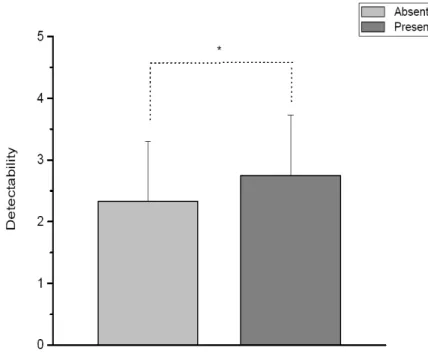
D-prime was greater in the auditory stimulus present condition than in the auditory stimulus absent condition (t17=-2.86, p=0.011) (Figure 1). This indicates that the detectability of the target stimulus was increased by the
auditory stimulus. (Note 1)
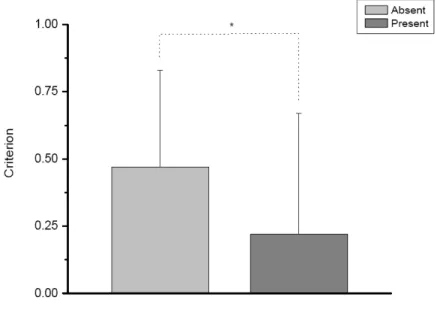
C was lower in the auditory stimulus present condition than in the auditory stimulus absent condition (t17=3.00,
p=0.008) (Figure 2). This indicates that the criterion to judge that the target stimulus had occurred was lowered by the auditory stimulus. (Note 2)
4. Discussion
The present study demonstrated that automatic temporal expectation, in the case mobilized by a prime auditory stimulus, increases the detectability of a visual target stimulus which occurs 200 ms later. It also reduces the criterion to judge that this target had occurred. These seem to be the first more direct behavioral demonstrations that automatic temporal expectation modulates both sensory and decisional processing.
As mentioned in the Introduction, previous studies have indicated that automatic temporal expectation facilitates premotor processes. With the exception of the study of Rolke and Hofmann (2007), the exact level of action of this facilitatory influence was not specified. It could be either a sensory level or a decisional level or both levels. Rolke and Hofmann (2007) presented evidence suggesting an action at the sensory level. The present results confirm this conclusion and extend it to the decisional level.
Lippert, Logothetis, and Kayser (2007) demonstrated that both the detection and the discrimination rates of visual targets are increased by an auditory stimulus that always occurs synchronously. Signal detection analyses of their results revealed that detectability-discriminability, as indicated by the d-prime, was increased and criterion, as indicated by C, was reduced by the auditory stimulus. Although their results are in agreement with those obtained in this work, it is not clear to what extent they can be attributed to automatic temporal expectation due to the simultaneity of the auditory stimulus. It is more parsimonious to suppose that they were due to a very different process, namely an integration of the auditory prime stimulus signals and the visual target stimulus signals at an early sensory level. The authors disconsidered this possibility on basis of the fact that when they reduced the relevance of the auditory prime stimulus, its facilitatory effect disappeared. This evidence is, however, far from conclusive. It might well be that the reduction of the relevance of the auditory prime stimulus led to its partial habituation and, consequently, an appreciable reduction of any sensory integration and its behavioral effects. The current findings that automatic temporal expectation facilitates sensory processing parallels the findings reported for controlled temporal expectation. Thus, Correa et al. (2005, 2006) presented behavioral and electrophysiological evidence that this kind of attention increases visual processing. They demonstrated that d-primes were higher in a rapid serial visual presentation task when temporal expectation was validly oriented than when it was invalidly oriented. They also demonstrated that the P1 component of the visual evoked potential in a discrimination task was larger for the valid condition than for the invalid condition. Additional electrophysiological evidence for an influence of temporal expectation on sensory processing was presented by Sanders and Astheimer (2008) and Anderson and Sheinberg (2008). The former authors demonstrated that the N1 component of the auditory evoked potential in a discrimination task was larger for the expected time than for other times. The latter authors demonstrated that targets that appeared at the expected time produced more robust neuronal spiking and larger evoked local field potentials in the monkey inferior temporal cortex than targets which appeared at another time.
It could be argued that, since the auditory prime stimulus was always succeeded by the visual target stimulus at a fixed interval, controlled temporal expectation (characterized as intentional) was mobilized. We cannot exclude some involvement of this kind of temporal expectation in our results; however, we consider it less important than the contribution of automatic temporal expectation (characterize as unintentional). First of all, the very short interval between the auditory prime stimulus and the visual target stimulus, namely 200 ms, should have made very difficult to generate a controlled temporal expectation. Second, no explicit indication of a relationship between the two stimuli was provided, clearly distinguishing the procedure used in this work from that commonly used to mobilize controlled temporal expectation.
In conclusion, the current study results indicate that automatic temporal expectancy facilitates both sensory processing and decisional processing.
References
Anderson, B., & Sheinberg, D. (2008). Effects of temporal context and temporal expectancy on neural activity in
inferior temporal cortex. Neuropsychologia, 46, 947-957.
http://dx.doi.org/10.1016/j.neuropsychologia.2007.11.025
Bausenhart, K. M., Rolke, B., Hackley, S. A., & Ulrich, R. (2006). The locus of temporal preparation effects: Evidence from the psychological refractory period paradigm. Psychonomic Bulletin & Review, 13, 536-542. http://dx.doi.org/10.3758/BF03193882
Bertelson, P., & Tisseyre, F. (1969). The time-course of preparation: Confirmatory results with visual and auditory warning signals. Acta Psychologica, 30, 145-154. http://dx.doi.org/10.1016/0001-6918(69)90047-X
Bueno, V. F., & Ribeiro-do-Valle, L. E. (2010, Sept.). Influence of temporal attention mobilized by auditory stimuli in visual discrimination tasks. XXXIV Annual Meeting of the Brazilian Society for Neurosciences and Behavior, Caxambu, MG, Brazil.
Correa, A., Lupiáñez, J., & Tudela, P. (2005). Attentional preparation based on temporal expectancy modulates processing at the perceptual level. Psychonomic Bulletin & Review, 12, 328-334. http://dx.doi.org/10.3758/BF03196380
Correa, A., Lupiáñez, J., Madrid, E., & Tudela, P. (2006). Temporal attention enhances early visual processing: A review and new evidence from event-related potentials. Brain Research, 1076, 116-128. http://dx.doi.org/10.1016/j.brainres.2005.11.074
Coull, J.T., Frith, C.D., Büchel, C., & Nobre, A.C. (2000). Orienting attention in time: behavioural and neuroanatomical distinction between exogenous and endogenous shifts. Neuropsychologia, 38, 808-819. http://dx.doi.org/10.1016/S0028-3932(99)00132-3
Del-Fava, F., & Ribeiro-do-Valle, L. E. (2004). Relative contribution of expectancy and immediate arousal to the facilitatory effect of an auditory accessory stimulus. Brazilian Journal of Medical and Biological Research, 37, 1161-1174
Engel, A.K., Fries, P., & Singer, W. (2001). Dynamic predictions: oscillations and synchrony in top-down processing. Nature Review Neuroscience, 2, 704-716. http://dx.doi.org/10.1038/35094565
Fecteau, J. H., & Munoz, D. P. (2007). Warning signals influence motor processing. Journal of Neurophysiology, 97, 1600-1609. http://dx.doi.org/10.1152/jn.00978.2005
Fernandez-Duque, D., & Posner, M. I. (1997). Relating the mechanisms of orienting and alerting.
Neuropsychologia, 35, 477-486. http://dx.doi.org/10.1016/S0028-3932(96)00103-0
Hackley, S. A., Langner, R., Rolke, B., Erb, M., Grodd, W., & Ulrich, R. (2009). Separation of phasic arousal and expectancy effects in a speeded reaction time task via fMRI. Psychophysiology, 46, 163-171. http://dx.doi.org/10.1111/j.1469-8986.2008.00722.x
Hackley, S. A., & Valle-Inclán, F. (1998). Automatic alerting does not speed late motoric processes in a reaction-time task. Nature, 391, 786-788. http://dx.doi.org/10.1038/35849
Hackley, S. A., & Valle-Inclán, F. (2003). Which stages of information processing are speeded by a warning signal?
Biological Psychology, 64, 27-45. http://dx.doi.org/10.1016/S0301-0511(03)00101-7
Jennings, J. R., Van der Molen, M. W., & Steinhauer, S. R. (1998). Preparing the heart, eye, and brain: foreperiod
length effects in a nonaging paradigm. Psychophysiology, 35, 90-98.
http://dx.doi.org/10.1111/1469-8986.3510090
Keuss, P. J. G. (1972). Reaction time to the second of two shortly spaced auditory signals both varying in intensity.
Acta Psychologica, 36, 226-238. http://dx.doi.org/10.1016/0001-6918(72)90007-8
Leuthold, H. (2003). Programming of expected and unexpected movements: effects on the onset of the lateralized readiness potential. Acta Psychologica, 114, 83-100. http://dx.doi.org/10.1016/S0001-6918(03)00051-9
Lippert, M., Logothetis, N. K., & Kayser, C. (2007). Improvement of visual contrast detection by a simultaneous sound. Brain Research, 1173, 102-109. http://dx.doi.org/10.1016/j.brainres.2007.07.050
Macmillan, N. A., & Creelman, C. D. (2005). Detection Theory. A User’s Guide. Mahwah, NJ: Lawrence Erlbaum.
Mattes, S., & Ulrich, R. (1997). Response force is sensitive to the temporal uncertainty of response stimuli.
Perception & Psychophysics, 59, 1089-1097. http://dx.doi.org/10.3758/BF03205523
Miller, J., & Anbar, R. (1981). Expectancy and frequency effects on perceptual and motor systems in choice reaction time. Memory and Cognition, 9, 631-641. http://dx.doi.org/10.3758/BF03202358
Müller-Gethmann, H., Ulrich, R., & Rinkenauer, G. (2003). Locus of the effect of temporal preparation: Evidence
from the lateralized readiness potential. Psychophysiology, 40, 597-611.
http://dx.doi.org/10.1111/1469-8986.00061
Niemi, P., & Näätänen, R. (1981). Foreperiod and simple reaction time. Psychological Bulletin, 89, 133-162. http://dx.doi.org/10.1037/0033-2909.89.1.133
Nobre, A. C., Correa, A., & Coull, J. T. (2007). The hazards of time. Current Opinion in Neurobiology, 17, 465-470. http://dx.doi.org/10.1016/j.conb.2007.07.006
Posner, M. I., Nissen, M. J., & Klein, R. M. (1976). Visual dominance: An information-processing account of its origins and significance. Psychological Review, 83, 157-171. http://dx.doi.org/10.1037/0033-295X.83.2.157 Rolke, B., & Hofmann, P. (2007). Temporal uncertainty degrades perceptual processing. Psychonomic Bulletin & Review, 14, 522-526. http://dx.doi.org/10.3758/BF03194101
Sanders, A. F. (1998). Elements of Human Performance. Mahwah, NJ: Lawrence Erbaum.
Sanders, L. D., & Astheimer, L. B. (2008). Temporally selective attention modulates early perceptual processing: Event-related potential evidence. Perception & Psychophysics, 70, 732-742. http://dx.doi.org/10.3758/PP.70.4.732
Scheirs, J. G. M., & Brunia, C. H. M. (1982). Effects of stimulus and task factors on Achilles tendon reflexes evoked early during a preparatory period. Physiology and Behavior, 28, 681-685. http://dx.doi.org/10.1016/0031-9384(82)90051-8
Smith, P. L., & Wolfgang, B. J. (2004). The attentional dynamics of masked detection. Journal of Experimental Psychology: Human Perception & Performance, 30, 119-136. http://dx.doi.org/10.1037/0096-1523.30.1.119 Taylor, M. M., & Creelman, C. D. (1967). PEST: Efficient estimates on probability functions. Journal of the Accoustical Society of America, 41, 782-787. http://dx.doi.org/10.1121/1.1910407
Ulrich, R., & Mattes, S. (1996). Does immediate arousal enhance response force in simple reaction time? The Quarterly Journal of Experimental Psychology, 49A, 972-990. http://dx.doi.org/10.1080/027249896392397 Van der Heijden, A. H. C. (1992). Selective attention in vision. New York, NY: Routledge.
Van der Lubbe, R. H. J., Keuss, P. J. G., & Stoffels, E.-J. (1996). Threefold effect of peripheral precues: alertness,
orienting, and response tendencies. Acta Psychologica, 94, 319-337.
http://dx.doi.org/10.1016/S0001-6918(96)00005-4
Weis, S., Fimm, B., Longoni, F., Dietrich, T., Zahn, R., Herzog, H., Kemna, L., Wilmes, K., & Sturm, W. (2000). The functional anatomy of intrinsic and phasic alertness in a PET-study with auditory stimulation. Neuroimage, 11, 10. http://dx.doi.org/10.1016/S1053-8119(00)90945-5
Figure 1. Target stimulus detectability, as evaluated by the d-prime measure (mean±s.e.m.), in the absence and in the presence of the auditory prime stimulus
Figure 2. Criterion to decide that the target stimulus had occurred, as evaluated by the C measure (mean±s.e.m.), in the absence and in the presence of the auditory prime stimulus