A contingency model for estimating success of strategic information systems
planning
Tamir Bechor
a, Seev Neumann
b, Moshe Zviran
b, Chanan Glezer
c,*
aSchool of Information Systems and Technology, Claremont Graduate University, Claremont, CA, USAb
Management of Technology and Information Systems Department, Faculty of Management, Tel Aviv University, Tel Aviv, Israel c
Department of Industrial Engineering and Management, Faculty of Engineering, Ariel University Center of Samaria, Ariel, Israel
1. Introduction
The dynamic and uncertain nature of today’s environment entails observation on many levels, of the structural, business, to technological environment. New patterns of interaction within organizations, such as moving from vertical integration to outsourcing, and to virtual organizations, allow the development of strategic alliances and partnerships that enable firms to focus on their core competencies. Organizations are changing in response to these needs by becoming flat, fast, flexible, adaptive, collaborative and information-intensive structures, by using IT.
The impact of this on strategic management has been to provoke the adoption of total system thinking, i.e., management of the entire strategy process and its components[11], thus, there is clearly a need for preliminary strategic planning activities to successfully assimilate the ITs[16].
Strategic information system planning (SISP)is the process of strategic thinking that identifies the most desirable IS on which the firm can implement and enforce its long-term IT activities and policies. It is a mechanism for assuring that IT activities are aligned with the organization’s evolving needs and strategies [15], SISP was identified as a critical management issue in the 1990s and is still
ranked high as a critical issue today of key issues in IS manage-ment.
With the pervasiveness of IT in the 2000s and increasing pressure on firms to leverage their IT assets, the importance of SISP has increased[7]. Organizations are now investing extensively in IS to obtain maximum benefits of IT. But ISs are often deemed unsuccessful due to lack of alignment between IS and business planning; huge divergence in the approaches adopted by different enterprises in time, cost, and environmental factors and ignoring of IS project management activities in most enterprises, especially SMEs[6].
While studies have indicated the important effect of context on IS planning, the incorporation of contextual factors has not been general and categorization of the factors has not been made explicit while some factors have only been superficially examined
[4]. As centralization increases, IT tends to control the planning process and, as a result, IS planning becomes more tactical than strategic and is dominated by IT infrastructure planning.
Prior research on the difficulties that SISP processes have encountered, suggested that the competitive environment, with its rapidly changing IT, may exacerbate the dangers of ineffective planning. Surveys have found that more than half of the parties involved in SISP are dissatisfied with the outcome.
Researchers have investigated SISP success, and its factors and problems, the effect of top management support[8], SISP process
[12,13], IS planning methodologies and approaches, planning
A R T I C L E I N F O
Article history:
Received 23 January 2009
Received in revised form 21 May 2009 Accepted 12 September 2009 Available online 19 September 2009
Keywords:
Strategic information systems planning (SISP)
Key success factors Planning approach Planning context Contingency theory IS planning paradox
A B S T R A C T
Strategic information system planning (SISP) has been identified as a critical management issue. It is considered by many as the best mechanism for assuring that IT activities are congruent with those of the rest of the organization and its evolving needs.
Our research investigated the success of SISP as a function of its key success factors (KSFs) in different contexts and SISP approaches, in a framework that integrated all of the SISP components and provided a new perspective on how the constructs are instrumental to produce SISP success.
Based on responses from 172 American CIOs, our study’s findings empirically supported our research model: the combination of SISP context and approach was found to have a moderating influence on the basic relationship between SISP KSFs and its success, the best predictor for the long-term success of the SISP process was apparently based on the three-way interactions between SISP’s KSFs, its approach and its context. In addition, specific combinations of SISP approach and SISP context were found to decrease or increase the size of the ‘‘planning paradox’’ (the inconsistency in the behavior of the ‘‘basic relationship’’ between the three).
ß2009 Elsevier B.V. All rights reserved.
* Corresponding author. Tel.: +972 3 6440414; fax: +972 3 6440414.
E-mail address:[email protected](C. Glezer).
Contents lists available atScienceDirect
Information & Management
j o u r n a l h o m e p a g e : w w w . e l s e v i e r . c o m / l o c a t e / i m0378-7206/$ – see front matterß2009 Elsevier B.V. All rights reserved. doi:10.1016/j.im.2009.09.004
horizon, business change, IT change, and their alignment[14], and various other aspects of the planning process [9]. Empirical research investigating the influence of IS planning on SISP success has been based on a general list of organizational characteristics or specific aspects, such as the need to conduct comprehensive planning in a turbulent environment, the external IT and business environment[2], environmental analysis[3], or the impact of the role of IS in the organization.
Few researchers have tried to identify and understand the integration among the various design dimensions of the planning process[1,5], though there has been some discussion on the main dimensions of the SISP process and their impact on SISP success but with no empirical support. These problems have led to the suggestion that contingency theory would be an appropriate mechanism with which to study SISP.
We decided to study and empirically test a new framework for understanding SISP success, premising that a multidimensional examination could provide a successful process.
2. Model background
The variables that impact on the success of the SISP process can be categorized on one of three dimensions:
Key success factorsincluding a variety of prescriptions that reflect the ‘‘rational behavior’’ of the SISP process. Research studies that focus on this dimension examine the necessary conditions (e.g., user participation) that make the process more effective in studying the correlation between KSFs and SISP success. However there is a possible planning paradox: the success of the SISP process cannot be solely predicted from the KSFs, which may adversely affect the success of the SISP process.
The planning approachincluding decision variables that represent various alternatives for the planning style adopted during the SISP process (e.g., what is the planning focus? what is the time horizon covered in it?). Organizations sometimes use a commercial methodology that dictates the attributes of the planning approach.
The planning contextincluding variables that represent attributes of the organization and its environment. These include external conditions that can impact the process and its success (e.g., the
level of environmental uncertainty, the organizational structure, and importance of IT to the organization).
The importance of fit between the planning approach and the planning context has been emphasized in strategic management literature, including the area of strategic IT planning. Newkirk and Lederer found that greater SISP comprehensiveness predicted greater SISP success. In another study, they found that more extensive strategy formulation uniformly predicted successful planning in more uncertain environments, whereas strategic awareness generally predicted it in less uncertain ones.
Many studies have examined one dimension only (KSFs or approach or context), a few have examined two dimensions and tested their interactions and/or their mutual impact, but very few have included all three.
3. Our research model
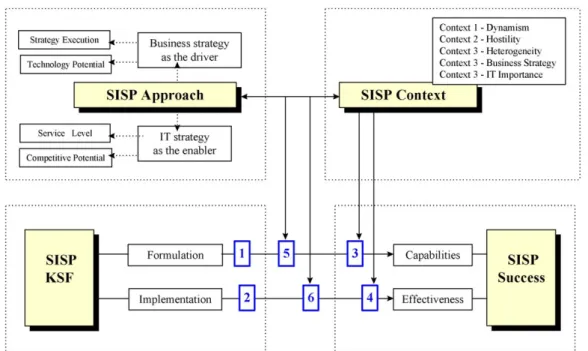
The conceptual framework presented inFig. 1involves the three dimensions in a model that attempts to explain success in an SISP process. The research model is based on contingency theory, postulating abasic relationshipbetween two variables moderated by a contingency variable. It is commonly used in studies pertaining to strategic planning at the corporate level and has also been applied in investigating IS management processes. It has been used to study the SISP process in relation to its fit with environmental characteristics, with the role of IS, and with corporate strategy.
3.1. SISP success—dependent variable
We defined the success of the SISP process as depending on two variables:
1. The degree of improvement in the capabilities associated with the SISP process.
2. The degree of effectiveness in meeting the objectives of the SISP process.
According to Raghunathan and Raghunathan: ‘‘the system capabilities. . .can be viewed as the ‘‘means’’ or process aspect of
the concept of planning success and as a predictor of the ‘‘ends’’ or outcome benefits of planning, i.e., the fulfillment of planning objectives’’. Their findings support the assumption that capabilities and effectiveness are two different variables that measure the SISP process along different time horizons. The first variable represents the short-term planning improvement benefits that can be achieved during or immediately after the plan formulation phase of the SISP process. The second represents the goal-centered approach to the evaluation of effectiveness, or the long-term benefits from the process, achieved during or after the imple-mentation of the plan.
In our model, SISP success is measured by the degree of improvement in planning capabilities, which reflect short-term success, during or after plan formulation, and by the degree of planningeffectiveness, which reflects long-term success, during or after plan implementation. The operational definitions of these variables (Appendix A, part D) are based on previous studies that reported a high degree of internal validity and consistency of the measures for the capabilities and the effectiveness variables. 3.2. SISP KSFs (The SISP process)—independent variable
We assumed that the KSFs (Appendix A, part B) relating to the strategy formulationphase of the SISP process were different from those relating to theimplementationphase, and suggested there-fore that KSFs should be categorized according to the phase in which they appear. It is an approach that has been adopted in research on IS planning and has shaped the design of research models in the area. Furthermore, it allowed presentation of the independent variable along different time horizons, similar to that of the dependent variable. 18 KSFs were selected to represent the two phases of the SISP process.
3.3. SISP approach—moderating variable
In light of its importance in research on key IS management issues, we adopted the dimension of alignment between corporate strategy and IT to describe the SISP approach (Appendix A, part C). This construct was measured using the four dominant perspectives of Henderson and Venkatraman’s Strategic Alignment Model, which has been used in previous empirical studies. The first perspective (strategy execution) is based on using the traditional hierarchical approaches for strategic planning of IT, like Rockart’s CSF or IBM’s BSP. The second (technology potential) is based on a technological focus on attributes and critical areas of IT that fit a chosen organizational strategy. The third (service level) mainly focused on developing the capabilities of the IS group to handle more flexibly and efficiently unexpected future demands of end-users, and situations when organizational strategies are unclear or change frequently. The fourth (competitive potential) relates to the impact of IT on business strategy and on the redesign of business processes.
3.4. SISP context—moderating variable
Following studies, SISP context (Appendix A, part A) is a wrapping (meta-) construct which incorporates three component contexts: environmental – referring to uncertainty; organizational – dealing with business strategy issues; and technological – referring to IS importance.
4. Hypotheses
The research model ofFig. 1was derived from the conversion of the dimensions of the conceptual framework into crisp variables. Boxed numbers denote the six research hypotheses.
The first two hypotheses concern a basic relationship between SISP KSFs and SISP success:
H1. There is a positive association between SISP key success factors in the formulation phase of the SISP process and the improvement in planning capabilities.
H2. There is a positive association between SISP key success factors in the implementation phase of the SISP process and the effectiveness of the SISP process.
H1and H2represented a ‘‘narrow’’ research perception that investigated a relationship between a single explanatory variable (SISP KSFs) and a dependent variable (SISP success). This is problematic and was expected to fail in explaining the dependent variable, leading to the planning paradox. Therefore, this basic relationship was later investigated with two contingency variables (SISP context and SISP approach) that were presumed to affect it. Hypotheses H3–H6 investigated the existence of an interaction effect, i.e., whether the impact of SISP KSFs on SISP success, disregarding SISP context and SISP approach, was different from the impact when SISP context and SISP approach were considered.
H3andH4tested whether SISP context or SISP approach separately affected the basic relationship, whereasH5andH6tested whether the basic relationship was affected by the combined impact of SISP context and SISP approach.
H3andH4reflect the assumption that considering only the SISP context or SISP approach, but not both, does not explain the basic relationship. Therefore, our expectation was that both would be rejected.
H3. The impact of SISP key success factors in the formulation phase on the improvement in planning capabilities is dependent on the SISP context or the SISP approach.
H4. The impact of SISP key success factors in the implementation phase on the effectiveness of the SISP process is dependent on the SISP context or the SISP approach.
Two additional hypotheses proposed the existence of a three-way interaction between SISP KSFs, SISP context, and SISP approach that triggers a joint effect of these three on SISP success. H5. The impact of SISP KSFs in the formulation phase on the improvement in planning capabilities is dependent on the degree of fit between the SISP context and the SISP approach.
H6. The impact of SISP KSFs in the implementation phase on the effectiveness of the SISP process is dependent on the degree of fit between the SISP context and SISP approach.
5. Research methodology
The data for this study were collected by means of a questionnaire. Its validity and clarity were pre-tested in a pilot implementation with five IS faculty and 22 graduate students (who were practicing CIOs). The pilot tested internal consistency among questions, biases, errors of syntax and structure and filling out time, and resulted in suggestions for improvements.
The survey respondents were CIOs of US firms. This choice was based on the findings of previous studies that CIOs were the main drivers of the SISP process and were involved in it more than other managers.
The sampling population was the Directory of Top Computer Executives, East and West Edition. After deleting small organiza-tions (less than 300 employees), questionnaires were mailed to a random sample of 2300 organizations, of which 167 responded within 2 months. Reminders were then sent to a random sample of
500 organizations drawn from the non-respondents (the limit of 500 reminder letters was due to research budget constraints), resulting in 39 additional responses.
Out of the 206 responses, 185 questionnaires were acceptable for analysis. Of these, 13 were returned by organizations that had not implemented an SISP process. The remaining 172 question-naires were amenable to statistical analysis. The demographics of respondent organizations are given inTable 1.
The low response rate 9%, 206 responses out of 2300 mailed questionnaires, may be due to:
1. Low response rates are typical of American CIOs.
2. As 93% of the responding organizations (172 out of 185 proper responses) had implemented a SISP process, it can be assumed that many CIOs did not respond because their organizations had not implemented an SISP process.
3. Organizations tend not to disclose information on strategic issues. In spite of our promise of confidentiality, CIOs may have been unwilling to disclose strategic information to an outsider. The need to report on the degree of SISP success or admit a failure may have posed additional difficulties that reduced the response rate.
4.Problematic timing. The questionnaires and reminders were mailed between November and January, a time when many mangers are on vacation and/or are involved in reporting and planning sessions; thus, may not have had time to fill out the questionnaires.
To eliminate the possibility of a non-response bias, the late return technique was performed to verify that the sample of 172 responses is also representative of the organizations that did not respond. The test was based on the common assumption that those who responded in the second round (39 out of 500) represented the non-respondents.
The sample of 206 responding organizations was divided into the group of 167 early respondents (replying before the reminder) and the group of 39 late respondents. A Pearson Chi-square test was used to investigate whether the two groups differed in terms of economic sector affiliation, number of employees and annual sales. The null hypothesis stated that there was no significant difference between the two groups. It could not be rejected at a 5% level of significance for the three variables. We thus concluded that the early and late respondents were similar and that the sample of observations represents the sampling frame from which it was drawn and thus can be used for statistical analysis. This improved the external validity of the questionnaire and added confidence to the validity of the statistical conclusions.
5.1. Validity and reliability assessment
The quality of measurement of the research variables was examined by applying statistical techniques.External validitywas tested by applying the non-response bias test. Previous studies have tested content validity by adopting operational definitions that proved valid in earlier studies, by using different principles for the design of the questionnaire; and pre-testing a pilot ques-tionnaire on a sample of the target population.
Factor analysis was used to test construct validity and discriminant validity. The factor analysis was initially performed on the 12 items that represent SISP success; see the capabilities and effectiveness statements inAppendix A.Table 2exhibits the factor groupings and their loading values.
An exploratory factor analysis with two factors grouped the SISP success measurement items into two categories: six items (S01– S06) converged into one factor that reflected the capabilities and satisfaction improvement dimension; the other six converged into a factor that represented the effectiveness of the SISP process. It was later used to measure the long-term success of the SISP process. A confirmatory factor analysis (CFA) was also performed on the detailed items: it supported their convergence into two factors.
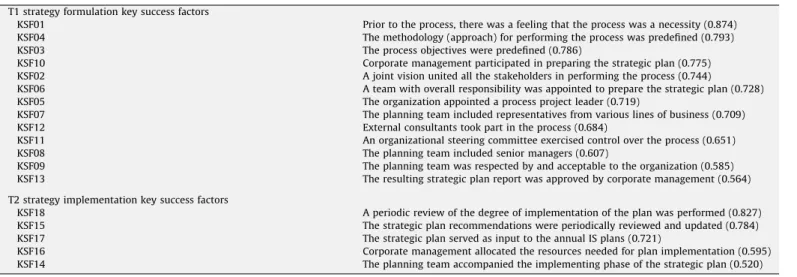
Exploratory factor analysis was also performed on the 18 measurement items that represent the SISP KSFs. The 18 items converged into two factors, as depicted inTable 3. Items KSF01– KSF13 converged into one named ‘‘strategy formulation’’ and items KSF14–KSF18 collapsed into a factor ‘‘achieving effectiveness of the SISP process’’.
The SISP KSFs of the implementation phase converged into a single category that included items measuring the quality of plan implementation. Factor analysis of the 10 items representing environmental uncertainty was performed to validate their Table 1
Sectorial distribution of respondent organizations.
Sector Number of respondents No SISP SISP Sector % out of total SISP
Industry 64 4 60 34.6 Insurance 22 4 18 11.9 Banking 2 0 2 1.1 Other financial 5 1 4 2.7 Commerce 11 0 11 5.9 Education 14 0 14 7.6 Health 14 0 14 7.6 Transportation 6 0 6 3.2 Infrastructure 14 1 13 7.6 Federal administration 1 0 1 0.5 State administration 15 0 15 8.1 Local administration 15 3 12 8.1 N/A 2 0 2 1.1 Total 185 13 172 100% Table 2
Factor loadings for SISP success.
T1 improving capabilities and satisfaction
S03 Identifying new ideas and opportunities (0.832)
S05 Establishing uniform basis for prioritizing IT projects (0.772) S02 Identifying key problem areas (0.728)
S04 Improving coordination of decision making (0.706)
S06 Improving control of human, software and hardware resources (0.689) S01 Understanding the information needs of the business (0.523) T2 achieving effectiveness of the SISP process
S08 Gaining a competitive advantage from IT (0.815) S07 Anticipating changes and trends in the industry (0.784) S09 Aligning IT with business needs (0.731)
S10 Implementing appropriate information architecture (0.692) S11 Increasing user satisfaction with IT services (0.621) S12 Increasing top management commitment to IT (0.568)
subdivision into three categories that represented the degrees of dynamism, hostility, and heterogeneity.Table 4depicts the factor groupings and loading values as prescribed by the conceptual framework of our study.
The validity of the business strategy variable was tested by a statistical analysis of its relationship with the number of employees in the sampled organizations. An ANOVA at a 0.05 significance level showed a significant association between the two variables (
x
2= 17.8,df= 8,p= .023), supporting the validity of measuring business strategy as a categorical variable.Similarly, the validity of the measurements of the variablesIS roleandSISP approachwas tested by an analysis of the relationship between them, based on empirical findings that confirmed the relationship between two phenomena representing a growth cycle. An analysis of variance at a 0.05 significance level resulted in a significant relationship between the two variables (
x
2= 27, df= 6,p= .000), indicating that the measurements of the variables had an acceptable validity.The reliability of the research variables was examined by the degree of internal consistency, using Cronbach’s alpha test with a minimum value of
a
>0.7 as a limit for an acceptable reliability. The values in Table 5for the research variables, the number of items used to measure them, and the correspondinga
values indicate a high degree of internal consistency among the items. 6. Analysis and findings6.1. Descriptive statistics
Table 6 exhibits the descriptive statistics for the research variables. As evident from the results, the responses represent almost the full range of values on the 1–7 scales, facilitating an effective analysis of the data.
Using the Miles and Snow typology[18]to measurebusiness strategy, 39% of the 172 organizations were shown to have a defender strategy, 46% had an analyzer strategy and 15% a prospector strategy.
IS role/importancewas measured on the basis of a typology that identified three organization types that differ in terms of integrating IT with business strategy. In 92% of the sampled organizations, the IS group supported, or was involved in, business strategy. Less than 8% reported a minor role of IS, expressed in support of operations only.
SISP approach was measured on the basis of Henderson and Venkatraman’s typology of four perspectives for IS strategic planning that differ in terms of the strategic fit between the organization and IS. More than 38% of the sampled organizations used a competitive potential planning approach, which is akin to BPR. About 31% used Table 5
Reliability of research variables (Cronbach’s coefficienta).
Variable Number
of items
Cronbach’s coefficienta
SISP key success factor (formulation phase) 13 0.7819 SISP key success factor (implementation phase) 5 0.7433 SISP success (capabilities) 3 0.8195 SISP success (effectiveness) 4 0.8044 SISP context (dynamism) 4 0.7455 SISP context (hostility) 3 0.8292 SISP context (heterogeneity) 3 0.8499
Table 3
Factor loadings for SISP key success factors. T1 strategy formulation key success factors
KSF01 Prior to the process, there was a feeling that the process was a necessity (0.874) KSF04 The methodology (approach) for performing the process was predefined (0.793) KSF03 The process objectives were predefined (0.786)
KSF10 Corporate management participated in preparing the strategic plan (0.775) KSF02 A joint vision united all the stakeholders in performing the process (0.744)
KSF06 A team with overall responsibility was appointed to prepare the strategic plan (0.728) KSF05 The organization appointed a process project leader (0.719)
KSF07 The planning team included representatives from various lines of business (0.709) KSF12 External consultants took part in the process (0.684)
KSF11 An organizational steering committee exercised control over the process (0.651) KSF08 The planning team included senior managers (0.607)
KSF09 The planning team was respected by and acceptable to the organization (0.585) KSF13 The resulting strategic plan report was approved by corporate management (0.564) T2 strategy implementation key success factors
KSF18 A periodic review of the degree of implementation of the plan was performed (0.827) KSF15 The strategic plan recommendations were periodically reviewed and updated (0.784) KSF17 The strategic plan served as input to the annual IS plans (0.721)
KSF16 Corporate management allocated the resources needed for plan implementation (0.595) KSF14 The planning team accompanied the implementing phase of the strategic plan (0.520)
Table 4
Factor loadings for SISP context (environmental uncertainty). Dynamism
UNCRT1 Products or services in our industry become obsolete very quickly (0.842)
UNCRT2 The technologies underlying products or services in our industry change very quickly (0.773) UNCRT3 We cannot predict what our competitors are going to do next (0.699)
UNCRT4 We cannot predict when the demand for our products or services will change (0.624) Hostility
UNCRT5 The survival of our organization is currently threatened by tough price competition (0.888)
UNCRT6 The survival of our organization is currently threatened by tough competition in product/service quality (0.820) UNCRT7 The survival of our organization is currently threatened by tough competition in product/service differentiation (0.815) Heterogeneity
UNCRT8 In our industry, there is considerable diversity in customers’ buying habits (0.880) UNCRT9 In our industry, there is considerable diversity in nature of competition (0.875) UNCRT10 In our industry, there is considerable diversity in product lines (0.803)
the more traditional strategy execution approach, which assumes that the IS infrastructure is a passive entity that supports organizational strategy and processes. About 18% used a technology potential approach, and about 12% used a service level approach. 6.2. Testing the basic relationship hypotheses: H1, H2
The relationship between SISP KSFs and SISP Success was the basic relationship in our research. The statistical analyses of this relationship are shown inTables 7 and 8as H1: for short-term success and H2: for long-term success.
The results indicate that H1 and H2 cannot be rejected, suggesting that:
The KSFs for the formulation phase of the SISP process positively affect planning capabilities.
The KSFs for the implementation phase positively affect the effectiveness of the SISP process.
Confirmation of these research hypotheses strengthens the findings of earlier studies.
6.3. Testing the hypotheses of the contingency model for predicting short-term SISP success (H3, H5)
H1 and H2 reflect a ‘‘narrow’’ perception that investigates a relationship between a single explanatory variable (SISP KSFs) and a dependent variable (SISP success). As this perception is destined
to fail (the planning paradox), this tests the basic relationship as impacted by two contingency variables (SISP context and SISP approach). The main statistical techniques for investigating interactions in a contingency model are ANOVA and moderated multiple regression (MMR).
The partial contingency model underlying H3 investigated whether the SISP context or SISP approach variables directly affected SISP success in the short term and/or individually moderate the basic model:
H3:
Capabilities¼
a
þb
1F KSFþb
2Approachþb
3F KSF Approachþb
4Contextþb
5F KSFContext The comprehensive contingency model underlying H5 inves-tigates the effect of including the combination of SISP context and SISP approach in the basic model in the short term, as represented by theb
6coefficient added to the regression equation:H5:
Capabilities¼
a
þb
1F KSFþb
2Approachþb
3F KSF Approachþb
4Contextþb
5F KSFContext þb
6F KSF ðApproach and ContextÞTable 6presents the results of testing H3 and H5. The findings of testing H3 (partial contingency model) indicated that none of the SISP context or SISP approach variables directly affected the SISP success, or moderated the basic relationship. The findings of Table 6
Descriptive statistics for the 172 organizations (scale of 1–7).
Variable Mean S.D. Data distribution
Min. 25 quartile Median 75 quartile Max.
Capabilities 5.24 .911 2 4.67 5.17 5.83 7
Effectiveness 5.11 .762 2 4.67 5.17 5.67 7
Formulation Phase_ Key Success Factors 4.98 .809 2 4.46 4.96 5.66 7 Implementation Phase_Key Success Factors 5.01 .974 2 4.40 5.20 5.60 7
Dynamism 3.99 1.142 1 3.00 4.00 4.75 7
Hostility 4.51 1.410 1 3.67 4.67 5.33 7
Heterogeneity 3.86 1.396 1 3.00 4.00 5.00 7
Table 7
Results of the regression related to SISP success in the short term.
Statistical estimates Independent variables Sig.a= 5% DR2
T bn Variable description Variable symbol
H1: Basic model
.000 .157 6.61 .452 Formulation phase KSFs F_KSF
H3: Approach and context as a single moderator
.823 .000 .22 .016 SISP approach Approach
.616 .001 .50 .240 Interaction variable F_KSF*Approach .763 .000 .30 .022 SISP context (dynamism) Dynamism .180 .009 1.34 .670 Interaction variable F_KSF*Dynamism .716 .001 .36 .026 SISP context (hostility) Hostility .432 .003 .78 .392 Interaction variable F_KSF*Hostility .510 .002 .66 .047 SISP context (heterogeneity) Heterogeneity .911 .000 .11 .058 Interaction variable F_KSF*Heterogeneity .542 .002 .61 .044 SISP context (bus. strategy) Bus_Strtgy .197 .008 1.29 .635 Interaction variable F_KSF*Bus_Strtgy
.351 .004 .93 .069 SISP context (IS role) IS_Role
.318 .005 1.00 .591 Interaction variable F_KSF*IS_Role H5: Approach and context in combination
.251 .007 1.15 .329 Three-way interaction F_KSF*Approach*Dynamism .244 .007 1.16 .330 Three-way interaction F_KSF*Approach*Hostility .715 .001 .36 .092 Three-way interaction F_KSF*Approach*Heterogeneity
.004 .040 2.89 .783 Three-way interaction F_KSF*Approach*Bus_Strategy .718 .002 .56 .084 Three-way interaction F_KSF*Approach*IS_Role
N= 172, dependent variable = capabilities, F_KSF = formulation phase KSFs, I_KSF = implementation phase KSFs. Bold values significance are listed as 5%.
testing H5 (the comprehensive contingency model) showed that the various combinations of SISP context, in terms of dynamism, hostility, heterogeneity or IS role, and SISP approach did not have a joint effect on the basic relationship. The one exception was the significant interaction between SISP KSFs, SISP approach and SISP context (in terms of business strategy), which added somewhat to the explanation of the basic model.
6.4. Testing the hypotheses of the contingency model for predicting long-term SISP success (H4, H6)
The partial contingency model underlying H4 investigated whether the SISP context and SISP approach variables directly affected SISP success in the long term and/or individually moderated the basic model:
H4:
Effectiveness¼
a
þb
1I KSFþb
2Approachþb
3I KSF Approachþb
4Contextþb
5I KSFContext The comprehensive contingency model underlying H6 investi-gated the effect of including the combination of SISP context and SISP approach in the basic model in the long term, as represented byb
6coefficient added to the regression equation:H6:
Effectiveness¼
a
þb
1I KSFþb
2Approachþb
3I KSF Approachþb
4Contextþb
5I KSFContext þb
6I KSF ½Approach and ContextTable 7presents the results of testing H4 and H6. The findings of testing H4 indicated that IS role directly affected SISP success and also moderated the basic model. The other SISP context and SISP approach variables neither impacted SISP success directly nor moderated the basic model. This does not contradict the theoretical rationale of the study, which claimed that a con-tingency variable that represented approach or context alone did not moderate the basic relationship and hence called for a comprehensive contingency model.
The findings of testing H6 supported the research hypothesis. The model, which proposed that the combination of SISP approach and SISP context have a moderating effect on the basic relationship between SISP success and SISP KSFs, was empirically confirmed for most of the context variables tested (except for the environmental heterogeneity variable). The findings indicate that the best predictor of long-term SISP success was the three-way interaction between KSFs, approach, and context. These findings confirmed the comprehensive contingency model, which explained SISP success in the long term.
7. Discussion and conclusions
Our research investigated the success of the SISP process as a variable that depends on three dimensions: SISP KSFs; SISP approach; and SISP context. The model expresses a theoretical rationale that the basic relationship between SISP success and SISP KSFs (or the planning paradox) is dependent on the fit between SISP context and SISP approach.
The empirical findings confirmed the hypotheses concerning the basic relationship, indicating a positive relationship between: SISP KSFs in the formulation phase of the SISP process and the improvement in planning capabilities; and SISP KSFs in the implementation phase and the effectiveness of the SISP process. Our findings did not confirm the partial contingency model but confirmed the need to investigate SISP success under a compre-hensive contingency model.
The findings empirically confirmed the comprehensive con-tingency model for the success of the SISP process in the long term only. For all the variables tested, a significant moderating effect was found for the combination of context and approach with the basic relationship. The best prediction for long-term SISP success was based on the interaction among the three explanatory SISP variables (KSFs, context, and approach) and confirmed the theory that while a single contingency variable (SISP context) does not moderate the relationship between SISP KSFs and success, but its combination with another moderating variable (SISP approach) does generate a significant effect.
Our study was integrative and facilitated a comprehensive investigation of the SISP process. Its theoretical contribution was Table 8
Results of the regression related to SISP success in the long term.
Statistical estimates Independent variables Sig.a= 5% DR2
T bn Variable description Variable symbol
H2: Basic model
.000 .358 9.74 .599 Implementation phase KSFs I_KSF H4: Approach and context as a single moderator
.553 .001 .59 .038 SISP approach Approach
.538 .001 .61 .248 Interaction variable I_KSF*Approach .246 .005 1.16 .073 SISP context (dynamism) Dynamism .113 .010 1.59 .666 Interaction variable I_KSF*Dynamism .893 .000 .13 .008 SISP context (hostility) Hostility
.027 .019 2.23 .975 Interaction variable I_KSF*Hostility .593 .001 .53 .033 SISP context (heterogeneity) Heterogeneity .731 .000 .34 .143 Interaction variable I_KSF*Heterogeneity .663 .001 .43 .028 SISP context (bus. strategy) Bus_Strtgy .939 .000 .76 .031 Interaction variable I_KSF*Bus_Strtgy
.009 .026 2.64 .168 SISP context (IS role) IS_Role
.005 .029 2.87 1.07 Interaction variable I_KSF*IS_Role H6: Approach and context in combination
.017 .021 2.41 .629 Three-way interaction I_KSF*Approach*Dynamism
.003 .032 3.01 .764 Three-way interaction I_KSF*Approach*Hostility .179 .007 1.35 .320 Three-way interaction I_KSF*Approach*Heterogeneity
.003 .034 3.04 .733 Three-way interaction I_KSF*Approach*Bus_Strategy
.000 .059 4.30 1.33 Three-way interaction I_KSF*Approach*IS_Role
N= 172, dependent variable = effectiveness, F_KSF = formulation phase KSFs, I_KSF = implementation phase KSFs. Bold values significance are listed as 5%.
expressed in the explanation of the planning paradox, suggesting a theory that explained the inconsistency in the basic relationship and empirically confirming the dependency of the basic relation-ship on the quality of fit between SISP context and approach. As recent empirical evidence seemed to suggest a negative relation-ship between IS and firm performance, the purpose in SISP was questioned [17]. The resolution of the productivity paradox triggered practitioners’ interests and made SISP a common practice in firms[10].
Our findings also had a practical contribution, assisting CIOs in reconciling the dissonance between the considerable investment of time, capital, and human resources in SISP processes, and their IS failures, which was a key concern of CIO during the 1980s and 1990s, and in recent years has never been stronger. CIOs should therefore acknowledge the complexity of the process and engage in a preparatory planning stage (meta-planning) before starting the core SISP process.
The limitations of our study are mostly related to the research model (which has a multitude of variables and dimensions) and to the use of a mailed questionnaire as the data collection tool. The first limitation stems from the representation of dimensions of the research question. As the research model consisted of four dimensions that were not directly measurable observation, they
were converted into variables by a process of filtering, whereby the variables were chosen from a larger number of variables identified as being suitable. The research design may therefore have excluded variables of importance.
A second limitation stemmed from insufficient operational measurement of several research variables. Measurement techniques that use multi-item scales can reduce the probability of measurement errors. However, due to the large number of variables in our study, these techniques would have led to a longer questionnaire, which could have reduced the response rate. Therefore, when the measurement technique would have been based on a large a number of items, simpler techniques were selected; this involved a risk of measurement errors in the categorical measurements of some variables.
A third limitation stemmed from measuring many variables using a Likert scale, in the form of statements that express a view of a subject; this, raised the possibility of bias due to the opinion of a respondent.
Finally, the low response rate of 8.95% and the fact that the study was performed only in one country, restrict the external validity of the questionnaire. A compensating factor for the former issue was the large size of our sample, 2300.
Appendix A. All responses will be kept strictly confidential Part A—Characteristics of the organizationa.
aPart A operationalized the Context construct in the research model.
Part B—SISP process in your organizationsb. Appendix A(Continued)
bPart B operationalized the KSF construct in the research model.
Part C—SISP approach in your organizationsc. Appendix A(Continued)
c
Part C operationalized the approach construct in the research model. Part D—Contribution of the SISP processd.
d
Part D operationalized the SISP Success construct in the research model. Appendix A(Continued)
References
[1] V. Basu, E. Hartono, A.L. Lederer, V. Sethi, The impact of organizational commit-ment, senior management involvecommit-ment, and team involvement on strategic information systems planning, Information and Management 39 (6), 2002, pp. 513–524.
[2] I. Brown, Investigating the impact of the external environment on strategic information systems planning: a qualitative inquiry, in: Proceedings of the 2008 Annual Research Conference of the South African Institute of Computer Scientists and Information Technologists on IT Research in Developing Countries: Riding the Wave of Technology, SAICSIT’08, vol. 338, Wilderness, South Africa, October 6–8, 2008, ACM, New York, NY, 2008, pp. 8–15.
[3] L. Chi, K.G. Jones, A.L. Lederer, P. Li, H.E. Newkirk, V. Sethi, Environmental assessment in strategic information systems planning, International Journal of Information Management 25 (3), 2005, pp. 253–269.
[4] J. Cohen, Contextual determinants and performance implications of information systems strategy planning within South African firms, Information & Manage-ment 45 (December (8)), 2008, pp. 547–555.
[5] N. Cunningham, RISE and reward? A model for the role of information systems in strategic change within healthcare organizations Organization Development Journal 19 (Spring (1)), 2001, pp. 93–108.
[6] A. Garg, D.P. Goyal, A.S. Lather, Information systems success factors in software SMEs: a research agenda, International Journal of Business Information Systems 3 (4), 2008, pp. 410–430.
[7] V. Grover, A.H. Segars, An empirical evaluation of stages of strategic information systems planning: patterns of process design and effectiveness, Information & Management 42 (5), 2005, pp. 761–779.
[8] G.S. Kearns, The effect of top management support of SISP on strategic IS management: insights from the US electric power industry, Omega 34, 2006, pp. 236–253.
[9] W.R. King, T. Teo, Assessing the impact of proactive versus reactive models of strategic information systems planning, Omega 28 (6), 2000, pp. 667–679. [10] K. Krell, S. Matook, Competitive advantage from mandatory investments: an
empirical study of Australian firms, The Journal of Strategic Information Systems 18 (March (1)), 2009, pp. 31–45.
[11] M.B. Mohdzain, K.M. Ward, A study of subsidiaries views of information systems strategic planning in multinational organisations, The Journal of Strategic Infor-mation Systems 16 (December (4)), 2007, pp. 324–352.
[12] H.E. Newkirk, A.L. Lederer, Incremental and comprehensive strategic information systems planning in an uncertain environment, IEEE Transactions on Engineering Management 53 (3), 2006, pp. 380–394.
[13] H.E. Newkirk, A.L. Lederer, The effectiveness of strategic information systems planning under environmental uncertainty, Information & Management 43 (4), 2006, pp. 481–501.
[14] H.E. Newkirk, A.L. Lederer, A.M. Johnson, Rapid business and IT change: drivers for strategic information systems planning? European Journal of Information Systems 17, 2008, pp. 198–218.
[15] R. Sabherwal, Y.E. Chau, Alignment between business and IS strategies: A study of prospectors, analysers and defenders, Information Systems Research 12 (1), 2001, pp. 11–33.
[16] H. Salmela, T.A.M. Spil, Dynamic and emergent information systems strategy formulation and implementation, International Journal of Information Manage-ment 22 (3), 2002, pp. 441–460.
[17] T. Tallon, Does IT pay to focus? An analysis of it business value under single and multi-focussed business strategies Journal of Strategic Information Systems 16 (3), 2007, pp. 278–300.
[18] R. Miles, C. Snow, Organizational Strategy, Structure, and Process, McGraw-Hill, New York, 1978.
Tamir Bechoris a visiting researcher at the School of Information System and Technology, Claremont Grad-uate University, CA, USA. He holds a Ph.D. degree in Information Systems from The Leon Recanati Graduate School of Business Administration, Tel Aviv University, Israel. His main areas of interest are Organizational and management aspects of IS, strategic thinking of IT, and IT architectures and integration platforms. Tamir worked for over 25 years in the IT industry in Israel and he has extensive experience in conducting strategic thinking processes and aligning organizational tech-nology to dynamic environments. He planned and implemented technology strategy and policies and has wide executive management experience in the design, development and deployment of IS and IT infrastructures.
Seev Neumannis the Emeritus Mexico Professor of MIS at the Recanati Graduate School of Business Adminis-tration, Tel Aviv University. Since 2006 he is the President of the College of Management. He received his BS from the Hebrew University of Jerusalem and his MBA and Ph.D. (1967) from the University of California. He has published nine books and more than 40 refereed articles. His research interests are information systems policy, information systems economics and informa-tion systems security. Since 1985, he has held a joint appointment at the School of Information Science, Claremont Graduate University. He has served as Dean of the Recanati Graduate School of Business Adminis-tration in 1973–1978 and in 1985–1989. He has held visiting positions at the University of Illinois, the University of California, Sasin Graduate School of business Administration, Bangkok, and the University of Cape Town.
Moshe Zviranis vice-dean, Chair of the Management of Technology and Information Systems program and professor of Information Systems at the Faculty of Management, The Leon Recanati Graduate School of Business Administration, Tel Aviv University. He received his B.Sc. degree in Mathematics and Compu-ter Science and the M.Sc. and Ph.D. degrees in information systems from Tel Aviv University, Israel, in 1979, 1982 and 1988, respectively. He held academic positions at the Claremont Graduate Uni-versity, California, the Naval Postgraduate School, California, and Ben-Gurion University, Israel. His research interests include information systems plan-ning, measurement of IS success, user satisfaction measurement and information systems security. He is also a consultant in these areas for a number of leading organizations. Prof. Zviran’s research has been published in MIS Quarterly, Communications of the ACM, Journal of Management Information Systems, IEEE Transactions on Engineering Management, Information and Management, Omega, Data and Knowledge Engineering, The Computer Journal and other journals. He is also co-author (with N. Ahituv and S. Neumann) of Information Systems for
Management (Tel-Aviv, Dyonon, 1996) and Information Systems – from Theory to Practice (Tel-Aviv, Dyonon, 2001).
Chanan Glezeris a senior lecturer at the Department of Industrial Engineering and Management, Ariel Univer-sity Center of Samaria, Israel. He holds a Ph.D. degree in MIS from Texas Tech University and a M.B.A. from The Leon Recanati Graduate School of Business Adminis-tration, Tel Aviv University, Israel. His main areas of interest are Electronic commerce, organizational com-puting and Internet security. His research has been published in journals such as Communications of the ACM, Journal of Organizational Computing and Electro-nic Commerce, Journal of Strategic Information Sys-tems, Data and Knowledge Engineering, Journal of Information Warfare, Journal in Computer Virology, Information Security Technical Report, International Journal of Electronic Business, and the Journal of Medical Systems.