BELTON, RHONDA ANDREWS, Ph.D. The Impacts of Experiential Learning on Leadership Identity in Female College Graduates. (2010)
Directed by Dr. Deborah J. Taub. 189 pp.
The purpose of this study was to gain a clearer understanding of how
undergraduate Experiential Learning facilitates leadership identity among female college students. The higher education research literature focuses on the leadership development of White males primarily, without examining the Experiential Learning component of a college education with regard to leadership outcomes. Most studies on leadership in higher education use a quantitative approach with leadership survey instruments. Using an interpretive research paradigm and building on previous research literature examining leadership identity in college students, the researcher asked six female college graduates about the role of Experiential Learning in their leadership identity. The students’ four year-end legacy papers from their leadership program were examined as well. The data revealed that Undergraduate Leadership, Volunteer Service, Study Abroad, and
Internships had a positive impact on leadership outcomes for the participants. Ultimately, this study revealed that this style of learning did facilitate leadership identity in female students who might not otherwise have reached full leadership identity due to their initial perceptions of leaders as being central, positional, and authoritative rather than
THE IMPACTS OF EXPERIENTIAL LEARNING ON LEADERSHIP IDENTITY IN FEMALE COLLEGE GRADUATES
by
Rhonda Andrews Belton
A Dissertation Submitted to the Faculty of The Graduate School at The University of North Carolina at Greensboro
in Partial Fulfillment
of the Requirements for the Degree Doctor of Philosophy Greensboro 2010 Approved by Committee Chair Dr. Deborah J. Taub
ii
To my beautiful daughter, Kristin.
Never stop believing in your ability to positively affect the lives of others. You can do anything you want to do if you just trust in the Lord to guide you.
iii
APPROVAL PAGE
This dissertation has been approved by the following committee of the Faculty of the Graduate School at the University of North Carolina at Greensboro.
Committee Chair Dr. Deborah J. Taub Committee Members Dr. David F. Ayers
Dr. Jane Ye He
Dr. Cherry M. Callahan
October 27, 2010
Date of Acceptance by Committee October 27, 2010
iv
ACKNOWLEDGMENTS
I would like to thank my daughter, my Mom, my boss, and my sister for their strong support during my doctoral studies. I would like to express to my doctoral
colleagues who went through this journey with me, how much I enjoyed their friendships and appreciated our study time spent together in and outside of class. I would like to thank all of my friends and colleagues at my institution who helped guide me and supported me with interest and encouragement throughout the dissertation phase. I would also like to thank my participants in this study, who truly are leaders in the world today.
I would like to let Drs. Ayers and Taub know how much I learned from them over the years about higher education in general and about conducting research. I appreciate Dr. Taub for being such a fantastic Committee Chair, for the time she gave to her students during dissertation lunch meetings in which I gained valuable information, and for helping me to refine my dissertation to a finished product of which I am very proud. I am grateful to Dr. Ayers for helping me take my writing style to a higher level of
scholarly writing. I am especially grateful to Dr. Ye He for her teachings in mixed methods research and for helping me with my analysis methods for this study. I feel honored to have Dr. Callahan on my committee and appreciate the high level
“Administrator” expertise that she brings as I am a college administrator at my institution and that is what I truly enjoy.
v
Higher Education is truly my passion. Having worked in Higher Education for many years, I truly value the growth and development that occurs in an educational environment. I love to sit through each Freshmen Convocation and watch the new freshmen class walk through the faculty lines excited to see what college has to offer them. I also love to sit through graduation each year and watch the exiting senior class walk through the same faculty lines to see what they, with the college education, can offer the world. This is a confirmation of the fact that all of us in the campus community make meaningful contributions to the lives of others. I am so appreciative of the
opportunity to have earned this Ph.D. in Higher Education and have enjoyed every step of this journey.
vi
TABLE OF CONTENTS
Page
LIST OF TABLES ... xi
LIST OF FIGURES ... xii
CHAPTER I. INTRODUCTION ...1
Studies Addressing the Problem ...2
Deficiencies in the Literature ...4
Importance of the Study ...6
Purpose Statement ...6
Research Questions and Rationale for a Qualitative Study ...7
Summary ...8
II. REVIEW OF THE LITERATURE AND CONCEPTUAL FRAMEWORK...10
Experiential Learning...10
Experiential Learning Theory ...10
Types of Experiential Learning ...14
Service Learning ...14
Volunteer Service...16
Undergraduate Student Leadership Development ...18
Leadership ...20
Leadership and Experiential Learning ...20
Leadership Reconsidered ...21
Leadership Perception ...23
Leadership Identity ...24
Recent Development in Higher Education Leadership Development ...26
Multi-Institutional Study of Leadership...26
Social Change Model of Leadership (SCM) ...27
Leadership Identity Development Model (LID) ...30
Gender and Leadership Development/Identity ...34
vii
Page
III. METHODS ...41
Introduction ...41
Design of the Study ...42
Research Site ...44
Center for Leadership Development Program at Research Site University ...45
Participants ...47 Haley ...48 Kaylin ...48 Jillian ...49 Grace ...50 Alyssa ...50 Taylor ...51
Role of the Researcher ...51
Methods of Data Collection ...52
Documents ...54 Interviews ...54 Data Analysis ...55 Validity ...60 Ethical Considerations ...62 Summary ...64 IV. FINDINGS ...65 Introduction ...65 Research Question 1 ...66
Perception of Leadership Identity ...66
Before the leadership program—(“leaders boss people around”)...67
After the leadership program—(“get people empowered”) ...68
Movement through the Leadership Identity Model Stages ...68
Stage 1—Awareness (“leadership is happening out there somewhere”) ...69
Stage 2—Exploration/engagement (“looking for leadership opportunities”) ...72
Stage 3—Leader identified (“leader-centric; positional leader”) ...72
viii
Page Stage 4—Leadership differentiated (“non-
positional leader”) ...73
Stage 5—Generativity (“making a contribution to the future”) ...76
Stage 6—Integration/synthesis (“leading effectively with confidence”) ...80
Growth Moments in Leadership ...85
View Changed over 4 Years ...88
Single positional power leadership to shared leadership ...89
Formal to informal leadership ...90
General to relational leadership, and servant leadership ...91
Summary: Research Question 1 ...93
Research Question 2 ...95
Participation in Experiential Learning ...96
Outcomes Gained from Experiential Learning ...101
Self-reported leadership outcomes ...101
Confidence ...102
Appreciation for diversity ...103
Continual desire to serve and give back ...103
Continual desire to make a difference or improve ...104
Evaluation/change in career path ...105
Professional skill sets ...105
Collaboration and shared leadership ...107
Continual desire to grow as a leader ...107
Self-awareness ...107
Continual desire for involvement...108
Better understanding of leadership ...108
Improved communication skills ...109
Seven “C”s—Outcomes of the Common Good Model ...109 Group outcomes ...110 Change ...110 Collaboration...113 Common purpose ...114 Consciousness of self ...115
Controversy with civility ...116
ix
Page
Citizenship ...117
Commitment ...118
Congruence ...119
Summary: Research Question 2 ...119
Research Question 3 ...121
Experiential Learning—Theory to Practice ...121
Haley ...122 Kaylin ...124 Jillian ...125 Grace ...126 Alyssa ...128 Taylor ...129
Support for Experiential Learning’s Contribution to Movement through the LID Model ...132
Other Factors Influencing Leadership Identity ...133
Relationships ...133
Mentors ...134
Serving as mentors to other students ...136
Breadth of involvement...137
Summary: Research Question 3 ...138
Other Emerging Themes ...139
Surprising Themes ...139
Conclusion ...142
V. DISCUSSION AND IMPLICATIONS ...144
Introduction ...144
Summary of Findings ...146
Research Question 1 ...146
Research Question 2 ...147
Research Question 3 ...152
Undergraduate experiences impact on leadership identity ...152
Other contributing factors to leadership identity—Relationships, mentors, and mentoring ...153
General Discussion and Overview ...154
Implications for Practice ...164
Limitations of the Study...166
Recommendations for Future Research ...168
x
Page
REFERENCES ...173
APPENDIX A. EMAIL SENT TO PARTICIPANTS ...182
APPENDIX B. LEGACY PAPERS OUTLINES ...183
xi
LIST OF TABLES
Page
Table 1. Research Question Matrix and Data Sources/Analysis ...53
Table 2. LID Model Movement ...70
Table 3. Participants’ Leadership/Service Today—Two Years beyond Graduation ...81
Table 4. Participants’ Growth Moments in Leadership ...86
Table 5. How Participants’ Views of Leadership Changed Over Four Years in College ...89
Table 6. Participation in Experiential Learning ...97
Table 7. Self-reported Leadership Outcomes by Participant ...101
Table 8. Experiences with Contribution to SCM Outcomes ...111
Table 9. Participants’ Meanings of Experiential Learning in their Leadership ...130
xii
LIST OF FIGURES
Page
Figure 1. Kolb’s Experiential Learning Circle (Smith, 2001) ...12
Figure 2. Leadership Identity Based on Experiential Learning ...14
Figure 3. Social Change Model (SCM) ...29
Figure 4. Leadership Identity Development Model (LID) ...32
Figure 5. Frequencies of Participants’ Self-reporting Leadership Outcomes ...102
CHAPTER I INTRODUCTION
Leadership is an important outcome of undergraduate education. Upon
graduation, men often identify as leaders, but this is less common for women (Astin & Astin, 2000; Kezar & Moriarty, 2000; Shertzer & Schuh, 2004). This reluctance to assume a leadership identity is problematic because civic engagement and career success often require women to assume leadership roles. Before women can accept leadership positions, however, they must see themselves as leaders. One possible solution to this issue is long-term leadership development programs in higher education. Unfortunately, long-term training such as multi-semester leadership programs, leadership certificate programs, leadership minors or majors, emerging leaders programs, or living-learning programs have proven less effective for female participants than for male participants (HERI, 1996). One probable explanation for this difference in effectiveness may be that women tend to learn leadership through personal experience and direct application as opposed to learning leadership through passive participation in training programs. Belenky, Clinchy, Goldberger, and Tarule (1986), in their study of “Women’s Ways of Knowing,” described one characteristic way of knowing as “connected” knowing, where knowing is through relationships with other people and the knower believes the most trustworthy knowledge comes from direct, personal experiences rather than from proclamations by authority. It may prove beneficial to the development of leadership
identity in women to incorporate Experiential Learning into leadership development programs in higher education.
Further, higher education researchers (Calizo, Cilente, & Komives, 2007) have associated short-term leadership training such as workshops, retreats, conferences, or lectures with leadership development both for men and women. Other than these findings, little is known about how the college experience (programs, experiences, relationships, and other factors in the collegiate environment) actually influences leadership identity development in college women. This is true despite the prominence of leadership development in most institutions’ missions in higher education. If
undergraduate programs are to prepare women for leadership roles, educators must learn how to promote leadership identity among female undergraduates.
Studies Addressing the Problem
Student leadership programs have been addressed in higher education literature (Cress, Astin, Zimmerman-Oster, & Burkhardt, 1991; Komives, Owen, Longerbeam, Mainella, & Osteen, 2005; Shertzer & Schuh, 2004), but college administrators still know very little about how different types of learning experiences promote desired outcomes upon graduation. Researchers have explored the relationship between Experiential Learning and leadership (Astin & Astin, 2000; Astin & Sax, 1998; Astin, Vogelgesang, Ikeda, & Yee, 2000; Bialek & Lloyd, 1997; Dugan, 2006b; Eyler & Giles, 1999; Logue, Hutchens, & Hector, 2005; Pascarella & Terenzini, 2005). For example, Bialek and Lloyd (1997) examined the long-term effects of Experiential Learning in college after graduation. Similarly, Pascarella and Terenzini (1991, 2005) found a direct relationship
between involvement in student organizations and the development of leadership skills. Finally, leadership development programs have been shown to enhance academic performance, self-efficacy, civic engagement, and personal development (Cress et al., 1991).
Recent studies have shown similarities and differences in how men and women develop leadership skills and perceive leadership ability (Baxter-Magolda, 1990; Calizo et al., 2007; Dugan, 2006a; Kezar & Moriarty, 2000; Whitt, 1994). Two notable studies on leadership development have focused solely on women—in women’s colleges (Whitt, 1994) and at large universities (Romano, 1996). Romano (1996) examined perceptions of women leaders on campus and found that the lack of peer acceptance can be a deterrent to women student leaders and that some women experience subtle forms of discrimination during college such as not being taken seriously. She found that family members and role models had an effect on initial and continuous involvement in
women’s Undergraduate Leadership and that observing and emulating behaviors of peer leaders improved leadership skills in women. Whitt (1994) noted that women rely upon different skills from men when leading others and are expected to lead in environments that structure leadership experiences around models that are typically better suited for male leaders and their preferred participative leadership styles with emphasis on relationships, collaboration and community, and the sharing of information and power.
Changes in leadership paradigms in the twenty-first century have placed social responsibility and change for the common good as critical components for effective leadership (HERI, 1996) with Social Change Model of Leadership (SCM). The SCM
addressed student leadership competencies on constructs of Consciousness of Self, Congruence, Commitment, Common Purpose, Collaboration, Controversy with Civility, Citizenship, and Change. Leadership Identity Development (LID) Theory has placed emphasis on the development of leadership identity through the post-industrial paradigm where society is more concerned with knowledge and networking than production (Komives et al., 2005). Leadership development theories are now based on
“collaboration, ethical action, moral purposes, and leaders who transform followers into leaders themselves” (p. 593).
Deficiencies in the Literature
Unfortunately, studies in higher education leadership development to date either focus on the educational needs of men or assume that the needs of men and women are the same. This assumption is problematic because women tend to approach leadership differently in that they rely more on collaboration, relationships, and shared power and less on confidence in leadership; they also have perceptions of leadership as more non-positional than non-positional (Cress et al., 1991; Engbers, 2006; Kezar & Moriarty, 2000; Komives, Lucas, & McMahon, 1998; Romano, 1996; Shertzer & Schuh, 2004). Theorists and practitioners have been challenged to expand models of development to include women and other populations of students underrepresented in the literature and on campus. Also, the extant literature addresses leadership development of college students, but what happens after graduation is relatively unknown. Further research needs to include how leadership development during college impacts leadership identity in college students after graduation.
Studies also have focused on leadership theory and skill-sets, but few have considered Experiential Learning as an approach to promoting leadership identity. The relative absence of Experiential Learning merits attention because Experiential Learning Theory (ELT) has been shown to transform experience into knowledge for students who can then use the knowledge for individual and collective development therefore linking education, work, and personal development (Kolb, 1984). Dugan (2006b), for example, found that positional leadership roles, participation in student leadership training, student organization membership, and community service positively affected leadership
development. He suggested that further research was needed to distinguish between types of involvement and how this involvement differs across institutions for educators providing intentional and effective student leadership opportunities using more vigorous methodologies.
The Social Change Model of leadership (SCM) has existed for over a decade, yet very few studies (only two published in refereed journals) have attempted to
operationalize the model despite its recognition as the most employed college student leadership model at that time (Kezar, Carducci, & Contreras-McGavin, 2006). Most research on college student leadership development is atheoretical, using general
measures of leadership rather than those tied specifically to conceptual models designed for college students (Dugan, 2006b).
Further, in spite of the recent increase in literature that focuses on student leadership, few scholars have addressed the development of leadership ability or leadership identity (Komives et al., 2005). Additional research is needed to devise a
model of leadership identity development appropriate for female college students. In order to create effective leadership develop programs for female college students, we must first fully understand what types of learning contribute to the development of leadership identities.
Importance of the Study
The findings of this study may inform theory and practice. First, although we know a great deal about student leadership programs and positive impacts of Experiential Learning on other student outcomes, we know very little about leadership identity
development in college women based on Experiential Learning. This study fills that gap. Second, college student educators may find these results useful as they plan, design, implement, and assess leadership programs, particularly those involving an Experiential Learning component. These findings should grant greater insight into student leadership development and provide improved leadership development opportunities for college women. Specifically, the findings of this study may enable college student educators to be more intentional in developing leadership identity among female undergraduates.
Purpose Statement
It is reasonable to assume that because ELT has been shown to promote the ability to work cooperatively, appreciation for diversity, critical thinking skills, and a sense of civic responsibility, it also may promote leadership identity. Unfortunately, no one has examined this relationship. The purpose of this study was to gain a clearer understanding of whether, and if so then how, Experiential Learning facilitates leadership identity development among female college graduates. Although opportunities for Experiential
Learning abound in higher education, I focused specifically on Undergraduate Leadership, Service Learning, Internships, Study Abroad, and Volunteer Service incorporated into a single, specific student leadership program. I chose these types of opportunities to examine because they are most often listed in the higher education leadership literature and most common in colleges and universities today. The role of the researcher will be discussed in Chapter III.
Research Questions and Rationale for a Qualitative Study The following research questions guided this study:
1. How do recent female college graduates perceive their own leadership identity?
2. How do recent female college graduates describe their participation in Experiential Learning (Undergraduate Leadership, Service Learning, Internships, Study Abroad, and Volunteer Service) during college?
3. When considering the acquisition of and growth in leadership identity, what undergraduate experiences are meaningful for recent female college
graduates?
Given the nature of these questions, I conducted a qualitative approach to research the connections that female college graduates make between their participation in
Experiential Learning participation and their leadership identity. Data collection strategies included phone and Skype interviews with six female leadership program participants who have recently graduated and completed the program, along with documents obtained from the participants at year-end for each of the four years the
participants were in the leadership program. Data were analyzed using triangulation to ensure the overall trustworthiness of the study (Miles & Huberman, 1994). This method of analysis led to a better understanding of how leadership is experienced in female recent college graduates and helps provide a means to structure Experiential Learning as a component of leadership identity.
Summary
There has been an increase in literature on student leadership development. Leadership development models over the years have addressed the element of
Experiential Learning (Callahan & Mabey, 1985; Chambers, 1992; Clark, 2001; Engbers, 2006; Komives et al., 2005; Komives, Longerbeam, Owen, Mainella, & Osteen, 2006; Roberts & Ullom, 1989). With this increase on student leadership development, few scholars have chosen to address the development of leadership identity (Komives et al., 2005). The Komives et al. (2006) Leadership Identity Development (LID) model (discussed in more detail in Chapter II) was formed to focus on the development of leadership identity in college students. This model of leadership identity, which addressed a research gap on student leadership development, has stages and entails working with individuals as they develop their leadership identity and working with groups as they develop empowering environments for shared leadership. The framework for the LID model consists of six stages that begin with early recognition that leaders exist and continue through the acceptance of leadership as an important part of self identity.
The assumption of this study is that experiences and reflection interact over the duration of a student’s college career and lead to the development of leadership identity. The intention of this study was to compare a university leadership program against the LID model by developing an understanding of the meaning that students make out of this four-year leadership development training. The [Research Site Leadership Program] is based on the SCM and is designed to develop students’ understanding of leadership in order to create positive change for the common good. This leadership program includes various types of Experiential Learning.
CHAPTER II
REVIEW OF THE LITERATURE AND CONCEPTUAL FRAMEWORK
In this chapter, I review the current state of knowledge on Experiential Learning and college student leadership development. The first topic I will discuss is Experiential Learning Theory (ELT) (Kolb & Kolb, 2008) and the impact of different types of
Experiential Learning with respect to leadership. I will then discuss leadership with regard to leadership perception, leadership development and identity, and recent
developments in student leadership including the Multi-Institutional Study of Leadership (MSL), the Social Change Theory Model of Leadership Development (SCM) (HERI, 1996), and the Leadership Identity Development Model of Leadership (LID) (Komives et al., 2006). In addition, this chapter reviews the literature that addresses ways that gender influences leadership identity.
Experiential Learning Experiential Learning Theory
John Dewey (1938) proposed that education be designed on the basis of a theory of experience referred to as Experiential Learning. Dewey and more recent educational leaders such as Piaget and Lewin (Kolb & Kolb, 2008) and Schon (1983) felt that reflection is a key element to the learning process and view reflection as a “process of inquiry based on prior understanding where difficult and complex problems are resolved for an immediate purpose as well as generalized to principles in order to solve future
problems” (Murray State website, Retrieved October 2008, from
http://coekate.murraystate.edu/professor/koren/conceptualframework06doc).
Dewey believed that educators “must understand the nature of how humans have the experiences they do, in order to design effective education” (Neill, 2005, p. 1). Dewey's theory of experience rests on two central tenets, continuity and interaction. Continuity refers to the idea that from every experience a person learns something that is carried into the future; interaction builds on the notion of continuity by explaining the way past experience interacts with the present situation to create one’s present
experience.
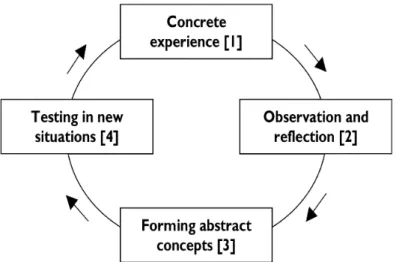
David A. Kolb (1984) described Experiential Learning as “the process whereby knowledge is constructed through the transformation of experience” (p. 41). Experiential Learning Theory (ELT) is based on a learning cycle that includes the dual phases of action/reflection and experience/abstraction (Kolb & Kolb, 2008). The four stages are concrete experience (CE), reflective observation (RO), abstract conceptualization (AC), and active experimentation (AE). These four stages occur in sequence in a cycle that may be entered into from any point but must stay in the correct sequential order and are repeated in a spiral of cycles. Kolb’s Experiential Learning circle is shown in Figure 1.
Other researchers have referred to these stages as wanting, doing, feedback, and digesting (Race, 1993); sensing/feeling, watching/reflecting, thinking, and doing
(Fielding, 1994); pragmatist, reflector, theorist, and activist (Honey & Mumford, 1986). The two main dimensions to the learning process are the abstract conceptualization-concrete experience (AC-CE) dimension and the active experimentation-reflective
observation (AE-RO) dimension, which correspond to the two different processes by which we learn. The first dimension (AC-CE) is how we grasp or perceive new
information, and the second (AE-RO) is how we process what we perceive. The way we grasp or perceive experience ranges from immersing ourselves in the experience through senses and feelings in a “concrete” manner (CE) to thinking in an “abstract” manner through logic and reason (AC) (Healey & Jenkins, 2000). The way we process information ranges from active experimentation (AE) with active involvement to reflective observation (RO) through watching or observing.
Figure 1. Kolb’s Experiential Learning Circle (Smith, 2001)
Students acquire knowledge and learn through lecture and classroom style instruction, but learn best if this instruction is coupled with other instructional methods that facilitate deeper understanding of concepts with the chance for application and reflection (Dewey, 1938; DiConti, 2004; Healey & Jenkins, 2000; Kolb, 1984; Koren, 2008). Following Dewey, Kolb maintained that “an important goal of the experiential
program is to learn how to transform experience into knowledge, and then use this knowledge for individual and collective development” (DiConti, 2004, p. 175). This learning outside the classroom through experience allows for application through the concrete experience and reflective observation. Kolb defined Experiential Learning as “a process linking education, work, and personal development” (Smith & Rosser, 2007, p. 3).
The most common types of Experiential Learning in colleges and universities today are Service Learning, Volunteer Service, Internships, Study Abroad, and Undergraduate Leadership among others (ACPA, 2004; Astin & Astin, 2000; Dugan, 2006b). Service Learning is a pedagogy that combines the concrete experience of community service with reflection observation, which is the academic instruction focusing on critical, reflective thinking. Volunteer Service is student engagement in the community by providing service to a philanthropic organization or a business in the local area with no course credit or connection to academic course material. Internships, which are usually credit-bearing, occur when students participate in field-based education through cooperative education, practicum experiences, or classroom-based hands-on laboratory activities (DiConti, 2004). Study Abroad is defined as any of a number of arrangements by which students complete part of their degree program through educational activities outside the United States. Such activities include, but are not limited to, classroom study, research, internships or externships, and Service Learning (Purdue website, Retrieved on March 4, 2009 from http://www.studyabroad.purdue.edu/
faculty/definition.cfm). Undergraduate Leadership programs help students understand the nature of leadership and prepare them to become leaders on campus, in the
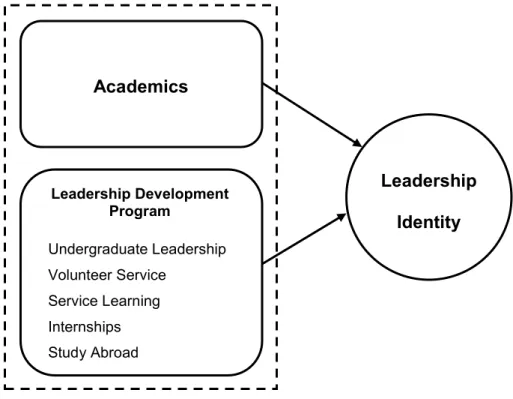
community, and in their professions. A visual diagram for Leadership Identity supplemented by Experiential Learning is shown in Figure 2.
Figure 2. Leadership Identity Based on Experiential Learning
Types of Experiential Learning Service Learning
The direct link between Service Learning and leadership is still vague in the literature. Service Learning allows students to gain real-life experiences by interacting with community partners, develop a sense of community with classmates and local organizations, retain more of what they learn, and explore career options while applying
Leadership Development Program Undergraduate Leadership Volunteer Service Service Learning Internships Study Abroad Academics Leadership Identity
what they have learned in the classroom through reflection (Purdue website, Retrieved on October 8, 2009 from http://www.purdue.edu/servicelearning/Students/why_service_ learning.html).
Reflection, according to Reed and Koliba (1995), provides insight into a student’s own self-interests when he or she reflects on how service has made a difference in his or her own life. Reflection allows a student to develop growth and understanding in several areas including: career exploration, civic responsibility, social change/justice,
professional development, leadership development, intellectual pursuit, spiritual fulfillment, and political consciousness.
Service Learning has been found to have a positive impact on leadership,
although not a strong impact (Astin et al., 2000; Eyler & Giles, 1999; Simons & Cleary, 2005). Astin et al. (2000) provided an executive summary on how Service Learning affects students using a national sample of 22,236 students. The impact of Service Learning was assessed on academic outcomes, values, self-efficacy, leadership, career plans, and plans to participate in service after college. Performing service as part of a course was found to add significantly to the benefits associated with community service for all outcomes except for interpersonal skills, self-efficacy, and leadership with the latter two being border-line (p < .05). The leadership measures in the study did not show more benefit from Service Learning than from generic community service for students. Service participation had its strongest effect on the students’ decision to pursue a career in a service field. Qualitative findings suggested that Service Learning is effective as it aids in outcomes such as increased personal efficacy, an increased awareness of the world
and personal values, increased engagement in the classroom experience, and a heightened sense of civic responsibility.
Simons and Cleary (2005) conducted a mixed methods study of the value added by Service Learning to the community and to students by examining academic learning, personal and interpersonal development, and community engagement for college students who participated in Service Learning, both from a personal level and from a social level. The study included 59 students who were enrolled in two sections of an educational psychology course at a private university in an eastern metropolitan area during the Spring semester of 2003. These students worked with elementary age children teaching them to read. The results were that service-learners increased their problem-solving skills, political awareness, social justice attitudes, preferences for short-term community involvement, and desire to make a difference in the lives of community recipients from the beginning of the semester to the end. Other findings were that students who made short-term commitments often transitioned to long-term commitments in community service. Other benefits from Service Learning included stronger academic learning, growth in relationships, greater self-knowledge, personal self-efficacy, and career development. This study showed results of a positive effect on outcomes that is
important in leadership, but “leadership” was not determined to be an outcome from the Service Learning.
Volunteer Service
Volunteer Service is defined as working in the community merely on a voluntary basis while receiving no academic credits for the hours invested and having no
connection to an academic course. There is substantial research that examines the relationship between Volunteer Service and leadership with positive findings on the effects of community service on leadership development (Astin & Astin, 2000; Astin & Sax, 1998; Dugan, 2006b). Astin and Sax (1998) conducted a study with 3,450 students from 42 institutions on effects of service participation during college years using the Cooperative Institutional Research Program (CIRP) Freshman Survey and the College Student Survey (CSS) as a follow-up survey. The findings for life skill outcomes showed increased leadership ability and social self-confidence with other positive outcomes for students including enhancement in understanding the world around them and community problems, knowledge and acceptance of different races and cultures, interpersonal skills, improvement in conflict resolution skills and critical thinking, satisfaction in leadership opportunities, more relevance of course work to everyday life, and preparation for future careers.
Astin and Astin (2000), in their book, Leadership Reconsidered: Engaging
Higher Education in Social Change, noted that student engagement in community service substantially enhances the development of leadership skills. They contend that
connections are to be made between the formal classroom learning and the informal out-of-classroom learning activities with outcomes of greater meaning, transforming
campuses, and the development of leadership skills. They went on to say students often fail to realize that participating in campus activities such as volunteerism and in student organizations can lead to growth in leadership development as these activities provide an opportunity “to exercise leadership and develop leadership skills” (p. 18). The academic
experience offers opportunities for students to interact with each other, faculty, and community members through Service Learning and Internships. Students involved in active learning through volunteer service versus passive learning develop qualities of competence and commitment. Students in group learning develop qualities of
collaboration and shared purpose. These researchers define the co-curricular experience as a concept that involves students in dynamic learning environments outside the
classroom, such as community service, where the students:
1. reach a greater depth of understanding of course concepts through practical application (i.e., Service Learning),
2. gain experience that is directly applicable to employment after college, 3. achieve a greater awareness of community needs and societal issues, and 4. create more meaningful relationships with faculty, student affairs educators,
and other students. (pp. 21-22)
Undergraduate Student Leadership Development
Undergraduate Leadership programs help students understand the nature of
leadership and prepare them to become leaders on campus, in the community, and in their professions. Cress et al. (1991) conducted a study that built upon the Higher Education Research Institute (HERI) study, which used the CIRP survey and the CSS survey, by administering 20 supplemental questions to 875 students at 10 sample institutions that were funded for leadership development programs. The Cress et al. study revealed that students who participated in leadership development and training programs showed growth in areas of leadership and understanding of leadership theories, civic
responsibility, multicultural awareness, and personal and societal issues. Three common elements of the leadership programs in this study emerged that directly impacted student development: service, experiential activities such as Internships, and active learning through collaboration.
According to the leadership literature, anyone has the potential to be a leader through experiences and education (Cress et al., 1991; Komives et al., 1998; Swatez, 1995). The findings of Cress et al. (1991) indicated that all students have leadership potential that can be developed through leadership programs and activities. Komives et al. (1998) argued that leadership needs to be learned and practiced as would any other acquired skill. Swatez (1995) believes that teaching leadership to undergraduate students is difficult due to the lack of students’ experience. He posits that exposure to different forms of leadership through the bridging of the classroom with the community provides students with a background of knowledge that can be drawn upon to integrate the various leadership theories and skills that are taught and that the successful combination of these two strategies transforms our students into leaders.
Bialek and Lloyd (1997) explored the impact that student leadership experiences during college had on the personal and professional lives of college graduates one to five years after college graduation. Their interest was to explore possible long-term effects from participation in student leadership programs. Their qualitative study, based on interviews conducted by telephone with 26 graduates from a single institution, found connections between the participants’ Undergraduate Leadership experiences and the interactions and relationships with a wide range of people, enhanced leadership,
management, and teamwork skills, and an increased sense of pride with regard to their university. The researchers explored how the skills and abilities fostered in
Undergraduate Leadership experiences were applicable to participants’ lives after college. Three themes emerged: enhanced professional leadership, management, and teamwork skills, improved interpersonal communication skills, and increased self-confidence and professional poise.
Leadership
This section discusses the connection between leadership and Experiential Learning as examined through a 2007 literature review, Leadership Reconsidered, leadership perceptions as positional and as non-positional, leadership identity, and recent leadership development models to aid in college students’ leadership identity
development. Leadership is one of the most essential life skills that students need to develop; colleges and universities today need to provide programs with real-life
experiences and collaboration to enhance leadership competencies, abilities, and efficacy (Astin & Astin, 2000).
Leadership and Experiential Learning
Smith and Rosser (2007) reviewed the literature on leadership and Experiential Learning. They defined leadership development as working on “individual-based knowledge, skills, and abilities associated with an actual leadership position or a formal leadership role” (p. 2). They referred to Northouse (2004) who said “skills imply what leaders can accomplish whereas traits imply who leaders are” (p. 2). Smith and Rosser stated that Experiential Learning such as Service Learning, Internships, and
Undergraduate Research help students reach personal and intellectual growth, which they considered the most valuable contributions to development in the undergraduate years. This Experiential Learning gives students the required skills and abilities to be well-rounded individuals, prepares them to enter the workforce with success, and instills life-long learning. Service Learning connects learning in the classroom through lecture and discussion with the real world experiences for which school is supposed to prepare them. Smith and Rosser quoted Ryan (1996) to say the cycle of learning is complete when students can “reframe what they know, the content, and understand how they learned it, the process” (p. 7). Experiential Learning allows students to test what they have learned in the classroom while it also tests whether higher education institutions are doing what they say they are doing, which is to prepare students to be successful adults in society. Leadership Reconsidered
In Leadership Reconsidered: Engaging Higher Education in Social Change,Astin and Astin (2000) addressed the application of transformative leadership to higher
education. They considered that “effective leadership is an essential ingredient of positive social change” (p. iv) and that higher education, being a central player in shaping the quality of leadership in America, should strive to produce students who will improve society. Classroom instruction in this study was said to give little attention to the personal qualities that are deemed crucial to effective leadership such as “self-understanding, listening skills, empathy, honesty, integrity, and the ability to work collaboratively” (p. 3). Astin and Astin observed that, although there has been an increased emphasis on co-curricular programs for student leadership development,
institutions still lack requirements or content that focuses on leadership. Although student engagement in community service substantially enhances the development of leadership skills, this co-curricular experience remains essentially marginal on most campuses.
The authors of Leadership Reconsidered posited that the basic purposes of leadership development in higher education in the United States are to generate new knowledge, serve the community, and to empower students to become agents of positive social change in the larger community. This development comes from a collaborative educational environment where students can acquire needed knowledge and skills while learning about themselves and other group members and acting as facilitators in the development of competence, self-knowledge, and empathy.
Astin and Astin (2000) stated that leadership is most essential of the life skills that a student learns during the college career with special recognition given to the facts that:
1. leadership is no longer the province of the few, the privileged, or even the merely ambitious, and
2. leadership skills are increasingly among the qualifications needed by
employers of all kinds, from private corporations and nonprofit organizations to government agencies and academic institutions. Virtually all of our social institutions are hungry for people who are self-aware, authentic, innovative, empathetic, committed, comfortable working collaboratively, and able to lead constructive change efforts. (p. 31)
Leadership skills can be consciously developed. Learning and applying leadership principles will encourage students to become more deeply involved and committed to shaping the educational experience so they can take advantage of
Astin and Astin (2000) also believe that by providing programs where students practice and integrate classroom knowledge with real-life experiences and collaborate in group learning, student affairs professionals help enhance students’ leadership
competence and abilities. These administrators should focus on students’ holistic development in terms of academic skills and knowledge, interpersonal communication abilities, and feeling of connectedness to the campus community as to society as a whole. This develops skills in conflict management, team-building, tolerance for difference, communication, reflective questioning, problem-solving, analysis of information and context, and critical thinking with hopes that these students will model the same qualities in their communities after graduation in their roles as professionals, family members, and citizens.
Leadership Perception
As we live in different perceptual worlds today with regard to leadership power, the assumption for this study is that leadership can be either positional or non-positional. Engbers (2006) posited that positional leadership involves an authoritative leader where a gifted person is selected and given the opportunity to lead. Engbers defined
non-positional leadership as inclusive, shared, and traded fluidly among a variety of
individuals seeking to achieve a common goal, thus, many team dynamics are studied in leadership education. An individual can be a leader in a career or a leader as a change agent in the community or in society as a whole. A good leadership development model should provide framework on how to teach leadership and should address not only the roles of individuals in leadership but also the existence of a group effect and the organic
nature of leadership in group life (Engbers, 2006). In this new era of leadership where group involvement is emphasized over the individual, the assumption is that all have leadership qualities that can be pooled and drawn upon as needed when working with others on vital common issues. It is important for women to realize that leadership is not always positional with a single powerful authority figure, but that leadership can also have more collaborative relational approaches.
Shertzer and Schuh (2004) studied students’ perceptions of leadership and how these perceptions empower or constrain students with regard to involvement in
leadership. Through interviews, focus groups, and documents’ review with 24 student leaders and five disengaged students at a single institution, they found that a student’s own definition of leadership influences the degree to which he or she perceives himself or herself to be a leader. The emergent themes from this study were leadership as an
individual possession, leadership as positional, leaders possess certain qualities and skills, and leaders act from internal motivations. Their findings were that disengaged students were less confident and did not believe in their ability or competence to be in a leadership position. “A student’s definition of leadership may play a significant role in whether or not the student perceives him/herself as a leader” (p. 112).
Leadership Identity
Identity as a concept is as elusive as is everyone’s sense of his or her own personal identity and is “connected to the fateful appraisals made of oneself - by oneself and others” (Strauss, 1969, p. 9). In spite of the recent increase in literature that focuses on student leadership, few scholars have addressed the development of leadership ability
or leadership identity (Komives et al., 2005). In the new post-industrial era, society is now more concerned with knowledge and networking than in the older leadership theories. Society now calls for new leadership development theories that are based on “collaboration, ethical action, moral purposes, and leaders who transform followers into leaders themselves” (p. 593). In order to create effective leadership development programs, one must first fully understand how leadership identities are formed.
Personal values, group norms, cognitive development, and perceived need to realize a vision are underlying notions of developing a leadership identity (HERI, 1996; Komives et al., 1998; Komives, Casper, Longerbeam, Mainella, & Osteen, 2004). A handful of leadership models have incorporated these factors; two that have made major contributions to scholarship and practice in higher education are the Social Change Model of Leadership Development (HERI, 1996) and the Relational Leadership Model (Komives et al., 2004). These models provide the conceptual framework for the Leadership Identity Model developed by Komives et al. (2005), which reveals the similarities between leadership development and student development. Students are simultaneously developing across multiple models in Komives et al.’s Leadership Identity Model, Perry’s (1970) Intellectual and Ethical Model, and Chickering’s (1969) Personal Identity Model. In Perry’s (1970) model of intellectual development, students advance through stages of dualism, multiplicity, relativism, and commitment. It is during the stage of relativism that students start out viewing concepts in black and white and end up viewing the same concepts in shades of gray. In Chickering’s (1969) model of
managing emotions, moving through autonomy toward interdependence, developing mature interpersonal relationships, establishing identity, developing purpose, and developing integrity. The stages that students advance through in the LID Model are discussed later in this chapter.
Recent Development in Higher Education Leadership Development Multi-Institutional Study of Leadership
The Multi-Institutional Study of Leadership (MSL) was a national study with data collected in 2006 from 56,584 students at 52 different institutions of higher learning across the United States examining leadership development and college student leadership outcomes (Dugan & Komives, 2007). Researchers at the University of
Maryland-College Park used an instrument that was a modified version of Tyree’s (1998) Socially Responsible Leadership Scale (SRLS) and was framed on SCM. This study addressed the challenges of developing leadership in college students due to a significant gap between theory and practice, an unclear picture of the leadership development needs in college students, and the uncertainty with regard to the influences of the college environment on leadership outcomes. In this study, it was shown that college experiences matter; students who were involved in campus clubs and organizations scored higher across all of the SCM values. The study addressed student involvement and its influences across 21 types of co-curricular experiences. Twenty percent of the students reported never having participated in a campus organization, whereas forty percent of the students in the study reported heavy involvement on campus. The amount of involvement was positively related to the level of development; however, breadth of
involvement, being involved in too many organizations, was negatively related to leadership outcomes. The study showed that patterns of involvement reflecting
traditional collegiate experiences, such as co-curricular group experiences, demonstrated high degrees of influence as evidenced by the strength of their association with higher leadership scores. Leadership outcomes showed high scores on the value of Commitment and low scores on the value of Change. Other findings were that student perceptions changed over time; pre-college experience matters; leadership shows moderate gender, racial, and ethnic differences; openness to change is greater for marginalized groups of students; socio-cultural discussions matter a great deal; mentoring matters; campus involvement matters; service matters; positional leadership roles develop leadership; and formal leadership programs matter.
Social Change Model of Leadership (SCM)
The Social Change Model of Leadership (SCM) was designed collaboratively by Helen and Alexander Astin and other scholars. This model of leadership development is grounded in social responsibility and change for the common good (HERI, 1996) and served later as the framework for Leadership Identity Development Model (LID) study. This model further describes students in growth across eight critical core values:
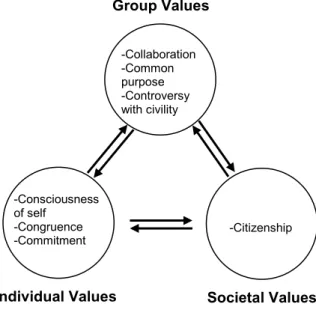
Consciousness of Self; Congruence; Commitment; Common Purpose; Collaboration; Controversy with Civility; Citizenship; and Change for the Common Good from interactions between individual, group, and society with change being the overall goal (Dugan, 2006a). These values interact dynamically across three levels: (a) individual (consciousness of self, congruence, and commitment), (b) group (collaboration, common
purpose, and controversy with civility), and (c) society (citizenship). SCM defines leadership as a purposeful, collaborative, values-based process that results in positive social change (Dugan & Komives, 2007). This model has the basic premise of leadership as both positional and non-positional and leadership as a process rather than a position. It also promotes the values of equity, social justice, self-knowledge, service, and
collaboration. The focus of this model is on the individual’s level of self-knowledge and also on the capacity to engage others in collaborative work.
Dugan (2006a) examined leadership styles of 410 college men and 443 college women at a single large, public, doctoral-granting institution in the west using SCM. He found differences between men and women when measuring leadership development across the eight constructs of this model. Women scored higher than men on all eight of the leadership constructs. All of these differences were significant except for the collaboration construct; this contradicted previous research indicating that women use collaboration and shared decision-making more regularly than men. Univariate analysis indicated that students struggle with controversy with civility, citizenship, and change constructs regardless of gender and that the type of involvement affected type of development along general measures of leadership with community service as the most influential type. The results of this study have potential to impact women’s leadership experiences on campuses with advice to deconstruct persisting stereotypes that contribute to women’s lack of self-confidence, understand institutional opportunities for women, and tap into women’s skills as they relate to SCM. Dugan further recommended
to connect students’ values with their work in the community. The model, SCM, which provided the framework for the LID Model this study draws upon, is shown in Figure 3.
Figure 3. Social Change Model (SCM)
The following are the eight constructs of SCM:
1. Consciousness of self—being self-aware of the beliefs, values, attitudes and emotions that motive you to take action
2. Congruence—acting in ways that are consistent with your values and beliefs 3. Commitment—having significant investment in an idea or person, both in
terms of intensity and duration
4. Collaboration—working with others in a common effort, sharing responsibility, authority, and accountability
5. Common Purpose—having shared aims and values, involving others in building a group’s vision and purpose
-Collaboration -Common purpose -Controversy with civility -Consciousness of self -Congruence -Commitment -Citizenship Group Values
6. Controversy with civility—recognizing two fundamental realities of any creative effort, differences in viewpoint are inevitable, such differences must be aired openly and with civility
7. Citizenship—believing in a process whereby an individual and/or group must become responsibly connected to the community and to society through some activity, recognizing individuals and groups have responsibility for the welfare of others
8. Change—believing in the importance of making a better world and a better society for oneself and others; believing that individuals, groups, and communities have the ability to work together to make that change. Leadership Identity Development Model (LID)
The Leadership Identity Development (LID) Model resulted from a grounded theory study (Komives et al., 2006) focusing on the developmental aspects of leadership and informed by social learning theory (Bandura, 1997), which presents influences for development of self-efficacy. Thirteen diverse students were selected for this study from students who worked inclusively with others in group process, were committed to ethical processes and heightened involvement, were able to work toward common goals, and thus were engaged in relational leadership. This group was comprised of 5 women and 8 men, including 8 White students, 3 African American students, 1 Asian American
student, and 1 African student who immigrated as a child. These students were nominated through intensity sampling by campus experts, including campus activities staff, residence life staff, and advisors to groups such as ethnic and cultural groups, as
well as ODK honor society. The five influencing categories were “broadening view of leadership, developing self, group influences, developmental influences, and the
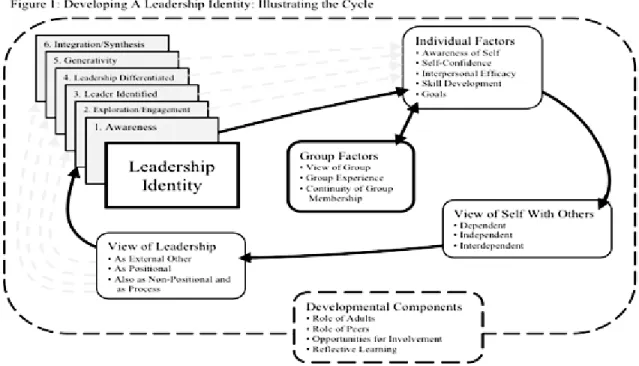
changing view of self with others” (p. 6). Developing self included the deepening of self-awareness, self-confidence, interpersonal efficacy, new skill application, along with motivations. Group influences included learning from membership continuity in groups and changing perceptions of groups. The development influences included adult and peer influences, meaningful involvement, and reflective learning. Changing view of self with others was influenced through the interaction of developing self and influences and included properties of being dependent and independent. Students moved through these stages informed by their experiences in these categories. The leadership development model, LID, consistent with the post-industrial paradigm, which guides this study is shown in Figure 4.
This cyclical model allows students to repeat stages with deeper and more complex understanding and performance in each repeated stage. Achievement in each stage is influenced by contextual factors in the environment and by each student’s readiness. Environmental factors and the presence of mentors were shown to be important in facilitating transitions through the stages. Reflection occurs as subjective while a student is in each stage and moves to objective as the student surpasses the stage. Transition is when a student may seek to reject or find dissonance with his or her old self and where a student could be at risk to retreat or escape (Perry, 1981). A student is secure once integration is achieved and he or she becomes immersed in a stage.
From “Developing a Leadership Identity: A Grounded Theory,” by S. R. Komives, J. E. Owen, S. D. Longerbeam, F. C. Mainella, and L. Osteen, 2005, Journal of College Student Development, 46(6), 593-611. Reprinted with permission.
Figure 4. Leadership Identity Development Model (LID)
Stage one is “Awareness” where students begin recognizing that leadership is happening out there somewhere and they begin to verbalize making a difference and accomplishing goals. Stage two is “Exploration/Engagement” where students begin interacting with peers by exploring opportunities in group settings thus building self-confidence and self-efficacy. This is when students join organizations and observe their leaders without formally becoming leaders themselves. Stage three is “Leader Identified” and occurs when students hold leader-centric views and believe that one person can be the positional leader. Students here realize they can become leaders through positions they take and may connect to mentors or find organizations to fit their values and interests in this stage. Stage four is “Leadership Differentiated” and is where students
begin to view leadership being exhibited by non-positional group members rather than merely by the positional leader. This is the stage in which students learn teamwork skills and communication skills such as listening and empathy, build group community, and handle group conflict. Stage five is “Generativity” where students look beyond themselves and express a passion and commitment for the welfare of others such as peace, justice, and serving others. Students could learn to mentor new members, set up structures for mentoring, help other students identify their personal passions and
commitments, have other students examine their goals, and teach other students to see the perspectives of the groups they inhabit. Stage six is “Integration/Synthesis” where
students view themselves as effective in working with others and build the confidence with the ability to do so in almost any context. In this stage, students should be able to identify their personal values about working with others in group settings as well as the talents and strengths they can bring to a group. Students should move into stage six as they end their college careers and transition from the educational context.
According to Komives et al. (2006), students in the study viewed leadership as hierarchical when they came to college, with the traditional approaches being trait, behavioral and situational. This model incorporates elements of inclusiveness, purpose, empowerment, and reflection on the students’ experiences with others in their
environment. Students, by using this model, were able to then view leadership as
“something many in a group do and as a process among people, which is consistent with the post-industrial view of leadership” (p. 23).
1. Awareness—“Other people are leaders; leadership exists somewhere.” 2. Exploration/Engagement— “I want to be involved.”
3. Leader Identified— “A leaders gets things done; I am the leader and others follow me.”
4. Leadership Differentiated— “I can be a leader even if I’m not the leader; we are all doing leadership together.”
5. Generativity— “I am responsible to my communities and the future of them; I am responsible for developing the leadership of others.”
6. Integration/Synthesis— “I know I am able to work effectively with others to accomplish changes from anywhere in the organization.”
Gender and Leadership Development/Identity
Findings from recent studies (Dugan, 2006a; Calizo et al., 2007; Kezar &
Moriarty, 2000; Sax, 2008; Whitt, 1994) have shown both similarities and differences in how men and women develop leadership skills and perceive their leadership ability. Calizo et al. (2007) discussed findings from the 2005-2006 MSL study to compare the leadership development of men and women by looking at the impact of diversity discussions, leadership training, community service, and mentoring opportunities. The MSL measured students’ self-efficacy (confidence in leadership ability) and the eight outcomes associated with the Socially Responsible Leadership Scale (SRLS). Using scales of leadership self-efficacy, consciousness of self, commitment, congruence, collaboration, common purpose, controversy with civility, citizenship, and change,
Differences were experienced in leadership training through workshops, lectures, conferences, or retreats, with a more positive impact on men than women. Community service had an impact on women for consciousness of self and change and had a positive impact for all categories of leadership outcomes for men. Peer mentoring had the
greatest effect on women in commitment, common purpose, and citizenship outcomes, though mentoring relationships with faculty, student affairs staff, or other students had positive impacts on both men and women in general.
Whitt (1994) studied gender differences as they apply to student leadership by visiting three four-year women’s colleges and interviewing 200 students, alumni, faculty, and administrators. Whitt discussed the fact that women are attending college in record numbers but do not have the proper tools to lead successfully. She noted that women rely upon different skills from men when leading others and often favor a participative
leadership style. Whitt stated that women as leaders place greater importance on relationships, seek collaboration and community, and are more willing to share information and power than men as leaders. However, women are expected to lead in environments that structure leadership experiences around models that are typically better suited for male leaders and their preferred leadership styles. Though noting that women’s colleges promote women’s leadership well, Whitt’s study identified several ways in which coeducational colleges and universities can foster and develop leadership potential among their women students. Findings suggested that promoting women to high profile leadership positions on campus and including programs explicitly designed for women
such as all-female leadership programs, women’s social and service sororities, and female residence halls can foster female leadership development.
Kezar and Moriarty (2000), in a quantitative study of almost 10,000 students, examined the ways that White women and African American men and women develop leadership skills and leadership ability. They challenged theorists and practitioners to expand models of development to include women and other underrepresented populations of students as most research in the past on students’ leadership development had used White men. Other researchers have been debating the needs of different populations after discovering that women, as well as African Americans or other racial and ethnic groups, struggle to find common experiences with White men due to the way they experience the social world (Belenky et al., 1986; Gilligan, 1982). Kezar and Moriarty (2000) found that regardless of race, men usually have a higher self-perception of themselves as leaders than women, both upon entering college and after graduating college. The findings also suggested that men were able to take better advantage of opportunities to continue their development in leadership skills during college or that perhaps the opportunities to develop these skills are a “better fit for men or were developed with this population in mind” (p. 61). These researchers called for further examination of college factors that impact change in self-concept related to leadership and the development of leadership skills beginning in students’ first year at a university. “Co-curricular experiences, typically designed to develop leadership among students, seem to be working to enhance self-perception of leadership ability for White men. White men appear to be gaining in
perceptions of leadership ability in large part due to their participation in out-of-classroom activities” (p. 62).
Sax (2008) synthesized the findings on gender differences based on students who entered colleges nationwide over the past four decades using the CIRP and CSS surveys. She noted that the ability to develop leadership skills depends on having opportunities to do so for both college men and women with aspects of academic and extracurricular engagement. This engagement can account for high levels of self-confidence exhibited in leadership and in social skills. Sax listed important aspects of leadership development specific to women such as attending college farther away from home and gaining distance from parents, involvement on campus, and choice of major with higher-than-average gains for women majoring in business and lower-than-higher-than-average gains for women majoring in the biological science fields. Interestingly, her findings for important aspects of leadership development specific to men include higher ratio of female faculty
members and full-time employment through college.
Since Chickering’s 1969 publication on student development, research has shown that men and women experience vectors involving autonomy and mature interpersonal relationships in different ways (Foubert, Nixon, Sisson, & Barnes, 2005; Taub, 1995). Chickering’s original assertion that a student must establish autonomy before developing the capacity for intimacy in mature interpersonal relationships has been questioned. Studies have shown that women tend to develop intimacy prior to autonomy and that women develop greater capacity for intimacy than do men (Straub, 1987). Most women go through the “developing mature interpersonal relationships” vector prior to going