Multi-User Private Queries
over Encrypted Databases
Y.J. Yang*
Institute for Infocomm Research, Singapore 138632
E-mail: [email protected] *Corresponding author
X.H. Ding
School of Information Systems, Singapore Management University E-mail: [email protected]
R.H. Deng
School of Information Systems, Singapore Management University E-mail: [email protected]
F. Bao
Institute for Infocomm Research, Singapore 138632
E-mail: [email protected]
Abstract: Searchable encryption schemes allow users to perform keyword based searches on an encrypted database. Almost all existing such schemes only consider the scenario where a single user acts as both the data owner and the querier. However, most databases in practice do not just serve one user; instead, they support search and write operations by multiple users. In this paper, we systematically study searchable encryption in a practical multi-user setting. Our results include a set of security no-tions for multi-user searchable encryption as well as a construction which is provably secure under the newly introduced security notions. We also discuss to improve query efficiency.
Keywords: searchable encryption; database security; multi-user setting; privacy; prototype.
Reference to this paper should be made as follows: Yang, Y.J., Ding X.H, Deng, R.H. and Bao, F. (2008) ‘Multi-User Private Queries over Encrypted Databases’, Int. J. High Performance Computing and Networking, Vol. 1, Nos. 1/2/3, pp.64–74.
Biographical notes:Yanjiang Yang is a Research Fellow at Institute for Infocomm Research, Singapore. He completed his PhD degree from National University of Sin-gapore in 2005. His research interests include information security and applied cryp-tography.
Xuhua Ding is an assistant professor at School of Information Systems, Singapore Man-agement University. He received his PhD in Computer Science from the University of Southern California, USA, in 2003. His research focuses on information security, ap-plied cryptography.
Robert H. Deng is a professor, Associate Dean for Faculty & Research, and Director of SIS Research Center, School of Information Systems, Singapore Management Univer-sity. He received his PhD from Illinois Institute of Technology, USA. He has 26 patents and more than 200 technical publications in international conferences and journals in the areas of computer networks, network security and information security.
Feng Bao is the principal scientist and the department head of the Cryptography & Security Department at Institute for Infocomm Research, Singapore. He received his PhD in computer sciences from Gunma University, Japan, in 1996. He has published more than 180 international journal/conference papers and owned 16 patens.
1 INTRODUCTION
With the prevalence of network connectivity, a typical paradigm of many enterprise database applications is for multiple users to access a shared database via a local area network or the Internet. Moreover, recent years have seen the surge of database outsourcing, where databases are hosted and managed by a third party which offers database services to users. For business-critical or security-sensitive data, encryption is often used as the last line of defense to combat unsolicited data accesses. Consider the following application example. A federation of healthcare institutes plans to establish a medical database so that their medical practitioners and researchers can share clinic records and research results. To reduce the operational cost, manage-ment of the database is outsourced to a database service provider. The database is encrypted in order to comply with patient privacy related laws, such as HIPPA in the United States, and yet the encrypted database must be searchable by authorized users.
Searchable encryption is a cryptographic primitive that enables users to perform keyword-based searches on an en-crypted database just as in normal database transactions (Curtmola et al., 2006; Chang and Mitzenmacher, 2005; Goh, 2003; Song et al., 2000). However, all the existing schemes are limited to the single-user setting where the database owner who generates the database is also the single user to perform searches on it. To support multi-user searches, Curtmola et al. (2006), by directly extend-ing their sextend-ingle-user schemes, suggest to share the secret key for database searching among all users. Their scheme allows only one user to write to the database, though mul-tiple users are able to search. Unfortunately, many prac-tical applications (e.g., the aforementioned healthcare fed-eration example) require a database to support both write and search operations by multiple users. Moreover, user revocation in their scheme is based on broadcast encryp-tion, where a revocation affects all non-revoked users.
A na¨ıve approach of extending a single-user scheme to a full-fledgedmulti-user scheme is to share secret keys (or the private keys of public key based systems (see Section 2)) among all users. However, it suffers from several serious shortcomings. First, there is no feasible means to deter-mine the originator of a query in a provable manner, since all queries are generated from the same key. This becomes unacceptable when accountability of queries is desired by the database application. Secondly, user revocation can be prohibitively expensive. In a multi-user application, user revocation is a routine procedure. For a key-sharing based scheme, revocation often implies a new round of key dis-tribution involving all non-revoked users. Obviously, this is not scalable for large and dynamic systems where user revocation may occur frequently. One may suggest us-ing access control to complement key sharus-ing in order to address the problem of user revocation (i.e., user revoca-tion does not entail key renewal). However, deployment
Copyright c°200x Inderscience Enterprises Ltd.
of access control in practice is prohibitively expensive as pointed out in Curtmola et al. (2006), and worse yet, users have to maintain an additional set of secrets. Thirdly, many searchable encryption schemes follow the symmetric access paradigm, i.e., the same key is used for index gen-eration and search. Therefore, once a revoked user breaks the security perimeter of a database system and gains il-legal access to the encrypted database, she is still able to search it at her will. One remedy could be to update the in-dexes after every user revocation. However, it is obviously infeasible for large databases due to the immense cost it entails.
In this paper, we systematically study searchable en-cryption in the multi-user setting. We formulate a system model and define its security requirements. We also pro-pose an efficient construction, which offers not only the conventional query privacy, but also the following new fea-tures.
• Our system allows a group of users, each possess-ing a distinct secret key, to insert their encrypted data records to the database while every user in the group is able to searchall the records using her cho-sen keywords with the assistance from a semi-trusted database server.
• Our system allows the user management of the database owner organization to dynamically and ef-ficiently revoke users. Our revocation does not re-quire distribution of new keys, nor needs to update the encrypted database including the indexes. After a revocation, the revoked users are no longer able to search the database, while the revocation process is transparent to those non-revoked users. Our system also allows for dynamic user enrollment, since a user joining does not affect other user’s settings.
• Our system offers query unforgeability in the sense that neither a dishonest user nor the database server is able to generate valid queries on behalf of another user unless her secret key is compromised.
We use bilinear maps so that users using different query keys still generate the same index for a keyword. However, the performance of our construction does not deteriorate due to the use of bilinear maps, as the database server only needs to perform a pairing operation for a query.
The rest of the paper is organized as follows. In the next section, we show the related work and highlight the differ-ence between our work and other searchable encryption schemes. Then, we define the system and formulate secu-rity requirements in Section 3. Our proposed construction, together with a rigorous security analysis and a perfor-mance evaluation, are presented in Section 4. A technique to speedup query efficiency is also discussed in Section 4. Concluding remarks are in Section 5.
2 RELATED WORK
Our work is under the umbrella of searchable encryption, which in general allows a user to search among encrypted data and find the data containing a chosen keyword. The first practical scheme of this kind is due to Song et al. (2000), who consider searches across encrypted keywords within a file with an overhead linear to the file size. Goh (2003) and Chang and Mitzenmacher (2005) propose to search encrypted indexes of a set of documents. Their ap-proaches improve the search efficiency at the cost of a large storage for the constructed indexes (the bit-length of the index for each document is proportional to the total num-ber of keywords). A formal security notion of searchable encryption is defined in Curtmola et al. (2006) which also constructs schemes provably secure against non-adaptive and adaptive adversaries. Yang et al. (2006) apply the con-cept of searchable encryption to dynamic databases. The works of Ballard et al., 2005; Golle et al., 2004 consider the variation of simultaneous search of conjunctive keywords.
All of the schemes above make use of symmetric key primitives. The first public-key based searchable encryp-tion scheme is due to Boneh et al. (2004), where the pri-vate key holder can perform a search among messages en-crypted under the corresponding public key. Park et al., 2004; HWang and Lee, 2007 propose variations of con-junctive keywords search in the public key setting. Ab-dalla et al. (2005) further analyze the consistency property of public key based searchable encryption, and demon-strate a generic construction by transforming an anony-mous identity-based encryption scheme. Latest results and variations on public-key based search encryption include (Boneh and Waters, 2007; Shi and Waters, 2008; Katz et al., 2008)
However, none of the above schemes fully consider the multi-user setting. All the searches are performed under a single key. Note that while public key based schemes al-low for multi-user writing, only the key holder who knows the private key can perform searches. As a result, apply-ing public key based searchable encryption schemes to the multi-user setting would face the same problem as that of symmetric key based ones. Although Curtmola et al. (2006) suggested to employ broadcast encryption to allow multiple user search, it only allows a single user to write to the database. Moreover, their scheme is more suitable for a static collection of documents than a dynamic database. By contrast, our work in this paper studies searchable en-cryption in database applications where a group of users share data in a way that all users are able to write to and search an encrypted database without sharing their secrets.
3 MODEL AND DEFINITIONS
3.1 System Model
We consider a database system{D, U M, Serv,U}, where
D is a database; U M is the user manager of the data
owner organization that is responsible for the management of users, e.g., user enrolment and user revocation;Serv is the database server providing the search service; U is a group of users.
The database D consists of m records {d1,· · · , dm} of multiple attributes. One of the attributes is thekeyword used for search (note that it is straightforward to consider multiple keyword attributes). The domain of the keyword attribute is denoted byW. The keyword ofdi is denoted by di.w. Serv does not host the database D directly; instead, it hosts an encrypted version of D, denoted by
D0 ={d0
1,· · ·, d0m}, where d0i =hE(di), I(di.w)i: the first component is an encryption ofdiand the second is the out-put of an index generation functionI(·) ondi.w. LetED= {E(d1),· · ·, E(dm)}andID={I(d1.w),· · ·, I(dm.w)}.
With the assistance of Serv, an authorized user u ∈ U, is allowed to insert data records to D0 and to search
data records including those inserted by others based on her chosen keywords. We use qu(w) to denote a query from useruon keyword w∈ W. On receiving query q=
qu(w), Serv is expected to return aq = {E(di) | di ∈
D, di.w = w}. Whenever necessary, U M may revoke a user’s privilege of searching the database. Therefore, the user set U is divided into an authorized user set UA and a revoked user set UR. Only users in UA are allowed to successfully search and write to the database.
U M is an offline user manager of the data owner orga-nization and is responsible for user enrollment and revoca-tion; therefore we assume that U M is trusted and all in-teractions withU M are secure (Please do not confuseU M
with the system administrator of the database server). We consider a semi-trustedServas in Goldreich (2004), in the sense that it does not deviate from the prescribed protocol execution while it may try to derive as much information as possible from user queries and database access patterns. In particular, we assume that it will not launch active at-tacks such as collusion with users. Our trust model for
Serv is based on the following observation. In practice, most database hosting services are run by large and rep-utable IT service providers which clearly understand the paramount importance of corporate reputation for busi-ness success. Therefore, it is logical to assume that the database hosting server follows trusted-but-curious (semi-trusted) behavior. Active attacks are easy to detect/notice and therefore risk the server from being caught. Even a rumor of violation of rules will result in very bad publicity and damage a company’s reputation.
Throughout the rest of the paper, we use the following notations. For a setS, we write x∈RS to denote thatx
is selected uniformly at random from S, and write |S| to denote the size ofS. For an algorithm A, x←A denotes thatA outputsx. A functionν:N→[0,1] is negligible if for any polynomialp, there existskp∈Nsuch that for all
k≥kp,ν(k)≤1/p(k). For convenience of reference, other notations used in the sequel are listed in Table 1.
Table 1: Notations
Notation Semantic
kU M the secret key ofU M
e the encryption key for record encryption
qku, ComKu useru’s query key and her complementary
key, respectively
U-ComK a list of 2-tuples (u, ComKu) maintained
byServ
3.2 Definitions
We now define the multi-user encrypted database system and its security notions. A multi-user encrypted database system, denoted by Γ, consists of the following algorithms: • Setup(1κ). A probabilistic algorithm executed byU M to set up the system and to initialize system-wide pa-rameters, whereκis the security parameter. The al-gorithm outputs a secret key kU M for U M and the record encryption keyefor a semantically secure sym-metric key encryption scheme.
• Enroll(kU M, u). Executed by U M to enroll useru to the system. Taking as input kU M and user identity
u, it outputs a pair of query key and complementary key (qku, ComKu) foru. qku andeare then securely transported to useru, andComKu is securely passed toServ who then updates the U-ComK list by insert-ing a new entry (u, ComKu).
• GenIndex(qku, w;ComKu). An interactive algorithm run between useruandServto generate an index for keyword w. User u sends an index request on w to
Serv, who then computes a response using the corre-spondingComKu. Finally,uoutputs I(w) based on
Serv’s response.
• Write(qku, e, di;ComKu). Run between user u and
Servto write an encrypted record d0
i toD0. The user
ufirst invokes GenIndex(qku, di.w;ComKu) to gener-ateI(di.w), then computesE(di) usinge, and finally passesd0
i=hE(di), I(di.w)itoServ which appends it toD0.
• ConstructQ(qku, w). Run by a user uto construct a query. It takes as input the secret query keyqku and a chosen keywordw, and outputs a queryqu(w). • Search(qu(w), ComKu, D0). Run byServto searchD0
for records containingw. Namely, on a queryqu(w), it outputsaq ={E(di)|di∈D, di.w=w}.
• Revoke(u). Run byU M to evict a user from the sys-tem. On an input user identityu, it revokesu’s search capability. As a result,UA=UA\{u},UR=UR∪{u}, anduis no longer able to search the database. A multi-user encrypted database system Γ is cor-rect if an authorized user can always get the cor-rect query reply. More formally, ∀u ∈ UA,∀w ∈
W,Search(ConstructQ(qku, w), ComKu, D0) = {E(di) |
di∈D, di.w=w}.
We also formalize several security requirements of the multi-user encrypted database system, includingquery pri-vacy, query unforgeabilityandrevocability.
Query Privacy A common security requirement for all searchable encryption schemes is query privacy, which is a security notion on the amount of information leakage to the server regarding user queries. As discussed in Curt-mola et al. (2006), any searchable encryption scheme in-evitably reveals certain query traces (defined shortly) to the server, unless using the private information retrieval techniques, or PIR for short (Chor et al., 1995). We re-fer interested readers to Beimel et al. (2002); Chor et al. (1995); Kushilevitz and Ostrovsky (1997); Lipmaa (2005) for various discussions on PIR. For searchable encryption, the server always observes the database access patterns (e.g. two queries have the same reply), albeit the server is unable to determine the keyword in a query. However, apart from the information that can be acquired via ob-servation and the information derived from it, no other information should be exposed to the server.
For a record di, we use id(di) to denote the identify-ing information that is uniquely associated with di, such as its database position or its memory location. For a queryq and its reply (i.e., the outputs of Search) aq, we define Ω(q) ={uq, id(aq)}, whereuq is the issuer ofqand
id(aq) represents the identifying information of each record in aq. Let Qt = (q1,· · ·, qt) be a sequence of t queries from the user group, and let Wt = (w1, w2..., wt) be the corresponding queried keywords, and At = (a1, a2, ..., at) be the correspondingtreplies, wheret∈Nand is polyno-mially bounded. We defineVtas theviewof an adversary (i.e., Serv) over the t queries as the transcript of the in-teractions between Serv and the involved query issuers, together with some common knowledge. Specifically,Vt= (D0 = (E
D, ID), id(d01), ..., id(d0|D0|),U-ComK list, Qt, At). Following the notation from Curtmola et al. (2006), the trace of the t queries is defined to be: Tt = (|D0|, id(d0
1), ..., id(d0|D0|),Ω(q1), ...,Ω(qt),|UA|), which con-tains all the information that we allow the adversary to obtain. Note that |UA| equals the number of entries in the U-ComK list. A simulation-based definition of query privacy is formally presented as follows.
Definition 1 (Query Privacy). A multi-user encrypted database system Γ achieves query privacy if for all databaseD, for all t∈N, for all PPT algorithm A, there exists a PPT algorithm (the simulator)A∗, such that for
allVt, Tt, for any functionf:
|Pr[A(Vt) =f(D, Wt)]−Pr[A∗(Tt) =f(D, Wt)]|< ν(κ)
where the probability is taken over the internal coins ofA andA∗.
Intuitively, the notion of query privacy requires that all information on the original database and the queried key-words that can be computed byServ from the transcript
of interactions she obtains (i.e.,Vt) can also be computed from what it is allowed to know (i.e. Tt). In other words, a system satisfying query privacy does not leak any in-formation beyond the inin-formation we allow the adversary to have. Note that query privacy implies record secrecy, i.e. the encrypted databaseD0 = (E
D, ID) does not reveal information on the original database.
Remark 1. We stress that in the definition of query privacy, user-server collusion is not included in our adver-sarial model. As we argued earlier, this is a practically rational assumption. On the other hand, from a technical perspective, user-server collusion is able to comprise any searchable encryption scheme, since the sever can always compare the access patterns between a target user and the colluding user.
Query Unforgeability In our system, queries issued by user u is generated by her individual secret query key, which is distinct to any other user’s query key. It is thus a basic requirement that neither another user nor the server can generate a legitimatequery on behalf of u. We refer to this property, which is only applicable to the multiple-user setting, asquery unforgeability. Query unforgeability allows a query to be uniquely bound to its issuer in a prov-able way. Therefore, it is the security basis of other system features, e.g. accountability and non-repudiation.
To define query unforgeability, we first define the le-gitimacy of user queries. For a user u ∈ U, we de-fine u’s legitimate query set as Qu = {qu(w)|qu(w) ←
ConstructQ(qku, w), w ∈ W}. Namely, a query is useru’s legitimate query if it is indeed constructed by running Con-structQwithqku. Therefore, an informal meaning of query unforgeability is that for any useru, no adversary is able to computeqsatisfyingq∈Quwithout compromisingqku. Query unforgeability is defined based on a game between an adversary and a challenger. We consider two types of adversaries: malicious users (possibly in a collusion) and
Serv. They have different knowledge and attack capa-bilities. Let AU be the adversary representing malicious users andAS representingServ. Let ˆube the target user. In AU’s game, the challenger simulates the execution of Γ and offers an oracle Ø which answers AU ’s queries on the executions ofEnroll,GenIndex,Write,Search, and Con-structQ(qkuˆ,·) which allows AU to obtain queries on key-words of her choices with respect to user ˆu1. InAS’s game, she has the knowledge of all users’ complementary keys and a collection of ˆu’s queries (gathered when ˆusearches the database). Thus the challenger givesAS the oracle access toConstructQ(qkuˆ,·).
The game is the following: the adversary (either AU or AS) first picks her target user ˆu. Then for AU, she is given the query keys of the remaining users, and she queries Ø at her will with the restriction that the number of queries is polynomial-bounded. For AS, she is given the complementary keys of all users including the target
1An malicious user may observe ˆu’s queries by attacking her
sys-tem or the communication channel.
user, and the oracle access to ConstructQ(qkˆu,·). In the end, the adversary halts and returns a query q. Let Q0
ˆ u denote the set of ˆu’s queries obtained by the adversary from queryingConstructQ(qkuˆ,·). The adversary wins the game if and only if q ∈ Quˆ\Q0uˆ. The advantage of the adversary against query unforgeability is defined as the probability of she winning the game. We summarize the notion of query unforgeability as follows.
Definition 2 (Query Unforgeability). A multi-user encrypted database system Γ achieves query unforgeabil-ity if for anyuˆ∈ U, for all PPT algorithms AU andAS:
Pr[q∈Qˆu\Qu0ˆ:(kU M, e)←Setup(1κ); ∀u∈ U (qku, ComKu)←Enroll(kU M, u); q← AØ U({qku|u∈ U \ {ˆu}}) or q← AConstructQ(qkuˆ,·) S ({ComKu|u∈ U}) ]< ν(κ)
where the probability is taken over the internal coins ofAU, AS,Setup, andEnroll.
Remark 2. Since each user possesses a distinct query key, it would be a natural requirement to maintainsecrecy of query keys, i.e., a query key is only known to its owner. It is straightforward to observe that if a system is query unforgeable, it also preservessecrecy of query keys. Other-wise, the knowledge of the target’s query key easily leads to generating a legitimate query.
Revocability User eviction is an indispensable part of a multi-user application. It is desirable to allow U M to revoke the search capabilities of users who are deemed no longer appropriate to search the database. Since the inca-pability of searching the database indexes is implied by the incapability of distinguishing them, we define revocability based on index indistinguishability.
An adversary’s advantage in attacking revocability is de-fined as her winning probability in the following game. The adversary A runs in two stages, A1 and A2: In the first stage, A1 acts as an authorized user and is allowed to ac-cess the oracle Ø as in Definition 2. At the end of the first stage, A1 chooses two new keywords w1 and w2, which have not been queried thus far. Let state represent the knowledge A1 gains during the first stage. In the second stage, A2 is revoked, and is given the index of one of the two keywords. A2 finally outputs a bit b0. A wins the game if and only if b0 = b. We summarize the notion of
revocability as follows.
Definition 3 (Revocability). A multi-user encrypted database query systemΓachieves revocability if for all PPT algorithmsA= (A1,A2):
Pr[b0=b: (k
U M, e)←Setup(1κ);
∀u∈ UA (qku, ComKu)←Enroll(kU M, u); (qkA, ComKA)←Enroll(kU M,A);
(state, w0, w1)← AØ1(qkA); Revoke(A);
b∈R{0,1},I(wb)←GenIndex(qku, wb;ComKu)u∈RUA; b0 ← A
2(state, I(wb), w0, w1), ]<1/2 +ν(κ)
where the probability is taken over the internal coins ofA, Setup,Enroll, and the instance of u.
Intuitively, the definition demands that all successful searches rely on the assistance from Serv using the cor-responding complementary keys. With this feature, U M
is able to efficiently revoke a user by instructing Serv to delete the relevant key.
Remark 3. The definition of revocability based on the index indistinguishability addresses the cryptographic strength of the searching protocol. A revoked user might mount attacks on the system or the communication chan-nel in order to perform a search. For instance a replayed query may help a revoked user to search the database. We argue that this type of attacks can be neutralized by de-ploying secure communication channels or a user authenti-cation mechanism, which are out of the scope of this paper.
4 OUR CONSTRUCTION
We begin with a brief review of the technical preliminaries used in our protocol and proofs.
4.1 Technical Preliminaries
Random Oracle Model The Random Oracle Model (Bellare and Rogaway, 1993; Fiat and Shamir, 1986) is a paradigm to simplify cryptographic protocol design by modelling cryptographic hash functions as random func-tions (random oracles) publicly accessible by all parties. In particular, the simulation for a random oracle is by a Query-Response list {hq1, r1i, ...}: given a query q, the Query-Response list is scanned to see whether this query has been previously issued. If a matched entry hqi, rii is found (i.e., qi = q), the corresponding ri is returned as response; otherwise, a random elementr is selected from the range of the hash function and returned as response. In the latter case, a new entry hq, ri is inserted into the Query-Response list. While it has been shown in Canetti et al. (1998) that security under the random oracle model does not imply security in the real world since no existing hash function behaves the same as a random oracle, this concept remains a useful tool to analyze the security of cryptographic constructions.
Pseudorandom Function and Pseudorandom Per-mutation Loosely speaking, a pseudorandom function is a function whose outputs cannot be efficiently distin-guished from the outputs of truly random functions. A
keyed cryptographic hash function is often modeled as a pseudorandom function. The main difference between a pseudorandom function and the above random oracle is that the former can be accessed only by the key holder, while the latter is publicly accessible. If a pseudorandom function is a permutation, then it is pseudorandom per-mutation. Symmetric key encryption schemes are often modeled as pseudorandom permutations.
Bilinear Map Let G1 and G2 be two groups of prime order p. A bilinear map is a function ˆe:G1×G1 →G2, satisfying the following properties:
1. Bilinear: For all g1, g2 ∈ G1 and all x1, x2 ∈ Zp∗, ˆ
e(gx1
1 , g2x2) = ˆe(g1, g2)x1x2 .
2. Non-degenerate: Ifgis a generator ofG1, then ˆe(g, g) is a generator ofG2.
3. Computable: ˆe(g1, g2) can be efficiently computed for anyg1, g2∈G1.
Note that the G1 is a Gap-Diffie-Hellman group (GDH group), where the Decisional DH problem (DDH) is easy while the Computational DH problem (CDH) is still hard. The CDH problem is to compute gab, giveng, ga, gb; and the DDH problem is to determinec=? gab, giveng, ga, gb, c, whereGis a cyclic group generated bygof prime orderp,
c∈RG, anda, b∈RZ∗
p.
BLS Short Signature Boneh et al. (2001) proposed a short signature scheme based on bilinear maps. A brief recall of the scheme is as follows: LetG1, G2,eˆbe defined as the above, andgbe a generator ofG1;h:{0,1}∗→G1 be a collision resistant hash function. A user’s key pair is (x∈ Z∗
p, y = gx ∈ G1), where xis the private signing key. Then, the signature on a message mis defined to be
σ = h(m)x. Signature verification is to check ˆe(g, σ) =? ˆ
e(y, h(m)). The BLS short signature achieves existential un-forgeability ifhis modeled as a random oracle.
4.2 Protocol
We now present our construction. LetG1, G2be two cyclic groups of a prime orderp, and a bilinear map ˆe:G1×G1→
G2between them as defined above. Letgbe the generator of G1. Let [m]k denote an encryption of a message m ∈ Munder a secure symmetric encryption scheme with the secret keyk∈ K, whereMis the message domain andK is the domain of the secret key. We use hcik to denote its decryption. Let h: G2 → K be a collision-resistant hash function mapping an element inG2to an element inK, and
hs:S × W → G1 be a keyed hash function under a seed
s∈ Sthat maps a keyword to an element inG1, whereSis the domain of the secret seeds. The details of our protocol for the multi-user encrypted database system (MuPQ) are shown in Figure 1. In this construction, the encryption of records is performed using a semantically secure symmetric key encryptionE() with the keye. Note that [.]k andE()
can be different symmetric encryption schemes (in fact, [.]k is not necessarily semantically secure), so we distinguish them for clarity reason.
Note also that while the database serverServmaintains a Com K list, the list is not intended to enforce access con-trol, or to make any verification on the legitimacy of the user or the relationship between the user and the comple-mentary key ComKu. Serv simply uses the complemen-tary key indicated by the querying user in the algorithm of Search.
4.3 Correctness
The correctness of the protocol is straightforward. Suppose that a record hE(di), I(w)i is generated by user u, where di.w = w and I(w) = hr,[r]ki. Note that k = h(ˆe(hs(w)rw, ComKu)xu/rw) = h(ˆe(hs(w)rw, gx/xu)xu/rw) = h(ˆe(hs(w), g)x).
Con-sider a user ¯u with a secret keyxu¯ and a complementary key at Serv being ComKu. Her query on the keyword¯
w is qu(¯ w) = hs(w)xu¯; and the key used in Search is thus k0 = h(ˆe(q
¯
u(w), ComKu)) =¯ h(ˆe(hs(w)xu¯, g
x x¯u)) = h(ˆe(hs(w), g)x). Since k = k0, E(di) is inserted into the reply set and returned to ¯uaccording to the protocol. We remark that since h(·) and hs(·) are collision resistant hash functions, the probability of computing the same key from two different keywords are negligible.
4.4 Security Analysis
In this section, we analyze the security of our protocol, and in particular show that the construction of MuPQ in Figure 1 satisfies the security requirements in Section 3.
Query Privacy. We first prove that our protocol achieves query privacy in the following theorem.
Theorem 1. MuPQ achieves query privacy in Defini-tion 1 ifE(·)and[·]k are pseudorandom permutations and
hs(·)is a pseudorandom function.
Proof. It suffices for us to construct a PPT simulator A∗ such that for all t ∈ N, for all PPT adversaries
A, all functions f, given the trace of t queries Tt, A∗ can simulate A(Vt) with non-negligible
proba-bility. More specifically, we show that A∗(Tt) can
generate a view V∗
t which is computationally indis-tinguishable from Vt, the actual view of A. Recall that Tt = (|D0| = m,1, ..., m,Ω(q1), ...,Ω(qt),|UA|) and Vt = (ED = {E(d1), ..., E(dm)}, ID = {I1, ..., Im},1, ..., m,U-ComK, Qt, At). For t = 0 (Qt = ∅, At = ∅), A∗ builds V∗ t = (ED∗ = {E(d1)∗, ..., E(dm)∗}, ID∗ = {I∗
1, ..., Im∗},1, ..., m,U-ComK∗) as follows. For 1 ≤ i ≤ m, it selects E(di)∗ ∈R {0,1}|E(di)|, and sets I∗
i =hIi∗[1], Ii∗[2]i, whereIi∗[1]∈RMandIi∗[2]∈RM. To construct U-ComK∗, for each entry A∗ selects a random
user identity and sets the corresponding complementary key as a random element from G1 (the total number of entries is|UA|, which is contained inTt). It is easy to check that V∗
t and Vt are computationally indistinguishable
if the symmetric encryption (i.e., used to instantiate E
and [·]k) is pseudorandom permutation. Note that in this proof, we did not consider the process of generating
D0, and assume that D0 is already in place. In fact,
the generation of D0 in MuPQ does not provide A any
additional knowledge on the keywords, since the only extra information A obtains by observing the generation of D0 is hs(w)rw for each w (rw ∈R Z∗
p), which clearly is computationally indistinguishable from a random element fromG1.
For t > 0, A∗ builds V∗
t =
(E∗
D, ID∗,1, ..., m,U-ComK∗, Q∗t, A∗t) as follows. To be general, we suppose that all queries in Qt are from distinct users (recall that the querier of a query can be seen from Ω(qi)), but some of them may query the same keywords. For 1≤j ≤ |UA|, it selectsx∗
j ∈R Zp∗ and sets
x∗=x∗
1×...×x∗|UA|.
• Generating E∗
D: Generation ofED∗ is the same as in the case oft= 0, where eachE(di)∗is a random value.
• GeneratingQ∗
t: Recall that from Ω(q1), ...,Ω(qt) con-tained inVt,A∗ can determine which queries ask the same keyword. For each Ω(qi), it selects a random user identity u∗
i as the querier, and picks up an el-ement from {x∗
1, ..., x∗|UA|}, say x ∗
i, for u∗i. If there does not exist j < i such that Ω(qj) = Ω(qi) (note that Ω(qj) = Ω(qi) means thatqi andqj ask the same keyword), selects a random element rg ∈R G1 and computes q∗
i = r x∗
i
g . Otherwise, re-uses the same rg forq∗
j to computeqi∗.
• Generating U-ComK∗: We actually associate eachx∗
i with a user in UA. Accordingly, the complementary key corresponding to x∗
i is computed as gx
∗/x∗ i. To
organize the U-ComK∗, the users together with the corresponding complementary keys involved in gener-atingQ∗
t should be placed to the appropriate positions according to Ω(q1), ...,Ω(qt), while the remaining users and complementary keys can be placed randomly to fill the remaining entries of the list.
• Generating I∗
D: From Ω(qi),1 ≤ i ≤ t, A∗ knows which records are retrieved by queryqi. Recall that for Ω(qi), q∗ i is computed as r x∗ i g . Computes k∗ = h(ˆe(rg, g)x ∗
), and for each of the records retrieved by
qi, the index is set as hr ∈R M,[r]k∗i. At last, the
index of each of the remaining records (i.e., those are not retrieved byQt) is set ashr1∈RM, r2∈RMi. • Generating A∗
t: Generation of A∗t is straightforward.
A∗
t is simply the set of records fromED∗ whose id’s are contained in Ω(q1), ...,Ω(qt).
We show that V∗
t is computationally indistinguishable fromVtby comparing them component by component. It is easy to see that ifEis a pseudorandom permutation,E∗
D andEDare computationally indistinguishable. ForQ∗t and
Setup(1κ) :U M sets up public system parametersG
1, G2, and ˆe; selectsx∈RZp∗ and assigns
kU M = x; selects the random data encryption key e for E() and a random seed
s∈ S for the keyed hash functionhs.
Enroll(kU M, u):U M sets UA =UA∪ {u}; selects xu ∈R Zp∗ and computesComKu =g
x xu ∈ G1;
securely sendsqku= (xu, s) andeto useru, and sendsComKu toServ, who then inserts a new entry (u, ComKu) to U-ComK.
GenIndex(qku, w;ComKu): To generate an index for keywordw, userufirst selects a random blinding element
rw∈RZp∗, and computes and sends (u, hs(w)rw) toServ. Upon receiving the gener-ate indexrequest,Serv returnsew= ˆe(hs(w)rw, ComKu) touwho then computes
k= h(exu/rw
w )∈ K, and sets the index for w as I(w) = hr,[r]ki, where r ∈R M. OutputsI(w).
Write(qku, e, di;ComKu): To write a recordditoServ, userufirst generating the index ofdi.w(i.e.,I(di.w)) by invoking GenIndex(qku, di.w;ComKu). Then u computes E(di) using e, and passesd0
i =hE(di), I(di.w)itoServ.
ConstructQ(qku, w): User u computes qu(w) = hs(w)xu and outputs (u, qu(w)) as her query on the keywordw.
Search(qu(w), ComKu, D0):Servscans U-ComK to findComKu. If no result, she outputs⊥. Otherwise, using
ComKu, she computes k0 =h(ˆe(qu(w), ComKu)) and sets a
qu(w) =∅. For each Ii∈IDin the form (A, B), she setsaqu(w)=aqu(w)∪ {E(di)}ifA=hBik0. Finally,
she returnsaqu(w)to useru.
Revoke(u):U M setsUA=UA\ {u}andUR=UR∪ {u}. Then she instructsServ to delete the entry of (u, ComKu) from the U-ComK list.
Figure 1: Construction of MuPQ. a simulated query q∗ u =r x∗ u g , where rg ∈R G1: qu(w) and q∗
uare computationally indistinguishable ifhsis a pseudo-random function. For U-ComK∗ and U-ComK, an actual
complementary keygx/xu and a simulated complementary
key gx∗/x∗
u is indistinguishable, since xu and x∗
u are ran-dom values. It is also not hard to see thatI∗
D andID are computationally indistinguishable if [·]k is pseudorandom permutation. Finally, given the above indistinguishabil-ity results, the indistinguishabilindistinguishabil-ity between A∗
t and At is straightforward. ¤
Remark 4.As a cautious note, the model and the above proof for query privacy do not capture possible informa-tion leakage to newly inserted records, especially after user queries have been issued. As a matter of fact, some infor-mation is indeed disclosed as long as a new record has a keyword value, which has been queried by some user. To see this, suppose the newly inserted record has a keyword
w. If a user has ever issued a query onw, the server gets
k0=h(ˆe(hs(w), g)x) as per our scheme. Withk0at her
dis-posal, the server clearly can test whether the new record’s keyword iswor not just as in the usual search algorithm. We believe information leakage of this kind is tolerable, be-cause by definition of searchable encryption, the server def-initely learns which of the existing records have the same keyword value after processing a user query.
Query unforgeability. In the following, we prove that our protocol satisfies query unforgeability.
Theorem 2. If there exists a PPT adversary (either AU or AS) that breaks the query unforgeability of MuPQ in Definition 2 with an advantage ², then there exists a PPT adversary B who can succeed in forging BLS short signatures with the same amount of advantage.
Proof. We prove the theorem relative to AU and AS, respectively. Given a BLS short signature scheme as spec-ified in Section 4.1, wherexis the secret signing key and
yis the public key. LetBbe a PPT adversary attempting to forge a short signature with respect toy.
Case 1 (For AU): Intuitively, AU obtains a set of queries Q = {hs(w1)xuˆ, hs(w2)xuˆ, ...} of the target user ˆ
u through theConstructQ(qkuˆ,·) oracle. Note that since AU knows s, hs cannot be modeled as a pseudorandom function; rather, it is modeled as a random oracle. As a result, these queries are essentially the BLS short signa-tures under the signing key xu. Ifˆ A computes hs(w)xuˆ from Q, it clearly forges a signature onw. The detail of the proof follows.
The proof involves constructing BO(x)(Desc(O(x))), on input ofDesc(O(x)) which is a description of an instance of the BLS short signature scheme, and is provided the sign-ing oracle O(x). Note that Desc(O(x)) includes g ∈ G1, the public keyy=gx, hash functionhused in the signature scheme, ˆe:G1×G1→G2, and possibly other parameters describing the scheme. The main idea is to set the signing keyxto be the secret query key of the target user. As such, the most challenging part of the simulation is that ifkU M is selected randomly as in the original protocol construc-tion, we have difficulty in computing the complementary key of the target user, which should be gkU M/x, since we
only knowgx. The trick we have is to letBchoosek U M in a “controlled” way, butAU does not detect the difference. Specifically, the details of the simulation are as follows.
1. Setup: In setting up the system, B uses G1, G2,ˆe of the BLS short signature scheme as system parameters. B then selects a random seed s and a random data
encryption key e. To generatekU M, B chooses a set
X = {x1, ..., xj, ...xmax}, where xj ∈R Zp∗ and max is the maximum number of user in the system which is polynomially bounded by the security parameterκ. Then B sets ˜kU M = y |QX| j=1 xj = gx. |QX| j=1 xj ∈ G1. Note that B actually does not need to know the discrete logarithm ofkU M.
2. Enroll: To enroll users in U to the system, B as-signs a random element from X to a user as the query key. In particular, for each ui ∈ U \ {uˆ}, chooses a distinctxi ∈X, and sets (qkui, ComKui) =
((xi, s), yx1...xi−1xi+1...x|X|). for the target user ˆu, it setsComKuˆ=g
|QX| i=1
xi
(as a result,x=xuˆis a compo-nent ofqku, whichˆ B tries to compute);B then gives
qkui,ui∈ U \ {ˆu}, together withetoAU.
3. Answer O queries: B needs to answer the following types of queries from AU: Enroll, GenIndex, Write,
Search, andConstructQ(qkuˆ,·). It should be clear that Bcan trivially answer the queries of Enroll,GenIndex,
Write Search, because she has the correct complemen-tary keys of all users. We thus focus on howBanswers
ConstructQ(qkuˆ,·) queries. AU can ask for queries on keywords of her choice constructed using the tar-get user’s query key. To answer a ConstructQ(qkˆu,·) query,Bresorts to its oracleO(x): on receiving a key-wordw, B submits the word toO(x); on getting the reply fromO(x),Btests the validity of the reply using the verification algorithm of the signature scheme. If it is not valid, B continues to query O(x) until gets a valid reply. B then returns to AU the reply it gets from O(x). Note that implicitly, O(x) simulates the random oracleh(·), and provides the oracle access to B. Moreover, sinceAU knowss,Bneeds to simulates
hs(·) toAU. To simulatehs(·),Buses the oracleh(·) from Ø(x): in particular, whenever getting a message fromAU queryinghs(·),Basks the same message to
h(·), and returns to AU what is returned fromO(x). As a result, the set of {hs(w1)xuˆ, hs(w2)xuˆ, ...} ob-tained byAUis actually{h(w1)xuˆ, h(w2)xuˆ, ...}, which is a set of the BLS signatures.
4. Bfinally outputs whatAU outputs.
Case 2 (For AS): The proof is similar to Case 1. To avoid redundancy, we only highlight the differences between two proofs. AS also obtains a set of queries
Q={hs(w1)xuˆ, hs(w2)xuˆ, ...}of the target user ˆuthrough the ConstructQ(qkuˆ,·) oracle, but AS does not know the seed s. This intuitively suggests that forging a query is much harder forAS than for AU. In the actual proof, B does not choosesat all inSetup(the trick is actually that Bdoes not use any key for the hash function). Moreover, Bdoes not providesAS the oracle access tohs(·), sinceAS does not knowsand thus does not have access tohs(·).
The simulation byB is perfect in both cases. It is ob-vious that ifq on w output byAU or AS is a legitimate
query of the target user ˆu, thenqmust be equal toh(w)xuˆ,
which is a valid BLS short signature onw. This completes the proof. ¤
Revocability. The following theorem establishes that the construction of MuPQ satisfies revocability.
Theorem 3. MuPQ achieves revocability in Defini-tion 3 if[·]k is a secure encryption scheme.
Proof. The proof is pretty straightforward, and we only state the intuition behind the proof. The indexes of the two keywords w1 and w2 are I(w1) = hr1,[r1]k(w1)i and I(w2) =hr2,[r2]k(w2)i, where r1, r2∈RM, and k(w1) and k(w2) denote the secret keys generated from w1 and w2, respectively. Since the complementary key of a revoked user is deleted from the U-ComK list, the revoked user can never getk(w1) andk(w2) from the keywords and the query key it has; moreover, it cannot get the keys either if [·]k is a secure encryption scheme that does not expose the encryption key. As a result,I(w1) andI(w2) are indepen-dent ofw1andw2, respectively, from the perspective of the revoked user. So the advantage of the adversary guessing the correct bit cannot be significantly more than 1/2. ¤ 4.5 Performance and Improvement
We focus on the online query process, as other procedures (algorithms) have constant computational overhead. For query issuance, the main computation at the user side is simply an exponentiation operation. Thus its computa-tional complexity isO(1). For a query process, the main computation at the server side includes a pairing operation, andm symmetric key decryption (i.e., sequential search), wheremis the number of records. Thus the computational complexity is asymptoticallyO(m). Note that all existing single-user searchable encryption schemes except those in Curtmola et al. (2006) requireO(m) server computation. This suggests that the searching efficiency of our protocol does not downgrade due to supporting multiple users.
The computation cost of Curtmola et al. (2006) is linear to the size of the keyword set, instead of the document set. This performance gain is due to a preprocessing of all documents so that the index of a keyword links together all relevant documents. However, it introduces more cost in document deletion or insertion. A possible optimization approach for our scheme is for the server to group the records retrieved by a reply together by sharing a common index (since they contain the same keyword). It saves the server from repetitively searching the same keyword. As the system proceeds, this can greatly reduce the server computation overhead.
More performance gain is possible as long as binary search rather than sequential search could be performed in query processing. In the above scheme, since sequential testing is required, binary search clearly is not feasible. Inspired by Yang et al. (2006), we next give a technique for query speedup, allowing for binary search. We how-ever note that this technique is more suitable for static databases where record insertion by individual users sel-dom occurs. As an example, an application scenario for
multi-user static databases is that a company outsources a database to a database server, and allows its employees or cooperators to access the database from the server, but does not wish them to update the database. Of course, there is no hurdle for the data owner organization to up-date the database.
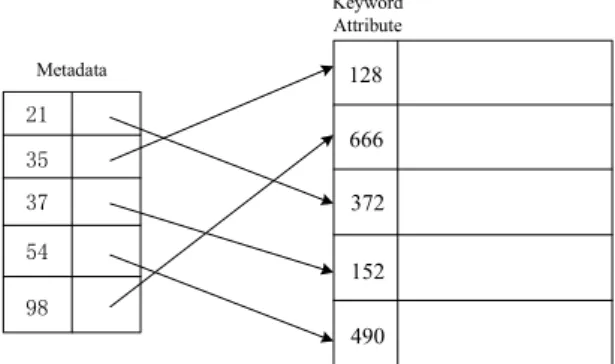
Query Speedup This approach needs extra data struc-tures. In particular, we add some metadata to the en-crypted database so as to facilitate query processing, avoid-ing sequential testavoid-ing: the metadata for a record is a tag and a link that points to the corresponding record. The tag is determined by the keyword of the record, and the metadata is sorted according to the tags. At the time of querying database, a user sends the corresponding tag to the server, who then binary-searches the sorted metadata, and follows the link to locate the queried record. We use Figure 2 as a toy example to illustrate the concept of meta-data. The database has 5 records, whose keywords are 128,
Figure 2: Exposition of metadata
666, 372, 152, 490, respectively, and the corresponding tags derived from these keywords are 35, 98, 21, 37, 54. As a result, the metadata after sorting is of the form (21,link to record “372”), (35, link to record “128”), (37, link to record “152”), (54,link to record “490”), and (98,link to record “666”).
In this method, we have to consider multiple occurrences of the same keyword value in different records. The same keyword value in different records should generate distinct tags; otherwise, the adversary such as the database server will know those records that have the same keyword by simply inspecting the database. Our solution to this issue is the following. Recall that in the above schemekU M=x,
E() is the encryption for records, andhs is a keyed hash function. Let h0(.) be another collision resistant
crypto-graphic hash function. For a recorddi, whose keyword is
di.w = w, suppose that this is the cth occurrence of w in the database. Then the tag for di.w is computed as
tg=h0(ˆe(hs(w), gx), c), and the link associated withtgis pointed toE(di), the encrypted record2. The metadata is passed to the database server, together with the encrypted database.
2We suppose that generation of the encrypted database is by the
user manager, who belongs to the data owner organization.
To query w, user u computes and sends qu(w) =
hs(w)xu to the database server, who then computes k0 =
ˆ
e(qu(w), ComKu). The database server continues to per-forms the following steps: it repeatedly binary searches the metadata in order to find out all tags derived from the same keyword value. Note that the server stops once no matching tag is found (i.e.,lnk=N U LL).
c= 0; Repeat c = c+1; tg=h0(k0, c); lnk = Binary-Search(tg, Metadata); If lnk=N U LL Return; Else
Collect the record pointed bylnk to useru.
End (of Repeat)
We next point out the reason why this method does not apply to dynamic databases supporting record insertion by individual users. When a user computes the tag for a new record, she must know the number of occurrences of the keyword value of that record; but this information is not easy to get in our setting. Adding another data structure containing keywords together with their number of occurrences as in Yang et al. (2006) does not totally solve the problem. Of course, updates by the data owner organization who outsources the database are still easy, since it knows this information. However, it should be clear that if we are willing to reveal the information on the number of occurrences of a keyword, our technique readily supports dynamic database update by individual users.
5 CONCLUSION
Existing efforts on searchable encryption have focused on single-user settings. Directly extending a searchable en-cryption scheme for the single-user setting to the multi-user setting has several downsides, e.g., the consider-able costs associated with re-distributing query keys and re-generating the encrypted database. To solve theses problems, in this paper we presented a systematic study on searchable encryption under a practical multi-user database setting. We first formulated a system model as well as a set of security requirements, then presented a con-crete construction which provably satisfies those require-ments. In our construction, each user employs a distinct key, and consequently, user revocation does not entail up-dating of query keys and re-encryption of the database, and is transparent to the non-revoked users. Moreover, each authorized user can also insert and search the database, an important feature to data sharing in the multi-user set-ting. Our construction is efficient, achieving similar per-formance as most of the existing single-user schemes. Bet-ter yet, in case of static databases where record insertion by individual users is not supported, we can further im-prove performance to binary search rather than sequential
search.
REFERENCES
Abdalla, M., Bellare, M., Catalano,D., Kiltz, E., Kohno, T., Lange,T., Lee, J., Neven, G., Paillier, P. and Shi, H. (2005) ‘Searchable encryption revisite: consistency properties, ration to anonymous IBE, and extensions’, Crypto’05, LNCS 3621, pp. 205-222.
Boneh, D., di Crescenzo, G., Ostrovsky, R. and Persiano, G. (2004) ‘Public key encryption with keyword search’, Eurocrypt’04, pp. 506-522.
Beimel, A., Ishai, Y., Kushilevitz, E. and Jean-Fran¸cois Raymond. (2002) ‘Breaking the o(n1/(2k−1)) barrier for information-theoretic private information retrieval’, FOCS’02, pp. 261-270.
Ballard, L., Kamara, S. and Monrose, F. (2005) ‘Achiev-ing efficient conjunctive keyword searches over encrypted data’, International Conference on Information and Communications Security, ICICS’05, pp. 414-426. Boneh, D., Lynn, B. and Shacham, H. (2001) ‘Short
Signa-tures from the Weil Pairing’,Proc. Asiscrypt’01, LNCS 2248, pp. 514-532.
Bellare, M. and Rogaway, P. (1993) ‘Random oracles are practical: A paradigm for designing efficient protocols’, ACM Conference on Computer and Communications Security, CCS’93, pp. 62-73.
Boneh, D. and Waters, B. (2007) ’Conjunctive, subset, and range queries on encrypted data’,Theory of Cryptogra-phy Conference, TCC’07, LNCS 4392, pp. 535-554. Canetti, R., Goldreich, O. and Halevi, S. (1998) ‘The
ran-dom oracle methodology, revisited’,Proc. STOC’98, pp. 209-218.
Curtmola, R., Garay, J., Kamara, S. and Ostrovskey, R. (2006) ‘Searchable symmetric encryption: improved def-initions and efficient constructions’,ACM Conference on Computer and Communications Security, CCS’06, pp. 79-88.
Chor, B., Kushilevitz, E., Goldreich, O. and Sudan, M. (1995) ‘Private information retrieval’, Journal of the ACM, 1995.
Chang, Y. and Mitzenmacher, M. (2005) ‘Privacy preserv-ing keyword searches on remote encrypted data’,Applied Cryptography and Network Security, ACNS’05, LNCS 3531, pp. 442-455.
Fiat, A. and Shamir, A. (1986) ‘How to prove yourself: Practical solutions to identification and signature prob-lems’,Proc. Crypto’86, LNCS 263, pp. 186-194.
Goh, E. (2003) ‘Secure indexes’,
http://crypto.stanford.edu/
eu-jin/papers/secureindex/secureindex.pdf.
Goldreich, O. (2004) ‘Foundations of cryptography’, Vol-ume 2, Cambridge University Press, 2004.
Golle, P., Staddon, J. and Waters, B. (2004) ’Secure con-junctive keyword search over encrypted data’, Applied Cryptography and Network Security, ACNS’04, pp. 31-45.
Hwang,, Y.H. and Lee, P.J. (2007) ‘Public key encryp-tion with conjunctive keyword search and its extension to a multi-user system’, International Conference on Pairing-Based Cryptography, Pairing’07.
Kushilevitz, E. and Ostrovsky, R. (1997) ‘Replication is not needed: single database, computationally private in-formation retrieval’,Proc. FOCS’97pp. 364-373. Katz, J. Sahai, A. and Waters. B. (2008) ‘Predicate
en-cryption supporting disjunctions, polynomial equations and inner products’,Eurocrypt’08.
Lipmaa, H. (2005) ‘An oblivious transfer protocol with log-squared communication’, Information Security Confer-ence, ISC’05, LNCS 3650, pp. 314-328.
Park, D., Kim, K. and Lee, P. (2004) ‘Public key en-cryption with conjunctive field keyword search’, Interna-tional Workshop on Information Security Applications, WISA’04, pp. 73-86.
Song, D., Wagner, D. and Perrig, A. (2000) ‘Practical tech-niques for searches on encrypted data’,IEEE Symposium on Security and Privacy, S&P’00, pp. 44-55.
Shi, E. and Waters, B. (2008) ‘Delegation capabilities in predicate encryption systems’, Cryptographer’s Track, ICALP’08.
Yang, Z., Zhong, S. and Wright, R. N. (2006) ‘Privacy-preserving queries on encrypted data’, 11th European Symposium on Research in Computer Security, ES-ORICS’06, pp. 479-495.