Sentiment Analysis to Measure Celebrity
Endorsment’s Effect using Support Vector Machine
Algorithm
Fransiska Jesinta Pinem Faculty of Industrial and System
Engineering Telkom University Bandung, Indonesia [email protected]
Rachmadita Andreswari Faculty of Industrial and System
Engineering Telkom University Bandung, Indonesia [email protected]
Muhammad Azani Hasibuan Faculty of Industrial and System
Engineering Telkom University Bandung, Indonesia
Abstract—Celebrity endorsement is a phenomenon in which companies advertises their products by using celebrity services, and celebrities take advantage of their popularity to promote a brand or product of the company through social media. In this study, KFC did a celebrity endorsement to make their menu more popular. KFC choose to work with Raditya Dika to promote their latest menu, KFC Salted Egg Chicken. This study will examine whether in such cases there is a change in public sentiment towards the product after the celebrity endorsement. It can be done using text mining and sentiment analysis. There are several algorithms that can be used to perform sentiment analysis, one of them is Support Vector Machine. Support Vector Machine (SVM) was chosen because this method is quite accurate in various studies. SVM also takes into account various features of the document, including features that often do not appear on the document, so it can reduce the loss of information from the data. The data used in this research are taken from YouTube and Twitter comment about KFC Salted Egg Chicken. Several step was done in this sentiment analysis research, that are preprocessing text, feature extraction, classification, and evaluation. The result model is tested and evaluated before and after endorsement by looking at the value of accuracy, precision, recall, and f1-measure. The test result of accuracy, precision, recall, and f-measure before endorsement were 67,83%, 69%, 68%, and 66%. After the endorsement, the test results were 74.06%, 74%, 74%, and 74% respectively. The results of this study indicate that SVM has an accurate measurement in sentiment analysis studies. Moreover, this study found that there was not significant change in public sentiment regarding the product before and after the celebrity endorsement.
Keywords—sentiment analysis, celebrity endorsement, social media, text mining and support vector machine
I. INTRODUCTION
Celebrity endorsement is a phenomenon in which a company advertises its products by using celebrity services, where the celebrity exploits its popularity to promote a brand or product of the company. By celebrity endorsement, it is expected that new products can be accepted and responded positively by society.
Kentucky Fried Chicken (KFC) is a famous fast food restaurant company in Indonesia. Fried chicken is the main menu of KFC. There are several variations of KFC food menu, one of the variations of the menu is KFC salted egg fried chicken, which is fried chicken with salted egg sauce. KFC salted egg chicken is one of the KFC products themed Taste of Asia. The taste of salted eggs was chosen because according to a survey conducted by KFC, the taste of salted egg is one
of the five most popular flavors in Asia [1]. This menu was launched on February 1, 2018. Since this product was released, this product is reaping controversy on food lovers because of its unique taste. There are various responses to this product, some people like it, some people dislike it, and some people feel neutral about it.
Two weeks after the new menu was launched, KFC endorsed Raditya Dika to promote the menu. Raditya Dika is one of the famous celebrities among young people. He is a writer and also a social media influencer. KFC and Raditya Dika held a contest to make video about review of the new menu. The winner that chosen by him would get a meal voucher at KFC for fifty thousand rupiahs and will also collaborate with Raditya Dika to create video content. This contest encourages people to buy and review the food. However, the effect of celebrity endorsement is unknown regarding public opinion about KFC Salted Egg Chicken. The tendency of public sentiment can be known by sentiment analysis. Sentiment analysis is an approach to classify opinions digitally. Sentiment analysis, also known as opinion mining, is the field of research to analyze sentiments, evaluations, judgments, attitudes, and emotions on entities such as products, services, organizations, characters, topics, and attributes of the entity [2]. Sentiment analysis is often done by various companies to find out whether the product and brand companies have positive or negative responses in communities. Moreover, sentiment analysis can be used to get criticism and suggestions from the public on a product or brand.
Public opinion about a product or brand can be taken from text on social media. Social media is an internet-based application built on the ideology and technology of Web 2.0, which allows users to create content and exchange the content with other users [3]. People use social media as a means to review and discuss various topics, including on food reviews. This research uses the YouTube and Twitter as a source of data to explore public opinion. YouTube is choosen as the source of opinion in this study because according to Statista’s research in the third quarter of 2017[4], YouTube is the most popular social media in Indonesia. YouTube was originally a platform for uploading videos, but now the platform has evolved into social media, as it supports users to interact and conduct social activities, such as commenting, rating, etc. The next data source is Twitter, the seventh most popular social media in Indonesia according to Statista in 2017. The number of Twitter users in Indonesia is quite big. Indonesia is a country with the most users of twitter in Asia Pacific. Every year, the number of Twitter users in Indonesia are always
increase. Twitter was choosen because of the popularity and growth of its users.
After obtaining social media data sources, a text classification using machine learning is done. The algorithm used in this research is Support Vector Machine (SVM). SVM was choosen because it considered quite accurate in various studies. For example, on the comparison of the Deep Recurrent Neural Network algorithm with Support Vector Machine on sentiment analysis based on aspects of Arabic hotel reviews [5]. SVM was rated better than Deep Recurrent Neural Network. In addition, the SVM considers in various features of the document, including a few frequency accurance features. This ability can reduce the loss of information from the data.
II. LITERATURE REVIEW A. Celebrity Endorsement
Celebrity endorsement is one of the advertising strategies in which a company advertises its products by using celebrity services [6]. Celebrities use their popularity to promote the product to the wider community. Promotion is considered to help company to create a positive image or perception to their consumer towards a brand or product [6]. However, this method is considered very expensive. The effectiveness of celebrity endorsement in several studies has an impact on consumer perceptions of the product. A study of consumer behavior examines the effect of celebrity endorsement on consumer buying interest and consumer responses to a particular product advertised by television [7]. This study uses quantitative methods in which the researchers analyzed the results of questionnaires from 200 respondents from various students from various universities. The results of this study indicate that there is influence of celebrity endorsement to public buying interest. According to the results, celebrity endorsement is more attractive than conventional advertisement. Most consumers involved in the study said they would buy products promoted by celebrities. Some of the factors that make celebrity endorsement more appealing are the physical attraction of celebrities, credibility, and the alignment of celebrities with promoted products. These factors affect consumer perceptions of a product.
B. Sentiment Analysis
Sentiment analysis or also referred to opinion mining is a field of research to analyze opinions, sentiments, evaluations, judgments, attitudes, and emotions on entities such as products, services, organizations, figures, topics, and attributes of these entities [8].
In the study [9] performed sentiments of analysis on television shows via Twitter using Support Vector Machine and Genetic Algorithm as Feature Selection Method. The study calculated the rating of television shows using sentiment analysis. The dataset used is a tweet of 160, divided into 80 positive tweets and 80 negative tweets. Five experiments were conducted with the ratio of training data and data testing as follows: 90:10, 80:20, 70:30, 60:40, and 50:50. The research process begins by taking a tweet, then do preprocessing. Then the vector term presence is performed. After that, the feature selection is done using genetic algorithm. After that, done classification with Support Vector Machine algorithm and television ratings calculation. Accuracy without feature selection in five experiments is about 90.5%. The accuracy
with feature selection approximates accuracy without feature selection, with an error value of 0.62%, except in the first experiment. The first experiment with feature selection, with training data ratio 90:10, yielded 87.5% accuracy. The result of comparison of television ratings rating based on AGB Nielsen rating and by using sentiment analysis is not much different. Calculation with sentiment analysis has an average error value of 0.562 on AGB Nielsen rating.
There are several approaches in classifying sentiment analysis. Broadly speaking, the approaches are [9]:
• Machine learning approach
Broadly speaking, the machine learning approach relies on machine learning algorithms to be able to perform sentiment analysis. This algorithm is used to classify texts that have linguistic features. Algorithms commonly used in this approach are Naive Bayes, Neural Network, Support Vector Machine, Decision Tree, and so forth. • Lexicon based approach.
Broadly speaking, the lexicon based approach is done by counting the total weight of positive and negative words on a document or sentence to determine whether the document or sentence has positive or negative sentiments. C. Support Vector Machine
Support Vector Machine is one of machine learning algorithm. The algorithm was discovered by Vapnik, et al, in about 1960s [10]. Currently support vector machine is often used and is one of the basic algorithms learned in learning machine learning process.
The support vector machine algorithm is basically aimed at finding the best hyperplane to separate the two different classes [11]. Hyperplane maximizes the margin between the closest positive and negative class data from the hyperplane. The closest data of the hyperplane is called support vector [12]. The Support Vector Machine algorithm, in the context of natural language processing, will classify words, phrases, or sentences into categories based on the feature set [13][14]. The entered data will be mathematically transformed by using the kernel function, where this kernel function will create linear separation of data from various categories [13].
III. RESEARCH METHODOLOGY A. Conceptual Model
In this research sentiment analysis is developed to examine the effect of celebrity endorsement on public sentiment by using SVM and had an evaluation phase by doing scenario testing. This research is based on the problem formulation of whether celebrity endorsement affects the public sentiment of the product, especially in the case of KFC salted egg fried chicken. The environment in this research consists of celebrity and social media technology.
The basic knowledge used in this research are sentiment analysis and SVM algorithm. Text mining methodology is also implemented in this research (Fig 1).
B. Methodology
This research methodology is divided into three stages: problem and solution identification stage, sentiment analysis stage using SVM, result analysis and conclusion stage. • Problem identification stage.
The problem identification and solution stage begun by doing problem identification, followed by a literature
study, case study, and algorithm selection. The next process is solution identification. The next process is the identification of research objectives, followed by the
identification of research benefits. The last is problem scoping.
Fig. 1 Conceptual Model • Sentiment analysis stage
Sentiment analysis stage using the SVM algorithm, began with the data collection [14]. The data collected was obtained from Twitter and YouTube comments from several videos related to case study. After the data obtained, the preprocessing data, i.e. the process of cleaning the data before the text classification is performed. In this process there are four main activities performed: punctuation removal, stop words removal, tokenization, and stemming. Stop words removal is the process of removing the words that have no significant meaning [15]. Tokenizing is the process of breaking sentences into words. Stemming is the process of restoring word into its basic form. The next process is extract features from the data. In the feature extraction process, the frequency of word occurrence is calculated, and comments are converted to vector form. Then, the next process is the classification of sentiment using the SVM algorithm. In this process carried out two activities, namely training data and testing data. The next process is checking the accuracy of machine learning. Python programming language is used in this research.
• Result analysis and conclusion stage
The third and final stage of this research is the result analysis and conclusion stage. In this stage, evaluation and analysis of classification results are performed. Then conclusion and suggestion from this research is obtained. C. Dataset
The dataset used in this study are YouTube user's comments and tweets from Twitter that related to the topic of discussion, which is about KFC salted egg chicken. The comments are taken using open source tools. Then the comments are put together in a file with csv format. Then the comments that have been collected are separated according to the date - before and after February 18, 2018. The parameters
used in this study are comments only. Once the data extracted, we labeled the comments based on their sentiments. The data label consists of positive, negative, and neutral.
IV. RESULT AND ANALYSIS
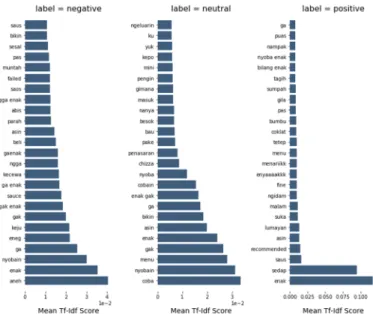
The dataset contains comments before and after their celebrity endorsement was split into ratio of 75:25. Data is divided randomly. The amount of dataset of comments before celebrity endorsement is 458. Total amount of data training is 343 and total amount of data testing is 115. The amount of data in the dataset of comments after the celebrity endorsement is 737. After divided, total amount of data training is 552 and the total amount of data testing is 185. The feature with the highest value in comment dataset before endorsement can be seen in the following figure 2.
Fig. 2 Feature with Highest Value on Dataset Comments Before Endorsement
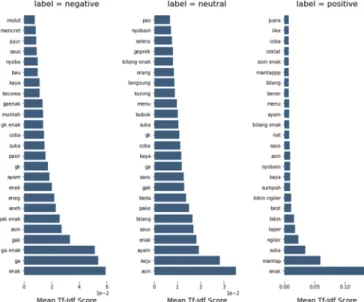
While the feature with the highest value in the comment dataset after the endorsement can be seen in Figure 3.
Fig. 3 Feature with Highest Value in Comment Dataset After Endorsement
Details of the amount of data testing based on manual data labeling are as follows (table 1):
TABLE I Details of the amount of data testing Periode Positive Negative Neutral Sum Before
endorsement 26 27 62 115
After
endorsement 43 73 69 185
The number of comments and tweets analyzed using SVM in the period before celebrity endorsement was 115 with details of 14 positive comments, 19 negative comments, and 82 neutral comments. While the number of comments in the period after celebrity endorsement was 185, with details of 33 positive comments, 78 negative comments, and 74 neutral comments (Fig 4).
Fig. 4 Total amount of comments and tweets
Details of sentiment proportions before celebrity endorsement were 71% neutral, 17% negative, and 12% positive. The proportion of sentiments in the period before the celebrity endorsement is illustrated in figure 5.
Fig. 5 Sentiment proportions before celebrity endorsement While the details of sentiment proportions after celebrity endorsement were 40% neutral, 42% negative, and 18% positive. The proportion of sentiments in the period after the celebrity endorsement can be illustrated in figure 6.
Fig. 6 Sentiment proportions after celebrity endorsement Based on the illustration, we can see that there was a sentiment shift between the two periods. Prediction results in the period before celebrity endorsement showed that the sentiments on KFC Salted Egg Chicken products were neutral. This prediction caused by not many people who tried the product in the period before the celebrity endorsement. Most commentators ask whether the product is tasty or not. In addition, there were neutral comments that said that the product is ordinary and had no strong feeling towards it.
Prediction results in the period after celebrity endorsement as shown in Fig. 6 showed that most of the sentiments on KFC salted egg chicken products were negative. Most commentators say they dislike the product. In addition, there was a shift in the proportion of neutral sentiments, it can be assumed that already many people had tried the product.
This result showed that the celebrity endorsement of KFC salted egg chicken product by Raditya Dika affected product sentiment. Based on predicted results from both periods, we can see that there is a tendency for greater negative sentiment toward the product than positive sentiment. This is more likely caused by the number of comments that dislike the product is more than the number of comments that likes the product.
Based on this research the accuracy of SVM algorithm in the dataset before celebrity endorsement is 67.83%. 14 33 19 78 82 74
Before Endorsement After Endorsement
Total Amount of Comments and Tweets
Positive Negative Neutral
Positive 12% Negative 17% Neutral 71%
Sentiment Before Celebrity Endorsement
Positive 18% Negative 42% Neutral 40%
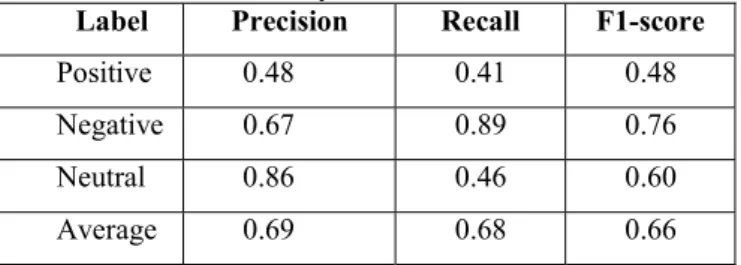
Evaluation of SVM algorithm in dataset of comments before celebrity endorsement is as follows.
TABLE II Evaluation of SVM algorithm on dataset before celebrity endorsement
Label Precision Recall F1-score
Positive 0.48 0.41 0.48
Negative 0.67 0.89 0.76
Neutral 0.86 0.46 0.60
Average 0.69 0.68 0.66
The accuracy of SVM algorithm in dataset of comments after celebrity endorsement is 74,06%. Evaluation of SVM algorithm in comment dataset after celebrity endorsement is as follows.
TABLE III Evaluation of SVM algorithm on dataset after celebrity endorsement
Label Precision Recall
F1-score Positive 0.74 0.79 0.77 Negative 0.72 0.77 0.74 Neutral 0.79 0.60 0.68 Average 0.74 0.74 0.74 V. CONCLUSION
In this study, the SVM method is used to generate a classifier to classify and predict user comments on a food product. The classification result of this user comment is then used to see how far the endorsement of an artist influences the sentiment of the product being promoted. Based on the results of testing of SVM the accuracy of the support vector machine classifier in performing sentiment analysis before the celebrity endorsement is 67.83% and after the celebrity endorsement is 74.06%.
REFERENCES
[1] Maharani, S. (2018, Februari 3). Retrieved from Kumparan: https://kumparan.com/@kumparanfood/perkenalkan-taste-of-asia-kfc-luncurkan-menu-salted-egg-chicken
[2] Liu, B. (2012). Sentiment Analysis and Opinion Mining. Chicago, USA: Morgan & Claypool Publishers.
[3] Kaplan, A. M., & Haenlein, M. (2010). Users of the World, Unite!: The Challenges and Opportunities of Social Media. Business Horizons, 59-68.
[4] Statista (2018) Retrieved from Statista: https://www.statista.com/statistics/284437/indonesia-social-network-penetration/
[5] Al-Smadi, M., Qawasmeh, O., Al-Ayyoub, M., Jararweh, Y., & Gupta, B. (2017). Deep Recurrent Neural Network vs. Support Vector Machine for Aspect-based Sentiment Analysis of Arabic Hotels’ Reviews. Journal of Computational Science.
[6] Erdogan, B. Z. (1999). Celebrity Endorsement: A Literature Review. Journal of Marketing Management, 291-314.
[7] Ahmed, R., Seedani, S., Ahuja, M., & Paryani, S. (2015). Impact of Celebrity Endorsement on Consumer Buying Behavior. Journal of Marketing and Consumer Research, 12-20.
[8] Liu, B. (2012). Sentiment Analysis and Opinion Mining. Chicago, USA: Morgan & Claypool Publishers.
[9] Medhat, W., Hassan, A., & Korashy, H. (2014). Sentiment Analysis Algorithms and Applications: A Survey. Ain Shams Engineering Journal, 5, 1093-1113.
[10] Smola, A. J., & Scholkopf, B. (2004). A Tutorial On Support Vector Regression. Statistics and Computing, 199-222.
[11] Khan, A., Baharudin, B., Lee, L. H., & Khan, K. (2010, February). A Review of Machine Learning Algorithms for Text-Documents Classification. Journal of Advances in Information Technology, 1(1), 4-20.
[12] Hotho, A., Nürnberger, A., & Paaß, G. (2005). A Brief Survey of Text Mining. LDV Forum - GLDV Journal for Computational Linguistics and Language Technology, 19-62.
[13] Nadkarni, P., Ohno-Machado, L., & Chapman, W. W. (2011, September 1). Natural Language Processing: an Introduction. Journal of the American Medical Informatics Association, 18(5), 544-551. [14] Amolik, A., Jivane, N., Bhandari, M., & Venkatesan, D. (2016).
Twitter Sentiment Analysis of Movie Reviews using Machine Learning Techniques. International Journal of Engineering and Technology, 7(6), 2038-2044.
[15] Hakim, L., Kusumasari, T. F., & Lubis, M. (2018). Text Mining of UU-ITE Implementation in Indonesia. Journal of Physics: Conference Series, 1007(1). http://doi.org/10.1088/1742-6596/1007/1/012038