A thesis submitted in fulfilment of the requirements for the degree of Doctor of Philosophy
Shafiza Mohd Shariff
B.Sc. (Hons.) in Computer Science, University Putra Malaysia, Malaysia, M.Sc in Information Technology, University Technology MARA, Malaysia
School of Science,
College of Science Engineering and Health, RMIT University
I certify that except where due acknowledgement has been made, the work is that of the author alone; the work has not been submitted previously, in whole or in part, to qualify for any other academic award; the content of the thesis is the result of work which has been carried out since the official commencement date of the approved research program; any editorial work, paid or unpaid, carried out by a third party is acknowledged; and, ethics procedures and guidelines have been followed.
Shafiza Mohd Shariff School of Science RMIT University October 2018
First and foremost, I wish to praise Allah the Almighty, for whom we ultimately depend on for guidance and protection. I would like to send my utmost gratitude to Him for giving me the opportunity, determination, knowledge, and strength to do my research. Allah’s mercy and grace have been with me throughout my life and even more so during my research journey.
I would like to extend my deepest gratitude to my supervisor, Associate Professor Dr Xiuzhen Zhang, for her continuous support, assistance and encouragement. Apart from being an excellent supervisor, she is very knowledgeable of research in her subject area. I really appreciate the ideas, time and support she has given me during the tenure of my research.
I would also like to express my gratitude to my second supervisor, Professor Dr Mark Sanderson. I really appreciate his support, guidance and valuable advice. Indeed, his quick feedback and constructive comments were really inspiring and helpful. He always tries to make time for me, even when he is busy, and for that, I am truly grateful.
I would like to thank my colleagues and friends for the discussions, suggestions and criticism especially my lab mates, Husna Sarirah Husin, Sharin Hazlin Huspi, Evi Yulianti, Fatimah Alqahtani, Lishan Cui and Chen Xi. To the many participants of the user studies that have been conducted for this research, thank you. I am also thankful to my friends and colleagues back in Malaysia, and also my online researchers support group. To my sponsors, Majlis Amanah Rakyat (MARA) and Universiti Kuala Lumpur, thank you for the opportunity given to me to pursue my PhD study at RMIT University, Australia.
family abroad. For that, I would also like to express my gratitude to my friends here in Melbourne especially from Kampung Victoria North Melbourne (KVNM) for supporting and encouraging me throughout my study, the care and concern given for my family’s well-being here in Melbourne, and for all the knowledge during our fortnightly knowledge sharing session. I enjoyed spending time with all of them. Thanks for giving me such a joyful time. Before I was a PhD student, I am foremost a wife, a mother and a daughter. For that, I would like to convey my deepest appreciation and gratitude to the love of my life, my other half, Tengku Mohd Abas for his constant support, sacrifice and love. Without him, I would not be able to focus and have the determination to complete my PhD research. The encour-agement and continuous prayer by my parents and family back in Malaysia have also been my strength, and I am truly grateful and blessed with their love. Not forgetting my beautiful children, I am thankful for your sacrifice and support. Your existence is my achievement and encouragement in life. I owe everything to you. Thus this work is dedicated to my family. I love each and every one of you dearly.
Portions of the material described in this thesis have been published in peer-reviewed publi-cations. These publications correspond to the following chapters in this thesis:
• Chapter 3: Shariff, S.M., Zhang, X. and Sanderson, M., 2014. User perception of information credibility of news on Twitter. In European Conference on Information Retrieval (ECIR), pp. 513-518. Springer International Publishing.
• Chapter 4: Shariff, S.M., Sanderson, M. and Zhang, X., 2016. Correlation Analysis of Readers Demographics and Tweet Credibility Perception. In European Conference on Information Retrieval (ECIR), pp. 453-465. Springer International Publishing.
• Chapter 4: Shariff, Shafiza Mohd, Xiuzhen Zhang, and Mark Sanderson, 2017. On the Credibility Perception of News on Twitter: Readers, Topics and Features. Computers in Human Behavior, Volume 75, pp. 785-796. Elsevier Ltd.
Other publication during the candidature that is not directly related to this thesis:
• Shariff, Shafiza Mohd, and Xiuzhen Zhang, 2014. A survey on deceptions in online social networks. International Conference on Computer and Information Sciences (IC-COINS), pp. 1-6. IEEE.
The thesis was written in typeset using the LATEX 2εdocument preparation system.
All trademarks are the property of their respective owners.
Note
Unless otherwise stated, all fractional results have been rounded to the displayed number of decimal figures.
Abstract 1
1 Introduction 3
1.1 Background . . . 4
1.2 Scope of the Thesis . . . 8
1.3 Research Objectives . . . 9 1.4 Research Questions . . . 10 1.5 Research Contributions . . . 13 1.6 Thesis Organisation . . . 15 2 Research Background 17 2.1 Credibility . . . 17
2.1.1 Credibility and Trust . . . 18
2.2 Credibility Factors . . . 20
2.2.1 Sources of Information . . . 21
2.2.4 Interface Design Layout . . . 23 2.2.5 Readers’ Attributes . . . 25 2.3 Credibility Evaluation . . . 27 2.3.1 User Studies . . . 29 2.3.2 Statistical Analysis . . . 31 2.3.3 Machine Learning . . . 32 2.4 Research Gaps . . . 35 2.5 Summary . . . 36
3 Research Design and Methodology 37 3.1 Research Methodology . . . 37
3.2 User Study Design . . . 39
3.2.1 Data Collection Methods . . . 39
3.2.2 Three User Studies . . . 41
3.2.3 Sample and Population . . . 45
3.3 Summary . . . 46
4 Tweet Features and Credibility Association Analysis 48 4.1 Introduction . . . 48
4.2 Data Collection . . . 49
4.3 Evaluation Approaches . . . 53
4.4 Data Analysis . . . 56
4.4.1 Deriving Features using Content Analysis . . . 56
4.4.2 Analysing Features for Credibility . . . 59
4.5 Result . . . 59
4.5.1 Extracting Features for Credible Tweets . . . 60
4.5.2 Analysing Misjudged and Difficult-to-Judge Tweets . . . 60
4.5.3 Feature and Credibility Association Analysis . . . 61
4.6 Discussion . . . 62
4.7 Summary . . . 63
5 Factors in Credibility Perception 64 5.1 Introduction . . . 64
5.2 Data Collection . . . 65
5.2.1 Tweet Message Collection . . . 65
5.2.2 TweetCred Credibility Rating . . . 66
5.2.3 Readers’ Credibility Rating . . . 67
5.3 Data Analysis Approaches . . . 73
5.3.1 Cohen’s Kappa . . . 73
5.3.2 Chi-Square Test of Independence . . . 74
5.4 Data Analysis Results . . . 77
5.4.1 Overall Demographics . . . 77
5.4.4 Findings . . . 81
The Difference between Human Perception and Machine Predicted Credibility Levels . . . 81
Correlation Analysis . . . 82
5.5 Discussion . . . 90
5.6 Summary . . . 95
6 Personality and Behavioural Factor Analysis 97 6.1 Introduction . . . 97 6.2 Personal Characteristics . . . 98 6.2.1 Personality . . . 99 6.2.2 Readers’ Behaviour . . . 100 6.3 Data Collection . . . 102 6.3.1 Study Design . . . 102 6.4 Data Analysis . . . 107 6.4.1 Reliability Test . . . 107 Cronbach alpha . . . 108 Composite reliability . . . 108 6.4.2 Multiple Regression . . . 108 6.4.3 Factor Analysis . . . 110 6.5 Result . . . 111 6.5.1 Overall Demographics . . . 112
6.5.3 Readers’ Behaviour . . . 115
6.6 Discussion . . . 121
6.7 Summary . . . 124
7 Conclusion 126 7.1 Credibility Features . . . 127
7.2 Factors Correlated with Credibility Perceptions . . . 127
7.3 How Personal Characteristics Influence Credibility Perceptions . . . 129
7.4 Limitations of the Study . . . 130
7.5 Future Work . . . 131
Bibliography 133 A List of News-Related Topics for Second User Study 150 B Approval Letters for Human Ethics Application 156 B.1 Approval Letter for ASEHAPP 47-13 . . . 156
1.1 Example of tweet messages . . . 8
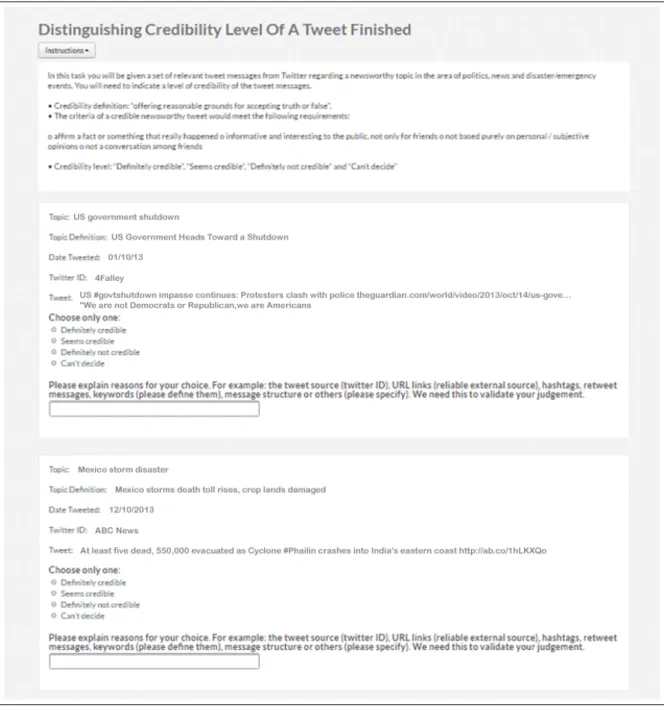
4.1 User study screenshot to find readers’ feature preferences . . . 52
5.1 Credibility rating of a tweet predicted by TweetCred . . . 67
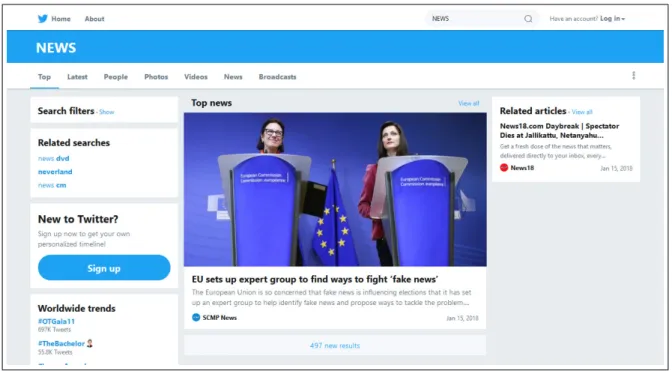
5.2 A screenshot of using Twitter’s search platform . . . 68
5.3 Tweet message and demographic questions . . . 70
5.4 Credibility perception and feature selection . . . 71
5.5 Grouped matrix-based for 346 association rules with k=10 groups . . . 89
6.1 Demographic section . . . 104
6.2 Tweet message and credibility perception . . . 105
6.3 Ten-Item Personality Inventory (TIPI) personality test . . . 106
2.1 User studies conducted in credibility studies . . . 30
2.2 Statistical analysis used in credibility studies . . . 33
2.3 Supervised learning for credibility prediction/analysis . . . 34
3.1 Data collection methods used in credibility studies . . . 42
4.1 News event-related topics . . . 51
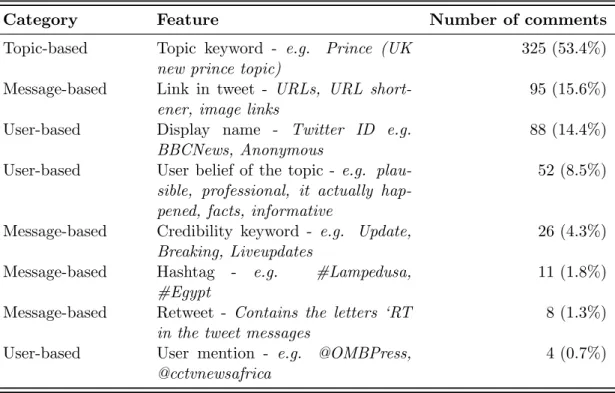
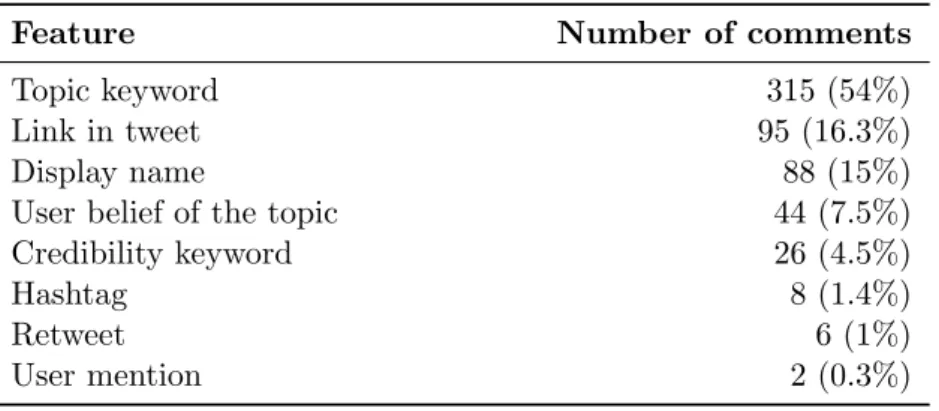
4.2 Tweet direct feature occurrences commented on by readers . . . 57
4.3 Features derived from reader comments for credibility rating . . . 58
4.4 Distribution of credibility ratings for 400 tweets . . . 59
4.5 Features derived from reader comments for credible tweets . . . 60
4.6 Top association rules . . . 61
5.1 Demographic attribute distribution . . . 78
5.2 Tweets news topic distribution . . . 79
credibility prediction . . . 81
5.5 Demographic profiles and credibility perception chi-square results . . . 83
5.6 Chi-square result for demographic attribute pairwise correlation . . . 84
5.7 News characteristic correlation with readers’ credibility perception . . . 84
5.8 Chi-square result between readers’ demographics and news topics . . . 85
5.9 Correlation between readers’ demographics and news topics with credibility perception . . . 86
5.10 Associations between demographics and news characteristics for credibility perception . . . 88
5.11 The chi-square correlation between demographics and features used in credi-bility perception . . . 90
5.12 Frequent pattern mining of feature categories . . . 91
6.1 Demographic profile distribution . . . 113
6.2 Pearson’s correlation (r) between readers’ personality traits and credibility perceptions . . . 114
6.3 Multiple regression . . . 115
6.4 Factors in readers’ cognitive heuristics in credibility perception . . . 117
6.5 Reliability scores for each factor . . . 119
6.6 Means of readers’ behaviour factor by cluster . . . 120
Information on Twitter is vast and varied. Readers must make their own judgements to de-termine the credibility of the great wealth of information presented on Twitter. This research aims to identify the factors that influence readers’ judgements of the credibility of information on Twitter, especially news-related information. Both internal (within the Twitter platform) and external factors are studied in this research. User studies are conducted to collect read-ers’ perceptions of the credibility of news-related tweets, Twitter features, and the impact of reader characteristics, such as a reader’s demographic attributes, their personality and behaviour. Twitter readers are found to depend solely on surface tweet features in making these judgements such as the author’s Twitter ID, pictures, or the number of retweets and likes, rather than the tweet’s metadata as recommended in previous studies. In this study, surface features are related to cognitive heuristics. Cognitive heuristics are features that the mind uses as shortcuts for making quick evaluations such as deciding the credibility of tweets. There are three main types of cognitive heuristic features found on Twitter that readers use to determine credibility: endorsement, reputation and confirmation. This study finds that readers do not use only one single feature to make credibility judgements but
and geolocation also have a significant positive correlation with their perceptions of a tweet’s credibility. Readers with tertiary level education, or living in a certain location or environ-ment, such as in a crisis or conflict area, are observed to be more careful in making credibility judgements. Readers who possess conscientiousness and openness to experience personality traits are also seen to be very cautious in their credibility judgements. Another insight pro-vided by this research is the categorisation of readers’ behaviours according to credibility perceptions on Twitter. The behavioural categorisations are defined by readers’ behavioural reliance on Twitter’s surface features when judging the credibility of tweets. The findings can assist social media authors in designing the surface features of their social media content in order to enhance the content’s credibility. Furthermore, findings from this research can help in developing effective credibility evaluation systems by considering readers’ personal characteristics.
Introduction
Online social media (OSM) has been around since 1996, but only after the emergence of Facebook in 2006 did social media become a global phenomenon [Boyd and Ellison, 2007]. Many sites require their users to be honest with the information they provide in their profiles, but users may not necessarily follow these policies. Once an account has been created, social media users will develop connections and build friendship network links with others [Musia l and Kazienko, 2013].
The friendship links allow users to experience online social activities with one another. Common activities include sharing links, files, photos and videos, updating user profiles, writing status updates, commenting on and tagging posts, photos, videos and files, adding and deleting friends and posting on friends’ pages/walls [Wilson et al., 2009]. As a result of all these activities, large volumes of information are made publicly accessible. However, not all the information posted online can be trusted and true. There are many negative categories of information found online such as rumours, gossips, deceptive and fake
informa-tion [Alowibdi et al., 2014; Zubiaga et al., 2015]. People have to make the judgement of the online information themselves.
In making a judgement, people rely on some heuristic principles to make the process of assessing an event a simple and quick exercise of judgement [Tversky and Kahneman, 1974]. The use of heuristic principles is explained by Evans [2003] whereby people depend on two systems known as heuristic and analytic systems to make a decision. The two systems are the two major information processing systems described in the dual-processing theory of de-cision making. The heuristic system is an automatic and implicit process, while the analytic system concerns rational and critical thinking [Evans and Curtis-Holmes, 2005]. When read-ers evaluate online information for credibility, they automatically use the heuristic system to gain an overview of the credibility of the information. The analytic system may then be engaged depending on factors such as a reader’s motivation and willingness to evaluate credibility [Lim, 2009; Rieh and Hilligoss, 2008], a reader’s information skills [Lucassen et al., 2013], or language [Eysenbach and K¨ohler, 2002]. Therefore, it is important for readers to understand the factors that could help them identify and determine the credibility of online content.
1.1 Background
A popular social media platform is Twitter, which allows users to post messages publicly that are currently limited to 280 characters. Other than text, Twitter users can also post up to four pictures, a GIF file and one video. These messages are called tweets. Only Twitter account members can post on Twitter, while non-members can only read the tweets.
Both members and non-members can search for tweets on the platform. Twitter users are encouraged to share freely: anything from self-opinion tweets regarding a topic or sharing articles from other newswires. Almost anything can be shared on Twitter.
With the variety of information now available online, the process of judging whether information is true or false depends entirely on readers. This process is known as credibility perception. Research on credibility mostly resides in the areas of human-computer interaction (HCI), communication and information science. In each research area, the credibility study approach varies. In HCI, credibility studies focus on determining key features that could help developers design credible-looking websites, blogs and social media posts. The interface design could help users in undertaking a credibility assessment process of the different online platforms. Rieh et al. [2014] showed that bloggers adapt this technique when designing their blogs. The bloggers design their blogs depending on how they want their readers to perceive the credibility of their blog.
In the communication field, credibility research focuses on the way information is conveyed depending on the information type, and the media and users’ behaviours in response to the information. Kaye and Johnson [2011] described how a blog reader’s motivation to read a blog would influence their perception of the blog’s credibility level depending on the blog’s genre. In this context, Sundar [1999] defined credibility as “global evaluation of the objectivity of the story” (page 380). We can also see a similar pattern in online social media where the users show different credibility perceptions for different genres of tweets [Morris et al., 2012]. While credibility research in the field of communication is similar to that of information science, information science focusses on the criteria users rely on when seeking reliable
infor-mation. Castillo et al. [2011] described the criteria for a credible tweet is based on four main features derived from Twitter: message-based, content-based, user-based and propagation-based. Kang et al. [2012] further added that credibility on social media is best judged by social connections (the number of followers and followees). They found connections achieved a higher predictive accuracy for credibility in their study.
Existing studies have focused on tweet credibility prediction by supervised learning using features from tweet content, the tweet author’s social network, and the source of retweets. Prediction models trained from human-annotated credibility ratings are used to predict the credibility of unseen tweets [Castillo et al., 2011], while the tweet credibility prediction model presented in the study by Gupta and Kumaraguru [2012] was used to rank news event tweets by credibility using content-based features such as the number of unique characters in the tweet, and user-based features like the length of the author’s username. Continuing on from their work in 2012, Gupta and Kumaraguru, released TweetCred [Gupta et al., 2014], a public tweet credibility prediction tool ranking tweets credibility in real time. Other studies have focused on the utility of individual features for automatically predicting credibility, such as the work by ODonovan et al. [2012] regarding topic-specific tweet collections, and on the credibility verification of tweets for journalists based on the author’s influence, the media and information quality and the geolocation of the author as an eyewitness for the news event [Schifferes et al., 2014].
Another class of research has examined the features influencing readers’ credibility per-ceptions of tweets. Examining certain tweet features, Morris et al. [2012] studied just under 300 readers from the US. The authors identified that a tweet written by authors with a
topically-related display name influenced reader credibility perceptions. Meanwhile, Yang et al. [2013] conducted similar research comparing readers from China and the US and found that different cultural backgrounds affect the credibility perceptions of tweets differently, in terms of what and how features were used.
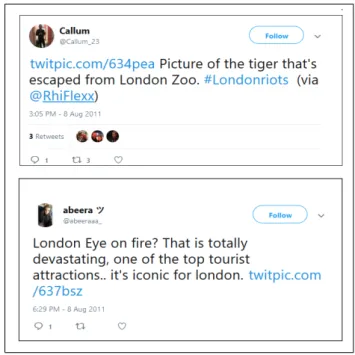
From the two studies above, it is made clear that criteria for credibility perception is mainly about people’s personal judgements, and perceptions are subjective. Rieh and Hilligoss [2008] supported this, having identified believability, information quality, and pe-ripheral cues as part of the credibility constructs used to make a judgement. Thus, under-standing how readers determine the credibility level of information online is the motivation of this research: to study the factors influencing readers’ credibility judgements of tweets, especially when tweets are from authors outside of their trusted friendship network links (the follower-followee relationship), such as tweets retrieved from a search activity. Figure 1.1 shows an example of tweet messages on Twitter regarding the London riot in 2011 that are retrieved through the search request. Although these tweet messages are actually rumours, some may still judge these tweet messages as true (note that the first tweet has been shared three times).
The design of current credibility evaluation system is based on identification and credibil-ity prediction based on the behind-the-scene information that is out of the view of the readers, such as friendship network links and the propagation network of the tweets. This system may not be applicable to readers when deciding credibility levels as the two heuristic-analytic decision-making systems serve as the conceptual basis in credibility judgments. Therefore, it is necessary to understand readers’ credibility perception behaviours and how readers use
Figure 1.1: Example of tweet messages
heuristics in judging the credibility of a tweet. Furthermore, there is a need to take into account other integrated factors regarding readers such as culture, education, age and gen-der, and personal characteristics, in understanding the role of personal characteristics in credibility judgments.
1.2 Scope of the Thesis
In this research, we focus on the information seeking behaviour of credible news-related tweets as topical information content is crucial and misinformation could set off panic among the public. As there are many news tweet topics available on Twitter, it is essential to know what features best help people judge credibility or if these features differ depending on the topic. Tweet message surface features are available directly to readers at first glance, and
what is engaged by readers is based on a readers personal characteristics.
In this study, the surface features on the tweet message are: the text including (if any) the user mention, URL and hashtag, author’s description such as their picture and Twitter ID, the date the tweet was posted, number of times the tweet has been shared, also known as retweets, and the number of people liking the tweet. Refer to Figure 1.1 for an example of the surface features on tweet messages. First glance refers to when a reader is conducting a heuristic process in using certain features to make a quick decision. Meanwhile, the definition of personal characteristics is based on that established by Donnellan et al. [2009] describing: a) the individual variations in ways of thinking, feeling and acting; and b) adaptation to their environment throughout their life (e.g. work, relationship, culture). Therefore, personal characteristics will cover a reader’s demographic data, personality traits and behaviour.
Our research focuses on the scenario where a reader is searching for news topic information on Twitter using the search platform. We chose to focus on the credibility perception of Twitter search results as readers are fed with tweets related to their search queries rather than news stories tweeted by authors within their trust social network [Hu et al., 2012; Petrovic et al., 2013].
1.3 Research Objectives
In this research, there are three research objectives that we would like to achieve. The objectives will provide the description of the specific actions we will take in order to reach the aim of this research in understanding readers’ credibility perceptions. The three objectives are as follows:
• The first objective is to identify what features readers use to help them determine the credibility level of information on Twitter. Feature identification aims to compare the features readers use and the automated credibility prediction and evaluation systems on Twitter that have been proposed in previous studies.
• Our second objective is to study the correlation between a reader’s credibility per-ceptions and surface feature preferences with other factors such as news tweets and demographic attributes. Through this goal, we aim to address our hypothesis that a reader’s credibility perceptions of different news attributes are related with other factors.
• In the last objective, we want to investigate the connections between a reader’s be-haviour, reliance on heuristics and a reader’s personality in assessing the credibility level of news tweets. The underlying idea is that a reader’s personal characteristics may influence their belief regarding the truth of online information. Therefore, the behaviour of readers when perceiving the credibility level of a tweet will indicate the credibility design of tweets.
1.4 Research Questions
A reader must judge the credibility of information on Twitter. While previous studies have focused on the multitude of features found on Twitter, including the visible and metadata features, it is unclear whether those features are also used by readers. In this research, we focus on understanding the factors that impact online content credibility. Specifically, we address the following research questions:
RQ1: How do readers judge the credibility of tweets?
In most existing work, credibility judgements are derived based on the features compiled by crawling the Twitter space and extracting the link relationship between twitterers. The com-piled features are used for developing automatic predictions and may not necessarily reflect readers’ perceptions of important signals of credibility. We hypothesise that readers use sur-face features, features that are made apparent to readers, in forming credibility perceptions rather than spending the time to authenticate the author’s information or reading comments on a tweet when searching for topic-related tweets as proposed by previous studies. For this research question, identifying a reader’s credibility perception of news-related tweets is the main focus.
To achieve RQ1, a user study is conducted to examine Twitter readers’ perceptions of the credibility of tweets for news events. News topics and corresponding relevant tweets are selected for the study. Based on readers’ comments on how they make credibility judgements of tweets, features are extracted and analysed using association rule analysis to establish the connections between features and credibility levels. The extracted features are then mapped to a detailed list of features described by Castillo et al. [2011]. This is discussed in more detail in Chapter 3.
RQ2: Does the credibility of tweets correlates with factors related to external
attributes other than tweet surface features?
A study by Yang et al. [2013] showed that cultural background affects the credibility per-ceptions of tweets, in terms of what and how features are used. Based on this study, we hypothesise that demographic attributes also influence a reader’s credibility perceptions and
the features they use in forming perceptions. So, this research question will examine the relationship between a reader’s credibility perceptions and surface feature preferences on Twitter, and other underlying factors such as demographic and news tweets attributes. We further study the correlation between these factors.
To address this research question, a user study is conducted to explore the correlation between readers’ demographic attributes, credibility perceptions, and the features used to judge tweet credibility. Only the surface features presented in tweets available directly to readers will be studied based on the findings in RQ1. Correlation analysis is conducted to study the correlation between each demographic attribute with credibility perceptions, news attributes and features. This is discussed in more detail in Chapter 4.
RQ3: Do Twitter readers’ personal characteristics play an important role in
credibility evaluations of information on Twitter?
Our intuition is that a reader’s credibility perceptions of information on Twitter may also be influenced by the attitudes and behaviours of the reader. This intuition is further strength-ened by a study by Ahmad et al. [2011] that suggested a reader’s personal characteristics influence their belief regarding the truth of information on websites during the information-seeking process. Thus, it is important to study the connections between a reader’s behaviour, their reliance on heuristics and their personality in assessing the credibility level of news tweets.
To answer RQ3, a user study was conducted to capture Twitter readers’ behaviours in perceiving the credibility of news tweets and readers’ personalities. Data collected from the user study was analysed with factor analysis and a multiple regression model. The findings
were then compared to the information-seeking behaviour and decision-making model. This is discussed in more detail in Chapter 5.
1.5 Research Contributions
This study builds on previous research regarding online information credibility perceptions. By studying readers’ credibility perceptions of tweet messages and the features they use to make these judgements, this study concludes that:
1. Readers use Twitter’s features found on the tweet messages, known as surface features, rather than a tweet’s metadata, behind-the-scenes information about the tweet message, to judge the credibility of tweets.
2. Only certain external factors related to demographic attributes correlate with credibility perceptions.
3. Personal characteristic influence, to some extent, how readers determine the credibility of online content.
These contributions are achieved by, first, understanding how a reader makes credibility judgements of information in tweet messages. Although previous research has focused on the behind-the-scene information of a tweet, or the tweet’s metadata, such as by investigating the author’s social network relationships, this study finds that readers assign more value to the surface features as credibility indicators than a tweet’s metadata. Furthermore, the features are used in combination rather than as singular features to help with the heuristic processing inherent to forming credibility perceptions.
Since the features are used as part of the decision-making process to determine credibility levels, this research is able to distinguish three categories of cognitive heuristics: endorse-ment, reputation and confirmation. Endorsement heuristics describe the way readers perceive information as more credible if other people agree with the information presented. Repu-tation heuristics refer to the repuRepu-tation of the authors of the tweet messages and, lastly, confirmation heuristics describe the features that readers use to validate the information in the tweet message. Although previous web credibility studies have also mentioned cognitive heuristics, Twitter has different sets of features not available on the web such as hashtags and user mentions, and the design of tweet messages is dissimilar to messages presented elsewhere on the web.
Aside from the use of tweets’ surface features, using the data collected from the study, we are able to establish a relationship between demographic data and credibility perceptions. Education levels and the geolocation of readers were also found to contribute to the way readers view the credibility levels of news tweets. Readers with a higher level of education and in certain living conditions and locations are seen to be more careful in making credibility judgements. Not only that, this research also found that personality traits do have a role to play in readers’ credibility perceptions. Readers who have the conscientiousness and openness to experience personality traits are seen to be very cautious in making credibility judgements.
Moreover, this research provides results regarding readers’ credibility perception be-haviours. The results show that there are three categories of credibility perception behaviour on Twitter: those who overly depend on Twitter features that relate to confirmation
heuris-tics, those who modestly rely on features relating to cognitive heurisheuris-tics, and readers who only slightly depend on cognitive heuristics to help them determine the credibility of tweets. This finding is defined by their behavioural reliance on Twitter’s surface features when judging the credibility level of tweets.
1.6 Thesis Organisation
The remainder of the thesis is organised as follows:
• Chapter 2summarises previous research. The fundamentals of Twitter, the diffusion of information on online social media (OSM) and the relevant literature in assessing the trustworthiness of information on online social media, will be discussed.
• Chapter 3 describes the methodology used to answer the research questions. Our basis for conducting user studies to investigate readers’ credibility perceptions and the factors that impact credibility are discussed.
• Chapter 4 describes the identification of Twitter features readers use to judge the credibility level of tweets.
• Chapter 5describes the correlation between different factors regarding topics, features and demographic attributes that influence readers’ credibility perceptions of informa-tion posted on Twitter.
• Chapter 6 discusses the connections between a reader’s reliance on heuristics and a reader’s personal traits in perceiving the credibility of news tweets.
• Chapter 7summarises the findings, concludes the present work and proposes future work based on the outcomes and limitations of this research.
• Appendixpresents the list of news-related tweet topics and Human Ethics Application approval letters regarding the user studies conducted in this research.
Research Background
A large body of literature exists on online credibility evaluation, with particular emphasis on online social media (OSM), specifically Twitter. In Section 2.1, we will provide background knowledge on the theoretical part of information credibility, and define the terms related to credibility. Section 2.2 will discuss readers’ credibility perception behaviours and factors that have an impact on credibility judgements. This is then followed by a description of credibility evaluation methodologies (Section 2.3) and we summarise the implications of this research and research gaps regarding information credibility perceptions (Section 2.4). Lastly, Section 2.5 provides a summary of this chapter.
2.1 Credibility
In order to discuss previous studies on information credibility assessment, we will first for-mulate and define some essential terms, and differentiate the different credibility assessments of online information.
2.1.1 Credibility and Trust
The Merriam-Webster dictionary defines credibility as “the quality of being believed or ac-cepted as true, real, or honest”. Based on this definition and work by Fogg [2003] regarding factors influencing final judgements, credibility generally regards one’s belief in the truth due to an initial impression of a subject. Fogg [2003] distinguishes four types of credibility: presumed, earned, reputed and surface. Presumed credibility reflects general assumptions held by a reader. Earned credibility refers to the experience a reader has with a platform. Reputed credibility is the need for cognition/approval such as links to other reputed websites and other factors. Finally, surface credibility is connected with the design, usability of a platform (e.g. online social media, website) and others. These different types of credibil-ity assessment are taken into account by readers depending on individual differences. Here, credibility is seen as a process where a user decides whether a trust relationship would concur between a trustor and trustee based on the quality of the information and the reputation or quality of a source.
Credibility and trust are closely related. Mayer et al. [1995] defined trust as “the willing-ness of a party to be vulnerable to the actions of another party based on the expectation that the other will perform a particular action important to the trustor, irrespective of the ability to monitor or control that other party” (page 712). Wang and Emurian [2005] further listed four characteristics of trust: trustor and trustee (relationship between two parties), vulner-ability (involve uncertainty and risk), produced actions (transactions or activities between the two parties) and subjective matter (behaviour or attitude of the two parties regarding the transaction that occurred). Based on the two definitions, trust is viewed as the
interper-sonal relationship between a trustor (the person who trusts) and a trustee (the person being trusted).
Trust in online social media is classified into four types: asymmetric, transitive, context-dependent and personal [Johnson, 2011]. Asymmetry in trust means that two profiles have a different level of trust with one another. If the trust develops from a close mutual friendship, it is called transitive trust. Sometimes users choose to have a different degree of trust depending on circumstances (context-dependent) and, lastly, each user is entitled to have their own opinion and views of the same individuals. In an observation of Facebook users conducted by Dwyer et al. [2007], many users were found to have high confidence in online social media (OSM) to protect their personal information and their social trust levels increase when their friends also use a platform.
Tseng and Fogg [1999] distinguished credibility from trust. In their work, trust is about the dependability and reliability of an object or person, while credibility regards the be-lievability or trustworthiness of information or the quality of the source from where such information comes. The notion of credibility is the quality of being believed or accepted as true, real, or honest, whether it regards the information or the source. Tseng and Fogg [1999] indicate that there are two key elements in the measurement of credibility: trustworthiness and expertise. This concept supports the work by Hovland and Weiss [1951] where informa-tion coming from an expert receives higher credibility percepinforma-tion than the informainforma-tion that comes from a questionable source.
Rieh and Hilligoss [2008] discover a person’s experience and similar social connections influence the credibility judgement of information, online or offline. Sikdar et al. [2013b]
describe how online communication in social media shows the type of relationship between the author and the reader, thus explaining why readers tend to believe the online information posted by their group of friends, the people they follow on social media, over those who are not in that friendship group. Even friends and the people readers follow online yield different online information credibility perception levels. Similar findings are mentioned in studies by McKnight and Kacmar [2007]; Rafalak et al. [2014]. These findings show that credibility perception not only focuses on information but also on the trust relationship between reader and author.
In this research, we adopted the notion of credibility by Tseng and Fogg [1999] where credibility is the quality of being believed or accepted as true, real, or honest, whether it regards the information or the source. In this sense, we distinguish that, before trust can be established, credibility must be present. Believing an information or source is credible allows a trust relationship to form. Thus, this thesis studies the factors that would have an effect on the formation of credibility perception so that trust can subsequently be established.
2.2 Credibility Factors
In previous studies, researchers study and propose different factors are involved in the for-mation of credibility of online inforfor-mation on websites and social media. Most of the factors in the literature are based on peripheral cues and system surface features, as these are the exterior features on the line of sight of the readers, not requiring them to venture deeper in investigating content. These features hold a fairly low-effort assumption regarding how to as-sess online content. In this section, we will discuss these credibility factors on two platforms,
the web and online social media.
2.2.1 Sources of Information
On websites, the reputation and trustworthiness of a source are important features in de-termining whether online information on pages such as blogs or article posts are credible, as shown in previous studies [Armstrong and McAdams, 2009; Fogg et al., 2001; Lucassen et al., 2013; McKnight and Kacmar, 2007; Rieh and Hilligoss, 2008; Sundar et al., 2007]. The source credibility features are, however, different on social media. Researchers found that an author’s profile and social network on Twitter represent a higher credibility indicator regarding the tweet messages the author posted [AlRubaian et al., 2015; Canini et al., 2011; Castillo et al., 2011; Gupta and Kumaraguru, 2012; Gupta et al., 2012; Kang et al., 2012; Morris et al., 2012; Sikdar et al., 2013b; Yang et al., 2013].
The differences in a source’s credibility features between websites and social media are due to the interface design of each platform. On a website, the image and information regarding the author is limited or not available. Readers also consider the site host, such as the name of a news agency or the name of the company, as a source of the information if the details of the author are not made available [Sundar et al., 2007]. In contrast, a social media author’s information such as image, gender, location and whom they are connected with on social media is more accessible and thus gives more confidence to the readers of the online information regarding the credibility of the source and the information posted by the source.
2.2.2 Composition of Information
The next credibility factor for online information is the information itself. The main feature of credible online information is the level of relatedness of the information to the topic [Flanagin and Metzger, 2000; Rieh and Hilligoss, 2008; Sundar et al., 2007]. Topic related informa-tion is described as being informative and relevant to the keyword search and title of the post [Flanagin and Metzger, 2000] or having similar information to other online informa-tion from different websites regarding the topic or keyword [Sundar et al., 2007]. Although topic-related message posts on social media and on websites is still a prominent feature for credibility as shown in previous studies [Aladhadh et al., 2014; Canini et al., 2011; Castillo et al., 2011; Gupta and Kumaraguru, 2012; Kang et al., 2012; Morris et al., 2012; ODono-van et al., 2012; Sikdar et al., 2013b], language is another credibility feature proposed by researchers as a credibility indicator for information on social media.
Since social media is a platform for anyone to post messages about anything, the language used on such posts is informal and contains Internet abbreviations, especially on Twitter due to the limit of characters per post. A post with formal language will be perceived as more credible than one with slang and abbreviations [Gupta and Kumaraguru, 2012; ODonovan et al., 2012; Sikdar et al., 2013b]. A language element that has been proposed is the use of sentiment and semantic words. These words describe the opinion of an author and the positive/negative relation of the post towards the topic. Other than these, social media has special features that can be used as part of the information text that are not found or widely used on the web: hashtags and user mention. The use of features such as hashtags, which start with the symbol ‘#’, and the user mention indicator which starts with the character
‘@’, also give an indication of the relation between the information with the topic [AlRubaian et al., 2015; Gupta et al., 2012; ODonovan et al., 2012].
2.2.3 External Source Links
The next credibility factor is embedding external sources in the information. Social media users sometimes link external sources on their posts, such as images or links, for example, to other online content. The external sources will give an impression that the information posted is not fabricated [AlRubaian et al., 2015; Castillo et al., 2011; Gupta and Kumaraguru, 2012; Gupta et al., 2012; Kang et al., 2015]. Husin et al. [2013] described that social network users access news agency websites for further information by the hyperlink embedded in the news story posts on online social media such as Twitter, a verification act when the readers are deciding the credibility level of the post’s author and evaluating the information [Rieh and Hilligoss, 2008].
Meanwhile, the use of external links on web online content, such as blogs, are mostly linking to articles within the same web platform. However, there have been some websites or blogs that have embedded the URL link to the external source, if the article is based on the source such as Wikipedia [Rieh and Hilligoss, 2008]. Again, this is an option for readers to do their own verification of the credibility of the information.
2.2.4 Interface Design Layout
Other than information structures, the design or features available on a website and social media platform are another credibility feature contributing to the credibility perceptions
of online information. On websites, the layout design of the site gives different credibility perceptions of the online information appearing on those sites [Flanagin and Metzger, 2000]. If the design consists of much commercial content such as advertisements, it gives a lower credibility perception than a layout design that shows a real-world feel and ease of use [Fogg et al., 2001]. The time indicator on the website is also a credibility feature as it will show the recency of the online information posted on the website. The time indicator could also ensure the information is consistent with other information posted on other sites within the same time period [Sundar et al., 2007].
The time indicator is also an important design feature on social media. Consistent with Sundar et al. [2007], who found the importance of knowing when an article is posted on the website, AlRubaian et al. [2015]; Morris et al. [2012] and Kang et al. [2015] also discovered that if a message posted on social media is dated in the middle of the occurrence of a trending issue, the higher the credibility perception of the message post. Other credibility features for online information based on the social media platform design are propagation and count features. Both give an indicator that other social media users find the message posted to be trustworthy. The users can choose to propagate the message using a sharing method, and the number of shares will be shown [AlRubaian et al., 2015; Castillo et al., 2011; Gupta et al., 2012; Kang et al., 2015; Morris et al., 2012; Sikdar et al., 2013b]. Another design feature that has been proposed by Li and Suh [2015] as a credibility indicator on social media is the interaction feature. This feature is the communication between social media users on their own social media page by using the user mention feature in their message post and also in the comment section underneath each message post. Although some researchers argue that
the use of user mention is a credibility indicator on the message post as discussed earlier, Li and Suh [2015] focused on the use of the user mention in the design of social media as it is what makes social media unique.
Generally, the aim of information credibility studies is to find features that make good credibility indicators online. However, there are few studies that consider reader’s attributes. The studies that relate to readers mostly look at the use of surface features, including the source features. Demographic attributes of readers are also used to differentiate the popu-lation and their credibility judgement [Lucassen and Schraagen, 2011; Morris et al., 2012; Tseng and Fogg, 1999].
2.2.5 Readers’ Attributes
Research on characterising users and their behaviour for credibility perceptions in the online community is important and so is discussed separately in this section. The credibility of information on the Internet is rated higher by experienced and savvy users rather than by less experienced users. In addition, the freedom users have in choosing the information from the source they deem credible based on their experience and verification steps also contribute to the high credibility rating of the Internet [Flanagin and Metzger, 2000]. Due to this, Rieh et al. [2014] described in their work how blog authors would design their blog based on the credibility perception of their readers so that the information presented in the blog would be believed and deemed trustworthy. Thus, this would create a trust relationship between the blog authors and their readers when the blog is perceived as credible.
online information also shows a difference in the way readers perceive the credibility level of online information. Readers also use the interface designs of where the online information was published to help them decide the credibility level of the information. The reliance on interface design is a psychological action known as cognitive heuristics. Sundar [2008] and Metzger et al. [2010] both established the use of cognitive heuristics in credibility perception of online information on the web while Yin et al. [2018] discuss the different cognitive heuristics preferences between a reader’s gender when perceiving the credibility of information posted or shared on social media. In another study on cognitive heuristics, Lin et al. [2016] examined the ability of three specific heuristic cues based on non-content features: authority, identity and bandwagon cues, in making source credibility judgement. However, the study does not identify and analyse the overall cognitive heuristic cues that readers value, which also include content-based features in credibility assessment.
Demographic attributes also show a relationship with credibility perception. Fogg et al. [2001] describe that demographic profiles are seen to be correlated with the credibility percep-tion of websites regarding specific factors. They discovered that website credibility elements such as interface, expertise and security are influenced by a reader’s demographic attributes. In the visual factor, another study found that the user’s demographics influenced the percep-tion of online media when shown different manipulapercep-tion levels of online news photos [Greer and Gosen, 2002]. Although not on the subject of photo manipulation, Kang et al. [2015] found a similar correlation between demographic attributes and visual features on microblogs where young people judged as more credible Twitter posts having these visual features.
and features that contribute to a reader’s credibility perception, such as the influence of the tweet author’s location [Aladhadh et al., 2014], the reader’s demographic attributes [Kang et al., 2015], cognitive heuristics for website credibility assessment [Metzger et al., 2010; Sundar, 2008; Yin et al., 2018], and the effect of heuristic indicators for source credibility assessment on Twitter [Lin et al., 2016]. The research shows that credibility studies that incorporate the reader’s element as a feature related to online information credibility are a minority.
2.3 Credibility Evaluation
Assessing the credibility of information is a challenging task since “credibility” is a complex concept, as discussed in Section 2.1.1. Credibility assessments need to be considered rela-tive to both people’s credibility judgements and credibility contexts such as environment, situations, expectations, and others [Fogg, 2003; Wathen and Burkell, 2002]. Based on the credibility factors studied by other researchers, three main components affecting perception of the credibility of online information can be identified:
1. Contexts such as language, topic, event or the type of online platform
2. Available features (cues) on the online platform
3. Reader traits and cognitive heuristics such as the selection of cues in making a credibility judgement
In order to gather these credibility factors, researchers have adopted quantitative and qualitative studies. A closed question is often used in quantitative data where a specific
set of answers is provided for the participants to choose, while an open question gives the participants a choice to express themselves freely, producing qualitative data. Section 2.3.1 discusses user studies obtained from previous studies in relation to credibility.
In analysing the data collection, different methods have been used for evaluating credi-bility. Statistical analysis is one of the methods. The analysis can be examined descriptively and inferentially. A descriptive analysis is mainly on the summarisation process of numbers collected from the user study, such as mean, range and frequency. In an inferential analysis, the data is generalised to show the relationship between variables in the study and to help to make predictions. Some examples of statistical models for doing inferential analysis are chi-square, the t-test and the regression test. In credibility studies, statistical analysis has been used on both descriptive [Morris et al., 2012] and inferential analysis [Aladhadh et al., 2014]. Further discussion on the use of statistical analysis in previous studies is found in Section 2.3.2.
Another evaluation method focussing on quantitative data is the use of machine learning. Machine learning is using algorithms to learn from data without relying on rules-based pro-gramming, whereas statistical analysis uses mathematical equations to learn the relationships of variables in the data. Machine learning algorithms are mostly used for predictive mod-elling problems as the computer tries to find out patterns hidden in the data. In the study of credibility, machine learning has been used to develop a model based on credibility fea-tures [Castillo et al., 2011], predict the credibility of online contents [Kang et al., 2012], and rank the credibility of information [Gupta and Kumaraguru, 2012]. Section 2.3.3 discusses how machine learning is used as an evaluation tool in credibility studies.
2.3.1 User Studies
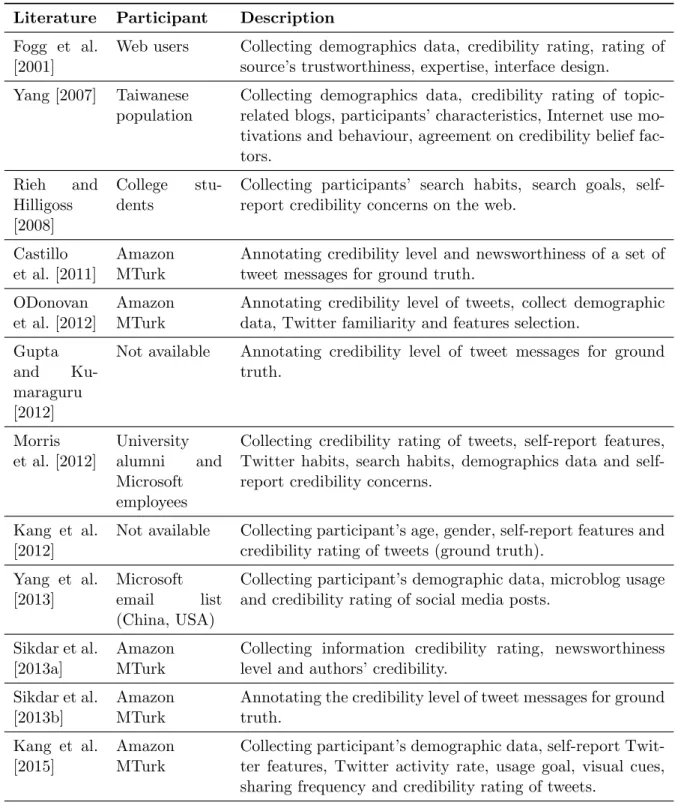
User studies are used to collect credibility judgements as ground truth, and explore features for credibility and study user characteristics and behaviours. The different types of user studies conducted in credibility have been discussed in Section 3. In most studies, respondents are asked to rate the credibility level of information and identify the features that influence them in forming their credibility perceptions. Demographic attributes and familiarity levels with information platforms are also collected in user studies. User studies also seek to obtain credibility ground truth for evaluation purposes [Castillo et al., 2011; Gupta and Kumaraguru, 2012; Sikdar et al., 2013b]. Most of these studies use crowdsourcing platforms to recruit respondents. Table 2.1 summarises the user studies that have been carried out by previous studies in the area of credibility research.
Table 2.1: User studies conducted in credibility studies Literature Participant Description
Fogg et al. [2001]
Web users Collecting demographics data, credibility rating, rating of source’s trustworthiness, expertise, interface design.
Yang [2007] Taiwanese population
Collecting demographics data, credibility rating of topic-related blogs, participants’ characteristics, Internet use mo-tivations and behaviour, agreement on credibility belief fac-tors. Rieh and Hilligoss [2008] College stu-dents
Collecting participants’ search habits, search goals, self-report credibility concerns on the web.
Castillo et al. [2011]
Amazon MTurk
Annotating credibility level and newsworthiness of a set of tweet messages for ground truth.
ODonovan et al. [2012]
Amazon MTurk
Annotating credibility level of tweets, collect demographic data, Twitter familiarity and features selection.
Gupta and Ku-maraguru [2012]
Not available Annotating credibility level of tweet messages for ground truth. Morris et al. [2012] University alumni and Microsoft employees
Collecting credibility rating of tweets, self-report features, Twitter habits, search habits, demographics data and self-report credibility concerns.
Kang et al. [2012]
Not available Collecting participant’s age, gender, self-report features and credibility rating of tweets (ground truth).
Yang et al. [2013]
Microsoft email list (China, USA)
Collecting participant’s demographic data, microblog usage and credibility rating of social media posts.
Sikdar et al. [2013a]
Amazon MTurk
Collecting information credibility rating, newsworthiness level and authors’ credibility.
Sikdar et al. [2013b]
Amazon MTurk
Annotating the credibility level of tweet messages for ground truth.
Kang et al. [2015]
Amazon MTurk
Collecting participant’s demographic data, self-report Twit-ter features, TwitTwit-ter activity rate, usage goal, visual cues, sharing frequency and credibility rating of tweets.
Lin et al. [2016]
University stu-dents and from social media
Collecting authors’ credibility
Yin et al. [2018]
Social media users
Collecting factual, accurate, and credible annotation, demo-graphic data, authors’ credibility
As outlined in the table above and in Table 3.1, there is variation in how user studies are conducted taking into consideration the type of data collected. Most of the user studies show tweet messages along with their cues/features to participants to rate the credibility of messages, and identify feature importance. The messages can be real or manipulated tweets (e.g., user images, user names, etc.). The user study results could then be used to identify the features that have more influence on credibility perception. Results of the user study can be derived from both the statistical and machine learning approaches. This is shown in the studies by Castillo et al. [2011] and Gupta and Kumaraguru [2012], who use machine learning to analyse their user study data, and Kang et al. [2012], Morris et al. [2012], and Gupta and Kumaraguru [2012] (just to name a few), who analyse their user study data with statistical analysis.
2.3.2 Statistical Analysis
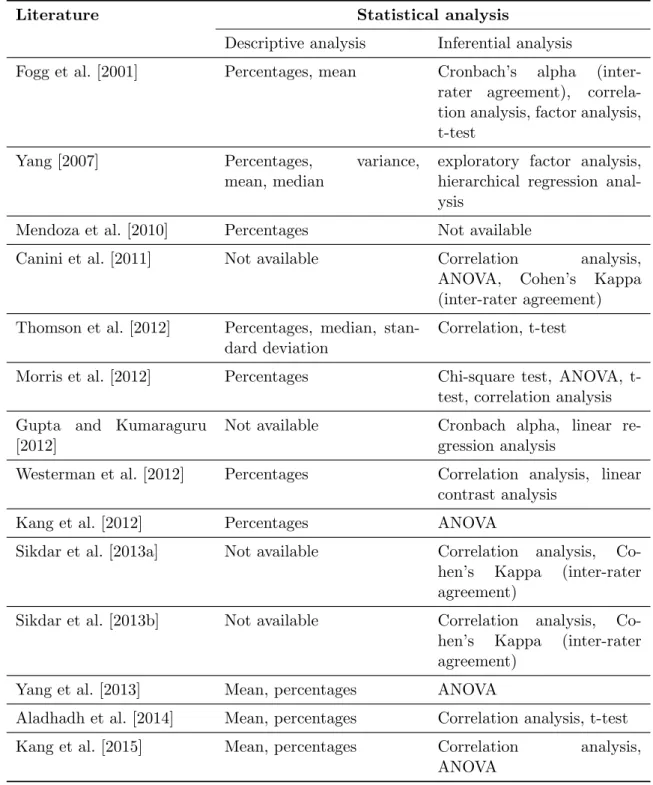
Most research on credibility has used various statistical analysis techniques such as descriptive and classical tests to prove their hypotheses and discover credibility factors, as part of their evaluation method. Some research uses both types of tests while others use only one type depending on the focus of the research. Mendoza et al. [2010] used percentage to examine the ability to identify retweets of true tweets and rumours. Thomson et al. [2012] used a
t-test and correlation test to examine the credibility of information on Twitter regarding the Fukushima disaster in regard to source credibility. Table 2.2 shows the list of studies on credibility that employ descriptive analysis in their work.
2.3.3 Machine Learning
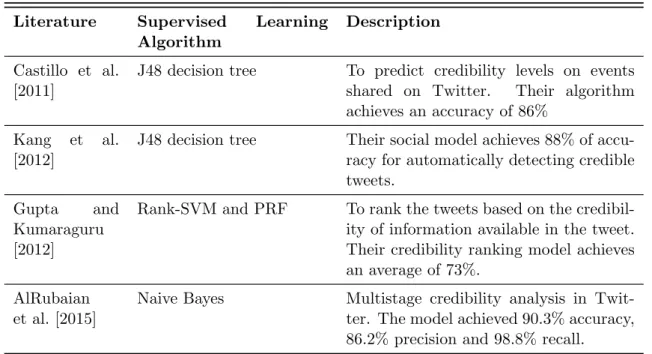
Previous studies on credibility use different supervised learning algorithms to automatically classify or rank credibility. Table 2.3 lists previous studies that have used algorithms to engage in credibility classification/ranking accuracy.
Castillo et al. [2011] presented credibility classification with accuracy results of 86% using a J48 decision tree, shown to be better than any other random predictor. The researchers used supervised classifiers for news/chat classification and assessed credibility of 747 news topics. The focus of the prediction model was to detect news tweets that are almost true against other tweets. The features included in the classifier were the tweet message, the tweet authors, the tweet topics (collection of tweets), and the propagation of retweets. Their method was based on topic credibility rather than individual tweets. Crowdsourcing evaluation is used to determine the ground truth.
Kang et al. [2012] focused on individual tweets for their social credibility prediction model and achieved 88% accuracy using the J48 decision tree algorithm. One thousand and twenty-three manually annotated topic-specific (Libya) tweets were used. Three models were built based on source, content and hybrid features (combination of source and content features). Their best accuracy (88.17%) came from a credibility model using source features.
Table 2.2: Statistical analysis used in credibility studies
Literature Statistical analysis
Descriptive analysis Inferential analysis
Fogg et al. [2001] Percentages, mean Cronbach’s alpha (inter-rater agreement), correla-tion analysis, factor analysis, t-test
Yang [2007] Percentages, variance, mean, median
exploratory factor analysis, hierarchical regression anal-ysis
Mendoza et al. [2010] Percentages Not available
Canini et al. [2011] Not available Correlation analysis, ANOVA, Cohen’s Kappa (inter-rater agreement) Thomson et al. [2012] Percentages, median,
stan-dard deviation
Correlation, t-test
Morris et al. [2012] Percentages Chi-square test, ANOVA, t-test, correlation analysis Gupta and Kumaraguru
[2012]
Not available Cronbach alpha, linear re-gression analysis
Westerman et al. [2012] Percentages Correlation analysis, linear contrast analysis
Kang et al. [2012] Percentages ANOVA
Sikdar et al. [2013a] Not available Correlation analysis, Co-hen’s Kappa (inter-rater agreement)
Sikdar et al. [2013b] Not available Correlation analysis, Co-hen’s Kappa (inter-rater agreement)
Yang et al. [2013] Mean, percentages ANOVA
Aladhadh et al. [2014] Mean, percentages Correlation analysis, t-test Kang et al. [2015] Mean, percentages Correlation analysis,
Table 2.3: Supervised learning for credibility prediction/analysis
Literature Supervised Learning Algorithm
Description
Castillo et al. [2011]
J48 decision tree To predict credibility levels on events shared on Twitter. Their algorithm achieves an accuracy of 86%
Kang et al. [2012]
J48 decision tree Their social model achieves 88% of accu-racy for automatically detecting credible tweets.
Gupta and Kumaraguru [2012]
Rank-SVM and PRF To rank the tweets based on the credibil-ity of information available in the tweet. Their credibility ranking model achieves an average of 73%.
AlRubaian et al. [2015]
Naive Bayes Multistage credibility analysis in Twit-ter. The model achieved 90.3% accuracy, 86.2% precision and 98.8% recall.
rank tweets based on the credibility score for topic-specific (Libya) tweets. An SVM ranking algorithm was used to rank tweets based on content and source features. Then, using Pseudo Relevance Feedback (PRF), 34 frequent word unigrams from top tweets were extracted. Next, the text similarity between the frequent unigrams and the top tweets was used to re-rank the tweets. Annotators from an online study were shown news links of 14 news events to label 500 tweets per topic. Using Rank-SVM and PRF, Gupta and Kumaraguru [2012] reported a 73% average NDCG score. Their results showed that an average of 30% tweets from their dataset contained information, 17% of the informative tweets were credible, and 14% were spam. The researchers further tested their prediction model on real-time tweets by developing a Chrome extension tool called TweetCred.
AlRubaian et al. [2015] proposed a multi-stage credibility assessment model that uses tweet and author features that include an author’s relationship network. The dataset focused
on political topics regarding The Islamic State of Iraq and the Levant (ISIS) written in the Arabic language. The multi-stage credibility assessment model successfully classified credible tweets with 98.8% recall and 86.24% precision leading to only 13.76% false positives for the credible label.
2.4 Research Gaps
Most of the proposed methods for credibility evaluation are based on user credibility judgment ratings. Ground truth credibility values are typically gathered using human participants, who act as online content readers and evaluators. We believe that there are differences between readers in how credibility perception is disclosed. Attributes such as demographic profile, personality traits, and attitude toward the online content might impact on readers’ perceptions of the information, which could contribute to a deeper understanding about how and why users carry out their credibility judgments. Most research has not paid sufficient attention to this issue.
Further, there was a gap in previous research incorporating user study results in identi-fying the credibility features importance and readers attributes. Our recommendation is to integrate the user study results with the content analysis results to help identify and corre-late the credibility factors that influence credibility perceptions. Another recommendation is to identify how readers use the surface features of tweets discussed in Section 2.2, to make credibility judgements of tweets retrieved from a query action, and distinguish the effect of the reader’s cultural background, behaviour and personality in the credibility perception of tweet messages and Twitter feature preferences.
2.5 Summary
In this chapter, we reviewed literature related to our work on credibility perception. We first distinguished the key terms in credibility. Next, the categorisation of credibility factors studied in previous work, approaches to credibility evaluation, and studies related to readers’ attributes were described. Discussions in this chapter provided us with a selection of ideas in answering the research questions. The research gaps and research recommendations were also addressed. The coming chapters will include the literature discussed here and the approach in relation to the research questions that will address the research gaps.
Research Design and Methodology
The present study intends to identify the features Twitter readers use to make credibility judgements, the correlation between a reader’s credibility perception with other factors and readers’ credibility perception behaviours. In order to answer each of the research questions, we designed three user studies using potential Twitter readers in order to gain representative information regarding the readers’ credibility perception of information posted on Twitter. The chapter is organised as follows: approaches for analysing information credibility (Sec-tion 3.1), followed by details of the user study (Sec(Sec-tion 3.2), and finally, a summary of the methodology (Section 3.3).
3.1 Research Methodology
Methodology is a theoretical foundation that determines the appropriate research method in answering research hypotheses [Wahyuni, 2012]. The common research methods are quanti-tative, qualitative or mixed methods. Quantitative studies are used to determine the
rela-tionships between factors, while qualitative studies focus on developing new theory [Sogunro, 2002]. To determine the type of research method suitable, we need to confirm the aims of this study. In this study, we intend to explore the effect of already established theories and to identify the factors that have an effect on credibility perception. Based on this intention, the appropriate research method to adopt is the quantitative method. Furthermore, most of the previous literature on information credibility uses the quantitative rather than the qualitative approach when collecting credibility judgements [Castillo et al., 2011; Gupta and Kumaraguru, 2012; Kang et al., 2012; Morris et al., 2012; Rieh and Hilligoss, 2008; Sikdar et al., 2013b; Yang et al., 2013].
During a search process of information on Twitter, readers are shown lists of messages that are relevant to the query made. Readers are then required to make their own judgement regarding the credibility of the tweet messages. The reader’s credibility perception can be captured as part of a user study. Analysis of interface features influencing a reader’s credibility perception [Lucassen and Schraagen, 2011; Morris et al., 2012; Tseng and Fogg, 1999] and the reader’s demographic impact on credibility perception was studied [Fogg et al., 2001; Kang et al., 2015; Morris et al., 2012; Song et al., 2016; Yang et al., 2013; Yang, 2007] to better understand readers’ credibility perception behaviours [Lin et al., 2016; Yin et al., 2018].
A user study is conducted when a researcher wants to explore, describe or explain a particular phenomenon that mostly involves the participation of humans [Kelly et al., 2009]. In the area of credibility perception, user studies are conducted online. The type of setting used in the user study is determined by the question the research is trying to answer. Most
user studies are conducted in a natural or laboratory setting. In a natural setting, the researchers will observe the participants’ behaviour in a normal routine activity environment. However, the researcher has little control over the setting. The laboratory setting is reverse to the natural setting. The user study is conducted in a controlled environment. Later, the user study setting is often used in identifying the effect of one or more variables. Nonetheless, there is a drawback for the laboratory setting. The participants’ behaviour could be artificial, and does not represent real life. In our user study, the laboratory setting is used as we aimed to study the effect of variables on readers’ credibility perceptions of information on Twitter.
3.2 User Study Design
The first research question examines how readers form a credibility perception of news-related tweet messages, the second question addresses the effect of demographic factors and topic familiarity, while the last question explores the influence of reader-related factors, such as personality and cognitive activities. Therefore, we employed a user study in answering all of these research questions.
3.2.1 Data Collection Methods
Data collection is a vital part of any research evaluation. Researchers often use a mix-ture of different methods to gather data. These methods include questionnaires, interviews, think-aloud, crowdsourcing and observation. Table 3.1 shows the mixture of data collection methods used by previous researchers in user studies on credibility perception.