Technical Report—Child Passenger Safety
abstract
Despite significant reductions in the number of children killed in motor vehicle crashes over the past decade, crashes continue to be the lead-ing cause of death for children 4 years and older. Therefore, the Amer-ican Academy of Pediatrics continues to recommend inclusion of child passenger safety anticipatory guidance at every health-supervision visit. This technical report provides a summary of the evidence in sup-port of 5 recommendations for best practices to optimize safety in passenger vehicles for children from birth through adolescence that all pediatricians should know and promote in their routine practice. These recommendations are presented in the revised policy statement on child passenger safety in the form of an algorithm that is intended to facilitate their implementation by pediatricians with their patients and families. The algorithm is designed to cover the majority of situa-tions that pediatricians will encounter in practice. In addition, a sum-mary of evidence on a number of additional issues that affect the safety of children in motor vehicles, including the proper use and installation of child restraints, exposure to air bags, travel in pickup trucks, chil-dren left in or around vehicles, and the importance of restraint laws, is provided. Finally, this technical report provides pediatricians with a number of resources for additional information to use when providing anticipatory guidance to families.Pediatrics2011;127:e1050–e1066
INTRODUCTION: MAGNITUDE OF THE PROBLEM OF MOTOR VEHICLE CRASHES
Motor vehicle crashes represent the leading cause of death for chil-dren and youth older than 3 years in the United States.1Each year, more
than 5000 children and adolescents under the age of 21 years die in crashes, which represents approximately 15% of people killed each year in crashes.2Fatalities represent only the tip of the motor vehicle
crash problem for children and youth. For every fatality, approximately 18 children are hospitalized and more than 400 receive medical treat-ment for injuries sustained in a crash.1Current estimates of injuries
and fatalities are updated annually and can be found in the Centers for Disease Control and Prevention Web-based Injury Statistics Query and Reporting System at www.cdc.gov/injury/wisqars.
In the United States, motor vehicle traffic-related mortality rates are highest for black and American Indian/Alaskan Native children, lowest among Asian/Pacific Islander children, and intermediate for Hispanic and white children.3Examining trends over a 20-year period through
2003 reveals significantly declining rates for child occupant deaths among all race and ethnic groups examined. However, among infants (aged 0 –12 months), improvements in mortality rates among black children have slowed more recently. Occupant mortality rates among
Dennis R. Durbin, MD, MSCE, COMMITTEE ON INJURY, VIOLENCE, AND POISON PREVENTION
KEY WORDS
car safety seat, booster seat, child restraint system, air bag, child passenger safety, motor vehicle crash
ABBREVIATIONS
NHTSA—National Highway Traffic Safety Administration CSS—car safety seat
AAP—American Academy of Pediatrics LATCH—lower anchors and tethers for children OR—odds ratio
CI—confidence interval
FARS—Fatality Analysis Reporting System RR—relative risk
FMVSS—Federal Motor Vehicle Safety Standard FAA—Federal Aviation Administration
This document is copyrighted and is property of the American Academy of Pediatrics and its Board of Directors. All authors have filed conflict of interest statements with the American Academy of Pediatrics. Any conflicts have been resolved through a process approved by the Board of Directors. The American Academy of Pediatrics has neither solicited nor accepted any commercial involvement in the development of the content of this publication.
The guidance in this report does not indicate an exclusive course of treatment or serve as a standard of medical care. Variations, taking into account individual circumstances, may be appropriate.
www.pediatrics.org/cgi/doi/10.1542/peds.2011-0215 doi:10.1542/peds.2011-0215
All policy statements from the American Academy of Pediatrics automatically expire 5 years after publication unless reaffirmed, revised, or retired at or before that time.
PEDIATRICS (ISSN Numbers: Print, 0031-4005; Online, 1098-4275). Copyright © 2011 by the American Academy of Pediatrics
children 1 to 4 years of age showed a tendency toward increased mortality in black, Hispanic, and American Indian/Alaskan Native children. Al-though there were significant declines in total motor vehicle mortality rates across all racial groups, improvement in occupant injury was greater for white children, and disparities actually widened for both black and American Indian/Alaskan Native children com-pared with white children.
The racial/ethnic disparities in motor vehicle occupant death rates are likely explained in large part by lower use of restraints, including child restraint systems, by people of racial minorities. Seat belt and child restraint use among black adults and children are lower than the national average.4,5
Similarly, seat belt use among His-panic (85%) and non-HisHis-panic black (80%) adults traveling with children was lower than that for white (96%) adults traveling with children.6 The
reasons for these disparities in re-straint use are not completely known but may be related to a lack of knowl-edge as well as a lack of culturally ap-propriate messages from generalized public education intervention pro-grams.7 More culturally sensitive
tervention programs designed to in-crease child restraint use among minority populations have resulted in significant increases in restraint use among target populations.8
Through the early 1990s, child occu-pant fatality rates remained relatively stagnant at approximately 3.5 deaths per 100 000 population.9Beginning in
1995, when children killed by deploying passenger air bags were first re-ported clinically, attention began to fo-cus on the unique needs of children in automotive safety. Subsequently, in the United States, the number of motor vehicle fatalities and serious injuries has been reduced through a combina-tion of increased attencombina-tion to
age-appropriate restraint use and rear seating position10–15 as well as
hanced child restraint laws and en-forcement of these laws.16,17In the 10
years from 1999 to 2008, the number of children younger than 15 years who died in motor vehicle crashes in the United States declined by 45%.2Annual
updates on the number of children killed in motor vehicle crashes can be obtained from the National Highway Traffic Safety Administration (NHTSA) at www-fars.nhtsa.dot.gov/Main/index. aspx.
Although significant progress has been made in reducing the number of children killed in crashes, the expo-sure of children to motor vehicle travel and, thus, to potential crashes is great. Children younger than 16 years travel nearly as much as adults (average of 3.4 trips per day and 45 to 50 minutes/day spent in a vehicle), which emphasizes the importance of age-appropriate re-straint on every trip.18
THE IMPORTANCE OF AGE-APPROPRIATE RESTRAINT USE
Mechanism of Action of Restraint Systems
Restraint systems are designed to re-duce risk of ejection during a crash, better distribute the energy load of the crash through structurally stronger bones rather than soft tissues, limit the crash forces experienced by the ve-hicle occupant by prolonging the time of deceleration, and limit the contact of the occupant with interior vehicle structures. Optimal performance of re-straint systems depends on an ade-quate fit between the restraint system and the occupant at the time of the crash. Restraint systems can be generally categorized as vehicle re-straints—air bags and seat belts— or add-on restraints specifically made for children— child restraint systems. Child restraint systems include infant-only car safety seats (CSSs),
convert-ible and combination CSSs, inte-grated seats, travel vests, and belt-positioning booster seats. A de-scription of each type of restraint is provided below as well as in Table 1 of the accompanying policy statement.19
Age-Specific Prevalence of Restraint Use
In large part because of the increased attention paid to the needs of children in motor vehicle safety beginning in the mid-1990s, large increases in re-straint use (including CSSs and booster seats) by children have been observed over the past decade. Data from the National Occupant Protection Use Survey and the National Survey of the Use of Booster Seats indicate that restraint use for children in the United States in 2008 stood at 99% among in-fants younger than 1 year, 92% among 1- to 3-year-olds, and 89% among 4- to 7-year-olds.20 Restraint use for
chil-dren driven by a belted driver was sig-nificantly higher (92%) than for those driven by an unbelted driver (54%). It is important to note that although child restraint use is high among the young-est children, improper use of the re-straint may limit the effectiveness of the system. Among children either younger than 1 year or who weighed less than 20 lb, a group that has tradi-tionally been recommended to ride in a rear-facing CSS, 21% were not compli-ant with these recommendations.21
Similarly, although overall restraint use among older children is relatively high, nearly half of children 12 years and younger who are under 54 inches in height are not using a CSS or booster seat, which is their recom-mended form of optimal restraint.21
(ranging from 72% for 8- to 12-year-olds to 94% for infants younger than 1 year).22 It should be noted that child
restraint use among black children 4 to 7 years of age increased from 73% in 2007 to 84% in 2008.
Among children 8 years and younger in crashes, overall reported use of child restraint systems has increased nearly threefold since 1999 to 80% of children in a large sample of children in crashes by 2007.23The largest
rela-tive increase in child restraint use among children in crashes was among 6- to 8-year-olds, yet 57% of these chil-dren continued to be inappropriately restrained in 2007. Forward-facing CSSs were primarily used by children 3 years and younger, whereas belt-positioning booster seats have be-come the most common restraints for 4- to 5-year-olds.24
Pediatric obesity has become a major public health concern in the United States as the prevalence of being over-weight among children tripled over the past 2 decades.25 Currently, 34% of
children are categorized as being “overweight” (BMIⱖ95th percentile) or “at risk for overweight” (BMIⱖ85th to⬍95th percentile).26Childhood
obe-sity has significant implications for child passenger safety, because young children who are overweight may not fit properly in CSSs or booster seats that would otherwise be appropriate for their age.27It is fortunate that, over
the past several years, increasing numbers of CSSs and booster seats with higher weight and height limits have been introduced into the market in response to this challenge. Among currently available products listed in the American Academy of Pediatrics (AAP) pamphlet “2011 Car Safety Seats: A Guide for Families” (available at www.healthychildren.org/carseatlist), nearly half (14 of 29) of infant-only seats can accommodate children to 30 lb or more, which represents at least
the 75th percentile for girls and boys at 24 months of age. Nearly all (30 of 35) currently available convertible CSSs can accommodate children to 35 lb or more when used rear-facing, a weight that exceeds the 95th percen-tile for boys and girls at 24 months of age. Similarly, for children 2 to 8 years of age, 34 of 53 currently available forward-facing seats used with a har-ness can accommodate children to at least 50 lb, which exceeds the 95th per-centile for boys and girls younger than 5 years. Therefore, there are sufficient products available to consumers to ac-commodate larger children in the cor-rect restraint. Limited data exist on the risk of injury to overweight children in motor vehicle crashes but suggest that overweight children may be at an increased risk of particular types of injuries, particularly lower-extremity fractures, compared with children of normal weight.28–30Further research is
needed to establish motor vehicle safety as yet another public health bur-den imposed by childhood obesity and to ensure that overweight children are properly protected in motor vehicles.
Seat belt use among all front-seat oc-cupants (drivers and front passenger-seat occupants) in the United States increased to 84% in 2009.31 Among
older children, restraint use in any seating location in the vehicle in 2008 was 85% among 8- to 12-year-olds and 83% among 13- to 15-year-olds.6,20Seat
belt use anywhere in the vehicle among 13- to 15-year-olds varied ac-cording to race and ethnicity; white ad-olescents had higher seat belt use rates (89%) than either Hispanic (82%) or black non-Hispanic (46%) youth.
It is important to note that CSSs were designed as occupant safety devices in motor vehicles, not as general child seating devices. A recent study that used data from the National Electronic Injury Surveillance System operated by the US Consumer Product Safety
Commission estimated that more than 8000 infants younger than 1 year are evaluated in hospital emergency de-partments each year for car seat– related (non–motor vehicle crash) in-juries suffered when the car seats were used improperly or for unin-tended purposes.32The majority (85%)
of injuries were related to falls, either infants falling out of car seats or car seats falling from elevated surfaces such as countertops and tables. Nearly half of the injuries occurred at home, and head and neck injuries accounted for 84% of the injuries to infants. Pro-longed use of CSSs by young infants for positioning also contributes to the in-creased incidence of plagiocephaly, exacerbates gastroesophageal reflux, and increases risk of respiratory com-promise.33Families should be
encour-aged to use CSSs only as occupant-protection devices for travel as they were intended.
Installation of Child Restraint Systems
CSSs must be installed tightly to derive the optimum benefit of both the crash-worthiness of the vehicle (eg, crumple zones that dissipate the energy of the crash and prolong the time of deceler-ation of the vehicle) and the design of the seat itself. As a general rule, if a CSS can be moved more than 1 inch from side to side or front to back when grasped at the bottom of the seat near the belt or lower anchors and tethers for children (LATCH) attachment points, it is not installed tightly enough. Improper installation of a CSS may result in an increased likelihood of excessive movement of the child in the event of a crash, thus increasing the child’s risk of injury.
most common critical misuses were loose harness straps and a loose
at-tachment of the CSS to the vehicle when using the seat belt. Results of several studies have indicated that misused CSSs may increase a child’s risk of serious injury in a crash.13,14,36,37
An issue specific to installing rear-facing CSSs relates to the recline angle of the seat. Proper installation results in a semireclined angle of approxi-mately 45°, which enables the infant’s head to lie against the back of the CSS, as opposed to potentially falling
for-ward, which compromises the infant’s airway, if the seat is angled too up-right. Preterm infants are particularly vulnerable to an increased risk of oxy-gen desaturation, apnea, and/or bra-dycardia, especially when placed in a semireclined position in CSSs.38–41
Therefore, CSS monitoring in the in-fant’s own CSS before discharge from the hospital should be considered for any infant who was less than 37 weeks’ gestation at birth to determine if the infant is physiologically mature and has stable cardiorespiratory function. More specific information on car seat
testing of preterm newborn infants and recommendations based on re-sults of testing are available in an AAP clinical report on the subject.33
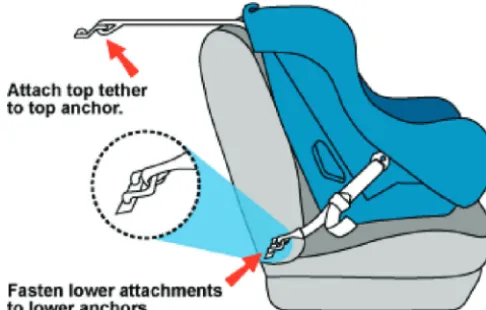
A relatively new way by which CSSs can be installed in passenger vehicles, known as LATCH, was designed to re-duce the difficulty associated with in-stalling CSSs. This system uses dedi-cated attachment points in the vehicle rather than using the vehicle seat belt for CSS installation. All vehicles and child restraints manufactured and
sold in the United States after Septem-ber 2002 are required to have this an-choring system. For rear-facing CSSs, there are 2 points of attachment at the base of the CSS. For forward-facing CSSs, a third dedicated attachment point near the top of the CSS is used for
a top tether to attach to a separate an-chor point in the vehicle (see Fig 1).
Previous research has evaluated the performance of LATCH (or its European counterpart, ISOFIX) in laboratory sled-test environments42–44 and
demon-strated improved kinematics and re-duced injury measures on crash test dummies, in particular with use of the top tether, when compared with using a seat belt to attach the CSS. To date, there are no real-world data from evalu-ations of the performance of LATCH, al-though its theoretical advantages in en-suring proper installation suggest that families should use it when available.
Arbogast and Jermakian have re-viewed cases of CSSs attached by us-ing LATCH and illustrated examples of LATCH misuse.45In 2005, a large-scale
observation study that examined LATCH use and misuse in the United States was conducted at 66 sites across 7 states.46The study results
in-dicated that many parents who pur-chased newer vehicles did not update their CSS to take advantage of the available LATCH attachment system. Approximately one-fifth of CSSs in vehi-cles equipped with LATCH did not have tether straps, and one-sixth did not have lower attachments. Even when their CSSs were LATCH equipped, ap-proximately one-third of the drivers with LATCH-equipped vehicles stated
that they could not use LATCH because there were no anchors in their vehi-cles. Much of the nonuse of lower an-chors in this study related to the fact that the vehicle safety belt was the only method available in the center rear-seating position for installing a CSS. The rear seats of most passenger vehi-cles typically are equipped with lower LATCH anchors only in the outboard seating positions. When parents had experience attaching CSSs by using the safety belt and LATCH system, three-quarters reported a preference for LATCH, because they found it easier to use and obtained a tighter fit, and they felt that the child was more secure.
EVIDENCE FOR BEST-PRACTICE RECOMMENDATIONS
The following section of this technical report will provide a summary of the evidence in support of each of the best-practice recommendations included in the accompanying policy statement.
Children with certain physical and be-havioral conditions may require spe-cialized restraint systems and other considerations. Relevant conditions may include prematurity, cerebral palsy, the presence of a tracheostomy, muscle tone abnormalities, skeletal abnormalities, and certain behavioral or emotional conditions as well as
FIGURE 1
temporary conditions such as frac-tures that require spica casts. There-fore, the AAP has developed a separate policy statement that reviews impor-tant considerations for transporting children with special health care needs and provides current guidelines for the protection of children with spe-cific health care needs, including those transported in wheelchairs.47
1. Best-Practice Recommendation: All Infants and Toddlers Should Ride in a Rear-Facing CSS Until They Are 2 Years of Age or Until They Reach the Highest Weight or Height Allowed by the
Manufacturer of Their CSS
This best practice results from the need to support the young child’s pos-terior torso, neck, head, and pelvis and to distribute crash forces over the en-tire body. Developmental consider-ations, including incomplete vertebral ossification, more horizontally ori-ented spinal facet joints, and excessive ligamentous laxity put young children at risk of head and spinal cord injury. Rear-facing CSSs address this risk by supporting the child’s head and pre-venting the relatively large head from moving independently of the propor-tionately smaller neck.
In the United States, although the major-ity of children use rear-facing CSSs dur-ing the first year of life, 21% of infants who are either younger than 1 year or weigh less than 20 lb have been turned forward-facing.21 In Sweden, many
chil-dren remain rear-facing up to the age of 4 years and transition directly from the rear-facing CSS to a booster seat. Swed-ish researchers have reported that rear-facing CSSs reduce the risk of significant injuries (those with an Abbreviated In-jury Scale score ofⱖ2) by 90% relative to unrestrained children, which reinforces their policy of children remaining in a rear-facing CSS up to the age of 4 years.48,49
Henary et al50reviewed US crash data
to calculate the relative effectiveness of rear-facing CSSs compared with forward-facing CSSs for children 0 through 23 months of age in crashes from 1988 to 2003. The authors re-ported that children in forward-facing CSSs were significantly more likely to be seriously injured when compared with children restrained in rear-facing CSSs in all crash types (odds ratio [OR]: 1.76 [95% confidence interval [CI]: 1.40 –2.20]). When considering frontal crashes alone, children in forward-facing CSSs were more likely to be seriously injured, although this finding was not statistically significant (OR: 1.23 [95% CI: 0.95–1.59]). In side-impact crashes, however, children in forward-facing CSSs were much more likely to be injured (OR: 5.53 [95% CI: 3.74 – 8.18]). When children 12 to 23 months of age were analyzed sepa-rately, those who were restrained in forward-facing CSSs were also more likely to be seriously injured (OR: 5.32 [95% CI: 3.43– 8.24]). These authors concluded that for children through 23 months of age, rear-facing CSSs pro-vided optimal protection. The lack of meaningful numbers of children 24 months or older in rear-facing CSSs in US databases has prevented extension of these analyses to even older age groups of children, such as those stud-ied in Sweden.
2. Best-Practice Recommendation: All Children 2 Years or Older, or Those Younger Than 2 Years Who Have Outgrown the Rear-Facing Weight or Height Limit for Their CSS, Should Use a Forward-Facing CSS With a Harness for as Long as Possible, up to the Highest Weight or Height Allowed by the
Manufacturer of Their CSS
The recommendation for forward-facing CSSs has been based, in part, on an analysis by Kahane51of laboratory
sled tests, observational studies, and
police-reported crash data from the early 1980s that estimated that cor-rectly used forward-facing CSSs re-duce the risk of death and injury by approximately 71% compared with un-restrained children. The engineering tests documented the biomechanical benefits of the CSS in spreading the crash forces over the shoulders and hips and controlling the excursion of the head during a crash. Kahane fur-ther estimated the effectiveness of a partially misused CSS as providing a 45% reduction in risk of fatality and serious injury. Using Fatality Analysis Reporting System (FARS) data from 1988 to 1994, NHTSA found that, among children between 1 and 4 years of age in passenger cars, those in forward-facing CSSs had a 54% reduction in risk of death compared with unre-strained children.52Given the currently
high rates of restraint use among chil-dren in the United States, it is no lon-ger meaningful to quote effectiveness estimates in comparison to unre-strained children.
de-scribed hereafter, have been developed to minimize the effects of this bias.
The results of most studies to date have indicated that forward-facing CSSs are effective at preventing nonfa-tal injuries when compared with seat belts; effectiveness estimates have ranged from 71% to 82% reduction in serious injury risk.13,53 Elliott et al14
compared the effectiveness of child re-straints to seat belts in preventing fa-tal injuries to 2- to 6-year-old children in crashes by combining data from the FARS with data from the National Auto-motive Sampling System–Crashwor-thiness Data System. The combined data set, in theory, overcame several of the known limitations of using either data source alone. Compared with seat belts, child restraints, when not seriously misused (eg, unattached re-straint, child restraint system harness not used) were associated with a 28% reduction in risk of death (relative risk [RR]: 0.72 [95% CI: 0.54 – 0.97]) after adjusting for seating position, vehicle type, model year, driver and passenger ages, and driver survival status. When including cases of serious misuse, the effectiveness estimate was slightly lower (21%) and not statistically signif-icant (RR: 0.79 [95% CI: 0.59 –1.05]).
In a controversial analysis, Levitt54
used FARS data from 1975 to 2003 and, by various methods, directly com-pared the mortality rates for child re-straints and for seat belts for children aged 2 to 6 years and could not dem-onstrate a difference in effectiveness. Levitt restricted the FARS data set to 2-vehicle crashes in which someone in the other vehicle (ie, the vehicle with-out the index child occupant) died, un-der the assumption that the distribu-tion of restraint use among children in potentially fatal crashes is indepen-dent of whether someone in the other vehicle dies, after adjusting for various crash-related characteristics. In a sub-sequent study in which a
marginal-structural-model-type estimator was used in an attempt to explore the rela-tionship between various biases inher-ent in data sources and the estimates of CSS restraint effectiveness, Elliott et al55suggested a 17% reduction in
fatal-ity risk for children 2 through 6 years of age in child restraint systems rela-tive to seat belts. This reduction is es-timated at 22% when severe misuse of the restraint is excluded.
3. Best-Practice Recommendation: All Children Whose Weight or Height Is Above the Forward-Facing Limit for Their CSS Should Use a Belt-Positioning Booster Seat Until the Vehicle Lap-and-Shoulder Seat Belt Fits Properly, Typically When They Have Reached 4 Feet 9 Inches in Height and Are Between 8 and 12 Years of Age
Children who have outgrown a forward-facing CSS (based on the height or weight limit of the seat) should be restrained in belt-positioning booster seats by using the lap-and-shoulder belts in the back seat of a vehicle. Booster seats position the child so that the lap-and-shoulder belt fits properly. Correct fit of the belt is defined as follows:
● The shoulder belt lies across the middle of the chest and shoulder, not the neck or face.
● The lap belt is low across the hips and pelvis, not the abdomen.
● The child is tall enough to sit against the vehicle seat back with his or her knees bent without slouching and can stay in this position comfortably throughout the trip.
Although seat belt geometry varies from vehicle to vehicle depending on the depth of the seat bottom and place-ment of the upper and lower anchor points of the belt, most vehicle seat belts will not fit correctly until a child reaches approximately 4 feet 9 inches in height and is between 8 and 12 years
of age. This height threshold was de-rived from a study of 155 children 6 to 12 years of age who were assessed for the fit of the vehicle seat belt in 3 differ-ent types of vehicles in 1993.56The
mini-mum height of a child who could fit prop-erly in the vehicle seat belts was 148 cm (58 inches). It is important to note that this study is nearly 20 years old, and sig-nificant changes have been made to the vehicle fleet during this time.
Cases of serious cervical and lumbar spinal cord injury, as well as intraab-dominal injuries, to children in motor vehicle crashes resulting from poorly fitting seat belts have been described for many years and are known as the “seat belt syndrome.”57First described
by Kulowski and Rost in 1956,58 the
term “seat belt syndrome” was coined by Garrett and Braunstein in 196259 to
describe a distinctive pattern of injuries associated with lap seat belts in serious crashes. Two predominant factors have been hypothesized to explain this con-stellation of injuries: the immaturity of the pediatric pelvis to properly anchor the lap portion of the belt and the ten-dency of children to scoot forward in the seat so that their knees bend at the edge of the vehicle seat. From this position, in a rapid deceleration, the belt can directly compress abdominal organs against the spinal column, and the child’s body may “jack-knife” around the belt, putting high tension forces on the lumbar spine, which may lead to distraction injuries of the posterior elements of the spine, such as Chance-type fractures.
Durbin et al12published results of the
from 1998 to 2002, Corden60
deter-mined that there would be an approxi-mate 57% reduction in deaths and hos-pitalizations if all 4- to 7-year-olds were in booster seats. A recent updated analysis of booster effectiveness in preventing nonfatal injuries was able to examine a greater percentage of older children using booster seats; 37% of the more recent study sample using booster seats were 6 to 8 years of age.24In this
study, children 4 to 8 years of age using belt-positioning booster seats were 45% (95% CI: 4%– 68%) less likely to sustain nonfatal injuries than children of similar ages using the vehicle seat belt. Among children restrained in belt-positioning booster seats, there was no detectable difference in the risk of injury between the children in backless versus high-back boosters.
Rice et al61 extended the data on
booster seat performance by estimat-ing the effectiveness of booster seats in reducing the risk of fatal injuries to children 4 to 8 years of age. Using a matched cohort analysis of data from the FARS, Rice et al determined that booster seats reduced the risk of fatal injuries by 67% for 4- to 5-year-olds and 55% for 6- to 8-year-olds compared with unrestrained adults and children. They also determined that seat belts alone reduced the risk of fatal injury by approximately 62% for 4- to 8-year-olds compared with unrestrained adults and children. They did not demon-strate a significant difference in fatal-ity risk reduction for booster seats when compared with seat belts (RR: 0.92 [95% CI: 0.79 –1.08]). The authors postulated that although booster seats, which improve seat belt fit, may reduce the risk of nonfatal injuries (some of which may be attributable to improperly fitting seat belts), they may not improve the likelihood that children will survive a severe crash with major occupant compartment intrusion or dur-ing rollovers. It may be that properly
fit-ting seat belts are no better than poorly fitting seat belts at preventing fatal inju-ries in these severe crashes.
Although most newer vehicles include lap-and-shoulder belts in all rear-seating positions, many older vehicles still in use may have only lap belts available in some seating positions, typically in the center of the rear seat. Laboratory tests have revealed increased head excursions when booster seats are used with lap belts compared with when only lap belts are used.62,63 Other research results have
indicated that booster-aged children using only lap belts are likely to strike their heads on vehicle seat backs or other interior components in front of them, even without booster seats.64,65
Results of a recent study that used 2 real-world data sources suggested that children restrained in booster seats with lap belts had a lower injury risk when compared with children re-strained in lap belts only, although the possibility of no difference could not be excluded.66For families faced with
frequently transporting booster-aged children in lap-belt-only seating posi-tions, there are other restraint options (eg, forward-facing CSSs with higher weight limits and safety vests) that, al-though typically more expensive than booster seats, are more likely to pro-vide optimal protection if children ride regularly in these seating positions. It should be noted that the number of children in this scenario will decrease over time as vehicles equipped with lap-belt-only restraints in rear seats are phased out of the US vehicle fleet.
4. Best-Practice Recommendation: When Children Are Old Enough and Large Enough to Use the Vehicle Seat Belt Alone, They Should Always Use Lap-and-Shoulder Seat Belts for Optimal Protection
Lap-and-shoulder belts have been re-quired in rear outboard positions of
vehicles since 1989. However, it was not until 2005 that lap-and-shoulder
belts were required in the center rear-seat position. Many manufac-turers introduced center rear lap-and-shoulder belts in advance of this requirement, and by model year
2001, most vehicles provided them as standard equipment.67 Arbogast
et al68determined that the presence
of a shoulder belt reduced the risk of injury by 81% for children seated in
the center rear in seat belts, and the primary benefit is seen in reductions in abdominal injuries. Parenteau et al69 had previously documented a
similar shift in the pattern of injury
to children in lap-only belt restraints to lap-and-shoulder belts. Their study, however, examined the rear seat as a whole and did not separate the rear seating positions.
Using data from the FARS, the NHTSA has evaluated the performance of lap-and-shoulder belts in the rear rows and found them to be effective (compared with unrestrained occu-pants) in all crash directions for
chil-dren and adult occupants 5 years and older. The estimated fatality reduction, compared with unre-strained occupants, was 77% in roll-over crashes, 42% in side impacts,
29% in frontal impacts, and 31% in rear impacts and other crashes.70
Two studies have evaluated seat belt effectiveness specifically for chil-dren. Chipman et al,71using a
data-base of fatal crashes in Ontario,
Can-ada, estimated that seat belts reduced the risk of serious injury or death by 40% for children 4 to 14 years of age. Data from Wisconsin suggested that 100% seat belt use by
5. Best-Practice Recommendation: All Children Younger Than 13 Years Should Be Restrained in the Rear Seats of Vehicles for Optimal Protection
In large part because of the attention resulting from the tragedy of children killed by passenger air bags, signifi-cant declines in front seating of chil-dren in vehicles have occurred since the mid-1990s. By 2008, 95% of infants, 98% of children 1 to 3 years of age, and 88% of children 4 to 7 years of age rode in the rear seat.20These rates compare
with rates of 85%, 90%, and 71%, re-spectively, in 2002, the first year from which these data were available from direct observation studies.72It should
be noted that rear seating does not seem to vary on the basis of whether there is a state law requiring children to ride in the rear. In 2008, 92% of chil-dren who lived in states in which such a law existed rode in the rear, versus 93% of children from states in which no such law exists.20 Children using
child restraint systems were more likely to sit in the rear (ⱖ93%) than were those in seat belts (89%) or rid-ing unrestrained (84%). In a study of children involved in nonfatal crashes, children were more likely to be seated in the front if the vehicle was driven by a male or by someone other than the child’s parent or if the vehicle was not equipped with a passenger air bag.73
Among children younger than 4 years in CSSs who have been in crashes, there seems to be a preference for placing the CSS in the right outboard seating position in the rear row (41%) compared with the center rear (31%) or left outboard (28%),74 which likely
has to do with the increased ability for the driver to directly observe the child more easily when in the right outboard rear seating position.
Several studies have documented the benefits of rear seating for children. Estimates of the elevated risk of injury
for children in the front seat compared with children in the rear have ranged from 40% to 70% depending on the time period and characteristics of the group studied.10,75,76The authors of 1 of
these studies specifically noted that the beneficial effects of the rear seat were no longer seen for children 13 years and older.10Thus, the AAP
contin-ues to recommend that all children younger than 13 years ride in the rear seat. It is interesting to note that the benefits of rear seating for child occu-pants extend to side impacts as well; children seated in the rear are 62% less likely to sustain an injury.77 Not
only is the overall risk higher, but the severity of injury is also greater in the front seat. An analysis of crashes iden-tified through the Crash Injury Re-search and Engineering Network (CIREN) revealed that child occupants in the front seat sustained more se-vere injuries than those seated in the rear rows as measured by an injury severity score higher than 16.78
Two recent studies specifically evalu-ated the potential incremental benefits of the center rear seating position compared with the rear outboard po-sitions. Lund79used data from the
Na-tional Automotive Sampling System– General Estimates System system from 1992 to 2000 to evaluate the effect of seating position on the risk of injury for children in child restraints. Lund reported that children in the center rear seat had a similar risk of injury to children in the outboard rear seats. In contrast, Kallan et al74used
data from the Partners for Child Pas-senger Safety project, a large, child-focused crash-surveillance system, from 1998 to 2006 and found that chil-dren restrained in forward-facing CSSs and seated in the center rear had an injury risk 43% lower than similarly restrained children in either of the rear outboard positions (adjusted OR: 0.57 [95% CI: 0.38 – 0.86]). These
con-trasting findings are likely attributable to how injuries were defined in the 2 studies. Lund defined injury as any police-reported injury, which included those of a relatively minor nature. The threshold for injury was higher in the Kallan et al analysis, which included only injuries involving internal organs and fractures of the extremities.
CHILDREN AND AIR BAGS
In November 1995, an article in the
Morbidity and Mortality Weekly Report
of the Centers for Disease Control and Prevention described 8 deaths of child occupants involving air-bag deploy-ment that were of special concern, be-cause they involved low-speed crashes in which the children otherwise should have survived.80As passenger air bags
diffused into the market, numerous case reports began appearing in the medical literature describing brain and skull injuries sustained by chil-dren in rear-facing CSSs and brain and cervical spine injuries sustained by older children who were often unre-strained or reunre-strained in seat belts in-appropriately for their age.81–85
Several researchers reviewed case se-ries of children exposed to deploying passenger air bags to elucidate the mechanisms of injury.86–90For children
air-bag deployment continue to appear in the literature, including injuries to the eye91 and upper extremities92 as
well as respiratory and hearing prob-lems related to the sound wave and cloud of fine particulate matter re-leased during an air-bag deployment.93
Several population-based estimates of the effects of air bags on young chil-dren in crashes have consistently indicated an increased risk of fatal and nonfatal injuries to both re-strained and unrere-strained child occu-pants.11,12,94–98 Exposure to passenger
air bags increased the risk of both mi-nor injuries, including facial and chest abrasions, and moderate and more se-rious injuries, particularly head inju-ries and upper-extremity fractures.
On the basis of this evidence, the NHTSA initiated a 2-pronged program of education and regulation in re-sponse to the initial reports of deaths and serious injuries to children from air bags. First, the NHTSA, joined by many national organizations including the AAP, recommended that all child passengers younger than 13 years sit in the rear seats of vehicles. Second, in 1997, the NHTSA enacted a substantial regulatory change to Federal Motor Vehicle Safety Standard (FMVSS) 208, the safety standard that governs the protection of motor vehicle occupants in frontal impact crashes. Because frontal air bags are designed to pri-marily protect occupants in frontal im-pact crashes, their performance is certified through FMVSS 208. The change provided automakers a choice in the type of test that could be used to certify frontal crash performance for unbelted adults.99This change in the
standard resulted in the redesign of frontal air bags to reduce the force with which they deploy. These new air bags are often referred to as “second-generation air bags” and were gener-ally present in all vehicles beginning with model year 1998.
Several studies have examined the ef-fect of these design changes on child occupants in real-world crashes. Olson100found that second-generation
air bags reduced the risk of death among right-front-seated children 6 to 12 years of age by 29% compared with no air bag. For children younger than 6 years, both first- and second-generation air bags increased the risk of death compared with no air bag; however, the increased risk of death was less for second-generation air bags (10%) compared with first-generation air bags (66%). Arbogast et al101 quantified the risk of serious
nonfatal injuries in frontal crashes among belted children in the front seat of vehicles in which second- ver-sus first-generation passenger air bags deployed. Serious injuries were reported in 14.9% in the first-generation group versus 9.9% in the second-generation group. In particular, children in the second-generation group sustained fewer head injuries, including concussions and other se-rious brain injuries, than in the first-generation group.
Braver et al102examined federal crash
data to determine the effect of second-versus first-generation air bags on the risk of fatal injuries to children in the right-front seat. Right-front passen-gers younger than 10 years in vehicles with second-generation air bags had statistically significant reductions in risk of dying in frontal collisions compared with children of similar ages in vehicles with first-generation air bags, including a 65% reduced risk among children 0 to 4 years of age (RR: 0.35 [95% CI: 0.21– 0.60]). Nonsignificant decreases in risk of death were observed among chil-dren 10 to 14 years of age.
Kuppa et al103evaluated the influence
of the air bag on the effectiveness of rear seating by using a double-pair comparison study of frontal impact
crashes identified in the FARS. Two pairs were analyzed: the first group consisted of fatal crashes in which a driver and front outboard seat passen-ger were present and at least 1 of them was killed; the second group consisted of fatal crashes in which a driver and a rear outboard seat passenger were present and at least 1 of them was killed. This analysis examined vehicles with and without a passenger air bag separately. For restrained children 5 years or younger, the presence of a passenger air bag increased the benefit, in terms of reduced fatali-ties, associated with rear seating. For restrained child occupants older than 8 years, the rear seat was still associated with a lower risk of death than the front, but its benefit was less in vehicles with a passenger air bag than in vehicles without a pas-senger air bag.
Air bags continue to undergo signifi-cant redesigns in an effort to optimize their effectiveness in serious crashes while minimizing their risk of adverse injuries in minor crashes. In 2001, ad-ditional revisions were made to FMVSS 208, which now requires the testing of air-bag systems for all sizes of occu-pants, including children. At this time, no studies have evaluated the benefits of these designs, often termed “certi-fied advanced compliant air bags,” for child occupants.
There have been limited studies that have attempted to examine age-specific effects of air bags on risk of in-jury to children. Newgard and Lewis97
second-generation air bags were gen-erally available in the vehicle fleet. Newgard and Lewis found that chil-dren 0 to 14 years of age involved in frontal collisions seemed to be at in-creased risk of serious injury from air-bag presence (OR: 2.66 [95% CI: 0.23– 30.9]) and deployment (OR: 6.13 [95% CI: 0.30 –126]), although these values did not reach statistical significance. Among children 15 to 18 years of age involved in frontal collisions, there was a protective effect on injury from both air-bag presence (OR: 0.19 [95% CI: 0.05– 0.75]) and deployment (OR: 0.31 [95% CI: 0.09 – 0.99]). A similar analysis has not been replicated to determine if different age cutoffs might be identi-fied with children in vehicles equipped with second-generation air bags. Therefore, the AAP continues to strongly recommend that all children younger than 13 years sit in the rear seat. In vehicles with only a single row of seats, such as compact pickup trucks, the frontal air bag can be deac-tivated, or an on/off switch can be in-stalled, to prevent its deployment in the event of a crash, thus allowing ei-ther the installation of a CSS in the front seat or the ability of a child younger than 13 years to ride in the front if necessary.104
Side air bags were introduced in the mid-1990s as a safety strategy to re-duce serious injuries and fatalities oc-curring in side-impact crashes. Initial crash tests that involved vehicles equipped with so-called torso side air bags in the front seats revealed that the head was still at risk of serious injury in side-impact crashes.105,106To
maximize protection of the head for adult front and rear-seat occupants of a variety of statures and seating pos-tures, the roof-rail or head curtain air bag was developed and has become the preferred head-protection system for side-impact crashes. These sys-tems, frequently accompanied by a
separate torso side air bag, provide more extensive coverage of the upper vehicle side interior and often extend the entire length of the vehicle, includ-ing the rear rows. Side air bags have become a common safety technology in the vehicle; 79% of model-year 2006 vehicles have some type of side air bag either as standard or optional equip-ment.107The NHTSA recently conducted
an analysis of side-impact protection with a focus on side air-bag tech-nology108and determined that side air
bags resulted in a reduction in struck-side fatality risk of 18% in multivehicle crashes and substantial improvement in a thoracic injury metric, the Tho-racic Trauma Index, in laboratory as-sessments. Benefits were greater for head side air bags than those with torso side air bags alone. However, these analyses were primarily fo-cused on protection of adult drivers and front-seat occupants. Arbogast and Kallan109 used the Partners for
Child Passenger Safety (PCPS) data-base to estimate the prevalence of side air-bag exposure to children in crashes and to provide estimates of in-jury risk among those exposed. In the study sample, 2.7% of children in crashes were exposed to a deployed side air bag. More than 75% of these children were seated in the rear seat, and 65% of those exposed were younger than 9 years. Of those ex-posed, 10.6% sustained an Abbrevi-ated Injury Scale 2 injury to the head or upper extremity, a rate similar to that of children exposed to second-generation frontal air bags. These limited field data on the performance of side air bags with respect to child occupant protection suggest that, al-though a significant number of chil-dren are exposed to side air-bag de-ployments, there is no evidence that these air bags pose a particular risk of serious or fatal injuries to children.
SPECIAL CONSIDERATIONS
The Safety of Children Left in or Around Vehicles
Children should never be left unat-tended in or around parked cars. Among the safety risks that have been described, being backed over when the vehicle is set in motion, hyperthermia, and strangulation from entrapment in power windows are among the most serious and preventable injuries. In 2008, Kids and Cars, a safety advocacy group dedicated to the prevention of such injuries, amassed reports of a wide range of safety incidents that in-volved nearly 1000 children and re-sulted in more than 200 deaths.110 In
response to the Cameron Gulbransen Kids Transportation Safety Act of 2007 (Pub L No. 110-189), the NHTSA created a virtual database called the Not in Traffic Surveillance (NiTS) system to ascertain population-based estimates of the prevalence of noncrash deaths and injuries. NiTS data indicate that ap-proximately 35 to 40 occupants (pri-marily children) die of hyperthermia and 5 die of power-window strangula-tion each year, which highlights the im-portance of never leaving children un-supervised in or around cars.111
The Safety of Children in Pickup Trucks
Pickup trucks are popular vehicles in the United States and accounted for approximately 13% of new vehicle sales in 2008.112Although many have
seat of compact extended-cab pickup trucks were more than 4 times as likely to be injured (adjusted OR: 4.69 [95% CI: 2.44 –9.01]) as were rear-row–seated children in other ve-hicles. A substantial portion of the in-creased risk was mediated by contact with the vehicle interior during the crash, because the rear-seat compart-ment in these trucks is typically not as well padded as in other vehicles. It is important to note that full-size extended-cab pickup trucks, which typ-ically have a rear-seat compartment similar in size and configuration to other vehicles, were found to have in-jury risks similar to those of other pas-senger vehicles.
Of particular concern regarding the safety of pickup trucks for children is the use of the cargo area of pickup trucks for the transport of children and youth. Because the cargo area is not intended for passenger use, it is neither required nor designed to meet occupant safety standards applicable to passenger locations. The fatality risk to children in the cargo area of pickup trucks has been well de-scribed.114,115The most significant
haz-ard of travel in the cargo area of a pickup truck is ejection of a passenger in a crash or noncrash event (eg, sud-den stop, turn, swerve, or loss of bal-ance, as well as intentional or uninten-tional jumps and falls). It is fortunate that the number of children and ado-lescents younger than 18 years killed as passengers in the cargo area of pickup trucks has declined by more than 50% over the past decade, from more than 40 per year to less than 20 per year more recently.2The most
ef-fective prevention strategies for re-ducing the number of deaths and inju-ries to children in pickup trucks are the prohibition of travel in the cargo area and age-appropriate restraint use in an appropriate rear-seat loca-tion in the cab.
The Safety of Children on Commercial Airlines
Currently, the Federal Aviation Admin-istration (FAA) exempts children younger than 2 years from the require-ment that all aircraft passengers oc-cupy a seat with a separate safety belt.116The FAA and NHTSA agreed on a
single government performance stan-dard, FMVSS 213, that would satisfy both aviation and highway safety re-quirements for child restraint sys-tems.117The FAA has also approved a
harness-type restraint appropriate for children who weigh between 22 and 44 lb. This type of device provides an alter-native to using a hard-backed seat and is approved only for use on aircraft. It is not approved for use in motor vehi-cles.118Newman et al119examined the
potential impact and costs of a re-quirement for use of child restraint systems by young children on aircraft. The potential impact of such a regula-tion requires a number of assump-tions, primarily regarding the effec-tiveness of child restraint systems in survivable aircraft crashes and the proportion of families who would switch from air to ground travel if re-quired to assume the added cost of an additional aircraft seat and the child restraint system for their children younger than 2 years. Using available data on the risk of fatalities from air travel and the survivability of crashes and reasonable assumptions for RRs of death for restrained and unre-strained young children involved in crashes, Newman et al found that the number of deaths that could be pre-vented in the United States with man-datory child restraint system use in commercial aircraft is small: less than 1 per year. The number of deaths that could be prevented by mandatory child restraint system use is limited, be-cause the number of deaths of unre-strained young children in survivable aircraft crashes is already low.
New-man et al suggested that a policy of requiring child restraint system use for airplane travel is likely to lead to a net increase in deaths caused by in-creased motor vehicle travel if the pro-portion of families switching to auto-mobile travel exceeds approximately 5% to 10%. This threshold varied with the estimated number of lives saved by child restraint system use on air-planes, the average length of the added round trips by car, and the risk profile of the drivers but was unlikely to exceed 15%. The National Transpor-tation Safety Board disputed the “di-version” claim made by Newman et al and others and suggested that avail-able data did not indicate that diver-sion to road travel has previously oc-curred when circumstances made it likely (eg, immediately after the terror-ist attacks on September 11, 2001).120
An alternative approach supported by the FAA is to encourage families to in-quire about the availability of open seats on less crowded flights so that parents could put their child in a child restraint system in a seat next to them without needing to buy a ticket and without revenue loss to the airline. This approach was also advocated by Bishai121in an editorial that
accompa-nied the Newman et al study. If open seats are not available, families would be required to check the CSS as lug-gage. In 2008, the Department of Fed-eral Affairs surveyed all major US air-lines on their baggage policies and learned that with 1 exception, airlines have adopted policies that do not count CSSs toward checked baggage allowances.122
and used to provide evidence to inform the policy debate and ticket-pricing policies and security screening proce-dures are enhanced to make it easier for families to follow best-practice rec-ommendations for correct child re-straint use during commercial airline travel, and to have their own CSS or booster seat available to them after airline travel, the current situation of allowing young children to travel in a manner inconsistent with best-practice recommendations is likely to continue.
CHILD RESTRAINT LAWS
The first state child occupant restraint law was passed in Tennessee in 1978, primarily attributable to the efforts of pediatrician Robert Sanders. By 1985, all 50 states and the District of Colum-bia had passed laws requiring child re-straints for young children. However, these initial child passenger safety laws were generally inconsistent with best-practice recommendations at the time, which created several gaps in coverage of children and resulted in poor compliance with the provisions of the laws.123 Recognizing the
impor-tance of laws in both changing re-straint behavior and educating the public about recommended restraint practices, most states have recently enhanced their child occupant re-straint laws through the enactment of booster seat use provisions for older children. Current information on all child restraint laws in the United States is up-dated by the Insurance Institute for High-way Safety and can be found at www. iihs.org/laws/ChildRestraint.aspx. Al-though the laws aim to ensure the ap-propriate use of all forms of child re-straints (eg, CSSs and belt-positioning booster seats), the revised laws gener-ally became known as “booster seat laws.” Results of subsequent study of the association of a booster seat pro-vision in a state child restraint law with changes in child restraint use in
that state indicated that booster seat provisions that cover children from 4 through 7 years of age increase the use of child restraints by 39% among children in this age range.16Children 4
to 5 years of age in states with booster seat laws were 23% more likely to be reported as appropriately restrained than were children in other states, and those 6 to 7 years of age were twice as likely to be reported as appropri-ately restrained. For 6- to 7-year-olds, the effect was much stronger when the law included children through 7 years of age than when it included only those 4 to 5 years of age.
A focus-group study of violators of Cal-ifornia’s child restraint law revealed that multiple complex factors influ-ence consistent use of a CSS.124At the
time of the study, the California law re-quired children younger than 4 years and weighing less than 40 lb to be properly secured in a CSS that meets federal standards. Parents who vio-lated the law described a number of factors, including unreliable access to a vehicle, the trip circumstances, parenting style, and child refusal, that affected the use of a CSS at the time of the citation. Among parents who had been ticketed for not re-straining their children, participa-tion in a class in which child passen-ger safety information was provided demonstrated some benefit in their subsequent knowledge of child pas-senger safety issues, compared with a fine alone.
Seat belt laws have played a critical role in increasing seat belt use by 83% of front-seat occupants by 2008.125
However, seat belt use continues to be lower—at 80% in 2008 —among driv-ers and front-seat occupants 16 to 24 years of age. There are 2 different types of enforcement of seat belt laws: primary and secondary enforcement. Primary-enforcement laws allow a
ci-tation to be issued whenever a law en-forcement officer observes an un-belted driver or passenger. Secondary enforcement seat belt laws require the officer to stop a violator for another traffic infraction before being able to is-sue a citation for not using a seat belt. Previous studies have demonstrated that, on average, the effects of primary-enforcement laws are larger and more consistent than secondary-enforcement laws in increasing seat belt use and de-creasing injuries among adult drivers and passengers.126–129
Gaps between adult seat belt laws and child restraint laws result in lack of coverage for many older children (5–15 years of age) in all seating posi-tions. For example, in some states, a 15-year-old can ride legally in the back seat without a restraint, because the laws in those states apply only to front-seat occupants. To gain insight on the potential effect of primary-enforcement safety belt laws on older child passengers, Durbin et al130
com-pared with a primary-enforcement state (RR: 2.2 [95% CI: 1.4 –3.5]). The authors concluded that primary-enforcement laws were associated with higher rates of seat belt use com-pared with secondary-enforcement laws among children 13 to 15 years of age, a group not generally covered by restraint laws.
RESOURCES FOR PEDIATRICIANS AND FAMILIES
The NHTSA began a standardized child passenger safety training and certifi-cation program in 1998. Since then, tens of thousands of people have been certified as child passenger safety technicians.131 These people
partici-pate in community-based child safety seat clinics and are a source of infor-mation for families on appropriate use and installation of all types of CSSs and booster seats. Although the algorithm to guide implementation of best-practice recommendations by pedia-tricians provided in the policy state-ment is designed to cover the majority of situations that pediatricians will encounter in practice, pediatricians
should consider child passenger safety technicians as sources of infor-mation when atypical circumstances may be encountered that are not ade-quately managed by the algorithm. In most communities, technicians work at formal inspection stations; a list of these stations is available at www. seatcheck.org. If your community does not have an inspection station, you can find a technician in your area via the National Child Passenger Safety Certi-fication Web site (http://cert.safekids. org) or the NHTSA child safety seat in-spection station locator (www.nhtsa. dot.gov/cps/cpsfitting/index.cfm). Tech-nicians with enhanced training in re-straining children with special health needs, as well as those with Spanish-language proficiency, can be identified at these sites. Car seat checkup events are updated at www.safekidsweb.org/ events/events.asp. In addition, addi-tional resources for pediatricians and families can be found at www.aap.org and www.healthychildren.org.
LEAD AUTHOR
Dennis R. Durbin, MD, MSCE
COMMITTEE ON INJURY, VIOLENCE, AND POISON PREVENTION, 2008 –2010 H. Garry Gardner, MD, Chairperson
Carl R. Baum, MD M. Denise Dowd, MD, MPH Dennis R. Durbin, MD, MSCE Beth E. Ebel, MD
Michele Burns Ewald, MD Richard Lichenstein, MD Mary Ann P. Limbos, MD Joseph O’Neil, MD, MPH Elizabeth C. Powell, MD Kyran P. Quinlan, MD, MPH Seth J. Scholer, MD, MPH Robert D. Sege, MD, PhD Michael S. Turner, MD Jeffrey Weiss, MD CONTRIBUTOR
Stuart Weinberg, MD– Partnership for Policy Implementation (PPI)
LIAISONS
Julie Gilchrist, MD– Centers for Disease Control and Prevention
Lynne Janecek Haverkos, MD– Eunice Kennedy Shriver National Institute of Child Health and Human Development
Jonathan D. Midgett, PhD– Consumer Product Safety Commission
Alexander S. Sinclair– National Highway Traffic Safety Administration
Natalie L. Yanchar, MD– Canadian Paediatric Society
STAFF Bonnie Kozial
REFERENCES
1. Centers for Disease Control and Preven-tion. Injury Prevention & Control, Web-Based Injury Statistics Query and Report-ing System (WISQARS). Available at: www. c d c . g o v / i n j u r y / w i s q a r s / i n d e x . h t m l . Accessed August 17, 2010
2. National Highway Traffic Safety Adminis-tration. Fatality Analysis Reporting System encyclopedia. Available at: www-fars. nhtsa.dot.gov. Accessed August 17, 2010 3. Pressley JC, Barlow B, Kendig T,
Paneth-Pollak R. Twenty-year trends in fatal inju-ries to very young children: the persis-tence of racial disparities.Pediatrics. 2007;119(4). Available at: www.pediatrics. org/cgi/content/full/119/4/e875 4. Garcia AN, Patel KV, Guralnik JM. Seat belt
use among American Indians/Alaska Na-tives and non-Hispanic whites.Am J Prev Med. 2007;33(3):200 –206
5. Daniels F, Moore W, Conti C, et al. The role of the African-American physician in re-ducing traffic-related injury and death
among African Americans: consensus re-port of the National Medical Association.J Natl Med Assoc. 2002;94(2):108 –118 6. National Highway Traffic Safety
Adminis-tration.Seat Belt Use in 2008: Race and Ethnicity Results Among Occupants Travel-ing With Children. Washington, DC: Na-tional Highway Traffic Safety Administra-tion, National Center for Statistics and Analysis; 2009. DOT HS 811 107: Traffic Safety Facts, Research Note. Available at: www-nrd.nhtsa.dot.gov/Pubs/811107.PDF. Published 2009. Accessed August 17, 2010, 2010
7. Falcone RA Jr, Brentley AL, Ricketts CD, Al-len SE, Garcia VF. Development, implemen-tation and evaluation of a unique African-American faith-based approach to increase automobile restraint use.J Natl Med Assoc. 2006;98(8):1335–1341 8. Ebel BE, Koepsell TD, Bennett EE, Rivara FP.
Use of child booster seats in motor vehi-cles following a community campaign: a
controlled trial. JAMA. 2003;289(7): 879 – 884
9. National Highway Traffic Safety Adminis-tration.Traffic Safety Facts 1999: A Compi-lation of Motor Vehicle Crash Data From the Fatality Analysis Reporting System and the General Estimates System. Wash-ington, DC: National Highway Traffic Safety Administration; 2000. Available at: www. nhtsa.gov/people/ncsa/809-100.pdf. Ac-cessed August 17, 2010
10. Durbin DR, Chen I, Smith R, Elliott MR, Win-ston FK. Effects of seating position and ap-propriate restraint use on the risk of in-jury to children in motor vehicle crashes.
Pediatrics. 2005;115(3). Available at: www. pediatrics.org/cgi/content/full/115/3/ e305
12. Durbin DR, Elliott MR, Winston FK. Belt-positioning booster seats and reduction in risk of injury among children in vehicle crashes.JAMA. 2003;289(21):2835–2840 13. Arbogast KB, Durbin DR, Cornejo RA, Kallan
MJ, Winston FK. An evaluation of the effec-tiveness of forward facing child restraint systems.Accid Anal Prev. 2004;36(4): 585–589
14. Elliott MR, Kallan MJ, Durbin DR, Winston FK. Effectiveness of child safety seats vs seat belts in reducing risk for death in chil-dren in passenger vehicle crashes.Arch Pediatr Adolesc Med. 2006;160(6):617– 621 15. Nichols JL, Glassbrenner D, Compton RP. The impact of a nationwide effort to re-duce airbag-related deaths among children: an examination of fatality trends among younger and older age groups.J Safety Res. 2005;36(4):309 –320
16. Winston FK, Kallan MJ, Elliott MR, Xie D, Durbin DR. Effect of booster seat laws on appropriate restraint use by children 4 to 7 years old involved in crashes.Arch Pedi-atr Adolesc Med. 2007;161(3):270 –275 17. Segui-Gomez M, Wittenberg E, Glass R,
Lev-enson S, Hingson R, Graham JD. Where children sit in cars: the impact of Rhode Island’s new legislation.Am J Public Health. 2001;91(2):311–313
18. US Department of Transportation, Federal Highway Administration. National House-hold Travel Survey, 2001. Available at: http://nhts.ornl.gov. Accessed August 17, 2010
19. American Academy of Pediatrics, Commit-tee on Injury, Violence, and Poison Preven-tion. Child passenger safety.Pediatrics. 2011;127(4):788 –793
20. National Highway Traffic Safety Adminis-tration.Child Restraint Use in 2008: Overall Results. Washington, DC: National Highway Traffic Safety Administration, National Center for Statistics and Analysis; 2009. DOT HS 811 135: Traffic Safety Facts, Re-search Note. Available at: www-nrd.nhtsa. dot.gov/Pubs/811135.PDF. Accessed Au-gust 17, 2010
21. National Highway Traffic Safety Adminis-tration.Child Restraint Use in 2008: Use of Correct Restraint Types. Washington, DC: National Highway Traffic Safety Adminis-tration, National Center for Statistics and Analysis; 2009. DOT HS 811 132: Traffic Safety Facts, Research Note. Available at: www-nrd.nhtsa.dot.gov/Pubs/811132.PDF. Accessed August 17, 2010
22. National Highway Traffic Safety Adminis-tration.Child Restraint Use in 2008: Demo-graphic Results. Washington, DC: National Highway Traffic Safety Administration,
Na-tional Center for Statistics and Analysis; 2009. DOT HS 811 148: Traffic Safety Facts, Research Note. Available at: www-nrd. nhtsa.dot.gov/Pubs/811148.PDF. Accessed August 17, 2010
23. Partners for Child Passenger Safety.Fact and Trend Report. Philadelphia, PA: Chil-dren’s Hospital of Philadelphia; 2008 24. Arbogast KB, Jermakian JS, Kallan MJ,
Durbin DR. Effectiveness of belt position-ing booster seats: an updated assess-ment.Pediatrics. 2009;124(5):1281–1286 25. Flegal KM. Epidemiologic aspects of
over-weight and obesity in the United States.
Physiol Behav. 2005;86(5):599 – 602 26. Ogden CL, Carroll MD, Curtin LR, McDowell
MA, Tabak CJ, Flegal KM. Prevalence of overweight and obesity in the United States, 1999 –2004.JAMA. 2006;295(13): 1549 –1555
27. Trifiletti LB, Shields W, Bishai D, McDonald E, Reynaud F, Gielen A. Tipping the scales: obese children and child safety seats. Pe-diatrics. 2006;117(4):1197–1202 28. Pollack KM, Xie D, Arbogast KB, Durbin DR.
Body mass index and injury risk among US children 9 –15 years old in motor vehicle crashes.Inj Prev. 2008;14(6):366 –371 29. Haricharan RN, Griffin RL, Barnhart DC,
Harmon CM, McGwin G. Injury patterns among obese children involved in motor vehicle collisions.J Pediatr Surg. 2009; 44(6):1218 –1222
30. Zonfrillo MR, Nelson KA, Durbin DR, Kallan MJ. The association of weight percentile and motor vehicle crash injury among 3 to 8 year old children.Ann Adv Automot Med. 2010;54:193–199
31. National Highway Traffic Safety Adminis-tration.Seat Belt Use in 2009: Overall Re-sults. Washington, DC: National Highway Traffic Safety Administration, National Center for Statistics and Analysis; 2009. DOT HS 811 100: Traffic Safety Facts, Re-search Note. Available at: www-nrd.nhtsa. dot.gov/Pubs/811100.PDF. Accessed Au-gust 17, 2010
32. Parikh SN, Wilson L. Hazardous use of car seats outside the car in the United States: 2003–2007. Pediatrics. 2010;126(2): 352–357
33. Bull MJ, Engle WA; American Academy of Pediatrics, Committee on Injury, Violence, and Poison Prevention and Committee on Fetus and Newborn. Safe transportation of preterm and low birth weight infants at hospital discharge. Pediatrics. 2009; 123(5):1424 –1429
34. Decina LE, Lococo KH. Child restraint
sys-tem use and misuse in six states.Accid Anal Prev. 2005;37(3):583–590
35. Bulger EM, Kaufman R, Mock C. Childhood crash injury patterns associated with re-straint misuse: implications for field tri-age.Prehosp Disaster Med. 2008;23(1): 9 –15
36. Sherwood CP, Ferguson SA, Crandall JR. Factors leading to crash fatalities to chil-dren in child restraints.Annu Proc Assoc Adv Automot Med. 2003;47:343–359 37. Czernakowski W, Muller M. Misuse mode
and effects analysis: an approach to pre-dict and quantify misuse of child restraint systems.Accid Anal Prev. 1993;25(3): 323–333
38. Willett LD, Leuschen MP, Nelson LS, Nelson RM Jr. Risk of hypoventilation in prema-ture infants in car seats.J Pediatr. 1986; 109(2):245–248
39. Willett LD, Leuschen MP, Nelson LS, Nelson RM Jr. Ventilatory changes in convales-cent infants positioned in car seats.J Pe-diatr. 1989;115(3):451– 455
40. Merchant JR, Worwa C, Porter S, Coleman JM, deRegnier RA. Respiratory instability of term and near-term healthy newborn infants in car safety seats.Pediatrics. 2001;108(3):647– 652
41. Bass JL, Mehta KA, Camara J. Monitoring premature infants in car seats: imple-menting the American Academy of Pediat-rics policy in a community hospital. Pedi-atrics. 1993;91(6):1137–1141
42. Charlton JL, Fildes B, Laemmle R, Smith S, Douglas F. A preliminary evaluation of child restraints and anchorage systems for an Australian car.Annu Proc Assoc Adv Automot Med. 2004;48:73– 86
43. Sherwood CP, Abdelilah Y, Crandall JR, Ste-vens SL, Saggese JM, Eichelberger MR. The performance of various rear facing child restraint systems in a frontal crash.Annu Proc Assoc Adv Automot Med. 2004;48: 303–321
44. Bilston LE, Brown J, Kelly P. Improved pro-tection for children in forward-facing re-straints during side impacts.Traffic Inj Prev. 2005;6(2):135–146
45. Arbogast KB, Jermakian JS. Field use pat-terns and performance of child restraints secured by lower anchors and tethers for children (LATCH).Accid Anal Prev. 2007; 39(3):530 –535
46. Decina LE, Lococo KH. Observed LATCH use and misuse characteristics of child re-straint systems in seven states.J Safety Res. 2007;38(3):273–281