IMPROVEMENT OF PRODUCTIVITY IN
ONSTRUCTION PROJECTS USING A LEAN-DRIVEN
SCHEDULING METHOD
Dr.P.Subramanian, Madhankumar.M, Durai mohan.M, Snthosh.S,
Ragavan.M, Karthik.S
Department of Civil,Sengunthar Engineering College,Thiruchengode (India)
ABSTRACT
The building and construction sector accounts for more than 4% of New Zealand’s Gross Domestic Product (GDP). However, the sector is plugged with problem in poor productivity level. One of the factors which largely affect productivity in construction is variability. This issue represents almost 80% of productivity reduction in repetitive construction projects. Variability causes instability and fluctuations in different performance measures such as cycle times, cost, and planning efficiency. Buffers are commonly used to protect production schedules against the variations by allowing a certain level of flexibility. Variability and buffer management are also key topics in the lean construction agenda as reduction in variability effects can decrease the non-value-adding components in production.
This paper discusses the use of a Lean-driven buffered schedule in improvement of productivity in construction. A systematically buffered schedule can improve the reliability of construction plans. The improvement is apparent where considerations are given to the probable non-alignment between the planned and the actual progresses. Consequently, waste in the form of waiting time or slow work can be minimized which addresses the Lean ideal requirements. It is shown that a systematic buffered construction schedule can decrease project delivery time by 31% to 41%, and increase productivity level up to 30% when combines with variation mitigation strategies such as “Last Planner System”.
KEYWORDS:
Productivity; buffers; Lean Construction
.
Introduction
The building and construction industry is the fifth largest sector in New Zealand. Its output contributes to 45%
of all gross fixed capital formation of the country (Construction Industry Council 2006; Productivity Partnership
- Roadmap 2012; Building a Better New Zealand 2013). Nevertheless, the sector is plugged with a major
problem in poor productivity level (Construction Industry Council 2006; PWC 2011; Productivity Partnership -
Action Plan 2012; Building Research Association of New Zealand 2013). Figure 1 shows the changes in
productivity level in construction sector over recent decades. The level remained almost static for the first 25
years. The constant level was followed by a decline during the past decade (Page 2010). Construction
productivity in New Zealand is poor not only compared to other local industries, but also the international
standards (Building Research Association of New Zealand 2013). Given the major contribution of this sector to
Topics
A Structured Approach to Boost Productivity in Construction
Variability versus Productivity
Role of Buffers in Variability Control
Buffer Management Techniques
Buffer Management under Lean Concept
A Structured Approach to Boost Productivity in Construction
Identification of proper actions to improve the work efficiency starts with definition of a reliable index to
quantify productivity. “Building Research Association of New Zealand” (BRANZ) suggested to measure the
productivity level by a multi-factor productivity index (MFP) that comprises of labour and capital factors (Page
2010). It addresses a three-level industry structure proposed by Davis (2007, 2008). The structure comprises of
“individual level” where on-site productivity is considered; “Firm level” in which the productivity is perceived in simultaneous groups of projects; and “industry level” that takes in productivity of the whole industry. This research fosters performance improvements at “individual level” in projects. In turn it enables managers to better allocate their available resources at “Firm level” and achieve a higher degree of efficiency. The outcome of improvement at the lower level may positively influence the productivity at the “industry level” for medium
and long term periods. It becomes possible if a widespread adoption of the proposed planning method at
construction projects and firms occur.
The importance of variability management in construction sites in improving performance at “individual level”
is addressed in this paper. Variability is one of the factors which largely affects productivity in construction
(Ballard and Howell 1994; Howell and Ballard 1994; Ballard and Howell 1995; Alarcón 1997; González et al.
2011). It is represented by the variations in daily production, time schedule, and cost control which appear in the
form of deviation from the intended target (Alarcón 1997). The relationship between productivity and variability
in practice is supported by the findings of the Catholic University of Chile based on the information collected
from more than 1,000,000 square feet of building construction projects (Alarcón 1997). In fact, variability
accounts for almost 80% of productivity reduction in repetitive construction projects (Ballard and Howell 1994).
Variability versus Productivity
Variability has been identified as an inherent characteristic of production systems from the early 1920s by Shewhart
(Garvin 1988; Koskela 2000). It causes instability in performance of construction processes by inducing
fluctuations in the flow of work and information (Thomas et al. 2002). Figure 2 (a) demonstrates the negative
impact of variability in a hypothetical construction project. The figure shows a part of a construction project that
includes two processes which were planned to be done within 50 days. To analyse the variability effects,
“velocity diagram” is applied which plots the cumulative progress of processes against time. Hence, the
processes interdependencies can be observed.
In the presented case, outputs produced by the first process were prerequisites to the work performed by the
second process. Tommelein et al. (1999) has suggested such a consecutive pattern in repetitive construction
projects and term it as “Parade of Trades”. As the figure shows, variability has caused fluctuation in the
by 8.1 days from the planned target. It conveys 121.5 units behind the schedule. This deviation in the first
process caused three periods of waiting time in the second process (W1 to W3). During these periods the second
process was idle to receive its requirements. The total waiting time in this case was 10.8 days. As a result, the
production rate of the second process (number of produced units divided by time) ended up with 3 (units/day)
slower than the planned rate. The slower production rate, caused 10 days delay in the final delivery date of this
project. The variability affects not only the individual process but also other dependent processes. Figure 2 (b),
shows how the problem can extend from a single case of two processes to a whole project. The figure illustrates
a set of consecutive repetitive construction processes according to the model suggested by Tommelein et al.
(1999). The total planned time for this multi-process case was 90 days while due to variability, the finish time
deviated by 10 days. Besides, the total waiting time in this case came to 32.2 days.
The strong connection between the degraded performance measures and variability has been addressed by
several researchers (Ballard and Howell 1994; Alarcón 1997; Junior et al. 1998; González et al. 2004;
Koskenvesa and Koskela 2005; Alsehaimi et al. 2012). It is argued that deviation from the planned date due to
variability roughly happens in one out of each three activities on construction sites (Ballard and Howell 1994).
According to Hosseini et al. (2012), waiting time and delays account for up to 65% of total project time. Hence,
the waiting time increases the portion of ineffective time within the project and accordingly represents lower
work efficiency and a decreased productivity level.
Role of Buffers in Variability Control
Given the role of variability in shrinking the work efficiency and its close connection to productivity,
development of methods for variability management has been put in light (Ballard et al. 2005). Effective
variability management can result in 30% to 49% lift in productivity (Howell and Ballard 1994; González et al.
2004; Alarcón et al. 2005). As stated before, to maintain a suitable management approach in construction it is
suggested to focus on the “control” of flow variation by taking care of the operations and pushing the planning
commitments onto activities (Howell 1999). Efforts should be put to mitigate variability through a set of
controlling and corrective actions such as frequent checking and updates on the resource availability, shifting
the attentions from local optimization toward the project optimality, spotting the potential obstacles and devise
proper solutions for them. (Construction Industry Institute 1986; Ballard 2000; González et al. 2008). However,
a second group of strategies is required to cope with the remaining part of variability (Ballard and Howell 1995).
Buffers have been commonly used to protect production schedules against the uncontrolled part of variation by
maintaining a certain level of flexibility in the system (Howell 1999; González et al. 2011). A buffer isolates the
production process from its environment as well as the processes depending on it (Hopp and Spearman 2008).
Buffers can be implemented in the form of a delay between processes (time buffer), extra work capacity such as
labours or machinery in each process (capacity buffer), or extra material in front of each process (inventory
buffer). Thus, the processes can be shielded against the potential uncontrolled variation. According to Hopp and
Spearman (2008), buffers can help to prevent loss of throughput, wasted capacity, and inflated cycle times in the
production projects. Figure 3 (a), shows the role of buffer in improvement of project performance. It allows the
comparison of the performance of the second process in two different cases:
(1) a buffer is introduced to the system, and
By introducing a buffer of 120 production units in supply or 10 days delay in its start time, the second process
can be isolated against the variability in its upstream process. As the Figure 3 (a) shows buffers helped the
second process to avoid the unnecessary waiting times to receive its requirements. This situation presents a
better production rate and process efficiency. Accordingly, a higher level of productivity can be obtained.
Similar improvements can be expected from the use of buffers in the illustrated multi-process case in Figure
3(b). A productivity improvement between 6% and 51% (depending on nature of work) has been reported when
buffers were implemented in repetitive construction projects (Howell et al. 1993; González et al. 2009). A
comparison between Figure 3 (b) and figure 2 (b) shows that the implementation of buffers not only reduces
waiting times, improves production rates, efficiency of processes, and productivity, but it also can reduce the
observed delay in the final delivery date of project. Accordingly, an improvement of 31% to 41% can be
expected in project delivery time from the implementation of buffers in construction (Horman 2001; Koo et al.
2011). A general 30% lift in productivity is claimed to be achieved in construction projects through
implementing the buffering techniques in combination with LPS as the strategy for variation mitigation (Ballard
and Howell 1994).
Figure 3, also can show another advantage of using buffers in construction projects. It is able to help a crew of
workers to spend less time on-site and finish their job faster by avoiding unnecessary waiting times/slow work.
It increases efficiency of work at individual level that can reduce the total project duration. Page (2011) in
„BRANZ study report 259‟ has discussed that a quicker construction can be beneficial to both builders and
owners. For builders, faster completion of each construction process may improve cash flow and it enables
overheads to be spread over more projects, thereby increasing profit. For owners, quicker construction may
result in a higher profitability and lower rental financial costs. In that report, Page (2011) focused on the effects
of the project overall duration on profitability. This study argues additional potential savings exist from
improvement in productivity and shorter duration for each individual construction process.
Buffer Management Techniques
A wide range of production approaches and techniques have been developed to manage buffers. The techniques
have evolved from inventory theory to the modern manufacturing techniques. They vary in terms of emphasis
on decision rules, system status, and the type of used buffers (Hopp and Spearman 2008). Economic order
quantity (EOQ), (Q, r) model, Base Stock model (BSM), Material requirement planning (MRP), Just-In-Time
(JIT), Constant-Work-in-Process (CONWIP), Drum- Buffer- Rope (DBR), and Critical Chain project
management (CCPM) are some of the existing buffer management approaches in manufacturing (Hopp and
Spearman 2008). Similar strategies can be applied in construction to manage buffer as long as they are adapted
to the peculiarities of its production environment (González et al. 2010). Production in construction is peculiar
because it is associated with design and assembly of fixed-in-place objects, characterized by a site production,
unique product, and temporary teams (Ballard and Howell 1998). A considerable effort has been invested to
adapt the existing buffering methods in manufacturing to construction context. However, lack of practical
buffering approaches is still apparent in construction practices (Park and Peña-Mora 2004; González et al.
2009). Introduction of “Lean construction” has provided a new ground to propagate an improved framework for
Buffer Management under Lean Concept
Variability and buffer management are key topics in the Lean construction agenda (Ballard and Howell 1994;
Ballard and Howell 1995; Koskela 2000; González and Alarcón 2010; Slack et al. 2010). “Lean Construction” is
established on the basis of “Lean Production” which has introduced significant improvements to the
manufacturing and automotive industry. In Lean, reduction of variability is considered as a means of decreasing
non-value-adding components in production (Thomas et al. 2002; Womack and Jones 2003). “Value” represents
customer satisfaction and non-value-adding elements characterize waste. Variability results in non-value-adding
components (waste) in the flow of work and information in a production system (Thomas et al. 2002; Womack
and Jones 2003). Lean Construction aims to reduce waste in production (Womack and Jones 1996). In this
sense, reduction of waste increases efficiency in production system that accordingly decreases required time and
cost to perform a task (Horman 2001; Thomas et al. 2002).
Figure 4, shows the current difference between average productivity in manufacturing and construction
in New Zealand. These two industries are similar from operations management point of view, but manufacturing
has a productivity level twice of construction (Page and Curtis 2011). It is expected that construction receives
the same benefits as manufacturing by applying Lean concepts and methods in its production systems and
projects. Alarcón et al. (2005) assessed the impacts of implementing Lean Construction on a number of projects
and reported that the majority of project members noticed a significant improvement in productivity. Also, many
of the interviewees addressed the importance of the Lean in avoiding waste of time and improvement in their
project delivery. Similarly, Pacific Contracting of San Francisco reported a 20% lift in productivity and turnover
by applying Lean concepts (Egan 1998). Existing evidences suggest significant opportunities to apply Lean in
construction to prevent the negative productivity effects from variability.
Figure 4- Comparison between productivity in manufacturing and construction in New Zealand (1995/96 dollars is
used as the constant) (Page and Curtis 2011)
Lean ideal strives to avoid safety buffers because they represent waste (Womack and Jones 1996; Erdmann et al.
2012). Otherwise, in the absence of buffers, the system needs to control workflows strictly in order to be smooth
and predictable. Hence, no buffer makes production systems vulnerable to disruptions and buffer-less system
appears as a rare practice in ordinary construction projects (Hall 1983; González et al. 2009; Erdmann et al.
2012). The dichotomy between the Lean ideal and real practices connects with a “balance problem”: A state of
balance is required to be established between excessive size of buffer that represents undesirable waste and the
no buffer scenario that stimulates vulnerability in the system and accordingly poor performance (Hopp et al.
1989; González and Alarcón 2010). The “balance problem” gives a valuable criterion to address the buffer
The combination of buffer optimization and variability mitigation techniques can provide a hybrid
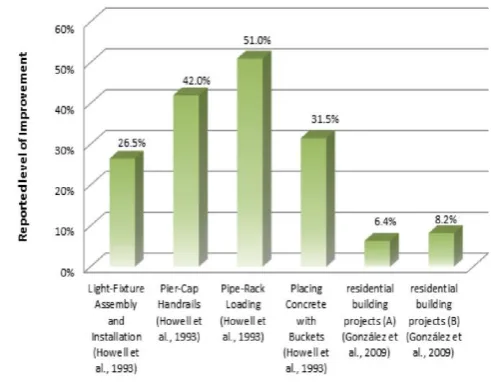
framework that is able to introduce considerable improvements in project performance. Figure 5 presents some
of the reported levels of improvement in productivity through application of hybrid strategies in construction
activities. As shown, implementation of a systematic approach in variability management has resulted in an
improvement between 6.4% and 51% depending on the nature of the construction work. The applied buffering
methods in these experiments were segregated and locally adjusted to a restricted range of applications in their
intended area of work. Therefor even more improvement can be expected in productivity in construction if a
comprehensive and integrated buffermanagement approach is taken.
Figure 5- Reported improvements in construction productivity through implementing buffer
management approaches
Conclusion
It was discussed that development of a buffering method based on the Lean construction concept can
protect construction productivity against the negative effects of variability. Such a systematic buffering method
can allow for generating reliable construction plans at the early stages of projects, by including the likely
non-alignment between the planned and actual progress of processes. The improvement in planning reliability can
bring significant performance improvements in construction projects. For instance, some studies have shown
that 50% of improvement in the planning reliability can increase productivity up to 35.0% (González et al. 2010;
González et al. 2013). The proposed method follows the Lean ideal to minimize waste in the form of waiting
time or slow work which is mentioned by Page and Curtis (2012) as the main areas of waste in the New Zealand
construction industry. In summary, given the provided evidence a substantial boost can happen in construction
References
[1] Alarcón, L. F. (1997). "Lean Construction". New York, Taylor & Francis.
[2] Alarcón, L. F., and D. B. Ashley (1999). "Playing Games: Evaluating the Impact of Lean Production Strategies on Project Cost and Schedule". 7th Annual Conference of the International Group for Lean Construction, IGLC-7, 263-274.
[3] Alarcón, L. F., S. Diethelm, O. Rojo, and R. Calderon (2005). "Assessing the Impacts of Implementing Lean Construction". The 13th Annual Conference of the International Group for Lean Construction, Sidney, Australia, 387-393.
[4] AlSehaimi, A., L. Koskela, and P. Tzortzopoulos (2012). "The Need for Alternative Research Approaches in Construction Management: The Case of Delay Studies." Journal of Management in Engineering. Alsehaimi, A. O., P. Tzortzopoulos, and L. Koskela (2009). "Last Planner System: Experiences from Pilot
Implementation in the Middle East, 53-65.
[5] Ballard, G., and G. Howell (1994). "Implementing Lean Construction: Stabilizing Workflow". the 2nd Annual Conference of International Group for Lean Construction, Santiago, Chile, 105-114.
[6] Ballard, G., and G. Howell (1995). "Toward Construction JIT". Lean Construction”. L. Alarcón. New York, Taylor & Francis: 291-300.
[7] Ballard, G., and G. Howell (1997). "Implementing Lean Construction: Improving Downstream Performance". Lean Construction. L. Alarcón. Rotterdam, Netherlands, A.A. Balkema Publishers: 111-125.
[8] Ballard, G., and G. Howell (1998). "Shielding Production: Essential Step in Production Control." Journal of Construction Engineering and Management 124(1): 11-17.
[9] Ballard, G., L. Koskela, G. A. Howell, and I. D. Tommelein (2005). "Discussion of “Improving Labor Flow Reliability for Better Productivity as Lean Construction Principle” by H. Randolph Thomas, Michael J. Horman, R. Edward Minchin Jr., and Dong Chen." Journal of Construction Engineering and Management
131(5): 615-616.
[10 ]Ballard, H. G. (2000). "The Last Planner System of Production Control". Ph.D., the University of Birmingham. Building a Better New Zealand (2013). The Research Strategy for the Building and Construction Industry. Building Research Association of New Zealand (2013). Construction Sector
Productivity – the Devil‟s in the Detail. Productivity Hub conference. Construction Industry Council
(2006).
[11] Nzcic Research Agenda. Construction Industry Institute (1986). Constructability: A Primer. Texas, USA, Construction Industry Institute Austin. Conte, A. S. I. (1998). "Last Planner, Look Ahead, Ppc: A Driver
to the Site Operations". The 6th Annual Conference of the International Group for Lean Construction
(IGLC-6), Guarujá, Brazil, 1.
[12]. Davis, N. (2007). Construction Sector Productivity: Scoping Report. Martin Jenkins for Department [13]. of Building and Housing, Wellington, New Zealand. Davis, N. (2008). Productivity in the Building and
Construction Sector: Summary Report. Martin
[15]. Prescott, on the Scope for Improving the Quality and Efficiency of Uk Construction." The [16]. Department of the Environment, Transport and the Regions. Erdmann, T. P., H. Boessenkool, L.
Hogewoning, and R. J. M. M. Does (2012). "Quality Quandaries:
[17]. Reducing Work in Process at an Emergency Assistance Center." Quality Engineering 25(1):
[18]. 78-84. Garvin, D. A. (1988). "Managing Quality: The Strategic and Competitive Edge". New York, Free [19]. Press. González, V., and L. F. Alarcón (2010). "Uncertainty Management in Repetitive Projects Using
WIP
[20]. Buffers". Germany, Lambert Academic Publishing. González, V., L. F. Alarcón, S. Maturana, and J. A. Bustamante (2011). "Site Management of Work-in-Process Buffers to Enhance Project Performance Using the Reliable Commitment Model:
[21]. Case Study." Journal of Construction Engineering and Management 137(9): 707-715. González, V., L. F. Alarcón, S. Maturana, F. Mundaca, and J. Bustamante (2010). "Improving
[22]. Planning Reliability and Project Performance Using the Reliable Commitment Model." [23]. Journal of Construction Engineering and Management 136(10): 1129-1139. González, V., L. F.
Alarcón, and K. Molenaar (2009). "Multiobjective Design of Work-in-Process
[24]. Buffer for Scheduling Repetitive Building Projects." Automation in Construction 18(2): 95-108. González, V., L. F. Alarcón, and F. Mundaca (2008). "Investigating the Relationship between [25]. Planning Reliability and Project Performance." Production Planning and Control 19(5): 461-474.
González, V., L. F. Alarcón, and T. W. Yiu (2013). "Integrated Methodology to Design and Manage [26]. Work-in-Process Buffers in Repetitive Building Projects." Journal of the Operational
[27]. Research Society 64(8): 1182–1193. González, V., L. Rischmoller, and L. F. Alarcón (2004). "Design of Buffers in Repetitive Projects:
[28]. Using Production Management Theory and It Tools". 4th International Postgraduate Research [29]. Conference, Manchester, U.K., University of Salford. Hall, R. W. (1983). "Zero Inventories
Homewood". Homewood, Illinois, USA, Dow Jones-Irwin. Hopp, W. J., N. Pati, and P. C. Jones (1989). "Optimal Inventory Control in a Production Flow
[30]. System with Failures." International Journal of Production Research 27(8): 1367-1384. Hopp, W. J., and M. L. Spearman (2008). "Factory Physics". New York, USA, McGraw-Hill, 720. Horman, M. J. (2001). "Modeling the Effects of Lean Capacity Strategies on Project Performance".
[31]. 9th Annual Conference of the International Group for Lean Construction, Kent Ridge
[32]. Crescent, Singapore. Hosseini, S. A. A., A. Nikakhtar, and P. Ghoddousi (2012). "Flow Production of Construction
[33]. Processes through Implementing Lean Construction Principles and Simulation." Howell, G., and G. Ballard (1994). "Implementing Lean Construction: Reducing Inflow Variation."
[34]. Lean construction. Howell, G., A. Laufer, and G. Ballard (1993). "Interaction between Subcycles: One Key to Improved
[35]. Methods." Journal of Construction Engineering and Management 119(4): 714-728. Howell, G. A. (1999). "What Is Lean Construction". 7th Annual Conference of the International
[36]. Group for Lean Construction (IGLC-7 ), Berkeley, California, USA. Jarkas, A. M., and C. G. Bitar (2011). "Factors Affecting Construction Labor Productivity in Kuwait."
[37]. Journal of Construction Engineering and Management 138(7): 811-820. Junior, J., A. Scola, and A. Conte (1998). "Last Planner as a Site Operations Tool". the 6th Annual