Adsorption of Crystal Violet on Walnut Shell from
Aqueous Solution
*
Dler. M. Salh,
**Bakhtyar K. Aziz and Khanda Faraidoon
Chemistry Department, Faculty of Science and Educational Science, Sulaimani University, Kurdistan Region, Iraq Clay and Environmental Chemistry research group
*[email protected] **[email protected]
Abstract
—
The Walnut Shell WNS powder has been investigatedas a low cost solid adsorbent used for the removal of the hazardous Crystal Violet (CV) from aqueous solutions. In batch system, optimization of operation variables: equilibrium time, working temperature and the initial pH of the dye solution. The percentage removal was found to be at maximum in basic medium. The adsorption process was reached in equilibrium within 400 minutes. Kinetic studies showed that the adsorption rates were more accurately represented by a pseudo second-order model and the sorption isotherm well fitted to the Freundlich isotherm model.
Index Term— Adsorption, crystal violet, pseudo second-order model, Walnut shell
1. INTRODUCTION
The traditional aim of wastewater treatment is to enable wastewater to be disposed safely, without being a danger to public health and without polluting watercourses or causing other nuisance. Increasingly another important aim of wastewater treatment is to recover energy, nutrient, water, and other valuable resources from wastewater. Wastewater management is one of the challenging issues in the world. The traditional aim of wastewater treatment is to enable wastewater to be disposed safely, without a danger to public health, polluting watercourses or causing other nuisance. Increasingly another important aim of wastewater treatment is to recover energy, nutrients, water and other valuable resources from wastewater [1].
The presence of very small amounts of dyes in water (less than 1 mg/L for some dyes) is highly visible and undesirable. The dye containing colored wastewater damages the aesthetic nature of water and enhances the chances of toxic impact on the aquatic flora and fauna. These water-soluble dyes offer considerable resistance for their biodegradation due to their complex structures and high thermal and photo stability [2].
Crystal violet derivative, which develops a blue color, is used for staining bacteria (Gram test), and the azo dye Prontosilrubrum was the first drug that produced the active agent sulfanilamide on reduction in the body [3].
Adsorption processes are being employed widely for large-scale biochemical, chemical, environmental recovery and purification applications. Adsorption application follows a
simple design ease of operation and guarantees relatively high efficiency [4].
Many materials, like fly ash and Bone ash, activated carbon, silicates and porous glass, etc, were used as adsorbents for adsorb wastewater contaminants. Walnut shell and active carbon prepared from walnut also can be used for this purpose, which were used as an adsorbent for removing many pollutants like Zinc [5], chlorination by-products [6] Methylene Blue [7], Rhodamine-B [8], mercury [9], lead [10]…etc.
The Walnut Shell (WNS) powder in the present work has been investigated as a low cost solid adsorbent used for the removal of the hazardous Crystal Violet (CV) from aqueous solutions.
2. MATERIALS AND METHODS: 2.1ADSORBENT AND ADSORBATE
The walnut shell was taken from local natural resources. The material was thoroughly washed with distilled water to remove the dirt of the surface. It was then dried at room temperature, powdered and sieved to pass 63µm sieve.
Methyl Violet dye used in this study was of analytical grade and used without further purifications. A stock of 1000 mg.L-1 dye solution was prepared in distilled water. Different concentrations of dye solutions were prepared by appropriate dilution from the stock solution.
2.2 ADSORPTION EXPERIMENTS
Adsorption experiments were carried out by contacting 0.5g WNS sample with 50 ml CV solutions of desired concentrations at various pH and temperatures in 120ml polyethylene bottles in thermostat water-bath shaker at 150 rpm.
UV-Vis spectra were recorded using TU-1800S UV-Vis spectrophotometer. The calibration curve of CV was obtained using a series of standard solutions of CV and the absorbance was measured at 585nm.
30, 60, 90, 120, 180, 240, 300,360, 420 and 1440 min) from the shaker and the adsorbent were removed from the mixture by centrifuging at rate of 3000 rpm for 10 minutes and analyzed for CV concentration spectrophotometrically. The equilibrium time was found to be 420 minutes.
Effect of temperature on the adsorption kinetic was carried out by performing the adsorption experiments at various temperatures (20, 30, and 40°C).
Isotherm study was performed in a set of polyethylene bottles containing 0.5 g WNS with different concentrations of CV. The mixtures were agitated at a rate of 150 rpm for 420 minutes at 30oC, then equilibrium CV concentrations were found spectrophotometrically after centrifugation.
The adsorption capacity of dyes was then calculated using the relation:
Where Co and Ce (mg/L) are the liquid-phase concentrations of dye at initial and equilibrium time, respectively, V is the volume of the solution in liters, and m(g) is the mass of adsorbent used. The pH values at optimum temperature of the dyes used were (2, 3, 4, 5, 6, 7, 8, 9, 10, 11 and 12).
3. RESULT AND DISCUSSION 3.1.EQUILIBRIUM TIME STUDY
The rate of CV removal by WNS increased sharply at the initial stage of adsorption, decreased gradually and reached equilibrium in about 400 minutes as shown in Fig. 1
.
Fig. 1 Equilibrium time study
3.2.pH STUDY
One of the most important factors controlling the adsorption capacity of dye on an adsorbent in aqueous solutions is pH. The pH effect was studied at 300mg/L initial CV concentration between pH values of 2 to 9. The initial pH was adjusted with dilute NaOH or HCl solutions. The effect of pH on CV adsorption on WNS is shown in Fig. 2.
The amount of adsorbed CV was found to increase with an increase in pH, which can be explained by the electrostatic interaction of cationic dye molecules with the negatively charged surface [11]. H+ may compete with CV for the adsorption sites on the adsorbent at low pH conditions on one hand, and the number of negatively charged adsorbent sites decreases and positively charged sites increases on the other hand, which does not favor the adsorption [12]. In the pH range between 5.5 to 7.5, the increase in adsorption is due to the electrostatic attraction between the negatively charged sites of the adsorbents and the positively charged dye molecules (=N+(CH3)2) [11].
Fig. 2. The effect of initial solution pH on the adsorption capacity of CV on WNS
3.3.KINETIC STUDY
In order to understand the controlling mechanism of the adsorption process, the pseudo first-order, the pseudo second order and intraparticle diffusion models were applied to examine the experimental data.
The pseudo first-order rate expression of Lagergren is given as [13]:
( )
where k1 ( min-1) is the rate constant of the pseudo-first-order adsorption process which is obtained from the slop of the plot of log(Qe-Qt) vs time and the intercept gives Qe (equilibrium or maximum adsorption capacity) as shown in fig. 3.
The pseudo-second-order kinetics given by Ho’s equation [14]:
where k2 (gmg-1 min-1) is the the pseudo-second-order rate constant. The slopes andintercepts of plots of t/qt versust were used to calculatethe second-order rate constant k2 and Qe. 10
11 12 13 14 15 16 17 18 19
0 500 1000 1500
Qt
(m
g/g
)
Time (min)
20C
30C
40C
10 12 14 16 18 20 22
0 2 4 6 8 10
Qe
(m
g/g
)
Fig. 3. Pseudo-first-order kinetic model plots for adsorption of CV on WNS Fig. 4. Ho's Pseudo-second-order kinetic model plots for adsorption of CV on WNS
The values of regression coefficient for pseudo-second-ordermodel are greater than those for pseudo-first order model, and the calculated Qe(calc) values from second order kinetic model are very close to what is experimentally obtained Qe(exp) with deviation percentage not exceeding 9.7% while they exceed 50% deviation for first order kinetic model. Thus the adsorption of CV onto WNS is best explained by the pseudo-second-order kinetic model. Adsorption rate constants and calculated adsorption capacities are summarized in Table 1.
The intra-particle diffusion model equation is given as [1]:
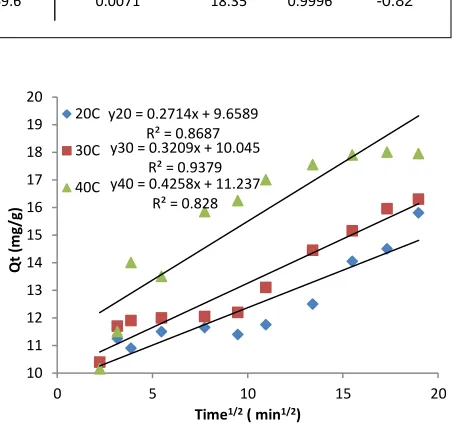
where kid, the intra-particle diffusion rate constant (mg/g min0.5) which can be evaluated from the slope of the linear plot of Qt versus t0.5 and C represents the thickness of the boundary layer [2]. The intraparticle diffusion plot is shown in fig. 5.
Fig. 5. Intraparticle diffusion model plots for adsorption of CV on WNS
The curves are not very linear as an overall, and show multi-linear curves and the intercepts are greater than zero (the lines do not pass through the origin). The deviation of straight lines from the origin indicates that the intraparticle diffusion is involved in the adsorption process but not only the controlling step [3].
The equilibrium adsorption capacity was found to be affected by temperature. The activation energy was found (Fig. 6) from the plot of Arrhenius equation:
y20 = -0.0017x + 0.8448 R² = 0.8812 y30 = -0.00204x + 0.83654
R² = 0.97189 y40 = -0.0045x + 0.7428
R² = 0.9369 -1.2
-1 -0.8 -0.6 -0.4 -0.2 0 0.2 0.4 0.6 0.8
0 100 200 300 400
log(
Qe
-Q
t
)
Time (min)
20C
30C
40C
y20 = 0.0652x + 1.0624 R² = 0.9843 y30 = 0.06097x + 0.89464
R² = 0.99227 y40 = 0.0545x + 0.4166
R² = 0.9996
0 5 10 15 20 25 30
0 100 200 300 400
t/Q
t
Time (min)
20C
30C
40C
y20 = 0.2714x + 9.6589 R² = 0.8687 y30 = 0.3209x + 10.045
R² = 0.9379 y40 = 0.4258x + 11.237
R² = 0.828
10 11 12 13 14 15 16 17 18 19 20
0 5 10 15 20
Qt
(m
g/g
)
Time1/2 ( min1/2)
20C
30C
40C
TABLE I
KINETIC PARAMETERS OF THE ADSORPTION OF CV ONTO WNS
Peseudo First Order kinetics Pseudo Second Order Kinetcis
Temp. oC Qe exp.
(mg/g)
k1
(min-1)
Qe calc.
(mg/g) R
2 %
Deviation in Qe
k2
(g. mg-1.min)
Qe calc.
(mg/g) R
2 %
Deviation in Qe
20 17 0.0017 6.99 0.88 58.8 0.004 15.34 0.9843 9.7
30 17.5 0.00204 6.86 0.972 61.8 0.0042 16.402 0.992 6.27
where Ea is the activation energy, k2 is the pseudo second-order rate constant for adsorption, A is the temperature-independent Arrhenius factor, R is the gas constant and T is the solution temperature (K)
Fig. 6. Arrhenius plot for the adsorption of CV on WNS
The activation energy was found to be 21.81 kJ.mol-1. Generally, low activation energies (5–40 kJ/mol) are characteristic of physical adsorption and high activation energies (40–800 kJ/mol) suggest more likely chemisorption process. According to the present result of activation energy, the possible adsorption mechanism is a physical adsorption.
3.4.ISOTHERM STUDIES
The adsorption isotherm indicates how the adsorption molecules are distributed between the liquid phase and the solid phase when the adsorption process is at equilibrium. Adsorption isotherms parameters obtained from the different models provide important information on the surface properties of the adsorbent and its affinity to the adsorbate. The equilibrium adsorption of CV onto WNS was studied as a function of CV concentration (100–750 mg/L).
The amount of dye adsorbed (Qe), plotted against the equilibrium concentration (Ce) for CV in Fig. 6. The shape of the isotherm indicated L-behavior according to Giles classification which confirms the high affinity of the CV molecules toward WNS powder.
Fig. 6. Adsorption isotherm of CV onto WNS powder
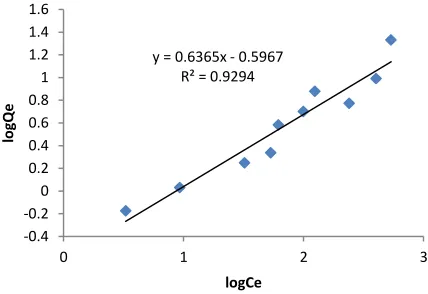
Freundlich and Langmuir models are commonly used to describe adsorption isotherms, and their constants provide significant parameters for predicting adsorption capacities [
4
]. In figures 7 and 8, Langmuir and Freundlich isotherms are presented.Fig. 7 Langmuir adsorption isotherm for adsorption of CV on WNS powder
Fig. 8 Freundlich adsorption isotherm of CV on WNS powder
y = -2606.2x + 3.2935 R² = 0.7982
-5.7 -5.6 -5.5 -5.4 -5.3 -5.2 -5.1 -5 -4.9
0.0031 0.0032 0.0033 0.0034 0.0035
Ln k
2
1/T (K-1)
0 5 10 15 20 25
0 200 400 600
Qe
(m
g/g
)
Ce (mg/L)
y = 0.0441x + 14.678 R² = 0.4494
0 5 10 15 20 25 30 35 40 45
0 200 400 600
C
e
/Q
e
Ce
y = 0.6365x - 0.5967 R² = 0.9294
-0.4 -0.2 0 0.2 0.4 0.6 0.8 1 1.2 1.4 1.6
0 1 2 3
logQ
e
The calculated values of Langmuir and Freundlich constants are given in Table II.
TABLE II
LANGMUIR AND FREUNDLICH ADSORPTION PARAMETERS Langmuir Isotherm Freundlich Isotherm
Qm (mg/g) KL (L/mg) R2 n KF (mg/g) R2
22.67 0.00301 0.45 1.57 0.253 0.929
The isotherm data were found to be best fit to Freundlich isotherm model. The maximum monolayer sorption capacity Qm, determined with the Langmuir isotherm, was 22.67 mg/g. Freundlich isotherm parameter n is an indication of the type of adsorption, if n is below unity, it implies that the adsorption process is chemical, and if n is above unity, it is a physical adsorption process4. Table 2 shows that n value at equilibrium was 1.57, indicating the process is more likely to be physical adsorption which is consistent with the kinetic study results. Physical adsorption of adsorbate on adsorbents are more easily in regeneration process after adsorption.
4.CONCLUSION
This study shows that WNS, an agro-waste material, can be used as a cheap adsorbent for removal of CV (a cationic dye) from aqueous solutions. The study shows that pH has a considerable effect of the efficiency of adsorption, the adsorption capacity at pHs above 7 is nearly twice the adsorption capacity at pHs lower than 6.
Kinetic studies reveals that the sorption might follow the pseudo second-order kinetic model as can be seen by the comparison of the correlations coefficients and the % deviation of Qcalc. from Qexp.
R
EFERENCES[1] Michael T. and David B., An Introduction to Wastewater Treatment, (2011), P. 8-9, ISBN 978-87-7681-843-2
[2] Puthiya V. N., Rajan G., Kinetic analysis of crystal violet adsorption on to bottom ash, 36, (2012), Turkish J. Eng. Env. Sci, p- 249 – 262.
[3] Klaus H., Industrial Dyes “Chemistry, Prosperities, Applications” (2003), ISBN 3-527-30426-6, WILEYVCH, P.53-576
[4] Mi-Hwa B., Christianah O. I., Se-Jin O., Dong-Su K., Removal of Malachite Green from aqueous solution using degreased coffee bean, 176, (2010), Journal of Hazardous Materials, p 820-828 [5] Zhang Q. and Patrick H. B., Distribution and transport of foliar
applied zinc in pistachio, 124, (1999), J. of American Society for Horticultural Science, (4), p. 433-436.
[6] Mohamed A., Wayne E. M., Abdo A. H., Ipek G. and Ramu M. R., 79, (2004), J ChemTechnol Biotechnol, 1092–1097.
[7] Abechi S. E., Gimba C. E., Uziaru A. & I. G. Ndukwe I. G., Science World Journal, 1, (2006), (1) P. 33-35.
[8] Sumanjtt, Tejinder Pal Singh Walia and Ishu Kansal, J. Surface Sci. Technol., 24, (2008), No. 3-4, pp. 179-193.
[9] Zabihia M., Haghighi A. A., Ahmadpourb A., Journal of Hazardous Materials 174 (2010) 251–256
[10] Radka W., Eva P. and Peter F., Removal of lead from aqueous solution by walnut shell, Journal of Environmental Chemistry and Ecotoxicology, 5, (2013), (6), pp. 159-167
[11] Bouna, L., Rhouta, B., Amjoud, M., Jada, A., Maury, F., Daoudi, L., Senocq, F., Correlation between eletrokinetic mobility and ionic dyes adsorption of Moroccan stevensite. Appl. Clay Sci. 48, (2010), (3), 527–530
[12] Nainasivayam C., Kadirvelu K., Coirpith, An agricultural waste by-product for the treatment of dying wastewater, Bioresour. Technol. 48 (1994) 79–81.
[13] Yuh-Shan H., Comment on An evaluation of copper biosorption by a brown seaweed under optimized condition's by Antunes, W.M., Luna A. S., Henriques C. A., and da Costa A. C., Electronic Journal of Biotechnology, (2004).
[14] Ho YS, McKay G., Pseudo-second order model for sorption processes, 34, (1999), Process Biochem, Volume 34, P 451. [15] Yesim S., Yucel A., Mass transfer and equilibrium studies for the
sorption of chromium ions onto chitin, 36, (2000), Process Biochemistry, P 157-173.
[16] Furusawa, T., Smith, J.M., Intraparticle mass transport in slurries by dynamic adsorption studies. 20, (1974), J. AIChe (1), 88–93. [17] Khalid E., Abderrahmane L., Abdellah A., Mohamed A., Removal
of methyl violet from aqueous solution using a stevensite-rich clay from Morocco, 54, (2011), Applied Clay Science, p 90–96. [18] Shaw D. J., Introduction to Colloid and Surface Chemistry,