e-ISSN: 2278-7461, p-ISSN: 2319-6491
Volume 7, Issue 8 [August 2018] PP: 15-21
Methanol dehydration reaction using mesoporosity modified
zeolites
Meifang Qin, Yin Liu, Ricardo Orench and Howard L. Fang*
Primus Green Energy, Inc.
Corresponding author:Meifang Qin
ABSTRACT:
Fresh and mesoporosity modified zeolite samples were evaluated for dimethyl ether (DME) conversion from methanol dehydration. The reactivity of DME conversion is zeolite type specific and the corresponding activation energy is sensitive to alkali-ion coverage on the Brønsted acid sites. One major benefit in mesoporosity modification for zeolite comes from diffusion improvement of the transport behavior of reactants and products that significantly affects the Arrhenius prefactor in dehydration rate. The diffusion benefit of mesopore modification is larger for H-form zeolite than the corresponding alkali-ion capped samples. In terms of R1-R2 combination, mesopore modified H:ZSM-5 or partly alkali-ion capped USY samples can be used as potent candidates with minimum contribution in hydrocarbon formation.--- --- Date of Submission: 17-08-2018 Date of acceptance: 31-08-2018 ---
---I.
INTRODUCTIONThe use of zeolite as dehydration catalyst for the methanol conversion into dimethyl ether (DME), 2CH3OH CH3OCH3 + H2O, has been the topic of many investigations.1-5 The main purpose is focused on a direct DME synthesis in R1-R2 combination during methanol-to-gasoline (MTG) process where R1 and R2 are reactors for MeOH and DME generation respectively. One major benefit using R1-R2 combination is the reduction of the relatively high operation pressure required for methanol synthesis without any sacrifice in gasoline product selectivity derived by a rapid shift of MeOH into DME. When H:ZSM-5 is used as dehydration catalyst, the reaction centers are located on both Lewis acid (LAS) and BrØnsted acid sites (BAS) and BAS show much higher acid strength than LAS. Besides acidity, many other factors affect dehydration efficacy including surface adsorption efficiency of water and zeolite morphological structure. Different kinetic pathways and adsorption parameters involving MeOH, DME and water on acid sites have been well documented in literatures.6-8 Unlike ɤ-Al2O3, the number of adsorbed molecules of MeOH and water on each BrØnsted site can be significantly larger than one.9 Due to the high adsorption capability of multiple MeOH molecules on each acid site, the denominator term in the kinetic rate of Langmuir-Hinshelwood model can be represented as a first-order term of (1+ kMeOHPMeOH + kH2OPH2O) where kMeOH and kH2O are adsorption coefficients of MeOH and H2O on catalyst surface with their corresponding partial pressures. This is different from the Bercic model1 where a fourth-order term is used in the denominator for ɤ-Al2O3 catalyst due to the fact that four sites are required for the dehydration pathway.
of MeOH species. Another major constraint on microporous material is the diffusion resistance experienced by bulky reactant molecules which lead to inefficient utilization of the internal catalytic surface. The enlargement of mesoporosity in zeolite as hierarchical pathways will eliminate such exclusion detriment. Although zeolite catalyst is naturally prone for hydrocarbon synthesis, the hydrocarbon formation may compete with DME formation generating coke precursors in microchannels. Opening mesopores will minimize certain accumulation around the entrance area of microchannels. The easiness of diffusion within the enlarged pores will bring benefits not only in reactivity enhancement but also in minimizing the residence time required for the growth of coke precursors so that the lifetime of R2 catalyst can be extended.
II.
EXPERIMENTALIn this short note, two sets of zeolite samples were compared here with mesopore modification: the ion capped zeolite samples with Na+ or NH4+ coverage on the Brønsted acid sites and their corresponding H-form samples with proper calcination procedure. The DME conversion was carried by a tubular high-pressure fixed bed microreactor operated under the following conditions: 5 g catalyst in powder form, liquid methanol injection (0.25 ml/min) to reach SV~2.4 hr-1, 800 sccm N2 carrier gas. In order to simulate the water rich condition in R1-R2 combination, the corresponding amount of water (normally in 15~20%wt) was mixed in the methanol solution of liquid injection. Since the operation pressure would be reduced under R1-R2 combination, the system pressure for all microreactor measurements was maintained at relatively low 350 psi. The reactor temperature was scanned from 170°C to 270°C. The DME product and the reaction by-products including light hydrocarbons were detected by on-line GC (Agilent 0789A). Under the consideration of the single-loop configuration in syngas-to-gasoline process where the remaining gas from R4 is recycled back into R1, the partial pressure of hydrogen in the gas stream may show detrimental impact to gasoline product quality. Many side reactions of hydrogenation and hydrocracking in R3 will affect the efficacy of hydride transfer process of the zeolite hydrocarbon synthesis chemistry. Since hydrogen gas has nothing to do with methanol dehydration, H2 is not considered as one necessary ingredient in microreactor measurement.
As most Brønsted acid sites are covered by non-proton cations, the dehydration occurs mainly on Lewis acid sites of zeolite. Otherwise, both LAS and BAS will participate in DME formation and the Brønsted sites play major roles due to their higher acidity. The mesoporosity enlargement is carried by a standard desilication procedure where some silicon atoms are removed from zeolite framework to form soluble SiO3-2 and leave Si-hydroxyl-pools within the structure when the zeolite sample is soaked in alkali solution (normally 0.2N NaOH solution at 80°C for one hour). The degree of enlargement depends upon the severity of desilication including the concentration of NaOH as well as the soaking time and temperature. The tendency of Si-removal is location dependent. Silicon atoms sitting in the locations away from the Brønsted acid sites are more reactive with NaOH; further away from Al sites, easier to be dissolved by NaOH. Desilication also depends upon the acidity of zeolite. The samples with lower Si/Al ratio have higher tendency to react with the alkali solution. In general, the overall framework of zeolite crystal is intact upon the desilication process. The level of desilication can be easily identified by surface IR measurement. After desilication, the silano hydroxyl (Si-OH) band at 3740 cm-1 in the alkali-treated sample is increased with respect to the Brønsted Al-hydroxyl band at 3615 cm-1 suggesting a relative enhancement of Si-OH moiety. IR intensities for both Lewis acid (1450 cm-1) and Brønsted acid (1540 cm-1) bands are also increased. The increasing rate for Lewis site is faster than the Brønsted sites. As more Si atoms are removed, larger hydroxyl pools will be built and their locations will be moved closer to the originally unperturbed Brønsted site. This is the reason the νAl-OH intensity of the Brønsted site becomes enhanced. Proper ion-exchange procedure was applied to remove Na+ along the acid sites and converted the zeolite samples into NH4+-form. Additional calcination at high temperature will convert the NH4+-form into the H-form.
III.
RESULTS AND DISCUSSION
Unlike ɤ-Al2O3 where each Lewis acid site deals with one MeOH molecule only, several MeOH molecules can be simultaneously accommodated at each Brønsted acid site.5 Based on the model by Blaszkowski and Santen,3 the dehydration of two simultaneously adsorbed MeOH molecules can be carried by the following reaction:
2CH3OH + HX (CH3OH+ CH3- OH2+X-) (CH3)2O + H2O + HX
where HX represents the infrastructure of zeolite Brønsted acid site. The light-off temperature derived from temperature dependence in MeOH dehydration reflects the types of acid sites and the slope (DME conversion vs. temperature) reflects the magnitude of the acid strength. Certain improvement is expected for a mesoporosity modified zeolite sample.
promote the operation temperature even higher and a decaying trend of MeOH equilibrium curve could be present.
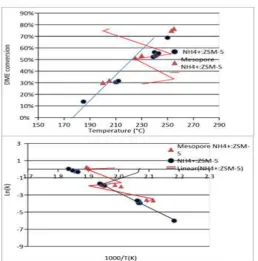
As the catalyst is shifted to alkali-ion capped ZSM-5 (SAR=80), the light-off temperature extrapolated from the function (DME conversion vs. temperature) near zero conversion is significantly decreased to 170°C. For H:ZSM-5, this value is further decreased to 135°C. Figure 1 shows a comparison of the temperature dependence of the dehydration reactivity between the standard NH4+:ZSM-5 and the mesopore enlarged NH4+:ZSM-5. The NH4+:ZSM-5 is obtained from Zeolyst (CBV8014 powder without γ-alumina binder) and the mesopore-enlarged NH4
+
:ZSM-5 is derived from NaOH desilication process with a proper ion-exchange procedure of NH4OH solution afterwards. A similar comparison between the standard H:ZSM-5 (SAR=80) and the mesopore modified H:ZSM-5 is shown in Figure 2. The activation energy can be readily derived from the slope of van Hoff plot of ln(k) vs. 1000/T(°K) in the Arrhenius equation as shown in the bottom parts of Figures 1&2 where k is the reaction rate of DME formation, k=[DME][H2O]/[MeOH]2. In order to establish a consistent quantitative comparison of all data in light-off temperatures, we set an algorithm with the temperature at 30 % conversion of DME for all zeolite samples. Reaction data with high conversion values are not representative caused by equilibrium interference.
Based on Figure 1, the light-off temperature of NH4 +
:ZSM-5 falls to a value around 210°C and the conversion becomes more than 50 % at 230°C. With the same algorithm, the light-off temperatures for the mesopore and non-mesopore modified NH4+:ZSM-5 are located at 205°C and 210°C. It is interesting to note that the temperature sensitivity of DME conversion of the mesopore modified NH4+:ZSM-5 catalyst is very similar to the fresh one of NH4
+
:ZSM-5 itself. As far as the Brønsted acid sites are capped by alkali cations, the activation energies between the mesopore and non-mesopore enlarged zeolite samples are similar (~35 kJ/mol) and the reaction rate is increased by a factor of 2 through diffusion improvement. Apparently the mesoporosity modification of NH4+:ZSM-5 does not generate additional Lewis acid sites in zeolite. Obviously the zeolite light-off temperature for dehydration is morphologically specific.
In terms of H:ZSM-5, the dehydration occurs not only on Lewis acid sites but also on Brønsted acid sites which are significantly higher in acid strength than LAS. The Na+-form of the zeolite sample after desilication has been ion-exchanged with NH4OH followed by proper calcination. H:ZSM-5 catalyst is known to be prone to hydrocarbon synthesis and the hydrocarbon formation will compete with dehydration, particularly under MeOH rich condition. For H:ZSM-5 samples with medium SAR value (such as SAR~80), the hydrocarbon formation normally occurs at temperature higher than 210°C. As far as the Brønsted acid sites of H:ZSM-5 are covered by alkali cations Na+ or NH4+, little hydrocarbon can be detected at T<250°C unless certain NH4
+
cations are gradually decomposed under high temperature. When zeolite sample is in the H-form, the acid strength of the Lewis acid sites will be significantly perturbed by the nearby Brønsted structure which in turns lowers the light-off temperature in DME formation. This is well demonstrated in Figure 2 where the light-off temperature is shifted to 160°C which is significantly lower than the 210°C for alkali ion-capped ZSM-5. Besides the lowering of the light-off temperature, the equilibrium temperature for the dehydration reactivity to reach saturation is also lowered at 220°C. After reaching equilibrium, the DME conversion at temperatures higher than saturation begins to decrease due to the onset of hydrocarbon formation which competes with the dehydration reaction in zeolite. Such decreasing trend is significantly shifted (more than 20°C) to lower temperature for mesoporosity enlarged H:ZSM-5. The slope of the temperature dependence of DME conversion begins to show difference between the mesopore and non-mesopore modified H:ZSM-5 samples.
The activation energies for both the NH4+:ZSM-5 and the mesopore modified NH4+:ZSM-5 samples are essentially identical (around 36 kJ/mol) which are significantly lower (x1/3) than the experimental value of 100~117 kJ/mol for ɤ-Al2O3.
1
It is interesting to note that there is no significant difference in activation energies between mesopore and non-mesopore modified ion-capped ZSM-5 catalysts (37.4 kJ/mol for mesopore NH4+:ZSM-5 and 34.5 kJ/mol for non-mesopore NH4+:ZSM-5). The DME rate increase of the mesopore modified NH4+:ZSM-5 must be attributed to the diffusion improvement for species travelling to and from microchannels introduced as difference in prefactors of Arrhenius equation. For H:ZSM-5, noticeable differences in activation energy begin to show in the comparison between the mesopore and non-mesopore samples. There are three indicators affecting DME conversion for zeolite catalysts: the light-off temperature (at 30 % conversion) or the equilibrium temperature (at the maximum saturation of DME conversion), the activation energy and the hydrocarbon formation amount (the total sum of C1-C4 components) under equilibrium temperature. All these parameters are listed in Table 1 for comparison.
Figure 1. (Top) The temperature dependence of DME formation rate of NH4+-capped ZSM-5 (SAR 80) and (bottom) the Arrhenius plot of ln(k) vs. 1000/T(°K) between mesopore and non-mesopore modified samples.
The major difference between Figures 1 and 2 is the magnitude shift of ln(k) between the non-mesopore and non-mesopore modified zeolite samples. For NH4
+
ion capped zeolites, the ln(k) shift is less than one logarithm unit (~x2.3) while the shift is increased to more than three units (~x9) for H:ZSM-5. In other words, the diffusion benefit in H-form of H:ZSM-5 is at least three times better than the alkali-ion capped form of NH4+:ZSM-5. The adsorption capability of MeOH on zeolite surface sites is obviously acid strength dependent. When a less acidic H:ZSM-5 with SAR=180 is used, the light-off temperature is shifted to 180°C (as shown in Table 1). Due to the high acid strength, the adsorption capability of MeOH on Brønsted acid sites in H:ZSM-5 should be much stronger than the one with alkali-ion capped NH4+:ZSM-5. However the desorption capability for the removal of H2O from the active site will follow an opposite trend with certain compensation of the stabilization energy.
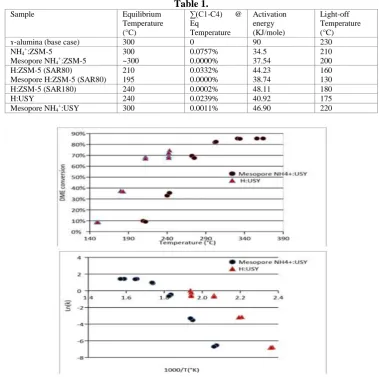
We have also compared the Y-zeolite samples between H:USY and the mesopore modified NH4+:USY (a 12-membered ring Faujasite) for DME conversion. Due to the stability issue, Y-zeolites always contain more alkali cations. The sample was prepared with Zeolyst H:USY powder (CBV720 with SAR=30) using proper desilication and multiple ion-exchange procedures with NH4OH solution where the NH4+ ion is kept to cover most Brøsted acid sites without high temperature decomposition. The mesopore modified NH4+:USY is compared to the H-form of H:USY. Under the similar experimental conditions, the temperature dependence of DME formation and the activation energy related to the Arrhenius equation are plotted in Figure 3. As far as all Brønsted acid sites in ZSM-5 are covered by NH4
+
, most samples show little variations in the activation energies of DME formation as well as the light-off temperature (205°C for mesopore NH4+:ZSM-5 and 210°C for non-mesopore NH4+:ZSM-5). Mesoporosity brings little diffusion benefit for alkali-capped zeolite samples. Based on this argument, the light-off temperature of NH4+-capped USY doesn’t bring significant benefit to dehydration. The light-off temperature is shifted to 220°C and the level-off equilibrium temperature becomes much higher than 310°C while the activation energy is found to be the largest (>46 kJ/mol) among all mesopore modified zeolite samples studied here. When the NH4+-ions are removed and converted into the H-form, significant changes in parameters are observed; similar to the
Figure 2. (Top) The temperature dependence of DME formation on H:ZSM-5 (SAR 80) and (bottom) the Arrhenius plot of ln(k) vs. 1000/T(°K) between mesopore and non-mesopore modified samples.
Table 1.
Sample Equilibrium
Temperature (°C)
∑(C1-C4) @ Eq
Temperature
Activation energy (KJ/mole)
Light-off Temperature (°C)
ɤ-alumina (base case) 300 0 90 230
NH4+:ZSM-5
Mesopore NH4+:ZSM-5
300 ~300
0.0757% 0.0000%
34.5 37.54
210 200 H:ZSM-5 (SAR80)
Mesopore H:ZSM-5 (SAR80) 210 195
0.0332% 0.0000%
44.23 38.74
160 130
H:ZSM-5 (SAR180) 240 0.0002% 48.11 180
H:USY 240 0.0239% 40.92 175
Mesopore NH4+:USY 300 0.0011% 46.90 220
As mentioned before, hydrocarbons can also be generated when excessive MeOH is passing through H:ZSM-5 (SAR 80) at T>260°C. For mesopre modified H:ZSM-5 (SAR 80), the formation temperature for trace amount of CH4 to appear in GC is shifted to 240°C. The CH4 formation is derived from MeOH decomposition on acid site. As acid sites are covered by alkali cations, the CH4 light-off temperatures are shifted to higher temperatures, 300°C and 280°C for NH4+:ZSM-5 and the mesopore modified NH4+:ZSM-5. Similar trend is observed for USY zeolite. As Brønsted acid sites are covered by NH4+, the initial temperature for CH4 to appear in GC spectrum is shifted to 320°C. We can conclude that BrØnsted acid sites are required for hydrocarbon formation and the mesoporosity enlargement for H-form zeolite will lower the initial temperature for hydrocarbon formation. The initial temperature for the appearance of CH4 in mesopore modified NH4+:USY becomes significantly higher than 320°C. The reason for incompatibility of alkali-ion capped USY in hydrocarbon generation at low-temperature can be attributed to its large morphological configuration where the adsorbed MeOH cannot easily decompose to release CH4.11,12
The easiness of hydrocarbon formation in zeolite may bring detrimental effect to R1-R2 combination under T>250°C. As the MeOH synthesis temperature falls to the low side of hydrocarbon formation temperature, the chance of coking material generation will be accelerated that may become the main cause of deactivation of zeolite resulting in blockage of the active sites or the entrance areas reaching micochannels. There are two types of coking materials in zeolite hydrocarbon synthesis: a fast buildup of sticky oxygenate materials (soft coke) masking Brønsted acid sites and a slow growth of graphitic type coke with large aromatic rings (hard coke) masking the entrance areas of microchannels. The soft-hard nature comes from typical thermogravitational analysis (TGA) where two separated bands (240~380°C and 390~640°C) are normally observed when a slowly ramping up temperature is applied.12,13 The low-temperature material contains significant portion of oxygenates rich of ether (C-O-C) linkage while the high-temperature material contains aromatic moiety similar to durene structure (durene is a representative of methyl substituted single ring aromatic under the dual loop fashion of zeolite chemistry). Under T<300°C, these two types of coking materials were collected in different areas and analyzed by differential IR; a white flake deposit in the outlet area of the reactor and the sticky material over the surface of the aged catalyst which can be extracted by CH2Cl2. Figure 4 shows the differential IR of the extraction solution which is obtained by subtraction of the spectrum of the neat CH2Cl2 from the spectrum of the extraction solution. The buildups in the spectrum reflect composition changes caused by extractable materials within the polar CH2Cl2. As shown in Figure 4, all sharp durene bands around 1003, 1027 and 1202 cm-1 (attributed to the methyl-substituted ring modes) can be easily identified to match the standard durene solution. Besides aromatic ring modes, two relatively broad bands located are seen at 1010 and 1090 cm-1 which can be assigned to the C-O stretchings of ether linkages (C-O-C). The presence of trace H2 detected in the gas stream suggests the formation mechanism is through formaldehyde pathway which will be further oligomerized into cyclic ethers. These C-O linkages cannot be assigned to alcohols because the corresponding high frequency OH-stretchings are totally missing in the spectrum, either the broad H-bonded band around 3450 cm-1 or the sharp free OH’s at 3600 cm-1
.
Figure 4. Differential IR spectra in the C-O stretching and ring mode regions
REFERENCES
[1]. G. Bercic and J. Levec, “Intrinsic and global reaction rate of methanol dehydration over ɤ-Al2O3 pellets”, Ind. Eng. Chem. Res.
1992, 31, 1035-1040
[2]. M. Migliori, A. Aloise, E. Catizone and G. Giordano, “Kinetic analysis of methanol to dimethyl ether reaction over H:MFI catalyst”, Ind. Eng. Chem. Res. 2014, 53, 14885-14891
[3]. S. R. Blaszkowski and R. A. van Santen, “Theoretical study of the mechanism of surface methoxy and dimethyl ether formation from methanol catalyzed by zeolitic protons”, J. Phys. Chem. B 1997, 101, 2292-2305
[4]. V. Vishwanathan, K. Jun, J. Kim and H. Roh, “Vapor phase dehydration of crude methanol to dimethyl ether over Na-modified H:ZSM-5 catalysts”, Appl. Catal. A 2004, 276, 251-255
[5]. K. Ha, Y. Lee, J.W. Bae, Y. W. Kim, M. H. Woo, H. Kim, M. Park and K. Jun, “New reaction pathways and kinetic parameter estimation for methanol dehydration over ZSM-5 catalysts”, Appl. Catal. A 2011, 395, 95-106
[6]. A. C. Sofianos and M. S. Scurrell, “Conversion of synthesis gas to dimethyl ether over bifunctional catalytic systems”, Ind. Eng. Chem. Res. 1991,30, 2372-2378
[7]. M. Jayamurthy and S. Vasudevan, “Methanol-to-gasoline conversion over ZSM-5, a temperature programmed surface reaction study”, Catalysis Letters 1996, 36, 111-114
[8]. A. Ison and R. J. Gorte, “The adsorption of methanol and water on H:ZSM-5”, Journal of Catalysis 1984, 89, 150-158
[9]. K. L. Ng, D. Chadwick and B. A. Toseland, “Kinetics and modelling of dimethyl ether synthesis from synthesis gas”, Chem. Eng. Science 1999, 54, 3587-3592
[10]. G. Jia, Y. Tan and Y. Han, “A comparative study on the thermodynamics of dimethyl ether systems from CO hydrogenation and CO2 hydrogenation”, Ind. Eng. Chem. Res. 2006, 45, 1152-1159
[11]. “Mesoporous Zeolites: Preparation, Characterization and Applications”, edited by J. Garcia-Martinez and Kumhao Li, 2015, Wiley-VCH Verlag GmbH & Co. KGaA
[13]. M. Bjørgen, F. Joensen, M. Spangsberg Holm, U. Olsbye, K. Lillerud and S. Svelle, “Methanol to gasoline over zeolite H:ZSM-5: Improved catalyst performance by treatment with NaOH”, Appl. Catal. A 2008, 345, 43-50
[14]. X. Sun, S. Mueller, Y. Liu, H. Shi, G. L. Haller, M. Sanchez-Sanchez, A. C. van Veen and J. A. Lercher, “On reaction pathways in the conversion of methanol to hydrocarbons on H:ZSM-5”, Journal of Catalysis 2014, 317, 185-197
[15]. U. Olsbye, S. Svelle, K. P. Lillerud, Z. H. Wei, Y. Y. Chen, J. F. Li, J. G. Wang and W. B. Fan, “The formation and degradation of active species during methanol conversion over protonated zeotype catalysts”, Chem. Soc. Rev. 2015, 44, 7155-7176