LEARNING OF SHAPE MODELS FROM EXEMPLARS OF BIOLOGICAL OBJECTS IN IMAGES
Institute of Computer Vision and applied Arno
A R T I C L E I N F O
INTRODUCTION
The analysis of shapes and shape variation is of great importance in a wide range of disciplines. Initially in 1917 D’Arcy Thompson [1] studied the field of geometrical shape analysis from a biological point of view. Intuitively it is especially interesting for biologists since shape is one of the most concise features of an object class and may change over time due to growth or evolution. The problems of shape spaces and distances have been intensively studied by Kendall
Bookstein [3] in a statistical theory of shape. We follow Kendall who defined shape as all the geometrical information that remains when location, scale, and rotat
filtered out from the object. Sometimes it is also interesting to retain the size of the objects, but we will not consider this case here. In most applications this invariance is not given a thus it is indispensable to transform the acquired shapes into a common reference frame. Different terms are equivalently used for this operation, i.e. superimposition, registration, and alignment. Only if the shapes are aligned, it will be possible to compare them to describe deformations or to define a measure distance between them.
Bookstein geometrically analyzed shapes and measured their change in many biological applications, e.g. bee wings, skulls, and human schizophrenic brains [4]. To give an example, with his morphometric studies he found out that the region
International Journal of Current Advanced Research
ISSN: O: 2319-6475, ISSN: P: 2319-6505,
Available Online at www.journalijcar.org
Volume 8; Issue 03 (C); March 2019; Page No.
DOI: http://dx.doi.org/10.24327/ijcar.2019
Copyright©2019 Petra Perner. This is an open access article distributed under the Creative Commons Attribution License, which permits unrestricted use, distribution, and reproduction in any medium, provided the original work is properly cited.
Article History:
Received 13th December, 2018 Received in revised form 11th January, 2019
Accepted 8th February, 2019 Published online 28th March, 2019
Key words:
Shape Alignment, Correspondence Problem, Shape Acquisition
*Corresponding author: Petra Perner
Institute of Computer Vision and applied Computer Sciences, IBaI, Arno-Nitzsche-Str. 45,04277 Leipzig, Germany
LEARNING OF SHAPE MODELS FROM EXEMPLARS OF BIOLOGICAL OBJECTS IN IMAGES
Petra Perner
Institute of Computer Vision and applied Computer Sciences, IBaI, Arno-Nitzsche-Str. 45,04277 Leipzig, Germany
A B S T R A C T
Generalized shape models of objects are necessary to match and identify an object in an image. To acquire these kinds of models’ special methods are necessary that allow to learn the similarity pair-wise similarity between shapes. They mainly concern is the establishment of point correspondences between two shapes and the detection of outlier. Known algorithm assume that the aligned shapes are quite similar in a way. But special problems arise if we must align shapes that are very different, for example aligning concave to convex shapes. In such cases it is indispensable to consider the order of the point-sets and to enforce legal sets of correspondences, otherwise the calculated distances are incorrect. We present our novel shape alignment algorithm which can also handle such cases. The algorithm establishes symmetric and legal one
between arbitrary shapes, represented as ordered sets of 2D measure which runs between 0 and 1.
The analysis of shapes and shape variation is of great importance in a wide range of disciplines. Initially in 1917 studied the field of geometrical shape analysis from a biological point of view. Intuitively it is especially interesting for biologists since shape is one of the most concise features of an object class and may change over The problems of shape spaces and distances have been intensively studied by Kendall [2] and [3] in a statistical theory of shape. We follow who defined shape as all the geometrical information that remains when location, scale, and rotational effects are filtered out from the object. Sometimes it is also interesting to retain the size of the objects, but we will not consider this case here. In most applications this invariance is not given a-priori, he acquired shapes into a common reference frame. Different terms are equivalently used for this operation, i.e. superimposition, registration, and alignment. Only if the shapes are aligned, it will be possible to o define a measure
Bookstein geometrically analyzed shapes and measured their change in many biological applications, e.g. bee wings, skulls, [4]. To give an example, with ound out that the region
connecting the two hemispheres is narrower in schizophrenic brains as in normal brains. In digital image processing the statistical analysis of shape is a fundamental task in object recognition and classification. It concerns applications in a wide range of fields, e.g. [5].
The paper is organized as follows. We describe the p
2D-shape alignment in Section 2. Related work is described in Sect.0. The image material used for this study is presented in Sect.0. We describe how image information can be extracted from an image and mapped into a case description in Sect. The algorithm for pair-wise alignment of the shapes and calculation of distances is proposedin Sect
given results for our algorithm. Finally, we give conclusions in Sect.8.
The Problem of Alignment of 2
Consider two shape instances
P
sets piR2, i1,2,,NPrespectively. The basic task of aligning two shapes consists of transforming one of them (say
optimal way the other one (say Fig 1).
International Journal of Current Advanced Research
6505, Impact Factor: 6.614
www.journalijcar.org
; Page No.17729-17737
//dx.doi.org/10.24327/ijcar.2019.17737.3373
This is an open access article distributed under the Creative Commons Attribution License, which permits ribution, and reproduction in any medium, provided the original work is properly cited.
Institute of Computer Vision and applied Computer Sciences, Str. 45,04277 Leipzig, Germany
LEARNING OF SHAPE MODELS FROM EXEMPLARS OF BIOLOGICAL OBJECTS IN IMAGES
Computer Sciences, IBaI,
Generalized shape models of objects are necessary to match and identify an object in an methods are necessary that allow to learn wise similarity between shapes. They mainly concern is the establishment of point correspondences between two shapes and the detection of outlier. are quite similar in a way. But special problems arise if we must align shapes that are very different, for example aligning concave to convex shapes. In such cases it is indispensable to consider the order of the rrespondences, otherwise the calculated distances are incorrect. We present our novel shape alignment algorithm which can also handle such cases. The algorithm establishes symmetric and legal one-to-one point correspondences sented as ordered sets of 2D-points and returns a distance
connecting the two hemispheres is narrower in schizophrenic n digital image processing the statistical analysis of shape is a fundamental task in object recognition and classification. It concerns applications in a
The paper is organized as follows. We describe the problem of shape alignment in Section 2. Related work is described in . The image material used for this study is presented in . We describe how image information can be extracted from an image and mapped into a case description in Sect.0. wise alignment of the shapes and f distances is proposedin Sect0. In Section 7 are given results for our algorithm. Finally, we give conclusions in
The Problem of Alignment of 2-D Shapes
P
and O defined by the and okR2, k1,2,,NO respectively. The basic task of aligning two shapes consists of transforming one of them (sayP
) so that it fits in some optimal way the other one (say O) (seeResearch Article
Fig 1 Alignment of two shapes instances with superimposition and similarity transformation
Generally the shape instance P
pi is said to be aligned to the shape instance O
ok if a distancethe two shapes cannot be decreased by applyin transformation to
P
. Various alignment approaches are known [6],[7], [8],[9],[10], [11], [12]. They mainly differ in the kind of mapping (i.e. similarity, rigid [13], affine[14]) and the chosen distance measure. A survey of different distance measures used in the field of shape matching can be found in [15].For calculating a distance between two shape instances the knowledge of corresponding points is required. If the shapes are defined by sets of landmarks [16],[17] the knowledge of point correspondences is implicit. However, at the beginning of many applications this condition is not hold and often it is hard or even impossible to assign landmarks to the acquired shapes. Then it is necessary to automaticall
correspondences between the points of two aligned shapes and O, see
Fig 2.
Fig 2 Aligned shapes with established point correspondences
One of the most essential demands on these approaches is symmetry. Symmetry means obtaining the same correspondences when mapping instance
P
and vise versa instance O to instance
P
. This requirement is often bound up with the condition to establish one correspondences. This means a point ok in shape instance has exactly one corresponding point pk in shape instance If we compare point sets with unequal point numbers under the condition of one-to-one mapping, then some points will notsuperimposition and similarity
is said to be aligned to if a distance d
P,O
between the two shapes cannot be decreased by applying a . Various alignment approaches are known [6],[7], [8],[9],[10], [11], [12]. They mainly differ in [13], affine[14]) and re. A survey of different distance measures used in the field of shape matching can be found inFor calculating a distance between two shape instances the knowledge of corresponding points is required. If the shapes [16],[17] the knowledge of point correspondences is implicit. However, at the beginning of many applications this condition is not hold and often it is hard or even impossible to assign landmarks to the acquired shapes. Then it is necessary to automatically determine point correspondences between the points of two aligned shapes
P
established point correspondences
One of the most essential demands on these approaches is symmetry. Symmetry means obtaining the same
P
to instance O . This requirement is often bound up with the condition to establish one-to-one in shape instance O in shape instanceP
. If we compare point sets with unequal point numbers under the one mapping, then some points will nothave a correspondence in the other called outlier.
Special problems arise if we must align shapes that are very different, for example aligning concave to convex shapes. In these cases, it is indispensable to consider the order of the point-sets and to enforce legal sets of correspondences, otherwise the calculated distances are incorrect.
presents our novel algorithm for aligning arbitrary 2D
represented as ordered point-sets. In our work natural shapes are acquired manually from real images.
appear with varying orientation, position, and scale in the image. The shapes are arbitrary and there is nothing special about them. They might have a great natural variation. They also might be very similar or very dissimilar. They e
have concave or convex shapes. The algorithm establishes symmetric and legal one-to
between arbitrary shapes, represented as ordered sets of 2D points and returns a distance measure which runs between and 1.
Related Work
The problems of shape spaces and distances have been intensively studied in a statistical theory of shape. The well known Procrustes distancebetween two point
is defined as the sum of squared dis corresponding points
N
1
i P
P i
PO
R p
O , P
d
where R
is the rotation matrix, centroids of the objectP
andare the standard deviations of the distance of a point to the centroid of the shapes and
correspondences between the point
example shows that theknowledge of correspondences is an important prerequisite for calculation of shape distances. There has been done a lot of work which concerns the problem of automatic finding of point correspondences between two unknown shapes. Hilletal. presented an interesting framework for the determination of point correspondences. First, the algorithm calculates pseudo-landmarks
dimensional polygonal shapes. The polygon approximation is controlled by an automatic calculated threshold to identify a subset of points on each shape. In the next step they establish an initial estimate of correspondences based on t
length of the polygons. Finally, the greedy algorithm is used as an iterative local optimization scheme to modify the correspondences to minimize the distance between both polygons. The complexity of the greedy algorithm is
nlogn
O for sorting the elements and
Brett and Taylor presented the extension of this method to three-dimensional surfaces. However, the algorithm was only applied to groups of objects from the same category. They assume that all acquired shapes are similar and compared them under non-rigid transformation.
Another popular approach in solving the correspondence problem is called Iterative Closest Point
Besl and McKay[18] and further improved in
have a correspondence in the other point set. These points are
Special problems arise if we must align shapes that are very different, for example aligning concave to convex shapes. In these cases, it is indispensable to consider the order of the egal sets of correspondences, otherwise the calculated distances are incorrect. This paper presents our novel algorithm for aligning arbitrary 2D-shapes, sets. In our work natural shapes are acquired manually from real images. The object shapes can appear with varying orientation, position, and scale in the image. The shapes are arbitrary and there is nothing special about them. They might have a great natural variation. They also might be very similar or very dissimilar. They even might have concave or convex shapes. The algorithm establishes to-one point correspondences between arbitrary shapes, represented as ordered sets of 2D-points and returns a distance measure which runs between 0
The problems of shape spaces and distances have been in a statistical theory of shape. The well-known Procrustes distancebetween two point-sets
P
and O is defined as the sum of squared distances between
2O O i
o
, (1)
is the rotation matrix, P and O are the and O respectively, P and O are the standard deviations of the distance of a point to the
PO
N is the number of point correspondences between the point-sets
P
and O. This example shows that theknowledge of correspondences is an important prerequisite for calculation of shape distances.lot of work which concerns the problem of automatic finding of point correspondences between two presented an interesting framework for the determination of point correspondences. First, the landmarks based on a set of two-dimensional polygonal shapes. The polygon approximation is controlled by an automatic calculated threshold to identify a subset of points on each shape. In the next step they establish an initial estimate of correspondences based on the arc-path length of the polygons. Finally, the greedy algorithm is used as an iterative local optimization scheme to modify the correspondences to minimize the distance between both polygons. The complexity of the greedy algorithm is for sorting the elements and O
n for the selection. presented the extension of this method to dimensional surfaces. However, the algorithm was only applied to groups of objects from the same category. They e that all acquired shapes are similar and compared themrigid transformation.
of initial, estimated registrations the ICP automatic converges to the nearest local minimum of a mean squared distance metric. It establishes correspondences by mapping the points of one shape to their closest points on the other shape. In the original version of the ICP the complexity of finding for each point pk in
P
the closest point in the point
NPNO
O in worst case. Marteetal. this complexity by applying a spatial subdivision of the points in the set
used clustering techniques to limit the search space of correspondences for a point pk to points which are located within a defined range around pk. But this can only be done because they assume that the point-sets are already in a proximity, i.e. a reasonably good initial registration state is already given. In general, the ICP is a very simple algorithm which can also be applied to shapes with geometric data of different representations (e.g. point-sets, line segments, curves, surfaces). On the other hand, it is not very robust with respect to noise and outlier. Fitzgibbon replaced the closed
loop of the ICP by the Levenberg-Marquardt algorithm, a non linear optimization scheme. His results showed an increased robustness and a reduction of the dependence of the initial estimated registrations without a significant loss of speed.
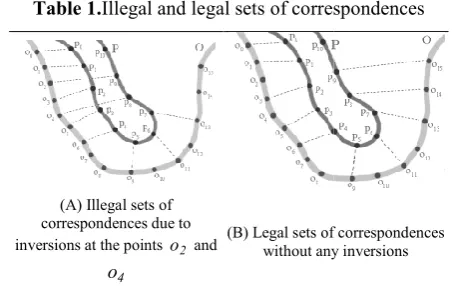
The main problem of the ICP is that is does not guarantee to produce a legal set of correspondences. By a legal set of correspondences is meant that there are no inversions between successive pairs of correspondences (see). In detail, when starting from a reference pair of corresponding points and traveling successive around the complete boundaries to pairs of correspondences, the arc path lengths in relation to the reference points always must be increasing.
Table 1.Illegal and legal sets of corres
(A) Illegal sets of correspondences due to inversions at the points o2 and
4
o
(B) Legal sets of correspondences without any inversions
An extension of the classical Procrustes alignment to point of differing point counts is known as the Softassign Procrustes Matching algorithm. It alternates between solving for correspondence, the spatial mapping, and the Procrustes rescaling. The Softassign Procrustes Matching
also an iterative process and uses deterministic annealing to solve the optimization problem. In deed it is a very time consuming and computationally expensive procedure. They applied the algorithm to dense point sets not to closed boundaries. One-to-one correspondences between points were established and points without correspondences are rejected as outlier. The establishment of point correspondences is only held in a nearest neighbor framework, so they do not gua to produce legal sets of correspondences.
Another solution of the correspondence problem was presented by Belongie et al. [20]. He added to each point in the set a descriptor called shape context. The shape context of a point is automatic converges to the nearest local minimum of a mean squared distance metric. It establishes correspondences by mapping the points of one shape to their closest points on the other shape. In the the complexity of finding for each the closest point in the point-set O is this complexity by applying a spatial subdivision of the points in the set O. They used clustering techniques to limit the search space of to points which are located . But this can only be done sets are already in a proximity, i.e. a reasonably good initial registration state is is a very simple algorithm also be applied to shapes with geometric data of sets, line segments, curves, surfaces). On the other hand, it is not very robust with respect replaced the closed-form inner Marquardt algorithm, a non-linear optimization scheme. His results showed an increased robustness and a reduction of the dependence of the initial estimated registrations without a significant loss of speed.
is that is does not guarantee to produce a legal set of correspondences. By a legal set of correspondences is meant that there are no inversions between . In detail, when ponding points and traveling successive around the complete boundaries to pairs of correspondences, the arc path lengths in relation to the
Illegal and legal sets of correspondences
(B) Legal sets of correspondences without any inversions
An extension of the classical Procrustes alignment to point-sets Softassign Procrustes It alternates between solving for correspondence, the spatial mapping, and the Procrustes ftassign Procrustes Matching algorithm is also an iterative process and uses deterministic annealing to solve the optimization problem. In deed it is a very time-consuming and computationally expensive procedure. They
ets not to closed one correspondences between points were established and points without correspondences are rejected as outlier. The establishment of point correspondences is only held in a nearest neighbor framework, so they do not guarantee
Another solution of the correspondence problem was presented [20]. He added to each point in the set a descriptor called shape context. The shape context of a point is
a histogram which contains information about the relative distribution of all other points in the set. The histogram can provide invariance to translation, scale, and rotation. The cost of mapping two points is calculated by comparing their histograms using the² test statistic. The
between all possible pairs of points between the two shapes must be calculated which results in a square distance matrix. The best match is found where the sum of distances between all matched histograms has reached its minimum. To solve this square assignment problem, they applied a shortest augmenting path algorithm for
has a time complexity of O
n³one correspondences between points with similar shape contexts. The algorithm can also handle point
different point counts by integratin
also not guaranteed that legal sets of correspondences were established.
Table 2 Establishing correspondences while mapping a concave and convex shape
(A) An unconstrained nearest neighbor framework may result in a
set of illegal correspondences with inversions and a small distance
measure
In none of these works is described the problem of aligning a convex to a concave shape. There arise special problems: Let us suppose that the concave shape representing the letter compared with the shape of the letter
correspondences were established between nearest neighbored points the resulting distance between both shape instances will be very small (see A). But intuitively we would say that these shapes are not very similar. In
regard the order of point correspondences and to remove correspondences if they produce inversions. In addition to legality of correspondences it is important to consider the complete contours of both shapes (see B). In result
big distances between corresponding points which leads to an increased distance measure.
MATERIAL USED FOR THIS STUDY
The materials we used for this study are fungal strains that are naturally 3-D objects but that are acquired in a 2
These objects have a great variance in the appearance of the shape of the object because of their nature and the imaging constraints. Six fungal strains representing species with different spore types were used for the study. shows one of the acquired images for each analyzed fungal strain.
a histogram which contains information about the relative distribution of all other points in the set. The histogram can ation, scale, and rotation. The cost of mapping two points is calculated by comparing their test statistic. The ² distances between all possible pairs of points between the two shapes calculated which results in a square distance matrix. The best match is found where the sum of distances between all matched histograms has reached its minimum. To solve this square assignment problem, they applied a shortest augmenting path algorithm for bipartite graph matching which
³ . The result is a set of one-to-one correspondences between points with similar shape contexts. The algorithm can also handle point-sets with different point counts by integrating dummy points. But it is also not guaranteed that legal sets of correspondences were
Establishing correspondences while mapping a concave and convex shape
framework may result in a (B) Enforcing legal correspondences and considering the complete contours results in an increased and
more suitable measure
In none of these works is described the problem of aligning a convex to a concave shape. There arise special problems: Let us suppose that the concave shape representing the letter C is compared with the shape of the letter O (see) . If the pair-wise correspondences were established between nearest neighbored points the resulting distance between both shape instances will be very small (see A). But intuitively we would say that these shapes are not very similar. In such cases it is necessary to regard the order of point correspondences and to remove correspondences if they produce inversions. In addition to legality of correspondences it is important to consider the complete contours of both shapes (see B). In result there arise big distances between corresponding points which leads to an
MATERIAL USED FOR THIS STUDY
The materials we used for this study are fungal strains that are D objects but that are acquired in a 2-D image. These objects have a great variance in the appearance of the shape of the object because of their nature and the imaging constraints. Six fungal strains representing species with different spore types were used for the study. shows one of the
Table 3 Images of six different fungi strains
Alternaria Alternata Aspergillus Niger Rhizopus Stolonifer
Scopulariopsis
Brevicaulis Ulocladium Botrytis
The strains were obtained from the fungal stock collection of the Institute of Microbiology, University of Jena
and from the culture collection of Jena Bios
strains were cultured in Petri dishes on 2% malt extract agar (Merck) at 24°C in an incubation chamber for at least fourteen days. For microscopy fungal spores were scrapped off from the agar surface and placed on a microscopic slide in a drop of lactic acid. Naturally hyaline spores were additionally stained with lactophenol cotton blue (Merck). A database of images from the spores of these species was produced.
Acquisition of Shape Cases
Background
The acquisition of object shapes from real images is still an essential problem of image segmentation. For automated image segmentation often low-level methods, such as edge detection and region growing [21], [22] are used to extract the outline of objects from an image. Low-level methods yield good results if the objects have conspicuous boundaries and are not occluded. In the case of complex backgrounds and occluded or noisy objects, the shape acquisition may result in strong distorted and incorrect cases.
Therefore, the acquisition is often performed manually at the cost of a very subjective, time-consuming procedure. In so studies, it might be enough to reduce the shapes of objects to some characteristic points which are common features of the object class. Landmark coordinates],[23] are manually assigned by an expert to some biologically or anatomically significant points of an organism. This must be done for every single object separately. Additional landmarks can be automatic constructed using a combination of existing landmarks. The calculation of the position of these constructed landmarks has to be precisely defined, i.e. landmark located in the midpoint of the shortest line between landmark
A
and landmarkB
. Every single landmark is not only defined by its position but also by the specific and unique feature that it represents.Landmarks might provide information about special features of an object contour but cannot capture the shape of an object because important characteristics might be lost. In many applications it is insufficient or impossible t
shape of an object only by landmarks. Then it is a common procedure to trace and capture the complete outlines of the
Images of six different fungi strains
Rhizopus Stolonifer
Wallenia Sebi
The strains were obtained from the fungal stock collection of the Institute of Microbiology, University of Jena / Germany Bios Gmb H. All strains were cultured in Petri dishes on 2% malt extract agar 24°C in an incubation chamber for at least fourteen days. For microscopy fungal spores were scrapped off from the agar surface and placed on a microscopic slide in a drop of lactic acid. Naturally hyaline spores were additionally stained otton blue (Merck). A database of images from the spores of these species was produced.
The acquisition of object shapes from real images is still an essential problem of image segmentation. For automated level methods, such as edge [21], [22] are used to extract the level methods yield good results if the objects have conspicuous boundaries and e case of complex backgrounds and occluded or noisy objects, the shape acquisition may result in
Therefore, the acquisition is often performed manually at the consuming procedure. In some studies, it might be enough to reduce the shapes of objects to some characteristic points which are common features of the object class. Landmark coordinates],[23] are manually assigned by an expert to some biologically or anatomically s of an organism. This must be done for every single object separately. Additional landmarks can be automatic constructed using a combination of existing landmarks. The calculation of the position of these constructed i.e. landmark C is located in the midpoint of the shortest line between landmark . Every single landmark is not only defined by its position but also by the specific and unique
Landmarks might provide information about special features of an object contour but cannot capture the shape of an object because important characteristics might be lost. In many applications it is insufficient or impossible to describe the shape of an object only by landmarks. Then it is a common procedure to trace and capture the complete outlines of the
objects in the images manually. Indeed, manually image segmentation may be a very time
procedure. Therefore, new semi
developed [24], [25] for interactive image segmentation. These approaches use live-wire segmentation algorithms which are based on a graph search to locate mathematically optimal boundaries in the image. If the
the proximity of an object edge, the labeled outline is automatically adjusted to the boundary. The manual acquisition of objects from real images with the help of semi automatic segmentation approachesis faster and more pre
As described in Section0 we are studying the shape of airborne fungi strains. The great natural variance in the shape of these objects and the imaging constraints have the effect that a manual assignment of landmark
impossible. We also reject a fully automatic segmentation procedure because this might produce outlier shapes due to the objects might be touching and overlapping. Therefore, we decided to use a manually labeling procedure in our application.
Acquisition of Object Contours from Real Images
1.1 As a shape we are considering the outline of an object but not the appearance of the object inside the contour. Therefore we want to elicit from the real image the object contour
P
represented by a set ofpoints pk, k1,2,,N
shape of the object at an arbitrary pixel
contour
P
. In our application we are only interested in the complete and closed outline of the objects. So after having traced the object, the labeling should end at a pixel pm, k1,2neighbourhood of p1. Because it might be difficult to
exactly meet this pixel manually, the contour will be closed automatic using the Bresenham
This algorithm connects two pixels in a raster graphic with a digital line. In addition to that we demand that two successive points may not be defined by the same point coordinates in the image. In consequence we obtain an ordered, discrete, and closed sequence of points where the Euclidean distance between two
successive points is either
Fig 3 the scheme of the acquisition of a shape is shown for illustration.
objects in the images manually. Indeed, manually image segmentation may be a very time-consuming and inaccurate Therefore, new semi-automatic approaches were [25] for interactive image segmentation. These wire segmentation algorithms which are based on a graph search to locate mathematically optimal user moves the mouse cursor in the proximity of an object edge, the labeled outline is automatically adjusted to the boundary. The manual acquisition of objects from real images with the help of semi-automatic segmentation approachesis faster and more precise.
we are studying the shape of airborne fungi strains. The great natural variance in the shape of these objects and the imaging constraints have the effect that a manual assignment of landmark coordinates is quite impossible. We also reject a fully automatic segmentation procedure because this might produce outlier shapes due to the objects might be touching and overlapping. Therefore, we decided to use a manually labeling procedure in our
Acquisition of Object Contours from Real Images
As a shape we are considering the outline of an object but not the appearance of the object inside the contour. Therefore we want to elicit from the real image the represented by a set of NP boundary
P
N .The user starts labeling the shape of the object at an arbitrary pixel p1 of the
. In our application we are only interested in the complete and closed outline of the objects. So after having traced the object, the labeling should end at a
P
N , , m , ,
2 in the
8-. Because it might be difficult to exactly meet this pixel manually, the contour will be closed automatic using the Bresenham [26] procedure. This algorithm connects two pixels in a raster graphic with a digital line. In addition to that we demand that two successive points may not be defined by the same point coordinates in the image. In consequence we obtain an ordered, discrete, and closed sequence of points where the Euclidean distance between two
successive points is either
1 or
2
. InFig 3 Scheme of the labeled object outline
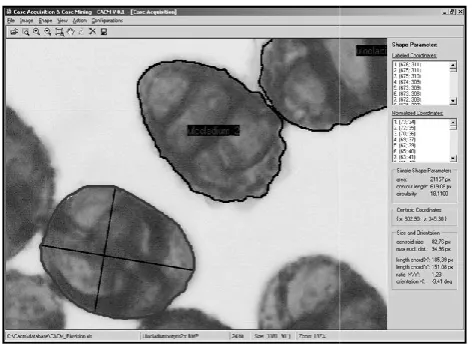
Fig 4 presents a screenshot from our developed program Acquisition and Case Mining - CACM while labeling a shape of the strain Ulocladium Botrytis with the point coordinates on the right side of the screenshot. In fact, image digitization and human imprecision always implies an error during the acquisition of the object shapes. It might be very difficult to exactly determine and meet every boundary
when manually labeling the contour of an object. Also, the quantization of a continuous image constitutes a reduction in resolution which causes considerable image distortion (Moiré effect). Furthermore, the contour of an object in a dig image may be blurred which means the contour is extended over a set of pixels with decreasing grey values.
Approximation
The amount of acquired contour points N
depends on the resolution of the input image and on the area and the contour length of the object. To speed up the succeeding computation time of the following alignment process we introduced a polygonal approximation. The resulting number of points from a polygonal approximation of the shape will be influenced by the chosen order of the polygon and the allowed approximation error. We apply the approximation only to shapes which consist out of more than 200 points. This limit was introduced because the con very small objects in images might be defined by a few pixels only. A further reduction of information about the contour of these objects would be disadvantageous.
Fig 4 Labeled shape with coordinates
For the polygonal approximation, we used the approach based on the area/length ratio according to Wall and Daniellson because it is a very fast and simple algorithm without time consuming mathematic operations. Suppose the set of pointsp1,p2,,pn defining the contour of the object which a polygonal approximation is desired. We use the first labeled point p1 as the starting point for the first
approximation. Next, we virtually draw a line segment from this starting point to the successor point in
between this line and the corresponding contour segment of is measured. If the area
A
divided by the length of the line is smaller than a predefined thresholdT
process is repeated for the next successor point in the set (see
Scheme of the labeled object outline
presents a screenshot from our developed program Case while labeling a shape with the point coordinates on In fact, image digitization and human imprecision always implies an error during the acquisition of the object shapes. It might be very difficult to exactly determine and meet every boundary pixel of an object when manually labeling the contour of an object. Also, the quantization of a continuous image constitutes a reduction in resolution which causes considerable image distortion (Moiré effect). Furthermore, the contour of an object in a digitized image may be blurred which means the contour is extended over a set of pixels with decreasing grey values.
P
N of a shape
P
depends on the resolution of the input image and on the area and the contour length of the object. To speed up the succeeding computation time of the following alignment process we introduced a polygonal approximation. The a polygonal approximation of the shape will be influenced by the chosen order of the polygon and the allowed approximation error. We apply the approximation only to shapes which consist out of more than points. This limit was introduced because the contour of very small objects in images might be defined by a few pixels only. A further reduction of information about the contour ofLabeled shape with coordinates
lygonal approximation, we used the approach based on the area/length ratio according to Wall and Daniellson [27] because it is a very fast and simple algorithm without time-consuming mathematic operations. Suppose the set of NP
defining the contour of the object
P
, for which a polygonal approximation is desired. We use the first as the starting point for the first w a line segment from this starting point to the successor point inP
. The areaA
between this line and the corresponding contour segment ofP
vided by the length of the lineL
T
, then the same process is repeated for the next successor point in the setP
Fig 5).
This procedure repeats until the ratio exceeds the threshold In that case the current point
approximated line and the starting
approximation. The same process is then repeated until the first point p1is reached. The result of the approximation is a
subset of pointsof the contour
P
The ratio L A
controls the maximal error of the approximation
since
A
is the area andL
rectangle. If the ratio is low, then the other side of the virtual rectangle is small.
Fig 5 Polygonal approximation based on the area/length ratio
Normalization of Shape Cases
In our application we demand the distance measure between two shapes to be invariant under translation, scale, and rotation. Thus, in a preprocessing step we remove differences in translation and we rescale the shapes so that the maximum distance of each point from the centroid of the shape will not be larger than one. The invariance to rotation will be calculated during the alignment process (see Sect.
The centroid of a set of NP
P
N
1 i
i P
x N
1 x
P
N
1 i
i P
y N
1
y .
To obtain invariance under translation we translate the shape so that its centroid is at the origin
x
x
'
x
i
i
y
y
'
y
i
i
Furthermore, for each shape we calculate the scale factor
² ' y ² ' x max
1 t
i i i P
; i1
This scale factor is applied to all points of the shape obtain the transformed shape instance
shapes are now superposed on the origin of a common coordinate system. The maximum Euclidean
point to the origin of the coordinate system is one.
Shape Alignment and Distance Calculation
The Alignment Algorithm
This procedure repeats until the ratio exceeds the threshold
T
. In that case the current point pm becomes the end of the approximated line and the starting point for the next approximation. The same process is then repeated until the is reached. The result of the approximation is aP
.controls the maximal error of the approximation
the side length of a virtual rectangle. If the ratio is low, then the other side of the virtual
Polygonal approximation based on the area/length ratio
Normalization of Shape Cases
In our application we demand the distance measure between two shapes to be invariant under translation, scale, and rotation. Thus, in a preprocessing step we remove differences in translation and we rescale the shapes so that the maximum oint from the centroid of the shape will not . The invariance to rotation will be calculated during the alignment process (see Sect.0).
points is given by:
(1)
To obtain invariance under translation we translate the shape so that its centroid is at the origin
P
N , , 2 , 1
i . (2)
Furthermore, for each shape we calculate the scale factor tP:
P N , , 2 ,
1 . (3)
This scale factor is applied to all points of the shape
P
to obtain the transformed shape instanceP
'
. The set of acquired shapes are now superposed on the origin of a common coordinate system. The maximum Euclidean distance of a point to the origin of the coordinate system is one.In the Procrustes Distance (see Eq. each of the shapes is rescaled in such a way that the standard deviation of all points to the centroid is identical
P O
. This normalization does not ensure that the resulting distance runs betweenSince we are interested in comparing objects of different categories we rescale the shapes so that the maximum distance of a point to the centroid is not larger than 1
Procrustes Distance we also do not need P
we have already removed the translation by transforming the objects into the origin (see Sect.0).
The differences in rotation will be removed during our iterative alignment algorithm. In each iteration of this algorithm the first shape is rotated stepwise while the second shape is kept fixed. For every transformed point in the first shape we try to find a corresponding point on the second shape. Based on the distance between these cor
points the alignment score is calculated for this specific iteration step. When the first shape is rotated once around its centroid, finally that rotation is selected and applied where the minimum alignment score was calculated.
We are regarding arbitrary shapes with varying orientations and different point counts and do not have any information about how the points of two shape instances must be mapped onto each other. As already stated, we must solve the correspondence problem before we are able to calculate the distance between two shape instances.In summary, for the establishment of point correspondences we demand the following facts:
Produce only legal sets of correspondences,
Produce one-to-one point correspondences,
Determine points without a correspondence as outlier, and
Produce a symmetric result, which is obtaining the same results when aligning instance
as when aligning instance O to
P
.It was shown in Sect.0 that the establishment of legal sets of correspondences is an important fact to distinguish between concave and convex shapes. The drawback of this requirement is that the acquired shapes must be ordered point
demand for establishing only legal sets of correspondences is also the main reason why we decided to extend the initial version of our alignment algorithm[28] that can only align concave with concave and convex with convex shapes. We extended our nearest neighbor-search algorithm presented there so that it can handle the correspondence problem while aligning concave with convex object shapes.
The input for our alignment algorithm is a pair of two normalized shapes
P
and O as described in Section define the shape instanceP
as the one which has less contour points then the second shape instance O. The instance with more points is always that one, which will be aligned to shape instance with less points. That means shapefixed while shape O will be stepwise rotated to match
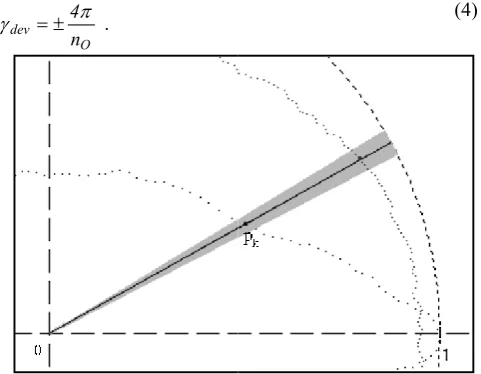
Before the iterative algorithm starts we define a range to search for potential correspondences. This range is defined by a maximum deviation of the orientation according to the centroid (see
Fig 6). This restriction will help us to producelegal sets of
correspondences. The maximum permissible deviation of In the Procrustes Distance (see Eq. each of the shapes is rescaled in such a way that the standard deviation of all points . This normalization does not ensure that the resulting distance runs between 0 and 1. Since we are interested in comparing objects of different categories we rescale the shapes so that the maximum distance 1. In comparison to
P and O because we have already removed the translation by transforming the
The differences in rotation will be removed during our . In each iteration of this algorithm the first shape is rotated stepwise while the second shape is kept fixed. For every transformed point in the first shape we try to find a corresponding point on the second shape. Based on the distance between these corresponding points the alignment score is calculated for this specific iteration step. When the first shape is rotated once around its centroid, finally that rotation is selected and applied where the
regarding arbitrary shapes with varying orientations and different point counts and do not have any information about how the points of two shape instances must be mapped onto each other. As already stated, we must solve the e are able to calculate the distance between two shape instances.In summary, for the establishment of point correspondences we demand the
Produce only legal sets of correspondences, one point correspondences,
points without a correspondence as outlier,
Produce a symmetric result, which is obtaining the same results when aligning instance
P
to instance Othat the establishment of legal sets of correspondences is an important fact to distinguish between convex shapes. The drawback of this requirement is that the acquired shapes must be ordered point-sets. The demand for establishing only legal sets of correspondences is also the main reason why we decided to extend the initial orithm[28] that can only align concave with concave and convex with convex shapes. We search algorithm presented there so that it can handle the correspondence problem while
ut for our alignment algorithm is a pair of two as described in Section0. We as the one which has less contour . The instance with more points is always that one, which will be aligned to shape instance with less points. That means shape
P
will be keptwill be stepwise rotated to match
P
.Before the iterative algorithm starts we define a range to search for potential correspondences. This range is defined by tation according to the
). This restriction will help us to producelegal sets of correspondences. The maximum permissible deviation of
orientation dev will be calculated in depende amount of contour points nO
instance that has more points than the other one. Our investigations showed that the following formula leads to a well-sized range
O dev
n 4
.
Fig 6 The permissible deviation of orientation for finding a point correspondent of the
point pk is illustrated. The line marks the orientation of the point
to search for a correspondence is shown
The outline of our iterative alignment algorithm is as follows:
Calculation of Point Correspondences
1.2 The most difficult and time
establishment of point-correspondences. For each point
k
p with 1k nP in the set
exactly one corresponding point
the set O. To create a list of potential correspondents we first select all pointsin
permissible range of orientation (see
Fig 6) and insert them into this list of potential correspondents
CorrList pk
of pk. Each of the selected points meets the following condition
pk
dev
oj
pk
devwith
pk the angle of pointrange of orientation around pk
In
Fig. is shown a part of two aligned shape instances at this state
of registration. Each point in shape
all its potential correspondences. It can also be seen that there is outlier on shape O. As an outlier we define all points where no correspondence could be established. Resulting points without correspondences are a logical consequence if we demand one-to-one correspondences when mapping shapes with unequal number of points. Such kind of points does not have any influence on the calculated distance.
Initialize /* stepwise rotation angle */ SET i0 /* actual rotation angle */
REPEAT UNTIL i2 or SCORE (A) Rotation of O with
(B) Calculate point correspondences between (C) Calculate distance
will be calculated in dependence of the of the shape O, which is the instance that has more points than the other one. Our investigations showed that the following formula leads to a
(4)
The permissible deviation of orientation for finding a point correspondent of the
marks the orientation of the point pk. The range where
to search for a correspondence is shown
The outline of our iterative alignment algorithm is as follows:
Point Correspondences
The most difficult and time-consuming part is the correspondences. For each point in the set
P
we try to establishexactly one corresponding point
o
j with 1 jnO in . To create a list of potential correspondents we first select all pointsin Owhich are located in the permissible range of orientation (see) and insert them into this list of potential correspondents Each of the selected points meets the
dev . (5)
the angle of point pk and dev the permissible
.
is shown a part of two aligned shape instances at this state of registration. Each point in shape
P
is connected by lines to all its potential correspondences. It can also be seen that there . As an outlier we define all points where no correspondence could be established. Resulting points spondences are a logical consequence if we one correspondences when mapping shapes with unequal number of points. Such kind of points does not have any influence on the calculated distance./* stepwise rotation angle */ /* actual rotation angle */
P,O 0
SCORE i
with ii1
point correspondences betweenPandO
If no point in Ois in the permissible range (
CorrList
pk
is empty), pk is marked as an outlier. Normally in case of aligning convex objects there is no point inP
which has not at least one potential correspondence. The permissible range of orientation is chosen big enough anyway. Indeed, this kind of outliers occurs only in cases of aligning convex to concave objects. Each point pk which has not a single potential corresponding point in O is included with the maximum distance of one when calculating the distance measure. If there is at least one potential correspondent, we calculate the squared Euclidean distances between pk and each point in this list. Then the points in this list
CorrList
pk
were sorted with ascending distances in relation to pk. In succession we check for each point in this list if there was already assigned a corresponding point inP
. The first found point without a correspondence is selected and we establish a one-to-one correspondence between them. If all points in the list
CorrList pk
have already a correspondence the point pk is marked as an outlier. In contrast to those outliers inP
which do not even have one potential correspondence in O, this kind of outlier will not be included in calculating the distance measure.Let us assume we had gone through the complete setP
and assigned to each point pk either a correspondence in O or marked it as an outlier. In the next step we want to ensure to produce a legal set of correspondences. Therefore we go through the setP
again and remove all one-to-one correspondences that are inversions (see). Suppose we have found a point pk assigned to a correspondenceo
g in O thatproduces an inversion with the point pm which is assigned to
the point
o
f
k,mnP; g,f nO
. First we try to remove the inversion by switching the correspondences, i.e. pk will beassigned to
o
f and pm will be assigned too
g. Otherwise weremove the correspondence of pk and check in succession all the remaining points in the list
CorrList
pk
if it is possible to assign a correspondence with one of these points that does not produce an inversion. If we find a point in this list, we establish the one-to-one correspondence between these two points. Otherwise we must mark pk as an outlier.Fig.Part from a screenshot made during the alignment of two shape cases. The outer
dotted shape
P is aligned to theinner dotted shape
O . Each point pk in P isconnected by lines with all its potential correspondences that are stored in
CorrList pk
Calculation of the Distance Measure
The distance between two shapes
P
and O is calculated based on the sum of Euclidean distances. If there was assigned a correspondence to the point pk, 1knP inP
, the Euclidean distance between this point and its corresponding pointok in O is calculated by
p ,o
x x
² y y
²d k k p o p o . (6)
If the point pk is an outlier because there could not be assigned at least one potential correspondence and the list
CorrList pk
is empty, the distance is set with the maximal value of one
p ,o
1d k k . (7)
The sum of all pair-wise distances between two shapes
P
and O is defined by
P
n
1 k
k k,o
p d O , P
.
(8)
Since we interested in obtaining a distance measure which runs between zero and one, we normalize the sum according to nP, the number of points in
P
P,O
n 1 O , P
P
. (9)
The mean Euclidean distance alone is not a sufficiently satisfactory measure of distance. Particularly in cases of wavy or jagged contours important information get lost using the averaged distance. Therefore, we also calculated the maximum distance between a pair of established correspondences’
P
n
1 k
k k max P,O max d p ,o
.
(10)
The final similarity measure is the weighted sum of the mean Euclidean distance and the maximum Euclidean distance
P,O
P,O
P,O
Score max . (11)
The choice of the value for the weights
and depends on the importance the user wants to respective distance measure. We chose for
and a value of 0.5 which results in an equal influence of both distances to the overall distance.Evaluation of our Alignment Algorithm
Table 4 Evaluation of Symmetry
ulocladium_12 is aligned to
ulocladium_13
(each shape is defined by 340
contour points)
2094 . 0
min
0842 . 0
1835 . 0
max
1339 . 0 Score Outlier included: 0
ulocladium_13 ulocladium_12
(each shape is defined by contour points)
min
0
max
Score Outlier included:
The table 5 presents some results of pair-wise aligned shape cases. In the left column of the table the visual results are shown with connecting lines between corresponding points. The right column of the table presents the calculated scores and the number of outliers which are included in the alignment score with a distance value of one. The alignment score of value zero means identity and the value of
understood as neutral. Up to a value of one the shapes become more and more dissimilar.Again, we take a closer look at the pair-wise alignment of a concave and a convex shape. Reconsider the example from above where the shape of the letter Omust be aligned to the shape of a letter
screenshot from our program where a similar situation occurred. There were twelve outliers determined on the convex shape which are included in the calculation of the alignment score. As more of these outliers are included as more dissimilar the two shapes become because each of them is assigned with the maximum distance of
circumstances the points on the inside of the concave shape may not have any influence on the resulting alignment score. This is since they were not mapped onto opposite points of the contour of the convex shape (see B). Indeed, this is an error of the algorithm but otherwise it may happen that the alignment score exceeds the value one.
CONCLUSIONS
We have proposed a method for the acquisition of shape instances and our novel algorithm for aligning arbitrary 2D shapes, represented by ordered point-sets of varying size. Our algorithm aligns two shapes under similarity transformation; differences in rotation, scale, and translation are removed. It establishes one-to-one correspondences between pairs of shapes and ensures that the found
Evaluation of Symmetry
ulocladium_13 is aligned to
ulocladium_12
(each shape is defined by 340
contour points)
2094 . 0
0856 . 0
1822 . 0
1339 . 0
Outlier included: 0
wise aligned shape cases. In the left column of the table the visual results are shown with connecting lines between corresponding points. The right column of the table presents the calculated scores of outliers which are included in the alignment . The alignment score of means identity and the value of 0.5 can be the shapes become we take a closer look at the wise alignment of a concave and a convex shape. Reconsider the example from above where the shape of the must be aligned to the shape of a letter C. presents a screenshot from our program where a similar situation occurred. There were twelve outliers determined on the convex shape which are included in the calculation of the alignment score. As more of these outliers are included as more he two shapes become because each of them is assigned with the maximum distance of one.Under these circumstances the points on the inside of the concave shape may not have any influence on the resulting alignment score. nto opposite points of the contour of the convex shape (see B). Indeed, this is an error of the algorithm but otherwise it may happen that the alignment
We have proposed a method for the acquisition of shape instances and our novel algorithm for aligning arbitrary
2D-sets of varying size. Our algorithm aligns two shapes under similarity transformation; tation, scale, and translation are removed. It one correspondences between pairs of
Table 5 Different shapes with corresponding distance measures and the alignment scores
concave is aligned to concave
0
0
max
0 Score
Outlier included: 0
ulocladium_10 ulocladium_01
0
max
Score
Outlier included:
aspernig_01 is aligned to
alternaria_42
3766 . 0
6305 . 0
max
5035 . 0 Score
Outlier included: 0
rectangle middle ulocladium_01
0
max
Score
Outlier included:
correspondences are symmetric and legal. The method detects outlier points and can handle some amount of noise. We have evaluated that the algorithm also works well if the aligned shapes are very different, like i.e. the alignment of concave and convex shapes. A distance measure which runs between and 1 is returned as result.
The methods are implemented in the program 1.4 which runs on a Windows PC.
Acknowledgement
The project “Development of methods and techniques for the image-acquisition and computer
dangerous substances BIOGEFA” is sponsored by the German Ministry of Economy BMWA under the grant number 16IN0147.
Fig 7 Screenshot with outlier, marked as
during the
alignment of a circle and a concave shape
Different shapes with corresponding distance measures and the alignment scores
ulocladium_10 is aligned to
ulocladium_01
1015 . 0
1557 . 0
1286 . 0
Outlier included: 0
ulocladium_03 is aligned to
ulocladium_01
2367 . 0
4303 . 0
max
3335 . 0 Score
Outlier included: 0
rectangle middleis aligned to
ulocladium_01
2835 . 0
5011 . 0
3932 . 0
Outlier included: 0
point is aligned to
ulocladium_01
3751 . 0
3751 . 0
max
3751 . 0 Score
Outlier included: 0
correspondences are symmetric and legal. The method detects outlier points and can handle some amount of noise. We have evaluated that the algorithm also works well if the aligned shapes are very different, like i.e. the alignment of concave pes. A distance measure which runs between 0
The methods are implemented in the program CACM Version PC.
The project “Development of methods and techniques for the acquisition and computer-aided analysis of biologically dangerous substances BIOGEFA” is sponsored by the German Ministry of Economy BMWA under the grant number
Screenshot with outlier, marked as green dots, occurred during the